What is the sign of an effective anti-war film? What's the mark of a successful entry? ANGER. Frustration. A struggle to believe what you're watching could have actually happened. One of the first American anti-war films is also one of the best, and in general, one of the best movies ever made. If you haven't seen it already, shame on you. Go watch it. Here's 1957's Paths of Glory.
It's 1916 and World War I has been waging for two-plus years. The fighting has bogged down to a standstill, the two sides blasting away from their trenches at each other across no man's land. A French offensive is in the works with one battalion, commanded by Colonel Dax (Kirk Douglas), assigned a key point in the German line. Under extreme machine gun fire, the attack is a failure, Dax's men returning to their own trenches. Someone must answer for the failure though, especially when the division commander (George Macready) demands retribution for the colossal failure. He wants men shot and court-martialed with the high command settling on three men. Three of Dax's men will be charged with cowardice in battle and sit before a court martial tribunal. A well-known criminal lawyer, Dax will defend them...but even the experienced lawyer can't know what awaits.
What a freaking movie. From director Stanley Kubrick (maybe you've heard of him), 'Glory' deserves its place as one of the great war films of all-time but also as one of the best films of all-time in general. Just in terms of story, it is ahead of its time. The cynical, disbelieving tone of its story seems far more in-tune with the late 1960's or the entire decade of the 70's, not the late 1950's. Technically speaking, it is damn perfect from beginning to end. If there's an obvious, glaring weakness, I'm missing it! A phenomenal movie.
The anti-war message is uncomfortable to the point the film is difficult to watch at times. While 'Glory' isn't based on any single incident, stories like this no doubt happened in World War I and countless other wars. Douglas' Dax finds himself defending three innocent soldiers -- Ralph Meeker, Timothy Carey, Joe Turkel -- who will be tried (and potentially worse) for cowardice in battle. He is met at every turn with resistance, countered by men uninterested in a real defense, battling selfish, egotistical maniacs who think solely of themselves, of glory and honor, of promotions and personal gain. If those gains are built on battlefields of men who didn't have to die...well, so be it. Kubrick's film does not pull a single punch. This is war. This is death. This is so much worse than you could have imagined it.
A star before and a star after, Douglas is at his all-time best here with a performance that definitely belongs at the top of his career. His Colonel Dax is a capable officer, a more than capable lawyer, but most of all, he's simply a good man. He's honest, an idealist and genuinely looks out for the well-being of his men. Dax is sick of war but knows the quicker it's over, the quicker he and his men can go him. Douglas does a lot with an understated part -- calm, cool and collected -- as he bides his time. It is in the final act that Douglas gets to stretch his legs with a fiery, pissed-off, beyond frustrated, beyond anger performance that resonates long after the movie's over. Dax's fire and passion shows through best in an outburst as he condemns the actions of one of the selfish, clueless commanding officer who remains oblivious to anything and everything around him. But kudos to Douglas though with a performance that allows him the chance to show off the full scope of his ability.
This is Douglas' film, no doubt, but there's strong performances all over. Adolphe Menjou and Macready are terrifying as the upper-crust commanding officers who look at war with a sort of fog covering their eyes. No one could be this selfishly inept, could they? Their scenes show the depths of their ignorance, of an old-fashioned way of looking at war. Equally despicable are Richard Anderson and Wayne Morris as two officers, both ignorant in their own ways; Anderson with his haughty arrogance, Morris his drunken cowardice. In Meeker, Turkel and Carey, we get the gamut of reactions, seeing how different individuals respond to a situation so hopeless and stupid that it baffles the mind. When nothing at all makes sense, how do you rationalize such a profoundly stupid decision made by countless people seemingly smart enough and powerful enough to know that decision simply shouldn't be made?
Released 11 years later, 2001: A Space Odyssey is usually remembered as Kubrick's best, usually followed by A Clockwork Orange. I think 'Paths' belongs with 1960's Spartacus as the director's best. Just 29 years old at the time, Kubrick already shows what an immense talent he is behind the camera. Clearly influenced by the French New Wave movement, Kubrick's camera becomes an additional character, especially in beautiful unedited, long takes navigating the claustrophobic frontline trenches. We're there with the troops in the bloody, muddy, rat-infested trenches. Going over the top into the death zone known as 'no man's land' is far worse though where men are chewed up and spit out by the hundreds and thousands. Then, we're off to gargantuan French mansions, the picture of decadence and elegance, where the high command makes all their brilliant decisions. The musical score is minimalist to say the least, all the focus on the performances.
Just too many memorable moments to mention. Basically any scene in the trench is memorable, a perfect example of how to film an uninterrupted tracking shot. The attack scenes are harrowing, and the courtroom scenes -- in those French mansions -- make you feel physically ill as you watch the court martial develop. Emile Meyer is memorable as a priest desperately trying to click with the potentially-condemned men, and Turkel is a scene-stealer in a dialogue-heavy scene talking about how soldiers want to die. Through it all, Meeker is at his career-best as the soldier who finds himself on trial for all the wrong reasons. It all leads to one of the more memorable moments I can think of in a war film, anti-war or not. Filmed at an expansive German villa, an extended military procession is an incredible sequence to watch, both aesthetically and emotionally.
An all-timer. One of the greats and a film every movie fan should see at least once.
Paths of Glory (1957): ****/****
The Sons of Katie Elder
"First, we reunite, then find Ma and Pa's killer...then read some reviews."
Showing posts with label Kirk Douglas. Show all posts
Thursday, March 24, 2016
Tuesday, January 26, 2016
The Strange Love of Martha Ivers
Kirk Douglas is a Hollywood legend. With too many classic films to his name to mention, from Spartacus to Paths of Glory and countless others in between, Douglas is one of the few who deserves that legend status. What's so crazy about his career? He didn't have a climbing period of supporting roles, bit parts and background players. He dove right in, starting with a hugely important part in his screen debut, 1946's The Strange Love of Martha Ivers.
It's 1928 in the up-and-coming town of Iverstown in Pennsylvania when three teenagers from vastly different backgrounds and upbringings are witness to a horrific crime that results in murder. The truth never comes out though, putting the three teenagers on again, vastly different paths into the future. Fast forward to 1946 when the now grown-up Sam Masterson (Van Heflin) drives back into town looking to get his car fixed. He discovers that the other two teenagers have married, with Martha (Barbara Stanwyck) having become one of the most powerful businesswomen in the state with all sorts of public influence. Her husband, Walter (Douglas), is an equally powerful district attorney with political aspirations but really, it's Martha pulling his strings. Now after so many years have passed, the secret that bonds the trio threatens to tear everything down. Martha and Walter are convinced Sam is looking for a payoff. What is his intention exactly?
This is a flick that's hard to peg down. Not quite a romance or a mystery, not quite a thriller or film noir. Instead, director Lewis Milestone's film manages to blend all those elements into one very solid movie. At different points, it is all of those disparate pieces, providing a wave of different tones that might not work together but somehow...they just do. Filmed in black and white, there's a dark, shadowy and sinister look to it all. As well, there's that vein of small-town Americana where everyone has their secrets but no one ever gets called out on them. I will add it is an odd film when you take it all in, but there's something oddly appealing about it, the romance-thriller-mystery-film noir final product.
What holds it all together for me was the characters. We've got four main characters, all of them very human, very flawed and very vulnerable. I don't want to give spoilers away to the opening intro (it runs about 20-25 minutes) but it does involve a murder. If that doesn't provide some pyrotechnics some 17 years later, I don't know what will! Stanwyck, Heflin, Douglas and Lizabeth Scott as a troubled young woman brought into the years-old drama are all on-point in bringing their characters to life, the ensemble working quite well together. They all get their moments to shine and none disappoint. The chemistry between Stanwyck and Heflin is smoldering, as is between Heflin and Scott. In an age of movies that had a tendency to get a little overdone in the acting department, 'Strange' manages to harness all the melodrama and keep it relatively reserved (thankfully!). This is an acting movie, and the actors don't disappoint!
I came away especially impressed with Douglas in his first on-screen appearance and his first-ever film role. His Walter O'Neil is a product of his childhood and later, his marriage to Stanwyck's Martha. As Heflin's Sam points out, he's still a scared-looking little kid. Knowing where Douglas' career would go (and go quickly), it's startling to see him as an alcoholic, sniveling, weakling of a man. What's better? He nails the part. There's a perfect intensity to the proceedings, but he's perfectly believable as a grown man who can basically make a decision for himself. An underrated actor, Heflin delivers one of his best performances as Sam Masterson, a gambler, a WWII vet and with a checkered past to his name who still remains confident that something will come along because...well, because it always has before. Excellent parts for all four leads.
If there's an issue here, it's the pacing. At 116 minutes, 'Strange' can be a tad on the slow side. We spend a lot of time just introducing our characters and laying things out, most of an hour-plus actually. It's only then the wheels go into motion as we start to figure out what everyone's intentions are. What is Sam's plan? Is he interested in blackmail or is he just in the wrong place at the wrong time? What is Scott's Toni's background? Does Martha still have feelings for Sam? A lot to deal with for sure in the closing 45-50 minutes. So that said, I enjoyed the first hour more with its sense of mystery and foreboding doom hanging in the air over this budding industrial town. I was surprised by the ending itself because I just wasn't sure how dark this story would go...but it goes.
An excellent flick all-around, definitely worth checking out.
The Strange Love of Martha Ivers (1946): ***/****
Labels:
1940s,
Barbara Stanwyck,
Film Noir,
Kirk Douglas,
Lewis Milestone,
Van Heflin
Sunday, November 29, 2015
The War Wagon
I love westerns. I love heist movies. They're two of my favorite genres. So what happens when you combine the two? And throw in two of my all-time favorite actors? Oh, no.....it's a movie nerd alert!!! With just an air of fun hanging over the whole story and production, it's hard not to get on-board and truly enjoy the 1967 western The War Wagon.
Fresh out of jail after serving a three-year sentence for a crime he didn't commit, former rancher Taw Jackson (John Wayne) heads home with revenge on his mind. Framed by a local businessman and landowner, Pierce (Bruce Cabot), Jackson wants to exact revenge where it hurts most...Pierce's gold mine. The attempt would seem suicidal though, Pierce paying for an armor-plated wagon outfitted with a Gatling gun and guarded by 33 outriders that transports the gold from the mine to the train station that would prove to be a major deterrent to any would-be robbers. Jackson isn't about to give up though, but he does need some help, including an unlikely partnership with a hired gun named Lomax (Kirk Douglas) with whom he's had a deadly rivalry in the past and has the bullet wounds to prove it. With a small team of fellow crooks, Taw puts his plan into action to rob the armor-plated wagon, the War Wagon. But just how in hell is he going to pull this off successfully without getting shot full of holes?
This is a movie that's just hard not to like. It was a staple on AMC and TNT growing up so I saw it many times, and it's one I always look forward to revisiting every so often. This last time, well, it had been quite awhile. From tough guy director (and a Wayne favorite) Burt Kennedy, 'War' is one of those perfectly straightforward westerns with no pretensions about the changing times or a revisionist view. It's F-U-N, plain and simple, mixing so effortlessly that western setting with a heist story. Put a crew together, give them a crazy, no way in hell this works mission, and let things fall where they may. Not the best, but one of the most purely entertaining westerns to come out of the decade.
So John Wayne and...Kirk Douglas. Please and THANK YOU. The duo had worked previously together in 1965's In Harm's Way and 1966's Cast a Giant Shadow, but this is the best pairing because it just lets these two pros go to work. Yeah, the heist is fun throughout, but you watch this movie for any and all scenes between Wayne and Douglas. The dialogue crackles between them, a rivalry that treads that fine line between joking and deadly serious. There's some genuine menace in the chemistry, but you just sit back and watch things develop. The best part? They're clearly having a blast. An underrated comedic actor to begin with, Wayne gets to show off his funny chops with some great line deliveries, and Douglas is the perfect foil as Lomax, a hired gun who's a bit of a dandy but takes his job supremely seriously, especially with so much potential money on the line. You couldn't ask for a better star duo to lead the adventure film.
Any good heist needs a good heist team so who to look out for? Certainly a motley crew of crooks, including the very white Howard Keel as Levi Walking Bear, Keenan Wynn as Wes, an employee of Pierce's, and Robert Walker Jr. as Billy, an explosives expert with a drinking problem. A Wayne friend and favorite, Cabot looks to be having a ball as Pierce, the sneering, menacing crook with a whole bunch of power. Also cool to see background player Don Collier get a more visible part as Pierce's right-hand man. Also look for Joanna Barnes, Valora Noland, Bruce Dern, Chuck Roberson (Wayne's stunt double), Emilio Fernandez, and Gene Evans rounding out the cast.
'Wagon' has a lot of little things going for it that combined make for a significantly better flick. Durango, Mexico was one of Wayne's favorite filming locations including Sons of Katie Elder, The Train Robbers, Chisum and here with 'Wagon.' The Mexican mountains and wilderness provide an intimidating, authentic backdrop to the story. Dimitri Tiomkin's score is a gem, big and booming, perfect for an adventure story and one that instantly screams 'Oh, yeah, that's Tiomkin music.' Lastly, an oh so perfectly bad theme song that you can listen to HERE. It's awful, but my goodness, is it ever catchy. I defy you to watch the movie and not to be humming along to the theme days later.
But, ah yes, the heist. There's hints along the way of what Taw, Lomax and Co. are up to, but nothing too specific. So like the best heist movies, as the caper develops, we're in the dark to the exact details, all of that adding a sense of mystery to the proceedings. Nothing too crazy here other than a matter of split-second timing, some dumb luck, and one rather prominent plot hole if you ask me. But there's no point in ripping it to pieces too hard. This is a movie that's meant to be a hell of a lot of fun, and it succeeds throughout on that premise. Wayne and Douglas are pitch perfect together and look to be having a ball.
Sit back, enjoy and let that fun take over from there.
The War Wagon (1967): ***/****
Rewrite of February 2009 review
Thursday, December 18, 2014
Tough Guys
Two of the biggest stars of the 1940s, 1950s and 1960s, Burt Lancaster and Kirk Douglas were frequent collaborators during their distinguished careers, doing seven films together. The two best -- for me -- are Gunfight at the O.K. Corral and Seven Days in May, but I've seen a couple others. Well, here's their last venture together, 1986's Tough Guys.
Having served 30 years in prison, Harry Doyle (Lancaster) and Archie Long (Douglas) have finally earned their parole. The veteran bank robbers are reintroduced to a world vastly different than the one they left. Now 72-year old Harry and 67-year old Archie have to figure things out if they hope to make it on the outside, starting with their new living arrangements. Because of his age, Harry is forced to live in a retirement home while Archie moves in at a small apartment and tries to hold down minimum wage jobs. Can they handle their new lives? Can 1980s Los Angeles possibly handle them? The two friends and ex-cons are going to try their hardest, but their checkered pasts may pop up to slow them down and make their readjustment that much harder...if they get through it at all.
As I watched this 1980s action-comedy from director Jeff Kanew, a thought crossed my mind. That can be pretty rare so I've gotta enjoy them when they make their appearances. You know that movie is? A forerunner for a whole sub-genre of flicks that seemed to pop up in the 1990s and still appear here and there. The OLD GUY movie! Since 1986, we've seen the Grumpy Old Men movies, My Fellow Americans, Last Vegas, and probably a bunch more I'm not thinking of. It isn't a good movie, but it is mildly entertaining, most of that because the talent involved is very impressive. It has some laughs but also tries really hard to get those laughs.
It's a premise that would be used in far better fashion some seven years later in The Shawshank Redemption when James Whitmore's Brooks is paroled and discovers a world nothing like the one he left. Here, the goal obviously isn't on the same dramatic level. It's laughs. So what do we get? Two old pros in Lancaster and Douglas wearing some impeccably stylish and impeccably dated hats and fedoras navigating Los Angeles. They're still tough guys, handling street toughs (typically with a swift kick to the crotch), dancing like a crazy person at a night club, and even stumbling into their old watering hole only to find that the bar is now...a gay bar! Oh, the hijinks people will get into, huh?!?
Still, it's Burt Lancaster and Kirk Douglas. Yeah, there are times where you feel like they're far, far better than the source material. Okay, basically the entire movie. These guys are Hollywood legends for a reason, and they don't disappoint. They commit to the script and the parts, breathing some energy into a movie that would have been dead on arrival without that energy. Setting the story in 1980s L.A. does add a fun flavor to the story, and the duo has a great chemistry throughout. Their dynamic reminded me of Paul Newman and Robert Redford as Butch and Sundance if they had made it out of Bolivia. Their dialogue just flows as smoothly as possible. They're got their routines, they've got their plans in a row, and at times, they bitch and moan at each other like an old married couple. About what you'd expect to see from two guys who spent 30 years in jail together. A movie worth watching because of Lancaster and Douglas.
Who else to look out for? Charles Durning as the cop who put Harry and Archie away some 30 years ago and is now suspicious of what they're up to, Alexis Smith as a former flame from Harry's past, a young Dana Carvey as the duo's adoring parole officer, Darlanne Fluegel as a much younger woman who's drawn to Archie's manliness, and Eli Wallach as a bespectacled killer looking to take the train-robbing duo out after years of waiting for a chance.
By the hour-mark, things get a little more predictable than they already were. They struggle to adjust? Ah what?!? Their solution makes perfect sense as they turn back to a life of crime. It gets goofy at times and downright dumb at others, especially the closing scene. But all that said, it's still Burt Lancaster and Kirk Douglas.
Tough Guys (1986): ** 1/2 /****
Labels:
1980s,
Burt Lancaster,
Charles Durning,
Eli Wallach,
Kirk Douglas
Wednesday, December 3, 2014
The Fury
As I've brought up in several reviews before, I'm not a huge horror fan. Basically, I don't like being scared. Yeah, yeah, laugh at the scaredy cat! I usually need something to pull me into a horror movie, like an especially unique premise or as the case with 1978's The Fury, some cool casting you might not associate with the genre.
A former CIA agent, Peter Sandza (Kirk Douglas) is in the Middle East with his son, Robin (Andrew Stevens), getting ready to move back to the U.S. so Robin can go to college in the states. Well, that's the plan. Robin is kidnapped by a secret government agency with Pete's old friend and colleague, Ben Childress (John Cassavetes), leading the effort. What's behind the kidnapping? Robin seems to have some hidden powers and abilities; telekinetic powers that he doesn't have a full grasp of. Childress and the agency try to kill Peter, but he manages to escape. Now he's hiding out and trying to find out what happened to Robin and where he's been dragged off to. The key may be a high school student in Chicago, Gillian (Amy Irving), who has similar abilities to Robin and is slowly learning how to handle and manipulate them. If only all the pieces can fit together.
This isn't an out-and-out horror movie to be fair. From director Brian De Palma, 'Fury' is more of a supernatural horror flick. De Palma was coming off the mega-success of 1976's Carrie and takes the next natural step. It's not just about telekinetic creepy kids, but the government's involvement with said kids! Yeah! Reading about the story and the cast, I was psyched to give this one a shot, but in the end, I felt like the premise ends up being far better than the finished product. It's a long movie at 118 minutes and struggles with pacing and rhythm. At times, it's over the top to the point I thought it was kinda spoof-like. An uneven final product, lots of characters, some potential, but ultimately one quasi-horror flick that I won't be revisiting anytime soon.
The biggest pull 'Fury' had on me was the casting, a pairing of Kirk Douglas and John Cassavetes. Douglas was in a lull in his career, the late 1970s and 1980s providing some real stinkers for the Hollywood legend. It's a cool part, if an underwritten one, as Douglas' Pete has all sorts of espionage experience that he tries to utilize to get back his son. At 62 years old here, Douglas isn't the prototypical action hero, but he more than holds his own in the chase scenes early in the movie. I grew up watching Cassavetes in The Dirty Dozen and little else so it's always cool seeing him pop up in a cast listing. He's calm, cool and impeccably sinister as Childress, head agent on this mission to acquire all sorts of telekinetic kids. Like so much else, I wish there was more backstory with Childress and this secret agency. What's the end game? What will these kids be used for? How much backing do they actually have or is this a bit of a roguish renegade?
I thought then I was getting one movie from the plot synopsis and ended up getting another. 'Fury' isn't just a movie about old friends turned deadly rivals. It's two stories, the Douglas/Cassavetes story moving along with a separate angle of young Gillian exploring her own powers (however scary and violent they may be). Irving does a really good job as a teenager struggling to come to terms with it all, Carrie Snodgress, Charles Durning, Fiona Lewis, and Carol Eve Rossen playing assorted doctors, physicians and assistants associated with the Paragon Institute, an organization "working" with talented kids. This felt like it could (and should) have been its own movie but no such luck. We get the two different stories that will eventually cross paths in the third act, but the pacing is rough getting there and there were several points I considered completely bailing. Things get a little goofy and a tad bit stupid in the finale with an especially graphic final scene. Some shock value from the director of Carrie? Who would have thought of that?
Now, yes, not a horror fan, but I am a sucker for certain things. High on that list? Any movie filmed in Chicago or even remotely close to the city. 'Fury' films a lot in and around Chicago, including some familiar locations for any fans of 1980's The Blues Brothers. We see everything from Lincoln Park to North Avenue Beach, Water Tower Place to Lower Wacker Drive, even the Old Chicago Shopping Mall and Amusement Park. If the story is a little dull at times, the filming locations in the background certainly help inject some life into things.
A mixed bag, but one I can't really recommend. And that's considering Spartacus, Franco and Chicago play key parts in it!
The Fury (1978): **/****
Labels:
1970s,
Brian De Palma,
Charles Durning,
Horror,
John Cassavetes,
Kirk Douglas
Wednesday, September 10, 2014
Detective Story
The police procedural in 2014 is a tried and true formula. It's gotten a genre reboot of sorts thanks to HBO's highly successful True Detective, but there's also been Law and Order, Dragnet, Hawaii Five-O, The Streets of San Francisco and countless others. As familiar as the genre can be, it can be fun to go back and see where things started...all the way back in the 1950s!!! Here's 1951's Detective Story.
It's a warm summer day in New York City and things are going about as normal at the 21st Precinct with its crew of detectives and seemingly never-ending stream of criminals, some petty crooks and others looking at a stiff prison sentence. Among the officers on duty is Detective Jim McCleod (Kirk Douglas), a hard-boiled officer who always gets his man, albeit with some less than legal methods. Now he has to deal with a case from his past, a doctor, Schneider (George Macready), who has built a reputation for all the wrong reasons. In previous run-ins, McCleod has never been able to close the case on the doctor through a variety of coincidences that certainly smell fishy. He's become almost obsessed with sending Schneider to jail no matter the case, no matter by what means he can do it. Will McCleod go too far this time around?
From director William Wyler, 'Detective' is based off a play by Sidney Kingsley. Wyler's film picked up four Oscar nominations but ultimately winning none. I've long tried to track it down, Netflix taunting me with the DVD that never seemed to be available. Well, I win Netflix! I found it on Turner Classic Movie's schedule! And in the end, it was well worth the wait. The stage-based roots pay huge dividends, almost the entire 103-minute running time spent in the 21st Precinct's bullpen and offices. It's busy, claustrophobic and a great backdrop to the ensemble story and long list of characters. It is a simple, straightforward technique that works in pretty effortless fashion. There isn't anything particularly flashy about Wyler's film, but it's realistic, tough and often enough ahead of its time mentality, 'Detective' is an easy recommend.
Just 35 years old at the time, it's crazy to think what Douglas accomplished in his first five years in Hollywood. Talk about a guy who hit the ground running, Douglas having Champion, Out of the Past and Ace in the Hole to his name. Add his performance here as Detective Jim McCleod to an impressive list for a young actor. There are times late where things get a little over-dramatic, but Douglas knows just where to stop where things could be considered a little hammy. McCleod is absolutely dripping with rage and fury, his job tearing him apart, not to mention some inner demons coursing through him. We see he's a good cop, pushing and pushing to catch the crooks, knowing all their tricks, but it's also a job that's pushed him to a state where he is hanging on the verge of absolutely losing his mind. Brimming with intensity, this is quite a performance for Douglas. Surprisingly enough, he wasn't nominated for an Oscar here, two other performances picking up nods.
Rounding out the cast is a solid ensemble starting with Eleanor Parker (picking up a Best Actress nomination) as Mary, McCleod's wife. She's a cop's wife, knowing her husband pushes himself while trying not to involve her too much in the horrors of what he sees. As for the other 21st Precinct detectives, look for William Bendix as McCleod's partner, Lou Brody, with Horace McMahon as Lt. Monahan, and Frank Faylen, Bert Freed, Grandon Rhodes and William Phillips rounding out the crew. Other folks to watch out for, Lee Grant as a first-time pickpocket, observing all that goes on in prison (and picking up an Oscar nomination?!?), a young man (Craig Hill) who robbed $400-plus from his boss but his girlfriend's sister (Cathy O'Donnell) wants to help him, and two crooks (Joseph Wiseman in just his second film, Michael Strong) trying not to turn on each other for their long list of burglaries. It's a cool ensemble, all the different responses from both sides of the law as the day develops.
There are weaknesses, but none are deal-breakers. Wiseman hams it up like his life depended on it. Grant's cute pickpocket comes across as more annoying than anything. It is a tad slow-moving at times. That said? It's a gem of a movie. Ahead of its time in dealing with an abortion doctor (in a 1950s film at that!), the story gets uncomfortable and very real as certain elements of the script come to life. The ending is not so surprisingly downbeat. Pay attention with some quick cues within several other scenes, and you should see where it's going. Well worth a watch. Highly recommended.
Detective Story (1951): *** 1/2 /****
Labels:
1950s,
Cops,
Frank Faylen,
Joseph Wiseman,
Kirk Douglas,
William Bendix,
William Wyler
Wednesday, July 30, 2014
Spartacus
I've been in Spartacus mode for about six months now. This spring I watched the entire run of Starz's Spartacus, I caught up with Howard Fast's novel Spartacus, found a couple non-fiction books about the famous slave turned gladiator at the library and then bought the TV miniseries that aired about 10 years ago. So what is there left? Naturally I tried to save the best for last, catching up recently with one of Hollywood's great historical epics, 1960's Spartacus.
It's the 70s B.C. in Rome when a Thracian slave named Spartacus (Kirk Douglas) is bought from a Libyan mine and sold to a gladiator school in Capua, Italy, several days ride from the city of Rome. The popularity of gladiators is growing ever stronger, Spartacus thrust into training to become hopefully one of the best. He shows promise but also resents the life, the hatred beginning to grow at Rome's brutal, cruel insistence on slaves and slavery itself. Months into his training, Spartacus incites a brutal takeover, his fellow gladiators joining him in a bloody attack that gives them power and allows them to escape. At first content to be a roving band of marauding bandits, Spartacus organizes his fellow escaped gladiators into an army. They can be more than bandits. They can be an army. An army that with growth and training could challenge Rome itself. His name grows, his army increases with each passing day. In Rome, a powerful Senator and businessman, Marcus Crassus (Laurence Olivier), watches the effect the gladiator slave general has and braces for a reply...if it's not too late.
Wowza, what a good movie, the definition of a historical epic that dominated Hollywood through the 1950s and into the early 1960s. A somewhat checkered production had some issues, a 30-year old Stanley Kubrick replacing Anthony Mann just a week or so into filming. Oddly enough, it is a movie that Kubrick doesn't consider one of his own, not including it in the canon of his films. It is an epic, a smart, well-written, beautifully shot movie with an impressive cast. Composer Alex North turns in a perfect score, large in scale but also very emotional in the quieter moments. I was always a fan of the score, but it really resonated with me on the most recent viewing. There isn't a weakness here, author Howard Fast's novel come to life in truly epic form.
One of the biggest stars working in Hollywood at the time, Kirk Douglas was firmly behind this movie, helping ramrod it right into production and is listed as executive producer. I've always thought this is one of his strongest, if underappreciated, performances. As slave turned gladiator turned general, Douglas is Spartacus. He has several effective so-called "bigger scenes" but the more effective moments are the quiet ones. When he touches the hand of the woman he loves, the rage in his eyes as he's addressed by his superiors, the pride when his army stands up for him, this is an actor doing his absolute best. He brings a real-life character to life, and it's easy to see why so many followed him against Rome. Douglas is charismatic and welcoming from beginning to end. He's furious and full of hate at the Roman system that enlists hundreds of thousands of slaves. Ultimately, he's pushed too far, and his response is something that shakes the world. Just a great performance from a Hollywood legend.
What this flick is able to do so well is to blend so many different moving pieces together. It is an epic with a true ensemble cast, all of the assembled talent given a chance to shine. In one of the best love stories I can think of, Douglas has a great chemistry with Jean Simmons, playing Varinia, a slave from Brittania who becomes Spartacus' wife, friend and confidant. They just work. They're perfect together. There's one of the great actors of all-time, Laurence Olivier, relishing the part of Crassus, a criminally smooth, brilliant manipulator who yearns for power in all forms. There's Tony Curtis in one of his best roles, here as Antoninus, an educated slave who escapes from Olivier's Crassus and joins Spartacus' army. Opposites in most ways, the uneducated leader and the younger, educated fighter become very close, a father-son, brotherly relationship. There's Charles Laughton as Gracchus, the Roman senator with a long, distinguished career behind him, now opposing Crassus, and John Gavin as Caesar, the young and upcoming senator, both giving Rome's perspective as Spartacus' revolt grows and grows. Oh, and there's a scene-stealing Peter Ustinov as Batiatus, the owner of the gladiatoral school that Spartacus escapes from, an Oscar-winning part for Ustinov.
Oh, but there's more. Herbert Lom plays Tigranes, an oily pirate negotiating with Spartacus to get his army out of Italy. As for the gladiators turned army command, look for an underused John Ireland as Crixus with Harold J. Stone and Nick Dennis also standing out from the crowd with smaller supporting parts. One of three performances in 1960 that helped make him more than a physical presence, Woody Strode plays Draba, an experienced gladiator worn down by the constant killing in the arena. A small part but a key one to propel the story forward. And last but not least, gravelly-voiced Charles McGraw as Marcellus, the brutal gladiator instructor, a man tasked with turning slaves into killing machines intended for the gladiator ring. Strength from top to bottom, not a weak link in one of the great casts ever put together.
This is a thinking man's epic, not a true sword and sandal epic. The script from blacklisted author/writer Dalton Trumbo is a gem, giving a window into the politics of the time. The story moves amongst the ensemble from the gladiator school in Capua, to the streets and halls of the Roman Senate, to Spartacus' base at Mount Vesuvius to his camps moving across Italy. Trumbo's script is an idea-script, one about freedom and corruption, living life to its fullest even if the means seem impossible. We see the inner-workings of the Roman senate, of Spartacus' inner circle. You get a feeling of what the times were like in ancient Rome. Just a beautifully written script, Douglas saying "Screw it" to the blacklist that prevented Trumbo from writing for years.
'Spartacus' has moments both big and small here, both working seamlessly. The arena fight between Spartacus and Draba is a gem. Not drawn out but incredibly intense, including a great twist near its conclusion. The revolt in the school is quick and hard-hitting, the tension finally boiling to an unbearable point. As the rebellion grows -- the real-life history was called the Third Servile War -- Spartacus realizes the fight can be as big as his army wants it to be. The entire movie is a treat to watch, but I've always found the second half the film's strongest, especially when the tide turns against the slave army. Maybe the most iconic scene, "I'm Spartacus!," has become a punchline in pop culture, but in context, it is one of the most beautifully constructed, emotionally perfect scenes ever, the camera lingering on Douglas as an ideal conclusion. Watch it HERE with obvious spoilers. The same for a late scene between Spartacus and Antoninus discussing the impact of what they've done, Spartacus willing to Crassus "He'll come back and he'll be millions." Too many great moments to mention.
This isn't an action-heavy movie so beware going in if you're expecting 3 hours of battle scenes. Supposedly more battle scenes were filmed but never used, all in hopes of making the one major battle late in the film far more effective. It is, but this is not a movie interested in the scope and scale of battle. This is a story about the people. We see scenes with literally thousands of extras, but the camera zooms in on the faces, people we see popping up throughout the second half of the movie. Old and young, mothers and fathers, teenagers, kids, thin and fat. The moment where Spartacus walks through his camp on the eve of battle is perfect, the former slave truly realizing the scope of what his army has accomplished. The post-battle scene is that much more gut-wrenching as is the finale itself.
Just a classic. Enjoy it.
Spartacus (1960): ****/****
Tuesday, October 30, 2012
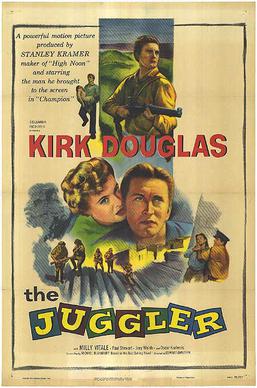
The Juggler
Born Issur Danielovitch, this actor would go on to a huge career in Hollywood as an actor under a different name; Kirk Douglas. The son of Jewish immigrants from Belarus, Douglas spent much of his life and early parts of his career fighting anti-Semitism, an interesting part of his autobiography The Ragman's Son. With his Jewish heritage, I can only imagine that 1953's The Juggler was an emotional venture for the actor.
It's 1949 and among hundreds of other Jewish refugees, Hans Mueller (Douglas) disembarks from a ship in Haifa in Israel at a refugee camp. A survivor of a WWII concentration camp, Hans was an international star before the war, gaining fame as a performer and juggler, but he was the lone survivor from his family; his wife and kids both dying in the camps. Now, Hans is struggling to adjust to a post-war life. He leaves the refugee camp, but when he is stopped by a police officer, Hans freaks out, runs and when cornered beats the officer senseless. Hans is now on the run, trekking across the Israeli countryside.
The Holocaust is one of those historical tragedies that is hard to fathom actually happened. Six million Jews killed in around six years? Millions more of Russians, minorities and various ethnicities and cultures? It boggles the mind. Many films have handled the touchy, emotional subject matter extremely well, but I can't think of another one that deals with how the survivors of the concentration camps assimilated themselves back to a "normal" life following their horrific ordeal. More impressive, 'Juggler' was made just four years after the story is set, and eight years since the end of WWII. That subject matter is still very much a fresh wound, and if for absolutely nothing else, this film gets bonus points for trying to tell a timely, emotional story.
Basically regardless of the role or the movie, if I see the name 'Kirk Douglas' in the cast listing, I'll give the film a shot. This is not a role that is mentioned with his best, but it is a hidden gem. He does an admirable job bringing Hans to life. As Hans treks across Israel, we learn more about his concentration camp past. Upon first meeting him, he mistakes another refugee family for his wife and kids. He's convinced it's them. But as we see more of his deep-seeded issues, it's easy to see that everything is not all right. Hans is claustrophobic, fears any sort of uniformed authority and is almost schizophrenic in his personal interactions. Douglas always had the ability to turn into an emotional livewire on-screen, and that's no different than here. A very effective performance, both understated and exaggerated at the same time, but just the right amount of both.
What struck me years back when I first stumbled across this movie was the photography. Made in 1953 before widescreen filming techniques were used, 'Juggler' nonetheless takes advantage of filling the fullscreen. Director Edward Dmytryk shoots the entire film in black and white on location in Israel, a choice that brings the entire movie up a notch. The California hills, the southwest desert, none of it would have sufficed here. As Hans walks across Israel, we get a sense of distance traveled, seeing Haifa, Jerusalem, Nazareth and the Hill of Galilee as a backdrop. The camera moves close in behind Douglas' Hans, but in the background we see the expansive countryside going on for seemingly endless miles. Not only is the movie timely, but because it was filmed in Israel, it feels that much more authentic.
As far as star power goes, the movie hitches its wagons to Douglas' name recognition. The rest of the cast isn't going to have much recognition at all with most viewers. Milly Vitale plays Ya'El, a Jewish woman working with refugees to relocate within Israel who begins to worry about Hans' mental mindset. Paul Stewart plays Detective Karni, the officer pursuing Hans after his attack on the police officer. Joseph Walsh plays Joshua, a Jewish teenager who joins Hans in his "travels" of sorts, the two bonding over similar backgrounds. Also look for future Sgt. Schultz John Banner as a witness to the attack who takes part in the investigation and Beverly Washburn as Susy, a young girl who becomes Hans' friend when they meet upon arriving at the camp.
This one was a pleasant surprise. At times, it borders on being a little overdone -- looking at you, George Antheil's musical score especially -- but mostly it hits all the right notes. Douglas is the biggest reason to see this ahead of its time story. Well worth seeking it out.
The Juggler <---trailer p="p">---trailer>
Saturday, March 17, 2012
The Vikings
In the age of the epic in the 1950s and 1960s, there wasn't a historical
era not covered by Hollywood ranging from ancient times in Ben-Hur and
Spartacus to more modern times like Around the World in 80 Days and
Lawrence of the Arabia. Not quite on the scale of those movies but just
as entertaining, 1958's The Vikings is an underrated epic that is as much fun now as it was over 50 years ago.
Leading a raid on an English camp, Viking warrior/chief Ragnar (Ernest Borgnine) rapes the English queen who secretly gives birth to a son nine months later. Almost 20 years pass and Ragnar is still leading his Viking warriors, his son, Einar (Kirk Douglas), at his side. Neither are aware that the son, Erik (Tony Curtis), has been among them for the last 20 years, living as a slave to the Vikings, unaware he is Ragnar's son and Einar's half-brother. Erik has an intense rivalry with Einar -- each one wanting to kill the other -- and it is ratcheted up even further when Ragnar's warriors kidnap the young woman, Morgana (Janet Leigh), promised to the king in marriage. Both men fall in love with her as the Vikings prepare a surprise attack on the King's castle.
The appeal of many epics is the scale. They aren't always fun movies, just big movies. From director Richard Fleischer, this is an exception. At 116 minutes, it isn't as long as so many 3-plus hour epics, but it is fun, entertaining and still manages to present an impressive scale of the time of the Vikings. It was filmed in the fjords of Norway while also visiting Germany, France and Croatia, the locations providing an accurate and stunningly beautiful backdrop for the adventure story. The music is especially memorable from composer Mario Nascimbene, including the main theme (listen HERE) that you'll be whistling for days. What's so fun about it all is Fleischer and his cast and crew committing to being accurate as possible. The sets look like actual Viking villages. Three Viking warships were built from actual blueprints of Vikings ships, and the shots of these ships, packed with warriors, making their way up the sun-lit fjords is a stunning visual. The movie shows the day-to-day lives of these people. We see some of their rituals, their beliefs, their parties, and it feels authentic from the very start.
Working together for the first time -- they'd reunite two years later in another epic, 1960s's Spartacus -- Douglas and Curtis are great leads, the half-brothers who are unaware they're related. Douglas isn't a villain, but he clearly isn't the good guy either, his Einar an anti-hero if he's anything. It's a big, showy part for Douglas, the type of role he excelled at. Curtis gets the less-interesting character, but his intense part as Erik is still worthwhile. Mrs. Tony Curtis -- Janet Leigh -- is the eye candy, the beautiful Morgana who finds herself in a love triangle and must choose who she truly loves. If you're going to do a love triangle, do it right like 'Vikings' did here. Life and death, an intense rivalry where the stakes are high, not just a happy winner and a mopey loser. Also be careful not to poke your eyes out with Janet Leigh's pointiest of bras.
My favorite character though is from Ernest Borgnine as Viking chief Ragnar. It's funny that he's cast as Douglas' father because in real-life he's actually two months younger than his movie "son." Just like Douglas is perfectly cast as Einar, so is Borgnine. Heavily bearded and spouting his love for the Viking god Odin, Ragnar is an exaggerated, scene-stealing part for Borgnine. I can't think of a better duo to play these larger-than-life ancient heroes. For a topper, Ragnar's death scene is one of the all-time greats, a man literally laughing death in the face. Also look for James Donald as Egbert, an English lord secretly working with the Vikings, and familiar epic bad guy Frank Thring as Aella, the weakly English king, and Eileen Way as Kitala, the Viking medicine woman who is in touch with all the Viking gods.
From the time I first saw this movie as a kid, it was the action sequences that stuck with me. I remembered Douglas' Einar running across the rigid oars of the Viking ships as they returned to the village, but the high point is the finale, a Viking assault on Aella's heavily guarded castle on the English coast (actually Fort-la-Latte in France). A real castle, it is a gorgeous setting for the attack in all its scale, seemingly hundreds of Vikings bursting through the gates and scaling the walls. Einar's entrance to the castle -- climbing up a ladder of thrown axes into the raised drawbridge -- stands out, Douglas doing some of his own stunts. It concludes with an epic showdown at the top of one of the castle's towers, Einar dueling with Erik. Both Douglas and Curtis handled much -- if not all -- of their stunts, making the dangerous fight scene a couple hundred feet up even more impressive. Action galore, the ending is a whopper of a climax.
Part of the appeal here is of childhood memories, but it stands the test of time. It isn't remembered as well as many other historical epics, but it's just as fun and probably more entertaining than many more. Big story, memorable theme, great cast, and can you really go wrong with those bloodthirsty, fun-loving Vikings? I submit that you cannot. The movie is available to watch at Youtube, but it's 111 minutes while the DVD runs 116 minutes so something's missing.
The Vikings <---trailer (1958): *** 1/2 /****
Sunday, October 16, 2011
Town Without Pity
Shows like Law and Order, Boston Legal, Perry Mason, and L.A. Law explore the topic. Countless courtroom dramas show the profession for what it is, warts and all. That job? Defense counsel. Being a lawyer is one thing, but I've always questioned part of the profession. Your job is to defend someone as they go through a trial the legal system allows them. Morally, ethically, your fundamental beliefs, how do you defend someone if you know they're guilty? I've never been able to wrap my head around it.
One of the best efforts to show this premise -- a defense lawyer in a seemingly open and shut case -- is 1961's Town Without Pity, more proof you should scour TV listings. Basically completely forgotten over the last 50 years, director Gottfried Reinhardt's film questions the struggles and inner turmoils a lawyer goes through. How far do you go to help save your clients? At what cost do you do so? When is it too far, or is there a limit?
A lawyer in the U.S. Army serving as part of the occupation forces in Germany, Major Steve Garrett (Kirk Douglas) has been called in for a particularly touchy case. A 16-year old German girl, Karin (Christine Kaufmann), has been raped by four U.S. Army soldiers (Robert Blake, Richard Jaeckel, Frank Sutton and Mal Sondock). With the German people calling for a brutal response, the Army High Command wants an example to be made of these four soldiers. In other words, Garrett's work is cut out for him. Prosecuting counsel (E.G. Marshall is Douglas' courtroom rival/opponent) is seeking the death penalty, putting Garrett in a spot. He has a way to ensure long prison sentences will be the judgment, not the death penalty, but it is a morally questionable strategy, one Garrett desperately wants to avoid.
This movie surprised me in a lot of ways, most of them positive. I thought it would be one thing, and it ends up being something completely different. This isn't a movie about guilt or why the soldiers did what they did. That's all but established right off the bat. Without being pretentious or condescending, 'Town' explores mob mentality and its roots in the individual. Why do people do what they do? Why do they revel in other people's pain and discomfort? As Douglas' Garrett investigates his case, he finds a town ready and willing to turn on one of their own. There's his opening. A case study? Maybe not, it is after all a movie. It goes deeper than I thought it would, but in a good way. The heart of the movie is Douglas though, and he doesn't disappoint.
Playing defense counsel Maj. Steve Garrett, Douglas' performance will no doubt decide if this movie sinks or swims for most viewers. He's defending rapists of a 16-year old girl, and their guilt is never truly in question. Garrett has to decide what his limit is. The law states that if the key witness can't complete their testimony, the death penalty cannot be enact. For Garrett? That means taking apart on the witness stand a 16-year old girl a few weeks removed from a vicious, brutal rape at the hands of four men. At what point does it become too much? He clearly doesn't want to do it, but his job almost requires him to do it. Intense in a way few actors can be, Douglas hits a home run with the part, wrestling inside with what he should do. Can he live with his decision once the trial is said and done? Only he knows for sure.
Douglas holds the movie together, key supporting parts revolving around him as the case and trial develops. The four soldiers are kept in the background surprisingly enough. Blake is the possible nut, Sutton the weasel trying to convince everyone of his innocence, Jaeckel the decorated vet who's come to terms with his actions, and Sondock the possibly slow soldier. Marshall is good in a thankless role as the prosecuting attorney, doing his best to keep up with Douglas. Kauffmann too is an eye opener as the possibly not so innocent Karin. Barbara Rutting is solid as Inge Koerner, a reporter looking for all sides of the story. Hans Nielsen plays Karl, Karin's father who believes his daughter is an innocent angel capable of nothing but good.
When I saw composer Dimitri Tiomkin's name listed in the cast/crew listing, I was encouraged, but this score is a doozy, a whopper of a badly inappropriate score. An odd mix of jazz and various other genres/samples, it just isn't the right choice for this dark, cynical story. It drives the action like the story of a thriller, not a story surrounding a rape case. Out of place doesn't begin to describe it. The theme song by Gene Pitney -- listen HERE -- will get stuck in your head. Guaranteed, no doubt about it, but it only plays at the beginning and end of the movie so it isn't as noticeably bad as the musical score.
This is a movie that had me wondering about halfway through how things would be wrapped up. I assumed no happy ending -- correct with that guess -- but not in the way Reinhardt's movie goes. The trial becomes an afterthought, just what it caused sending vibrations through the community that are felt everywhere. A moving ending to a wrongly forgotten courtroom drama.
Town Without Pity <---trailer (1961): ***/****
Labels:
1960s,
Courtroom Drama,
E.G. Marshall,
Kirk Douglas,
Military,
Richard Jaeckel,
Robert Blake
Friday, October 7, 2011
The Hook
A title card for 1963's The Hook makes an interesting distinction about war. Paraphrased a bit, it says that for war and all its major campaigns, violent battles, and conflict on such an epic scale, the actual art of war is a very personal thing that is based at the individual level. It is the individual doing the fighting. That's something that sounds incredibly obvious, but in terms of a successful anti-war movie, that idea is almost always present.
This little known Korean War movie has more or less been lost to the decades since 1963. Before it showed up on Turner Classic Movie's schedule in September, I had never even heard of it. Because of its subject matter, it is pretty clear why it has been forgotten over the last six decades. The story revolves around orders for three American GI's to murder their North Korean prisoner soon after capturing him. In other words, a story with the most obvious of anti-war messages. It doesn't always work with some holes in the plot, but the message comes through clearly without being overbearing. Definitely a movie that deserves a better fate since its 1963 release.
Working to load barrels of fuel onto a ship as part of an American withdrawal, Sgt. Briscoe (Kirk Douglas) and two privates, Dennison (Robert Walker Jr.) and Hatchett (Nick Adams) are strafed by a North Korean plane, their commanding officer killed in the raid. The plane crashes near the ship they're loading, and Dennison swims out to save the wounded North Korean (Pancho Magalona). Moving out on the Finnish ship run by Captain Van Ryn (Nehemiah Persoff), the trio bring the wounded prisoner with, planning to turn him over to the authorities when they reach their base. Just hours into the voyage though, they receive a startling radio message. The base has been badly hit in a bombing raid, and all the North Korean prisoners were overrun and killed by the locals. The order is simple; execute the prisoner before they reach the base. The enemy is the enemy, but can these three do it?
As far as subject matter, 'Hook' is years ahead of its time, coming two years before the United States was even involved officially in Vietnam. Even the most naive among us can appreciate that brutal and horrific things are done in war, atrocities that are crimes against man. Often times, there are incidents that happen far from the battle as opposing sides meet as is the case here. That's what the story boils down to. All hatred and prejudices aside, the act is a war crime, out and out murder, no matter that they're doing what they're ordered to. It is a talky movie, the three soldiers all battling with their inner struggles and personal morality about what they've been told to do. Acts like this have almost certainly been committed in war since the dawn of time, but does that make it any easier to handle? Not really. Death is death no matter how you cut it.
The individual face of the war comes across in the roles of the three soldiers, Douglas, Walker Jr., and Adams. Looking for some sort of existential symbolism or meaning, Persoff's captain is even a bit of a God-like figure, watching from above as the situation deteriorates. Okay, enough with that mumbo-jumbo and deeper meanings. The performances keep the movie based, especially Douglas as Sgt. Briscoe, a 19-year Army vet a year away from retirement and his pension. As the highest ranking soldier, he is handed the unenviable task of carrying out the order, bullying his two men into the act. It's Douglas at his best, a brother/father-like figure looking out for their well-being balanced out with a manipulative, conniving way of getting things done. His monologue about a patrol gone bad on Guadalcanal in WWII is an actor showing how good he is at what he does. Both hero and villain, he makes Briscoe an interesting character, no doubt about it.
Some of my concern about 'Hook' was the casting of Walker Jr. and Adams alongside Douglas, fearing they would be overshadowed. That wasn't the case thankfully. Walker's Dennison is the smart, thinking soldier, questioning aloud what they're supposed to do. North Korean or not, their prisoner is a man, a father and a husband. He intends to fight Briscoe about the execution every step of the way. I think it would have been more interesting for Dennison's character if he wavered even a little about the orders, just for that added dimension, but he's resolute in his stance. Adams too does not disappoint, his Hatchett a diminutive soldier who Briscoe has a hold on. He starts to see the folly in his ways as he is pushed and pushed to do what he doesn't want to do. A Filipino actor who only starred in a handful of American movies, Magalona does much with a character that has no speaking lines, communicating his fear and terror with his eyes. It's a good part, one that could have been a throwaway piece, an idea more than a human being.
What prevents 'Hook' from being an anti-war classic is the ending, which I won't spoil here. As is, the ending works in George Seaton's film. It is effective with a touch of irony and hope for the future still there. The finale delivers a twist in that irony, going down a path I didn't see coming. Once the twist is revealed though, more -- much more -- could have been done to really slam home the anti-war ideas. There was potential for a shocking, startling, surprising ending that would have made this an even more memorable conclusion. As is so often the case, my issue is what could have been done. This ending does work, but it is a safer ending. Still, I very much enjoyed this movie. It has been wrongly forgotten and deserves more of a following or audience.
The Hook <---TCM trailer (1963): ***/****
Labels:
1960s,
Kirk Douglas,
Korean War,
Nehemiah Persoff,
Nick Adams,
Robert Walker JR
Wednesday, October 5, 2011
The Big Trees
Taking it upon myself to question how movie stars and TV actors feel about their careers, it's too bad the individual can't choose the role or performance they're remembered for. I thought of that a lot while watching 1952's The Big Trees with Edgar Buchanan playing a key supporting role. Working in movies and television in part of five decades, Buchanan was in almost 200 different movies and shows. But what's he most known for? His part in the very bad, very campy Green Acres and Petticoat Junction. What's that got to do with the review? Nothing, but I needed a lead, and that worked.
A bottom-line businessman interested in cash and little else, Jim Fallon (Kirk Douglas) has hit a bit of a roadblock. Running a highly successful lumber business, Fallon has run out of trees, but he sees the potential for a huge payday in California where redwood trees tower over the land. The only problem? Well, besides having no money....Quakers live on the land and are in no mood to allow him to cut down the majestic trees. The potential for money is too much though, and Fallon keeps on pushing, finding a way to get to those trees. He is blinded by his drive, but when a former employee, Frenchy (John Archer), starts to work his own plan, all bets are off, especially with love and money on the line.
I'll get to Douglas, Buchanan and everything 'Trees' did and didn't have to offer, but first I have a question. You know what isn't interesting to watch? Trees. For all their beauty, they're just not entertaining. They just stand there. Sounds like a stupid complaint, huh? You would think a movie producer or a screenwriter would know better, but well....they didn't. This movie is only 90 minutes, but it felt like director Felix Feist has a weird tree fetish. The camera ogles the trees and in the process bring the already slow story to a screeching halt. Seeing the rings inside the tree, measuring their width, these are things that are as boring to write about as they are to watch. So anyways...yeah...if you really like random tree footage, this movie is for you.
I didn't mention Buchanan in the plot review mostly because his character is a key supporting character but not an essential one to the heart of the movie. He plays Yukon Burns, a veteran gold miner with plenty of years experience under his belt. Yukon ends up being a friend and working partner of Fallon's, doing some of his dirty work only to realize he's being swindled. Even though they're friends, he goes off on his own to join the Quakers in their efforts to stop Fallon. It's typical Buchanan stuff. He's gruff, mumbles and glares through his part, but it's always fun watching him do it. In his mean gruffness and being a crotchety old guy, there's some humor, and he does play well off Douglas's Fallon, not taking the crap that everyone else does.
Thanks to TCM choosing him as the September Star of the Month, there have been a fair share of Kirk Douglas reviews lately so I'll do my best to avoid repeating myself. While many actors could and did play straight heroic roles or straight villains, Douglas could do both, sometimes switching effortlessly between the two mid-movie, like he does here. However because it is the 1950s, it isn't enough of one or the other. Either make him a true bad guy or a true good guy. Don't waver in between. Fallon is a swindler and a cheat, but he has some sort of odd awakening late because the movie requires him to do so for the story to continue, not because it makes any sense. It's still Kirk Douglas, and he genuinely tries to make something of this, but it never works.
The screenplay is just too stupid to allow anything to ever happen in any semblance of a real world. One gimmick has a Quaker, Alicia Chadwick (Eve Miller), and the local judge, Crenshaw (Roy Roberts), going all Lucy and Ethel with a cat and two dogs to help burn a building down. Don't worry though, they're burning illegal documents in the process so the threat of hurting anyone or burning down the town is null and void. Later, Fallon also finds out Archer's Frenchy is double-crossing him. Oh no! They fight on a precarious bridge over a raging, roaring river, Frenchy falls, and Fallon walks away. Oh, by the way, French is fine! He's also ready to make more trouble. It's the little things that like that drive me crazy. None of it would happen in any real world, and the "twists" only exist to advance the story as needed. Be somewhat smart, be creative, think things through.
I really try with the reviews I write to give them all a fair shake, and I'm really trying here. I was bored to tears with this movie, and not even Kirk Douglas could save it. In other supporting parts look for a very young Alan Hale Jr. (later the Skipper on Gilligan's Island) as Tiny, one of Fallon's lumberjacks, and Patrice Wymore as Dora Figg, a young woman Fallon keeps on his arm in case she presents any value down the road. This movie was bad from the start and never improves. Pass on it, and keep on moving. For whatever reason, if you're curious, you can watch the whole movie at Youtube, link below.
The Big Trees <---whole movie (1952): */****
Monday, October 3, 2011
The Big Sky
The 19th Century was an incredibly busy one for the ever-growing United States as hundreds of thousands of people moved west trying to build new lives. American expansion isn't an easily handled topic for a movie with all its epic qualities and large scale and scope, but when handled right, it can be a beautiful story in the end. 'Sky' isn't your typical western, focusing on some of the first explorers into uncharted land more than gunfighters and shootouts. That's a good thing though, a big, expansive western about a chapter in American history so often overlooked. Our history has to start and continue, and this is as good a place as any to jump off from.
It's 1832, and Jim Deakins (Kirk Douglas) is traveling to Louisville when he meets another young traveler, Boone Caudill (Dewey Martin). With so much open land to the west of St. Louis just waiting to be explored, Jim and Boone head west looking to join up with Boone's uncle, Zeb Calloway (Arthur Hunnicutt), a trapper and frontiersman, one of the few men to explore deep into the west and the unknown. They find him in a jail cell and sign on for an expedition up the unexplored Missouri River. Along for the trip is Teal Eye (Elizabeth Threatt), a Blackfoot princess who will be used as a negotiating ploy in the trading process for beaver pelts. Trading seems a long way off though as Jim, Boone, Zeb and the crew of the keelboat must fight off Indian attacks, murdering white men, and nature's ever present danger.
Exploring the untapped American west and all its beauty is one of the most simple, direct and straightforward story ideas ever. There is something beautiful in the simplicity; a land untouched by technology or business. Director Howard Hawks filmed this movie on location in Grand Teton National Park and Jackson Hole, Wyoming, and the end result is stunning. Seeing the valleys, the mountains, the rivers, you understand why people would risk it all in the 1830s to uproot their families and move them west. That's the most appropriate word I can think of; stunning. It is a gorgeous movie to watch, even if I wondered what the movie would have looked like in color and a widescreen presentation (2 years too early) instead of the black and white standard presentation. Minor potatoes really, color or not, the Tetons are breathtaking.
Depending on the role and the movie he was in, Arthur Hunnicutt could be so downright homey and folksy, so home-spun and backwoods he drove me up a wall. There is such a thing as being too folksy if you ask me. He no doubt had talent though, and this is one of his most understated roles. Yes, there are bits of folksy attitude, but in the right doses it works. His Zeb serves as Sky's narrator, explaining what's going on to our crew of adventurers. The narration has some humor to it and never tries to be anything too over the top. It's just the trials and tribulations of traveling as Zeb sees it, and that's all. He received a Best Supporting Actor Oscar nomination, losing to Anthony Quinn in Viva Zapata!, and it's one he deserved. Hunnicutt and his veteran presence -- as an actor and as his part requires -- gives the movie that steady feeling of knowing where it needs to go.
In a variation on the buddy picture, Douglas and Martin are cast together nicely as Jim and Boone, two friends always competing, always getting into scrapes, and always coming out on the other side the better for it. These aren't characters who develop and change much, just two young men looking for adventure, and that's okay because that's all the story needs. They look to be having a lot of fun, and that's all that matters. Threatt never starred in another movie, strange considering how good she is here, making an easily stereotypical part into something better. Some of the keelboat's crew include Jourdonnais (Steven Geray) or 'Frenchy' to his men, the captain and owner of the boat, Romaine (Buddy Baer), a Goliath of a man, and Henri Letondal as La Badie, the cook. The very white Hank Worden plays Poordevil, a groan-inducing, stereotypical portrayal of an Indian who's touched in the head, while Jim Davis is Streak, a conniving bandit working against the expedition.
With a story that covers several months on the trail/river, 'Sky' leans more toward an episodic plot than one continuous storyline. This is both good and bad. The more interesting parts flow at a quick pace, but the slower ones drag it down. I don't dislike the movie, but at 138 minutes it feels a tad long in places, especially toward the end. Lost footage has been reinserted into the movie as well so that could have something to do with it. None of this is enough to not recommend this movie though. Dimitri Tiomkin's score is a nice touch, as big and wide as the story it accompanies, and the movie itself is a beauty. It doesn't receive the recognition it deserves so see if you can track a copy down or at least look out for it at TCM.
The Big Sky <---trailer (1952): ***/****
Labels:
1950s,
Arthur Hunnicutt,
Dewey Martin,
Howard Hawks,
Kirk Douglas,
westerns
Wednesday, September 28, 2011
I Walk Alone
When I think of Kirk Douglas, the first movie that comes to mind is Spartacus, a historical epic where he plays the leader of a slave revolution against the Roman Empire. It is a strong hero's role, the underdog fighting an empire. To a lesser extent, I think of parts like 20,000 Leagues Under the Sea or Seven Days in May, again Douglas in a heroic good guy role. Like so many actors though, Douglas had to put his time in, including 1948's I Walk Alone.
It was a trend early in his career, Douglas playing the villain, and not those likable rogues he would play later when he was an established star. We're talking out-and-out bad guys, backstabbing and betrayal around every corner. But relative unknown or established star, Douglas pulls it off. Even when he was the hero, he always had that edge to him under the surface...a good guy who was capable of bad when the time came. 'Walk' is nothing special in itself, a pretty average film noir overall, but the performances from Douglas and his two co-stars make it worthwhile.
After serving a 14-year sentence in prison, Frankie Madison (Burt Lancaster) has finally received his parole. His release has been a long time coming, especially because of his deteriorating relationship with his old friend and partner, Noll 'Dink' Turner (Douglas). During his time in jail, Frankie was not visited by Dink even once, only receiving a monthly carton of cigarettes. Now an established club owner, Turner is suspicious of his old pal's motives, and rightfully so. Before Frankie was sent away, the two men made an agreement, one Frankie has been counting on to start over with his life. It is an agreement that Turner has no intention of living up to. With money and fame on the line, what will happen when the two meet?
I should point something out before I dive too far into the review, something that will no doubt make me look not so good, but what are you going to do? When I recorded this off TCM recently, I accidentally hit 'Mute' on the remote. Our new digital recording literally tapes what's going on at that moment. In other words, it doesn't tape something and you can turn it up or put closed captioning on. It is as is. Sssssssso in other words, I had to watch this movie via closed captioning on mute. Yeah, I'm pretty much a genius. Just a word of warning.
The last half of the 1940s was a stomping ground for up and coming actors to make a name for themselves. Think of actors like Robert Mitchum, Lancaster and Douglas. The latter two would both shoot to stardom in the years following, and obviously hit it off, working together in movies like Gunfight at the O.K. Corral, Seven Days in May, and The Devil's Disciple. It's fitting that they worked so well together. Both Lancaster and Douglas were two of the most versatile actors to ever grace the screen. Intense drama, high-flying action, physical and/or smart comedy, they could do it all. They were intensely likable as actors -- for me at least -- and seeing them play off each other is always enjoyable.
As old friends turned rivals, the duo is the biggest reason I can recommend this movie. Playing heavy dramatic roles, these two are intense, like caged animals just waiting to attack each other. They play mind games back and forth, seeing who will blink first. A short flashback shows their history that set up the current dilemma, a promise made in a pressure situation coming back to bite them both in the butt. Lancaster is driven to do right and gets what he's owed while Douglas is the slippery baddie looking out for No. 1 and that's all. Lizabeth Scott (<---I don't know where the 'E' went) plays Kay, a singer working in Turner's club who at first takes pity on Frankie only to genuinely fall for him while Kristine Miller plays Mrs. Richardson, a well-to-do widow and possible sugar momma to Turner. Wendell Corey has a good supporting part as Dave, Turner's beaten down, mousey accountant.
The movie itself is pretty blah overall. The story takes place over a 24-hour time period, and a whole lot sure gets accomplished in such a quick time span. As good as the acting and the performances are, the story lacks any real energy. The mind games back and forth are interesting, but it's extremely obvious where everything is heading; Frankie vs. Noll, man to man. It's never boring, but it never amounts to a particularly memorable movie. Check it out for the acting, and remember to keep the volume up.
I Walk Alone <---TCM trailer (1948): ** 1/2 /****
Labels:
1940s,
Burt Lancaster,
Film Noir,
Kirk Douglas,
Wendell Corey
Thursday, September 15, 2011
The Heroes of Telemark
While troops from both the Allied and Axis powers all over Europe and the South Pacific in WWII, another battle raged in laboratories with scientists and doctors working toward another goal; the creation of the first atomic bomb. Whichever country made the first bomb would almost assuredly win the war as just the threat of using such a weapon would force other countries to surrender. In 1942 some three years into the war, Germany seemed to be in the lead as Adolf Hitler sought the perfect weapons.
Based on a true story, 1965's The Heroes of Telemark tells the story of the Norwegian resistance's effort to stop the atomic development. By the mid 1960s, WWII espionage and commando stories were at the absolute height of their success as a wave of movies flooded theaters (sorry for the bad pun). 'Telemark' is one that isn't a classic, and despite some interesting casting in the two leads has been generally forgotten. It hasn't been available to watch on DVD in the U.S. until recently so that might have something to do with it, but even though I enjoy the movie I can appreciate those who don't. More on that later.
Working at a university in Oslo in Nazi-occupied Norway in 1942, Professor Rolf Pedersen (Kirk Douglas) is trying to stay as far away from the war effort -- on either side -- as possible. One day he is approached by Knut Straud (Richard Harris), a resistance fighter from the town of Rjukan, who has information about the Germans' development and increased production of heavy water in a factory in his hometown. Rolf sees the potential for disaster and agrees to go with Knut to England -- sneaking into the country -- to consult with British Intelligence on what they want done. The thought of Hitler having atomic weapons at his disposal is all the motivation he needs. The objective then is simple; send a commando team (including Knut and Rolf) to the Rjukan factory to sabotage the effort and slow down the developments. The means to do it? A little harder as the Germans have an intimidating security force all around the factory.
While the names have been changed and some of the events dramatized a bit, the basic story is based off a true story of the Norwegian resistance and their efforts to slow down the Germans' advances in atomic weaponry. That plot description is a general one too, only taking the story up to the hour mark or so in a 131-minute movie. Director Anthony Mann certainly adds a wrinkle to the commando story with the potential of this new city-destroying weapon. Most commando/espionage movies have an objective like taking out a key bridge or an important gun emplacement. Using the history and very timely matter of atomic weapons is an interesting and fact-based twist.
My biggest surprise when I first saw this was the casting of Kirk Douglas and Richard Harris as the two leads. I was in a Richard Harris phase -- still am I guess, he's a badass -- and thought 'Why the hell was I not aware of this movie?!?' Seeing two big stars like these two is part of the fun of stumbling across movies like this. Douglas was the more established one here, Harris the rising star, and apparently they didn't get along too well on-set. That is very much a good thing because their on-screen rivalry is very much real. They don't like each other at all. They work together because they need each others help and are forced to do so, not because they enjoy being commandos together. Douglas gets the shinier part -- including a rekindling relationship with ex-wife Anna, played by Ulla Jacobsson -- while Harris gets pushed to the side too much. Still, it's Kirk Douglas and Richard Harris. They're cool so deal with it.
Two key sequences always stand out for me, both of them coming straight out of the history books. The first is the raid on the Rjukan factory as Rolf and Knut lead eight Norwegian resistance fighters into the factory, avoiding security at every turn. The real-life raid went just as smoothly as this one, but Mann shoots it so well that the scene's are packed with tension and adrenaline. All it takes is one goof, and these guys are going to be outnumbered in a big way. The same goes for the finale as the Dynamic Duo attempts to sink a ferry carrying thousands of gallons of heavy water going across the Norwegian fjords. In both sequences, there is little to no gunfire, the natural tension of the situation doing the heavy lifting.
So what's the problem with this movie? I can't put my finger on it, and I like the movie. It is just missing something. At 131 minutes it is a tad on the slow side. Mann shot the movie on location in Norway, and it is stunning to watch. Composer Malcolm Arnold's score is highly memorable, even if it borrows liberally from his Bridge on the River Kwai soundtrack. Michael Redgrave is underused as Anna's uncle also working with the resistance. I guess the best description I can give is that it isn't the most personal movie. It never sucks you in the way The Guns of Navarone or Where Eagles Dare do. Still a good WWII commando movie, but not the best.
The Heroes of Telemark <---TCM trailer (1965): ***/****
Labels:
1960s,
Anthony Mann,
Kirk Douglas,
Michael Redgrave,
Richard Harris,
WWII
Subscribe to:
Posts (Atom)


.jpg)