The Sons of Katie Elder

The Sons of Katie Elder
"First, we reunite, then find Ma and Pa's killer...then read some reviews."
Showing posts with label Klaus Kinski. Show all posts

Monday, March 31, 2014

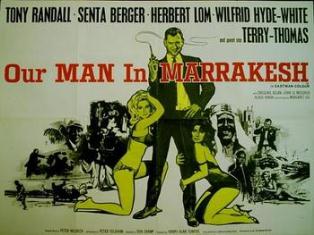
Bang! Bang! You're Dead!

B-movies can be really good when handled right. Now the counter, they can be really, really bad when handled wrong. Whole studios between the 1940s and 1960s were devoted to B-movies, like American International Pictures with its horror, thriller and westerns. How about a spy spoof that has some fun with the James Bond formula, the mistaken identity genre like North by Northwest and a generally fun attitude? That would be 1966's Bang! Bang! You're Dead, released in Europe as Our Man in Marrakesh.

On vacation from his job with an oil company, Andrew Jessel (Tony Randall) is spending his time away from work in northern Africa in Morocco. He boards a bus headed to Marrakesh with five other passengers, not knowing that one of them is carrying two million dollars intended for Mr. Casimir (Herbert Lom), a powerful man with his hand in everything underworld. Where's that money heading? Paid here and there to help fix an upcoming vote at the United Nations. Casimir is trying to find out who, Jessep finding himself mixed up in it all when he finds a dead body in his hotel room closet. One of the other passengers, Kyra Stanovy (Senta Berger), stumbles into the room and sees the dead body, stunned even more when she recognizes who it is. Now, Andrew is very much involved, trapped in a foreign country and trying to hide a corpse. Mr. Casimir is right with him, watching his every step.

I don't hide my feelings about spoofs. I'm usually not a fan. It's the rare spoof I like -- Blazing Saddles, Young Frankenstein, Spinal Tap -- with most of them trying too hard to...well, be a spoof. From director Don Sharp, 'Bang' isn't a literal spoof as I think of a spoof, instead having some fun with a typically pretty serious topic, international intrigue. In the end, I liked it but didn't love it. It's pretty light, fun at times, obnoxious at others, and a decent enough waste of time for 90 minutes or so. The on-location shooting in Marrakesh, Morocco is a definite plus, even if some scenes are undone by some really obvious green-screen shots. Still, Marrakesh in the 1960s sure looked cool, the time capsule effect a big positive.

Leading the way in the Mistaken Identity department is Tony Randall, Mr. Felix Unger himself. Doesn't Randall scream tough guy hero in a spy flick with international intrigue? Yeah, I guess not. He has some fun with the Everyman part, the normal guy thrust into a crazy situation full of conniving crooks, beautiful, mysterious women, wishy-washy motives, lots of enforcers, hit men and car chases, and life and death opportunities around every corner. Randall shows off his impeccable comedic timing throughout, questioning all the craziness that's going on but mostly going along with it. Would you question too much if you got to hang out with Senta Berger? Okay, maybe once a dead body showed up, but I'd still debate it. One of the more unlikely action heroes, Randall throws himself into the mix in the chase and action scenes, his goofiness and lighter tone playing well with the kooky story.

Across the board, the cast is the biggest selling point for this spy spoof. As the sexy sidekick, Berger is just that, pretty sexy. Skimpy and/or tight outfits, sexy Euro accent, how can you lose? Playing the slimy, slick villain, there weren't many better than Herbert Lom, an oiliness to his impeccably smooth and suave Mr. Casimir. Klaus Kinski makes the most of a small(ish) but intimidating part as Jonquil, Casimir's brutally effective enforcer while Margaret Lee sex kittens it up as Casimir's young lady friend/lover who's always asking him to "come lay down with him." Oh, scandalous! As for the other suspects on the bus to Marrakesh, look for Wilfrid Hyde-White as Fairbrother, a Brit working with a septic company (maybeeeeeee) and John Le Mesurier as Lillywhite, another Brith looking to expand his own business. Who is the courier with all that cash? What's everyone up to? There's also some fun parts for Terry-Thomas as El Caid, the son of a former crook trying to go straight...well, sorta, and Gregoire Aslan as Achmed, a truck driver who sides with Andrew and Kyra as things escalate.

My typical issue with movies with a twist, stories with some mystery, is that they try to be too cute in keeping that mystery under wraps. Without going back and rewatching 'Bang,' I'd wager Berger's Kyra tell Randall's Andrew "I'll tell you everything that's going on tomorrow!" Or.....or, just sit down and tell us now. Whatever works. Don't be too cute. Don't leave audiences on the hook for the sake of that cuteness. Thankfully, the last 30-40 minutes pick up the pace once we figure everything out. The finale is pretty fun as everything comes together, one extended chase and action sequence. It's a fun movie, easily digested and onto the next movie!

Bang! Bang! You're Dead! (1966): ** 1/2 /****

Monday, April 8, 2013

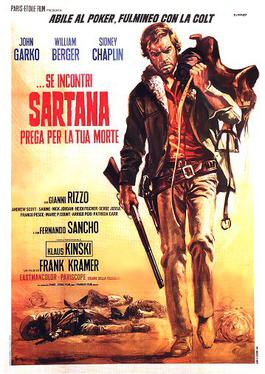
If You Meet Sartana, Pray For Your Death

The Man with No Name Dollars trilogy, Trinity, Django, Sabata, all characters that have their own series in the spaghetti western genre. I've seen at least parts of all those character series, and recently jumped into another, the Sartana series, starting with 1968's If You Meet Sartana, Pray for Your Death

A stagecoach has been robbed, and all its passengers lay dead. As the robbers loot the bodies, a mysterious gunman, Sartana (Gianni Garko), steps in front of them and guns them down. Not long after, a second stagecoach is attacked, this time carrying a huge gold shipment for a town up the trail. The only issue? The strongbox doesn't contain any gold at all....it's just heavily loaded with rocks. Who's up to something? Sartana seems to know, pitting all sides against each other. Another gunman, Lasky (William Berger), has been well-involved with all the robbery, murder and betrayal and is suspicious of what Sartana is up to. Sartana has too many enemies though as he investigates the disappearance of the gold. His only option is simple; pit all sides against each other and swoop in at the opportune time.

This spaghetti western is everything that's both good and bad about the genre. When it's entertaining, it's very entertaining (movie specific: this one's bad but entertaining). When it's bad.....it's very bad. For director Gianfranco Parolini, 'Pray' plays more like a test run for his infinitely better 1969 spaghetti classic, Sabata. The basic premise is almost entirely the same story. Garko's Sartana is a younger Sabata (played to perfection by Lee Van Cleef). The tone is light with some acrobatic gunmen and generally goofy atmosphere. The music from composer Piero Piccioni is pretty forgettable, a disappointment considering how good some of his other scores (The Deserter) were. There are some cool locations although the movie hamstrings itself by using the same locations repeatedly. I swear Sartana rides through the same hilly sand dune at least four different times.

Belonging in the short list of coolest spaghetti western title characters, Sartana is a pretty cool anti-hero gunfighter. He's a gentleman and dresses the part, favoring a suit, vest, cravat and overcoat that resembles a cape. He uses a long-range Winchester rifle and a multi-barreled derringer pistol. Sartana is a gambler as well as an accomplished gun, an ability that plays well in an early card game. Mostly I like the character because it hints -- in not so subtle fashion -- that Sartana is some sort of angelic killer, an angel of death. He seemingly can't be shot (check out the opening scene HERE) or hurt by enemies while appearing at will out of thin air. I like Garko a lot in the role, one he would play three more times, bringing a lighter touch to the anti-hero gunslinger. He's smooth with a gun and a bit of a smartass with whoever he meets. It's different, and I liked it a lot.

Spaghetti western diehards will eat this one up in the casting department with some really odd and really cool casting. Berger is over the top and goofy as Lansky, a brutally efficient hired gun with murder and blackmail on his mind. He's also completely undone whenever Sartana plays the tune from the watch of a man Lansky has killed. Klaus Kinski shows up in a bizarre cameo as Morgan, a knife-throwing killer with little bells for spurs. He's around for about 3 minutes, but it's Kinski so it's cool. Fernando Sancho does what he does best, playing a slimy, greasy, cackling Mexican bandit/general -- here General Tampico Mendoza -- who gets caught up in the killing. Sydney Chaplin and Gianni Rizzo play the two conniving businessmen in town who are up to something, Heidi Fischer playing Rizzo's equally conniving wife. Spaghetti western regular Salvatore Borghese makes a too quick appearance as Moreno, one of Sancho's main henchman.

There is a part of almost all spaghetti westerns that are inherently stupid, but you just go along (well, if you're a fan at least). Unfortunately, 'Pray' has so many of these moments it's hard to take even remotely serious. I liked the movie, but I can appreciate it and all its badness. If you did a drinking game after every time someone maniacally laughs, you'd be drunk in minutes thanks to maniacal laughing coffin maker Dusty (Franco Pesce). Sancho cackles and laughs, eating the same greasy piece of chicken in countless scenes. Berger's Lansky literally crumbles at just the sound of a musical watch. The script is pretty bad in itself -- Sartana's bedroom kinkiness a highlight -- and doesn't offer much of a story. The "story" requires people to connive and worry, Sartana shows up, plans are thrown out and started over. An impressive body count here with some fun action scenes too. It's bad. No doubt about it, but I was entertained throughout.     

If You Meet Sartana, Pray for Your Death (1968): ** 1/2 /****

Friday, February 22, 2013

Coffin Full of Dollars

A spaghetti western is like a pizza....for me at least. And yes, I realized I'm comparing Italian movies to Italian food. I'm clever like that. Even the lousy ones, they're still halfway decent. There are some truly bad spaghetti westerns out there, but they're almost always entertaining (sometimes because they're so bad). So with 1971's Coffin Full of Dollars -- how could you not appreciate the awesomeness of these names?!? -- there's nothing hugely memorable, but I liked it just the same.

Returning home from the Civil War, George Hamilton (Jeff Cameron) discovers that the family home has been burned down, and everyone inside was killed. The only clue to the perpetrator is a gold watch he finds in the wreckage. It belongs to a bandit leader, Hagen (Klaus Kinski), seeking revenge for the deaths of his brothers at the hands of the Hamiltons (Confused yet?). Going by the alias the Nevada Kid, Hamilton hits the trail to find Hagen and his small army of gunmen. He teams up with an amiable enough bounty hunter, John (Gordon Mitchell), who would like nothing more than to get a crack at the lucrative bounties hanging over the heads of Hagen and his gunmen. As the duo gets closer, they find out they've stumbled into a plan where Hagen stands to "earn" $10,000. Who gets out alive?

I stumbled across this one via On Demand and jumped at the chance. With some 600 spaghetti westerns made in the late 1960s and 1970s, you've got to take advantage when you find one like this you've never even heard of. A quick search over at Amazon shows that this 1971 spaghetti is only available in a difficult to find Region-2 DVD so not exactly readily available. It's pretty standard stuff, but that's not a bad thing. The version I saw clocked in at 82 minutes, but some versions are reported to be just over 90 minutes. A whole lot of stuff is going on, a whole lot of bullets fly through the air, and in the end, a whole lot of people get shot down in some pretty impressive shootouts. What more could you ask for?

From director Demofilo Fidani (who also wrote the script), the budget clearly isn't large in any sense of the word. We see some familiar spaghetti western locations and even some non-desert locales, but the story and scale (or lack of) is always on a smaller, more personal level. We don't get saloons packed to the gills with extras. There's some awkward cuts and editing, shots going on for too long rather than just transitioning to new scenes. The music from Coriolano Gori is pretty normal spaghetti music, good in the moment if not memorable.

Through all the general craziness and off the wall story, the characters/actors do have a lot of fun. An Italian actor who specialized in spaghetti westerns, gladiator epics and Italian war movies, Cameron does a solid job as George Hamilton (that name couldn't have been an accident), a polished gunslinger seeking revenge. Spaghetti regular Kinski's appearance amounts to little more than a cameo, disappearing for long stretches of the film, but whenever he is actually on-screen, it's good stuff. The same for Mitchell who isn't given much to do, but he commits as his muzzle-loading, rifle-toting bounty hunter pairs with the Nevada Kid and hams it up as presented. Jack Betts has some fun as Tamayo, Hagen's second-hand man who keeps messing up, Simonetta Vitelli is Monica, a young woman ransomed off by Hagen and rescued by the Nevada Kid, and Ray Saunders is Sam, a freed slave who ends up helping the Kid's efforts.

Blah blah blah. Shootouts! Gunfights! Action, action, action! In an otherwise standard western, the action here is exciting and dare I say....above average. Yes, it tends to be a little goofy with highly exaggerated deaths and tumbles, some generally very stunt-conscious nameless henchmen, and guns that never need to be reloaded. There's a handful of quick shootouts that are worthwhile, but two major set pieces set the bar. One has the Kid and John navigating a ghost town full of Hagen's gun men in hopes of rescuing Monica while the finale has the duo fighting their way through Hagen's isolated town similarly full of rival gunfighters. I liked this movie. I didn't love it, but I enjoyed it just the same. An enjoyable enough way to spend 90 minutes. Watch the full movie HERE.

Coffin Full of Dollars (1971): ** 1/2 /****

Monday, September 24, 2012

Doctor Zhivago

By 1965, director David Lean had already completed two of his most highly regarded and well-respected movies of his prestigious career. With 1957's The Bridge on the River Kwai and 1962's Lawrence of Arabia, Lean basically defined how a director should make a gigantic film epic. So some three years later, he followed up with 1965's Doctor Zhivago, a film I'm still digesting -- for good and bad -- some three days later.

A doctoral student who grew up with an adopted family of sorts, Yuri Zhivago (Omar Sharif) is an aspiring poet in the early 1910s in Russia. He marries childhood friend and longtime love, Tonya (Geraldine Chaplin), and starts a family. Growing up with a single mother, Lara (Julie Christie) goes through some harsh teenage years as she deals with a troubled single mother. As Russia is thrust into World War I -- the fighting eventually turning into the Russian Revolution -- Yuri (working as a doctor) and Lara (as a nurse) meet amongst the aftermath of a battle. They are instantly drawn to each other as they work side-by-side, but as the conflict escalates, this is a relationship that seems doomed to failure.

Wow, I'm not proud of that plot synopsis. It sounds like I'm reading a cheesy romance novel. Anyways, onto bigger, better and more on-point things. This is a GIGANTIC movie as one would come to expect from a David Lean epic. With locations in Spain, Canada and Finland, the scale is a pleasure to watch. Lean and cinematographer Freddie Young shoot each scene -- the snow-capped mountains, the desolate wastelands, the flower-covered plains -- like a Renaissance painting. It is a stunningly gorgeous film, one you can just sit back and experience. Composer Maurice Jarre's score won the Oscar -- rightfully so -- with Lara's Theme (listen HERE) an instantly recognizable, beautiful tune, one that you'll be humming for days. The sets are expansive, the cast numbering in the thousands with extras, and the story covers a time in history (Russia in the 1910s/1920s) that is rich with depth.

So what happens then? Why do I feel conflicted about this Lean-directed epic? In a 200-minute movie, there exists little to no story. It moves from location to location and time to time with transitions that can be jarring at times. My lack of knowledge about Russian history certainly did NOT help my enjoyment and/or appreciation of what was going on. I don't think lyrical is the right description, but it's all I'm coming up with. Story is also a word I use lightly. It isn't really a story so much as a budding relationship that develops over many years and all the people caught up and effected by it. We see snippets of a time/conflict/place, and then zip to another spot. Because of that, I never felt in tune with what was going on, feeling at times very disconnected from the plot.

And onto the cast, much easier to decipher. For one of the all-time great love stories, I didn't think much of the chemistry (or lack of) between Sharif and Christie. Omar Sharif is a very talented actor, and he does a fine job as Yuri Zhivago showing a man's flaws, imperfections and talents. Christie too as Lara is an interesting character, neither individual perfect by any means. I appreciated that. We're watching human beings, not immaculate individuals, but in terms of on-screen chemistry I was not buying Sharif and Christie as a couple that is drawn to each other in an unexplained way, not letting time or circumstances tear them apart. Christie is stunningly beautiful as Lara with Lean electing to photograph her like an angel, especially her blue, blue, BLUE eyes.

The name recognition from the supporting cast will draw in many film fans and understandably so. You don't put a cast together with the likes of Rod Steiger, Alec Guinness, Tom Courtenay, Chaplin, Klaus Kinski and Ralph Richardson together without causing a stir in the acting department. Among that group, there isn't a weak link in the bunch. Some are more impressive than others -- Steiger, Guinness, Chaplin and Kinski -- but the lack of a true, developing story hurts all of the performances. Steiger and Courtenay disappear for long stretches, only to reappear as the story requires. I just don't know how to describe this. I enjoyed the actors, enjoyed seeing their performances, but something just didn't click.

There are moments of near perfection amidst some of the rather leisurely 200-minute running time. After a sluggish first 45-60 minutes, things get flowing at a quicker, more enjoyable pace. Not surprisingly, the high points are several chaotic, impressively staged action sequences. One especially, Bolshevik cavalry charging across an ice-covered lake, stands out. An encounter between Russian replacements and Russian deserters on a wayward, desolate plain is simple in its brutality. Much of the success in these moments come from the visual that Lean and Young created. A framing device at the beginning and end with Guinness (a veteran Communist officer) interviewing a young woman (Rita Tushingham) who could be Yuri and Lara's daughter too is especially effective. The ending too goes right for the jugular, a heart-breaking ending for Yuri and Lara.

I'm torn on what to do here. I can appreciate why so many film fans adore this movie. I can also easily appreciate why some struggle to go along for the ride. Not to use a cop out, but I fall somewhere in between. I loved parts of it, liked others and struggled to go along for other portions. I love both 'River Kwai' and 'Lawrence' so Zhivago had some big shoes to fill in the expectations department, but it never quite lived up to them. Still a must-see film just for the scale and talent involved, but not the classic I was hoping it to be.

Doctor Zhivago <---trailer (1965): ** 1/2 /****

Saturday, December 18, 2010

Aguirre: The Wrath of God

Pair one of the craziest, most eccentric directors of the last 50 years -- German director Werner Herzog -- with one of the craziest, most eccentric actors of the last 50 years -- Klaus Kinski -- and what do you get? A movie that defies description, one that is equally loved and despised depending on who you ask.  Critics love it, and it has gained a reputation as one of the 100 best movies ever made, whether toward more of an arthouse crowd or movie fans in general.  The movie is 1972's Aguirre: The Wrath of God.

It is a movie that might as well come with a warning for anyone willing to sit down and actually watch it.  It is an art-house movie, one that movie aficionados can talk about in that snooty, I'm better than you tone because they "get" a movie.  It is a movie that is respected in part because of its badness, its small budget limiting the overall production but adding to a sense of realism, of verisimilitude (yeah, that's right. I can use a thesaurus too).  I don't know where to begin with a movie like this, one I've long been aware of but never watched before now.  Did I like it? Did I hate it? Honestly, Hell if I know.

Following the destruction of the Incan empire in the mid 16th Century, explorer Pizarro (Alejandro Repulles) leads an expedition into the Amazon jungle in search of the famed golden city of El Dorado. When his column meets obstacle after obstacle, he sends ahead a smaller group of 40 men headed by one of his officers, Ursua (Ruy Guerra), with Don Aguirre (Kinski) as his second in command. Heading downriver, this second column quickly faces the same problems; horrific conditions, dwindling supplies, treachery in the ranks, and an unseen hostile Indian enemy hiding in the jungle.  As the days pass and they trek further into the unknown, Aguirre's true nature comes out, a man obsessed with the glory and riches that await them in El Dorado, consequences and sacrifices be damned.

This movie doesn't have a plot so much as portraying a descent into madness.  Herzog apparently wrote the screenplay in two or three days, but even that sounds off.  There is little in the way of dialogue other than narration provided by Brother Gaspar de Carvajal (Del Negro), and the story doesn't develop much other than seeing this group of men slowly lose their minds as disease and fatigue take over.  I was frustrated beyond all belief watching this movie.  Random things happen that seem to have nothing to do with, well, anything, and then are thrown aside liked yesterday's trash.

One of the selling points of this movie was the incredible camera techniques, the uniqueness of it all.  I'll say this, 'Aguirre' is one of the most real movies I've ever seen.  Herzog filmed in the Peruvian rainforests and brought his cast and crew into some horrific places, filming all the time.  In scenes of the expedition floating down the Amazon, those frightened to death faces aren't faking it.  Those are real looks of terror.  Herzog built rafts, put his cameras on them, and shoved off to get his scenes.  No CGI or stuntmen here.  His camera is the fly on the wall, drifting in and among these men as they venture into madness.  We are there with them seeing this all happen.  It is a documentary posing as a feature film.  We're in the mud and muck with them seeing it all come apart bit by bit and piece by piece.

But for all the reality of the movie, it's incredibly frustrating to watch.  Dialogue is kept to an absolute minimum, and before he addresses his men about halfway through the movie I think Kinski spoke about 8 words.  Herzog sets up these epic scenes and then just leaves his camera there.  The opening scene is Pizarro's expedition making their way down an almost vertical path through the jungle.  It's a remarkable scene...for the first minute or so.  It goes on and on untouched, unedited.  That's the whole movie, static shots that are used repeatedly and feel like Herzog wants to beat you over the head to get his point across.  Whole stretches of time go by with absolutely nothing happening.  At one point, I looked up and saw there was 15 minutes left.  I was conflicted.  I was happy it was almost over, but at the same time, where had the last 75 minutes gone?

What does work here (even if it is a case of too little, too late) is the final 20-25 minutes as Aguirre's power-hungry motives come to fruition.  He pushes his men beyond all limits, killing anyone who even mentions turning back.  The remaining conquistadores float down the Amazon on this immense raft almost waiting to die in this finale that plays like an other-worldly dream, a depiction of the end of the world.  German band Popol Vuh supplies the soundtrack (listen HERE), a perfectly chosen piece of music. Watching the finale, you get the distinct feeling of some hallucinatory drug.  Is this really happening? Is Herzog insane?  The final shot of the movie is an incredible helicopter tracking shot that wraps it all up, one of the greatest final shots I've ever come across just for how well it is crafted.   

Herzog and Kinski would go on to work together several more times, and you can see why.  They're both bat-shit crazy.  No one could play the part of Don Lope de Aguirre like Kinski.  This is only the second movie of his I've seen that wasn't a spaghetti western, and it's quite a part.  It is all presence and looks with little in the way of speaking.  When he does talk, it is these incredible monologues that make the rest of the movie almost worthwhile.  This isn't a guy reciting lines.  This is an actor who believes what he's saying.  He truly is the wrath of God, the best part of a movie that I really didn't enjoy, but will most likely end up watching again at some point.  It's weird, unsettling, different, and will probably infuriate some viewers.  Give it a go though.

Aguirre: The Wrath of God <---trailer (1972): **/****

Thursday, July 2, 2009

Grand Slam

Before I get into another review, I wanted to bring up an underrated DVD company that has done a great job over the years releasing a wide variety of cult classics and exploitation films from Europe, especially Italian movies. Thanks to Blue Underground, I've been able to see many movies that I otherwise would have only been able to read about or pay a nice bundle for a region free DVD player. BU does a great job with packaging the movies in widescreen presentations and doesn't skimp on the special features. Check out their website for some great if not so well known movie selections.

My latest Netflix movie was from Blue Underground, a 1967 Italian heist film called Grand Slam. It has drawn some comparisons to Rififi which are fair, but it stands on its own with a very 60s style to it. The movie was filmed in Rio de Janeiro which provides some interesting locations as the heist develops. Grand Slam begins with a bookend, a set-up for the rest of the movie. So if nothing else, GS gets points for originality.

After 30 years teaching in Rio, Professor James Anders (Edward G. Robinson) is retiring and heads home to New York. He visits an old friend, Mark Milford (Adolfo Celi), who's now heavily involved in the underworld with a proposition, a heist that's been brewing in Anders' head for many years. From his office in Rio, Anders had a view twice a year of a diamond shipment being delivered to the bank across the street. It comes like clockwork, and the professor has everything figured out on how to get the diamonds. And why do it this year? The delivery coincides with Carnival and will leave the bank closed for business for 4 days and wide open for the heist. With help from Milford recruiting a team, Anders puts his plan into action.

Heading the team is a German mercenary (Klaus Kinski), joined by an engineer (Riccardo Cucciolla), a safecracker (George Rigaud), and interestingly enough, a playboy (Robert Hoffmann) who typically has no problems with women. Part of the heist goes to the playboy, Jean-Paul, who must seduce a woman who works in the bank, Mary Ann (Janet Leigh), and get his hands on a set of keys to the vault. The planning goes smoothy until the foursome discover the bank has installed a new security system, the Grand Slam, which utilizes extremely sensitive microphones and sets off an alarm at the slightest sound over 16 decibels.

After the opening introduction and recruiting of the team, Robinson and Celi disappear until the last 15 minutes or so. Most of the movies belongs to the heist team with the planning, execution, and getaway of the diamonds. Just wanted to point that out so don't go in expecting a Robinson-dominated movie although he is good in what amounts to an extended cameo, Celi too. The always intense Kinski leads the team, and he doesn't disappoint here, seemingly always one good shove away from snapping. Hoffmann gets to smooze Leigh, that must have been tough, and Cucciolla falls for a local girl. As the stoic safecracker, Rigaud doesn't get any love interests, but as the veteran of the group provides some needed calmness and leadership with Kinski.

Following the huge success of Alfred Hitchcock's Psycho, Leigh was only in a handful of other movies while guest starring on a number of TV shows in the 60s and 70s. Made to look somewhat plain with a large pair of glasses and pulled back pale blond hair, Leigh is supposed to be the unattractive secretary that no man would be interested in. All I could think at that characterization was rrrrrrrrright. It would have been hard to 'ugly up' Leigh, with one character even saying "I'm glad it wasn't me" in reference to Jean-Paul having to woo her. Leigh has a great part here as a woman being played by the playboy.

Some of the comparisons to Rififi have to come from the similarities in the actual heist sequence. It's a quiet sequence although I'd have to go back and watch to see if there was actually any words spoken between the four men. The way the team gets around the Grand Slam security system is a creative one, one I hadn't thought of, and the setting of the opening of Carnival with a huge parade going on makes for an interesting entrance and getaway. The heist is long, lasting most of a half hour in running time as the plan develops, but it's well-choreographed, especially with two security guards patrolling the building on a 30-minute loop.

Other things worth mentioning include the ending with 2 different twists, both working very well without being forced. The second twist isn't as surprising as the first, but it works perfectly and should hopefully produce a chuckle or two because if we've learned anything from heist movies over the years, crime doesn't pay. It's the type of twist ending that can make a good movie into a very good movie. I won't say it's a classic heist movie, but Grand Slam does everything well. Ennio Morricone turns in another interesting, catchy score although it's really only used in the opening and closing credits. Check out the trailer if you're wavering on whether to see it.

Grand Slam (1967): ***/****