The Sons of Katie Elder

The Sons of Katie Elder
"First, we reunite, then find Ma and Pa's killer...then read some reviews."
Showing posts with label John Carradine. Show all posts

Tuesday, June 24, 2014

Stagecoach

The western genre is all but dead, it has been for most of 30-plus years if not more. It is the genre I've always been drawn to, making it that much harder to say that it is in fact, dead. Over three decades though, the 1940s, 1950s and 1960s though, the success of the western was astronomical, both in film and later on television. What was the first truly great western though? From one of Hollywood's strongest years as a whole, here's 1939's Stagecoach.

In Tonto, Arizona in 1880, a stagecoach is preparing to hit the trail, making several stops along the way before reaching its ultimate destination, the town of Lordsburg in the New Mexico territory. The trip will be anything but easy though, rumors of Apache chief Geronimo on the warpath burning ranches and killing everyone they ride across. With a full load of passengers, including a prostitute, Dallas (Claire Trevor), being kicked out of town, as well as a drunken doctor, Doc Boone (Thomas Mitchell), in a similar situation, the stagecoach leaves the town into the wilderness. Before they can even reach their first stop, they pick up another passenger, the Ringo Kid (John Wayne), an outlaw who's escaped from prison and is looking for some revenge on certain people in Lordsburg. Can Ringo make it? Can the stagecoach make it through or will they run into an Apache war party?

In Hollywood history, it's hard to dispute a stronger year than 1939 with Gone With the Wind, The Wizard of Oz, Wuthering Heights, Mr. Smith Goes to Washington and today's review, Stagecoach just some of the classics released that year. From director John Ford (a man with a few decent movies to his name), this is the first true classic western. What sets this western apart? Well, for starters, it is a straightforward, brutally well-told story. It is crisp, fast-moving without being rushed, and packs a whole lot of excitement, development and action in a quick 96-minute running time. You take for granted what a movie like this can be. It won't blow you away, and the formula has been attempted countless times in the years since, but the original is still the best. From the debut of Monument Valley as the backdrop for more than a few Ford/Wayne westerns to the story and the characters, we've got a real classic on our hands.

Above all else -- including its status as a great western -- is that this Ford-directed western helped propel John Wayne, the Duke himself, into stardom. Relegated to B-westerns/serials for almost 10 years after The Big Trail bombed, Wayne does not disappoint here. In his first starring role in a so-called 'A-film' in almost a decade, he shows off that natural, easygoing charm that audiences would come to love about Wayne. He never looked like he was forcing anything, just going with it. His entrance is a classic in itself, a sequence that screams "Look at me, big things are on the horizon!" as Ford's camera zooms in on the Ringo Kid as the stagecoach approaches. Wayne would deliver better performances but the 31-year old actor is a scene-stealer here. Hollywood, say hello again to John Wayne. He isn't going anywhere for quite awhile.

Trivia time. Wayne actually wasn't the top-credited actor in Stagecoach, that honor going to Claire Trevor at the head of a very solid ensemble cast. Ford is very subtle in giving Trevor's Dallas' background, i.e. that she's a prostitute. It was 1939, and that sorta thing was frowned upon in film. I love the character and more than that, I love her chemistry with Wayne's Ringo. These are two people living almost as outcasts, drawn together in a hellish situation. Just two solid performances as is Mitchell -- who won Best Supporting Actor -- in a part that treads that fine line between overacting and just chewing the scenery some. As for the rest of the passengers look for Buck (Andy Devine), the worrisome driver,  Hatfield (John Carradine), a gambler with a reputation, traveling to look out for the very pregnant Lucy Mallory (Louise Platt) who's traveling west to meet her husband, Curley (George Bancroft), the sheriff riding shotgun for Buck, Peacock (Donald Meek), a whiskey salesman, and Gatewood (Berton Churchill), a banker running away with his own money.

Ford was a director of characters, visuals and straightforward stories (for the most part). His films aren't necessarily known for their action scenes. If anything, his bigger set pieces are often underplayed. That's the case here showcasing a shootout between the Ringo Kid and three rivals. Ford actually cuts away from the action right as the guns go off, and instead we see other characters' reactions around town to the shootout. It's an inspired, gutsy choice that is frustrating but stylistically, it works. As for the more visual aspect, an Indian war party roaring after the stagecoach across the smooth desert sand is amazing to watch, featuring some of the most impressive stunts I've ever seen. It's the both of best worlds.

Just a great movie. Monument Valley is absolutely stunning, visually setting the rhythm of the film as a tiny stagecoach travels across the wide expanses of the American west. What awaits them? In that wilderness, anything could. An uncredited musical score from Gerard Carbonara is perfectly suited to the story as well in a film that doesn't have a weakness. It influenced just about every western that came along after it, not to mention other films from countless other genres. It is a classic for a reason for any number of reasons to Ford's directing to the appearance of Monument Valley to the iconic, star-making performance from star John Wayne. All movie fans should see this one.

Stagecoach (1939): ****/****

Friday, March 1, 2013

The Return of Frank James

Late last June, I reviewed 1939's Jesse James, a generally inaccurate, sometimes dull western detailing the life of the infamous outlaw. It played fast and loose with the facts, turning James into a hero more than he probably really was. A bright spot though was Henry Fonda in a small, underused part as Jesse's brother, Frank. Just a year later, Fonda returned with his own movie, 1940's The Return of Frank James.

After the botched Northfield, Minnesota raid, outlaw Frank James (Fonda) leaves the remnant of his brother's gang behind, setting up an alias as a poor farmer. With some help from a youngster, Clem (Jackie Cooper), and a freed slave, Pinky (Ernest Whitman), Frank has managed to hide his identity, leaving his outlaw past behind him. One day though on the farm, he hears that his brother, Jesse, has been murdered, and that his killers, Bob (John Carradine) and Charlie (Charles Tannen) Ford (former members of the James gang), have been found guilty but released from any sentence. Balancing out his desire to leave his violent past behind while still looking to avenge his brother's murder, Frank straps his gunbelt back on and hits the trail in search of the Ford brothers.

There just wasn't much going for the 1939 western that set this sequel up. Tyrone Powers was acceptable as Jesse, but the movie itself lacked any sort of excitement or punch. The sequel is slightly more entertaining for one simple reason, and that's Henry Fonda. He played Frank in the 1939 western, but it is such a small, almost insignificant part that it was a wasted effort. If for nothing else, this sequel is worthwhile to see Fonda -- always the pro -- get an expanded, meatier part. He would later go on to star in westerns like Fort Apache, Once Upon a Time in the West, The Ox-Bow Incident, My Darling Clementine, but this was his first major role in a western. In a movie slightly better than its predecessor, Fonda is the best thing here by far.

In his mid 30s when he made 'Return,' Fonda reflects a lot of what a western hero (in this case anti-hero) should be. Yes, Frank James was an outlaw who's made to look like an immaculate saint here, but he has an ease on-screen that few actors do. He does it so well it doesn't even look like he's trying too hard, but it's there. Like the gentlemanly, serious Wyatt Earp in 'Clementine,' there is a quiet confidence about Fonda's Frank James. He seeks revenge, but he isn't obsessed by it. He has some morals, some ethics, and it is those things that help make it a more interesting character. I especially liked his relationship with young Clem (Cooper does a fine job), almost a big brother-little brother dynamic as they head out on the trail for those murdering Ford boys. It is a 1940 western so it's not real dark, but we at least get to see some of the turmoil brewing in Frank during his hunt.

Beyond Mr. Fonda, there is little star power here. Gene Tierney makes her screen debut as Eleanor Stone, a young woman trying to make it as a newspaper reporter who meets Frank under some odd circumstances....and gets a story in the process (sort of). Henry Hull returns from the original as bombastic, loud, and obnoxious newspaper man Major Rufus Cobb, defender of the downtrodden....and outlaws. Other than that? Not much. Some unintentionally hilarious bad guys, some angelic good guys, and that's it. Carradine is wasted as Jesse James' murderer, Bob Ford, appearing a couple times but mostly spending his screentime on the run.

Clocking in at just 92 minutes, 'Return' isn't around long enough to overstay its welcome. It's inoffensive and doesn't really add anything new to the western genre, but for the first 60 minutes, I was liking it a lot. The look of the movie in odd tinted color is oddly appropriate, and the scale is pretty impressive considering its quickish run-time. It's good, old-fashioned western storytelling at its best. Then, in the final 32 minutes, the story bogs down in Frank's trial as he tries to clear his name. Odd bits of humor, far too much talking, and a complete halt to the story in this disappointing finale for director Fritz Lang's film. The showdown between Frank and Carradine's Bob is a decent last fight, but like the rest of the movie, it's missing that special something. Historical accuracy aside, it's not a bad western, but it's not anything more than good either.

The Return of Frank James (1940): ** 1/2 /****

Saturday, January 19, 2013

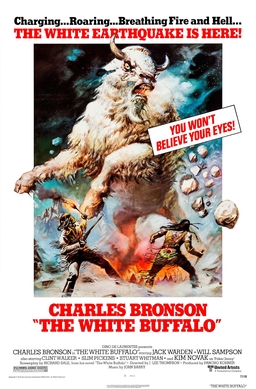
The White Buffalo

Gunfighter and army scout Wild Bill Hickok and Lakota warrior Crazy Horse are two of the most famous (even infamous), recognizable names in the history of the taming of the American west. At any point in their shortened lives -- they died a year apart in 1876 and 1877 -- did they meet? It's an interesting what-if and so goes 1977's The White Buffalo.

Having visited the East, Wild Bill Hickok (Charles Bronson) -- going under the alias 'James Otis' -- returns to the wild west. He has been tortured of late by a nightmare that plagues him night in and night out. It's the same nightmare each night; a vision of an immense white buffalo bearing down on him and ready to kill him in a second. Hickok doesn't know what to make of the dream, but when he hears rumors that a white buffalo has been spotted in the Black Hills, he goes on the hunt, bringing a trapper, Charlie Zane (Jack Warden), along for help. The famed gunfighter won't be alone though as they cross the path of Lakota chief Crazy Horse (Will Sampson) who similarly wants to hunt down and kill the alleged white buffalo. Which hunter will get him first?  

This was an odd western to watch. It's from director J. Lee Thompson of Cape Fear and The Guns of Navarone fame. The IMDB summary lists it as a quasi-Jaws ripoff, and it's not completely off base while also not being completely on-point either. Even three days since I've watched it, I'm still not sure exactly what I watched. It comes across as an odd, sometimes enjoyable episodic story that never quite finds a rhythm. Is it about Wild Bill making his return? Is it saying something more profound about the changing times of the west, and even the closing years of the "wild" west? Is it just a cool what-if about pairing two of the most interesting figures in American history? It's probably a little of all of them, but it is definitely hurt by not picking a route and sticking with it.

At its strongest, the focus is on the changing times of the west. Two men -- Hickok and Crazy Horse -- are very similar in personality, character and history. Their only difference? Hickok hates Indians, Crazy Horse hates the never-ending flow of white men into Indian land. As they both search for the white buffalo, they cross each others' paths, each saving the other man's life in a do-or-die situation. They put aside their hatred and differences aside in a quest to accomplish their mutual goals. I liked Bronson's performance a lot, even if it is pretty typical western anti-hero stuff. Sampson rises above a pretty stereotypically written part too as Crazy Horse. He avoids the stilted "Me Indian...you white man....How" conversation and plays well off of Bronson. The high point is Hickok and Crazy Horse talking across a campfire, both men wondering what the future holds.

Of the rest of the cast, Warden is the only one actually given anything more than a cameo. He has some good scenes with Bronson's Hickok, but it's a pretty standard meat and potatoes kind of role. Beyond those three parts, 'Buffalo' consists of a handful of really random cameos. We're not talking 10-15 minutes on-screen. We're talking individual scenes, some no more than a minute or two. Kim Novak gets the meatiest cameo as Poker Jenny, a woman from Hickok's past. Clint Walker also has some fun as Whistling Jack Kileen, a bear of a man gunning for Hickok. Also keep an eye out for Slim Pickens, Stuart Whitman, John Carradine, and Ed Lauter.

One of the oddest things though for 'Buffalo' is just that.....the buffalo. It doesn't look cheap, but it certainly tries for the Jaws-effect. We never really get a pristine, clear at the buffalo. Instead, we get extreme close-ups of the raging buffalo's eyes or his horns, we get far-off shots of the buffalo charging. It doesn't look ridiculous, but it sure approaches it. The final showdown among the buffalo, Hickok and Crazy Horse is pretty cool though. Sure, there are flaws. Any night scene was clearly shot on an indoor set with fake snow, trees and rocks. It looks pretty cheesy. There's also the cool scenes, an almost iconic shot of Hickok wearing his low-brimmed hat, his darkened glasses, his buckskin coat and brace of pistols. So in the end, it's a mixed bag, both good and bad.

The White Buffalo (1977): ** 1/2 /****

Monday, September 17, 2012

Around the World in 80 Days (1956)

There are epics, and then there are EPICS. In the age of such immense, gigantically-scaled films of the 1950s and 1960s, studios pulled out all the stops in hopes of impressing moviegoers. Huge all-star casts with thousands of extras, lavish sets and costumes, and in general, a sight to behold on the big screen. Some movies were just made for a viewing that only a full-size movie theater can offer, like 1956's Around the World in 80 Days.

It is the 1870s and new technological advances have made travel to far-off places not only possible but quicker, more efficient, and more entertaining. A prim and proper Englishman, Phileas Fogg (David Niven), even boasts to his fellow members of the Reform Club that he can travel completely travel around the world in just 80 days. The club members laugh at the thought, but Fogg maintains his stance and a bet is born. With a significant amount of money on the line, Fogg and his assistant/valet, Passepartout (Mexican actor Cantinflas), embark on a journey around the world against the clock with no idea of what will be actually thrown their way during their adventurous travels.

If you were trying to define what an old-school Hollywood epic is to someone who didn't know, this would be a great start. Filming in locations around the world from Japan, the U.S., Thailand, Spain, England, France, Pakistan and China, '80 Days' is a true visual stunner. The screen is filled with incredible locations packed to the gills with the cast and then hundreds and thousands of extras behind them. Director Michael Anderson filmed with a Todd-AO technique, an ultra-widescreen filming process that makes certain shots look like epically wide panoramic shots. I was impressed watching the film on my 32-inch TV. I can only imagine what this film would look like on a movie screen. As well, composer Victor Young's score (which won an Oscar) is light-hearted and fun, keeping the travels moving.

It is hard to criticize this movie on its technical levels. It is far easier to criticize the movie for basically everything else. Oh, didn't see that twist coming, did you? All that epic quality comes at the expense of character, story and any sort of development involving either of those. This is a movie you appreciate, just sit back and enjoy it. The widescreen filming process is a sight to behold, but they become tedious by the 11th or 12th such long shot of a mountain vista, train running down a track, Cantinflas fighting a bull. Yes, I get it. On visuals alone, this is a stunningly beautiful movie. But at almost three-hours long, it feels like nothing more than an extended world travel guide. There never is even the slightest sense of urgency to the 80 day deadline until the final 10 minutes. Instead we get the visual, Niven's Fogg paying someone to right a wrong, then another nature shot.

I'll go into more depth about the supporting cast of thousands in a bit, but let's start with the lead performances. David Niven is one of my favorite actors, but I came away disappointed here. His Fogg is the definition of a prim and proper Englishman. He's even asked 'Why must you be so British?' at one point. At no point though does he actually look interested in bringing the part to life. To me, Niven look bored, and that's tough to say as a fan. Famed Mexican actor Cantinflas sure takes some grief for his part as Passepartout, but I thought he did a fine job with his limited grasp of English. His bit with Red Skelton is a highlight, the duo shoveling food into the others mouth in a very funny routine. Other bigger parts include Shirley MacLaine oddly cast as an Indian princess traveling with Fogg and Passepartout, and Robert Newton as Mr. Fix, a bank investigator trailing Fogg who's convinced the Englishman is an infamous bank robber.

Then there's the cameos, a long list that must put even The Greatest Story Ever Told to shame. Take a deep breath, and here goes. Look out for Finlay Currie, Robert Morley, Noel Coward, Trevor Howard, John Gielgud, Charles Boyer, Gilbert Roland, Cesar Romero, Cedric Hardwicke, Peter Lorre, George Raft, Marlene Dietrich, Frank Sinatra, John Carradine, Buster Keaton, Joe E. Brown, Andy Devine, Victor McLaglen, John Mills and Glynis Johns among others. I include those names because I recognized them in the cast, not because I necessarily saw them in the actual film. They are the 'blink and you'll miss them' type of cameos to the point many don't even register. Sinatra is shown over his shoulder three times and then turns and smiles. Mind you, he doesn't even say anything. He SMILES. That's it. Yes, it's fun seeing all these actors/actresses together but give them something to do.

This is a tough one to review in the end. It's too long, downright dull at times, a visual treat to watch, and a movie experience unlike any other. It's flaws though are crippling. '80 Days' may be three-hour longs but because of its schizo, hyper kinetic energy that bounces all over the place, it feels significantly longer and has not aged well over the years. A movie to be appreciated for its positives for what it does amount to, even if I won't be watching it again anytime soon. Okay, maybe in a movie theater.

Around the World in 80 Days <---trailer (1956): ** 1/2/****         

Tuesday, June 26, 2012

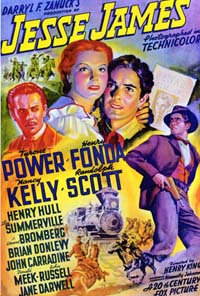
Jesse James

Thanks to films, television shows, dime novels, and with some time gone past, we can now look back at historical figures with rose-tinted glasses. Nowhere is that more evident than with wild west gunslingers, cowboys and outlaws. Some truly bad dudes have been remembered fondly, even as anti-heroes. One that always comes to mind for me is Jesse James, a Confederate guerrilla turned bank robber. He gets the whitewashed hero treatment in 1939's Jesse James.

Helping run the family farm with his mother (Jane Darwell), young Jesse James (Tyrone Power) works with his brother, Frank (Henry Fonda), to create a pleasant life for the family. Their country life is shattered as the railroad moves west, railroad agents ramrodding families off their land. An accident causes the death of the James' boys mother, forcing Jesse and Frank to seek revenge. With rewards posted for their arrest or death, Jesse and Frank are forced into a life of crime, robbing trains and banks as they're on the run. Jesse wants more revenge though, his name growing ever more well known.

Depending on the source, Jesse James is looked at as a heroic rebel, an intelligent bandit, a disturbed thief, and any number of options that fall somewhere in between. From director Henry King, this 1939 western goes an odd route. It makes Jesse a pretty straight hero, not even an anti-hero. We're not talking Butch and Sundance treatment -- it's too blase for that -- but it's approaching that territory. The history is condensed, tweaked and twisted from the start. Yes, it is based in the truth (or at least part of it), but then starts going off route quickly. Powers' Jesse isn't infallible, he's no immaculate hero. Still, it doesn't ring true. Railroad? Uber bad. Bandit? Bad....but he's fighting for his deceased mother.

A star of the 1930s and 1940s, Powers was quite the actor over a career that was cut short by his death in 1957 at the age of 44. I've never seen many of his movies, but he was always a likable enough actor. I came away less than impressed with this effort as the infamous, iconic western bandit, Jesse James. Only part of the blame can be chalked up to him. Even as Jesse's fame rises, we're still seeing him as pretty squeaky clean. Some characters flaws couldn't have hurt. Good or bad though, it just isn't that interesting of a part, and that's saying something. It's Jesse James! How could that not be interesting? It doesn't help the cause that much of the already condensed story is spent on Jesse's developing/loving relationship with Zee (Nancy Kelly), a young woman he's known since they were kids. Yeah! Love story about an outlaw!

Unfortunately for the rest of the cast, what's worth mentioning is that the cast is misused and underused. In a criminally underused part, Fonda is a huge bright spot as Jesse's older brother, Frank. This lanky, laconic, confident young man is a scene-stealer, especially his intro. Still a rising star, Randolph Scott is wasted too as Marshal Will Wright, a peace officer divided between his respect for Jesse and his call to duty. Thankfully, a love triangle isn't a focus of the story among Will, Jesse and Zee. Henry Hull hams it up like a crazy man as drunken newspaperman Rufus Cobb, Zee's uncle. Brian Donlevy has a great part as a sneering, vicious railroad agent who meets Jesse's wrath while John Carradine has a smallish part as Bob Ford, a possibly treacherous member of the James gang. Some interesting characters, just could have used more of them on-screen.

The movie is good and bad -- ridiculous history aside. It's a fondly remembered movie from one of the all-time great years in Hollywood history, 1939, so it does something right. There's some impressive scale, some great tracking shots full of hundreds of extras, one especially of Jesse (a stunt double at least) running across the top of a speeding train. It's a beautiful movie, and some scenes truly stand out, like the botched Northfield robbery and a subsequent chase. At just 106 minutes though, some 16 years of history is condensed into a rushed story. Maybe a rewatch would help, but for now, my first impression was pretty lukewarm. Some parts definitely work, but not on the whole.

Jesse James <---Youtube clip (1939): **/****

Tuesday, November 15, 2011

Drums Along the Mohawk

As far as solid years go for a director, 1939 was epically successful for John Ford with three classic or near-classic films. The most well-known is Stagecoach, but Young Mr. Lincoln and Drums Along the Mohawk are two of my favorites too. John Ford doing an American Revolution story without most of the trappings and pitfalls that plague so many of his movies? Count me in, one of my childhood favorites and a movie I've seen countless times.

It's 1776 in upstate New York and newlywed couple Gil Martin (Henry Fonda) and his wife, Lana (Claudette Colbert) are moving into the wilderness, a frontier cabin in Deerfield near the colonial settlement at German Falls. The revolution has started, the colonies declaring their independence from Britain. In Deerfield and the Mohawk Valley, the war seems a long way off as Gil and Lana build up a new live for themselves, starting from the ground up. Colonists loyal to the British, Tories, have stirred up the Indian tribes though, and now the outnumbered colonists find themselves fighting in a war that looked like it passed them by. Right in the mix? Gil and Lana protecting their young family and homestead as the war rages on around them.

Movies about the American Revolution are few and far between so you've got to enjoy them as you stumble onto them. Imagine a Ford western transplanted back to the late 1770s and early 1780s with the British and Indians replacing the bandits and Plains Indians. I grew up watching this movie and have always loved it. 'Mohawk' was filmed in Utah -- not exactly a look-a-like for upstate New York -- but it is a stunningly beautiful movie, especially impressive considering the movie is over 70 years old. Throw in a Yankee Doodle themed score from Alfred Newman, and you've got all the elements for a winner. 

Monday, May 23, 2011

Captain Kidd

The name is synonymous with the idea of a pirate, Captain William Kidd, a supposed pirate tried, sentenced and executed in 1701 for his actions as a pirate on the high seas. Historians debate now whether Kidd was in fact a pirate because much of his actions seemed to correspond more with the idea of a privateer, not a pirate. Nonetheless, his name still conjures up stereotypical pirates with eye patches and parrots on their shoulders. Released in 1945, Captain Kidd is anything but historically accurate no matter who or what the real-life Kidd was like. It's a Hollywood take on his "pirating" years, historical accuracy be damned.

Right in the middle of Hollywood's Golden Era, Captain Kidd was released when high seas adventures were at their most popular. Swashbuckling adventures starring Errol Flynn always went over well with audiences, and the appeal is clear when watching films like these. Traveling across thousands of miles of open water on tall ships does have an air of romanticism even though the life had nothing romantic or glamorous about it. Idealized is a good way to describe the life of a sailor on these ships, but it can be fun just to imagine what the life was like. In this case, Kidd is a very smart, very devious captain, always looking for a way to become rich himself, making promises to anyone who will listen only to turn on them the first chance he gets. Sounds like a good guy, doesn't he?

After looting an English ship off Madagascar, Captain William Kidd (Charles Laughton) and three officers (John Carradine, Gilbert Roland, and Sheldon Leonard) bury piles of treasure taken from the ship. They return to London, no one the wiser of what they've just done. Ever the convincing sort, Kidd manages to acquire a contract as an escort of an English ship traveling from India back to London by way of Madagascar. With a crew of pardoned convicts, Kidd's ship heads south around South Africa looking to meet their future target. Kidd has some ulterior motives though, starting with killing off his three officers who also know the location of the buried treasure. He's suspicious though of one of the crew, Adam Mercy (Randolph Scott), who he believes to be a spy placed on board by the English king to keep an eye on things. What are Mercy's intentions, and what exactly is he up to?

Laughton was no stranger himself to movies on the high seas, starring in 1935's Mutiny on the Bounty as the evil Captain Bligh, pushing his crew to a mutiny. In that role, he plays straight evil, a captain with a mean streak down his back like no other. Playing another historical figure here, Laughton gets to have a little more fun with the part. There's no doubt Kidd is the villain. That's not in questions. He connives and backstabs, betrays and lies, doing anything he can to kill off his rivals for the treasure. But in a weird way, he's got this odd ability to be charming in doing it. Granted, you know nothing good will come of anything he does, but he's able to disarm worries almost at will, an ability that certainly comes in handy when eveyrone around him is suspicious of him.

Above all else, Laughton's performance as Captain William Kidd is the best thing the movie has going for it. Bringing that charm to the character, Laughton makes every scene interesting. He is always up to something and then retreats to his cabin where he keeps a list of all his intended targets. When he does start knocking them off, he slowly draws a line through their name, an evil smile ever present on his face. It also doesn't hurt that Laughton's physical appearance throws you off. He's short and chubby, disheveled hair on his head. He doesn't look evil or even particularly bad. That's the fun though, a villain with a sense of humor, that ever-present mean streak, and a sense of paranoia when things start to go against him.

Looking surprisingly young for someone who was 47 years old at the time, Randolph Scott plays...well, Randolph Scott. His Adam Mercy character delivers a good twist about three-quarters of the way into the movie, but not the one you would think or have been led to believe. He's the strong-willed, silent but very capable character who in a lot of movies would have been the lead. Instead, he gets overshadowed by Laughton's performance. Still, it's Randolph Scott, and he's still cool. Carradine and Roland are unfortunately underused, but just by being there, the story is enhanced. I think Carradine always played the bad guy, and Roland gets a crack at his familiar Latin lover part. Throwing in a love interest, Barbara Britton plays Lady Anne, a woman brought on-board who Scott's Mercy looks out for.

Not as well known as so many other entries, Captain Kidd has lapsed into the public domain over the years. What's that mean? No studio holds rights on the movie so anyone who wants to can distribute the film in any form they so choose. Because of this, the prints aren't going to be that good with a grainy, washed out look. Individual shots are different shades of black and white, one scene much too dark and grainy, the next too bright where things are hard to make out. It's not a deal-breaker, but you can't help but notice it as you watch the movie. All complaints aside though, I liked this movie a lot, thanks in great part to Charles Laughton as the titular character, Captain Kidd. The movie would be just okay without him, but as is, it's moved up a notch. You can watch it at Youtube HERE.

Captain Kidd <---TCM clips (1945): ***/****

Wednesday, January 13, 2010

Man Hunt

Plots and conspiracies to kill political figures and social activists among others have existed as long as history itself. The flaw (or strength depending on how you look at) with making a movie about those subjects is that much of the time the audience will already know the end of the story. JFK, Lincoln, Ghandi, Archbishop Romero, you know that in the end, they're going to die. The same goes for people who weren't killed, think Day of the Jackal. Charles de Gaulle was not assassinated so it's obvious the Jackal is going to fail.

The enjoyment out of stories based in historical truth is in how the assassin is going to fail. The survivor of many assassination attempts, Adolf Hitler finally took his own life in Berlin in 1945 as the Russian forces closed in all around his underground complex. But for every attempt history has documented, like Valkyrie, how many failed? That's the basic idea of 1941's Man Hunt, an attempt on Hitler's life and the subsequent fallout in the summer of 1939 before Germany invaded Poland.

A tense opening sequence introduces a lone man, Alan Thorndike (Walter Pidgeon) walking through some a densely-wooded forest area. Armed with a precision rifle, Thorndike sets up a shot and is ready to take it. Who's in his scope? Adolf Hitler, the leader of the Third Reich. But before he can shoot, he's stopped by a guard. Under intense interrogation, Thorndike won't admit he was trying to kill Hitler. Instead, he says he just wanted to know what it felt like to have Hitler in his sights, but of course no one believes him. Thorndike refuses to sign a confession and ends up escaping when his captors attempt to kill him, all the while trying to make it seem like an accident.

Running for his life, Thorndike somehow makes it to safety, stowing away on a Danish freighter meant for London. But he isn't as safe as he thinks and soon finds out that two German agents are on his trail, Maj. Quive-Smith (George Sanders) and Mr. Jones (John Carradine). Thorndike gets help from a lower class British woman, Jerry Stokes (Joan Bennett), who has no idea what's she stepped into. Thorndike knows he cannot be captured, but he also can't go to the English government for help. He's completely on his own and must figure out a way to survive.

The premise is very interesting, and the opening sequence is a great introduction to the story. Seeing Hitler in Thorndike's sights is a startling moment because even when he places a bullet in the chamber, it's obvious he won't pull the trigger, not successfully at least. But the movie goes downhill almost immediately after this extended sequence. Thorndike escapes when the Germans plan to make his death look like an accident in a truly ridiculous scene. He's pushed off a cliff -- a high one at that -- but somehow survives without as much as a broken bone. I had trouble believing that Hitler's security force would have waited till hours later to check that the man was dead. On a bigger level, more likely they would have put a bullet in his head and not thought twice about it before even heading up to that cliff.

But it doesn't stop there as Thorndike seeds aid from Bennett's Jerry. This plot device has been used countless times and usually in a much stronger fashion; an unknowing, sometimes unwilling individual gets involved in some dangerous situation and decides to go all in. But watching the character, all I could think of was how she acts like a pouting toddler most of the time. Thorndike does his best to look out for her and keep her out of danger, but she grimaces, scrunches up her face and demands to be taken along. At one point, she even demands he buy her a new pin for her hat because her favorite one fell off when they were being chased. Granted, this pin serves a purpose late in the movie, but that doesn't take away the unnecessarily obnoxious make-up of the character.

All those logistical flaws -- incompetent Nazis, really? -- and annoyances aside, this would be a good movie. Having the Gestapo hunting you down does have its fair share of worry and tension involved. Two chase scenes, one in a busy London subway station, and the other a race through the streets on a foggy night, highlight the movie's better aspects. But too often, Pidgeon acts like the proper English gentleman, shrugging off the situation with a 'tut, tut' and 'cheerio, old chap' but in these scenes it'd be hard to ruin the atmosphere. His confrontations with the German agents are surprisingly graphic, not in what they show but what's actually happening in terms of violence, especially considering it was released in 1941.

Could have been an excellent WWII thriller but the flaws are just too much to ignore. Good villainous turns for Sanders and Carradine as the German agents on the hunt (Carradine barely says 10 words and is terrifying as all hell). The premise alone might make you want to check this one out, and I won't say 'don't do it' but be forewarned about a very flawed and sometimes entertaining movie. The ending is a little much too, even for a movie with a propaganda motive. Sorry, couldn't find a trailer anywhere.

Man Hunt (1941): **/****