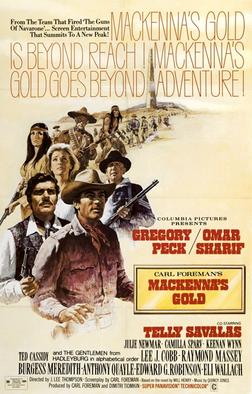
Oh, cable, how I love you. I basically have two channels on if I'm watching TV, either MLB Network or Encore Westerns. A whole channel devoted to western TV shows and movies?!? Aaahhh my head just exploded! It gives me a chance to revisit a whole bunch of movies I haven't seen in years, like 1969's Mackenna's Gold, a big-budget, all-star extravaganza that I remember liking (I think) on my first viewing. Does it hold up?
A marshal for the western town of Hadleyburg, Mackenna (Gregory Peck) is out on the trail when he's ambushed by an old Apache man who dies after a quick shootout. Before he dies, the Apache gives Mackenna a map to a famous, supposedly lost, canyon of gold ('Canon del Oro') that treasure hunters have long sought. Mackenna throws the map in the fire but not before noticing a couple landmarks on it. He's soon cornered by a Mexican bandit, Colorado (Omar Sharif), and his gang who similarly are looking for the canyon of gold. They're not alone. The desert seems full of treasure hunters and gold-hopefuls desperately searching for the gold. Discovering that Mackenna may hold the key to finding the canyon, he's taken along as Colorado's unwilling prisoner. The supposed location is days away across the vast desert with Mackenna, Colorado and his men forced to deal with a do-good posse out of Hadleyburg, an intervening cavalry troop and an Apache war party. How far will the prospect of gold drive all these folks?
I'm a sucker for westerns -- good and bad -- but this one is bad and just not that enjoyable. Talk about a movie where the ingredients don't come together (at all), and you've got this movie. The talent on-hand is unquestionable from director J. Lee Thompson, stars Gregory Peck and Omar Sharif leading a ridiculously deep cast, a cool, potential-filled story and a drop-dead look to it all...it should have been so much better. Or I guess I'd settle for just 'good' too. The formula seems to go after a western Guns of Navarone meets Treasure of the Sierra Madre combination, but it never jells into anything remotely coherent or especially enjoyable. That's tough to say because a cast this good should make a movie pretty decent on its own but alas, it wasn't meant to be this time! If you're looking for a Peck-Thompson-Carl Foreman pairing, stick with 'Navarone.'
Kudos to Encore Westerns. Watching the movie for the second time but first time since 2009, I watched it in widescreen, as it was meant to be. Thompson filmed in Super Panavision 70, a filming technique that fills the screen to epic proportions, almost like a panoramic picture. Shooting on-location in Monument Valley, Glen Canyon and Canyon de Chelly in Arizona adds a great visual appeal to the movie. Shots of riders galloping across these expanses are excellent to watch, a sight to behold, and unfortunately, one of the few genuine positives to take away from a western that's too long at 128 minutes. When a movie's looks are the best thing going...that's never a good thing.
Poor Gregory Peck, he looks like he's as bored as all get-out and doesn't quite know what to do. One of my all-time favorite actors, he's undone by all the shenanigans going on around him. Getting to play straight man to a murdering bandit, a gold-for-eyes posse, a bloodthirsty Apache war party, a murdering cavalry sergeant (an underused Telly Savalas), and all sorts of ancient legends coming to life is never a good thing. As reliable as anyone who's ever graced the screen, Peck is given little more to do than look out for Camilla Sparv's damsel in distress while navigating a love triangle with Julie Newmar's Apache warrior and Sparv. Yeah, you read that right. Catwoman plays an Apache warrior and looks great doing it! She even gets an odd nude swimming scene where she tries to kill both Peck and Sparv. So there's that!
So much of the rest of the cast is simply miscast. I like Sharif in just about any film he's ever done, but he's an odd choice to play our Mexican bandit, Colorado. His gang includes Keenan Wynn as a Mexican bandit named Sanchez, with Ted Cassidy (Lurch from The Addams Family), Rudy Diaz and Robert Phillips as Apache warriors. All spot-on casting! Brace for this list of appearances that amount to little more than cameos, members of a "posse" out of Hadleyburg that's looking for gold. The group includes Eli Wallach, Anthony Quayle, Lee J. Cobb, Burgess Meredith, Raymond Massey and Edward G. Robinson!!! Look at that Hollywood royalty! Unfortunately, they're introduced, given nothing to do and there basically because of their name recognition. So....yeah....there's that! Quite the cast, huh? I just wish they were given more to do. Maybe that character development was cut from the rumored 3-hour version of the film. Yeah, that's it I'm sure.
Just too many moving pieces that never get going in the same direction. There's virtually no story, just some character introductions and then they're off into the desert. The only detour are various ways to kill off characters in waves. Then, there's the beautiful location shooting, with a slight problem. Countless times, one after another, we see the location shots and then a quick cut to our actors in front of a rear projection shot. Nothing takes you out of the story's momentum like Peck, Sharif and Co. riding a "horse" as they tear across the desert. Throw in some odd, out of place narration (it's not Victor Jory's fault!), some painful theme ballads, and generally odd cutting and editing that is more and more jarring with each passing scene.
There's a meanness to the story that's hard to account for. Characters are introduced for the sake of dispatching them in unceremonious fashion, but the general tone of the movie itself isn't that dark. It feels like they're going for that "Greed will make you do horrible things" tone, but it's too light, fluffy and goofy to pull it off. There's some potential obviously with the all-star cast, some equally impressive camera angles and shots, and the location shooting, but there's just too much negative going on to ignore it. A stinker.
Mackenna's Gold (1969): **/****
The Sons of Katie Elder
"First, we reunite, then find Ma and Pa's killer...then read some reviews."
Showing posts with label Eli Wallach. Show all posts
Wednesday, December 30, 2015
Thursday, December 18, 2014
Tough Guys
Two of the biggest stars of the 1940s, 1950s and 1960s, Burt Lancaster and Kirk Douglas were frequent collaborators during their distinguished careers, doing seven films together. The two best -- for me -- are Gunfight at the O.K. Corral and Seven Days in May, but I've seen a couple others. Well, here's their last venture together, 1986's Tough Guys.
Having served 30 years in prison, Harry Doyle (Lancaster) and Archie Long (Douglas) have finally earned their parole. The veteran bank robbers are reintroduced to a world vastly different than the one they left. Now 72-year old Harry and 67-year old Archie have to figure things out if they hope to make it on the outside, starting with their new living arrangements. Because of his age, Harry is forced to live in a retirement home while Archie moves in at a small apartment and tries to hold down minimum wage jobs. Can they handle their new lives? Can 1980s Los Angeles possibly handle them? The two friends and ex-cons are going to try their hardest, but their checkered pasts may pop up to slow them down and make their readjustment that much harder...if they get through it at all.
As I watched this 1980s action-comedy from director Jeff Kanew, a thought crossed my mind. That can be pretty rare so I've gotta enjoy them when they make their appearances. You know that movie is? A forerunner for a whole sub-genre of flicks that seemed to pop up in the 1990s and still appear here and there. The OLD GUY movie! Since 1986, we've seen the Grumpy Old Men movies, My Fellow Americans, Last Vegas, and probably a bunch more I'm not thinking of. It isn't a good movie, but it is mildly entertaining, most of that because the talent involved is very impressive. It has some laughs but also tries really hard to get those laughs.
It's a premise that would be used in far better fashion some seven years later in The Shawshank Redemption when James Whitmore's Brooks is paroled and discovers a world nothing like the one he left. Here, the goal obviously isn't on the same dramatic level. It's laughs. So what do we get? Two old pros in Lancaster and Douglas wearing some impeccably stylish and impeccably dated hats and fedoras navigating Los Angeles. They're still tough guys, handling street toughs (typically with a swift kick to the crotch), dancing like a crazy person at a night club, and even stumbling into their old watering hole only to find that the bar is now...a gay bar! Oh, the hijinks people will get into, huh?!?
Still, it's Burt Lancaster and Kirk Douglas. Yeah, there are times where you feel like they're far, far better than the source material. Okay, basically the entire movie. These guys are Hollywood legends for a reason, and they don't disappoint. They commit to the script and the parts, breathing some energy into a movie that would have been dead on arrival without that energy. Setting the story in 1980s L.A. does add a fun flavor to the story, and the duo has a great chemistry throughout. Their dynamic reminded me of Paul Newman and Robert Redford as Butch and Sundance if they had made it out of Bolivia. Their dialogue just flows as smoothly as possible. They're got their routines, they've got their plans in a row, and at times, they bitch and moan at each other like an old married couple. About what you'd expect to see from two guys who spent 30 years in jail together. A movie worth watching because of Lancaster and Douglas.
Who else to look out for? Charles Durning as the cop who put Harry and Archie away some 30 years ago and is now suspicious of what they're up to, Alexis Smith as a former flame from Harry's past, a young Dana Carvey as the duo's adoring parole officer, Darlanne Fluegel as a much younger woman who's drawn to Archie's manliness, and Eli Wallach as a bespectacled killer looking to take the train-robbing duo out after years of waiting for a chance.
By the hour-mark, things get a little more predictable than they already were. They struggle to adjust? Ah what?!? Their solution makes perfect sense as they turn back to a life of crime. It gets goofy at times and downright dumb at others, especially the closing scene. But all that said, it's still Burt Lancaster and Kirk Douglas.
Tough Guys (1986): ** 1/2 /****
Having served 30 years in prison, Harry Doyle (Lancaster) and Archie Long (Douglas) have finally earned their parole. The veteran bank robbers are reintroduced to a world vastly different than the one they left. Now 72-year old Harry and 67-year old Archie have to figure things out if they hope to make it on the outside, starting with their new living arrangements. Because of his age, Harry is forced to live in a retirement home while Archie moves in at a small apartment and tries to hold down minimum wage jobs. Can they handle their new lives? Can 1980s Los Angeles possibly handle them? The two friends and ex-cons are going to try their hardest, but their checkered pasts may pop up to slow them down and make their readjustment that much harder...if they get through it at all.
As I watched this 1980s action-comedy from director Jeff Kanew, a thought crossed my mind. That can be pretty rare so I've gotta enjoy them when they make their appearances. You know that movie is? A forerunner for a whole sub-genre of flicks that seemed to pop up in the 1990s and still appear here and there. The OLD GUY movie! Since 1986, we've seen the Grumpy Old Men movies, My Fellow Americans, Last Vegas, and probably a bunch more I'm not thinking of. It isn't a good movie, but it is mildly entertaining, most of that because the talent involved is very impressive. It has some laughs but also tries really hard to get those laughs.
It's a premise that would be used in far better fashion some seven years later in The Shawshank Redemption when James Whitmore's Brooks is paroled and discovers a world nothing like the one he left. Here, the goal obviously isn't on the same dramatic level. It's laughs. So what do we get? Two old pros in Lancaster and Douglas wearing some impeccably stylish and impeccably dated hats and fedoras navigating Los Angeles. They're still tough guys, handling street toughs (typically with a swift kick to the crotch), dancing like a crazy person at a night club, and even stumbling into their old watering hole only to find that the bar is now...a gay bar! Oh, the hijinks people will get into, huh?!?
Still, it's Burt Lancaster and Kirk Douglas. Yeah, there are times where you feel like they're far, far better than the source material. Okay, basically the entire movie. These guys are Hollywood legends for a reason, and they don't disappoint. They commit to the script and the parts, breathing some energy into a movie that would have been dead on arrival without that energy. Setting the story in 1980s L.A. does add a fun flavor to the story, and the duo has a great chemistry throughout. Their dynamic reminded me of Paul Newman and Robert Redford as Butch and Sundance if they had made it out of Bolivia. Their dialogue just flows as smoothly as possible. They're got their routines, they've got their plans in a row, and at times, they bitch and moan at each other like an old married couple. About what you'd expect to see from two guys who spent 30 years in jail together. A movie worth watching because of Lancaster and Douglas.
Who else to look out for? Charles Durning as the cop who put Harry and Archie away some 30 years ago and is now suspicious of what they're up to, Alexis Smith as a former flame from Harry's past, a young Dana Carvey as the duo's adoring parole officer, Darlanne Fluegel as a much younger woman who's drawn to Archie's manliness, and Eli Wallach as a bespectacled killer looking to take the train-robbing duo out after years of waiting for a chance.
By the hour-mark, things get a little more predictable than they already were. They struggle to adjust? Ah what?!? Their solution makes perfect sense as they turn back to a life of crime. It gets goofy at times and downright dumb at others, especially the closing scene. But all that said, it's still Burt Lancaster and Kirk Douglas.
Tough Guys (1986): ** 1/2 /****
Labels:
1980s,
Burt Lancaster,
Charles Durning,
Eli Wallach,
Kirk Douglas
Tuesday, May 6, 2014
The Magnificent Seven
Why
do some movies stick with you more than others? I grew up watching
westerns and war movies from the 1950s and 1960s, movies that still
dominate my all-time Top 10, movies like The Alamo, The Great Escape,
The Dirty Dozen, The Good, the Bad and the Ugly, The Professionals and
several others. They still resonate now more than a few years later. Oh,
and of course, 1960's The Magnificent Seven.
Several years back I reviewed all four movies (the original and the 3
sequels), and it's been too long. Time for an updated review. The
original and still best, one of the best westerns ever and a personal
favorite.
South of the border in a small farming village, a bandit named Calvera (Eli Wallach) rides in and steals almost everything he and his gang of 40 bandits can carry, leaving just enough for the village to survive and start all over again. The villagers decide they've had about enough, riding north into Texas to buy guns so they can fight back against Calvera's gang. Instead, they meet Chris (Yul Brynner), a mysterious gunfighter clad in black who recommends they hire men rather than buy guns. Chris agrees to help, recruiting six other gunfighters from varying backgrounds, including an amiable drifter and gunfighter, Vin (Steve McQueen), to help out. The money is poor, the mission is more than difficult and the odds are stacked against them. Chris and the six gunslingers ride south, ready to help the village and fight off Calvera, odds be damned.
What a good movie. From director John Sturges (a master of 'Movies for Men'), 'Seven' came along at an interesting time for the western genre. Things, they were a'changing. Westerns were becoming more cynical, darker, more introspective, eventually transforming into the spaghetti western and the folksy, revisionist westerns of the 1970s. As fondly remembered as 'Seven' is now, it struggled in theaters in the U.S. upon its initial release, finding huge success in Europe and Asia before being re-issued in the U.S. several years later. It is an Americanized version of Akira Kurosawa's classic film, Seven Samurai, transplanting samurais for wild west gunfighters. It's interesting for any number of reasons, from the music to the budding star power on display, the dark tone to the exciting action scenes. A favorite of mine, a four-star review, and I won't really debate it. So there!
How about that casting?!? Much of the cast would go on to become huge stars, but here in 1960, they were relative unknowns. Brynner was the established star, The King and I, The Ten Commandments already to his name, and he's the pulse of the movie. His Chris is the unflappable leader of the group, a capable gunfighter who's also got all the qualities a leader should have. Loyal, strong, and tough. McQueen steps up to the plate in his first starring role. His Vin is easy-going, a drifter looking for work, quite good with his gun but maybe looking for something else in his life. Brynner and McQueen had a tumultuous relationship on the set -- McQueen trying to upstage the established star -- but the result is more than solid. Their chemistry crackles, their scenes together that perfect dynamic between the commander and his right-hand man. As the bandit Calvera, Wallach is an effortless scene-stealer, disappearing for huge stretches only to return with a vengeance.
And then there's the rest of the seven, because Brynner and McQueen weren't enough, right? Right?!? First, there's Charles Bronson as Bernardo O'Reilly, a half-Mexican, half-Irish gunman who has quite the reputation for cleaning up nasty jobs and his price is high...usually. He bonds with three boys from the village who "got him," promising to watch over him and care for his grave should he die in battle. Then, there's James Coburn as Britt, the laconic, knife-throwing specialist who has few equals with knife or gun. Coburn says about 30 words the entire movie and steals every scene he's in. Next, Robert Vaughn as Lee, a hired gun who's lost his edge, convinced he is facing his death. Next up, Brad Dexter as Harry Luck, a friendly gunslinger convinced there's more to the job than Chris is saying. Finally, there's Horst Buchholz as Chico, the young, unproven kid looking to make a name for himself with his more established cohorts.
As if that star power wasn't enough to carry a movie, I liked the characterization of these gunslingers more than anything. That's something I've picked up on repeated viewings as I got older. The portrayal of these hired guns is honest, not looking to glamorize these men. They're tied down by nothing, drift along from job to job, all the while risking their lives knowing that any job could be their last. What do they have? Their guns, their horse and maybe most importantly, their word. 'Seven' boasts one of my all-time favorite scenes, in westerns and films in general. Given a chance to run from a battle against seemingly insurmountable odds, they opt to stay. Coburn's Britt famously says "No one throws me my own guns and says run....Nobody." When offered the chance to run, Vaughn's Lee is told "Go ahead, Lee, you don't owe anything to anybody." His answer? "Except to myself." That's the essence and spirit of the movie. Men in a nasty situation doing what's right because it's what they should do, what is right. Profoundly simple, it always sticks with me, these men living by their code and what they believe in.
As for the villagers, look for Vladimir Sokoloff as the Old Man, the village patriarch who has little use for the whiny farmers, Jorge Martinez de Hoyos as Hilario, the fiery farmer ready to side with the gunmen, Pepe Hern and John Alonzo his close friends, Rico Alaniz as Sotero, the quasi-mayor of the village trying to weigh all his options and lastly, Rosenda Monteros as Petra, the young woman in the village who takes a liking to Buchholz's Chico. Also look for familiar western faces Robert J. Wilke and Whit Bissell in quick scenes.
More than anything else though, I think what's lasted the longest in the social conscience is composer Elmer Bernstein's musical score. The soundtrack is one of the all-time greats, the main theme a whistle-worthy track that will be running through your head for days. This is what big movie soundtracks can be. They add something to the movie itself, like a new but essential character. If you're not familiar with it (and even if you are), listen HERE. Just a great score, moving, adrenaline-pumping and emotional as needed. An all-time great score from an all-time great composer.
The story covers a lot of ground over its 128-minute running time. The story is fairly episodic, starting with the essential and entertaining recruiting of the team, Brynner's Chris seeking the gunmen out for the job. Each snippet gives each actor his chance to stand out on their own before becoming part of the group. Coburn's classic introduction especially stands out. From there, it's one great scene after another, both as entertainment value but also for delving into all the characters from the Seven to the villagers to Calvera. There isn't a ton of action, but the gunplay stands out, two featured sequences as the Seven tangle with Calvera's gang. It's the final battle that packs the emotional punch, the odds finally taking their toll on this group of gunfighters we've come to like and root for. It's a downbeat ending when you really consider it, but it's the right ending for this story and the characters.
Just a great movie. It was a favorite growing up and always will be. One of the best westerns ever, and an easy one to recommend for fans of the western genre or for someone just being introduced to the genre as a whole. A classic, plain and simple.
The Magnificent Seven (1960): ****/****
Rewrite of September 2009 review
South of the border in a small farming village, a bandit named Calvera (Eli Wallach) rides in and steals almost everything he and his gang of 40 bandits can carry, leaving just enough for the village to survive and start all over again. The villagers decide they've had about enough, riding north into Texas to buy guns so they can fight back against Calvera's gang. Instead, they meet Chris (Yul Brynner), a mysterious gunfighter clad in black who recommends they hire men rather than buy guns. Chris agrees to help, recruiting six other gunfighters from varying backgrounds, including an amiable drifter and gunfighter, Vin (Steve McQueen), to help out. The money is poor, the mission is more than difficult and the odds are stacked against them. Chris and the six gunslingers ride south, ready to help the village and fight off Calvera, odds be damned.
What a good movie. From director John Sturges (a master of 'Movies for Men'), 'Seven' came along at an interesting time for the western genre. Things, they were a'changing. Westerns were becoming more cynical, darker, more introspective, eventually transforming into the spaghetti western and the folksy, revisionist westerns of the 1970s. As fondly remembered as 'Seven' is now, it struggled in theaters in the U.S. upon its initial release, finding huge success in Europe and Asia before being re-issued in the U.S. several years later. It is an Americanized version of Akira Kurosawa's classic film, Seven Samurai, transplanting samurais for wild west gunfighters. It's interesting for any number of reasons, from the music to the budding star power on display, the dark tone to the exciting action scenes. A favorite of mine, a four-star review, and I won't really debate it. So there!
How about that casting?!? Much of the cast would go on to become huge stars, but here in 1960, they were relative unknowns. Brynner was the established star, The King and I, The Ten Commandments already to his name, and he's the pulse of the movie. His Chris is the unflappable leader of the group, a capable gunfighter who's also got all the qualities a leader should have. Loyal, strong, and tough. McQueen steps up to the plate in his first starring role. His Vin is easy-going, a drifter looking for work, quite good with his gun but maybe looking for something else in his life. Brynner and McQueen had a tumultuous relationship on the set -- McQueen trying to upstage the established star -- but the result is more than solid. Their chemistry crackles, their scenes together that perfect dynamic between the commander and his right-hand man. As the bandit Calvera, Wallach is an effortless scene-stealer, disappearing for huge stretches only to return with a vengeance.
And then there's the rest of the seven, because Brynner and McQueen weren't enough, right? Right?!? First, there's Charles Bronson as Bernardo O'Reilly, a half-Mexican, half-Irish gunman who has quite the reputation for cleaning up nasty jobs and his price is high...usually. He bonds with three boys from the village who "got him," promising to watch over him and care for his grave should he die in battle. Then, there's James Coburn as Britt, the laconic, knife-throwing specialist who has few equals with knife or gun. Coburn says about 30 words the entire movie and steals every scene he's in. Next, Robert Vaughn as Lee, a hired gun who's lost his edge, convinced he is facing his death. Next up, Brad Dexter as Harry Luck, a friendly gunslinger convinced there's more to the job than Chris is saying. Finally, there's Horst Buchholz as Chico, the young, unproven kid looking to make a name for himself with his more established cohorts.
As if that star power wasn't enough to carry a movie, I liked the characterization of these gunslingers more than anything. That's something I've picked up on repeated viewings as I got older. The portrayal of these hired guns is honest, not looking to glamorize these men. They're tied down by nothing, drift along from job to job, all the while risking their lives knowing that any job could be their last. What do they have? Their guns, their horse and maybe most importantly, their word. 'Seven' boasts one of my all-time favorite scenes, in westerns and films in general. Given a chance to run from a battle against seemingly insurmountable odds, they opt to stay. Coburn's Britt famously says "No one throws me my own guns and says run....Nobody." When offered the chance to run, Vaughn's Lee is told "Go ahead, Lee, you don't owe anything to anybody." His answer? "Except to myself." That's the essence and spirit of the movie. Men in a nasty situation doing what's right because it's what they should do, what is right. Profoundly simple, it always sticks with me, these men living by their code and what they believe in.
As for the villagers, look for Vladimir Sokoloff as the Old Man, the village patriarch who has little use for the whiny farmers, Jorge Martinez de Hoyos as Hilario, the fiery farmer ready to side with the gunmen, Pepe Hern and John Alonzo his close friends, Rico Alaniz as Sotero, the quasi-mayor of the village trying to weigh all his options and lastly, Rosenda Monteros as Petra, the young woman in the village who takes a liking to Buchholz's Chico. Also look for familiar western faces Robert J. Wilke and Whit Bissell in quick scenes.
More than anything else though, I think what's lasted the longest in the social conscience is composer Elmer Bernstein's musical score. The soundtrack is one of the all-time greats, the main theme a whistle-worthy track that will be running through your head for days. This is what big movie soundtracks can be. They add something to the movie itself, like a new but essential character. If you're not familiar with it (and even if you are), listen HERE. Just a great score, moving, adrenaline-pumping and emotional as needed. An all-time great score from an all-time great composer.
The story covers a lot of ground over its 128-minute running time. The story is fairly episodic, starting with the essential and entertaining recruiting of the team, Brynner's Chris seeking the gunmen out for the job. Each snippet gives each actor his chance to stand out on their own before becoming part of the group. Coburn's classic introduction especially stands out. From there, it's one great scene after another, both as entertainment value but also for delving into all the characters from the Seven to the villagers to Calvera. There isn't a ton of action, but the gunplay stands out, two featured sequences as the Seven tangle with Calvera's gang. It's the final battle that packs the emotional punch, the odds finally taking their toll on this group of gunfighters we've come to like and root for. It's a downbeat ending when you really consider it, but it's the right ending for this story and the characters.
Just a great movie. It was a favorite growing up and always will be. One of the best westerns ever, and an easy one to recommend for fans of the western genre or for someone just being introduced to the genre as a whole. A classic, plain and simple.
The Magnificent Seven (1960): ****/****
Rewrite of September 2009 review
Monday, April 21, 2014
How the West Was Won
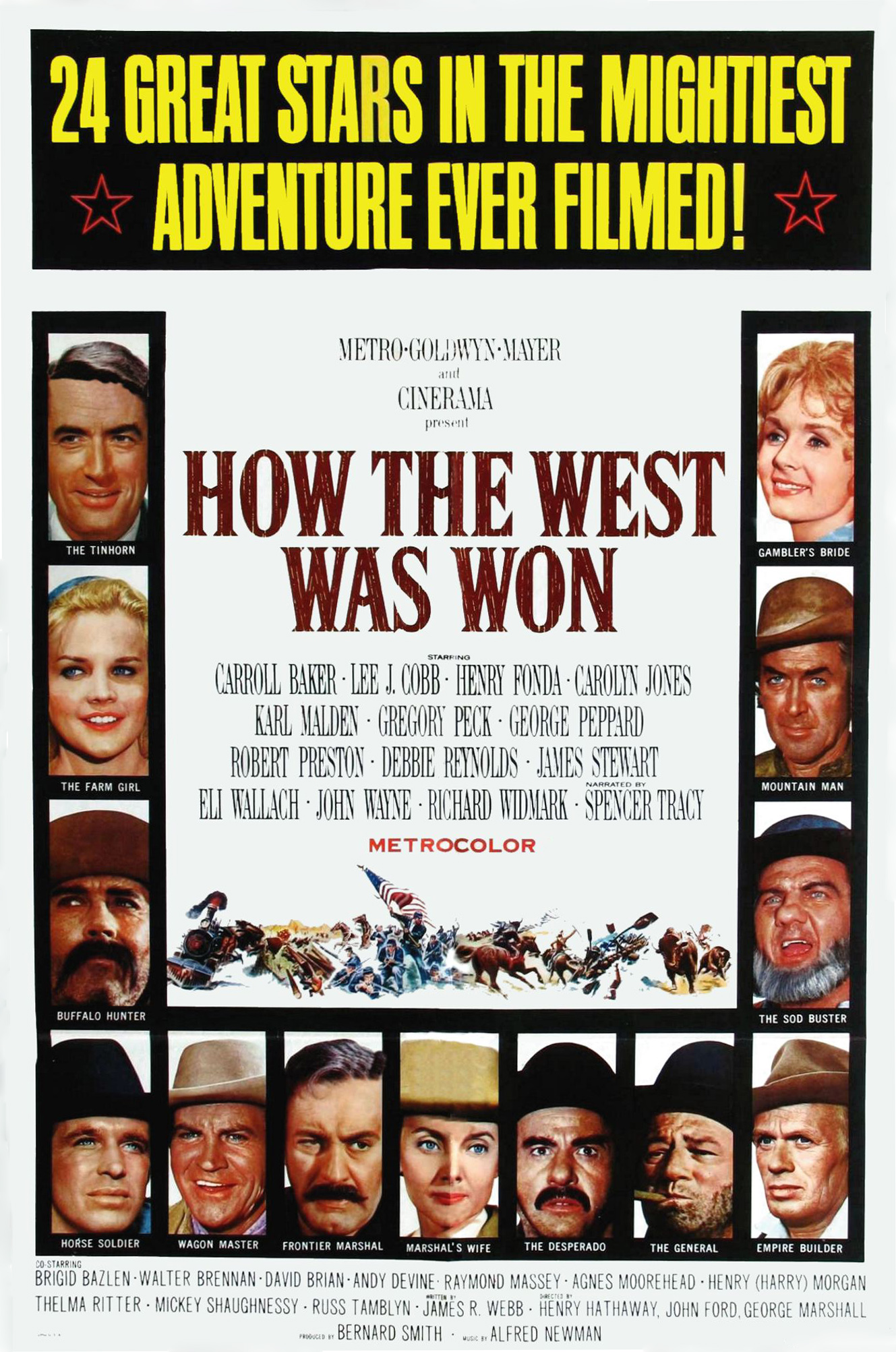
In the age of the epics -- the 1950s and 1960s -- some just stand above the rest. It's the stories, the cast, the scope. I don't love 1962's How the West Was Won but as far as epics go, there are very few in its neighborhood. There are obvious flaws, but when it works, it works in a big way. An impressive all-star cast, a story about the development of the American west and a shooting technique that is must-see. That's a winning formula.
A 162-minute film is broken up into five separate segments, the story following the Prescott-Rawlings family as it moves west and settles between the 1840s and the 1880s. It was directed by three different directors and covers a ton of ground. And away we go!
1. The Rivers (directed by Henry Hathaway): It's the 1840s, and the Prescott family, led by patriarch Zebulon (Karl Malden), is moving west and looking for a new life. In Zebulon's family is two daughters, Eve (Carroll Baker), looking for a new life in the west, and Lillith (Debbie Reynolds), wanting to stay in the far-more civilized East. In their dangerous travels on the rivers, they also meet Linus Rawlings (James Stewart), a mountain man with a canoe full of pelts.
Also starring: Lee Van Cleef, Walter Brennan, Agnes Moorehead, Brigid Bazlen.
2. The Plains (directed by Hathaway): Having worked for years on her own as a singer and dancer, Lillith Prescott (Reynolds) has just inherited a gold mine in the wake of the California gold rush. She heads west on a wagon train led by trail driver Richard Morgan (Robert Preston) with a gold-seeking gambler, Cleve Van Valen (Gregory Peck), also along too.
Also starring: Thelma Ritter.
3. The Civil War (directed by John Ford): The war between the states in its early months, young Zeb Rawlings (George Peppard) leaves home with the blessing of his mother, Eve, to join the Ohio volunteers in the fighting. Like so many others, he thinks the war will be full of glory and be over quickly. Zeb finds out how very wrong he is at the bloody battle of Shiloh.
Also starring: John Wayne (as General Sherman), Russ Tamblyn (as a Confederate deserter), Harry Morgan (as General Grant), Andy Devine, Ken Curtis, Raymond Massey (as Abraham Lincoln).
4. The Railroad (directed by George Marshall): In the years following the Civil War, railroad companies race across the U.S. to link the two coasts. Now in the cavalry, Zeb Rawlings (Peppard) finds himself balancing out what his duty requires of him with what he knows is right, the railroad, including brutal supervisor Mike King (Richard Widmark), pushing the Arapahoes to their limit.
Also starring: Henry Fonda as Jethro Stuart, a former mountain man.
5. The Outlaws (directed by Hathaway): Having left the cavalry behind, Zeb Rawlings is now a family man with two kids, now trying to leave his profession as a lawman behind. He receives a letter from his aunt, Lillith (Reynolds), and readies the family to move. As they travel though, Zeb runs into Charlie Gant (Eli Wallach), a notorious outlaw gunning for Zeb.
Also starring: Lee J. Cobb, Carolyn Jones.
This is a movie that's simply put, BIG. It was filmed in Cinerama, three cameras filming each scene and then splicing the action together. The result? An immense look at the expansion of the west. Shots look like panoramic paintings, putting a whole new scope on the growth and development of the American west. It is a beautiful movie. Certain sequences especially stand out -- the camera on a raft trying to survive river rapids, an Indian attack on a wagon train, a stampeding buffalo herd trampling a railroad camp, a runaway train during an attempted robbery -- over the course of the movie, but visually there just isn't a weak spot. I love composer Alfred Newman's score -- listen to an extended sample HERE -- as it gives a moving background to the story. Countless gorgeous filming locations, providing a great backdrop while also transitioning from segment to segment.
It had been years since I watched this movie straight through in one sitting before my recent revisit of this 1962 epic. As you compare the five separate segments, I don't think it's really in question which one is the strongest. It's John Ford's Civil War segment, doing in 20 minutes what entire movies couldn't do in bringing the Civil War to life. Quick, dark, visually striking and unsettling, it is a gem of a sequence, especially Peppard meeting Tamblyn's Confederate deserter after the battle. The second strongest segment for me is the opening 'Rivers' with Stewart, Baker, Reynolds and Malden all leaving a positive impression. All five segments could be stretched out to a feature length film on their own, but these two especially stand out. They get their message across in a quick window and in both cases left me wanting more. Kudos to Ford and Hathaway for their work here.
What struck me more on the rewatch was the other three segments. They are by no means bad segments, but they're just not as good as the other two. I've always thought the weakest was the Plains segment, things feeling too rushed in general. The same qualifies for the Railroad and Outlaws portions. By the time you take away the Entr'Acte, intermission, and Finale music, we're looking at a movie with five segments covered in about 150 minutes (give or take). None of these three are given a chance to breathe to the point they feel downright rushed. As for some other positives? I loved the transitional scenes -- narrated by Spencer Tracy, directed in uncredited fashion by Richard Thorpe -- that set things up, explaining how America has changed, how its people change. These quick montages provide the heart of the movie, almost like a documentary in some ways. Like any movie that tries to accomplish so much, there's good and bad. The positives -- especially the Civil War middle -- is enough to outweigh the negatives thankfully.
One of my biggest worries in reviewing this 1962 epic was that the cast is too big. There's no way I was gonna be able to get all those names tagged with a 200-character limit. Who stands out? Stewart i excellent as Linus Rawlings, Fonda is good in a quick part as Jethro Stuart, and Baker is very strong too. The best parts though are Debbie Reynolds as Lillith and George Peppard as Zeb, the two hearts of the family. One or both is in every segment, the audience seeing them age, learn and adapt as America grows with them. Their scenes together in the Outlaws portion ring especially true. However you cut it though, just an impressive cast from top to bottom, one of the best ever assembled for a Hollywood film.
A doozy of a movie for what it's trying to accomplish. It falls short at times, but this is a movie worth watching for what it represents alone. This is a throwback film, a true epic that strives to be something great. If it doesn't live up those high hopes, so be it. The effort is admirable, a fascinating story of America growing up over an extremely turbulent portion of its history. Oh, and Debbie Reynolds singing A Home in the Meadow (listen HERE) is a truly beautiful song, a fitting one for the movie.
How the West Was Won (1962): ***/****
A 162-minute film is broken up into five separate segments, the story following the Prescott-Rawlings family as it moves west and settles between the 1840s and the 1880s. It was directed by three different directors and covers a ton of ground. And away we go!
1. The Rivers (directed by Henry Hathaway): It's the 1840s, and the Prescott family, led by patriarch Zebulon (Karl Malden), is moving west and looking for a new life. In Zebulon's family is two daughters, Eve (Carroll Baker), looking for a new life in the west, and Lillith (Debbie Reynolds), wanting to stay in the far-more civilized East. In their dangerous travels on the rivers, they also meet Linus Rawlings (James Stewart), a mountain man with a canoe full of pelts.
Also starring: Lee Van Cleef, Walter Brennan, Agnes Moorehead, Brigid Bazlen.
2. The Plains (directed by Hathaway): Having worked for years on her own as a singer and dancer, Lillith Prescott (Reynolds) has just inherited a gold mine in the wake of the California gold rush. She heads west on a wagon train led by trail driver Richard Morgan (Robert Preston) with a gold-seeking gambler, Cleve Van Valen (Gregory Peck), also along too.
Also starring: Thelma Ritter.
3. The Civil War (directed by John Ford): The war between the states in its early months, young Zeb Rawlings (George Peppard) leaves home with the blessing of his mother, Eve, to join the Ohio volunteers in the fighting. Like so many others, he thinks the war will be full of glory and be over quickly. Zeb finds out how very wrong he is at the bloody battle of Shiloh.
Also starring: John Wayne (as General Sherman), Russ Tamblyn (as a Confederate deserter), Harry Morgan (as General Grant), Andy Devine, Ken Curtis, Raymond Massey (as Abraham Lincoln).
4. The Railroad (directed by George Marshall): In the years following the Civil War, railroad companies race across the U.S. to link the two coasts. Now in the cavalry, Zeb Rawlings (Peppard) finds himself balancing out what his duty requires of him with what he knows is right, the railroad, including brutal supervisor Mike King (Richard Widmark), pushing the Arapahoes to their limit.
Also starring: Henry Fonda as Jethro Stuart, a former mountain man.
5. The Outlaws (directed by Hathaway): Having left the cavalry behind, Zeb Rawlings is now a family man with two kids, now trying to leave his profession as a lawman behind. He receives a letter from his aunt, Lillith (Reynolds), and readies the family to move. As they travel though, Zeb runs into Charlie Gant (Eli Wallach), a notorious outlaw gunning for Zeb.
Also starring: Lee J. Cobb, Carolyn Jones.
This is a movie that's simply put, BIG. It was filmed in Cinerama, three cameras filming each scene and then splicing the action together. The result? An immense look at the expansion of the west. Shots look like panoramic paintings, putting a whole new scope on the growth and development of the American west. It is a beautiful movie. Certain sequences especially stand out -- the camera on a raft trying to survive river rapids, an Indian attack on a wagon train, a stampeding buffalo herd trampling a railroad camp, a runaway train during an attempted robbery -- over the course of the movie, but visually there just isn't a weak spot. I love composer Alfred Newman's score -- listen to an extended sample HERE -- as it gives a moving background to the story. Countless gorgeous filming locations, providing a great backdrop while also transitioning from segment to segment.
It had been years since I watched this movie straight through in one sitting before my recent revisit of this 1962 epic. As you compare the five separate segments, I don't think it's really in question which one is the strongest. It's John Ford's Civil War segment, doing in 20 minutes what entire movies couldn't do in bringing the Civil War to life. Quick, dark, visually striking and unsettling, it is a gem of a sequence, especially Peppard meeting Tamblyn's Confederate deserter after the battle. The second strongest segment for me is the opening 'Rivers' with Stewart, Baker, Reynolds and Malden all leaving a positive impression. All five segments could be stretched out to a feature length film on their own, but these two especially stand out. They get their message across in a quick window and in both cases left me wanting more. Kudos to Ford and Hathaway for their work here.
What struck me more on the rewatch was the other three segments. They are by no means bad segments, but they're just not as good as the other two. I've always thought the weakest was the Plains segment, things feeling too rushed in general. The same qualifies for the Railroad and Outlaws portions. By the time you take away the Entr'Acte, intermission, and Finale music, we're looking at a movie with five segments covered in about 150 minutes (give or take). None of these three are given a chance to breathe to the point they feel downright rushed. As for some other positives? I loved the transitional scenes -- narrated by Spencer Tracy, directed in uncredited fashion by Richard Thorpe -- that set things up, explaining how America has changed, how its people change. These quick montages provide the heart of the movie, almost like a documentary in some ways. Like any movie that tries to accomplish so much, there's good and bad. The positives -- especially the Civil War middle -- is enough to outweigh the negatives thankfully.
One of my biggest worries in reviewing this 1962 epic was that the cast is too big. There's no way I was gonna be able to get all those names tagged with a 200-character limit. Who stands out? Stewart i excellent as Linus Rawlings, Fonda is good in a quick part as Jethro Stuart, and Baker is very strong too. The best parts though are Debbie Reynolds as Lillith and George Peppard as Zeb, the two hearts of the family. One or both is in every segment, the audience seeing them age, learn and adapt as America grows with them. Their scenes together in the Outlaws portion ring especially true. However you cut it though, just an impressive cast from top to bottom, one of the best ever assembled for a Hollywood film.
A doozy of a movie for what it's trying to accomplish. It falls short at times, but this is a movie worth watching for what it represents alone. This is a throwback film, a true epic that strives to be something great. If it doesn't live up those high hopes, so be it. The effort is admirable, a fascinating story of America growing up over an extremely turbulent portion of its history. Oh, and Debbie Reynolds singing A Home in the Meadow (listen HERE) is a truly beautiful song, a fitting one for the movie.
How the West Was Won (1962): ***/****
Thursday, February 28, 2013
Wall Street: Money Never Sleeps
One of the more iconic movies to come out of the 1980s, 1987's Wall Street is memorable because of star Michael Douglas and his infamous line, "Greed is good." The movie itself is pretty good, and 23 years after its release, director Oliver Stone decided to return to his iconic character and continue the story with 2010's Wall Street: Money Never Sleeps.
After spending 13 years in jail for insider training and securities fraud, Gordon Gekko (Douglas) is finally given his parole. Some seven years pass, and now he's promoting his new book 'Is Greed Good?' when he meets a young stock broker, Jake Moore (Shia LaBeouf), who is engaged to Gordon's estranged daughter, Winnie (Carey Mulligan). Gordon wants to form a relationship with a daughter who might as well consider him dead. At the same time, Gordon begins to help Jake, a talented, intelligent broker in his own right, as he starts a new job with a high-level firm broker, Bretton James (Josh Brolin), who has rubbed plenty of people the wrong way in his rise to power. With millions and billions of dollars on the line and the massive egos to boot, an epic confrontation looms, but the struggling economy may have the last laugh over everyone involved.
For starters, let's get this somewhat obvious statement out of the way. Like just about any sequel ever, this is basically the definition of unnecessary. Why go back to a movie from 23 years ago and revisit a character -- however iconic -- and story that didn't need revisiting? Oh...the sequel made $130 million in theaters? I suppose that's as good a reason as any. Well, in business at least. Other than the epic economic issues of the last 10 years, there's no real reason to make this sequel. That said, it's not bad. The biggest thing working in positive fashion is the acting. The story lacks a bit of punch -- it's missing something in the energy department -- but I liked it just the same. Unnecessary? Oh, you betcha, but you could do worse.
I like movies, sports, reading. I can B.S. my way through a fair share of conversations. The financial crisis of 2008 is most definitely not one of those things. I have a very basic knowledge of the economic collapse that this sequel goes into in depth, but I'm far from an expert. In other words, some background and/or understanding in big money, Wall Street, stocks, and everything financial will no doubt help your enjoyment of this flick. Because my knowledge of the subject material is limited, I wasn't always crystal clear on what was going on. I still liked it, but it's an issue just the same. End of sidenote.
Without question, the best thing going for Stone's sequel is the return of Michael Douglas as Gordon Gekko. His introduction is perfect, Gekko getting his parole and being released from prison after serving 13 total years in jail. We see him get his possessions back from a suit to a watch to a rather massive cell phone. The message is clear; times have changed, and Gordon is a dinosaur who has to adjust with the times. I think Stone makes an incredibly wise choice. For much of the movie, Gekko is a secondary -- if incredibly important secondary -- character that fleets in and out of the story as needed. Any scene with Douglas in it is worth watching, his appearances bringing the entire movie up a notch just by being there. He makes the others around him better. The new movie itself is unnecessary, but Douglas's appearance makes it worthwhile.
The rest of the cast is solid if unspectacular. It seems no matter the movie, LaBeouf takes grief for any number of things -- wooden acting, bad acting, off-screen antics -- but as long as he's not in loud, obnoxious, and obvious Transformers mode, I like him. It isn't a flashy part (that is left to Douglas, nailing it in subtle fashion), but LaBeouf's Jake is the main character, and for me, an interesting one. Mulligan too is pretty good as Winnie, Gordon's estranged daughter who wants nothing to do with her father. Behind Douglas, I thought the best part was from Brolin as the Wall Street rival with some ulterior motives. Frank Langella is a scene-stealer as well as Louis Zabel, Jake's aging mentor who hates what Wall Street is becoming, Susan Sarandon plays Jake's mom who's heavily invested in real estate, Eli Wallach as a Wall Street dinosaur, and Jason Clarke as the NYC Fed chief. Not necessarily great performances, but it's fun to see all those names assembled.
This 2010 sequel is missing that special something from making it an above-average, truly enjoyable flick. It's good enough, but it's never more than that. Clocking in at 138 minutes, it feels incredibly long in certain stretches. Lots of dialogue isn't a bad thing, but at times, it gets a little tedious, a little slow. Douglas certainly helps the momentum pick up a bit, especially late when we see the Gekko we all love to hate. Charlie Sheen even makes a cameo as Bud Fox, the protagonist in the original Wall Street. I liked this one, didn't love it. Not bad stuff.
Wall Street: Money Never Sleeps (2010): ** 1/2 /****
After spending 13 years in jail for insider training and securities fraud, Gordon Gekko (Douglas) is finally given his parole. Some seven years pass, and now he's promoting his new book 'Is Greed Good?' when he meets a young stock broker, Jake Moore (Shia LaBeouf), who is engaged to Gordon's estranged daughter, Winnie (Carey Mulligan). Gordon wants to form a relationship with a daughter who might as well consider him dead. At the same time, Gordon begins to help Jake, a talented, intelligent broker in his own right, as he starts a new job with a high-level firm broker, Bretton James (Josh Brolin), who has rubbed plenty of people the wrong way in his rise to power. With millions and billions of dollars on the line and the massive egos to boot, an epic confrontation looms, but the struggling economy may have the last laugh over everyone involved.
For starters, let's get this somewhat obvious statement out of the way. Like just about any sequel ever, this is basically the definition of unnecessary. Why go back to a movie from 23 years ago and revisit a character -- however iconic -- and story that didn't need revisiting? Oh...the sequel made $130 million in theaters? I suppose that's as good a reason as any. Well, in business at least. Other than the epic economic issues of the last 10 years, there's no real reason to make this sequel. That said, it's not bad. The biggest thing working in positive fashion is the acting. The story lacks a bit of punch -- it's missing something in the energy department -- but I liked it just the same. Unnecessary? Oh, you betcha, but you could do worse.
I like movies, sports, reading. I can B.S. my way through a fair share of conversations. The financial crisis of 2008 is most definitely not one of those things. I have a very basic knowledge of the economic collapse that this sequel goes into in depth, but I'm far from an expert. In other words, some background and/or understanding in big money, Wall Street, stocks, and everything financial will no doubt help your enjoyment of this flick. Because my knowledge of the subject material is limited, I wasn't always crystal clear on what was going on. I still liked it, but it's an issue just the same. End of sidenote.
Without question, the best thing going for Stone's sequel is the return of Michael Douglas as Gordon Gekko. His introduction is perfect, Gekko getting his parole and being released from prison after serving 13 total years in jail. We see him get his possessions back from a suit to a watch to a rather massive cell phone. The message is clear; times have changed, and Gordon is a dinosaur who has to adjust with the times. I think Stone makes an incredibly wise choice. For much of the movie, Gekko is a secondary -- if incredibly important secondary -- character that fleets in and out of the story as needed. Any scene with Douglas in it is worth watching, his appearances bringing the entire movie up a notch just by being there. He makes the others around him better. The new movie itself is unnecessary, but Douglas's appearance makes it worthwhile.
The rest of the cast is solid if unspectacular. It seems no matter the movie, LaBeouf takes grief for any number of things -- wooden acting, bad acting, off-screen antics -- but as long as he's not in loud, obnoxious, and obvious Transformers mode, I like him. It isn't a flashy part (that is left to Douglas, nailing it in subtle fashion), but LaBeouf's Jake is the main character, and for me, an interesting one. Mulligan too is pretty good as Winnie, Gordon's estranged daughter who wants nothing to do with her father. Behind Douglas, I thought the best part was from Brolin as the Wall Street rival with some ulterior motives. Frank Langella is a scene-stealer as well as Louis Zabel, Jake's aging mentor who hates what Wall Street is becoming, Susan Sarandon plays Jake's mom who's heavily invested in real estate, Eli Wallach as a Wall Street dinosaur, and Jason Clarke as the NYC Fed chief. Not necessarily great performances, but it's fun to see all those names assembled.
This 2010 sequel is missing that special something from making it an above-average, truly enjoyable flick. It's good enough, but it's never more than that. Clocking in at 138 minutes, it feels incredibly long in certain stretches. Lots of dialogue isn't a bad thing, but at times, it gets a little tedious, a little slow. Douglas certainly helps the momentum pick up a bit, especially late when we see the Gekko we all love to hate. Charlie Sheen even makes a cameo as Bud Fox, the protagonist in the original Wall Street. I liked this one, didn't love it. Not bad stuff.
Wall Street: Money Never Sleeps (2010): ** 1/2 /****
Sunday, January 29, 2012
Zigzag (1970)
No VHS, no DVD, no Netflix or Amazon Instant. I had never seen a second of 1970s's Zigzag much less heard of it. It has been almost completely forgotten over the last 40 years so when it appeared on TCM's schedule I took my chance. How many chances do you get to see certain movies? Not a ton. Here though it's fairly obvious why this flick has been pushed to the side.
Working for an insurance company, Paul Cameron (George Kennedy) is diagnosed with a malignant brain tumor, his doctor estimating he has anywhere from a few months to a year to live. Cameron has a wife (Anne Jackson) and young daughter who he does not want to leave with a burden following his death, but what can he do to help them out? He goes through the files of an unsolved kidnapping/murder and knowing many of the facts, frames himself for the murder. Through a series of twists and turns, his wife will receive a reward for "solving" the murder. Somehow and some way, Cameron's plan works...to a point. Doctors discover he isn't going to die. Now Cameron has to prove he made the whole thing up, but can he?
A convoluted murder/thriller starring George Kennedy? My curiosity got the best of me. I had heard or read NOTHING about this flick. Movie nerd that I am, I've read through filmographies of many actors looking for hidden gems among the more well known movies. I didn't understand why Zigzag was a forgotten movie. It does have some positives if not many. The early 1970s style is fun to watch regardless of the tone of the movie, and Roy Orbison singing the theme song (listen HERE) is a guilty pleasure. As for the story, well.....
I'm all for convoluted and twisting stories that basically force you to stay glued to the screen the length of the movie. I enjoy a story that challenges you, defying you to figure out where it's going before the secret is revealed. That said, there is typical convoluted, and then there's Zigzag convoluted. There are plot holes and jumps you could drive a semi-truck through. Kennedy's Cameron implicates himself so perfectly that he's tried and found guilty of a kidnapping and murder? Are the police that fundamentally stupid? And how quick is this trial? I thought he had a few months to live, but the film judicial system is apparently pretty speedy. Some of the efforts are appreciated, especially the non-linear opening sequence and the use of scenes cut into other scenes, some flashbacks. Overall though, I got the feeling of trying too hard.
What kept me going through the film was the review I read prior to watching that ripped Zigzag and its ending to shreds. I'm a sucker for a stupid ending, mostly to see if I can see it coming. The "twist" is one thing, but director Richard A. Colla handles it in such a heavy-handed manner it loses all effectiveness. His use of slow motion is so ridiculously slowed down that the effort becomes laughable when we're supposed to be blown away by what we're seeing on-screen. A downer ending in the 1960s and 1970s is nothing new, but this one just ends. Game over, no other explanation provided. It is a surprise in a sense, but the techniques used to reveal that surprise ruin any chance it had of working.
Still, still....there were parts of the movie I liked. I've always been a fan of George Kennedy, and seeing him playing a leading role is an obvious bonus. In a ridiculous story, he manages to create an interesting character who even though he's doing something beyond stupid remains remarkably grounded. Eli Wallach plays his lawyer, Mario, with Steve Ihnat playing Gates, the prosecuting district attorney and William Marshall as Morris, an old friend of Cameron's and a bar owner. Mostly worth watching because of its rare availability, it certainly qualifies as a guilty 'so bad its good' pleasure.
Zigzag (1970): **/****
Working for an insurance company, Paul Cameron (George Kennedy) is diagnosed with a malignant brain tumor, his doctor estimating he has anywhere from a few months to a year to live. Cameron has a wife (Anne Jackson) and young daughter who he does not want to leave with a burden following his death, but what can he do to help them out? He goes through the files of an unsolved kidnapping/murder and knowing many of the facts, frames himself for the murder. Through a series of twists and turns, his wife will receive a reward for "solving" the murder. Somehow and some way, Cameron's plan works...to a point. Doctors discover he isn't going to die. Now Cameron has to prove he made the whole thing up, but can he?
A convoluted murder/thriller starring George Kennedy? My curiosity got the best of me. I had heard or read NOTHING about this flick. Movie nerd that I am, I've read through filmographies of many actors looking for hidden gems among the more well known movies. I didn't understand why Zigzag was a forgotten movie. It does have some positives if not many. The early 1970s style is fun to watch regardless of the tone of the movie, and Roy Orbison singing the theme song (listen HERE) is a guilty pleasure. As for the story, well.....
I'm all for convoluted and twisting stories that basically force you to stay glued to the screen the length of the movie. I enjoy a story that challenges you, defying you to figure out where it's going before the secret is revealed. That said, there is typical convoluted, and then there's Zigzag convoluted. There are plot holes and jumps you could drive a semi-truck through. Kennedy's Cameron implicates himself so perfectly that he's tried and found guilty of a kidnapping and murder? Are the police that fundamentally stupid? And how quick is this trial? I thought he had a few months to live, but the film judicial system is apparently pretty speedy. Some of the efforts are appreciated, especially the non-linear opening sequence and the use of scenes cut into other scenes, some flashbacks. Overall though, I got the feeling of trying too hard.
What kept me going through the film was the review I read prior to watching that ripped Zigzag and its ending to shreds. I'm a sucker for a stupid ending, mostly to see if I can see it coming. The "twist" is one thing, but director Richard A. Colla handles it in such a heavy-handed manner it loses all effectiveness. His use of slow motion is so ridiculously slowed down that the effort becomes laughable when we're supposed to be blown away by what we're seeing on-screen. A downer ending in the 1960s and 1970s is nothing new, but this one just ends. Game over, no other explanation provided. It is a surprise in a sense, but the techniques used to reveal that surprise ruin any chance it had of working.
Still, still....there were parts of the movie I liked. I've always been a fan of George Kennedy, and seeing him playing a leading role is an obvious bonus. In a ridiculous story, he manages to create an interesting character who even though he's doing something beyond stupid remains remarkably grounded. Eli Wallach plays his lawyer, Mario, with Steve Ihnat playing Gates, the prosecuting district attorney and William Marshall as Morris, an old friend of Cameron's and a bar owner. Mostly worth watching because of its rare availability, it certainly qualifies as a guilty 'so bad its good' pleasure.
Zigzag (1970): **/****
Thursday, January 26, 2012
The Good, the Bad and the Ugly
With 1964's A Fistful of Dollars, director Sergio Leone put the spaghetti western on an international stage and in the process made star Clint Eastwood a hugely popular actor worldwide. Leone followed it up the next year with For a Few Dollars More, what some (including this guy) consider to be the best spaghetti western ever. It was all practice though for 1966's The Good, the Bad and the Ugly, a movie that is bigger than just a spaghetti western or even a western in general. It's one of the best movies ever made.
It's 1863/1864 in the American southwest, and the Civil War is raging as Union forces battle with fleeing Confederate troops. Amidst all the fighting, a Confederate payroll has been stolen and ultimately hidden, buried away in a grave in a cemetery with thousands of near identical graves. The payroll of $200,000 in gold coins seems destined to waste away for all time, but three men know about it and are dead-set on acquiring it. Running a bounty scam, a drifting gunfighter, Blondie (Eastwood) and a Mexican bandit, Tuco (Eli Wallach) stumble across the information, one knowing the cemetery, the other knowing the name on the grave. A third man, a hired killer, Angel Eyes (Lee Van Cleef), is also on the prowl and never far behind. Who can get there first? Can they even make it alive?
I try not to throw this term around loosely, but The Good, the Bad and the Ugly is one of those rare perfect movies. Everything fits together like a jigsaw puzzle, all the little things working together seamlessly, impressive considering the scale of this movie. With the Civil War as its backdrop, it is a big, big western, the epitome of an epic. The scale Leone shoots his movie would be jaw-dropping in itself, but it's handled well. The Almerian locations in Spain become an additional character, using the land like so many other spaghetti westerns attempted but failed to do. It is an incredible visual experience. If not beautiful, it is powerful in its image. More details on all of this later, but Ennio Morricone's score is among the most instantly recognizable scores ever, the acting is perfect, the set pieces leaving a lasting impression, and a movie overall that won't easily be forgotten.
Like so many of the best directors, Leone had a knack for casting, and with Eastwood, Wallach and Van Cleef, the Italian director hits three home runs. Eastwood reprises his role from the first two Dollars movies, the man of few words gunslinger, Blondie (instead of Joe and/or Manco), who usually lets his gun do his talking. There's even an introduction of his infamous poncho. He is the prototypical anti-hero, the silent gunfighter looking for treasure. Van Cleef as Angel Eyes (Sentenza -- means Death Sentence -- in the Italian dubbing) is an all-time sinister villain, the hired killer who always seems to show up when least desired. Sinister, brutal, maniacal, all apply to this gunhand. The scene-stealer though is Wallach as Tuco, a well-traveled Mexican bandit. He's going 100 mph at all times, the fast-talking, quick-draw who is always crossing himself over his victims. These are all characters capable of carrying a movie on their own, but instead they work together to form one of the great lead ensembles ever assembled for a movie.
A couple smaller performances also deliver, regardless of how little screentime they have. Aldo Giuffre plays a Union captain who Blondie and Tuco come across in the midst of a battle. An alcoholic, he questions the lunacy of his orders but continues on because an officer must do his duty. Spaghetti regular Luigi Pistilli plays Father Ramirez, Tuco's brother who looks down upon what his brother has become, a lowly bandit. Spaghetti baddie Mario Brega plays Cpl. Wallace, a sadistic Union soldier looking over Tuco. Al Mulock plays a gunfighter gunning for Tuco after a past encounter. Fans of the genre should also look out for Benito Stefanelli, Aldo Sambrell, and Lorenzo Robledo as members of Angel Eyes' gang.
What ends up being another character is Morricone's score, as key an ingredient to the movie's success as any score/movie relationship I can think of. The main theme -- listen HERE -- is instantly recognizable, and basically everyone around the world has heard at it some point whether they knew it or not. The unique sound, the whistling, the tune, it all sets the stage for a score that goes from epic and huge to personal and moving with the snap of a finger. Used several times in the movie, Carriage of the Spirits is an ethereal, other-worldly beautiful sample of music that still sends chills up and down my back upon hearing it. That's what Morricone does, he makes his music effective and powerful no matter what the scene or setting. The best though of all -- even better than the GBU main theme -- is a track entitled Ecstasy of Gold, a hauntingly beautiful piece of music. Why's it so good? More on that later (sorry, I will get to it). All in all, an incredible score that serves an integral role in making this movie a classic. One of the all-time great film scores.
A handful of set pieces dominate the film -- several abandoned western towns, a shootout in a bombed out town, a huge, bloody battle between Union and Confederate forces -- but it all pales to the ending, the film's last 30 minutes or so as Blondie, Tuco and Angel Eyes all near the gold. The extended sequence starts with Tuco finding the cemetery, racing through rows and rows of graves trying to find the name Blondie has told him. Set to Morricone's Ecstasy of Gold, the sequence defies words. It's dizzying and unsettling, Leone's camera breathlessly following Wallach as he runs, finally finding the wanted grave. Watch it HERE. Then it's the showdown, one of the most respected, iconic (drinking game? How many times have I used that?) gunfights ever. Leone's trick though is the build-up. It's almost 5 minutes of positioning and mind games, the camera bouncing back and forth in close-ups and extreme close-ups, a blur of eyes, hands, and guns, all three men daring the other to draw. Watch it HERE, the single, greatest standoff in the history of movies.
Watching this recently on a big screen -- thank you, Doc Films -- I realized something odd and unique about the movie. It took an Italian director in Leone to make the best Civil War movie around. I think that gets lost sometimes with the scale and epicness of the movie. Wrapped up in it all is an anti-war message, and an effective one. All the soldiers we meet are cripples, drunks, corrupt, and dying. We see bodies littered on trails and in streets like discarded garbage. A thief is callously shot down by a firing squad. A Confederate spy's body is lashed to a cow-catcher on a train as a warning to others. Without beating us over the head with his message, Leone effectively shows the horror of war but also the lunacy and stupidity of it all. As Eastwood's Blondie states while overlooking a battle, "I've never seen so many men wasted so badly."
There it is, an epically long and rambling review for an epically great movie. Dark and cynical, it is oddly funny -- Tuco's 'When you have to shoot, shoot, don't talk' and the running 'There are 2 types of people in this world' line providing some good laughs -- and shows off an underrated script with a story that spans months and hundreds of miles. It is that perfect movie. A buddy-journey story set in the American Civil War with perfect performances, an immensely giant scale, a great musical score, and choreographed action which has been attempted over and over ever since. The definition of what a movie should be. It doesn't get better than this.
The Good, the Bad and the Ugly <---trailer (1966): ****/****
It's 1863/1864 in the American southwest, and the Civil War is raging as Union forces battle with fleeing Confederate troops. Amidst all the fighting, a Confederate payroll has been stolen and ultimately hidden, buried away in a grave in a cemetery with thousands of near identical graves. The payroll of $200,000 in gold coins seems destined to waste away for all time, but three men know about it and are dead-set on acquiring it. Running a bounty scam, a drifting gunfighter, Blondie (Eastwood) and a Mexican bandit, Tuco (Eli Wallach) stumble across the information, one knowing the cemetery, the other knowing the name on the grave. A third man, a hired killer, Angel Eyes (Lee Van Cleef), is also on the prowl and never far behind. Who can get there first? Can they even make it alive?
I try not to throw this term around loosely, but The Good, the Bad and the Ugly is one of those rare perfect movies. Everything fits together like a jigsaw puzzle, all the little things working together seamlessly, impressive considering the scale of this movie. With the Civil War as its backdrop, it is a big, big western, the epitome of an epic. The scale Leone shoots his movie would be jaw-dropping in itself, but it's handled well. The Almerian locations in Spain become an additional character, using the land like so many other spaghetti westerns attempted but failed to do. It is an incredible visual experience. If not beautiful, it is powerful in its image. More details on all of this later, but Ennio Morricone's score is among the most instantly recognizable scores ever, the acting is perfect, the set pieces leaving a lasting impression, and a movie overall that won't easily be forgotten.
Like so many of the best directors, Leone had a knack for casting, and with Eastwood, Wallach and Van Cleef, the Italian director hits three home runs. Eastwood reprises his role from the first two Dollars movies, the man of few words gunslinger, Blondie (instead of Joe and/or Manco), who usually lets his gun do his talking. There's even an introduction of his infamous poncho. He is the prototypical anti-hero, the silent gunfighter looking for treasure. Van Cleef as Angel Eyes (Sentenza -- means Death Sentence -- in the Italian dubbing) is an all-time sinister villain, the hired killer who always seems to show up when least desired. Sinister, brutal, maniacal, all apply to this gunhand. The scene-stealer though is Wallach as Tuco, a well-traveled Mexican bandit. He's going 100 mph at all times, the fast-talking, quick-draw who is always crossing himself over his victims. These are all characters capable of carrying a movie on their own, but instead they work together to form one of the great lead ensembles ever assembled for a movie.
A couple smaller performances also deliver, regardless of how little screentime they have. Aldo Giuffre plays a Union captain who Blondie and Tuco come across in the midst of a battle. An alcoholic, he questions the lunacy of his orders but continues on because an officer must do his duty. Spaghetti regular Luigi Pistilli plays Father Ramirez, Tuco's brother who looks down upon what his brother has become, a lowly bandit. Spaghetti baddie Mario Brega plays Cpl. Wallace, a sadistic Union soldier looking over Tuco. Al Mulock plays a gunfighter gunning for Tuco after a past encounter. Fans of the genre should also look out for Benito Stefanelli, Aldo Sambrell, and Lorenzo Robledo as members of Angel Eyes' gang.
What ends up being another character is Morricone's score, as key an ingredient to the movie's success as any score/movie relationship I can think of. The main theme -- listen HERE -- is instantly recognizable, and basically everyone around the world has heard at it some point whether they knew it or not. The unique sound, the whistling, the tune, it all sets the stage for a score that goes from epic and huge to personal and moving with the snap of a finger. Used several times in the movie, Carriage of the Spirits is an ethereal, other-worldly beautiful sample of music that still sends chills up and down my back upon hearing it. That's what Morricone does, he makes his music effective and powerful no matter what the scene or setting. The best though of all -- even better than the GBU main theme -- is a track entitled Ecstasy of Gold, a hauntingly beautiful piece of music. Why's it so good? More on that later (sorry, I will get to it). All in all, an incredible score that serves an integral role in making this movie a classic. One of the all-time great film scores.
A handful of set pieces dominate the film -- several abandoned western towns, a shootout in a bombed out town, a huge, bloody battle between Union and Confederate forces -- but it all pales to the ending, the film's last 30 minutes or so as Blondie, Tuco and Angel Eyes all near the gold. The extended sequence starts with Tuco finding the cemetery, racing through rows and rows of graves trying to find the name Blondie has told him. Set to Morricone's Ecstasy of Gold, the sequence defies words. It's dizzying and unsettling, Leone's camera breathlessly following Wallach as he runs, finally finding the wanted grave. Watch it HERE. Then it's the showdown, one of the most respected, iconic (drinking game? How many times have I used that?) gunfights ever. Leone's trick though is the build-up. It's almost 5 minutes of positioning and mind games, the camera bouncing back and forth in close-ups and extreme close-ups, a blur of eyes, hands, and guns, all three men daring the other to draw. Watch it HERE, the single, greatest standoff in the history of movies.
Watching this recently on a big screen -- thank you, Doc Films -- I realized something odd and unique about the movie. It took an Italian director in Leone to make the best Civil War movie around. I think that gets lost sometimes with the scale and epicness of the movie. Wrapped up in it all is an anti-war message, and an effective one. All the soldiers we meet are cripples, drunks, corrupt, and dying. We see bodies littered on trails and in streets like discarded garbage. A thief is callously shot down by a firing squad. A Confederate spy's body is lashed to a cow-catcher on a train as a warning to others. Without beating us over the head with his message, Leone effectively shows the horror of war but also the lunacy and stupidity of it all. As Eastwood's Blondie states while overlooking a battle, "I've never seen so many men wasted so badly."
There it is, an epically long and rambling review for an epically great movie. Dark and cynical, it is oddly funny -- Tuco's 'When you have to shoot, shoot, don't talk' and the running 'There are 2 types of people in this world' line providing some good laughs -- and shows off an underrated script with a story that spans months and hundreds of miles. It is that perfect movie. A buddy-journey story set in the American Civil War with perfect performances, an immensely giant scale, a great musical score, and choreographed action which has been attempted over and over ever since. The definition of what a movie should be. It doesn't get better than this.
The Good, the Bad and the Ugly <---trailer (1966): ****/****
Thursday, March 10, 2011
Seven Thieves
The key of course is to bring something new to the table, anything at all. A twist you didn't see coming, a character that keeps everyone around them suspicious to their motives. We're not talking rewriting the formula here, just tweaking it to something a little different, a little more exciting. So now in 2011, the movies have had their chance to expand on the formula. But in 1960, it was still something new when bad guys and crooks were allowed to be the main characters far more often than during Hollywood's Golden Era. Unfortunately for 1960's Seven Thieves, every cliche, every stereotype, every genre convention is used in this often dull, disappointing heist flick.
Visiting the French Riviera, discredited American professor Theo Wilkins (Edward G. Robinson) sends for a friend from his past to come visit him. Paul Mason (Rod Steiger) obliges his old friend, visiting Theo in Monte Carlo and Cannes. The aged professor has a plan for the convict just recently released from a 3-year prison sentence, one that could likely land him back in prison. Theo has assembled a small team to pull of a dangerous heist in the Monte Carlo Casino, but he trusts none of them and needs help from Paul in leading and organizing the job, all the little details that so many others would forget about. Wary of actually being able to pull off the job, Paul agrees almost exclusively as a favor to his old friend, and starts working on how exactly how to put it all together, a huge lump sum of money waiting at the end.
Movies slip through the cracks over the years, and even with the impressive cast here, Seven Thieves couldn't avoid that fate. Generally forgotten, the cast is still worth mentioning and was the main reason I stumbled across it on Netflix. Steiger is always watchable in a weird, eccentric way, and Robinson is a consummate pro no matter the depth of the project he's working on. Joining his team are Joan Collins as Melanie, a dancer/stripper in a cheap Cannes club, Eli Wallach as Pancho, Melanie's protective guardian, Alexander Scourby as Raymond, the inside man at the casino, Michael Dante as Louis, all-around ladies man and safecracker, and Berry Kroeger as Hugo, the strong man and unpredictable muscle.
Robinson assembles this team, but something feels like it was missing in the process. For one, their parts in the actual heist seem sketchy at best. Other than wearing slinky outfits and generally being sexy (watch her "scandalous" dance scene HERE), Collins' main role in the job is to open a window. Wallach's Pancho has no real use other than pretending to be a Baron which he ends up failing at. Scourby looks nervous, Dante struggles with heights, and Kroeger is capable of who knows what. Something doesn't add up with director Henry Hathaway not hitting the right notes at all with this team of specialists.
I guess my biggest problem here is that the movie is just plain dull. There's no sense of urgency, no feeling of danger. The crew is never really dealing with the threat of being captured. The job itself is criminally simple compared relative to the security they're facing. Are there no guards in this casino at all? More than that, this is a visually dull movie. Hathaway films in black and white, giving it a romantic, throwback feel to the story. But that's it. The cast clearly never went to France (Monte Carlo or Cannes), instead relying on long establishing shots that zoom in to green-screen shots of the actual cast "enjoying" beautiful France. Hathaway's filming style isn't so much a style either with the veteran director simply placing his camera in front of the cast and letting them go to work. I'm all for a build-up of tension, but there's nothing here. Just long, uninterrupted shots of the cast talking.
A saving grace for even the crappiest of heist movies can be what everyone wants to see...the actual heist. Compared to the rest of the movie, 'Seven''s heist is nothing special, too simplistic, just too easy after all the build-up about how difficult the job will be. The Ocean's 11 remake channels it in a way, improving on it by leaps and bounds. A bad heist is one thing, but Hathaway drops the ball in the finale. Wallach's Pancho is supposed to take a pill that will knock him out, mimicking death. He falters, Robinson injects him, and then pockets the still-pristine pill. SPOILERS STOP READING SPOILERS Robinson actually dies of a heart attack, and I'm thinking "Oh, here we go, big twist." He took the pill, faked his death and will now steal away with the winnings. Yeah, I wish. There's no twist, and Seven Thieves features one of the stupidest endings I can think of in a story/movie of this nature. It limps to the finish, content to go back into the forgotten closet of movies that could have been so much better.
Seven Thieves <---trailer (1960): **/****
Tuesday, November 23, 2010
The Ghost Writer
A fair share of reviews I've read took some offense to a not so thinly veiled dig at former British prime minister Tony Blair. I shouldn't even say 'not so thinly veiled' because besides a name change, a prominent character IS Tony Blair. It takes a lot more than political differences to chase me away from a movie, but I wanted to point it out. Some reviewers even said Blair should sue Polanski and the moviemakers for the portrayal of a character that rings oh so familiar to the former PM. Lost in those reviews is a solid thriller that struggles at times with its destination but is aided by several strong performances and an excellent gotcha! ending.
With several major save projects behind him, a writer known simply as the Ghost (Ewan McGregor) takes on a job that will pay him $250,000 but will also be his biggest challenge. Former British prime minister Adam Lang (Pierce Brosnan) is writing his memoirs, but the publishers are worried about how the project is going having invested $10 million in the rights to the book. The Ghost accepts the job, traveling to a small fishing island community of the east coast in the U.S. to get to work. He meets Lang's wife (Olivia Williams) and assistant (Kim Cattrall) and quickly realizes he's stepped into quite the murky situation. That's just the start though as the Ghost finds out more about the previous ghost writer's mysterious death, all the while as Lang's name surfaces in reports of illegal actions taking during his term involving terrorism and the C.I.A. Has he bitten off more than he can chew?
This is a cold, stark finished product. It is always cloudy, damp and raining, the sets are minimalism at its finest, and the camera isn't invasive in the least. Polanski puts the camera in the scene and lets his actors do the heavy lifting. But throw all those things together, and you get a movie that will interesting is never exciting. You're curious what McGregor's writer has stumbled into, but the reveal is such a slow burn that it loses any momentum built up getting to that spot. There were times I was reminded of an Alfred Hitchcock thriller -- especially because of composer Alexandre Desplat's score -- but something I can't put my finger on bothered me about the movie. I was never bored, but the 128-minute run time is a little long in the tooth.
From Sean Connery to Daniel Craig and every James Bond in between, actors who have played British superspy 007 have dealt with typecasting. I grew up watching all of the Bond movies, especially Brosnan's ventures as he took over the reins. Since leaving the part though, we've seen less of Brosnan unfortunately. The man can act plain and simple if he would just be given a chance. Acting-wise, I think he is the best thing 'Writer' has going for it. If anything though, he is criminally underused in a part that demands you pay attention to his character. His former Prime Minister was a celebrity more than a politician, and just watching him you can see his appeal to voters. However, the story requires him to disappear for vast stretches of time right as things are getting interesting. So overall, he is underused, but what's there is pitch perfect.
So while Brosnan isn't in the movie as much as I'd like and the pacing is a little off, I can recommend this movie because of the acting. McGregor is one of my favorite current stars in Hollywood, and you can always count on him to do something interesting with his part. Williams and Cattrall are the wild cards because you just don't know quite what they are up to or what their agenda is. If this was a 1940s film noir, Williams would be the perfect femme fatale, and Cattrall (who I'm only aware of because of Sex and the City) gives off this sexy vibe as the assistant who clearly isn't telling us everything we need to know. Not enough for you? Two supporting parts in the final hour come out of nowhere but work well nonetheless. Eli Wallach (chugging along at 95 and still cool as ever) plays a man McGregor interviews about some shady goings on, and Tom Wilkinson plays a former friend of Lang's who clearly is involved in something bigger because...well..because he's Tom Wilkinson.
So what is everyone up to? What is Brosnan's Lang really shooting for, if anything? McGregor slowly pieces everything together as to what's really happening in a twist that I didn't see coming. I don't know what I was expecting, but I was thinking something bigger. We're not talking Keyser Soze or Sixth Sense level twist, but it's solid. Better than that though is the final scene which supplies a real doozy of a shocker. It's the one time Polanski foreshadows what is about to happen with his camerawork -- very subtle though -- in a great final uncut single shot that made me jump. Lots of potential that doesn't live up to all of it, but still a solid thriller with a great cast.
The Ghost Writer <---trailer (2010): ** 1/2 /****
Labels:
2010s,
Eli Wallach,
Ewan McGregor,
Pierce Brosnan,
Tom Wilkinson
Subscribe to:
Posts (Atom)