Where do you stand on cursing/swearing in movies? Do you blush if someone drops an F-bomb? Do you laugh when profanity is used as a noun, verb, adjective, even a preposition? Well, let's say this. If you're easily offended by swearing -- and I mean a lot of swearing -- then 1992 Glengarry Glen Ross may not be your type of movie.
At a small real estate agency in Chicago, the four-man salesmen staff is about to get a little shock. They're called in one night for a special meeting, a representative from their big boss arriving with a message. That rep, Blake (Alec Baldwin), delivers a simple ultimatum. The salesmen have exactly one week to prove themselves, selling as many units as humanly possible. At the end of the week, the one in the lead will be awarded a car, the second will receive a set of steak knives, and the other two? They'll be looking for work. Doesn't get any simpler than that, does it? Already working on a day-to-day basis with questionable leads to follow and a tough sell, this group has their work cut out for them. Let the hijinks begin.
This is a movie that sat in my Netflix queue for quite awhile. The cast was ridiculously talented, the story certainly interesting, and the reviews were almost uniformly glowing. Well, I caught up with it, and I can honestly say it wasn't what I thought it was going to be. That's not a negative, just a surprise on my end. I had a picture of high-end real estate, an agency in downtown Chicago dealing with huge deals of millions of dollars and gazillionaires. What is it? A far smaller, low-end agency with a cramped, cluttered office where the salesmen use all sorts of underhanded, duplicitous means to finish off a sale. These four salesmen are truly desperate, knowing their jobs and livelihood depend on one week of being able to do their jobs. Talk about pressure.
From director James Foley, 'Ross' is based off a play from David Mamet (who also wrote the screenplay). It clocks in at 100 minutes and generally has the style and feel of a stage-based play. The story takes place over a span of maybe 12, 18 hours and is based in only two locations, the real estate office and the Chinese restaurant across the street where the salesmen go for a bite to eat and get a drink. The rhythm develops like a play, the cast getting a chance to show their stuff in extended scenes of dialogue, setting things up and then letting it all develop. This is a movie about the dialogue, no doubt about it, Mamet's script a gem. The dialogue is fast and furious, the talented cast delivering it in almost machine gun succession, rapid fire that never slows down. 'Ross' isn't a movie about the effects or the style. It's about the acting, the chemistry, the script and the dialogue. Straightforward in its objectives, it's the better for it.
How about that for a slow burn? I haven't even mentioned the cast beyond Baldwin's one-scene, scene-stealing appearance. Haha take that! Foley is working with quite the cast in terms of pure acting power. The real estate salesmen include Ricky Roma (Al Pacino), the fiery, criminally smooth operator and frontrunner for the award for best salesmen, Shelley Levene (Jack Lemmon), the oldest salesmen in the group and maybe the most desperate because of a recent cold streak in sales, George Aaronow (Alan Arkin), the tag-along of sorts, worried about the challenge but letting everyone else lead the way in opinions, and Dave Moss (Ed Harris), the most heated and the one maybe most willing to do something desperate for the job. As the circus master of this crew, Kevin Spacey bides his time as Williamson, their boss who tries to keep them in check while taking an almost constant barrage of criticism from his employees. Also look for Jonathan Pryce as a possible customer working with Roma who has a serious issue with a sale.
Each character gets his chance to shine, none of them disappointing. I was most impressed with Pacino and Lemmon, but that's like saying which pizza is the best. They're all really good, but some are just slightly better. The dialogue crackles from the get-go and never slows down. It can be uncomfortable at times, this crew just ripping each other apart for any number of reasons, from lack of sales to botching a call. Baldwin's cameo gets things going at a 100 miles per hour, demanding that these salesmen 'Always be closing.' It never really slows down. The dialogue is always going, but the camera just follows the conversational acting, letting the conversations and arguments and fights breathe and develop on their own. The movie is 100 minutes long, but it flies by.
I really liked where this one went about the halfway point. You think you know where it's going, and it pulls the rug out from under you. The ending especially caught me by surprise. Oh, and random pop culture tidbit, Lemmon's excellent performance as aging Shelley Levene was quite the inspiration for Gil Gunderson, the disheveled salesmen on The Simpsons.
Glengarry Glen Ross (1992): ***/****
The Sons of Katie Elder
"First, we reunite, then find Ma and Pa's killer...then read some reviews."
Showing posts with label Al Pacino. Show all posts
Monday, February 3, 2014
Wednesday, August 7, 2013
Stand Up Guys
Oh, how the time flies. Think back to movies of the late 1960s and into the 1970s -- a huge turning point in film history -- and think of all the actors who became huge stars during that stretch. Well, it's been over 30 years since that period, as many as 40 depending on the film/star, and those actors are now in their 60s, 70s and even 80s. Screen icons can't age, can they? If not leading men anymore in huge blockbusters, there's certainly roles out there for actors of such high caliber, like 2013's Stand Up Guys.
Released from prison after serving a 28-year sentence, an aging man named Val (Al Pacino) is met on his parole day by old friend and partner Doc (Christopher Walken). Having spent so much time away from any normal sort of life, Val wants to make up for lost time, drinking, partying, even visiting a brothel, but Doc isn't telling him anything at first. Val of course knows what awaits him...he must answer for the crime that put him away in prison for such a long sentence, even if the crime wasn't his fault. Doc has orders from a small-time aging mobster (Mark Margolis) to kill Val, and he's only got a few hours to do it. Old friends though, Doc is no rush to dispatch his friend, thinking he can at least give him a few hours more. They find another old friend, Hirsch (Alan Arkin), now wasting away in a nursing home, the intention to live up their last few hours together.
If you're a movie fan and can't figure out the appeal here, well....how can't you? In Pacino, Walken and Arkin, you've got three living legends from one of the most interesting periods in Hollywood history. One or two of them working together in a movie would be enough, but all three? Sign me up. From director/actor Fisher Stevens, 'Guys' is a solid comedy-drama with a familiar crook/mob background. It has touches of a film noir -- the story taking place almost entirely at night and all its shadows -- with an unnamed city serving as the backdrop. It's not an action-packed shoot-out, instead a movie content to be a good story that relies heavily on the star power to carry the heaviest load. There's some pretty low-brow humor with some Viagra jokes and multiple trips to a brothel that aren't necessary, but as a whole, the movie is solid.
If you have made it to the fourth paragraph of this review, I'm guessing it's because you're a fan of either one or all of Pacino, Walken and Arkin. This isn't groundbreaking stuff, nothing you haven't seen before if you're a fan of crime or mob movies, but in their capable hands it feels worthwhile throughout. Pacino's Val is the showiest of the parts, a crook who did time rather than give up his accomplices in a previous crime. He knows his time is up, just doesn't know for sure who will do the deed. Walken as Doc is perfect, understated and gentlemanly because he's had years to prep for this unpleasant task. He's tired, world-weary and dreads what awaits. Arkin's is the smallest part as Hirsch, the former getaway driver of the trio.
There is an effortless chemistry and charm to their scenes. An important aspect of the story is in the title. Stand up guys are those who do what the job dictates regardless of the unpleasant consequences. They do it because it's the job. Men do their jobs. As the story develops we see this code of honor among crooks. We learn more about Val, Doc and Hirsch's past, about their younger years when they were a team of low-level but highly effective mob crooks and henchmen. Their scenes among the group talking about the good old days offer some of the movie's high points. It works because these guys are so talented, so good at what they do. As Val's time runs out, Doc must decide what he's going to do. Kill one of his only friends? Don't kill him and risk his own life in the process? It additionally works because it's easy to imagine these three actors making a prequel in the early 1970s, starring as themselves.
Following the trio around, we meet a handful of characters in their misadventures. Julianna Margulies plays Nina, Hirsch's daughter who works as a nurse at a hospital Val and Doc visit. Ooohhh, ER reference! Margolis is his typical intimidating self as Claphands, a ridiculously vengeful mobster with Bill Burr as one of his ineffective henchmen. Lucy Punch is memorable as Wendy, the nerdy-looking owner of the brothel they visit while Addison Timlin is Alex, a waitress at an all-night diner who has befriended Doc over the years. Vanessa Ferlito has a good if odd part as Syliva, a beaten-up and raped woman who the trio rescues and helps exact revenge.
So how then should one end a movie like this? That is where the film struggles to find its footing. It has the right idea with a perfect scene that provides the ideal ending for these characters. It's what they deserve. It's what they should do......and then Stevens has the camera pull away so we don't actually see the ending. There's no resolution, too many things left hanging up in the air. For me, this ending feels a little too smarmy, a little condescending, too self-assured. The idea is right, and the thought is there but this is an ending that needed more closure. I still liked the movie on the whole, but the ending could have been significantly better. Still worth watching. It is difficult to pass up a movie starring the likes of Pacino, Walken and Arkin.
Stand Up Guys (2013): ***/****
Released from prison after serving a 28-year sentence, an aging man named Val (Al Pacino) is met on his parole day by old friend and partner Doc (Christopher Walken). Having spent so much time away from any normal sort of life, Val wants to make up for lost time, drinking, partying, even visiting a brothel, but Doc isn't telling him anything at first. Val of course knows what awaits him...he must answer for the crime that put him away in prison for such a long sentence, even if the crime wasn't his fault. Doc has orders from a small-time aging mobster (Mark Margolis) to kill Val, and he's only got a few hours to do it. Old friends though, Doc is no rush to dispatch his friend, thinking he can at least give him a few hours more. They find another old friend, Hirsch (Alan Arkin), now wasting away in a nursing home, the intention to live up their last few hours together.
If you're a movie fan and can't figure out the appeal here, well....how can't you? In Pacino, Walken and Arkin, you've got three living legends from one of the most interesting periods in Hollywood history. One or two of them working together in a movie would be enough, but all three? Sign me up. From director/actor Fisher Stevens, 'Guys' is a solid comedy-drama with a familiar crook/mob background. It has touches of a film noir -- the story taking place almost entirely at night and all its shadows -- with an unnamed city serving as the backdrop. It's not an action-packed shoot-out, instead a movie content to be a good story that relies heavily on the star power to carry the heaviest load. There's some pretty low-brow humor with some Viagra jokes and multiple trips to a brothel that aren't necessary, but as a whole, the movie is solid.
If you have made it to the fourth paragraph of this review, I'm guessing it's because you're a fan of either one or all of Pacino, Walken and Arkin. This isn't groundbreaking stuff, nothing you haven't seen before if you're a fan of crime or mob movies, but in their capable hands it feels worthwhile throughout. Pacino's Val is the showiest of the parts, a crook who did time rather than give up his accomplices in a previous crime. He knows his time is up, just doesn't know for sure who will do the deed. Walken as Doc is perfect, understated and gentlemanly because he's had years to prep for this unpleasant task. He's tired, world-weary and dreads what awaits. Arkin's is the smallest part as Hirsch, the former getaway driver of the trio.
There is an effortless chemistry and charm to their scenes. An important aspect of the story is in the title. Stand up guys are those who do what the job dictates regardless of the unpleasant consequences. They do it because it's the job. Men do their jobs. As the story develops we see this code of honor among crooks. We learn more about Val, Doc and Hirsch's past, about their younger years when they were a team of low-level but highly effective mob crooks and henchmen. Their scenes among the group talking about the good old days offer some of the movie's high points. It works because these guys are so talented, so good at what they do. As Val's time runs out, Doc must decide what he's going to do. Kill one of his only friends? Don't kill him and risk his own life in the process? It additionally works because it's easy to imagine these three actors making a prequel in the early 1970s, starring as themselves.
Following the trio around, we meet a handful of characters in their misadventures. Julianna Margulies plays Nina, Hirsch's daughter who works as a nurse at a hospital Val and Doc visit. Ooohhh, ER reference! Margolis is his typical intimidating self as Claphands, a ridiculously vengeful mobster with Bill Burr as one of his ineffective henchmen. Lucy Punch is memorable as Wendy, the nerdy-looking owner of the brothel they visit while Addison Timlin is Alex, a waitress at an all-night diner who has befriended Doc over the years. Vanessa Ferlito has a good if odd part as Syliva, a beaten-up and raped woman who the trio rescues and helps exact revenge.
So how then should one end a movie like this? That is where the film struggles to find its footing. It has the right idea with a perfect scene that provides the ideal ending for these characters. It's what they deserve. It's what they should do......and then Stevens has the camera pull away so we don't actually see the ending. There's no resolution, too many things left hanging up in the air. For me, this ending feels a little too smarmy, a little condescending, too self-assured. The idea is right, and the thought is there but this is an ending that needed more closure. I still liked the movie on the whole, but the ending could have been significantly better. Still worth watching. It is difficult to pass up a movie starring the likes of Pacino, Walken and Arkin.
Stand Up Guys (2013): ***/****
Labels:
2010s,
Al Pacino,
Alan Arkin,
Christopher Walken,
Gangsters
Monday, January 21, 2013
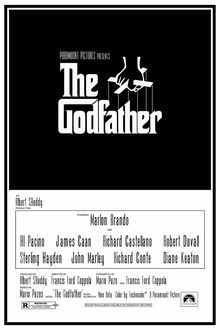
The Godfather
Some movies are just better than others, plain and simple. They're the ones that even the most casual movie fans among us are aware of, films like Gone With the Wind, Casablanca, Lawrence of Arabia, and one of my favorite movies, and maybe the greatest movie ever made, 1972's The Godfather.
It's just a few months since the end of WWII, and Vito Corleone (Marlon Brando), the head of the Corleone crime family in New York City and dubbed the Godfather, is at the height of his power. He has an epically successful business, running the unions and all the gambling in the city, and he's able to do it because he has countless politicians and judges in his back pocket. Things are changing though all around him, especially the underworld and the business he helped create. Vito is approached about a deal he could bankroll, but it involves drugs, and he chooses to ignore it. The decision is one that drastically affects the family, one that will incorporate all his family members, especially fiery firstborn Santino (James Caan), adopted Irish son, Tom Hagen (Robert Duvall), and his youngest and smartest son, Michael (Al Pacino). What does the future hold? Who will rise up to help their father?
Based off a novel of the same name by author Mario Puzo, 'Godfather' is one of those rarest films; it's perfect. In that sense, director Francis Ford Coppola improves on Puzo's novel, the rare film that is better than its source novel. None of that is a dig at Puzo -- the novel is one of my favorites, a well-written gem -- but the film takes the idea, premise and characters and runs with it. Clocking in at 175 minutes, it never slows down, never feels dull. The dialogue and script provide countless engrossing talking scenes. The look of the movie with its authentic wardrobe, cars and sets is incredible, Coppola filming in an earthy fashion where things always look dark and burned-out to a point. Oh, and composer Nino Rota's score is halfway decent (that's sarcasm by the way), one of the great, classic scores in Hollywood history. You know it already, but listen to the theme HERE.
What sets Coppola's film apart from countless other films about the Mafia, mobsters and organized crime is the impeccably written story. Puzo's novel introduces countless characters, relationships, history at the reader with all sorts of backstory, and the film assembles it into an expertly told, very coherent (sounds simple, but you'd be surprised) story that develops nicely. It covers over 10 years of time, but at no point does it feel even slightly rushed. Puzo's novel (he also worked with Coppola on the script) introduces characters and within minutes we feel like we've got a good idea of who they are as an individual. Imagine that with over 10 characters that get a fair share of screentime. There is a comfort level with the characters -- the good guys and the bad guys -- that makes the movie more enjoyable the second it begins. Does it all fall into place right away? No, it takes some time, but getting there is half the fun.
As far as true acting movies go, this 1972 classic is hard to beat. There isn't a performance that falls short or feels fake, but two rise above the rest; Brando as Vito Corleone and Pacino as his son, Michael. Playing one of the most iconic characters in film history, Brando's performance has opened the doors for all sorts of impressions, caricatures and stereotypes, but it is a career-best performance (and that's saying something considering Brando's career). It is a layered, nuanced performance, a man in the second half of his life who is highly intelligent, kind and ruthless at the same time, and a man who will stop at nothing to care for his family. Pacino's Michael goes through the film's biggest transition, a young man and WWII hero who wants nothing to do with his family's shady background but finds himself thrust into the family business when outside forces descend on the Corleones. Brando won an Oscar -- fully deserved -- and Pacino was nominated, but whatever the award nominations out there, it's two amazing performances.
Coppola's film earned plenty of acting nominations, three alone for Best Supporting Actor with Pacino, Duvall and Caan all earning a nod. The coolest part? All three deserved it for one reason or another. Caan and Duvall get less screentime, but they make the most of it. Caan is a scene-stealer as the fiery, hot-tempered Santino, known to friends and family as Sonny, the oldest Corleone son. The same for Duvall as Tom Hagen, but in a different way. Where Caan is more aggressive, Duvall underplays his part as Tom, the unofficial Irish Corleone brother, a childhood friend of Sonny's who Vito welcomed into the house. Other members of the Corleone family and operation? Richard Castellano and Abe Vigoda as Clemenza and Tessio, the Corleone caporegimes (think right-hand men, enforcers), John Cazale as Fredo, the Corleone brother and screw-up, Talia Shire as Connie, the lone Corleone sister and her similarly fiery husband, Carlo (Gianni Russo), and Diane Keaton as Kay, young Michael's love who must decide how much she's willing to put up with.
And then there's the opposition, the all-around nice individuals who are trying to take down the Corleones. For starters there's Richard Conte as Barzini, a head of another NYC crime family, Sterling Hayden as Capt. McCluskey, an NYC cop on a rival's payroll, John Marley as a film studio head who incurs the wrath of the Corleones, Al Lettieri as Sollozzo, a drug supplier looking for funding and backing, and Alex Rocco as a casino owner dealing with a buy-out of his casino.
On repeated viewings, I've noticed different features about the film, different layers that can affect how I view it. The biggest is simple; family. Yes, it's a pretty hardcore, violent story about a crime family with its hand in illegal happenings, but it's still family. If you can look past that whole criminal aspect, the biggest focus is the family and the dynamics and relationships among family members. Through the rather vicious, violent ups and downs, love and hate, they're there for each other (for this movie at least). I love how Vito dotes on his kids and grandchildren but can balance that out with a brutal mindset -- it's business, not personal -- at the same time. The relationship between Vito and Michael is the most heartfelt, including one of my all-time favorite scenes as father and son discuss what could have been, maybe what should have been. A worrying Vito wanted more for his son, but a firmly entrenched Michael (very much looking out for the family) calmly states "We'll get there, Pop." It's an endearing, heartfelt moment, one of many.
There are far too many memorable, iconic, and all-time great scenes to discuss one by one. Big picture, that's probably what viewers will remember the most on initial viewing. The infamous horse head scene, the introduction of Vito, his loyal enforcer, Luca Brasi (Lenny Montana), and his "offer he can't refuse," the perfect simplicity and natural quality of the opening wedding, a slight detour to Sicily and its beautiful hills, a meeting among Michael, Sollozzo, and McCluskey in a traditional Italian restaurant, and maybe the most memorable, the baptism scene, almost entirely silent other than Rota's score playing over the developing scenes. Each of the above scenes could be analyzed in a review unto itself, but this review is already getting long-winded. Long story short? It's maybe the greatest movie in Hollywood history without a flaw in sight. Shame on you if you haven't seen it by the way. What are you waiting for?
The Godfather (1972): ****/****
It's just a few months since the end of WWII, and Vito Corleone (Marlon Brando), the head of the Corleone crime family in New York City and dubbed the Godfather, is at the height of his power. He has an epically successful business, running the unions and all the gambling in the city, and he's able to do it because he has countless politicians and judges in his back pocket. Things are changing though all around him, especially the underworld and the business he helped create. Vito is approached about a deal he could bankroll, but it involves drugs, and he chooses to ignore it. The decision is one that drastically affects the family, one that will incorporate all his family members, especially fiery firstborn Santino (James Caan), adopted Irish son, Tom Hagen (Robert Duvall), and his youngest and smartest son, Michael (Al Pacino). What does the future hold? Who will rise up to help their father?
Based off a novel of the same name by author Mario Puzo, 'Godfather' is one of those rarest films; it's perfect. In that sense, director Francis Ford Coppola improves on Puzo's novel, the rare film that is better than its source novel. None of that is a dig at Puzo -- the novel is one of my favorites, a well-written gem -- but the film takes the idea, premise and characters and runs with it. Clocking in at 175 minutes, it never slows down, never feels dull. The dialogue and script provide countless engrossing talking scenes. The look of the movie with its authentic wardrobe, cars and sets is incredible, Coppola filming in an earthy fashion where things always look dark and burned-out to a point. Oh, and composer Nino Rota's score is halfway decent (that's sarcasm by the way), one of the great, classic scores in Hollywood history. You know it already, but listen to the theme HERE.
What sets Coppola's film apart from countless other films about the Mafia, mobsters and organized crime is the impeccably written story. Puzo's novel introduces countless characters, relationships, history at the reader with all sorts of backstory, and the film assembles it into an expertly told, very coherent (sounds simple, but you'd be surprised) story that develops nicely. It covers over 10 years of time, but at no point does it feel even slightly rushed. Puzo's novel (he also worked with Coppola on the script) introduces characters and within minutes we feel like we've got a good idea of who they are as an individual. Imagine that with over 10 characters that get a fair share of screentime. There is a comfort level with the characters -- the good guys and the bad guys -- that makes the movie more enjoyable the second it begins. Does it all fall into place right away? No, it takes some time, but getting there is half the fun.
As far as true acting movies go, this 1972 classic is hard to beat. There isn't a performance that falls short or feels fake, but two rise above the rest; Brando as Vito Corleone and Pacino as his son, Michael. Playing one of the most iconic characters in film history, Brando's performance has opened the doors for all sorts of impressions, caricatures and stereotypes, but it is a career-best performance (and that's saying something considering Brando's career). It is a layered, nuanced performance, a man in the second half of his life who is highly intelligent, kind and ruthless at the same time, and a man who will stop at nothing to care for his family. Pacino's Michael goes through the film's biggest transition, a young man and WWII hero who wants nothing to do with his family's shady background but finds himself thrust into the family business when outside forces descend on the Corleones. Brando won an Oscar -- fully deserved -- and Pacino was nominated, but whatever the award nominations out there, it's two amazing performances.
Coppola's film earned plenty of acting nominations, three alone for Best Supporting Actor with Pacino, Duvall and Caan all earning a nod. The coolest part? All three deserved it for one reason or another. Caan and Duvall get less screentime, but they make the most of it. Caan is a scene-stealer as the fiery, hot-tempered Santino, known to friends and family as Sonny, the oldest Corleone son. The same for Duvall as Tom Hagen, but in a different way. Where Caan is more aggressive, Duvall underplays his part as Tom, the unofficial Irish Corleone brother, a childhood friend of Sonny's who Vito welcomed into the house. Other members of the Corleone family and operation? Richard Castellano and Abe Vigoda as Clemenza and Tessio, the Corleone caporegimes (think right-hand men, enforcers), John Cazale as Fredo, the Corleone brother and screw-up, Talia Shire as Connie, the lone Corleone sister and her similarly fiery husband, Carlo (Gianni Russo), and Diane Keaton as Kay, young Michael's love who must decide how much she's willing to put up with.
And then there's the opposition, the all-around nice individuals who are trying to take down the Corleones. For starters there's Richard Conte as Barzini, a head of another NYC crime family, Sterling Hayden as Capt. McCluskey, an NYC cop on a rival's payroll, John Marley as a film studio head who incurs the wrath of the Corleones, Al Lettieri as Sollozzo, a drug supplier looking for funding and backing, and Alex Rocco as a casino owner dealing with a buy-out of his casino.
On repeated viewings, I've noticed different features about the film, different layers that can affect how I view it. The biggest is simple; family. Yes, it's a pretty hardcore, violent story about a crime family with its hand in illegal happenings, but it's still family. If you can look past that whole criminal aspect, the biggest focus is the family and the dynamics and relationships among family members. Through the rather vicious, violent ups and downs, love and hate, they're there for each other (for this movie at least). I love how Vito dotes on his kids and grandchildren but can balance that out with a brutal mindset -- it's business, not personal -- at the same time. The relationship between Vito and Michael is the most heartfelt, including one of my all-time favorite scenes as father and son discuss what could have been, maybe what should have been. A worrying Vito wanted more for his son, but a firmly entrenched Michael (very much looking out for the family) calmly states "We'll get there, Pop." It's an endearing, heartfelt moment, one of many.
There are far too many memorable, iconic, and all-time great scenes to discuss one by one. Big picture, that's probably what viewers will remember the most on initial viewing. The infamous horse head scene, the introduction of Vito, his loyal enforcer, Luca Brasi (Lenny Montana), and his "offer he can't refuse," the perfect simplicity and natural quality of the opening wedding, a slight detour to Sicily and its beautiful hills, a meeting among Michael, Sollozzo, and McCluskey in a traditional Italian restaurant, and maybe the most memorable, the baptism scene, almost entirely silent other than Rota's score playing over the developing scenes. Each of the above scenes could be analyzed in a review unto itself, but this review is already getting long-winded. Long story short? It's maybe the greatest movie in Hollywood history without a flaw in sight. Shame on you if you haven't seen it by the way. What are you waiting for?
The Godfather (1972): ****/****
Friday, February 10, 2012
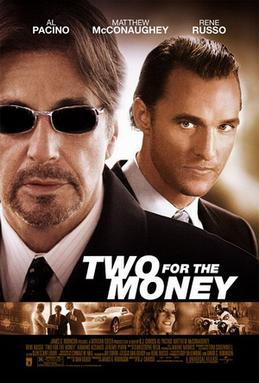
Two For the Money
Having suffered a possibly career-ending injury in a bowl game, quarterback Brandon Lang (Matthew McConaughey) has possibly hit it big helping bettors by picking scores of NCAA and NFL college scores. He's done so well in fact that he's been noticed by Walter Abraham (Al Pacino), the owner of one of the country's most successful sports gambling/counseling companies. Walter takes Brandon to New York to join his firm, and all he asks is that he keeps on doing what he does so freakishly well, picking winners and making money. Brandon does just that -- picking winners at an alarming rate -- but can his extraordinary luck hold out?
When I did stumble across this on late night TV, I didn't necessarily love it, but I was intrigued if nothing else. Having seen the entire movie now, I wasn't even intrigued by the end of this overlong, dull and predictable story from director D.J. Caruso. Nothing about it feels real. It feels forced from the beginning, even entirely fake at specific moments. Some of that stems from the "NFL teams" and the footage of games that looks like it's from the 1980s in Canada. But more than that, 'Money' reeks of style over substance. There's never really any question where it's going, but even the ride getting there isn't entertaining.
The showiest part in the movie goes to Al Pacino as Walter, a former gambler turned hugely successful consulting company owner. This movie continued a trend of parts like this that had Pacino playing a caricature of himself more than actually playing a part. This is a part that could and should have been pretty good, but it's so ridiculously over the top and showy that I never bought it. He screams, he mugs, he gets intense. Rene Russo plays his wife, Toni, a woman with similar past demons. Jeremy Piven has a good part as Jerry, one of Brandon's in-company rivals, Armand Assante sneers as Novian, one of the world's biggest sports gamblers, and Jaime King apparently got blackmailed into a part as a conquest of Brandon's.
What throws me depending on the role is McConaughey's continued success in movies. His aw-shucks demeanor and overly confident -- even arrogant -- ways works in movies like Sahara or We Are Marshall. But in a quasi-dramatic role like this, it just doesn't work for me. Brandon is supposed to be ultra-confident, and I bought into it, but by the end of the movie I just hated this character. Hated. McConaughey doesn't do a great job developing him, and his rise and inevitable fall can be predicted from the moment the movie starts. Mostly though, I just don't think much of him as a true dramatic actor. Going up against Pacino and his exaggerated style, his underplaying style does not go over well. Not a good mix at all.
By the time the ending nears, I thought I'd seen every stereotype possible. 'Money' deserves to be beaten with the cliche stick. The rise and fall, the possible relationship with Russo's Toni, the back and forth dynamic, it's all there. And then there's the one big game where everything that went wrong can be righted. Didn't see that one coming, did you? I'm somewhat surprised by how negative this review has gone because as I finished the movie I thought it was pretty average if nothing else. The more I thought about it, the more I disliked it though. Who knows what would have happened if I waited another day to write?
Two for the Money <---trailer (2005): */****
Labels:
2000s,
Al Pacino,
Jeremy Piven,
Matthew McConaughey,
Rene Russo,
Sports
Friday, October 1, 2010
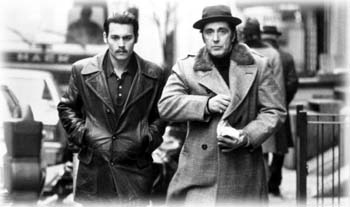
Donnie Brasco
Al Pacino has done countless characters that all are applicable answers when fans are asked for their favorites. But over three movies, my favorite Pacino character has and always will be cold-blooded Michael Corleone. The Godfather movies are on the whole classic movies -- okay, maybe not Part 3 -- and a huge reason for the classic status is Pacino's Corleone. Michael is cold, calculating, brutal and seemingly without emotion as he makes decisions to protect both his family and himself.
It is a character that has stuck with him throughout his career and in some ways typecast him. He's too good an actor to be pigeon-holed though, always experimenting with new, unique parts. Similar in story and background to The Godfather but different in every sense in looking at Pacino's character is 1997's Donnie Brasco. He plays Benjamin 'Lefty' Ruggiero, a mid-level thug who is stuck in his long-time position within organized crime, but because he does his job and doesn't cause trouble, he's not a threat either. So basically, the anti-Michael Corleone, a fast climber on his way to the top. It's an underrated and even a little under-appreciated performance from Pacino in an underrated movie.
It's 1973 in New York and FBI agent Joe Pistone (Johnny Depp) has been working undercover for two years trying to get in with the local hoods. He gets his chance when he's approached by Lefty Ruggiero (Pacino), a made man working for one of New York's big-time mafiosos. Lefty takes to Pistone -- cover name Donnie Brasco -- immediately and begins to show him how things are done, the ways of the business. One of Lefty's associates, Sonny Black (Michael Madsen), is making a positive impression wherever he goes, and he's bringing his crew with him to the top, including Donnie. But as the days turn into months and years, Donnie acclimates to the life to the point he likes his fake life better than his own. No matter how he feels though, it only takes one slip up and the whole ruse will come crashing down.
Mafia movies could have their own wing of a movie library all to themselves with all the quality entries over the year. Surprisingly enough though, Donnie Brasco is rarely mentioned with some of the classics. And to be fair, maybe it isn't a classic, but it's pretty close. It doesn't settle for the accepted stereotypes and never tries to make the mafia look like anything other than a low-down, dirty, bloody, extremely violent life where anyone and everyone could turn on you. Director Mike Newell gets the little things right from the 1970s style of cars and clothes to the camaraderie that develops among this tight-knit group. The writing is pitch-perfect (including THIS absolute classic discussing the meaning of 'Forget about it') and keeps the story flowing. The violence is kept to a minimum for the most part with one big exception, a hit attempt late in the movie, but don't go in expecting buckets of blood.
One of the coolest things a casting director can do is pair established mega-stars with up and coming stars on the rise. You get combinations of great acting duos across movie generations, and the audience almost always comes out on top. Above all else in Donnie Brasco is this relationship between Donnie and Lefty, the mafia made man eventually becoming a mentor to the new guy, almost like a big brother or even a father figure. Through all the trials and tribulations, the two remain friends. As the situation escalates, Donnie even begins to feel guilt at what he's doing. Sure, he's doing his job in the line of duty, but Lefty, Sonny, Nicky (Bruno Kirby) and Paulie (James Russo) have genuinely become his good friends. Of course, as an undercover agent, he knows there is no way it can all end pleasantly, but that's to worry about when the time comes.
Neither Pacino or Depp were nominated for their parts, but I can see how both could have earned at least an Oscar nomination if not a win. Pacino's part is a nuanced one as he somehow makes this very unlikable character into a likable one. He gives Lefty all these little personality traits that alone would seem odd, but combine them and they work as this great red-blooded character. Lefty's final scene -- while insinuating a fictional fate -- is Pacino at his best, a silent scene as he knows he's met his end in one way or another. For Depp, this was before his huge movie star parts, but he shows that no matter the movie he can nail the part. Depp always comes across as very watchable, very personable, even when his character isn't. Teamed with legendary Pacino, and you've got a real winner.
The only thing keeping Donnie Brasco from being a classic in my eyes was the subplot involving Donnie/Joe and his struggles at home with his wife (Anne Heche). These scenes have a been there, done that feel because we have been there and done that with these homefront fights. It's not that they're awful scenes, but compared to anything with Donnie and his infiltration of the mob, they just don't have the same impact. Still, this is a hidden gem, and one that I'm sorry I missed all these years.
Donnie Brasco <---trailer (1997): ***/****
It is a character that has stuck with him throughout his career and in some ways typecast him. He's too good an actor to be pigeon-holed though, always experimenting with new, unique parts. Similar in story and background to The Godfather but different in every sense in looking at Pacino's character is 1997's Donnie Brasco. He plays Benjamin 'Lefty' Ruggiero, a mid-level thug who is stuck in his long-time position within organized crime, but because he does his job and doesn't cause trouble, he's not a threat either. So basically, the anti-Michael Corleone, a fast climber on his way to the top. It's an underrated and even a little under-appreciated performance from Pacino in an underrated movie.
It's 1973 in New York and FBI agent Joe Pistone (Johnny Depp) has been working undercover for two years trying to get in with the local hoods. He gets his chance when he's approached by Lefty Ruggiero (Pacino), a made man working for one of New York's big-time mafiosos. Lefty takes to Pistone -- cover name Donnie Brasco -- immediately and begins to show him how things are done, the ways of the business. One of Lefty's associates, Sonny Black (Michael Madsen), is making a positive impression wherever he goes, and he's bringing his crew with him to the top, including Donnie. But as the days turn into months and years, Donnie acclimates to the life to the point he likes his fake life better than his own. No matter how he feels though, it only takes one slip up and the whole ruse will come crashing down.
Mafia movies could have their own wing of a movie library all to themselves with all the quality entries over the year. Surprisingly enough though, Donnie Brasco is rarely mentioned with some of the classics. And to be fair, maybe it isn't a classic, but it's pretty close. It doesn't settle for the accepted stereotypes and never tries to make the mafia look like anything other than a low-down, dirty, bloody, extremely violent life where anyone and everyone could turn on you. Director Mike Newell gets the little things right from the 1970s style of cars and clothes to the camaraderie that develops among this tight-knit group. The writing is pitch-perfect (including THIS absolute classic discussing the meaning of 'Forget about it') and keeps the story flowing. The violence is kept to a minimum for the most part with one big exception, a hit attempt late in the movie, but don't go in expecting buckets of blood.
One of the coolest things a casting director can do is pair established mega-stars with up and coming stars on the rise. You get combinations of great acting duos across movie generations, and the audience almost always comes out on top. Above all else in Donnie Brasco is this relationship between Donnie and Lefty, the mafia made man eventually becoming a mentor to the new guy, almost like a big brother or even a father figure. Through all the trials and tribulations, the two remain friends. As the situation escalates, Donnie even begins to feel guilt at what he's doing. Sure, he's doing his job in the line of duty, but Lefty, Sonny, Nicky (Bruno Kirby) and Paulie (James Russo) have genuinely become his good friends. Of course, as an undercover agent, he knows there is no way it can all end pleasantly, but that's to worry about when the time comes.
Neither Pacino or Depp were nominated for their parts, but I can see how both could have earned at least an Oscar nomination if not a win. Pacino's part is a nuanced one as he somehow makes this very unlikable character into a likable one. He gives Lefty all these little personality traits that alone would seem odd, but combine them and they work as this great red-blooded character. Lefty's final scene -- while insinuating a fictional fate -- is Pacino at his best, a silent scene as he knows he's met his end in one way or another. For Depp, this was before his huge movie star parts, but he shows that no matter the movie he can nail the part. Depp always comes across as very watchable, very personable, even when his character isn't. Teamed with legendary Pacino, and you've got a real winner.
The only thing keeping Donnie Brasco from being a classic in my eyes was the subplot involving Donnie/Joe and his struggles at home with his wife (Anne Heche). These scenes have a been there, done that feel because we have been there and done that with these homefront fights. It's not that they're awful scenes, but compared to anything with Donnie and his infiltration of the mob, they just don't have the same impact. Still, this is a hidden gem, and one that I'm sorry I missed all these years.
Donnie Brasco <---trailer (1997): ***/****
Labels:
1990s,
Al Pacino,
Gangsters,
Johnny Depp,
Michael Madsen
Saturday, April 3, 2010
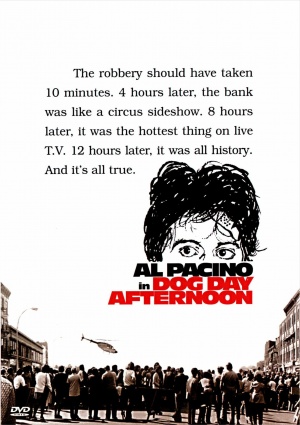
Dog Day Afternoon
Over the last year or so I've tried to catch up on all the classic movies I've missed. You know, those ones where people responded "WWWWWWWWWhat?" when you tell them you haven't seen them. I never intentionally dodged these movies, I just never actively sought them out. My problem in some cases is that I know these movies are held in high regard, and therefore expect more out of them. Raging Bull more than lived up to expectations, Goodfellas was highly enjoyable, and Judgment at Nuremberg was a powerfully effective movie. The latest one I've watched was 1975's Dog Day Afternoon.
I'll point this out first that I really enjoyed the movie, but I didn't love it. Certain parts worked perfectly, like director Sidney Lumet filming this true story like a documentary in the New York locations the story took place and Al Pacino's incredible performance. Lumet's pseudo-documentary style is appropriate for the story, giving the viewer a feeling of being a fly on the wall as the story develops. My only real complaint is that in its effort to be truthful with the facts, the movie is a little long. The first hour moves along at a quick pace, but somewhere in the second hour, the pacing hits a wall. All the momentum built up is lost, and while the ending is worth the wait, it can't save or solve the pacing issues.
On a scorching hot summer day in August 1972, two men, Sonny Wortzik (Pacino) and Sal Naturile (John Cazale) walk into a Brooklyn bank with a rifle and a machine gun to rob the place. Right away, nothing goes smoothly, starting with the bank having just over $1,000 after a deposit was picked up. Minutes go by longer than they had planned, and the phone rings. Detective Eugene Moretti (Charles Durning) is on the other end, and he wants to talk. The bank is surrounded by police, and there's no way out. Sonny refuses and with eight hostages -- the bank manager, 6 tellers, and a bank guard -- starts to negotiate a way out of the mess he's gotten himself into. Huge crowds form outside along with media and hundreds of cops, but a strange thing happens. Sonny becomes a hero to the crowd, but no matter what he does, there's no easy way out of the situation.
The circus-like atmosphere that develops following the botched bank robbery is an indictment of the times, with Sonny blatantly playing to the crowds, like THIS well-known scene. He screams at the police officers surrounding him to back off and holster their weapons. At one point, he throws money -- fake $5 bills -- to the gathering crowds and becomes a fan favorite to them. This is Pacino at his best in the role, a blend of calm intellect and brash outbursts all rolled into one. I won't go as far as saying I was rooting for Pacino's Sonny, but the fact that he's even a little bit sympathetic is a testament to Pacino's acting. This also earned him his 4th straight Best Acting Oscar nomination -- of which he won NONE -- and is a total departure from most of his other roles.
For such a big story, the cast is rather small which works surprisingly well. It's a big story, but the key moments are these interactions between a handful of characters. Cazale was only in six movies before dying at 43 of bone cancer, and he doesn't disappoint in any of them. His Sal has a tortured past of which we find out very little, but it's shown he's not a very smart person and is much more of a follower than a leader. Durning gets a flashier part as Det. Moretti, the police officer with the unpleasant task of negotiating the situation to save the lives of Sonny's hostages. Unfortunately, Durning's Moretti basically disappears once the FBI shows up and is gone in the last 45 minutes. Sully Boyar as Mulvaney, the bank manager, and Penelope Allen as Sylvia, the head bank teller, are the only hostages to make much of an impression. Chris Sarandon received an Oscar nomination for his part as Leon, but I'll go into that next.
SPOILERS for this paragraph SPOILERS I don't know if it's a twist because the Netflix movie sleeve says it in the first sentence of the description -- thanks for that, Netflix -- but Sarandon is Leon, Sonny's lover/husband, and the reason Sonny planned the robbery. He wanted to get money so Leon could have a sex-change operation because he thinks he's a woman trapped in a man's body. This revelation comes about halfway through the movie and certainly comes as a bit of a shock (and that's knowing it is coming). It isn't meant as a judgment that Sonny is gay or bisexual, instead Lumet just lays this all out for us to explain his motivations. Sonny is married with kids, and when we see his background and personal life, it is clear why he's done what he has. His wife is shrill, his mother overbearing, and the man he loves isn't all there in the head. He has been pushed too far and knows nowhere else to turn other than this desperate ploy.
The real-life incident 'Dog Day' is based on took about 14 hours, and in the movie the pacing starts to drag once the sun goes down as the story tries to show everything that happened. The real-life Sonny claimed only about 30% of the movie is true/factual. Certain scenes go on too long -- especially conversations Sonny has with his wife, mother and Leon -- and had me looking for the fast forward button. But still, the positives definitely outweigh the negatives, especially Pacino's performance and Lumet's direction. I won't say it is a classic because there are some serious flaws, but it is still a great movie.
Dog Day Afternoon <----trailer (1975): ***/****
I'll point this out first that I really enjoyed the movie, but I didn't love it. Certain parts worked perfectly, like director Sidney Lumet filming this true story like a documentary in the New York locations the story took place and Al Pacino's incredible performance. Lumet's pseudo-documentary style is appropriate for the story, giving the viewer a feeling of being a fly on the wall as the story develops. My only real complaint is that in its effort to be truthful with the facts, the movie is a little long. The first hour moves along at a quick pace, but somewhere in the second hour, the pacing hits a wall. All the momentum built up is lost, and while the ending is worth the wait, it can't save or solve the pacing issues.
On a scorching hot summer day in August 1972, two men, Sonny Wortzik (Pacino) and Sal Naturile (John Cazale) walk into a Brooklyn bank with a rifle and a machine gun to rob the place. Right away, nothing goes smoothly, starting with the bank having just over $1,000 after a deposit was picked up. Minutes go by longer than they had planned, and the phone rings. Detective Eugene Moretti (Charles Durning) is on the other end, and he wants to talk. The bank is surrounded by police, and there's no way out. Sonny refuses and with eight hostages -- the bank manager, 6 tellers, and a bank guard -- starts to negotiate a way out of the mess he's gotten himself into. Huge crowds form outside along with media and hundreds of cops, but a strange thing happens. Sonny becomes a hero to the crowd, but no matter what he does, there's no easy way out of the situation.
The circus-like atmosphere that develops following the botched bank robbery is an indictment of the times, with Sonny blatantly playing to the crowds, like THIS well-known scene. He screams at the police officers surrounding him to back off and holster their weapons. At one point, he throws money -- fake $5 bills -- to the gathering crowds and becomes a fan favorite to them. This is Pacino at his best in the role, a blend of calm intellect and brash outbursts all rolled into one. I won't go as far as saying I was rooting for Pacino's Sonny, but the fact that he's even a little bit sympathetic is a testament to Pacino's acting. This also earned him his 4th straight Best Acting Oscar nomination -- of which he won NONE -- and is a total departure from most of his other roles.
For such a big story, the cast is rather small which works surprisingly well. It's a big story, but the key moments are these interactions between a handful of characters. Cazale was only in six movies before dying at 43 of bone cancer, and he doesn't disappoint in any of them. His Sal has a tortured past of which we find out very little, but it's shown he's not a very smart person and is much more of a follower than a leader. Durning gets a flashier part as Det. Moretti, the police officer with the unpleasant task of negotiating the situation to save the lives of Sonny's hostages. Unfortunately, Durning's Moretti basically disappears once the FBI shows up and is gone in the last 45 minutes. Sully Boyar as Mulvaney, the bank manager, and Penelope Allen as Sylvia, the head bank teller, are the only hostages to make much of an impression. Chris Sarandon received an Oscar nomination for his part as Leon, but I'll go into that next.
SPOILERS for this paragraph SPOILERS I don't know if it's a twist because the Netflix movie sleeve says it in the first sentence of the description -- thanks for that, Netflix -- but Sarandon is Leon, Sonny's lover/husband, and the reason Sonny planned the robbery. He wanted to get money so Leon could have a sex-change operation because he thinks he's a woman trapped in a man's body. This revelation comes about halfway through the movie and certainly comes as a bit of a shock (and that's knowing it is coming). It isn't meant as a judgment that Sonny is gay or bisexual, instead Lumet just lays this all out for us to explain his motivations. Sonny is married with kids, and when we see his background and personal life, it is clear why he's done what he has. His wife is shrill, his mother overbearing, and the man he loves isn't all there in the head. He has been pushed too far and knows nowhere else to turn other than this desperate ploy.
The real-life incident 'Dog Day' is based on took about 14 hours, and in the movie the pacing starts to drag once the sun goes down as the story tries to show everything that happened. The real-life Sonny claimed only about 30% of the movie is true/factual. Certain scenes go on too long -- especially conversations Sonny has with his wife, mother and Leon -- and had me looking for the fast forward button. But still, the positives definitely outweigh the negatives, especially Pacino's performance and Lumet's direction. I won't say it is a classic because there are some serious flaws, but it is still a great movie.
Dog Day Afternoon <----trailer (1975): ***/****
Saturday, March 6, 2010
Serpico
Starting off his Hollywood career, Al Pacino started off with an incredible run of performances beginning with 1972's The Godfather. It continued with Serpico, The Godfather 2, and Dog Day Afternoon. The common link? He was nominated for an Oscar for each performance -- one supporting nod and three lead roles -- and somehow didn't win even one. How he didn't win for Godfather 2 just confuses me, but that's for another time.
1973's Serpico is based on the real-life trials of Frank Serpico, a New York City cop who went against the grain in trying to be the best cop he can be. There are two types of performances Pacino does when he's at his best. One, think Scarface or Any Given Sunday, where he is over the top in almost every scene. He's effective doing that because he commits so whole-heartedly to the part. Two, there's Serpico, Heat, The Godfather trilogy, where he plays a highly intelligent, relatively calm character who has moments of huge, emotional outbursts. I prefer him with the second option, and as much as I love Michael Corleone, Pacino's Frank Serpico might be his all-time best performance.
From as long as he can remember, Frank Serpico (Pacino) has wanted to be a police officer. He graduates the academy and becomes a patrolman at an NYC precinct. But right away, Serpico sees being a police officer isn't everything it's cracked up to be. He wants to do his job as best he can without all the corruption that goes on behind the scenes. Serpico refuses to take any pay-offs in any form and quickly draws the ire of superiors and co-workers. He bounces from precinct to precinct with the hope of finally gaining detective status and the gold shield that comes with the position. But after years of seeing this corruption, Serpico realizes he has nowhere else to turn and must take action against the rampant illegal activities crippling the police force.
Getting his nomination the second time around, Pacino lost to Jack Lemmon in 'Save the Tiger' which I haven't seen, but I assume it has to be pretty great. Lemmon also beat out Jack Nicholson (The Last Detail), Marlon Brando (Last Tango), and Robert Redford (The Sting). Playing a real person can be a daunting task so Pacino met the real-life Serpico and followed him around for several weeks, and it pays off. By a certain point in the movie, it doesn't feel like Al Pacino playing a cop. You're just watching Frank Serpico. And as a character study of a man who just wants to do what he think is right, this movie is a classic.
Taking place over several years, the story follows Serpico's police career so other characters -- in his professional and personal life -- drift in and out. The one constant is Pacino who is in just about every scene in this 129-minute flick. He presents Serpico as a pretty even-keeled guy who is genuinely confused when a fellow officer hands him an envelope full of money. He clearly never thought of this as a perk of the job and doesn't know what to do. This situation builds and builds over the years because Serpico gains a reputation as being untrustworthy because he doesn't take the pay-offs. As a cop, he works as a plainclothes officer, growing a thick beard and generally looking like a hippie with his clothes. And that's usually a good sign for me in judging a role, Pacino becomes Serpico. I'll have to check out 'Save the Tiger' but it has its work cut out because this was a great performance.
In bringing this story to the big screen, director Sidney Lumet wisely chose to film on the streets of New York. We're not talking downtown Manhattan either with locations including Brooklyn, the Bronx, and Queens helping bring the gritty story to life. Parts of New York City in the 1970s certainly had a rundown look so a plainclothes officer working the streets had to blend in. As Serpico points out, 'our undercovers wear black shoes and white socks.' Translated? They stick out like a sore thumb. Some of the better supporting parts here include Jack Kehoe as Keogh, a fellow officer trying to convince Serpico to go along with the others, Tony Roberts and Edward Grover as two police officers who side with the much-maligned Frank, and John Randolph as Chief Green, a higher-up in the police department.
The one flaw I can point out is that the last 30 minutes gets a little repetitive but not enough to derail the movie, not by a long shot. Pacino's performance is too strong and doesn't allow the movie to derail in any form. The ending is a bittersweet one that tells what Serpico ended up doing later in his life. The real-life Frank Serpico is a fascinating individual with Pacino and Lumet painting a great picture and a great movie of his heroic actions. Definitely check this one out.
Serpico <----trailer (1973): *** 1/2 /****
1973's Serpico is based on the real-life trials of Frank Serpico, a New York City cop who went against the grain in trying to be the best cop he can be. There are two types of performances Pacino does when he's at his best. One, think Scarface or Any Given Sunday, where he is over the top in almost every scene. He's effective doing that because he commits so whole-heartedly to the part. Two, there's Serpico, Heat, The Godfather trilogy, where he plays a highly intelligent, relatively calm character who has moments of huge, emotional outbursts. I prefer him with the second option, and as much as I love Michael Corleone, Pacino's Frank Serpico might be his all-time best performance.
From as long as he can remember, Frank Serpico (Pacino) has wanted to be a police officer. He graduates the academy and becomes a patrolman at an NYC precinct. But right away, Serpico sees being a police officer isn't everything it's cracked up to be. He wants to do his job as best he can without all the corruption that goes on behind the scenes. Serpico refuses to take any pay-offs in any form and quickly draws the ire of superiors and co-workers. He bounces from precinct to precinct with the hope of finally gaining detective status and the gold shield that comes with the position. But after years of seeing this corruption, Serpico realizes he has nowhere else to turn and must take action against the rampant illegal activities crippling the police force.
Getting his nomination the second time around, Pacino lost to Jack Lemmon in 'Save the Tiger' which I haven't seen, but I assume it has to be pretty great. Lemmon also beat out Jack Nicholson (The Last Detail), Marlon Brando (Last Tango), and Robert Redford (The Sting). Playing a real person can be a daunting task so Pacino met the real-life Serpico and followed him around for several weeks, and it pays off. By a certain point in the movie, it doesn't feel like Al Pacino playing a cop. You're just watching Frank Serpico. And as a character study of a man who just wants to do what he think is right, this movie is a classic.
Taking place over several years, the story follows Serpico's police career so other characters -- in his professional and personal life -- drift in and out. The one constant is Pacino who is in just about every scene in this 129-minute flick. He presents Serpico as a pretty even-keeled guy who is genuinely confused when a fellow officer hands him an envelope full of money. He clearly never thought of this as a perk of the job and doesn't know what to do. This situation builds and builds over the years because Serpico gains a reputation as being untrustworthy because he doesn't take the pay-offs. As a cop, he works as a plainclothes officer, growing a thick beard and generally looking like a hippie with his clothes. And that's usually a good sign for me in judging a role, Pacino becomes Serpico. I'll have to check out 'Save the Tiger' but it has its work cut out because this was a great performance.
In bringing this story to the big screen, director Sidney Lumet wisely chose to film on the streets of New York. We're not talking downtown Manhattan either with locations including Brooklyn, the Bronx, and Queens helping bring the gritty story to life. Parts of New York City in the 1970s certainly had a rundown look so a plainclothes officer working the streets had to blend in. As Serpico points out, 'our undercovers wear black shoes and white socks.' Translated? They stick out like a sore thumb. Some of the better supporting parts here include Jack Kehoe as Keogh, a fellow officer trying to convince Serpico to go along with the others, Tony Roberts and Edward Grover as two police officers who side with the much-maligned Frank, and John Randolph as Chief Green, a higher-up in the police department.
The one flaw I can point out is that the last 30 minutes gets a little repetitive but not enough to derail the movie, not by a long shot. Pacino's performance is too strong and doesn't allow the movie to derail in any form. The ending is a bittersweet one that tells what Serpico ended up doing later in his life. The real-life Frank Serpico is a fascinating individual with Pacino and Lumet painting a great picture and a great movie of his heroic actions. Definitely check this one out.
Serpico <----trailer (1973): *** 1/2 /****
Thursday, February 25, 2010
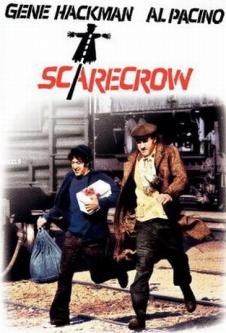
Scarecrow
A movie released in 1973 starring Al Pacino and Gene Hackman seemed like a no-brainer to me. Pacino was coming off the mega-success of The Godfather and his Oscar-nominated performance of Michael Corleone. Hackman was riding high after the success of The French Connection and The Poseidon Adventure. A teaming of two of Hollywood's biggest stars was only natural, but 1973's Scarecrow is one of the worst movies I've seen in quite awhile.
In a way that's hard to explain, movies from the 1970s have a style all to themselves. The 70s were a transition period for Hollywood in between the big studio epics of the 1950s and 60s, but before the blockbusters and special effects took over starting with movies like Jaws and Star Wars in the late 70s. Most of the time, that's a good thing. You can spot a movie from the early 70s sometimes just by reading a description. So many of these stories were folksy, quirky, different from what audiences had come to expect. 'Scarecrow' just tries too hard without really having any message.
It's a road movie -- typically one of my favorite subgenres -- about two men hitchhiking across the country, trying to get to Pittsburgh. There's Max (Hackman), an ex-con just released from jail after doing a 6-year stint, and Francis (Pacino), a lovable loser who's been working at sea for five years and now is going to Detroit to see his child he's never met. Max has some big plans and has worked out how he'll start a business in Pittsburgh. He's got everything figured down to the smallest details, and even offers Francis a full partnership in the business (a car wash) as long as they keep on the up and up with each other. Francis agrees, and the two set off making their way across the country with hopes of reaching Pittsburgh.
An easygoing road movie with no rush to get where it's going usually sounds pretty good to me, and that's primarily the reason why I added this to my Netflix queue. But this one is too easygoing with no real urgency to get anywhere. Maybe that's the purpose, the goal of the movie, but I was bored very quickly. Even with some great-looking western locations, the movie lacks any sense of being visually interesting. Long, uncut shots of Max and Francis talking or walking pepper themselves throughout the movie (like THIS SCENE in a diner). Typically this is a good thing, forcing actors to be in the moment like an actual conversation would be like. But it doesn't work, and it feels lazy like the director just put the camera in front of them and said 'Go.' Too much of the movie is spent like this and slows down the sluggish pace even more.
Now all that aside, the movie still would have been interesting if the characters were even somewhat likable. We're given little information on their backgrounds, like why did Francis bail on his pregnant girlfriend and take a job on a ship out at sea? Where do these trust issues and fits of rage come from in Max's past? Pacino is perfect at playing live wires always ready to blow up, like Michael Corleone, Tony Montana, Tony D'Amato, so it is different to see him in a more subdued role. His Francis is a jokester, always trying to make people laugh. Translated, that requires Pacino to ham it up in any number of scenes that are downright painful to watch. He isn't a comedic actor, and there's nothing wrong with that but this performance doesn't hit the right notes.
As his counter, Hackman's Max character is a real mess, not in terms of bad acting but instead that his character is not an easy one to like or root for. He has a very strong personality and has his fair share of quirks, but he's also very defensive and always ready to fight. Max is an intimidator, a bully who usually gets his way through brute strength or fear. A key moment in the second half of the film shows that he can be loyal to a fault and protective of those he cares about, but by that point it seemed too late. Like Pacino, Hackman's great at playing roles with personality to burn, and this is right in his wheelhouse. It's not a bad performance, anything but that, but Max is so easy to dislike, it's hard to get into his corner.
After fast-forwarding through much of the movie, I'm not sure how or what could have been done to make the story any better. There's a final revelation late in the movie that could have been heartbreaking in its execution, but it never produces any sort of real emotion. After that reveal, the movie just sort of ends and the credits roll with no explanations. I'm not one for an ending having to spell everything out, but even a little bit would have been nice here. Instead, the movie just ends with all sorts of plates still spinning. Big disappointment overall with not much at all to recommend. Pass on this stinker of a road movie.
If interested in watching Scarecrow, you can watch it at Youtube, starting here with Part 1. It's not a 'big movie' so you won't lose much watching it on your computer as opposed to watching it on the TV.
Scarecrow <-----trailer (1973): */****
In a way that's hard to explain, movies from the 1970s have a style all to themselves. The 70s were a transition period for Hollywood in between the big studio epics of the 1950s and 60s, but before the blockbusters and special effects took over starting with movies like Jaws and Star Wars in the late 70s. Most of the time, that's a good thing. You can spot a movie from the early 70s sometimes just by reading a description. So many of these stories were folksy, quirky, different from what audiences had come to expect. 'Scarecrow' just tries too hard without really having any message.
It's a road movie -- typically one of my favorite subgenres -- about two men hitchhiking across the country, trying to get to Pittsburgh. There's Max (Hackman), an ex-con just released from jail after doing a 6-year stint, and Francis (Pacino), a lovable loser who's been working at sea for five years and now is going to Detroit to see his child he's never met. Max has some big plans and has worked out how he'll start a business in Pittsburgh. He's got everything figured down to the smallest details, and even offers Francis a full partnership in the business (a car wash) as long as they keep on the up and up with each other. Francis agrees, and the two set off making their way across the country with hopes of reaching Pittsburgh.
An easygoing road movie with no rush to get where it's going usually sounds pretty good to me, and that's primarily the reason why I added this to my Netflix queue. But this one is too easygoing with no real urgency to get anywhere. Maybe that's the purpose, the goal of the movie, but I was bored very quickly. Even with some great-looking western locations, the movie lacks any sense of being visually interesting. Long, uncut shots of Max and Francis talking or walking pepper themselves throughout the movie (like THIS SCENE in a diner). Typically this is a good thing, forcing actors to be in the moment like an actual conversation would be like. But it doesn't work, and it feels lazy like the director just put the camera in front of them and said 'Go.' Too much of the movie is spent like this and slows down the sluggish pace even more.
Now all that aside, the movie still would have been interesting if the characters were even somewhat likable. We're given little information on their backgrounds, like why did Francis bail on his pregnant girlfriend and take a job on a ship out at sea? Where do these trust issues and fits of rage come from in Max's past? Pacino is perfect at playing live wires always ready to blow up, like Michael Corleone, Tony Montana, Tony D'Amato, so it is different to see him in a more subdued role. His Francis is a jokester, always trying to make people laugh. Translated, that requires Pacino to ham it up in any number of scenes that are downright painful to watch. He isn't a comedic actor, and there's nothing wrong with that but this performance doesn't hit the right notes.
As his counter, Hackman's Max character is a real mess, not in terms of bad acting but instead that his character is not an easy one to like or root for. He has a very strong personality and has his fair share of quirks, but he's also very defensive and always ready to fight. Max is an intimidator, a bully who usually gets his way through brute strength or fear. A key moment in the second half of the film shows that he can be loyal to a fault and protective of those he cares about, but by that point it seemed too late. Like Pacino, Hackman's great at playing roles with personality to burn, and this is right in his wheelhouse. It's not a bad performance, anything but that, but Max is so easy to dislike, it's hard to get into his corner.
After fast-forwarding through much of the movie, I'm not sure how or what could have been done to make the story any better. There's a final revelation late in the movie that could have been heartbreaking in its execution, but it never produces any sort of real emotion. After that reveal, the movie just sort of ends and the credits roll with no explanations. I'm not one for an ending having to spell everything out, but even a little bit would have been nice here. Instead, the movie just ends with all sorts of plates still spinning. Big disappointment overall with not much at all to recommend. Pass on this stinker of a road movie.
If interested in watching Scarecrow, you can watch it at Youtube, starting here with Part 1. It's not a 'big movie' so you won't lose much watching it on your computer as opposed to watching it on the TV.
Scarecrow <-----trailer (1973): */****
Subscribe to:
Posts (Atom)