The Sons of Katie Elder

The Sons of Katie Elder
"First, we reunite, then find Ma and Pa's killer...then read some reviews."
Showing posts with label Sidney Poitier. Show all posts

Tuesday, October 2, 2012

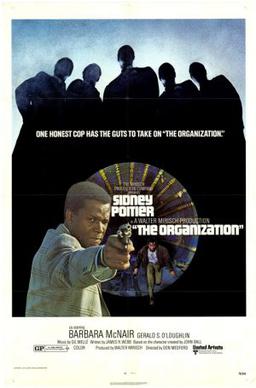
The Organization

For so many reasons, 1967's In the Heat of the Night was a key movie that helped mark the change of the portrayal of race on-screen. It was a groundbreaking movie, one that's noteworthy for the working relationship between two cops, one black, Sidney Poitier, and one white, Rod Steiger. While that film is fondly remembered though, Poitier returned with the same character in two sequels, 1970s's They Call Me Mister Tibbs and 1971's The Organization.

At a heavily guarded business, a murder has taken place, but there is little in the way of evidence pointing to the culprits, leaving the police and investigating officer Virgil Tibbs (Poitier) grasping at straws. As the investigation develops though, Tibbs is contacted by an urban revolutionary group with some revealing information. They take credit for robbing the business -- a front for a criminal organization -- of $4 million worth of heroin, but nothing about the murder. Tibbs is left to make a difficult decision. Help this group that broke the law (multiple times) even though their intentions were pure, or turn them in to face the law.

My first reaction when I found this movie on TCM's schedule was that Poitier was slumming with these two sequels. I've never seen 'Mister Tibbs' so take that into account here too. These two movies in no way affect the power or effectiveness of 'Night,' but what's the point? Why make two sequels? The original got the message across, and even though Poitier's Virgil Tibbs is one badass character, was there a need for more stories back in his hometown instead of the deep South? Nope, not really. Even more unfortunately, the sequel's script and story just isn't up to par. I'm not a huge fan of sequels to begin with, but if the effort is there I'll at least go along with it for the ride. Moral of the story is simple; cool character does not equal cool movie.

Thanks to Poitier and the San Francisco backdrop for the story, the movie isn't a complete waste of time. The script simply doesn't give Poitier much to do as the lead character. He gets deeper and deeper into this case with no easy way out, but there's nowhere to go other than straight down. We get some background with his wife, Valerie (Barbara McNair), and son (George Spell), even some oddly toned scenes where they talk about the birds and the bees. It's far from Poitier's best work, but even a mediocre performance from him is still worthwhile. There's not much else worthwhile in the character department though, leaving Poitier to do all the heavy lifting.

The sinister aspect of "THE ORGANIZATION" is wasted here because the story never picks a route to take. Instead, it bounces all over the place. The urban revolutionaries (including Raul Julia, Ron O'Neal, Billy Green Bush, Lani Miyazaki among others) could have been given their own movie, but instead they are background players here -- a means to an end -- and they never amount to anything more than that. The Organization and all their henchmen are nameless faces (intimidating if nothing else), and the bosses (Fred Beir and John Lasell) have little personality. This criminal organization is given no background, no history, no truly sinister nature other than what we see, but there's no reasoning or motive. So Poitier's Tibbs wants to take them down, but what's the point?

On the positive, look for 1970s eye candy Sheree North as a woman with a possible link to the case and Gerald S. O'Loughlin as a fellow police officer, Lt. Pecora, working with Tibbs on the investigation. Mostly though, the movie on the whole never connects. The story drifts along without much of an end-game in sight so the chases and shootouts don't amount too much. They're there in the story, but when you're not interested in the story to begin with, those sequences lack any energy or much of an interest level. As Bullitt and the Dirty Harry movies proved, San Francisco is a great backdrop for a cop story so the locations stand out, and Poitier is solid, but there's little else.

The Organization <---trailer (1971): **/****  

Saturday, March 3, 2012

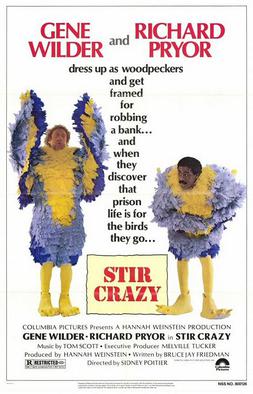
Stir Crazy

Go through Hollywood history, and it's easy to name some of the great comedy teams, not just duos. There's Laurel and Hardy, the Three Stooges, the Marx Brothers, Abbot and Costello, Dean Martin and Jerry Lewis, and one of the best, Richard Pryor and Gene Wilder. The duo starred together in four films, including 1980's Stir Crazy, a prime example of a stupid but entertaining 1980s comedy.

Having both lost their jobs on the same day, New Yorkers Harry (Pryor) and Skip (Wilder) decide to move west and put the nastiness of the city behind them. They take odd jobs for money, and their plan is working...for awhile. Taking a job in Arizona, they're mistaken for two bank robbers and sent to jail, earning 120 year sentences. Without much hope of an appeal, they settle in, finding out the prison is run by a -- surprise, surprise -- corrupt warden (Barry Corbin). Skip finds out he's a talented cowboy, and the warden sees a chance for some easy cash at the prison rodeo. Skip, Harry and their fellow inmates also see a choice opportunity...to escape.

I can't think of a more misleading plot review than that one. If I didn't know any better -- besides the New Yorker turned prisoner turned rodeo cowboy -- I'd peg this 1980 comedy as a drama. What's even weirder than that? Well-respected and award-winning actor Sidney Poitier is the director, one of nine movies he's directed during his career. This isn't a classic comedy to end all comedies. It's harmless and means well, and wants to do one thing and one thing only. It wants to make you laugh, and it succeeds there in a big way. The story has its fair share of meandering along with its episodic plot -- most of it routines for Wilder and Pryor to show off -- but it is always funny. Some of it leans toward more physical bits (both actors were great physical comedians) while also counting on them to sell their lines with some pitch perfect, immaculately delivered lines. A comedy that's fun. Novel concept, huh?

Four years since they first teamed in 1976's Silver Streak, Wilder and Pryor show why they were such a great team together. And that's the important thing; team. As comedic actors, they're both very capable of carrying a movie on their own. But like the best comedy teams/duos, they play off each other so well, setting each other up for jokes and laughs in every scene. Pryor's Harry is a nervous guy who sees things at their worst. Wilder's Skip is a naive idealist, constantly looking for the good in people. He doesn't seem to get that prison is a nasty place, and that "suggestions" to the warden aren't going to go over well. Harry is always looking out for his friend Skip as they navigate their new lives in the prison system, Skip always looking for stories and characters for his soon-to-be written novel. Some actors -- comedic or dramatic -- just work well together, and these two have some of the best chemistry I've ever seen. It's effortless, making the at-times stupid humor seem really smart. Dumb, smart, it doesn't matter. Pryor and Wilder make it good.

Like any memorable comedy, there's got to be something that sticks with fans after the movie concludes. 'Stir' has more than enough, those iconic scenes that keep you laughing whether you're watching the movie or not. The most iconic here is Harry and Skip first arriving in prison, Harry deciding they've got to show how "bad" they are, Skip falling in step. The physical mannerisms, the forceful deeper voices, it's priceless. Watch it HERE.There's too many to mention though, one just as good as the other. The running bit with the meanest prisoner around, Grossberger (Erland van Lidth), a serial killer, is perfect, Skip proving he's not so bad after all. Skip also survives countless torturing at the hands of the warden, shaking them off one by one like it's nothing, including a hanging torture that gets all the kinks out of his back. Long story short? Both Wilder and Pryor get a ton of chances to show off their ability.

The rest of the cast fills in nicely around the two, including Corbin and Craig T. Nelson as Warden Beatty and his head guard, Deputy Wilson. For the most part, they get to play the straight role to Wilder and Pryor's antics, doing so capably while keeping some personality in their roles. Georg Stanford Brown has a lot of fun with some stereotypes as Rory, the gay prisoner who likes Harry and ends up becoming part of the group along with Jesus, played by Miguel Angel Suarez and van Lidth as the immense Grossberger. Joel Brooks plays their incompetent lawyer, Garber, with JoBeth Williams playing his assistant, Meredith.

If there's an issue with the movie, it comes in the ending as 'Stir' struggles to get to any sort of finale. The prison rodeo drags on a little too long as Skip, Harry and the guys try to make their escape. The laughs are still there, but they're fewer and further between. Minor complaint though. The movie is a gem though thanks to the extraordinary talents involved.

Stir Crazy <---TCM clips (1980): ***/****

Wednesday, November 16, 2011

The Bedford Incident

The Cold War produced countless worthy movies ranging from the intensely dramatic like the classic Fail Safe to the insanely sardonic and comedic Dr. Strangelove. One that has been criminally forgotten over the years is much more in the vein of Fail Safe and is a semi-classic in its own right, 1965's The Bedford Incident.

Assigned to write a story about navy life aboard a U.S. ship, journalist Ben Munceford (Sidney Poitier) is flown by helicopter to join the U.S.S. Bedford in a patrol somewhere off the Greenland coast. Aboard the destroyer, Ben meets its captain, Eric Finlander (Richard Widmark), a career officer with a long list of accolades. Finlander is after results even though the United States is not officially at war. Ben finds a crew pushed to their limits, ready to split at the seams as they "hunt." Off the Greenland coast, sonar spots a Russian submarine where it shouldn't be. Finlander orders the Bedford to track it, hoping to receive orders to make the sub surface and identify itself. Ben begins to question though. What is the captain really up to, and what does he hopes will happen?

Tension doesn't begin to describe this movie from director James B. Harris, and why it's been forgotten or not remembered with Fail Safe I will never know. Harris films in black and white, the Bedford the one and only location for the length of the movie. It's cramped and claustrophobic, an odd feeling in the immensity of the ocean. But with Finlander's crew, we feel pushed to far too. We're waiting for something to happen, a confrontation we always wait for but never comes. It becomes almost unbearable as the Bedford hunts a Russian sub -- dubbed 'Big Red' -- with Finlander pushing and pushing, but for what? What does he hope to accomplish?

That of course leads to the ending, one of the best final 20 minutes in a movie ever. In terms of its ability to leave you feeling unsettled and even a little queasy, 'Bedford' and its ending are top notch. It rivals Fail Safe for pure shock and surprise value, and in the same way tries to deliver a message about the lunacy of the Cold War, a very timely message for 1965 and one that still rings true now in 2011. I want to discuss the ending in more specific detail, but I don't want to take away the emotional impact it can and should have. Stick with this one through to the end, a sense of doom and tension building until the very last shot.

Having worked together twice previously, Poitier and Widmark show off a chemistry together that actors dream of. Poitier is the intellectual, the journalist trying to understand exactly why and what this destroyer is doing. Nothing adds up for him. Widmark is one of my favorites, but I think this may be his best and by far most impressive character. He's a strong leader but a flawed one, driven to the point of obsession, a patriot but maybe too far. His Finlander will protect America at all costs, no matter the cost. Their interview midway through the movie is a highlight, two very talented actors going toe to toe, Harris filming in a close-up of each man's face the whole time.

The DVD packaging pushes those two lead actors as selling points, but that's just some of a handful of impressive supporting parts. Martin Balsam plays Doctor Chester Potter, the new medical officer who arrives with Munceford, immediately finding that he's out of his element, especially with Capt. Finlander. A young James MacArthur is Ensign Ralston, a young officer who Finlander pushes and pushes, possibly too far. Eric Portman is a scene-stealer as Commodore Schrepke, a former U-boat commander serving as an adviser now to the Navy, an extremely gifted commander who sees Finlander for all his flaws and abilities. Also look for Donald Sutherland, Wally Cox and Michael Kane as members of the crew.

This is a movie that deserves better, or at least more recognition. It deserves to be mentioned in the same breath as both Fail Safe and Dr. Strangelove, featuring strong performances from a deep cast, a unique tension-filled story, and one of the all-time great shocker endings. Definitely one worth catching up with.

The Bedford Incident <---trailer (1965): *** 1/2 /****

Tuesday, September 6, 2011

Paris Blues

Celebrities should stick to what they do best. Movie stars do movies, musicians do music, and sports stars stick to sports. Of course, as the people watching those celebrities, we're not always so lucky as they make crossovers into other ventures. They're not all bad though depending on the talent involved and the right situation. An iconic musician known for his gift to play the jazz trumpet and his instantly recognizable raspy singing voice, Louis Armstrong was first and foremost a musician, but even he made some ventures into film with 14 credits to his name. I was genuinely surprised to see him pop up in 1961's Paris Blues where he has small part as a jazz trumpeter and band leader. Obviously quite a stretch for Armstrong. It's a good example of how the right script and character can work for a non-actor in a movie that pleasantly surprised me.

Aired recently as part of TCM's day-long tribute to Joanne Woodward in the Summer Under the Stars festival, this is a movie that has several individuals working together in collaborations that obviously worked for everyone involved. Director Martin Ritt made five movies with star Paul Newman over a 10-year span with Ritt also working with star Sidney Poitier several times. Throw in Newman's marriage to Woodward -- the husband and wife were in 10 movies together -- and you've got a feeling of familiarity and comfort all over the picture...in a good way. It has the feel of a film noir from the late 1940s with its black and white filming but with a stylish, artsy feel to the proceedings thanks to the Paris setting. In general, 'Blues' plays more like a French movie than a U.S.-produced film, relying more in realism and honesty than everything ending up wrapped nicely with a bow. For me, always a fan of realism in a movie over sugary goodness, that's always a good thing.

Living in Paris, Ram Bowen (Newman) is following his dream, trying to make it big as a jazz musician with his band. He's written a jazz piece with one of his band members, the very talented and versatile Eddie Cook (Poitier), and hoping he signs a deal somewhere to rise to stardom. He's living life completely devoted to music, void of basically anything else meaningful. One night after a show, Ram meets Lilian (Woodward) and her friend, Connie (Diahann Carroll), two American women on vacation from America. Ram gets off to a rocky start with single mom Lilian, not showing much interest in her at all, but he comes around and hits it off with her. Both Ram and Lilian and Eddie and Connie start seeing each other every day, the relationships developing quicker than any of the four ever imagined happening. But this short vacation romance, is it doomed to failure? Ram is driven by his music, and Eddie has no interest in returning to the U.S. where he's judged by his skin color, not his musical ability. What will win out in the end?

This 1961 romantic drama is a prime example of a time gone past when romance and/or a love story in a movie didn't mean cheesy, over the top romantic comedy. It is stylish and low-key without a lot of ridiculous theatrics or cliched plot devices. I liked the movie that much more because it didn't try to be anything ridiculously unique. Ritt and his script are quite content to focus on two relationships -- both with their good and bad features -- that develop quickly but with an end in sight. All four individuals are looking for a feeling of right in their lives, whether they know it or not. They want to be happy in their day-to-day lives and have to figure out what that means. Is it a long-term relationship with someone you love, or is it a goal and a dream down the road that you must continue to work at? The decision isn't an easy one, including an ending that surprised me in its honesty, especially because it makes sense. A different ending that was more tidy would have been easier, but it would have rang false. Not the case here.

In general, I watched this movie because of its two leads, Newman and Poitier.  The story itself -- which I ended up getting sucked into and really liking -- didn't jump out at me right away, the cast did.  Issues I have with the movie had little to do with the performances from those two acting heavyweights either. Newman was in his roguish period where he played moody, temperamental a-holes who you don't necessarily like, but they're interesting to watch. He has a great chemistry with Woodward -- good thing considering their marriage -- and his character in general is interesting. A talent who hasn't quite hit the big time even as he so desperately wants to. That half of the story was the one I was much more interested in. Poitier and Carroll don't quite have the same interest level. Poitier is underused, and the character isn't given much to do, but that's not his fault. He brings his typical charm and professionalism to the role. Carroll's character is the problem, a  pretentious, manipulative individual who I didn't like from the get-go. Whenever her character is on-screen I found myself wishing she wasn't. That's never good.

There are few cities as perfectly suited for setting a movie as Paris, one of the most gorgeous cities anywhere.  Unfortunately, the movie is undone at times by back projection shots where the cast is "inserted" into Paris via a background shot.  Other shots have studio sets filling in for the City of Lights.  Still, there is enough actual shots of Paris to keep it interesting.  The setting ends up becoming another character by the end. It is a city full of cultures and individuals with their own unique, Bohemian lifestyles. It was a time in the 1960s where people gathered in smoke-filled bars and listened to jazz bands just go to town.  'Blues' certainly brings that atmosphere to life. As for the cast, Armstrong is basically playing himself, but it's what his character represents -- success and popularity on a grand scale -- that is important. Barbara Laage plays Marie, Ram's casual love affair, the resident and necessary sexy French woman while Serge Reggiani is a scene-stealer as Gypsy, a member of Ram's band, a supremely talented guitarist struggling with a drug addiction.

As I try to wrap this review up, I'm seeing that I'm painting a more negative picture of the movie than I'm intending to. Other than Carroll's shrill character, my only real complaint are a handful of scenes that push Duke Elllington's jazz score to the forefront of the movie. There are long scenes of jazz musicians going crazy on their solos, adoring fans and crowds staring at them taking it all in. I'm not a jazz fan so these scenes are probably lost on me. Jazz music just seems like freestyle to me, a lot of long, tedious songs that don't really go anywhere or do anything. The exception is a cool three-way song between Armstrong (actually playing) and Newman and Poitier (pretending to play). So over-reliance on those jazzy scenes aside, I liked the movie, the positives outweighing the negatives. A pleasant surprise overall.

Paris Blues <---TCM trailer/clips (1961): ***/****

Thursday, July 15, 2010

All the Young Men

In the last few days, I've written a handful of movies about the Korean War, dubbed the Forgotten War in the years since.  Along with the actual war, the movies set in the Korean War have been forgotten for the most part.  Some for good reason like the B-movies I've reviewed.  Others unjustly so as WWII and Vietnam movies are more well remembered.  Korea had its fair share though, like The Steel Helmet, Pork Chop Hill, The Bridges at Toko-Ri and several others I'm probably forgetting.  One I'd seen parts of and finally caught up include 1960's All the Young Men.

This war movie comes from one of our favorite genre's here at Just Hit Play; the unit picture.  Instead of focusing on an epic battle or behind the scenes action at HQ, the unit picture focuses on one specific group, anywhere from a squad or patrol to a regiment or brigade.  When handled well, they work so well because story-wise there is going to be a large cast full of multi-dimensional characters in some precarious position, usually forced to work together to get out alive.  More than most unit pictures, 'Young Men' reminded me a lot of 1934's The Lost Patrol.  But more than just a unit picture, an added dimension has been added, racism among soldiers.

After a successful landing in Korea, an advanced Marine recon platoon is sent out on patrol to take control of a Korean farmhouse controlling a key pass.  The pass needs to be held until reinforcements can arrive because a battalion of Marines has been cut off, and the pass provides their only way to safety and rescue.  But on the march, the patrol is ambushed with heavy casualties.  Dying of his wounds, the lieutenant commanding the platoon must pass command to one of two men.  First, there's Kincaid (Alan Ladd), a former sergeant busted for behavior with years of combat experience, and two, Sgt. Towler (Sidney Poitier), a new transfer who's never led men in combat. Towler is picked so he must lead the survivors to the pass and hope to hold out so the Marine battalion can get through safely.

The Korean War was the first conflict where the army units were integrated so here is one of the first examples of a movie showing black and white soldiers fighting alongside each other.  Kincaid objects to Towler's in-field promotion because of his lack of experience, not his skin color, while others like Paul Richards' Bracken is a bigoted Southerner who wants nothing to do with Towler.  Poitier must have been used to doing racially charged roles by 1960, but he does a great job as the sergeant with the target on his back.  As the man in charge, he's tasked with deciding what's best for his men and what's best for the war effort.  Not his best performance, but one definitely worth recommending.

It might come across as cliched or stereotypical, but the way director Hall Bartlett handles the soldiers and their interactions seem to ring true to me. The life of a soldier are these lightning quick moments of fear and terror broken up by long stretches of boredom with nothing to do.  Bartlett directed, produced and wrote this war flick that isn't heavy on action, instead letting the soldiers breathe a little, have conversations, let us find out who they are, what they think about, what they're afraid of.  The combat sequences are somewhat repetitive and reminded me of scenes from 1949's Battleground -- also filmed on an indoor set -- with their claustrophobic feel of being surrounded, being closed in by an unseen enemy.

Telling the story of this small group of soldiers, we see all sorts of backgrounds, all sorts of different walks of life as Bartlett assembles quite a unique group for his Marine squad.  A very old-looking Ladd is rather wooden here as Kincaid, the soldier the others trust most.  He comes to life during his intense confrontations with Poitier, but other than those scenes it is not his strongest role.  Filling out the rest of the group is former teen idol James Darren as Cotton, Glenn Corbett as Wade, the medic (same name as Saving Private Ryan's medic), comedian Mort Sahl as Cpl. Crane (given a chance to even do some of his act), and Swedish boxer Ingemar Johansson as Pvt. Torgil.  Filling out the ranks there's also a wounded soldier (Dick Davalos), a Navajo Indian, the youngster, and the tired vet.

Besides the ahead of its time decision about integrated units, 'Young Men' also pushes the envelope with its handling of violence whether it be blood squibs or just what and how things are shown, including a hand attached to a bloody rifle, no body in sight.  It's not particularly gory or graphic, but it is noticeable.  Filmed in black and white with a mix of indoor sets and outdoor (Glacier National Park in Montana), this is a solid Korean War movie that is well worth looking up.

All the Young Men (1960): ***/****

Thursday, June 24, 2010

Something of Value

Think of a movie star from the 1950s or 1960s.  There's a long list of possibilities, but chances are you picked a white actor or actress.  Now think of a black movie star from the same period.  A handful come to mind, but only one was a huge star and for good reason, Sidney Poitier.  For most of 20 years, black characters in movies were there for punchlines or for comic relief, but when Poitier burst onto the scene he opened the door for serious roles, including becoming the first African-American to win an Academy Award.

One reason Poitier is held in such high regard is the caliber of the movie he typically starred in.  He rarely went slumming, taking a paycheck for any old role.  Look up and down at his filmography and there just aren't many duds in the bunch.  Some are clearly better than others, but even the ones that don't reach classic status at least tried something new and different.  Movies like The Defiant Ones and In the Heat of the Night are probably his most famous roles, both dealing with racism in one form or another.  One that's been generally forgotten and past by dealing with similar topics, 1957's Something of Value.

Having grown up together in Africa, Peter (Rock Hudson) and Kimani (Poitier) are somewhat oblivious to their differences in skin color.  They've grown up as friends and even more than that, as brothers.  But it's 1945 in Kenya, and the differences start to stare them dead in the face.  Kimani's father is sentenced to prison for doing something his culture -- not the British law -- observes.  Fed up with the system, Kimani joins a violent revolutionary group called 'Mau Mau' that hopes to take Africa back from the British.  As the revolution grows and the body count increases daily, Peter tries to find Kimani, hoping to convince him that the way he has chosen is not the correct one, and that peace is possible.  It's been years though, and it may be too late to save either man.

I'm a victim of this as much as anyone, but sometimes I look at movies from the 1950s and think of everything as whitewashed and censored to the point where everything is bland -- a la Leave it to Beaver of Happy Days.  Those blanket statements can be helpful at times, but they're almost never true.  'Value' certainly pokes holes in my whitewashed theory in showing a particularly bloody, surprisingly gory depiction of an African uprising.  It is filmed in black and white, but that doesn't take away the very visceral feeling you get during the battle scenes.  Director Richard Brooks would have been hard-pressed to tell this story in any sense of a whitewashed fashion, but he doesn't take the easy way out telling this story, and the movie is better for that decision.   

Based on a novel by Robert Ruark, Brooks' movie is clearly divided into two stories after an opening segment introducing us to Peter and Kimani.  Once the story divides itself, it's either one or the other character.  Long segments focus exclusively on Peter or Kimani through their lives amidst the chaos of the Mau Mau rebellion.  Peter marries his longtime sweetheart (Dana Wynter) and has to deal with the massacre of some of his close family.  He tries to move on with sister Elizabeth (Wendy Hiller) and father Henry (Walter Fitzgerald), but the fighting might not let them. Kimani too starts a family as he tries to convince fellow revolutionaries that there is a peaceful way to protest but quickly gets nowhere.

Their stories are obviously on a collision course when the two will meet again, vastly different men than they were in their early 20s.  The white settlers (including a bloodthirsty Michael Pate) do their best to wipe out the revolution while the Mau Mau fighters plan on fighting to the last man, except for Kimani who sees how futile continuing the fight would be.  The ending caught me off guard in some of the decisions made, but not in a negative 'I hated that decision' way.  I haven't read the novel to compare, but Brooks goes for a realistic, depressing ending that still somehow offers a glimpse of hope, of survival in the end.

Some complaints spoke to the casting of Hudson as a British settler, and to be fair, he doesn't even attempt an accent of any sort.  Is that really a bad thing though?  For me, the casting was one of the strongest parts of the movie, especially Hudson and Poitier who play so well off each other in their few scenes together.  Wynter and Hiller play strong female characters trying to survive this hellish life they have, and Fitzgerald is the stout father figure that can't be shaken.  Pate plays the straight evil villain to perfection while Juano Hernandez plays Njogu, a sympathetic figure of the revolution who keeps his faith through it all. Also look for Ivan Dixon (Sgt. Kinch in Hogan's Heroes) as Lathela, Peter's right-hand man.  Generally forgotten, but definitely worth looking for.

Something of Value <---trailer (1957): ***/****

Sunday, December 20, 2009

The Wilby Conspiracy

Certain topics just seem odd when dealt with in movie form regardless of the result; i.e. was the movie good or not? By making a movie about genocide, racism, slavery, the Holocaust, you're fully stepping into the arena to be judged on a different level because people around the world feel so strongly about that topic one way or another. Years ago I saw part of 1975's The Wilby Conspiracy and revisited it this weekend and watched it all the way through. It's definitely a movie that qualifies as dealing with a difficult topic -- South African apartheid -- but it is handled in an incredibly unique way.

Right off the bat, we're talking issues about race that will bring up deep-seeded feelings and emotions in audiences. And while never completely avoiding the topic, director Ralph Nelson puts his own spin in dealing with a story based in South Africa in the 1970s. For those that didn't read the above link, here's the gist, apartheid is segregation on a massive scale and done legally that in South Africa's case existed for almost 50 years between 1948 and 1994. Instead of making a hard-hitting 'topic' movie, Nelson delivers a message rolled together with an action/adventure movie. Really who would have thought of 1970s South Africa as a ripe location for a buddy action movie?

After ten years in jail in Cape Town, Shack Twala (Sidney Poitier) is released when the charges against him are dropped. Going to get his identification papers with his lawyer, Rina (Prunella Gee), and her boyfriend and English engineer Jim Keogh (Michael Caine), Shack is stopped by the police and threatened with imprisonment. Keogh steps in to help and a fight ensues, forcing Shack and Keogh to flee for their safety. From his days in the anti-apartheid movement, Shack knows who can help them out of the country, a man in Johannesburg almost 900 miles away. But as they run, Keogh begins to suspect there's more going on, and he's right. Shack is after a bag of hidden diamonds that can help fund the resistance and the revolution and needs Keogh's help. Chasing after them are two members of the secret police, Major Horn (Nicol Williamson) and Van Heerden (Rijk de Gooyer).

I won't go as far as saying 'Wilby' is a buddy movie, but it's damn close. Saying that almost seems to minimalize the context of the story which does deal with the situation in South Africa where 3 million whites rule over the 18 million or so blacks. Because the apartheid is legal and supported/approved by the government, there's a delicate balance. What helps this is the very different main characters, Poitier's Shack who grew up and lives within this system and Caine's Keogh who is an outsider and goes along with it because he's expected to, not because he believes it.

Surprisingly enough, this dynamic provides some funny moments as Shack and Keogh are forced to pretend Keogh is the master so as not to arouse suspicion. Both men embrace these situations because they have to, but in the moments afterward they have it out, Shack even admitting 'I read Lenin, Marx, and Winnie the Pooh.' These lighter moments help balance out the story, especially the parts with the secret police who in many ways resemble the Gestapo or the KGB for the fear they can instill in the population. Williamson is a very capable villain as he tracks Shack down on this cross country chase.

All the cast handles this odd dynamic well as they balance social issues like apartheid and racism in general with the lighter additions like the humor and action. Caine and Poitier play off each other well as this forced partnership leaves them no other option than to work together. Poitier gets the meatier role as the anti-apartheid activist with vengeance on his mind, but Caine's performance equals it as the English engineer gets more and more involved within the movement. Gee's Rina is both a love interest and the moral compass in a small but effective performance. Saeed Jaffrey and Persis Khambatta have key roles as two Indians living in Johannesburg who worked with Shack in the past, and then Rutger Hauer is nicely evil as Rina's two-timing husband.

Now all social issues and messages aside, The Wilby Conspiracy has some really solid action sequences -- especially the end with what looks to be an incredibly dangerous helicopter stunt -- and has a quick pace throughout. The backstory of apartheid aside, the movie plays like any number of action movies centering on a chase or a fugitive manhunt. But it's handled so well and with such a unique spin on the story, you'll hardly notice. It's entertaining from start to finish with strong performances from Poitier and Caine. Available on DVD but look out for it on TV.

The Wilby Conspiracy <----trailer (1975): ***/****

Friday, September 25, 2009

Buck and the Preacher

Just more proof that studios don't have to rely solely on remakes and rehashes? 1972's Buck And the Preacher, a western documenting the story of former slaves moving west in the years following the Civil War. It's a unique story that I can't even think of a similar movie to compare it to. But no, we get remakes of remakes or high quality movies like 'I Hope They Serve Beer in Hell' which I haven't seen but feel safe saying it's not an instant classic. The stories are out there, studios just have to find them.

In his directorial debut, star Sidney Poitier presents a story unique in both its presentation and characters. But before I get long-winded, it all boils down to this; the story of African American families moving west for a new, better life following the Civil War. Westerns so often focus on the gunfighters and the Indian wars that stories like this get lost in the shuffle. Black characters are often supporting characters or in the background but not here. The main characters are all black, and to be honest I can't think of another western even remotely like it.

Trail guide Buck (Poitier) makes his money guiding wagon trains of black families west with hopes of establishing them with new lives in their new found freedom. The memories of the Civil War are still fresh in people's minds and maybe more importantly, the prejudices and racism still exist. Group of riders called 'Nightriders' harass and terrorize these wagon trains, shooting them up and scaring them into heading back east. One particular group, led by a man named Deshay (Cameron Mitchell), attacks one of Buck's trains leaving them with no money and little food to last out the coming winter.

Forced to work together with a con man preacher (Harry Belafonte) he keeps crossing trails with, Buck must think of some way to not only get money for the stranded wagon train but also avoid Deshay and his men. The unlikely duo is forced to take drastic measures, enlisting the help of Buck's wife Ruth (Ruby Dee) along the way as Deshay's murdering posse closes in to finish them off.

A buddy movie rolled together with a story that actually has to say something worthwhile, Buck and the Preacher was a pleasant surprise for me. Reading about it in advance, I got the sense it was a comedy, and while there are several funny moments, it's much more of a serious drama. Poitier as Buck is the typical western hero, resolute in his plans and a man who's word is as good as gold. He will stop at nothing to help the people he's promised to lead. Belafonte gets the scenery-chewing role as the Preacher, a man always ready with a Bible verse but who will also pull a gun on you if need be. Their uneasy friendship/alliance is a pleasure to watch from beginning to end, and in some ways reminded me of Paul Newman and Robert Redford in Butch Cassidy and the Sundance Kid with their bickering.

Background information is slowly filtered out about Belafonte's character, but even then it is a hard character to read. He is clearly out to help himself, others be damned, but when backed into a corner he fights as hard as anyone else. The finale is a good one as Buck and the Preacher seem to be cornered on a rocky summit with a posse quickly surrounding them. As Buck's wife Ruth, Dee is a strong presence with Poitier. It's a small role, but just like her husband, Ruth is willing to stand up for what's right when the time comes. As the villain, Mitchell isn't given much to do other than look menacing, which he pulls off well.

Other important supporting parts include Enrique Lucero and Julie Robinson (Belafonte's wife in real life) as an Indian chief and wife who is a somewhat unwilling ally of Buck. While the movie's focus is on the black families moving west, it's interesting to see the interaction with the Indians. It's two different groups of people, but in many ways they are very similar in the way they were treated by other cultures, especially whites. It's just one more aspect of a unique, interesting western with a message. Definitely give this one a shot.

Buck and the Preacher <----trailer (1972): ***/****

Wednesday, August 19, 2009

Edge of the City

This has been bugging me since I finished 1957's Edge of the City yesterday, and I'm having trouble with it. I can't think of a buddy movie made before 1957, but I know there has to be examples out there. Now officially they didn't become known until the late 1960s or early 1970s with movies like Butch Cassidy and the Sundance Kid, but EotC is if nothing else a quasi-buddy movie with some racial undertones, and one I can highly recommend.

Made a year before the much more well-known The Defiant Ones, Edge of the City tells the story of two men, one white and one black, who become close friends in a short time, but one of their pasts comes back to haunt them. Axel North (John Cassavetes) walks into a shipping yard in New York looking for a job. He gets a job and is put to work with Charlie Malik (Jack Warden) and his work gang but quickly rubs Charlie the wrong way. Instead, Axel bonds with Tommy Tyler (Sidney Poitier) and joins his crew in the train yards.

But it's no time before Axel's somewhat checkered past comes back to haunt him. He becomes fast friends with Tommy and his wife Lucy (Ruby Dee) and even starts to date a teacher in the neighborhood, Ellen (Kathleen Maguire), but everything starts to unravel when news of his past gets out to certain people. The problems build to a twist I did not see coming, and an ending that is probably really authentic for the situation, and therefore that much more heartbreaking. It's a testament to these actors and their ability because the ending hits so hard.

Usually playing supporting parts in TV shows, Cassavetes gets a shot here in one of his first starring roles. An intense actor in every sense of the world, he creates a 3-D, believable, sympathetic character you can't help but root for. His Axel has made mistakes in the past and is trying to hide from them. He's a shy guy and doesn't want to face those problems, whether it be talking to his parents (Robert F. Simon and Ruth White, both great in their two scenes) or addressing any sort of confrontation with coworkers, especially Warden's Charlie, a great villainous, heavy role. It's the type of role that made me question why Cassavetes didn't become a bigger star, a more well-known name, because he clearly has the ability to act with the best.

Matching Cassavetes, Poitier's Tommy Tyler is a family man, a young husband with a wife and 2 kids trying to get by. Tommy becomes a bit of a big brother to Axel, looking out for him and helping him find his way. They talk together about their pasts but are also able to just go out and have a good time, having a beer at the bowling alley. Poitier gets to have some fun with the part, Tommy being an extremely outgoing guy both at work and home. For such a well-respected actor, I still think of him as completely underrated, and this is a great part for him. The two men present a believable friendship, Youtube clip here with quasi-spoilers, that carries the movie.

Released in 1957, I can't know what kind of reaction it got from critics and audiences, but it's the type of basic story, a black man befriending a white man, that could still push peoples' buttons today in 2009. And because of that, a movie released over 50 years ago, it's refreshing to see a story like this. Not once do Tommy and/or Axel mention that they have different skin color. It's not an issue for either of them, only some around them, but give director Martin Ritt credit. He tells the story by letting the actors do what they do and not calling attention to himself.

The strategy pays off because the characters and their relationships and interactions come across as authentic. A friendship starts with one man standing up for another and goes from there. A relationship begins with an awkard introduction between Axel and Ellen and turns into something more. The movie has an authentic, almost documentary-like feel to the story. The camera's never invasive and just follows the story. Filmed in New York and New Jersey in black and white, Ritt presents a realistic portrayal of lower middle class folks, some with pasts they'd rather forget.

I'd never heard of this one before stumbling across it on TCM, and it only caught my eye because of the two stars. I was glad I did watch it, and hopefully it continues to climb into the lexicon of movie fans because it's that good. It's been released on DVD as part of the Sidney Poitier Collection, but if you don't want to buy the set keep your eye out for it on the TCM upcoming schedule.

Edge of the City <----trailer (1957): *** 1/2 /****