The Sons of Katie Elder

The Sons of Katie Elder
"First, we reunite, then find Ma and Pa's killer...then read some reviews."
Showing posts with label Christopher Lee. Show all posts

Saturday, March 15, 2014

The Three Musketeers (1973)

Some stories and literature just translate well to the big screen. Plain and simple. What do you think is the piece of literature that has inspired the most film adaptations? Okay, as I write this I'm assuming the Bible, but I'm talking about author Alexandre Dumas' The Three Musketeers. There have been one adaptation after another over the years, an estimated 200 for Dumas' career work. Well, that's add another review from that list, 1973's The Three Musketeers.

It's the 1620s in France, and a young, poor and idealistic Frenchman, D'Artagnan (Michael York) is on his way to Paris to become a Musketeer. Without the experience necessary, D'Artagnan is quickly turned down and turned away. In the span of a few hours, he manages to insult three different Musketeers, agreeing to duel with each of them at three different times back-to-back. When he meets them later, D'Artagnan ends up fighting at their sides, including Athos (Oliver Reed), Aramis (Richard Chamberlain) and Porthos (Frank Finlay), against the Cardinal's guards. While he's not officially a Musketeer, young D'Artagnan is welcomed by the friendly trio, especially when they are thrust into some intrigue between the French queen and an English lord while Cardinal Richelieu (Charlton Heston) seeks to gain more and more power over the inept French king.

Ready to get your mind blown? This movie was originally intended for.....The Beatles!!! Director Richard Lester had worked with the famous British rockers in Help! and A Hard Day's Night, but the Musketeers a la The Beatles never came to fruition. Instead, we get this entry, a solid action-packed story with a great cast and some funny physical humor that works surprisingly well. With a ton of attention to period detail, 'Musketeers' shot on location in Spain (a nice stand-in for France, kudos to cinematographer David Watkin) and features a fun, big, fast-paced score from composer Michel Legrand. It isn't the cleaned-up, glossy vision like the 1948 version or even the 1993 reboot. I can't speak for the the newest take on Dumas' iconic characters from 2011. Lester's version though? It seems to be the favorite of all the versions, so good that most of four hours of footage was shot, Lester deciding to make one film into two. Yeah, the cast was less than pleased. Paid for one film, turned into two. That's good business.

Go figure, the high point of this 1973 take is the Three Musketeers. I haven't seen much with Michael York in it other than the Austin Powers trilogy so it was cool to see him in a part like this. Playing D'Artagnan, he just goes for it, committing to bringing the almost hyper-active, goofy, idealistic young man to life. He also falls for the lovely Constance Bonacieux, played by Raquel Welch, and that's never a bad thing. York fits in well with Reed, Chamberlain and Finlay as the three established Musketeers who all come to respect young D'Artagnan, originally thinking of him as one of their own. If anything, the group is underused through much of the 105-minute movie. I wanted to see more of them. Of the three, I was most impressed with Oliver Reed as the fiery Athos, the unofficial leader of the trio. Reed defined on-screen intensity in the 1970s, and his Athos is just a cool character, waiting for an enemy to make his mistake and unleash an attack. Also look for Roy Kinnear as Panchet, D'Artagnan's hired servant who becomes an unofficial fifth member of the group.

If there's a weakness, it's that Dumas' novel just has so much going on. A ton of characters, a fast-moving story, it's a lot to handle in a movie that's 15 minutes short of 2-hours, and that's including a credit sequence. There's a ton of talent here, but it gets lost in the shuffle at times. Heston is underused as Cardinal Richelieu, the treacherous papal official looking to take over France, Faye Dunaway playing his gorgeous spy, Milady de Winter, and Christopher Lee as Rochefort as the head of the Cardinal's guards. As for the French royalty, look for Geraldine Chaplin and Jean Pierre Cassel. Rounding out the cast is Simon Ward as the Duke of Buckingham and Spike Milligan as Bonacieux, Constance's dimwitted husband.

But what are the Musketeers all about? Sword fighting. Lots of sword fighting. Master swordsman William Hobbs choreographed some great fight scenes that are big and all over the place with four and five swordsman on either side. The highlight is a great extended fight at a quiet countryside convent, a group of laundry women working away when the Musketeers arrive to fight a group of the Cardinal's guards. The action features some great physical gags, rope swings that don't quite reach where they're needed, trips and falls at will. Kinnear provides some good laughs too, always ready to hit some baddies over the head with a blunt instrument while the Musketeers duel away with their swords. Fun throughout.

Because it was decided post-production to turn one movie into two, the ending is just sorta there. A tad disjointed to say the least with not much resolved. I hope to check in with the follow-up soon. In the meantime, this one was pretty good. How can you pass up a movie where Roy Kinnear walks around dressed up as a polar bear who can juggle and then causes massive amounts of havoc? Or a catfight between Raquel Welch and Faye Dunaway. I submit that you CANNOT.

The Three Musketeers (1973): ***/****

Thursday, September 19, 2013

Triage

Actually seeing something in a film can be an emotional, moving, dramatic, heartbreaking thing. Heck, anything in terms of seeing something, real life or film. But what about pictures? In ways that moving images can't always express, sometimes a picture says it all. Photojournalists put themselves in harm's way over and over again covering and shooting some of the world's most dangerous places. How they do cope? That's 2009's Triage.

Having worked for 12-plus years in one hellish war zone after another, Mark Walsh (Colin Farrell) is a highly respected photojournalist who's willing to go anywhere for a picture. It's 1988 and Mark is heading to the Middle East to follow a group of Kurd rebels fighting Saddam Hussein and his Iraqi forces, his similarly experienced friend and fellow photojournalist, David (Jamie Sives), going with him. Following Kurd forces and spending a lot of time at a triage unit in the field, Mark and David are both pushed to their limits, David deciding he's seen enough and wanting to get back to his pregnant wife. Mark decides to stay is seriously hurt while shooting a Kurd attack on an Iraqi fort. He remembers nothing and heads home weeks later only to find that David never arrived. What happened exactly? Where is his friend and why can't he remember the details of how he got there?

A straight-to-DVD release here in the U.S., Triage never quite adds up. From director Danis Tanovic, it clocks in at 99 minutes and while it covers a lot of ground, it bounces around far too much. It knows the tone it's going for, but it drifts and meanders in getting there. It was filmed in Spain (standing in for a fictional territory with the Kurd/Iraqi fighting) and Ireland (after Mark returns) and for lack of a better description, feels like a straight-to-DVD flick. It doesn't need a huge scale with a cast of hundreds, instead focusing on a handful of characters, and it's a wise decision. On the other hand, at just over 90 minutes, the story never picked up any momentum, and I was less than intrigued as it developed. You stick with it to get an answer, to discover what happened, but getting there is far from fun to the point of being dull.

Sporting long hair and a variety of facial hair (my favorite was the quasi-Hitler mustache), Farrell is solid but maybe a little too underplayed here as Mark, the tortured photojournalist struggling to find the answers and cope with everything he's seen. It's a part without a whole lot of energy which reflects Mark's general state of mind, but a little energy, a little fire would have gone a long way. It isn't a bad performance, but Farrell has done better.Late in the flick as revelations come to light, Farrell is called on to emote some, but it feels funny, even forced.

The rest of the cast ranges from pretty good to pretty bad. Paz Vega is shrill as Elena, Mark's worrying girlfriend back in Ireland. Her part consists of her asking if he's all right, looking worried about his answer, and then ultimately finding a solution that in itself feels pretty odd. Sives as David is interesting but nothing comes of it. His whole purpose after introduction is to be homesick so pretty one-note, Kelly Reilly playing his very pregnant wife, Diane. Branko Djuric is the best thing going here by far as Dr. Talzani, a doctor working with the Kurds who is forced to make horrific decisions everyday about how to treat his patients. Through Mark and his pictures, we get to know Talzani better than any other character here. Rounding out the cast is Christopher Lee as Jose, Elena's grandfather, a doctor who has a history of working with former war criminals, getting them to admit to what they've done. It's a strategy he tries with Mark as well.

There are parts that work here. Following Mark embedded with the Kurd fighters, we get a real sense of what the fighting was like, the toll it would take on both the fighters and the photojournalists. You can only see so much before it completely rips away who you are. Seeing Dr. Talzani at work is unsettling and brutal, and his conversations with Mark provide some very good moments. The same for the later scenes with Mark and Jose, Mark finally realizing what happened to himself, David and what drove them there. The ending isn't nearly as shocking as it tries to be. Effective? Yes, but not an Earth-swelling finale, just a good one.

Triage (2009): **/****

Wednesday, May 8, 2013

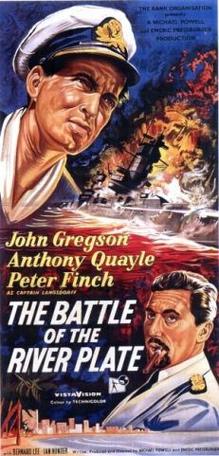
Pursuit of the Graf Spee

In the early years of World War II, Germany ruled the seas as its enemies jumped into a new age of naval warfare. The battleship Bismarck was the most infamous example of German firepower on the high seas, a ship that terrorized Allied shipping. Another example -- a significantly lesser-known one -- is the pocket battleship Graf Spee, a cruiser dubbed a battleship that caused an international sensation late in 1939, a story told in 1956's Pursuit of the Graf Spee.

As 1939 comes to a close, British merchant marine Captain Dove (Bernard Lee) sees his ship sunk by a German cruiser, the Graf Spee, that is gaining notoriety around the world for its ability to disrupt Allied shipping. On board the German cruiser, Dove meets its captain, Langsdorff (Peter Finch), who tells him that he will be kept with other prisoners until they can be dealt with. The days and weeks pass though and Dove is joined by countless other prisoners who tell him a rumor of coming trouble. The British are sending a three-cruiser convoy in pursuit to hunt down the infamous German warship. Outnumbered but not necessarily outgunned, the Graf Spee is ready for a battle, but the coming fight involves more than either side was planning for, including international negotiations and intrigue.

From directors Michael Powell and Emeric Pressburger, 'Pursuit' is an interesting movie, but for reasons I really didn't see coming. A forerunner of 1960s/1970s WWII movies like Midway, The Longest Day, A Bridge Too Far, Tora Tora Tora, this British-made film plays like a documentary at times. Big, expansive story telling a true historical battle and a big impressive cast set the backdrop. What I was most impressed with was the use of real ships that give the story a sense of authenticity and realism. There are some truly impressive shots of these immense, destructive warships at sea, and some equally enjoyable shots of cast and crew on-board these ships.

Beyond that though, the movie stays on a superficial for its first half of the 119-minute running time. It gets bogged down quickly in the details and the naval tactics of the history. It's apparently very accurate, but that doesn't make the story interesting to watch. The commander of the cruiser convoy (Anthony Quayle) sits down with his ship commanders and explains what their plan of attack is. Then we see the attack after an excruciatingly long segment of the ships scanning the horizons for the Graf Spee that plays in real-time (seemingly of course). The actual battle is ships miles away from each other just blasting away at each other. While we see the effects as the shells land and tear the ships apart, it is far from exciting to watch. I never felt emotionally or personally invested in the story that sticks to close to its quasi-documentary style.   

After the slow-moving naval intro that never really caught my attention, 'Pursuit' finally picked up pace in the second half when it takes a surprising turn. Severely damaged in the battle, the Graf Spee makes a beeline for the neutral harbor of Montevideo with the British not far behind. What follows is an interesting twist of that international intrigue as the Uruguayan government (including minister Peter Illing) decides what to do with the situation as several foreign ministers (Anthony Bushell = British, Douglas Wilmer = French, John Chandos = German) try to get their two cents in. At the same time, intelligence agents (Michael Goodliffe and William Squire) attempt to decipher what the Germans will do. An American radio rep (Lionel Murton) for NBC describes the action from shore as huge crowds gather on the beaches and docks to see what happens. The story just plays differently, and it plays well with a change of pace.

The overall casting has its positives and negatives. 'Pursuit' features a lot of impressive names, but like the early goings in the story, it has a superficial feel to it. The naval battle is especially affected in negative fashion, faceless sailors in white yelling amidst smoke and chaos. The captains of the British cruisers include John Gregson, Ian Hunter and Jack Gwillim with Patrick Macnee as one of their subordinates. Also look for Christopher Lee as Manolo, a passionate Uruguayan bar owner who bothers Murton's radio man, with Donald Moffat as a signalman in his film debut, and Anthony Newley and Nigel Stock with small, uncredited supporting parts. I wanted to like this one more, but it's too uneven and missing that special something (energy is my final verdict) that brings a movie up a notch. The second half is considerably better so stick with it for the payoff.

Pursuit of the Graf Spee (1956): ** 1/2 /****     

Sunday, May 20, 2012

The Cockleshell Heroes

Writing reviews about World War II, I've watched epics about large-scale battles, personal stories about the home front, behind the scenes stories about government/administration, but my favorite has always been the men-on-a-mission sub-genre, commandos, specialists and secret agents working together to pull off an impossible mission. One of my favorites I recently rewatched for the first time in quite awhile is 1955's The Cockleshell Heroes.

Early in 1942 with WWII's outcome still very much in question, Royal Marines Captain Stringer (Jose Ferrer) has been tasked with an improbable mission. German ships operating out of the French city of Bordeaux have been wreaking havoc on Allied shipping, and Stringer must attempt to reach the harbor city with a small group of commandos, destroying as many ships as possible. The catch? They'll be doing it by paddling up the Garonne River in two-man canoes. With help from a career Marine officer, Captain Thompson (Trevor Howard), Stringer goes about training his team of volunteers for a mission that seems suicidal to everyone involved.

From star and director Ferrer (one of 7 films he directed), 'Heroes' is based on the true story of Operation Frankton which took place in December 1942. I watched it as a kid on the History Channel and have always remembered it fondly. Released in 1955, it is more of a heroic look at the bravery these commandos showed on their mission. It doesn't yet have the darkness, cynicism or reality of so many WWII movies released a few years later in the 1960s. There is still an innocence to the story, a "nice" factor. The commandos are the heroes, their Nazi counterparts stereotypically evil. 'Heroes' is only 98 minutes long and was shot on a smaller scale (some cool English locations providing good background) with the focus on this specific mission. There's no sense of a bigger issue or the state of the war. Instead, it's about 8 commandos and the officers leading them. When handled right, who needs a bigger scale than that?

Not a hugely well known movie, 'Heroes' doesn't have the same name recognition in its cast so many other war films have. Ferrer is solid but not particularly memorable as Major Stringer, the unlikely, volunteer commander of the mission. He has several strong dialogue scenes with Howard's Thompson as a rivalry develops about how the mission should be handled, but there's little doubt who the star is. Trevor Howard is a scene-stealer, putting a spin on the stiff upper lip British officer. He's prim and proper and interested in the bottom line -- the success of the mission -- more than how the men feel about him. Thompson is the only character given any real background and Howard does not disappoint. The commandos include Victor Maddern as Sgt. Craig, Thompson's right hand man, as well as the Marine volunteers; Anthony Newley as Clarke, the smart-alec, David Lodge as Ruddock, the strongest of the Marines, Peter Arne as Stevens, the capable Corporal, Percy Herbert, Graham Stewart, John Fabian as Cooney, the Irishman, John Van Eyssen, and Robert Desmond (The Great Escape). Newly, Maddern and Lodge stand out from the group as memorable.      

At its heart, this is a men on a mission movie. It just so happens to be based on a true story, the results of the movie mission exaggerated a bit relative to the actual history. Truth or not, 'Heroes' follows a familiar formula. The story is pretty clearly divided in two parts; the training for the mission and then the execution of said-mission. I would have liked some more character background on the commandos, but the training scenes do just enough to differentiate them from each other. There are some original, unique scenes, including Stringer parachuting his commandos into England.....dressed as German soldiers. No money, no identification, they must trek some 300-plus miles back to the base without getting caught. These are some necessary scenes, giving us a rooting interest in these men as they head off to their mission.

Not surprisingly then, the best parts of the movie are the actual mission, dubbed 'Cockleshell,' as Stringer's team is dropped off by a British sub (commanded by Christopher Lee) and must paddle over 70 miles up the Garonne River to their target, ships waiting in the harbor. The final 40 minutes are tense and adrenaline-pumping as they navigate the river. It's here where I started to question. If I didn't know this was in fact a real mission, I'd say it was ridiculous. The bravery exhibited here in insane, commandos in 2-man canoes paddling exposed up a heavily guarded/defended river. HERE is a Google Map showing how far they actually traveled. The ending is downbeat with a sense of success, Howard delivering a very moving final line. Success at what cost though? Listen to some of the main theme HERE, a whistle-worthy score from composer John Addison. The link below is a documentary about the real-life mission. As for the movie, a hidden gem and one I've always enjoyed.

The Cockleshell Heroes <---documentary (1955): ***/****

Thursday, December 22, 2011

She

No point in wasting time with some lying in the intro. I didn't watch 1965's She because it sounded interesting or the names in the cast jumped out at me. I watched because Ursula Andress was in it, and.....well.....she's nice to look at.  So yeah, that's it. The Swiss beauty is gorgeous.

Having survived World War I, three friends, Leo (John Richardson), Holly (Peter Cushing), a former college professor, and Job (Bernard Cribbins), Holly's servant, are wondering what to do with themselves in 1918 Palestine. Leo meets a mysterious woman, Utane (Rosenda Monteros), who leads him to an exotic villa where he's introduced to a beautiful and even more mysterious woman, Ayesha (Andress), who speaks ominously of him joining her, all his dreams coming true and whatever he desired....if he can find her somewhere in the African desert in a supposed lost city. Curious of what awaits them, Leo is joined by Holly and Job, but none of them truly know what to expect, what awaits them.

A movie from Hammer Film Productions, 'She' has quite a bit of schlock value. It is in no way expected to be a classic, or even a good, average movie for that matter. What little budget existed seems to have been bookmarked for the indoor sets of a long-lost city in the desert, the rest saved for Andress' costumes. There isn't so much a story as a series of somewhat related scenes loosely tied together. In the meantime as viewers, I'm guessing we're supposed to stay involved seeing if we can see through Andress and Monteros' nearly sheer outfits. Not so fast though, it is the 1960s. No nudity here although Andress certainly is half naked much of the movie.

I guess what threw me off is that for about 30 minutes, maybe even 45 minutes, I was enjoying this movie. The post-WWI beginning in the Middle East is a unique, interesting set-up.  The relationship among the three vets -- Leo, the young, suave bachelor, Holly, the aged and intelligent professor, and Job, his ever loyal man servant -- is a good if familiar start. What to do after surviving a war? Normal, everyday life sounds dull so let's embark on another death-defying adventure! Not quite a 'Men on a Mission' story, but there are traces of that sub-genre. The appeal of possibly unearthing a lost city is just too much to pass up.

Now as bad as the movie can be at times -- real bad -- there is too much talent with certain members of the cast for it to be a complete waste. Two masters of British horror, Cushing and Christopher Lee, make sure of that. Both consummate professionals, they're going to commit to their parts and go for it. Cushing is a sidekick more than a lead character, but his scenes with Richardson and Cribbins are a high point. Lee has a somewhat smaller part as Bilali, Ayesha's high priest suspicious of Leo's arrival. Intimidating and imposing, Lee makes the most of what little screen time he has.

Then there's Andress and Richardson. Depending on the film and script, Andress could be a solid if unspectacular actress. 'She' has neither. Her part is completely about her physical appearance, an immortal goddess looking for a man to spend all of eternity with. On that note, Andress is great because she does in fact look gorgeous. I know what you're thinking. It's a stretch for her, but she pulls it off. A year before Richardson would woo Raquel Welch in One Million Years BC, he woos Andress and shares several long, even uncomfortable make-out scenes. He must have been doing something right because he couldn't act his way out of a paper bag. Not very good performances at the top.

Definitely wasn't expecting a classic, but I was expecting to enjoy the movie a bit more. A general feeling of cheapness and a story that never really goes anywhere, even Cushing, Lee and Andress' physical appearance couldn't save this one. Good start, but the momentum dies about 30 minutes in.

She <---TCM clips (1965): **/****

Friday, June 24, 2011

The Pirates of Blood River

Because I don't typically review a lot of horror movies here at Just Hit Play, the horror/thriller genre sometimes gets the short end of the stick, and more specifically certain actors.  Whether you know him by name, it's basically a sure thing that you've seen a movie starring British actor Christopher Lee. At almost 90 years old, Lee has been in almost 200 movies all told, many of them horror and thrillers from Hammer studios in the 1960s and 1970s.  He is synonymous with old school British horror movies, but in his Hammer films, there were some oddities, including 1962's The Pirates of Blood River.

Thanks to the Pirates of the Caribbean movies over the last decade or so, pirates in general have had a bit of rebirth in pop culture recently.  No doubt a lot of that can be attributed to Johnny Depp's Captain Jack Sparrow, a lovable scab of a pirate who even as he commits all these despicable acts still finds a way to be endearing in his greed, stupidity and general cluelessness.  Long story short? Pirates were just plain old nasty folks, killing, pillaging and raping wherever they went. 'Blood River' is certainly in that boat, portraying pirates in a negative light in an adventure story that is just a lot of fun.

It's sometime in the early 18th Century on the Isle of Devon, and in a small community of Huguenots, Jonathan Standing (Kerwin Matthews) is in trouble. Accused of having an affair with a married man's wife, Jonathan is sentenced by his own father to 15 years working in the penal colony. He goes, working several months before pulling off a dangerous escape. Fighting his way through the jungle, he's rescued by a crew of pirates led by a Frenchman, Captain LaRoche (Lee), who cuts a deal for Jonathan to lead him to the village. The pirate captain says he's looking for a resting spot for his ship and crew, but Jonathan quickly figures out otherwise. LaRoche is looking for treasure, and he's convinced there's hidden riches waiting for him. With help from an old friend, Henry (Glenn Corbett), Jonathan does everything he can to rescue his people.  

After finishing this movie, I somewhat stupidly started investigating some.  Where was this Isle of Devon? Who were these Huguenots?  Is there any truth to this pirate story, any basis in fact? Basically it was all wasted time.  As near as I can figure, there's no Isle of Devon, the Huguenots were a real people, and there was no basis at all for this premise. This island appears to be somewhere in the Caribbean, maybe somewhere off of Central or South America?  Who knows though, it's never said and it's not really that important. The point is that the movie doesn't need any of that background. It doesn't matter where this island is or who these people are. Jonathan's folks are the good guys, and Lee's pirates are the oh so bad guys.  Enough said, sit back and enjoy the flick.

There is something appealing about the films that came out of the Hammer Studios that is hard to explain. The stories have a small scale to them, but never feel like low-budget features.  A simplicity to the story is always nice as is the case here, good guys vs. bad guys with no real shade of gray.  It's never trying to deliver a message. It's a fun movie with lots of action, gunfights and sword play.  A win-win combination if there ever was one.  Director John Gilling actually never left England to film this movie which is impressive because I had the sense to think he filmed in some sort of Caribbean/jungle location. The pirates are all duded up, the Huguenot community looks like pilgrims, and there's enough action to keep everyone involved and entertained.

The casting is interesting, and in a positive way for the most part. Matthews is the heroic lead given a chance to redeem himself, but Corbett takes some of his screentime as friend and sidekick Henry.  I guess Jonathan needed some help dispatching the pirates so cue Henry, and away we go.  Lee not surprisingly steals his scenes as LaRoche, the smooth, above-it-all pirate captain who always knows how far he can push his men and still get results.  Lee's LaRoche does look ridiculous in his silk shirt, eye patch and tight black pants, but it's just one more weird oddity that adds up. Marla Landi plays Bess, Jonathan's sister, while Andrew Keir has a good part as Jason Standing, Jonathan's stubborn, strong-willed father. LaRoche's pirates include a young Oliver Reed, Peter Arne as Hench, LaRoche's right-hand man, and Michael Ripper as Mac, a possibly mutinous, back-stabbing pirate. 

Looking back over what I've written, I'm seeing that I haven't gone into much detail about the film.  I think it would be a case of over-analyzing a movie that just doesn't call for it.  Is this a great movie? No, not even close. What it is though is an exciting historical action flick from a studio that knew how to appeal to the wants and likes of an audience. From the credits to the final scene, I very much enjoyed Pirate's 87-minute running time. Underrated, exciting, and with some interesting casting. A weird one, but a good one. There are three extended clips available at Youtube, but there's no real rhyme or reason to them so I'm not going to link to them.

The Pirates of Blood River <---trailer (1962): ***/****

Friday, December 11, 2009

The Wicker Man (1973)

When a movie has been remade, a question presents itself. Which one do you watch first? Just a few weeks ago, I wrote a review of the remake of Flight of the Phoenix which I very much enjoyed, and then saw the original. I guess I got lucky there. Keeping it simple, think of it this way. In most cases, a movie is remade because the original is VERY GOOD and someone wants to capitalize on it with a new audience. It's the rare remake that tries to put a new spin on an awful movie.

This whole review is basically an exception to the rule. My senior year at IU the campus movie channel aired the 2006 version of The Wicker Man starring Nicolas Cage. Without giving away anything, let me say this. It is an awful, aaaaaaaawful movie...and I love it. It's played seriously but comes across as so unintentionally funny that I recommend it whenever I can. I'm not talking a chuckle here and there, I mean laugh out loud till you cry funny. Of course, the one problem is that the original, 1973's The Wicker Man, is a bit of a cult classic and held in high regard as a good movie.

So there's my problem. As epically bad (and therefore enjoyable) as Cage's remake is, it is almost a scene for scene redo with a few variations on the setting and background. The kicker is the ending which provides a huge twist and could have been a real shocker of a conclusion if it wasn't so damn funny. Well, last week TCM Underground aired the 1973 original and I taped it. It is a much better film and even treating everything deathly seriously, it is not a funny movie thankfully. But knowing the twist and where the story is going, it does lose some of the luster. So what to take away here? Almost always watch the original and then the remake. Anyways, on to the review.

A sergeant on the police force in England, Neil Howie (Edward Woodward), receives a letter from someone on the tiny coastal island of Summerisle. It asks for his help in finding a missing girl, Rowan Morrison, who disappeared completely in the past weeks. So off Howie goes to investigate, but he quickly finds everything is not as it seems (how often can you say that in a horror/thriller movie?). The island is run by Lord Summerisle (master of British horror Christopher Lee), whose family has cultivated a way to grow fruit by praying to all sorts of pagan gods. Howie, a devout Christian, is taken aback, but even more than that, he's confused. He gets the run around from the people of Summerisle, some say Rowan's dead, others have never heard of her. Can Howie figure out what's going on?

It depends on the movie whether I'll reveal the big twist in a review, and this is one I will not be telling. For one, it's a really good twist that comes completely out of left field. I can't think of even one hint or clue that's given like so many movies do nowadays. It's even a little shocking in the revelation as the doomsday scenario washes over the characters. Credit goes to Woodward for his part as Howie, a pompous, devoutly religious man, who scoffs at everything he seens on the island having to do with paganism. He's in just about every scene, and it's a performance that carries the movie.

As Lord Summerisle, Christopher Lee is the perfect choice to play the part. He gets to be eccentric, extravagant and basically everything you'd ever think of in your desire for a cult leader. But because it is Lee, it is never a laughable effort. It's Christopher Lee so he must be on to something. Diane Cilento plays Rose, the schoolteacher who tells the children all they'll need to know about their pagan religion, and Britt Ekland makes a memorable appearance as Willow, the innkeeper's daughter who tries to seduce Howie. In a very 70s scene, Ekland sings a Scottish folk song to Howie from another room while dancing naked. Next door, Howie tries to keep it together.

Director Robin Hardy filmed the movie in Scotland, and the movie benefits greatly from the on-location shooting. The old Scottish streets and houses, the green countryside all help build a sense of doom that something horrible is coming. It all looks too nice, too perfect, but you just know that something is building. The ending is worthwhile and makes the sometime slow pacing even more nervewracking. Check this one out, and then go see the awful remake. If possible, it'll be even funnier. The trailer has some semi-SPOILERS, I'd recommend going into this movie blind though.

The Wicker Man <----trailer (1973): ** 1/2 /****

Thursday, February 5, 2009

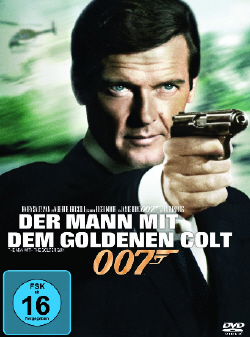
Netflix review #4: The Man With The Golden Gun


I've seen all the Connery Bond movies, the last two obviously with Daniel Craig, and bits and pieces of the Roger Moore entries, but I never really sat down and watched one straight through. I was never a huge fan of Moore, but thought as a fan of the series I should watch all of the movies. I watched Moore's first movie, Live and Let Die, a few weeks back and got The Man With The Golden Gun in the mail yesterday.


Reading reviews, TMWTGG seems to take a lot of heat for being pretty cheesy so I was surprised by how much I liked it. Moore seems to have figured out how to play 007 more so as compared to LaLD. His one-liners are there, but they're not overdone. We get it, you're clever, stop with the cheesiness. The action scenes are well-handled, and he's more believable as it looks like he did most of his own stunts. When it comes to the ladies, Moore was never in question. Just two movies in and with the snap of a finger, he's got the Bond women waiting.

Horror movie master Christopher Lee is the villain here, the man with the golden gun, Francisco Scaramanga, the world's deadliest assassin who charges a $1 million per kill. The hit man supposedly sends a golden bullet to MI6 with "007" imprinted on it. So Bond has a master assassin on his tail, but there's a glitch, no one knows what he looks like. In an odd twist, even for this series, the only way to identify Scaramanga is that he has an extra nipple. There's a subplot here too about capturing solar energy, but it isn't as good as the two men going head to head.


In the Bond girls department, this one gets high points with Britt Ekland and Maud Adams starring. Ekland plays Mary Goodnight, a fellow agent working as Bond's liasion of sorts who plays hard to get with him. In a memorable ending, Ekland runs around the last 30 minutes or so in a bikini. In her first Bond movie, she would return as a different character in Octopussy, Adams is Andrea Anders, Scaramanga's mistress who sees a way to safety through 007. Both women are up there as two of the more beautifuly Bond women.

One more bit of interesting casting, a pre-Fantasy Island Herve Villechaise as Nick-Nack, Scaramanga's deadly little assistant who we're never quite sure what his motives are. Clifton James also returns as Sheriff JW Pepper from Live and Let Die in an unnecessary return. Convenient that a Louisiana sheriff is visiting Thailand the same time as Bond, isn't it?

When it comes to action, I thought "Golden Gun" was top-notch including an exciting boat chase and a chase through Hong Kong with a good pay-off as a car does a corkscrew over a river. The scene's marred by a cartoonish slide noise, but the stunt's impressive no matter how you look at it.

Other things worth mentioning, or maybe not mentioning, the theme by Lulu is forgettable and painfully unsubtle, even for a Bond song, and the movie at 125 minutes can be a little talky. But otherwise, it's worthwile. Not a classic Bond movie, but better than the clunkers. This was director Guy Hamilton's fourth and final 007 movie, a good end for the director of the classic Goldfinger.

The DVD has the movie in its widescreen presentation, the Hong Kong and Thailand locations look great, and two different commentary tracks.

The Man With The Golden Gun (1974): ***/****