The Sons of Katie Elder

The Sons of Katie Elder
"First, we reunite, then find Ma and Pa's killer...then read some reviews."
Showing posts with label Italian cinema. Show all posts

Friday, January 17, 2014

The Fifth Cord

Take a look to your right and find the runner marked Labels. Can you tell I like spaghetti westerns, a sub-genre of westerns with a cynical take on violence and the old west from the late 1960s and 1970s made with Italian backing and often starring American actors. I love the genre, but it's also opened the door to all sorts of other Italian films like sword and sandal epics to a new genre for me, the Italian giallo, starting with 1971's The Fifth Cord.

A journalist and reporter with a drinking problem, Andrea Bild (Franco Nero) attends a New Year's Eve party and ends more than sufficiently liquored up. He staggers home, sleeps it off and heads into work the next day to find out that a woman who attended the party, and a friend of Andrea's too, was murdered following the party. With an in at the police department, Andrea does his own investigation and doesn't buy how the police are tying it all together. It's not long though before several other murders take place, all of them guests from that same New Year's Eve party. Andrea tries to piece it all together at the risk of his own life, knowing that this serial killer may be targeting him next. Can he track down the murderer before he becomes that next victim?

The term 'giallo' in this context can mean any thriller, often about serial killers, gruesome murders and all that good stuff. Pretty uplifting, right? The genre blends in all sorts of archetypes, from the rather gory murders -- throat slices to decapitations -- to the typically deranged killers doing the deeds. It wasn't just about gore or shock value though, typically trying to amount to more, making an art of the genre. There is a style and a visual that helps it rise above the same old, same old from a familiar genre. I'm not a huge fan of just the good, old-fashioned slasher genre so having something additional to focus on makes it more than just a scare factor movie, a jump out of your seat fright fest one after another. And oh yes, it is pretty creepy.

As a writer -- okay, a freelance writer who typically writes about sports and movies -- I'm a sucker for most movies depicting the oh so glamorous lives of writers, reporters and journalists. If you listen to movies though, anyone who has ever committed a word to paper is drunk, really drunk, a drug addict or has such serious personal issues that it's amazing writers aren't crippled by their own flaws. Franco Nero does a solid job in the lead performance as the drunken journalist trying to track down a murderer before that murderer can get to him. I think Nero was a solid to above average actor, but when he was at his best it was because he was a huge, brooding, emotional presence. A life and death situation certainly brings that out. Nero was always able to do a lot with his eyes, that sinister, low-burn intimidation or that big, wide-eyed fear and/or panic. The story was hard for me to follow at times, but Nero was excellent.

I can't say that for the rest of the cast. For me, it felt like I was seeing a rotation of similar characters with very little in the way of distinguishing features that sets them apart from each other. No doubt, part of that comes from my complete lack of familiarity with most of the Italian cast, but some of it has to be attributed to the script. Familiar WWII face Wolfgang Preiss plays the police inspector who works with Nero's Andrea but also starts to suspect him as the clues and evidence mount up. Here's a problem though. With an exception here and there, I can't remember a single other prominent character five days after watching this movie. Some people get killed, some are introduced (poorly), and then one is revealed as the killer. When it happens, I couldn't even place him, questioning if we'd even met him at some point. The reasoning is cool, something we've seen as an audience many times in Law and Order, but when the payoff alone isn't worth it, any twist and/or reveal lands with a thud.

So while the story is disappointing, the giallo qualities work well. As an underplayed, moody and downright unsettling murder mystery, it works because the murder scenes are so perfectly uncomfortable. Director Luigi Bazzoni uses some off-center, wide-angle camera angles, zoomed in and then zoomed out to extremes to build up the tension as to what's about to happen. A paralyzed woman (Ira von Furstenberg) is trapped in her home, unable to reach her wheelchair, the killer tracking her down in the spacious, poorly lit rooms and hallways. Later, a little boy desperately tries to lock all the doors to his home, his Mom on the phone willing him to go faster, the killer trying to get in. Why? Eh, not really explained why the little boy is a target. And there's your problem. I feel like I missed a whole lot of explanation, and the story falls short in the end.

The Fifth Cord (1971): **/****

Tuesday, January 7, 2014

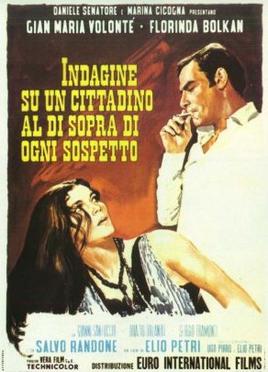
Investigation of a Citizen Above Suspicion

I don't remember which movie I saw first, A Fistful of Dollars or For a Few Dollars More, but I do remember this. I liked Gian Maria Volonte from the first movie I saw him in, a great villain in the first two flicks of Sergio Leone's Dollars trilogy. There's a problem of course, a lot of his movies simply aren't available to watch. Thankfully after sitting on my Netflix Unavailable queue for about three years, 1970's Investigation of a Citizen Above Suspicion became available. Thanks, Criterion Collection!

Visiting his mistress, Augusta (Florinda Bolkan) at her apartment, a middle-aged, well-dressed man (Volonte) has sex with her and promptly murders her, slicing her throat with a thin razor blade. He takes his time leaving the apartment, showering, gathering his things and doing one last thing. He calls the police, reporting a murder and even providing the address. He leaves the apartment and drives to work....where he's the Chief of the Homicide Division. His detectives and officers are busy dealing with the recently reported murder of his mistress, the Chief going about it like nothing's wrong. He's been promoted as well, moving up to Chief of the Political Division, leaving Homicide with the best reputation it has had in years. How good is the reputation though? Can his own force find out he's the murderer?

From director and screenwriter Elio Petri (writing with Ugo Pirro), 'Investigation' is an Italian film that earned Oscars, numerous international awards and according to Wikipedia (and when are they ever wrong?) is widely regarded as one of the great international films of the entire 1970s. For years, it simply wasn't available to watch in the United States, only getting its release in the U.S. recently courtesy of a Criterion Collection DVD release. I don't feel comfortable enough with an entire decade to call it one of the best, but it's easy to see the appeal. The story, the message (sometimes a little heavy-handed), the style, and the location shooting in Italy go a long way. It certainly has a lot going for it, starting with....

None other than Gian Maria Volonte. I went into this movie with a preconceived notion of what this movie was going to be like, the Netflix sleeve backing me up. I assumed Volonte's main character was trying to cover up the fact that he murdered his mistress. Yeah, about that.....nope. He wants to be caught. He wants to test the system, hence the title. The premise is that certain people just couldn't commit crimes, just wouldn't do it, especially one as heinous as murder. He's a police chief, of the Homicide Division at that, so he couldn't be a prime suspect in the investigation, could he? That's what Volonte's Chief intends to do. This is an epic cat and mouse game he's playing here. Having murdered the mistress, he casually walks around the apartment leaving clues that he was there. He leaves his fingerprints on a variety of things, steals jewelry but leaves a large pile of cash, is even spotted by a tenant in the apartment building.

So everything is seemingly working against him, right? That's the beauty of this part, the ever-developing case against him. The Chief goes into his plan fully intending to test the system, to see if he can get away with it, if his Division will put the pieces together and actually figure out it's him. He's an idealist if possibly insane and unhinged for actually murdering someone to try and prove a point. Is it ego? Is it pride? What drives him? I would have loved with a little more explanation as to his reasoning. What we do see is a man who is both convinced he's right and also a man who is sure he's made the wrong decision, trying to trip the police up at different points instead of spelling it out. He's impeccably smooth, always wearing a perfectly tailored tie, his hair slicked back into position, a man oozing with confidence and ego just daring to be taken down a notch or two. It's a great part that straddles that fine line between villain and master of evil villain. As mentioned, I would have loved a little more explanation, but the gist of his reasoning is there.

This is Volonte's movie, plan and simple. The rest of the cast is a means of testing him and pushing him, seeing how far he can push back at times with his fellow detectives, his superiors, the people working the nuts and bolts aspect of the police force. Let's start with Bolkan as the mistress, Augusta, just plain old crazy and a bit of a tramp...to put it lightly. It is her who first puts the thought of murder in the Chief's head, seeing how exactly he would murder someone and get away with it. Creepy performance, but a good one. Arturo Dominici is Mangani, the Chief's replacement in the Homicide Division, while Orazio Orlando is very good as Biglia, a younger officer but a smart one, someone who starts to see that the Chief should be a prime suspect. Gianni Santuccio is appropriately sleazy police commissioner, Volonte's Chief point-blank admitting the victim was his mistress. Also look for Sergio Tramonti as Antonio Pace, a revolutionary, an anarchist looking to cause some problems.  

The 1960s and 1970s were quite the turbulent, violent time in Italy, corruption wreaking havoc in the government and police force. The message here isn't subtle....basically don't trust anyone in a power position. ANYONE. It can be a little heavy-handed in its execution, but the story and premise are more than interesting enough to overcome that relative weakness. The ending is pretty good too, seemingly a twist throwing everything for a loop before revealing an open-ended finale that really isn't so open-ended when you think about it. A good movie with a great performance from Volonte that will hopefully pick up some more buzz in 2013 courtesy of a great-looking DVD from the Criterion Collection. Also worth mentioning, a playful musical score that builds up that tension from who else? Ennio Morricone of course.

Investigation of a Citizen Above Suspicion (1970): ***/****

Thursday, August 22, 2013

Salvatore Giuliano

Hero, outlaw, bandit, revolutionary, Robin Hood, all names to describe a historic figure who fought against the government or authority in some fashion. Depending on their motivations, tactics, techniques and ultimate goals, one and all of those descriptions can apply. As for their film stories, how are they portrayed? Pancho Villa, Che Guevara, and Salvatore Giuliano, an Italian bandit from the 1940s. Let's go with an Italian film of the same name, 1962's Salvatore Giuliano.

It's 1950 in a Sicilian town in the hills and a dead body has been found in an alleyway. Authorities identify the body as Salvatore Giuliano (Pietro Cammarata), an infamous bandit who has terrorized the countryside since late in WWII. In the wake of the Allied victory in Sicily, a power void was created with many different groups trying to grab that power. One group, the MIS, approaches Salvatore with an offer. Can he continue to cause the government and police as much trouble and chaos as possible? The Italian bandit takes up the offer, his group of bandits and gunmen wreaking havoc. The power is there, but one government change after another, one election after another, his group's desires aren't met, putting Salvatore on the outlaw path again. How does he end up dead in the alleyway? What led him to the situation that eventually led to his death?

Ready for a twist? Are you sure? The titular character, the one who was the only character mentioned in that plot description....is a secondary, even minor character. By my count, he had maybe three lines, and those are simple orders to his men as they prepare for battle. He has little to no dialogue, has no real close-ups and is a key character in name only. It's what his name represents that's important. He's discussed in just about every scene, and we actually see him more as a corpse than a living human being. What's more surprising? How well it works. His name and the idea of his name becomes more than he ever could have hoped. The film from director Francesco Rosi obviously takes a favorable point of view upon Giuliano so his intentions, motivations and personal relationships become secondary to what his name actually means to the people. I would have never thought this would have worked, but it ends up working on just about all levels.

Filmed almost like a documentary -- a neo-realist documentary style according to the InterHighway -- 'Giuliano' can also be viewed and appreciated solely in terms of style. It is filmed in black and white, giving the story an eerie calmness throughout. Rosi films on location in Italy, the Italian countryside providing a criminally simplistic background that gives the story quite an air of authenticity. Also, Rosi and cinematographer Gianni Di Venanzo shoots in a variety of fashions. The neo-realist style comes into play here with an almost complete lack of editing. Rosi and Di Venanzo set the camera up and let things go, long, interrupted shots that are a marvel to watch. We see scenes come together -- action or drama or both -- and the camera simply follows the action, countless extras walking in and out of frame as needed. It's less editing than just about any movie you'll see out there now, but by doing so much less in terms of filmmaking, they actually do a lot more. Again, it's crazy how well it works on a very simple, aesthetic level.

Actually delving into some story, there's actually more style to be discussed. The opening scene is an eerie, unsettling scene, police and investigators milling around Salvatore's bullet-riddled, bloody corpse just lying in the dirt in an alley. For starters, once we learn it's Salvatore, we know in a sense how the movie will end. Salvatore Giuliano will die. The rest of the story is told in a non-linear flashback style, scenes bouncing back and forth between Giuliano's rise to power (of sorts) and the fallout following his death. It's tough to keep up with -- reading Italian subtitles aside -- because there aren't very obvious transitions. Sometimes, it took me quite awhile to realize the story had bounced back and forth. You get into a rhythm, but it is an atypical story that definitely forces you to pay attention scene in and scene out.

Now, everything can't be perfect so here we go. The movie runs 125 minutes, and for the first 60-plus minutes, things are pretty perfect. I loved the first half of the movie. LOVED it. Then the bouncing story bounces forward, following the fallout of Salvatore's death including a trial as some of his men/followers, including right hand man and deputy, Gaspare Pisciotta (Frank Wolff), who may or may not have betrayed Salvatore. Wolff is one of two true actors in the film (and hams it up), along with Salvo Randone as the judge presiding over the trial, the rest of the roles being given to locals and peasants in the area while filming. The court sessions go on for too long, dragging on with screaming matches about principles, guilt and ideologies. It's the opposite of what's good about the first half, and the resolution just isn't satisfying enough for all the build-up.

This movie is one that has lots going on, most of it very good, some of it difficult to get through. Without having much knowledge of the Sicilian fight for freedom in the 1940s, it is a tough movie and story to keep up with. Lots of groups, lots of individuals with their own motivations, it's hard to know who is on what side when Salvatore, the Mafia, the changing governments, the police, and the Carabinieri (the national military) are discussed from scene to scene. There are flaws here and there, but for me, the strength and power of the first hour wins out. If it's a little heavy-handed at times, so be it -- ooh, Salvatore's dead body looks like Jesus! -- but when it works, it's a great example of the power of film.

Salvatore Giuliano (1962): ***/****

Thursday, March 7, 2013

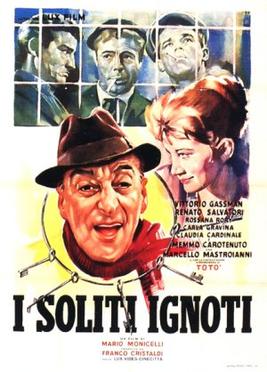
Big Deal on Madonna Street

From director Jules Dassin, 1955's Rififi is maybe the perfect heist movie. It succeeds on countless levels, one better than the other, and maybe most importantly/impressively, it has impacted just about every heist flick made in the 50-plus years since it's release in one way or another. The biggest compliment a movie can make is to imitate a predecessor, and 1958's Big Deal on Madonna Street takes the basic premise of Rififi and turns it into....a spoof? Color me surprised, but it works in a big way.

A small-time crook, Cosimo (Memmo Carotenuto) is arrested while trying to steal a car, found guilty and sentenced to jail. His timing is lousy though because he quickly hears about a foolproof plan, an intricate heist that will net quite a payday. What to do though? He needs a fall guy to take the blame for his actual crime, but his partner, Capannelle (Carlo Pisacane), can't find anyone. Instead, all his candidates team to find someone else, settling on struggling boxer Peppe (Vittorio Gassman), but even that plan doesn't go according to plan, Peppe ending up in jail with Cosimo. The boxer pulls a double cross though and finds out Cossimo's plan, and now with his motley team of amateur and small-time crooks, he intends to do the job himself.

It isn't quite fair to say that this Italian film from director Mario Monicelli is a straight remake of Dassin's 1955 film, but it does bear some striking resemblances. The most obvious connection is the actual heist scene, but even that is tweaked enough to set it apart. I loved this one. It is a spoof, but not in the modern sense of a spoof like the bizarrely stupid Scary Movie series. It's a smart humor mixed in with some rather dry laughs, proving spoof doesn't equal stupid.

Maybe it's the Italian charm, but 'Madonna' has style to burn that mixes the natural drama of an involved, complicated heist with that light sense of humor. For one, I love the look of the film, shot on location in and around Rome. No matter the era, Rome has a historic, beautiful look that translates ridiculously well to film. No sets here, just real-life Rome. Composer Piero Umiliani's score is perfect, a mix of fast-moving, light-hearted jazz and quieter moments as the heist comes together. Listen to a sample HERE.And then there's the style of the story. Title cards reminiscent of a 1920s silent movie keep the story moving along, filling in holes with the story so the 106-minute run-time is never lagging. They're genuinely funny messages on the title cards, but I also like the fact that it's subtle humor. Monicelli didn't feel the need to spell out everything little thing for us. Because of the title cards, the story does take some jumps and transitions but never in a bad way. It works, trusting the audience to figure things out to a point.

The biggest spoof aspect comes from the crew of amateur crooks and low-level thieves who team up to pull off a heist. Gassman is a strong lead, the tough boxer who ends up leading his motley crew through one ridiculous trial after another. His team includes Mario (Renato Salvatori), a thief who will buy and sell anything, Norma (Rossana Rory), Cossimo's former girlfriend, Capannelle (Pisacane), the aging, bumbling thief, Ferribotte (Tiberio Murgia), the gentlemanly thief trying to protect his single sister, Carmelita (Claudia Cardinale), Tiberio (Marcello Mastroianni), a down on his luck thief caring for his son since his wife was sent to jail, and Dante (Toto), the expert and veteran safecracker. Of the group, Gassman, Salvatori, Pisacane, Murgia and Mastroianni become the stars, the little group coming together nicely as the heist comes together. Great casting, good variety, and a perfect chemistry.

While the main focus is on the heist, there are certain departures that are handled really well. They're the type of departures that normally would drive me up a wall, but for whatever reason, they work here. Most come as off-shoots of the heist, like Gassman's Peppe trying to woo Nicoletta (Carla Gravina), a maid in an apartment the crew will have to use to get at a safe. The young maid doesn't go willingly, messing with Peppe as much as he does with her. The same goes for Mario and Carmelita. Ferribotte hides his beautiful sister away so only her fiance will ever see her, but Mario falls for her at first sight. It all works together nicely, the different storylines blending well.

In the end though, this is a heist movie, spoof/comedy or not. It has influenced plenty of other films itself and has been remade twice, 1984's Crackers and 2002's Welcome to Collinwood. Up until this point, the amateur masterminds have managed to overcome any number of shortcomings, but when the actual heist comes along, one thing leads to another. Moral of the story? Nothing -- nothing at all -- goes smoothly. One issue snowballs into another. One sight gag especially stood out, catching me by surprise in the movie's biggest laugh. The whole movie is funny, but the best and biggest laughs are saved for the heist. A nearly perfect movie. I loved it. Can't recommend it enough.

Big Deal on Madonna Street (1958): *** 1/2 /****      

Tuesday, May 24, 2011

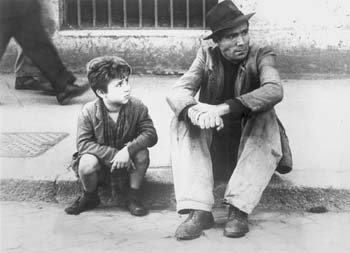
The Bicycle Thief

For all the great stories and scripts that twist and turn, throwing you for a loop around every corner, sometimes the simplest plot devices are the best.  There's nothing to distract from a single, pointed effort as a character searches for one thing, something that needs to be achieved at all costs to continue living in any sort of reasonable fashion. That's one of many reasons I really enjoyed 1948's The Bicycle Thief.

As a fan of movies in general, I try to watch movies from different countries and not just U.S. made productions.  The more I see, the more I like Italian films, especially the neo-realistic films that hit theaters in the years following WWII. The beauty of these movies is their basis in reality. In an age of editing and style where films make you very aware that you are in fact watching a movie, these Italian films do just the opposite. These are slice of movies, partially out of necessity, partially out of an intentional style. This is life. Watch it, and go along for the ride. I like all sorts of movies, but it is refreshing watching movies like this every so often.

Struggling to support his small family including his wife, Maria (Lianella Carell) and his two small children, Antonio Ricci (Lamberto Maggiorani) manages to get a job placing posters all over Rome for fair wages. The only requirement for the job is that he needs to have a bicycle at his disposal. He gets one, renting one for all the money he can put together between him and his wife. He heads off to work on his first day, excited and ready to start, only to have the bike stolen a few hours in. Wanting to keep his new-found job, Antonio starts a desperate search with his son, Bruno (Enzo Staiola), through the city for any sign of the bike. The search is like looking for a needle in a haystack, and Antonio begins to question if anything can go right for him.

Is that one of the most simple, straightforward stories you've ever heard? Man needs bike for job, bike gets stolen, man needs to find bike. It's criminally simplistic, but I think that's part of the genius of the movie. Anything more "dramatic," anything more over-the-top or emotional would have failed miserably.  Director Vittoria De Sica never tries to do anything else, knowing he's got the perfect tone as is. There is nothing to distract from the issue at hand. Don't go in thinking there is a twist coming halfway through. Half of the movie -- literally, not figuratively -- is Antonio and Bruno searching the stores, fairs and markets of Rome on a Sunday morning and afternoon. That's it. It is almost idiotic how straightforward it is, and I mean that in the most positive sense.

One of De Sica's trademarks as a director -- as was the case with many Italian directors at the time -- was to cast amateur actors in key lead roles.  Maggiorani was in 16 movies in his career, most of them bit parts and none of them as important or as moving as his part here as Antonio, a father stretched to his limit. Carell is equally as good as Maria, his equally distressed wife who knows they must grasp at any gasp of hope in front of them. She basically disappears once the search starts, letting the spotlight shine on Maggiorani and Staiola playing their eldest son, Bruno. When you see so many awful child actors around, it's always nice to see some talent. Like all of the actors here, young Staiola is as natural as they come. It never feels forced, his performance feeling genuine, a young boy who worships his Dad and would do anything to help him.

That is the heart of the movie, the father and son relationship, the father-son bonding that happens over the course of their day-long search. Some of the movie's most beautiful parts are montages set to composer Alessandro Cicognini's score of Antonio and Bruno walking through the crowded Rome streets. Maybe because they weren't classically trained actors, but this relationship (like so much of the movie) is as authentic as possible. They joke and argue, always looking out for each other. The city of Rome ends up being its own character thanks to De Sica's direction and Carlo Montuori's cinematography. Like many European cities, it is hard to make Rome not look good, but in black and white filming, it is a visually gorgeous, even stunning city. You fall in love with the city and all its beauty.

The Italian movies I've seen are notorious for downer endings, if "downer" is the right choice. The endings are typically realistic, and how about that? Real-life solutions aren't always happy. The Bicycle Thief is no exception. Realizing their efforts are fruitless, Antonio attempts to steal a bike only to get caught in the effort. Seeing the strain on this man, the bike's owner decides not to press charges. Antonio and Bruno walk away as the sun sets, dejected at their lack of success and not knowing what awaits them. The End. It came as a surprise certainly for me, but it is a thing of beauty. Seeing Antonio's anguish as he contemplates stealing the bike and ultimately decides to do it is an uncomfortable, moving scene to watch unfold. I liked the ending because it is real. There's rarely a nice, tidy ending, and anything else would have seem forced here.

The Bicycle Thief <---trailer (1948): *** 1/2 /**** 

Thursday, April 14, 2011

Open City

The effect of a war can be calculated in loss of life, millions of dollars spent in rebuilding, and even the long-term impact on the people who survived and must move on. That effect has to be more pronounced in countries where the actual fighting took place, especially Europe in WWII.  This was a war that was unlike anything seen before and basically left a whole continent in ruins.  In Italy, the profound impact of the war eventually impacted the movie industry, producing a genre of films known as Italian neorealism.

The film that truly put Italian neorealism on an international level was 1945's Open City from director Roberto Rossellini. These were films that represented the time they were made in.  Neorealism put the camera down in the streets as part of the stories.  They were stories of the poor and the working class, the people who were most affected by the war as their lives were traumatized, their families killed, their homes destroyed.  The movies reflected those feelings.  They were not happy go lucky stories that tried to force people to move on. They are incredibly dark in tone with realistic sounding to me like the best description around. Remarkable films, one any movie fan should watch.

It's Rome 1944 and resistance fighter Manfredi (Marcello Pagliero) is on the run from German forces in the city. He's running out of places to hide though, and it looks like it will only be a matter of time before the Germans close in for good.  The rest of his family tries to survive in their own way, his sister Pina (Anna Magnani) preparing for her wedding to Francesco (Francesco Grandjacquet), but even then the Germans may intervene as part of their search for Manfredi.  Helping pull strings and lead the resistance as best as he can, an Italian priest, Don Pietro (Aldo Fabrizi) tirelessly keeps working to aid the cause, all the while risking his own life.

In any war where an invading army occupies another country/city/village, there is almost a certainty that a resistance will rise up and try to drive the invaders out.  In terms of storytelling at its most basic, there are few things more dramatic than a small group of fighters going toe to toe with an opponent that has more men, more supplies, more everything at their disposal.  Just on the basis of sheer courage and bravery, it can be hard to comprehend what these resistance fighters really accomplished, often at a great cost in life.  Too often, the overwhelming numbers they faced did become too much and they were wiped out.  It's that rare movie that shows resistance fighters in all their plight. It rarely ended well for these men and women. What often rose out of the ashes though was more fighters, more individuals joining the cause as they saw these heroic people sacrifice everything for what they believed in.

Above all else -- story, filmmaking techniques -- is what is so successful about Open City. This isn't a glamorous fight with superhero citizens able to mow down German soldiers by the truckload. These are everyday people working in the alleys and shadows to drive the Germans out of their towns. It's Pina, desperately trying to save her fiance from a German patrol. It's Manfredi moving from house to house and apartment to apartment always trying to stay one step ahead of the always charging German soldiers.  It's Don Pietro using his status as a figurehead in the community to aid the cause, knowing if he is caught his place as a priest will mean nothing.  Director Roberto Rossellini makes an incredibly personal, visceral movie that gives you a picture of the horrors and realities of war like few other directors have.

Released in 1945, it would have been easy for Rossellini and the screenwriters to paint in broad strokes here to characterize the Italians and Germans, and to a point, he does.  The Italians are presented in a mostly positive light while the Germans -- especially Harry Feist's Major Bergman -- are the bad guys but rarely in a cartoonish, exaggerated fashion.  Of course, the Germans in their actions were typically cartoonishly evil, but it's not necessarily the case here. Instead of just saying they're evil or bad, Rossellini shows us through their actions, especially a painful, honest depiction of torture and interrogation. In theaters months after the end of the war, it's hard to comprehend what audiences must have felt when they saw a shelf full of instruments used to get information out of people, hearing the screaming in the other room.  Talking about fresh wounds in 1945, these are incredible scenes to watch some 60-plus years later.

On to things that are easier to analyze, the movie as a movie.  The neorealism is a breath of fresh air in an age of big budgets and ridiculous CGI. Rossellini filmed in war-torn Rome so right off the bat, you get a sense of actually being caught up in WWII.  He shoots in black and white, giving Open City a stark, scarred look.  And on top of that, he's working with a small budget, but it all clicks and works seamlessly. The ending is heartbreaking SPOILERS STOP READING SPOILERS as Don Pietro is eventually caught but refuses to give up the information the Germans want. Executed by a firing squad, the boys he teaches see him die, only to return to the city, walking back into Rome. Depressing and realistic? You bet, but as is so often the case with stories like this, the children represent the remnant, the hope for the future to continue the fight. It's just a great movie.

Open City <---trailer (1945): *** 1/2 /****   

Monday, March 7, 2011

La Strada

For all my efforts trying to watch as many movies as I can, I can't help it that some slip through the cracks.  Stars, genres, directors, some of each.  Just because I'm not familiar with a name/movie doesn't mean I'm not aware of them. For example, I recognize Italian director Federico Fellini and could name two or three of his movies. But other than that he was a highly influential director with a unique movie-making style, I know little to nothing about him.

The one Fellini movie I'd seen until recently was 8 1/2 which was supposed to be weird, different, and existential, dreamlike in its execution.  It was just too much for me, and I was never able to get into the movie.  It is definitely a movie I would revisit only because it's so universally acclaimed I feel like I missed out on something.  Never one to completely shut down on a director, I gave Fellini's 1954 movie La Strada a chance this weekend, and I ended up liking it if nothing being blown away by it. You've got to start somewhere, right?

The oldest daughter of a single mother trying to raise a family of four kids, Gelsomina (Giulietta Masina) has always been a little different from other people, but no one knows why. In an effort to help her family, her mother sells the teenage girl to Zampano (Anthony Quinn), a traveling performer who moves from town to town performing his act. Very naive, very innocent Gelsomina is thrust into a world she just can't comprehend, growing up quicker than she ever anticipated.  Zampano looks out for her at times but generally treats her poorly. She doesn't know any way out of the situation, even when she meets a fellow circus performer, the Fool (Richard Basehart), who could possibly be an outlet for her, an escape from this prison of a life she finds herself in.

I've made no bones about my preference for movies that are more realistic and therefore more downbeat and generally cynical.  But of all the movies I've seen, this is one of the darkest.  This is a world without much hope in it, especially for the innocent (is she mentally handicapped in some way? The story hints at it subtly) Gelsomina.  It is a dog eat dog world where anyone and everyone will turn on you if it possibly helps them.  If anything, it's even too dark for a cynical moviegoer like me. With a few exceptions, there always has to be hope in the end, something positive to strive for however slim.  There's none of that here, Fellini's movie's outlook on life and survival getting dimmer and dimmer with each passing minute as the climax approaches.

Not too complain about subtitles because I don't mind reading and watching a movie, but the dubbing distracted me from the performances. Always a very physical, verbose actor, Quinn lives up to his reputation, delivering a fiery part as Zampano, a character that's hard to judge. But with his very distinct voice, it's off-putting when you hear someone else's voice come out of that mouth. The same goes for Basehart, which by the way, how did the very American-looking Basehart end up playing an Italian circus performer? Somebody explain that to me.

Three performances dominate the movie for better or worse.  Quinn never disappoints, and he certainly doesn't here.  Never afraid to play an unlikable character, he plays maybe his most despicable character in a long career. There is nothing redeeming about his Zampano, and a shady past is hinted at often.  Gelsomina's sister was sold to him the year before but died. What happened to her? Most likely he just abandoned her somewhere.  Basehart is more hit or miss, the existential link to the story, a fool, a circus performer who wonders aloud about life and its meaning, what everyone's purpose truly is.  He is a talented actor, no doubt about it, but even just being there he feels out of place.

The brightest spot here is Masina as Gelsomina.  By no means a classical beauty, she brings something different to this very tragic character.  From the moment she is introduced, you just know she's doomed in one way or another.  Fitting well with Fellini's very visual style, Masina says so much with her eyes (maybe the saddest eyes I've seen in a movie ever), not wasting time with long passages of dialogue. It is so easy to feel bad for this character because you're rooting for her. You want her to escape, to live her life, to go back to that convent that seemed to appeal to her.  But in this incredibly dark world of Fellini, life doesn't always end up so rosy. One of the darker movies I've come across, and not necessarily for the better.

La Strada <---TCM clips (1954): ** 1/2 /****

Thursday, December 23, 2010

Too Bad She's Bad

So I like movies with shootouts, car chases, and some sort of raunchy humor.  Okay, it's not that simple, but those three things always help.  Guys like certain movies and hate others the same way women like some types of movies and despise others.  One genre of films that stereotypically lean more toward a female audience is the romantic comedy.  It's fair to say that many of the movies I like can be pretty cookie-cutter, but I use that as a criticism here of romantic comedies which seem to churn out the same old story in new packaging every couple of weeks.  That's not to say they're all bad, but I'll admit to not seeking them out too often.

One that I came across thanks to TCM's weekly foreign imports feature (TCM Imports) was 1954's Too Bad She's Bad, an Italian romantic comedy with a bit of slapstick and screwball laughs thrown in too.  Maybe because it's a foreign comedy -- and to call it a straight comedy isn't fair -- I look at it differently, but thanks to some strong casting and a type of humor that doesn't overdo it, I enjoyed it.  If nothing else, it's different.  It isn't a cookie-cutter story of some ridiculously hot 30-year old woman who can't find a man, or an eccentric middle-aged man who finds his true love who can see past his oddness.  Although SPOILER ALERT the girl gets the guy, or is it the guy gets the girl? Eh, not important. It's a good movie.

Spending years saving up enough so he can invest in his own taxi cab, cabbie Paolo (Marcello Mastroianni) takes a far for two young men and a pretty girl, Lina (Sophia Loren), who want to drive from Rome to Anzio to spend a day at the beach. Paolo isn't aware the trio plans to steal his cab and leave him stranded but quickly finds out, foiling their plan. The two men get away and Lina slips away in the traffic when he tries to take her to the police station. Paolo can't afford the damages and starts to look for any of the three with Lina popping up repeatedly on his path. Just looking for some cash though, he gets deeper and deeper into a web of thieves with Lina's family all taking a shine to him. Worse than that? Through all the craziness, Paolo realizes he likes Lina too.

Now for starters, any movie that was filmed in Rome in the early 1950s is going to get at least a passing grade from me.  It's post-war Rome following WWII and is as beautiful and romantic a European city as I can think (okay, maybe Paris).  Director Alessandro Blasetti films much of his movie on the streets of Rome and with the exception of the Coliseum doesn't use any easily recognizable locations.  He shoots on the streets with the people, giving us a view of early 1950s Rome that only exists in pictures.  Alessandro Cicognini's musical score not surprisingly relies on Italian music to set the stage but never goes overboard.  My only complaint is that the English subtitles are in white letters, making it difficult to read at times against Blasetti's black and white camerawork. I never missed anything major but did find myself focusing more than usual on the subtitles just trying to keep up.

So you're casting a female part that requires the character to be so downright beautiful and charming that no matter how many unpleasant situations she gets you in the guy still wants to be around her.  If there was ever a part built for Sophia Loren this is it.  Just 20 years old at the time, Loren had already been in over 15 movies with parts ranging from small supporting parts to bigger roles like this.  Looks aside, she shows off some great comedic chops and impeccable timing as we get to know her Lina character.  Her thieving ways continue to get her into trouble, but there's not a situation created yet Lina can't talk her way out of.  My only complaint comes from a certain trend/style of the time...hairy armpits on a woman.  Loren is drop dead gorgeous, but there's not a woman alive that look works for.

Two male parts balance out Loren, one holding a slight edge over the other.  Mastroianni's incredibly gullible, even naive Paolo is too clueless for words at times.  Duped on repeated occasions by the lovely Lina, he continues to believe everything she tells him.  He has a knack for physical humor with some cliched mannerisms and reactions of a fiery Italian man, but he produces laughs, not groans with his actions.  The part I liked more was Lina's father, Vittorio, played by Italian director and star Vittorio De Sica. He raised a family of thieves that supports itself by selling anything valuable they steal with Lina his protege with the most talent.  Vittorio is smooth as silk, convincing you that what he's stealing means nothing, almost like he's helping you out.  It's clear from watching him where Lina got her talent for some truly underhanded things, but they're so charming and likable you don't even notice.

Where does that leave us? Ah, the ending, quite a mix of so many things with not all of them working.  A scene in a police station is played for some genuine laughs that goes on too long, leading to a bit of domestic violence leading to marriage.  It makes sense, don't you think?  An odd ending for sure to an otherwise enjoyable (whudda thunk it?) 1950s Italian romantic comedy.

Too Bad She's Bad <---low quality Youtube clip (1954): ***/****

Friday, August 13, 2010

Two Women

Does the Academy Awards tend to give an actress more credit for a role when she plays down her looks, like Charlize Theron in Monster or Hilary Swank in Boys Don't Cry?  I'm guilty of it as well, seeing a gorgeous actress and forgetting at times what a strong actress they can be.  But I do think there's something to it that when their looks are left by the wayside for a part people take them more seriously.  Unfortunate yes, but what are you gonna do about it?  I'm trying to decide if 1960's Two Women applies to that premise.

Italian star Sophia Loren won the Best Actress Academy Award for her performance of a widowed mother trying to get her 12-year old daughter through war-torn Italy late in WWII. It was the first Oscar ever given for a performance in a foreign language film, and one Loren fully deserved.  She's not playing against type because regardless the movie, serious or comedy, Loren was able to get into that character.  But it is a powerhouse performance that tries to dumb down her look, putting her in plain clothes with no makeup.  All I could think though was 'Good luck trying to make Sophia Loren look like an Italian peasant.'  But does her performance apply?  As of now, I'm thinking not at all, it's just a great performance.

Late in WWII, widowed mother Cesira (Loren) lives in Rome running a little grocery with her 12-year old daughter Rosetta (Eleonora Brown).  The war is not going in the Axis' favor, and Rome is being bombed more regularly, forcing Cesira to make the decision to leave the city until things quiet down.  With her daughter, they head to Cesira's village where she grew up as a child.  There much of her family waits, including many refugees and one intellectual (Jean-Paul Belmondo) who can't wait for the Germans and Italians to lose the war. Their biggest problems with so many people are finding enough to eat and drink every day, but as the war approaches the isolated country village, Cesira finds out that no matter how much you prepare, you can't prepare for everything.

Many of the WWII movies I've reviewed are of the front line soldier variety where we see the war from the perspective of a soldier or his unit in a certain battle.  While the war drives the story in 'Two,' this is a story that focuses almost completely away from the battles and the front lines other than a few strafing runs or appearances of lost patrols looking for help.  Director Vittorio De Sica creates this vision of war-torn Italy and lets the characters go to work.  It's a world where everyone is basically on their own for their own survival, and dangers lurk around every corner.  There aren't so much Allies and Axis soldiers as good and bad on both sides, a situation that comes into play late in the movie.  Everyone is affected by the war, and for these characters, they don't care who wins as long as the war ends.

Off and on throughout the movie, I didn't always get the sense of the danger that hung over Italy and more specifically Cesira's life in her village.  The biggest problem facing the single mother and her extended refugee family is food, finding enough so everyone can eat.  The war is the cause of this shortage, but it feels like a far-off war at many times.  More time is spent in the relationship between Cesira and Belmondo's Michele character, an intellectual who shakes his head at the whole premise of the war while also falling madly in love with Cesira (do you blame him?).  German characters drift into the story and leave -- along with two British commandos and a Russian deserter -- but the focus is more on the day-to-day survival caused by the war.

Where Loren won the Oscar for me was in the last half hour as Cesira and Rosetta return home to Rome via the country roads, the Americans and Allied soldiers advancing past them on tanks, trucks and jeeps.  This is where the real horrors of war come into play which I'm not going to spoil here.  It comes as a surprise because to a certain point we've been lulled to sleep by the relative safety of the country village.  But here Loren's mother has to protect her daughter in a way she's only considered, never thinking it would come true.  Loren's performance as a whole was excellent, feeling like a real mother with only two real concerns, her daughter and herself, but the final 30 minutes or so sets the character apart from other similar characters.

As for Loren's looks, I'm not sure if it is actually possible to dull them down.  Her hair is unkempt, she wears no makeup, and she wears loose, baggy clothing (if cut a little low at the neckline), all in an attempt to make her look like a run of the mill Italian peasant single mother.  Yeah, good luck with that.  I'll say this, natural is a good look for her.  If interested, watch the movie at Youtube starting with Part 1 of 13 with Italian subtitles. Early in the movie I struggled to keep up with the speed and lightning pace of the subtitles, but you get into a rhythm soon enough.  Also look for Raf Vallone in a one-scene cameo. Watch this one for a moving portrayal of WWII's effect on the civilians, especially Loren in one of her best performances.

Two Women (1960): ***/**** 

Saturday, May 22, 2010

Rocco and His Brothers


A long movie does not necessarily have to be a bad movie.  Some of my favorite movies -- The Great Escape, The Alamo, The Godfather, The Good, the Bad and the Ugly -- all clock in around three hours if not longer.  But these long movies tend to work better in a historical context, the big epic movie.  It's not a hard and fast rule, but it certainly helps.  The Godfather is a 3-hour movie about a mafia family, but for lack of a more educated description; stuff happens.

One of Italy's neorealist films, 1960's Rocco and His Brothers, is a movie that clocks in at just under three hours, and in a similar fashion tells the relationships and inner workings of a large family.  Sure, those relationships develop over time and problems arise, but in telling a story as realistically and personally as possible, the sometimes slow pacing kills any energy that builds up.  Add to the mix characters making decisions that no human being would ever make, and I came away disappointed in a movie that's earned a reputation of a classic.

After the family patriarch dies, the Parondi clan moves north to Milan, leaving their simpler life in the Italian countryside behind them.  The mother, Rosaria (Katina Paxinou), hopes to receive some help settling in from her oldest son, Vincenzo (Spiro Focas), who's moved to the city and is engaged to Ginetta (Claudia Cardinale). Rosaria disapproves of the engagement so now the family and her five sons must figure a way to survive on their own with no means of support.  Vincenzo ends up moving out and living with Ginetta so the other four brothers have to scramble for work.

The second oldest brother, Simone (Renato Salvatori), drifts along until he's spotted working in a gym and starts boxing, quickly rising through the ranks.  Then there's Rocco (Alain Delon), a good-natured, very kind young man who always looks out for his mother and brothers, often at his own expense.  Ciro (Max Cartier) goes to trade school so he can get a job at the Alfa Romeo factory, and the youngest, teenager Luca (Rocco Vidolazzi) makes deliveries for a pharmacy.   Everything seems like they're on the right track, but conflicts and rivalries pop up among the brothers, tearing them apart with little hope of bringing them back together.

In terms of style, 'Rocco' is can't miss with that Italian neorealism filmmaking easily seen throughout the movie.  Filmed in black and white on location in Rome and Milan, director Luchino Visconti delivers a movie that is gorgeous to look at.  The camerawork isn't aggressive but you're always aware the lens is right there in the streets or the crowded apartments with the characters.  Long shots/takes pop up throughout the movie almost as if the camera is there with the characters watching the plot develop.  In a cool little bit of personal style, each segment is introduced with a brother's name as their personal story comes to the forefront.

But as talented as Visconti is and as beautiful a movie as he creates, the visual and the realism only last for so long.  This is a llllllllllllong movie where just about every one of its 175-minute running time is noticeable.  Overall, not much happens other than long scenes of dialogue here and there, then longer segments where nothing is said at all. 

Even with five brothers, the Parondi mother, and a long list of supporting characters, the story centers on Rocco, the saintly brother, and Simone, the supremely flawed brother on a bad road.  Delon is one of my favorites, and his character is beyond likable without a dent in the armor with at least a couple allusions to him being a Christ-like figure.  Salvatori as Simone is everything Rocco isn't.  He drinks, gambles, runs around with women but truly loves one, a prostitute, Nadia (Annie Girardot) and lets his brief success and power go to his head.

The conflict between these two brothers is the key driving force in the 2nd half of the movie as Simone hits wall after wall, causing one problem after another, and driving his family away even though they're trying to help him.  Leading that charge is Rocco who is able to look past all these horrific flaws and decisions because at the core of the problem, Simone is his brother and he can look past it all.  I won't spoil how the relationship develops and climaxes, but let's say Nadia is involved and she ends up with the brother she wants nothing to do with.  Rocco makes decision after decision trying to help his brother when in real life, it feels like NO ONE would ever allow themselves to be stepped on and marched over as much as he does.

I understand making Rocco's character as likable as he is.  After his father dies, Rocco steps into the role of looking out for his family because no one else can.  But there's a limit to that.  I've always had a pet peeve about characters -- not just in movies but also books, TV -- that make a decision(s) because the story requires it.  Add to that element the issue that Simone is impossible to root for, impossible to get behind, and it just becomes more infuriating.  The ending itself is ambiguous and forces you to decide how everything is resolved.  Ideally, Rocco comes to his senses, but that's just too easy.

Knowing this movie was held in high regard by critics and fans alike, I wanted to like this movie, even more so considering the talent involved in front of and behind the camera.  But all things considered, the flaws were just too much.  The movie is far too long, incredibly slow-moving, and the characters make decisions that no sane person would ever make for the sake of the story.  I'll give it 2 stars because it's trying to be something more, and even if it fails, it was a worthy attempt.

Rocco and His Brothers <----trailer (1960): **/****

Thursday, January 7, 2010

Almost Human

Every so often a character in a movie, a book, a TV show, anything really, comes along that is just so despicable, so downright low that it is beyond easy to hate them. They tend to have no redeemable qualities at all, often performing acts so unspeakable it can be difficult to watch. For me at least, this is often balanced out because that character is the villain, an individual matched in screentime by some sort of hero. What about if there isn't a hero, and that villain dominates almost every scene? Put that all together, and you've got 1974's Almost Human.

By 1974, Cuban actor Tomas Milian had made quite a name for himself working in Europe, tending to stay within the western and crime genres for his parts. He was a perfect choice for a roguish individual who usually lived in that fine line between good and bad but often enough ended up making the right choice and saving the day. Often enough, but not every time. Working with director Umberto Lenzi for the first time, Milian delivers a performance in Almost Human that pulls out all the stops with a character so ridiculously evil that it borders on going too far over the top. But of all his roles, Milian picks 'Almost Human' as his best.

Working as a low-level hood for the mafia in Italy, Giulio Sacchi (Milan) panics during a bank robbery and kills a police officer trying to ticket his car. The mafia capo, Majone (Luciano Catenacci), does not appreciate any undue attention being called to him and his organization and lets Giulio go. Fed up with these small-time jobs, Giulio turns to bigger fish and finds what seems the perfect crime when he visits his girlfriend (Anita Strindberg) at work. Her boss has a young daughter in her early 20s, and Giulio decides there's millions of lire in it if he was to kidnap her and demand ransom. Working with two similarly low-level thugs, Carmine (Ray Lovelock) and Vittorio (Gino Santercole), Giulio goes about figuring out his plan for the kidnapping.

The story starts with Giulio panicking and killing a patrolling police officer and never stops from there. The body count begins to build -- I counted 15 people Giulio kills by himself -- as the crimes escalate and the kidnapping plan is put into execution. The transformation Milian's main character goes through is alarming, starting off as a thug who panics in a chaotic situation but degenerating into a sadistic killer who has little whim about killing anyone if it will benefit him. At one point, he even guns down a little girl with a machine gun. If that's not a character to root against, I don't know if there's one out there. Giulio is a brutal, bi-sexual, drug addicted murderer who you can't wait to see get his comeuppance. I put bi-sexual not as a judgement, just to add to the overall eccentricity of the character.

What makes this all more uneasy to watch is that the 'good guy' is nothing more than a crime thriller stereotype. Usually playing the role Milian takes here, Henry Silva is police commissioner Walter Gribaldi, a veteran officer trying to piece together all these crimes popping up. For one thing, it's nice to see Silva playing a good guy after a long line of psychotic lunatics, but the character has no development other than being a near-obsessed police officer. Even then, Silva isn't given much to work with in his scenes although he does come around in the end...the end you can see coming miles away. More was needed though to give the viewer someone to root for.

Where many other Italian crime thrillers added other elements to the main story, 'Almost Human' rises and falls on Milian's performance alone. And character dislike aside, this is a great performance for the actor although I disagree that this is his best overall. But other than Milian, there's not much to recommend. I can't place it, but I swear Ennio Morricone's score was used in another movie, and the action overall isn't meant to be exciting, but unsettling instead. It's a pulpy B-movie with plenty of blood and guts, gratuitious nudity, and an in your face style. Take away Milian in the lead, and it's a bad movie. With the performance, it's at least worth giving a mild recommendation.

Almost Human <----trailer (1974): **/****

Thursday, September 10, 2009

Revolver (1973)

Watching Quentin Tarantino's Inglourious Basterds recently, part of the fun was picking out the director's musical choices for his soundtrack. I recognized a good amount of the tracks, including many from Ennio Morricone, but one really caught my attention for the first time, Morricone's 'Un Amico.' It's used perfectly in Tarantino's WWII movie so I investigated and found out it was originally used in a 1973 Italian thriller called Revolver.

It's a movie from director Sergio Sollima who made no bones about getting his political beliefs into his movies. Some work better than others, The Big Gundown is a classic, because sometimes the political preaching can get to be a little much, especially in westerns where that element is unnecessary to add to a story's depth or lack of. I liked Revolver because Sollima's feelings are mostly left out of it, and what's there is actually a worthwhile commentary on society.

The problem isn't with the political undertones, but the pacing of the first hour. It's the type of movie that throws everything at you with seemingly unrelated storylines and lets the plot develop. That's fine in itself in some cases, but the story is so muddled at times with Revolver I was never quite sure what was going on for the first 60 minutes. The story rights itself when things are explained and makes that last half of the movie much better and much more enjoyable.

Coming home one day, prison warden Vito Cipriani (Oliver Reed) finds his wife (Agostina Belli) is gone from their apartment. The phone rings, and a mysterious voice at the other end says she's been kidnapped, and the only way he'll get her back is to free a prisoner, Milo Ruiz (Fabio Testi), from his jail. Vito struggles with what to do but ultimately decides to do it. The only problem? When he frees Milo, the criminal has no idea who would want to help him out of prison.

In another storyline that seems to have no link, a higher-up politician is murdered while leaving his office by an assasin on a motorcycle. It's not long before the police find him, kill him and destroy the motorcycle and have a friend of the killer, folk singer Al Niko (Daniel Beretta), identify what's left of the body. Of course, the stories do connect at the movie's midpoint, and it generally works. Some unexplained scenes now make sense, and the unfolding of the rest of the plot comes together.

The somewhat political message of the movie is that society has ways of guarding itself against danger, laws, police, government, but that sometimes all it takes is for one man to take a revolver and right a wrong. Reed's Vito is put in this situation when faced with a decision on trading Testi's Milo in exchange for his wife in a prisoner exchange. He knows Testi will most likely be killed so as a warden and former police officer can he rationalize one life for another? That question certainly makes for an interesting resolution.

While other characters bounce in and out of the story, it's Reed and Testi that carry the movie. On the DVD, an interview with Sollima talks about how you can throw just about everything else away. It's a movie about a good guy, Reed, who's not so good, and a bad guy, Testi, who's not so bad. Known as much for his drinking ability as his acting career, Reed is an incredible presence here, a brooding, intense, driven man who will stop at nothing to get his wife back safely. Testi, often known for his looks more than anything, provides a strong balance as the criminal thrown into the middle of a situation he has little to no control over. All other things aside, the movie is about these two men and their unlikely partnership, a buddy movie on steroids if you will.

Other nice touches include the French and Italian shooting locations, and a gritty style Sollima had by then become known for. Here's the opening, which features 'Un Amico' with lyrics which isn't as effective as the song itself. The rest of the Morricone score isn't his best and seems too similar to some other scores he'd done. But the main track is a keeper and is used perfectly in the opening and especially in the final scene. While it may have been difficult getting there at times, the ending is worthwhile to say the least.

Good casting and an intriguing storyline but it takes too long getting there. Worth a watch but don't expect a classic. Here's the DVD interviews in two parts, one and two, with Sollima and Testi interviewed. SPOILER ALERT though, don't watch the interviews if you don't want the ending ruined.

Revolver <----trailer (1973): ** 1/2 /****

Wednesday, July 29, 2009

Netflix reviews: The Big Racket and The Heroin Busters

Pretty much everyone knows who Michael Bay is by now, right? If you don't, you should probably get out from that rock you are sleeping under. And to a lesser degree, people know or at least have heard of directors like Michael Mann and Sam Peckinpah? In a sort of odd hybrid mix of all three directors, Italian director Enzo Castellari has left his mark on the action genre whether you know it or not with a nice mix of story, character, style and crazy action.

Two of those movies, The Big Racket which is rated as his best at IMDB for whatever that's worth and The Heroin Busters, were the latest in my Netflix queue. I've seen a handful of Castellari's other movies and enjoyed them across the board. The stories tend to be pretty basic like something you'd see in an old B-movie or pulp fiction novels. Nothing groundbreaking but always entertaining. An anti-hero is typically thrust into a situation where he must save the day sometimes at a high cost as he rebels against his superiors and sometimes society in general. Of the two, I liked 'Racket' more so I'll cover that more in depth.

Both movies have Italian star Fabio Testi in the lead, both parts being in law enforcement in one way or another. I've always been aware of Testi and could have picked him out of a lineup if need be, but these were the first two movies I'd actually seen of him. He comes across well as the rebellious anti-hero. It can be hard judging performances that are dubbed into English, and often not very well, but Testi is a strong physical presence with roles that require that above all else. Acting be damned!

In 'Racket,' Testi plays Inspector Nico Palmieri, an Italian police officer trying to put away some underworld characters for intimidating and blackmailing business owners for 'protection.' If the owners don't comply, they're in for it as this little gang rapes, murders and loots their way into power. But for Palmieri, the work is frustrating because no one will testify against these hoods and therefore no charges can be presented. It's as the case continues that Nico deserves there's more to this enterprise than he thought as the different factions of the underworld plan to unite.

Could it be too late though? Nico may have pushed the limits of what he can do as a police officer and is thrown over the force. With nothing or no one holding him back, the former inspector puts together a team of vigilantes, all with their own personal reasons for revenge, to help him take out the leaders of the underworld, the 'big racket' of the title. Joining Nico are Pepe (Vincent Gardenia with an odd, unnecessary dubbing), a small-time crook with a history, Luigi (Renzo Palmer), a father who's daughter was raped by the hoods, Giani (Orso Maria Guerrini), a champion skeet shooter who helped Nico in the spur of the moment and paid for later, Mazzarelli (Glauco Onorato), a mafioso with a grudge, and Doringo (Romano Puppo), a hired killer.

The story unfolds slowly as we realize what the sadistic baddies are capable of. At first, it appears they're breaking and entering and using good old-fashioned intimidation, but they do much, much worse. By that point, you're fully on the vigilantes side and rooting for them to off everyone involved. Movies where citizens take the law into their own hands sure sounds appealing sometimes. Castellari lives up to his precedent with the finale, a shootout in an empty factory as Nico and Co. attempt to ambush the underworld heads. The director always seemed to find unique locations for his shootouts, adding an eerie spectacle to the gunfight.

And like most directors, Castellari leaves his personal stamp on these movies with some actors returning for many of the director's movies including head baddie Joshua Sinclair who was in 'Heroin' and 'Racket.' His shooting style is always consistent with some unique POV shots and quick-cutting to counter some of the slow motion in the shootouts. If Peckinpah opened the door on slow-motion violence, Castellari kicked it wide open. And if there was any doubt these were movies straight out of the 1970s, the scores are always a good clue with the De Angelis brothers in 'Racket' and alt rock band Goblin in 'Heroin.' Both scores have a synthesiser sound heavy on guitars that really gets your blood going.

As for Heroin Busters, I enjoyed it but just not as much. The story has Testi playing an undercover cop trying to bust a drug ring that seems to have connections at all the corners of the world. It takes a while to develop and is somewhat confusing until then, but all is forgiven with the last half hour, a running chase/shootout with motorcycles, a construction site and a vacant subway all ending up in some Italian ruins. David Hemmings stars as an Interpol agent working with Testi with much of the supporting cast from 'Racket' here too, including Sinclair and Puppo.

In reviewing these movies, I go back to my reliable line 'a movie doesn't have to deliver a message to be good.' Castellari revels in that, making high quality B-movies with great action scenes, anti-heroes you root for and villians you love to hate, and overall just a good time. I've been watching the Blue Underground DVDs and highly recommend them if you're looking to watch and catch up.

----Trailers----
The Big Racket (1976): *** 1/2 /****
The Heroin Busters (1977) ***/****

Saturday, June 13, 2009

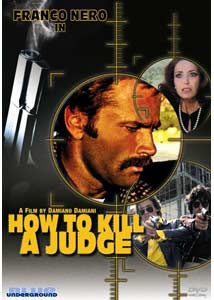
Netflix review #21: How to Kill a Judge

Ever since I saw him in Django as the mysterious gunfighter dragging a coffin behind him, I've always been a fan of Italian star Franco Nero. He's able to play the quintessential good guy hero, but he can then turn it around and play a villain you just love to hate like in Die Hard 2 or the treacherous partisan in Force 10 from Navarone. Unfortunately, he hasn't made a whole lot of movies in the U.S. so fans have got to look to his European movies. Of course, those can be harder to find.

Thankfully, DVD companies like Blue Underground are out there to release any number of lesser known and cult classics that otherwise are near impossible to find. Trying to catch up with Nero's movies, BU has been more than helpful with my latest movie being 1974's How to Kill a Judge. I was expecting more of an action movie going in, but director Damiano Damiani's mystery thriller was still a solid effort.

Nero stars as Giacomo Solaris, an Italian movie director, who has just released his latest effort. It's causing quite a stir as fans flock to see the film that details the somewhat dubious past of an Italian judge, Alberto Traini (Marco Guglielmi) including one major controversy where witnesses ended up dead, protocol was ignored and a major criminal was let out of prison halfway through his sentence. Solaris' movie ends in a bang quite literally as the judge is shot for his past transgressions. Traini actually laughs off the movie even though everyone around him, including his wife Antonia (Francoise Fabian), wants to take him to court for slander.

The situation gets out of hand when Traini is murdered in an empty park one morning with no witnesses to see how it happened or who did it. Solaris comes under fire for having incited the murder with his movie, now even more successful in theatres, but the director can't help but think, is he next as more bodies start to pile up? Everyone from the local mafia bosses to corrupt politicians become suspects, but there's no clear suspect. All of them had a motive, but who had the guts to go through with it?

As I wrote before, there wasn't much action in this movie, which is fine with me, just don't go in looking for a shoot 'em up like so many other Nero movies, action and western. It's really a murder mystery as Solaris, feeling at least partially guilty and trying to clear his name, goes into detective mode to find the judge's real killer. There's too many twists and turns following the killing to even mention here, and besides I'm not sure I even know what was going on at all times. The last 15 minutes delivers a pretty good twist with the reveal of the murderer, which I sort of saw coming, but I thought all the characters were guilty at some point.

With little to no action, the movie's success hinges on the story then which can be confusing. What stood out for me was the dialogue. It's quick, snappy and even provides a laugh or two. One exchange stands out as Traini introduces Solaris to a young actress who's been in two westerns. Traini snaps back "Oh, he doesn't do westerns," a nice little good-hearted dig at Nero and the spaghetti westerns that made him a star. A great physical actor and presence, Nero's conversations with Vincenzo Terrasini (Renzo Palmer), his mafia connection, and Commisario Zamagna (Gianni Zavota) help propel the movie forward when it might have gotten bogged down in all the suspects and conspiracy theories that develop.

The Blue Underground DVD is a bit pricey, but like they're other products, it's a good package. The movie is shown in widescreen presentation, the Italian city shooting stands out as very strong, with the option to watch the movie in its original Italian audio with English subtitles or in a dubbed English version. Special features include 'The Damiani/Nero Connection,' a 15-minute featurette with interviews with Nero and Damiani, and then the trailer in both English and Italian. The interviews just point out why I like Nero especially, he loves movies and loves talking about them. With so many DVDs released with no special features, it's always a treat to see DVDs like this, even if it's just an average movie on the whole.

How to Kill a Judge (1974): ** 1/2 /****

Saturday, February 28, 2009

The Four Days of Naples

All too often war movies are thrown by the wayside, and some for good reason; they're not very good. I still love them though, the good and the bad. TCM, officially the best channel ever, aired a WWII drama that I'd never come across this week called "The Four Days of Naples." When I saw some of the cast and recognized names from the spaghetti westerns, I figured I had to give it a try.

This was renegade filmmaking before anyone knew what that meant. There's no big picture here, just the story of resistance fighters going toe to toe with the German troops occupying Naples. The movie starts with a description of how the war is going, Mussolini has been overthrown and the talk of an Italian surrender is rumored all over the country. When it seems like the war may be over for Naples, German troops move into the city to prepare for the upcoming Allied advance.


At first, the Neapolitans go along with the occupation, unwillingly of course but what else is there to do? It takes one moment to push the population to resistance. Two young boys, teenagers maybe, are killed in a brief firefight. One is known, but the other is a mystery. No one recognizes him. In the chaos that results, small resistance units take to the streets with weapons left behind by the Italian army. In the narrow streets of Naples, battles erupt as these inexperienced citizens fight it out with veteran German troops.

What jumped out from the movie was the casting. There's not one main star here, no huge name, just lots of characters the movie follows as the fightings in Naples develops. There's Stimoli (Gian Maria Volonte), an Italian captain who finds himself the unlikely leader of a large group trying to rescue hostages in an abandoned stadium. There's Livornese (Jean Sorel) and Pitrella (Aldo Guiffre, the drunk captain from The Good, the Bad and the Ugly), a lieutenant and his sergeant dragging an artillery piece all over the city looking for a fight. There's Gennaro, a young boy separated from his mother who sees the fighting as a bizarre sort of game, joining in with his German helmet he found. Ayello (Raffaele Barbato) is a student at a reformatory, leaving the principal (Georges Wilson) behind, only to have the older man join his band of youngsters. Frank Wolff plays Salvatore, a man looking for revenge after his friend is shot down, his widow joining him. That's just a sampling with many more characters and plot lines jumping out.

One character especially jumps out, and he doesn't even have a name. Charles Belmont plays Sailor, an Italian sailor not quite sure what's going on with a rumored surrender. He begins to move across the city with a German soldier and ends up serving as an example to the Italian people of those who rebel. It's a small part, but a memorable one.

With so many characters, the movie works because director Nanni Loy puts the camera right there in the streets and on the rooftops with the resistance fighters as they tangle with German troops. The black and white cinematography adds something to the feel of realism all the way until the final shot of Italians celebrating their victory. The battles aren't staged or too Hollywood either; people die, there's no immortal hero gunning down hundreds of Nazis.

Of course there's no VHS or DVD so hopefully TCM airs the movie again so more people can see this underappreciated WWII story. The Four Days of Naples trailer, unfortunately with some bad dubbing, the TCM version had subtitles.