The Sons of Katie Elder

The Sons of Katie Elder
"First, we reunite, then find Ma and Pa's killer...then read some reviews."
Showing posts with label Jean-Paul Belmondo. Show all posts

Friday, August 16, 2013

The Burglars

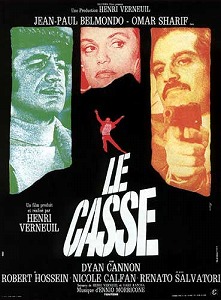
Well, give me credit. I'm timely every so often....now whether I intended to be timely, that's a different story. A few days ago I reviewed an underrated film noir from 1957, The Burglar, only to find out I had also recorded another version of the same novel by author David Goodis. Well, it's alike in basic -- very basic -- storyline alone, going down a different route in 1971's The Burglars. It's plural this time!

Working with a small crew of thieves, a master crook named Azad (Jean-Paul Belmondo) pulls off an impossible job, robbing a wealthy Greek businessman (Jose Luis de Vilallonga) of a million dollar's worth of rare emeralds. The plan goes off without a hitch, or so Azad and the crew think. A suspicious police officer, Abel Zacharia (Omar Sharif), is onto them and knows what they're trying. His only issue becomes proving their guilt, finding them while they're carrying the emeralds. Azad is ready to make his getaway out of a Greek port, but the ship is undergoing maintenance and can't leave for five more days. Now, he must improvise, getting the persistent -- and dirty -- cop off his trail. Can the crew stay quiet and hidden away until they're ready to escape?

Okay, get the basic plot from Goodis' novel and then go with it. That's all this 1971 version really has to do with its source novel or its 1957 predecessor. Now that said, it isn't a bad thing. Director Henri Verneuil has a good film somewhere in his 120-minute movie, but it's finding that movie that proves difficult. Reading a plot description, I thought I was getting a hard boiled heist flick, and in doses, that's what it is. Without much of a transition, one scene will be brutally dark, the next oddly off the wall. Then, we get some weird aside at an "erotic club" followed by one of the craziest, best car chases I've ever seen in a film. While I liked 'Burglars,' I also thought it was far too schizophrenic to be a movie that received a straight-up positive review. When it works though, it really works. It's getting to that point.

The positives are pretty obvious, starting with Belmondo and Sharif as the two leads, the cat-and-mouse rivals. I've yet to be impressed with Belmondo -- I still don't get the appeal of Breathless -- in the films I've seen, but this performance is a gem. He sounds dubbed but apparently that's him (go figure). Most surprisingly though, he proves himself as an action star, handling his own stunts for the most part including a couple ridiculous stunts. He literally rides the side of a handful of buses on busy streets and later takes a rolling fall down the side of a hill with an almost sheer face. His character itself is pretty cool, a confident, slightly showy thief who thinks he has no rivals, always believing he can outsmart Sharif's cop if it comes down to it. That smartass smile/smirk plays well though, and I really liked what he did with the character.

 Doing a 180 from most of his hero performances, Sharif looks to be having a ball as the sinister, truly brutal cop, Abel Zacharia, looking to line his own pockets in "catching" Azad. At first glance, he appears to be a pretty normal cop but with each passing scene we learn the true depths of how far he'll go for a payday. Dyan Cannon plays Lena, a nude model and quasi-Playmate of sorts who catches Azad's eye and may be letting on more than she knows. Robert Hossein, Nicole Calfan and Renato Salvatori round out Azad's crew, none really given much to do with the spotlight on Belmondo and Sharif. 

Coupled with the tough guy leads, 'Burglars' manages to stand free of the crowd because of the action. A 13-minute car chase about 30 minutes into the movie is ridiculous to the point of being overindulgent. We're talking two cars that should have blown up miles and crashes ago still running and doing so smoothly. It gives us some solid new additions to the car chase sequence too, never a bad thing. Watch it HERE. When there is action, it's handled expertly, including another slightly lower key chase with Belmondo jumping from moving bus to moving bus (again, doing all his own stunts seemingly). Watch a really solid stunt montage HERE. There is a simple professionalism to these scenes that just works well. Not flashy, just efficiently effective. Oh, and composer Ennio Morricone turns in a quiet, understated gem of a soundtrack. Didn't see that coming, did you?

So anyhoo.....the movie does have some flaws. The opening heist sequence is so interested in the gory, boring and downright dull details of how they're pulling the job that any tension gets thrown out the window. What should be a great opening, building momentum is actually a hindrance to a story that ends up being pretty good. A later departure to Cannon's "erotic club" goes on far too long, and in general, too much time is spent with Cannon for a disappointing payoff late in the movie. It is a movie that could have been tightened up at several different points along the way. It's also trying to be funny, action-packed, slightly romantic, full of drama, and it just doesn't always work. In the end, it could have been a near classic, but as is, it's a very watchable heist movie with some pretty severe flaws. Give the movie a watch HERE at Youtube.

The Burglars (1971): ** 1/2 /****

Friday, February 4, 2011

Casino Royale (1966)

After a four-year gap since Pierce Brosnan's final James Bond movie, MI6 agent 007 returned in a big way in 2006 with Daniel Craig taking over the part of the secret agent.  It was a huge success and served as an excellent reboot for the franchise, quickly climbing into my top 5 all-time Bond flicks.  Why did it work? Like most of the best movies from the franchise, it stuck close to the Ian Fleming source novel that had not been made previously...in a serious fashion at least.  That's where 1966's awful Casino Royale jumps in.

By 1966, star Sean Connery had already completed four 007 movies and had turned James Bond into one of the world's biggest stars.  It was so popular that spoofs started popping up like James Coburn as Derek Flint and Dean Martin as Matt Helm among others.  I get it, strike when the iron is hot, but in a saturated market of spy and espionage movies -- serious and spoof -- don't you want to at least turn out a quality product?  With six different directors shooting different portions of the movie, this was like How the West Was Won: 007 Style.  Besides an occasional laugh here and there, the only redeeming quality is an out-of-this world (if wasted) cast, but more on that later.

All over the world, American, British, Russian, and French agents are turning up dead and their agencies don't have the slightest clue or evidence as to who's pulling off the jobs.  The agency heads turn to retired MI6 agent, Sir James Bond (David Niven), to root out the problem. Bond is a legend in the espionage business, but his best days are behind him, and he questions what has happened to the field he worked so well in, carving out a name and reputation for himself.  He concocts a crazy plan to smoke out whoever is behind the murders; using his name, agents all over the world (Peter Sellers, Ursula Andress, Daliah Lavi, Joanna Pettet, Woody Allen, Terence Cooper) will see if working as bait draws the mastermind out of his lair. The plan might be too good though because SMERSH and mastermind Le Chiffre (Orson Welles) send agents to kill the original and still best James Bond around.

Now anyone familiar with Casino Royale -- Fleming's novel or the Craig movie -- knows that the plot described there is nothing like the book or the movie.  Bond's effort to detain Le Chiffre at the baccarat table is handled in a scene that takes about 10 minutes, not an entire movie.  Using other spy spoofs as an example, there is clearly potential here.  A character as ripe for the picking as James Bond is hard to mess up in the humor department, but this movie is a mess.  For all the subtle, perfectly delivered lines that pepper the script, there's huge scenes of excess of physical and slapstick humor that even Mel Brooks must have shaken his head at.  The finale is the worst of all with one of the 14 directors obviously not knowing where to cut things off.

Let's start with the crazy amount of talent involved here behind the camera, including John Huston (also playing M in one scene) and Robert Parrish among four other less notable names.  The writing too includes Sellers, Billy Wilder, and Joseph Heller.  How did this much talent put together such an awful movie? On top of the cast listed above, there's also parts for Deborah Kerr, William Holden, Jean-Paul Belmondo, Peter O'Toole (on-screen for about 6 seconds), Charles Boyer, George Raft, Jacqueline Bisset, and Barbara Bouchet. What's worse is that the cast appears to be having a blast making the picture.  It's just that much worse that what they're working with is beneath all of their talent.  Bit parts and extended cameos for almost all of these names limit actual on-screen time, but just in terms of name power, this movie is impressive.

The only star that I thought was legitimately good was David Niven as retired 007, Sir James Bond, enjoying his retirement in an isolated English country villa only to be thrust back into the world of espionage.  Because it is an older Bond, Niven has some fun with the part, poking fun at Connery's portrayal especially.  He gets some good laughs from his constant curiosity of how all secret agents have become sex fiends, leaving lonely, beautiful women in every city all over the Earth.  He shakes his head at all the changes he sees in the life of a spy only to embrace them once he's back into it.  A professional plain and simple, Niven makes the most of the material, rising above it to deliver a worthwhile performance.

So this movie was bad, downright awful at times, okay? I am scraping the bottom of the barrel here looking for something to write about.  Most of the movie was just so stupid and dumb I can't even complain.  It's so bad it is surreal at times.  So what can I recommend? If nothing else with this overabundance of characters, the script calls for a long list of beautiful actresses who are required to wear slinky outfits and do little else.  Kerr, Lavi, Pettet, Andress, and Bouchet are all half-naked for about 90% of the movie, and that's all I've got.  So stupidly bad, this movie has to be seen to be believed.

Casino Royale <---trailer (1966): */****

Friday, August 13, 2010

Two Women

Does the Academy Awards tend to give an actress more credit for a role when she plays down her looks, like Charlize Theron in Monster or Hilary Swank in Boys Don't Cry?  I'm guilty of it as well, seeing a gorgeous actress and forgetting at times what a strong actress they can be.  But I do think there's something to it that when their looks are left by the wayside for a part people take them more seriously.  Unfortunate yes, but what are you gonna do about it?  I'm trying to decide if 1960's Two Women applies to that premise.

Italian star Sophia Loren won the Best Actress Academy Award for her performance of a widowed mother trying to get her 12-year old daughter through war-torn Italy late in WWII. It was the first Oscar ever given for a performance in a foreign language film, and one Loren fully deserved.  She's not playing against type because regardless the movie, serious or comedy, Loren was able to get into that character.  But it is a powerhouse performance that tries to dumb down her look, putting her in plain clothes with no makeup.  All I could think though was 'Good luck trying to make Sophia Loren look like an Italian peasant.'  But does her performance apply?  As of now, I'm thinking not at all, it's just a great performance.

Late in WWII, widowed mother Cesira (Loren) lives in Rome running a little grocery with her 12-year old daughter Rosetta (Eleonora Brown).  The war is not going in the Axis' favor, and Rome is being bombed more regularly, forcing Cesira to make the decision to leave the city until things quiet down.  With her daughter, they head to Cesira's village where she grew up as a child.  There much of her family waits, including many refugees and one intellectual (Jean-Paul Belmondo) who can't wait for the Germans and Italians to lose the war. Their biggest problems with so many people are finding enough to eat and drink every day, but as the war approaches the isolated country village, Cesira finds out that no matter how much you prepare, you can't prepare for everything.

Many of the WWII movies I've reviewed are of the front line soldier variety where we see the war from the perspective of a soldier or his unit in a certain battle.  While the war drives the story in 'Two,' this is a story that focuses almost completely away from the battles and the front lines other than a few strafing runs or appearances of lost patrols looking for help.  Director Vittorio De Sica creates this vision of war-torn Italy and lets the characters go to work.  It's a world where everyone is basically on their own for their own survival, and dangers lurk around every corner.  There aren't so much Allies and Axis soldiers as good and bad on both sides, a situation that comes into play late in the movie.  Everyone is affected by the war, and for these characters, they don't care who wins as long as the war ends.

Off and on throughout the movie, I didn't always get the sense of the danger that hung over Italy and more specifically Cesira's life in her village.  The biggest problem facing the single mother and her extended refugee family is food, finding enough so everyone can eat.  The war is the cause of this shortage, but it feels like a far-off war at many times.  More time is spent in the relationship between Cesira and Belmondo's Michele character, an intellectual who shakes his head at the whole premise of the war while also falling madly in love with Cesira (do you blame him?).  German characters drift into the story and leave -- along with two British commandos and a Russian deserter -- but the focus is more on the day-to-day survival caused by the war.

Where Loren won the Oscar for me was in the last half hour as Cesira and Rosetta return home to Rome via the country roads, the Americans and Allied soldiers advancing past them on tanks, trucks and jeeps.  This is where the real horrors of war come into play which I'm not going to spoil here.  It comes as a surprise because to a certain point we've been lulled to sleep by the relative safety of the country village.  But here Loren's mother has to protect her daughter in a way she's only considered, never thinking it would come true.  Loren's performance as a whole was excellent, feeling like a real mother with only two real concerns, her daughter and herself, but the final 30 minutes or so sets the character apart from other similar characters.

As for Loren's looks, I'm not sure if it is actually possible to dull them down.  Her hair is unkempt, she wears no makeup, and she wears loose, baggy clothing (if cut a little low at the neckline), all in an attempt to make her look like a run of the mill Italian peasant single mother.  Yeah, good luck with that.  I'll say this, natural is a good look for her.  If interested, watch the movie at Youtube starting with Part 1 of 13 with Italian subtitles. Early in the movie I struggled to keep up with the speed and lightning pace of the subtitles, but you get into a rhythm soon enough.  Also look for Raf Vallone in a one-scene cameo. Watch this one for a moving portrayal of WWII's effect on the civilians, especially Loren in one of her best performances.

Two Women (1960): ***/**** 

Monday, March 1, 2010

Classe Tous Risques

Having seen a handful of movies starring Lino Ventura, I feel safe saying that the guy just can't play anything else than a villain.  That's not a dig or a criticism, just an observation.  He's really good at playing the bad guys.  Even in a movie like Melville's Army of Shadows where he's a French resistance leader fighting the Germans, Ventura puts off this aura of intimidation and fear that makes you think he's a villain even as you're rooting for him.

In 1960's Classe tous risques, Ventura's part certainly treads that line between good and bad.  He's a gangster, but he's also a dad looking out for his two young sons, ages 8 and 5.  But in looking out for his kids, Ventura's Abel character breaks the law left and right, pulling off robberies, knocking off a couple guys, whatever it takes.  There are moments where his character is incredibly sympathetic, but it's not long before he reminds you he's a killer and a gangster.

After four years on the run, infamous gangster Abel Davos (Ventura) is sneaking back into Paris with his family.  Sneaking into the country proves to be more difficult than planned and his wife and partner are killed in a shootout with customs officials.  Stranded in the middle of Italy with little money, no resources and his two kids, Abel turns to members of his old gang now living in Paris for help.  They recruit a young thief, Eric Stark (Jean-Paul Belmondo), to drive an ambulance to pick him and the kids up and bring them back to Paris.  It's during this rather tense journey that Abel forms a quick friendship with Eric, but he's got other things on his mind.  Abel starts to question why didn't his friends come help him personally instead of sending this youngster?

Directed by Claude Sautet, 'Classe' (translated as Consider All Risks) has all the elements of a high-quality noirish gangster movie.  It's filmed in black and white and the French and Italian locations look phenomenal, both the scenes in the cities and countryside.  There's something to be said for filming on location, and that's a big appeal of the French new wave.  They feel incredibly realistic with a gritty on the street look.  So whether the movie is good or bad, there's always something enjoyable to notice.

All that said, I didn't love this one.  There is little action involved with an extended chase occupying much of the first 30 minutes or so, on foot, in cars, and in boats so all the biggies.  But the remainder of the story is more of a slow burn with the threat of being captured providing some tense moments.  That's the issue though, the detective (Jacques Dacqmine) is hot on Abel's trail but never too hot.  An unnecessary subplot with Belmondo's Stark and a young actress (Sandra Milo) is added that seems ridiculous in this story.  Driving through Italy, Stark picks her up on the side of the road and offers a ride. Surprisingly enough, they fall for each other, and much of the last 30 minutes is spent on their budding relationship.  So when the story should be focusing on the noose tightening around Abel, we get a date between Stark and Liliane.

As pointed out before, I'm all for the downer endings, especially in stories with gangsters and gunfighters.  How often does it end well for killers and thieves in real life? But in movies they always seem to make it.  'Classe' has its equivalent of a downer ending, but not in a good way.  All this great tension is built up, and then there's no pay-off.  It just ends, like that.  Cue the credits, or in this case 'Fin.'  It does work for the story, but it's dispatched with too quickly.  Some quick narration explains what happens in two or three sentences, and that's it.  I felt kind of cheated out of a better ending.

The relationship between an older vet of the biz and a relative newcomer is nothing unique to movies.  Name a genre, and you can probably pick an example of that storytelling technique.  It works especially well here because Ventura and Belmondo are such strong, reliable actors.  Their ages differ by many years, but they're similar in many ways and seem to live by the same code and principles.  Improving the movie would have been easy for me, add more about Ventura's Abel and Belmondo's Eric.  The rest of the cast is solid, especially two of Abel's old cronies (Michel Ardan and Claude Cerval) and a fence (Marcel Dalio) who's worked with Abel before, sometimes more willingly than others.

'Classe' falls in the middle when comparing some other French gangster movies.  The cast -- especially pros like Ventura and Belmondo -- is worth recommending, and the cinematography does not disappoint.  Composer Georges Delerue provides a nice score that's both appropriately loud when needed and soothing in the quieter scenes.  While it's not a classic, it's still good.  And an average movie that strives to be great tends to be better than an average movie that just settles for the status quo.

Classe tous risques <----trailer (1960): ** 1/2 /****

Monday, March 30, 2009

Netflix review #12: Le Doulos

Have you ever watched a movie all the way through, it ends, and you're just confused? The questions run through your head. What happened? Who shot who? Is he alive? Was it good or bad? I'm all for ambigous endings that leaves the finale to the viewer to make up his/her mind about the movie they've just watched. I can put Jean-Pierre Melville's Le Doulos in that category.

The French master of the cool, suave gangster movie, Melville made a career out of movies about gangsters, hit men, thieves and elaborately planned heists. I haven't loved all of his movies I've seen, but each one had something worth recommending, Le Doulos included. Even not completely understanding what all the twists and turns in the movie were, I can appreciate the style, the cinematography and the two leads.

Fresh out of jail, a thief named Maurice (Serge Reggiani) is looking for revenge. He knocks off one man who's befriended him, supposedly to redeem himself for killing Maurice's girlfriend years before. Stashing a gun, hot jewelry and thousands of dollars in cash, Maurice plans a robbery that is supposed to go smoothly. Of course it doesn't, and Maurice's partner and a police lieutenant are killed in the ensuing shootout. What went wrong? Everything points to Maurice's friend, Silien (Jean Paul Belmondo), who has a reputation all around town as possibly being an informer for the police. Could he have turned in his friend? Maurice is convinced that's what happened and begins to plot more revenge.

There were a ton of twists and turns here with the big reveal coming late in the movie. Through the twists and turns, countless scenes go by but because we don't know what the character's motivation is, it's hard to comprehend what's actually going on. The reveal explains much of what we've seen, but by then I was so confused I felt like I needed to go back and watch the whole thing again.

And now to the positives. One scene in particular jumps out, an 8-minute interrogation scene with Belmondo's Sallien and a police chief. What sets it apart from any other similar scene? It's all done in one take as the camera follows the dialogue and movements of the two characters in a spacious police office. In a time when cuts in a movie aren't even perceptible to the human eye, it's nice to see a scene play out slowly and build up. The same can be said for the opening, one long tracking shot that goes on for almost 4 minutes. Le Doulos' opening made me think of a similar beginning to Melville's Army of Shadows seven years later.

By now, I've learned Melville is not content with a happy ending, and the one here really comes together in the closing minutes, lots of tension and nerves. Much of the tension is built around the relationship between Maurice and Silien, friends in the past but something doesn't feel right. Credit goes to Reggiani and Belmondo for keeping the viewer on edge. Like Maurice, we're not quite sure what's going on.
So overall, it's tough to rate this one. I enjoyed it, I think, but didn't love it. I'd probably have to go back and watch it again to see if it works thanks to the information delivered in the reveal of the actual police informer. Still, I think it's worth recommending, but know what you're getting yourself into. Like Melville's other movies, it is very stylized, very cool, but the plot is extremely difficult to follow. It's probably better to just sit back and try to enjoy the movie and don't overthink it.

Le Doulos (1962): ** 1/2 /****