The Sons of Katie Elder

The Sons of Katie Elder
"First, we reunite, then find Ma and Pa's killer...then read some reviews."
Showing posts with label Percy Herbert. Show all posts

Sunday, January 24, 2016

Mysterious Island (1961)

It's been awhile since I've reviewed anything like this, but it's long overdue. It's time for a Ray Harryhausen-themed review! Master of pre-computer and CGI effects, Harryhausen is a legend and for good reason. He did for movies what had previously seen impossible, bringing creatures -- real and otherwise -- to life, meant to impress, terrify and produce wonder and scale. Though I've long been aware of it, having seen bits and pieces here and there, I'd never seen in its entirety 1961's Mysterious Island, until now!

It's late in the Civil War in 1865 in Richmond and a small group of Union prisoners, led by Captain Cyrus Harding (Michael Craig), is plotting an escape from Libby Prison. Their means of escape? A hot air balloon tethered near the camp. The group manages to let the balloon loose but it gets caught up in a horrific storm unlike any ever seen before. Harding's men drift through the air for days and days until finally they discover there's no land beneath them. Finally after many days in the balloon, the escaped prisoners crash in the ocean somewhere and manage to survive by reaching a nearby island. Everyone survives as they explore the island that seems to offer at least somewhat abundant supplies of food and water. Can they be rescued? That may not be the biggest of their concerns. This island has some secrets waiting to be revealed.

What a fun movie. In the vein of Robinson Crusoe and Swiss Family Robinson, 'Mysterious' plays on that shipwrecked backstory and throws some twists into the movie. Director Cy Endfield brings to life Jules Verne's novel of the same name (a sequel to two previous Verne novels), a story full of the unknown and crazy prehistoric creatures and one of my favorites, a great sense of foreboding and hanging doom in the air! What exactly do the island's secrets hold? The island/beach scenes were filmed in Castel-Platja d'Aro in Catalonia, Spain, a suitable replacement for a Pacific island supposedly ignored by passing time. Throw in a score from composer Bernard Hermann and you've got a winning formula.

By 1961, Harryhausen was an established effects man with movies like The Beast from 20,000 Fathoms, It Came From Beneath the Sea, The 7th Voyage of Sinbad, and 20 Million Miles to Earth to his name. If there's a weakness in 'Mysterious,' it's that there's not enough of Mr. Harryhausen's work! What's there is excellent, but I wish there was more. Our intrepid heroes on the island must battle a giant crab, an immense prehistoric bird, and a gigantic cephalopod as they explore their new surroundings. The stop-animation technology stands out like a sore thumb with an almost washed out, grainy look in the background now, but it's crazy to know the depths Harryhausen went to in bringing these impressive creatures to life. I just wish there was more of them! Still, what's there is excellent (with some other surprises along the way) and should definitely be entertaining, enjoyed and appreciated!

Now how about are characters who could potentially be fodder for these giant creatures? Along with Craig's heroic Captain Harding, look for fellow prisoners, cowardly Herbert (Michael Callan), heroic soldier, Neb (Dan Jackson), and war correspondent, Spilitt (Gary Merrill), with a Confederate prisoner in tow, Pencroft (Percy Herbert). For good measure, our heroes are joined by two shipwrecked ladies, the very lady-like Lady Mary Fairchild (Joan Greenwood) and her niece, Elena (Beth Rogan). A good ensemble, nothing flashy without any huge star power, but some fun characters trying to piece together the island's secrets and mysteries.

Verne's most memorable character in his stories is the iconic Captain Nemo, a brilliant man capable of inventions far ahead of his time, and an extremist idealist at the same time. His hatred? He wants the world to be at peace. Totally at peace. Here, he's played by Herbert Lom who shows up in the third act with a potential rescue but with some secrets of his own up his sleeve. Lom is excellent as the iconic Nemo, bringing a sense of menace and calm all mixed into one. We're not always sure what to think of him or what his intentions are because he's so eerily calm. The problem is that when he arrives, out goes the mystery. The payoff simply isn't as good as the build-up. By the finale, things seem a little rushed and then it just ends. A somewhat disappointing finale to an otherwise enjoyable flick. A bit of a measured recommendation, but definitely still worth seeking out.

Mysterious Island (1961): ** 1/2 /****

Tuesday, August 18, 2015

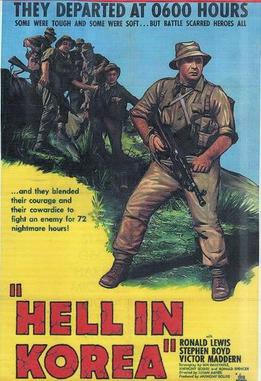
Hell in Korea

When I think of anti-war films, I tend to zoom right in on the 1960's, right as the Vietnam War jumped into full gear and moviegoing audiences amped up their cynicism. Well, sorta. The theme of today's review intro? The Brits, ahead of the game in the dark, gloomy, cynical anti-war film. I'll obviously mention some others later, but for now, here's 1956's Hell in Korea.

Commanded by inexperienced Lieutenant Butler (George Baker), a 15-man patrol leaves its base and heads out on a reconnaissance patrol. The patrol is split up down the middle, half professional soldiers and the other half National Service men called up when the fighting in Korea started. Their objective is simple; march out to a seemingly isolated village and find out if it is garrisoned or being used at all by North Korean and Chinese forces. Short answer? It ain't, but on the way back to base, the patrol is cut off by a much larger Chinese force. Butler tries to pull off a delaying action, but more Chinese troops quickly arrive on the scene. Butler's patrol has only one alternative...cut back through the abandoned village and fort up above it in a mountainside temple cut perched next to a cliff before they're cut to pieces. If they can make it...

There's something to be said for movies like this. By the late 1950's, studios in Hollywood and London alike were starting to focus more on BIG movies, EPIC movies with a huge scale and a bigger cast. Then there's movies like this. Filmed in black and white, 'Korea' focuses on one patrol, its mission, and its fallout when things go wrong. There is no bigger picture of the war. The focus is on one patrol. It was filmed in a barren location (I can't find where) and feels removed from any civilized part of the world. Cut-off from their own forces, the patrol is on their own. It can be stories like this that work so well because for all the huge battles and large-scale clashes, there were far more stories like this when it comes to a realistic war.

Two movies came to mind while watching this 1956 war drama, both like-minded stories and outlooks, as I thought about what to write. Wouldn't you know it? Both are British, 1961's The Long and the Short and the Tall (liked it) and 1959's Yesterday's Enemy (loved it). These aren't movies interested in glorifying war or showing it for all its heroism and bravery. It was about survival, plain and simple. That's where director Julian Amyes' film works best. The men on the patrol come from a variety of backgrounds, some don't like each other to the point it borders on hate, and they aren't looking for medals or notoriety. They want to survive and get home, war be damned. There's honesty in that sentiment. There's nothing heroic about getting your head blown off on a desolate Korean hillside. The stark black and white photography certainly adds something to that bleak, no-hope filled anti-war sentiment.

What originally caught my eye though wasn't the message or anti-war feelings. It was the cast! Featuring a Lost Patrol/Sahara/Bataan-like ensemble, the cast here is the patrol. We don't meet anyone back at HQ, no one on the enemy, NO ONE else. The cast is the patrol. That's it, and that's all. Though none get key, lead parts, it's cool to see Michael Caine (in his screen debut), Robert Shaw and Stephen Boyd in early roles. As the inexperienced but intelligent Lt. Butler, Baker is very solid in the best performance, getting help from Harry Andrews and Stanley Baker as the embattled veterans on the patrol, Andrews the tough as hell sergeant, Baker the Chinese-hating corporal. Also look for familiar faces in Michael Medwin, Ronald Lewis, Victor Maddern, Percy Herbert, Harry Landis and Robert Brown as members of the patrol.

As simple, straightforward and effective as 'Korea' can be at times, there are moments that feel like misfires. There's some key moments in firefights where the camera moves away from where the action should be. Characters being killed off is almost an afterthought, brushed away as quick as the camera can move. Things feel a bit rushed at just 80 minutes, much of the downtime between battles spent with the patrol bitching and moaning about the state they find themselves in. Some of it builds the tension, helps us get to know the men at least a little bit, but it also gets repetitive when it should be getting interesting as the bullets are supposed to start flying.

It is is a good, interesting movie, but not a great one. I loved the temple set, up on a hilltop seemingly in another world. I liked Malcom Arnold's score, somewhat reminiscent of his most famous score, The Bridge on the River Kwai. So while it isn't a great movie with some big flaws, this is still a little-known, mostly forgotten war film that is definitely worth catching up with. Track it down if you can. I happened to stumble across it on Turner Classic Movies recently.

Hell in Korea (1956): ** 1/2 /****

Wednesday, November 26, 2014

The Bridge on the River Kwai

When you're talking about great prisoner of war movies, that conversation is inevitably going to come down to two movies. For me, it's an easy distinction, an easy pick for which one is the best. That's one of my two favorite movies ever, 1963's The Great Escape. What's the other classic P.O.W. film? One of Hollywood's all-time greats, 1957's The Bridge on the River Kwai.

It's 1943 in western Burma and a battalion of British prisoners has arrived at Camp 16 along the Burma Railway. Allied prisoners are being used all along the railway to help build the tracks and bridges it needs to move supplies up and down the country. The commandant of the camp, Colonel Saito (Sessue Hayakawa), has been given a quick deadline in order to build a bridge over the river Kwai, but he quickly hits a roadblock in the form of the ranking officer among the Brits, Colonel Nicholson (Alec Guinness). Both men are career officers, both of them stubborn and strong-willed that they know what is right and how to do it. What follows is a battle of wills as the two commanders see who will crack first with the deadline fast approaching. Unbeknownst to both of them, Allied intelligence has caught wind of the bridge across the river. A former prisoner, Shears (William Holden), of the camp is working with an experienced commando, Warden (Jack Hawkins), to lead a team back into Burma and take out the bridge. 

That David Lean, he was a halfway decent director, winning two Best Picture Oscars in his storied career. One win was for Lawrence of Arabia. One was for River Kwai. My favorite? You're reading that movie's review right now. It is a film remembered as one of the all-time greats, and it deserves that status. The portrayal of war, its message about war, the instantly recognizable Colonel Bogey March (listen HERE), the phenomenal casting, the on-location shooting in Ceylon (Sri Lanka), the gorgeous filmography, and a great musical score overall from Malcolm Arnold. The scale is gigantic, but the story remains personal. It is a giant movie with an ability to never lose its focus or get too far away from where it wants to go. On my most recent viewing, I thought (more than I remember) there were some slow/sluggish portions in the 161-minute movie but not nearly enough to fault an otherwise pretty perfect movie.

The name evades me, but I remember seeing another British actor say in an interview "I didn't understand the Nicholson part until I saw Guinness' performance." That's how good Alec Guinness is in his Oscar-winning performance. This is an incredible acting job, a layered character that is baffling at times to understand. Colonel Nicholson is a fascinating character because his word, his beliefs and his stubborn make-up are everything to him. If he believes he is right, he IS right. This is a career soldier willing to put his life on the line to stand by his beliefs. A career officer, he knows nothing else other than the army. His dynamic with Hayakawa's Col. Saito is the guts of the movie, two officers believing they're right and seeing who will blink first. Who needs the other more to accomplish their goal? A late scene where Guinness' Nicholson discussing his career illuminates what drives the man. He wants to leave something that will be remembered. He does, but what if it helps the Japanese war effort?

What a cast! Guinness rightfully deserves first mention, but that's only the start. William Holden's character, Shears, is underwritten some, but it is a necessary, still very interesting character to move the action along. Holden is one of my favorites, and I liked his Shears, especially when a big twist is revealed near the halfway point. Jack Hawkins is just solid as Warden, the unlikely commando officer, an interesting similarity to Nicholson in the very, very British officer category. Hayakawa at times gets lost in the conversation, but he too is highly memorable as Saito, rough facade, terrified/worried inside at a possible failure. James Donald (also starring in The Great Escape) is the viewer, playing Major Clipton, the medical officer, trying to figure things out, to understand what's going on. Also worth mentioning is Geoffrey Horne as Joyce, the young, inexperienced commando trying to prove he can handle the job.

Also look for Andre Morell as Colonel Green, a key officer in Force 316, and Percy Herbert and Harold Goodwin as two British soldiers in the camp, Grogan and Baker.

Without resorting to hitting us over the head with a message, Lean does an understated job of delivering an anti-war message. What is it? Well....war is crazy. This isn't a horrifically violent movie, and the portrayals of a Japanese P.O.W. camp are pretty tame, but 'Kwai' effortlessly lays out all these different responses to war. Shears = Survival. Warden = A job. Clipton = Chaos and confusion. And Nicholson? A career. There are some moments of humor, usually pretty dark, mostly cynical, but Lean's movie (working off a novel by Pierre Boulle) presents the lunacy of war and simply lets it breathe. Decide for yourself who is right, if anyone.

So let's talk about that ending. No real SPOILERS here, but still, I'm talking (hopefully vaguely) about the finale. Great movie overall, one of the best ever. The ending to 'Kwai' is maybe top 5 finales to a movie ever as Force 316 (Warden, Shears, Joyce, a Siamese guerrilla and several Siamese girls) attempts to destroy the bridge at its grand opening. With nothing given away, there's a twist that is too perfect to describe. The last 35-40 minutes are phenomenal, and it only gets stronger in the final 15 minutes when the twist is revealed. Talk about tension built to an almost unbearable level. You can't believe what you're seeing, especially when Nicholson makes an amazing decision. It is a finale that leaves you drained and hammers home Lean's anti-war message. In the end, what is accomplished and at what cost? Boulle's finale is a doozy, a true whopper, if you read the novel.

Sometimes movies just work, a synergy of everything assembled clicking together. It is a beautiful movie, and Arnold's score works in unison with that visual, especially when Warden, Shears, Joyce and Co. finally arrive deep in the jungle at the bridge site. It is the first time we're seeing the completed bridge, and there's something simple and beautiful about the structure. Arnold's score soars, and all the pieces fit together. I think that's the beauty of it. This is my favorite David Lean movie overall, and it deserves its status as an all-time classic.

The Bridge on the River Kwai (1957): ****/****

Tuesday, August 12, 2014

The Wild Geese

A little bit of a spin on the wild west gunslinger, today's discussion centers around the mercenary, the hired gun who will take just about any job as long as the money is good. And if movies have taught us anything, mercenaries had lots of work throughout Africa in the 1960s and since with movies like Dark of the Sun, The Dogs of War and most recently Tears of the Sun. What about the best of the bunch? It's a movie many American viewers may not have heard of because it didn't get much of a release in the states. That movie? One of my favorites, 1978's The Wild Geese.

 A brutally efficient mercenary with years of experience under his belt, Allan Faulkner (Richard Burton) has agreed to take on a dangerous mission in Africa courtesy of the equally brutal, efficient and greedy merchant banker, Sir Edward Matherson (Stewart Granger). With lucrative copper mining rights on the line, Matherson needs Faulker to rescue a deposed African leader, Julius Limbani (Winston Ntshona), a leader of the people and a good man, to retake the government and settle things down. Taking a hefty payday, Faulker assembles an experienced, effective unit of 50 mercenaries, including fellow officers Lt. Shawn Fynn (Roger Moore), Capt. Rafer Janders (Richard Harris) and Lt. Pieter Coetzee (Hardy Kruger), and goes about putting together an effective plan, a smash and grab job. Faulker has the men assembled to pull off the job with a minimum of danger, but no matter how well thought out the mission is, even these mercenaries can't know what awaits them when they drop into Africa.

This review comes just a day after my Von Ryan's Express review, one of the great entertaining war movies ever made. More than that, just a great action movie. Well, surprise surprise, but I put this 1979 mercenary-centric action/drama on the same level. Is it a great movie in the vein of The Godfather or Lawrence of Arabia? Heck no, but it doesn't need to be! I watched a version that was 128 minutes long, and it is one extended thrill ride from beginning to end. Director Andrew McLaglen is far from a great director, but this is one of his best (if not THE best) movies. It is gritty, graphic, rough and tumble and the definition of a great tough guy flick. This is a movie that earns it's "Guy's Guy" type of movie, even if that theme song (listen HERE) seems a little out of place. But that's for the opening and closing credits. Enough with that. Let's get to the action!

Okay, not quite yet there with the casting. In the men-on-a-mission vein of The Guns of Navarone or Where Eagles Dare, here's one of the all-time great tough guy casts. The script calls for some older mercenaries, giving stars who weren't exactly A-list stars a chance at the spotlight again, and let me tell you, they don't disappoint. In a part of his career where the films weren't exactly great (an understatement), Richard Burton absolutely nails the part as Faulkner, a weathered, experienced mercenary who doesn't care for much other than the money he makes and the booze he can drink. Not exactly a stretch, but let's not nitpick. His officers include Harris as Janders, the master tactician and planner, Moore as Fynn, the born soldier who can fly or drive anything with a motor, and Kruger as Coetzee, the South African experienced bush fighter who has quite a few racist tendencies. They each get their moments to shine, the tough guy quartet killing it throughout with an easygoing, likable chemistry.

But wait....there's more!!! Along with Granger's quick appearance, there's Barry Foster and Patrick Allen as other shadowy characters involved in putting the mission together. Filling out the mercenary lineup are scene-stealing Jack Watson as foul-mouthed drill instructor Sandy Young, John Kani as Sgt. Jesse, the youngest of the bunch but an incredibly capable fighter, Kenneth Griffith as Witty, the flamboyantly gay medic, with Ronald Fraser, Ian Yule (an actual former mercenary), Percy Herbert, and Glyn Baker rounding out the crew. Also look for Jeff Corey and Frank Findlay in small parts. Just a cool, underrated supporting cast with plenty of memorable, recognizable faces.

Based off a novel by Daniel Carney and a Reginald Rose screenplay, one of 'Wild's' most underrated aspects is its script. Yes, it is familiar. Yes, it is politically incorrect one moment and somewhat preachy the next. But in the end, you throw it all together and all those separate ingredients work well together. It follows the men-on-a-mission formula nicely, going from assembling the team, to training the team, to unleashing the mercenaries on their dangerous mission deep in Africa, a regiment of brutal Simbas waiting to wipe them out if given the chance. There's too many good moments to mention from the Wild Geese free-falling out of a plane at 25,000 feet to Watson's hysterical rants during the training sequences to the almost non-stop smartass attitudes that produce a ton of memorable one-liners, some funny and some highly effective in the old drama department. Just a lot of positives on display here across the board.

But the biggest positive? The action of course! It's so good that the DVD actually offers a stand-alone menu where you can watch solely the explosions, shootouts and all sorts of hell that breaks loose. Without giving away any spoilers, the mission doesn't go off quite as planned, Faulkner and his men forced to improvise deep in enemy territory. Most of the last hour of the film is one extended action scene with some occasional dialogue to break things up. The highlight is the last 30 minutes, the mercenaries shooting it out with a large force of Simbas hell bent on stopping them from escaping. It's bloody, graphic and uncomfortable and features some surprising twists too as the body count rises ever higher. The action turns into a chaotic chase across the African savannah, lines and flanks shifting minute to minute. What an action movie.

This can be a difficult movie to track down. Years ago, I was lucky enough to track down a Tango DVD of this 1978 mercenary flick. It's currently available at Amazon for a very reasonable $12.99 if you're curious. As I mentioned, is it a perfect film? Nope, and again, it isn't meant to be. Instead, it is pure escapism, pure entertainment, and for me that's all I'm looking for. Familiar but highly entertaining story, action to burn and one of my all-time favorite casts. Can't recommend this one enough.

The Wild Geese (1978): ****/****
Rewrite of June 2009 review

Thursday, August 16, 2012

The Viking Queen

In the 1960s, the unofficial age of the epics, not all studios were able to produce immensely scaled historical dramas with A-list stars and a cast of thousands. Some, like Hammer Films, did their best to counter on significantly smaller budgets. More violence, more nudity, less message and spectacle, like 1967's oddly named The Viking Queen.

With her father the Briton king on his deathbed, young Briton woman Salina (Finnish actress/model Carita) is given power of the empire and is told to rule with a fair and just hand. Her selection divides the people, but she does her best to make a decision that is best for her people. Part of her father's deal was a controversial deal of co-rule with the Roman rulers, led by governor general Justinian (Don Murray). Very few among the Britons, Druids and Romans seem willing to go along with the plan, but when they fall deeply in love, both Salina and Justinian do everything they can to make the new system of rule work. With so much power at stake, all sides begin to conspire.

From Hammer Film Productions, this is a somewhat interesting if not necessarily good movie. Obviously made on a significantly smaller budget than the Hollywood epics of the time, 'Queen' has a certain low-budget charm. Much of the budget seems to have been spent on costuming and set design, leaving all those other things left by the wayside. So instead of a big sweeping story, we get lots of curvy, scantily clad women and....yeah, that's about it. Basically every scene a woman is on-screen, she's topless but strategically covered by hair, wearing a low-cut top that reveals -- as Peter Griffin would say -- 'side boob,' or just forced to wear a top and push-up bra that looks like she's being choked. Who needs spectacle when you've got that?

The Romeo and Juliet angle is played out about as you would expect it. Definitely the feeling of been there and seen and done that. It certainly doesn't help that Murray is rather wooden as Roman general Justinian although he does sport a Roman-looking haircut that's pretty ridiculous. Finnish model Carita (in one of 2 career film roles) just isn't an actress although her performance is far from the worst thing here. She's acceptable if somewhat stiff. Mostly her part is what I mentioned earlier; eye candy and lots of it. In that department, she's perfect casting, like THIS scene where's she "topless" and whipped. But putting the two actors together, Murray and Carita just don't have much in the way of chemistry. With a story that focuses on that Romeo and Juliet angle, even a little chemistry would have gone a long way.

Thankfully the rest of the cast with lots of familiar faces is having some fun with the cliched story. Donald Houston hams it up like nobody's business as Maelgan, a Druid high priest who rants and raves at anyone who will listen about the coming war that will have the land running with blood. Andrew Keir is a bright spot as Octavian, Justinian's second in command who resents the fact that he's been passed over for promotion, Percy Herbert playing his also treacherous Roman right hand man. Patrick Troughton too is a positive as Tristram, Salina's trusted adviser, who must also look out for his wavering son, Fergus (Sean Caffrey). Adrienne Corri and Nicola Pagett round out the eye candy contingent as Salina's sisters.

Now if you're in the Ass-Kicking Female Characters Dept., stick around for the end, a battle royale between Salina's Britons and Justinian's Roman legion. Salina and her two sisters -- going for the sexy look rather than battle appropriate -- ride their chariots into the Roman ranks. Like I've mentioned, no huge scale, but a solid, well put together battle sequence. A quick downer ending too which came as a bit of a surprise. And also, what the hell is with the title? Salina isn't a Viking, and there's no freaking Vikings anywhere in the story! Pretty mindless "historical epic" mostly worthwhile for the babe quotient. That's all I got. Eye candy here.

The Viking Queen <---Youtube clip (1967): * 1/2 /****

Sunday, May 20, 2012

The Cockleshell Heroes

Writing reviews about World War II, I've watched epics about large-scale battles, personal stories about the home front, behind the scenes stories about government/administration, but my favorite has always been the men-on-a-mission sub-genre, commandos, specialists and secret agents working together to pull off an impossible mission. One of my favorites I recently rewatched for the first time in quite awhile is 1955's The Cockleshell Heroes.

Early in 1942 with WWII's outcome still very much in question, Royal Marines Captain Stringer (Jose Ferrer) has been tasked with an improbable mission. German ships operating out of the French city of Bordeaux have been wreaking havoc on Allied shipping, and Stringer must attempt to reach the harbor city with a small group of commandos, destroying as many ships as possible. The catch? They'll be doing it by paddling up the Garonne River in two-man canoes. With help from a career Marine officer, Captain Thompson (Trevor Howard), Stringer goes about training his team of volunteers for a mission that seems suicidal to everyone involved.

From star and director Ferrer (one of 7 films he directed), 'Heroes' is based on the true story of Operation Frankton which took place in December 1942. I watched it as a kid on the History Channel and have always remembered it fondly. Released in 1955, it is more of a heroic look at the bravery these commandos showed on their mission. It doesn't yet have the darkness, cynicism or reality of so many WWII movies released a few years later in the 1960s. There is still an innocence to the story, a "nice" factor. The commandos are the heroes, their Nazi counterparts stereotypically evil. 'Heroes' is only 98 minutes long and was shot on a smaller scale (some cool English locations providing good background) with the focus on this specific mission. There's no sense of a bigger issue or the state of the war. Instead, it's about 8 commandos and the officers leading them. When handled right, who needs a bigger scale than that?

Not a hugely well known movie, 'Heroes' doesn't have the same name recognition in its cast so many other war films have. Ferrer is solid but not particularly memorable as Major Stringer, the unlikely, volunteer commander of the mission. He has several strong dialogue scenes with Howard's Thompson as a rivalry develops about how the mission should be handled, but there's little doubt who the star is. Trevor Howard is a scene-stealer, putting a spin on the stiff upper lip British officer. He's prim and proper and interested in the bottom line -- the success of the mission -- more than how the men feel about him. Thompson is the only character given any real background and Howard does not disappoint. The commandos include Victor Maddern as Sgt. Craig, Thompson's right hand man, as well as the Marine volunteers; Anthony Newley as Clarke, the smart-alec, David Lodge as Ruddock, the strongest of the Marines, Peter Arne as Stevens, the capable Corporal, Percy Herbert, Graham Stewart, John Fabian as Cooney, the Irishman, John Van Eyssen, and Robert Desmond (The Great Escape). Newly, Maddern and Lodge stand out from the group as memorable.      

At its heart, this is a men on a mission movie. It just so happens to be based on a true story, the results of the movie mission exaggerated a bit relative to the actual history. Truth or not, 'Heroes' follows a familiar formula. The story is pretty clearly divided in two parts; the training for the mission and then the execution of said-mission. I would have liked some more character background on the commandos, but the training scenes do just enough to differentiate them from each other. There are some original, unique scenes, including Stringer parachuting his commandos into England.....dressed as German soldiers. No money, no identification, they must trek some 300-plus miles back to the base without getting caught. These are some necessary scenes, giving us a rooting interest in these men as they head off to their mission.

Not surprisingly then, the best parts of the movie are the actual mission, dubbed 'Cockleshell,' as Stringer's team is dropped off by a British sub (commanded by Christopher Lee) and must paddle over 70 miles up the Garonne River to their target, ships waiting in the harbor. The final 40 minutes are tense and adrenaline-pumping as they navigate the river. It's here where I started to question. If I didn't know this was in fact a real mission, I'd say it was ridiculous. The bravery exhibited here in insane, commandos in 2-man canoes paddling exposed up a heavily guarded/defended river. HERE is a Google Map showing how far they actually traveled. The ending is downbeat with a sense of success, Howard delivering a very moving final line. Success at what cost though? Listen to some of the main theme HERE, a whistle-worthy score from composer John Addison. The link below is a documentary about the real-life mission. As for the movie, a hidden gem and one I've always enjoyed.

The Cockleshell Heroes <---documentary (1955): ***/****

Friday, December 16, 2011

Tank Force

Running for two season in the 1960s, The Rat Patrol was a fun, little show following the exploits of the real-life Long Range Desert Group. Yes, it was ridiculous, four men taking on seemingly the entire German army in North Africa without taking casualties, but it was entertaining and a lot of fun to watch. Released in 1958, British war flick Tank Force seems almost like a dry run for the short-lived TV show.

Caught up in a chaotic back and forth battle, two British tank crews, one commanded by an American, Sgt. Thatcher (Victor Mature), and the other by Sgt. Kendall (Leo Genn), are captured by German forces. They are transported to a makeshift prison camp where hundreds of other Allied prisoners are being held in the Libyan desert. Kendall goes along with the flow, joining the escape committee and joining in on the effort to pull off a successful escape. Thatcher on the other hand is looking out for himself, planning his own escape without checking in with the rest of the camp. His efforts piss off the other prisoners, but he has his reasoning. An SS officer is headed to the camp to interrogate Thatcher who has no intention of being around for that questioning.

Directed by future James Bond director Terence Young, 'Tank' is a forgettable if entertaining WWII story. I enjoyed it, but didn't love it and probably won't feel the need to revisit again anytime soon. Part tank battle, part POW escape story, it's heavy on action and short on story and any sort of reality. It is entertaining though, and a WWII story that focuses on the 1942 North Africa campaign is rarely dull. Desert warfare always makes for interesting, unique viewing, and an escape across that desert with murdering Arab tribesmen, Italian and German forces on patrol and waiting is a cool premise.

American and British, a natural and historical rivalry, so in step Mature and Genn. Their dynamic is easily the best thing going in 'Tank.' They both want the same thing but go about it in polar opposite fashion, Mature's Thatcher on his own and Genn's Kendall as part of the team. Only when their backs are against the wall do they decide to work together. Their rivalry actually consists of a handful of scenes where they argue back and forth, but seeing the brooding intimidating American -- with an interesting backstory at that -- and the stuffy shirt, prim and proper British soldier going at it certainly keeps the action going.

Filling out Tank's Rat Patrol is a small but international bunch, starting with Anthony Newley as Pvt. 'Tiger' Noakes, Kendall's driver and all-around optimist. Nothing seems to rattle him, and he's always ready with a joke like most of Newley's supporting parts were. Bonar Colleano plays Walewski, the Polish POW who teams up with Thatcher in his escape efforts. Ready and willing to kill to preserve his own well-being, it certainly adds a darker dimension to the group. Some other familiar faces include Sean Kelly, Percy Herbert, David Lodge and Alfred Burke as the other British prisoners. Future Bond-girl/villain Luciana Paluzzi has a small part to as Carola, an Italian woman aiding the escape effort.

Not surprisingly, the action is what will draw most viewers in. Escaping the prison camp, Thatcher, Kendall and crew cut a swath through North Africa a mile wide, taking out Germans and Italians wherever they go. It's a fun movie overall that isn't great and isn't bad. Entertaining and forgettable but not much else. Probably worth a watch if nothing else.

Tank Force (1958): ** 1/2 /****

Tuesday, August 16, 2011

Too Late the Hero

By 1970, the United States had been involved in the Vietnam War for going on five years. The American public had grown tired of a war that was producing no results and eating up American soldiers' lives by the thousands. As a country, we grew sick of authority and power figures, losing faith in the people we were supposed to trust. This distrust and frustration with the system came out in countless outlets, especially in films and even more so in war films, like 1970's Too Late the Hero.

From director Robert Aldrich comes this war movie that has been generally forgotten over the last 40-plus years.  Is there a chance it is too cynical, too dark, too anti-war?  It certainly could be any of those reasons, and while it is not a great anti-war movie, it certainly is a good one. Just three years earlier, Aldrich had directed the classic anti-war movie The Dirty Dozen, a mix of incredibly dark humor, anti-establishment sentiment and in general a disdain for anything related to the powers that be. With 'Hero,' he takes it up a notch. Think Dirty Dozen mixed with The Guns of Navarone and Play Dirty, and you've got this war flick.

A day away from a month's leave, American Navy officer Lt. Sam Lawson (Cliff Robertson) is instead assigned a dangerous mission in the southwest Pacific in 1942. He's sent to a small, seemingly inconsequential island in the New Hebrides to join a British outfit fighting Japanese forces on an island. Lawson's services as a translator -- he speaks Japanese working for intelligence -- are needed as he joins a small patrol trekking across the island to a Japanese base. Their mission? Knock out the radio so an American naval convoy can pass by the island safely and have Lawson transmit a message to Japanese headquarters so as to no alert the enemy of the coming attack. The men on the patrol are a mixed bunch including troublemaker and medic Pvt. Tosh Hearne (Michael Caine) and is commanded by a courageous if inept officer, Lt. Hornsby (Denholm Elliott). As they approach their objective though, a wild card emerges, news of a Japanese counterattack that intelligence is unaware of.

Is there a such thing as a war movie that is too opposed to war, too anti-war in its general sentiment?  That's always my issue with movies like this.  Think Platoon, All Quiet on the Western Front, Born on the 4th of July, Full Metal Jacket. All high quality, solid movies, but because they're not necessarily entertaining it can be hard to go back and revisit the films with multiple viewings. That's my problem at least. I bought Too Late the Hero seven years ago, watched it once and even though I enjoyed it, did not watch it again until this summer.  It can be a tad on the slow side -- meandering along at 134 minutes -- and stretches go by where not much happens. It is an incredibly dark film overall, making it hard to go along for the ride. None of this is intended to steer you away from the movie, but instead serve as fair warning heading in.

Where Aldrich's The Dirty Dozen had some redeeming characters, 'Hero' has none of them.  There are few positive qualities in any of them. Robertson's Lawson is basically trying to sit out the war in a rear echelon radio post and goes along only when there are no other options. He blatantly refuses to go along with an order on the mission, using a discrepancy to hide his cowardice. Caine's Tosh is a little better, but he is truly only looking out for himself. Screw the lives of others if his life is the necessary sacrifice. It is hinted that Elliott's Hornsby is gay, but it's not important overall. He's both brutally cold and stupidly inept in his command. Harry Andrews is the British commander ready to sacrifice his men as needed, and in a cameo Henry Fonda basically blackmails Lawson into going on the mission. The patrol includes Ian Bannen, Percy Herbert, Ronald Fraser, and Lance Percival among other interchangeable characters there to be fodder for the Japanese.

Setting the movie apart from so many other anti-war films that are content in delivering their 'War is hell!' message is a script from Aldrich that revels in being unique, in going where many war films don't want to go. It is genuinely unique. As the survivors of the patrol race back through the jungle to the relative safety of their own base, the Japanese are in hot pursuit with some psychological warfare prepared. A Japanese major, Yamaguchi (Ken Takakura), uses loud speakers and an amplification system to address the men he's pursuing, offering them terms of surrender with an ever-shrinking deadline. The Japanese aren't the bloodthirsty savages here for the most part, and as is the case with Takakura's Yamaguchi, he's just a soldier trying to do his duty. The booming voice through the jungle is a nice touch though, an enemy that cannot be seen and only be heard.

The best though by far is the finale so OBVIOUS SPOILERS from here on in. SPOILERS STOP READING SPOILERS Needing to deliver the news of the coming Japanese attack, only two survivors make it back -- Tosh and Lawson.  The only problem? The only way back to the base is an open stretch of land, a veritable no man's land. The Japanese have it covered, and any attempt to cross the vast openness is basically a suicide mission. Tosh and Lawson attempt it, running like madmen in a zig-zag pattern in an attempt to make it hard to pick them off.  Aldrich shoots this adrenaline-pumping sequence from a distance, making sure we can't see which man is which. I won't spoil the ending as to who makes it -- or do both make it? Hhhmmm, interesting -- but it is a whopper of an ending and another unique touch, something I'd never seen before in a war movie. Watch it HERE with more OBVIOUS SPOILERS.

This certainly isn't a perfect war movie, but as far as anti-war movies go it's hard to beat. Maybe some of the reasoning I've come up with is because it hasn't been fondly remembered since its 1970 release. It is a bit of a hidden gem.  An appropriate if not so subtle message tries too hard at times, but the idea is there. Throw in some great performances from a deep cast -- especially Robertson and Caine -- and it is definitely worth a watch.

Too Late the Hero <---trailer (1970): ***/**** 

Sunday, May 15, 2011

One Million Years B.C.

Earlier in 1966, Raquel Welch starred in Fantastic Voyage, a cool little science fiction movie with an impressive ensemble cast. But if we're talking movies Welch starred in during 1966, that conversation is going to begin and end with one movie, One Million Years B.C.. Before this cult caveman classic was even released, 20th Century Fox Studios released photos of Miss Welch outfitted in a skimpy fur bikini that not surprisingly, went over quite well with audiences (I'm assuming a male-dominated audience). The pictures are easy to find -- just do a simple Google search -- and if anything, it is the outfit that is remembered more than the actual movie, which is pretty bad all things considered. It's up there with Ursula Andress in Dr. No coming out of the water in her white bikini as moments burned into the brains of thousands of viewers. As for the movie, you can take it or leave it.

Rewatching it this week for the first time in years, I realized how bad a movie it is.  It was made by Hammer Films -- master of cheesy schlock in science fiction, horror, thriller and B-movies -- and came at a time when audiences ate up these low-budget flicks.  In one of those weird examples where it is hard to explain reasoning, movie-going audiences went through a caveman/creature faze in the late 1960s and early 1970s. Of the ones I've seen, none of them are very good, but I don't know exactly what to say. These were movies about cavemen. Were they supposed to be good? Maybe not, but if nothing else they offered a chance to see some cool creature creations (more on that later) and female castmembers in various stages of undress or in scantily clad outfits. Take Raquel Welch out of this movie, and we're talking about a flick left to the ages.

In some sort of ridiculous past time where dinosaurs and people lived together, a caveman from the Rock tribe, Tumak (John Richardson), is banished from the group after a fight with the tribe's chieftain, Akhoba (Robert Brown). He heads out in the vast wasteland that is the desert wilderness on his own, battling creatures and conditions, desperately clinging to life. Tumak walks and walks and finally at the brink of death collapses near a large body of water where another tribe, the blonde Shell people, rescue him and bring him to their caves. One member of the tribe, the beautiful Loana (Welch), takes a keen interest in this strange, dark-looking man who walked out of the wild. But almost immediately, Tumak's ways burn that bridge too, and together he and Loana head back out into the wilderness. As they try to start a new life, a conflict is brewing between the two tribes, one that will bring them all together.

I've seen this movie a handful of times (it was a favorite of mine as a kid), but it wasn't until just now I realized how stupid it really is. To say there is an actual plot is a gigantic understatement. This is Cavemen Walking in the Desert. That's it. Occasionally, they grunt at each other, battle some prehistoric creatures, and then keep walking. The script -- yes, there is a script -- is an oddity because no actual conversation goes on at any point. There is some sort of pig latin caveman speak, but any interactions among anyone on-screen is a grunt, a blank stare, or a pissed off "I'm going to kill you!" look. If you're looking for a positive, and trust me, I'm trying, it's that director Don Chaffey shot this movie in the Canary Islands off of Spain. What did the landscape look like in prehistoric times? Who knows for sure, but this movie looks like some sort of post-apocalyptic hellhole where anything would struggle to survive. Stupid story, you bet. Great-looking movie, that too.

To talk about performances here feels beyond ridiculous to me so I'm not going to even make an attempt. Typically, I try and avoid minimizing criticisms/judgment of female characters based on looks or sex appeal alone, but that's basically impossible to do here because the whole movie is an excuse to watch Raquel Welch in her skimpy fur and leather bikini. That's it. End of movie. She's gorgeous, beautiful, out of this world sexy. Reviews have some fun pointing out that she's the most well-maintained cave-woman ever. A blonde, tan Raquel Welch in a bikini running around from all sorts of cavemen and creatures trying to kill her? It sounds like a decent basis for a movie. Who actually needs words spoken or a story when you've got that? Because there are at least a few other people in the movie, I'll mention them too. Richardson is phenomenal at looking bug-eyed and screaming, Brown is one gnarly-looking, angry dude, Percy Herbert is equally pissed off and willing to kill anyone who as much as looks at him funny, and Martine Beswick is Welch's Rock people adversary, a gorgeous, brunette cave-woman. See what they did there? Pretty sneaky.

One of the reasons movies like this are remembered so fondly are the creature creations of model-master Ray Harryhausen, he of Jason and the Argonauts fame among many other 1950s and 1960s flicks. Some 40-plus years later, the special effects do look dated, but they all add to the camp appeal of the movie. His stop-motion filming technique was a staple of a pre-CGI era in Hollywood. We see an allosaurus attack the Shell people's village, a pterodactyal swoop down and scoop up Welch's Loana, a giant turtle attack a hunting party, and several other examples peppered throughout the film. There is also the technique of super-imposing smaller animals (lizards, snakes, tarantulas) onto the screen to make them look gigantic, dwarfing the cast members. The movie never goes long without throwing some odd creature into the story, building up to the apocalyptic ending when all hell breaks loose when the volcanoes start to go. Yeah, no explanation needed there, just go with it. Throw in composer Mario Nascimbene and his epic, booming score, and you've certainly got a visually interesting movie.

Read through the DVD reviews at Amazon or anyplace really, and you'll come across complaints that the film as is on the DVD is an edited version of the film that was released in theaters in 1966.  Almost 10 full minutes were cut out, and fans understandably were pissed they weren't seeing the whole movie.  Good news for those fans, the print Turner Classic Movies aired recently is the full 100-minute long version. All the scenes mentioned that were cut (read IMDB's Alternate Versions HERE) were in the movie, back for everyone to enjoy. This is a guilty pleasure movie if there ever was one. A really bad, even awful movie, but one you can't help but enjoy through all the camp and cheesiness.

One Million Years B.C. <---trailer (1966): ** 1/2 /****

Friday, May 6, 2011

Sea Fury

Most well-known for his performances in a handful of John Ford movies, Victor McLaglen was one of the great character actors to come out of Hollywood's Golden Age. In the Ford movies, his theatrics were often a little too much, a little too jokey for my liking, but it doesn't take away from a great career.  It was one that saw him star in over 100 movies (silent and sound), even winning a Best Actor Oscar for his performance in The Informer.  He died in 1959 from a heart attack, just a year after completing his final film, 1958's Sea Fury.

It can be sad watching actors and actresses in their last films, and for McLaglen, that's true on several levels.  In his 70s by the time this movie was made, he looks every inch of 70 if not more.  He's playing a character he often played, a rough, brawling and boozing man who's led a tough life but plans on going out kicking, not lying back in bed.  McLaglen just doesn't look himself though right from the start. What makes it worse is that through all his trademark blustering is that's nearly indecipherable, mumbling his way through lines to the point it's hard to comprehend a thing he says. The performance is far from bad, but it's not up to his standards that he established over a 30-plus year career.

Captaining the Fury II, a tugboat salvage vessel, Captain Bellew (McLaglen) leads his ship into port in the Bay of Biscay hoping to get help for his long-time first officer, severely wounded in an accident.  It's in port that he meets Salgado (Roger Delgado), a poor man who tries to set up Bellew with his very beautiful young daughter, Josita (Luciana Paluzzi). The weathered old captain tries to buy young Josita's affections with many gifts and presents, but she wants nothing to do with him, much less marry him as her father intends.  Instead, she falls for Abel Houston (Stanley Baker), a new crew member aboard the Fury, who returns her affections. Going behind the captain's back, Abel starts to see Josita, knowing that eventually everything with come crashing down. As the confrontation comes to a head, the Fury receives a radio report of a wrecked ship carrying a valuable cargo. It's a race to the wreck with a rival ship, the tension momentarily thrown by the wayside.

A film generally forgotten over the years, 'Sea Fury' is an interesting piece for several reasons. If nothing else, it is McLaglen's last film, the last chance viewers have to see him before his death a year later in 1959.  More than just that though, it's dark look at action on the high seas through the eyes of a salvage vessel (a shady occupation if there ever was one). Director Cy Endfield's film has not aged well over the years, but that could just be the print I saw on TCM. Shot in black and white, 'Fury' still is a pleasure to watch. The little, tucked away coastal village in Cataluna is idyllic, like a picture of a time long since past. The musical score is Spanish-themed, a Spanish guitar playing lightly in the background, giving a soothing feeling to the story that will not end well. More on that later.

I've made no cover-up about my dislike for the love triangle plot-line in movies, TV, books, and generally...pop culture.  It's a lazy way to create conflict among a group of characters, and is about as hackneyed a topic as one you'll come across.  If you are going to go down that route, at least do it the right way, and 'Fury' definitely tries.  It is clear from the start that Paluzzi's Josita is only going along with her father's wishes to make him happy. She has no intention of ending up with McLaglen's much older, unattractive brawler.  There's the tension because Baker's Abel clearly knows it too.  This isn't a lovey-dovey triangle where the cute girl has to decide who she'll end up with. You fear for Baker's life, knowing if McLaglen's Captain finds out, he's going to take him out.  The tension and fear is genuine, even if the execution in the end disappoints.

The three main leads -- McLaglen, Baker, and Paluzzi -- are an interesting bunch. McLaglen was the most established, Baker a rising star, and Paluzzi was fast-becoming a sex kitten on-screen.  The dynamic among the three of them drives the movie, always keeping the story flowing along.  I talked about McLaglen's performance already, disappointing for a last hurrah.  Baker is the more prototypical lead, young, handsome, and strong.  Paluzzi -- at 21 years old -- is drop dead gorgeous, plain and simple.  As an actress, she's still raw, but the potential is there.  Also look for Gregoire Aslan as Fernando, a fellow member of the crew, a young Robert Shaw as a conniving officer on board, and British character actor Percy Herbert as an insubordinate member of the Fury's crew, among others, none of whom I recognized.

The tension is there, the potential for a great ending just waiting to be tapped, and then? Nothing. Happy ending. Everyone walks off into the sunset, happy with how things turned out.  As Mr. Cynical, I Love Downer Endings, it seemed obvious to me to kill Baker's character during a dangerous salvage mission near the end (there's some great footage here of an open sea rescue, very exciting and expertly handled). Even Endfield shoots the action like Baker's Abel will be killed, but he ends up making it. Happy with his big score, Bellew gives Josita to Abel, and credits roll. It was a wasted effort in my mind only because the build-up keeps working toward a downer ending, and then pulls the rug out from under you.  Still a decent enough movie, but not nearly what it could have been.

Sea Fury (1958): ** 1/2 /****

Friday, January 21, 2011

The Safecracker

One of England's most prolific character actors, Percy Herbert had a face that any moviegoer would recognize.  With over 100 film and television roles, it would be hard for someone not to at least stumbled across Herbert in a movie.  Now, whether you knew who he was or what his name was, that's a different story. With his steely scowl and Cockney accent, he was always a welcome addition to a movie and never disappointed in his supporting roles.  He made a career of those parts, often in WWII stories where he was the tough drill sergeant, a smart-mouthed soldier, or even just the reliable veteran in the background.  Never a star but always visible, Herbert is one of my favorites.

Like so many of his movies, 1958's The Safecracker doesn't give him much in the way of screen-time, but he makes the most of his limited appearance. That's part of the fun of so many British movies from the 1950s and 1960s.  There were always the established stars out front leading the way, but the rest of the cast was always peppered with these great character actors, instantly recognizable faces and talented individuals who have a knack for bringing a movie up a notch just by being there.  Too often they don't get enough recognition for their talents, but they always brighten up a movie for me, especially here with such a different WWII story that isn't as good as it could have been.  More on the cast later because there's a handful of worthwhile supporting roles.

An honest worker who creates safes while opening safes that banks/businesses/individuals have lost the combination for, Colly Dawson (Ray Milland) is bored with his profession.  He's the best at what he does, but what does he have to show for it?  He takes up with an unscrupulous art dealer, Bennett Carfield (Barry Jones), who puts Colly to work stealing art from otherwise unbreakable safes.  Colly pushes too far though and is thrown in jail in 1939 for a 10-year sentence. But by 1941, Great Britain is up to its neck in WWII and on a dangerous mission the army needs a safecracker to be dropped into Belgium with a commando team. The only candidate with the required skills for the job is Colly who agrees only when told that his sentence will be commuted upon return.  But can this safecracker keep up with the commandos behind enemy lines?

For a movie that I'd never heard of, I was looking forward to seeing this safecracker turned commando WWII story.  But starring and directing, Milland makes two different movies rolled into one 96-minute feature length movie. The first 50 minutes covers his exploits as a locksmith turned master thief while the remaining 45 minutes show his participation on the commando raid into Belgium.  Both segments would have been interesting movies on their own, but here they are too rushed to be any good.  The master thief segment is surprisingly boring maybe because Milland's Colly is too good at what he does.  Up until the job he is arrested on, he's never as much as questioned or spotted during a robbery.  Long scenes with no dialogue and no tension help make an easy decision to fast forward this slow-moving story.

Thankfully, Milland rights the ship in the second half with the training for and execution of the commando raid.  It's a case of too little too late, but is still head and shoulder above the rest of the movie.  Ernest Clark plays Major Adbury, commander of the raid, with Herbert as the tough sergeant with Victor Maddern and a young Bernard Fox as two of the 8-man commando team. The training portion provides some laughs as the older, out of shape Colly struggles to keep up with the younger, fitter commandos as he goes through hikes, runs, and parachute training.  The mission itself is the best part of the movie with Colly's services needed to crack a safe that holds a list of all the German agents working in England.  Performed at night, it's a tense, well-executed scene that helps the movie overcome its painfully slow first half.

A problem I've come across with movies starring Ray Milland is that Ray Milland is in them.  That's not to say he's a bad actor, far from it, he's very good.  It's that no matter the part he is playing, he comes across as a cocky, downright arrogant individual who is hard to put up with at all, much less like him.  Whether it's his upper-class British accent or his general demeanor, you can feel him glaring down his nose at you.  Watching his Colly Dawson go about his job, I actively disliked this character.  For lack of a better description, he's an asshole.  Too old to begin with for the part, he's in it for himself and doesn't care about the consequences as they affect everyone else.  Then there's the ending where his character makes a decision so epically stupid that says everything about his character.  A final scene tries to make him a hero -- and to a point, he is -- but it comes across as a whitewash, covering up something else as it really happened.  Milland is a talented actor, but it's hard to like him or his characters.

Two movies edited into one, Milland the director could have chosen one or the other and made a single movie about a safecracker or a commando.  There was certainly potential here, and it's not an awful movie.  The second half saves it from being unwatchable, but that's still only half a movie.  Just start at the 50-minute mark and imagine an hour-long TV show instead.

The Safecracker <---TCM trailer (1958): **/****    

Saturday, August 14, 2010

Yesterday's Enemy

War movies can be categorized into a wide variety of sub-genres, but two really stick with me the more I think about.  I'm struggling to come up with one that doesn't fit into one or the other in some way, anti-war and then a more heroic look at war.  Anti-war will typically get better critical reviews, think Platoon, Paths of Glory, Born on the 4th of July, Full Metal Jacket, and many, many more.  One that has been almost completely forgotten because of its controversial story is 1959's Yesterday's Enemy, a movie years ahead of its time that still packs a punch over 50 years later.

Anti-war movies typically have to tread that fine line between powerful and moving emotionally and just being preachy.  'Enemy' is just too honest, too forthright with the realities of war to be preachy.  It drags you into this story and quickly dispatches any notions you have about war movies you've seen in the past.  Sure, there's some genre characters, but they don't act like characters you've seen before.  These are soldiers fighting a hopeless mission where chances of survival range from slim to none, but they continue on because it's what they do, they fight.  Later after the plot review, I'm going to give major plot points away so be forewarned as you continue reading.

After a surprise Japanese attack, the ragtag remnants of a British battalion trudge through the Burmese jungle hoping to hook up with the main line of defense or at least find other wandering units.  Commanded by the highest ranking surviving officer, Capt. Langford (Stanley Baker), the survivors -- totaling between 40 and 50 men -- stumble across an isolated village where they find information about an upcoming Japanese offensive.  It's news that could save the lives of hundreds and maybe thousands of men if it reaches headquarters.  The radio is out though, forcing Langford to send a small squad forward with the news led by his right hand man, Sgt. McKenzie (Gordon Jackson), hoping the news reaches HQ.  With the Japanese not far behind, Langford stays behind in the village with the rest of the men, trying to buy as much time as possible while maybe, just maybe, surviving the coming firefight against impossible odds.

With WWII, there is and was a perception that the Allies were all heroic soldiers while the Axis were all demonized murderers intent on mass slaughter.  War crimes were committed on both sides of the war in Europe and the Pacific no matter what people believe.  That's part of what sets this movie apart from others.  In 1959 just 14 years since the end of WWII, 'Enemy' shows British and Japanese troops committing acts that would have been prime grounds for a war crime trial.  But in the context of the movie, it's necessary.  Baker's Langford is going to do whatever it takes to protect his men. A war correspondent (Leo McKern) asks though at what point does it become an atrocity? Two innocent people killed? 10? 100? Thousands? Topping this off though, director Val Guest doesn't answer that question. It's up to the individual to decide. If one person dies, is it worth the 10 that were saved?

It's rare you see a war movie, especially a pre-Vietnam war movie, that is so brutally honest.  Baker orders the execution of two Burmese villagers to get a Japanese informant to spill his guts.  Later, a Japanese officer (Philip Ahn) puts Langford in a similar situation, demanding he tell him everything he knows or his men will be killed.  Neither man does this because they relish killing in cold blood.  They do it because if they want to do their job and win the war people have to die, often in horrific, blood curdling situations. The whole movie delivers a powerful message, but it really hits home in the end.  Not knowing that McKenzie's squad has been ambushed and killed, Langford and a handful of survivors stand fast till the bitter end.  It is an unknown futile effort, but maybe it is more courageous because of that.  They don't know their stubbornness is wasted, their bravery unnecessary.  It is their duty and they intend to live up to it.

Known most for his performances in Zulu and The Guns of Navarone, Baker delivers a career-best performance as Capt. Langford.  He's not a raging, homicidal maniac, he's an officer who thinks things out in detail.  Forced to make extremely difficult decisions that will knowingly cause death in his own ranks, Langford commands this battalion remnant with a bigger picture in mind.  This isn't a hero or a villain, it's one man in an uncompromising situation who has to make decisions that could have horrific consequences and then has to live with it.  The conscience of the movie comes in three characters, a priest (Guy Rolfe), McKern's correspondent, and a medical officer (David Oxley), all questioning the humanity of what they're doing, Rolfe and McKern especially delivering strong performances.  Along with Jackson's Sgt. character, rounding out the unit among many others is Percy Herbert, David Lodge, and Richard Pasco as Lt. Hastings, the young officer dealing with the inner demons that tell him survival is a better option than blind courage. 

Filmed mostly on an indoor set, 'Enemy' still manages to give the feeling of being in the humid, sweaty Burmese jungle with a claustrophobic surrounding that gives the perception of being closed in with nowhere to go.  Guest films in black and white -- adding to the stark feeling -- and makes his soldiers look like soldiers who've been jungle fighting for months.  They're sweaty, wear unkempt beards, and their uniforms are in tatters.  Like everything else in this forgotten war movie, it all rings true.  Forgotten because of it's controversial subject matter and portrayal of Allied soldiers, Yesterday's Enemy is one of the best war movies I've ever seen. Honest, brutal, incredibly realistic, and a must see movie.

Yesterday's Enemy <---TCM trailer (1959): ****/****

Friday, January 29, 2010

Tobruk

Before the History Channel became more interested in reality-based programming in the last year or so, this network focused more on (and it's a novel concept) history programming. Makes sense to me. Some dubbed it 'the Hitler Channel' because so much of their schedule was devoted to WWII shows, but that was just a small portion of their schedule. For years on Sunday mornings, History would show older war movies, ranging from classics to cheap retreads, and when I could be bothered to get up early I'd tune in and see some of my favorites, one of them being 1967's Tobruk.

It's a story set in 1942 North Africa as an inexperienced American army joins British forces in trying to keep German commander Erwin Rommel from completely booting the Allies out of the continent. I don't have numbers to back this up, but it seems to me a majority of WWII movies tend to focus on post D-Day stories as the Allies trudge across Europe. Personally though, the early stages of the war are just as interesting to me with TV shows that included The Rat Patrol and movies like The Hill and Play Dirty all set in North Africa with Tobruk added to that list.

Captured by French authorities and about to be shipped off to a German prison camp, Canadian officer Major Donald Craig (Rock Hudson) is rescued by a team of commandos led by Capt. Kurt Bergman (George Peppard), a German Jew fighting with the S.I.G (Special Investigation Group) in the Allied forces. Craig, a member of the Long Range Desert Group, has been busted out to guide a dangerous mission behind enemy lines. The commando commander, Colonel Harker (Nigel Green), has two objectives, destroy the harbor guns in Tobruk to help the invasion force and to destroy Rommel's fuel depot. Harker's men will pose as P.OW.s with Bergman's German Jews posing as their German escorts as the convoy travels over 800-miles across the desert to accomplish their mission.

Threading the needle to get to Tobruk, Harker's commandos and Bergman's unit face German minefields, patrols appearing out of nowhere, even their own fighters attacking what they think is a German column. But worst of all, there seems to be a traitor among Bergman's men, and when they pick up two German sympathizers with news that Egypt will join the fight against the Allies, their mission becomes even more important. It's a large-scale story in the vein of The Guns of Navarone (harbor guns moved from the Mediterranean to Tobruk) and Where Eagles Dare, and while not on par with those WWII action/adventures, it is still an above average flick.

For a WWII adventure to be nominated for an Academy Award -- any award -- says something. Tobruk was nominated for special effects (Howard A. Anderson and Albert Whitlock) and for good reason. The effects during the action sequences were ahead of their time, especially the finale as the commandos try to pull off both aspects of their mission as an invasion force readies to hit the beach. This is one of those battle sequences that really makes you feel like you're there scrunched up behind a rock, hoping a bullet doesn't find you. Even better, with the use of many of these effects it looks like the stars, especially Peppard, did many of their own stunts.

Tobruk's action is so good in fact it was used over again 4 years later in 1971's Raid for Rommel. Whole scenes were cut from Tobruk and inserted right into the 1971 vehicle starring Richard Burton with a similar storyline. And the action is the reason to seek this movie out, and that's considering a story that is pretty decent compared to most shoot 'em up flicks. Right from the start there's a commando rescue, but that is just the beginning. Tobruk never goes too long without some suspense, some adventure of some sort. The ending is something else with tanks, flamethrowers, motorcycles and commandos descending rappel cords off a cliff all thrown into the mix.

Getting to the finale is a lot of fun too with the three leads playing off each other well, especially Peppard and Green. Peppard steals the movie as a German Jew looking for revenge, any sort of vengeance against Germany for what they're doing to his people. He's ruthless in his actions and is more than willing to sacrifice himself for the cause. Green is the stiff upper-lip commander who clashes instantly with Peppard's Bergman, even questioning his motives. Their rivalry drives the movie, both actors rising above what could have been cardboard cutouts of characters. Hudson isn't at his best -- a soldier sick of war who does his job and nothing more -- but it is a decent enough part.

Other supporting parts include one of my personal favorites Jack Watson doing what he does best, playing the tough sergeant, with a similar end result to at least two other movies of his I can think of. Guy Stockwell is Lt. Mohnfeld, one of Bergman's officers, and Norm Rossington and Percy Herbert as two commandos around for some comedic relief. Tobruk's screenwriter Leo Gordon, who usually played tough guys in supporting roles, gets a crack to play one of the good guys for a change as well as Sgt. Krug. A WWII movie that's a lot of fun, a good old-fashioned popcorn flick. Of course, there's no DVD release but who knows, maybe History Channel will put it on one Sunday morning.

Tobruk <---trailer (1967): *** 1/2 /****