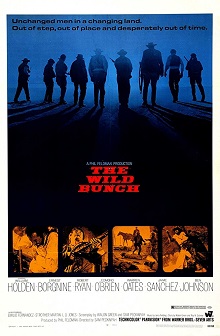
By 1969, director Sam Peckinpah had worked on several TV series and several film productions, including The Deadly Companions, Ride the High Country and Major Dundee. He was an incredibly talented director but one whose fiery personality and personal demons could potentially derail any film he worked on. But in 1969, it all came together, Peckinpah making his classic, his all-time great film, one of the best westerns ever and best films ever in general, 1969's The Wild Bunch.
It's 1913 in a small border town near the Rio Grande, and a gang of outlaws, led by the infamous Pike Bishop (William Holden), disguised as soldiers ride in to rob the bank of a rumored silver shipment. The robbery is an epic disaster as a posse of bounty hunters, led by Deke Thornton (Robert Ryan), a paroled outlaw who used to ride with Pike, is waiting in ambush. Many of Pike's gang is killed in the robbery that nets them NO money. The remaining members of the gang, including Dutch Engstrom (Ernest Borgnine), retreat into Mexico. They need a new job, a new robbery, a new chance to earn some money. Pike especially knows that time is running out, that times are changing, and their chances at surviving as outlaws is becoming ever more unlikely. It doesn't help that Deke and his bounty hunters have followed them into Mexico, looking to collect the bounties on these infamous outlaws. With time running out, what do they do?
What a movie. Every so often, each and EVERY thing involved in the making of a film comes together and forms that perfect symmetry. 'Bunch' is an all-timer, not just a movie I love but a great movie in terms of storytelling and in technical terms. Appropriate for the time it was released (the late 1960's), it is cynical, horrifically violent, brutally honest and generally downbeat. This is a western and film ahead of its time, helping set the tone where films would go in the coming years. This is Peckinpah at the top of his game. He would have other good to great to classic films, but this is his Great film. Just a gem.
There is little to nothing to criticize here. While the filming process sounds incredibly interesting (a film in itself), the choice to film in Mexico pays off huge dividends. Cinematographer Lucien Ballard shoots a beautiful movie with the Mexican countryside and desert as a backdrop. The locations are phenomenal. You feel like you're watching the actual settings of the Mexican Revolution to our story. Composer Jerry Fielding turns in quite the memorable score as well, appropriately epic at times and equally quiet and emotional as necessary in other scenes. Listen to a sample HERE. As for the story itself, Peckinpah and writer Walon Green turn in a screenplay that's just a gem. It isn't a movie in a rush, letting things breathe and allow the viewer to get to know the characters -- for good or bad -- over its 145-minute running time. Sit back and take it in. You shan't be disappointed!
Many westerns have dealt with the death of the old west, the end of an era, but none better than The Wild Bunch. It's 1913 and there's no place for these outlaws, killers and gunfighters anymore. The world is changing, and civilization (of sorts) is moving in to replace them. We follow a gang of those outlaws, robbers, killers/murderers as they try to pull off their one last job and step away, and it's a testament to the acting on display and screenplay that we feel any sympathy at all to these men. Like few movies I've ever seen, there is a doomed quality to these men who are working with limited time on their hands. They know the door is closing on them, more than likely a bloody death awaiting them if they don't figure out something soon.
Where Peckinpah's screenplay is so strong is in its characterization and its depth. There's a whole lot of acting talent on display in 'Bunch,' and for much of the cast, this is their all-time best performance or certainly one of their best. Holden's Pike Bishop is one of the most fascinating characters ever in my book, an aging outlaw who's outlived his time but doesn't know what else to do. Borgnine too is excellent as Dutch, his right-hand man who can also see the writing on the wall. Their scene together after the early botched robbery is essential, two men who potentially know what awaits them but go into things willingly because maybe that ending is what's supposed to happen. On the counter, Ryan's Deke Thornton is equally tragic. He's riding after his old partner, Bishop, and would much rather be riding with them than chasing them. But as the script relies on, your word is your word, and these men live by that coda.
One of the many things Peckinpah loved to touch on in his films was that bond of men under fire who come through while others don't. Holden's Pike is the mouthpiece for that concept, of giving your word and sticking by it even when it'd be far easier to tuck your tail and run. We see that again and again with the bunch, including Pike, Dutch, old, grizzled Sykes (Edmond O'Brien), the crass, unsavory Gorch brothers, Lyle (Warren Oates) and Tector (Ben Johnson), and Angel (Jaime Sanchez), the youngest of the group, a fiery Mexican. What's interesting is that though Pike and the bunch claim to live by this coda, they continue to fall short of actually living up to it. It's when they realize their faults in that department that the story takes a far more tragic turn toward the inevitable ending that you just knew was coming.
Because the already-mentioned star power wasn't enough, here's some more! Along with Ryan, look for scene-chewing Strother Martin and L.Q. Jones as two scummy bounty hunters with Albert Dekker as the railroad magnate "employing" them. Emilio Fernandez is perfectly slimy as Mapache, the Mexican general claiming to be some sort of freedom fighter but it seems it is all for show, for more power, with Jorge Russek and Alfonso Arau (El Guapo in Three Amigos) as his subordinate officers. Also look for Bo Hopkins, Dub Taylor and Chano Urueta in key (if small) supporting parts.
What 'Bunch' has become synonymous with over the years is its groundbreaking, sometimes horrifying portrayal of on-screen violence. It's not that Peckinpah lingers on the violence for the sake of shock value. Far from it, but instead he makes it into an art form. The idea of a 'dance of death' comes to mind in any portrayal of violence with three main set pieces (1. The opening robbery turned into a bloody shootout 2. A prolonged train robbery and 3. The final, bullet-riddled and blood-splattered gun battle). The editing is ridiculously fast and cut in with perfect uses of slow motion. Simply put, there is an art to Peckinpah's use of violence, both in the editing, in the overwhelming use of slow-motion blood squibs, and the impact of that violence we're seeing. If Bonnie and Clyde opened the door some for its own use of on-screen violence, Peckinpah's The Wild Bunch kicked that door wide open. Almost 50 years later, it still resonates, and it's clear the impact it had on hundreds and thousands of movies released since.
It all builds to maybe the most memorable action sequence of all-time. If it's not No. 1, it certainly belongs in the conversation. In a sequence that's been dubbed "The Battle of Bloody Porch," it all comes together in an extended sequence that has lost none of its edge since its release in 1969. This is a transfixing scene that is equal parts horrifying and startling but you just can't look away. There are too many great moments just in this scene alone to mention, including an improvised walk the Bunch takes on their way to a final showdown (maybe the movie's second-strongest sequence). It is followed by a quick, shocking death, and then an eerie moment of silence that hangs in the air. With one gunshot, it is on, bullets flying thick in the air. Obvious SPOILERS but you can watch it HERE. If you haven't seen the movie, I don't recommend watching the sequence out of context. Watch the movie and soak it all in as part of the whole product. Just a remarkable extended sequence with virtually no music. The focus is the characters, violence and death. Nothing more. Nothing less.
A classic in every sense of the word. I pick something new up with every viewing, and it never loses any of its impact. A film without a weakness.
The Wild Bunch (1969): ****/****
The Sons of Katie Elder
"First, we reunite, then find Ma and Pa's killer...then read some reviews."
Showing posts with label Ben Johnson. Show all posts
Monday, December 28, 2015
Wednesday, May 6, 2015
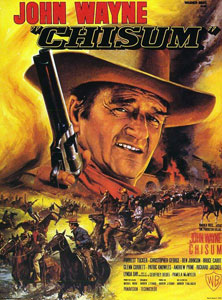
Chisum
By the late 1960s and into the 1970s, John Wayne's movies became more familiar, more safe. You know what though? There's a comfort in familiarity, and there's some genuinely good movies in the bunch. Today's review is one of those efforts, telling one of the more famous stories of the wild west that ranks up there with the gunfight at the O.K. Corral or the Battle of the Little Big Horn. That story? The Lincoln County War. That movie? 1970's Chisum.
It's 1878 in the New Mexico territory, and aging rancher John Chisum (Wayne) has carved an immense cattle ranch out of the wilderness, made it all into something to behold. He's preparing for his niece, Sallie (Pamela McMyler), to come and visit the ranch, but there's some serious issues to be dealt with. An equally powerful man with some serious financial backing, Lawrence Murphy (Forrest Tucker), has moved into Lincoln County and is looking to take over. Take over EVERYTHING. First up on his list? Buying the sheriff, the bank, and scooping up all the land he can and drive Chisum out as quick as he can. Chisum is well-rooted though, and nothing is going to come easy for the despicably vicious, greedy Murphy. There's a wild card in the entire situation though, a young, fiery gunfighter with a fast-growing reputation and a fast draw with his pistol, William Bonney (Geoffrey Deuel), better known as Billy the Kid.
I've loved John Wayne and his movies since I was a little kid. Hopefully, I always will! I hadn't seen this 1970 western from director Andrew McLaglen in years until a recent showing on Turner Classic Movies gave me the opportunity to revisit it. Am I glad I did! It is different, telling the mostly true story of the Lincoln County War with some artistic license thrown in here and there. A lot of familiar faces, filming locations in Durango, Mexico where other Wayne ventures (The War Wagon, Sons of Katie Elder, The Undefeated, The Train Robbers) were filmed, a memorable score from Dominic Frontiere, and cinematographer William Clothier bringing the Mexican locations to life, yeah, it IS familiar. That's not a bad thing. I loved catching up with the movie and liked it much more than I remember. There's just enough different here to keep things interesting. And let's face it, the story and recognizable historical characters are a great backdrop for that mostly true story.
Okay, one of the most famous stories of the wild west. What do we need? How about a movie star capable of leading the way? In 1970, Wayne was still at the top of his game. He had the tough guy hero part down to an art with decades of practice. That is most definitely a compliment. Wayne was always at home in the western, and that's the case here. His Chisum -- based on the real-life John Chisum -- becomes a figurehead of the west. Years before, Chisum moved west into New Mexico and carved out a cattle ranch out of the land. Now, he's learning to slowly, begrudgingly changing with the times to survive. A testament to Wayne here is that he's not on-screen a ton. Yes, he's the star, but the Hollywood legend is content to let other members of a solid ensemble step into the limelight. When he is in the limelight? It's Duke at his tough as nails best, playing straight man to a bunch of antics while also stealing the camera, especially in a late confrontation with Tucker's Murphy. Nothing flashy, just a western professional.
Part of the fun here is the familiar names and characters popping up. The Billy the Kid story has been told in the Young Guns movies, The Left-Handed Gun, Pat Garrett and Billy the Kid, The Outlaw and many more I'm probably forgetting. I liked the spin Deuel puts on young William Bonney, a brash kid trying to put a checkered past behind him. He may be too good with a gun to let it happen though. Deuel's scenes with Glenn Corbett's Pat Garrett are a highlight, especially knowing where these two men end up. Also look for peaceful, second-chance rancher John Tunstall (Patric Knowles), Alex McSween (Andrew Prine, with his wife Lynda Day George), corrupt Sheriff Brady (Bruce Cabot), and more than a few familiar faces in the background.
The cast is one of Chisum's best features. Tucker is a slimy, nasty, slithery villain, with both Christopher George and Richard Jaeckel as his brutal enforcers. Another Just Hit Play favorite, Ben Johnson is Pepper, Wayne's right-hand man, a mumbling cowboy who'd rather solve a problem with his gun than his words, a part similar to the one he played in both The Undefeated and The Train Robbers. You ready though for some other names? Take a deep breath with me. Also look for John Agar, Robert Donner, Ray Teal, Hank Worden, Pedro Armendariz Jr., Edward Faulkner, Christopher Mitchum and plenty of faces from the John Wayne stock company. Quite the cast. QUITE a group of tough guys, a McLaglen specialty.
About as good as a traditional western can get. There's good guys, dastardly bad guys, shootouts to be had, and set against the backdrop against one of the wild west's most famous/infamous incidents ever. Something really hit me with this most recent watch, and I came away more impressed than I'd been with previous viewings. Hopefully, you'll like it just as much!
Chisum (1970): *** 1/2 /****
It's 1878 in the New Mexico territory, and aging rancher John Chisum (Wayne) has carved an immense cattle ranch out of the wilderness, made it all into something to behold. He's preparing for his niece, Sallie (Pamela McMyler), to come and visit the ranch, but there's some serious issues to be dealt with. An equally powerful man with some serious financial backing, Lawrence Murphy (Forrest Tucker), has moved into Lincoln County and is looking to take over. Take over EVERYTHING. First up on his list? Buying the sheriff, the bank, and scooping up all the land he can and drive Chisum out as quick as he can. Chisum is well-rooted though, and nothing is going to come easy for the despicably vicious, greedy Murphy. There's a wild card in the entire situation though, a young, fiery gunfighter with a fast-growing reputation and a fast draw with his pistol, William Bonney (Geoffrey Deuel), better known as Billy the Kid.
I've loved John Wayne and his movies since I was a little kid. Hopefully, I always will! I hadn't seen this 1970 western from director Andrew McLaglen in years until a recent showing on Turner Classic Movies gave me the opportunity to revisit it. Am I glad I did! It is different, telling the mostly true story of the Lincoln County War with some artistic license thrown in here and there. A lot of familiar faces, filming locations in Durango, Mexico where other Wayne ventures (The War Wagon, Sons of Katie Elder, The Undefeated, The Train Robbers) were filmed, a memorable score from Dominic Frontiere, and cinematographer William Clothier bringing the Mexican locations to life, yeah, it IS familiar. That's not a bad thing. I loved catching up with the movie and liked it much more than I remember. There's just enough different here to keep things interesting. And let's face it, the story and recognizable historical characters are a great backdrop for that mostly true story.
Okay, one of the most famous stories of the wild west. What do we need? How about a movie star capable of leading the way? In 1970, Wayne was still at the top of his game. He had the tough guy hero part down to an art with decades of practice. That is most definitely a compliment. Wayne was always at home in the western, and that's the case here. His Chisum -- based on the real-life John Chisum -- becomes a figurehead of the west. Years before, Chisum moved west into New Mexico and carved out a cattle ranch out of the land. Now, he's learning to slowly, begrudgingly changing with the times to survive. A testament to Wayne here is that he's not on-screen a ton. Yes, he's the star, but the Hollywood legend is content to let other members of a solid ensemble step into the limelight. When he is in the limelight? It's Duke at his tough as nails best, playing straight man to a bunch of antics while also stealing the camera, especially in a late confrontation with Tucker's Murphy. Nothing flashy, just a western professional.
Part of the fun here is the familiar names and characters popping up. The Billy the Kid story has been told in the Young Guns movies, The Left-Handed Gun, Pat Garrett and Billy the Kid, The Outlaw and many more I'm probably forgetting. I liked the spin Deuel puts on young William Bonney, a brash kid trying to put a checkered past behind him. He may be too good with a gun to let it happen though. Deuel's scenes with Glenn Corbett's Pat Garrett are a highlight, especially knowing where these two men end up. Also look for peaceful, second-chance rancher John Tunstall (Patric Knowles), Alex McSween (Andrew Prine, with his wife Lynda Day George), corrupt Sheriff Brady (Bruce Cabot), and more than a few familiar faces in the background.
The cast is one of Chisum's best features. Tucker is a slimy, nasty, slithery villain, with both Christopher George and Richard Jaeckel as his brutal enforcers. Another Just Hit Play favorite, Ben Johnson is Pepper, Wayne's right-hand man, a mumbling cowboy who'd rather solve a problem with his gun than his words, a part similar to the one he played in both The Undefeated and The Train Robbers. You ready though for some other names? Take a deep breath with me. Also look for John Agar, Robert Donner, Ray Teal, Hank Worden, Pedro Armendariz Jr., Edward Faulkner, Christopher Mitchum and plenty of faces from the John Wayne stock company. Quite the cast. QUITE a group of tough guys, a McLaglen specialty.
About as good as a traditional western can get. There's good guys, dastardly bad guys, shootouts to be had, and set against the backdrop against one of the wild west's most famous/infamous incidents ever. Something really hit me with this most recent watch, and I came away more impressed than I'd been with previous viewings. Hopefully, you'll like it just as much!
Chisum (1970): *** 1/2 /****
Wednesday, March 11, 2015
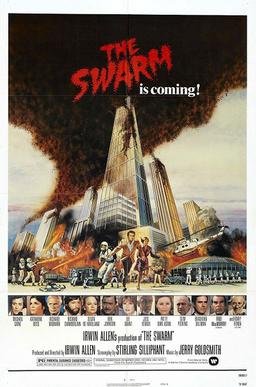
The Swarm
I'm not always the quickest learner so I'll take the blame for this one. I guess I should have learned quicker. While there are exceptions, there just weren't many good disaster movies in the 1970s and then into the 1980s. So for every Airport, Towering Inferno and Poseidon Adventure, there are movies like 1978's The Swarm. Yep, another nail in the coffin of a genre struggling to hold on for dear life.
At an isolated army installation in the American Southwest, a heavily armed patrol slowly navigates the eerily empty facility. What the hell happened here? Deep underground at the installation, the investigating patrol finds several dead bodies and a few lucky survivors, including a mysterious doctor, Brad Crane (Michael Caine), who says he's an expert on the world of insects. A much larger army force, commanded by crotchety General Slater (Richard Widmark), arrives soon after, and they're too stunned at what they find and what Crane claims is behind the mysterious attack. The responsibility goes to....an immense swarm of African killer bees. Bees!!!! Making the situation worse, there's no cure for the bees' surprisingly venomous sting and seemingly no one is immune. It looks like nothing can stop the not-so-fast moving bees, and they're heading for Houston.
Sometimes you DO just know. When this 1978 disaster flick from director Irwin Allen -- Master of Disaster flicks -- popped up on Turner Classic Movies' schedule, I had to set it to record. I HAD to. Movies with casts like this don't pop up too often so I had to at least give it a try. Worst case, it's just entertaining in a bad, guilty pleasure fashion, right? Well, that's what you would think. This wasn't even good in a 'So bad it's good' way. It just isn't entertaining. Apparently, I'm not the only one who thinks so. 'Swarm' is on all sorts of worst movies ever made lists and bombed in epic fashion in theaters back in 1978. If that's not a recipe for success, I don't know what is!
Maybe the most frightening thing to take away from this bee-disaster flick is that there's a director's cut available out there clocking in at 156 minutes. The TCM version I saw was an already painfully long 116 minutes. God knows what else could be expanded on in an additional 40 minutes because I was losing interest in the shortened version at the 60-minute mark. For goodness sake, 'Swarm' utilizes a love triangle featuring Olivia de Havilland, Ben Johnson and Fred MacMurray (in his last role) as a subplot! Yes, because that's what we need, three Hollywood legends in a senior citizen love triangle in a disaster flick where a swarm of killer bees are the villains. Seems reasonable, don't it? I can't say I'd be too interested in seeking out that longer version of a dud like this.
Star Michael Caine has said this is the worst movie he ever made, and it's hard to disagree. As the insect/bug specialist, Caine looks to be immensely bored throughout. If there's a slightly redeeming quality in 'Swarm,' it's that the cast is epically impressive. Now are any of them given much of anything to do? That would be a big N-O, but still, look at all those Hollywood stars! Along with Caine and perpetually angry Widmark, look for Katharine Ross, Henry Fonda and Richard Chamberlain as some of the scientists tasked with halting the advance of the bees. Also look for Lee Grant, Jose Ferrer, Patty Duke, Bradford Dillman, Slim Pickens, and Cameron Mitchell in other supporting parts, some more painfully forced than others.
Things unfortunately develop in more spoof-fashion than straight disaster flick. How many slow motion bee attack scenes can we witness before it just becomes laughable? Because the movie is about bees, we get one hilarious scene after another about our very talented cast discussing what the bees' intentions are, if they're seeking revenge, if there is a major bee plan to take over the world. It's all done so straight that it becomes spoof-like, and that's never a good thing. The problem is there just isn't that one reason to sit back and watch this one, and that's considering the star power on hand. The cast is given little to nothing to do, the killer bees are a laughable "villain," and the entertainment value just isn't there. Give this one a wide berth.
The Swarm (1978): */****
At an isolated army installation in the American Southwest, a heavily armed patrol slowly navigates the eerily empty facility. What the hell happened here? Deep underground at the installation, the investigating patrol finds several dead bodies and a few lucky survivors, including a mysterious doctor, Brad Crane (Michael Caine), who says he's an expert on the world of insects. A much larger army force, commanded by crotchety General Slater (Richard Widmark), arrives soon after, and they're too stunned at what they find and what Crane claims is behind the mysterious attack. The responsibility goes to....an immense swarm of African killer bees. Bees!!!! Making the situation worse, there's no cure for the bees' surprisingly venomous sting and seemingly no one is immune. It looks like nothing can stop the not-so-fast moving bees, and they're heading for Houston.
Sometimes you DO just know. When this 1978 disaster flick from director Irwin Allen -- Master of Disaster flicks -- popped up on Turner Classic Movies' schedule, I had to set it to record. I HAD to. Movies with casts like this don't pop up too often so I had to at least give it a try. Worst case, it's just entertaining in a bad, guilty pleasure fashion, right? Well, that's what you would think. This wasn't even good in a 'So bad it's good' way. It just isn't entertaining. Apparently, I'm not the only one who thinks so. 'Swarm' is on all sorts of worst movies ever made lists and bombed in epic fashion in theaters back in 1978. If that's not a recipe for success, I don't know what is!
Maybe the most frightening thing to take away from this bee-disaster flick is that there's a director's cut available out there clocking in at 156 minutes. The TCM version I saw was an already painfully long 116 minutes. God knows what else could be expanded on in an additional 40 minutes because I was losing interest in the shortened version at the 60-minute mark. For goodness sake, 'Swarm' utilizes a love triangle featuring Olivia de Havilland, Ben Johnson and Fred MacMurray (in his last role) as a subplot! Yes, because that's what we need, three Hollywood legends in a senior citizen love triangle in a disaster flick where a swarm of killer bees are the villains. Seems reasonable, don't it? I can't say I'd be too interested in seeking out that longer version of a dud like this.
Star Michael Caine has said this is the worst movie he ever made, and it's hard to disagree. As the insect/bug specialist, Caine looks to be immensely bored throughout. If there's a slightly redeeming quality in 'Swarm,' it's that the cast is epically impressive. Now are any of them given much of anything to do? That would be a big N-O, but still, look at all those Hollywood stars! Along with Caine and perpetually angry Widmark, look for Katharine Ross, Henry Fonda and Richard Chamberlain as some of the scientists tasked with halting the advance of the bees. Also look for Lee Grant, Jose Ferrer, Patty Duke, Bradford Dillman, Slim Pickens, and Cameron Mitchell in other supporting parts, some more painfully forced than others.
Things unfortunately develop in more spoof-fashion than straight disaster flick. How many slow motion bee attack scenes can we witness before it just becomes laughable? Because the movie is about bees, we get one hilarious scene after another about our very talented cast discussing what the bees' intentions are, if they're seeking revenge, if there is a major bee plan to take over the world. It's all done so straight that it becomes spoof-like, and that's never a good thing. The problem is there just isn't that one reason to sit back and watch this one, and that's considering the star power on hand. The cast is given little to nothing to do, the killer bees are a laughable "villain," and the entertainment value just isn't there. Give this one a wide berth.
The Swarm (1978): */****
Saturday, April 26, 2014
The Undefeated
Considering the extreme and far-reaching effects the Civil War had on American history, it's odd there haven't been more movies about the most costly war in the United States' relatively young history. The western genre has done its fair share of quasi-Civil War movies, the war becoming a jumping off point for a shoot 'em up story. What to do once the war is over? Like Major Dundee and Vera Cruz, many went south into Mexico. We can add 1969's The Undefeated to that short list.
After four years of bloody fighting, the Civil War has come to a close, leaving both the North and South to figure out where to go forward. With some of his remaining soldiers, a former Union cavalry officer, Colonel John Henry Thomas (John Wayne), rounds up a herd of 3,000 wild horses with the intention of driving them south into Mexico where they'll sell them to Emperor Maximilian's forces. A former Confederate officer, Colonel James Langdon (Rock Hudson), who had outfitted his own regiment, is leaving his plantation behind, moving south to Mexico with his surviving men, along with their wives, children and family in hoping to start a new life. In turbulent times for both the U.S. and Mexico, these two groups' paths may cross, and with wounds from the war still fresh on both sides.
This portion of history has always fascinated me, especially in movies like this, Major Dundee and Vera Cruz. I grew up watching this John Wayne western, and in spite of its flaws, I've always been a fan. From frequent Wayne collaborator and director Andrew V. McLaglen, 'Undefeated' is a fun western with a very good, deep cast, authentic locations in and around Durango, Mexico (Dundee fans will appreciate some familiar spots), a memorable score from composer Hugo Montenegro (listen HERE, disregard the odd video choice), and in general an entertaining quality that lifts it up past the flaws. It plays like a lot of Wayne's later movies; easy to sit back and watch, some action and shootouts, some drama, some romance, and some laughs here and there. When westerns were changing so dramatically in the late 1960s and heading into the 1970s, it can be fun just to watch an old-fashioned western with good guys and bad guys. No more, no less.
In a pretty cool casting choice, Wayne goes toe to toe here with Rock Hudson. It's not the most obvious pairing, but it works, simple as that. Wayne is playing a variation on his archetypal cowboy part, the leader of a small, surviving group of volunteers that rode with him throughout the Civil War. Now, he's looking for some cash to start over with, hence the immense horse drive. Hudson's Langdon too is looking for a clean start, the horrors and severe losses of the war still fresh on his mind. They're two different men, but they also have many similarities. They're fighting men who stand by what's right, loyal to those who ride with them, and ultimately try to do what they should do, not what's easiest. Their scenes together are the high points of the story, an easygoing charm with just a little Union vs. Confederacy animosity lingering. Two parts I liked a lot.
Working with a big story and a whole lot of characters, there's a lot going on in 'Undefeated,' clocking in at 119 minutes. Both halves -- Union and Confederacy -- are interesting, but I liked Wayne's half more. His trail-worn, loyal riders include Ben Johnson as Short Grub, his right hand man, Harry Carey Jr., John Agar (his part was heavily cut, including his early death scene), Don Collier (a familiar face, often a stunt man in Wayne movies), Jerry Gatlin and Dub Taylor as McCartney, the cantankerous cook who's always looking to fight, a mangy cat, High Bred, at his side. NFL quarterback Roman Gabriel joins the cast too as Blue Boy, Thomas' adopted Cherokee son. With so many western regulars, there's an ease to these scenes that are just fun to watch. Also look briefly for small parts for Paul Fix, Royal Dano and Pedro Armendariz Jr.
With the kinda-sorta episodic story that amiably drifts along, half of the focus is on those Confederates. It's never boring, but it's also not as interesting as their Union counterparts. We meet Langdon's wife (Lee Meriwether), his buxom teenage daughter, Charlotte (Melissa Newman), and his widowed sister-in-law (Marian McCargo). His men include Bruce Cabot, NFL star Merlin Olsen, Jan-Michael Vincent, Robert Donner, Edward Faulkner and whiny Big John Hamilton. We get to see young, pretty Charlotte hold off Jan-Michael Vincent's Bubba Wilkes' advances (she like Blue Boy). We get to see worrying wife Lee Meriwether....well, look worried. Olsen's Little George hangs out with the kids, then fights the Union cavalry. There's plenty of familiar faces, some good parts, but it's simply not as interesting to watch. Not bad, just not as good as it could have been.
Certain portions of the episodic story drag, but some certainly stand out. The pre-credits sequence wraps up the Civil War in a quick Union attack on a Confederate position. Later, Wayne and Hudson must team up to hold off a bandit attack on the Confederate wagon train, a good, exciting sequence. My favorite though is a late battle between the Union riders and French cavalry, the horse herd used as a weapon and negotiating ploy with a Mexican officer (Tony Aguilar). I'm wavering here. It's not a great western -- maybe not even a good one -- but I'm always entertained watching it. John Wayne fans, western fans alike should like this one.
The Undefeated (1969): ***/****
After four years of bloody fighting, the Civil War has come to a close, leaving both the North and South to figure out where to go forward. With some of his remaining soldiers, a former Union cavalry officer, Colonel John Henry Thomas (John Wayne), rounds up a herd of 3,000 wild horses with the intention of driving them south into Mexico where they'll sell them to Emperor Maximilian's forces. A former Confederate officer, Colonel James Langdon (Rock Hudson), who had outfitted his own regiment, is leaving his plantation behind, moving south to Mexico with his surviving men, along with their wives, children and family in hoping to start a new life. In turbulent times for both the U.S. and Mexico, these two groups' paths may cross, and with wounds from the war still fresh on both sides.
This portion of history has always fascinated me, especially in movies like this, Major Dundee and Vera Cruz. I grew up watching this John Wayne western, and in spite of its flaws, I've always been a fan. From frequent Wayne collaborator and director Andrew V. McLaglen, 'Undefeated' is a fun western with a very good, deep cast, authentic locations in and around Durango, Mexico (Dundee fans will appreciate some familiar spots), a memorable score from composer Hugo Montenegro (listen HERE, disregard the odd video choice), and in general an entertaining quality that lifts it up past the flaws. It plays like a lot of Wayne's later movies; easy to sit back and watch, some action and shootouts, some drama, some romance, and some laughs here and there. When westerns were changing so dramatically in the late 1960s and heading into the 1970s, it can be fun just to watch an old-fashioned western with good guys and bad guys. No more, no less.
In a pretty cool casting choice, Wayne goes toe to toe here with Rock Hudson. It's not the most obvious pairing, but it works, simple as that. Wayne is playing a variation on his archetypal cowboy part, the leader of a small, surviving group of volunteers that rode with him throughout the Civil War. Now, he's looking for some cash to start over with, hence the immense horse drive. Hudson's Langdon too is looking for a clean start, the horrors and severe losses of the war still fresh on his mind. They're two different men, but they also have many similarities. They're fighting men who stand by what's right, loyal to those who ride with them, and ultimately try to do what they should do, not what's easiest. Their scenes together are the high points of the story, an easygoing charm with just a little Union vs. Confederacy animosity lingering. Two parts I liked a lot.
Working with a big story and a whole lot of characters, there's a lot going on in 'Undefeated,' clocking in at 119 minutes. Both halves -- Union and Confederacy -- are interesting, but I liked Wayne's half more. His trail-worn, loyal riders include Ben Johnson as Short Grub, his right hand man, Harry Carey Jr., John Agar (his part was heavily cut, including his early death scene), Don Collier (a familiar face, often a stunt man in Wayne movies), Jerry Gatlin and Dub Taylor as McCartney, the cantankerous cook who's always looking to fight, a mangy cat, High Bred, at his side. NFL quarterback Roman Gabriel joins the cast too as Blue Boy, Thomas' adopted Cherokee son. With so many western regulars, there's an ease to these scenes that are just fun to watch. Also look briefly for small parts for Paul Fix, Royal Dano and Pedro Armendariz Jr.
With the kinda-sorta episodic story that amiably drifts along, half of the focus is on those Confederates. It's never boring, but it's also not as interesting as their Union counterparts. We meet Langdon's wife (Lee Meriwether), his buxom teenage daughter, Charlotte (Melissa Newman), and his widowed sister-in-law (Marian McCargo). His men include Bruce Cabot, NFL star Merlin Olsen, Jan-Michael Vincent, Robert Donner, Edward Faulkner and whiny Big John Hamilton. We get to see young, pretty Charlotte hold off Jan-Michael Vincent's Bubba Wilkes' advances (she like Blue Boy). We get to see worrying wife Lee Meriwether....well, look worried. Olsen's Little George hangs out with the kids, then fights the Union cavalry. There's plenty of familiar faces, some good parts, but it's simply not as interesting to watch. Not bad, just not as good as it could have been.
Certain portions of the episodic story drag, but some certainly stand out. The pre-credits sequence wraps up the Civil War in a quick Union attack on a Confederate position. Later, Wayne and Hudson must team up to hold off a bandit attack on the Confederate wagon train, a good, exciting sequence. My favorite though is a late battle between the Union riders and French cavalry, the horse herd used as a weapon and negotiating ploy with a Mexican officer (Tony Aguilar). I'm wavering here. It's not a great western -- maybe not even a good one -- but I'm always entertained watching it. John Wayne fans, western fans alike should like this one.
The Undefeated (1969): ***/****
Tuesday, March 4, 2014
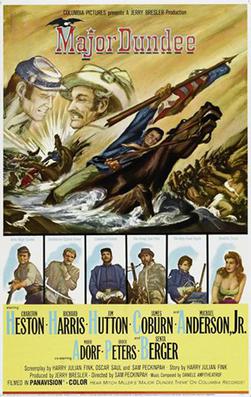
Major Dundee
It's late in 1864, the Civil War raging back east, but in the New Mexico territory, an Apache war party led by Sierra Charriba (Michael Pate), massacres a troop of U.S. cavalry, kidnapping three boys from a local ranch at the same time. The commander of a nearby Confederate prison camp, Major Amos Dundee (Charlton Heston) decides to go after the Apaches, rescuing the kids and bringing Charriba to justice. Without abandoning the camp though, he must assemble a ragtag group of Confederate prisoners, black infantry, inexperienced officers, cowboys, drunks, bandits and thieves to capture the Apaches. At his right hand is a Confederate officer and friend from the past but now a sworn enemy, Capt. Benjamin Tyreen (Richard Harris). Dundee's company of irregular cavalry hits the trail, following the Apache war party into Mexico, tangling with occupying French forces as well. The Apaches and the French are just two enemies though, the Union and Confederate loyalties among the company threatening to tear Dundee's command apart from the inside.
The production history of this Peckinpah western has quite the checkered past. The production in Mexico went way over budget and way over schedule. Depending on what you read, Peckinpah's original cut for 'Dundee' was anywhere between three and four hours long. When the studio took it away from him, it was cut down to just over two hours. A DVD released in 2005 had a new, never before seen version with almost 15 additional minutes added to the running time. Some additional footage was found that was unable to be reinserted back into the film, but as is, we'll probably never know/see Peckinpah's intended version. So what's the end result with the 136-minute version? A far better western than the 123-minute version that features some good performances, a ridiculously deep cast, some ahead of its time vicious action, and a story that drifts needlessly at times.
What was Peckinpah's goal? He wanted to make an epic western, a new western in the vein of the John Ford cavalry movies. It was supposed to be big and violent full of scope and vision. 'Dundee' doesn't quite live up to that, but in terms of pure entertainment, it's hard to beat. It starts with Charlton Heston in the titular role. Like Peckinpah's best movies, Dundee is the flawed anti-hero like nobody's business. The story almost becomes Moby Dick in the Civil War west. Dundee has been posted to this isolated prison camp because of a command decision he made at Gettysburg (hinted at, never spelled out), and he intends to right that wrong. His plan? Get the kids back, take out Sierra Charriba, become a hero again. The problem? Dundee may not be cut out for command. He's equal parts brilliant strategist with overreaching egoist. His pride and ego get in the way of things, the mission into Mexico becoming an obsession. Quite the performance, one that doesn't always get the notoriety it deserves in Heston's already impressive filmography.
One of Peckinpah's favorite storytelling devices was the anti-hero and his right hand man, sometimes a former friend turned unwilling ally, a device used to its best ability four years later in The Wild Bunch. Here, that relationship is between Heston's Dundee and Richard Harris' Capt. Ben Tyreen. Again, their checkered history (friendship turned bitter rivalry, even hatred) all leads up to this, two men forced to work together. Harris is one of my favorite actors, and this is my favorite performance of many, one of my all-time favorite characters in any film. Harris' Tyreen is everything Dundee wants to be; intelligent, charming, a good leader, and well liked and respected by his men. Tyreen has one great line after another, Harris bringing this character to life, a Irish immigrant turned cashiered American officer to Confederate renegade. The dynamic between Dundee and Tyreen provides some of the movie's best dialogue scenes, the confrontations crackling with energy. Kudos to both actors for developing that chemistry to its fullest.
Brace yourself though. This movie has one sick cast of tough guy actors, many from the Peckinpah stock character Hall of Fame. Jim Hutton provides some laughs as Lt. Graham, a bumbling artillery officer assigned to the cavalry. James Coburn is a scene-stealer as Samuel Potts, Dundee's one-armed, bearded, quick-witted scout, as is Mario Adorf as the feisty, loyal Sgt. Gomez, Dundee's most capable Union soldier. Michael Anderson Jr. does a fine job too as Trooper Ryan, Dundee's young bugler, providing the narration from his in-mission journal. There's also Brock Peters as Aesop, the leader of the small contingent of black infantry, Slim Pickens as Wiley, the drunken mule-packer, R.G. Armstrong as Reverend Dahlstrom, the shotgun-wielding preacher, and Dub Taylor as Priam, the disheveled horse thief. As for Tyreen's Confederates, there's Ben Johnson as the tough Sgt. Chillum, L.Q. Jones and Warren Oates as Arthur and O.W. Hadley, and John Davis Chandler as Jimmy Lee, the troublemaker. Also look for Karl Swenson as Dundee's second-in-command at the prison camp. Just a ridiculously deep cast full of great characters.
Where the movie struggles some -- but is also damn entertaining in those struggles -- is the final 40 minutes. The story does drift too much from the Apaches to the French to Dundee's lost weekend in Durango and a brief love affair with Senta Berger's Teresa. Trooper Ryan's narration gets choppy, weeks slipping by in a flash. The saving grace is back-to-back action sequences, one a showdown with the Apaches in a box canyon, the other a bloody, violent battle with French lancers in the Rio Grande. This is Peckinpah at his action best, clearly an indicator of where his movies would go, especially with The Wild Bunch. Watch the scene with the French and see how brutal it is, how graphic it could have been if censors allowed it. Characters are unceremoniously killed off (blink and you'll miss it), including one surprising death, but it's just a great action scene leading to a quick ending.
Most Peckinpah fans don't list this as their favorite, maybe not even one of their favorites. I just really like this movie, always have, and the longer version with the additional 15 minutes or so really does help make it better. The musical score from composer Daniele Amfitheatrof takes some heat, especially the Major Dundee theme (listen HERE), but I like it, almost as a guilty pleasure. Filming on location in Mexico, including stops in Durango, a gorgeous waterfall location at El Saltito, and many more, all add to that authentic flavor. You really feel like you're on an odyssey across Mexico, seeing a variety of spots, locations and cities. One of my favorite westerns, a heavily flawed but just a damn entertaining movie in the end. Hard to beat, even if we'll never see that epic 4-hour version Peckinpah intended.
Major Dundee (1965): ****/****
Rewrite of August 2009 review
Friday, December 7, 2012
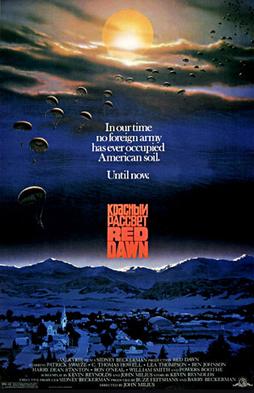
Red Dawn (1984)
Just about any movie can -- and most likely will -- be remade at some point. After a debacle of a free screening of the new Red Dawn movie (I missed it, didn't get there early enough), I consoled myself with the original, a 1980s classic that is still as good as ever. Guilty pleasure? Eh, maybe, I maintain it's just a good movie. Enter 1984's Red Dawn.
It's an October day like any other in the town of Calumet, Colorado. As classes start at the local high school though, parachutes appear in the sky, hundreds of them. What exactly is going on? It's Russian and Cuban paratroopers dropping in as an advance element of the invasion of the U.S. The school and town gets shot up in the process with many casualties, but a group of teenagers including Jed (Patrick Swayze), a former jock working with his Dad, and his younger brother, Matt (Charlie Sheen), manage to escape the town and head for the Rockies where they'll be relatively safe. A month goes by though as they hide, and then the news hits. The invasion was a success -- to a point -- but the fighting has now gone stagnant. Well behind Russian/enemy lines, Jed, Matt and their friends decide to take the attack to their invaders, becoming a partisan group of resistance fighters.
From tough guy writer/director John Milius, 'Dawn' is definitely a product of the times, but in good ways. With the Cold War still very much alive between the U.S. and Russia, this potential invasion story hits home. People had wondered and questioned for years if this was where the conflict was heading. In the years since, 'Dawn' has gained a reputation as a so bad it's good movie, even a guilty pleasure. Yes, I suppose it qualifies, but I tend to disagree. The acting is over the top at times, the ultra-patriotism evident everywhere, and some scenes do produce some unintentional laughs, but I maintain this is just a good movie. If it is a little heavy-handed at times, so be it. It is entertaining as hell from the start, and that doesn't change by the end.
The screenplay from Milius and Kevin Reynolds wastes no time setting the stage. Less than two minutes into the movie, parachutes are descending on Colorado, sending Calumet into chaos. People are running for their lives as paratroopers start shooting anything that moves. Talk about a tone-setter. As an opening, it's hard to beat. 'Dawn' has its fair share of memorable moments, probably most famously the teenagers yelling 'Wolverines!' after successful attacks on invading forces (Wolverines was the school mascot). Aided by Basil Poledouris' score, the action scenes -- of which there are plenty -- and dramatic scenes are balanced out perfectly. Listen to the main theme HERE. The film was shot on location in New Mexico in the mountains, giving it a hard-edged look that benefits the ever-darkening story as well.
It is an 80s movie, and the cast certainly reflects that. I have a theory about Swayze in 1980s movies. He's in every great movie from the decade. If you can't find him, you're not looking hard enough. A 32-year old playing a recent high school graduate? Right. But who cares?!? It's Patrick Swayze, and he's ridiculously cool! Along with Sheen, the Wolverines include Lea Thompson, C. Thomas Howell, Jennifer Grey, Darren Dalton, Brad Savage and Doug Toby. Swayze and Sheen as brothers stand out, as does Howell as Robert, the Wolverine so bent on revenge for his parent's death he becomes a hardened killer. Also look for Powers Boothe as Col. Andy Tanner, a downed fighter pilot who fights with the Wolveines, in a scene-stealing part. In smaller parts, old pros Ben Johnson and Harry Dean Stanton (as Jed and Matt's imprisoned Dad) certainly make positive impressions too.
On repeated viewings, I've come to like this movie more and more. I think you can chalk that up to the darkness of the story. Yes, there's a fair share of fantasy here; school kids getting guns and taking on invading forces, becoming heroes in the process. But actually considering the story, it's incredibly dark. Case in point? The Wolverines start getting picked off one-by-one. The Russian invaders call in a specialist, a hunter, Strelnikov (William Smith), to brutally hunt them down, using any tactics he has at his disposal. We see the war from basically the opposite side of how the U.S. has fought in any conflict. We're being attacked. We're defending. When the Wolverines kill Russians, Americans are killed in retaliation, but on we fight. In a sympathetic part, Ron O'Neal plays Colonel Bella, a former revolutionary now fighting from the opposite perspective, an officer trying to quell an uprising.
This darkness comes through in the final 45 minutes, building to a surprising but highly effective ending. I love Swayze and Sheen's conversations they have in between fights. Swayze's Jed puts it best as these two friends/brothers plan their line of attack, knowing their odds are slim. He states "It's not easy being brothers, huh?" Shakespeare? No, but it works. As the Russians turns the tables on the Wolverines, that is 'Dawn' at its best. I love the ending as well, Jed and Matt taking the attack to the Russian base. It's a great ending, and not surprisingly, a patriotic one. Heavy-handed guilty pleasure? Maybe, but I think it's just a really good movie.
Red Dawn (1984): *** 1/2 /****
It's an October day like any other in the town of Calumet, Colorado. As classes start at the local high school though, parachutes appear in the sky, hundreds of them. What exactly is going on? It's Russian and Cuban paratroopers dropping in as an advance element of the invasion of the U.S. The school and town gets shot up in the process with many casualties, but a group of teenagers including Jed (Patrick Swayze), a former jock working with his Dad, and his younger brother, Matt (Charlie Sheen), manage to escape the town and head for the Rockies where they'll be relatively safe. A month goes by though as they hide, and then the news hits. The invasion was a success -- to a point -- but the fighting has now gone stagnant. Well behind Russian/enemy lines, Jed, Matt and their friends decide to take the attack to their invaders, becoming a partisan group of resistance fighters.
From tough guy writer/director John Milius, 'Dawn' is definitely a product of the times, but in good ways. With the Cold War still very much alive between the U.S. and Russia, this potential invasion story hits home. People had wondered and questioned for years if this was where the conflict was heading. In the years since, 'Dawn' has gained a reputation as a so bad it's good movie, even a guilty pleasure. Yes, I suppose it qualifies, but I tend to disagree. The acting is over the top at times, the ultra-patriotism evident everywhere, and some scenes do produce some unintentional laughs, but I maintain this is just a good movie. If it is a little heavy-handed at times, so be it. It is entertaining as hell from the start, and that doesn't change by the end.
The screenplay from Milius and Kevin Reynolds wastes no time setting the stage. Less than two minutes into the movie, parachutes are descending on Colorado, sending Calumet into chaos. People are running for their lives as paratroopers start shooting anything that moves. Talk about a tone-setter. As an opening, it's hard to beat. 'Dawn' has its fair share of memorable moments, probably most famously the teenagers yelling 'Wolverines!' after successful attacks on invading forces (Wolverines was the school mascot). Aided by Basil Poledouris' score, the action scenes -- of which there are plenty -- and dramatic scenes are balanced out perfectly. Listen to the main theme HERE. The film was shot on location in New Mexico in the mountains, giving it a hard-edged look that benefits the ever-darkening story as well.
It is an 80s movie, and the cast certainly reflects that. I have a theory about Swayze in 1980s movies. He's in every great movie from the decade. If you can't find him, you're not looking hard enough. A 32-year old playing a recent high school graduate? Right. But who cares?!? It's Patrick Swayze, and he's ridiculously cool! Along with Sheen, the Wolverines include Lea Thompson, C. Thomas Howell, Jennifer Grey, Darren Dalton, Brad Savage and Doug Toby. Swayze and Sheen as brothers stand out, as does Howell as Robert, the Wolverine so bent on revenge for his parent's death he becomes a hardened killer. Also look for Powers Boothe as Col. Andy Tanner, a downed fighter pilot who fights with the Wolveines, in a scene-stealing part. In smaller parts, old pros Ben Johnson and Harry Dean Stanton (as Jed and Matt's imprisoned Dad) certainly make positive impressions too.
On repeated viewings, I've come to like this movie more and more. I think you can chalk that up to the darkness of the story. Yes, there's a fair share of fantasy here; school kids getting guns and taking on invading forces, becoming heroes in the process. But actually considering the story, it's incredibly dark. Case in point? The Wolverines start getting picked off one-by-one. The Russian invaders call in a specialist, a hunter, Strelnikov (William Smith), to brutally hunt them down, using any tactics he has at his disposal. We see the war from basically the opposite side of how the U.S. has fought in any conflict. We're being attacked. We're defending. When the Wolverines kill Russians, Americans are killed in retaliation, but on we fight. In a sympathetic part, Ron O'Neal plays Colonel Bella, a former revolutionary now fighting from the opposite perspective, an officer trying to quell an uprising.
This darkness comes through in the final 45 minutes, building to a surprising but highly effective ending. I love Swayze and Sheen's conversations they have in between fights. Swayze's Jed puts it best as these two friends/brothers plan their line of attack, knowing their odds are slim. He states "It's not easy being brothers, huh?" Shakespeare? No, but it works. As the Russians turns the tables on the Wolverines, that is 'Dawn' at its best. I love the ending as well, Jed and Matt taking the attack to the Russian base. It's a great ending, and not surprisingly, a patriotic one. Heavy-handed guilty pleasure? Maybe, but I think it's just a really good movie.
Red Dawn (1984): *** 1/2 /****
Friday, March 16, 2012
The Town That Dreaded Sundown
With TV shows like Law and Order, CSI, and their countless spinoffs and knock-offs, it seems impossible for a criminal to get away with anything. Of course, these shows are in a more modern age with all sorts of technology available to law enforcement officials and plenty of forensic evidence. It wasn't always that way though, police having to go through mind-numbing minutiae to get the crook, like the semi-true story presented in 1976's The Town That Dreaded Sundown.
It's early 1946 in the city of Texarkana along the border between Texas and Arkansas. The people and the town are recovering from recently-ended WWII, life seemingly going back to normal. But one February night, a young man and woman are brutally attacked by a hooded stranger, both surviving the vicious assault. Local police, including Deputy Sheriff Norman Ramsey (Andrew Prine), investigate but find nothing as to the attacker's identity. Three weeks later another attack occurs, but now the victims are murdered, and three weeks later the same thing happens. A respected Texas Ranger, Capt. J.D. Morales (Ben Johnson), is called in and with Ramsey's help and the whole police department try to catch the killer, dubbed The Phantom. Can they catch him before he kills anymore?
Based on the true story of the Texarkana Killer -- the Phantom Killer -- this B-movie is an oddity among police movies. It has the feel of a docu-drama, narration providing much of the background as the Phantom appears and starts to knock off victims. Instead of a stylish production of an investigation of a murder mystery, we are more so the fly on the wall watching it develop. Even with a small budget, the period quality is there of a mid-sized 1940s town completely taken aback by the stunning appearance of a serial killer in their midst. The story sticks pretty close to the truth of the facts of the case so points have to be awarded for not embellishing those facts. Police procedurals never go out of style -- in film or on television -- and even though this is far from a classic, any fans of cop shows/movies should get some enjoyment out of it.
With a cast of relative unknowns and actual Texarkana residents, 'Sundown' relies on two veterans to carry the load, Ben Johnson and Andrew Prine. One of my favorite actors, Johnson's role is similar to the one he played three years earlier in 1973's Dillinger as Melvin Purvis, the FBI agent tasked with bringing infamous bank robber John Dillinger to justice. He growls, looks tough, smokes his cigars and worries that they'll never catch the killer. Nothing flashy and far from his best performance, but without Johnson, the movie just limps to the finish. Prine too isn't doing anything new or unique, the local cop working with the out-of-towner to help protect his town. In their few scenes together, Johnson and Prine do have a good chemistry, easy-going in a way, two experienced law enforcement officials working with little in the way of leads or evidence.
The appearance of the Phantom is interesting because as a movie it isn't quite a crime story but it also isn't a horror movie. It's surprising, especially considering the hood worn by the Phantom clearly influenced horror movies in the 1980s. More surprising? The "attack" scenes are unintentionally funny. Yes, his sudden appearances of a masked head popping up in a car or house window is startling. Things quickly go downhill from there. The male victims are clueless, basically rolling over and accepting their beating and/or death. The female victims don't run for their lives. They sit still, paralyzed in fear and scream instead. The attacks are telegraphed with a really obvious musical score....slow and sinister and then BAM! ATTACK MUSIC! It is amusing how much this real-life serial killer influenced horror/slasher films. The Phantom favors slutty teenagers at first, and if slasher movies have taught us anything, it's that minorities and slutty girls always go first. Look for Dawn Wells -- Mary Ann from Gilligan's Island -- as one of the victims.
A story focusing on a series of brutal murders done by a serial killer named the Phantom is pretty dramatic stuff, right? I thought so. Director Charles B. Pierce apparently disagrees. He directs and co-stars as Sparkplug, a deputy assigned to serve as Morales' personal driver. But guess what? He's a kooky driver, always screwing up and getting Morales and Ramsey into unwanted trouble. Oh, hilarious! Did Pierce think his dark story needed an injection of humor? Did he think his serial killer story was too dark? No problem, let's liven it up with some really hammy, forced humor! The scenes are painful to watch and completely disrupt what little tone the movie had.
The beauty of Law and Order and CSI is that for the most part, the bad guys are always caught in an hour or less. With this true story, there is no resolution. I'm glad the script didn't call for a fictionalized "capture" of the Phantom, but in getting to that point, 'Sundown' has little energy. The movie even at 86 minutes drifts along in between the attacks, not sure where it wants to do. The ending -- a meeting and chase between the Phantom, Morales and Ramsey -- is exciting, but it's a case of too little, too late. Interesting movie, but not necessarily a good one. You can watch the entire movie HERE at Youtube in a choppy, pan-n-scan cut.
The Town That Dreaded Sundown <---trailer (1976): **/****
It's early 1946 in the city of Texarkana along the border between Texas and Arkansas. The people and the town are recovering from recently-ended WWII, life seemingly going back to normal. But one February night, a young man and woman are brutally attacked by a hooded stranger, both surviving the vicious assault. Local police, including Deputy Sheriff Norman Ramsey (Andrew Prine), investigate but find nothing as to the attacker's identity. Three weeks later another attack occurs, but now the victims are murdered, and three weeks later the same thing happens. A respected Texas Ranger, Capt. J.D. Morales (Ben Johnson), is called in and with Ramsey's help and the whole police department try to catch the killer, dubbed The Phantom. Can they catch him before he kills anymore?
Based on the true story of the Texarkana Killer -- the Phantom Killer -- this B-movie is an oddity among police movies. It has the feel of a docu-drama, narration providing much of the background as the Phantom appears and starts to knock off victims. Instead of a stylish production of an investigation of a murder mystery, we are more so the fly on the wall watching it develop. Even with a small budget, the period quality is there of a mid-sized 1940s town completely taken aback by the stunning appearance of a serial killer in their midst. The story sticks pretty close to the truth of the facts of the case so points have to be awarded for not embellishing those facts. Police procedurals never go out of style -- in film or on television -- and even though this is far from a classic, any fans of cop shows/movies should get some enjoyment out of it.
With a cast of relative unknowns and actual Texarkana residents, 'Sundown' relies on two veterans to carry the load, Ben Johnson and Andrew Prine. One of my favorite actors, Johnson's role is similar to the one he played three years earlier in 1973's Dillinger as Melvin Purvis, the FBI agent tasked with bringing infamous bank robber John Dillinger to justice. He growls, looks tough, smokes his cigars and worries that they'll never catch the killer. Nothing flashy and far from his best performance, but without Johnson, the movie just limps to the finish. Prine too isn't doing anything new or unique, the local cop working with the out-of-towner to help protect his town. In their few scenes together, Johnson and Prine do have a good chemistry, easy-going in a way, two experienced law enforcement officials working with little in the way of leads or evidence.
The appearance of the Phantom is interesting because as a movie it isn't quite a crime story but it also isn't a horror movie. It's surprising, especially considering the hood worn by the Phantom clearly influenced horror movies in the 1980s. More surprising? The "attack" scenes are unintentionally funny. Yes, his sudden appearances of a masked head popping up in a car or house window is startling. Things quickly go downhill from there. The male victims are clueless, basically rolling over and accepting their beating and/or death. The female victims don't run for their lives. They sit still, paralyzed in fear and scream instead. The attacks are telegraphed with a really obvious musical score....slow and sinister and then BAM! ATTACK MUSIC! It is amusing how much this real-life serial killer influenced horror/slasher films. The Phantom favors slutty teenagers at first, and if slasher movies have taught us anything, it's that minorities and slutty girls always go first. Look for Dawn Wells -- Mary Ann from Gilligan's Island -- as one of the victims.
A story focusing on a series of brutal murders done by a serial killer named the Phantom is pretty dramatic stuff, right? I thought so. Director Charles B. Pierce apparently disagrees. He directs and co-stars as Sparkplug, a deputy assigned to serve as Morales' personal driver. But guess what? He's a kooky driver, always screwing up and getting Morales and Ramsey into unwanted trouble. Oh, hilarious! Did Pierce think his dark story needed an injection of humor? Did he think his serial killer story was too dark? No problem, let's liven it up with some really hammy, forced humor! The scenes are painful to watch and completely disrupt what little tone the movie had.
The beauty of Law and Order and CSI is that for the most part, the bad guys are always caught in an hour or less. With this true story, there is no resolution. I'm glad the script didn't call for a fictionalized "capture" of the Phantom, but in getting to that point, 'Sundown' has little energy. The movie even at 86 minutes drifts along in between the attacks, not sure where it wants to do. The ending -- a meeting and chase between the Phantom, Morales and Ramsey -- is exciting, but it's a case of too little, too late. Interesting movie, but not necessarily a good one. You can watch the entire movie HERE at Youtube in a choppy, pan-n-scan cut.
The Town That Dreaded Sundown <---trailer (1976): **/****
Saturday, October 29, 2011
The Getaway
In a too short career, director Sam Peckinpah is both rightly and wrongly remembered for one thing; on-screen violence. It's true of course, The Wild Bunch opening the door for more graphic, brutal portrayals of violence. On the other hand, Peckinpah is so much more, an extremely talented director who used violence as a way of telling his stories. 'Wild' and Straw Dogs were shockers, Bring Me the Head of Alfredo Garcia a drug-induced trip, Ride the High Country a western classic. His most mainstream movie though, just a straight action thriller with no real message, is 1972's The Getaway.
Serving a 10-year sentence for armed robbery, Carter 'Doc McCoy (Steve McQueen) is paroled when his wife, Carol (Ali MacGraw), cuts a deal with a crooked/corrupt businessman, Jack Beynon (Ben Johnson). The parole comes at a price though, Doc having to take part in a bank robbery with two other crooks, Butler (Al Lettieri) and Jackson (Bo Hopkins). The robbery nets $500,000, but in the aftermath Jackson is killed, Butler tries to turn on Doc, and Beynon is looking to double cross them all. Now with Carol in tow, Doc is on the run, searching for a way out. With hired killers all around smelling the money, Doc and Carol -- dealing with some additional marriage issues -- must run the gauntlet to freedom, but where do they go?
Say what you want about Peckinpah as a director -- and he has his fair share of detractors -- but the man had style. By 1972, he was an established director and ended up with one of his career's biggest successes with 'Getaway.' His movies had style, but it was a gritty, realistic, no frills style. His trademark slow-motion violence is there (if somewhat subdued compared to other movies), and the characters are as tough as they come, everyone doing whatever it takes to survive on their own. It's a nasty little world Peckinpah presents as Doc makes his getaway across southern Texas along the Rio Grande. From his typically unique opening credit sequence through the final shootout, Peckinpah always keeps it interesting.
I love seeing teams of superstar directors and actors, especially when they're two of my favorites like here with Peckinpah and McQueen. The duo worked twice together in 1972, also making rodeo flick Junior Bonner. Their personal and individual styles just work together. McQueen's icy, business-like Doc McCoy is one of his darker characters. He's an incredible anti-hero, an ex-con who doesn't trust anybody, even his wife when he finds out what she's been up to. Where some actors made impressions with long stretches of dialogue, McQueen does a lot here -- as he often did -- with very little, using his face, a simple look, his physicality to get a message across. A man of few words to say the least. And because I mention it with every McQueen review....he's very cool. Black suit, shades and a 12-gauge shotgun blasting away at a police car? How isn't that cool?
Because of McQueen as the leading man and Peckinpah in the director's chair, I've always been able to look past some of the movie's more glaring problems. For one? There are surreal moments that just don't fit. Lettieri can and usually was an intimidating villain, but his Rudy Butler is bizarre, almost child-like. He ends up kidnapping a veterinarian, Harold (Jack Dodson), and his wife, Fran (Sally Struthers), to patch up his wounds. The scenes are so off-the-wall they're painful to watch, Rudy having sex with Fran in front of Harold. There's also a food fight, and Fran's utter dependence on Rudy with Struthers at her shrill best. I'm not for domestic abuse, but when McQueen punches a screaming, frantic, whining Struthers near the end it was like a release. Lettieri wasted, and Struthers at her annoying best.
Putting together a finished product, McQueen used his clout to get a new score for the movie, replacing Peckinpah collaborator Jerry Fielding with Quincy Jones. All in all, a bad choice. The score is awful and completely out of place. Not that kind of awful you can ignore either. Harmonica solos? Really, that's the best you've got? And God bless her, but MacGraw just was not a good actress. The future Mrs. Steve McQueen brings little personality to the part with McQueen salvaging what he can of their on-screen time together. Whatever chemistry they had in real-life rolled over to the movie at least a little bit, but that can't save 'Getaway' from her lack of acting ability.
Thankfully there's a ton of other small but well-done supporting parts. Johnson is underused, but his scene with McQueen on the Riverwalk in San Antonio is a great exchange. Hopkins too -- a Peckinpah favorite -- isn't around long, but it's always good seeing his brewing yet cool and laid back persona. Also look for Richard Bright as a conman, Dub Taylor as Laughlin, a hotel owner with connections everywhere, and Roy Jenson and John Bryson as two of Beynon's henchmen. The best part though is for Slim Pickens as an aging Cowboy who Doc and Carol meet in their getaway attempt. It's a small part -- maybe 5 minutes -- that I think should have earned Pickens a Best Supporting Actor nomination, it's that good. His dialogue is honest and refreshing, and his extended scene with McQueen and MacGraw is one of the most natural exchanges I've ever seen. Great part for one of the all-time great character actors.
For a Peckinpah movie, the action is pretty slim. If anything, 'Getaway' focuses more on the chase and the tension that gets built up. McQueen going to town on pursuing police with a shotgun is like a release for him as much as it is the viewer. The same goes for the showdown in Laughlin's hotel, an orgy of shotguns and machine guns. Peckinpah doesn't go overboard, tapping the brakes as necessary. He knows what works and what doesn't, what audiences want to see. It's a flawed movie in the end, but a good one. Since it has inspired a remake while also being sampled by countless other movies, especially impacting No Country for Old Men. Check this one out for Peckinpah behind the camera, and McQueen in front of it.
The Getaway <---trailer (1972): ***/****
Serving a 10-year sentence for armed robbery, Carter 'Doc McCoy (Steve McQueen) is paroled when his wife, Carol (Ali MacGraw), cuts a deal with a crooked/corrupt businessman, Jack Beynon (Ben Johnson). The parole comes at a price though, Doc having to take part in a bank robbery with two other crooks, Butler (Al Lettieri) and Jackson (Bo Hopkins). The robbery nets $500,000, but in the aftermath Jackson is killed, Butler tries to turn on Doc, and Beynon is looking to double cross them all. Now with Carol in tow, Doc is on the run, searching for a way out. With hired killers all around smelling the money, Doc and Carol -- dealing with some additional marriage issues -- must run the gauntlet to freedom, but where do they go?
Say what you want about Peckinpah as a director -- and he has his fair share of detractors -- but the man had style. By 1972, he was an established director and ended up with one of his career's biggest successes with 'Getaway.' His movies had style, but it was a gritty, realistic, no frills style. His trademark slow-motion violence is there (if somewhat subdued compared to other movies), and the characters are as tough as they come, everyone doing whatever it takes to survive on their own. It's a nasty little world Peckinpah presents as Doc makes his getaway across southern Texas along the Rio Grande. From his typically unique opening credit sequence through the final shootout, Peckinpah always keeps it interesting.
I love seeing teams of superstar directors and actors, especially when they're two of my favorites like here with Peckinpah and McQueen. The duo worked twice together in 1972, also making rodeo flick Junior Bonner. Their personal and individual styles just work together. McQueen's icy, business-like Doc McCoy is one of his darker characters. He's an incredible anti-hero, an ex-con who doesn't trust anybody, even his wife when he finds out what she's been up to. Where some actors made impressions with long stretches of dialogue, McQueen does a lot here -- as he often did -- with very little, using his face, a simple look, his physicality to get a message across. A man of few words to say the least. And because I mention it with every McQueen review....he's very cool. Black suit, shades and a 12-gauge shotgun blasting away at a police car? How isn't that cool?
Because of McQueen as the leading man and Peckinpah in the director's chair, I've always been able to look past some of the movie's more glaring problems. For one? There are surreal moments that just don't fit. Lettieri can and usually was an intimidating villain, but his Rudy Butler is bizarre, almost child-like. He ends up kidnapping a veterinarian, Harold (Jack Dodson), and his wife, Fran (Sally Struthers), to patch up his wounds. The scenes are so off-the-wall they're painful to watch, Rudy having sex with Fran in front of Harold. There's also a food fight, and Fran's utter dependence on Rudy with Struthers at her shrill best. I'm not for domestic abuse, but when McQueen punches a screaming, frantic, whining Struthers near the end it was like a release. Lettieri wasted, and Struthers at her annoying best.
Putting together a finished product, McQueen used his clout to get a new score for the movie, replacing Peckinpah collaborator Jerry Fielding with Quincy Jones. All in all, a bad choice. The score is awful and completely out of place. Not that kind of awful you can ignore either. Harmonica solos? Really, that's the best you've got? And God bless her, but MacGraw just was not a good actress. The future Mrs. Steve McQueen brings little personality to the part with McQueen salvaging what he can of their on-screen time together. Whatever chemistry they had in real-life rolled over to the movie at least a little bit, but that can't save 'Getaway' from her lack of acting ability.
Thankfully there's a ton of other small but well-done supporting parts. Johnson is underused, but his scene with McQueen on the Riverwalk in San Antonio is a great exchange. Hopkins too -- a Peckinpah favorite -- isn't around long, but it's always good seeing his brewing yet cool and laid back persona. Also look for Richard Bright as a conman, Dub Taylor as Laughlin, a hotel owner with connections everywhere, and Roy Jenson and John Bryson as two of Beynon's henchmen. The best part though is for Slim Pickens as an aging Cowboy who Doc and Carol meet in their getaway attempt. It's a small part -- maybe 5 minutes -- that I think should have earned Pickens a Best Supporting Actor nomination, it's that good. His dialogue is honest and refreshing, and his extended scene with McQueen and MacGraw is one of the most natural exchanges I've ever seen. Great part for one of the all-time great character actors.
For a Peckinpah movie, the action is pretty slim. If anything, 'Getaway' focuses more on the chase and the tension that gets built up. McQueen going to town on pursuing police with a shotgun is like a release for him as much as it is the viewer. The same goes for the showdown in Laughlin's hotel, an orgy of shotguns and machine guns. Peckinpah doesn't go overboard, tapping the brakes as necessary. He knows what works and what doesn't, what audiences want to see. It's a flawed movie in the end, but a good one. Since it has inspired a remake while also being sampled by countless other movies, especially impacting No Country for Old Men. Check this one out for Peckinpah behind the camera, and McQueen in front of it.
The Getaway <---trailer (1972): ***/****
Labels:
1970s,
Al Lettieri,
Ben Johnson,
Bo Hopkins,
Dub Taylor,
Sam Peckinpah,
Slim Pickens,
Steve McQueen
Monday, August 29, 2011
War Drums
So movie portrayals are one thing because stereotypes are an easy way to get a message across. But what about westerns -- and movies in general -- that try to be an end-all, be-all depiction of the Native Americans? That was what I took away from 1957's War Drums. By the 1950s, westerns were leaning toward a more favorable (at least a little more balanced) portrayal of Indians, movies like Broken Arrow starring Jimmy Stewart. 'Drums' certainly tries to go down that route, presenting the Apaches in a positive light, but that portrayal is so ripe with stereotypes and misconceptions -- not to mention some really bad casting -- that the effort is lost.
Living as a slave following a raid on her family ranch, a young Mexican woman, Riva (Joan Taylor), is rescued in a way by an Apache war party, led by chief Mangas (Lex Barker). The chief's first thought is to sell her to a white settler and make some money off her or at least make a worthwhile trade. A friend of Mangas', Luke Fargo (Ben Johnson), is a trader and horse wrangler and sees Riva's plight, instantly falling head over heels for her. Mangas has started to feel the same way and decides to take her as a wife. She is not your typical Apache wife though, learning to hunt and fight at her husband's side. Fargo worries about her and where she will end up, but can't go against his friend's wants and wishes. The problem comes to fruition though as more and more white settlers move into the area, including many who couldn't care less they're on Apache land.
I give any western (and on a bigger level, any movie) that tries to be unique, to tell a story from a different perspective than most viewers are used to. At its most basic -- stripping away reliance on stereotypes and a generally odd portrayal of Apaches -- War Drums tries to do that. Early on, it portrays the Apaches as...wait for it....human beings just trying to survive and live their lives. The story is set in the late 1850s and early 1860s as the United States steers toward the Civil War, providing an interesting counter to that situation in the Southwest. Another positive, an honesty about the life and the times. Apaches warred with Mexicans, whites fought with Apaches. No one was exempt, and no one group was all bad. There's always a couple rotten apples.
Who should I rip first? Well, because the movie focuses more on the Apache tribe, let's start with them. In an effort to humanize this warring, brutal tribe, director Reginald Le Borg (<---cool name, huh?) makes an odd choice. He makes a legitimate attempt to show the Apaches weren't stereotypically evil by using...stereotypes? All of the Apaches -- warrior, wives, medicine man -- speak in a stilted, halting fashion, talking in lines full of odd animal imagery and existential thoughts. Lex Barker -- formerly Tarzan and later Old Shatterhand -- is a very white Apache chief, supposedly playing the real-life Mangas Colorado. His Mexican wife, Riva, is badly miscast, Taylor apparently around for eye candy. She goes for a stereotypically over the top and fiery Mexican woman who becomes a feared warrior after shooting a few arrows into a tree. Mostly, she wears short dresses or tight buckskin pants.
That's not all though, just a good start. Apparently the Apache warrior as an individual had a weird war cry that the Ewoks from Return of the Jedi or 10th Century Viking warriors would have been proud of. At every possible moment, they yell 'Ayee!' We're talking happy, sad, defeating an enemy, getting married, having a good breakfast. They yell that nonsensical war cry. Enough with the Indian ripping, let's get to the white men, either angelically faultless like Johnson's Luke Fargo or mind-blowingly evil like the bloodthirsty miners who almost start a war. In an effort to demonize them even more, the story calls for outright pandering. When Mangas is caught and whipped, one miner yells 'Carve your name into his back!' to the "whipee." The man with the whip replies "I would if I knew how to write!" Oh, that's just too much. Is he evil because he's stupid, or stupid because he's evil?
For all the groan-inducing, roll your eyes at the badness moments, the movie isn't as bad as I've made it out to be. To be fair, it's not that great either, but I enjoyed it for what it is. It is a 75-minute B-western with a different story and some exciting action. A classic it is not, but even if the execution didn't work out in trying to tell a balanced story about whites and Indians, the attempt (however heavy handed) was made. In the supporting cast, look for an unrecognizable John Colicos as Chino, an Apache medicine man, and an uncredited Stuart Whitman playing a worrying husband.
War Drums <---TCM trailer (1957): ** 1/2 /****
Labels:
1950s,
Ben Johnson,
Lex Barker,
Stuart Whitman,
westerns
Sunday, August 28, 2011
Wild Stallion
As long as I've been watching Turner Classic Movies, the month of August has always been 'Summer Under the Stars Month.' Instead of their usual programming, each day in August is devoted to a specific movie star -- men and women -- with a full day's worth of flicks airing. Doing this month-long promotion enough, eventually you're going to have to go past the big names. You can only do Humphrey Bogart Day so many times before it just gets repetitive.
That's why I was more than a little pleased to see a whole day devoted to one of my all-time favorite actors, Ben Johnson. The real-life cowboy turned movie star is known for any number of movies including his teamings with John Ford in She Wore a Yellow Ribbon and Rio Grande and also with Sam Peckinpah in The Wild Bunch, Major Dundee and The Getaway. Some of them were bit parts or supporting roles, but in a career that lasted into the 1990s before his death in 1996, Johnson was in just under a 100 movies. Not all of them are that well known, including 1952's Wild Stallion.
For over 10 years, 23-year old cowboy Dan Light (Johnson) has had his eyes set on one thing and one thing only. Growing up in the west, Dan came home one day to find his parents brutally killed by an Indian war party, and one of the family's horses, a beautiful white colt, escape and join a herd of wild horses. Working with the man who found him after the massacre, Johnny Wintergreen (Edgar Buchanan), Dan has grown up into quite the cowboy, bringing in wild horses to the U.S. cavalry at a lonely, far-off fort. The horse taunts Dan with his presence, but he's never able to bring in the horse and keep him for himself. Finally, he's able to catch him, spending several days with the animal and breaking the horse. It escapes once more though as a cavalry patrol is sent out from the fort, quickly coming under attack.
This is the definition of a western oater, a simple, straightforward story that has no allusions about being anything else than what it is. The budget is obviously pretty small, and the story and setting have no bigger scope, no aim to tell an epic story of the taming of the west. Cut away everything else, and at its most basic, this is a story about a young man and his horse. An IMDB review (the only review for the movie) points out 'Stallion' gets caught up in the sentiment, ending up like a Disney movie more than your typical western. It's not a bad movie by any means. At just 70 minutes, it isn't around long enough to be bad. On the other hand, it isn't very good either. A decent enough way to pass a little more than an hour, and nothing else. Probably for die-hard western fans alone.
Now if you couldn't figure out from my lead that touts Ben Johnson as one of my favorite actors, basically the only reason I watched this movie was Johnson in the lead role. The lone review I found was mixed, the IMDB rating came in at a straight down the line 5 out of 10, and the cast did little to grab my attention other than Johnson, Buchanan and Martha Hyer. Johnson was coming off three movies that helped define his career and put him into the public eye, all with John Ford ('Ribbon,' 'Rio Grande' and Wagon Master). Without Ford's guiding ways, Johnson was finding himself as an actor. He was most at home in the western genre -- appropriate considering his actual cowboy roots -- and he was coming off a strong part in 1951's Fort Defiance, an average western boosted by his down to Earth performance.
Wild Stallion was his next movie, and it seems like the most natural of choices for Johnson to play a cowboy and his relationship (is that the right word?) with a hard to reach white stallion. Before he got into the movies, Johnson was a rodeo star so that gives an added dimension to his characters. A great extended sequence has Johnson's Dan interacting with the wild stallion, a scene that is great to watch in its simplicity, just a man and animal figuring each other out. He does all his own stunts so anytime you see a rider whipping across the horizon at breakneck speed, that's him in the saddle, not a stunt double. Don't be tricked either. There are some badass, very cool riding stunts. On top of it all, I can add this. Rodeo star, movie cowboy, Johnson wasn't acting. He was just being himself. He was a great presence and an above average actor, and you know what? He's cooler than you.
Clocking in at just 70 minutes, there's no time to waste here. The story is told in flashback through Buchanan's character explaining Dan and the stallion -- dubbed Top Kick -- and their history. Buchanan is as solid and watchable as ever (when wasn't he?) with Hyer playing the requisite love interest, Hayden Rorke (later of I Dream of Jeannie) playing Major Cullen, the cavalry commander, Hugh Beaumont (later of Leave it to Beaver) as another cavalry officer, and Don Haggerty as Sgt. Keach, a trooper who has a bone to pick with Light. An innocent enough little western without a negative bone in its body. Mostly worth watching for Ben Johnson.
Wild Stallion <---TCM clips (1952): ** 1/2 /****
That's why I was more than a little pleased to see a whole day devoted to one of my all-time favorite actors, Ben Johnson. The real-life cowboy turned movie star is known for any number of movies including his teamings with John Ford in She Wore a Yellow Ribbon and Rio Grande and also with Sam Peckinpah in The Wild Bunch, Major Dundee and The Getaway. Some of them were bit parts or supporting roles, but in a career that lasted into the 1990s before his death in 1996, Johnson was in just under a 100 movies. Not all of them are that well known, including 1952's Wild Stallion.
For over 10 years, 23-year old cowboy Dan Light (Johnson) has had his eyes set on one thing and one thing only. Growing up in the west, Dan came home one day to find his parents brutally killed by an Indian war party, and one of the family's horses, a beautiful white colt, escape and join a herd of wild horses. Working with the man who found him after the massacre, Johnny Wintergreen (Edgar Buchanan), Dan has grown up into quite the cowboy, bringing in wild horses to the U.S. cavalry at a lonely, far-off fort. The horse taunts Dan with his presence, but he's never able to bring in the horse and keep him for himself. Finally, he's able to catch him, spending several days with the animal and breaking the horse. It escapes once more though as a cavalry patrol is sent out from the fort, quickly coming under attack.
This is the definition of a western oater, a simple, straightforward story that has no allusions about being anything else than what it is. The budget is obviously pretty small, and the story and setting have no bigger scope, no aim to tell an epic story of the taming of the west. Cut away everything else, and at its most basic, this is a story about a young man and his horse. An IMDB review (the only review for the movie) points out 'Stallion' gets caught up in the sentiment, ending up like a Disney movie more than your typical western. It's not a bad movie by any means. At just 70 minutes, it isn't around long enough to be bad. On the other hand, it isn't very good either. A decent enough way to pass a little more than an hour, and nothing else. Probably for die-hard western fans alone.
Now if you couldn't figure out from my lead that touts Ben Johnson as one of my favorite actors, basically the only reason I watched this movie was Johnson in the lead role. The lone review I found was mixed, the IMDB rating came in at a straight down the line 5 out of 10, and the cast did little to grab my attention other than Johnson, Buchanan and Martha Hyer. Johnson was coming off three movies that helped define his career and put him into the public eye, all with John Ford ('Ribbon,' 'Rio Grande' and Wagon Master). Without Ford's guiding ways, Johnson was finding himself as an actor. He was most at home in the western genre -- appropriate considering his actual cowboy roots -- and he was coming off a strong part in 1951's Fort Defiance, an average western boosted by his down to Earth performance.
Wild Stallion was his next movie, and it seems like the most natural of choices for Johnson to play a cowboy and his relationship (is that the right word?) with a hard to reach white stallion. Before he got into the movies, Johnson was a rodeo star so that gives an added dimension to his characters. A great extended sequence has Johnson's Dan interacting with the wild stallion, a scene that is great to watch in its simplicity, just a man and animal figuring each other out. He does all his own stunts so anytime you see a rider whipping across the horizon at breakneck speed, that's him in the saddle, not a stunt double. Don't be tricked either. There are some badass, very cool riding stunts. On top of it all, I can add this. Rodeo star, movie cowboy, Johnson wasn't acting. He was just being himself. He was a great presence and an above average actor, and you know what? He's cooler than you.
Clocking in at just 70 minutes, there's no time to waste here. The story is told in flashback through Buchanan's character explaining Dan and the stallion -- dubbed Top Kick -- and their history. Buchanan is as solid and watchable as ever (when wasn't he?) with Hyer playing the requisite love interest, Hayden Rorke (later of I Dream of Jeannie) playing Major Cullen, the cavalry commander, Hugh Beaumont (later of Leave it to Beaver) as another cavalry officer, and Don Haggerty as Sgt. Keach, a trooper who has a bone to pick with Light. An innocent enough little western without a negative bone in its body. Mostly worth watching for Ben Johnson.
Wild Stallion <---TCM clips (1952): ** 1/2 /****
Tuesday, March 29, 2011
The Train Robbers
For lack of a better reason, I like this movie because of my childhood memories of The Train Robbers. Watching it now, I still get the same enjoyment I did that I watched it when I was 10 or 11. This was one of my Grandma's favorite westerns, one that she'd taped off of WGN at some point. So every couple months when my sister and I would have a sleepover at her house, this was one of those movies I'd stay up until the wee hours watching. So maybe that's why I like it so much in spite of its many flaws. Not one of the Duke's best, but still an interesting, entertaining western.
In the isolated border town of Liberty, Texas, five gunmen, including grizzled cowboys, Grady (Rod Taylor) and Jesse (Ben Johnson), and young hotshots, Calhoun (Christopher George), Ben (Bobby Vinton) and Turner (Jerry Gatlin) wait for the inbound train. On board is an old friend, Lane (Wayne), who offers a dicey if promising deal. With him is a widow, Mrs. Lowe (Ann-Margret), who wants to get the reward for the gold/money her since dead husband stole from a train. The gold has been stashed away in the desert some three or four days south somewhere in Mexico, but only Mrs. Lowe knows the exact spot. With the chance to split the reward, they all join Lane and start out on the trail south, but they're not alone. The other surviving members of the gang from the robbery years before are gunning for the gold. It's a race into the desert to see who can find it first.
Doing his typical solid if unspectacular, workmanlike job directing, Burt Kennedy has a problem with this movie which he also wrote. The movie is just 93 minutes long and at times feels like it was severely cut. I've read nothing that confirms a longer version of The Train Robbers, but it is a surprisingly short movie. Call it a gut reaction, but something was missing and maybe it was lost in the editing room. What's left still manages to be full of holes. Of the 91 minutes, I'd wager half is long/medium shots of riders on the horizon, Wayne and Co. riding south. While tedious, it's not all bad. Composer Dominic Frontiere's score is memorable, especially the main theme that you'll be humming for days. Two, the locations are gorgeous (Durango, Mexico for those curious) and familiar to fans of westerns. Still, this movie feels more like a travel guide than a feature length film at times.
Somewhat predictable storyline aside (more on that later), the strength of the movie is in the casting, especially Wayne, Taylor and Johnson. The Duke is as comfortable as ever as the western hero, and he plays well off of consummate vets like Taylor and Johnson. As Grady, Taylor is that obnoxious friend who never shuts up, but you like him anyways. As Jesse, Johnson plays a variation on every character he ever played, the grizzled but wise cowboy. Their history is probably worthy of its own movie, but the trio has an ease on-screen that carries the movie through its slower portions. George is the only one of the other three to distinguish himself as Calhoun, the fiery gunfighter along for the cash also trying to prove himself. This is the 3rd review in a row I'll say it, but Ann-Margret God bless her is there for eye candy. She succeeds magnificently by the way.
Writing this script, it seems pretty clear to me that Kennedy had an idea for the opening, the shootout over the gold in the middle of the desert, and then the final showdown back at the sleepy train station and town. Anything else in between those three things? Eh, we'll figure it out. That's where the long, uninterrupted shots of riders on the horizon come in, the repetitious campfire scenes. Thankfully those three set pieces are worthwhile. The dusty opening as the crew waits for the train is reminiscent of a similar opening in Once Upon a Time in the West. The shootout in the desert around an over-turned train has an apocalyptic, other-worldly feel to it, and the finale has plenty of shooting and explosions to appease the action fan in all of us. I just wished there was something else, something more.
Worth pointing out is a really solid surprise ending courtesy of Ricardo Montalban's mysterious hombre. Up until this point, he's just been hovering around the story without a word said. His twist he delivers is a classic, prompting a great exchange between Taylor and Johnson. It's a good movie overall, but I've always felt it could have been much, much better. It's missing something that's hard to explain. If curious, check it out at Youtube, watch the whole thing HERE.
The Train Robbers (1973): ***/****
Wednesday, October 20, 2010
Fort Defiance
If there was ever a place where having all your physical abilities and capabilities was necessary, the American West seems cut out to be that place. But a handful of westerns come to mind dealing with a character(s) who is deaf like The Great Silence or blind like Blindman and Eye for an Eye, or a B-western I recently watched 1951's Fort Defiance. A generally forgotten smaller budget western, 'Defiance' introduces a blind character and lets the story build around it in a surprisingly enjoyable, very easygoing western that caught me off guard.
It's been a few months since the end of the Civil War and former Union soldier Ben Shelby (Ben Johnson) is riding west. He's looking for revenge and finds the ranch of the man he's looking to kill, but the man, infamous gunfighter Johnny Tallon, isn't there. Instead he finds Johnny's blind brother, Ned (Peter Graves), and his uncle Charlie (George Cleveland) there. Ben takes a job and sits back and waits only to find out Johnny was gunned down while returning home. Having developed a brotherly relationship with Ned, Ben decides to stay on and help build up the ranch. He sends for his wife, and everything looks to be going smoothly. But the cavalry is having problems with a local Navajo tribe that's ready to go on the warpath, and just when everything is at its bleakest, Johnny Tallon (Dane Clark) shows up, throwing everyone for a loop.
Of the three moves mentioned before about gunfighters with disabilities, all of them had a bit of a superhuman element to them. Honestly, how long could a blind gunfighter survive? That's no problem here because Ned doesn't even carry a gun. He's a good man who lost his eye sight in a bar fight, but years later he refuses to pity himself. He knows he's up against it in terms of having any success running a large cattle ranch, but he's willing to try. Ned needs help and gets it through the relationship that develops between himself and Ben. With as many westerns as I've seen, I'm usually just looking for something, a change of pace, and this B-western does what few much bigger scale westerns I've seen couldn't do. 'Defiance' uses many familiar elements but adds just enough to be different, to be interesting.
Some of my favorite westerns are the of the more cynical variety, downbeat, realistic looks at the American west. There is a darkness to 'Defiance' but it never overshadows the good that's in these characters. Johnson's Shelby character is looking for revenge for the the death of his brother which could have been easily avoided. He's a family man who has to right a wrong done to his family. Hunting Johnny Tallon down, he doesn't expect anything to come of it other than a bullet in his gut or Tallon's. The relationship that develops between him and Ned -- also looking for help and needing a big brother -- is completely genuine. Credit to Graves and Johnson for nailing their parts. Amidst all the revenge, Indian uprisings and pissed off gunfighters are these two men looking to build a new life for themselves.
The dynamic among the three leads is what made this B-western more enjoyable for me. All three are flawed in some way, but they're not downright nasty people. Even Clark's Johnny Tallon has made mistakes in his past and resorted to a life of crime when nothing else was there, but when a situation presents itself where he has a chance to think of only himself, he thinks of his scorned brother. It was just one of many things that appealed to me about this western. Johnson was coming off the success of his two parts in John Ford's Cavalry trilogy and shows off his natural, easygoing way on-screen. In just his second credited part, Graves shows he's got some talent to work with, and Clark makes the most of playing a bad guy who isn't really that bad, but he has to live up to his hard-earned reputation.
With all this going on, throw in the cavalry, an Indian uprising, a runaway stagecoach with a pretty saloon girl (Tracey Roberts), a second vengeful gunman and his gang, and you've got quite a lot of plates trying to keep spinning at the same time. Some get neglected or left by the wayside, but at the heart of the movie is a bigger dynamic among men forced to work together in stressful, extremely deadly situations. When it would be easier to ride out, these men dig their heel in and brace themselves for what's coming. A classic by no means, but a western I really enjoyed from the start. I can't put my finger on it, I just liked the movie and hopefully you do too.
Fort Defiance (1951): ***/****
It's been a few months since the end of the Civil War and former Union soldier Ben Shelby (Ben Johnson) is riding west. He's looking for revenge and finds the ranch of the man he's looking to kill, but the man, infamous gunfighter Johnny Tallon, isn't there. Instead he finds Johnny's blind brother, Ned (Peter Graves), and his uncle Charlie (George Cleveland) there. Ben takes a job and sits back and waits only to find out Johnny was gunned down while returning home. Having developed a brotherly relationship with Ned, Ben decides to stay on and help build up the ranch. He sends for his wife, and everything looks to be going smoothly. But the cavalry is having problems with a local Navajo tribe that's ready to go on the warpath, and just when everything is at its bleakest, Johnny Tallon (Dane Clark) shows up, throwing everyone for a loop.
Of the three moves mentioned before about gunfighters with disabilities, all of them had a bit of a superhuman element to them. Honestly, how long could a blind gunfighter survive? That's no problem here because Ned doesn't even carry a gun. He's a good man who lost his eye sight in a bar fight, but years later he refuses to pity himself. He knows he's up against it in terms of having any success running a large cattle ranch, but he's willing to try. Ned needs help and gets it through the relationship that develops between himself and Ben. With as many westerns as I've seen, I'm usually just looking for something, a change of pace, and this B-western does what few much bigger scale westerns I've seen couldn't do. 'Defiance' uses many familiar elements but adds just enough to be different, to be interesting.
Some of my favorite westerns are the of the more cynical variety, downbeat, realistic looks at the American west. There is a darkness to 'Defiance' but it never overshadows the good that's in these characters. Johnson's Shelby character is looking for revenge for the the death of his brother which could have been easily avoided. He's a family man who has to right a wrong done to his family. Hunting Johnny Tallon down, he doesn't expect anything to come of it other than a bullet in his gut or Tallon's. The relationship that develops between him and Ned -- also looking for help and needing a big brother -- is completely genuine. Credit to Graves and Johnson for nailing their parts. Amidst all the revenge, Indian uprisings and pissed off gunfighters are these two men looking to build a new life for themselves.
The dynamic among the three leads is what made this B-western more enjoyable for me. All three are flawed in some way, but they're not downright nasty people. Even Clark's Johnny Tallon has made mistakes in his past and resorted to a life of crime when nothing else was there, but when a situation presents itself where he has a chance to think of only himself, he thinks of his scorned brother. It was just one of many things that appealed to me about this western. Johnson was coming off the success of his two parts in John Ford's Cavalry trilogy and shows off his natural, easygoing way on-screen. In just his second credited part, Graves shows he's got some talent to work with, and Clark makes the most of playing a bad guy who isn't really that bad, but he has to live up to his hard-earned reputation.
With all this going on, throw in the cavalry, an Indian uprising, a runaway stagecoach with a pretty saloon girl (Tracey Roberts), a second vengeful gunman and his gang, and you've got quite a lot of plates trying to keep spinning at the same time. Some get neglected or left by the wayside, but at the heart of the movie is a bigger dynamic among men forced to work together in stressful, extremely deadly situations. When it would be easier to ride out, these men dig their heel in and brace themselves for what's coming. A classic by no means, but a western I really enjoyed from the start. I can't put my finger on it, I just liked the movie and hopefully you do too.
Fort Defiance (1951): ***/****
Tuesday, June 1, 2010
The Sacketts
In a career that spanned a handful of decades, author Louis L'Amour published over 100 works that included novels, short stories, and even some non-fiction, many of which were turned into TV shows and feature length film adaptations. Most of these works were westerns, and I started reading them at a young age, starting with The First Fast Draw. I've enjoyed some more than others, but the ones I've gone back to come from a series of books about the Sackett family.
In the time when miniseries were extremely popular -- better known as the 1970s and 1980s -- two of L'Amour's Sackett novels were turned into a two-part miniseries in 1979 appropriately titled The Sacketts. My first concern was that the two source novels are two separate works about three brothers -- two in one book, and the third in a separate book -- with a very quick crossover. So how is a miniseries with two vastly different stories expected to work? Like any adaptation, things were dropped and left by the wayside, but big picture, this miniseries works because of the talent involved.
Based on the novels The Daybreakers and Sackett, the miniseries focuses on three brothers from a Tennessee family heading west in the years following the Civil War. Tell (Sam Elliott) is the oldest and despite growing up in the South, joined up with a Union infantry regiment during the war. Once Lee surrenders, Tell heads west, ending up as a drifter/saddle tramp looking for work wherever he can get it. Too young to join the fight, Orrin (Tom Selleck) is engaged to be married to a local girl, but a long-standing feud interrupts with young brother Tyrel (Jeff Osterhage) killing a man in his brother's defense. With the local law looking for answers, Orrin and Ty head west to set up a new life.
Riding into Texas, Orrin and Ty sign on with a cattle drive heading north to Abilene. Along the way, they become more than capable cowpunchers and in the process meet ramrod and trail driver Tom Sunday (Glenn Ford) and veteran cowboy Cap Rountree (Ben Johnson). Delivering the cattle to a buyer, the quartet sticks together and heads west to Santa Fe only to find a range war brewing between the Mexicans (led by Gilbert Roland) and the Americans (the always evil John Vernon in charge). Further north in the mountains, Tell stumbles upon a gold vein, but that's just the start. The Bigelow brothers are on his trail looking for vengeance. And wouldn't you bet, at some point the brothers' trails cross?
Cramming two full books into a 4-hour miniseries had to have been a daunting task for writer Jim Byrnes, and he does a solid job adapting the novels. Both books delved into romantic subplots with the brothers meeting women along the way, but in putting together a story about three brothers -- and not the ladies -- these subplots are just that, subplots in the background. Byrnes also had to invent basically a new storyline (the brothers meeting up on the trail) and an ending because Daybreakers and Sackett just didn't cross paths. All in all, props to Byrnes for pulling it off.
Starting with the casting of the Sackett brothers, the actors involved from top to bottom are downright impressive, more so for fans of westerns. Elliott, Selleck, and Osterhage were not stars when they were chosen to play these brothers. It's funny that the best character, Tyrel, was played by the actor who for some reason, never became a bigger star. As L'Amour writes them, Ty was my favorite. Like Tell, he's quiet and unassuming, but when pushed he pushes back. Elliott is basically a rougher, older Ty and growls his way through the part, and Selleck gets to be Selleck, a charming, likable personality. Among the three, there's a definite chemistry which pays off in a big way.
L'Amour's main characters were the prototypical western hero; tough, honorable, and able to shoot their way out of any sticky situation. These were men of few words who did what was right because they didn't know any other way. These three actors were all so good there's even an unofficial sequel -- 1982's The Shadow Riders -- where they play a trio of brothers, the Travens this time. Through all its other flaws in the miniseries, the casting is about as perfect as casting can be.
By 1979, the western had played out its line in terms of moviegoing popularity thanks to the spaghetti westerns and ultra-violent spins the genre took. So in a way, this is a last hurrah for the western, and the casting represents that. Tom Sunday is younger in the book, but Ford playing him is just right. He's a former lawyer, a cowboy, and a gunfighter and serves as a replacement father for the boys. Johnson as the saddle-sore cowboy who seen it all? Born to play the part. Roland makes a quick appearance, and Vernon is typically evil. Ruth Roman is good as Emma, a saloon owner in an outlaw town who knows Cap. The Bigelow brothers include Jack Elam, Slim Pickens, and Gene Evans. For the cherry on top, throw L.Q. Jones and Paul Koslo in for good measure. It'd be hard to ask for a better cast.
This review is getting a little long so I'll start to wrap this up. It's hard to complain about a TV miniseries looking like a TV miniseries, but The Sacketts isn't exactly made on a huge scale. It feels like we see the same town over and over with the same backgrounds once the story requires the brothers to hit the trail. My biggest complaint though was the music. A soundtrack doesn't have to be great, it just can't be noticeably bad. Well, the score here is bad, and in an obvious overdone way. Overall though, just complaints for a highly entertaining, well-made miniseries that does justice to Louis L'Amour's novels.
The Sacketts (1979): ***/****
Friday, May 21, 2010
Cheyenne Autumn
A solid director early in his career, John Ford shot to stardom behind the camera thanks to success in one particular genre, the western. Starting with Stagecoach in 1939 and continuing into the 1940s with his 'cavalry trilogy,' Ford became a go-to director westerns that he was able to put his own personal -- often romantic -- look at the American west in the latter half of the 19th century. And in almost every one of these westerns, Native Americans were portrayed in a negative light, whether as a fearful presence or as murdering on-screen savages.
With his last western, 1964's Cheyenne Autumn, Ford did an about face in terms of the depiction with something that has since been dubbed 'white man's guilt.' Based on a true story, the movie attempts to put Native Americans in a positive light instead of the stereotypical savage so often associated with westerns. It's a noble concept and feels like a bit of an apology on Ford's part, but too many things work against this movie from the start, ranging from the casting to the dull, slow-paced storyline.
It's 1878 and 300 members of a Cheyenne tribe on a reservation in the southwestern desert have had enough. They don't receive supplies promised to them -- food, clothes, medicine -- and are basically being ignored by the U.S. government. Led by two proud warriors (Ricardo Montalban and Gilbert Roland), the Cheyenne leave the reservation in the dead of night with hopes of marching almost 1,500 miles north to their ancestral hunting grounds in South Dakota and Montana. Pursuing them is a cavalry outfit led by the sympathetic Capt. Archer (Richard Widmark) who tries his best to bring the Cheyenne in peacefully. Nothing comes easy though and the terror sets in of 300 Cheyenne roaming the west in towns all along their trail.
To tell this story, Ford assembles a remarkable cast but as is so often the case with huge casts of big name stars, many are lost in the shuffle. Along with those mentioned already, there's also Karl Malden, Edward G. Robinson, Dolores Del Rio, Carroll Baker, Jimmy Stewart, Arthur Kennedy, Sal Mineo, George O'Brien, and Sean McClory, along with several others I'll mention later. Needless to say, that's a ton of talent involved, but the odd thing is almost NOTHING happens the entire movie. It's downright dull at many points and never really gets the viewer invested in what's going on.
First off, the story does represent the Cheyennes in a positive light as a tribe just trying to survive now that their heyday has passed. But then Ford spends a majority of the time with the white characters as the Cheyenne tribe disappears here and there for long stretches. There's also the issue of casting Hispanic actors as Indians which just doesn't make much sense to me. I figure there weren't many Native American actors working in Hollywood in the 1960s, but for a story trying to be authentic and fair, it would have been worthwhile to cast one or two. Montalban and Roland represent themselves well as the warriors leading the tribe while Mineo says two or three words and enthusiastically takes his shirt off at one point.
One criticism of Ford over his career is his bawdy, broad humor that populates his movies, and Cheyenne Autumn doesn't disappoint. About 90 minutes in, a 20-plus minute segment takes a complete detour from the story for some incredibly out of place humor in Dodge City with Stewart playing Wyatt Earp and Kennedy playing Doc Holliday. Besides being incredibly miscast as the famous gunfighters, the tone of this extended segment is comical and over the top. The tone to this point has been downbeat if not entirely interesting, and we get a segment here that is ripped right from any of the cavalry trilogy. This comedic segment is so out of place that it can be difficult to watch in its badness.
What I enjoyed most about this movie were the scenes on the trail with the Indians or with the cavalry pursuing them. Widmark makes the most of a part that just doesn't give him much to do, but Ford seems incredibly comfortable in the cavalry scenes. Patrick Wayne (the Duke's son) plays Lt. Scott, a young officer out for blood, Mike Mazurki plays the veteran sergeant, and in a nod to Rio Grande and She Wore a Yellow Ribbon, Ben Johnson and Harry Carey Jr play troopers Plumtree and Smith. A running bit between the two has Archer consistently forgetting Carey's name. Both parts were uncredited ones for the veteran character actors. Maybe because it feels like a throwback to better westerns, but the cavalry portions of the story are infinitely more watchable than much of the rest of the movie.
For all its flaws, 'Autumn' is still worth watching just to see that huge cast work together and as is typical with a Ford western, the Monument Valley scenery. Through all the movies ever shot there, I don't know if its ever looked better serving as a backdrop for the story. Overall though, this is an average movie from a great director like Ford. It's too inconsistent to call a good western, but one that fans should still see. A disappointing but intriguing last western from one of the genre's best.
Cheyenne Autumn <----trailer (1964) **/****
With his last western, 1964's Cheyenne Autumn, Ford did an about face in terms of the depiction with something that has since been dubbed 'white man's guilt.' Based on a true story, the movie attempts to put Native Americans in a positive light instead of the stereotypical savage so often associated with westerns. It's a noble concept and feels like a bit of an apology on Ford's part, but too many things work against this movie from the start, ranging from the casting to the dull, slow-paced storyline.
It's 1878 and 300 members of a Cheyenne tribe on a reservation in the southwestern desert have had enough. They don't receive supplies promised to them -- food, clothes, medicine -- and are basically being ignored by the U.S. government. Led by two proud warriors (Ricardo Montalban and Gilbert Roland), the Cheyenne leave the reservation in the dead of night with hopes of marching almost 1,500 miles north to their ancestral hunting grounds in South Dakota and Montana. Pursuing them is a cavalry outfit led by the sympathetic Capt. Archer (Richard Widmark) who tries his best to bring the Cheyenne in peacefully. Nothing comes easy though and the terror sets in of 300 Cheyenne roaming the west in towns all along their trail.
To tell this story, Ford assembles a remarkable cast but as is so often the case with huge casts of big name stars, many are lost in the shuffle. Along with those mentioned already, there's also Karl Malden, Edward G. Robinson, Dolores Del Rio, Carroll Baker, Jimmy Stewart, Arthur Kennedy, Sal Mineo, George O'Brien, and Sean McClory, along with several others I'll mention later. Needless to say, that's a ton of talent involved, but the odd thing is almost NOTHING happens the entire movie. It's downright dull at many points and never really gets the viewer invested in what's going on.
First off, the story does represent the Cheyennes in a positive light as a tribe just trying to survive now that their heyday has passed. But then Ford spends a majority of the time with the white characters as the Cheyenne tribe disappears here and there for long stretches. There's also the issue of casting Hispanic actors as Indians which just doesn't make much sense to me. I figure there weren't many Native American actors working in Hollywood in the 1960s, but for a story trying to be authentic and fair, it would have been worthwhile to cast one or two. Montalban and Roland represent themselves well as the warriors leading the tribe while Mineo says two or three words and enthusiastically takes his shirt off at one point.
One criticism of Ford over his career is his bawdy, broad humor that populates his movies, and Cheyenne Autumn doesn't disappoint. About 90 minutes in, a 20-plus minute segment takes a complete detour from the story for some incredibly out of place humor in Dodge City with Stewart playing Wyatt Earp and Kennedy playing Doc Holliday. Besides being incredibly miscast as the famous gunfighters, the tone of this extended segment is comical and over the top. The tone to this point has been downbeat if not entirely interesting, and we get a segment here that is ripped right from any of the cavalry trilogy. This comedic segment is so out of place that it can be difficult to watch in its badness.
What I enjoyed most about this movie were the scenes on the trail with the Indians or with the cavalry pursuing them. Widmark makes the most of a part that just doesn't give him much to do, but Ford seems incredibly comfortable in the cavalry scenes. Patrick Wayne (the Duke's son) plays Lt. Scott, a young officer out for blood, Mike Mazurki plays the veteran sergeant, and in a nod to Rio Grande and She Wore a Yellow Ribbon, Ben Johnson and Harry Carey Jr play troopers Plumtree and Smith. A running bit between the two has Archer consistently forgetting Carey's name. Both parts were uncredited ones for the veteran character actors. Maybe because it feels like a throwback to better westerns, but the cavalry portions of the story are infinitely more watchable than much of the rest of the movie.
For all its flaws, 'Autumn' is still worth watching just to see that huge cast work together and as is typical with a Ford western, the Monument Valley scenery. Through all the movies ever shot there, I don't know if its ever looked better serving as a backdrop for the story. Overall though, this is an average movie from a great director like Ford. It's too inconsistent to call a good western, but one that fans should still see. A disappointing but intriguing last western from one of the genre's best.
Cheyenne Autumn <----trailer (1964) **/****
Subscribe to:
Posts (Atom)