The Sons of Katie Elder

The Sons of Katie Elder
"First, we reunite, then find Ma and Pa's killer...then read some reviews."
Showing posts with label The Alamo. Show all posts

Monday, March 7, 2016

Davy Crockett: King of the Wild Frontier

The name David Crockett is pretty instantly recognizable. One of the biggest heroes in American history, he accomplished a ton in his 50 years on Earth, a hunter, politician and through his actions at the Alamo, a tragic, mysterious icon. But the thing that people most often associate with Crockett is actually the Disney treatment, 1955's Davy Crockett: King of the Wild Frontier.

It's the mid 1810's and Tennessee hunter and farmer Davy Crockett (Fess Parker) has joined the local militia to help General Andrew Jackson (Basil Ruysdael) combat the revolting Creek Indian tribe. Joining him is his friend, George Russel (Buddy Ebsen), as they join the army. Crockett's exploits of scouting, hunting and fighting begin to pile up and his name (and legend grow). It all starts the backwoods frontiersman down a road that will take him to the state legislature for Tennessee and ultimately to Washington City as a US Congressman. Always on the move though, always looking for new fresh and unexplored land though, Crockett and Russel end up in San Antonio, Texas at a beat-up old mission, the Alamo, joining the fight for Texas independence against Mexican general Santa Anna and his army of thousands.

Aired as part of Walt Disney's Disneyland TV program in 1955, the Davy Crockett craze began with three hour-long episodes, with two more episodes filmed and shown on TV later that year. I was lucky enough to buy the DVD collection of all five original episodes years ago, and man, was it cool to watch it. It's rather pricey here at Amazon if you were looking to purchase it. 'Frontier' is actually about 90 minutes long while the three episodes in their entirety ran about 150 minutes or so. In the infancy of TV, this was a craze that swept across the country. Kids everywhere needed a coonskin cap and desperately waited for each new episode. Before the Internet, Twitter and all our other modern idiocies, this was a CRAZE. It's easy to see why.

It all starts with the casting of Fess Parker as the famous Tennessee frontiersman, David 'Davy' Crockett. As presented, this is more of a portrayal of the legend of the man, not who he actually was, and that's okay. Quick with a joke, a smile, a welcoming line, Parker becomes Crockett in a career-defining performance. It becomes difficult not to picture Parker as Crockett. He's an explorer, a frontiersman, one who lives by a code, who wants to know he's doing right and then go ahead. He's not content to sit still and is always working toward something. His homespun jokes, his easygoing manner (until he's pushed/cornered), the Crockett we see is maybe not the most accurate portrayal of the actual historical man. Instead, maybe it's what we'd like to think of the man. Again, this is more the myth, the legend of Davy -- not David -- Crockett but it works on so many levels from beginning to end. Parker at his absolute best.

What does a hero need? A sidekick. A friend. A road trip buddy. In steps Buddy Ebsen -- also in a career-best part -- as George E. Russel, a friend and confidant, a fellow deadshot with a rifle, and Davy's conscience at times as they navigate Indian wars, politics and ultimately, a life and death situation at the Alamo.  Most importantly, it's easy to believe in this friendship. Parker and Ebsen have the best kind of chemistry, natural and easy-going. These are our two heroes with Ruysdael's Jackson, William Bakewell, Pat Hogan, Helene Stanley, Mike Mazurki rounding out the cast.

The part of Crockett's life that always fascinated me was him ending up in the Alamo. The Disney version is a streamlined version of the battle but that doesn't take away from its effectiveness. Crockett, Russel and their two new companions, Thimblerig (Hans Conried), a down on his luck gambler, and Busted Luck (Nick Cravat), a down on his luck Comanche warrior, actually ride into the mission during the battle, not before it. Where there was a light-headed air at times with some comedic relief through the first two episodes, it's hard to pull that off with a story that ends with a massacre. Surprisingly dark, unsettling at times, it's nonetheless a perfect example of why people have been drawn to Crockett for going on 200-plus years. He fights for the underdog. He fights for what he believes and he's willing to sacrifice a ton for it, maybe even his life. As for the final assault on the Alamo, it's quite the iconic ending. We see Davy swinging his empty rifle at charging soldiers. We never see him die. It's a more effective, moving ending that way.

In our Alamo portion, also look for Kenneth Tobey as Jim Bowie and Don Megowan as William Travis, the other two heroes of our Alamo Holy Trinity. Some cool moments, including the infamous drawing of the line -- those willing to die cross over -- and Ebsen's Russel stepping in as the Alamo messenger who rides out looking for help...only to find none and still come back. The highlight remains for me the night before the attack, Davy quietly singing a song he's written about Tennessee. The men in the Alamo know what's coming, a somber, thoughtful cloud hanging in the air. A very effective ending for an excellent movie/show overall.

It was a lot of fun catching up with this Disney classic from Parker and Ebsen's scene-stealing roles to the instantly recognizable theme (Listen HERE), this was a gem then and it is now. Highly recommended in whatever format you can find it. I'm hoping to review the final two episodes soon as well, work/schedule permitting! In the meantime, DAVY...DAVY CROCKETT, KING OF THE WILD FRONTIER......That's me singing if you couldn't figure it out.

Davy Crockett: King of the Wild Frontier (1955): ****/****

Tuesday, June 23, 2015

History's Texas Rising

I am a self-admitted, fully nuts, obsessed Alamo nut. I grew up watching Disney's Davy Crockett episodes and John Wayne's The Alamo and have been reading and watching everything I could find in the many years since. A few years back, I found out I was even related to one of the Alamo defenders who died in the infamous 1836 battle. So when I discovered that History was doing a TV miniseries about the Texas Revolution following the battle of the Alamo, I almost lost my mind. Here it is, the recent five-part TV miniseries, 2015's Texas Rising.

It's March 6, 1836, and Mexican forces under president and dictator Antonio Lopez de Santa Anna (Olivier Martinez) have wiped out the Alamo garrison in a brutal, bloody massacre. Some miles to the west, Texas forces under General Sam Houston (Bill Paxton) are trying to build an army to combat Santa Anna's troops that severely outnumber the Texans. Much of Houston's staff and many of his men want to turn and fight the Mexicans, avenge the Alamo massacre, but Houston knows -- even though it's difficult -- that he must pick and choose his spot to fight, even if it means retreating much to the chagrin of his men. So as Houston's men move east across Texas, Santa Anna's forces chase close behind, both sides waiting for their moment to strike. Many will be impacted, from a former slave, Emily West (Cynthia Addai-Robinson), to a deaf Texas Ranger named Erastus Smith (Jeffrey Dean Morgan). In the process, a whole bunch of history will be made.

Much like the western genre, the TV miniseries has gone the way of the do-do bird. Basically, it's extinct. History (formerly the History Channel) seems to have found a way to revive it starting with Hatfields and McCoy and more recently the so-so but generally well-received Sons of Liberty. This recent venture is a five-part miniseries, covering about eight months in 1836 following the massacre at the Alamo. It's a daunting task taken on by director Roland Joffe and his cast and crew with tons of moving pieces from real-life historical figures and events, an immense backdrop, characters covering the entire gamut and so much more. The verdict? Pretty good but not great. I think Joffe and his screenplay writers did a pretty admirable job assembling this whole story into something digestible for casual fans and diehard fans of the time and history.

Maybe the biggest thing going for 'Rising' is that the history just isn't as well known as what precedes the story we see. It starts with an effective scene that takes place maybe an hour or so after the end of the Battle of the Alamo. Most Texas Revolution-themed movies use the following history as an afterthought, but here, it's the guts of the story. Plain and simple, it's cool to see the Runaway Scrape with some detail. Houston and Santa Anna are at the forefront, but we also see Colonel James Fannin (Rob Morrow) and the disaster he causes at Goliad. We see President Andrew Jackson (Kris Kristofferson) back in Washington, keeping tabs on the ever-escalating conflict in Texas. We get a genuine picture of the history and the bigger picture of the time and its impact. I won't bore with the history details, but there's also cool parts for Jeff Fahey, Crispin Glover, Chad Michael Murray while also meeting real-life figures life Alamo messenger Juan Seguin and Mexican officer Juan Almonte. Some cool parts.

The focus of course is on two things, Houston vs. Santa Anna and then the early development of the Texas Rangers. Paxton and Martinez both have some fun with their parts, generally avoiding cliches that could have gone really badly. Paxton's Houston speechifies too much, but in the quieter, more personal moments, you feel like you get a picture of the man who became known as the Father of Texas. Martinez is okay but the script has Santa Anna portrayed far more as a straight villain, a bloodthirsty dictator and ruler. By all accounts, this portrayal is at least somewhat accurate, but it plays too much like an over the top Bond villain.

My favorite part of the movie though was those Texas Rangers, led by Morgan's Erastus 'Deaf' Smith. A hero of the Texas Revolution, 'Deaf' (pronounced 'deef') finally gets his due, and Morgan gives the miniseries' strongest performance. He's dying of tuberculosis but he's going to play out his hand as the revolution heats up. A very strong part for an underrated actor. His men include Brendan Fraser as a white man who lived with the Comanches, Christopher McDonald (Yes, Shooter McGavin) as Karnes, Smith's right-hand man, Jeremy Davies as cowardly Knowles, Rhys Coiro as ladies man Vern, Joe Egender as goofy Beans, Stephen Monroe Taylor as outlaw on the run Gator Davis, and Trevor Donovan as Kit Acklin, a good rider, good guy and a trustworthy partner. The scenes focusing on the Rangers were the movie's strongest I thought whether it be on the trail, in camp or during battle. Some fun parts with Morgan, Fraser and McDonald especially standing out.

It's the rare miniseries that is able to juggle so many balls in the air, and 'Rising' has its flaws. For the most part, the historical accuracy is pretty decent with a few liberties taken here and there. Not much is known about the real-life Emily West so the script fills in the holes by adding a love interest with Sam Houston. It feels forced although Paxton and Robinson do have some chemistry. There are too many plotlines, as simple as that. Thomas Jane and Sarah Jones play the Wykoffs, a family moving into Texas with a story that never gets much development. Robert Knepper's evil empresario is too evil for his own good venturing into caricature as well. Things move around a lot to cover so much ground so it's understandable to get mixed up if you're not familiar with the history. History also aired quick mini-movies about a subplot that seemingly got cut for time. Face it. There's a TON to be dealt with, and 'Rising' I thought did an admirable job juggling it all.

What else to look for? I especially liked Ray Liotta's especially dark turn as Lorca, an Alamo defender who though badly wounded survives the massacre and goes on the warpath, murdering all the Mexicans he meets. I also liked the subplot between two real-life rangers, Jack Hays (Max Thieriot) and Bigfoot Wallace (Robert Baker) as they ride across Texas toward the fighting.

I very much enjoyed this History venture into a known part of history that definitely needs more spotlight. It's cool seeing these people and stories so often brushed to the side in the portrayals of Texas history. From the Alamo to Goliad to the Runaway Scrape to San Jacinto to the fallout following as Texas becomes its own republic, 'Rising' tackles a lot and comes through pretty well. I look forward to seeing this one on DVD again soon. Definitely worth giving a shot, especially if you're a history/Texas/Alamo buff!

Texas Rising (2015): ***/****

Tuesday, March 3, 2015

James A. Michener's Texas

Well, it's that time of the year again. Time for Alamo and Texas independence-themed reviews! Today's entry is a 1994 TV movie that aired over two nights. I remember watching it, just in that fun stage as I was really getting into history for the first time. Loved it then, liked it years later when I re-visited it, and here we sit, watching it some 21 years since I first watched it. Now I'm 29 and have everything figured out. Right? Right?!? Here's 1994's Texas.

It's 1821 and Stephen F. Austin (Patrick Duffy) is leading several hundred American settlers into the Mexican province of Texas. The settlers will help tame this wild territory that is as wild as they come, all the while doing so as Mexican citizens. The years pass though and tensions begin to rise between the Mexican government down in Mexico City and the ever-increasing number of Americans flowing into the territory. Among the settlers are a widowed mother, Mattie (Chelsea Field), trying to create a new life, a Scottish farmer, MacNab (Daragh O'Malley), who's son, Otto (Rick Schroder), will play a huge role in Texas' future, and a Mexican landowner and vaquero, Benito Garza (Benjamin Bratt), who sees the trouble coming on the horizon. As the 1820s turn into the 1830s, the tensions heat up to the point where war looks more and more likely. The war for Texas Independence is fast approaching.

From the time I saw Disney's Davy Crockett and then John Wayne's The Alamo, I was immediately intrigued by the story of the Alamo. I still am. I'll read, watch, look into anything about the subject so growing up, this ABC miniseries was right up my alley. In the years, I expanded my horizons some to include the entire Texas Revolution. So where do we start? Nine-year old me wasn't quite so harsh on what he watched. 29-year old me? Eek. I still like it because of the subject matter, but my goodness, this miniseries just isn't very good. Sure, condensing 15 years of story into a 3-hour miniseries is a daunting task....but still. The miniseries is based off an immense, humongous, if you hit someone with it you'd knock them out book from author James Michener. Well worth checking out for a good read and a good workout.

The Texas Revolution packed a ton of action into about seven months, something History's Texas Rising will hopefully bring to life come Memorial Day. What do we get here? A love triangle between politically-minded Austin, independent Mattie and fiery Benito. For real? A love triangle? Gag me. That's the crux of the first half of the running time with a surprising payoff in the second half. Come on though, Texas history and we get two guys fighting over the same woman? The budget is somewhat limited, borrowing footage liberally from previous Alamo/Texas movies like 1955's The Last Command and another TV movie, Gone for Texas. I guess it shouldn't come as a surprise that a movie made 39 years before doesn't exactly fit in with a 1994 TV movie. The attempt and effort is impressive overall, but ultimately it falls short.

Going for that big miniseries feel, we get some familiar faces in the cast but no HUGE stars. Schroder, Bratt and Duffy are the most memorable characters, bringing them to life where others remain mostly cliches or cardboard cutouts of real individuals. The relationship between Schroeder's young Otto and Bratt's Benito is a high-point, a brotherly relationship developing between the American teenager and the Mexican cowboy. That relationship takes some surprising twists as the war approaches, the two men deciding what's most important to them. Duffy too is strong as Austin, the father of Texas who's left out of the history books far too often. Field's character is interesting but is handed no favors by the screenplay that has love tearing at her from both sides. Oh, the horror!

As far as instantly recognizable Texas personalities go, we also get to meet Stacy Keach as Sam Houston, sneering and growling throughout, and our Alamo trio of Jim Bowie (an excellent if somewhat over the top David Keith), William Travis (Grant Show), and Davy Crockett (John Schneider in a small part). I also liked country singer Randy Travis as Captain Sam Garner, a Texas Ranger commander, and Frederick Coffin as Zeve Campbell, a fellow settler and friend of MacNab's. Anthony Michael Hall feels out of place and forced as the cowardly, big-talking Yancey Quimper. There's also a small part for Maria Conchita Alonso. Oh, and someone named Charlton Heston -- whoever that is -- provides the narration.

While I was still entertained overall, that entertainment came as more of a guilty pleasure this time around. The music is okay, but overdone at times, and the acting ranges from good to acceptable to hysterically overdone. Without a doubt the second half is the stronger half as Texas is plunged into the revolution, but even that's limited. The entire Alamo battle sequence is lifted from Last Command, and the Battle of San Jacinto is about 15 minutes straight of slow motion, blood-squibbed garbage. Probably best suited for history, Texas and Alamo buffs.

Texas (1994): ** 1/2 /**** 

Sunday, September 21, 2014

Viva Max

From the time I watched Disney's Davy Crockett episodes, I was hooked to the story of the battle of the Alamo. I read all I could about one of Texas history's most infamous events. I watched every movie I could from John Wayne's The Alamo to 1955's The Last Command and everything in between. But 20-some years, one movie managed to steer clear of my grasp...until now that is. It took me years, but I finally tracked down 1969's Viva Max.

Along the U.S./Mexico border, a company of Mexican infantry from the Rio Nuevo garrison crosses the Rio Grande river, throwing the border patrol for a loop. Their commander, Lt. General Maximilian Rodrigues de Santos (Peter Ustinov), has told his men very little about what they're actually doing, instead keeping his plans close to his vest. What exactly is he up to? In 1960s Texas over 130 years since the actual battle, General Max intends to retake the Alamo mission, now an instantly recognizable landmark sought out by millions of tourists each year. What are his motives? Well, that's for Max to reveal at his choosing. Before Max and his small army are done, the San Antonio police (including Sheriff Harry Morgan), the National Guard (including General Jonathan Winters) and the Army (including General Keenan Wynn) are all going to get involved. How can they solve this ridiculous situation peaceably?

I visited San Antonio for the first time with my Dad when I was 10 years old where I bought one of my favorite books, Frank Thompson's Alamo Movies. I've done my best to track down and catch up with all of the listed movies, but this 1969 flick managed to avoid me. The catch? This movie from director Jerry Paris is a comedy, a screwball, physical comedy at that. Yes, you read it right. A movie about a horrific, bloody massacre is a comedy. A comedy!!! That was my biggest worry heading into a flick I've long wanted to see. It wasn't that it was going to be in poor taste. I assumed on that much. But how badly in poor taste was it going to be? I hold the Alamo story above almost all else and even have a distant relative/ancestor who fought and died there in 1836. Heroic efforts on both sides ending in costly casualties. Should you even remotely touch that in the comedy department?

Just know going in that you probably will be offended at some point during this film because of that subject matter. Now all that said, I enjoyed this 1969 comedy a whole lot. Yeah, it is dumb, even stupid at times. Some efforts at physical, goofy humor fall short but as a whole? It's funny as the more subtle gags and lines work because of a talented cast stepping to the plate. This ain't rocket science but 'Max' is funny. As an Alamo buff, one thing stands out above all else. San Antonio and the Alamo allowed 'Max' to film on the mission grounds in downtown San Antonio. To film A LOT. All the footage works as a behind the scenes look at the Alamo a lot. What's left of the mission is almost miniscule compared to what the Alamo looked like in 1836 (check it out HERE), but it works as a backdrop where a Hollywood backlot wouldn't have. Issues with the humor/story aside, the visual works in effortless fashion.

Playing our title character, Ustinov throws himself into the part as Max, a Mexican general who inspires....well, no faith in his men, and that becomes his motivation. I won't give it away completely, but his motives for retaking the Alamo are far from historical reasons, revenge reasons or basically anything you'd think. His motives? Far more personal. Ustinov -- heavily tanned -- has a lot of fun with the part with his Max, a generally quiet guy who's a bit of a dandy, a bit of a doof and pretty oblivious to just about everything around him. He gets some especially funny scenes with a beautiful young woman (Pamela Tiffin) who has an odd request of the Mexican general as she's captured inside the Alamo. His right-hand man, Sergeant Valdez (scene-stealing John Astin), tries to keep his men in line and his general at the front...something that proves harder than you'd think. A very funny performance for Ustinov.

The whole cast doesn't disappoint. We're not talking subtle, smart laughs, but usually big goofy laughs and moments. Morgan, Winters and Wynn split time in the clueless command spots, Winters especially getting some laughs as the politically correct, generally inept National Guard general. I loved Astin's part, the underplayed performance as Valdez, Max's loyal, capable sergeant. Also look for Alice Ghostley as a paranoid prisoner convinced Max and his men are Chinese Communists, Kenneth Mars as her ultra-patriotic nephew with a para-military group, and Ann Morgan Guilbert (Paris' co-star and on-screen wife in The Dick Van Dyke Show) and Bill McCutcheon as a married couple who Max's infantry comes across. Also look for Gino Conforti and Larry Hankin as two of the more visible/vocal troops in Max's makeshift army.

I probably shouldn't have liked this movie, but I did. It cracked me up in all its badness. An early on-screen message says 'No one mentioned in this movie is real except for Davy Crockett, Jim Bowie, William Travis, John Wayne and Richard Widmark.' John Wayne's Alamo becomes a running gag at times, him and Widmark's name becoming passwords and countersigns as the "battle" develops. It's those smaller, quieter and smarter moments that work, especially Max's version of Travis' line in the sand moment. Still, I liked it throughout, a mindless but very entertaining way to spend 90-plus minutes. Worth tracking down if you can.

Viva Max (1969): ***/****

Monday, April 15, 2013

The Man from the Alamo

One of the most well-known stories from the battle and siege of the Alamo is Colonel William Travis purportedly drawing a line in the sand and asking who among the defenders would stay, fight and certainly die in defense of the mission. The story -- and maybe history -- says that one man, Louis Rose, a Napoleonic War veteran, didn't cross the line and slipped away from the mission in the dead of night. Is it true? Opinions vary, but it has become part of the legend and myth of the Alamo. Having some fun with the what-if possibility that history offers, here we go with 1953's The Man from the Alamo.

Under siege by the Mexican army by General Santa Anna, the Alamo mission and garrison is in trouble. A messenger returns to the mission with the worst news possible; no reinforcements will come, leaving the defenders to fight it out themselves. He also tells of reports of raiding Mexican soldiers attacking, burning, destroying and killing Texan settlements where many defenders -- and their families -- lived. The small group decides that someone must go help protect the families, and John Stroud (Glenn Ford) draws the short stick. Leaving the garrison behind, Stroud slips out and returns home to find his family killed and house burned down. A young Mexican boy, Carlos (Marc Cavell), witnessed the attack and tells him Americans dressed as Mexicans led the attack. As he starts to track the men down though, Stroud finds out the Alamo has fallen, and a messenger from the Alamo, Lt. Lamar (Hugh O'Brian), identifies him as the coward who abandoned the mission, not knowing why he left. Can Stroud avenge his family while also clearing his name?

I like everything about the Alamo. I'll read anything, watch anything, talk about anything so for me, this 1953 B-western from director Budd Boetticher is a hidden gem. It's pretty standard stuff in terms of its western status, but instead of just telling the story of a coward who abandons his friends, it's a story of a coward from the Alamo. Using the basic premise of the famous 'Line in the Sand' speech, 'Man' runs with it. The Alamo portion of the story covers less than 20 minutes in a 79-minute movie, but it's a great bookend. The rest of the story is still interesting, playing fast and loose with the historical facts while always maintaining a high entertainment level. Stroud takes off on a journey through war-torn Texas in the Runaway Scrape, attempting to prove his innocence while taking an involvement in a wagon train trying to evade the chasing Mexican army. It's good stuff throughout, and for a sucker like me for anything even remotely Alamo-related, it's really good stuff.

Playing the titular character, Ford does a good job leading a pretty solid ensemble cast. He was always at home in the western, and he doesn't disappoint here. We don't learn a lot about him by seeing it, we simply here about it. As he leaves the Alamo, we hear from those left behind that his John "has always had bad luck." True, he won't be killed at the Alamo, but the tag of being the man that left the doomed mission will hang over him regardless of his intentions. We don't meet his family, only seeing him arrive at the charred remains of his home, Carlos having buried his own father along with John's wife and son. I liked the character a lot. He doesn't really care what others think of him because he knows the truth. Instead, he becomes obsessed with getting revenge on the men who killed his family. Not flashy for Ford, but very good, including handling many of his own stunts, including some impressive ones on horseback.

Because the story requires someone to believe Stroud is innocent -- at some point after the appropriate doubts -- Julie Adams stars as Beth, a young woman traveling with the wagon train away from the Mexican army. Oh, she's the love interest too. I know, I was stunned too. Chill Wills (who would star 7 years later in John Wayne's The Alamo) co-stars as Beth's father, a one-armed newspaper publisher, while Myra Marsh plays Beth's mother. O'Brian is a good quasi-bad guy, a Texan officer who's convinced Stroud is a coward, not knowing the entire story. Victor Jory is Jess Wade, the Texan/American working with a gang of cutthroats and killers on the Mexican's side to cause chaos, Neville Brand playing one of his thugs. Also look quickly in the opening scene for Stuart Whitman as a guard overlooking a Texan counsel.

Now for some Alamo analysis! Sure, the Alamo segment runs only about 20 minutes, but it's a worthy intro. The Alamo fortress seems to be only the fortified chapel -- nothing like the actual layout of the mission -- but it works in an odd way, giving a claustrophobic feel to the battle. Mexican cannon shells rain down on the condensed fortress, a living hell if there ever was. We meet Crockett, Bowie and Travis however briefly (even seeing Dennis Weaver as coonskin cap-wearing defender), but the focus is on the impending doom and Stroud's similarly doomed mission. I really enjoyed the intro, but I liked the whole movie a lot too. Well worth it.

Man from the Alamo (1953): ***/****

Wednesday, March 6, 2013

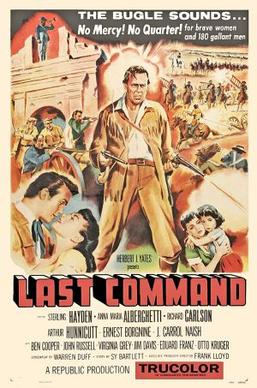
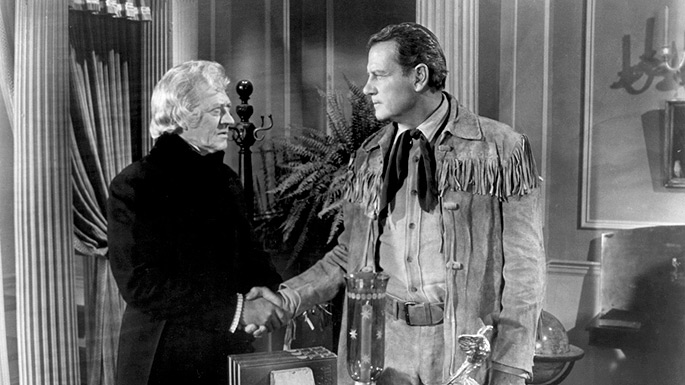
The Last Command (1955)

Of the three most well-known heroes of the battle of the Alamo, David Crockett, James Bowie and William Travis, there's no doubt who is the most well-known of the three. Oh, that'd be Crockett for those unfamiliar with history. In second place, the infamous knife fighter Jim Bowie who's had several films based on his exploits including 1952's The Iron Mistress (meh) and for today's review, 1955's The Last Command.

It's 1834, and knife fighter, adventurer and land owner Jim Bowie (Sterling Hayden) is riding south through Texas to Mexico to see his home and his family. As he rides through the territory though, he finds that many Texan colonists have had enough with Mexican president, Santa Anna (J. Carrol Naish), who's become more of a dictator with each passing day. Old friends with the president, Bowie isn't sure who to side with at first, but when his wife and children die, he's forced to come up with answers about what he believes and what he should ultimately do with the coming revolution. He joins the fighting, leading a group of volunteers. Santa Anna has started to march an army north from Mexico City to deal with the revolutionaries, and all roads lead to the town of San Antonio and a ruined old mission, the Alamo.

Anyone familiar with John Wayne's The Alamo from 1960 will no doubt notice some similarities between that film and this 1955 flick from Republic Studios. The reason? This was originally made with Wayne -- still working at Republic -- attached as an actor. He wanted to make an Alamo film, but disagreements with the studio drove the two sides apart. The end result was simple; Wayne left Republic, Republic made the film without Wayne, apparently out of spite. There are some similarities, from Davy Crockett's death to the Alamo defenders raiding the surrounding Mexican army for artillery and many others. The biggest difference though is obvious, a focus on Jim Bowie.

It's funny that in the casting of the infamous knife fighter, one of America's truly unique historical personalities, two of Hollywood's most wooden, vanilla actors were chosen. In 'Iron,' Alan Ladd starred, and here, Hayden takes the reins as Bowie. I'll say this. I don't think Hayden has a "showy" side, but he at least commits here and shows some energy in the lead. Just like Wayne's film would do, there is an unnecessary -- even painful -- love story as Bowie falls for Consuelo (Anna Maria Alberghetti), a young Mexican woman from a rich family (Eduard Franz plays her well-to-do uncle). Above all else, it's cool to see Bowie get a movie devoted to him and his involvement in the months leading up to and in the Texas Revolution. He was a fiery, passionate fighter who fought for what he believed in. His friendship with Santa Anna is a little much (the Mexican dictator affectionately calls him 'Jimmy'), but seeing a familiar story from an unfamiliar angle is refreshing.

Overall, the story focuses on a two-year period starting in 1834 and running through March 1836 and the battle and fall of the Alamo. The movie runs just 110-minutes and is a little slow-moving at times -- rather talky -- so non-history fans may lose some interest. Alamo buffs will get a kick out of the story though that focuses on Texas history that most Alamo movies simply ignore. We do meet some familiar faces, including Colonel Travis (Richard Carlson), Davy Crockett (Arthur Hunnicutt) and Lt. Dickinson (John Russell). Carlson is solid as the similarly fiery Travis, and Hunnicutt is a scene-stealer as the backwoods, storytelling Crockett that's based more in myth than the real-life Crockett. The story doesn't just jump right to the Alamo, but lays some ground work and background leading up to the famous battle. Also look for Ernest Borgnine as Mike Radin a rival-turned-friend of Bowie's and Ben Cooper as Jeb Lacey, a young Texan who looks up to Bowie. Other Alamo defenders include Slim Pickens, Jim Davis, Roy Roberts and Russell Simpson as the Parson.

The actual battle for the Alamo takes up about the last 40 minutes of 'Command.' The set is somewhat limited -- we basically see one corner of the mission along with the wooden palisade -- but there's something oddly cool about the set built near Bracketville, Texas (where Wayne's film was made). For a movie released in 1955, the final assault on the Alamo is surprisingly vicious and violent. Nothing graphic, but still pretty hardcore stuff for a 1950s audience. Each character gets their moment, their on-screen death with Bowie saved for last.

There's nothing hugely memorable about this 1955 Republic picture, but I like it just the same. Composer Max Steiner's score is a highlight -- give it a sample HERE -- and the Jim Bowie theme song (listen HERE) is pretty awful, but in an amazingly bad and memorable way. Lots of good actors, familiar faces and an enjoyable if unspectacular story in director Frank Lloyd's historical bio-pic. One IMDB reviewer points it out accurately. It's neither a big budget A-movie or a low-budget B-movie, but it's somewhere in between. TCM has three clips available so give them a watch at the link below.

The Last Command (1955): ***/****

Friday, April 20, 2012

The Alamo (2004)

Right from the get-go, it seemed 2004's The Alamo was doomed. Casting problems with casting and directing and especially the rating -- make it a hard R or a more family friendly PG-13 -- hung over the production.  Then once director John Lee Hancock finished the movie, an hour of his finished product was hacked away and the release date pushed back three months.  Finally released in theaters Easter weekend against Passion of the Christ, Hancock's movie bombed, barely making $20 million. Failure in theaters, yes, but that doesn't take away from one of my favorite movies on one of my favorite subjects.

It's February 1836 and less than 200 Texans and Mexicans have holed up in the Alamo, a crumbling adobe mission outside San Antonio.  Mexican dictator Santa Anna (Emilio Echevarria) leads an army numbering almost 5,000 men and means to squash this rebellion no matter the cost.  Inside the Alamo, three men lead the tiny garrison; Jim Bowie (Jason Patric), the infamous knife fighter, David Crockett (Billy Bob Thornton), a famed frontiersman and ex-Congressman, and William Travis (Patrick Wilson), a young unproven officer in the regular army.  As the siege wears on day after day, General Sam Houston (Dennis Quaid) tries to assemble an army to come to the aid of the besieged Alamo.  But inside the doomed mission, the defenders see more Mexican troops arriving daily and know what awaits them if they don't surrender.

Before I dive in, I'll say that ever since I was a kid, the story of the Alamo has appealed to me. I'll read and watch anything I can find on the subject. John Wayne's The Alamo is one of my two favorite movies, and even with extremely high expectations going into this one upon its initial release, I loved this movie. It feels crazy that it's almost 10 years since it was released in theaters. It is a shame also that Hancock's believed 3-hour version will never see the light of day. As is right now at 137 minutes, it has its fair share of flaws. At times, it's far too rushed. It has Pearl Harbor Syndrome as well, insisting on a happy ending as opposed to a more appropriate ending. But when it does get right? It hits a home run.

The shame of it is, Hancock has finished the most accurate re-telling of the Alamo battle, including the build-up and actual battle. An immense set in Dripping Springs, Texas was built including the actual Alamo mission and the nearby town of San Antonio. Like Wayne's version, having a full-scale set adds to the realism of the story and battle. The characters are not the legends we remember them as, but the people they actually were. People with personalities, hopes and dreams, fears and desires. The Alamo defenders weren't frontiersman, but townspeople like bankers, lawyers, farmers, and store owners. Without making them into the mythological characters they've become, Hancock has made a very human, personal movie. It's easy to see and feel what the defenders went through; an impossible situation with no easy resolution.

The Alamo story typically presents three main characters, the Alamo trinity of Crockett, Bowie and Travis. I'll get to all three, but the best performance hands down belongs to Billy Bob Thornton as Crockett. This is not the Fess Parker Crockett, but instead a regular guy who's tied down by his own legend he had little to do with creating. Of all the Crockett performances, this is the best, one I thought Thornton deserved an Oscar nomination for. The defenders look to him for support, for answers, for a way out. A monologue mid-siege is transfixing to watch, subtle and quiet but nonetheless highly effective. Another scene has Crockett playing his fiddle atop the Alamo walls, harmonizing with the Mexican army's band playing the Deguello (a high point of Carter Burwell's unassuming but still moving score). Watch the scene HERE. Somewhat controversially, the 2004 Alamo handled Crockett's death in a way no other Alamo movie even dared touch, Thornton rising to the occasion.

The diary of a Mexican soldier -- Enrique de la Pena -- who served at the Alamo claims that Crockett was captured in the closing moments of the battle and brought before a gloating Santa Anna. He was executed with a handful of other prisoners who survived the battle. This is the way the 2004 version chooses to go with, a scene that ends up being the most memorable one in the whole movie. This is Thornton bringing this man to life. Under his breath, Crockett mumbles 'Davy Crockett' as he faces death, his legend hanging over him as the Mexican army awaits what he will do. You can watch the scene HERE. Crockett's death -- whether by surrender/execution or going down fighting -- is maybe the most controversial aspect of the battle for Alamo buffs, but as presented here I can't understand anyone objecting to it.

Onto the other 2/3 of the Alamo trinity. About as far removed from a Hollywood star as possible, Patric is ideally suited to play Jim Bowie, a man who's earned his reputation where Crockett has had his thrust upon him. He's a hard-drinking, stubborn fighter, willing to fight it out if he believes he's right. Playing Colonel Travis, Wilson too shines, showing the transformation the young Alamo commander makes in such a short time as he attempts to rally the mission. All three men make these historical figures people and not just a name. Echevarria doesn't fare so well as Santa Anna, making the Mexican dictator a villain in the vein of a James Bond movie. Quaid too struggles to bring Houston to life, but much of his part was cut when the movie was hacked at to the tune of an hour of lost footage. Jordi Molla as Juan Seguin, a Mexican messenger from the Alamo, especially represents himself well as does Leon Rippy, Marc Blucas (as messenger James Bonham) and Kevin Page as Micajah Autry, Crockett's friend.

What The Alamo does well is especially evident in the choice to stay accurate to the final assault the morning of March 6 when the defenders were overwhelmed and killed to a man. It shows the attack in the morning darkness in an extended sequence that runs almost 15 minutes. Watch most of the sequence HERE. The scale is impressive, giving a real sense of what the battle must have been like. Actually imagine the setting; an enemy closing in on four sides and you've got nowhere to run. It isn't presented as a noble, heroic fight but a gruesome hand-to-hand conflict as sheer numbers overwhelm the Alamo defenders. It starts off in a great sequence as Crockett plucks the string on his fiddle, the shot changing with each pluck as the Mexican army silently approaches the Alamo walls. The most effective moment is a quiet one. Delirious with sickness, Bowie lies in bed barely able to move. He buttons up his vest, ready to face whatever comes through the door. As Rippy's Ward says "We know what awaits us and are prepared to meet it."

Wrapping up the movie is a rushed 20-minute follow-up, Houston's victory at San Jacinto. Like the Doolittle Raid being tacked onto Pearl Harbor, it feels unnecessary. It doesn't take away from a moving story though. The cast is nearly perfect, the music fitting and not your typical historical epic score, the actual Alamo set is a sight to behold, the camerawork and the visual are stunning, and like other successful Alamo movies, it gets the message across. Facing impossible odds, these defenders stood their ground, ready to give their lives because they believed they were right.

The Alamo <---trailer (2004): ****/****

Tuesday, April 10, 2012

The Alamo: 13 Days to Glory


In its history, Hollywood continues to go back to the well on certain historical events. The battle of the Alamo has been the focus of major studio productions like John Wayne's The Alamo in 1960 or more recently in the accurate, well-told 2004 version that flopped in theaters. It has even been shown as a background piece in movies focusing on the Texas revolution as a whole. Split the difference in years between the two major movies, and we get a TV movie from 1987, The Alamo: 13 Days to Glory.

It's February 1836 in San Antonio, Texas, and Colonel William Travis (Alec Baldwin) and Jim Bowie (James Arness) command a little over 100 volunteers, all the while awaiting the arrival of the Mexican army under the command of Antonio Lopez de Santa Anna (Raul Julia). When Santa Anna's army of several thousand men arrives, Travis, Bowie, Davy Crockett (Brian Keith) and their ragtag force retreat into the Alamo, an old Spanish mission, in hopes of stalling the army as long as possible. The fort is in ruins though, and Travis' command is far too small to defend it adequately. The Texans inside wait and wait for help, hoping reinforcements can arrive in time before Santa Anna's soldiers storm the walls.

Made for NBC in 1987, this made-for-TV movie is based off the novel of the same name from author Lon Tinkle. Veteran director Burt Kennedy takes the helm, working with a small budget that limited what he could do with the story. This is not the epic that Wayne made, '13 Days' instead made on a much smaller scale. There's never any sense of an enormous, overwhelming Mexican army waiting outside the walls, just a few extras in Mexican soldiers' uniform. Drawing further comparison to Wayne's version, the miniseries was filmed on location at Alamo Village, the set Wayne built for his 1960 film. It adds some needed realism to the scaled-down story with composer Peter Bernstein's score aiding the cause, especially in the final battle and the main theme.

Watching this since I was a kid, I have a soft spot for '13 Days' but I can still appreciate some of its truly bad, awful moments. Historical accuracy is one thing, but there are some real oddities here whether it be from a lack of budget or just a bad script. We see the same shots over and over again, a cannon being fired, the Alamo defenders firing in a volley, Mexican cavalry riding in front of Santa Anna's tent, just to name a few. There's also moments of mind-blowing stupidity, like Mexican artillery firing a cannon with a ramrod still in the gun's barrel. Other winners? Capt. Dickinson (Jon Lindstrom) tells wife, Susannah (Kathleen York), he'll be back at night to bring her into the Alamo. Oh, by the way, the Mexican army is on the edge of town. Colonel Fannin's relief column consists of about 15 men, a supply wagon and a cannon. Low budget for that one. It's those little things -- like David Ogden Stier's Col. Black, a fictional English officer fighting with the Mexicans -- that strike an odd, out of left field note.My favorite though is Alamo messenger Jim Bonham (Jim Metzler) calling Sam Houston (Lorne Green in a bizarre cameo) a coward. First, no such meeting ever occurred, but it is an unintentionally funny scene.

With such recognizable names as Crockett, Bowie, Travis and Santa Anna, '13 Days' goes 2-for-4 in the casting department. Keith and Arness are just too old to play Crockett and Bowie. Keith was 66 at the time, Arness was 64 while in 1836 Crockett was 50 and Bowie just 40 years old. They give it a valiant effort -- Keith's Crockett a mix of real-life David and legendary Davy, Arness' Bowie an imposing, intimidating figure -- but it never completely clicks. On the other hand, a young Alec Baldwin is a great choice to play Travis, a young, brash officer thrust into a command position, rising to the occasion with his life on the line. His line in the sand speech is one of the best from all the Alamo movies. '13 Days' is also one of the few movies to portray Santa Anna somewhat fairly, Julia doing a great job with the part. He's both an obsessed, possibly lunatic leader and also a president trying to save his country.

Thanks to Tinkle's novel, the TV miniseries also tries to turn the spotlight on some of the other Alamo defenders including Metzler's Bonham and Lindstrom and York as the Dickensons. York especially represents herself well as Susannah Dickinson, the strongest portrayal of the real life woman yet committed to the screen in an Alamo movie. There's also Travis' slave, Joe (Hinton Battle), Juan Seguin (Michael Wren), the Alamo messenger, and Eloy Casados as Gregorio Esparza, one of the Tejanos fighting in the Alamo. Other defenders include Tom Schanley as Danny Cloud, a Tennessean engaged to a local girl (shrill Laura Fabian), Tony Becker and Ethan Wayne (the Duke's son) as the Taylor brothers, George and Edward, Buck Taylor and Stan Ivar as Colorado Smith and Doc Sutherland, two more messengers, along with Gene Evans, Grainger Hines, Tom Everett, Jerry Potter and Jay Baker. With so many characters, most aren't given much development, just enough to introduce them and be somewhat interested in them.

With a few slower segments over its almost three-hour run-time, '13 Days' picks up in the final hour as reality sets in that no help is coming for the beleaguered defenders. It sets the tone well for men awaiting their death, wind whipping around the fort, silence hanging in the air. For its small scale and reliance on re-using shots repeatedly for action sequences, the final assault on the Alamo on March 6 is a surprisingly effective battle scene. You can watch the final attack HERE at Youtube. For the "big" shots, footage from 1955's The Last Command was used, some obvious editing showing how different the Alamo looked in the two films. The battle is easily the high point of the movie, making up for some of those slower portions. The defenders finally being overwhelmed supply some surprisingly emotional moments, again aided by the music.

Faults aside -- and there's a-plenty -- '13 Days' works fairly well because like most Alamo movies, it gets the message right. Outnumbered against an army of thousands and surrounded on all sides, less than 200 men decided to stick it out and fight, knowing death awaited them with that decision. When it would have been easy to surrender, they fought on. So even through the cheesiness, the bad casting, the general low budget feel, '13 Days' is still well worth a watch, especially for Alamo buffs.

The Alamo: 13 Days to Glory (1987): ***/****

Tuesday, March 6, 2012

The Alamo (1960)

From the time I was introduced to Fess Parker as Davy Crockett in the Disney episodes, I fell hook, line and sinker for the story of the siege and fall of the Alamo. Even as a kid, I was able to appreciate the courage, the sheer bravery of the defenders of the mission who sacrificed themselves. But while I love the Disney Davy Crockett episodes, one thing stands above. Right alongside The Great Escape as my favorite movie, 1960's The Alamo.

It's February 1836 and the Mexican province of Texas is fighting for its freedom against Mexico and its dictator Antonio Lopez de Santa Anna. Leading the Texas revolutionaries is General Sam Houston (Richard Boone) who leads a nonexistent army and needs time to assemble and train a fighting force. In the town of San Antonio stands the Alamo, an old mission built by Franciscan monks over a 100 years earlier, a mission never intended for military use. With hopes of buying Houston the time he needs, Lt. Colonel William Travis (Laurence Harvey), knife-fighter and adventurer Jim Bowie (Richard Widmark), and famed frontiersman and former Congressman Davy Crockett (John Wayne) and 180-odd volunteers have forted up in the Alamo and are quickly surrounded by Santa Anna's army of over 7,000 men.

For star John Wayne, The Alamo was a labor of love, a film he had wanted to make for 14 years. He not only stars in it but also produced it and directed, his first ever film as a director. The story of the battle of the Alamo had long appealed to him -- the bravery, the heroism, the sacrifice -- and it was a story he wanted and needed to tell. He spared no expense in this truly epic production. In Bracketville, Texas, Wayne had a complete Alamo mission built, not to mention the town of San Antonio too in the middle of the Texas desert. The set -- dubbed Alamo Village -- becomes an additional character, adding a sense of realism and authenticity that no studio set would have done justice. The actual Alamo mission constructed is a sight to behold, a behemoth fortress that puts in perspective how difficult it would have been for 180 men to defend against an army of thousands. Wayne's love child, most will disagree with me, but I think it's a nearly perfect movie.

Playing three legendary figures, Wayne, Widmark and Harvey all deliver layered, nuanced performances, all of them unique and different from the rest. As Davy Crockett, Wayne is a huge presence. It's far from his best acting roles -- The Searchers, She Wore a Yellow Ribbon -- but Crockett of the time was a legend in his own right. Who better to play him than one of Hollywood's biggest stars? Much of the tension in the movie comes from the rivalry over command between Widmark's Bowie and Harvey's Travis, both actors representing themselves flawlessly. Widmark is fiery and hot-tempered, Harvey condescending, intelligent and an idealist, but they share a common goal. All differences aside, both men are willing to sacrifice themselves for the cause they're fighting. I love the banter, the back and forth, the chemistry among the three. Making a two-scene cameo as Houston, Boone too doesn't disappoint, making those two scenes more than just throwaway fluff.

In terms of actual screentime, the big three dominate, but as a director, Wayne assembled quite a cast. Ken Curtis plays Capt. Dickinson, Travis' second-in-command, with Joan O'Brien as his loyal, equally brave wife, Susannah. Crockett's Tennessee volunteers include singer Frankie Avalon as Smitty, the youngest Alamo defender, Chill Wills (in an Oscar-nominated turn) as Beekeeper, the drinking, jovial fighter, Denver Pyle as Thimblerig, the thinker and gambler, Hank Worden as the Parson, a preacher, with Chuck Roberson (a talented stunt man and Wayne's double) and Rudy Robbins as two unnamed Tennesseans, engaging in their running bit; 'Do that mean what I think it do?....It do.'  Other defenders include Patrick Wayne as Lt. Bonham, the Alamo's famous messenger, John Dierkes as Jocko and his blind wife, Nell (Veda Ann Borg), Joseph Calleia as Juan Seguin, and Guinn Williams as Lt. Finn, and Jack Pennick as Sgt. Lightfoot. Two other worthwhile performances include singer Jester Hairston as Jethro, Bowie's slave, and the lovely Linda Cristal as Flaca, a young woman who shares a brief relationship with Wayne's Crockett.

Anyone remotely familiar with the historical facts knows that on March 6, 1836, the Mexican army assaulted the Alamo and wiped out the defenders to a man in a brutal, bloody massacre; extreme casualties on both sides. For a first-time director, Wayne puts together one of the all-time great battle sequences ever committed to film (if not the best ever). Almost five full minutes are shown as the Mexican army marches into formation around the doomed mission, an eerie silence hanging in the air for several seconds before the attack begins. The assault features hundreds of extras -- and in one scene, thousands -- as the garrison tries to repel the soldiers from the walls only to be ultimately overwhelmed. Cavalry, infantry, artillery, this defines the SPECTACLE of an epic. More than that, it is a moving sequence, each of the defenders we've come to know meeting their death. More details later on this, but Dimitri Tiomkin's score here is some of his best work. You can watch the battle sequence HERE, but to be appreciated, see it on a large, large screen.   

Wayne's film has its share of detractors, and the complaints are fair (even if I disagree with them). The original version is 192 minutes and has its slower moments. Speechifying abound from James Edward Grant's script, but I eat this stuff up. Big speeches about freedom, Republic, right and wrong. That's John Wayne at his best. What does work? The very real emotion of the movie. Countless scenes impact me the more I watch this movie. Travis addressing his men, knowing death awaits those who stay, is beautifully simple. Watch it HERE. I love too, that Crockett's men dismount before him. Overlooking a field covered with casualties, Pyle's Thimblering says 'Speaks well for a man who's willing to die because he believes right is on his side...speaks well.' The night before the final assault is the most effective though, the defenders sitting quietly as they wait for the inevitable in the morning. Bowie releases Jethro, but the former slave decides to stay and fight. Roberson's Tennessean delivers a simple monologue that is profound in its outlook on life. And best of all, Crockett is asked by Thimblering, "What are you thinking about?" to which Crockett answers "Not thinking....just remembering." The last 45 minutes features some of the most perfect dialogue, emotion, music and spectacle of any movie ever. The Green Leaves of Summer (listen HERE), one of the most beautiful songs ever, playing over this sends chills up and down my back at the thought of it.

A criticism of The Alamo is the complete lack of historical accuracy as pertaining to the actual 1836 battle, and that's true. Wayne never set out to do a spot-on, dead-on accurate telling of the story. The 2004 film -- The Alamo -- does that. Instead, Wayne wanted to tell the story honoring the men who fought and died. They fight because they believe in what they're fighting for. Surrounded on all sides with no hope of reinforcement, the Alamo defenders stay inside the walls, knowing certain death awaits. They go out fighting, go down swinging. That is what Wayne was going for. I have difficulty even processing that sort of heroism. Crockett's Tennesseans dismounting before him illustrates that. Crockett has seen some of his men die already and doesn't want to see anymore die, but his men don't look to him for a decision. They do it because they want to, not because they're told. Say what you want about Wayne as a director/star with a heavy-handed message, but he got that part right to a T.

Initial reviews were mixed for The Alamo, forcing Wayne to cut 30 minutes from his 192-minute long movie. Those cut portions include Intro Music, an Intermission and Entr' Acte, and Exit Music with about 15-20 minutes of scenes, some better than others. The scene that truly needed to be in the final print was Parson's death, a beyond moving, effective scene as the battle becomes very real for Crockett and his men. Watch it HERE. The actual prints of the 192-minute version seem lost to the ages, but many of the deleted scenes are available at Youtube. Watch several of them in one video, HERE. Among them is Scotty's death, and a birthday party held for Lisa Dickinson, played by Wayne's daughter Aissa. As a fan of the movie, it's great to see any of this footage.

So what else can I ramble about? That's probably enough. I love this movie and everything about it. Wayne gets the spirit right, showing the bravery and heroism of the Alamo defenders as they faced certain death and didn't shy away from it. A true epic with scale and spectacle to impress all moviegoers. Great cast, an amazing set of the Alamo mission, Tiomkin's phenomenal score, and a battle sequence that few can even approach in terms of quality. They don't make them like this anymore.

The Alamo <---trailer (1960): ****/****

Tuesday, April 5, 2011

The First Texan

From the time I watched Fess Parker as Davy Crockett in the Disneyland episodes and John Wayne's The Alamo, I was hooked on the story of the famous 13-day siege in 1836 that ended with the massacre of the whole garrison on March 6.  It was a natural jumping off point to the whole Texas War of Independence which took place between late 1836 and spring 1836 as Texas fought for its freedom from Mexico. It's a little stretch of history that often gets overlooked in the shadow of the Alamo massacre, but one of our country's most unsung heroes, Sam Houston, played a major role in the war and the formation of Texas into one of the United States.

Now before I write this, yes, I realize Houston has a city named after him, but his name isn't always synonymous with the other heroes of the war for independence, Crockett, Bowie, Travis, Seguin, Stephen Austin.  He was a larger than life individual who hasn't always gotten his due through history.  In 2004's The Alamo played by Dennis Quaid, Houston's part was severely cut.  A 1980s TV movie Gone for Texas is a mediocre effort at telling his story even with a solid lead performance from Sam Elliott.  Add 1956's The First Texan to the list of bland attempts at telling Houston's involvement in Texas' fight for freedom in 1836.

In 1832, former Tennessee governor Sam Houston (Joel McCrea) rides into the Mexican province of Texas looking to start fresh with his life after a personal scandal back home helped ruin his reputation. Rumors abound about a coming fight with Mexico for Texas independence with infamous knife fighter and land owner Jim Bowie (Jeff Morrow) among the leaders who approach Houston to join the cause. Smitten by a young woman, Katherine Delaney (Felicia Farr), he meets in San Antonio, Sam just wants to move on with his life and build up his law practice. A natural leader like he is though, it's only a matter of time before he gets pulled into the conflict, especially when tensions escalate between the Texans and the Mexican government, prompting General Antonio Lopez de Santa Anna (David Silva) to lead his army into Texas.

For starters, McCrea is a solid choice to play Sam Houston beginning with his physical resemblance.  Houston was a big man in real life, standing over 6' feet tall.  In one of his later roles, McCrea's presence lends itself well to this larger than life character.  Through most of his westerns, he typically played roles like this anyways, stout, resolute, heroic men who stood by their word and their gun as needed.  Making the jump then to play Houston (who by all accounts was a man like that) isn't a huge stretch then for McCrea.  He can be a little stiff at times, and his forced relationship with Farr's Catherine is unnecessary, but it's a solid leading performance.  Too bad the rest of the cast (mostly B-movie actors and TV guest stars) isn't quite up to the standard.

Biographies of a historical figure are always a tough project to tackle, especially in B-westerns like this that clock in at a slim 82 minutes.  Four years are glossed over in Houston's life in less than 90 minutes.  The scope and perspective are limited from the start with a smallish budget.  Worse though is that nothing is really done to try and disguise this.  The first 70 minutes are so ridiculously dialogue heavy that the whole pace of the movie gets thrown off.  The massacre at the Alamo is talked about but not shown (I'm assuming because of budget constraints), and then the next 20 minutes shows the Runaway Scrape. Watching men retreat across Texas and then bitching about it at night doesn't make for the most exciting visual experience either.  By the time the battle of San Jacinto arrives, it is just too late to save the movie.

For an Alamo and history buff, I look for certain things in movies like this that just have to work, have to click if the movie's going to be successful.  All the big names are here, starting with Morrow's Bowie and continuing on to Davy Crockett (James Griffith), William Travis (William Hopper), Stephen Austin (Dayton Lummis), scout Deaf Smith (Chubby Johnson), Mexican colonel Cos (Rodolfo Hoyos Jr), among several other recognizable names.  Unfortunately, the script basically pushes these guys aside for fictional characters who do the same things but with different names. There are so many characters they all become lost in the shuffle, hard to distinguish them all from each other.  One bright spot is McCrea's son, Jody McCrea as Lt. Baker, one of Houston's aides.

Trying to avoid sounding like that pretentious 'I know everything about history' guy, I'll keep this brief.  For the few topics I actually know something about, I hate seeing those things mangled in movie form.  'Texan' certainly plays free and easy with historical accuracy.  Sure, some of the mistakes can be chalked up to budget and time limitations, but The First Texan does a poor job overall, just randomly making things up and tweaking other things for the sake of doing it.  This isn't a good or bad movie. It's just boring, and is an inoffensive enough way to kill 82 minutes. I just wish it could have been better.

The First Texan (1956): **/****