The Sons of Katie Elder

The Sons of Katie Elder
"First, we reunite, then find Ma and Pa's killer...then read some reviews."
Showing posts with label James Stewart. Show all posts

Thursday, January 21, 2016

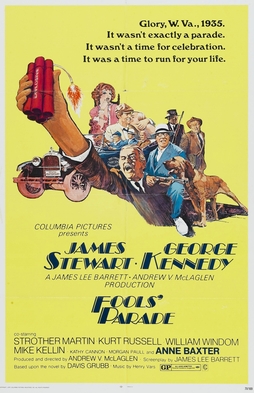
Fools' Parade

So you know what sounded pretty awful? The Great Depression. Man, I'm good at writing introductions to these reviews, aren't I? For every well-known Depression-era movie out there, it seems like there's that many more generally forgotten in a wave of flicks. Here's one I stumbled across on a cable movie channel recently and simply couldn't pass up because of an impressive cast, 1971's Fools' Parade.

It's 1935 and three convicts are being released from a West Virginia penitentiary, including Mattie Appleyard (James Stewart), Lee (Strother Martin) and Johnny (Kurt Russell), all of them having served their sentence for varying crimes. They're driven to the train station by a vicious prison guard, Doc Council (George Kennedy), who ominously states that he'll see them soon. The trio boards the train with plans of opening a general store down the train line, using Mattie's hard-earned savings as a bankroll to get things started. There's a problem though as they get further away from the town and penitentiary. Mattie's check -- earned and saved from 40 years in prison -- can only be cashed back in Glory...where they've been less than pleasantly told to never come back. If they do, Council will be waiting for them. That's not their only problem. Council may not even be waiting that long to hunt them down...

From the older classic like The Grapes of Wrath to the newer entries like O, Brother, Where Art Thou, Depression-era flicks are a cool little genre of flicks that doesn't always get a ton of attention. Maybe it's the whole soul-killing tone of these flicks. Maybe. I don't know. The 1970's especially had some cool entries, including this flick, Emperor of the North Pole, Hard Times, Paper Moon and Dillinger among others. 'Parade' belongs in that group. It's dark(ish), gritty and has the look and feel of one of America's roughest historical stretches.

So why then does this 1971 drama with some light comedy touches have virtually no reputation? Virtually no following? Well, for starters, it most definitely and assuredly is very, very odd. I can't specifically put a finger on said oddness, but it is. It's there. It...is...odd. Maybe as close as I can get is the tone, or lack of. From director Andrew McLaglen and a screenplay by James Lee Barrett, 'Parade' is just a bit of an oddball flick. It's able to build up an impressive sense of doom early on but it never quite takes off. Things slowly derail as the 98-minute running time nears its finish. Still, this is a movie that's never dull or boring. Very watchable, just odd.

Sometimes, an all over the place tone comes in second to something, anything else that's far more appealing. Here, that's easy. It's the cast. That cast. We mostly follow our three recently-freed crooks in Stewart, Martin and Russell. Stewart's Mattie served a 40-year sentence for killing two men, Martin's Lee six years for bank robbery, and Russell's Johnny a shorter sentence for an incident with a girl that's generally left unexplained. The story doesn't linger long on our trio's past criminal transgressions (wisely), instead focusing on them trying to start over again, albeit at different points in their lives. I especially liked Stewart as Mattie, sporting a bizarre-looking glass eye, the oldest of the three who most strongly wants that fresh start. He stashed away all his money during his 40-year sentence (earning a ridiculous-sounding $25,000) and now meets all sorts of roadblocks in getting that cash. Martin's Lee is seemingly a little simple-minded in his obsession with putting together a general store inventory while Russell's Johnny is stubbornly loyal to Mattie. Still, there's something charming about the trio, and there is a solid chemistry among the group.

An interesting cast all-around. When he wanted to, George Kennedy could play one interesting bad guy, and that's on display here. It's just creepy watching him. You're rooting for him to get his due and get it badly. Who else to watch for? An unrecognizable Anne Baxter as a madam who's fallen on hard times, William Windom as an unlucky traveling salesman, Mike Kellin and Morgan Paull as Doc's oddball killers, Robert Donner as a train conductor, Katherine Cannon as Baxter's lone "girl," and David Huddleston as the greedy bank owner. Quite the eclectic bunch!

I can't quite put my finger on it as to 'why' exactly, but I very much enjoyed this movie. Though the subject matter is dark, it is an easy-going, mostly pleasant movie. Yeah, it is a touch slow at times for a movie that runs just 98-minutes, but it is never dull. The West Virginia filming locations are an ideal backdrop for the story as well, giving it an authentic sense of watching where this story would have actually happened. Worth a watch. Apparently, it's somewhat difficult to find so here's my help to the situation. I watched it on Retro, a movie channel coupled with the Encore package on cable. It's a movie I recommend tracking down. Hope you enjoy it!

Fools' Parade (1971): ***/****

Friday, August 7, 2015

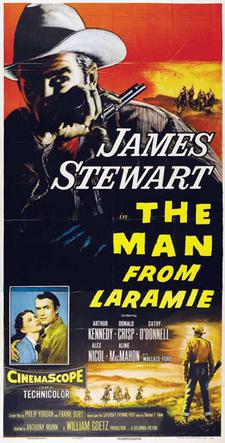
The Man From Laramie

By 1950, James Stewart had been working in Hollywood for 15-plus years, most of those years as a go-to star who audiences and critics alike liked and appreciated. In 1950 though, he starred in a western called Winchester '73, teaming with director Anthony Mann. It ended up playing a key -- if unappreciated -- role and movie as Stewart headed into the next portion of his career. From there on in, Stewart was a regular in the western genre, by my count starring in 17 westerns. Today's entry? That would be 1955's The Man from Laramie.

Having endured a long trip on the trail, Will Lockhart (Stewart) and his packed-to-the-gills freight wagons have finally arrived in the small, isolated desert town of Coronado. Lockhart sells his goods and is in no rush to get back to Laramie. Actually...he'd like to stick around. He's got some questions he would like answered about a cavalry patrol being massacred several months before by an Apache war party using repeating rifles. Where did those rifles come from? Who sold them to the Apaches? Now, Will isn't letting on to his real goal of being Coronado, but he quickly draws the ire of the local rancher, Alec Waggoman (Donald Crisp), who with his weak son, Dave (Alex Nicol), and loyal foreman, Vic (Arthur Kennedy), rule over the surrounding area. The clock is ticking on Lockhart if he wants to get his answers before he ends up six feet under with a bullet or knife in his back.

Early in his career, Stewart did star in one pretty excellent western, 1939's Destry Rides Again. Some more years under his belt, his service in World War II behind him, Stewart was a little more weathered, a little more grown up when he really dove into the western genre in the 1950's. He just looks like he belongs in the western, from the beat-up hat he wore in so many to the tall, lean look that screamed authentic cowboy. He's likable -- as always -- but as necessary, Stewart is able to call up this rage and fury as needed. That's especially important as we discover exactly what his Will Lockhart is up to in Coronado. It's an excellent performance from Jimmy Stewart all around, an actor and a man who appears quite comfortable in a genre that is and was happy to have him.

John Wayne had John Ford. Randolph Scott had Budd Boetticher. Jimmy Stewart....he had Anthony Mann. This is actually the fifth and final pairing of the actor/director combo, and it's a good one. They also paired in Winchester '73, Bend of the River, The Naked Spur, The Far Country, and this film. So many 1950's westerns were clean and polished, but there's a meanness, a darkness to these pairings. With touches of Shakespearean storylines, even some mythological storylines (greed, betrayal, lust, murder), Mann added a much-needed darkness and depth to the western. It wasn't always a cut and dry good and bad. It was tortured anti-heroes (a sign of things to come in the genre). It was realistic -- if not graphic -- violence. There are a fair share of pretty weak westerns from this decade, but when they were good? They were pretty good overall, like here, and so many Stewart/Mann, Scott/Boetticher pairings.

'Laramie' doesn't feature a huge cast or a ton of recognizable names, but the casting in general is solid because of the script with all that Shakespearean, mythology-based storylines. Crisp is excellent as the aging rancher who's desperately clinging to what he carved out of the wilderness. He's trying to keep it all together, balancing things between his whiny, weak-minded son, Dave (a sniveling Nicols), and the tougher, ruthless Vic Hansbro. Kennedy is excellent, as he usually was, without resorting too much to chewing the scenery. Cathy O'Donnell plays Barbara, Waggoman's niece and Vic's fiance, caught up in the middle of all the family drama, Aline MacMahon is a weathered, ranching rival to the Waggomans with a history with her rivals, Wallace Ford is Charley, Lockhart's quasi-partner and a tried and true wagon driver with experience to burn, and an underused Jack Elam doing what he did best as shifty, two-faced supporting villain.

This is a western with a ton to offer. It has elements of film noir storytelling, the mystery of the massacre playing out against a western backdrop. Lockhart's secret doesn't come as a huge surprise, but it works because the tension and mood is built up more with each passing scene. The final reveal in the closing scene is dealt with in almost matter of fact fashion, but getting there is a ton of fun. The score is nothing to write home about, but my goodness, the visuals from the on-location shooting in New Mexico are Stunning. What a beautiful picture, the rocky mountains and sand-swept plains and vistas filling the background with each passing scene. It is a sun-drenched western with seemingly no clouds anywhere near or around the location shooting. Story, twists and characters aside, you can just sit back and appreciate the natural beauty.

If there's a weakness, it's in the last 45 minutes or so of a 104-minute movie. As certain things are revealed, the story loses some momentum. The ending itself features some twists and betrayals and backstabbing along the way that do make it fun, but there isn't the same energy as was there in the first half. Still, it's a solid, well-made adult western from the 1950's and Jimmy Stewart is always fun to watch. Definitely worth seeking out.

The Man From Laramie (1955): ***/****

Wednesday, May 13, 2015

Bandolero!

With 1960's The Alamo -- one of my two favorite movies -- producer-director-star John Wayne built an entire set in Bracketville, Texas, that included the famous Alamo mission and nearby San Antonio. It was a set that was used in many, many films in the years following, even becoming quite the tourist attraction, before closing in the last few years. One of the best and one of my favorites? A 1968 western called Bandolero!

It's 1867 in Val Verde, Texas -- a small border town not far from the Rio Grande -- where noted outlaw Dee Bishop (Dean Martin) and his gang is caught trying to rob a bank, killing two people in the process. Sentenced to hang, the entire gang is rescued on the gallows by Mace Bishop (James Stewart), who is posing as the hangman. Dee and his men escape, riding out of town hell bent for leather trying to reach Mexico ahead of a posse led by the stubborn Val Verde sheriff, July Johnson (George Kennedy). On the trail, the Bishop gang takes a hostage, Maria Stoner (Raquel Welch), a widow of one of the men killed in the robbery, and continue on to Mexico with the posse close behind. Embarrassed in his town, July Johnson has another reason to pursue the gang as far as they go. He's long been in love with Maria. All sides cross into Mexico into what Maria calls 'territorio bandolero.' Translation? Bandit country, bandits who will kill any and all gringos they come across.

This isn't a classic western, but for me, it's always been one that is a lot of fun. It's from director Andrew McLaglen, a director who specialized in pretty straightforward, almost always pretty entertaining guy's guys movies like this, The Wild Geese, McClintock, The Devil's Brigade and many others. He's one of my favorites just because of that, he made movies that were fun, that were entertaining. This is one of his better efforts, a western with a great cast, an interesting premise, and some tweaks and twists and turns in a story that tries to blaze its own trail. Again, not a classic, but damn entertaining and one of my little-known movies I consider a personal favorite.

It starts with two of my favorite actors, Jimmy Stewart and Dean Martin, in lead roles. The character premise is familiar but handled nicely. These are two brothers torn apart by the Civil War, Stewart's Mace fighting for the Union while Martin's Dee fought with the South, specifically Quantrill's Raiders. Now, years later they're brought back together by dumb luck, some coincidence and one brother desperately trying to help the others. These are two good actors, and they carry the dramatic moments. It's especially cool to see Martin in a villain role, albeit a likable villain. The middle portion of the movie is carried by their scenes as they reunite, talk things out, plan for the future, all the while trying to mend their differences. So yeah, they're on the wrong side of the law, but...meh, it's Jimmy Stewart and Dean Martin so you kinda go with it.

As for the Bishop gang, look for Will Geer as the crotchety old man, Pop Chaney, his ill-mannered, probably a little off son, Joe (Tom Heaton), Babe Jenkins (Clint Richie), a deadshot with a rifle and a bit of a ladies man, and Robbie O'Hare (Sean McClory), the hard-living, loving-life Scotsman. An interesting, nasty group to round out the gang.

The rest of the cast ranges from interesting to good to good-looking. Kennedy is underused but very solid as Sheriff Johnson, the peace officer trying to do his job but he's got some ulterior motives for his actions. I also have always liked Andrew Prine as Roscoe Bookbinder, Johnson's loyal deputy. Lonesome Dove author Larry McMurtry was apparently a big fan of this movie and used both character names and general descriptions in that novel. As for Raquel Welch, she's trying, really doing up a Mexican accent. It isn't nearly as bad as some reviews make it out to be -- the script doesn't do her any favors -- but it isn't especially good either. Shallow dude time though, she looks as beautiful as ever. Plenty more familiar faces though including Denver PyleRudy Diaz (the bandit leader), Harry Carey Jr.Perry Lopez, and Dub Taylor.

Now for that Alamo Village portion of our programming. McLaglen uses the Alamo set to good use with two extended set pieces, the opening being Val Verde, the robbery and then the eventual escape. The finale is actually on the Alamo mission set, an abandoned town set among the ruins of the bombed out fort. They try to disguise the recognizable chapel face, but you can't miss it if you're paying attention. It's a great use of the locations, Utah and Arizona also serving as some locations. Also, one more thing. I love composer Jerry Goldsmith, but this is one of his favorites, a score I absolutely love. The use of a mouth harp over the opening credits is an odd choice, but does it ever work. The rest of the score is more action-packed western themes, but it's catchy, memorable and a great support to all the action. Give it a listen HERE.

If there's an issue in this McLaglen western, it's that the script has a great opening set piece and a memorable, blood and guts finale. In the middle....yeah, things drag at times. There's a couple campfire scenes, Maria getting to know Dee, Dee reacquainting himself with Mace, and all the while Johnson's posse tangles with a large gang of bandits. Never boring, but never as exciting as the beginning and end. Now that ending/finale? Yikes, it packs a wallop, packs quite a punch and does so while delivering some genuine surprises. Quite an ending to one of my favorites. A perfectly entertaining little western. Nothing more, nothing less.

Bandolero! (1968): ***/****

Rewrite of February 2010 review

Thursday, January 29, 2015

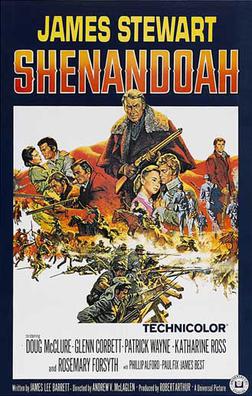
Shenandoah

As far as directing powerhouses of the 1960s, Andrew V. McLaglen will never be remembered as one of the greats. He started off in television before making the jump to feature film, teaming several times with John Wayne while also specializing in audience friendly "guy movies." Good guys versus bad guys, lots of familiar faces and situations, you know the formula. One of his best? An underrated Civil War drama, 1965's Shenandoah.

It's 1864 in Virginia, and the tide of the Civil War has turned as the Union forces are slowly beating down the Confederate armies. Doing his best to remain free of the bloody fighting, farmer and patriarch Charlie Anderson (James Stewart) wants nothing to do with the war. Both for himself and his family -- seven kids, one daughter-in-law -- Anderson simply wants to keep working his 500-acre farm and get through the war unscathed. Fight for Virginia? Fight for slaves he doesn't have? He fights for what he believes in, his family and his farm. Well, that's what he'd like to do. While the fighting rages on, Charlie is stunned when he finds out his youngest son (Phillip Alford) has been confused as a Confederate soldier and captured by nearby Union forces. Now the war and the fighting that Anderson has done so well to steer clear of has landed square on his front porch. Can he find his son amidst the hell of war?

This was a movie I watched often growing up when my sister and I had sleepovers with my Grandma. It made an excellent Civil War double feature with Friendly Persuasion, and let me tell ya, they both hold up! I watched this McLaglen-directed Civil War drama for the first time in years, and it resonated just as much now as an adult as it did when I was a kid, if not more. McLaglen had some excellent movies to his name -- The Wild Geese is a favorite, Hondo, McLintock are also excellent -- but this is his best movie overall. The story is a series of very effective, often moving and often disturbing vignettes, all held together by the Anderson family. Filmed on-location in Oregon and California, 'Shenandoah' is an underrated visual film, and the musical score from composer Frank Skinner is a gem. So what stands out viewing this one as a 29-year old, not a 13-year old kid?

That would be James Stewart, one of my favorites in just about any movie he's in. This doesn't get the attention or notoriety as one of Stewart's best performances, but it certainly belongs in the conversation. I love what he does with the part of Charlie Anderson, a stubborn, feisty Virginia farmer and widower looking out for the best intentions of his family. He doesn't care about the war, about slavery, about Union and Confederate. He will do anything, ANYTHING, to protect his family. Stewart has some great scenes with the younger supporting cast, especially Alford's youngest son, only called 'Boy,' with his daughter, Jenny (Rosemary Forsyth), daughter-in-law, Anne (Katharine Ross), and his sons. There are too many memorable, emotional scenes to mention, but my favorites are the most simple. Minutes before the Andersons go to church each Sunday, Charlie visits his wife's grave and just talks to her. Simple perfection, Stewart absolutely nailing the underplayed but charged scenes. 

Stewart is the unquestioned star of McLaglen's film, but 'Shenandoah' offers quite the ensemble of recognizable faces. Glenn Corbett and Patrick Wayne play Jacob and James, the two oldest brothers. Corbett especially stands out as Jacob who's beginning to question if their choice to stay out of the war is the right decision. Wayne is solid too, especially in his scenes with Ross. In her film debut, Forsyth is excellent, a subtle scene-stealer as innocent, tough and thoughtful Jenny who's also interested in a young Confederate soldier, Sam (Doug McClure). The other Anderson boys include Charles Robinson, Jim McMullan and Tim McIntire. Maybe the best thing you can say about the story is that the family dynamic, it just works. You believe them as one cohesive unit, one that stands together through thick and thin.

But wait, there's more! Also look for George Kennedy as a sympathetic Union officer, Gene Jackson as Gabriel, a friend of Boy's, a slave, Paul Fix as the local doctor, Denver Pyle as the pastor, James Best as Carter, a fellow prisoner who takes Boy under his wing, Harry Carey Jr. as another Confederate prisoner, Tom Simcox as Lt. Johnson, a Confederate officer, with Kevin Hagen, Dabbs Greer and Strother Martin also playing small but memorable parts.

So 29-year old me certainly picked up some new things, or at least was able to process things differently. This is one hell of an anti-war flick. The portrayal of the latter stages of the Civil War is unsettling and often times, disturbing. Death awaits around every corner, hiding behind every tree. The lines are up in the air as the war takes a turn toward its ultimate conclusion. A late battle between a small Confederate camp and a larger Union force with heavy artillery is quick and awful and uncomfortable, one of the more underrated battle sequences I can think of. The last half hour especially features one kick in the gut after another that truly hammers home the anti-war message. And that last scene? Pretty perfect, the possibility of hope lingering in the air amongst all this pain and suffering and death. One of my favorite movies.

Shenandoah (1965): ****/****

Monday, April 21, 2014

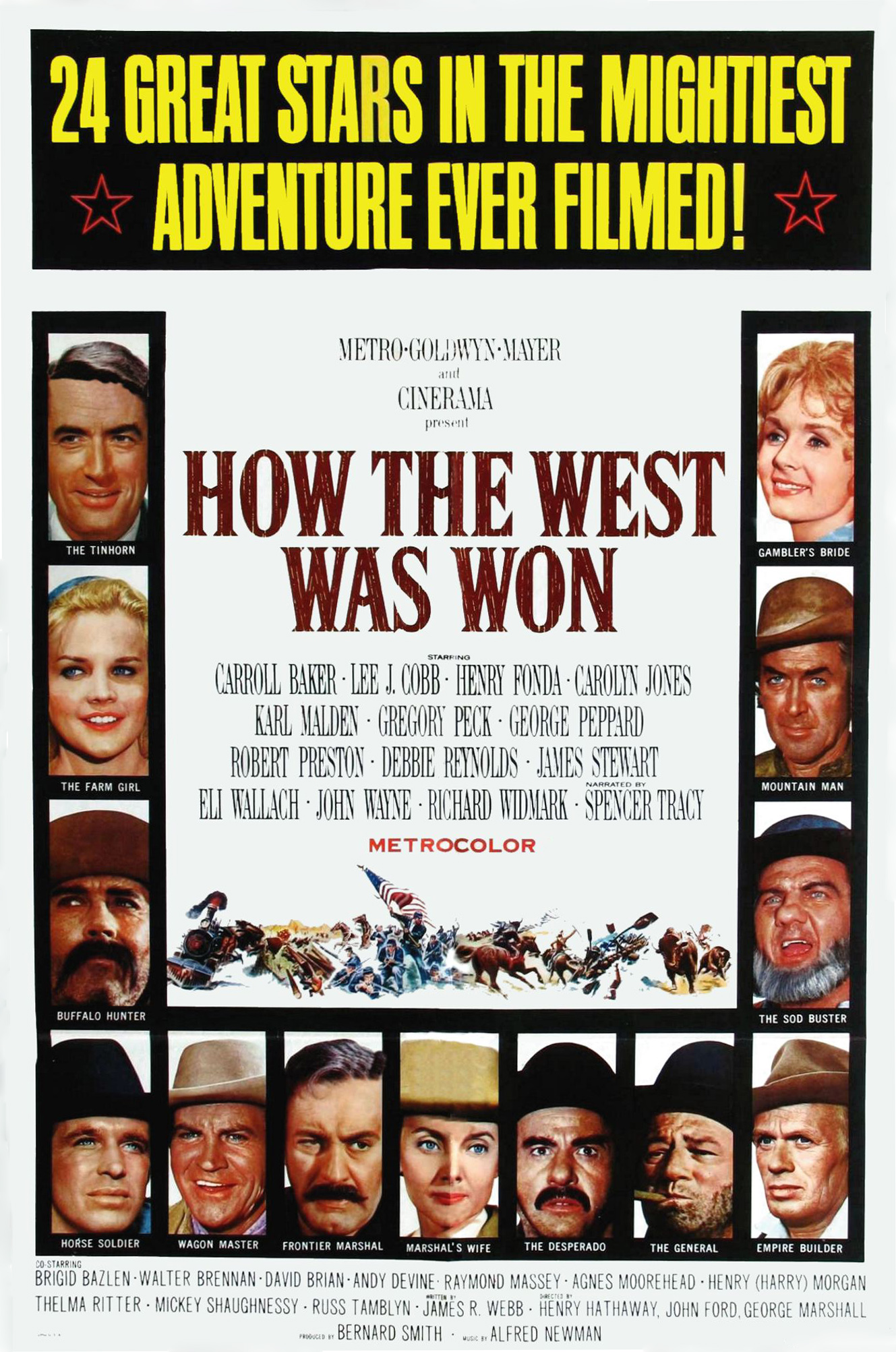
How the West Was Won

In the age of the epics -- the 1950s and 1960s -- some just stand above the rest. It's the stories, the cast, the scope. I don't love 1962's How the West Was Won but as far as epics go, there are very few in its neighborhood. There are obvious flaws, but when it works, it works in a big way. An impressive all-star cast, a story about the development of the American west and a shooting technique that is must-see. That's a winning formula.

A 162-minute film is broken up into five separate segments, the story following the Prescott-Rawlings family as it moves west and settles between the 1840s and the 1880s. It was directed by three different directors and covers a ton of ground. And away we go!

1. The Rivers (directed by Henry Hathaway): It's the 1840s, and the Prescott family, led by patriarch Zebulon (Karl Malden), is moving west and looking for a new life. In Zebulon's family is two daughters, Eve (Carroll Baker), looking for a new life in the west, and Lillith (Debbie Reynolds), wanting to stay in the far-more civilized East. In their dangerous travels on the rivers, they also meet Linus Rawlings (James Stewart), a mountain man with a canoe full of pelts.
Also starring: Lee Van Cleef, Walter Brennan, Agnes Moorehead, Brigid Bazlen.

2. The Plains (directed by Hathaway): Having worked for years on her own as a singer and dancer, Lillith Prescott (Reynolds) has just inherited a gold mine in the wake of the California gold rush. She heads west on a wagon train led by trail driver Richard Morgan (Robert Preston) with a gold-seeking gambler, Cleve Van Valen (Gregory Peck), also along too. 
Also starring: Thelma Ritter.

3. The Civil War (directed by John Ford): The war between the states in its early months, young Zeb Rawlings (George Peppard) leaves home with the blessing of his mother, Eve, to join the Ohio volunteers in the fighting. Like so many others, he thinks the war will be full of glory and be over quickly. Zeb finds out how very wrong he is at the bloody battle of Shiloh.
Also starring: John Wayne (as General Sherman), Russ Tamblyn (as a Confederate deserter), Harry Morgan (as General Grant), Andy Devine, Ken Curtis, Raymond Massey (as Abraham Lincoln).

4. The Railroad (directed by George Marshall): In the years following the Civil War, railroad companies race across the U.S. to link the two coasts. Now in the cavalry, Zeb Rawlings (Peppard) finds himself balancing out what his duty requires of him with what he knows is right, the railroad, including brutal supervisor Mike King (Richard Widmark), pushing the Arapahoes to their limit.
Also starring: Henry Fonda as Jethro Stuart, a former mountain man.

5. The Outlaws (directed by Hathaway): Having left the cavalry behind, Zeb Rawlings is now a family man with two kids, now trying to leave his profession as a lawman behind. He receives a letter from his aunt, Lillith (Reynolds), and readies the family to move. As they travel though, Zeb runs into Charlie Gant (Eli Wallach), a notorious outlaw gunning for Zeb.
Also starring: Lee J. Cobb, Carolyn Jones.

This is a movie that's simply put, BIG. It was filmed in Cinerama, three cameras filming each scene and then splicing the action together. The result? An immense look at the expansion of the west. Shots look like panoramic paintings, putting a whole new scope on the growth and development of the American west. It is a beautiful movie. Certain sequences especially stand out -- the camera on a raft trying to survive river rapids, an Indian attack on a wagon train, a stampeding buffalo herd trampling a railroad camp, a runaway train during an attempted robbery -- over the course of the movie, but visually there just isn't a weak spot. I love composer Alfred Newman's score -- listen to an extended sample HERE -- as it gives a moving background to the story. Countless gorgeous filming locations, providing a great backdrop while also transitioning from segment to segment.

It had been years since I watched this movie straight through in one sitting before my recent revisit of this 1962 epic. As you compare the five separate segments, I don't think it's really in question which one is the strongest. It's John Ford's Civil War segment, doing in 20 minutes what entire movies couldn't do in bringing the Civil War to life. Quick, dark, visually striking and unsettling, it is a gem of a sequence, especially Peppard meeting Tamblyn's Confederate deserter after the battle. The second strongest segment for me is the opening 'Rivers' with Stewart, Baker, Reynolds and Malden all leaving a positive impression. All five segments could be stretched out to a feature length film on their own, but these two especially stand out. They get their message across in a quick window and in both cases left me wanting more. Kudos to Ford and Hathaway for their work here.

What struck me more on the rewatch was the other three segments. They are by no means bad segments, but they're just not as good as the other two. I've always thought the weakest was the Plains segment, things feeling too rushed in general. The same qualifies for the Railroad and Outlaws portions. By the time you take away the Entr'Acte, intermission, and Finale music, we're looking at a movie with five segments covered in about 150 minutes (give or take). None of these three are given a chance to breathe to the point they feel downright rushed. As for some other positives? I loved the transitional scenes -- narrated by Spencer Tracy, directed in uncredited fashion by Richard Thorpe --  that set things up, explaining how America has changed, how its people change. These quick montages provide the heart of the movie, almost like a documentary in some ways. Like any movie that tries to accomplish so much, there's good and bad. The positives -- especially the Civil War middle -- is enough to outweigh the negatives thankfully.

One of my biggest worries in reviewing this 1962 epic was that the cast is too big. There's no way I was gonna be able to get all those names tagged with a 200-character limit. Who stands out? Stewart i excellent as Linus Rawlings, Fonda is good in a quick part as Jethro Stuart, and Baker is very strong too. The best parts though are Debbie Reynolds as Lillith and George Peppard as Zeb, the two hearts of the family. One or both is in every segment, the audience seeing them age, learn and adapt as America grows with them. Their scenes together in the Outlaws portion ring especially true. However you cut it though, just an impressive cast from top to bottom, one of the best ever assembled for a Hollywood film.

A doozy of a movie for what it's trying to accomplish. It falls short at times, but this is a movie worth watching for what it represents alone. This is a throwback film, a true epic that strives to be something great. If it doesn't live up those high hopes, so be it. The effort is admirable, a fascinating story of America growing up over an extremely turbulent portion of its history. Oh, and Debbie Reynolds singing A Home in the Meadow (listen HERE) is a truly beautiful song, a fitting one for the movie.

How the West Was Won (1962): ***/****

Wednesday, October 30, 2013

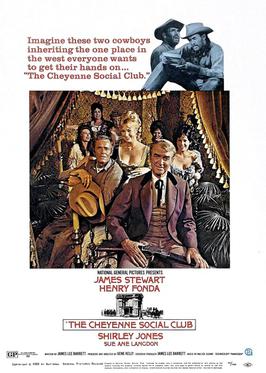
The Cheyenne Social Club

Two of Hollywood's most legendary stars, James Stewart and Henry Fonda starred together in 1968's Firecreek, a pretty solid western that pitted the two legends against each other as adversaries. Friends off the screen, the duo didn't wait long to team up again, working together on 1970's The Cheyenne Social Club.

It's 1867 in Texas and two cowboys, John O'Hanlan (Stewart) and Harley Sullivan (Fonda), are doing what they do best, punching cows on a cattle ranch, when John receives a long overdue telegram. His brother has died and has left him his business, an establishment called the Cheyenne Social Club in Wyoming. The cowboys saddle up and head north to see what's up, but they're in for a surprise. Upon arrival, they meet Jenny (Shirley Jones) at the club and quickly realize that the Cheyenne Social Club is actually a whorehouse. John had been dead set on being a property owner, but now he faces an ethical situation. Does he continue on as owner or does he switch things up, turn it into a boarding house? The city of Cheyenne may have something to say about that.

Considering the year this flick was released -- 1970 -- it's a bit of an oddity. Spaghetti westerns were still very popular in Europe, and in America a trend toward revisionist westerns with a darker tone was on the upward swing. How then does a fairly light, sexually suggestive story fit in? Surprisingly well. Oh, and the director is dancer/actor Gene Kelly?!? It's a weird, pretty out there formula that just works. It doesn't rewrite the genre, and it has its funny moments with some sexually suggestive dialogue. The tone is appropriate (light) with some darker moments late. It's been generally forgotten since its release in 1970, but it's a solid American western from an era where there just weren't many solid American westerns.

It doesn't take a nuclear scientist to figure out the main appeal here. The chemistry between Stewart and Fonda is on display here from the opening scene. Stewart does what he does best, a sort of prickly, high-voiced cowboy with some eccentricities. Mostly though, he'd just like to have something of his own in terms of property, a business, some land. Fonda's Harley reminded me of his part in The Rounders (with Glenn Ford), an easy-going, even laconic cowboy who goes with the wind. He's talkative, rambling on almost incessantly, completely oblivious that he's even doing it. His Harley just enjoys life for the little things and goes with the flow. Their cowboy partnership working cattle drives and ranches together goes back 10 years (apparently they avoided the Civil War entirely), a history that's hinted at more than directly addressed. It's two pros doing their thing perfectly and carrying a movie in the process.

I liked the dynamic between the two veteran cowboys and their surprise gaggle of high-class hookers. A pre-Partridge Family Shirley Jones is excellent as Jenny, the head girl at the Social Club who ends up going toe-to-toe with Stewart's John. Her girls of the night include Opal Ann (Sue Ane Langdon), who takes a shining to Harley, Pauline (Elaine Devry), Carrie Virginia (Jackie Russell), Annie Jo (Jackie Joseph), and Sara Jean (Sharon DeBord). Also look for Robert Middleton as an amiable and angry bartender, Arch Johnson as Cheyenne's sheriff, Robert J. Wilke as a revenge-seeking gunslinger and Dabbs Greer as John's lawyer.

As a western, I liked the message 'Club' goes for. Stewart's John begins to question what he really wants to do with his life. He delivers a good monologue late laying it all out. The longtime friendship comes under fire late when John goes after the wrong man in town, setting his family down on Cheyenne and the Social Club. That's really the only action on display in the 102-minute movie, but it's an enjoyable action set piece. It's a good movie I'm having trouble analyzing. Maybe it's not meant to be. If you like westerns, James Stewart and Henry Fonda, you'll like this one.

The Cheyenne Social Club (1970): ***/****

Monday, December 24, 2012

Malaya

Look down the right side of the page, and you'll see under 'Labels' quite a few war movies. For the most part though, most are about the actual fighting, the combat of war. What about the behind the scenes war angle though? How about the things that make a war possible, like production of planes, guns, materiel, and all that good stuff? A little change of pace today with 1949's Malaya, a shadowy film noir-ish story set in World War II.

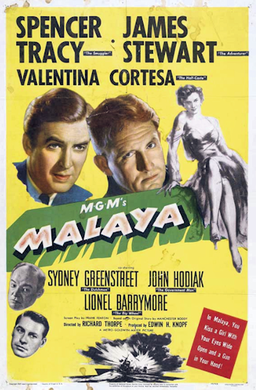
Having just escaped the South Pacific with Japanese forces on his tail, newspaper reporter John Royer (James Stewart) is approached by a former boss (Lionel Barrymore) upon arrival. The conversation turns to Royer's exploits -- sometimes shady ones -- in Asia and the Pacific, Royer admitting he knows where quite a lot of raw rubber is being stored, harvested and hidden in Malaya. As the need for war materiel increases, so does the need for rubber, used to build countless key things needed to fight the war. With backing from the government (on a somewhat backdoor-ish deal), Royer agrees to go back to Malaya and see if he can buy as much as the rubber as possible and slip it out of the country. He needs help though and arranges for a friend, former partner and smuggler, Carnahan (Spencer Tracy), to aid the cause. Together, they head into Japanese-occupied territory on their nearly suicidal mission.

Considering the star power assembled here -- and there's more -- I was surprised I had never stumbled across this WWII flick before. I'm glad I did. From director Richard Thorpe, it's a mix between a behind the lines secret agent mission with many of the conventions viewers in 1949 had come to love about the film noir genre. Filmed in black and white with Malaya as the backdrop, it is a South Pacific film noir, and I can honestly say I've never seen a movie quite like that. Okay, maybe 1952's Macao. I loved the setting here, the crowded, smoky saloon and gambling house, the alleyways and dim streets, the expansive mansions and businesses in the countryside. The combination of the war movie and the crime noir just flows well together. It's always fun to see two such vastly different genres combine (usually not this well), but the end result is a lot of fun.

Not exactly a buddy movie, 'Malaya' nonetheless plays on some of those conventions that would become so familiar to audiences over the coming years. This film was the only on-screen pairing Tracy and Stewart ever made although they were together in 1962's How the West Was Won (Tracy narrating, Stewart acting). I'm never going to complain when a film pairs two Hollywood legends like this and lets them have at it. The two play well off each other. Stewart's Royer is a journalist with quite the checkered past, but with this mission, he wants to accomplish something, something meaningful. Tracy's Carnahan is a businessman and a convincing one. He looks out for himself more than anything, questioning Royer's patriotic actions. His bottom line? Usually dollar signs. Together though, they're great, always sarcastically calling each other 'Buddy!' as the mission develops. A WWII Odd Couple noir style of sorts, it's a winning combination.

Most movies would be quite content to pair two actors of that caliber together and let things be, but Thorpe doesn't settle for just two stars. This is one impressive cast, both in star power and performances delivered. Noir veteran and perpetual scene stealer Sydney Greenstreet plays the Dutchman, a saloon and gambling house owner with his hand in everything that could make him more money who joins in with Carnahan and Royer. Valentina Cortese is the checkered woman with a heart of gold, Luana, Carnahan's long-time love. John Hodiak is underused but reliable as always as Keller, a government agent working with Royer who puts the plan in motion for his Malayan plan. Barrymore too makes what amounts to a cameo as Manchester, a businessman working with several other very well to-do businessman to help the war effort. Also look for Gilbert Roland as Romano, one of the locals who teams up with Carnahan, utilizing his "unique" skill set to help in the thieving. Richard Loo gets to sneer and leer as Colonel Tomura, the Japanese officer suspicious of what's going on.

So a story that blends WWII and noir conventions? Not bad, not bad at all. How about elements of a western too? Why not?!? I very much enjoyed how the story plays out as Royer and Carnahan deal with various rubber plantation owners, working with some, intimidating others. We see their motives and intentions though, and that goes a long way. Royer is far from an idealist, but he wants to accomplish something. Carnahan is the opposite, thinking logically. Where it comes to a fork in the road is that both men come to a point where they want to do what's right. Is is the smart decision? No, if anything it's more dangerous, but there's a code of honor of sorts. As a man, what do you decide? The ending has a bit of a cop-out, but it's not a big deal. It's a movie that blends a whole lot of different things but manages to come out the better. Well worth checking out.

Malaya (1949): ***/****

Saturday, December 15, 2012

The FBI Story

Released in 1959, The FBI Story is an interesting flick, but not always for the right reasons. Made with the support of J. Edgar Hoover and the FBI, the final product has that whitewashed, diluted feel to it. Hoover apparently ran roughshod over the making of the movie, and it shows. Some things stand out, but for the most part, it's one big dull pat on the back.

Working as a field agent in the infancy of the Federal Bureau of Investigations, Chip Hardesty (James Stewart) proposes to his long-time girlfriend, Lucy (Vera Miles), and agrees to resign his post. His timing could not be worse as the FBI is making drastic changes to become a more effective, more efficient government office. Chip maintains his status as an agent right as the U.S. is heading into some of its most tumultuous times in its young history. Chip sees all the good that he is able to accomplish through his work -- even with the danger -- while Lucy worries away at home with their growing family.

The biggest fault this movie has is that J. Edgar Hoover had any involvement at all with it. The FBI director apparently ordered film director Mervyn LeRoy to re-shoot certain scenes, insisting they show the FBI in a more positive light. So while Hoover attempted to make a movie that showed his agency for all its heroism and righteousness, the end result is a disgustingly positive "look" into the inner workings. These are Superheroes! G-Men! Infallible and can't be touched. The potential is there -- seeing the 1950s crime scene techniques, the depths an investigation will go to -- with some cool scenes, but it has an incredibly fake, forced feel. I can just see Hoover smiling like a nut thinking 'Oh, audiences will love this," almost like he's holding a door open to let us see. Nice try, Mr. Hoover.

In terms of the story, think of this movie as The FBI Story: The Forrest Gump Version. From when he joins the FBI in the mid 1920s, Stewart's Chip takes part in just about every important, watershed moment in FBI history. The Ku Klux Klan, murdered Native Americans for oil rights, shifty Communists, the gangsters of the 1930s, Axis agents in WWII, this guy does everything. The problem? In a 149-minute movie (a very long 149 minutes), none of these events are given their due. 'Story' covers 30-plus years in history, glazing over the most important -- and usually entertaining -- portions with broad strokes. All of those things are worthy of a movie on their own, but here we're treated to little windows, just snippets, of what was going on. Again, maybe chalk it up to Hoover trying to show everything the FBI has ever done? Who knows for sure. 

Unfortunately, the solution to the above-problem is simple. Yes, it's a 149-minute long movie. I would guess anywhere from 90-100 minutes is actually about the FBI. The rest? As one IMDB reviewer so eloquently put it...."Father Knows Best: With Guns." Mindlessly tedious scenes with Chip, Lucy and their family are painful to watch. It even makes the FBI snippets insanely exciting (and they're really not). Chip goes on assignment. Lucy complains, buckles and lets him go. Chip goes on assignment..........and repeat eight or nine times. It's not interesting the first time so time No. 8 isn't any better. To top it off, Stewart and Miles (one of my least favorite actresses) don't have a ton of chemistry. She comes across as shrill, and Stewart to quirky-goofy at times in their home scenes.

Any more problems? Sure, why not! Other than Stewart and Miles, 'Story' has little in the way of star power. The movie doesn't call for a cast of thousands, all big name celebrities, but on the other hand, some more recognizable faces couldn't hurt. Murray Hamilton is good if underused as Chip's partner, Sam Crandall, who climbs the FBI ladder with him. Larry Pennell plays George Crandall, Sam's son who grows up wanting to be an FBI agent like his father. Also look for Nick Adams in a small part early as a mentally unhinged individual who plants on a bomb on a commercial airliner. Unfortunately, no one else truly stands out. Disappointed here overall. You know it's bad when even Jimmy Stewart can't save a movie, but this FBI-backed story just has too many holes and flaws.

The FBI Story (1959): **/****

Thursday, October 25, 2012

Call Northside 777

This is going to sound simple, but certain movies make me think of the message. Watching old films from basically any Hollywood film is one of my favorite things to do. It can give a window into times long since past. We see towns and cities as they were, not as they are. An all-around solid quasi-documentary, film noir-ish mystery, 1948's Call Northside 777 is a gem.

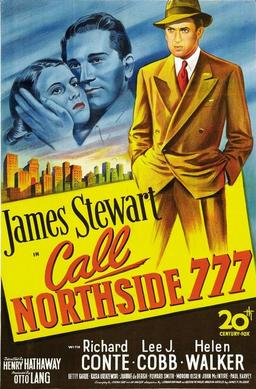
A reporter for the Chicago Times newspaper, reporter P.J. McNeal (James Stewart) is given a new assignment. An 11-year old murder case from 1932 is in the news, both Frank Wiciek (Richard Conte) and Tomek Zaleska (an uncredited George Tyne) serving 99-year prison sentences for the murder of a Chicago police officer. Wiciek's mother, Tillie (Kasia Orzazewski), a blue collar worker if there ever was, has offered a $5,000 reward for finding the real murder, exonerating her son. McNeal writes the mother's story, but it grabs attention of readers who want more of this story leaving McNeal to explore the long-retired murder case. Ever the suspicious reporter, McNeal goes along but questions the case. Could Frank actually be guilty?

Based on a true story involving the murder of a Chicago police officer (read about it HERE, SPOILERS obviously), 'Call' is an interesting movie for all the right reasons. From director Henry Hathaway, it is part documentary, part investigative procedural, part film noir. The good thing? It moves among those three different genres effortlessly. Clocking in at 112 minutes, it isn't always the quickest-paced flick, but it moves around a lot so that's excusable. A story in the shadows, taking advantage of the black and white photography, it's a great movie to watch.

For me though, this movie is worthwhile for two reasons. One, Hathaway filmed on location in Chicago. This is a great window into late 1940s Chicago. Trivia question and answer for you, but this was the first Hollywood feature film to film on location in Chicago. Where so many films from the 1940s would limit themselves to Hollywood sets, 'Call' gets a whole lot of points for filming in downtown Chicago, but the suburbs as well. Curious what the Windy City looked like 60-plus years ago? This is your movie. The other reason; as a writer who's written for the Chicago Sun-Times, it's a great precursor for All the President's Men. We see how journalists and investigators worked in a pre-Internet age, doing their investigating the old-fashioned way. It's the little things, ain't it?

Already an established star by 1947, Stewart does a solid, workmanlike job as reporter P.J. McNeal. Cynical to a point because the job requires it, McNeal is skeptical of the whole case but takes it on because it's a decent story that readers are curious about it. As the real story comes out though, he starts to question even more, giving Stewart a good chance to flex a little dramatically. Go crusading journalist! Conte is solid in a supporting role as the possibly falsely-convicted Frank while Orzazewski is a scene-stealer as his mother, Tillie. Usually a tough guy actor, Lee J. Cobb plays Kelly, McNeal's editor at the Chicago Times. Joanne De Bergh has a small but essential part as Helen, Frank's wife who supports his innocence. Also look for John McIntire as a former state's attorney trying to cover his butt and an uncredited E.G. Marshall in a small part.

There are some oddities here I feel I have to point out. For a story that's built on the small details, the little pieces of evidence, the movie itself.....isn't. Several rather key questions go unanswered in the end. We find out what happens to Conte's Frank, but what about his supposed partner, Tyne's Tomek? Why is Cobb's editor so dead-set on following this story up? A backstory is hinted at, but never dealt with. The ending is effective, but with a 112-minute movie, it comes together a little quickly, almost like Hathaway ran out of time or money. Still, these are problems but not ones that can ruin a movie. Highly recommend checking this one out.

Call Northside 777 <---trailer (1948): ***/****

Thursday, January 12, 2012

Mr. Smith Goes to Washington

It seems not a few days or weeks go by before another political corruption story hits the news circuits. Idealized maybe, but we vote elected officials into office to represent then us, and inevitably we find out that so much more was going on behind the scenes -- cough Blago cough -- that we never find out about. One of the best looks into political corruption, 1939's Mr. Smith Goes to Washington, is a true classic.

When a U.S. senator dies in an unnamed western state, naive and idealistic Jefferson Smith (James Stewart) is named to the vacant seat. The young Smith has no idea that he's been chosen to keep the seat warm for two months before reelection, an unknowing yes man to the more experienced senator from his state, Joseph Paine (Claude Rains). Jefferson is a newspaper publisher who helps run a camp for boys and has no experience in politics. He quickly finds out that he's been chosen only to serve as a dupe but decides to make the best of it, working with his assistant, Saunders (Jean Arthur), to put a bill through the Senate. He's unknowingly stepped into a high-level bill that will force him to deal with all sorts of political corruption, but can he maintain his idealist views?

As far as successful years go in Hollywood history, 1939 is basically 1, 1A and 1B. Any other years pales in comparison, and 'Mr. Smith' more than deserves it standing as one of the year's best. Teaming with Stewart (later reuniting for It's a Wonderful Life), director Frank Capra is at the helms of one of the all-time greats. It avoids some of the sappiness so prevalent in his other films and still manages to get its message across. To a 1930s audience still suffering through the Great Depression, it's message of the underdog sticking to his beliefs and cause must have hit home more. A political machine and system (Edward Arnold as the business kingpin in a frightening, real role) looking out for itself and willing to pressure and intimidate its way to riches? All too realistic. Not a heavy-handed attempt at delivering the message either, an obvious positive.

Okay, casting an idealistic, naive, well-meaning and intelligent young man stepping into a powerful government position, who better to choose than Mr. All American himself, Jimmy Stewart. I can't think of a better actor -- living or dead -- to play Jefferson Smith. His 'aw shucks' demeanor was made for this part. If this movie is going to work, you need to buy Stewart as Jefferson and everything about him. Mission accomplished then. Nominated but ultimately not winning for Best Actor, Stewart was a rising star here. You believe him and genuinely like him through all his innocence and naivete. His Jefferson Smith has become one of the more iconic movie characters ever, and it's easy to see why.

His most memorable scene is a whopper, and an entire 40-minute sequence carries this movie into another higher level. Made to look like he is one of the corrupt politicians and trying to save his good name -- among other things -- Jefferson is forced to filibuster, a political procedure that basically stalls for time. Talking and talking, the hours roll by as he tries to prove his point. This is where Capra's message comes across best, an effort by thousands of Americans -- on both sides, for good and bad -- work to help their side win. A remarkable sequence, and one that's remembered for a reason. Stewart earned his nomination with this scene alone. 

The rest of the characters are painted with some broad strokes -- good or bad -- but the performances are almost uniformly strong. Jean Arthur actually received top billing (odd in a movie called Mr. Smith), playing well with Stewart as they show off an easy-going natural chemistry. Claude Rains as Paine, the veteran senator, is the darkest part, a man who wants more politically but knows it will come at a cost; his integrity. Thomas Mitchell plays Diz Moore, Saunders' friend and a political correspondent and reporter. Guy Kibbee, Eugene Pallette and Arnold play Jefferson's main opposition with Harry Carey stealing his scenes as the President of the Senate. 

It's nice to go into a classic film and get just that...a classic. So often they're disappointing but not here. Filming on location in Washington D.C. gives a sense of realism and authenticity, and it's a beautiful city to begin with. The sets, especially the Senate chambers, become a character all to themselves. Mostly though, this is a classic about people and their beliefs, how far they're willing to take it when fighting for what they believe is right. A must-see film for movie fans.

Mr. Smith Goes to Washington <---TCM trailer/clips (1939): ****/****

Sunday, November 13, 2011

Bell Book and Candle

Working together in Alfred Hitchcock's 1958 classic thriller Vertigo, co-stars James Stewart and Kim Novak showed off an impressive chemistry that helped make the movie what it was. Stewart was Hitchcock's flawed leading man and Novak the icy blonde. So what's the natural progression as the two worked again later that year? Naturally from a murder thriller to a romantic comedy, 1958's Bell Book and Candle

A modern-day witch, Gillian Holroyd (Novak) does her best to hide the fact that she is in fact, a witch. With her brother, Nicky (Jack Lemmon), a warlock, and aunt and fellow witch, Queenie (Elsa Lanchester), Gillian is limited by what she can do without revealing herself. Running her little shop of voodoo and primitive art, Gillian has developed a bit of a crush on Shepherd Henderson (Stewart), a big-wig publisher who lives in the building. Well, sort of a crush, it can only go so far with witches. When she sees that he's engaged, she puts a hex on him, one that makes him fall in love with her. As things develop though, can Gillian tell him the truth? Can she develop feelings for just a regular old human being?

Just a couple months after reviewing Sunday in New York, here comes another well-written, well-acted, charming and even sweet romantic comedy from the 1950s and early 1960s. Where have they gone? They're just good movies. Sure, they are based in some sort of alternate universe where stories like this could actually exist, but that's part of the fun. The obvious influence this movie had is on the classic 1960s show Bewitched, a modern-day witch with her family trying to hide her "witch-dom." These aren't mean, cruel or vindictive witches -- for the most part, don't mess with Novak's Gillian -- but instead witches that are hiding who they are and struggling with it, seeing an easy way to easy cash and riches but unable to do anything about it.

The romantic pairing of Stewart and Novak might seem a little odd when you really look at it. This was actually Stewart's final role where he played a romantic interest because apparently he didn't think he was suited anymore for that type of role. He was 50 at the time while Novak was 25. So I'm no mathematician, but that's 25 years difference in age, right? For me, the age discrepancy was not an issue. If an on-screen duo has chemistry, that's great regardless of age. It can carry a movie, and here the age difference makes no impression at all. Stewart and Novak are great together, romantically, dramatically and in terms of the more obvious plays for laughs. The relationship is completely removed from the much darker Vertigo so it's fun to see two talented actors switch it up.

While I've always been familiar with her name, this was only the second movie I've seen Novak in, Vertigo being the other. She was only in 28 movies during her career, not many of them hugely popular or widely well-known. In 'Bell Book' Novak is the best thing going here. She is funny and smart and her voice is so perfectly sexy you can't help but fall for the character. Okay, well, I did. I don't care if you didn't. All I can say? I'll be looking for more movies with her starring roles. Yes, I kinda fell in love.

The rest of the cast looks to be having a lot of fun playing off the witchcraft hijinks. Lemmon and Lanchester are hysterical together, a warlord and witch quite content with their special "talents" and "abilities." Lemmon has some great scenes as the bongo band leader of a house band at the Zodiac Club, a den for witches and warlocks. Ernie Kovacs gets to ham it up as the drunken literary expert on all things mystical, including trying to write a book for Stewart's Henderson about witches in New York, not realizing what he's stepped into. Hermione Gingold is funny in a smaller part as Bianca de Passe, the higher-up of all witches, the woman to go to when some special powers are needed.

Funny, charming romantic comedy that I enjoyed from the start. Stewart is very funny, and it's a bonus seeing him do some physical comedy -- his facial expressions are hilarious -- while Novak plays off him well and is gorgeous so she's got that going for. Director Richard Quine has a real winner here.

Bell Book and Candle <---TCM trailer/clips (1958): ***/****

Wednesday, August 17, 2011

The Flight of the Phoenix (1965)

In the age of unnecessary remakes, I'm usually first in line opposing the new movies. If a movie in its original form was lacking something and with a remake could be significantly improved, then so be it.  Really though, how rarely does that happen?  A little less than two years ago, I reviewed the 2004 version of Flight of the Phoenix (a guilty pleasure that I love), a remake of the original, 1965's The Flight of the Phoenix. Even as I wrote that first review, I couldn't believe I was writing I enjoyed the new version more...but it's still true.

It is impossible to review a movie combination of an original and a remake without comparing the two so let's get that out of the way early.  The 1965 original is held in high regard thanks to its directing, survival story, and all-star cast.  As for the 2004 remake, well....it's more fun.  It is the most unnecessary of remakes, dumbing down the original with a thinner story that revolves more around action and adventure than pure survival.  I still liked it though a lot.  The problem with the original is that it just isn't as fun.  A better movie? Oh, definitely, but it does not have that re-watchable aspect that I'm always looking for in movies.

Flying a cargo plane headed to Bhengazi loaded with passengers and cargo, veteran pilot Frank Towns (James Stewart) and navigator Lew Moran (Richard Attenborough) are forced to detour when they fly into an epic sandstorm. The storm eventually knocks out both their engines, forcing them to crash land in the desert. With about a dozen survivors, survival mode kicks in with a dwindling supply of water and pressed dates as the only food around. Towns, Moran and the survivors sit back and wait, hoping a search plane or some form of rescue will save them. As the days go by though, all the men question what their fates will be. That is until a German passenger, Heinrich Dorfman (Hardy Kruger), steps forward with an idea. Why not use the wreckage from the downed plane to build a new smaller plane? Could it somehow work?

From director Robert Aldrich comes a tough, hard-edged and well-told story with no frills or distractions. This is a story about surviving in the harshest of conditions with nothing else to focus on.  These survivors of the plane crash can either sit back and die waiting to be rescued, or they can work together and try to pull off this seemingly impossible scheme. Aldrich films in the California desert (a decent stand-in for the Sahara), giving his movie a wide open, vacant feel to it.  Over the course of the movie (a sometimes long 141 minutes), we see the effects of the desert on the survivors, their skin looking like it is being torn apart by the winds and lack of water. You feel like you're there with them, going through the same things they are in a struggle to survive.

The best thing going for Aldrich's survival story is the chemistry among the cast.  Nowhere is that more evident than between James Stewart and Hardy Kruger.  Stewart's Frank Towns has been flying for decades, thousands and maybe millions of miles under his belt.  He's struggling with the guilt of knowing that some of his passengers died in the crash -- he blames himself -- and now has to deal with a primadonna in Kruger's Dorfman who wants everything done exactly as he has stated. A battle of wills ensues, both men fighting for control, their pride and vanity getting in the way of working together and surviving another day. Their scenes together bristle with tension and intensity, providing some much needed outside drama as opposed to just battling the conditions.

It is an Aldrich movie, and one of his trademarks as a director was being able to work with all-star ensemble casts.  In a career of movies with impressive casts, this might be his best.  Stewart and Kruger are great as the opposing forces with Attenborough delivering one of his all-time best performances as Moran, the second-rate navigator who's always struggled with drinking too much. The survivors of the crash include Captain Harris (Peter Finch), a long-time prim and proper, very British officer, and his not so loyal sergeant, Watson (Ronald Fraser), Dr. Renaud (Christian Marquand), Standish (Dan Duryea), a company accountant, and a group of recently relieved oil drillers including Ernest Borgnine, Ian Bannen, and George Kennedy. Star power much? Like any ensemble, all involved get a chance to shine, none disappointing here at all. Finch stands out as does Marquand, Borgnine and Bannen.

Now as a 26-year old moviegoer and film fan, I often get lumped in with a lowest common denominator crowd. I don't like reading subtitles, hate foreign movies, and only go to see new movies with nudity and/or explosions.  I resent the judgment most times, but I say that as a forewarning. It takes a lot for me to say this, but 'Phoenix' is a downright boring movie at times. The focus is on survival and the interactions among these men, but watching the survivors put together a plane out of wreckage is just not a visually stimulating thing to watch. In the night, they work. During the day, they sleep. It doesn't ruin the movie. It just slows it down at times to an incredibly slow pace.

By all means, see both movies and compare. The original is the better made, more professional and well-handled movie, but I still enjoy the dumber, more action-packed remake more.

The Flight of the Phoenix <---trailer (1965): ** 1/2 /****

Wednesday, July 14, 2010

The Shootist

As a movie star, you don't always pick how you get to ride into the sunset on the horizon.  For many, their days as a star are long past.  Others just never get that right role that allows you to end on a high note.  Well, there is an exception to every role, and that's John Wayne, one of the most iconic stars to come out of Hollywood's first 50 years with sound films. A star whose popularity went up and down some over a long career, Wayne was always in the public eye with his movies, his last part being one of his best all-time parts, 1976's The Shootist.

During the mid 1970s when Wayne was in the process of making his last few movies, The Duke was struggling with stomach cancer that would ultimately end up killing him in 1979.  More than any other time in his career, Wayne resorted to playing a version, a caricature of himself in the late 1960s and into the 1970s.  There was a comfort factor involved for both the actor and the audiences who still loved seeing him on-screen.  With an exception here and there, none of these later movies are classics, but they're all entertaining.  The Shootist is one of those few exceptions, a classic thanks almost exclusively to Wayne's performance in the title role.

It's 1901 and infamous gunfighter J.B. Books (Wayne) rides into Carson City to see an old friend of his, Doc Hostetler (James Stewart). Books has been feeling poorly, and the Doc confirms the bad news; he has cancer and only has a few months to live. The gunfighter takes a room at a boarding house run by a recent widow, Mrs. Rogers (Lauren Bacall) and her troublemaker son, Gillom (Ron Howard).  Books goes about wrapping certain things up with his life as he prepares to die, putting things in place and tying up some loose ends.  But the Doc warned him, letting the cancer kill him will be a long, drawn out and incredibly painful process.  If there was a way to quicken that death, he recommends Books do it.  So knowing what awaits him, the older, worn-out gunfighter puts together one last moment of glory.

Seven years earlier, Wayne won his first and only Academy Award for his performance as Rooster Cogburn in True Grit.  In a sense, it was a lifetime achievement award for all he had accomplished in his career.  But just on performance alone, his John Bernard Books ranks up there as one of his all-time top five.  It is a part that Wayne was born to play, plain and simple.  His Books is a dignified man with a reputation as a killer, a man who lives by certain principles and expects others to do the same.  He doesn't apologize for his past and to a certain point, is frustrated with the life he has led where every young punk with a gun wants to kill him to prove how good they are.  Easily one of the Duke's best parts, and a fitting end to a great career.

Directed by Don Siegel, 'Shootist' brings together an excellent cast, almost like a going away party for the Duke.  Having worked together 20 years before in 'Blood Alley,' Bacall and Wayne are perfect together with some of the best on-screen chemistry Wayne ever had with a female co-star.  Their scenes flow so easily, and it's just fun watching two pros show what they can do with good material.  The same for young Ron Howard who plays a different character than the viewer is used to considering his Andy Griffith and Happy Days roots.  Books becomes a bit of a father figure to Howard's Gillom and tries to teach him the lessons of how to be a man.  Along with Stewart as the doctor, there's Harry Morgan as the town sheriff, John Carradine as the undertaker, Sheree North as a lost love of Books, and Scatman Crothers as the livery stable owner.

The story builds to a certain point, and you dread where it is going -- even knowing it is where it has to go.  Books takes the Doc's advice and arranges a way so three men who would love nothing more than to put a bullet in him meet him at the same place.  If all goes well, he'll go out in one last blaze of glory, avoiding whatever the cancer can throw at him.  The trio include Richard Boone, Hugh O'Brian and Bill McKinney, all three waiting for him in a saloon. The ending is foreshadowed in a line delivered midway through the movie, but it still comes as a bit of a shock.  Of his 170 or so movies, John Wayne actually died in just eight movies, and few are as moving as this one. You can watch it HERE, obvious SPOILERS.

Beyond the sets, background and lack of gunplay, this is a movie entirely devoted to character, specifically John Bernard Books and the last few days of his life.  It is a western focusing on the changing times as the old west becomes a thing of the past, the U.S. advancing forward into a new time.  In that way, it's appropriate that the Wayne character wants no part of it.  As some characters point out, he is a relic from the previous times.  His exit then is only appropriate, going out as he came in.  One of Wayne's best and an underrated western overall.

The Shootist <----trailer (1976): ****/****

Friday, May 21, 2010

Cheyenne Autumn

A solid director early in his career, John Ford shot to stardom behind the camera thanks to success in one particular genre, the western.  Starting with Stagecoach in 1939 and continuing into the 1940s with his 'cavalry trilogy,' Ford became a go-to director westerns that he was able to put his own personal -- often romantic -- look at the American west in the latter half of the 19th century.  And in almost every one of these westerns, Native Americans were portrayed in a negative light, whether as a fearful presence or as murdering on-screen savages.

With his last western, 1964's Cheyenne Autumn, Ford did an about face in terms of the depiction with something that has since been dubbed 'white man's guilt.' Based on a true story, the movie attempts to put Native Americans in a positive light instead of the stereotypical savage so often associated with westerns.  It's a noble concept and feels like a bit of an apology on Ford's part, but too many things work against this movie from the start, ranging from the casting to the dull, slow-paced storyline.

It's 1878 and 300 members of a Cheyenne tribe on a reservation in the southwestern desert have had enough.  They don't receive supplies promised to them -- food, clothes, medicine -- and are basically being ignored by the U.S. government.  Led by two proud warriors (Ricardo Montalban and Gilbert Roland), the Cheyenne leave the reservation in the dead of night with hopes of marching almost 1,500 miles north to their ancestral hunting grounds in South Dakota and Montana.  Pursuing them is a cavalry outfit led by the sympathetic Capt. Archer (Richard Widmark) who tries his best to bring the Cheyenne in peacefully.  Nothing comes easy though and the terror sets in of 300 Cheyenne roaming the west in towns all along their trail.

To tell this story, Ford assembles a remarkable cast but as is so often the case with huge casts of big name stars, many are lost in the shuffle.  Along with those mentioned already, there's also Karl Malden, Edward G. Robinson, Dolores Del Rio, Carroll Baker, Jimmy Stewart, Arthur Kennedy, Sal Mineo, George O'Brien, and Sean McClory, along with several others I'll mention later.  Needless to say, that's a ton of talent involved, but the odd thing is almost NOTHING happens the entire movie.  It's downright dull at many points and never really gets the viewer invested in what's going on.

First off, the story does represent the Cheyennes in a positive light as a tribe just trying to survive now that their heyday has passed.  But then Ford spends a majority of the time with the white characters as the Cheyenne tribe disappears here and there for long stretches.  There's also the issue of casting Hispanic actors as Indians which just doesn't make much sense to me.  I figure there weren't many Native American actors working in Hollywood in the 1960s, but for a story trying to be authentic and fair, it would have been worthwhile to cast one or two.  Montalban and Roland represent themselves well as the warriors leading the tribe while Mineo says two or three words and enthusiastically takes his shirt off at one point.

One criticism of Ford over his career is his bawdy, broad humor that populates his movies, and Cheyenne Autumn doesn't disappoint.  About 90 minutes in, a 20-plus minute segment takes a complete detour from the story for some incredibly out of place humor in Dodge City with Stewart playing Wyatt Earp and Kennedy playing Doc Holliday.  Besides being incredibly miscast as the famous gunfighters, the tone of this extended segment is comical and over the top.  The tone to this point has been downbeat if not entirely interesting, and we get a segment here that is ripped right from any of the cavalry trilogy.  This comedic segment is so out of place that it can be difficult to watch in its badness.

What I enjoyed most about this movie were the scenes on the trail with the Indians or with the cavalry pursuing them.  Widmark makes the most of a part that just doesn't give him much to do, but Ford seems incredibly comfortable in the cavalry scenes.  Patrick Wayne (the Duke's son) plays Lt. Scott, a young officer out for blood, Mike Mazurki plays the veteran sergeant, and in a nod to Rio Grande and She Wore a Yellow Ribbon, Ben Johnson and Harry Carey Jr play troopers Plumtree and Smith. A running bit between the two has Archer consistently forgetting Carey's name.  Both parts were uncredited ones for the veteran character actors. Maybe because it feels like a throwback to better westerns, but the cavalry portions of the story are infinitely more watchable than much of the rest of the movie.

For all its flaws, 'Autumn' is still worth watching just to see that huge cast work together and as is typical with a Ford western, the Monument Valley scenery.  Through all the movies ever shot there, I don't know if its ever looked better serving as a backdrop for the story.  Overall though, this is an average movie from a great director like Ford.  It's too inconsistent to call a good western, but one that fans should still see.  A disappointing but intriguing last western from one of the genre's best.

Cheyenne Autumn <----trailer (1964) **/****    

Thursday, February 4, 2010

The Rare Breed

A few months back I reviewed a western from director Burt Kennedy named 'Young Billy Young' starring Robert Mitchum. Kennedy made a career of straight-laced, been there and done that movies that still managed to be entertaining. Another director from the 1960s, Andrew V. McLaglen, could have been separated at birth from Kennedy.

Comparing the two directors' filmographies, McLaglen comes out on top with a deeper selection of worthwhile movies. Of course, that doesn't necessarily mean he was a great director. More and more, I think his success in directing was a result of a nice trio to have when making a movie. One, great casting, two, lots of action, and three, a well-written script (with some obviously better than others). But looking through McLaglen's movies, they can't all be winners, like 1966's The Rare Breed.

A long-time television director who directed almost 200 combined episodes of Gunsmoke and Have Gun Will Travel, McLaglen had finally hit the jackpot on the big screen with McClintock and Shenandoah. Both stories had their similarities, tough, family men trying to live their lives amidst a strong conflict. Most of McLaglen's movies followed a tried and true formula and were the better for it. But with his next movie, The Rare Breed, he is undone by an awful script that is about as unbalanced as they come that results in an incredibly dull finished product.

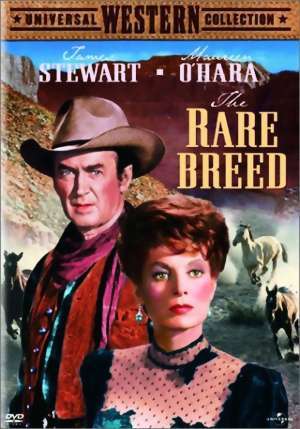
After traveling from England to the U.S. with a prize hereford bull, Martha Price (Maureen O'Hara) hopes to crossbreed her Hereford bull with the famous longhorns that roam across Texas and the west. With her daughter Hilary (Juliet Mills) along, Martha finds a buyer who pays handsomely for the animal, and then a cowboy, 'Bulldog' Sam Burnett (James Stewart) to help get the Hereford where it needs to be. Seeing a chance for some quick, easy cash, Burnett makes a deal with another rancher to "lose" the animal en route. There's another cowboy on their trail, a gun-wielding psycho, Simons (Jack Elam), who has plans of his own for the bull and the money.

Netflix only slightly recommended this late 60s western, but with the talent involved I thought it was a safe bet that I'd enjoy it. I wasn't looking for an instant classic, just a good movie. The story and the characters though are so uneven and all over the place that 'Rare Breed' never gets into any rhythm. Even at just 97 minutes, it felt incredibly long, and I found myself fast-forwarding for most of the last hour. If a movie doesn't grab you early, it probably won't later on either.

The idea of the Hereford cow moving into the west is nothing new but still presents a unique setting. The cattle drive was an integral part of the west in the 1800s and has been used many times before, handled best in Lonesome Dove and in a similar way in James Michener's Centennial. All three, including 'Rare Breed,' deal with the changing times as technology and innovations in all fields push the wild west into the history books. But this McLaglen entry never takes a stand and says anything, if anything help push the good old days out the door.

A bright spot in this dud is James Stewart who brings his character to life where it just as easily could have been a cardboard cutout of a character. Unfortunately, the rest of the cast isn't so good, and it's not necessarily their fault. O'Hara was an ideal woman to ride along with the fellas in the action/adventure genre; she was tough but endearing, hardhewn but likable, and her looks never hurt. But her Martha is dead on arrival here and not a good role at all. In the weird casting department, Brian Keith plays Bowen, a mad Scotsman living on his forted-up ranch in Texas. Typically I like Keith, especially as a character actor, but here he is every stereotype imaginable of a Scottish man. Other cast members include Ben Johnson as a crippled cowboy who is gone by the 15-minute mark, Harry Carey Jr as Elam's partner (gone by the 45 minute mark), and Perry Lopez, who you'd better look fast for in the background.

If you're going to assemble a pretty solid cast like this, give them something to do at least. Elam's villain is dispatched about 45 minutes in, and with him goes any conflict or sense of danger the story had. The second Keith's son is introduced is also the exact second you can predict the ending to the movie. It's not that this is a bad movie, it just has a lazy feel to it. The music is generic, the script plodding, and some truly awful looking greenscreen effects. Some California locations look nice, but when the filming location is the best thing about the movie you know you're in trouble.

The Rare Breed <---trailer (1966): * 1/2 /****