The Sons of Katie Elder

The Sons of Katie Elder
"First, we reunite, then find Ma and Pa's killer...then read some reviews."
Showing posts with label James Donald. Show all posts

Tuesday, January 27, 2015

Third Man on the Mountain

When people think of Walt Disney, any number of movies come up. Go ahead. Think of a classic Disney flick. Okay, did you pick one? I bet it was an animated movie, and there's absolutely nothing wrong with that. In the 1950s and 1960s though, Disney backed some of my all-time favorites, many of them live action flicks like The Love Bug, Swiss Family Robinson and of course, the Davy Crockett episodes on TV's Disneyland. Let's give another one a try, 1959's Third Man on the Mountain.

Growing up in the mountain village of Kurtal in Switzerland, Rudi Matt (James MacArthur) has spent his life dreaming of being and doing one thing. He's working in town as a dishwasher at the hotel, but he aspires to be a mountain guide for tourists and climbers who want to explore the nearby mountains. Mountain climbing in his blood though, even if that stigma hangs over his head. Why? When Rudi was just a boy, his father died on an immense, intimidating mountain that towers over the town, the Citadel. No one has ever even made it up the mountain, but Rudi's father and his legend grew. Rudi wants to live up to his famous name and may get a chance when a famous mountain climber, John Winter (Michael Rennie), visits the town with an intention of becoming the first person to ever climb the Citadel. Winter takes a liking to young Rudi and sees the potential. Could the younger climber join him in his dangerous climb?

That Walt Disney fella, he sure knew what he was doing. From his TV shows to movies to marketing to his theme parks, Disney simply knew what audiences wanted. Read more about his Walt Disney Pictures HERE. He didn't pander to any one demographic. These were movies families could watch together where both parents and the children could enjoy them. Director Ken Annakin works with an interesting story with composer William Alwyn turning in a solid score (the duo would work together again a year later on the classic Swiss Family Robinson). I don't put 'Mountain' in classic status because there are some issues, but it's still a solid movie with some really easy to recommend moving pieces.

Quite the familiar face in Disney movies, MacArthur had already starred in The Light in the Forest, starred here in 'Mountain' and would star in two later Disney ventures, 'Swiss Family' and Kidnapped. Just 21 at the time of filming, MacArthur brings that ideal youthful charm to the part. You believe him as a teenager. Considering his background of losing his father at a young age, we're rooting for him to reach all of his goals, to become the mountain climber that his Dad would have been proud of. A young actor who's likable and natural. Go figure, but it works. I've always been a MacArthur fan because of 'Swiss' and TV's Hawaii Five-O, and even at a young age, he shows off that natural on-screen ability. He's got some good scenes with another Disney favorite and Swiss co-star, Janet Munro, and a former mountain guide who he looks up to, Uncle Teo, played by Laurence Naismith.

In casting his films and TV shows, Disney often was able to pick out that ideal actor for the perfect part, often with names you might not think of. Rennie is excellent as famous mountain climber John Winters, a mentor who becomes a sort of father figure to Rudi. Also look for James Donald as Rudi's uncle, Franz, who is worried his nephew will follow in his father's steps and ruin his life with all its dangers. Herbert Lom plays Emil Saxo, a guide from another village with some selfish intentions. Even MacArthur's mom, Helen Hayes, makes a quick appearance as a tourist at the hotel.

Above all else, there's one BIG old reason to watch this Disney flick. It's the mountain scenery with Disney deciding to film on-location in Switzerland in the Alps. The climbing footage shot up on the mountains is absolutely stunning with the Matterhorn serving as the film's Citadel. This movie serves as a prime example of why I love older films. There wasn't any computer-generated images available so the alternative...well, was to ACTUALLY FILM STUFF!!! Production involved stunt doubles and climbers actually climbing and the resulting footage is stunning to watch. Just beautiful stuff to watch. When filming in the mountains became unfeasible, equally beautiful matte paintings stood in for the action. All the while, we see insert shots of MacArthur, Rennie, Donald and Lom all climbing to add that little touch of realism and authenticity.

The movie struggles at times with the more personal, dramatic moments off the mountains, but it's a minor flaw relative to the overall success. The cast is very good, the visual and mountain locations pitch perfect. Another winner from Mr. Disney.

Third Man on the Mountain (1959): ***/****

Wednesday, November 26, 2014

The Bridge on the River Kwai

When you're talking about great prisoner of war movies, that conversation is inevitably going to come down to two movies. For me, it's an easy distinction, an easy pick for which one is the best. That's one of my two favorite movies ever, 1963's The Great Escape. What's the other classic P.O.W. film? One of Hollywood's all-time greats, 1957's The Bridge on the River Kwai.

It's 1943 in western Burma and a battalion of British prisoners has arrived at Camp 16 along the Burma Railway. Allied prisoners are being used all along the railway to help build the tracks and bridges it needs to move supplies up and down the country. The commandant of the camp, Colonel Saito (Sessue Hayakawa), has been given a quick deadline in order to build a bridge over the river Kwai, but he quickly hits a roadblock in the form of the ranking officer among the Brits, Colonel Nicholson (Alec Guinness). Both men are career officers, both of them stubborn and strong-willed that they know what is right and how to do it. What follows is a battle of wills as the two commanders see who will crack first with the deadline fast approaching. Unbeknownst to both of them, Allied intelligence has caught wind of the bridge across the river. A former prisoner, Shears (William Holden), of the camp is working with an experienced commando, Warden (Jack Hawkins), to lead a team back into Burma and take out the bridge. 

That David Lean, he was a halfway decent director, winning two Best Picture Oscars in his storied career. One win was for Lawrence of Arabia. One was for River Kwai. My favorite? You're reading that movie's review right now. It is a film remembered as one of the all-time greats, and it deserves that status. The portrayal of war, its message about war, the instantly recognizable Colonel Bogey March (listen HERE), the phenomenal casting, the on-location shooting in Ceylon (Sri Lanka), the gorgeous filmography, and a great musical score overall from Malcolm Arnold. The scale is gigantic, but the story remains personal. It is a giant movie with an ability to never lose its focus or get too far away from where it wants to go. On my most recent viewing, I thought (more than I remember) there were some slow/sluggish portions in the 161-minute movie but not nearly enough to fault an otherwise pretty perfect movie.

The name evades me, but I remember seeing another British actor say in an interview "I didn't understand the Nicholson part until I saw Guinness' performance." That's how good Alec Guinness is in his Oscar-winning performance. This is an incredible acting job, a layered character that is baffling at times to understand. Colonel Nicholson is a fascinating character because his word, his beliefs and his stubborn make-up are everything to him. If he believes he is right, he IS right. This is a career soldier willing to put his life on the line to stand by his beliefs. A career officer, he knows nothing else other than the army. His dynamic with Hayakawa's Col. Saito is the guts of the movie, two officers believing they're right and seeing who will blink first. Who needs the other more to accomplish their goal? A late scene where Guinness' Nicholson discussing his career illuminates what drives the man. He wants to leave something that will be remembered. He does, but what if it helps the Japanese war effort?

What a cast! Guinness rightfully deserves first mention, but that's only the start. William Holden's character, Shears, is underwritten some, but it is a necessary, still very interesting character to move the action along. Holden is one of my favorites, and I liked his Shears, especially when a big twist is revealed near the halfway point. Jack Hawkins is just solid as Warden, the unlikely commando officer, an interesting similarity to Nicholson in the very, very British officer category. Hayakawa at times gets lost in the conversation, but he too is highly memorable as Saito, rough facade, terrified/worried inside at a possible failure. James Donald (also starring in The Great Escape) is the viewer, playing Major Clipton, the medical officer, trying to figure things out, to understand what's going on. Also worth mentioning is Geoffrey Horne as Joyce, the young, inexperienced commando trying to prove he can handle the job.

Also look for Andre Morell as Colonel Green, a key officer in Force 316, and Percy Herbert and Harold Goodwin as two British soldiers in the camp, Grogan and Baker.

Without resorting to hitting us over the head with a message, Lean does an understated job of delivering an anti-war message. What is it? Well....war is crazy. This isn't a horrifically violent movie, and the portrayals of a Japanese P.O.W. camp are pretty tame, but 'Kwai' effortlessly lays out all these different responses to war. Shears = Survival. Warden = A job. Clipton = Chaos and confusion. And Nicholson? A career. There are some moments of humor, usually pretty dark, mostly cynical, but Lean's movie (working off a novel by Pierre Boulle) presents the lunacy of war and simply lets it breathe. Decide for yourself who is right, if anyone.

So let's talk about that ending. No real SPOILERS here, but still, I'm talking (hopefully vaguely) about the finale. Great movie overall, one of the best ever. The ending to 'Kwai' is maybe top 5 finales to a movie ever as Force 316 (Warden, Shears, Joyce, a Siamese guerrilla and several Siamese girls) attempts to destroy the bridge at its grand opening. With nothing given away, there's a twist that is too perfect to describe. The last 35-40 minutes are phenomenal, and it only gets stronger in the final 15 minutes when the twist is revealed. Talk about tension built to an almost unbearable level. You can't believe what you're seeing, especially when Nicholson makes an amazing decision. It is a finale that leaves you drained and hammers home Lean's anti-war message. In the end, what is accomplished and at what cost? Boulle's finale is a doozy, a true whopper, if you read the novel.

Sometimes movies just work, a synergy of everything assembled clicking together. It is a beautiful movie, and Arnold's score works in unison with that visual, especially when Warden, Shears, Joyce and Co. finally arrive deep in the jungle at the bridge site. It is the first time we're seeing the completed bridge, and there's something simple and beautiful about the structure. Arnold's score soars, and all the pieces fit together. I think that's the beauty of it. This is my favorite David Lean movie overall, and it deserves its status as an all-time classic.

The Bridge on the River Kwai (1957): ****/****

Saturday, March 17, 2012

The Vikings

In the age of the epic in the 1950s and 1960s, there wasn't a historical era not covered by Hollywood ranging from ancient times in Ben-Hur and Spartacus to more modern times like Around the World in 80 Days and Lawrence of the Arabia. Not quite on the scale of those movies but just as entertaining, 1958's The Vikings is an underrated epic that is as much fun now as it was over 50 years ago.

Leading a raid on an English camp, Viking warrior/chief Ragnar (Ernest Borgnine) rapes the English queen who secretly gives birth to a son nine months later. Almost 20 years pass and Ragnar is still leading his Viking warriors, his son, Einar (Kirk Douglas), at his side. Neither are aware that the son,  Erik (Tony Curtis),  has been among them for the last 20 years, living as a slave to the Vikings, unaware he is Ragnar's son and Einar's half-brother. Erik has an intense rivalry with Einar -- each one wanting to kill the other -- and it is ratcheted up even further when Ragnar's warriors kidnap the young woman, Morgana (Janet Leigh), promised to the king in marriage. Both men fall in love with her as the Vikings prepare a surprise attack on the King's castle.

The appeal of many epics is the scale. They aren't always fun movies, just big movies. From director Richard Fleischer, this is an exception. At 116 minutes, it isn't as long as so many 3-plus hour epics, but it is fun, entertaining and still manages to present an impressive scale of the time of the Vikings. It was filmed in the fjords of Norway while also visiting Germany, France and Croatia, the locations providing an accurate and stunningly beautiful backdrop for the adventure story. The music is especially memorable from composer Mario Nascimbene, including the main theme (listen HERE) that you'll be whistling for days. What's so fun about it all is Fleischer and his cast and crew committing to being accurate as possible. The sets look like actual Viking villages. Three Viking warships were built from actual blueprints of Vikings ships, and the shots of these ships, packed with warriors, making their way up the sun-lit fjords is a stunning visual. The movie shows the day-to-day lives of these people. We see some of their rituals, their beliefs, their parties, and it feels authentic from the very start.

Working together for the first time -- they'd reunite two years later in another epic, 1960s's Spartacus -- Douglas and Curtis are great leads, the half-brothers who are unaware they're related. Douglas isn't a villain, but he clearly isn't the good guy either, his Einar an anti-hero if he's anything. It's a big, showy part for Douglas, the type of role he excelled at. Curtis gets the less-interesting character, but his intense part as Erik is still worthwhile. Mrs. Tony Curtis -- Janet Leigh -- is the eye candy, the beautiful Morgana who finds herself in a love triangle and must choose who she truly loves. If you're going to do a love triangle, do it right like 'Vikings' did here. Life and death, an intense rivalry where the stakes are high, not just a happy winner and a mopey loser. Also be careful not to poke your eyes out with Janet Leigh's pointiest of bras.

My favorite character though is from Ernest Borgnine as Viking chief Ragnar. It's funny that he's cast as Douglas' father because in real-life he's actually two months younger than his movie "son." Just like Douglas is perfectly cast as Einar, so is Borgnine. Heavily bearded and spouting his love for the Viking god Odin, Ragnar is an exaggerated, scene-stealing part for Borgnine. I can't think of a better duo to play these larger-than-life ancient heroes. For a topper, Ragnar's death scene is one of the all-time greats, a man literally laughing death in the face. Also look for James Donald as Egbert, an English lord secretly working with the Vikings, and familiar epic bad guy Frank Thring as Aella, the weakly English king, and Eileen Way as Kitala, the Viking medicine woman who is in touch with all the Viking gods.

From the time I first saw this movie as a kid, it was the action sequences that stuck with me. I remembered Douglas' Einar running across the rigid oars of the Viking ships as they returned to the village, but the high point is the finale, a Viking assault on Aella's heavily guarded castle on the English coast (actually Fort-la-Latte in France). A real castle, it is a gorgeous setting for the attack in all its scale, seemingly hundreds of Vikings bursting through the gates and scaling the walls. Einar's entrance to the castle -- climbing up a ladder of thrown axes into the raised drawbridge -- stands out, Douglas doing some of his own stunts. It concludes with an epic showdown at the top of one of the castle's towers, Einar dueling with Erik. Both Douglas and Curtis handled much -- if not all -- of their stunts, making the dangerous fight scene a couple hundred feet up even more impressive. Action galore, the ending is a whopper of a climax.

Part of the appeal here is of childhood memories, but it stands the test of time. It isn't remembered as well as many other historical epics, but it's just as fun and probably more entertaining than many more. Big story, memorable theme, great cast, and can you really go wrong with those bloodthirsty, fun-loving Vikings? I submit that you cannot. The movie is available to watch at Youtube, but it's 111 minutes while the DVD runs 116 minutes so something's missing.

The Vikings <---trailer (1958): *** 1/2 /****

Wednesday, June 1, 2011

The Great Escape

I have two favorite movies, neither of which I'm able to pick one over the other.  I love them both, and all other movies come after it, first is 1960's The Alamo which I've reviewed before and then there's 1963's The Great Escape. Introduced to it at a young age when I showed an interest in history, I've probably seen it 25 or 30 times straight through, and another 75 or 100 catching bits and pieces. For me, it is that rare perfect movie. Great story, impressive cast, exciting action, and one of the best soundtracks ever. You can't ask for much more.

In World War II, both the Allies and Axis forces had to deal with how to handle prisoners of wars. In Germany, the Luftwaffe, the German Air Force, was placed in charge of these Allied prisoners, placing them in P.O.W. camps all over their occupied territory. These prisoners -- as was their sworn duty -- tried countless escapes over the length of the war in typically small groups, sometimes getting as many as a dozen out. But one true story set the bar for heroism and courage among the prisoners, the true story of 76 prisoners escaping Stalag Luft III in March 1944. Literally hundreds of prisoners were involved in the effort as the escape even had an impact on D-Day some three months later.

It's 1943, and a new prison camp has been built. The German Luftwaffe has taken the worst prisoners from all their camps and thrown them in this new camp that features all the security aspects they've learned from previous camps.  In this "perfect" camp, the Germans (Hannes Messemer is the commandant) intend to watch these men very carefully. Leading the prisoners is Roger Bartlett (Richard Attenborough), dubbed 'Big X' for his leadership at the top of the 'X Organization,' a team of prisoners working together to bust out as many captured soldiers as they can. Bartlett has bigger plans though this time around. Instead of just getting two or three prisoners out, he intends to get 250 out of the camp with a large-scale plan that includes three extremely long tunnels under the barbed-wire fence. The plan seems impossible, but the prisoners go to work, slowly working their way toward escape.

Do you know the line 'They don't make them like they used to?' This movie applies. Director John Sturges (one of my favorites and an underrated filmmaker overall) turns in his all-time best film, one that stands at or near the top in the lexicon of World War II movies. It is based in fact, sticking to the details and truths in the story, without getting bogged down.  There is action, humor (never overplayed, just natural humor arising from the situation), and characters you love and are generally rooting for. Composer Elmer Bernstein turns in a score that is one of the greats, especially the main theme, listen HERE. Bernstein's score both drives the story as needed and keeps it grounded in the quieter, emotional scenes (including one where a tunnel is discovered and its tragic consequences).  Sturges filmed in Germany -- as his assistant said, 'Germany looks like Germany.' An entire camp was built, an exact duplicate of the actual camp, bringing this 1963 epic up another notch in terms of realism and authenticity.

Sturges' movies were famous for their male-dominated ensemble casts, but this may be his most impressive. Start with Steve McQueen as Hilts, the motorcycle-riding 'Cooler King,' the role that shot him to international stardom. Then there's James Garner as Hendley, the scrounger, and Attenborough as Bartlett, the prisoner's top man, a brilliant mind who comes up with this improbable plan. Not bad, huh? Oh yeah, there's also James Donald as Ramsey, the senior British officer, Charles Bronson and John Leyton as Danny and Willie, the tunnel kings, James Coburn as Sedgwick, the manufacturer, Donald Pleasence as Blythe, the forger, David McCallum as Ashley-Pitt, "dispersal," and Gordon Jackson as MacDonald, the intelligence officer. Other prisoners include Nigel Stock, Jud Taylor and Angus Lennie in a small but essential part as Ives, Hilt's progressively wire-happy partner. A more impressive cast could be impossible to assemble.

What is amazing is that even with all those stars -- some on the rise, some already established -- is that they all register, they all make a lasting impression in a positive way. More on McQueen later, but Attenborough delivers a career-best as Big X, the driven even obsessed leader who wants to take the war back to the Germans, not sitting out the war comfortably as his captors intend. Garner's Hendley bonds with Pleasence's Blythe in some of the movie's most touching scenes, two very different people forming a friendship. Bronson and Leyton as the tunnel kings certainly make an impression, carving three tunnels out of the Earth 30 feet below the surface. Bronson is at his best, a Polish flyer with claustrophobia who hides his fear of small, enclosed spaces and digs. Coburn doesn't get a ton to do compared to the others, but is his usual, laconic self. There is not a weakness in the cast from top to bottom.

When movie fans think of The Great Escape, they usually go right to Steve McQueen, a rising star who got his crack at the big time here and didn't disappoint.  His Capt. Virgil Hilts is one of his most iconic roles, the loner, trouble-making American prisoner who attempts escape attempt after attempt.  What's funny is that his character basically disappears for vast stretches of the movie, only to reappear after a stint in the cooler and steal every scene he is in. This is McQueen at his laid back, scene-stealing best. With all the notable actor's actors around him, he is the unquestioned star thanks in great part to the finale, a motorcycle chase across Germany with his captors in hot pursuit. It is one of the greatest chases sequences ever, caped with one of the most impressive stunts ever, a 7-foot jump by stunt man Bud Ekins over a high-strung barbed-wire fence. McQueen is my favorite, but this is always his best to me.

With a final run-time of 2 hours and 53 minutes, Sturges' true story doesn't have to rush along at a lightning pace...but does anyway. The first 105 minutes or so focus exclusively on the escape attempt, putting all the little details together that need to happen. The first and biggest of course is the digging of the tunnels, 30 feet down and over 300 feet straight out. A track is built to transport prisoners/diggers, and wooden boards are needed to shore up the entire length of the tunnel. Up above, forgers create documents, tailors make clothes, Intelligence gathers information, all part of an elaborate system of security and watchmen to make sure nothing is discovered by their ever-vigilant German guards. It would have been easy for this movie to get bogged down in these details, but The Great Escape revels in them, making the mundane and possibly boring, exciting at a breakneck pace.

It is a movie called 'The Great Escape' though, and it is at its most exciting once the prisoners do escape, 76 of them in the dead of night spread out all over the German countryside. The escape attempt covers the last hour of the movie, an incredible extended sequence that is hard to top. It is almost entirely dialogue free, Bernstein's score playing over the action the whole way. Finally free of their camp, the prisoners make their efforts to hopefully reach freedom, some by train, some by bikes, others by planes, and in Hilts' case, a stolen German motorcycle.  Sturges was an action master, and this may be his tour de force sequence.

I could go on and on with this movie, and I've already sort of done so. My head is full of little tidbits of information that I've picked up over the course of repeated viewings.  Above all else through the drama, the facts, and the action is that Sturges gets the tone right from Paul Brickhill's source novel, and most importantly, the true story it is based on. These men did the impossible in an impossible situation. Knowing their chances of escape back to freedom were slim, they plodded on when they could have just as easily quit. If you didn't know and just read the details -- check out the Wikipedia entry HERE for more details -- you would say there's no way this happened, but somehow, some way, it did. The ending hits you square in the stomach as it should, but the movie ends on a positive note; McQueen's Hilts once again in the cooler, bouncing his baseball off the wall.  You may capture him again, but you'll never stop him from trying.

A perfect movie, one of the best around, and one of my two favorite movies.

The Great Escape <---trailer (1963): ****/****

Sunday, April 17, 2011

In Which We Serve

When I hear British director David Lean's name, I typically think of one thing and one thing only; epics.  Huge, monstrous movies like Lawrence of Arabia, Doctor Zhivago, The Bridge on the River Kwai. Basically, everything that is good and right about movies when handled correctly with the right crew, cast and story. Even one of the most respected directors of all-time has to start somewhere though, right? You don't jump right in and get an epic movie handed to you. Still, for a first movie, 1942's In Which We Serve is quite the first impression.

Making his directorial debut, Lean shares the director's chair with British writer/actor Noel Coward who also stars in the movie. I try my best to keep my reviews as different as possible without repeating topics, but I can't help it with this one. It pertains to the time the movie was released, in this case a WWII movie hitting theaters during WWII. We're not talking late in the war either when the end result had all but been decided. We're talking 1942 when the war was very much still up in the balance. We never actually see any German soldiers/sailors/pilots as the story focuses exclusively on the British armed forces, specifically the Navy. The tone though is certainly one meant to inspire although to Lean and Coward's credit, it isn't straight propaganda. Instead, it's a story of people rising up and working together in one of history's darkest chapters.

It's the middle of WWII and a British destroyer, the HMS Torrin, is sailing through the Mediterranean in support of the invasion of Crete. Commanded by Captain Kinross (Coward), the Torrin is attacked by German dive bombers and the crew is forced to abandon ship. In all the chaos, a small group of survivors manage to get off the ship -- including Kinross -- and cling together on a small life raft, hoping that a rescue effort is coming to save them. As they await their hopeful rescue, they look back on how they got to this point, reflecting on the ship being made and the coming years as WWII broke out. They think back, remembering their families, their friends, and their stories, all the while hoping time won't run out on them.

Telling the story of an HMS destroyer and her 300-man crew, 'Serve' has a cross-section of actors filling out the ranks so we get to know all sides of the story, not just the captain and the officers or the lowly sailors.  Coward's Captain is the stiff upper lip commander, unshakable in battle and a courageous leader. He addresses his men three different times, the third and final time being the most moving. Then there's Seaman Shorty Blake (John Mills), a young sailor with an expecting wife back home.  He's the lower/middle class sailor, the representative of the crew more or less. There's also Chief Petty Officer Hardy (Bernard Miles), an intelligent if somewhat clueless officer who you nonetheless come to like. Also look for Richard Attenborough in his first film, an uncredited but worthwhile role, and James Donald as the Torrin's on-board doctor.

It's best to think of this as two movies. First, the plight of the survivors which is handled briefly but fairly. How much can you show of 10 or 11 men clinging to a life raft without the proceedings getting tedious?  Second, the flashbacks of Coward, Mills, Miles, and even Attenborough briefly. While those too are tedious at times (how many times can we see sailors say goodbye to their wives and still have it mean something?), they end up being worthwhile. Stories that deal with the home front are few and far between, especially anything documenting London and England during the massive German bombings.  Getting to these scenes can be a slow-go at times, but the wait is worth it. Worthwhile parts for the women left behind include Celia Johnson as Mrs. Kinross, the captain's wife, Joyce Carey as Kath Hardy, the doting but tough wife of the petty officer, Kay Walsh as Freda, Blake's fiance and eventually his wife, and Kathleen Harrison as Mrs. Blake, Shorty's always-worrying mother.

Whether it was released in the 1940s when audiences needed a positive jolt or 30 years later in the 1970s when audiences were more cynical, a war movie has to leave some impression on you to be truly effective. Coward's last address of his men is well-handled, but two other scenes hit me. SPOILERS STOP READING SPOILERS Blake finds out that Hardy's wife and mother-in-law were killed in a bombing and has to deliver the news, a poignant scene showing two men struggling with how exactly to handle the situation. Second, after the Torrin sinks, Blake's mother receives a telegram saying her son is alive. Her genuine relief, her screaming to tell his wife hit me right in the gut in terms of emotional impact. So that's what I'll take away from this movie which does have its dry spots. A moving story that could have been better, but still worthwhile.

In Which We Serve <---full movie (1942): ***/****

Saturday, July 24, 2010

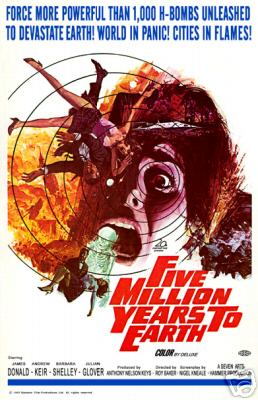
Five Million Years to Earth

Not as well known now as they were even 10 years ago, Hammer Film Productions ruled the horror movie scene for almost 30 years during the 1950s through the 1970s.  Horror movies were everywhere, but these British-made movies were extremely popular with their low-budget look and feel, the gothic stories, and of course, a fair share of gore.  TCM recently showed a Hammer film that went a different route, and with mixed results, 1967's Five Million Years to Earth.

As someone who doesn't usually seek out horror movies, I can say the scariest part of a movie is usually the build-up (for me at least).  Present a situation, drop a couple of hints that all hell is about to break loose, and let the imagination run wild.  This Hammer horror flick is a great example of that, leaving the viewer guessing as to what's coming.  The first hour reminded me a lot of Jaws in that sense as you wait for the shark to actually be shown on-screen.  But where seeing Jaws jump out of the water at Chief Brody is one of the greatest movie shockers of all-time, 'Five Million' falls short in the 'A-HA!' moment.

A subway station is being extended in London when workers stumble across a handful of oddly-shaped skeletons.  Two archaeologists/specialists are called in Dr. Roney (James Donald) and Professor Quatermass (Andrew Keir) to supervise the excavation of what else they can find.  A handful of skeletons are found that look like ape ancestors of a human, but slightly different from what you'd expect.  More than that though, as the excavation continues a large object that looks like a space ship is uncovered that is impermeable to anything thrown at it.  Roney and Quatermass are baffled, but the professor starts to do research and finds out that this spot where the object was found has long been a source of fear and evil-doings.  Meanwhile, an army colonel (Julian Glover) believes it is an unexploded WWII rocket that poses no threat, but he couldn't be more wrong.

The build-up is where this horror flick is at its best, the clues slowly filtering out as to what these skeletons and space ship really are.  As they do their research, Roney and Quatermass (along with Barbara Shelley's assistant character) figure out that the location dates back hundreds of years and contains many documented instances of strange occurrences with no valid explanation.  I know not revealing what the ship actually contains probably isn't feasible -- I would have been pissed -- but the story is always more interesting when you're guessing what could happen, not what does happen.  Stop reading if you don't want to know the reveal. SPOILERS for the next paragraph SPOILERS

When the ship actually reveals its cargo, it's about as low budget as possible.  They're martians from thousands of years ago (or I guess maybe five million) who traveled to Earth in hopes of finding a new location to live.  How do they get rid of the occupants already living here?  Releasing huge amounts of energy that will cause humans to turn on each other, killing anyone who is different.  That premise is perfect, and for a movie released in the midst of the Cold War and all its paranoia, it is even better.  One great scene late has a crowd of men cornering a single older man, ready to pounce on him and kill him.  They're like zombies, staring him down and moving slowly.  But it's just one scene, and the ending makes that one good scene a waste.

Here's a case of a small budget killing the momentum.  The martians look to be 3-feet tall praying mantises.  Terrifying, huh?  Worse than that, the scientists/doctors use a contraption that allows you to see into a person's subconscious, their dreams.  By touching the space ship, we can also see the subconscious of dead martians!  The "footage" is black and white with little models of hundreds of martians killing each other.  I think, it looked like they were just walking around to me.  Then when the energy does escape, it comes in the shape of a cloud that looks like a martian, or to me, Marvin Martian. Low budget limitations are one thing, but this was just awful, and the solution is even worse.

Not an awful movie because of the strength of the first hour, but this Hammer horror film goes downhill quickly.  The main set of the excavated subway station is pretty cool, very claustrophobic as it encases something evil inside, and the cast is solid if unspectacular.  The script has them scrambling around looking for answers most of the time while other characters make decisions so stupid nobody in their right mind would go along.  Kinda like the end of the movie.

Five Million Years to Earth <----trailer (1967): ** 1/2 /****

Wednesday, February 18, 2009

Lust for Life

Certain movies can also single-handedly be carried by one performance, Mickey Rourke in The Wrestler and Daniel Day-Lewis in There Will Be Blood are just two recent examples. Add Kirk Douglas as artist Vincent Van Gogh to that list for his performance in 1956's Lust for Life. It was an Oscar-nominated performance, he lost to Yul Brynner in The King and I (I really don't understand that decision), with great supporting performances from Anthony Quinn, who won a supporting Oscar for his part as Paul Gauguin, and James Donald as Theo, Vincent's older brother.

The movie starts out with a positive before a word is spoken. With red hair and sporting a beard, Douglas looks like the Dutch painter. The actual performance is one of the actor's best and was one of three Oscar-nominated roles. Douglas portrays both sides of Van Gogh. At his best, Vincent just wants to create art and paintings that will brighten people's days. Even beyond the art, he wants people to be happy. At his worst, he is like a caged animal prone to outbursts and violent attacks who late in his life developed mental illnesses that have not even now been diagnosed. An incredibly physical actor but also one who could handle the emotional scenes, Douglas makes both aspects of the character believable.

Quinn doesn't have a huge part, but it's a goodie. As Gauguin, he is both Van Gogh's best friend and worst enemy. There's a friendship between them that comes from similar experiences, as this scene shows. They have deep, intellectual conversations about art and what inspires them, but sometimes these talks devolve into screaming matches, one of them leading to Van Gogh slicing off part of his ear. Quinn was always able to pull off fiery roles, and this one doesn't disappoint. The scenes of conflict between the two actors are scary in their reality. I thought one or the other was going to throw a punch.
James Donald as Theo gets the less meaty role, but it's a part that drives the film and keeps it moving. Much of his part is reading Vincent's letters to his brother so we get a picture of what Vincent is going through but also how his brother reacts. All his life, Theo looked out for his brother, encouraging him to become the best painter he could be. Donald made a career out of key supporting roles, and this is one of his better parts.

Obviously with a bio-film of a famous artist, the paintings and sketches are on display throughout. In some of the movie's most effective scenes, Van Gogh's letters to Theo are read while his paintings are shown on screen. I've never been an art afficionado in any sense of the word other than "Hey, I like that one," but seeing the struggles Van Gogh went through during his life make me appreciate his art more. I still might not completely understand what he's going for with his paintings and their meanings, but I have some idea now, or at least I like to think so.

Don't miss this film though, it's worth watching just to see the fire and emotion Douglas brings to the role. Here's the trailer, and I agree again with the post. Douglas should have won the Oscar...