One of those great Hollywood tough guys, Jack Palance was without a doubt, one of the best heavies around in film. He was great in those tough, can't keep down parts that ranged from heroes to dastardly villains, especially in 1953's Shane where he played one of the western genre's all-time great villains. So in the 1950s as he played a lot of anti-heroes, a lot of out-and-out bad guys, it's cool to see him in a well-told, somber western from 1957, The Lonely Man.
In a quiet, dusty western town, a man with quite the reputation, Jacob Wade (Palance), rides up the street looking to find someone. His reputation leans heavily toward the wrong side of the law, Wade gaining notoriety as a gunfighter, a killer, a bandit, and wherever he goes, that name precedes him. He finds the man he's looking for, Riley (Anthony Perkins), a young man, a bit of a loafer around town who goes about his own business quietly. Who is he? He's Wade's son, the son he hasn't seen in over 15 years since leaving him and the boy's mother, hitting the outlaw trail of sorts. After all those years apart though, Wade wants to do right by his son, setting him up with a ranch, some cattle. It will be small at first, but with some hard work, it can flourish....if Riley wants anything to do with his long-lost father's help. It's more than that though. Men from Wade's past are on his trail, men looking to exact revenge on the infamous gunslinger.
Well, here we sit. It is movies like this that make me such a huge fan of the western. There's nothing particularly out of this world unique, nothing you probably haven't seen in other, more well-known westerns over the years. And you know what? There's nothing wrong with that. From director Henry Levin, 'Lonely' is a well-told, old-fashioned story that I liked from the beginning. It gets to the core of what can be so right about westerns. Ultimately, it's about doing what's right, even if it'd be easier to turn and ride out. It's about living up to your word, standing by a friend when he's in trouble, and doing your damnedest to live up to what you should be whether it's loyal, honest or hard-working. As Davy Crockett said, 'Know you're right and go ahead.' In story terms, it doesn't get more straightforward than that.
We get that perspective that would be dealt with years later in movies like Ride the High Country, The Magnificent Seven and The Wild Bunch through the eyes of Palance's Jacob Wade (apparently not related to THIS Jake Wade). His outlaw is trying to put that outlaw past behind him, but that past may not allow it. He regrets the things he's done, the men he's killed, those he's put at risk. It may be too late to save himself, but in his son, there remains some sort of hope for a better future. Palance could be a gem at chewing the scenery, but he was at his best here when he underplays everything. He keeps it inside, the emotions brewing and waiting for an outburst. It is a part that brims with intensity, but it never comes over the top. The chemistry between Palance and Perkins is excellent, a father who wants to help the son he abandoned (supposedly), a son who wants nothing to do with the offer of help. The father-son dynamic works across most genres, and that's no different in the western.
Now that supporting cast. Yikes, just yikes. Some of those familiar faces would go onto bigger and better in the coming years, but that's our benefit. There's a very deep cast that western fans will definitely appreciate from top to bottom. Neville Brand gets the lead villain part as King Fisher, a former saloon owner who has a bullet he carries with Wade's name on it, some of the lead still in his leg. His gang includes Lee Van Cleef, Elisha Cook Jr., and Adam Williams. Robert Middleton has a strong, key supporting part as Ben Ryerson, a former member of Wade's gang, now riding with him trying to put the boy on the right track. There's also a quick part for Claude Akins, a former gang member looking for some "help" with John Doucette riding by his side. Even look for Denver Pyle in an early appearance as a sheriff who knows Wade's reputation.
There's some issues here, but nothing huge. The story is a tad slow, even at 88 minutes dragging in bits and pieces. The subplot with Elaine Aiken's Ada, a saloon girl who rode with Wade and wanted to settle down with him, doesn't develop as much as it could have. When Perkins' Riley shows some interest, I'd had about enough with that part of the story. For the most part though, things work and they work well. A somber, soft score permeates the emotionally-charged family story, and the locations in the Alabama Hills in California are a gorgeous backdrop to the developments across the board. It isn't a perfect western, but it is a really good one that genre fans will definitely enjoy. You pretty much know where it's building early on, but getting to the finale was part of the fun. An easy western to recommend.
The Lonely Man (1957): ***/****
The Sons of Katie Elder
"First, we reunite, then find Ma and Pa's killer...then read some reviews."
Showing posts with label Neville Brand. Show all posts
Sunday, July 13, 2014
Tuesday, May 27, 2014
Tora! Tora! Tora!
One of the most infamous days in American history, December 7, 1941 is one of those instantly recognizable dates. The ones that live on in history itself. The Japanese surprise attack on Pearl Harbor was a world-changer, the United States thrust into World War II in a flash. Released in 1970, Tora! Tora! Tora! takes an almost documentary look at one of the most horrific days in American history.
In 1941, World War II is raging across Europe, Adolf Hitler's army marching and conquering all over the continent. In Japan, a new commander, Admiral Yamamoto (So Yamamura), has been named in the Japanese Navy with huge plans in play. Negotiations have been going on for months with the America and will continue for months to come. The American fleet all over the Pacific waits and braces for an attack that many believe is imminent while American intelligence back in Washington D.C. tries to decipher countless pieces of information, clues and evidence that will point to Japan's intentions. Will the Japanese attack? At the navy base at Pearl Harbor in the Hawaiian islands, Admiral Himmel (Martin Balsam) tries to decide what to do next. As the end of November 1941 nears, a meticulous Japanese plan of attack is put into action; much of the fleet sailing toward Pearl Harbor to unleash a surprise attack that hopes to cripple the American navy.
From director Richard Fleischer, with Kinji Fukasaku and Toshio Masuda directing the Japanese sequences, 'Tora' is the anti-Longest Day. While that 1962 epic told the true story of the D-Day invasion at Normandy with an epic cast of Hollywood legends, 'Tora' goes for the true story angle but without the star power. Fleischer and Co. are interested in the details, the history, the build-up, the intelligence, the government responses, all those little things that history buffs will eat up. It takes a little while to get going -- clocking in at 144 minutes overall -- but it is never dull and once it finds its rhythm, the momentum gets going in a big way. This was a movie that struggled in American theaters but was a huge hit in Japanese theaters. Why is that you ask?
Well, the true story of the attack on Pearl Harbor is hard to believe in itself. There's no way it should have worked on so many levels. That's where 'Tora' is special. The Japanese surprise attack was a brilliant military plan, a reliance on air power leading to the success and that almost complete surprise on the American naval base. From the American side, any number of people and issues impacted the attack. Intelligence reports were handled slowly and sent to the wrong people and places. When the radar spotted the hundreds of Japanese fighters, reports were ignored. It's an amazing series of events, Fleischer's movie interested in all those little things. 'Tora' finds its groove near the hour-mark as the attack becomes imminent. The shots of the Japanese fighters and bombers taking off from carrier decks in the pre-dawn darkness as the sun rises in front of them are eerie, oddly beautiful and intensely uncomfortable as we know what their plan will accomplish.
That's the movie at it's absolute best. Nominated for five Academy Awards, 'Tora' won the award for Best Special Effects. Why? Because of the extended attack on Pearl Harbor, bringing one of the darkest moments in American history to life. The Pearl Harbor sequence is remarkable, starting about the 100-minute mark. The amount of ground it covers is remarkable from the attacks on Battleship Row to Hickam Field and anything and everything in between of military importance. The camera films from ground level to put the American POV in perspective while also filming in the air to give the view the Japanese pilots saw as they attacked. The sequence of the Japanese planes flying across Hawaii to Pearl Harbor especially resonated with me in terms of the reality of what we're watching. Amazing aerial sequences, some incredible stuntwork, and composer Jerry Goldsmith's score boosting it all up a notch, this is a sequence that works on all levels. It brings the horrors of the real-life incident to life to the point it is uncomfortable to watch. A great sequence.
With hopes of leaving the focus on the true story of the attack on Pearl Harbor, the cast was filled out with recognizable, respected actors who didn't exactly have star power. Among the high-ranking American military, look for Balsam, James Whitmore and Jason Robards, and with the Intelligence, E.G. Marshall and Wesley Addy. Among the Japanese there's Yamamura as Admiral Yamamoto with Takahiro Tamura as the flight commander leading the attack on Pearl with and Eijiro Tono as the Admiral leading the attack group across the Pacific toward Hawaii. There's gotta be a 100 or so speaking roles so far too many to mention here, but also look for Joseph Cotten, Richard Anderson and Neville Brand among many others.
An interesting movie basically across the board. Told from both the American and Japanese perspectives on seemingly countless levels, you get an excellent sense of the events leading up to the attack on Pearl Harbor, the actual attack, and the immediate fallout. It ends on a somber note, the world truly thrust into the war at this point on an international level, Yamamoto expressing his thoughts. "I fear all we have done is to awaken a sleeping giant and filled it with a terrible resolve." Profound words and a fitting end to the movie.
Tora! Tora! Tora! (1970): ***/****
In 1941, World War II is raging across Europe, Adolf Hitler's army marching and conquering all over the continent. In Japan, a new commander, Admiral Yamamoto (So Yamamura), has been named in the Japanese Navy with huge plans in play. Negotiations have been going on for months with the America and will continue for months to come. The American fleet all over the Pacific waits and braces for an attack that many believe is imminent while American intelligence back in Washington D.C. tries to decipher countless pieces of information, clues and evidence that will point to Japan's intentions. Will the Japanese attack? At the navy base at Pearl Harbor in the Hawaiian islands, Admiral Himmel (Martin Balsam) tries to decide what to do next. As the end of November 1941 nears, a meticulous Japanese plan of attack is put into action; much of the fleet sailing toward Pearl Harbor to unleash a surprise attack that hopes to cripple the American navy.
From director Richard Fleischer, with Kinji Fukasaku and Toshio Masuda directing the Japanese sequences, 'Tora' is the anti-Longest Day. While that 1962 epic told the true story of the D-Day invasion at Normandy with an epic cast of Hollywood legends, 'Tora' goes for the true story angle but without the star power. Fleischer and Co. are interested in the details, the history, the build-up, the intelligence, the government responses, all those little things that history buffs will eat up. It takes a little while to get going -- clocking in at 144 minutes overall -- but it is never dull and once it finds its rhythm, the momentum gets going in a big way. This was a movie that struggled in American theaters but was a huge hit in Japanese theaters. Why is that you ask?
Well, the true story of the attack on Pearl Harbor is hard to believe in itself. There's no way it should have worked on so many levels. That's where 'Tora' is special. The Japanese surprise attack was a brilliant military plan, a reliance on air power leading to the success and that almost complete surprise on the American naval base. From the American side, any number of people and issues impacted the attack. Intelligence reports were handled slowly and sent to the wrong people and places. When the radar spotted the hundreds of Japanese fighters, reports were ignored. It's an amazing series of events, Fleischer's movie interested in all those little things. 'Tora' finds its groove near the hour-mark as the attack becomes imminent. The shots of the Japanese fighters and bombers taking off from carrier decks in the pre-dawn darkness as the sun rises in front of them are eerie, oddly beautiful and intensely uncomfortable as we know what their plan will accomplish.
That's the movie at it's absolute best. Nominated for five Academy Awards, 'Tora' won the award for Best Special Effects. Why? Because of the extended attack on Pearl Harbor, bringing one of the darkest moments in American history to life. The Pearl Harbor sequence is remarkable, starting about the 100-minute mark. The amount of ground it covers is remarkable from the attacks on Battleship Row to Hickam Field and anything and everything in between of military importance. The camera films from ground level to put the American POV in perspective while also filming in the air to give the view the Japanese pilots saw as they attacked. The sequence of the Japanese planes flying across Hawaii to Pearl Harbor especially resonated with me in terms of the reality of what we're watching. Amazing aerial sequences, some incredible stuntwork, and composer Jerry Goldsmith's score boosting it all up a notch, this is a sequence that works on all levels. It brings the horrors of the real-life incident to life to the point it is uncomfortable to watch. A great sequence.
With hopes of leaving the focus on the true story of the attack on Pearl Harbor, the cast was filled out with recognizable, respected actors who didn't exactly have star power. Among the high-ranking American military, look for Balsam, James Whitmore and Jason Robards, and with the Intelligence, E.G. Marshall and Wesley Addy. Among the Japanese there's Yamamura as Admiral Yamamoto with Takahiro Tamura as the flight commander leading the attack on Pearl with and Eijiro Tono as the Admiral leading the attack group across the Pacific toward Hawaii. There's gotta be a 100 or so speaking roles so far too many to mention here, but also look for Joseph Cotten, Richard Anderson and Neville Brand among many others.
An interesting movie basically across the board. Told from both the American and Japanese perspectives on seemingly countless levels, you get an excellent sense of the events leading up to the attack on Pearl Harbor, the actual attack, and the immediate fallout. It ends on a somber note, the world truly thrust into the war at this point on an international level, Yamamoto expressing his thoughts. "I fear all we have done is to awaken a sleeping giant and filled it with a terrible resolve." Profound words and a fitting end to the movie.
Tora! Tora! Tora! (1970): ***/****
Thursday, January 2, 2014
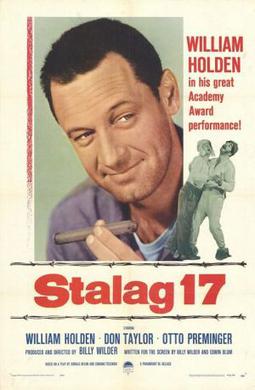
Stalag 17
Well, there are just certain movies I should have reviewed by now. I've mentioned on multiple occasions how much I like prisoner of war movies like The Great Escape and Bridge on the River Kwai, but the first one to really put the WWII sub-genre came along in 1953, Stalag 17, a classic that doesn't always get its due.
It's nearing Christmas in 1944, and a breakout is planned in Stalag 17, a German prisoner of war camp deep in Germany for Allied fliers. The night of the escape, the two prisoners making the attempt are machine gunned outside the barbed wire fence, leaving the prisoners they left behind in Barracks 4 to question what's going on. How did the Germans know details of the escape? The prisoners look to J.J. Sefton (William Holden) as the culprit, a possible stoolie who trades and bargains with the German captors for all sorts of luxuries from eggs to cigarettes to booze. Maybe Sefton has been giving away all their secrets for his own benefit, but Sefton knows otherwise. He may be a chiseler, but he's not a traitor. The problem is simple though, he can't prove it. Who among the other prisoners in Barracks 4 is the real culprit? He's going to need an answer and need it quick before his bunkmates decide they've had enough of him for good.
From director Billy Wilder, 'Stalag' is a gem of a film, one of my favorites going back to when I was a kid. It was based on a Broadway play that had 472 showings over its run. The stage-based play roots are obvious, but in a good way. Filmed in a very appropriate, very effective black and white, 'Stalag' is set almost entirely in Barracks 4 as the story develops, Christmas approaching ever quicker. The only departures we have from the barracks are outside into the camp compound. We never leave the camp, the entire story based in Stalag 17. The crowded, claustrophobic barracks becomes another character with the bunks almost bumping into each other, the windows with the frost and ice sticking to the panes, the clothes hanging from lines hung from wall to wall. Franz Waxman's uncredited score is solid as well if underplayed, Johnny Coming Marching Home a key component of the story as well.
One of three nominations the movie received went to William Holden as Barracks 4 chiseler and general trouble-maker J.J. Sefton. Nominated for his part in Sunset Boulevard but not winning, Holden got a much-deserved win here, taking home the Oscar. More impressive? He was going up against Burt Lancaster and Montgomery Clift in From Here to Eternity. Holden brings this character to life, a less than sympathetic but still appealing individual who's decided to make the most of his prisoner of war status. He's going to live in comfort, and if that means dealing/trading with his German captors, then so be it. It's not an issue until his bunkmates decide he's the traitor giving the Germans all their secrets. This is where Holden's acting steps up a notch, a desperate man now fighting for his survival instead of his personal comfort. Not often remembered as one of his best, but it's a goodie.
Holden's performance comes as part of a very solid ensemble cast that doesn't feature a ton of A-list stars, instead turning to a group of familiar character actors. Start with Robert Strauss as Animal and Harvey Lembeck as Harry Shapiro, the barracks cut-ups, Richard Erdman as Hoffy, the barracks chief, Peter Graves as Price, barracks security, Neville Brand as Duke, the hothead, and Gil Stratton as Cookie, Sefton's mousey assistant, and Robinson Stone, Robert Shawley, and William Pierson rounding out the bunch. Don Taylor co-stars as Lt. Dunbar, a prisoner in transit who comes under SS questioning, Jay Lawrence his impersonating, smart-mouthed traveling companion, Sgt. Bagradian. The comedy between Animal and Harry gets to be a little much at times, Bagradian's impersonations a little forced, but as a collective whole it's a good, strong, deep group of interesting characters.
It is hard to watch this without seeing the obvious influences some 10-plus years later with TV's Hogan's Heroes. Director Otto Preminger stars as Von Scherbach, the Stalag commander, an old-school German aristocrat and gentleman while Sig Ruman plays barracks guard Sgt. Schulz, a VERY obvious influence on John Banner's famous Sgt. Schultz character in the TV show.
An episodic story that clocks in at exactly 120 minutes, there really isn't a slow moment in Wilder's Stalag 17. In directing his film, Wilder decided to shoot chronologically so that way the cast and crew wouldn't know the twist -- the identity of the barracks traitor -- until the end of filming. The first hour or so of the movie blends the drama and comedy nicely setting up the second half of the movie. As the barracks traitor story comes to the forefront, that's when '17' is at its best. The last 30 minutes are pretty perfect, Holden's Sefton starting to piece the clues together in a great couple scenes, Wilder's talent fully on display in shooting style, while the actual reveal and the finale are spot-on. This is a movie that doesn't always get the recognition it deserves, but it sure deserves it. One of my favorites.
Stalag 17 (1953): ****/****
It's nearing Christmas in 1944, and a breakout is planned in Stalag 17, a German prisoner of war camp deep in Germany for Allied fliers. The night of the escape, the two prisoners making the attempt are machine gunned outside the barbed wire fence, leaving the prisoners they left behind in Barracks 4 to question what's going on. How did the Germans know details of the escape? The prisoners look to J.J. Sefton (William Holden) as the culprit, a possible stoolie who trades and bargains with the German captors for all sorts of luxuries from eggs to cigarettes to booze. Maybe Sefton has been giving away all their secrets for his own benefit, but Sefton knows otherwise. He may be a chiseler, but he's not a traitor. The problem is simple though, he can't prove it. Who among the other prisoners in Barracks 4 is the real culprit? He's going to need an answer and need it quick before his bunkmates decide they've had enough of him for good.
From director Billy Wilder, 'Stalag' is a gem of a film, one of my favorites going back to when I was a kid. It was based on a Broadway play that had 472 showings over its run. The stage-based play roots are obvious, but in a good way. Filmed in a very appropriate, very effective black and white, 'Stalag' is set almost entirely in Barracks 4 as the story develops, Christmas approaching ever quicker. The only departures we have from the barracks are outside into the camp compound. We never leave the camp, the entire story based in Stalag 17. The crowded, claustrophobic barracks becomes another character with the bunks almost bumping into each other, the windows with the frost and ice sticking to the panes, the clothes hanging from lines hung from wall to wall. Franz Waxman's uncredited score is solid as well if underplayed, Johnny Coming Marching Home a key component of the story as well.
One of three nominations the movie received went to William Holden as Barracks 4 chiseler and general trouble-maker J.J. Sefton. Nominated for his part in Sunset Boulevard but not winning, Holden got a much-deserved win here, taking home the Oscar. More impressive? He was going up against Burt Lancaster and Montgomery Clift in From Here to Eternity. Holden brings this character to life, a less than sympathetic but still appealing individual who's decided to make the most of his prisoner of war status. He's going to live in comfort, and if that means dealing/trading with his German captors, then so be it. It's not an issue until his bunkmates decide he's the traitor giving the Germans all their secrets. This is where Holden's acting steps up a notch, a desperate man now fighting for his survival instead of his personal comfort. Not often remembered as one of his best, but it's a goodie.
Holden's performance comes as part of a very solid ensemble cast that doesn't feature a ton of A-list stars, instead turning to a group of familiar character actors. Start with Robert Strauss as Animal and Harvey Lembeck as Harry Shapiro, the barracks cut-ups, Richard Erdman as Hoffy, the barracks chief, Peter Graves as Price, barracks security, Neville Brand as Duke, the hothead, and Gil Stratton as Cookie, Sefton's mousey assistant, and Robinson Stone, Robert Shawley, and William Pierson rounding out the bunch. Don Taylor co-stars as Lt. Dunbar, a prisoner in transit who comes under SS questioning, Jay Lawrence his impersonating, smart-mouthed traveling companion, Sgt. Bagradian. The comedy between Animal and Harry gets to be a little much at times, Bagradian's impersonations a little forced, but as a collective whole it's a good, strong, deep group of interesting characters.
It is hard to watch this without seeing the obvious influences some 10-plus years later with TV's Hogan's Heroes. Director Otto Preminger stars as Von Scherbach, the Stalag commander, an old-school German aristocrat and gentleman while Sig Ruman plays barracks guard Sgt. Schulz, a VERY obvious influence on John Banner's famous Sgt. Schultz character in the TV show.
An episodic story that clocks in at exactly 120 minutes, there really isn't a slow moment in Wilder's Stalag 17. In directing his film, Wilder decided to shoot chronologically so that way the cast and crew wouldn't know the twist -- the identity of the barracks traitor -- until the end of filming. The first hour or so of the movie blends the drama and comedy nicely setting up the second half of the movie. As the barracks traitor story comes to the forefront, that's when '17' is at its best. The last 30 minutes are pretty perfect, Holden's Sefton starting to piece the clues together in a great couple scenes, Wilder's talent fully on display in shooting style, while the actual reveal and the finale are spot-on. This is a movie that doesn't always get the recognition it deserves, but it sure deserves it. One of my favorites.
Stalag 17 (1953): ****/****
Monday, November 25, 2013
The Desperados (1969)
Guerrilla warfare has been around....well, probably as long as war itself has. In American history, guerrilla warfare goes back into the French and Indian war, especially the American revolution, but in my goofy head, I always think of the Civil War as when the guerrilla fighting took a particularly nasty turn. Because it was so vicious -- Bleeding Kansas, Quantill's raiders -- not as many films explore the topic. Unfortunately, the ones that I've seen that do jump in...they're not very good. As for 1969's The Desperados, it isn't very good, but it is badly entertaining.
It's late in the Civil War, a group of Confederate guerrillas led by Josiah Galt (Jack Palance), a former parson, is doing its best to terrorize Union forces in the western theater. Among his men are three of his sons, including David (Vince Edwards), who's grown disgusted with their tactics. Following one attack on a peaceful town that degenerates into a massacre, David decides to leave his father's group. He's caught though and sentenced to death by his own father, only managing to escape at the last minute. David manages to start a new life, marrying his sweetheart, Laura (Sylvia Syms), and with the end of the Civil War thinks he may be safe. Years pass, but Josiah is still at the head of his gang of guerrillas turned bandits, terrorizing Texas and the southwest. David hopes he can steer clear, but the Galt gang may be heading his way.
I had never heard of this western -- at all -- before finding it on the Movie Channel (original name, huh?). I'm always curious to see little known westerns like this so I recorded it, and here we sit. From director Henry Levin (with backing from producer Irving Allen), 'Desperados' has the distinct feel of an American western posing as a spaghetti western. Maybe it was cheaper, but it was definitely filmed in Spain and not the American west. The look of the film -- in La Pedriza and Colmenar Viejo, Spain -- is definitely one of the most positive aspects of the game. The cynical/dark nature of the story with some Greek/Roman mythological undertones combined with some surprisingly bloody violence all leans toward the spaghetti western genre. It isn't though, just a decent American impression.
The biggest part of the Greek tragedy from mythology comes in the story's focus on the Galt family. Who better to play a nutso family patriarch with some bizarre religious beliefs than Jack Palance? The answer you're looking for is No One. Given a second career in Europe with spaghetti westerns, Palance hams it up like only he could. He's big and loud and all over the place in a part that -- as usual -- borders on being too much. Edwards is okay as the do-good David, but he gets lost in the shuffle too much as the heroic brother who wants to do the right thing. He does rock some awesomely big hair so he's got that going for him. Also starring as the Galt brothers are George Maharis as Jacob, the loyal brother who sticks with his father through thick and thin, while Adam (Christian Roberts) is nuts, the youngest and possibly unhinged brother.
Having some fun in a key supporting part is Neville Brand as Marshal Kilpatrick, the peace officer who knows David's true identity and wants to help him lead his new life. Kate O'Mara plays Adah, a dance hall girl/prostitute who worries about David's well-being and that of his family. John Paul plays Sheriff Lacey, another peace officer who questions David's intentions.
Basically across the board, this is a pretty weird western. It is at its strongest early on when the Civil War is raging, the pace slowing down some once the war ends and David settles down to a new life. The finale makes up for some of the goofiness in the middle, including a final twist that definitely caught me by surprise. On top of the surprising violence -- lots of blood post-shooting -- is some really funny and bizarre nudity. At one point, a pimp/saloon owner stands over his girls who are topless wrestling (strategic places are covered up). All very tasteful. There's also some concealed nudity with Syms swimming, Edwards dangling her clothes just out of reach. It's just that kind of western. Pretty odd, at times really bad, but mostly entertaining. Where else can you see a preening Jack Palance screaming and taunting his grandson who he intends to kill? The answer is nowhere.
The Desperados (1969): ** 1/2 /****
It's late in the Civil War, a group of Confederate guerrillas led by Josiah Galt (Jack Palance), a former parson, is doing its best to terrorize Union forces in the western theater. Among his men are three of his sons, including David (Vince Edwards), who's grown disgusted with their tactics. Following one attack on a peaceful town that degenerates into a massacre, David decides to leave his father's group. He's caught though and sentenced to death by his own father, only managing to escape at the last minute. David manages to start a new life, marrying his sweetheart, Laura (Sylvia Syms), and with the end of the Civil War thinks he may be safe. Years pass, but Josiah is still at the head of his gang of guerrillas turned bandits, terrorizing Texas and the southwest. David hopes he can steer clear, but the Galt gang may be heading his way.
I had never heard of this western -- at all -- before finding it on the Movie Channel (original name, huh?). I'm always curious to see little known westerns like this so I recorded it, and here we sit. From director Henry Levin (with backing from producer Irving Allen), 'Desperados' has the distinct feel of an American western posing as a spaghetti western. Maybe it was cheaper, but it was definitely filmed in Spain and not the American west. The look of the film -- in La Pedriza and Colmenar Viejo, Spain -- is definitely one of the most positive aspects of the game. The cynical/dark nature of the story with some Greek/Roman mythological undertones combined with some surprisingly bloody violence all leans toward the spaghetti western genre. It isn't though, just a decent American impression.
The biggest part of the Greek tragedy from mythology comes in the story's focus on the Galt family. Who better to play a nutso family patriarch with some bizarre religious beliefs than Jack Palance? The answer you're looking for is No One. Given a second career in Europe with spaghetti westerns, Palance hams it up like only he could. He's big and loud and all over the place in a part that -- as usual -- borders on being too much. Edwards is okay as the do-good David, but he gets lost in the shuffle too much as the heroic brother who wants to do the right thing. He does rock some awesomely big hair so he's got that going for him. Also starring as the Galt brothers are George Maharis as Jacob, the loyal brother who sticks with his father through thick and thin, while Adam (Christian Roberts) is nuts, the youngest and possibly unhinged brother.
Having some fun in a key supporting part is Neville Brand as Marshal Kilpatrick, the peace officer who knows David's true identity and wants to help him lead his new life. Kate O'Mara plays Adah, a dance hall girl/prostitute who worries about David's well-being and that of his family. John Paul plays Sheriff Lacey, another peace officer who questions David's intentions.
Basically across the board, this is a pretty weird western. It is at its strongest early on when the Civil War is raging, the pace slowing down some once the war ends and David settles down to a new life. The finale makes up for some of the goofiness in the middle, including a final twist that definitely caught me by surprise. On top of the surprising violence -- lots of blood post-shooting -- is some really funny and bizarre nudity. At one point, a pimp/saloon owner stands over his girls who are topless wrestling (strategic places are covered up). All very tasteful. There's also some concealed nudity with Syms swimming, Edwards dangling her clothes just out of reach. It's just that kind of western. Pretty odd, at times really bad, but mostly entertaining. Where else can you see a preening Jack Palance screaming and taunting his grandson who he intends to kill? The answer is nowhere.
The Desperados (1969): ** 1/2 /****
Labels:
1960s,
George Maharis,
Jack Palance,
Neville Brand,
Vince Edwards,
westerns
Monday, August 26, 2013
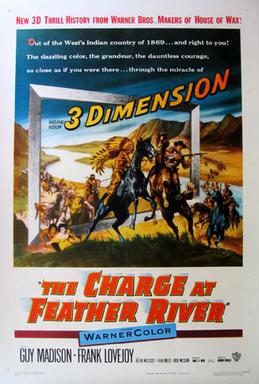
The Charge at Feather River
Why are some movies remembered and others aren't? It can be the tiniest thing, something that lingers with audiences long after viewing. A childhood favorite of mine, seemingly always airing on TNT, is 1953's The Charge at Feather River. What's it got going for it? Well, two things, an early use of 3-D technology that works surprisingly well and an iconic death scene that's influenced everything from Indiana Jones to Star Wars.
In the months following the end of the Civil War, former Union soldier Miles Archer (Guy Madison) returns to a ruined ranch with no cattle. He's approached by the commander at the nearby fort to undertake a dangerous mission. The railroad is moving into Cheyenne territory, leaving one last chance to get back two sisters who have long been held prisoners of the Cheyenne. Archer is less than enthused to take on this suicide mission, but he takes it on just the same, bringing a capable sergeant, Baker (Frank Lovejoy), to help him command a squad of prisoners from the guardhouse. Archer's squad heads into Cheyenne territory, but they find that only one of the women, Anne (Helen Westcott), even wants to be rescued while the other, Jennie (Vera Miles), is engaged to a chief, Thunder Hawk. More surprises await on this dangerous mission, Archer working to protect himself from threats inside and out.
According to a recent airing on Turner Classic Movies, 'Charge' was the highest grossing western released in 1953. Not bad when you consider Shane, Hondo, and The Naked Spur were all released that year. It's nothing special as a western, but it is enjoyable throughout. Director Gordon Douglas' movie is a solid cavalry vs. Indians western, featuring some cool locations and a memorable score from composer Max Steiner (borrowing some from his They Died With Their Boots On score). Listen to Steiner's main theme HERE. Using a familiar theme of saving captives from raiding Indians (The Searchers, Major Dundee), it's a pretty good example of what a pretty straightforward B-western can be. Some cool characters, good action and musical score. It doesn't have to be groundbreaking to be enjoyable.
What was the appeal then? No doubt some of the success had to do with the original release being in 3-D. I've never been a fan of 3-D filming, gone on record far too many times with that, but there is a cheesy charm when it's handled right. Maybe it has something to do with the 1953 release as opposed to 2013, but it's fun to watch. At different points, we get arrows, tomahawks, spears and lances chucked directly at the camera. Right in the midst of a battle, it can be a fun, diverting gimmick. At one point late, Lovejoy's Sgt. Baker even spits tobacco juice right at the camera!!! Twice!!! Take that rattlesnake about to bite him! Go figure, but the 3-D technique works here pretty well.
Taking a break from his starring role on TV's Adventures of Wild Bill Hickok, Madison is his typical workmanlike self, a tried and true hero to lead the way in an impossible mission. He's never flashy, but he was a good hero in countless westerns like this. Lovejoy too is well-cast as Baker, the necessary sidekick and right hand man, given a rivalry with Pvt. Ryan (Steve Brodie), who was trying to make a move on Baker's wife. Westcott is okay as the quasi-love interest while Miles gets to villain it up as Jennie, the captive turned future Indian princess. Madison's Guardhouse Brigade includes Cullen (Dick Wesson), a drunken thief providing some comic relief, Johnson (Onslow Stevens), a journalist/artist along for the mission, Johnny (Ron Hagerthy), the kidnapped sisters' younger brother, the treacherous Morgan (Neville Brand), Smiley (Henry Kulky), the boozing private, Zebulon (Lane Chandler), a former Confederate cavalry officer, and Connors (James Brown), the capable soldier.
It's a pretty straightforward formula once Archer and Co. get out on the mission road. We've got about 15-20 men on a dangerous mission in enemy territory. Who's going to make it, and who isn't? Various trials and tribulations are thrown at Archer's squad, providing some cool action scenes as they try and make it to safety with warring Indians seemingly all around them. The action is never on a large scale, but it's well put together, especially the finale with Thunder Hawk's war party closing in on all sides. What else to talk about? The scream of a certain Pvt. Wilhelm as he's hit with an arrow. Watch HERE. It is a scream that's been used in several movies since, including both the Star Wars and Indiana Jones series. Watch a compilation HERE. It's something little that helps make a good western particularly memorable. Solid western all-around.
The Charge at Feather River (1953): ***/****
In the months following the end of the Civil War, former Union soldier Miles Archer (Guy Madison) returns to a ruined ranch with no cattle. He's approached by the commander at the nearby fort to undertake a dangerous mission. The railroad is moving into Cheyenne territory, leaving one last chance to get back two sisters who have long been held prisoners of the Cheyenne. Archer is less than enthused to take on this suicide mission, but he takes it on just the same, bringing a capable sergeant, Baker (Frank Lovejoy), to help him command a squad of prisoners from the guardhouse. Archer's squad heads into Cheyenne territory, but they find that only one of the women, Anne (Helen Westcott), even wants to be rescued while the other, Jennie (Vera Miles), is engaged to a chief, Thunder Hawk. More surprises await on this dangerous mission, Archer working to protect himself from threats inside and out.
According to a recent airing on Turner Classic Movies, 'Charge' was the highest grossing western released in 1953. Not bad when you consider Shane, Hondo, and The Naked Spur were all released that year. It's nothing special as a western, but it is enjoyable throughout. Director Gordon Douglas' movie is a solid cavalry vs. Indians western, featuring some cool locations and a memorable score from composer Max Steiner (borrowing some from his They Died With Their Boots On score). Listen to Steiner's main theme HERE. Using a familiar theme of saving captives from raiding Indians (The Searchers, Major Dundee), it's a pretty good example of what a pretty straightforward B-western can be. Some cool characters, good action and musical score. It doesn't have to be groundbreaking to be enjoyable.
What was the appeal then? No doubt some of the success had to do with the original release being in 3-D. I've never been a fan of 3-D filming, gone on record far too many times with that, but there is a cheesy charm when it's handled right. Maybe it has something to do with the 1953 release as opposed to 2013, but it's fun to watch. At different points, we get arrows, tomahawks, spears and lances chucked directly at the camera. Right in the midst of a battle, it can be a fun, diverting gimmick. At one point late, Lovejoy's Sgt. Baker even spits tobacco juice right at the camera!!! Twice!!! Take that rattlesnake about to bite him! Go figure, but the 3-D technique works here pretty well.
Taking a break from his starring role on TV's Adventures of Wild Bill Hickok, Madison is his typical workmanlike self, a tried and true hero to lead the way in an impossible mission. He's never flashy, but he was a good hero in countless westerns like this. Lovejoy too is well-cast as Baker, the necessary sidekick and right hand man, given a rivalry with Pvt. Ryan (Steve Brodie), who was trying to make a move on Baker's wife. Westcott is okay as the quasi-love interest while Miles gets to villain it up as Jennie, the captive turned future Indian princess. Madison's Guardhouse Brigade includes Cullen (Dick Wesson), a drunken thief providing some comic relief, Johnson (Onslow Stevens), a journalist/artist along for the mission, Johnny (Ron Hagerthy), the kidnapped sisters' younger brother, the treacherous Morgan (Neville Brand), Smiley (Henry Kulky), the boozing private, Zebulon (Lane Chandler), a former Confederate cavalry officer, and Connors (James Brown), the capable soldier.
It's a pretty straightforward formula once Archer and Co. get out on the mission road. We've got about 15-20 men on a dangerous mission in enemy territory. Who's going to make it, and who isn't? Various trials and tribulations are thrown at Archer's squad, providing some cool action scenes as they try and make it to safety with warring Indians seemingly all around them. The action is never on a large scale, but it's well put together, especially the finale with Thunder Hawk's war party closing in on all sides. What else to talk about? The scream of a certain Pvt. Wilhelm as he's hit with an arrow. Watch HERE. It is a scream that's been used in several movies since, including both the Star Wars and Indiana Jones series. Watch a compilation HERE. It's something little that helps make a good western particularly memorable. Solid western all-around.
The Charge at Feather River (1953): ***/****
Labels:
1950s,
Frank Lovejoy,
Gordon Douglas,
Guy Madison,
Neville Brand,
Vera Miles,
westerns
Sunday, April 28, 2013
Raw Edge
When I think of westerns, I think of isolated windswept towns, lonely deserts, and far-off mountain ranges. Thank the spaghetti western genre for that one. It's always nice to see a change of pace though, like 1956's Raw Edge, a quasi-western based in 1840s Oregon.
It's 1842 in the wild Oregon territory, and Tex Kirby (Rory Calhoun) is looking to meet up with his brother (John Gavin) and work his ranch together. Upon arriving though, Tex finds his brother hung by a lynch mob, his Indian wife, Paca (Mara Corday), missing, and the ranch in ruins. Who's behind it? A local ranch owner, Montgomery (Herbert Rudley), rules the territory with an iron fist including a bizarre rule concerning any single women in the area. Supposedly Tex's brother was in his way, but now he's looking for answers. Tex finds himself in a situation deeper and darker than he expected, especially with Montgomery's wife, Hannah (Yvonne De Carlo), becoming an issue too. All around the valley though, an Indian war party threatens to attack, smoke signals hanging in the air.
This is not the typical desert western, that's a good thing. Not only is it set in Oregon, it is based in 1840s Oregon long before the typical wild west movie (usually after the Civil War). It was actually filmed in the San Bernardino National Forest, a more than worthy stand-in as a location shoot. Similar to the desert westerns, there's an isolated claustrophobia to the story. One town dots the territory, then there's Montgomery's forted-up, walled ranch, and last his mountain camp. The forest and woods hide all sorts of trouble, and the San Bernardino forest is a beautiful backdrop to the 1840s story.
From director John Sherwood, 'Raw' has a surprisingly dark story. It starts with a truly odd opening monologue that claims to be historically accurate, but who knows for sure? It says that in 1840s Oregon a man -- supposedly Montgomery -- ruled the region and mandated that single women -- A-N-Y single woman -- can be scooped up by any man who wants to take her as his wife. It provides an interesting subplot with Corday's Paca, a young Indian woman who married Tex's brother. The scene where the lynch mob hangs her husband is spooky and unsettling, certain members of the lynch mob leaving the hanging and turning their attention to the beautiful Paca. It develops later with Hannah, Montgomery's wife, as some of his men plan what to do with her should Montgomery not be in the picture anymore.
I liked that darkness that 'Raw' offers. Calhoun is the heroic lead, but his Tex is gunning for revenge and little else. Again, I liked Calhoun a lot, a prime example of a worthy lead in countless B-westerns in the 1950s who never became a huge star. De Carlo is very good too as Hannah, a beautiful wife who looks out for herself when she realizes her situation is not as ideal as she would have liked. Rudley is a good if underused villain with his henchmen leaving more of an impression, including Tarp (Neville Brand), Pop (Emile Meyer), Tarp's equally sinister father, and Sile (Robert J. Wilke), who takes Paca as his own wife. There's also Randolph (Rex Reason), a gentlemanly gambler who pits everyone against each other for his own betting profit, only to have a change of heart late. There are no real heroes here, just less bad heroes, and that's pretty cool to see in a 1956 western.
Seeing all these characters working toward their own greedy/selfish motives provides plenty of fireworks, but it takes a little too long getting there. With a 75-minute movie, that's not a good thing. While I enjoyed the entire movie, the first 45 minutes are too slow with too much talking and not enough action. The last 30 minutes pick up the pace as the Indian attack looms closer and closer. Good B-western, nothing great with solid casting and a change of pace location. Check out the movie at the link below.
Raw Edge (1956): ** 1/2 /****
It's 1842 in the wild Oregon territory, and Tex Kirby (Rory Calhoun) is looking to meet up with his brother (John Gavin) and work his ranch together. Upon arriving though, Tex finds his brother hung by a lynch mob, his Indian wife, Paca (Mara Corday), missing, and the ranch in ruins. Who's behind it? A local ranch owner, Montgomery (Herbert Rudley), rules the territory with an iron fist including a bizarre rule concerning any single women in the area. Supposedly Tex's brother was in his way, but now he's looking for answers. Tex finds himself in a situation deeper and darker than he expected, especially with Montgomery's wife, Hannah (Yvonne De Carlo), becoming an issue too. All around the valley though, an Indian war party threatens to attack, smoke signals hanging in the air.
This is not the typical desert western, that's a good thing. Not only is it set in Oregon, it is based in 1840s Oregon long before the typical wild west movie (usually after the Civil War). It was actually filmed in the San Bernardino National Forest, a more than worthy stand-in as a location shoot. Similar to the desert westerns, there's an isolated claustrophobia to the story. One town dots the territory, then there's Montgomery's forted-up, walled ranch, and last his mountain camp. The forest and woods hide all sorts of trouble, and the San Bernardino forest is a beautiful backdrop to the 1840s story.
From director John Sherwood, 'Raw' has a surprisingly dark story. It starts with a truly odd opening monologue that claims to be historically accurate, but who knows for sure? It says that in 1840s Oregon a man -- supposedly Montgomery -- ruled the region and mandated that single women -- A-N-Y single woman -- can be scooped up by any man who wants to take her as his wife. It provides an interesting subplot with Corday's Paca, a young Indian woman who married Tex's brother. The scene where the lynch mob hangs her husband is spooky and unsettling, certain members of the lynch mob leaving the hanging and turning their attention to the beautiful Paca. It develops later with Hannah, Montgomery's wife, as some of his men plan what to do with her should Montgomery not be in the picture anymore.
I liked that darkness that 'Raw' offers. Calhoun is the heroic lead, but his Tex is gunning for revenge and little else. Again, I liked Calhoun a lot, a prime example of a worthy lead in countless B-westerns in the 1950s who never became a huge star. De Carlo is very good too as Hannah, a beautiful wife who looks out for herself when she realizes her situation is not as ideal as she would have liked. Rudley is a good if underused villain with his henchmen leaving more of an impression, including Tarp (Neville Brand), Pop (Emile Meyer), Tarp's equally sinister father, and Sile (Robert J. Wilke), who takes Paca as his own wife. There's also Randolph (Rex Reason), a gentlemanly gambler who pits everyone against each other for his own betting profit, only to have a change of heart late. There are no real heroes here, just less bad heroes, and that's pretty cool to see in a 1956 western.
Seeing all these characters working toward their own greedy/selfish motives provides plenty of fireworks, but it takes a little too long getting there. With a 75-minute movie, that's not a good thing. While I enjoyed the entire movie, the first 45 minutes are too slow with too much talking and not enough action. The last 30 minutes pick up the pace as the Indian attack looms closer and closer. Good B-western, nothing great with solid casting and a change of pace location. Check out the movie at the link below.
Raw Edge (1956): ** 1/2 /****
Labels:
1950s,
Neville Brand,
Robert J. Wilke,
Rory Calhoun,
westerns,
Yvonne De Carlo
Monday, April 15, 2013
The Man from the Alamo
Under siege by the Mexican army by General Santa Anna, the Alamo mission and garrison is in trouble. A messenger returns to the mission with the worst news possible; no reinforcements will come, leaving the defenders to fight it out themselves. He also tells of reports of raiding Mexican soldiers attacking, burning, destroying and killing Texan settlements where many defenders -- and their families -- lived. The small group decides that someone must go help protect the families, and John Stroud (Glenn Ford) draws the short stick. Leaving the garrison behind, Stroud slips out and returns home to find his family killed and house burned down. A young Mexican boy, Carlos (Marc Cavell), witnessed the attack and tells him Americans dressed as Mexicans led the attack. As he starts to track the men down though, Stroud finds out the Alamo has fallen, and a messenger from the Alamo, Lt. Lamar (Hugh O'Brian), identifies him as the coward who abandoned the mission, not knowing why he left. Can Stroud avenge his family while also clearing his name?
I like everything about the Alamo. I'll read anything, watch anything, talk about anything so for me, this 1953 B-western from director Budd Boetticher is a hidden gem. It's pretty standard stuff in terms of its western status, but instead of just telling the story of a coward who abandons his friends, it's a story of a coward from the Alamo. Using the basic premise of the famous 'Line in the Sand' speech, 'Man' runs with it. The Alamo portion of the story covers less than 20 minutes in a 79-minute movie, but it's a great bookend. The rest of the story is still interesting, playing fast and loose with the historical facts while always maintaining a high entertainment level. Stroud takes off on a journey through war-torn Texas in the Runaway Scrape, attempting to prove his innocence while taking an involvement in a wagon train trying to evade the chasing Mexican army. It's good stuff throughout, and for a sucker like me for anything even remotely Alamo-related, it's really good stuff.
Playing the titular character, Ford does a good job leading a pretty solid ensemble cast. He was always at home in the western, and he doesn't disappoint here. We don't learn a lot about him by seeing it, we simply here about it. As he leaves the Alamo, we hear from those left behind that his John "has always had bad luck." True, he won't be killed at the Alamo, but the tag of being the man that left the doomed mission will hang over him regardless of his intentions. We don't meet his family, only seeing him arrive at the charred remains of his home, Carlos having buried his own father along with John's wife and son. I liked the character a lot. He doesn't really care what others think of him because he knows the truth. Instead, he becomes obsessed with getting revenge on the men who killed his family. Not flashy for Ford, but very good, including handling many of his own stunts, including some impressive ones on horseback.
Because the story requires someone to believe Stroud is innocent -- at some point after the appropriate doubts -- Julie Adams stars as Beth, a young woman traveling with the wagon train away from the Mexican army. Oh, she's the love interest too. I know, I was stunned too. Chill Wills (who would star 7 years later in John Wayne's The Alamo) co-stars as Beth's father, a one-armed newspaper publisher, while Myra Marsh plays Beth's mother. O'Brian is a good quasi-bad guy, a Texan officer who's convinced Stroud is a coward, not knowing the entire story. Victor Jory is Jess Wade, the Texan/American working with a gang of cutthroats and killers on the Mexican's side to cause chaos, Neville Brand playing one of his thugs. Also look quickly in the opening scene for Stuart Whitman as a guard overlooking a Texan counsel.
Now for some Alamo analysis! Sure, the Alamo segment runs only about 20 minutes, but it's a worthy intro. The Alamo fortress seems to be only the fortified chapel -- nothing like the actual layout of the mission -- but it works in an odd way, giving a claustrophobic feel to the battle. Mexican cannon shells rain down on the condensed fortress, a living hell if there ever was. We meet Crockett, Bowie and Travis however briefly (even seeing Dennis Weaver as coonskin cap-wearing defender), but the focus is on the impending doom and Stroud's similarly doomed mission. I really enjoyed the intro, but I liked the whole movie a lot too. Well worth it.
Man from the Alamo (1953): ***/****
Wednesday, December 23, 2009
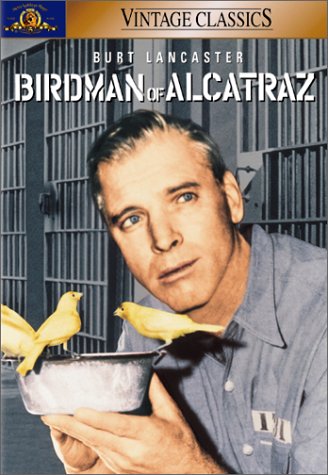
Birdman of Alcatraz
I wonder sometimes if directors and actors get sick of each other if they work together enough. Sure, there's probably a reason they choose to work together on multiple movies, but making movies is such a tough, difficult process that at some point nerves have to be a little shot. Don't they? Maybe the end result justifies some of the struggles, who knows for sure. Over a three year stretch, director John Frankenheimer and star Burt Lancaster worked together 4 times starting with The Young Savages and continuing into Birdman of Alcatraz, Seven Days in May, and The Train. In this case, the ends definitely justify the means.Seven Days in May and The Train are classics and now I can add Birdman of Alcatraz to that list as Lancaster again turns in a defining performance from his career. Lancaster was able to balance out his roles, those that required more of an action edge, those that needed him to be at the top of his game acting, and those somewhere in the middle. Think of The Train, which required him to do both. As an actor, there's 2 sides to Lancaster that I've been able to piece together. One, there's Elmer Gantry where the actor is loud, boisterious and over the top from the opening scene. Then, there's 'Birdman' where he's quiet, composed and barely cracks a smile the whole movie...and still brings his character to life.
Based on the real life story of convict Robert Stroud, 'Birdman' starts in 1912 as a young Stroud (Lancaster) is sent to Leavenworth prison for killing a man (the victim was beating a prostitute). He clashes with warden Shoemaker (Karl Malden) right away and ends up killing a guard who is preventing his mother from visiting him. He is sentenced to hang but is saved by his mother (Thelma Ritter) who goes all the way to President Woodrow Wilson to save her son. Stroud is saved, but instead of death he's sent to solitary where he'll only have contact with a few guards while never seeing other prisoners.
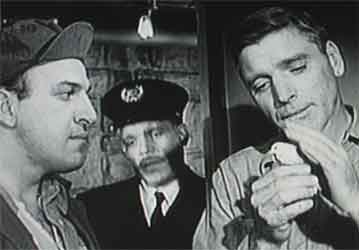
Basically challenged to survive by Shoemaker, Stroud vows to win out in the end. One day in the yard, he finds a little sparrow who cannot fly and begins to care for it in his cell. So it starts as Stroud's actions impact other inmates who now want birds as cellmates. What starts as one small sparrow snowballs into many more. As the years pass, Stroud becomes an expert on birds and everything about their makeup, including how to treat bird diseases that previously had no cure. But other things are afoot as Shoemaker is now in charge of the Federal Bureau of Prisons which could impact Stroud and his birds.
What was surprising about the movie is how fascinating these sequences with the birds really are. We're talking whole scenes with little to no dialogue as Lancaster's Stroud first treats just one sparrow (which he names Runty) to then trying to figure out what is happening to all the birds that occupy his cell as an unexplained epidemic races through the cages. These are the high points of the movie -- the first 90 minutes or so -- as Stroud learns much about his avian friends while also interacting with guard Bull Ransom (Neville Brand playing against type in a good guy role) and fellow inmate Feto Gomez (Telly Savalas also in an atypical part) who also bonds with birds sent to him by his family.
Really my only issue with the movie is a change that comes about 100 minutes into the story -- and at 149 minutes overall it is a tad long -- when Stroud is transferred to Alcatraz. He is forced to leave all his birds, his studies, his makeshift laboratory behind as he moves to the island prison in San Francisco. So other than the fact that Stroud never had birds at Alcatraz yet he's still dubbed 'the birdman of Alcatraz,' the story gets away from what made the first 90 minutes so strong. Granted, this is a story about a man, not the birds, so the natural progression has to be played out, but the last hour is somewhat dull as this long-time inmate struggles in a new prison. A subplot with a prison riot (with Seinfeld's Uncle Leo leading the riot) seems like it's out of another movie.
What carries the movie through some of it's struggles is the fine cast led by Lancaster and Malden. Malden especially is presented as a good and bad guy, a man trying to do his job who comes down hard sometimes on Stroud, as a viewer it comes across unnecessarily harsh. Brand also delivers one of his best performances in a key supporting role as a guard who unexpected bonds with two-time murderer Stroud, and Savalas gets a chance to play a non-crazy person for a change. Betty Field also makes a strong impression as Robert's wife Stella, and Edmond O'Brien has a bookend cameo as an author who wrote a book about Stroud. Lancaster, Ritter and Savalas were all nominated for their performances. Lancaster deserved to win for this scene with Malden's Shoemaker alone.
Overall though, the strengths of the first half of the movie outweigh the sometimes slow pacing of the second half. Elmer Bernstein's score is a little more understated than his usual booming efforts, and sounds reminiscent of the quieter moments in his Great Escape score. Watch this movie for the performances from Lancaster in the lead to the members of the supporting cast. Maybe Lancaster and Frankenheimer did get on each other's nerves, but if this was the result, it was worth it.
Birdman of Alcatraz <----trailer (1962): *** 1/2 /****
Thursday, May 14, 2009
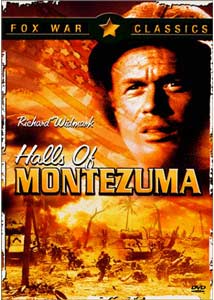
Netflix review #20: Halls of Montezuma
WWII movies have been done left and right in the 64 years since the war ended, some good and some bad. But the heyday was in the 50s and 60s when memories and wounds from the war were still fresh. What these movies provided were a chance to put together a good story with a wide variety of characters. Movies like The Dirty Dozen and Kelly's Heroes stand out as just two examples, war movies with male-dominated casts full of great character actors. Not as well known but made over 15 years earlier, 1950's Halls of Montezuma fits that bill.Following the campaigns in the Pacific at Guadalcanal and Tarawa, Lt. Carl Anderson (Richard Widmark) prepares his men for another assault on a Japanese-held island. Anderson's been going through a bit of a breakdown recently as just 7 men from his original platoon have survived. He's torn up inside at the thought of all the men he's lost and gets horrific headaches under stress. It's after the Marines hit the beach and have moved inland that the real trouble starts. The Japanese garrison unleashes hundreds of rockets at the advancing Marines. The problem, no one can spot the rocket emplacements.
Assigned to lead a patrol from his commander, Lt. Colonel Gilfillan (Richard Boone), Anderson must find the rockets and call their location in before a huge push the next day. Among the patrol are the few men Anderson genuinely cares about and wants to see make it through, the original members of the platoon. Leading that group is Pigeon Lane (Jack Palance), a former boxer suckered into the Marines, Coffman (Robert Wagner), the youngster trying to figure out who saved him at Tarawa, Doc Jones (Karl Malden), Anderson's close friend, Cpl. Conroy (Richard Hylton), a former student of Anderson's, Pretty Boy Riley (Skip Homeier), a soldier trying to rise above his past, Slattery (Bert Freed), the best soldier in the bunch and the biggest troublemaker, and Sgt. Zelenko (Neville Brand), the tough sergeant. Then for good measure there's a Japanese translator, a war correspondent (Jack Webb), and a new recruit along.
I've written before about how much I like 'men on a mission' movies, and this certainly qualifies with the cast full of recognizable character actors. But instead of just dropping the viewer into the platoon, we get an interesting technique to get to know the platoon. With a handful of flashbacks, we see their interactions in the group, some while in the unit, others as far back as their civilian days. It helps then when the platoon starts getting picked off by the Japanese. These aren't random, faceless soldiers, we know something about them and their makeup.
For a movie made just 5 years since the end of WWII, director Lewis Milestone tells it pretty straight. These aren't superhero G.I. Joe soldiers. Widmark is close to cracking up, and some of his men aren't too far behind. The more I watch of him, the more I think Widmark is one of the more underrated, underappreciated actors to come out of the late 1940s. As well, the Japanese soldiers aren't presented as stereotypical, one-dimensional soldiers. The whole movie has a clear anti-war stance. The action, while good, is understated. Characters are shot off-screen or hit by shrapnel as they head for a foxhole. And made in 1950 years before blood squibs became commonplace in war movies and westerns, the violence is fairly graphic, including one hand-to-hand encounter with a Japanese sniper.
The DVD has the movie in standard presentation, it was released about 3 years before widescreen was used, a trailer, and a handful of trailers for other Fox war movie DVDs. It's not a great WWII movie, but it's certainly a good one. Widmark leads a strong cast, and in general, Halls of Montezuma was ahead of its time when dealing with some of the deeper issues that war movies would later explore.
Halls of Montezuma (1950): ***/****
I've written before about how much I like 'men on a mission' movies, and this certainly qualifies with the cast full of recognizable character actors. But instead of just dropping the viewer into the platoon, we get an interesting technique to get to know the platoon. With a handful of flashbacks, we see their interactions in the group, some while in the unit, others as far back as their civilian days. It helps then when the platoon starts getting picked off by the Japanese. These aren't random, faceless soldiers, we know something about them and their makeup.
For a movie made just 5 years since the end of WWII, director Lewis Milestone tells it pretty straight. These aren't superhero G.I. Joe soldiers. Widmark is close to cracking up, and some of his men aren't too far behind. The more I watch of him, the more I think Widmark is one of the more underrated, underappreciated actors to come out of the late 1940s. As well, the Japanese soldiers aren't presented as stereotypical, one-dimensional soldiers. The whole movie has a clear anti-war stance. The action, while good, is understated. Characters are shot off-screen or hit by shrapnel as they head for a foxhole. And made in 1950 years before blood squibs became commonplace in war movies and westerns, the violence is fairly graphic, including one hand-to-hand encounter with a Japanese sniper.
The DVD has the movie in standard presentation, it was released about 3 years before widescreen was used, a trailer, and a handful of trailers for other Fox war movie DVDs. It's not a great WWII movie, but it's certainly a good one. Widmark leads a strong cast, and in general, Halls of Montezuma was ahead of its time when dealing with some of the deeper issues that war movies would later explore.
Halls of Montezuma (1950): ***/****
Subscribe to:
Posts (Atom)