Though the name might not be instantly recognizable, director Brian G. Hutton has been at the helm of two of my favorite movies, both of them WWII flicks, Where Eagles Dare and Kelly's Heroes. He only directed nine movies while also acting in film and television so those directing efforts? Gotta scoop them up when you can. Turner Classic Movies helped me out last week, screening 1968's Sol Madrid.
An undercover Interpol officer with a checkered past, Sol Madrid (David McCallum) has been tasked with possibly his most dangerous mission yet. A longtime right-hand man to a Mafia boss in NYC, Harry Mitchell (Pat Hingle) has gone rogue and stole $500,000 from the boss while running away with said boss' girlfriend. The catch? Mitchell has a computer-like mind and is able to remember everything he's ever done for the Mob. If Interpol or the FBI can bring him in and convince him to testify, the case is almost a sure thing against the Mafia. Madrid follows some leads and finds out that Mitchell has headed south of the border to Mexico and is hiding out with a rival mob boss in Acapulco. How can Madrid get to him and then convince him? Well, it starts with finding the mob boss' girlfriend, Stacey (Stella Stevens), and convincing her to help with the promise of protection. Can it all work out?
Even considering the very cool cast assembled here, I'd never even remotely heard of this one. But courtesy of TCM, here we sit! This is a movie I wanted to love but ended up only liking it. I'll get into the cast more in a bit, but it's NUTS! Filmed in Acapulco, featuring an appropriately quirky score from Lalo Schifrin, and a style and winding story that seems like a 1960s bizarre-o film noir...'Madrid' should have been better. That's it. It just should have been better in plain and simple words. This is a 1960s crime thriller that is missing that one special thing to make it a really solid, memorable flick. As is? It's okay, pretty cool in moments, kinda dumb/weird in others.
That cast though....man, it's worth watching just to see the collection of talent assembled. Let's start with the other Man from U.N.C.L.E., David McCallum himself. He never grew into a huge star -- he's probably most well-known for his Ducky role in NCIS -- but it's always cool to see him in a leading role, especially an anti-hero role like this. We meet Sol Madrid as he's resting in an apartment full of drugged-out heroin users. What an introduction! From there, it's one cold-blooded decision after another, all the while observing what's going on around him and planning steps in advance of everyone around him. Brutal, calculating and looking at the bottom line, Madrid risks it all over and over again. And that name? Sol Madrid?!? Sounds very fake, but damn, I wish I had a badass, ridiculously goofy and cool name like that.
I'm a sucker for ensemble casts though, and what we've got here for 'Madrid' is pretty impressive. Stevens specialized in these type of roles in the late 60s and early 70s as the damaged woman so it's right in her wheelhouse! She certainly has some fiery scenes with McCallum's Madrid. How about some tough guys?!? Hey, everybody, it's Telly Savalas as Emil Dietrich, a drug supplier with a rivalry against the Mafia! Next up, Ricardo Montalban as Jalisco, another undercover officer and Madrid's contact who may be too comfortable in his job. Oh, and there's Rip Torn as Villanova, the mob boss with a vengeful streak right up his back. Not a bad group, huh?
Also look for Paul Lukas as an older, experienced mobster, Michael Ansara as a Mexican police officer, Perry Lopez as Francisco, Dietrich's enforcer, and Michael Conrad as Scarpi, a mafia hitman tasked with killing Madrid and Stacey.
Probably the biggest flaw in this 90-minute flick is the story. It's far from pointed and doesn't seem to know where it's going, where it wants to end up. To get his hands on Mitchell, McCallum's Madrid partners up with Dietrich to bring huge amounts of heroin into the U.S. In a painfully slow scene, we actually see the smuggling effort, bringing an already slow pace down to a snail's speed. Things pick up in the final act with some good twists and finally some action, but as a whole, this isn't a consistent movie. Decent, pretty entertaining but with some serious flaws.
Sol Madrid (1968): ** 1/2 /****
The Sons of Katie Elder
"First, we reunite, then find Ma and Pa's killer...then read some reviews."
Showing posts with label Ricardo Montalban. Show all posts
Friday, February 6, 2015
Wednesday, February 19, 2014
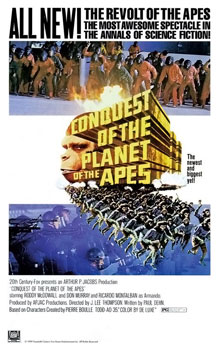
Conquest of the Planet of the Apes
Well, we might as well continue what we've started. While I'd seen the first three Planet of the Apes movies growing up on multiple occasions, I can't say the same for the last two movies in the series, 1972's Conquest of the Planet of the Apes and 1973's Battle for the Planet of the Apes. I've seen bits and pieces of both but never all the way through in one sitting. And away we go!
It's 1991 in North America, some 20 years since the talking apes, Zira and Cornelius, were murdered along with their baby...but it wasn't their baby. Things have changed around the world, a mysterious virus killing every single cat and dog on Earth, humans turning to apes/monkeys to be their pets. That changed quickly though, their mental capacities showing they're not so worthwhile as pets, but as slaves. It's been eight years, apes and chimpanzees used as janitors, delivery men, waiters and so many other tasks and jobs. That baby though that was supposed to have died? He didn't, and now he's 20 years old, still with loving-life Armando (Ricardo Montalban), who is now bringing the 20-year old intelligent, talking Caesar (Roddy McDowall) to the big city for the first time. Caesar is stunned and disgusted at what he finds, and when he becomes separated from Armando he's forced to adjust or reveal his secret.
Watching the Apes series in fairly quick succession, I've came away impressed. This fourth entry, this one from director J. Lee Thompson who had been in talks to direct the first movie, certainly qualifies. Is it a classic film? No, but fans of the series and science fiction in general will no doubt enjoy it. This series has impressed me because the original 1968 Planet of the Apes is a classic stand-alone science fiction film. It doesn't need any sequels. There are some questions we'd like more answers about, more background, but we know the truth, what really happened. Following the first sequel, 'Beneath,' the series found a way to survive and evolve -- whether intentionally or just lucking into it -- by bringing all five movies full circle. It's a nice touch, and each movie is different from its predecessor. Similar themes, tones, even some actors make it from movie to movie, but in an age of repetitive sequels, it's cool to see original, different sequels like this.
For this third sequel, there's a time jump.....into the future of 1991!!! 'Conquest' was filmed on location in Los Angeles at Century City, an appropriate, sparse and ultra-modern look for the visual of what Earth would have looked like in 1991....from a 1972 audience. Basically the entire story takes place in this one complex, the human rulers trying to limit and control the problems among the ape slaves. The apes are getting smarter, showing more initiative, being more disobedient. Add the very intelligent and very disgusted/motivated Caesar to the mix, and we've officially got an issue. There are points where things feel rushed in an 88-minute movie, another 10 minutes maybe fleshing it out some, but continuing what the series has laid out, this is a particularly dark, brutal story. What we see is even a tamed version of the original ending. It's not graphic (these movies were still considered "family movies") but the violence can be disturbing at times.
As has been the case for the first three movies, the key is the characters, whether they be heroes, villains or somewhere in between. That's what I found interesting here. Do we want to root for the evil, despicable humans who abuse slaves? Or do we root for the revolting apes to....wipe out mankind? Hhhhmmm, well, that's a toughie. It can be an uncomfortable movie to watch at times because of that dynamic. McDowall returns to the series, playing Cornelius' son (so technically his own) Caesar. It's a very good part for McDowall, fiery and angry, the match that sets off the explosion that's been waiting to happen. Hidden away from what society has become by Montalban's Armando, Caesar hasn't seen the darkness the world has to offer, until now. The rage inside him begins to grow and when he gets the proper motivation for revenge, he begins to planning the revolution, assembling and building, waiting for his time. A very good part for McDowall, especially his monologue in the final scene.
Again stealing the show is Montalban as the likable, charming and idealistic Armando, more Caesar's surrogate father than owner. It's not a huge part, but it is definitely a memorable one, Montalban again stealing all his scenes. Don Murray is nicely cast as Breck, the sadistic governor of the city, convinced that a talking ape is out there and hellbent on finding and killing him. Hari Rhodes plays his assistant, McDonald, an intelligent, thoughtful man, who has a bond of sorts with Caesar after they meet, and Severn Darden plays Breck's enforcer on his other shoulder, Kolp. Natalie Trundy continues her participation in the series, playing Lisa, a female ape, after already playing a mutant and a doctor in previous movies. John Randolph appears briefly in an update of a monologue he had in 'Escape' as well.
The portrayal of the future can be uncomfortable to watch at times. Breck and his fellow officials wear black and dark clothing, his soldiers wearing completely black uniforms that make them look like Nazi stormtroopers. The apes on the other hand wear green and orange jumpsuits, the color jumping off the screen. As I mentioned, I was surprised by how this story developed. The actual conquest in the final act of the movie is intense to say the least. The ending is startling, even if it was edited to be a little more tame. Still, I liked this sequel a lot and can't wait to see where the series goes in its finale. As well, it's hard not to notice how much this sequel inspired the Apes reboot, 2011's Rise of the Planet of the Apes. Just saying.
Conquest of the Planet of the Apes (1972): ***/****
It's 1991 in North America, some 20 years since the talking apes, Zira and Cornelius, were murdered along with their baby...but it wasn't their baby. Things have changed around the world, a mysterious virus killing every single cat and dog on Earth, humans turning to apes/monkeys to be their pets. That changed quickly though, their mental capacities showing they're not so worthwhile as pets, but as slaves. It's been eight years, apes and chimpanzees used as janitors, delivery men, waiters and so many other tasks and jobs. That baby though that was supposed to have died? He didn't, and now he's 20 years old, still with loving-life Armando (Ricardo Montalban), who is now bringing the 20-year old intelligent, talking Caesar (Roddy McDowall) to the big city for the first time. Caesar is stunned and disgusted at what he finds, and when he becomes separated from Armando he's forced to adjust or reveal his secret.
Watching the Apes series in fairly quick succession, I've came away impressed. This fourth entry, this one from director J. Lee Thompson who had been in talks to direct the first movie, certainly qualifies. Is it a classic film? No, but fans of the series and science fiction in general will no doubt enjoy it. This series has impressed me because the original 1968 Planet of the Apes is a classic stand-alone science fiction film. It doesn't need any sequels. There are some questions we'd like more answers about, more background, but we know the truth, what really happened. Following the first sequel, 'Beneath,' the series found a way to survive and evolve -- whether intentionally or just lucking into it -- by bringing all five movies full circle. It's a nice touch, and each movie is different from its predecessor. Similar themes, tones, even some actors make it from movie to movie, but in an age of repetitive sequels, it's cool to see original, different sequels like this.
For this third sequel, there's a time jump.....into the future of 1991!!! 'Conquest' was filmed on location in Los Angeles at Century City, an appropriate, sparse and ultra-modern look for the visual of what Earth would have looked like in 1991....from a 1972 audience. Basically the entire story takes place in this one complex, the human rulers trying to limit and control the problems among the ape slaves. The apes are getting smarter, showing more initiative, being more disobedient. Add the very intelligent and very disgusted/motivated Caesar to the mix, and we've officially got an issue. There are points where things feel rushed in an 88-minute movie, another 10 minutes maybe fleshing it out some, but continuing what the series has laid out, this is a particularly dark, brutal story. What we see is even a tamed version of the original ending. It's not graphic (these movies were still considered "family movies") but the violence can be disturbing at times.
As has been the case for the first three movies, the key is the characters, whether they be heroes, villains or somewhere in between. That's what I found interesting here. Do we want to root for the evil, despicable humans who abuse slaves? Or do we root for the revolting apes to....wipe out mankind? Hhhhmmm, well, that's a toughie. It can be an uncomfortable movie to watch at times because of that dynamic. McDowall returns to the series, playing Cornelius' son (so technically his own) Caesar. It's a very good part for McDowall, fiery and angry, the match that sets off the explosion that's been waiting to happen. Hidden away from what society has become by Montalban's Armando, Caesar hasn't seen the darkness the world has to offer, until now. The rage inside him begins to grow and when he gets the proper motivation for revenge, he begins to planning the revolution, assembling and building, waiting for his time. A very good part for McDowall, especially his monologue in the final scene.
Again stealing the show is Montalban as the likable, charming and idealistic Armando, more Caesar's surrogate father than owner. It's not a huge part, but it is definitely a memorable one, Montalban again stealing all his scenes. Don Murray is nicely cast as Breck, the sadistic governor of the city, convinced that a talking ape is out there and hellbent on finding and killing him. Hari Rhodes plays his assistant, McDonald, an intelligent, thoughtful man, who has a bond of sorts with Caesar after they meet, and Severn Darden plays Breck's enforcer on his other shoulder, Kolp. Natalie Trundy continues her participation in the series, playing Lisa, a female ape, after already playing a mutant and a doctor in previous movies. John Randolph appears briefly in an update of a monologue he had in 'Escape' as well.
The portrayal of the future can be uncomfortable to watch at times. Breck and his fellow officials wear black and dark clothing, his soldiers wearing completely black uniforms that make them look like Nazi stormtroopers. The apes on the other hand wear green and orange jumpsuits, the color jumping off the screen. As I mentioned, I was surprised by how this story developed. The actual conquest in the final act of the movie is intense to say the least. The ending is startling, even if it was edited to be a little more tame. Still, I liked this sequel a lot and can't wait to see where the series goes in its finale. As well, it's hard not to notice how much this sequel inspired the Apes reboot, 2011's Rise of the Planet of the Apes. Just saying.
Conquest of the Planet of the Apes (1972): ***/****
Thursday, February 13, 2014
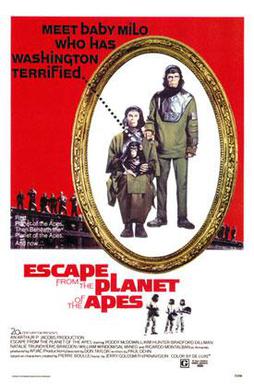
Escape from the Planet of the Apes
Sometimes a series is too successful to just let it end naturally. Following the success of Planet of the Apes and Beneath the Planet of the Apes, Fox Studios wanted another sequel, but there was a problem. Without giving too much away, the ending for 'Beneath' well....didn't really leave any opening for a follow-up. That's what screenwriters are for and ta-da! The series continued! A third movie in the series, 1971's Escape from the Planet of the Apes.
On a warm sunny day off the coast in southern California, a spaceship is discovered floating in the Pacific. The ship is brought ashore, the Army waiting to welcome the astronauts on-board but no one is sure where the spaceship came from or who is in fact on-board. Those waiting are stunned when the three astronauts remove their helmets, revealing themselves as apes. The three astronauts? Dr. Cornelius (Roddy McDowall), his wife, Dr. Zira (Kim Hunter) and Dr. Milo (Sal Mineo). The arrival of talking, intelligent apes stuns the world, forcing the government to decide what to do with the ape trio. Some are welcoming, Cornelius and Zira especially becoming instantly famous in pop culture. Others though aren't so welcoming, questioning where these apes came from and what is their intention in coming to Earth? Both sides need to find a happy medium, but some are sure the presence alone of these futuristic astronauts is a threat to the future of mankind.
So as we talked about, Beneath the Planet of the Apes didn't leave much of an opening for the series to continue, Charlton Heston insisting that be it for the series. Money is a powerful motivator though, isn't it? The series continues, but back on Earth in modern times. Director Don Taylor begins the second half of the series, catapulting the franchise in a different route for its final three films, composer Jerry Goldsmith returning as well with a great score. The premise linking 'Beneath' and 'Escape' is a tad contrived, a tad forced when you think about how 'Beneath' ended but for the sake of where the series is going, it's not so bad. Why does it stand out from the rest?
Two reasons. McDowall and Hunter. Playing Cornelius, McDowall returns to the series after being unable to to star in 'Beneath' because of a scheduling conflict. Less than pleased with her characterization in 'Beneath' (or maybe lack of), Hunter returned because she liked the script. The story is a departure from the first two movies, but this returning duo is perfect. Where we saw Heston's Taylor and James Franciscus' Brent struggling to adjust in a simian world, we now see Cornelius and Zira going through the same struggles in a human world. Where everything else has changed around them, having a spouse is a constant. Their chemistry is perfect, two intelligent individuals deciding what should be their next step, how best to survive in this human world. They have these perfect little moments, Cornelius trying on suits, Zira trying on stylish dresses, Cornelius standing up for his wife, Zira fighting for respect that carries the story surprisingly well on an emotional level.
It's cool to see Cornelius and Zira -- key supporting parts in the first two movies, still supporting parts -- step into the lead roles. That added dimension carries the movie. Who else to look for? Bradford Dillman and Natalie Trundy as Lewis Dixon and Stephanie Branton, two doctors and animal psychiatrists who become almost public relations representatives for Cornelius and Zira, but more importantly, they become trusted friends. Eric Braeden is Dr. Otto Hasslein, the scientific adviser to the President (William Windom), who questions that if these apes come from Earth's future...why did they leave? It's Eric Braeden so yes, he's a villain. Mineo makes the most of his smallish part as Dr. Milo, the third ape to travel through time with Cornelius and Zira, while Ricardo Montalban is a scene-stealer as Armando, the charming, friendly owner of a circus who works with Lewis and Stephanie. Also look for Jason Evers and Albert Salmi as Braeden's two henchmen, while John Randolph is the head of the commission investigating what to do with the visiting simians.
There are portions of this movie that are really sweet, great emotional moments that work because of the chemistry between McDowall and Hunter. Following the trend of the first two movies though, things take a turn for the dark though near the halfway point of the 98-minute movie. The time travel aspect comes up, if someone from the future knows what's going to happen, can we change it by wiping them out? We discuss issues of nuclear war, experimentation on animals, prejudices against races and cultures, but it is all handled in subtle enough fashion that it works. The ending is pretty heartbreaking in itself, but as the series has set us up for, there's a great twist in the final scene. Definitely stick with it to the final credits.
Another worthy Planet of the Apes movie, throwing us for a loop but all for the interesting. Coming up next, the final two films in the series, Conquest of Planet of the Apes and Battle for the Planet of the Apes, neither of which I've seen in one sitting. Stay tuned!
Escape from the Planet of the Apes (1971): ***/****
On a warm sunny day off the coast in southern California, a spaceship is discovered floating in the Pacific. The ship is brought ashore, the Army waiting to welcome the astronauts on-board but no one is sure where the spaceship came from or who is in fact on-board. Those waiting are stunned when the three astronauts remove their helmets, revealing themselves as apes. The three astronauts? Dr. Cornelius (Roddy McDowall), his wife, Dr. Zira (Kim Hunter) and Dr. Milo (Sal Mineo). The arrival of talking, intelligent apes stuns the world, forcing the government to decide what to do with the ape trio. Some are welcoming, Cornelius and Zira especially becoming instantly famous in pop culture. Others though aren't so welcoming, questioning where these apes came from and what is their intention in coming to Earth? Both sides need to find a happy medium, but some are sure the presence alone of these futuristic astronauts is a threat to the future of mankind.
So as we talked about, Beneath the Planet of the Apes didn't leave much of an opening for the series to continue, Charlton Heston insisting that be it for the series. Money is a powerful motivator though, isn't it? The series continues, but back on Earth in modern times. Director Don Taylor begins the second half of the series, catapulting the franchise in a different route for its final three films, composer Jerry Goldsmith returning as well with a great score. The premise linking 'Beneath' and 'Escape' is a tad contrived, a tad forced when you think about how 'Beneath' ended but for the sake of where the series is going, it's not so bad. Why does it stand out from the rest?
Two reasons. McDowall and Hunter. Playing Cornelius, McDowall returns to the series after being unable to to star in 'Beneath' because of a scheduling conflict. Less than pleased with her characterization in 'Beneath' (or maybe lack of), Hunter returned because she liked the script. The story is a departure from the first two movies, but this returning duo is perfect. Where we saw Heston's Taylor and James Franciscus' Brent struggling to adjust in a simian world, we now see Cornelius and Zira going through the same struggles in a human world. Where everything else has changed around them, having a spouse is a constant. Their chemistry is perfect, two intelligent individuals deciding what should be their next step, how best to survive in this human world. They have these perfect little moments, Cornelius trying on suits, Zira trying on stylish dresses, Cornelius standing up for his wife, Zira fighting for respect that carries the story surprisingly well on an emotional level.
It's cool to see Cornelius and Zira -- key supporting parts in the first two movies, still supporting parts -- step into the lead roles. That added dimension carries the movie. Who else to look for? Bradford Dillman and Natalie Trundy as Lewis Dixon and Stephanie Branton, two doctors and animal psychiatrists who become almost public relations representatives for Cornelius and Zira, but more importantly, they become trusted friends. Eric Braeden is Dr. Otto Hasslein, the scientific adviser to the President (William Windom), who questions that if these apes come from Earth's future...why did they leave? It's Eric Braeden so yes, he's a villain. Mineo makes the most of his smallish part as Dr. Milo, the third ape to travel through time with Cornelius and Zira, while Ricardo Montalban is a scene-stealer as Armando, the charming, friendly owner of a circus who works with Lewis and Stephanie. Also look for Jason Evers and Albert Salmi as Braeden's two henchmen, while John Randolph is the head of the commission investigating what to do with the visiting simians.
There are portions of this movie that are really sweet, great emotional moments that work because of the chemistry between McDowall and Hunter. Following the trend of the first two movies though, things take a turn for the dark though near the halfway point of the 98-minute movie. The time travel aspect comes up, if someone from the future knows what's going to happen, can we change it by wiping them out? We discuss issues of nuclear war, experimentation on animals, prejudices against races and cultures, but it is all handled in subtle enough fashion that it works. The ending is pretty heartbreaking in itself, but as the series has set us up for, there's a great twist in the final scene. Definitely stick with it to the final credits.
Another worthy Planet of the Apes movie, throwing us for a loop but all for the interesting. Coming up next, the final two films in the series, Conquest of Planet of the Apes and Battle for the Planet of the Apes, neither of which I've seen in one sitting. Stay tuned!
Escape from the Planet of the Apes (1971): ***/****
Friday, January 6, 2012
The Deserter
When a poster at a message board brought the movie up, I didn't believe him, thinking the movie he talked about was made up. As a western fan, how had this one slipped past me? Somehow it did, probably thanks to no U.S. DVD release and an old VHS (thank you Amazon vendors). The movie? A spaghetti western of sorts, think The Dirty Dozen in the West. It's 1970's The Deserter.
Returning from a patrol, Captain Viktor Caleb (Bekim Fehmiu) finds his wife on the brink of death, raped and tortured by an Apache war party. He mercifully ends her suffering, shooting her, and abandons his post but not before shooting the commander, Maj. Brown (Richard Crenna), who he blames. Two years pass and the cavalry Border Command has a new commander, General Miles (John Huston). Caleb has spent two years waging his own war on the Apaches, but Miles needs his help. An Apache chief, Mangus Durango, is organizing a huge war party that threatens to wipe out everyone in the territory. Their only hope? Caleb selects a small group of men and train them to fight like Apaches, striking the Apache camp in Mexico before the slaughter begins.
From American director Burt Kennedy, 'Deserter' isn't your prototypical spaghetti western. It was filmed in Almeria, Spain -- with some familiar locations for spaghetti fans -- and features a quirky but memorable score from Piero Piccioni. Listen to the main theme HERE. As opposed to bandits and gunslingers, the story obviously focuses on the cavalry and the Apaches so it's a cool change of pace. Mostly though, it is an above average men on a mission story, one of my favorite sub-genres in movies. A small group of men, all experts and specialists in their own way assigned an almost impossible, nearly suicidal mission. The movie follows the cookie-cutter formula, but in a good way. First, lay things out and assemble the team. Second, train them. And third, unleash them for their mission.
My rating far down below may be high in the eyes of some readers, but there's a reason. This isn't a great, classic movie that will live on in movie history. On the other hand, it is a great, fun and entertaining movie that quickly climbed into my list of favorites upon first viewing. Kennedy was a workmanlike director more than an auteur, but he knows how to manage this movie. The screenplay by western regular Clair Huffaker is a gem, nothing original but full of great one-liners, the perfect dialogue for a team of tough as nails "volunteers." This always sounds like a cop-out to me, but it's just a fun movie. Sit back and enjoy 100 minutes of running and gunning action in the desert.
Read some reviews about this generally forgotten western, and you'll find plenty of criticism of the casting of star Fehmiu in the lead. A Yugoslavian actor, this is one of his few English-speaking roles. I had absolutely no problem with him as Caleb and even think his steely-eyed, ice water running through his veins acting style is a high point of the film. Caleb doesn't care about living or dying, just avenging his wife's brutal death. That can be an appealing trait in a lead character. While I came to like Fehmiu as Caleb, what drew me into this movie was the supporting cast.
Big names? No, not especially, but reading the cast listing should put a smile on any western fan's face. Crenna is solid as needed as Caleb's opposition, and Huston is a scene-stealer as General Miles, chewing the scenery like only he can. Then there's Caleb's squad, a who's who of western characters. Start with Slim Pickens and Ricardo Montalban as Tattinger, a crotchety veteran scout, and Natchai, an Apache scout, both of them Caleb's closest friends. Not enough? There's also Chuck Connors as Reynolds, a dynamite-wielding chaplain, Ian Bannen as Crawford, an English soldier touring the Southwest, Brandon De Wilde as Ferguson, the young, unproven officer, Woody Strode as Jackson, the strong man and troublemaker, Albert Salmi as Schmidt, the soldier with a grudge against Caleb, Patrick Wayne as Robinson, the Gatling gun operator with his brother, Doc Greaves as Scott, the doctor, and recognizable spaghetti face Fausto Tozzi as Orozco, the knife fighter.
Good cast much? If you can't go along with that group, westerns probably aren't your thing. It is a men on a mission movie, and that means....wait for it...action! Most of it is saved for the last 40 minutes, but the training sequences leading up to it are equally as fun, a quick montage highlighting all the mayhem. The mission is the high point though, and even though some night scenes are limited by obviously indoor sets, it isn't a deal breaker. Men on a mission movie means casualties though, and the results here were surprising as to who makes it and who doesn't. Violent, bloody and chaotic, a worthwhile end to an underrated western.
Now this link won't be to a pristine, widescreen print, but it you're curious about seeing the movie you can see it at Youtube HERE. It's a Public Domain print and looks to be missing about 6 minutes from the VHS I have, but when a movie is as hard to find as this one, take what you can. Hope you enjoy it as much as I do!
The Deserter <---trailer (1971): ****/****
Returning from a patrol, Captain Viktor Caleb (Bekim Fehmiu) finds his wife on the brink of death, raped and tortured by an Apache war party. He mercifully ends her suffering, shooting her, and abandons his post but not before shooting the commander, Maj. Brown (Richard Crenna), who he blames. Two years pass and the cavalry Border Command has a new commander, General Miles (John Huston). Caleb has spent two years waging his own war on the Apaches, but Miles needs his help. An Apache chief, Mangus Durango, is organizing a huge war party that threatens to wipe out everyone in the territory. Their only hope? Caleb selects a small group of men and train them to fight like Apaches, striking the Apache camp in Mexico before the slaughter begins.
From American director Burt Kennedy, 'Deserter' isn't your prototypical spaghetti western. It was filmed in Almeria, Spain -- with some familiar locations for spaghetti fans -- and features a quirky but memorable score from Piero Piccioni. Listen to the main theme HERE. As opposed to bandits and gunslingers, the story obviously focuses on the cavalry and the Apaches so it's a cool change of pace. Mostly though, it is an above average men on a mission story, one of my favorite sub-genres in movies. A small group of men, all experts and specialists in their own way assigned an almost impossible, nearly suicidal mission. The movie follows the cookie-cutter formula, but in a good way. First, lay things out and assemble the team. Second, train them. And third, unleash them for their mission.
My rating far down below may be high in the eyes of some readers, but there's a reason. This isn't a great, classic movie that will live on in movie history. On the other hand, it is a great, fun and entertaining movie that quickly climbed into my list of favorites upon first viewing. Kennedy was a workmanlike director more than an auteur, but he knows how to manage this movie. The screenplay by western regular Clair Huffaker is a gem, nothing original but full of great one-liners, the perfect dialogue for a team of tough as nails "volunteers." This always sounds like a cop-out to me, but it's just a fun movie. Sit back and enjoy 100 minutes of running and gunning action in the desert.
Read some reviews about this generally forgotten western, and you'll find plenty of criticism of the casting of star Fehmiu in the lead. A Yugoslavian actor, this is one of his few English-speaking roles. I had absolutely no problem with him as Caleb and even think his steely-eyed, ice water running through his veins acting style is a high point of the film. Caleb doesn't care about living or dying, just avenging his wife's brutal death. That can be an appealing trait in a lead character. While I came to like Fehmiu as Caleb, what drew me into this movie was the supporting cast.
Big names? No, not especially, but reading the cast listing should put a smile on any western fan's face. Crenna is solid as needed as Caleb's opposition, and Huston is a scene-stealer as General Miles, chewing the scenery like only he can. Then there's Caleb's squad, a who's who of western characters. Start with Slim Pickens and Ricardo Montalban as Tattinger, a crotchety veteran scout, and Natchai, an Apache scout, both of them Caleb's closest friends. Not enough? There's also Chuck Connors as Reynolds, a dynamite-wielding chaplain, Ian Bannen as Crawford, an English soldier touring the Southwest, Brandon De Wilde as Ferguson, the young, unproven officer, Woody Strode as Jackson, the strong man and troublemaker, Albert Salmi as Schmidt, the soldier with a grudge against Caleb, Patrick Wayne as Robinson, the Gatling gun operator with his brother, Doc Greaves as Scott, the doctor, and recognizable spaghetti face Fausto Tozzi as Orozco, the knife fighter.
Good cast much? If you can't go along with that group, westerns probably aren't your thing. It is a men on a mission movie, and that means....wait for it...action! Most of it is saved for the last 40 minutes, but the training sequences leading up to it are equally as fun, a quick montage highlighting all the mayhem. The mission is the high point though, and even though some night scenes are limited by obviously indoor sets, it isn't a deal breaker. Men on a mission movie means casualties though, and the results here were surprising as to who makes it and who doesn't. Violent, bloody and chaotic, a worthwhile end to an underrated western.
Now this link won't be to a pristine, widescreen print, but it you're curious about seeing the movie you can see it at Youtube HERE. It's a Public Domain print and looks to be missing about 6 minutes from the VHS I have, but when a movie is as hard to find as this one, take what you can. Hope you enjoy it as much as I do!
The Deserter <---trailer (1971): ****/****
Tuesday, March 29, 2011
The Train Robbers
For lack of a better reason, I like this movie because of my childhood memories of The Train Robbers. Watching it now, I still get the same enjoyment I did that I watched it when I was 10 or 11. This was one of my Grandma's favorite westerns, one that she'd taped off of WGN at some point. So every couple months when my sister and I would have a sleepover at her house, this was one of those movies I'd stay up until the wee hours watching. So maybe that's why I like it so much in spite of its many flaws. Not one of the Duke's best, but still an interesting, entertaining western.
In the isolated border town of Liberty, Texas, five gunmen, including grizzled cowboys, Grady (Rod Taylor) and Jesse (Ben Johnson), and young hotshots, Calhoun (Christopher George), Ben (Bobby Vinton) and Turner (Jerry Gatlin) wait for the inbound train. On board is an old friend, Lane (Wayne), who offers a dicey if promising deal. With him is a widow, Mrs. Lowe (Ann-Margret), who wants to get the reward for the gold/money her since dead husband stole from a train. The gold has been stashed away in the desert some three or four days south somewhere in Mexico, but only Mrs. Lowe knows the exact spot. With the chance to split the reward, they all join Lane and start out on the trail south, but they're not alone. The other surviving members of the gang from the robbery years before are gunning for the gold. It's a race into the desert to see who can find it first.
Doing his typical solid if unspectacular, workmanlike job directing, Burt Kennedy has a problem with this movie which he also wrote. The movie is just 93 minutes long and at times feels like it was severely cut. I've read nothing that confirms a longer version of The Train Robbers, but it is a surprisingly short movie. Call it a gut reaction, but something was missing and maybe it was lost in the editing room. What's left still manages to be full of holes. Of the 91 minutes, I'd wager half is long/medium shots of riders on the horizon, Wayne and Co. riding south. While tedious, it's not all bad. Composer Dominic Frontiere's score is memorable, especially the main theme that you'll be humming for days. Two, the locations are gorgeous (Durango, Mexico for those curious) and familiar to fans of westerns. Still, this movie feels more like a travel guide than a feature length film at times.
Somewhat predictable storyline aside (more on that later), the strength of the movie is in the casting, especially Wayne, Taylor and Johnson. The Duke is as comfortable as ever as the western hero, and he plays well off of consummate vets like Taylor and Johnson. As Grady, Taylor is that obnoxious friend who never shuts up, but you like him anyways. As Jesse, Johnson plays a variation on every character he ever played, the grizzled but wise cowboy. Their history is probably worthy of its own movie, but the trio has an ease on-screen that carries the movie through its slower portions. George is the only one of the other three to distinguish himself as Calhoun, the fiery gunfighter along for the cash also trying to prove himself. This is the 3rd review in a row I'll say it, but Ann-Margret God bless her is there for eye candy. She succeeds magnificently by the way.
Writing this script, it seems pretty clear to me that Kennedy had an idea for the opening, the shootout over the gold in the middle of the desert, and then the final showdown back at the sleepy train station and town. Anything else in between those three things? Eh, we'll figure it out. That's where the long, uninterrupted shots of riders on the horizon come in, the repetitious campfire scenes. Thankfully those three set pieces are worthwhile. The dusty opening as the crew waits for the train is reminiscent of a similar opening in Once Upon a Time in the West. The shootout in the desert around an over-turned train has an apocalyptic, other-worldly feel to it, and the finale has plenty of shooting and explosions to appease the action fan in all of us. I just wished there was something else, something more.
Worth pointing out is a really solid surprise ending courtesy of Ricardo Montalban's mysterious hombre. Up until this point, he's just been hovering around the story without a word said. His twist he delivers is a classic, prompting a great exchange between Taylor and Johnson. It's a good movie overall, but I've always felt it could have been much, much better. It's missing something that's hard to explain. If curious, check it out at Youtube, watch the whole thing HERE.
The Train Robbers (1973): ***/****
Thursday, February 10, 2011
Mystery Street
Since 2000 when CSI: Las Vegas premiered, the CBS police procedural/forensics has given viewers a look into the behind the scenes lives of police officers and crime scene investigators. In this modern age of technology, the equipment available to investigators is truly amazing, able to analyze evidence seemingly in minutes. Well, it's easy to take it for granted, especially when CSI has spinoffs, and other shows like Law and Order and Bones deal with the same topic. It wasn't always that easy before computers made police work "easier."
Released in 1950 at the height of the film noir popularity, Mystery Street shows the life of a police investigator doing his job the only way he knows how, getting out on the streets and following up any piece of evidence or clue that could help solve the case. It reminded me a lot of All the President's Men where two reporters do the same thing trying to break a story that ends up being the Watergate scandal. The procedures seem archaic now watching them, but the story certainly gives a look at what old-fashioned police work entailed over 60 years ago.
Driving out of Boston to meet an acquaintance and deliver some important news, call girl/escort Vivian Heldon (Jan Sterling) picks up a drunk man, Henry Shanway (Marshall Thompson) drinking his worries away after his wife lost their baby in labor. Vivian leaves Henry stranded in the middle of nowhere to go meet her mystery man who then shoots her, buries her naked on the beach and dumps the stolen car in a deep pond. Six months pass, and the bones are found. A local detective working for the district attorney, Peter Moralas (Ricardo Montalban), leads the investigation with help from a Boston officer (Wally Maher) to follow what little evidence they have. A Harvard medical professor (Bruce Bennett) may be their only hope as he starts to analyze the found bones, hoping it leads to something, anything that could help solve the case.
Some reviewers at IMDB asked if this was the first ever police procedural movie? I know there were others before this (Jules Dassin's The Naked City was released in 1948), but it is clear this is one of the first of many that would follow. Think of an extended episode of Law and Order or CSI that runs about 90 minutes and this is the movie you'd get. The script isn't anything out of the ordinary, and the case itself is one you will have seen if you've watched even a few cop/lawyer TV shows. Still, there's a grittiness to the story that keeps it interesting. The acting is solid, director John Sturges doesn't waste time on any unnecessary subplots, and there are some very cool shots of Boston neighborhoods as the investigation moves along.
Once the investigation is laid out for Montalban's character, the story is nothing new, but the opening of the movie certainly gets points for originality. Sturges introduces a handful of characters without explaining much as to what's going on or who they are. Then, BAM! The cute blonde is dead, stripped and buried, and the story fast forwards 6 months to when a man walking on the beach sees bones poking out of the sand and reports them to the police. As a viewer, we're given just enough information to make us think we know what's going on, but let's face it, we're in the dark. We're a little bit ahead of Montalban and the police but not by much. We still don't know motive or who did it, making the somewhat worn story flow along at an easier clip.
Leading the cast, this is the Ricardo Montalban I am a fan of. We're not talking Fantasy Island here, we're talking a solid actor who was one of the first Mexican actors to hit it big in Hollywood. The early part of his career was defined by roles like this, a Hispanic character doing a job who also has to worry about prejudices and racial undertones from the people he's working with. There is just enough of a racial edge to the story and his character to make it interesting without being overbearing. The rest of the cast is solid if unspectacular, starting with Sally Forrest as Grace Shanway, Henry's wife who is sure her husband couldn't have done what he's being accused of. Bennett is good as the Harvard professor helping the investigation (even if his techniques are lost on everyone around him), Thompson is good at looking worried, Elsa Lanchester hams it up as Mrs. Smerling, the owner of Vivian's boarding house, Betsy Blair is a friend and neighbor of Vivian, and Edmon Ryan plays Harkley, a man Vivian ran across months before.
Watching the case and clues materialize, I couldn't help but think how police and law enforcement agencies caught anyone in a pre-computer era. All a killer would have had to do was start driving and don't look back. By the time the police figured out what was going on, he could be in Russia. Still, it's a cool look at an era that is most definitely a thing of the past. Now it is a movie so Montalban and Co. obviously get their guy. The finale is typical Sturges, solid action with some great camerawork, filming a chase scene in a train station and a rail yard as the murderer attempts to get away. An interesting noir overall with a mix of police procedural.
Mystery Street <---TCM trailer (1950): ***/****
Released in 1950 at the height of the film noir popularity, Mystery Street shows the life of a police investigator doing his job the only way he knows how, getting out on the streets and following up any piece of evidence or clue that could help solve the case. It reminded me a lot of All the President's Men where two reporters do the same thing trying to break a story that ends up being the Watergate scandal. The procedures seem archaic now watching them, but the story certainly gives a look at what old-fashioned police work entailed over 60 years ago.
Driving out of Boston to meet an acquaintance and deliver some important news, call girl/escort Vivian Heldon (Jan Sterling) picks up a drunk man, Henry Shanway (Marshall Thompson) drinking his worries away after his wife lost their baby in labor. Vivian leaves Henry stranded in the middle of nowhere to go meet her mystery man who then shoots her, buries her naked on the beach and dumps the stolen car in a deep pond. Six months pass, and the bones are found. A local detective working for the district attorney, Peter Moralas (Ricardo Montalban), leads the investigation with help from a Boston officer (Wally Maher) to follow what little evidence they have. A Harvard medical professor (Bruce Bennett) may be their only hope as he starts to analyze the found bones, hoping it leads to something, anything that could help solve the case.
Some reviewers at IMDB asked if this was the first ever police procedural movie? I know there were others before this (Jules Dassin's The Naked City was released in 1948), but it is clear this is one of the first of many that would follow. Think of an extended episode of Law and Order or CSI that runs about 90 minutes and this is the movie you'd get. The script isn't anything out of the ordinary, and the case itself is one you will have seen if you've watched even a few cop/lawyer TV shows. Still, there's a grittiness to the story that keeps it interesting. The acting is solid, director John Sturges doesn't waste time on any unnecessary subplots, and there are some very cool shots of Boston neighborhoods as the investigation moves along.
Once the investigation is laid out for Montalban's character, the story is nothing new, but the opening of the movie certainly gets points for originality. Sturges introduces a handful of characters without explaining much as to what's going on or who they are. Then, BAM! The cute blonde is dead, stripped and buried, and the story fast forwards 6 months to when a man walking on the beach sees bones poking out of the sand and reports them to the police. As a viewer, we're given just enough information to make us think we know what's going on, but let's face it, we're in the dark. We're a little bit ahead of Montalban and the police but not by much. We still don't know motive or who did it, making the somewhat worn story flow along at an easier clip.
Leading the cast, this is the Ricardo Montalban I am a fan of. We're not talking Fantasy Island here, we're talking a solid actor who was one of the first Mexican actors to hit it big in Hollywood. The early part of his career was defined by roles like this, a Hispanic character doing a job who also has to worry about prejudices and racial undertones from the people he's working with. There is just enough of a racial edge to the story and his character to make it interesting without being overbearing. The rest of the cast is solid if unspectacular, starting with Sally Forrest as Grace Shanway, Henry's wife who is sure her husband couldn't have done what he's being accused of. Bennett is good as the Harvard professor helping the investigation (even if his techniques are lost on everyone around him), Thompson is good at looking worried, Elsa Lanchester hams it up as Mrs. Smerling, the owner of Vivian's boarding house, Betsy Blair is a friend and neighbor of Vivian, and Edmon Ryan plays Harkley, a man Vivian ran across months before.
Watching the case and clues materialize, I couldn't help but think how police and law enforcement agencies caught anyone in a pre-computer era. All a killer would have had to do was start driving and don't look back. By the time the police figured out what was going on, he could be in Russia. Still, it's a cool look at an era that is most definitely a thing of the past. Now it is a movie so Montalban and Co. obviously get their guy. The finale is typical Sturges, solid action with some great camerawork, filming a chase scene in a train station and a rail yard as the murderer attempts to get away. An interesting noir overall with a mix of police procedural.
Mystery Street <---TCM trailer (1950): ***/****
Labels:
1950s,
Film Noir,
John Sturges,
Marshall Thompson,
Ricardo Montalban
Friday, May 21, 2010
Cheyenne Autumn
A solid director early in his career, John Ford shot to stardom behind the camera thanks to success in one particular genre, the western. Starting with Stagecoach in 1939 and continuing into the 1940s with his 'cavalry trilogy,' Ford became a go-to director westerns that he was able to put his own personal -- often romantic -- look at the American west in the latter half of the 19th century. And in almost every one of these westerns, Native Americans were portrayed in a negative light, whether as a fearful presence or as murdering on-screen savages.
With his last western, 1964's Cheyenne Autumn, Ford did an about face in terms of the depiction with something that has since been dubbed 'white man's guilt.' Based on a true story, the movie attempts to put Native Americans in a positive light instead of the stereotypical savage so often associated with westerns. It's a noble concept and feels like a bit of an apology on Ford's part, but too many things work against this movie from the start, ranging from the casting to the dull, slow-paced storyline.
It's 1878 and 300 members of a Cheyenne tribe on a reservation in the southwestern desert have had enough. They don't receive supplies promised to them -- food, clothes, medicine -- and are basically being ignored by the U.S. government. Led by two proud warriors (Ricardo Montalban and Gilbert Roland), the Cheyenne leave the reservation in the dead of night with hopes of marching almost 1,500 miles north to their ancestral hunting grounds in South Dakota and Montana. Pursuing them is a cavalry outfit led by the sympathetic Capt. Archer (Richard Widmark) who tries his best to bring the Cheyenne in peacefully. Nothing comes easy though and the terror sets in of 300 Cheyenne roaming the west in towns all along their trail.
To tell this story, Ford assembles a remarkable cast but as is so often the case with huge casts of big name stars, many are lost in the shuffle. Along with those mentioned already, there's also Karl Malden, Edward G. Robinson, Dolores Del Rio, Carroll Baker, Jimmy Stewart, Arthur Kennedy, Sal Mineo, George O'Brien, and Sean McClory, along with several others I'll mention later. Needless to say, that's a ton of talent involved, but the odd thing is almost NOTHING happens the entire movie. It's downright dull at many points and never really gets the viewer invested in what's going on.
First off, the story does represent the Cheyennes in a positive light as a tribe just trying to survive now that their heyday has passed. But then Ford spends a majority of the time with the white characters as the Cheyenne tribe disappears here and there for long stretches. There's also the issue of casting Hispanic actors as Indians which just doesn't make much sense to me. I figure there weren't many Native American actors working in Hollywood in the 1960s, but for a story trying to be authentic and fair, it would have been worthwhile to cast one or two. Montalban and Roland represent themselves well as the warriors leading the tribe while Mineo says two or three words and enthusiastically takes his shirt off at one point.
One criticism of Ford over his career is his bawdy, broad humor that populates his movies, and Cheyenne Autumn doesn't disappoint. About 90 minutes in, a 20-plus minute segment takes a complete detour from the story for some incredibly out of place humor in Dodge City with Stewart playing Wyatt Earp and Kennedy playing Doc Holliday. Besides being incredibly miscast as the famous gunfighters, the tone of this extended segment is comical and over the top. The tone to this point has been downbeat if not entirely interesting, and we get a segment here that is ripped right from any of the cavalry trilogy. This comedic segment is so out of place that it can be difficult to watch in its badness.
What I enjoyed most about this movie were the scenes on the trail with the Indians or with the cavalry pursuing them. Widmark makes the most of a part that just doesn't give him much to do, but Ford seems incredibly comfortable in the cavalry scenes. Patrick Wayne (the Duke's son) plays Lt. Scott, a young officer out for blood, Mike Mazurki plays the veteran sergeant, and in a nod to Rio Grande and She Wore a Yellow Ribbon, Ben Johnson and Harry Carey Jr play troopers Plumtree and Smith. A running bit between the two has Archer consistently forgetting Carey's name. Both parts were uncredited ones for the veteran character actors. Maybe because it feels like a throwback to better westerns, but the cavalry portions of the story are infinitely more watchable than much of the rest of the movie.
For all its flaws, 'Autumn' is still worth watching just to see that huge cast work together and as is typical with a Ford western, the Monument Valley scenery. Through all the movies ever shot there, I don't know if its ever looked better serving as a backdrop for the story. Overall though, this is an average movie from a great director like Ford. It's too inconsistent to call a good western, but one that fans should still see. A disappointing but intriguing last western from one of the genre's best.
Cheyenne Autumn <----trailer (1964) **/****
With his last western, 1964's Cheyenne Autumn, Ford did an about face in terms of the depiction with something that has since been dubbed 'white man's guilt.' Based on a true story, the movie attempts to put Native Americans in a positive light instead of the stereotypical savage so often associated with westerns. It's a noble concept and feels like a bit of an apology on Ford's part, but too many things work against this movie from the start, ranging from the casting to the dull, slow-paced storyline.
It's 1878 and 300 members of a Cheyenne tribe on a reservation in the southwestern desert have had enough. They don't receive supplies promised to them -- food, clothes, medicine -- and are basically being ignored by the U.S. government. Led by two proud warriors (Ricardo Montalban and Gilbert Roland), the Cheyenne leave the reservation in the dead of night with hopes of marching almost 1,500 miles north to their ancestral hunting grounds in South Dakota and Montana. Pursuing them is a cavalry outfit led by the sympathetic Capt. Archer (Richard Widmark) who tries his best to bring the Cheyenne in peacefully. Nothing comes easy though and the terror sets in of 300 Cheyenne roaming the west in towns all along their trail.
To tell this story, Ford assembles a remarkable cast but as is so often the case with huge casts of big name stars, many are lost in the shuffle. Along with those mentioned already, there's also Karl Malden, Edward G. Robinson, Dolores Del Rio, Carroll Baker, Jimmy Stewart, Arthur Kennedy, Sal Mineo, George O'Brien, and Sean McClory, along with several others I'll mention later. Needless to say, that's a ton of talent involved, but the odd thing is almost NOTHING happens the entire movie. It's downright dull at many points and never really gets the viewer invested in what's going on.
First off, the story does represent the Cheyennes in a positive light as a tribe just trying to survive now that their heyday has passed. But then Ford spends a majority of the time with the white characters as the Cheyenne tribe disappears here and there for long stretches. There's also the issue of casting Hispanic actors as Indians which just doesn't make much sense to me. I figure there weren't many Native American actors working in Hollywood in the 1960s, but for a story trying to be authentic and fair, it would have been worthwhile to cast one or two. Montalban and Roland represent themselves well as the warriors leading the tribe while Mineo says two or three words and enthusiastically takes his shirt off at one point.
One criticism of Ford over his career is his bawdy, broad humor that populates his movies, and Cheyenne Autumn doesn't disappoint. About 90 minutes in, a 20-plus minute segment takes a complete detour from the story for some incredibly out of place humor in Dodge City with Stewart playing Wyatt Earp and Kennedy playing Doc Holliday. Besides being incredibly miscast as the famous gunfighters, the tone of this extended segment is comical and over the top. The tone to this point has been downbeat if not entirely interesting, and we get a segment here that is ripped right from any of the cavalry trilogy. This comedic segment is so out of place that it can be difficult to watch in its badness.
What I enjoyed most about this movie were the scenes on the trail with the Indians or with the cavalry pursuing them. Widmark makes the most of a part that just doesn't give him much to do, but Ford seems incredibly comfortable in the cavalry scenes. Patrick Wayne (the Duke's son) plays Lt. Scott, a young officer out for blood, Mike Mazurki plays the veteran sergeant, and in a nod to Rio Grande and She Wore a Yellow Ribbon, Ben Johnson and Harry Carey Jr play troopers Plumtree and Smith. A running bit between the two has Archer consistently forgetting Carey's name. Both parts were uncredited ones for the veteran character actors. Maybe because it feels like a throwback to better westerns, but the cavalry portions of the story are infinitely more watchable than much of the rest of the movie.
For all its flaws, 'Autumn' is still worth watching just to see that huge cast work together and as is typical with a Ford western, the Monument Valley scenery. Through all the movies ever shot there, I don't know if its ever looked better serving as a backdrop for the story. Overall though, this is an average movie from a great director like Ford. It's too inconsistent to call a good western, but one that fans should still see. A disappointing but intriguing last western from one of the genre's best.
Cheyenne Autumn <----trailer (1964) **/****
Subscribe to:
Posts (Atom)