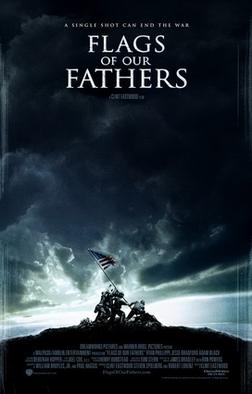
The picture itself is one of the most iconic, instantly recognizable images in American history. Days into the battle for Iwo Jima, photographer Joe Rosenthal snapped a picture of six Marines on Mount Suribachi as they raised a flag pole on this remote Japanese-held island. For a country who needed it as World War II raged on and the casualty lists increased day-by-day, the picture became something bigger, something more. The story itself though, isn't so well known, as told in 2006's Flags of Our Fathers.
It's February 1945 and World War II is in its final year. The Allies are advancing on all fronts and in the Pacific theater, a huge invasion is being planned on the island of Iwo Jima. After days of horrific fighting, a platoon of Marines walks up Mount Suribachi, planting an American flag at the summit. A photographer snaps a picture that becomes an instant sensation across the U.S. Three soldiers in the picture, John Bradley (Ryan Phillippe), a Navy corpsman, and two Marines, Rene Gagnon (Jesse Bradford), and Ira Hayes (Adam Beach), are pulled from the fighting and sent back to the U.S.. Why? The trio of soldiers begin a nationwide tour so Americans buy war bonds to aid the fighting. As they criss-cross the country, each of them begins to question what they're doing. There's more to the story than what people are being told. And why are they being honored when so many others didn't make it off Iwo Jima, off hundreds of little islands all over the Pacific?
What director Clint Eastwood set out to do when he decided to make two films about the battle for Iwo Jima was truly daunting. Filming back-to-back, Eastwood filmed 'Flags' (from the American perspective) and then Letters from Iwo Jima (from the Japanese perspective). Both films received excellent reviews (Letters higher than Flags) and the two films combined to earn about $130 million in theaters while also picking up quite a few award wins and nominations. For 'Flags' alone, he's taking on a lot. The true story of the flag-raising in Iwo is a fascinating one. The picture we all know, the Marines memorial in Washington D.C., that was actually the second flag-raising on Mount Suribachi that day in March 1945. That's one of the biggest selling points for Eastwood's film, a not so well known historical story, and what actually played out. Interesting stuff throughout.
This is not a combat heavy movie for those expecting Saving Private Ryan or We Were Soldiers. This is a war story that involves combat but uses that as a jumping off point. The firefights on Iwo Jima were filmed in Iceland and are incredibly uncomfortable to watch, but that's what the fighting on Iwo was like. The Japanese garrison had miles of tunnels, bunkers, pillboxes and intended crossfires, all waiting to unleash hell. That garrison didn't intend to surrender. They intended to die fighting for the island, and the fighting was the definition of hell. These scenes aren't prolonged, but it's quick, hard-hitting and visceral. It's never flashy either. Eastwood just presents it and lets the scenes breathe. The actual flag-raising on Mt. Suribachi is almost secondary, an effective scene that is even underused a little.
No, not a combat movie. This is a movie about the profound impact the Iwo Jima picture makes in the months following the picture's release. The focus is on Phillippe, Bradford and Beach, three different responses, three solid performances. Also look for John Benjamin Hickey as Keyes Beech, the trio's military handler on the bonds tour, and John Slattery as Bud Gerber, the Treasury official working as the ramrod of the tour. The story in a sense is familiar, those who survived honored as heroes and struggling with the title. They survived while thousands of others didn't. Now they're talking heads, public relations figures meant to give the war a heroic and financial boost. A truly interesting story that isn't hugely well known.
Who else to look out for? Beyond those three main soldiers, look for Jamie Bell, Barry Pepper and Paul Walker as key Marines, Bell given more to do as a close friend of Phillippe's Bradley. Pepper is solid -- as he always is -- as Sgt. Mike Strank, the platoon sergeant trying to get his men through the fighting. Robert Patrick and Neal McDonough have small parts as higher-ranking Marines. With this comes a pretty major issue for me. The focus is almost solely on the three survivors. The Marines who raised the first flag and the three who don't survive from the second flag-raising are barely mentioned, much less introduced. When we see them killed later in a quick montage, the deaths have little to no impact because we simply don't know these young men. Two deaths do resonate, one happening off-screen, but it's because we've met these two men and know a little something about them.
The storytelling device is tricky here, 'Flags' going a little down the Saving Private Ryan route. The story is told with a modern framing device, WWII/Iwo Jima vets telling their story to a reporter ('Flags' author James Bradley). Then we're thrown back to the actual tour. Then we're thrown back to the fighting. It leaves a disjointed feel to the story without a rhythm being found. It feels like we're bouncing around too much. Mostly though, the film works. The emotions are there, and it is an effective, fascinating story. The final scene is especially touching as are the pictures we see rolling over the credits of the real-life people and the real-life incidents. It's not Saving Private Ryan, but that's an all-time classic. Well worth checking out for history and WWII buffs.
Flags of Our Fathers (2006): ***/****
The Sons of Katie Elder
"First, we reunite, then find Ma and Pa's killer...then read some reviews."
Showing posts with label Clint Eastwood. Show all posts
Friday, November 14, 2014
Thursday, June 12, 2014
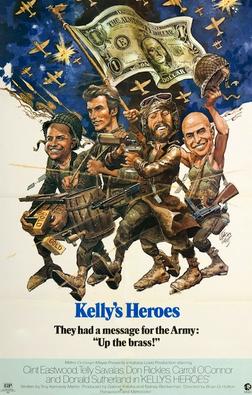
Kelly's Heroes
Growing
up, I always associated Memorial Day Weekend with the war movie
marathons on TV that dotted TNT, AMC and Turner Classic Movies. I ate
them up -- still do -- as I watched as many as I could. They're still
some of my favorite movies, everything from The Dirty Dozen to The
Devil's Brigade and one of my favorites, 1970's Kelly's Heroes.
It's fall 1944 and Allied forces are fighting their way across France, the German army slowly being beaten back. At the forefront of the Allied advance, a recon platoon, including Sgt. Big Joe (Telly Savalas), are worn down after months of fighting. One member of the platoon, Pvt. Kelly (Clint Eastwood), stumbles across an interesting tidbit of information while interrogating a German colonel. There is 14,000 bars of gold -- worth $16 million -- in a bank just waiting to be plucked. The catch? The bank is 30 miles behind German lines. Joe manages to convince both Big Joe and the platoon to navigate through the lines and get their hands on the gold. With a scrounger/supply sergeant, Crapgame (Don Rickles) and three Sherman tanks commanded by a hippie, Oddball (Donald Sutherland), along for the ride, Kelly and his motley crew of soldiers head out with a chance to net quite the payday.
What an appropriately timed World War II movie. By the late 1960s, the tone of war movies had changed from the big epics to the more cynical/comedic variety, movies like MASH and Catch 22 among others. Enter Kelly's Heroes, directed by Brian G. Hutton (who also directed Where Eagles Dare), one of the most entertaining war movies I've ever seen. Cynical with a dark sense of humor but also some lighter moments -- courtesy of Sutherland's hippie tank commander -- with some great action, memorable score, and one of those perfect tough guy casts. There's a reason it remains a fan favorite 40-plus years later, and much of it because it blends all those things together so effortlessly. Even an odd-sounding theme, Burning Bridges, fits perfectly in an odd way. It is one of my favorite movies and always will be, a classic war flick that I can sit down and watch whenever it pops up on TV.
Can you ask for a better lead quartet than Clint Eastwood, Telly Savalas, Don Rickles and Donald Sutherland? Yeah, there has been casts with bigger star power, bigger name recognition, but it's more than that here. This is four tough guys having fun, on-screen chemistry that's just hard to describe. They all get their chance in the spotlight. Eastwood is Eastwood, the impeccably cool and man of few words hero. Savalas is a subtle scene-stealer as Big Joe, the unofficial commander of the recon platoon (Hal Buckley playing the clueless real commander Capt. Maitland), just trying to get his men through the fighting unscathed and a somewhat unwilling participant in the gold heist. Rickles is an out of left field choice to join the cast, but it works, his Crapgame a smart-ass New Yorker always with an eye for a profit. And then there's Sutherland as Oddball, the tank commander always talking about positive waves (No Negative Waves, man!), his Zen-like qualities, heading into battle with music blaring and shells filled with paint waiting to be unleashed on the Germans.
As a fan of guy's guys movies, it's simply hard to beat those four stars. They make it look downright easy. Much of that chemistry and success comes from the script written by Troy Kennedy-Martin, a script with too many great one-liners to even mention. We see familiar character archetypes, familiar war movie situations -- stumbling into a minefield, prepping for battle -- but there's a different energy to the whole thing. It's that tone that blends the drama, comedy and action so easily that makes it work. Carroll O'Connor too is excellent in a part that lets him ham it up as General Colt, the fiery division commander who's frustrated with the stagnant front lines, getting a jolt of energy when Kelly's screwball force unintentionally opens things up all along the front. There's something to be said for a movie that is non-stop fun. It never gets heavy-handed or obvious like some more message-oriented war movies.
When the platoon looks back on a field where some of their fallen comrades lay dead in the dirt, there's no words that need to be said. The looks on the surviving men's faces says it all. Showing he's putting on appearances for his men, Big Joe turns and raises his binoculars to check one last time. The dynamic is there from the lead quartet right down to the platoon, a group of recognizable character actors clearly having some fun. The platoon includes Little Joe (Stuart Margolin), Big Joe's radioman, Cowboy (Jeff Morris) and Willard (Harry Dean Stanton), two drawling best buds, Gutowski (Dick Davalos), the sniper, Petuko (Perry Lopez), the smooth, goofy ladies man, Cpl. Job (Tom Troupe), Joe's second-in-command close friend, Fisher (Dick Balduzzi), the platoon genius, and Babra not Barbara (Gene Collins). Also, you can't forget Gavin MacLeod as Moriarty, Oddball's mechanical genius and constant provide of negative waves.
Also look for Seinfeld's Uncle Leo, Len Lesser, as Bellamy, an engineer Oddball ropes into helping the cause and Karl-Otto Alberty as a German tank commander who goes up against Kelly's forces and Oddball's tank trio.
With a 146-minute running time, we've got plenty of chances for guys being guys and plenty of action scenes. We get lots of action -- escaping a minefield, a tank attack on a railway station, the platoon racing through a German crossroad under mortar attack -- but the best is saved for last as the platoon descends on Clermont, the town where the bank and the gold are waiting. It's an extended sequence that runs about 35 minutes that doesn't rush into it. We get almost 10 minutes of the men and the tanks sneaking into town while the German garrison slowly wakes up, composer Lalo Schifrin's score driving the action. The entire movie was filmed in Czechoslovakia, the action finale filmed in the village of Vizinada. It's an extended sequence that is hard to beat.
Just a great movie overall. Great cast, incredibly quotable, lots of action, memorable soundtrack (Quentin Tarantino is a big fan of the score, especially Tiger Tank), and even a nod to Eastwood's spaghetti western background with a three-way showdown with said tank. One of my all-time favorites and hopefully you'll enjoy it just as much as I do.
Kelly's Heroes (1970): ****/****
Rewrite of August 2009 review
It's fall 1944 and Allied forces are fighting their way across France, the German army slowly being beaten back. At the forefront of the Allied advance, a recon platoon, including Sgt. Big Joe (Telly Savalas), are worn down after months of fighting. One member of the platoon, Pvt. Kelly (Clint Eastwood), stumbles across an interesting tidbit of information while interrogating a German colonel. There is 14,000 bars of gold -- worth $16 million -- in a bank just waiting to be plucked. The catch? The bank is 30 miles behind German lines. Joe manages to convince both Big Joe and the platoon to navigate through the lines and get their hands on the gold. With a scrounger/supply sergeant, Crapgame (Don Rickles) and three Sherman tanks commanded by a hippie, Oddball (Donald Sutherland), along for the ride, Kelly and his motley crew of soldiers head out with a chance to net quite the payday.
What an appropriately timed World War II movie. By the late 1960s, the tone of war movies had changed from the big epics to the more cynical/comedic variety, movies like MASH and Catch 22 among others. Enter Kelly's Heroes, directed by Brian G. Hutton (who also directed Where Eagles Dare), one of the most entertaining war movies I've ever seen. Cynical with a dark sense of humor but also some lighter moments -- courtesy of Sutherland's hippie tank commander -- with some great action, memorable score, and one of those perfect tough guy casts. There's a reason it remains a fan favorite 40-plus years later, and much of it because it blends all those things together so effortlessly. Even an odd-sounding theme, Burning Bridges, fits perfectly in an odd way. It is one of my favorite movies and always will be, a classic war flick that I can sit down and watch whenever it pops up on TV.
Can you ask for a better lead quartet than Clint Eastwood, Telly Savalas, Don Rickles and Donald Sutherland? Yeah, there has been casts with bigger star power, bigger name recognition, but it's more than that here. This is four tough guys having fun, on-screen chemistry that's just hard to describe. They all get their chance in the spotlight. Eastwood is Eastwood, the impeccably cool and man of few words hero. Savalas is a subtle scene-stealer as Big Joe, the unofficial commander of the recon platoon (Hal Buckley playing the clueless real commander Capt. Maitland), just trying to get his men through the fighting unscathed and a somewhat unwilling participant in the gold heist. Rickles is an out of left field choice to join the cast, but it works, his Crapgame a smart-ass New Yorker always with an eye for a profit. And then there's Sutherland as Oddball, the tank commander always talking about positive waves (No Negative Waves, man!), his Zen-like qualities, heading into battle with music blaring and shells filled with paint waiting to be unleashed on the Germans.
As a fan of guy's guys movies, it's simply hard to beat those four stars. They make it look downright easy. Much of that chemistry and success comes from the script written by Troy Kennedy-Martin, a script with too many great one-liners to even mention. We see familiar character archetypes, familiar war movie situations -- stumbling into a minefield, prepping for battle -- but there's a different energy to the whole thing. It's that tone that blends the drama, comedy and action so easily that makes it work. Carroll O'Connor too is excellent in a part that lets him ham it up as General Colt, the fiery division commander who's frustrated with the stagnant front lines, getting a jolt of energy when Kelly's screwball force unintentionally opens things up all along the front. There's something to be said for a movie that is non-stop fun. It never gets heavy-handed or obvious like some more message-oriented war movies.
When the platoon looks back on a field where some of their fallen comrades lay dead in the dirt, there's no words that need to be said. The looks on the surviving men's faces says it all. Showing he's putting on appearances for his men, Big Joe turns and raises his binoculars to check one last time. The dynamic is there from the lead quartet right down to the platoon, a group of recognizable character actors clearly having some fun. The platoon includes Little Joe (Stuart Margolin), Big Joe's radioman, Cowboy (Jeff Morris) and Willard (Harry Dean Stanton), two drawling best buds, Gutowski (Dick Davalos), the sniper, Petuko (Perry Lopez), the smooth, goofy ladies man, Cpl. Job (Tom Troupe), Joe's second-in-command close friend, Fisher (Dick Balduzzi), the platoon genius, and Babra not Barbara (Gene Collins). Also, you can't forget Gavin MacLeod as Moriarty, Oddball's mechanical genius and constant provide of negative waves.
Also look for Seinfeld's Uncle Leo, Len Lesser, as Bellamy, an engineer Oddball ropes into helping the cause and Karl-Otto Alberty as a German tank commander who goes up against Kelly's forces and Oddball's tank trio.
With a 146-minute running time, we've got plenty of chances for guys being guys and plenty of action scenes. We get lots of action -- escaping a minefield, a tank attack on a railway station, the platoon racing through a German crossroad under mortar attack -- but the best is saved for last as the platoon descends on Clermont, the town where the bank and the gold are waiting. It's an extended sequence that runs about 35 minutes that doesn't rush into it. We get almost 10 minutes of the men and the tanks sneaking into town while the German garrison slowly wakes up, composer Lalo Schifrin's score driving the action. The entire movie was filmed in Czechoslovakia, the action finale filmed in the village of Vizinada. It's an extended sequence that is hard to beat.
Just a great movie overall. Great cast, incredibly quotable, lots of action, memorable soundtrack (Quentin Tarantino is a big fan of the score, especially Tiger Tank), and even a nod to Eastwood's spaghetti western background with a three-way showdown with said tank. One of my all-time favorites and hopefully you'll enjoy it just as much as I do.
Kelly's Heroes (1970): ****/****
Rewrite of August 2009 review
Friday, May 9, 2014
A Fistful of Dollars
By 1964, the spaghetti western genre -- westerns typically made in Italy and Spain with Italian backing -- was alive and well, but not quite what people think of now. The genre was still in its infancy, light, even family-oriented westerns that were cheap knockoffs of American westerns. That changed in 1964, one movie kicking in the door and changing the genre and westerns as a whole in a huge way. The movie? 1964's A Fistful of Dollars.
In the small, south of the border town of San Miguel, a nameless gunfighter (Clint Eastwood) rides into town and promptly catches the attention of three gunfighters. He callously shoots them down in the street and heads to the saloon. There he meets the saloon owner, Silvanito (Jose Calvo), who fills him in on the town and its background. Things are run by two warring families, the Rojos, three brothers led by the maniacal, Ramon (Gian Maria Volonte), and the Baxters, led by the town sheriff, John (Wolfgang Lukschy). The two families are always going at it, and the mysterious gunfighter sits directly in the middle. Seeing a chance to make some serious money, the gunman pits the two families against each other, his job made that much easier when a troop of Mexican cavalry rides into San Miguel transporting a gold shipment headed for the U.S.
Wow, what a movie from director Sergio Leone as he kicks off his Dollars trilogy. A director with a handful of films to his name -- some credited, some not -- Leone put his name on the map with this western. This is unlike just about any western that came before it. Leave it to an Italian director working in Spain with an international cast and crew to rewrite the most American of genres. Tweaking Akira Kurosaw's Yojimbo, this is dark, dirty, brutally sadistic and cynical from the characters to the story and everything in between. There aren't so much good guys and bad guys, just less bad guys. No one is safe. The violence is aggressive, stylish and in your face. 'Fistful' helped propel the western into a new age, Leone's For a Few Dollars More and The Good, the Bad and the Ugly hitting theaters in the two years following. It all started here, and it starts in a big way.
A recognizable face from TV's Rawhide, Clint Eastwood was far from a star in 1964. He was a definite TV star and had some supporting parts in films, but in 1964, he signed on to star in this Euro-western with a director he knew little about. What a wise decision it was, Eastwood propelling to international stardom thanks in great part to the Leone westerns. This is the definition of a western anti-hero. He isn't typically interested in what's right or living up to his word. He's looking to survive, make some money and move on. He earned the nickname the Man with No Name -- he's called Joe here, Manco and Blondie in the other Dollars movies -- for these movies, a gunfighter and drifter who moves from job to job. For the most part, he's a man of few words, typically letting his six-shooter do his talking. He squints and stares, sometimes revealing that "I'm up to something" smirk.
Much of the character is in the visual. Eastwood's Man with No Name wears a hat pulled down tight on his head, a long poncho over his frame, a calfskin vest and denim shirt, tight blue jeans, and plain boots with his gunbelt worn low on his hip. His face is covered in a short beard, almost a five-o'clock shadow. Talk about doing a 180 from the typical white hat-wearing western hero. That's a big part of the spaghettis appeal, credit going to Leone in general. The west was hot, dirty and sweaty, and it reflects in the look of the movie. The Almeria locations, the wardrobes, the town sets, all these little things add up to the success of the movie. Oh, and there's that composer, Ennio Morricone, turning in a memorable score that he would top with the next two movies. A good score, but he would set the bar high with each passing movie. Listen to an extended sample HERE. It's all those little things that add up from the look to the style to soundtrack to the stylish opening credits, and they all add up here nicely.
Working again with Leone a year later as the villain in For a Few Dollars More, Volonte became one of the all-time great western villains as the psychotic, pot-smoking Indio. It took that crazy performance to keep this performance in the background. Volonte delivers a gem of a part as Ramon Rojo, the fiery leader of the Rojo family. He's a brutal, calculating killer who's a dead-shot with a rifle. In Eastwood's Joe, he sees an expert gunman who can cause problems. Snake-like, sinister and creepy, a great lead performance. His brothers include Sieghardt Rupp and Antonio Prieto Puerto, his gang including spaghetti regulars Benito Stefanelli, Aldo Sambrell and Mario Brega. Along with Lukschy as the Baxter patriarch, look for Margarita Lozano as his wife and Bruno Carotenuto as their oldest son, Antonio.
In a lot of ways, 'Fistful' feels like a dry run for what's to come. The cynicism, the style, the characters, the shootouts, Leone would improve on it all over the next two movies. The gunfights are quick and harsh, and the finale as Joe stands down Ramon, his brothers and their gang shows that style that would become iconic in 'FAFDM' and 'GBU.' The close-ups, sometimes extreme close-ups of faces and eyes, the violent fanning of the gun for rapid fire effect. It's all there. Is it a great movie? No, but it's really good. A modern comparison is easy, Christopher Nolan's Batman trilogy. Batman Begins is a really good movie, but the next two movies are simply better. That said, the first one had to lay out the groundwork for what was to come. An excellent movie, a huge turning point for where westerns would go in the mid to late 1960s.
A Fistful of Dollars (1964): ***/****
In the small, south of the border town of San Miguel, a nameless gunfighter (Clint Eastwood) rides into town and promptly catches the attention of three gunfighters. He callously shoots them down in the street and heads to the saloon. There he meets the saloon owner, Silvanito (Jose Calvo), who fills him in on the town and its background. Things are run by two warring families, the Rojos, three brothers led by the maniacal, Ramon (Gian Maria Volonte), and the Baxters, led by the town sheriff, John (Wolfgang Lukschy). The two families are always going at it, and the mysterious gunfighter sits directly in the middle. Seeing a chance to make some serious money, the gunman pits the two families against each other, his job made that much easier when a troop of Mexican cavalry rides into San Miguel transporting a gold shipment headed for the U.S.
Wow, what a movie from director Sergio Leone as he kicks off his Dollars trilogy. A director with a handful of films to his name -- some credited, some not -- Leone put his name on the map with this western. This is unlike just about any western that came before it. Leave it to an Italian director working in Spain with an international cast and crew to rewrite the most American of genres. Tweaking Akira Kurosaw's Yojimbo, this is dark, dirty, brutally sadistic and cynical from the characters to the story and everything in between. There aren't so much good guys and bad guys, just less bad guys. No one is safe. The violence is aggressive, stylish and in your face. 'Fistful' helped propel the western into a new age, Leone's For a Few Dollars More and The Good, the Bad and the Ugly hitting theaters in the two years following. It all started here, and it starts in a big way.
A recognizable face from TV's Rawhide, Clint Eastwood was far from a star in 1964. He was a definite TV star and had some supporting parts in films, but in 1964, he signed on to star in this Euro-western with a director he knew little about. What a wise decision it was, Eastwood propelling to international stardom thanks in great part to the Leone westerns. This is the definition of a western anti-hero. He isn't typically interested in what's right or living up to his word. He's looking to survive, make some money and move on. He earned the nickname the Man with No Name -- he's called Joe here, Manco and Blondie in the other Dollars movies -- for these movies, a gunfighter and drifter who moves from job to job. For the most part, he's a man of few words, typically letting his six-shooter do his talking. He squints and stares, sometimes revealing that "I'm up to something" smirk.
Much of the character is in the visual. Eastwood's Man with No Name wears a hat pulled down tight on his head, a long poncho over his frame, a calfskin vest and denim shirt, tight blue jeans, and plain boots with his gunbelt worn low on his hip. His face is covered in a short beard, almost a five-o'clock shadow. Talk about doing a 180 from the typical white hat-wearing western hero. That's a big part of the spaghettis appeal, credit going to Leone in general. The west was hot, dirty and sweaty, and it reflects in the look of the movie. The Almeria locations, the wardrobes, the town sets, all these little things add up to the success of the movie. Oh, and there's that composer, Ennio Morricone, turning in a memorable score that he would top with the next two movies. A good score, but he would set the bar high with each passing movie. Listen to an extended sample HERE. It's all those little things that add up from the look to the style to soundtrack to the stylish opening credits, and they all add up here nicely.
Working again with Leone a year later as the villain in For a Few Dollars More, Volonte became one of the all-time great western villains as the psychotic, pot-smoking Indio. It took that crazy performance to keep this performance in the background. Volonte delivers a gem of a part as Ramon Rojo, the fiery leader of the Rojo family. He's a brutal, calculating killer who's a dead-shot with a rifle. In Eastwood's Joe, he sees an expert gunman who can cause problems. Snake-like, sinister and creepy, a great lead performance. His brothers include Sieghardt Rupp and Antonio Prieto Puerto, his gang including spaghetti regulars Benito Stefanelli, Aldo Sambrell and Mario Brega. Along with Lukschy as the Baxter patriarch, look for Margarita Lozano as his wife and Bruno Carotenuto as their oldest son, Antonio.
In a lot of ways, 'Fistful' feels like a dry run for what's to come. The cynicism, the style, the characters, the shootouts, Leone would improve on it all over the next two movies. The gunfights are quick and harsh, and the finale as Joe stands down Ramon, his brothers and their gang shows that style that would become iconic in 'FAFDM' and 'GBU.' The close-ups, sometimes extreme close-ups of faces and eyes, the violent fanning of the gun for rapid fire effect. It's all there. Is it a great movie? No, but it's really good. A modern comparison is easy, Christopher Nolan's Batman trilogy. Batman Begins is a really good movie, but the next two movies are simply better. That said, the first one had to lay out the groundwork for what was to come. An excellent movie, a huge turning point for where westerns would go in the mid to late 1960s.
A Fistful of Dollars (1964): ***/****
Wednesday, January 22, 2014
Trouble with the Curve
I really like baseball. I also really like just about any movie Clint Eastwood has ever done. So naturally I should like a movie that combines the two things, right? Right?!? Yeah, that's what I thought, but it didn't quite turn out that way. I had modest expectations going into 2012's Trouble with the Curve, but it was surprisingly bad.
A longtime scout for the Atlanta Braves, Gus Lobel (Eastwood) has made a career out of being able to analyze a baseball player's skills and tell if they'll be able to cut it in the Majors. His contract is about to expire, just a few months away, and though he's unaware of it, the Braves are trying to decide if they should re-up with him. With the first-year player's MLB Draft fast approaching, Gus has been tasked with scouting Bo Gentry (Joe Massingill), a power-hitting third baseman projected to be either first or second pick overall. The Braves have the No. 2 pick so Gentry could fall to them, but Gus has a serious issue. He's starting to lose his vision but refuses to get any help. His daughter, Mickey (Amy Adams), an associate aiming to be a partner at her law firm, takes a few days off to accompany her Dad and help him out if possible. Their relationship is to say the least strained though, and both are working through some past and current issues, the draft approaching ever faster.
I really thought this was a can't miss kind of film. No, not an all-time classic that would rejuvenate my love of movies, but a good, old-fashioned story about family and baseball and all that good stuff. So as I mentioned, modest expectations, nothing more. Even then, I came away extremely disappointed. Basically all the reviews made a clear distinction. The script from Randy Brown is schmaltzy, sappy, too darn sweet, and oh so darn heartwarming. Everyone admitted it, but it seemed to divide the reviews. Some people said all those things and liked it (I didn't see many "love" reviews) while others said all those things and came away disappointed with a dull, cheesy movie. I'll give two guesses, but you'll only need one. Which camp do you think I'm in?
It doesn't take a genius to watch the trailer and figure out it's going to be all of those things I mentioned above (watch the trailer below at the end of the review). I figured it would use that as a jumping off point, a springboard to bigger, better and more. Yeah, about that.....nope, it just doesn't happen. A movie that runs 111 minutes plays like one big after school special. A torn apart family, wounds still fresh and unresolved, a chance to come together and get a shot at some redemption, it gets tedious by the second or third confrontation between Eastwood's Gus and Adams' Mickey (named after Mickey Mantle). Mickey wants to deal with their checkered past, Gus a single dad who worked a lot and tried his best but really pawned off his little girl on family. It takes too long to get anywhere, it's dull getting there and the resolution is more than just predictable. You can predict it now. Go ahead, try it.
As the plodding story moved along, I kept waiting for this movie to get better. If nothing else, the talent assembled would make it worthwhile, or so I thought. It didn't. Eastwood came out of acting retirement to star here, but he's playing that same gruff, growling old man he's done in Gran Torino and any number of other movies. It's not a bad performance, just a familiar one that isn't particularly interesting. Adams tries her best here to bring it all together, a woman who's spent much of her adult (and child) life trying to adjust and cope with what happened to her as a kid. Her chemistry is okay with Eastwood, but far too much time is devoted to her 'Will they? Won't they?' possible relationship with Justin Timberlake's dreamy young baseball scout, Johnny. So Mickey is trying to help (read = save) her Dad, but her Dad is the one that's helping her out too, everyone learning a lesson in the process? Gag me.
Also look for John Goodman as a higher-up Braves official and a close friend of Gus, Robert Patrick as the Braves general manager, Matthew Lillard as a younger scout who's embraced all the stats of scouting rather than the personal analysis of watching a player, and Ed Lauter, Chelcie Ross and Raymond Anthony Thomas as fellow crotchety baseball scouts.
More than anything, I had an issue as a baseball fan of a baseball movie that doesn't know the sport it's writing about. The Red Sox are going to send an inexperienced scout like Timberlake's Johnny to scout the possible No. 1 player in the draft? And Bo is a five-tool player? He's slow, chubby and is supposed to be the next Albert Pujols? Yeah, I'm not buying it, the character an unlikable caricature. Those are all issues but nothing that would ruin a movie. That comes in the finale, a ridiculously forced ending that would happen in no real world of professional sports with millions of dollars on the line. Big, broad characters -- for good and bad -- and a story that's going to get where it wants to get, making sense be damned. A huge disappointment.
Trouble With the Curve (2012): */****
A longtime scout for the Atlanta Braves, Gus Lobel (Eastwood) has made a career out of being able to analyze a baseball player's skills and tell if they'll be able to cut it in the Majors. His contract is about to expire, just a few months away, and though he's unaware of it, the Braves are trying to decide if they should re-up with him. With the first-year player's MLB Draft fast approaching, Gus has been tasked with scouting Bo Gentry (Joe Massingill), a power-hitting third baseman projected to be either first or second pick overall. The Braves have the No. 2 pick so Gentry could fall to them, but Gus has a serious issue. He's starting to lose his vision but refuses to get any help. His daughter, Mickey (Amy Adams), an associate aiming to be a partner at her law firm, takes a few days off to accompany her Dad and help him out if possible. Their relationship is to say the least strained though, and both are working through some past and current issues, the draft approaching ever faster.
I really thought this was a can't miss kind of film. No, not an all-time classic that would rejuvenate my love of movies, but a good, old-fashioned story about family and baseball and all that good stuff. So as I mentioned, modest expectations, nothing more. Even then, I came away extremely disappointed. Basically all the reviews made a clear distinction. The script from Randy Brown is schmaltzy, sappy, too darn sweet, and oh so darn heartwarming. Everyone admitted it, but it seemed to divide the reviews. Some people said all those things and liked it (I didn't see many "love" reviews) while others said all those things and came away disappointed with a dull, cheesy movie. I'll give two guesses, but you'll only need one. Which camp do you think I'm in?
It doesn't take a genius to watch the trailer and figure out it's going to be all of those things I mentioned above (watch the trailer below at the end of the review). I figured it would use that as a jumping off point, a springboard to bigger, better and more. Yeah, about that.....nope, it just doesn't happen. A movie that runs 111 minutes plays like one big after school special. A torn apart family, wounds still fresh and unresolved, a chance to come together and get a shot at some redemption, it gets tedious by the second or third confrontation between Eastwood's Gus and Adams' Mickey (named after Mickey Mantle). Mickey wants to deal with their checkered past, Gus a single dad who worked a lot and tried his best but really pawned off his little girl on family. It takes too long to get anywhere, it's dull getting there and the resolution is more than just predictable. You can predict it now. Go ahead, try it.
As the plodding story moved along, I kept waiting for this movie to get better. If nothing else, the talent assembled would make it worthwhile, or so I thought. It didn't. Eastwood came out of acting retirement to star here, but he's playing that same gruff, growling old man he's done in Gran Torino and any number of other movies. It's not a bad performance, just a familiar one that isn't particularly interesting. Adams tries her best here to bring it all together, a woman who's spent much of her adult (and child) life trying to adjust and cope with what happened to her as a kid. Her chemistry is okay with Eastwood, but far too much time is devoted to her 'Will they? Won't they?' possible relationship with Justin Timberlake's dreamy young baseball scout, Johnny. So Mickey is trying to help (read = save) her Dad, but her Dad is the one that's helping her out too, everyone learning a lesson in the process? Gag me.
Also look for John Goodman as a higher-up Braves official and a close friend of Gus, Robert Patrick as the Braves general manager, Matthew Lillard as a younger scout who's embraced all the stats of scouting rather than the personal analysis of watching a player, and Ed Lauter, Chelcie Ross and Raymond Anthony Thomas as fellow crotchety baseball scouts.
More than anything, I had an issue as a baseball fan of a baseball movie that doesn't know the sport it's writing about. The Red Sox are going to send an inexperienced scout like Timberlake's Johnny to scout the possible No. 1 player in the draft? And Bo is a five-tool player? He's slow, chubby and is supposed to be the next Albert Pujols? Yeah, I'm not buying it, the character an unlikable caricature. Those are all issues but nothing that would ruin a movie. That comes in the finale, a ridiculously forced ending that would happen in no real world of professional sports with millions of dollars on the line. Big, broad characters -- for good and bad -- and a story that's going to get where it wants to get, making sense be damned. A huge disappointment.
Trouble With the Curve (2012): */****
Labels:
2010s,
Amy Adams,
Clint Eastwood,
Ed Lauter,
John Goodman,
Justin Timberlake,
Robert Patrick,
Sports
Friday, September 27, 2013
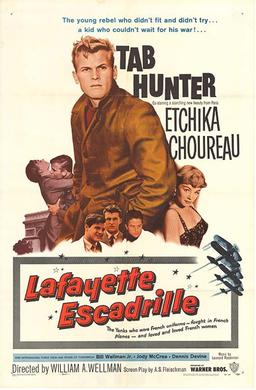
Lafayette Escadrille
Before the U.S. entered the fighting in World War I, Americans still had a chance to join the fighting themselves, especially those wanting to fly. The Lafayette Escadrille was created as a fighter squadron of American volunteers who wanted to help turn back the Axis forces. The famous squadron has been in three film adaptations of their exploits, including a silent film, recently with 2006's Flyboys, and a real dud of a flick on basically all levels, 1958's Lafayette Escadrille.
Having gotten in trouble with the law and subsequently with his father, Thad Walker (Tab Hunter) flees and sneaks onto a ship out of New York heading for Europe. His plan? Join the Lafayette Escadrille, a squadron of flyers in the French army created for American volunteers looking to join the fighting in World War I. He's worried about his trouble with the law stopping him from the squadron, but he's accepted and arrives with three other Americans. They begin training under French commanders, learning to work as a team -- mostly on the ground with very little actual training in a plane. Thad's mind is elsewhere though. He's constantly thinking about Renee (Etchika Choureau), a beautiful young French woman he met in Paris before shipping out to training camp. Can he focus enough on the training and flying to become a flyer?
How do I put those delicately? From director William A. Wellman, this movie just ain't good. It's almost painful at times to actually get a movie that runs an endless 93 minutes. For starters, it isn't really much of a story about the American flyers flying with the French. That must have been a ploy by Wellman. Point to you, Wellman! It's a bizarre mix of a forced love story, out of place physical humor, and broadly written dull characters. How many scenes do we need of a French drill sergeant (Marcel Dalio) who can't speak English trying to get his volunteers to march in formation? Oh, but one of the Americans speaks French and is just messing with the sergeant?!? That's hilarious. The actual training scenes are embarrassing, rickety wooden planes crashing into each other, even running into a bakery and a bakery thief. It doesn't have to be a consistently dark tone, but a Keystone Cops tone is exactly what shouldn't have been done.
Much like 2006's Flyboys -- which I liked a lot -- 'Lafayette' devotes far too much time to an unnecessary love story that is criminally boring to watch develop. I've never been a huge fan of Hunter as an actor, and here the 27-year old just doesn't bring the character to life. First off, it's hard to root for him. As we meet him, he's stealing a car and actually crashes at high speeds into a kid on a bike (the kid's only injured thankfully). His Thad comes from a tough house where his rich dad was very tough on him. Boo-hoo, I don't feel for you, buddy. It's not just that I didn't like the character, I was actively rooting against him. That's always a good jumping off point for any movie. His relationship with Choureau's Renee brings an already slow-moving story to a grinding halt. At the 45-minute mark, the story focuses almost exclusively on the love story away from the airfield. I felt like I'd stumbled into a different movie, a far more boring movie.
But wait, there's hope! Right? Eh, maybe not. I was intrigued by the supporting cast here so I held out hope. Thad's fellow pilots he arrives with include David Janssen as the smooth-talking, pencil mustache pilot, Duke, William Wellman Jr. playing a variation on his dad who actually flew as a WWI pilot Jody McCrea as Tom. As for the rest of the pilots, look for a pre-Rawhide Clint Eastwood, pre-Billy Jack Tom Laughlin, and Will Hutchins. The problem becomes that many more pilots are introduced, but they're a faceless bunch of characters that never amount to anything. We're actually introduced to them as they're sleeping -- so we don't actually see most of their faces -- as Wellman Sr. narrates what will happen to them. We don't actually see any of that happen, but we learn that most of them will die. It would have had at least some emotional impact if we actually got to know them. Also look for Paul Fix briefly as an American general.
It's a film that wasn't intended to be a classic but is still highly disappointing. The actual aerial footage of the WWI-era planes is pretty cool, but there's very little of it. We don't even see a dogfight until the last 10 minutes of the movie, and by then I had long since checked out. A cool cast makes it almost worth watching as a sort of guilty pleasure, a way to check off an actor like Eastwood's filmography, but it has little else to recommend. It's Rebel Without a Cause in planes, but they forgot to bring the planes. Pass.
Lafayette Escadrille (1958): */****
Having gotten in trouble with the law and subsequently with his father, Thad Walker (Tab Hunter) flees and sneaks onto a ship out of New York heading for Europe. His plan? Join the Lafayette Escadrille, a squadron of flyers in the French army created for American volunteers looking to join the fighting in World War I. He's worried about his trouble with the law stopping him from the squadron, but he's accepted and arrives with three other Americans. They begin training under French commanders, learning to work as a team -- mostly on the ground with very little actual training in a plane. Thad's mind is elsewhere though. He's constantly thinking about Renee (Etchika Choureau), a beautiful young French woman he met in Paris before shipping out to training camp. Can he focus enough on the training and flying to become a flyer?
How do I put those delicately? From director William A. Wellman, this movie just ain't good. It's almost painful at times to actually get a movie that runs an endless 93 minutes. For starters, it isn't really much of a story about the American flyers flying with the French. That must have been a ploy by Wellman. Point to you, Wellman! It's a bizarre mix of a forced love story, out of place physical humor, and broadly written dull characters. How many scenes do we need of a French drill sergeant (Marcel Dalio) who can't speak English trying to get his volunteers to march in formation? Oh, but one of the Americans speaks French and is just messing with the sergeant?!? That's hilarious. The actual training scenes are embarrassing, rickety wooden planes crashing into each other, even running into a bakery and a bakery thief. It doesn't have to be a consistently dark tone, but a Keystone Cops tone is exactly what shouldn't have been done.
Much like 2006's Flyboys -- which I liked a lot -- 'Lafayette' devotes far too much time to an unnecessary love story that is criminally boring to watch develop. I've never been a huge fan of Hunter as an actor, and here the 27-year old just doesn't bring the character to life. First off, it's hard to root for him. As we meet him, he's stealing a car and actually crashes at high speeds into a kid on a bike (the kid's only injured thankfully). His Thad comes from a tough house where his rich dad was very tough on him. Boo-hoo, I don't feel for you, buddy. It's not just that I didn't like the character, I was actively rooting against him. That's always a good jumping off point for any movie. His relationship with Choureau's Renee brings an already slow-moving story to a grinding halt. At the 45-minute mark, the story focuses almost exclusively on the love story away from the airfield. I felt like I'd stumbled into a different movie, a far more boring movie.
But wait, there's hope! Right? Eh, maybe not. I was intrigued by the supporting cast here so I held out hope. Thad's fellow pilots he arrives with include David Janssen as the smooth-talking, pencil mustache pilot, Duke, William Wellman Jr. playing a variation on his dad who actually flew as a WWI pilot Jody McCrea as Tom. As for the rest of the pilots, look for a pre-Rawhide Clint Eastwood, pre-Billy Jack Tom Laughlin, and Will Hutchins. The problem becomes that many more pilots are introduced, but they're a faceless bunch of characters that never amount to anything. We're actually introduced to them as they're sleeping -- so we don't actually see most of their faces -- as Wellman Sr. narrates what will happen to them. We don't actually see any of that happen, but we learn that most of them will die. It would have had at least some emotional impact if we actually got to know them. Also look for Paul Fix briefly as an American general.
It's a film that wasn't intended to be a classic but is still highly disappointing. The actual aerial footage of the WWI-era planes is pretty cool, but there's very little of it. We don't even see a dogfight until the last 10 minutes of the movie, and by then I had long since checked out. A cool cast makes it almost worth watching as a sort of guilty pleasure, a way to check off an actor like Eastwood's filmography, but it has little else to recommend. It's Rebel Without a Cause in planes, but they forgot to bring the planes. Pass.
Lafayette Escadrille (1958): */****
Labels:
1950s,
Clint Eastwood,
David Janssen,
Paul Fix,
Tab Hunter,
WWI
Tuesday, July 30, 2013
Pale Rider
By the 1980s, the western genre had played out the string. Revisionist westerns of the 1970s had nailed that coffin shot, leaving an occasional western for a 1980s audience, flicks like The Long Riders (good), Tom Horn (a near classic), Heaven's Gate (potential but a disaster), and Silverado (okay but meh) among others. What was the most financially successful western of the decade? That would be 1985's Pale Rider.
It's the 1880s somewhere in the California mountains and Hull Barrett (Michael Moriarty) is one of many miners trying to carve a life for himself in a small, isolated mining village. Some gold has been found -- enough to keep the people around -- but no huge lode just yet. Finding any gold strike has proved to be extremely difficult as a local businessman and miner himself, LaHood (Richard Dysart), constantly sends a gang of thugs to disrupt the village's activities. Miners and not gunfighters, the village doesn't know what to do following one particularly dangerous raid. The situation seems hopeless until a mysterious drifter known only as the Preacher (Clint Eastwood) arrives in town. He instantly tangles with LaHood's thugs, prompting a bigger showing of power. Will the Preacher be able to hold off LaHood, especially when he calls in help from a corrupt marshal?
Making over $41 million in theaters in the United States alone, 'Rider' was a huge hit with audiences. Both producing and directing as well as starring, Eastwood makes his return to the western genre that helped make him an international star. His last true western was a classic in itself, 1976's The Outlaw Josey Wales. It is an interesting if not particularly unique western, borrowing very liberally from both Shane and another Eastwood flick, High Plains Drifter. I liked it if I didn't love, a dark if still traditional western that is worth a watch. The filming locations in the Boulder Mountains and Sawtooth National Recreation Area in Idaho are a change of pace visually, beautiful, cluttered and claustrophobic like it's hanging over the story. Composer Lennie Niehaus' score was forgettable as I'm unable to member a single note or tune.
This is one of a few Eastwood movies that's evaded me over the years. I heard less than sterling reviews, but when it showed up on TCM's scheduling recently I wanted to give it a shot. Eastwood is one of a few faces of the western genre, a huge star who's name is instantly associated with it. He plays a similar character here to what we're familiar with, a quiet (although he talks more than usual) drifter, a gunman who travels with the clothes on his pack and his bedroll and saddle. He doesn't seem to take money, only doing what he believes to be right; in this case, defending the miners against the greedy, evil LaHood. Though he is downright talkative relative to his other roles, Eastwood is a menacing, intimidating presence more than anything. His Preacher is a great character, a familiar if worthwhile anti-hero.
The most accurate description I can give of this movie is Shane meets High Plains Drifter. It blends the idea of a hired gun -- Shane -- protecting landowners/farmers with a possibly other-worldly potential -- as was the case in HPD. Nothing is ever spelled out, but there is obviously the intention that Eastwood's Preacher is some sort of avenging angel, quoting literally Revelations. Preacher actually shows up following a prayer asking for help. He moves effortlessly, seemingly disappearing at times, especially in a final showdown. Hired guns fire blindly where they saw him, but he's not there anymore. Is he a ghost? Is he dead? An avenging angel? There's another route, one that I prefer. Preacher is a man back from the dead -- we see his back riddled with past bullet wounds -- and one key character appears to know him from somewhere. However you interpret the character, it allows for some pretty cool possibilities.
The supporting cast, while solid, doesn't jump off the page. Maybe there's too many characters, too much going on. Moriarty is the Joe Starrett character, the miner trying to build a life for himself, taking in a widow (shrill, annoying Carrie Snodgress) and her daughter (Sydney Penny), both taking an instant like to Preacher. He pairs well with Eastwood, both good men, one just more pure. Dysart is a decent villain but underused. The real villain is John Russell as Stockburn, an aging, corrupt marshal who works for whatever law will pay him and travels with six gunslinging deputies (including Billy Drago). Also look for Chris Penn as LaHood's bullying, entitled son and Richard Kiel as one of his miners/henchmen. That's just the start though with at least a dozen other speaking parts, none given a whole lot to do.
The action too is saved for a few specific set pieces. One, Preacher's introduction in town as he whales on a handful of LaHood henchmen with a solid piece of hickory, almost like a samurai wielding a sword (watch it HERE). The best is the finale as Preacher goes up against Stockburn and his deputies on an empty, quiet street. This is the scene that most convinced me the character is some sort of avenging angel, especially the ultimate resolution. I did like this western, but it is missing something that prevents it from being a classic. The insistence on Snodgress' Sarah and Penny's Megan both falling for Preacher is a little much, especially in execution in some painfully stilted scenes. Even the final scenes loses some effectiveness because of it. A good western, not a great one.
Pale Rider (1985): ***/****
It's the 1880s somewhere in the California mountains and Hull Barrett (Michael Moriarty) is one of many miners trying to carve a life for himself in a small, isolated mining village. Some gold has been found -- enough to keep the people around -- but no huge lode just yet. Finding any gold strike has proved to be extremely difficult as a local businessman and miner himself, LaHood (Richard Dysart), constantly sends a gang of thugs to disrupt the village's activities. Miners and not gunfighters, the village doesn't know what to do following one particularly dangerous raid. The situation seems hopeless until a mysterious drifter known only as the Preacher (Clint Eastwood) arrives in town. He instantly tangles with LaHood's thugs, prompting a bigger showing of power. Will the Preacher be able to hold off LaHood, especially when he calls in help from a corrupt marshal?
Making over $41 million in theaters in the United States alone, 'Rider' was a huge hit with audiences. Both producing and directing as well as starring, Eastwood makes his return to the western genre that helped make him an international star. His last true western was a classic in itself, 1976's The Outlaw Josey Wales. It is an interesting if not particularly unique western, borrowing very liberally from both Shane and another Eastwood flick, High Plains Drifter. I liked it if I didn't love, a dark if still traditional western that is worth a watch. The filming locations in the Boulder Mountains and Sawtooth National Recreation Area in Idaho are a change of pace visually, beautiful, cluttered and claustrophobic like it's hanging over the story. Composer Lennie Niehaus' score was forgettable as I'm unable to member a single note or tune.
This is one of a few Eastwood movies that's evaded me over the years. I heard less than sterling reviews, but when it showed up on TCM's scheduling recently I wanted to give it a shot. Eastwood is one of a few faces of the western genre, a huge star who's name is instantly associated with it. He plays a similar character here to what we're familiar with, a quiet (although he talks more than usual) drifter, a gunman who travels with the clothes on his pack and his bedroll and saddle. He doesn't seem to take money, only doing what he believes to be right; in this case, defending the miners against the greedy, evil LaHood. Though he is downright talkative relative to his other roles, Eastwood is a menacing, intimidating presence more than anything. His Preacher is a great character, a familiar if worthwhile anti-hero.
The most accurate description I can give of this movie is Shane meets High Plains Drifter. It blends the idea of a hired gun -- Shane -- protecting landowners/farmers with a possibly other-worldly potential -- as was the case in HPD. Nothing is ever spelled out, but there is obviously the intention that Eastwood's Preacher is some sort of avenging angel, quoting literally Revelations. Preacher actually shows up following a prayer asking for help. He moves effortlessly, seemingly disappearing at times, especially in a final showdown. Hired guns fire blindly where they saw him, but he's not there anymore. Is he a ghost? Is he dead? An avenging angel? There's another route, one that I prefer. Preacher is a man back from the dead -- we see his back riddled with past bullet wounds -- and one key character appears to know him from somewhere. However you interpret the character, it allows for some pretty cool possibilities.
The supporting cast, while solid, doesn't jump off the page. Maybe there's too many characters, too much going on. Moriarty is the Joe Starrett character, the miner trying to build a life for himself, taking in a widow (shrill, annoying Carrie Snodgress) and her daughter (Sydney Penny), both taking an instant like to Preacher. He pairs well with Eastwood, both good men, one just more pure. Dysart is a decent villain but underused. The real villain is John Russell as Stockburn, an aging, corrupt marshal who works for whatever law will pay him and travels with six gunslinging deputies (including Billy Drago). Also look for Chris Penn as LaHood's bullying, entitled son and Richard Kiel as one of his miners/henchmen. That's just the start though with at least a dozen other speaking parts, none given a whole lot to do.
The action too is saved for a few specific set pieces. One, Preacher's introduction in town as he whales on a handful of LaHood henchmen with a solid piece of hickory, almost like a samurai wielding a sword (watch it HERE). The best is the finale as Preacher goes up against Stockburn and his deputies on an empty, quiet street. This is the scene that most convinced me the character is some sort of avenging angel, especially the ultimate resolution. I did like this western, but it is missing something that prevents it from being a classic. The insistence on Snodgress' Sarah and Penny's Megan both falling for Preacher is a little much, especially in execution in some painfully stilted scenes. Even the final scenes loses some effectiveness because of it. A good western, not a great one.
Pale Rider (1985): ***/****
Labels:
1980s,
Chris Penn,
Clint Eastwood,
John Russell,
Richard Kiel,
westerns
Wednesday, July 10, 2013
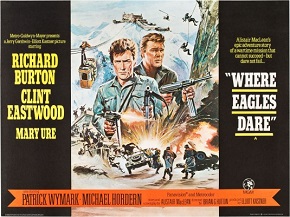
Where Eagles Dare
With his novel The Guns of Navarone (and its film version), author Alistair MacLean deserves an all-time spot in the impossible, suicide, men on a mission genre. Not all of his novels are winners, especially some of his later entries, but as far as success goes, 1968 was a year that was hard to beat for the author. Two of his novels were made into highly successful adventure movies, Ice Station Zebra and Where Eagles Dare.
It's the winter of 1944 and an American general's plane with knowledge of the coming Second Front has crashed in the Bavarian Alps. Captured by German forces, General Carnaby (Robert Beatty) is sent to the Schloss Adler, a mountain fortress home to the SS in the district. A commando team headed by Major John Smith (Richard Burton) is being parachuted into the mountains disguised as German soldiers. Their mission is straightforward if extremely difficult; gain access to the heavily guarded, fortified castle and rescue Carnaby before German interrogators can get the information out of him that they need. On Smith's team are five fellow British commandos and one American Ranger, Lt. Schaffer (Clint Eastwood). Almost the second the team lands, things start to go wrong, and Major Smith isn't letting on everything he knows. Is there something else going on with this mission, more than the others could even guess?
The story of this movie comes from MacLean, who on a request from a producer and Burton wrote a novel that could be made into a fast-paced adventure film. MacLean wrote the novel which became a huge success and was quickly put on the fast track, the film getting its release in 1968. As far as war/adventure films go, there are very few that are more fun than this one. Better ones? Yes, but in terms of pure entertainment value, this one is hard to beat. Director Brian G. Hutton (Kelly's Heroes) does a fine job crafting a twisting, turning story that is almost secondary to the war-time shenanigans. Many reviews that you read are from viewers who were genuinely confused watching this flick. I don't blame them. It took me multiple viewings to pick up everything you need to know.
The beauty of that statement is that this WWII espionage film can be enjoyed on different levels. We find out quickly that there's far more to the mission than we know. I won't reveal any spoilers here, but there's a-plenty of them! From the second the team parachutes into Bavaria, one of the commandos is killed by one of the team. What's going on? MacLean's script does a fine job parceling out hints here and there about the actual intent of their mission, finally revealing itself in a mind-bending, classic scene in a huge, Medieval-looking dining hall near the halfway point. The build-up is a little slow-moving, but it's worth it. Scenes you thought were pointless end up having key importance later in the movie. We see Smith and Schaffer prepping for their getaway days and hours in advance. We see the inner workings of this suicide mission. Not too many men on a mission movies go into such a detail, therefore setting 'Eagles' one step above so many other like-minded flicks.
Some pairings are just too perfect. Case in point, Burton and Eastwood. Burton as Maj. Smith is the highly capable, brutally effective and nearly brilliant secret agent and commando. He did a lot of acting parts in his career so it's great to see him do a movie that's just fun. It shows. It looks like he had a phenomenal time doing the part, his silky smooth voice, his smartass smirk ever-present on his face. And his radio call sign 'Broadsword calling Danny Boy' sounds almost Shakespearean in its delivery. As his American counterpart, Eastwood is given little to do other than look very cool, and he succeeds on all levels. Burton's Smith calls him a 'second rate punk,' an American Ranger and brutally efficient killing machine. Through all the craziness, it works. This is two pros who look to be having a lot of fun. Also in the team is Donald Houston, Peter Barkworth, William Squire, Brook Williams and Neil McCarthy.
Though Burton and Eastwood are in almost every scene, the supporting cast is solid just the same. Mary Ure plays Mary, a longtime fellow agent of Smith's (and some romance too) secretly along for the mission, with Ingrid Pitt as Heidi, an Allied agent working in the town below the fortress. Patrick Wymark and Michael Horden play Col. Turner and Adm. Rolland, two high-ranking officers back in Britain who knew the true intention of the mission. Rounding out the cast is some familiar faces as the evil German counterparts including Anton Diffring, Ferdy Mayne and Derren Nesbitt.
While all the build-up, background and twists are fun, the movie's most entertaining feature is the finale. The truth of the mission revealed, Smith, Schaffer and Mary (with some friends along for the ride) must basically shoot their way out of the mountaintop fortress, causing as much chaos as they can along the way. Eastwood's Schaffer alone single-handedly dispatches a whole German division on his own. The shootouts in the dark, poorly-lit castle hallways are a highlight, but the coolest sequence has Smith fighting two Germans aboard a cable car hundreds of feet off the ground. Adrenaline-pumping action, it is a doozy. It's ridiculous action throughout, our heroes able to pick off enemy soldiers at will while the hundreds of enemy soldiers can barely manage to nick our intrepid heroes. And how many packs of dynamite can two men manage to carry? Apparently 385 by my count.
This is not meant to be a serious war film. It's meant to be a film you enjoy from beginning to end. The on-location shooting in Austria, including the Hohenwerfen Castle and in and around Werfen, are spot-on choices for accuracy and realism. As a topper, composer Ron Goodwin's score is big and booming and equally perfect, keeping the tension building and driving the action. Listen to the main theme HERE. In the vein of MacLean's The Guns of Navarone, this is a popcorn flick at its best. Sit back and enjoy Burton and Eastwood win WWII with pretty girls, plenty of action, and even more twists and turns in that ridiculously convoluted plot.
Where Eagles Dare (1968): *** 1/2 /****
Updated February 2009 review
Thursday, January 26, 2012
The Good, the Bad and the Ugly
With 1964's A Fistful of Dollars, director Sergio Leone put the spaghetti western on an international stage and in the process made star Clint Eastwood a hugely popular actor worldwide. Leone followed it up the next year with For a Few Dollars More, what some (including this guy) consider to be the best spaghetti western ever. It was all practice though for 1966's The Good, the Bad and the Ugly, a movie that is bigger than just a spaghetti western or even a western in general. It's one of the best movies ever made.
It's 1863/1864 in the American southwest, and the Civil War is raging as Union forces battle with fleeing Confederate troops. Amidst all the fighting, a Confederate payroll has been stolen and ultimately hidden, buried away in a grave in a cemetery with thousands of near identical graves. The payroll of $200,000 in gold coins seems destined to waste away for all time, but three men know about it and are dead-set on acquiring it. Running a bounty scam, a drifting gunfighter, Blondie (Eastwood) and a Mexican bandit, Tuco (Eli Wallach) stumble across the information, one knowing the cemetery, the other knowing the name on the grave. A third man, a hired killer, Angel Eyes (Lee Van Cleef), is also on the prowl and never far behind. Who can get there first? Can they even make it alive?
I try not to throw this term around loosely, but The Good, the Bad and the Ugly is one of those rare perfect movies. Everything fits together like a jigsaw puzzle, all the little things working together seamlessly, impressive considering the scale of this movie. With the Civil War as its backdrop, it is a big, big western, the epitome of an epic. The scale Leone shoots his movie would be jaw-dropping in itself, but it's handled well. The Almerian locations in Spain become an additional character, using the land like so many other spaghetti westerns attempted but failed to do. It is an incredible visual experience. If not beautiful, it is powerful in its image. More details on all of this later, but Ennio Morricone's score is among the most instantly recognizable scores ever, the acting is perfect, the set pieces leaving a lasting impression, and a movie overall that won't easily be forgotten.
Like so many of the best directors, Leone had a knack for casting, and with Eastwood, Wallach and Van Cleef, the Italian director hits three home runs. Eastwood reprises his role from the first two Dollars movies, the man of few words gunslinger, Blondie (instead of Joe and/or Manco), who usually lets his gun do his talking. There's even an introduction of his infamous poncho. He is the prototypical anti-hero, the silent gunfighter looking for treasure. Van Cleef as Angel Eyes (Sentenza -- means Death Sentence -- in the Italian dubbing) is an all-time sinister villain, the hired killer who always seems to show up when least desired. Sinister, brutal, maniacal, all apply to this gunhand. The scene-stealer though is Wallach as Tuco, a well-traveled Mexican bandit. He's going 100 mph at all times, the fast-talking, quick-draw who is always crossing himself over his victims. These are all characters capable of carrying a movie on their own, but instead they work together to form one of the great lead ensembles ever assembled for a movie.
A couple smaller performances also deliver, regardless of how little screentime they have. Aldo Giuffre plays a Union captain who Blondie and Tuco come across in the midst of a battle. An alcoholic, he questions the lunacy of his orders but continues on because an officer must do his duty. Spaghetti regular Luigi Pistilli plays Father Ramirez, Tuco's brother who looks down upon what his brother has become, a lowly bandit. Spaghetti baddie Mario Brega plays Cpl. Wallace, a sadistic Union soldier looking over Tuco. Al Mulock plays a gunfighter gunning for Tuco after a past encounter. Fans of the genre should also look out for Benito Stefanelli, Aldo Sambrell, and Lorenzo Robledo as members of Angel Eyes' gang.
What ends up being another character is Morricone's score, as key an ingredient to the movie's success as any score/movie relationship I can think of. The main theme -- listen HERE -- is instantly recognizable, and basically everyone around the world has heard at it some point whether they knew it or not. The unique sound, the whistling, the tune, it all sets the stage for a score that goes from epic and huge to personal and moving with the snap of a finger. Used several times in the movie, Carriage of the Spirits is an ethereal, other-worldly beautiful sample of music that still sends chills up and down my back upon hearing it. That's what Morricone does, he makes his music effective and powerful no matter what the scene or setting. The best though of all -- even better than the GBU main theme -- is a track entitled Ecstasy of Gold, a hauntingly beautiful piece of music. Why's it so good? More on that later (sorry, I will get to it). All in all, an incredible score that serves an integral role in making this movie a classic. One of the all-time great film scores.
A handful of set pieces dominate the film -- several abandoned western towns, a shootout in a bombed out town, a huge, bloody battle between Union and Confederate forces -- but it all pales to the ending, the film's last 30 minutes or so as Blondie, Tuco and Angel Eyes all near the gold. The extended sequence starts with Tuco finding the cemetery, racing through rows and rows of graves trying to find the name Blondie has told him. Set to Morricone's Ecstasy of Gold, the sequence defies words. It's dizzying and unsettling, Leone's camera breathlessly following Wallach as he runs, finally finding the wanted grave. Watch it HERE. Then it's the showdown, one of the most respected, iconic (drinking game? How many times have I used that?) gunfights ever. Leone's trick though is the build-up. It's almost 5 minutes of positioning and mind games, the camera bouncing back and forth in close-ups and extreme close-ups, a blur of eyes, hands, and guns, all three men daring the other to draw. Watch it HERE, the single, greatest standoff in the history of movies.
Watching this recently on a big screen -- thank you, Doc Films -- I realized something odd and unique about the movie. It took an Italian director in Leone to make the best Civil War movie around. I think that gets lost sometimes with the scale and epicness of the movie. Wrapped up in it all is an anti-war message, and an effective one. All the soldiers we meet are cripples, drunks, corrupt, and dying. We see bodies littered on trails and in streets like discarded garbage. A thief is callously shot down by a firing squad. A Confederate spy's body is lashed to a cow-catcher on a train as a warning to others. Without beating us over the head with his message, Leone effectively shows the horror of war but also the lunacy and stupidity of it all. As Eastwood's Blondie states while overlooking a battle, "I've never seen so many men wasted so badly."
There it is, an epically long and rambling review for an epically great movie. Dark and cynical, it is oddly funny -- Tuco's 'When you have to shoot, shoot, don't talk' and the running 'There are 2 types of people in this world' line providing some good laughs -- and shows off an underrated script with a story that spans months and hundreds of miles. It is that perfect movie. A buddy-journey story set in the American Civil War with perfect performances, an immensely giant scale, a great musical score, and choreographed action which has been attempted over and over ever since. The definition of what a movie should be. It doesn't get better than this.
The Good, the Bad and the Ugly <---trailer (1966): ****/****
It's 1863/1864 in the American southwest, and the Civil War is raging as Union forces battle with fleeing Confederate troops. Amidst all the fighting, a Confederate payroll has been stolen and ultimately hidden, buried away in a grave in a cemetery with thousands of near identical graves. The payroll of $200,000 in gold coins seems destined to waste away for all time, but three men know about it and are dead-set on acquiring it. Running a bounty scam, a drifting gunfighter, Blondie (Eastwood) and a Mexican bandit, Tuco (Eli Wallach) stumble across the information, one knowing the cemetery, the other knowing the name on the grave. A third man, a hired killer, Angel Eyes (Lee Van Cleef), is also on the prowl and never far behind. Who can get there first? Can they even make it alive?
I try not to throw this term around loosely, but The Good, the Bad and the Ugly is one of those rare perfect movies. Everything fits together like a jigsaw puzzle, all the little things working together seamlessly, impressive considering the scale of this movie. With the Civil War as its backdrop, it is a big, big western, the epitome of an epic. The scale Leone shoots his movie would be jaw-dropping in itself, but it's handled well. The Almerian locations in Spain become an additional character, using the land like so many other spaghetti westerns attempted but failed to do. It is an incredible visual experience. If not beautiful, it is powerful in its image. More details on all of this later, but Ennio Morricone's score is among the most instantly recognizable scores ever, the acting is perfect, the set pieces leaving a lasting impression, and a movie overall that won't easily be forgotten.
Like so many of the best directors, Leone had a knack for casting, and with Eastwood, Wallach and Van Cleef, the Italian director hits three home runs. Eastwood reprises his role from the first two Dollars movies, the man of few words gunslinger, Blondie (instead of Joe and/or Manco), who usually lets his gun do his talking. There's even an introduction of his infamous poncho. He is the prototypical anti-hero, the silent gunfighter looking for treasure. Van Cleef as Angel Eyes (Sentenza -- means Death Sentence -- in the Italian dubbing) is an all-time sinister villain, the hired killer who always seems to show up when least desired. Sinister, brutal, maniacal, all apply to this gunhand. The scene-stealer though is Wallach as Tuco, a well-traveled Mexican bandit. He's going 100 mph at all times, the fast-talking, quick-draw who is always crossing himself over his victims. These are all characters capable of carrying a movie on their own, but instead they work together to form one of the great lead ensembles ever assembled for a movie.
A couple smaller performances also deliver, regardless of how little screentime they have. Aldo Giuffre plays a Union captain who Blondie and Tuco come across in the midst of a battle. An alcoholic, he questions the lunacy of his orders but continues on because an officer must do his duty. Spaghetti regular Luigi Pistilli plays Father Ramirez, Tuco's brother who looks down upon what his brother has become, a lowly bandit. Spaghetti baddie Mario Brega plays Cpl. Wallace, a sadistic Union soldier looking over Tuco. Al Mulock plays a gunfighter gunning for Tuco after a past encounter. Fans of the genre should also look out for Benito Stefanelli, Aldo Sambrell, and Lorenzo Robledo as members of Angel Eyes' gang.
What ends up being another character is Morricone's score, as key an ingredient to the movie's success as any score/movie relationship I can think of. The main theme -- listen HERE -- is instantly recognizable, and basically everyone around the world has heard at it some point whether they knew it or not. The unique sound, the whistling, the tune, it all sets the stage for a score that goes from epic and huge to personal and moving with the snap of a finger. Used several times in the movie, Carriage of the Spirits is an ethereal, other-worldly beautiful sample of music that still sends chills up and down my back upon hearing it. That's what Morricone does, he makes his music effective and powerful no matter what the scene or setting. The best though of all -- even better than the GBU main theme -- is a track entitled Ecstasy of Gold, a hauntingly beautiful piece of music. Why's it so good? More on that later (sorry, I will get to it). All in all, an incredible score that serves an integral role in making this movie a classic. One of the all-time great film scores.
A handful of set pieces dominate the film -- several abandoned western towns, a shootout in a bombed out town, a huge, bloody battle between Union and Confederate forces -- but it all pales to the ending, the film's last 30 minutes or so as Blondie, Tuco and Angel Eyes all near the gold. The extended sequence starts with Tuco finding the cemetery, racing through rows and rows of graves trying to find the name Blondie has told him. Set to Morricone's Ecstasy of Gold, the sequence defies words. It's dizzying and unsettling, Leone's camera breathlessly following Wallach as he runs, finally finding the wanted grave. Watch it HERE. Then it's the showdown, one of the most respected, iconic (drinking game? How many times have I used that?) gunfights ever. Leone's trick though is the build-up. It's almost 5 minutes of positioning and mind games, the camera bouncing back and forth in close-ups and extreme close-ups, a blur of eyes, hands, and guns, all three men daring the other to draw. Watch it HERE, the single, greatest standoff in the history of movies.
Watching this recently on a big screen -- thank you, Doc Films -- I realized something odd and unique about the movie. It took an Italian director in Leone to make the best Civil War movie around. I think that gets lost sometimes with the scale and epicness of the movie. Wrapped up in it all is an anti-war message, and an effective one. All the soldiers we meet are cripples, drunks, corrupt, and dying. We see bodies littered on trails and in streets like discarded garbage. A thief is callously shot down by a firing squad. A Confederate spy's body is lashed to a cow-catcher on a train as a warning to others. Without beating us over the head with his message, Leone effectively shows the horror of war but also the lunacy and stupidity of it all. As Eastwood's Blondie states while overlooking a battle, "I've never seen so many men wasted so badly."
There it is, an epically long and rambling review for an epically great movie. Dark and cynical, it is oddly funny -- Tuco's 'When you have to shoot, shoot, don't talk' and the running 'There are 2 types of people in this world' line providing some good laughs -- and shows off an underrated script with a story that spans months and hundreds of miles. It is that perfect movie. A buddy-journey story set in the American Civil War with perfect performances, an immensely giant scale, a great musical score, and choreographed action which has been attempted over and over ever since. The definition of what a movie should be. It doesn't get better than this.
The Good, the Bad and the Ugly <---trailer (1966): ****/****
Saturday, August 6, 2011
Sudden Impact
Growing up watching westerns, I will always associate Clint Eastwood with the genre, most notably his spaghetti westerns with Italian director Sergio Leone. He of course is known for any number of other things, including become an Oscar-winning director as he started working behind the camera instead of in front of it. So while I picture him as the Man With No Name, a roaming gunfighter looking to make a buck, ask another fan and you will probably get a completely different answer depending on the fan.
Name Eastwood's most famous character over the course of his career, and I'd bet 8 or 9 people out of 10 would say Dirty Harry instead, San Francisco homicide detective Harry Callahan. It's easy to understand why as Eastwood created one of the most recognizable, iconic characters in movie history with this tough as nails police officer who does things his way, procedure and laws be screwed. Starting with 1971's Dirty Harry, Eastwood played Callahan five times, the fourth effort coming with 1983's Sudden Impact after a seven-year break since 1976's The Enforcer.
Working a case with Mafia connections, San Francisco homicide detective Harry Callahan (Eastwood) is up to his usual shenanigans. He meets a mob boss in public and berates him, the boss actually dying of a heart attack. His superiors are sick of his troublesome attitude and complete disregard for procedures and the laws, assigning him to a case in the tiny, seemingly peaceful coastal town of San Paulo involving a brutal murder where the victim was shot in the crotch and in the forehead. Callahan sees a connection with his case though as more bodies start to mount up. A victim of a vicious gang rape 10 years earlier, Jennifer Spencer (Sondra Locke), has returned, killing off the men who raped her. No one thinks much of his hunch though, meaning Callahan is on his own...as usual. Criminals watch out because here comes Dirty Harry.
The threat with any series/franchise is the proceedings getting stale at a certain point. Like any series, Dirty Harry doesn't always keep up the momentum. The first two movies of five -- Dirty Harry and Magnum Force -- are a cut above the last three, but that doesn't mean they aren't good movies...just not as good. In terms of story, this has to be the darkest of the five, a rape victim gunning for her rapists. With Eastwood directing though, I think too much time was spent on Locke's Jennifer character. By the last 30-45 minutes of the movie, the story focuses more on Jennifer than on Harry. Credit to Eastwood girlfriend and underrated actress Sondra Locke for bringing her character to life, but I watch these movies for Dirty Harry above all else.
That is what is so appealing about vigilante movies like this, even if Callahan's vigilantism is toned down a bit here. In his world, there are no shades of gray. There is black and white, good and bad, and if you can't pick a side, Callahan will pick one for you. As a veteran inspector, he's just sick of the countless crimes he sees around him. He always gets his guy -- sometimes stretching the limits of the law to do so -- only to see the system let the bad guys back on the street. The bad guys here are ridiculously evil, not a human bone or redeeming quality in sight. The rapists include Paul Drake as the psychotic Mick, Audrie Neenan, and Jack Thibeau. This is a Dirty Harry movie that's tired of bosses, superiors, and all-around tools so the uppity-ups include Pat Hingle as the San Paulo police chief, and Bradford Dillman and Michael Currie as his San Fran bosses. If we've learned anything from these movies though, it's that Dirty Harry doesn't do well when told what to do.
This isn't a great cop movie regardless of who the main character is. It starts off on a great note, the first 30 minutes full of energy, action and one-liners as Eastwood has some fun with the character, delivering the iconic 'Go ahead, make my day' line when stopping a robbery in progress. Watch that scene HERE. The remaining 90 minutes are far from boring, but they have the feel of being phoned in. It lacks the energy that the first half hour has. The movie is at its best when Eastwood is front and center. At different points, Harry takes on the mob, chases a suspect by driving a retirement home bus, practices with his cannon of a Magnum pistol, and hangs out with his bulldog, Meathead. Albert Popwell plays Horace, a friend on the force, while Mark Keyloun has a good supporting part as Bennett, a young San Paulo officer working with Callahan. Overall, the character has become more of a caricature of itself as opposed to an even somewhat realistic character.
Still, all things consider, it's Clint Eastwood as Dirty Harry, and it's hard to pass that up. There is something simple and perfect in terms of entertainment value watching Callahan lose his mind and take his anger out on any crook stupid enough to tangle with him. There is no question that in the end he will get his man, just how and when. Sudden Impact doesn't bring anything new to the procedural cop drama or the Dirty Harry series, but it is a solid if unspectacular (and still entertaining) movie, mostly because Clint Eastwood is still and always will be cooler than anyone and everyone.
Sudden Impact <---trailer (1983): ** 1/2 /****
Name Eastwood's most famous character over the course of his career, and I'd bet 8 or 9 people out of 10 would say Dirty Harry instead, San Francisco homicide detective Harry Callahan. It's easy to understand why as Eastwood created one of the most recognizable, iconic characters in movie history with this tough as nails police officer who does things his way, procedure and laws be screwed. Starting with 1971's Dirty Harry, Eastwood played Callahan five times, the fourth effort coming with 1983's Sudden Impact after a seven-year break since 1976's The Enforcer.
Working a case with Mafia connections, San Francisco homicide detective Harry Callahan (Eastwood) is up to his usual shenanigans. He meets a mob boss in public and berates him, the boss actually dying of a heart attack. His superiors are sick of his troublesome attitude and complete disregard for procedures and the laws, assigning him to a case in the tiny, seemingly peaceful coastal town of San Paulo involving a brutal murder where the victim was shot in the crotch and in the forehead. Callahan sees a connection with his case though as more bodies start to mount up. A victim of a vicious gang rape 10 years earlier, Jennifer Spencer (Sondra Locke), has returned, killing off the men who raped her. No one thinks much of his hunch though, meaning Callahan is on his own...as usual. Criminals watch out because here comes Dirty Harry.
The threat with any series/franchise is the proceedings getting stale at a certain point. Like any series, Dirty Harry doesn't always keep up the momentum. The first two movies of five -- Dirty Harry and Magnum Force -- are a cut above the last three, but that doesn't mean they aren't good movies...just not as good. In terms of story, this has to be the darkest of the five, a rape victim gunning for her rapists. With Eastwood directing though, I think too much time was spent on Locke's Jennifer character. By the last 30-45 minutes of the movie, the story focuses more on Jennifer than on Harry. Credit to Eastwood girlfriend and underrated actress Sondra Locke for bringing her character to life, but I watch these movies for Dirty Harry above all else.
That is what is so appealing about vigilante movies like this, even if Callahan's vigilantism is toned down a bit here. In his world, there are no shades of gray. There is black and white, good and bad, and if you can't pick a side, Callahan will pick one for you. As a veteran inspector, he's just sick of the countless crimes he sees around him. He always gets his guy -- sometimes stretching the limits of the law to do so -- only to see the system let the bad guys back on the street. The bad guys here are ridiculously evil, not a human bone or redeeming quality in sight. The rapists include Paul Drake as the psychotic Mick, Audrie Neenan, and Jack Thibeau. This is a Dirty Harry movie that's tired of bosses, superiors, and all-around tools so the uppity-ups include Pat Hingle as the San Paulo police chief, and Bradford Dillman and Michael Currie as his San Fran bosses. If we've learned anything from these movies though, it's that Dirty Harry doesn't do well when told what to do.
This isn't a great cop movie regardless of who the main character is. It starts off on a great note, the first 30 minutes full of energy, action and one-liners as Eastwood has some fun with the character, delivering the iconic 'Go ahead, make my day' line when stopping a robbery in progress. Watch that scene HERE. The remaining 90 minutes are far from boring, but they have the feel of being phoned in. It lacks the energy that the first half hour has. The movie is at its best when Eastwood is front and center. At different points, Harry takes on the mob, chases a suspect by driving a retirement home bus, practices with his cannon of a Magnum pistol, and hangs out with his bulldog, Meathead. Albert Popwell plays Horace, a friend on the force, while Mark Keyloun has a good supporting part as Bennett, a young San Paulo officer working with Callahan. Overall, the character has become more of a caricature of itself as opposed to an even somewhat realistic character.
Still, all things consider, it's Clint Eastwood as Dirty Harry, and it's hard to pass that up. There is something simple and perfect in terms of entertainment value watching Callahan lose his mind and take his anger out on any crook stupid enough to tangle with him. There is no question that in the end he will get his man, just how and when. Sudden Impact doesn't bring anything new to the procedural cop drama or the Dirty Harry series, but it is a solid if unspectacular (and still entertaining) movie, mostly because Clint Eastwood is still and always will be cooler than anyone and everyone.
Sudden Impact <---trailer (1983): ** 1/2 /****
Labels:
1980s,
Bradford Dillman,
Clint Eastwood,
Cops,
Pat Hingle,
Sondra Locke
Saturday, July 23, 2011
Every Which Way But Loose
As a huge Eastwood fan, I've done my best to try and view all his movies -- directing and/or starring. This one just sounded too weird, too off the beaten track. I'll go into more detail about this flick, but take away everything and anything else, and this movie is about one thing that can be summed up in one simple sentence...Clint Eastwood takes a road trip with an orangutan named Clyde. There you go, that's it. Yes, there is more to this movie, but that's the gist of it. If just reading that sentence doesn't amuse you even a little bit, I'd wager you probably would not like this movie. For that reason -- among others -- I liked it as a prime example of what a quality 1970s movie can be.
A trucker and a bare-knuckle boxer, Philo Beddoe (Eastwood) is an all-around pretty easy-going guy. He works, he drinks, he hangs out with his best friend and promoter, Orville (Geoffrey Lewis), and lives at home with his aging mother (Ruth Gordon) and his orangutan, Clyde, who he won in a fight. He meets aspiring country singer Lynn Halsey-Taylor (Sondra Locke) and falls for her quickly, only to find a note one day that she's left. Packing up his things, Philo jumps in his truck and goes after her with Clyde, Orville and a woman named Echo (Beverly D'Angelo) along for the ride. He doesn't know where Lynn went, but he intends to find her. Also on his trail is a biker gang called the Black Widows and two police officers looking to exact some revenge on him.
By 1978, Eastwood had created a name for himself as quite the tough guy actor, one of the best around at the action and adventure flick. So a movie where he drives around with an orangutan seems natural, doesn't it? The script was originally intended for Burt Reynolds, but Eastwood read it, liked it and brushed aside studio concerns that it wasn't an appropriate movie for him. It was a movie that was panned critically, but audiences loved the movie as it grossed over $100 million in theaters. It is easy to see why moviegoers were drawn to this movie. It is an easy-going, fun story that as many IMDB reviewers point out is a good late night guilty pleasure or a rainy Sunday afternoon flick.
This is the type of movie that could only be made in the 1970s, and at that with the backing of one of the most bankable stars in Hollywood in Eastwood. There isn't a plot as much as a series of bits and vignettes that keep things moving along. The soundtrack is mostly country -- with Eddie Rabbitt singing the theme 'Every Which Way But Loose,' listen HERE -- but also featuring performances from Charlie Rich, Cliff Crofford and even Locke singing a couple songs. The villains -- the Black Widows biker gang and two vengeful cops -- are there more for comedic relief than anything, and never really seem too intimidating or much of a challenge. The humor is pretty low-brow (at one point Eastwood seeks out a zoo to get Clyde some action), the boxing and fighting as brutal as they get, and through it all you can't help but enjoy it. Okay, I enjoyed it. I can't speak for you.
Playing against type, Eastwood looks to be having some fun with his part as Philo Beddoe. Yes, he's a fighter and tough guy, but this has to be one of his most human roles. He thinks he's found something with Locke's Lynn and doesn't know why she left. Philo just wants to be happy. Frequent co-star Locke has the chemistry she always had with Eastwood, delivering a solid twist at the end of the movie I didn't see coming. Lewis and D'Angelo similarly have a good chemistry together. Lewis is one of those faces you love to see in 1970s movies, a character actor who starred in countless classics, and Gordon is a scene-stealer as foul-mouthed Ma. The bikers include John Quade, Roy Jenson, Bill McKinney, Dan Vadis and William O'Connell while Gregory Walcott and James McEachin play the dimwitted cops.
Now onto the unquestioned star of the movie...Clyde the orangutan! The formula sounds so simple; throw Eastwood into a movie with a monkey and have him interact. It's criminally stupid, but somehow it works. We're not talking intelligent humor here, but Clyde ends up being probably the most memorable character from the movie. You end up thinking of him as a person by the end of the movie. And come on, a monkey flipping off a bunch of angry bikers is hilarious however you cut it. This movie has a lot going for it when it really shouldn't, but Clyde the orangutan is maybe the best character ever. A guilty pleasure if there ever was one, but a good one...even if I'm not proud of how much I liked it.
Every Which Way But Loose <---trailer (1978): ***/****
Labels:
1970s,
Bill McKinney,
Clint Eastwood,
Geoffrey Lewis,
Sondra Locke
Saturday, July 2, 2011
Tarantula
I think what works so well about these movies -- however poorly done or cheesy they are in their execution -- is that they play on feelings, worries and nerves that most audiences can relate to. What lies in the depths of the oceans or hidden away in a volcano? Or what about ordinary, everyday things, like spiders? In this case, it's that simple. A tarantula at its largest is only three or four inches long, but there's just something about them that sends shivers up your spine (okay, maybe it is just me). So even with some cheesy effects to make it look bigger, what about a tarantula over 100 times larger than your typical arachnid? Okay, it isn't particularly scary, but it is creepy and it makes for a good movie.
In a small, isolated desert town in Arizona, Dr. Matt Hastings (John Agar) is called in to investigate a mysterious death. The man's partner, a scientist, Professor Deemer (Leo G. Carroll), explains the death as a bizarre, rapidly moving and rare genetic condition that caused the body to contort. Hastings isn't buying it but when Deemer welcomes a new assistant, a beautiful medical student from California, Stephanie (Mara Corday), the good doctor starts to investigate. Is the professor up to something that he's trying to cover up? As Hastings starts to poke around, weird occurrences start to pop up all over. What can they chalk it up to? Hastings has an inkling, but he can't prove it outright, much less explain it to other people. Can he get his evidence in time?
Without going into a lot of detail (and if you've made it this far I'm hoping you know what's going on), it is in fact....a giant tarantula terrorizing the countryside in this B-movie. Carroll's Deemer is in fact up to no good, even if his intentions are genuine. He's looking for a way to provide food and nourishment for a rapidly overcrowded world. Smart doctor that he is, he test his radioactive nutrient on animals including rats, guinea pigs, and of course, a tarantula which escapes as it is still growing. Tarantulas need to eat, and there you go. You've got your badass creature, a tarantula several hundred feet tall with an insatiable appetite. Now how do we go about killing it?
This is a movie I can understand some movie fans wanting to be remade, but I like the low-budget charm of this 1955 popcorn flick. The tarantula is in fact, a tarantula. Thankfully the studios did not make a life-size spider or a miniature that could be blown up to make it look bigger. The movements of an actual spider were filmed and then inserted over footage shot in real-time, making it appear that the tarantula is actually interacting with the much, much smaller cast. Considering how bad it could have looked had Arnold chosen a different route, it's easy to look past the sometimes-cheesy look of these scenes. Still, it's a gigantic tarantula with booming music playing over its attacks. How is that not scary at least a little bit?
Blah blah blah spider movie with a cast. Who cares? Well, I do. B-movie star John Agar is his typical solid self as Dr. Matt Hastings. As an actor, he didn't have the greatest range, but I just don't understand why Agar never amounted to more after bursting onto the scene in two John Ford westerns and another with John Wayne (Sands of Iwo Jima). He's a good actor if not a flashy one and a solid leading man here. Corday is the babe, the love interest although not much comes of that. Carroll is the scientist with the right intentions who ends up unleashing a crime against nature on the world. Also look for Nestor Paiva as Sheriff Andrews and Ross Elliott as Joe Burch, the nosy newspaper reporter looking for a scoop.
As a fan of pointless movie trivia, I'll add this too. Look for Clint Eastwood in an uncredited role and one of his first movies overall. Even Dirty Harry had to start somewhere. I lost a bet in the last year or two that Eastwood was even in this movie, and it is a quick appearance. Stick around until the end as he plays a fighter pilot called in to battle the gigantic tarantula. This is a fun movie all-around and a good example of what a science fiction B-movie from the 1950s can be when handled correctly. Watch the movie at Youtube starting HERE with Part 1 of 8. Pretty decent quality too for a 1950s Youtube version.
Tarantula <---trailer (1955): ***/****
Monday, April 11, 2011
Hereafter
After struggling in theaters last fall during its first release, Clint Eastwood's 2010 film Hereafter has been in the news recently for all the wrong reasons. The film opens with a startling sequence of a tsunami hitting a coast somewhere in Asia. After the recent natural disaster in Japan with an almost identical tsunami that claimed thousands of lives, the movie's premiere was postponed and more than likely canceled for good in Japan.
Upon its release, Eastwood's film struggled in theaters. Critics were mixed about the movie, and it never caught on with audiences. It's easy to see why. In a lot of ways, it is the completely atypical Eastwood movie, unlike any of his other flicks as a director (more on that later). It also deals with one of the more polarizing issues when it comes to audiences and people in general, faith, religion, death and the afterlife. Just about everyone has their personal opinions on the subject, and many don't want to be preached at about someone else's beliefs. Fair enough I guess. It's a shame because the movie is typical Eastwood, well-made, well-written, and just a good movie overall.
On vacation in Asia with her boyfriend, French TV journalist Marie Lelay (Cecile De France) barely survives a near-death experience when an immense tsunami strikes the coastal town she's staying in. Swept away by the wall of water, Marie has visions, maybe hallucinations, of another place, maybe out of this world which she struggles to deal with as she returns to her normal life. In London, 12-year old Marcus (played by twins Frankie and George McClaren) is dealing with the death of his twin brother as his mother deals with a substance abuse problem. All Marcus wants is some sort of answer. Is his brother all right wherever he went? And where do the dead do? In San Francisco, factory worker George Lonegan (Matt Damon) is trying to move on with his life. From an early age, George has been able to communicate with the dead, but looking at the ability as a curse, he's trying to put it all behind him and live a normal life. As these three people's lives develop and change (for the better and worse), their paths seem destined to cross in some way. How? Who really knows?
Many of the reviews I read about Hereafter pointed out that this was such a departure for Clint Eastwood as a director. His films always had a very gritty, hard-edged feel that showed people struggling through some past trauma, past incidents. Think of Mystic River, Gran Torino, Million Dollar Baby, even Unforgiven and The Bridges of Madison County. They were all about the people above all else. That's why I don't understand the reviews written about Hereafter. Is it a departure for Eastwood? Yes, of course it is because he is working on a different level, more faith-based, more personal beliefs. But at its heart, this movie is about the small people in a big world looking for some sort of happiness, some sort of answers to a question or a problem facing them. What I'm trying to say is that yes, this movie is different, but not bad different. It's Eastwood playing with what he knows but expanding on it out of his comfort zone.
Where I'm guessing this movie lost some people is at its most basic level, the conversation and dependency on the idea of an other world after death. That's an individual thing that will hit each person differently when talking about this movie. If you don't believe in some version of a god, some place your soul goes after your death, you're probably going to struggle getting through this movie. Not a judgment there, just an observation, I struggle with those questions myself. At a certain point, you just have to go along with it all. Damon's Lonegan actually does communicate with the dead. This isn't left up for interpretation by Eastwood and the script. George does it. Either you can accept this or you can't as a movie viewer. The message boards at the IMDB are riddled with arguments -- not discussions -- about religions, god, life after death. It's got to be one of the easiest ways to start an argument (mention any of those), and it is then easy to see why a movie like this can be so dividing. What's disappointing is I don't think Eastwood intended to make a "message" movie. This is a movie about the people, not the idea.
The story follows in the vein of Crash where character interactions and storylines are inevitable. For me, Damon's story is the best, a middle-aged man truly struggling through an ability given him. He's lonely and just wants to be happy in one form or another. Through physical contact he can communicate with the dead so relationships are nearly impossible. He has a chance with Melanie (Bryce Dallas Howard, great supporting part), a woman he meets at a cooking class he's enrolled in. You're rooting for George to just be happy, and Damon -- maybe Eastwood's new favorite actor -- does a fine job with the character. The other two main characters, Marie and Marcus, deliver equally impressive performances, but I didn't love them as much as Damon's. De France especially turns in an amazing performance, and she's one of the more classically beautiful actresses I've ever seen. It all plays into this innocence, this vulnerability to her character trying to right her life.
One complaint I can understand is the somewhat slow pacing in this 129-minute movie. Eastwood is in no rush to move the story along, and that's fine because we do get to know the three different characters. He provides these heartbreakingly real moments that will make you forget the slower moments. George makes a connection with Howard's Melanie only to see his "ability" ruin the possibility of any future. Marcus narrowly avoids being killed himself with some possible divine intervention. Marie finds an outlet for the questions she has. The best though is George's late scene with Marcus, genuine and real no matter how you look at it. The ending could have been pegged sappy, but I'll say instead that it's tone and theme appropriate. An underrated work from one of my favorites, Clint Eastwood.
Hereafter <---trailer (2010): *** 1/2 /****
Upon its release, Eastwood's film struggled in theaters. Critics were mixed about the movie, and it never caught on with audiences. It's easy to see why. In a lot of ways, it is the completely atypical Eastwood movie, unlike any of his other flicks as a director (more on that later). It also deals with one of the more polarizing issues when it comes to audiences and people in general, faith, religion, death and the afterlife. Just about everyone has their personal opinions on the subject, and many don't want to be preached at about someone else's beliefs. Fair enough I guess. It's a shame because the movie is typical Eastwood, well-made, well-written, and just a good movie overall.
On vacation in Asia with her boyfriend, French TV journalist Marie Lelay (Cecile De France) barely survives a near-death experience when an immense tsunami strikes the coastal town she's staying in. Swept away by the wall of water, Marie has visions, maybe hallucinations, of another place, maybe out of this world which she struggles to deal with as she returns to her normal life. In London, 12-year old Marcus (played by twins Frankie and George McClaren) is dealing with the death of his twin brother as his mother deals with a substance abuse problem. All Marcus wants is some sort of answer. Is his brother all right wherever he went? And where do the dead do? In San Francisco, factory worker George Lonegan (Matt Damon) is trying to move on with his life. From an early age, George has been able to communicate with the dead, but looking at the ability as a curse, he's trying to put it all behind him and live a normal life. As these three people's lives develop and change (for the better and worse), their paths seem destined to cross in some way. How? Who really knows?
Many of the reviews I read about Hereafter pointed out that this was such a departure for Clint Eastwood as a director. His films always had a very gritty, hard-edged feel that showed people struggling through some past trauma, past incidents. Think of Mystic River, Gran Torino, Million Dollar Baby, even Unforgiven and The Bridges of Madison County. They were all about the people above all else. That's why I don't understand the reviews written about Hereafter. Is it a departure for Eastwood? Yes, of course it is because he is working on a different level, more faith-based, more personal beliefs. But at its heart, this movie is about the small people in a big world looking for some sort of happiness, some sort of answers to a question or a problem facing them. What I'm trying to say is that yes, this movie is different, but not bad different. It's Eastwood playing with what he knows but expanding on it out of his comfort zone.
Where I'm guessing this movie lost some people is at its most basic level, the conversation and dependency on the idea of an other world after death. That's an individual thing that will hit each person differently when talking about this movie. If you don't believe in some version of a god, some place your soul goes after your death, you're probably going to struggle getting through this movie. Not a judgment there, just an observation, I struggle with those questions myself. At a certain point, you just have to go along with it all. Damon's Lonegan actually does communicate with the dead. This isn't left up for interpretation by Eastwood and the script. George does it. Either you can accept this or you can't as a movie viewer. The message boards at the IMDB are riddled with arguments -- not discussions -- about religions, god, life after death. It's got to be one of the easiest ways to start an argument (mention any of those), and it is then easy to see why a movie like this can be so dividing. What's disappointing is I don't think Eastwood intended to make a "message" movie. This is a movie about the people, not the idea.
The story follows in the vein of Crash where character interactions and storylines are inevitable. For me, Damon's story is the best, a middle-aged man truly struggling through an ability given him. He's lonely and just wants to be happy in one form or another. Through physical contact he can communicate with the dead so relationships are nearly impossible. He has a chance with Melanie (Bryce Dallas Howard, great supporting part), a woman he meets at a cooking class he's enrolled in. You're rooting for George to just be happy, and Damon -- maybe Eastwood's new favorite actor -- does a fine job with the character. The other two main characters, Marie and Marcus, deliver equally impressive performances, but I didn't love them as much as Damon's. De France especially turns in an amazing performance, and she's one of the more classically beautiful actresses I've ever seen. It all plays into this innocence, this vulnerability to her character trying to right her life.
One complaint I can understand is the somewhat slow pacing in this 129-minute movie. Eastwood is in no rush to move the story along, and that's fine because we do get to know the three different characters. He provides these heartbreakingly real moments that will make you forget the slower moments. George makes a connection with Howard's Melanie only to see his "ability" ruin the possibility of any future. Marcus narrowly avoids being killed himself with some possible divine intervention. Marie finds an outlet for the questions she has. The best though is George's late scene with Marcus, genuine and real no matter how you look at it. The ending could have been pegged sappy, but I'll say instead that it's tone and theme appropriate. An underrated work from one of my favorites, Clint Eastwood.
Hereafter <---trailer (2010): *** 1/2 /****
Labels:
2010s,
Bryce Dallas Howard,
Clint Eastwood,
Matt Damon
Friday, July 16, 2010
Invictus
This is the true story of the 1995 World Cup and the South African charge to win the cup with the tournament being hosted on its own turf. On a much bigger level, it is the story of a country in turmoil as Mandela steps into the presidency as South Africa deals with the end of the long-standing apartheid. Eastwood tries to find that delicate balance between the two and does find a solid middle ground to work with. It has the ability to be a large scale story in telling a story about South Africa and its 40-million plus residents, but Eastwood grounds the film thanks to two key performances, both nominated for Academy Awards.
Following his release from prison after serving 27 years, Nelson Mandela (Morgan Freeman) goes about trying to fix the problems facing South Africa, eventually winning the 1994 presidential race and becoming the first president to be elected in a democratic election. His country is facing a long list of problems, some involving crime, the economy and violence and crime while others can be attributed to the hatred between black and white. Mandela sees potential to bring the country together again, to unite them as one people, through the national rugby team, the Springboks, captained by Francois Pienaar (Matt Damon). Mandela turns to Pienaar in hopes of motivating the team to do the best they can. The team captain leads his team on one of the most improbable World Cup runs ever as the country watches.
To say Invictus is a rugby movie isn't exactly accurate. To say it's just a sports movie is limiting. Rugby is the means to an end for Mandela, but in reality it could have been any sport. Eastwood doesn't even focus much on the actual rugby matches. I had little to no knowledge of the game, but that doesn't hurt in the scenes in '94's pool play and then the knockout games. It's easy to follow and certainly keeps you interested. I noticed the music throughout, but the soundtrack during the game action is especially strong. The final match against New Zealand is likewise a strong sequence if a little heavy on slow-motion.
Both Freeman and Damon were nominated for their performances and rightfully so. Neither won -- damn you Jeff Bridges and Christoph Waltz! -- but that doesn't take away from the strength of their performances. Nothing was done to Freeman physically other than his hair to look like Mandela, but at certain moments, usually the quiet moments where the president is alone, he is the spitting image of Mandela. The man is basically a modern day Ghandi so you're treading on thin ice, but Freeman is fantastic in the part, giving Mandela a personality, a livelihood, a charm and likability that rings true as to what he's really like. Damon bulked up in a big way to play a rugby player and still looks a little on the small side, but his part is a really solid one in a long line. These two actors dominate the movie and end up carrying it from start to finish.
As mentioned before, Invictus is about more than just a country trying to win the rugby World Cup. It's about a new president trying to unite his country after years of strife and fighting, most of it racially based. Eastwood provides a handful of moments that show this reuniting taking place, one of the high points being the Springboks visiting a poor region to teach little kids how to play rugby. Another plot running through the movie is the relationship among Mandela's bodyguards, one black contingent and one white, forced to work together to protect their president. Tony Kgoroge plays Jason Tshabalala, the leader of the black guards, while Julian Lewis Jones plays Etienne Feyder, the leader of the white guards. Over the years, their relationship develops from a pure hatred to a respect to a comfort level and possibly even friends. It is those quieter, softer moments that make the movie a little more special.
Invictus <----trailer (2009): *** 1/2 /****
Labels:
2000s,
Clint Eastwood,
Matt Damon,
Morgan Freeman,
Sports
Wednesday, November 18, 2009
The Beguiled
A major disappointment in theaters because of some not so truthful marketing, The Beguiled was the third teaming between Eastwood and director Don Siegel and it wouldn't be their last as they worked together in the Dirty Harry series too. Siegel was known for his tough, hard-hitting movies that included westerns, war movies and police stories. So working together on a Gothic, off-beat Civil War suspense thriller was really a departure for both actor and director. Surprisingly enough, the combination works in an odd way.
While walking through the woods looking for mushrooms, 12-year old Amy (Pamelyn Ferdin) stumbles across a wounded Union soldier. She's able to drag him to the School for Young Ladies she lives in in southern Louisiana. The owner of the school, Martha Farnsworth (Geraldine Page), decides to treat the soldier's wounds before turning him over to Confederate forces so he can be sent to a prison camp. Soon enough, the Union soldier comes around and introduces himself as Corporal John McBurney (Eastwood). Seeing an opportunity, McBurney takes it and starts going to work on the men-starved women living at the school as he recovers and builds up his strength.
This is about as off-beat a movie as Eastwood has made and for that reason one of the best. It's completely different from any other movie he stars in. Shot on location in Louisiana, 'Beguiled' has the feel of a Gothic horror movie. Using an actual Southern home for outdoor shooting, there's a feeling of authenticity that would have been lost with a Hollywood set. The house is surrounded by brush, shrubbery and plant life, giving an intense feeling of claustrophobia right from the get-go. There's a sense that anything could be hiding in the brush -- Union or Confederate soldiers -- and who knows when it will reveal itself.
Credit goes to composer Lalo Schifrin and cinematographer Bruce Surtees for creating such a beautiful but unsettling movie. Schifrin's score varies from whimsical to downright scary depending on the scene. Surtees' camera work relies on shadows and darkness in the vast hallways of the Southern plantation home. Combine these two and the with the ever-changing tone of the movie, you've got a surprisingly moody Civil War story. It has elements of horror and suspense that work so well together leading up until the final scenes which provide quite a twist. Several scenes make me wince just thinking of them, but I won't spoil them here.
Probably speaking here more than in some of his earlier movies combined, Eastwood plays against type as Cp. John McBurney, or McB to his friends. He's a hustler and a con man in many ways, seducing any of the young women who come close to him, especially school teacher Edwina (Elizabeth Hartman in a great part). McBurney's going to do whatever it takes to avoid being sent to a Confederate prison camp, no matter how many people he has to trick. As his counter, Broadway actress Page is a worthy foe, a woman in charge of an isolated school for young women. Her Martha knows she probably shouldn't keep McB on, but also feels a need to have a man around the grounds. The other girls include Ferdin in a scene-stealing role, Jo Ann Harris as Carol, the sexually curious 17-year old, Darleen Carr as Doris, the fiercely patriotic Southerner convinced they should turn McB in, and Mae Mercer as Hallie, Martha's slave.
Completely surprised by how much I enjoyed this movie. Different from what you might normally expect from a Clint Eastwood and Don Siegel movie, but keep an open mind and this one could catch you off guard too.
The Beguiled (1971): ***/****
Subscribe to:
Posts (Atom)