At the height of his popularity in the 1950s, John Wayne turned down an offer that ended up profiting for one person in particular. Wayne turned down the lead role for TV's Gunsmoke and instead recommended James Arness for the part. Wayne kept on being Wayne, and Gunsmoke...well, it aired for 20 seasons with over 600 episodes. Wayne and Arness became friends, Arness even starring in a flick from Wayne's production company (Batjac), a 1956 western, Gun the Man Down.
Following a botched bank robbery, Rem Anderson (Arness) is left behind by his fellow robbers, Rankin (Robert J. Wilkie) and Farley (Don Megowan), when he's wounded and can't keep up with a posse close behind. Anderson is able to hide, but it's only a matter of time before the posse picks up his trail and he's sentenced to a year in prison. Upon getting his parole, Rem has one goal in mind; revenge. He's not sure what became of Rankin and Farley, but he intends to find out. His trail leads him across the territory where finally he tracks them down in a town where they used the money from the bank robbery to open up a successful, raucous saloon. They're out in the open, but that presents a problem in itself. No one knows them as bank robbers, only saloon owners. How can Rem hope to exact his revenge with the chips stacked against him?
Starting in the early 1950s, Batjac Productions backed movies well into the 1970s, many of them starring the Duke, several others made with other stars. For the most part, they were fan friendly flicks, movies audiences would scoop up and enjoy. Not too surprisingly, the ones with Wayne were more successful than those without him, but of the ones I've seen, they've all been solid to good to really good. This 1956 western is a no frills western from director Andrew McLaglen and screenwriters Burt Kennedy and Sam Freedle. McLaglen and Kennedy were frequent collaborators with Wayne in the 50s, 60s and 70s, and you could see a younger Duke playing the Arness part. 'Gun' clocks in at just 76 minutes and features a small scale story with a small cast. It's good, but could have been better.
The odd part? There are times you feel like you're watching a small-scale film noir western. Revenge stories are nothing new to the western genre, but this one is simple and straightforward. We've got our anti-hero (Arness) trying to right a wrong, get his revenge, and get his woman (Angie Dickinson) back in the process (the femme fatale). The villains are dastardly, the cops are waiting for their chance, and we've got a fringe character or two waiting to swoop in for a profit. How can you go wrong? I wish all these pieces fit together in tighter fashion though. It is only 76 minutes long, but it drags at times with some serious pacing issues. Lots of talking, lots of dialogue, making an already short movie feel inexplicably long at times. That's never good when you're struggling to get through a movie that isn't even an hour and a half long.
Without the star power of a John Wayne, 'Gun' still has some cool parts. Arness is a solid, resolute hero who in the second half is more of a presence than an actual hero. We see other characters react to him, see others cower and worry what he's up to. Also, he was robbing a bank to provide for a new life with Dickinson's Janice so he's not all-bad, right? Right?!? Wilkie and Megowan are solid as our villains, ready to cut bait at the first sign of trouble. My favorite parts were for Emile Meyer (usually playing a heavy) as Sheriff Morton and Harry Carey Jr. as his well-meaning but little slow deputy, Lee. Morton knows the dangers of the job, has been at it forever, and is trying to look out for Lee as best as possible. Their dialogue scenes are especially worthwhile, especially Meyer as Morton. Also worth mentioning are Michael Emmet as Billy Deal, a hired killer and friend of Rem's, and Pedro Gonzalez Gonzalez as a hotel employee (he'd work with Dickinson in a similar role 3 years later in Rio Bravo). A solid cast, nothing too flashy.
I just wish I liked this one more as I'm wavering back and forth between ratings. I liked it, but man, it was slow-going at times. There's also some funny, odd moments, including Rem being told a judge will throw the book at him for the robbery...and he gets a year sentence for bank robbery where a man in town was shot during said robbery. Maybe I misread it, but there's a hilarious scene where Wilkie races to catch his horse, mounts up, rides about 4 feet and then dismounts. I'm assuming it's meant to show the horse came up lame, but it had me laughing. Now with all that considered, it's still a pretty decent little western. There are some surprising, dark twists in the last act, and things are wrapped up nicely for everyone (well, almost everyone). Western fans should at least check it out with just enough positive going for it.
Gun the Man Down (1956): ** 1/2 /****
The Sons of Katie Elder
"First, we reunite, then find Ma and Pa's killer...then read some reviews."
Showing posts with label Angie Dickinson. Show all posts
Monday, January 12, 2015
Monday, July 21, 2014
Rio Bravo
Do you have a favorite western? No? What's wrong with you?!? Do a search for top 10 lists, of fans and critics alike pointing out their favorite westerns, and you'll see countless picks. One that pops up often that I'm not a huge fan of is 1952's High Noon. You know who else isn't a big fan? The Duke himself, John Wayne. Working with a deep cast, a talented director and a great script, here's Wayne's response to High Noon, 1959's Rio Bravo.
In the Texas border town of Rio Bravo, Sheriff John T. Chance (Wayne) finds himself in a bit of a spot. A man named Joe Burdette (Claude Akins) callously shot down an unarmed man in a bar argument and is now sitting in Chance's jail. A murderer in itself isn't big news, but when Joe's brother is one of the richest men in Texas -- and with a small army of gunmen at his side -- that provides some problems for Chance. Burdette has bottled up the town so Chance can't transport his prisoner and he can't bring help in either. All the sheriff is left with is two deputies, Dude (Dean Martin), a drunkard, and Stumpy (Walter Brennan), an aging crippled man, to help do the job. With the town waiting to see what happens, Burdette's gunmen similarly waiting on the streets, Chance goes about putting a plan into action to get out alive and bring Joe Burdette to justice.
Wowza, what a good movie, a western that deserves its classic status. I grew up watching this Howard Hawks-directed western a lot as a kid and recently revisited it for the first time in years. The plot description proved a little rough because....well, the script is excellent, but the story isn't the most well-connected, concise of stories. If there's a complaint, it's that at 141 minutes and with an episodic story, things can be a tad slow at times, but you never really notice it (or I didn't at least). It isn't a comedy western, and it isn't a cynical, ultra-dark western, but somewhere in between as it mixes comedy (the script again), the drama and the action. Old Tucson is a great location spot for the town of Rio Bravo, that archetypal winding, dusty western town. Composer Dimitri Tiomkin turns in a great subtle score -- very whistle-worthy -- and even test runs part of the score he'd use a year later in The Alamo. All key contributions to a winning formula.
Of all his movies, John Wayne is most associated with the western genre. Many consider his western roles -- The Searchers, Red River, She Wore a Yellow Ribbon, The Shootist -- to be among his strongest. Maybe not the showiest part, but Wayne's leading role here as Rio Bravo sheriff John T. Chance is Wayne at his tough, likable, easy-going best. If not his best acting performance, it's one of his most visually iconic, the vest over the red or blue shirt, the bent-up hat brim, the ever-present Winchester rifle in his hand. In the acting department, this is one of my favorites of the Duke's. He makes it look criminally easy what he's doing. He lets those around him show off more with "bigger" performances, content to do his thing. In the process, you can't help but watch him. He's the tough lead, the lead with some great comedic timing, and has one of his all-time best love interests in the form of Angie Dickinson as Feathers, a young woman with some troubles behind her. That chemistry is perfect, Wayne's Chance more and more exasperated with each passing scene. Just a great underplayed performance.
As a director, one of Hawks' specialties was the bonds and friendships formed among men in serious situations, a life and death drama. I don't know if that dynamic was ever better than it was here. There isn't a weak spot in the bunch with Wayne as Chance and Martin and Brennan as his maligned deputies. Even teen idol Ricky Nelson manages to find a good spot as Colorado Ryan, a young gunslinger looking to mind his business....at first. Facing seemingly insurmountable odds, they bond, put their differences aside and become stronger as a collective group. Their chemistry is evident throughout, their dialogue crackling with each passing scene. Sure, they sing a couple songs together (My Rifle, My Pony and Me, Cindy, listen HERE) but it's Dean Martin! You're rooting for these guys, each of the quartet bringing something different to the table. Just hard to beat, one of the best, underrated casts in a western.
That's where the script steps to the plate. We don't get much in the way of backstory about most of the characters. In a line here and there, we pick up more than you'd think. We learn what drove Dude to drink, why cackling, ranting Stumpy has a limp, why Chance carries a rifle. Good, interesting characters we get to know quickly, and from there, the cast does the rest. Also look for Ward Bond (in his last film role) as Pat Wheeler, a freight owner who offers to help Chance, an underused, sneering Akins at his best, John Russell as his intimidating older brother, Nathan, Pedro Gonzalez Gonzalez as Carlos, the hotel owner, and Estelita Rodriguez as his wife, Consuela.
So there isn't the most pointed story here. So be it, Hawks was never interested in the most linear, fast-paced stories. The pacing works here, too many episodic moments to mention. The opener is several minutes of silence as we're introduced to Chance and Dude, ultimately seeing Joe gun an unarmed man down. My personal favorite is a set piece with Chance and Dude following a wounded hired killer with muddy boots into a saloon...only they can't find him. It's a great little scene with an excellent payoff. The movie is full of such great moments, including the finale as Chance and Co. go toe-to-toe with the Burdettes during a prisoner exchange with Old Tucson again providing a pitch perfect backdrop to the western action.
Is it a perfect movie? No, but as far as entertaining movies goes, this one is hard to beat whether it is a western or not. The cast is perfectly used, showing off a chemistry that makes it fun to watch. Some truly funny laughs (Chance calling Stumpy "a treasure" and kissing him on his bald head), some great dialogue and one-liners, and a script that provides some great quotables. Hard to beat, and one of my favorite movies. If you're a fan, check out both El Dorado and Rio Lobo, Hawks basically remaking his own movie twice more.
Rio Bravo (1959): ****/****
Thursday, April 10, 2014
Sam Whiskey
Before Burt Reynolds became a bankable star in the 1970s, he had to cut his teeth somewhere, both as a supporting player on a show like Gunsmoke (1962-1965) and in a handful of B-movies from the late 1960s like Navajo Joe, 100 Rifles, Impasse, and in 1969, Sam Whiskey, a generally forgotten B(ish)-western with a solid cast.
An orphan who grew up on his own during the 1840s/50s/60s, creating his own instantly recognizable reputation, Sam Whiskey (Reynolds) has done it all from being a cowboy to a shotgun driver on a stagecoach, an Army scout to a cattle rancher. Well, he's now gotten himself into something deep that could prove rather difficult. A widow, Laura Breckenridge (Angie Dickinson), approaches Sam with a favor, her dead husband having robbed the U.S. Mint of $200,000 worth of gold bars, but the ship it was being transported on sunk in the middle of a deep river. Laura doesn't want it back but to put it back so her husband's memory can be saved. With help from two partners, O.W. Bandy (Clint Walker), a quirky inventor, and Jed Hooker (Ossie Davis), a blacksmith, Sam goes about putting his plan into action, but there's some other parties who want the gold just as bad.
There are some movies out that that just don't want to be watched. I recorded this western from director Arnold Laven off of MGM-HD on TV over the last couple weeks only to receive a surprise. MGM doesn't use commercials, instead using a mid-movie intermission. Well, when the intermission came back, the credits for a new movie we're rolling. What the heck?!? Thankfully, it popped up on the schedule again, and I was able to watch the last 40 minutes. There's nothing classic about this comedic western, but if nothing else, it's cool to see this generally light-hearted, funny western in a time -- the late 1960s -- when the western was anything but. At times, it has the feel of an extended TV episode (mostly because of the town sets) with a limited budget. Expect an easygoing story with some fun characters, and you won't be disappointed.
Not yet the instantly recognizable leading man with the sex appeal and the bankable background, Reynolds looks to be finding his groove early of things to come in the future. His Sam Whiskey is an amiable if somewhat devious drifter who's done a little bit of everything to make some money. In the coming years, Reynold would eat a part like this for breakfast. It looks easy for him. He's charming and smooth, a quick thinker who always see the potential for a big payoff. He's also constantly singing, a little dirty ditty dubbed Mary McCarty, which adds to the general goofiness of the story. As for the humor, it leans toward the scandalous in certain departments. How exactly does Dickinson's Breckenridge convince Sam to help her? Sure, the money works, but so does jumping into bed with him. Dickinson disappears for vast stretches of a 97-minute movie -- watch out, Lady, men at work -- but her part is good, especially when she's forced to babysit a kidnapping victim (Woodrow Parfrey). Still, Reynolds and Dickinson have a pleasant chemistry throughout.
Much of the story revolves around Sam, Walker's Bandy and Davis' Hooker, a kind of oddball teaming but one that works surprisingly well nonetheless. Reynolds is Reynolds, the smooth, confident leader while the other two play well off Reynolds' antics. Walker especially plays against type, forsaking his usual strongman character for a smart, quirky inventor who's putting his alcohol-fueled life behind him...or at least trying, sometimes successfully. Davis as the blacksmith gets to play the straight man to the antics around him for the most part. His Jed Hooker isn't about to get conned by Sam, seeing through his shenanigans as they pop up. With much of the story following this trio on the trail, recovering the gold and eventually replacing the gold, it's never a bad thing when you've got three likable stars working together to carry the story.
The strongest part of 'Whiskey' comes in the second half -- after that doomed "intermission" -- when Sam, Bandy and Hooker try to put the gold back into the U.S. Mint in Denver. That's right, putting the gold back. 'Whiskey' is a comedic western, but this extended sequence is very well-done in the old drama department. Almost working like an anti-heist, the trio must work inside a well-guarded mint in the dead of night, guards patrolling all around, the mint superintendent (William Schallert) slowly figuring out their plan. An especially enjoyable sequence, improving on the first half of the movie that, while good, is a tad slow-moving at times. A good, not great comedy western overall.
Sam Whiskey (1969): ** 1/2 /****
Labels:
1960s,
Angie Dickinson,
Burt Reynolds,
Clint Walker,
Heist movies,
Ossie Davis,
westerns
Wednesday, April 24, 2013
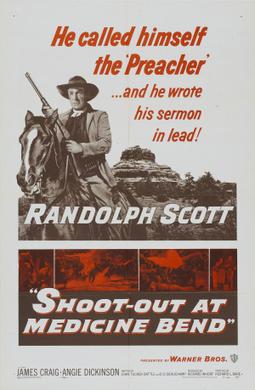
Shoot-Out at Medicine Bend
Between 1956 and 1960, star Randolph Scott and director Budd Boetticher teamed up for seven westerns that rose above their B-status to become classic, even iconic status. One of the more prolific actors of his era though, Scott was far from limited to just those seven movies. Over that span, Scott made three other westerns, including 1957's Shoot-Out at Medicine Bend.
Mustered out of the cavalry after serving for multiple years, Capt. Buck Devlin (Scott) has plans to join his brother and family at their ranch in a quickly developing area with acres and acres of available land. Along with him are two of his soldiers he's become good friends with, Sgt. John Maitland (James Garner) and Pvt. Will Clegg (Gordon Jones). The trio arrives in time to help fight off an Indian attack, finding Buck's brother killed because faulty ammunition prevented his rifle from firing. Looking for answers and revenge -- while also gaining supplies for other local farmers/ranchers similarly supplied with bad ammo -- Buck, Maitland and Clegg head to the nearby town of Medicine Bend. It doesn't take them long to figure out who's behind the ammunition, a powerful businessman with his hand in everything in town, Ep Clark (James Craig). Knowing his guilt is one thing, and proving it is another. How can the trio bring Clark to justice in a town where he controls everything?
I found this B-western on Encore Westerns and because of the cast I decided to give it a chance. Just recently I reviewed The Proud Ones, a very entertaining, well-made 1950s western that rose above some of its limitations. It was an adult 1950s western, one revolving around actual relationships, betrayals and greed. 'Shoot-Out' is basically the complete polar opposite. It has the look of a glorified television show, using several sets that any fans of 1950s TV westerns will no doubt recognize. The story starts off interestingly enough with Scott and Co. riding into an Apache attack and saving the day. They undertake a mission to help the local ranchers and farmers, and I'm thinking we're off to a good start. It goes downhill from there, and quickly.
There is an obvious potential with the story for a fairly dark western. A businessman so intent on making money he sells bullets filled mostly with coal dust instead of gunpowder? That's pretty gnarly if you ask me. His henchmen intimidate other shopkeepers into raising prices -- or just not selling at all -- so locals are forced to buy his merchandise. That's all good and nice, but even that aspect is botched here. The tone in this western from director Richard L. Bare is....wishy-washy to say the least. After Buck's brother is killed and they begin their rescue, we're treated to a scene where the very nude trio has their clothes stolen. They're left to approach a Quaker wagon train wearing whatever they find to cover themselves. Oh the hijinks! The story movies back and forth among dark, very serious and funny, goofy and stupid. I don't know if either option would have made a good (or watchable) western, but it couldn't have hurt. Instead, the mix ends up being pretty lousy.
I managed to stick with it though because of the casting. Mr. Western, Scott is decent in the lead, but he's not given much to do. Maybe it's just because his pairings with Boetticher were so significantly better than this one, but it's not one I'd really recommend for fans. Playing his bumbling partners -- and reminding me of a bad 1930s buddy serial -- Garner is the ladies man and Jones is the stupid, booze hound who always gets the group into trouble. Craig is a decent, sneering villain, obsessed with gaining more power. In the 'Hey, they're good-looking, let's keep watching department, Angie Dickinson (just 26 years old) plays Priscilla, the daughter of a rival shopkeeper of Clark, and Dani Crayne as Nell Garrison, a saloon/dance hall singer and dancer. Even the lousiest of B-westerns apparently need some forced, not believable love interests.
Not much else to say here so let's keep this one short. It's dull and has no real point. Basically, it's worthwhile because Scott is always watchable -- even in badness -- and for fans to look for early appearances from future stars James Garner and Angie Dickinson.
Shoot-Out at Medicine Bend (1957): * 1/2 /****
Labels:
1950s,
Angie Dickinson,
James Garner,
Randolph Scott,
westerns
Saturday, April 13, 2013
Ocean's Eleven (1960)
One of my favorite movies from the 2000s, I love 2001's Ocean's Eleven. I'm no dummy though, and I remember stating that the 2001 remake was better than the original. Well, it took me a little while -- okay, well over a year, but who's counting? -- but I'm revisiting that statement. Was I right or wrong? Maybe somewhere in between? Let's get started with the Rat Pack original, 1960's Ocean's Eleven.
A former paratrooper with countless daring, behind the lines missions under his belt during World War II, Danny Ocean (Frank Sinatra) has moved on with his life, but some 15 years since the end of the war, he's got a plan. The catch? He needs help from his old army buddies to pull off a daring heist. Ocean gets the group together, including Sam Harmon (Dean Martin), Jimmy Foster (Peter Lawford), and Josh Howard (Sammy Davis Jr.) among others, and lays out the plan for them. Just a few days away, Ocean and Co. plan on hitting five of Las Vegas's biggest casinos on New Year's Eve when the vaults are packed to the gills with money. Could it work? The plan depends on to-the-second timing, teamwork and countless little details, maybe even a little luck. It sounds like an impossible plan, but Ocean's crew might be crazy enough to pull it off.
Starting in the mid 1950s, Sinatra, Martin, Davis Jr., Lawford and Joey Bishop teamed up to star in movies that are simply known as....Rat Pack movies. Classic cinema they are not, but they are basically the definition of a good popcorn flick. Just sit back and enjoy them. Of all the Rat Pack movies though, this one is the best by far. Lewis Milestone directs, but his job is basically to get Sinatra and the boys on the right track and let them go. In that sense, he hits it out of the park. It is a vastly different movie than the 2001 remake which is really a remake in name and basic premise alone. The script, the heist, and the Vegas setting are all a means to an end. If you like Sinatra, Martin or any of the Rat Pack, you will enjoy this movie.
Singing or performing on stage, starring in movies, the Rat Pack had an innate chemistry that most entertainers dream of having. So cutting away a lot of other things, this movie is about the Packers hanging out, drinking some liquor, smoking a lot of cigarettes and wearing impeccably cool suits. Is it self-indulgent? Yes, basically the definition of self-indulgent. If you're a fan of Sinatra, Martin or any of the guys, this is the movie for you. It's genuinely funny with plenty of quick, snappy dialogue, lots of one-liners that don't feel like a script. It feels like it is a bunch of friends hanging out busting each other. Oh, and they happen to be planning an epic casino robbery too so they've got that going for them.
One of the biggest differences between the 1960 original and the 2001 remake is the background. Made 15 years after the end of WWII, the paratroopers angle is pretty cool. Sinatra's Danny is the sergeant, Lawford the entitled officer, Martin's Sam the soldier who saved Danny's life and best friend, and so on. Along with Davis. Jr as Josh and Bishop as Mushy, Danny's crew includes Richard Conte as Tony, just out of prison and looking to provide for his son, Henry Silva as smooth, quick-talking Roger, Buddy Lester as Vince, the former club bouncer with an in, Richard Benedict as Curly, Norman Fell as Peter, the explosives specialist, and Clem Harvey as Jackson, the drawling cowboy. Like the best men-on-a-mission movies, there's something inherently cool about a group of specialists working together to pull of an impossible job. When you actually like some of the group? That's even better, like a fastball down the middle.
Not surprisingly, the focus here is on Danny's crew, but the rest of the cast is pretty solid. Angie Dickinson plays Beatrice, Danny's wife who's working through some issues with her always moving husband. Cesar Romero is Duke Santos, a well-connected former gangster who stumbles into Ocean's plan and who happens to be engaged to Jimmy's mother (Ilka Chase). Akim Tamiroff gets a lot of laughs as Spyros, the ex-con who concocted the casino heist but can't come up with the details, turning to Danny for that part. Also look for Red Skelton playing himself in a casino scene, frustrated and wanting more money, and George Raft as a casino head in a strategy session. Even look for an uncredited Shirley MacLaine as a drunken New Year's Eve partygoer who meets Martin's Sam during the heist. And lastly, listen for Richard Boone providing his voice talents in a key scene late, even if he never appears on-screen.
I loved the style from this 1960 heist movie, and that doesn't come as a surprise considering the talent involved. The credits sequence from Saul Bass gets things going nicely. Watch it HERE, composer Nelson Riddle's score playing as accompaniment. Much of the film was shot on location in Las Vegas, and who would have thought? 1960 Vegas looks amazingly fun, like a time capsule into a smooth, cool era. Even the indoor sets look cheesy, but they're cool cheesy. The heist itself is pretty cool if a little more simplistic than the 2001 remake (Damn technology!). As most heist films will tell you though, it's the post-robbery stuff that's the issue. It's Vegas in the middle of the desert. How do you escape or hide the money? The ending delivers a couple great twists, especially the final one that sets up a very cool, very stylish final scene as Ocean's Eleven walk along the Vegas strip.
There is a simple, stylish elegance to this movie. Is it a classic film, an example of great cinema? No, but in terms of pure entertainment value, it's hard to beat. The scene where the crew discuss the upcoming heist in Spyros' well-decorated man cave is epically cool, Ocean's Eleven huddled around the pool table discussing the ins and outs of the heist. It's a fun, cool and entertaining movie that's a prime example of the style of a past era in Hollywood. The Rat Pack is cool. If you agree, you'll like this movie.
Ocean's Eleven (1960): ****/****
Monday, August 23, 2010
The Sins of Rachel Cade
In the Belgian Congo in 1939, American missionary and nurse Rachel Cade (Dickinson) arrives at a somewhat isolated mission only to have the doctor in charge drop dead from a heart attack. Forced to take over the not so friendly mission, Rachel does her best to offer medical treatment to the African villagers while also trying to teach them the ways of God, Jesus and the Bible from a Christian perspective. Nothing goes smoothly, but it gets more interesting when two different men, local commander Henri Derode (Peter Finch) and a suave doctor (Roger Moore) begin to show interest in the pretty young nurse, forcing her to decide if she can live by the lessons and teachings she gives to the local villagers.
After seeing Dickinson in mostly supporting roles or at least parts that usually relegated her to love interests, it was cool to see actually see her in a starring role. Her Rachel Cade is an interesting character, starting off as innocent, somewhat naive, and in some ways condescending to others' beliefs. I realize as a missionary that is her job, her mission, but she dismisses the beliefs of the villagers who have had those beliefs their whole lives. Still, even as she struggles with some inner demons and hypocritical feelings, it is a fascinating character to watch. Dickinson never gets too high or too low so Rachel is a little too laid back at times, but because we see her develop over several years, that's the character. Relatively calm even when everything around her seems to be falling apart.
Finch and Moore provide some interesting counters, and not just in who they play. Both Englishmen, Finch plays a French officer (thankfully not trying an accent) and a very young-looking Moore plays an American doctor from Boston (still sounding like a Brit). Rachel feels something for both men and ends up getting involved in a very serious way with one -- no SPOILERS today, folks -- that makes her question the morality of what's she doing. Of the two, Finch delivers the better performance, Moore playing his typically suave, ultra-charming character he perfected years later with the James Bond movies. Other good parts include Errol John as Kulu, Rachel's assistant open to embracing a Christian God, Frederick O'Neal as the local chief curious to Rachel's motivations and actions, and Rafer Johnson and Charles Wood as two of Rachel's helpers in the makeshift hospital.
Dealing with conversations about personal religious beliefs and what religion works and doesn't work, I struggled at times with how preachy the story could be. I haven't read the novel the movie was based on so I don't know what director Gordon Douglas was working with, but it is a very one-track story. Christianity good, African beliefs bad, no middle ground. Juano Hernandez plays a local medicine man/chief who may or may not believe in what he preaches, and Woody Strode plays an imposing medicine man who looks more like a witch doctor than anything else. The portrayal -- however true it is, I don't know -- seems very stereotypical to me and full of political incorrectness. Because of that portrayal, it seems obvious that of course Rachel is going to have success with converts to Christianity.
Simply in the moviemaking process, I struggled to get into this movie. It was filmed on an indoor set for this African village/mission Rachel comes to work at. Filming in Africa would have been no doubt rather expensive, but find somewhere outdoors that could have even slightly resembled the African jungle. You're very aware you're watching a movie that was filmed on a studio set and not anywhere on location. Composer Max Steiner's score is all right but doesn't leave much of a lasting impression. I had a hard time really getting into this story, and I don't know why.
The story lacks a certain amount of energy as it finds a rhythm among Rachel's mission, her personal feelings, and all the conflicts going around in the village. When issues do come up with Rachel finally caving in to some of her wants and desires, it is handled in such a PG fashion that it lacks any punch. Were we supposed to be shocked when Rachel reveals she is pregnant? Douglas probably couldn't get away with much by 1961 standards, but watching the movie some 50 years later, it is very noticeable. The whole movie is fairly dated, but some good acting brings it up a notch and at least makes the movie watchable.
The Sins of Rachel Cade <---TCM clip (1961): **/****
Saturday, April 10, 2010
Tension at Table Rock
In a career that spanned over 30 years, Richard Egan was in over 60 movies and made guest appearances on several TV shows. But like so many Hollywood actors/actresses from the time, he's been mostly forgotten in the years since his death in 1987. Some of it surely has to do with his films -- not one is a true classic -- but that doesn't mean he was in good movies. Where some stars reach the heights of the profession, Egan became more known for his work in B-movies. I'll never consider him a great actor, but even in his lesser roles, he had presence to spare.
A good example of his abilities is on display in the 1956 western Tension at Table Rock. Egan plays the main character -- a gunfighter running from his past -- in a story that uses just about every western cliche available and still manages to be halfway decent. Egan has one emotion in this movie, if you can call it an emotion, and it's monotone. His voice never goes up or down whether he's angry, wooing a lady, or just having a conversation. His face seems to be stuck in the one position for the whole 93 minutes, and through it all still makes it an interesting character.
Wes Tancred (Egan) is dealing with his name becoming legendary -- and not in a good way -- after he shot his best friend and partner, a fellow gunslinger, who was turning on him. The legend builds that Wes gunned him down in the back, and soon enough, a ballad pops up describing the killing. Wes is pardoned by the governor and moves further west under a new name. He takes a job at a stagecoach station but is forced to move on after a robbery with the loner survivor of the attempt, young Jody (Billy Chapin) in tow. Jody has an uncle living in the nearby town of Table Rock who happens to be the sheriff, Fred Miller (Cameron Mitchell). Some well-hidden sparks start to fly between Wes (alias 'Bailey') and Miller's wife Lorna (Dorothy Malone), but that's the least of the problems. Fred is still recovering from a brutal attack and with a cattle drive coming his way, he will have to stick up for the town against the rowdy cowboys, with or without Wes's help.
The story does take its time setting everything up, and it's over 45 minutes in before the cattle drive and its boss (John Dehner) is even introduced. The different storylines bounce every which way with just about every possibility imaginable taken into account in one way or another. 'Table Rock' borrows liberally from other 1950s westerns but still manages to put its own spin on things. All the important elements of a good western are there; honesty, loyalty, doing what's right no matter the cost, and being true to yourself. Still, it's hard not to shake the idea that the plot was never really settled on. Everything wraps up nicely though in the end with the heroic Egan moving on to another town rather than cause a disruption where he is.
The western drifter/gunfighter has been done to death although on a positive note this was well before Sergio Leone got his hand on the genre and infused a bit of cynicism into the western. Egan's Wes is a flawed man who's made out to be something he's not. Sure, he's good with a gun, but he's not a cold-blooded killer. 1950s westerns love flawed characters like these because they're not bad guys, but they're not white hatted good guys either. These sort of anti-heroes usually end up making some sort of personal sacrifice -- not usually involving their own death, it is the 1950s -- so that a family or a town can move on from their pasts.
Joining Egan is a strong supporting cast, especially Mitchell as Sheriff Fred Miller. He's still recovering from a horrific beating that almost killed him and is thrown right into the fire to protect his town from the incoming rowdy cowpokes. Mitchell makes Miller a character who wavers over what to do but ends up figuring out what's right and what's wrong, consequences be damned. Malone is good as Miller's wife Lorna who can't help but be attracted to the steely-eyed, mysterious gunfighter. Dehner is wasted as a quasi-villain with Royal Dano having some fun with his part as the crotchety old newspaper man. Only in one scene, DeForest Kelly (pre Star Trek) makes a strong impression as Jim Breck, a hired gun with a unique mission.
Nothing really remarkable about this B-western, but as several IMDB reviewers point out, doing a well-worn formula picture well has to count for something. At Youtube, several clips have been posted focusing on child star Billy Chapin's performance for those curious and looking for more about the movie. Also look for a young Angie Dickinson in a small part, playing against the image she would become known for when she became a star. Innocent enough western that is a pleasant enough way to spend 90 minutes.
Tension at Table Rock <----trailer (1956): ** 1/2 /****
Labels:
1950s,
Angie Dickinson,
Cameron Mitchell,
John Dehner,
Richard Egan,
Royal Dano,
westerns
Sunday, March 14, 2010
Big Bad Mama
I've had a string of bad luck when it comes to movies lately with some real stinkers. Thanks to TCM Underground, that string was busted up a little by 1974's Big Bad Mama. It's a B-movie from producer Roger Corman that doesn't try to be anything other than entertaining and because of that, succeeds in a big way. It has no concerns of a movie with a bigger message. Instead, there's lots of action, car chases and nudity, basically the big 3 of B-movies.
Corman's flick plays with familiar territory of the 1930s gangsters and bank robbers that took America by storm during the Great Depression. One of the most famous was Ma Barker, or so people thought, because in the 80 years since it has been proven that the Barker matriarch wasn't really a crook at all. Using the notion that Ma Barker's legendary exploits were true, 'Bad Mama' is ever so loosely based on those exploits. That is, if Ma Barker was about 40 years younger and looked like Angie Dickinson. Minor sticking points if you ask me.
Fed up with not being able to provide a good life for her two teenage daughters, Texas mother Wilma McClatchie (Dickinson) hits the road. With her daughters Billy Jean (Susan Sennett) and Polly (Robbie Lee) in tow, Wilma starts robbing banks, moonshining, pulling cons and basically anything else that will bring in some much-needed money. Along the way, they form their own little gang with bank robber Fred Diller (Tom Skerritt) and down on his luck conman William Baxter (William Shatner) joining the trio of women. They cut a path of crime through the southwest and into California with two clueless, bumbling detectives on their trail.
A 1930s gangsters story wouldn't seem to be the ideal choice for a lighthearted, sex romp, but if anybody could pull it off, it'd be Roger Corman. All of the action scenes have a fast-paced banjo playing as the soundtrack and most of the violence is saved for the finale. Sure, there's some gun battles sprinkled into the story, but 'Big Bad Mama' rivals The A-team for most shots fired with no one actually getting shot. When the bullets actually do hit their mark, watch out for some 1970s bright red squibs. The finale especially is over the top and ridiculous with Skerritt's Diller blasting away at cops with a tommy gun that never runs out of ammunition.
Lots of slapstick and generally low-brow humor throughout this B-movie. Apparently though to get an R-rating, Corman had to tone down some of the nudity in the movie which is surprising considering how much was left in the finished product. All the cast is nude at some point -- some more than others -- and I'd wager Dickinson and her two "daughters" spend a quarter or so of the movie either topless or completely naked. It's a very 70s story in terms of the nudity, and it is never long before any two (and in one case three) of the five main cast members shack up. It's surprising with Dickinson especially because she was an established actress, in movies and on TV with Police Woman starting the same year as Big Bad Mama was released.
This isn't going to be a very long review because let's face it, there isn't much to review. The cast seems to having a good time, Shatner hams it up as only he can (watch this short scene), Skerritt plays the gun-crazy bank robber, and Dickinson is the oblivious mom gangster trying to help her kids and looking great doing it. It is the trashiest of movies with plenty of nudity, lots of gunplay and violence and just enough story to keep things moving along.
Big Bad Mama <----trailer (1974): ** 1/2 /****
Tuesday, September 29, 2009
Young Billy Young
Starting his movie directing career in the mid 1960s, Burt Kennedy found a home in the western genre and rarely left it in a 20-year span. None of the Kennedy westerns are classic, far from it, but they are about the equivalent of the hour-long serials from the 1930s. Nothing groundbreaking with good guys tangling with some ornery bad guys, but they are always entertaining if nothing else.Kennedy worked with a wide variety of tough guy actors in these westerns, including John Wayne, Glenn Ford, Henry Fonda, Ben Johnson, Yul Brynner, Frank Sinatra, Kirk Douglas and Robert Mitchum. Just like director Kennedy, many of these actors are remembered for their parts in westerns over the years. Mitchum especially never really left the western behind, joining with Kennedy for the 1969 oater Young Billy Young just two years removed from minor classic El Dorado.
Based loosely on a novel about Wyatt Earp's involvement with the Cowboy gang following the shootout at the O.K. Corral, Young Billy Young feels like a mash-up of several different stories all rolled into one. A great opening sequence has two young gunfighters, Billy Young (Robert Walker JR) and Jess Boone (David Carradine) sneaking onto a Mexican troop train and completing a hit on a Mexican general. In their escape, Jess abandons Billy when his horse throws up, and it's only by pure luck Billy escapes.
Billy makes it to the next town on the back of a burro, but it's not long before he guns down the town's sheriff for cheating in a card game. With some help from a gunfighter, Ben Kane (Mitchum), passing through town, Billy escapes a posse on his trail. He tags along with Ben who's on his way to a new job, working as a deputy in a roughshod town with no law and order run by slimy John Behan (Jack Kelly). The odds are against Ben, but he's got revenge on the mind as he looks for the man (John Anderson) who killed his son years ago in a jailbreak.
As if that wasn't enough, a saloon/dance hall girl, Lilly (Angie Dickinson), takes a shine to Kane, but Lilly is Behan's girl and doesn't take too nicely to Ben stepping in. There's more that is revealed in terms of plot twists that won't be spoiled here, but it's nothing too new that you won't have seen before. The only problem is that with all these different storylines about revenge and friendships and shootouts, the 89-minute running time is all sorts of convoluted. Maybe another 30 minutes could have served the movie better, but it's not a deal breaker.
Some characters get short-shrift, like Anderson's gunfighter who shows up in town, disappears for awhile, and then reappears with little warning for a final showdown with Mitchum (a disappointing end for that story). It would have been interesting to see two storylines, Billy and Jesse and then Ben's revenge dealt with exclusively, but what's there is entertaining nonetheless. It doesn't hurt that the movie was filmed in Old Tucson and looks great.
With the cast, Mitchum provides credibility just by being there. It's the type of part for the veteran star that he could do with no heavy lifting. He shows up, acts cool, shoots some baddies and gets the girl. Made the same year as he made Easy Rider, Walker JR gets a more mainstream role here as Billy who with Mitchum's older, more experienced gunfighter make a good old vs. young buddy pairing. Carradine's a good villain (when wasn't he?) while Kelly sneers as Behan, I guess loosely based on the real-life John Behan. In a role similar to her part 10 years earlier in Rio Bravo, Dickinson again plays a strong female character with a checkered past and even as little as she was height-wise is a good match with Mitchum.
So what's not to like with a western with a more than capable cast, some nice location shooting, plenty of gunfights, and Robert Mitchum singing the theme song? Maybe Burt Kennedy wasn't the best director around and one without much of a personal style, but he put together some exciting westerns during his career. Young Billy Young is certainly one of them, an oater that will keep you interested from start to finish.
Young Billy Young (1969): ** 1/2 / ****
Subscribe to:
Posts (Atom)


.jpg)

Poster.jpeg)