The Sons of Katie Elder

The Sons of Katie Elder
"First, we reunite, then find Ma and Pa's killer...then read some reviews."
Showing posts with label Arthur Hunnicutt. Show all posts

Friday, February 20, 2015

The Revengers

As I've mentioned before, I've got a list in my head of hard-to-find movies that I've long sought. An interesting cast, a intriguing story, anything and everything, it can be anything that catches my eye. Today's entry? A 1972 western, The Revengers, that I found recently at the local Barnes and Noble. It was a tad pricey for a movie I've never seen, but this is one that's been on the list for too long to risk passing up. Did it pass the test?

A Civil War veteran with a distinguished war record, John Benedict (William Holden) has put the war behind him and is now running a successful ranch in Colorado. His life is thrown into chaos though when he returns from a hunt to find his wife and four children brutally murdered. A posse catches some of those responsible, Comancheros working with raiding Comanche Indians, who identify the leader of the attack, a one-eyed renegade named Tarp. Wanting nothing more than to exact revenge on the renegade, Benedict rides into Texas and then Mexico, ultimately leaving a posse behind. He tracks Tarp down to an isolated trading post but the odds are stacked against him. Needing help to kill Tarp, Benedict takes desperate measures, recruiting six convicts from a prison mine in the hills in Mexico. Will they turn on him the first chance they get? Can Benedict hold them together long enough to get the job done?

Yikes, what a weird movie. The 1970s were a weird time for the western genre in general, but this one was really weird. It's from director Daniel Mann and was a bomb in theaters upon its release. 'Revengers' has the distinct feel of an American western but with touches of a made-for-TV flick with some touches of ultra-violent spaghetti western mixed in. So unfortunately it is all of those and none of those because it never quite picks a tone. The positives though? Filmed in New Mexico, this is quite the good-looking western with some unique locations that I've never seen in a western before. The western-themed score features some rock overtones too, kinda odd but it works in a bizarre fashion. Go figure. There's something entertaining and oddly appealing just the same even if I can't honestly say that it's "just good."

The basic premise for 'Revengers' is a tweak on the 1967 WWII movie, The Dirty Dozen (one of my favorites). One halfway decent guy, a team of convicts turned mercenaries of sorts, unleash them on some impossible, mostly suicidal mission. I loved the DD and really enjoyed knockoffs and quasi-knockoffs using a similar premise. I thought I'd enjoy (maybe love) this one. I didn't. Holden is solid but nothing flashy as John Benedict, the revenge-seeking rancher who wants to kill the man who helped lead the attack on his family and ranch.

His Revengers? There's some recognizable faces and some cool parts, starting with Ernest Borgnine hamming it up as Hoop, a former Comanchero himself who'd turn on his own mother for a profit. There's also Job (Woody Strode), a runaway slave who killed his pursuers and ended up in prison, Quiberon (Roger Hanin), a woman-loving deserter from Maximillian's army and a bandito, Zweig (Reinhard Kolldehoff), the mad German, Chamaco (Jorge Luke), the young Mexican assassin, and Cholo (Jorge Martinez de Hoyos), the philosophizing revolutionary. The international, dynamic feel to the quasi-vigilante group is very cool. Like the movie and story itself, there is a ton of potential that never quite jells. Benedict treats his convict partners as equals, addressing them as 'Mr. ...' and they come to respect the man who handed them their freedom.

That's where things get to be a little disjointed. By a little, I mean a lot. The build-up is entertaining but familiar, seemingly shooting for something action-heavy and dumb and fun. It's a movie that is 108 minutes long and takes a big, surprising departure a little past the halfway point. I didn't see it coming AT ALL. However, it isn't just that the departure happens. It's that the twist throws the rest of the movie for a loop that it never really recovers from. We're shown that most of a year passes, the Revengers develop into friends, becoming almost a bounty hunting gang -- randomly shooting down attackers at one point -- and Benedict has become something else, something he never wanted to be. That device is used several times, jumps in stories moving things forward without warning in a flash.

And in the end, that becomes it's ultimate undoing. 'Revengers' has absolutely no idea what it wants to say or do, much less how to do it. I would have loved to see a story that focused far more on the dynamic between Benedict and the men who become his unlikely allies. That premise could have been at the helm of a really good to maybe great western. Instead, it never clicks as intended. Even the ending disappoints, kinda a limp finish for a story that could have built to something ultra-violent and dark and surprising. In other parts, look for Susan Hayward and Arthur Hunnicutt. Ultimately a disappointment but one that did entertain me overall. Probably more of a two-star review, but with that cast, I'll give it a slight bump. The print on the DVD is a beauty for those wavering over what to do concerning a purchase.

The Revengers (1972): ** 1/2 /****

Wednesday, March 12, 2014

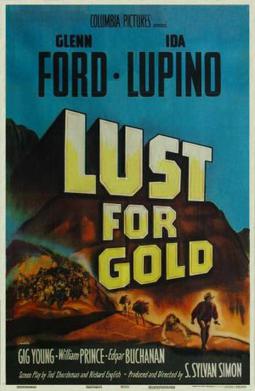
Lust for Gold

As Gordon Gekko profoundly said, 'Greed is good.' One of the all-time great films dealing with one of the seven deadly sins was released in 1948, Treasure of the Sierra Madre, a frightening look at what gold can do to one's minds. It's one of the all-time classics, making 1949's Lust for Gold an odd choice. Was it an effort to build off its success? Whatever the reason, it doesn't work despite some potential.

It's 1948 in Arizona, a treasure-hunter of sorts, Barry Storm (William Prince), is walking through the Superstition Mountains looking for a supposedly long-lost mine, the Lost Dutchman. He's actually following a famous treasure hunter who states he's got the mystery figured out, but Storm is stunned when he hears a gunshot and soon after finds the treasure hunter dead. He walks to the nearest town, still several days away, to report the murder, quickly realizing this isn't some innocent old treasure hunt. Storm is quickly cleared of suspicion, but his interest makes some curious as he claims to be the grandson of the original owner of the Dutchman mine. As the police waits for a break in the case, Storm sits back and listens to the legendary story of how the mine came to be, including how his grandfather, Jacob Walz (Glenn Ford), came to be involved.

This was an interesting movie, not always for the good. From director S. Sylvan Simon (and an uncredited George Marshall), 'Lust' does have its positives and negatives. It plays at times like a pseudo-documentary, a film noir meets a rough and tumble western. Unfortunately, it never really gels as one coherent film. I liked the framing device in the story, a 90-minute story split about 55 (the Glenn Ford part) and 35 (the 1948 part) divvying things up appropriately. It comes with a message from the state of Arizona -- almost like a Welcome Guide, "Come and see Arizona!" -- stating that the mine is still out there somewhere. It is based off a book by the real Barry Storm, called Thunder Gods Gold, and it plays like a pandering effort to sell some copies of the book. Prince's Storm's narration is a little much too, almost an attempt to sound like a James Cagney-esque gangster. "The gold's out there, I tells ya! Don't believe me, eh?!?"

Oddly enough though, I enjoyed the 1948 portion of the story far more than the 1885 portion. Prince is okay as the intrepidly curious Storm, jobless and interested in finding the lost mine that's supposedly filled with literally tons of gold. The film noir in the desert plays well, dead bodies and potshots piling up over the years as treasure hunters supposedly near the location of the lost mine. In addition to Prince, look for Paul Ford as the local sheriff with Will Geer and an uncredited Jay Silverheels (later Tonto on The Lone Ranger) as his two deputies. The mystery builds nicely and when things wrap up back in 1885, we get some solid resolution. The ending was pretty exciting, wrapping things up that the first 20-25 minutes set up.

Surprising for me was how dull the actual 1880 Arizona western was. It starts off well, greed, murder and betrayal introduced early to the point I thought I had stumbled onto a hidden gem from a genre I love. Well, I didn't. The story detours quickly and is never able to recover. Glenn Ford gets a rare turn as a bad guy -- an out and out bad guy -- but it's wasted because after he finds the gold mine by some rather duplicitous means (read = Murder) the story hamstrings the character as it devolves into a forced love triangle with Ida Lupino's Julia and her husband who she fights with constantly and would like to divorce, played to smarmy annoyingness by Gig Young. Wait, she loves her husband, but she doesn't because she loves Jacob but she doesn't love him either. Gag me, the story goes nowhere, turning a potentially really good story about what greed can do to people into a lame, glacially-moving love triangle. A love triangle of sorts. You've gotta be kidding me.

In the flashback portion, also look for Edgar Buchanan as a grizzled old trail hand working with Ford's Jacob and uncredited parts for Arthur Hunnicutt and Antonio Moreno as two rivals who may hold the key to the location of the lost gold mine. Even western veteran John Doucette turns up for a quick appearance in a barber shop talking about how much gold may be out there.

There are parts that worked surprisingly well. The explanation of how the gold came to be in the mine is a gem, an Apache war party descending on a heavily-guarded escort in a surprisingly graphic action scene. The same for the intro to the 1880s flashback, Glenn Ford's Jacob straight up murdering folks. How many movies can you say that about? Glenn Ford is a good guy for goodness sake! The ending in the flashback has some potential too, but by then I was so bored with the Ford-Lupino-Young part of the story I just didn't care. A movie that has its moments, but not enough of them unfortunately.

Lust for Gold (1949): **/****

Monday, February 17, 2014

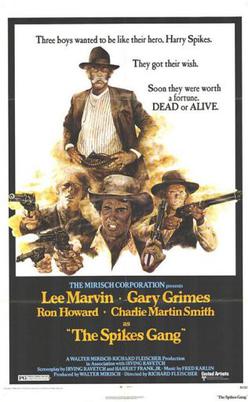
The Spikes Gang

Growing up is tough, and yes, here we are with another coming of age movie. No, it's not a teenager in the 1980s, a little boy growing up in Germany during the Holocaust, but a sub-genre from one of my favorite genres, growing up in the wild west. Movies from The Culpepper Cattle Co. to True Grit and others, it's an always interesting sub-genre. We can definitely add 1974's The Spikes Gang to the list.

Living with his parents on an isolated farm in Texas, teenager Wilson Young (Gary Grimes) has had about enough of his father's strict, one might say cruel, treatment. Walking around out in the isolated brush country with his two friends, Les (Ron Howard) and Tod (Charles Martin Smith), Will finds the body of a seemingly dead man. He isn't though, the three teenagers nursing the severely wounded man back to health. They find out the man is Harry Spikes (Lee Marvin), a notorious bank robber who thanks the boys for their help and rides out. Not soon after, Will, Les and Tod all leave home, vowing to live life and explore the world and all it has to offer. Life on the road isn't everything it's made out to be though, the trio ending up in a Mexican prison with no hope...until now. Spikes lucks upon them, bribing the guard to let them out. His solution? He likes the boys and teaches them how to become bank robbers, forming the oddest gang of bank robbers around.

I was worried as I watched the credits for this Richard Fleischer-directed western. The soundtrack was a soft, folksy-sounding guitar playing, and I'm thinking I stumbled into a lyrical, whimsical 1970s western where everyone's nice and cute and the world is just dreamy. Well, I'm glad I stuck with it. There certainly are moments like that, the three boys hitting the road and ready to experience the world. That sentiment is quickly thrown out the window, and the movie gets better immediately. With no money and starving, Will decides to rob a bank out of nowhere. They get away with some money but Tod accidentally shoots a passerby trying to stop them. From there, the story's previously happy, go-lucky story degenerates, getting darker with each passing scene. Is that a good thing? Um, yes, my name is Tim. Have you read any of my reviews?

This is a gem of a western, one that deserves a much bigger reputation. Fans of westerns typically love or hate 1970s westerns, movies that ripped away the idea that the wild west was glamorous, romantic or anything like most John Wayne westerns. As an interesting touch, 'Spikes' was filmed in Almeria and Andalucia in Spain, the familiar locations for countless spaghetti westerns. So we've got an unsentimental American western interested in exposing the myths of the old west in locations made famous by spaghetti westerns, a genre similarly interested in blowing open the American west. How can you lose? The 96-minute western covers a lot of ground but never feels rushed, an episodic story a positive here. We see some quick appearances from Arthur Hunnicutt as a past-his-prime gunslinger/saddle tramp, Noah Berry Jr. as an unlikely ally, and it all works in perfect fashion.

Beyond the story, the movie works because of the cast. It starts with Lee Marvin as infamous bank robber Harry Spikes. This is a part equal parts charming/disarming and frightening in its reality. He genuinely likes the three boys, looking after them, feeding them, buying them clothes and guns, teaching them how to become outlaws, but he's also brutally honest about it. If they get hurt, he'll leave them. This is a dangerous profession he's chosen and the boys have chosen. It can end at any time, and all it takes is one bullet. Marvin's performance is a gem, one that deserves to be considered one of his best. It's funny, charming, disturbing at times, and he steals every scene he is in. This isn't a part that requires him to be in every scene, drifting in and out at times as needed. When he's on-screen though, it's impossible to look away.

With a lead performance like Marvin as Harry Spikes, it'd be easy for his teenage counterparts to get lost in the shuffle. These are three talented young actors though, and any such worry is unfounded. The best part is for Gary Grimes as Will, the unofficial leader of the trio. He's sick of his father's constant nagging (and occasional beatings with a belt), opting to hit the road. The transformation he goes through is the most profound, the darkest of the three. He was a specialist in the youngster role in 70s westerns, also starring in Culpepper Cattle Co. and Cahill, U.S. Marshal, ultimately retiring from acting in the late 1970s. It's a very human part with some startling developments late. The same year Happy Days premiered, Howard is also very good as Will's closest friend, a logical thinker who's almost the group's conscious. Martin Smith too is excellent as Tod, the most religious and worrisome of the trio.

I wasn't sure exactly where this 1974 western was heading although there were some hints at the finale. The ending is perfectly executed, a major twist revealing itself in the last 15 minutes. It isn't glossy, polished or romantic. This is the west as it was. Dark, nasty, bloody and all about survival. In other words, it's realistic and far from a happy ending. I loved this western, can't recommend it enough.

The Spikes Gang (1974): *** 1/2 /****

Wednesday, March 6, 2013

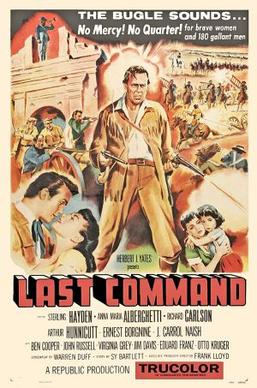
The Last Command (1955)

Of the three most well-known heroes of the battle of the Alamo, David Crockett, James Bowie and William Travis, there's no doubt who is the most well-known of the three. Oh, that'd be Crockett for those unfamiliar with history. In second place, the infamous knife fighter Jim Bowie who's had several films based on his exploits including 1952's The Iron Mistress (meh) and for today's review, 1955's The Last Command.

It's 1834, and knife fighter, adventurer and land owner Jim Bowie (Sterling Hayden) is riding south through Texas to Mexico to see his home and his family. As he rides through the territory though, he finds that many Texan colonists have had enough with Mexican president, Santa Anna (J. Carrol Naish), who's become more of a dictator with each passing day. Old friends with the president, Bowie isn't sure who to side with at first, but when his wife and children die, he's forced to come up with answers about what he believes and what he should ultimately do with the coming revolution. He joins the fighting, leading a group of volunteers. Santa Anna has started to march an army north from Mexico City to deal with the revolutionaries, and all roads lead to the town of San Antonio and a ruined old mission, the Alamo.

Anyone familiar with John Wayne's The Alamo from 1960 will no doubt notice some similarities between that film and this 1955 flick from Republic Studios. The reason? This was originally made with Wayne -- still working at Republic -- attached as an actor. He wanted to make an Alamo film, but disagreements with the studio drove the two sides apart. The end result was simple; Wayne left Republic, Republic made the film without Wayne, apparently out of spite. There are some similarities, from Davy Crockett's death to the Alamo defenders raiding the surrounding Mexican army for artillery and many others. The biggest difference though is obvious, a focus on Jim Bowie.

It's funny that in the casting of the infamous knife fighter, one of America's truly unique historical personalities, two of Hollywood's most wooden, vanilla actors were chosen. In 'Iron,' Alan Ladd starred, and here, Hayden takes the reins as Bowie. I'll say this. I don't think Hayden has a "showy" side, but he at least commits here and shows some energy in the lead. Just like Wayne's film would do, there is an unnecessary -- even painful -- love story as Bowie falls for Consuelo (Anna Maria Alberghetti), a young Mexican woman from a rich family (Eduard Franz plays her well-to-do uncle). Above all else, it's cool to see Bowie get a movie devoted to him and his involvement in the months leading up to and in the Texas Revolution. He was a fiery, passionate fighter who fought for what he believed in. His friendship with Santa Anna is a little much (the Mexican dictator affectionately calls him 'Jimmy'), but seeing a familiar story from an unfamiliar angle is refreshing.

Overall, the story focuses on a two-year period starting in 1834 and running through March 1836 and the battle and fall of the Alamo. The movie runs just 110-minutes and is a little slow-moving at times -- rather talky -- so non-history fans may lose some interest. Alamo buffs will get a kick out of the story though that focuses on Texas history that most Alamo movies simply ignore. We do meet some familiar faces, including Colonel Travis (Richard Carlson), Davy Crockett (Arthur Hunnicutt) and Lt. Dickinson (John Russell). Carlson is solid as the similarly fiery Travis, and Hunnicutt is a scene-stealer as the backwoods, storytelling Crockett that's based more in myth than the real-life Crockett. The story doesn't just jump right to the Alamo, but lays some ground work and background leading up to the famous battle. Also look for Ernest Borgnine as Mike Radin a rival-turned-friend of Bowie's and Ben Cooper as Jeb Lacey, a young Texan who looks up to Bowie. Other Alamo defenders include Slim Pickens, Jim Davis, Roy Roberts and Russell Simpson as the Parson.

The actual battle for the Alamo takes up about the last 40 minutes of 'Command.' The set is somewhat limited -- we basically see one corner of the mission along with the wooden palisade -- but there's something oddly cool about the set built near Bracketville, Texas (where Wayne's film was made). For a movie released in 1955, the final assault on the Alamo is surprisingly vicious and violent. Nothing graphic, but still pretty hardcore stuff for a 1950s audience. Each character gets their moment, their on-screen death with Bowie saved for last.

There's nothing hugely memorable about this 1955 Republic picture, but I like it just the same. Composer Max Steiner's score is a highlight -- give it a sample HERE -- and the Jim Bowie theme song (listen HERE) is pretty awful, but in an amazingly bad and memorable way. Lots of good actors, familiar faces and an enjoyable if unspectacular story in director Frank Lloyd's historical bio-pic. One IMDB reviewer points it out accurately. It's neither a big budget A-movie or a low-budget B-movie, but it's somewhere in between. TCM has three clips available so give them a watch at the link below.

The Last Command (1955): ***/****

Monday, October 3, 2011

The Big Sky

As a fan of westerns, I'm always somewhat taken aback when someone tells me they don't like the genre. Everyone has their preferences. I can understand and appreciate that.  Like any successful genre though, I think you have to give it a chance. Do some exploring, see what's good, what's considered a cult classic, what's bad and what you should avoid. There are little groups of niches within the western of course, one that any movie fan should be able to appreciate, the expansion to the west in the United States, like 1952's The Big Sky.

The 19th Century was an incredibly busy one for the ever-growing United States as hundreds of thousands of people moved west trying to build new lives. American expansion isn't an easily handled topic for a movie with all its epic qualities and large scale and scope, but when handled right, it can be a beautiful story in the end. 'Sky' isn't your typical western, focusing on some of the first explorers into uncharted land more than gunfighters and shootouts. That's a good thing though, a big, expansive western about a chapter in American history so often overlooked. Our history has to start and continue, and this is as good a place as any to jump off from.

It's 1832, and Jim Deakins (Kirk Douglas) is traveling to Louisville when he meets another young traveler, Boone Caudill (Dewey Martin). With so much open land to the west of St. Louis just waiting to be explored, Jim and Boone head west looking to join up with Boone's uncle, Zeb Calloway (Arthur Hunnicutt), a trapper and frontiersman, one of the few men to explore deep into the west and the unknown. They find him in a jail cell and sign on for an expedition up the unexplored Missouri River. Along for the trip is Teal Eye (Elizabeth Threatt), a Blackfoot princess who will be used as a negotiating ploy in the trading process for beaver pelts. Trading seems a long way off though as Jim, Boone, Zeb and the crew of the keelboat must fight off Indian attacks, murdering white men, and nature's ever present danger.

Exploring the untapped American west and all its beauty is one of the most simple, direct and straightforward story ideas ever. There is something beautiful in the simplicity; a land untouched by technology or business.  Director Howard Hawks filmed this movie on location in Grand Teton National Park and Jackson Hole, Wyoming, and the end result is stunning. Seeing the valleys, the mountains, the rivers, you understand why people would risk it all in the 1830s to uproot their families and move them west. That's the most appropriate word I can think of; stunning. It is a gorgeous movie to watch, even if I wondered what the movie would have looked like in color and a widescreen presentation (2 years too early) instead of the black and white standard presentation. Minor potatoes really, color or not, the Tetons are breathtaking.

Depending on the role and the movie he was in, Arthur Hunnicutt could be so downright homey and folksy, so home-spun and backwoods he drove me up a wall.  There is such a thing as being too folksy if you ask me.  He no doubt had talent though, and this is one of his most understated roles. Yes, there are bits of folksy attitude, but in the right doses it works. His Zeb serves as Sky's narrator, explaining what's going on to our crew of adventurers. The narration has some humor to it and never tries to be anything too over the top. It's just the trials and tribulations of traveling as Zeb sees it, and that's all.  He received a Best Supporting Actor Oscar nomination, losing to Anthony Quinn in Viva Zapata!, and it's one he deserved. Hunnicutt and his veteran presence -- as an actor and as his part requires -- gives the movie that steady feeling of knowing where it needs to go.

In a variation on the buddy picture, Douglas and Martin are cast together nicely as Jim and Boone, two friends always competing, always getting into scrapes, and always coming out on the other side the better for it.  These aren't characters who develop and change much, just two young men looking for adventure, and that's okay because that's all the story needs. They look to be having a lot of fun, and that's all that matters. Threatt never starred in another movie, strange considering how good she is here, making an easily stereotypical part into something better. Some of the keelboat's crew include Jourdonnais (Steven Geray) or 'Frenchy' to his men, the captain and owner of the boat, Romaine (Buddy Baer), a Goliath of a man, and Henri Letondal as La Badie, the cook. The very white Hank Worden plays Poordevil, a groan-inducing, stereotypical portrayal of an Indian who's touched in the head, while Jim Davis is Streak, a conniving bandit working against the expedition.  

With a story that covers several months on the trail/river, 'Sky' leans more toward an episodic plot than one continuous storyline.  This is both good and bad.  The more interesting parts flow at a quick pace, but the slower ones drag it down. I don't dislike the movie, but at 138 minutes it feels a tad long in places, especially toward the end.  Lost footage has been reinserted into the movie as well so that could have something to do with it. None of this is enough to not recommend this movie though. Dimitri Tiomkin's score is a nice touch, as big and wide as the story it accompanies, and the movie itself is a beauty. It doesn't receive the recognition it deserves so see if you can track a copy down or at least look out for it at TCM.

The Big Sky <---trailer (1952): ***/****

Monday, September 12, 2011

Two Flags West

For four years between 1861 and 1865, the Civil War raged on as North fought South, mostly in the eastern half of the country.  Out west though, life went on, and the U.S. army and cavalry still had to protect settlers from raiding Indians from any number of tribes.  It's a little known but always interesting part of American history, this time in the west that is overshadowed what was happening back in the east. It's a topic that's been explored a couple times through film, most notably Sam Peckinpah's Major Dundee and John Sturges' Escape from Fort Bravo, and now I can add another to the list, 1950's Two Flags West, an obvious influence on both films.

So if a majority of your soldiers are off fighting elsewhere, what does an army do to fill out its ranks? In 1863, President Lincoln passed a proclamation stating that any Confederate prisoners of war in Union prison camps could sign up to fight with the Union in the west, battling Indians rather than wasting away in a prison camp.  As if fighting Indians wasn't enough, any movie dealing with this situation now gets the natural rivalry and hatred of North vs. South now forced to work alongside each other.  If that's not a recipe for success, I don't know what is. 'Flags' plays on that sentiment, ending up with an underrated and exciting Civil War/western combo.

On his way to Fort Thorn, a remote outpost in New Mexico, wounded Union officer Capt. Bradford (Cornel Wilde) stops at a Union prison camp in Illinois, offering Confederate cavalry there commanded by Colonel Clay Tucker (Joseph Cotten) a proposition. If they enlist in the Union army, they can ride out of the camp and join him in traveling west to fight the warring and dangerous Apache tribe in the southwest. Tucker and his fellow surviving prisoners -- some 40-plus men -- agree and head west with Bradford to Fort Thorn. There they find the situation a little more prickly than they imagined. In addition to the Apaches, they must deal with Major Kenniston (Jeff Chandler), an officer with a deep-seeded hatred for any Confederates who he blames for his brother's death. His brother's widow, Elena (Linda Darnell), is also at the post, providing even more of a rivalry among the new arrivals.

With the talented cast involved and the above-average finished product, I'm semi-stunned to see this movie has no reputation at all, either positive or negative.  I was lucky enough to catch it on TCM's recent tribute to Linda Darnell, but other than that it's not available anywhere on DVD or even VHS (that I could find). It makes sense of course. It's a good movie, lost in a sea of good movies over the years. Director Robert Wise turns out a solid western that knows what it is doing and how to entertain. 'Flags' is a pretty dark western overall, especially for one released in 1950, and has its fair share of violence, some of which is surprisingly graphic and gruesome. It doesn't overstay its welcome at just 92 minutes, but coupled with an interesting story, great cast, gorgeous New Mexico locations and a solid score from composer Hugo Friedhofer, ends up being an above average western that deserves some sort of reputation.

Maybe some of the issue is the casting. Cotten, Darnell, Chandler and Wilde are not HUGE names when it comes to movie stars.  I count that as a big positive here.  They're all good actors, not just stars.  They work well together in an ensemble that does have a lot going on, but Wise keeps all those plates spinning for the most part.  Cotten is the gentleman Southern officer, a more than capable soldier who looks out for his men above all else.  Chandler gets to be a villain of sorts playing a character that reminded me of Henry Fonda's performance in Fort Apache.  He always played flawed good guys so doing a 180 is a nice twist. Wilde is the odd man out with the smaller part but he makes the most of it. And instead of a love triangle, we've got a love square with Darnell having to decide among those three actors.  My only other movie I've seen Darnell in is My Darling Clementine -- not a great performance for her but not really her fault -- so this is a drastic improvement.

Filmed in black and white, Wise's cavalry western with North meeting South isn't your typical western. Sure, there are those iconic shots a la John Ford of a cavalry troop riding across the horizon, but in general there is a darkness here that you don't see often.  Chandler's Major Kenniston hates the Confederates -- he was wounded in the opening moments of the fighting at First Bull Run and later escaped from Libby Prison -- and through his hatred almost gets his whole command wiped out. Cotten's Colonel Tucker is a proud Southern officer but only to a point, an issue which Kenniston pokes and prods. Everyone is out for themselves in this western, leading to a surprising ending.

Thinly garrisoned by aging and wounded Union soldiers sent west and a lone company of Confederate cavalry, Kenniston provokes an attack as the Apache tribes come together to attack Fort Thorn. For a modestly budgeted western, the assault on the fort is impressive in its scale.  Chaotic and violent, it looks like at one point the whole garrison -- women and children included -- will be massacred. The ending does provide a twist, Chandler's ego-maniacal officer given a chance to redeem himself.  Thin on action up to this point, the finale makes up for it.

In other supporting parts, look for Noah Beery Jr, Arthur Hunnicutt and Dale Robertson as the three most visible members of Colonel Tucker's Confederate troop. Jay C. Flippen has a small part as Sgt. Duffy, Kenniston's aide and a veteran soldier with plenty of experience. Flippen and Hunnicutt have a couple good back-and-forths with their Union vs. Confederacy rivalry. Skeptical as to why this movie had no notoriety, I wasn't sure what to expect from Two Flags West, but I was more than pleasantly surprised. If you can track down a copy or stumble across it on TCM again, I highly recommend it.

Two Flags West <---TCM trailer (1950): ***/****

Thursday, June 17, 2010

The Lusty Men

When it comes to sports, I'll give just about anything a shot, and thanks to ESPN's family of networks I've gotten that shot at seeing all sorts of unique sporting events from the basics to fringe sports like bowling or billiards.  Then there's rodeo, a sport I've never really understood and some of that may have to do with where I've lived most of my life, Illinois and Indiana.  While not as violent as say bullfighting, rodeo has always rubbed me the wrong way for its treatment of animals.

TCM aired 1952's The Lusty Men last week, a story with the rodeo as the setting.  Before I get into this movie, I should say I've seen and enjoyed other rodeo movies like Junior Bonner with Steve McQueen or J.W. Coop with Cliff Robertson.  Some sports translate well to a movie form, football, basketball, baseball all come to mind, but I just don't think rodeo is one of them.  Up close and personal, I imagine it's a lot better to view, but there's a main flaw I have trouble getting past when it comes to movie versions.  That's for later though, let's talk story.

After one too many accidents on the rodeo circuit, past-his-prime cowboy Jeff McCloud (Robert Mitchum) gets a job as a ranch-hand where he meets fellow cowboy Wes Merritt (Arthur Kennedy).  Wes instantly recognizes Jeff and begs him to teach him some techniques and strategies for being successful at rodeos.  Married for two years to wife Louise (Susan Hayward), Wes is trying to save up $5,000 so they can buy a spread for themselves, but at his pay rate it will take years.  With Jeff's help, he sees a way to get the money fast, by joining the rodeo.  Louise is adamantly against it, but there's nothing she can do to stop her husband, sending him down a road she's worried he'll never come back down.

I was a little disappointed in the story here because for the first 90 minutes it is as predictable as possible.  If you've ever seen a movie with a teacher/mentor and a youngster/student, you basically know where this one is going.  McCloud and Merritt start off on the right foot, the younger cowboy idolizing his hero as he teaches him all he knows about the business.  But the second Wes gets any taste of success, he begins to resent his teacher who he previously looked up to. He doesn't want to be held back and wants to explore this new world on his own.

If about 15 minutes you haven't figured out where this movie is going, shame on you.  Wes does get a taste of the big-time after a lifetime of scraping by from month to month.  At first all he wanted was a little place of his own, but now he's living on easy street so why should he go back to busting his hump?  My only question in all of this was whether Mitchum's Jeff was going to pounce on Hayward's Louise.  That issue is resolved late, and I give props to director Nicholas Ray for not taking the easy way out. The ending as is has one character making a sacrifice -- unintentionally so -- that ends up making the other two very happy.

Watching this predictable storyline, hopefully you'll be saved by the three starring performances.  Mitchum plays his typical laid back, uber-cool guy who never gets too rattled by anything.  He drifts along, letting Kennedy do the heavy lifting with the meatier role of the cowboy turned rodeo star.  Through all their ups and downs though, the two still have a friendship that can't be broken up.  A wordless scene late between them -- a smile and a wink here -- show it will take more than one fight to split them up.  Hayward is the strongest part of the movie playing a woman who just wants to be happy with her husband, even though it seems he wants nothing to do with settling down.  Also, Arthur Hunnicutt plays Booker Davis, a former rodeo star now a near-cripple.  For the most part, Hunnicutt doesn't over-do it as his parts so often required him to do. Frank Faylen plays a stock owner traveling along with the rodeo.

Even with the rodeo movies I've enjoyed as mentioned above, my issue is with the actual rodeo scenes.  One, studios aren't going to let stars like Mitchum, McQueen, Kennedy, and Robertson actually do any bronc riding or bulldogging.  Instead, we get a quick shot of the star on a horse/bull and a quick cut to an actual cowboy in a long shot in the ring.  Repeat this over and over to your heart's delight.  I don't know now if CGI could help this, but it is always distracting and can be downright dull at times watching cowboys or stunt doubles take over instead of the actors.

While these rodeo scenes can be a little slow moving, the movie as a whole is still worth a watch.  Ray has some fun with some interesting looking camerawork, and the actors are all solid -- especially Hayward -- in making these three characters full-fledged, 3-D, believable people and not just cardboard cutouts.

The Lusty Men <----TCM trailer (1952): ** 1/2 /****

Monday, May 31, 2010

The French Line

In a time where everyone and everything has to be politically correct, it can be funny to look back on other times and see what was then considered censurable-material.  Where better to start than the 1950s where TV shows like Leave it to Beaver and Happy Days have helped convince the world that the decade was flawless with no imperfections?  The movie is 1953's The French Line, a musical -- a logical place to censor -- that now over 50 years later seems tame.

Who knows though, those 50s censors must have been pretty fast with the old trigger finger.  The main issue here by the censors and the Catholic Legion of Decency was star Jane Russell and the outfits -- or lack of -- she wore in the movie originally released in 3-D format.  The flick's tagline even said 'Jane Russell will knock both your eyes out!'  Pretty subtle if you ask me.  From the time she was introduced in The Outlaw, studios wanted to flaunt what God gave her, especially mega-millionaire and film producer/director Howard Hughes, and her roles typically had her in the skimpiest/tightest outfits around.  But now watching this in 2010, it seems tame to say the least.

With oil fields and millions of dollars to her name, Mary Carson (Russell) can't seem to find a husband.  All the men she meets are intimidated by her piles of money, including the latest fiance who bails days before the wedding.  She goes to New York to visit a friend, Annie(Mary McCarty) and thinks up a scheme to meet a man who will like her for her, not her money.  Mary's going to pose as a model while a model will pose as May. Her protector and ranch foreman, Waco Mosby (Arthur Hunnicutt), is worried somebody will take advantage of her and hires a Spanish/French playboy Pierre DuQuesne (Gilbert Roland) to tag along and keep an eye on her. But uh-oh, that crafty plan has an impact when Pierre confuses model for millionaire.

I typically avoid musicals like the plague unless they're holiday-themed or involve Bing Crosby in some way, but I liked the cast here so I gave it a try.  It plays like any number of 1950s comedies with plots so thin yet so ridiculous that they come across like extended episodes of I Love Lucy with Mary and Annie filling in nicely for Lucy and Ethel.  The 'find me a husband' story also feels very dated, very 50s, with feminists ripping their hair out at the very thought.  There's also one sticking point.  A rich woman who looks like Jane Russell can't find a husband?  I'll believe that when I see it.

Now whether I liked the cast or not, I always have an issue with musicals.  I know they're supposed to sing and do extravagant numbers every 10 or 15 minutes, but it never fails to make me laugh how they transition from conversation to a song and dance number.  Then, what do they do afterward. "Oh, so the song's over? What should we do now? Wanna get some dinner?"  That said, the numbers here aren't bad.  Russell was a pretty decent singer and even released several songs on top of her acting career.  Roland, not so much, who is an odd choice and a little old to play Russell's romantic interest.

As for the censors who were worried about Russell revealing too much, it's just funny.  Here's the non-edited version of this offensive scene.  The TCM version moves the camera back about 20 feet, and you can barely make Russell out.  I guess the censors didn't want Russell to actually knock people's eyes out in theaters across the country, but who knows for sure?  Check out the edited cut of that scene HERE. There's also this scandalous scene where she *gasp* takes a bath with plenty of split-second timing to actually avoid seeing anything you shouldn't see.  Pretty sneaky, movie editors and censors!

Extremely tame by today's standards, The French Line is still a mess of a movie.  Watch Roland make women swoon and get them drunk at the same time -- classy, huh? -- and Hunnicutt overact and scream to the point where you just want him to shut up.  A reviewer said this movie was made so moviegoers could check out Russell's anatomy, and that's about as dead-on a description as I can think of.  Russell is beautiful and not a bad actress/singer to boot.  Other than that, this one is a bomb.

The French Line <----trailer (1953): **/****

Tuesday, December 8, 2009

Devil's Canyon

Sometimes I wonder if older movies even tried to be believable, authentic, or realistic. Granted, much of this can be attributed to budget -- or lack of -- but make an effort at least. It's always been a pet peeve of mine about westerns, especially with pre-1960 genre entries. The west was a dirty, dusty, scorching hot place that didn't exactly have all the facilities to make personal hygiene a priority. That's one reason spaghetti westerns are among my favorites, they made the west look like it actually was, albeit in Spain and Italy.

And yeah, yeah, I know audiences might not go see a glamorous 50s actress looking like a frontier woman who hasn't seen a bathtub in months, but at least try to make it look like that actress is not walking onto the set right from the photo shoot. Not that the guy's appearance isn't an issue, it's just not as noticeable in most cases. So is the case with 1953 B-western Devil's Canyon, an effort from RKO Pictures that had a fair share of potential but never rises to the occasion.

Supposedly based on a true story (names have been changed to protect the individuals involved, no joke, they use that line), Devil's Canyon tells the story of retired marshal Billy Reynolds (Dale Robertson) who no longer even wears a gun. One day in town, Abby Nixon (Virginia Mayo), a female outlaw, rides in and warns Billy that the Gorman brothers are coming to kill him. Billy disregards a local ordinance that has outlawed gunplay, kills the two Gorman brothers in self defense, and is still sent to the Yuma Territorial Prison with a 10-year sentence.

The problems are just starting for Reynolds as Jessie Gorman (Stephen McNally), the oldest of the clan, is a prisoner at Yuma and has every intention of getting his revenge. The prison warden (Robert Keith) wants to reform Reynolds, but there are other things afoot. Abby gets herself thrown into prison as well on a robbery charge and begins to go to work setting up a jail break with dreamy Reynolds and her old flame Jessie.

First off, besides some flaws I'll get into later with the small budget and any sense of realism, I liked this movie. It has a dark edge to it in telling a story almost completely self-contained in the real-life Yuma Prison. The build-up is enjoyable, the supporting cast is noteworthy, and the ending while predictable is particulary vicious. Three key members of the supporting cast include Reynolds' fellow cellmates, Arthur Hunnicutt playing Arthur Hunnicutt as he always did, George Lewis and Whit Bissell as an arsonist who burned down his own warehouse because he "likes to watch fire." Jay C. Flippen is also good as the head guard, and Earl Holliman makes his first credited appearance as one of Gorman's henchmen.

Mayo and Robertson are capable enough as the leads, but their appearances make me smile just thinking of it. Mayo is always perfectly done up with hair, makeup, and apparel, including strategically cut shirts that fall all the way to her chest. Convenient, huh? And in an all-male prison too, that makes sense. She also wears one of those pointy 1950s bras that look like they'd take an eye out if you weren't careful. Robertson is a little wooden as the stalwart hero, but let's face it, his hair is the star here. Robertson's WALL of hair must be five or six inches tall, and it is always nicely coiffed and gelled. McNally's bad guy doesn't let him off so easily, pushing his hair to the limit as well. Is any of this key to the story? Absolutely not, but it's hard to miss.

What works so well is the final jailbreak. The Yuma set is just that, an indoor set, which limits the capabilities of the story. Made years later and with a much bigger budget, There Was a Crooked Man showed what is possible with an outdoor, fully workable prison set. But in the end with plenty of shadows and full night colors, the jailbreak makes for an exciting end if not entirely original. If the showdown itself was in a movie made 10 years later, we're talking Bonnie and Clyde-esque violence. An enjoyable, utterly average B-western that I enjoyed, even if there was no Devil's Canyon ever mentioned in the story. Curious if you ask me although I did read some interpretations that were rather graphic and had to do with Miss Mayo's body. The particularly misleading trailer below seems to play that up.

Devil's Canyon <----TCM trailer (1953): ** 1/2 /****