The Sons of Katie Elder

The Sons of Katie Elder
"First, we reunite, then find Ma and Pa's killer...then read some reviews."
Showing posts with label Randolph Scott. Show all posts

Tuesday, February 16, 2016

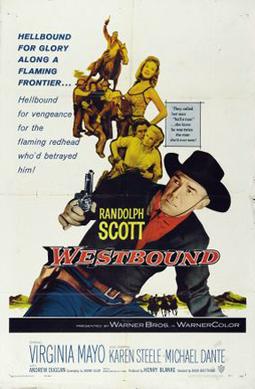
Westbound

Well, I did it. It may have taken me years, but I finally did it! Thanks to a recent airing on Turner Classic Movies (my go-to movie station), I was able to finally watch the only Budd Boetticher-Randolph Scott pairing I had not seen. That entry? From 1959, Westbound, actually the sixth of seven films the director and star worked together on. Where does it end up among the seven? Read on and find out!

It's late in the Civil War as the Union and Confederacy continue the bloody fighting, both sides looking for more gold to bankroll all the fighting. One of the keys? Getting that gold from California across the southwest to safety so it can be deposited in banks and mints. In steps John Hayes (Scott), an extremely capable Union cavalry officer who has a background in running a stagecoach line. He's now being sent to start up a line on the fly, one that will be running coaches full of gold being shipped as fast as humanly possible. The task is incredibly difficult, especially because Southerners in abundance are going to do their damnedest to stop him from succeeding. First up on that list is his former employee, Clay Putnam (Andrew Duggan), a Confederate sympathizer who's hijacked much of the already-established stage line. Into it all, Hayes steps in with little room for error and less time to get things right.

As a western fan, it is hard not to like these films, these seven pairings between Boetticher and Scott. Their reputation has grown over the years -- thankfully! -- to the point that western fans look to these films as some of the best of the genre, a canon to be recognized. Where does 'Westbound' fall? Right in the middle. I liked it a lot, but I can't put it on the same level as 7 Men from Now and Ride Lonesome, my two favorites of the bunch. It's better too than Decision at Sundown and Buchanan Rides Alone, putting it instead among Comanche Station and The Tall T as the 'good, but not great' entries. None of them are bad, just some better than others. 'Westbound' is one that grew on me during its 72-minute running time. Something clicked in about the 25-minute mark or so, and I was hooked.

I've made no bones about my dislike and worry over so many heavy, overdone adult westerns from the 1950's. The drama, the emotion, the betrayals, it was all laid on so thick. One of many beauties of the Boetticher/Scott films is their outlook on the west. There was good, bad and those caught in the middle, those who have to decide to do what's right (and possibly dangerous) or just go along with the easy payday, what's easy. Among westerns -- and films, stories in general -- there's nothing more direct than good vs. evil. Where will everyone fall in the end? Boetticher follows the similar formula, the same archetypes and at just 72-minutes, 'Westbound' is a fast-moving, often dark, adult western that flies by. An excellent, underrated final product.

Leading the way and navigating through the good and bad is star Randolph Scott, an ideal lead for these movies, a necessary front man. Movie-in and movie-out, Scott was what these movies needed. His John Hayes is no different, resolute in getting the job done no matter what odds are stacked against him. He doesn't see black or white or shades of grey. Hayes sees what is right and intends to get the job done. There's never a doubt of his intentions. These aren't anti-heroes, but instead, a last wave of true western heroes. Scott throws himself into those parts with abandon. He's believable. You buy it that he will never take the easy way out. But you ask, even when a lost love (Virginia Mayo) is waiting there to be swept away? NO! Our hero wouldn't dream of it! What about a lovely young bride (Karen Steele) who he's clearly attracted to? Double NO! It just ain't gonna happen, a true western hero, a dying breed by 1959 in the genre.

There's some good parts all around in this Boetticher western. I liked Duggan a lot as Putnam, the Confederate sympathizer determined to stop Hayes but even he has limits. His enforcer, Mace (Michael Pate), has no such limits, providing some tense moments as their plan is put into action. Mayo is Putnam's wife, a woman torn by her past feelings of Scott's Hayes and her genuine feelings for her current husband. Steele is a bright spot also as Jeanie Miller, a young bride to Rod (Michael Dante), a Union soldier who lost an arm in the fighting and was sent home. There's an interesting dynamic among Hayes, Jeanie and Rod as the stage plan comes together that takes some surprising turns as the story develops. Wally Brown provides some comic relief as Stubbs, the stagecoach driver, with John Daheim memorable as the sneering henchman of Mace's...Russ.

Nothing flashy, nothing too out of the ordinary. It wouldn't fit with Boetticher's straightforward, no-nonsense smile. This is a western at its finest with a story that doesn't pull any punches, a hero who it's easy to root for, villains you can't wait to see get their due, and all of it wrapped tightly in a nice 72-minute package. If you're a fan of the other Boetticher/Scott pairings, you'll definitely enjoy this one too.

Westbound (1959): ***/****

Tuesday, March 17, 2015

Thunder Over the Plains

Ever heard of a carpetbagger? It is a particularly nasty piece of American history. Following the Civil War, they were northerners who moved into the south looking to make a profit off the Reconstruction Era. You see them briefly in Gone With the Wind, even a John Wayne western like The Undefeated, but because it was such a despicable profession of sorts...well, we're not going to see a whole lot of movies about them. When we do, like 1953's Thunder Over the Plains, they're the easiest of villains to root against.

It's 1869, some four years removed from the end of the Civil War, and the wounds are still fresh from the war. Texas has not yet been readmitted to the Union as a state with tensions high as carpetbaggers ravage the Texans trying to get back on their feet with corruption and high taxes. A Robin Hood-like bandit, Ben Westman (Charles McGraw), has stepped forward and with a small, loyal gang wreaks havoc on the carpetbaggers' efforts to earn their ill-got profits. A Texan who fought on the Union side and remains in the cavalry, Capt. David Porter (Randolph Scott) finds himself in a sticky situation. He tends to agree with Westman's actions, but he's honor-bound by duty to try and bring Westman to justice. All sides are pulling at the captain, both inward and outward, as he deals with pressure from his own commander, his wife, his fellow officers and the $-for-eyes carpetbaggers.

By the 1950s, star Randolph Scott was doing westerns exclusively. From 1945 on, Scott only made two non-western films. Think about that. This was a man who knew what he wanted, what he liked doing at work, and what audiences wanted to see him do. John Wayne would take a similar approach in the latter stages of his legendary career. The issue becomes that other than Scott's pairings with director Budd Boetticher (7 different films) and later Sam Peckinpah (Ride the High Country), his 1950s westerns are typically okay at best and dull and far too familiar at worst. Unfortunately, 'Thunder' falls into that category. While it has some potential and Scott is reliable as ever, it's just missing that special something and ends up going off the rails near the halfway point.

That ends up being the most frustrating part in this western from director Andre de Toth. 'Thunder' has a ton of potential. For a 1953 western, it's surprisingly dark. The post-Civil War setting in Texas during Reconstruction isn't exactly commonplace in the genre. There is a variety of characters with some great heroes and equally awful villains. But in a movie that runs just 82 minutes, it can't sustain that energy. The story begins to meander near the 45-minute mark and limps to the finish. One pretty major subplot isn't even addressed or given a worthwhile resolution....so yeah, that kinda sucks. Everything gets all jumbled together with too many characters and twists and secondary plots, and the ship never rights itself. A western that could have been pretty good ends up being disappointing and below average.

So while I'm not a huge fan of Randolph Scott's western, I am a big fan of Scott himself. This is a part he specialized in, the resolute, loyal and tough as nails western hero who's going to do what's right no matter what it takes. A sheriff, a cavalry officer, a drifter, he played tweak versions on this throughout the last 17 years of his career and did it well. He's undone by a script that has his Capt. Porter simply trying to keep too many plates spinning. At home, his wife (Phyllis Kirk) incessantly talks about leaving for a different post. At the fort, his friend and commander (Henry Hull) nags and nags without actually offering any help. As well, a new officer arrives in the form of Capt. Bill Hodges (Lex Barker), who resents the posting, isn't too partial about using his new silver pistol and has his eyes set on Mrs. Porter.  It's not Scott's fault. All the way, he's going for it. A true pro even in one of his lesser efforts.

Who else to look for? Buried deep in the credits are Hugh Sanders and Elisha Cook Jr. as the corrupt carpetbagger and the the equally corrupt tax commissioner sticking it to recovering Texas. In the familiar face department, look for Lane Chandler, James Brown and a very young Fess Parker in supporting roles.

I wish I liked this one more. Scott is excellent, and McGraw's Ben Westman is a very cool character that is underutilized. I would have loved to see a movie that focused far more on those two characters and their very interesting dynamic. As is, 'Thunder' disappoints. It has potential, but it never delivers unfortunately.

Thunder Over the Plains (1953): **/****

Wednesday, April 24, 2013

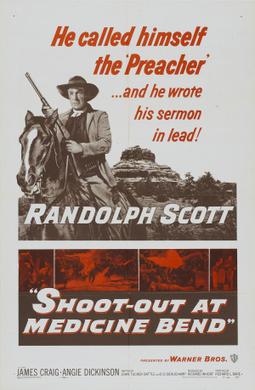
Shoot-Out at Medicine Bend

Between 1956 and 1960, star Randolph Scott and director Budd Boetticher teamed up for seven westerns that rose above their B-status to become classic, even iconic status. One of the more prolific actors of his era though, Scott was far from limited to just those seven movies. Over that span, Scott made three other westerns, including 1957's Shoot-Out at Medicine Bend.

Mustered out of the cavalry after serving for multiple years, Capt. Buck Devlin (Scott) has plans to join his brother and family at their ranch in a quickly developing area with acres and acres of available land. Along with him are two of his soldiers he's become good friends with, Sgt. John Maitland (James Garner) and Pvt. Will Clegg (Gordon Jones). The trio arrives in time to help fight off an Indian attack, finding Buck's brother killed because faulty ammunition prevented his rifle from firing. Looking for answers and revenge -- while also gaining supplies for other local farmers/ranchers similarly supplied with bad ammo -- Buck, Maitland and Clegg head to the nearby town of Medicine Bend. It doesn't take them long to figure out who's behind the ammunition, a powerful businessman with his hand in everything in town, Ep Clark (James Craig). Knowing his guilt is one thing, and proving it is another. How can the trio bring Clark to justice in a town where he controls everything?

I found this B-western on Encore Westerns and because of the cast I decided to give it a chance. Just recently I reviewed The Proud Ones, a very entertaining, well-made 1950s western that rose above some of its limitations. It was an adult 1950s western, one revolving around actual relationships, betrayals and greed. 'Shoot-Out' is basically the complete polar opposite. It has the look of a glorified television show, using several sets that any fans of 1950s TV westerns will no doubt recognize. The story starts off interestingly enough with Scott and Co. riding into an Apache attack and saving the day. They undertake a mission to help the local ranchers and farmers, and I'm thinking we're off to a good start. It goes downhill from there, and quickly.

There is an obvious potential with the story for a fairly dark western. A businessman so intent on making money he sells bullets filled mostly with coal dust instead of gunpowder? That's pretty gnarly if you ask me. His henchmen intimidate other shopkeepers into raising prices -- or just not selling at all -- so locals are forced to buy his merchandise. That's all good and nice, but even that aspect is botched here. The tone in this western from director Richard L. Bare is....wishy-washy to say the least. After Buck's brother is killed and they begin their rescue, we're treated to a scene where the very nude trio has their clothes stolen. They're left to approach a Quaker wagon train wearing whatever they find to cover themselves. Oh the hijinks! The story movies back and forth among dark, very serious and funny, goofy and stupid. I don't know if either option would have made a good (or watchable) western, but it couldn't have hurt. Instead, the mix ends up being pretty lousy.

I managed to stick with it though because of the casting. Mr. Western, Scott is decent in the lead, but he's not given much to do. Maybe it's just because his pairings with Boetticher were so significantly better than this one, but it's not one I'd really recommend for fans. Playing his bumbling partners -- and reminding me of a bad 1930s buddy serial -- Garner is the ladies man and Jones is the stupid, booze hound who always gets the group into trouble. Craig is a decent, sneering villain, obsessed with gaining more power. In the 'Hey, they're good-looking, let's keep watching department, Angie Dickinson (just 26 years old) plays Priscilla, the daughter of a rival shopkeeper of Clark, and Dani Crayne as Nell Garrison, a saloon/dance hall singer and dancer. Even the lousiest of B-westerns apparently need some forced, not believable love interests.

Not much else to say here so let's keep this one short. It's dull and has no real point. Basically, it's worthwhile because Scott is always watchable -- even in badness -- and for fans to look for early appearances from future stars James Garner and Angie Dickinson.

Shoot-Out at Medicine Bend (1957): * 1/2 /****

Tuesday, June 26, 2012

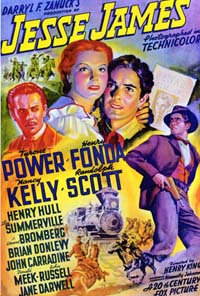
Jesse James

Thanks to films, television shows, dime novels, and with some time gone past, we can now look back at historical figures with rose-tinted glasses. Nowhere is that more evident than with wild west gunslingers, cowboys and outlaws. Some truly bad dudes have been remembered fondly, even as anti-heroes. One that always comes to mind for me is Jesse James, a Confederate guerrilla turned bank robber. He gets the whitewashed hero treatment in 1939's Jesse James.

Helping run the family farm with his mother (Jane Darwell), young Jesse James (Tyrone Power) works with his brother, Frank (Henry Fonda), to create a pleasant life for the family. Their country life is shattered as the railroad moves west, railroad agents ramrodding families off their land. An accident causes the death of the James' boys mother, forcing Jesse and Frank to seek revenge. With rewards posted for their arrest or death, Jesse and Frank are forced into a life of crime, robbing trains and banks as they're on the run. Jesse wants more revenge though, his name growing ever more well known.

Depending on the source, Jesse James is looked at as a heroic rebel, an intelligent bandit, a disturbed thief, and any number of options that fall somewhere in between. From director Henry King, this 1939 western goes an odd route. It makes Jesse a pretty straight hero, not even an anti-hero. We're not talking Butch and Sundance treatment -- it's too blase for that -- but it's approaching that territory. The history is condensed, tweaked and twisted from the start. Yes, it is based in the truth (or at least part of it), but then starts going off route quickly. Powers' Jesse isn't infallible, he's no immaculate hero. Still, it doesn't ring true. Railroad? Uber bad. Bandit? Bad....but he's fighting for his deceased mother.

A star of the 1930s and 1940s, Powers was quite the actor over a career that was cut short by his death in 1957 at the age of 44. I've never seen many of his movies, but he was always a likable enough actor. I came away less than impressed with this effort as the infamous, iconic western bandit, Jesse James. Only part of the blame can be chalked up to him. Even as Jesse's fame rises, we're still seeing him as pretty squeaky clean. Some characters flaws couldn't have hurt. Good or bad though, it just isn't that interesting of a part, and that's saying something. It's Jesse James! How could that not be interesting? It doesn't help the cause that much of the already condensed story is spent on Jesse's developing/loving relationship with Zee (Nancy Kelly), a young woman he's known since they were kids. Yeah! Love story about an outlaw!

Unfortunately for the rest of the cast, what's worth mentioning is that the cast is misused and underused. In a criminally underused part, Fonda is a huge bright spot as Jesse's older brother, Frank. This lanky, laconic, confident young man is a scene-stealer, especially his intro. Still a rising star, Randolph Scott is wasted too as Marshal Will Wright, a peace officer divided between his respect for Jesse and his call to duty. Thankfully, a love triangle isn't a focus of the story among Will, Jesse and Zee. Henry Hull hams it up like a crazy man as drunken newspaperman Rufus Cobb, Zee's uncle. Brian Donlevy has a great part as a sneering, vicious railroad agent who meets Jesse's wrath while John Carradine has a smallish part as Bob Ford, a possibly treacherous member of the James gang. Some interesting characters, just could have used more of them on-screen.

The movie is good and bad -- ridiculous history aside. It's a fondly remembered movie from one of the all-time great years in Hollywood history, 1939, so it does something right. There's some impressive scale, some great tracking shots full of hundreds of extras, one especially of Jesse (a stunt double at least) running across the top of a speeding train. It's a beautiful movie, and some scenes truly stand out, like the botched Northfield robbery and a subsequent chase. At just 106 minutes though, some 16 years of history is condensed into a rushed story. Maybe a rewatch would help, but for now, my first impression was pretty lukewarm. Some parts definitely work, but not on the whole.

Jesse James <---Youtube clip (1939): **/****

Sunday, March 18, 2012

The Stranger Wore a Gun

While many movies in the 1950s tried to offer something that television simply couldn't match, many westerns dug their heels in and refused to change/adjust. The result? A lot of straightforward, traditional efforts that were like most westerns released over the previous 20-plus years. If you haven't figured it out, none of this is particularly positive, like 1953's The Stranger Wore a Gun, a B-western in every regard.

After the bloody raid on Lawrence, Kansas by William Quantrill, Confederate rider Jeff Travis (Randolph Scott) leaves Quantrill's raiders and heads west. But even after the end of the Civil War, the memory persists in his head, and more importantly, so does the stigma of being one of Quantrill's guerrilla riders. Wanted for a murder he didn't commit, Travis heads to Prescott, Arizona on the advice of long-time friend, Josie (Claire Trevor). He finds a job with a former Confederate soldier who wants the Confederacy to live on, Jules Mourret (George Macready), but finds out quickly that Jules is willing to go to some dark places to accomplish his goal. For Travis though, it could be too late to make a change.

With so many 1950s westerns, I feel like my reviews lean toward cookie-cutter. They're the same thing over and over again, just changing the names and places. Like so many 1950s westerns, 'Stranger' has its good and bad, but the biggest thing is that nothing at all is particularly memorable. Director Andre De Toth goes about his job with workmanlike precision, telling a familiar story that doesn't throw anything new at the viewer. The stories are forgettable, the characters interchangeable, and if you've got more than two or three functioning brain cells, you know how it's going to end before it started. Some of the California locations look very nice here, but it does absolutely nothing to distinguish it from the thousands of other westerns you could watch. Not bad, not good, and not memorable in the least.

Starring in many of these westerns was Randolph Scott, a stout, resolute western hero in that second rung of western stars. His biggest problem? Unless he was working with directors like Budd Boetticher and Sam Peckinpah, his typically solid lead parts were lost in a sea of bad B-movies. Playing Jeff Travis, he's one of the better things going for 'Stranger.' His motivations aren't always explained -- he's running from his Confederate past by working for a Confederate trying to revive the Confederacy?....right -- but in a sea of mediocrity, his performance stands out. Trevor does what she does best, playing the damaged society woman, Macready is an average at best villain, and Joan Weldon plays a wooden requisite pretty girl (another trademark of a low budget 1950s western) that Scott's Travis must decide if he really loves, with Pierre Watkin playing her father.

Enough beating around the bush, let's get to some negatives! Anyone who's seen Treasure of the Sierra Madre is familiar with the infamous 'We don't need no stinking badges!' line delivered by bandit chief Rodolfo Bedoya. Instead of one well-handled scene, he gets a much bigger role here with a similar character, the stereotypes amped up....a lot. His "portrayal" of Degas, a Mexican bandit and gang leader, is laughable and painful to watch. He laughs hysterically for no apparent reason at least three different times, and speaks in an odd variation of Spanglish. His sidekick, Shorty (Joseph Vitale), is just as bad, speaking in halted, quasi-threatening tones. Way, way too much of a good thing here. Also worth mentioning -- I suppose -- is the 3-D filming technique. We get guns "fired at" the camera, not to mention torches, punches, vases, you name it, thrown at us. Oooohhhh, startling! There's also a bizarre technique where rocks/brush are placed in front of stock footage, apparently to make it look more realistic? I guess. I can't come up with anything else. It's bad. That's what I'm going for.

One positive -- however small -- with many of these 1950s westerns is that future stars who shot to fame in the 1960s got their start with supporting roles. Here in 'Stranger' there's Lee Marvin and Ernest Borgnine as Kurth and Slager, two of Jules' henchmen. Hindsight is 20-20, but it's clear the talent they're working with even in supporting roles. Not a ton to recommend overall, and maybe I'm reaching for straws, but something's got to get you through these B-movies.

The Stranger Wore a Gun <---TCM trailer (1958): **/****

Monday, May 23, 2011

Captain Kidd

The name is synonymous with the idea of a pirate, Captain William Kidd, a supposed pirate tried, sentenced and executed in 1701 for his actions as a pirate on the high seas. Historians debate now whether Kidd was in fact a pirate because much of his actions seemed to correspond more with the idea of a privateer, not a pirate. Nonetheless, his name still conjures up stereotypical pirates with eye patches and parrots on their shoulders. Released in 1945, Captain Kidd is anything but historically accurate no matter who or what the real-life Kidd was like. It's a Hollywood take on his "pirating" years, historical accuracy be damned.

Right in the middle of Hollywood's Golden Era, Captain Kidd was released when high seas adventures were at their most popular. Swashbuckling adventures starring Errol Flynn always went over well with audiences, and the appeal is clear when watching films like these. Traveling across thousands of miles of open water on tall ships does have an air of romanticism even though the life had nothing romantic or glamorous about it. Idealized is a good way to describe the life of a sailor on these ships, but it can be fun just to imagine what the life was like. In this case, Kidd is a very smart, very devious captain, always looking for a way to become rich himself, making promises to anyone who will listen only to turn on them the first chance he gets. Sounds like a good guy, doesn't he?

After looting an English ship off Madagascar, Captain William Kidd (Charles Laughton) and three officers (John Carradine, Gilbert Roland, and Sheldon Leonard) bury piles of treasure taken from the ship. They return to London, no one the wiser of what they've just done. Ever the convincing sort, Kidd manages to acquire a contract as an escort of an English ship traveling from India back to London by way of Madagascar. With a crew of pardoned convicts, Kidd's ship heads south around South Africa looking to meet their future target. Kidd has some ulterior motives though, starting with killing off his three officers who also know the location of the buried treasure. He's suspicious though of one of the crew, Adam Mercy (Randolph Scott), who he believes to be a spy placed on board by the English king to keep an eye on things. What are Mercy's intentions, and what exactly is he up to?

Laughton was no stranger himself to movies on the high seas, starring in 1935's Mutiny on the Bounty as the evil Captain Bligh, pushing his crew to a mutiny. In that role, he plays straight evil, a captain with a mean streak down his back like no other. Playing another historical figure here, Laughton gets to have a little more fun with the part. There's no doubt Kidd is the villain. That's not in questions. He connives and backstabs, betrays and lies, doing anything he can to kill off his rivals for the treasure. But in a weird way, he's got this odd ability to be charming in doing it. Granted, you know nothing good will come of anything he does, but he's able to disarm worries almost at will, an ability that certainly comes in handy when eveyrone around him is suspicious of him.

Above all else, Laughton's performance as Captain William Kidd is the best thing the movie has going for it. Bringing that charm to the character, Laughton makes every scene interesting. He is always up to something and then retreats to his cabin where he keeps a list of all his intended targets. When he does start knocking them off, he slowly draws a line through their name, an evil smile ever present on his face. It also doesn't hurt that Laughton's physical appearance throws you off. He's short and chubby, disheveled hair on his head. He doesn't look evil or even particularly bad. That's the fun though, a villain with a sense of humor, that ever-present mean streak, and a sense of paranoia when things start to go against him.

Looking surprisingly young for someone who was 47 years old at the time, Randolph Scott plays...well, Randolph Scott. His Adam Mercy character delivers a good twist about three-quarters of the way into the movie, but not the one you would think or have been led to believe. He's the strong-willed, silent but very capable character who in a lot of movies would have been the lead. Instead, he gets overshadowed by Laughton's performance. Still, it's Randolph Scott, and he's still cool. Carradine and Roland are unfortunately underused, but just by being there, the story is enhanced. I think Carradine always played the bad guy, and Roland gets a crack at his familiar Latin lover part. Throwing in a love interest, Barbara Britton plays Lady Anne, a woman brought on-board who Scott's Mercy looks out for.

Not as well known as so many other entries, Captain Kidd has lapsed into the public domain over the years. What's that mean? No studio holds rights on the movie so anyone who wants to can distribute the film in any form they so choose. Because of this, the prints aren't going to be that good with a grainy, washed out look. Individual shots are different shades of black and white, one scene much too dark and grainy, the next too bright where things are hard to make out. It's not a deal-breaker, but you can't help but notice it as you watch the movie. All complaints aside though, I liked this movie a lot, thanks in great part to Charles Laughton as the titular character, Captain Kidd. The movie would be just okay without him, but as is, it's moved up a notch. You can watch it at Youtube HERE.

Captain Kidd <---TCM clips (1945): ***/****

Wednesday, March 16, 2011

The Desperadoes

One of my biggest pet peeves with westerns is female characters added to the story for the sake of having a female character.  Beyond just being eye candy and something nice to look at (I didn't intend that as sexist as it sounds), the character serves no real purpose. Yes, they might provide a secondary storyline that has them falling for one of the heroes, but generally, they are there to be saved, the damsel in distress.  One of the few actresses to make a positive impression in a western for me is Claire Trevor. She's beautiful but tough and always held her own with the guys.

Unfortunately the timing of me watching 1943's The Desperadoes wasn't that great with Trevor playing a key supporting role. The casting isn't the question, and the western itself isn't that bad.  Basically though, it just has too many similarities with 1941's Texas which I reviewed yesterday.  I felt like I was watching the same movie for a second time.  Similar cast, similar backstory, and overall a feeling of been there, done that. It's not awful by any means, but it's not that good either.

It's 1863 in Red Valley, Utah when the bank is robbed by a gang that murders three people in the process.  The bank owner, Clanton (Porter Hall) and the local mailman, Uncle Willie (Edgar Buchanan), pulled an inside job, netting almost $80,000 in the process.  The plan though was altered because the man originally hired to do it, Cheyenne Rogers (Glenn Ford), couldn't make it in time.  Now, he's arrived in town only to find that an old friend is the town sheriff, Steve Upton (Randolph Scott), is searching for the actual robbers. Worried that they will be exposed for stealing money from the townspeople, Clanton and Willie go about setting up another plan that will pit Cheyenne against Steve in hopes of covering up everything.

It is the rare western I won't be able to find something to recommend.  Some are just harder than others finding that positive aspect.  The Desperadoes is somewhere in between.  Ford and Scott working together is a pleasure to watch even if the script puts them in the stupidest, most implausible situations around.  This was Columbia Pictures' first color feature, and it looks great with the Utah locations really coming to life.  Trevor does what she does best, the somewhat scandalized woman (think a higher class Dallas from Stagecoach) caught in a tricky situation.  Her character isn't essential to the story, but she makes her presence known immediately. Her scenes with Ford and Guinn Williams are a high point, the few scenes that use both drama and comedy effectively.

As I watched this movie, I thought of another pet peeve that isn't exclusive to westerns.  It's just laziness on the part of someone involved in the production whether that be the screenwriter, the producer or the director.  A title card introduces the situation, explaining that 1863 Utah is struggling with little money available in the territory. For some reason, the setting is key, but I can't figure out why. If it's 1863, why is the Union army driving a herd of horses west away from the fighting with the Confederacy? Wouldn't it make sense to go the other way?  Then later, a character says a horse stampede will make this town feel like Custer's Last Stand.  So a throwaway line ends up predicting the future? If it is 1863, why is this town yokel aware that Custer is going to be massacred some 13 years later? Yes, these are little things, but they're all something that easily could have been fixed. Make a movie, and make sure you get the details right. Lazy when it comes to spending millions of dollars is inexcusable.

Maybe I've just been ruined by the cynicism of spaghetti westerns and American westerns from the 1960s, but westerns from the 1930s and 1940s drive me nuts more and more of late.  They walk that middle line that tries to please everyone.  Comedy, drama, and romance are all there.  Ford and Scott vie for the affections of Buchanan's daughter, Allison (Evelyn Keyes), always keeping it fair with an 'Aw, shucks, you take her!' mentality. Williams is painful to watch as dimwitted sidekick Nitro, the attempts at humor falling far short of succeeding. Then there's the story with Ford's Cheyenne wanted with a $10,000 bounty on his head.  We never find out what he did, but he's wanted nonetheless.  Scott's sheriff seems less than interested that his old friend may be a crook so I guess we're supposed to look past it in the end too.

Not much else to say here.  The story winds around a lot without ever getting anyplace interesting.  The talent of Scott, Trevor, and Ford only takes the movie so far.  I've seen much, much worse westerns, but I can't give this a positive review. It's just not good enough.

The Desperadoes (1943): **/****

Monday, July 19, 2010

Ride Lonesome

Last fall I reviewed a western from director Budd Boetticher, Buchanan Rides Alone, one of seven pairings with star Randolph Scott.  'Buchanan' was one of the two I hadn't seen prior, and I enjoyed it, if not as much as the other pairings.  Everyone has their favorites, but one always stood out from the others for me, 1959's Ride Lonesome, a western typical of the Boetticher/Scott pairings.

These were B-westerns, but in the most positive sense of what a B-movie can be when handled the right way.  Almost criminal in their simplicity, these are must-see westerns for fans of the genre.  'Ride' has all the necessary elements; a tough, veteran cast, scenic Western locations, and a solid if unspectacular story that almost always features a twist or two.  I won't say the films are a romantic portrayal of the old west, but at times it sure feels like it.  Instead they followed a trend in the 1950s of more adult westerns, including a string of Anthony Mann and James Stewart westerns that are some of the best the genre has ever produced.

A former lawman turned bounty hunter, Ben Brigade (Scott) captures young outlaw Billy Joe (James Best), wanted for murder in Santa Cruz.  Stopping over at a stagecoach station, Brigade runs into two men who tread that fine line on either side of the law, Boone (Pernell Roberts) and Whit (James Coburn). Anyone who brings Billy in earns an amnesty for past actions, and Boone and Whit intend to collect.  Along for the ride is Carrie Lane (Karen Steele), the recent widow of the stagecoach station's owner. Brigade doesn't plan on giving his prisoner over to Boone and Whit, but he knows trouble is following them and he'll need their help.  Wearing out horses behind them, Billy's brother Frank (Lee Van Cleef) and his gang are hot on their trail. 

There are typically three different variations of characters in a Boetticher western -- four if you count the damsel in distress.  There's the good, the bad and the yet to be determined.  Scott always play the good, if a somewhat tortured good.  The bad is the straight villain with no basically no chance of survival (sorry Lee).  And third and the most fun is the yet to be determined, played here by Roberts and Coburn.  These are the characters you're not quite sure which way they'll go.  Will they turn on the good guy Scott or stay on the righteous path?  It depends on the movie which way they turn, but there's always that sense of mystery.  It's also the meatier, more showy character to have, but more on that later.

As the steely-eyed, tortured good guy, Scott has about 20 lines to say in the whole movie.  The thing is? He doesn't need to say more than that.  He's a man of few words with principles and beliefs he lives by, end result be damned.  Scott is going to do the right thing no matter the cost.  His Brigade has a past incident haunting him -- as most of his characters did in the Boetticher westerns -- and he will right a wrong whether you want him to or not.  The more showy character is Roberts playing Boone, an outlaw looking for a second chance.  He has this easy way about him that you can't help but like him, even if you're curious what he's really up to.  A real scene-stealing part.  Coburn in his first movie also shows some of the talent that would make him such a big star in the coming years.

On to the other elements, this one has the good and bad.  Karen Steele plays the eye of everyone's affection, the babely widowed station owner's wife.  Her platinum blonde hair and bras that could take an eye out look out of place, but her character is a whole lot tougher than most female characters in a western. Her looks sure don't hurt though.  Best isn't given much to do other than negotiate for his release, and Van Cleef only has two scenes where he actually talks.  For filming, Boetticher chose the California deserts and mountains, and along with cinematographer Charles Lawton Jr. turns in a gorgeous looking western that rivals some of John Ford's best in Monument Valley. The score by Heinz Roemheld is nothing special, but that's a minor complaint.

At just 73 minutes, there isn't a wasted moment or unnecessary scene anywhere to be found.  Some reviews call it a dull or slow-moving story, but the time flies by.  It isn't heavy on action if that's what you're looking for, instead building up to these quick outbursts of gunfire after long scenes of quiet.  The dialogue from screenwriter Burt Kennedy is top-notch and features some quotable western lines while also giving some inspirations for Sergio Leone and the Dollars trilogy.  It is available to watch through Youtube (here's Part 1), but it's in pan-n-scan.  If you can find a widescreen version, I'd recommend watching that one. 

Ride Lonesome <----TCM trailer (1959): *** 1/2 /****

Sunday, October 4, 2009

Hangman's Knot

By now I've made my enjoyment of historical movies pretty well known, and I'm not too picky. I'll watch just about anything. So how about some more movies about the Civil War? I understand producing a movie with thousands of extras like Gettysburg or Gods and Generals can be expensive, but hey, it's not my money now, is it? Just like I wrote about the lack of Revolutionary War movies, there's a ton of stories out there. It's just a matter of fleshing them out.

Westerns have tried to incorporate the Civil War into many different types of story, but most often as a jumping off point. In John Wayne's 1968 western The Undefeated, the war between the states serves as a jumping off point for the rest of the movie. Beginning a story amid the bloodiest war the U.S. has ever seen sets the tone right away and is a formula that's been used by many similar movies, including 1952's Hangman's Knot.

Led by Major Matt Stewart (Randolph Scott), an eight-man squad from the Army of Northern Virginia is sent west to Nevada to rob and take a Union gold shipment of over a quarter of a million dollars to help aid the Confederate war effort. The ambush works as Stewart and his men get the gold, but at a heavy cost as three of the men are killed. But meeting up with their commanding officer (Glenn Langan), the survivors find out the war is over. Even though their actions were those of soldiers doing their duty, others look at them as outlaws who massacred a Union cavalry squad.

With posses closing in all around them, including one particulary nasty bunch of drifters (led by Ray Teal and Guinn 'Big Boy' Williams) not looking to bring them to justice but to get their hands on the gold, Stewart and his men take over a stagecoach carrying two passengers, Lee Kemper (Richard Denning), a contractor for the Union army and Molly Hull (Donna Reed), a nurse traveling west. They make it to a stagecoach station with the posse close behind and prepare for a siege. The setting of the end of the Civil War open up the door for any number of story possibilities and provides a strong jumping off point for the story.

The robbery of a gold shipment seems simple enough a story for a western, but very little is black and white here. 'Knot' serves up conflict between just about every character. The posse is ready to turn on each other if it helps them get the gold, and they don't care who gets in their way, innocent or enemy. Inside the stagecoach station, Stewart also has to worry about one of his men, Rolf (Lee Marvin in tough guy psycho mode), killing them all and raping Molly. With so much conflict, the actual violence is left until the end mostly as a flashstorm descends on the station in a great, moody shootout. The gunplay is ahead of its time in its presentation as squibs are used and blood is visible when a character is shot, not just a clutch at an arm or leg.

As I've called him before, Randolph Scott is John Wayne-lite in many ways. A great western star, Scott is not necessarily a hugely well-known actor mostly because he made a career out of above average B-westerns, not epic classic westerns. He has an easygoing natural delivery that makes him likable from the get-go. His squad includes Marvin before he became a huge star, Claude Jarman JR as young Jamie, an inexperienced soldier who's family was killed during Sherman's march, and Frank Faylen as Cass, the quick with a one-liner soldier who's equally good with a gun, and John Call as Egan, the quiet one who just wants to get home to his wife. Denning is good as the sniveling, conniving weakling, and Reed makes the most of the damsel in distress part.

While 'Knot' isn't a classic or even a well-known western, I really enjoyed this one. It tries things that other westerns wouldn't do for another 10 years or so. The Civil War was a tragic time in U.S. history, and the story shows that. The stagecoach station owner (Clem Bevans) and his daughter-in-law (Jeanette Nolan) have a hatred of Stewart's Confederates that isn't easily forgotten as they're held prisoner. And that's the whole movie; greed, killing, and betrayals run rampant in this little-known western. It has been released on DVD, but also keep your eye out for it on the TCM schedule.

Hangman's Knot (1952): ***/****

Friday, July 3, 2009

Buchanan Rides Alone

When many people think of classic teamings between director and star in westerns, John Ford and John Wayne come to mind and for good reason. The duo made a handful of classic westerns that make many top 10 lists of all-time best westerns. One duo though that's been overshadowed over the years and has recently become more respected and held in high regard was the teaming between Randolph Scott and director Budd Boetticher.

A veteran of Hollywood movies since the late 1920s, Scott made a decision in the last half of the 1940s to only make westerns the rest of his career. Many of the movies he would then make were average, many of them B-westerns that have long since been forgotten. But teaming with Boetticher, Scott made a string of what are now considered cult classic westerns, six movies that last year were packaged in a long overdue DVD box set. Check that, five of the movies are in the set, Seven Men from Now is available separately.

These westerns are really just B-movies when comparing them to other westerns of the time like The Searchers or Shane. None are longer than 80 minutes and all of them are content to tell a simple, straightforward story. The main character in each of them, Scott in all 6, typically has a checkered past in one way or another and has to redeem himself in some way. While Scott was one of the first anti-heroes, the bad guys walked that fine line between good and bad, often working with Scott's character all the while building to a showdown. They're good old-fashioned movies, much like John Wayne's westerns, where you can just sit back and enjoy.

Having seen five of the six Scott/Boetticher westerns, I was happy to see Buchanan Rides Alone, the one I haven't seen, on TCM's schedule last week. It took me awhile to sit down and watch it, but it was worth the wait to say I've seen all six. Scott plays Tom Buchanan, a former mercenary coming back from fighting in the Mexican Revolution. He's got a pocketful of cash and is ready to start his spread up in west Texas. On the ride home, he's stopped in a dusty California town of Agry and quickly finds himself in a mess of a situation.

The man in charge in town, Simon Agry (Tol Avery), runs everything from the shops to the newspaper to the saloon and for good measure, his brother Lew (Barry Kelley) is the sheriff. Scott is having a drink at the saloon when a vaquero, Juan de la Vegas (Manuel Rojas), enters and promptly shoots Roy Agry, Simon's hot-headed son. We learn later Roy hit and possibly abused Juan's girlfriend. The townspeople jump to conclusions and think Buchanan was tied up in the shooting. Just wanting to start his life over in Texas, Buchanan now must fight his way out of one more brewing shootout.

What's notable from many Boetticher westerns was the director's ability to cast rising stars in a supporting role. As good as Scott is in these movies, it's often these actors who steal the scenes they're in. What's missing from 'Buchanan' is that great supporting cast. L.Q. Jones definitely qualifies as Pecos, another west Texas cowboy who sides with Buchanan, a role perfectly suited to the likable, drawling character actor. But other than Jones, no one jumps out or makes much of an impression. Craig Stevens plays Carbo, apparently Simon's right-hand man but he's never really explained so I could be wrong.

I'll always prefer wide-open wilderness westerns that town-based westerns, but this one at least takes advantage of shooting in a town. Filmed in Old Tucson, maybe most recognizably known from Rio Bravo, Agry feels like a real western town instead of shooting on a backlot in Hollywood. But other things don't work, especially some attempts at humor with Amos Agry (Peter Whitney), the somewhat slow-witted Agry brother who is always frantically running around town bringing news of developments at the jail or the ranch.

The final shootout could have been a good one, but parts of it were just too ridiculous. A saddlebag holding $50,000 lies on a dusty bridge with the two opposite groups on either side. When cowboys go running after it, they do just that...run. For goodness sake, crouch down and make your way out there. Other than the showdown at the end, Boetticher doesn't have much action here, but at just 78 minutes, the movie's always moving along at a good pace so you shouldn't be bored.

So while not as good as Ride Lonesome or Seven Men From Now, Buchanan Rides Alone is still a worthy entry in the Scott/Boetticher pairing. If you're looking to see these movies, they're available as a set at Amazon or any number of vendors (I included the link earlier) or rent them through Netflix. They may not be as known or even respected as many other westerns from the 50s, but they deserve to be listed with the classics like The Searchers and Shane. Here's a trailer and a 9-minute interview with filmmaker Taylor Hackford about 'Buchanan.'