Well, it's that time of the year again. Time for Alamo and Texas independence-themed reviews! Today's entry is a 1994 TV movie that aired over two nights. I remember watching it, just in that fun stage as I was really getting into history for the first time. Loved it then, liked it years later when I re-visited it, and here we sit, watching it some 21 years since I first watched it. Now I'm 29 and have everything figured out. Right? Right?!? Here's 1994's Texas.
It's 1821 and Stephen F. Austin (Patrick Duffy) is leading several hundred American settlers into the Mexican province of Texas. The settlers will help tame this wild territory that is as wild as they come, all the while doing so as Mexican citizens. The years pass though and tensions begin to rise between the Mexican government down in Mexico City and the ever-increasing number of Americans flowing into the territory. Among the settlers are a widowed mother, Mattie (Chelsea Field), trying to create a new life, a Scottish farmer, MacNab (Daragh O'Malley), who's son, Otto (Rick Schroder), will play a huge role in Texas' future, and a Mexican landowner and vaquero, Benito Garza (Benjamin Bratt), who sees the trouble coming on the horizon. As the 1820s turn into the 1830s, the tensions heat up to the point where war looks more and more likely. The war for Texas Independence is fast approaching.
From the time I saw Disney's Davy Crockett and then John Wayne's The Alamo, I was immediately intrigued by the story of the Alamo. I still am. I'll read, watch, look into anything about the subject so growing up, this ABC miniseries was right up my alley. In the years, I expanded my horizons some to include the entire Texas Revolution. So where do we start? Nine-year old me wasn't quite so harsh on what he watched. 29-year old me? Eek. I still like it because of the subject matter, but my goodness, this miniseries just isn't very good. Sure, condensing 15 years of story into a 3-hour miniseries is a daunting task....but still. The miniseries is based off an immense, humongous, if you hit someone with it you'd knock them out book from author James Michener. Well worth checking out for a good read and a good workout.
The Texas Revolution packed a ton of action into about seven months, something History's Texas Rising will hopefully bring to life come Memorial Day. What do we get here? A love triangle between politically-minded Austin, independent Mattie and fiery Benito. For real? A love triangle? Gag me. That's the crux of the first half of the running time with a surprising payoff in the second half. Come on though, Texas history and we get two guys fighting over the same woman? The budget is somewhat limited, borrowing footage liberally from previous Alamo/Texas movies like 1955's The Last Command and another TV movie, Gone for Texas. I guess it shouldn't come as a surprise that a movie made 39 years before doesn't exactly fit in with a 1994 TV movie. The attempt and effort is impressive overall, but ultimately it falls short.
Going for that big miniseries feel, we get some familiar faces in the cast but no HUGE stars. Schroder, Bratt and Duffy are the most memorable characters, bringing them to life where others remain mostly cliches or cardboard cutouts of real individuals. The relationship between Schroeder's young Otto and Bratt's Benito is a high-point, a brotherly relationship developing between the American teenager and the Mexican cowboy. That relationship takes some surprising twists as the war approaches, the two men deciding what's most important to them. Duffy too is strong as Austin, the father of Texas who's left out of the history books far too often. Field's character is interesting but is handed no favors by the screenplay that has love tearing at her from both sides. Oh, the horror!
As far as instantly recognizable Texas personalities go, we also get to meet Stacy Keach as Sam Houston, sneering and growling throughout, and our Alamo trio of Jim Bowie (an excellent if somewhat over the top David Keith), William Travis (Grant Show), and Davy Crockett (John Schneider in a small part). I also liked country singer Randy Travis as Captain Sam Garner, a Texas Ranger commander, and Frederick Coffin as Zeve Campbell, a fellow settler and friend of MacNab's. Anthony Michael Hall feels out of place and forced as the cowardly, big-talking Yancey Quimper. There's also a small part for Maria Conchita Alonso. Oh, and someone named Charlton Heston -- whoever that is -- provides the narration.
While I was still entertained overall, that entertainment came as more of a guilty pleasure this time around. The music is okay, but overdone at times, and the acting ranges from good to acceptable to hysterically overdone. Without a doubt the second half is the stronger half as Texas is plunged into the revolution, but even that's limited. The entire Alamo battle sequence is lifted from Last Command, and the Battle of San Jacinto is about 15 minutes straight of slow motion, blood-squibbed garbage. Probably best suited for history, Texas and Alamo buffs.
Texas (1994): ** 1/2 /****
The Sons of Katie Elder

"First, we reunite, then find Ma and Pa's killer...then read some reviews."
Showing posts with label Stacy Keach. Show all posts
Showing posts with label Stacy Keach. Show all posts
Tuesday, March 3, 2015

Thursday, January 30, 2014
Nebraska

An old man in Billings, Montana who's health problems are starting to wear on him, his health, his mind and his family, Woody Grant (Bruce Dern) is on a mission. He's received notice in the mail that he's won $1 million dollars, and he intends to go pick it up....in Lincoln, Nebraska. Woody keeps leaving the house, beginning to walk to Lincoln, picked up every time and brought back home. His son, David (Will Forte), is going through his own personal struggles, at home and at work, a 30-something midlife crisis of sorts. With his mother, Kate (June Squibb), nagging him to do something, David agrees to take Woody on a road trip to Lincoln to "pick up his winnings," basically calling his mother's bluff. He isn't quite sure what to expect, only knowing that his aging father has become quite the handful to take care of. What does he hope to achieve, knowing there is no million dollar treasure at the end of the road?
From director Alexander Payne (The Descendants, Sideways, About Schmidt) and screenplay writer Bob Nelson, 'Nebraska' piled up the Oscar nominations, the Academy Awards about a month away, including Best Picture, Best Director, Best Screenplay, Best Actor and Best Supporting Actor. I'll be curious to see if this film picks up any wins because it definitely deserves the wins. This is a movie about story above all else. There are no distractions, no special effects, no sex/explosions/violence, just a story about family. The score from composer Mark Orton is a soft, folksy, even soothing score that is underplayed, never overpowering the story and characters. It's so straightforward that it plays almost like a documentary, a look into the Grant family after years of alcoholism, arguments, disagreements and all the trappings that come with being a family, for good and bad.
Where to start with the whole acting thing? With a part that De Niro, Hackman, Duvall and Nicholson were all considered for, Bruce Dern nails the part as Woody Grant, a Korean War vet, an alcoholic who doesn't think drinking beer makes him an alcoholic, a quiet man of few words, and as we learn, he has a past full of generosity with a desire to help and so much more. He's also struggling with some health issues. Woody can't hear too well, seems to drift at times and wants nothing more than to go get his million dollars. Why? He wants a new truck (he can't drive) and an air compressor (he doesn't paint anymore). Like all the performances here, nothing feels forced. It's very natural. His hair disheveled, his beard needing a trim, his clothes hanging on him a bit. Dern nails the part from the word 'go.' I don't know if he'll win the Best Actor Oscar, his second nomination including a Supporting nod for Coming Home, but it is a perfectly played part. It's human, flawed, authentic, like being a....person...really...is.
There isn't a weak performance in the whole movie. As my buddy Steve said, the straight man never gets the accolades, but I think Will Forte deserves more buzz for his performance here. He is the straight man, the regular guy among all the kookiness. He's struggling a bit in his mid 30s, dealing with all the drama from his own relationship/break-up, his low-paying retail job, and a less than close relationship with his father, still holding some resentment for his childhood. When his father continues to bring up the sweepstakes winnings in Lincoln, David agrees to go with, hoping to spend some time with his father, but also help him feel like he's got a reason to live. The father-son dynamic is an essential ingredient here, Dern and Forte making it look easy. And then there's June Squibb as Kate, Woody's wife who feels ignored over the years as everyone worries about Woody. This was such a crazy, off the wall character, absolutely no filter as she talks about friends, family, acquaintances, anything and everything, usually knowing the dirt on anyone and everything. Quite the family for sure.
That ain't enough, is it?!? No! There's so much more. Stacy Keach makes quite an impression as Ed Pegram, an old friend of Woody's who is glad to see his old buddy but with his own motivation. Mary Louise Wilson and Rance Howard play David's aunt and uncle still living in the town Woody grew up in, Tim Driscoll and Devin Ratray (Buzz from Home Alone) their sons (David's cousins) who are a tad suspicious of Uncle Woody's winnings. Also look for Bob Odenkirk as Ross, David's older brother who's a bit more successful in his career, but is still close with David. There are too many other bit parts to mention. We meet a person here, a couple here, an old friend there, some congratulating Woody, others just glad to see him. These are appearances no longer than a minute or two for the most part, but like everything else, they feel natural, giving 'Nebraska' that additional sense of realism.
In bringing Nelson's script to life, director Payne made an interesting stylistic choice. He filmed his movie (clocking in at 110 minutes, leisurely played in an episodic story but never dull) in black and white, not color. It reminded me of 1971's The Last Picture Show and 1973's Paper Moon, also filmed in black and white even though color shooting is readily available. The black and white shooting gives it a retro, throwback look, like we're watching a movie from the early 1960s, maybe even a John Ford-esque movie from the 1940s. Even the opening credits are brutally straightforward, white letters on a black screen. It's hard to describe why the black and white works. It just does. Like so many other aspects of the movie, it helps strip away anything extra or unnecessary. And just on the visual level, it makes the story more appealing, like individual shots are Ansel Adams pictures. Don't make me explain it, but it works. Credit to Payne for trying it because if the style choice didn't work out, his movie was in trouble.
A couple hours after watching the movie, I'm sitting here thinking if Payne's movie had a specific message, something it wanted to tell us as an audience. What did I come up with? Nothing. I don't think there is one message to take away, and that is intended as a compliment. As cheesy as this may sound, I think it's a movie about small-town America, about tough times with the economy, about growing old, about appreciating family even when it's damn near impossible to do so. Payne shoots his movie with a respect for those country roads, those small, isolated towns dotting the map, the rolling farm land, all providing a great backdrop for the family-oriented story. An incredibly easy movie to recommend. Go out and see this one, dramatic, uncomfortable, funny, and most importantly authentic.
Nebraska (2013): *** 1/2 /****
Tuesday, August 20, 2013
Gray Lady Down

Awarded a promotion, Commander Paul Blanchard (Charlton Heston) is on his last patrol, bringing in the U.S.S. Neptune -- a nuclear submarine -- into port. In foggy conditions though in the Atlantic, the surfaced submarine is struck by a Norwegian freighter and sinks, falling over 1,400 feet below the surface. The Neptune manages to land on a ledge above the ocean floor, perched precariously and one slip-up away from sinking all the way to the bottom of the ocean. They manage to send out an S.O.S. though, and the U.S. Navy is quickly sending rescue ships and crews to the site, headed by specialist Captain Bennett (Stacy Keach). Time is running out though, and the surviving members of Neptune's crew have a limited amount of air. The mission is obviously extremely delicate, the Navy turning to an eccentric officer, Capt. Gates (David Carradine), with a specialized two-man sub to save the day. Can they do so in time?
My first thought when I stumbled across this movie was that it was based on a similar story, even sounding similar to a British war movie about a similar accident, Morning Departure. Nope, I was wrong. From director David Greene, 'Gray' is a disaster flick that doesn't play like a disaster flick. For me, that was a good thing. This isn't some natural calamity, no huge building on fire, no airplane trying to stay in the air. Instead, it feels like a war story that could be true. A horrific accident at sea? A group of survivors desperately holding out? An all-out effort by the Navy to rescue them? Yeah, I could totally buy that as being a true story. It plays well without pandering or being too obvious. There aren't a lot of stand-out examples of "Oh, drama! People are in danger!"
The danger is established and recognized throughout, but for me, it never felt really obvious. That's saying something considering the end-game here. The Neptune sinks several hundred feet below its crush depth, meaning that at any second the submarine could simply be ripped to pieces by the extreme pressure of the water. I can't think of too many worst ways to die than drowning near the bottom of the ocean. Making it worse, the Neptune was torn up nicely in the collision, forcing the survivors to band together in the parts of the sub that are still operational. Just inches and feet away though, the water pressure is beating away at the air-tight doors. Credit to composer Jerry Fielding for turning in a score that doesn't need to be in the forefront either. It is a solid, underplayed score that reveals itself in some key moments.
The one way 'Gray' does stick to its disaster flick roots is in the casting. It's not a huge A-list cast like Towering Inferno or Poseidon Adventure, but it's solid just the same. Mr. Disaster himself, Charlton Heston is a rock-solid lead. It's a quieter, less obvious part that Heston handles well, the sub commander trying to keep his men going while hiding his own worry, concern and guilt over the accident. Keach does a solid part in a more workmanlike role that simply doesn't give him much to do. It's Stacy Keach though, and that ain't a bad thing. As for Blanchard's crew, Ronny Cox is Cmdr. Samuelson, the Neptune's second-in-command who starts to question how things came about. Also look for Stephen McHattie as Murphy, the officer on watch who blames himself for the accident, a pre-Caddyshack Michael O'Keefe as the radioman, Hilly Hicks as Page, the medic, and more than a few other familiar faces. Rosemary Forsyth makes a quick cameo-like appearance as Blanchard's wife.
The best part though goes to David Carradine as the eccentric Navy officer who doesn't have much use for authority in any form. His Capt. Gates has developed a two-man submersible with a hydraulic arm that can be used underwater. When the Neptune's escape hatch is blocked, Gates and his assistant, Mickey (Ned Beatty), are called in to remove the underwater debris. Gates isn't interested in protocol, orders and what should be done. He's more interested in getting the job done and rescuing the trapped men in the Neptune. It is a part and character we're supposed to like, but Carradine's roguish Navy officer handles it perfectly. Solid casting from top to bottom, Carradine rising to the top.
Sure, things get to be a little much by the end. How many different things can be thrown at this seemingly doomed submarine? It's one thing after another and all against a ticking clock getting close to its deadline. The tension gets ratcheted up throughout, especially when the Navy is finally able to use its Deep Submergence Rescue Vehile (DSRV) in conjunction with Gates' submersible. The final 45 minutes feature a couple pretty big surprises, including one shocker in the final scene that caught me by surprise. Critics and reviews ripped this one to pieces for any number of reasons, but I liked it. It's a solid, entertaining and pretty dramatic story that kept me interested throughout. Also, look for a pre-Superman Christopher Reeve making his screen debut.
Gray Lady Down (1978): ***/****
Monday, July 1, 2013
The New Centurions

Fresh out of the police academy, Roy Fehler (Stacy Keach) and a new batch or rookies are assigned to precincts and departments across Los Angeles. A hopeful law student with a wife and daughter, Roy has become a cop in hopes of making some money and learning the business while studying for his law degree. He is paired with veteran beat cop Andy Silvinski (George C. Scott), a police officer who's seen everything good and bad the streets have to offer. They bond immediately and become fast friends, the veteran introducing the rookie to the ins and outs of the job, teaching how to handle anything that might present itself. As he gets used to the job though, Roy starts to realize he likes doing it, and that it's not just a job. His wife, Dorothy (Jane Alexander), wants him to leave the force, but he may be in too deep at this point. What to decide on? Your career or your family?
My above comment about police movies being a dime a dozen is not intended as a dig or insult. I very much like all those movies. Naturally, I was more than a little surprised then when I found this film from director Richard Fleischer at Netflix having heard absolutely nothing about it....ever. In an era when everyone and their mother was making police movies -- Bullitt, Dirty Harry, Branningan among many others -- it's refreshing to see one that isn't interested in the high profile cases, the so-called 'glamour' of the position. 'Centurions' focuses almost solely on the beat cops, their day-to-day jobs around the department, on patrol and in the streets, and most importantly in Roy's case, how the job affects all the other aspects of life. It's better because it is a more personal story, nothing big picture about the scandal/corruption in the force or a major case that leads the news every night.
On that personal level, the story leans toward the episodic and for the better. A movie that runs about 103 minutes covers a lot of ground, following Roy from his rookie days to his reassignment on the force to his return to the department where he started. It never feels rushed, but the story does keep moving and jumping from incident to incident. These scenes know when to cut things off, laying things out, showing us what's happening and then moves on, never overstaying their welcome. The best moments are Roy, Andy and the other departmental officers on night patrol, dealing with thieves and hookers to domestic disturbances and drunks. At times, things get a little too sunshine happy (an incident with six or seven hookers comes to mind), and composer Quincy Jones' score is a tad too 1970s funky at times, but for the most part, the positives are there.
In the late 1970s and into the 1980s, buddy cop movies were everywhere, usually pairing a goofball newbie with a chiseled, no-nonsense veteran. Obviously, that's not the case here. I love the easy-going dynamic between Keach and Scott in every one of their scenes. Their dialogue never feels forced, their friendship anything but fake. It's natural throughout. On the force, we also meet veteran officers Clifton James and Ed Lauter to pair with a couple of newbies, Scott Wilson and a pre-CHIPs Erik Estrada. James Sikking plays a glory-hunting Vice squad officer as well.
I had an inkling where the story was going here, but I wasn't quite sure. As good as Scott is as the veteran cop, the focus is on Keach, and he doesn't disappoint. We see his struggles at home with his wife and later how he meets another woman, Lorrie (Rosalind Cash), a nurse who once patched him up following a shooting. Realistic throughout, the story takes a dark turn -- not surprisingly -- in the final act. The ending is quick, brutal and highly effective. It's a hidden gem among the cop genre, one that has that early 70s charm with a good cast and a not so typical story in a familiar genre. Well worth seeking out.
The New Centurions (1972): ***/****
Tuesday, April 9, 2013
Doc
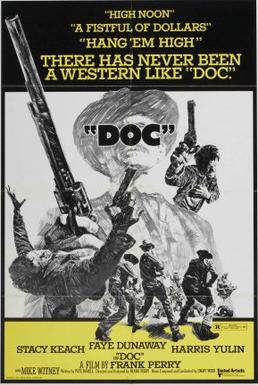
Riding west to Tombstone, Arizona, Doc Holliday (Stacy Keach) stops at a wayward, isolated stop along the trail. In a game of cards with a cowboy, Ike Clanton (Michael Witney), Holliday "wins" a woman, Kate Elder (Faye Dunaway), a prostitute similarly making her way west. Holliday agrees to have Kate travel with him as far as Tombstone, but upon arriving in the violent booming mining town, the gunfighter finds something he wasn't expecting. His friend Wyatt Earp (Harris Yulin) is the territorial Marshal, but not the town sheriff in Tombstone. Just the same, Wyatt sees the potential for riches with a town in his fingertips waiting to be controlled. He needs Doc's help though, Wyatt controlling the town from his position as a law officer, Doc from the saloons controlling the business end. Earp's grab for power though is a tricky one with the Clantons standing in the way, leaving Doc to decide how he wants to proceed.
If you needed an example of what a revisionist western really is, this 1971 western from director Frank Perry is right at the top of the list. It isn't interested in painting a romantic, heroic vision of the west. It's going for real, violent, cynical and dirty. Within minutes of meeting, Doc and Katie are in bed together. Riding through the mountains, they have a conversation about farting and later oral sex. In other words, this isn't John Ford's My Darling Clementine. Wyatt Earp is played as an unhinged psychopath, and the Clantons are unknowing -- if a little slow -- dupes in Earp's master plan. I like anything that tries to take a fresh, new look at assumed 'knowns' in history, but there's a line too. The best revisionist westerns find that middle ground in between the romantic vision and the ultra-cynical picture.
So while I didn't love the version of the story that Perry and scriptwriter Pete Hamill presents, it did appeal to me. The story of Wyatt Earp, Doc Holliday, Tombstone and the gunfight at the O.K. Corral has had countless film adaptations, and it's fair to say this is unlike any of the other versions. From what's been revealed and discovered in the last 100-plus years, this vision of Earp has some truth to it. He wasn't the clean-cut marshal some history books have made him out to be. Was he this psychotically unhinged though? I'm thinking probably not. As well, we see Dunaway's Katie Elder (known now as Big Nose Kate) as a whore traveling through the west. The topper though is definitely the finale, the iconic showdown between Wyatt and his two brothers and Doc vs. the Clanton/McLaury clan at the O.K. Corral. It is by the far the most gunplay you'll see in the entire movie, but it's over in a flash. Without giving any spoilers away, this gunfight is unlike any other depiction of the iconic event we've seen in any film version.
Through all the revisionist history though, what stands out from this 1971 western is the focus on Doc Holliday. Still a relative unknown, Keach does a fine job playing the tuberculosis-ridden dentist turned gunfighter John 'Doc' Holliday. He has a reputation as a gambler and a killer, that reputation preceding him wherever he goes. Doc is struggling through a disease that is tearing him apart, sending him into horrific fits of coughing. Traveling west in hopes of holding off the disease as much as possible, Holliday is looking for something else out of life, not just what he's known with gambling, drinking and women. In Kate Elder, he may have found that outlet to a better life. We also get a window into Doc with his relationship with the Kid (Denver John Collins), a young cowboy working with the Clantons who seeks out Doc's help learning how to be a gunfighter. In a story dead set on tearing history down and apart, it's cool to see Keach do such a fine job creating a human character.
Unfortunately, not much of the rest of the cast is especially memorable. Dunaway is trying, but I think she's simply miscast. She's too good-looking for the part, a rather unglamorous part. I liked Yulin as Earp mostly because it's such a departure from the known Wyatt Earp, but it's a one-note performance. Earp is nuts. That's all. John Scanlon is good as Bartlett, the friendly bartender, Dan Greenburg plays Clum, the newspaper editor hovering over the situation like a social conscience (subtle, huh?). I did like Whitney as Ike Clanton, another fresh look at a supposedly known individual, a surprisingly sympathetic character caught up in the Earp's whirlwind. Also, Earp's brothers are completely marginalized to dupes, latchkeys, and idiots. Lack of star power isn't a huge issue, but the performances here other than Keach and Whitney are disappointing.
I liked a lot about this movie. The almost silent opening at the isolated tavern is tense and unnerving with Perry using some interesting camera angles in a slow, anxiety-ridden sequence. There's no soundtrack at all, just a few instances of mariachi music being played live in a cantina or saloon. 'Doc' was filmed on location in Almeria where countless spaghetti westerns were filmed, giving the story an oddly effective other-worldly feel. I loved how the film looks, how scenes are composed with lighting and shadows. On the other hand, the history is garbage. Revisionist is one thing, but like lesser efforts, it simply tries too hard to tear down the history. A mixed bag with some really good positives and some really bad negatives.
Doc (1971): ** 1/2 /****
Monday, August 13, 2012
The Bourne Legacy

Working with a top secret program funded out of the C.I.A. called 'Outcome,' secret agent and killer Aaron Cross (Jeremy Renner) tests off the charts compared to the agency's other agents. A product of some medical advancements, Aaron is smarter, quicker and stronger. His superiors (Stacy Keach and Edward Norton among others) though are in some serious trouble, their operations possibly coming into the limelight because of Jason Bourne's "treacherous" actions. Rather than face serious legal repercussions if their own actions are revealed, they torch Outcome, killing everyone involved. Aaron is among the targets but escapes. Now he's looking for some answers, starting with another survivor of the burn, Dr. Marta Shearing (Rachel Weisz).
I'm not sure where to start with this quasi-Bourne movie. I went in with some expectations if not especially high ones. The Damon trilogy is the rare trilogy that I thought improved with each passing movie. 'Identity' is pretty damn good on its own so that's saying something. Once Damon wanted out though, the series/franchise has to take a twist. I can't help but wonder how director Tony Gilroy's film would have done without the 'Bourne' moniker floating over its head. Knowledge of the first three movies will certainly help, but it's not essential going into this 2012 sequel. Sorry to say though I came away highly disappointed with this newest venture. Building off the Bourne name and success, sure, there's potential, but it ends up being one big, boring, repetitive mess.
Clocking in at a very long 135 minutes, 'Legacy' is 16 minutes longer than any of the previous three movies.....and that IS NOT a good thing. This is a story that needed tightening up. The first hour is sluggish even as we bounce all over the world in a convoluted circle of information, worried looks, and menacing stares. I suppose somewhere in there was an explanation for the story, but I missed it. Long story short? Treadstone, Blackbriar and now Outcome all top each other, one agency becoming more efficient and effective than its predecessor. On the whole, the issue is simple. This is a movie that drifts far too much. The three Damon ventures are frenetically paced to the point where you feel like running home after seeing them. Not here. I was bored, legitimately bored, and counting down the minutes until it was over.
So there's the issue. It seems that Gilroy (who also co-wrote the script) wanted to use the Bourne moniker to get people in the door but from there on in was going to distance itself from those previous films. Unfortunately, the story is basically a rehash of The Bourne Identity. Everything...everything feels like we've seen this before right down to the government war rooms, action scenes, and never-ending chases. In the process somewhere, there must have been an ending too, but it didn't make the final cut. Impressive action scene ends, Cross is semi-happy and cue Moby's Extreme Ways. Oh, oops, my bad. I guess the movie is over. There is no resolution, and not even a huge jumping off point for a sequel. The movie just ends. That's all.
Continuing to springboard off his success from The Hurt Locker, Renner is a very solid lead as Aaron Cross. First off and most important, he doesn't try to be Jason Bourne. He's his own man/character. Aaron's background seems wasted though. There's a layer in there about how he came to be an agent and why he's so driven now that is highly interesting, but nothing much comes of it. Either way, Renner is the best thing going for her. Weisz is a fine actress, but she's nearly unbearable here; shrill, loud and in full-on damsel in distress mode. Norton is the biggest waste here, given NOTHING to do, as Outcome's director while Keach has to look mean and growl. Previous Bourne actors Scott Glenn, Joan Allen, Albert Finney and David Straithairn are around for brief, blink and you'll miss parts. Louis Ozawa Changchien is very cool as Larx 3, an assassin without the glitches of previous agents while Oscar Isaac is memorable as paranoid Outcome Agent No. 3 who a curious Aaron meets early on.
The action for the most part is disappointingly and surprisingly kept in the background, much of it saved for the finale, a foot-turned-motorcycle chase in the crowded streets of Manila. While the stunts are impressive, they still have that rehashed feel to them. That's the movie. There are some very cool moments -- Aaron manipulating a tracker in a unique way via an animal, Aaron's explanation of his past -- but they never amount to anything. Very sorry to give this a low rating if for nothing else than the original three movies set the bar so high. Renner is a good choice to take the reins, but that's about it here.
The Bourne Legacy <---trailer (2012): **/****
Sunday, January 8, 2012
Escape from L.A.

It's 2013 and the United States is very much a dystopian country still, even 16 years since Special Forces soldier turned criminal Snake Plissken (Kurt Russell) rescued the President in New York. Now though, an immensely powerful earthquake has ripped Los Angeles apart, the city now an island destination for any "undesirables." Now a new religious fanatic (Cliff Robertson) has become the President, and his extremist daughter (A.J. Langer) has hijacked an item that could destroy the world, retreating to L.A. to work with fellow extremist Cuervo Jones (Georges Corraface). Snake's services are called on once more. Blackmailed and working against a deadline of death, Snake must sneak into L.A., retrieve the item, kill the daughter, and only then will he be safe. Can he pull off the impossible again?
I didn't love the original Escape from New York, but I certainly liked it. Made on a small budget, there was a certain B-movie charm to Carpenter's film. It was cheesy and ridiculous and over the top and most importantly of all, fun to watch. The dystopian setting of an America that is nothing like the country we know now is ideal, opening the door for all kinds of outlets to take a story. Carpenter and Russell worked together a handful of times over their careers, clearly enjoying making movies together. Russell liked it so much -- and playing Snake too -- that he worked with Carpenter on writing a sequel. It was held up for years, finally coming to fruition in the mid 1990s. With that long of a wait and this much talent involved, why then is the sequel so bad?
The obvious answer is that it is basically the same movie. Sequels are fine when they add another step, a new layer to a pre-existing world and characters. But making the same movie -- quite literally -- with all the same features, characters and settings? Replacing New York with Los Angeles isn't unique or new. It's a road trip. I guess I just expected more. If you've got 15-plus years to write a sequel, couldn't you manage something better than this? It bombed in theaters, not making a profit, so I'm not the only one with complaints. The repeat of New York's success is one thing, but this 'Escape' has too much really awful CGI, too many similar characters, and did I mention the almost identical story?
What carries both movies on different levels is Kurt Russell. 'New York' is just a genuinely good B-movie that's aided and boosted by Russell. 'L.A.' is basically watchable only because of Russell. Snake Plissken is Russell's most iconic character from a successful career, and there's nothing about him that isn't cool. Okay, check that, the odd, fetishisized leather outfit is a little much. But other than that, Snake is the perfect anti-hero. A high profile crook with a reputation, he has no regard for any authority and only goes along with the plan because his life depends on it. Yes, he growls everything he says. Yes, he makes some awfully stupid decisions. But is he cool doing it? Yes, Kurt Russell is awesome, and he's cooler than you.
While the rest of the cast and characters are pretty ridiculous, Carpenter nonetheless assembles quite a cast. Start with Robertson, having some fun taking some jabs at the religious nuts. His U.S. President is one big stereotype, hamming it up like nobody's business. Stacy Keach plays Malloy, Snake's "handler" of sorts, with Michelle Forbes as his assistant. Steve Buscemi, Bruce Campbell, Valeria Golino and Peter Fonda play just some of the eccentric nuts trying to survive in Los Angeles who Snake runs across, Buscemi and Fonda making the best impressions. Look also for Pam Grier as Hershe Las Palmas, a drag queen who Snake used to work with on other jobs. I've gotta admit though, it's a little unsettling hearing a man's voice coming from Grier's mouth.
So watching a rehash of the more enjoyable Escape from New York, there are some saving graces in this most unnecessary of sequels. The ending features a couple very cool twists, some you can see coming if you're paying attention, but enjoyable nonetheless. Was there ever any doubt Snake was going to get duped repeatedly by these morons? I think not. Cool character, cool ending, but that doesn't save the movie.
Escape from L.A. <---trailer (1996): * 1/2 /****
Tuesday, December 14, 2010
The Life and Times of Judge Roy Bean

If you look at the list of westerns included in the Wikipedia entry, there are some good entries, but for the most part I don't necessarily like revisionist westerns. They try much too hard to show you that what you've been watching all these years is garbage. Take 1972's The Life and Times of Judge Roy Bean, directed by one of my favorites, John Huston. In telling the story of real-life Roy Bean, this western blends some really awkward comedic moments, overlong sub-plots that go nowhere, some hypocritical views on just about everything (can't decide if that was intended), and in general a waste of a very strong cast.
Sometime around the turn of the century, "outlaw" Roy Bean (Paul Newman) rides into west Texas past the Pecos River, an area notorious for hiding bandits and criminals. At one saloon, they turn on him and leave him for dead only to have the wounded man come back and gun them all down. Disgusted by what he's seen, Bean sets up shop as a judge, administering his unique brand of justice to anyone and everyone looking for trouble. Word spreads and soon he even has deputies who help him out, all in the name of Texas and Lilly Langtry (Ava Gardner), a stage actress from the east, a woman Bean has always been in love with. But Bean's style of justice may catch up with him as civilization follows him around every corner, and his time may be running out.
I don't know where to start with this one because to be fair, Huston doesn't know where to start either. Roy Bean was a real-life judge in west Texas who ended up becoming a legendary figure after he died. So with this revisionist western instead of telling a story that showed what the actual man was like, Huston goes for the ridiculous legend. At a run-time of 120 minutes (a very long 120 minutes), 'Life' is all over the place with no sense of where it's going. The tone ranges from slapstick comedy that produces its fair share of groans -- it did from me at least -- to an oddly serious finale. It tries to be funny while also delivering a hacked up message about the changing times and the last few years of the wild west. Pick one or the other and go with it, but don't waver between the two.
A bright spot not surprisingly is Newman in the titular role, rising above materiel that at times is just beneath him. Newman's parts in the 1970s typically covered a wide variety of movies, and this surely doesn't disappoint. What works is that he commits so fully to this part. His beliefs are ridiculously hypocritical, and he'll string anyone up at the drop of a hat if he disagrees with what's been said or done. If you're loyal to him, he'll be loyal to you, but for heaven's sake don't turn on him. This isn't a part on par with his best performances like Butch Cassidy or Lucas Jackson, but it's a quality one. Even when the movie is dull to watch, it's worthwhile to check out Newman.
So with a story that is light on story and heavy on non-related vignettes, we get a chance to see a long list of actors play small parts (some being on-screen no more than a few seconds). Gardner makes an appearance in the movie's final scene in a moving scene that comes along a little too late. Anthony Perkins is a scene-stealer as a traveling preacher who realizes Newman's Bean may be a little off his rocker but doesn't want to get shot bringing the topic up. Ned Beatty, Matt Clark, Jim Burk, Bill McKinney, and Steve Kanaly are underused but all solid as Bean's loyal deputies. Also watch for Victoria Principal, Tab Hunter, Huston as a grizzled old mountain man, Stacy Keach as an albino gunman, Roddy McDowall, Anthony Zerbe, and Jacqueline Bisset in parts that range from bad to good, your decision on where they fall.
I will give Huston credit for trying new things. Early on, we get narration from Perkins and Hunter, but instead of just hearing it, the camera is placed right in front of them as they ride into town. They're looking right at the audience, addressing us in a cool change of pace, a unique little technique. But then the narration resorts to been there, done that voiceovers. It's just an odd movie overall, one with plenty of flaws but enough positives to give it a mild recommendation.
The Life and Times of Judge Roy Bean <---trailer (1972): **/****
Subscribe to:
Posts (Atom)