The Sons of Katie Elder

The Sons of Katie Elder
"First, we reunite, then find Ma and Pa's killer...then read some reviews."
Showing posts with label Harris Yulin. Show all posts

Tuesday, July 7, 2015

Night Moves (1975)

The time of the film noir was long since past, its shadowy streets, scarred, flawed anti-heroes and dastardly villains gone the way of the do-do bird. The genre lived on into the 1950s some before moving on. Then...THEN, along came the 1960s and everything weird and drug-induced and dark and cynical. Here came a new type of film noir, almost as if it was on LCD or acid of some sort. A whole sub-genre of flicks came along, the private detective meets film noir meets general weirdness. That's today's flick, a 1975 neo-noir called Night Moves.

A former pro football player, Harry Moseby (Gene Hackman) is a mildly successful private investigator working in Los Angeles. He's a dogged investigator and good at what he does, stubborn to a fault to get answers, but there just isn't much money in the business. His home life with his wife (Susan Clark) becoming increasingly frustrated with that lifestyle, but now Harry has a case on his plate that's peaks his curiosity. A past her prime actress, Arlene Iverson (Janet Ward), wants Harry to track down her missing daughter, Delly, who's been gone for several days with no word at all. Delly is a teenager with a free spirit who's embraced quite the freeing lifestyle. Where to start though? Delly...well, she got around but Harry decides to start in Florida where her stepfather lives a life of ease (seemingly). Immediately though with anyone he talks to, Harry feels like he's getting the run-around. What has he stumbled into?

I recorded this movie on Turner Classic Movies a few months back and never got around to it, eventually deleting it. Just my luck, it popped back up on the schedule a few weeks ago so I gave it another shot. What to say? What an interesting, weird, off-the-wall movie in just about every description I can come up with. 'Night' comes from director Arthur Penn, he of Bonnie and Clyde, Little Big Man and The Missouri Breaks, among others. His movies were part of a New Wave in Hollywood, featuring European influences (mostly French) while also blending the general cynicism washing across America. Authority, the government, the system, all of it would come under question in the late 1960s and into the 1970s.

The filming style and technique used by Penn is a more natural effort. Scenes transition from one to the next in the blink of an eye. The story itself drifts along as Hackman's Harry meets one person after another, some he's met in the past, others he's meeting for the first time. There is some description or background of these people, but not a lot so pay attention or you'll miss the little tidbits here and there. There has to be a confidence within the story and the director and his crew to pull off something like that. Yeah, 'Night' has the idea of a story, but it is far from your typical, even straightforward story. So in that sense, this is a movie that drifts along in pretty easy-going fashion. It's also intensely frustrating at times because it slows down to a snail's pace where there's literally no story movement. The thing that holds it together...

Maybe you've heard of him. His name is Gene Hackman. The 1970s were Hackman's decade with one classic role and movie after another. Even when he hams it up a bit, he's still eternally watchable. When he plays things straight, you get movies like this. Hackman's Harry is calm and cool and exceptionally good at what he does. His personal life is a different story, like when he discovers his wife is having an affair (with Harris Yulin). Frustrated to no end, this P.I. dives back into his work, seeking some sort of solace in finding answers for his cases. He gets a lot of screentime with Jennifer Warren's Paula, a woman in her 30s with quite the checkered past that got her to this place. I didn't love the movie overall and struggled at time to stick with it, but Hackman helps get through the rough patches in a very solid lead performance.

The rest of the cast is okay, but nothing crazy. Not much in the way of big names so instead we get a lot of familiar faces in character actors. Along with Clark, Yulin and Warren, look for Edward Binns, Kenneth Mars, Anthony Costello, and John Crawford. In two of the best supporting parts, 17-year old Melanie Griffith plays the sexually free Delly while James Woods plays a mechanic who may be up to something who's also a friend of our young Delly. 'Night' caused a stir because the underage Griffith has several nude scenes and even had several love scenes cut from the final product. Woods is already brimming with intensity which works well in several scenes with Hackman.

It's been a week since I watched this 1975 detective noir story, and man, I still can't wrap my head around it. The second half of the movie does pack some surprises as Harry's investigation uncovers all sorts of shady dealings, but it never quite comes together. By the time everything is laid out....yeah, I'm still not sure what happened and why that person is dead or that person betrayed somebody. Confusing to say the least, but even with that said, there is still something oddly entertaining about this not so normal detective story. Flawed but interesting.

Night Moves (1975): ** 1/2 /****

Thursday, May 2, 2013

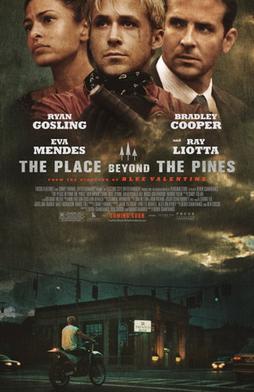
The Place Beyond the Pines

It's been about 24 hours since I saw 2013's The Place Beyond the Pines in theaters, and I'm still processing the film. Reviews were uniformly positive, the trailer instantly hooked me as did the cast, and my first thought was that it resembled an art-house crime drama like a Melville film or a moody 1970s American flick like The Driver. So yeah, I'm still processing it, but in a good way for a change. I liked it a lot, just deciding if maybe I loved it too.

A stunt motorcycle rider at a traveling carnival, Luke Glanton (Ryan Gosling) meets Romina (Eva Mendes) as the carnival returns to towns it visited the summer before. She has a shock for him; she had a baby, and it's his, the product of their one night together the year before. Romina has moved on, but Luke wants to help raise his son. He starts work as a mechanic, hoping to provide for his boy, but the money just isn't there. With a co-worker, he starts to rob banks, netting more than enough money to give Romina and his son everything they need. The plan can only work for so long though, and Luke's actions have put him on a path that will have him cross ways with Aaron (Bradley Cooper), a talented if inexperienced cop dealing with his own issues in the department.

I don't usually do this, but here goes. This is a review that's going to be somewhat difficult to write without giving some spoilers away. I won't be giving away any MAJOR SPOILERS -- and there are some surprising twists -- but be forewarned. There are some storytelling twists that I will have to talk about to be even remotely coherent.

Director Derek Cianfrance's follow-up to his uniquely interesting -- some would say odd -- 2010 film Blue Valentine, 'Pines' is a gem of a film. I fell for it the second I watched the trailer. It is an artsy, well-told and unique story that doesn't settle for any semblance of the status quo. The developing story has a lyrical feel to it, based in this world but in an almost ethereal feel to it. Cianfrance filmed on location in Schenectady (where the story takes place), a city in eastern New York that feels removed from the congestion and business of everyday life. It's a town that looks like any number of small towns across the country. Maybe the best thing adding to the mood and tone is the soundtrack from composer Mike Patton. It is a perfect mix of trance, subtle electronica, choirs, and quasi-religious church hymns. The score is perfect, giving it an authentic sense of the ethereal, the other worldly. Give it a listen HERE for the best track. 

Here comes the semi-spoilers so again, be forewarned. At 140 minutes, 'Pines' is broken down into three separate segments. The first has Gosling's Luke trying to provide for his son in desperate fashion, turning to robbing banks. The second has Cooper's Aaron trying to carve a name out for himself as a young police officer dealing with quite a legacy. The third actually fast-forwards 15 years as Luke's son, Jason (Dane DeHaan), meets Aaron's son, A.J. (Emory Cohen), at high school, the two teenagers not knowing that they're somehow connected through their fathers. Each segment is given equal time, about 45 minutes, each given a chance to breathe and develop without feeling forced. Don't be confused. They are connected, one part of the story transitioning seamlessly into the next. It's rare to see a story develop like that, and 'Pines' does it well. It's different from most films which isn't necessarily a good thing, but this one is a huge positive.

The unifying link among the three segments is the relationships between fathers and their sons, a story arc used in everything from Field of Dreams to The Godfather and countless others. Luke sees he's made a mistake and wants to right those mistakes. He's so driven to do that, he turns to crime. Aaron similarly wants to care for his infant son, but he doesn't know if the career he's chosen is actually the right one. Cianfrance's script shows how one decision affects another, one action leads to another. The relationship between a father and son is a simple and complicated relationship at the same time. Without sounding pretentious, the artsy story uses the notion that the universe is connected, people who are supposed to meet will meet. Some paths and individuals are destined to cross no matter what happens.

There isn't a weak performance in the bunch. Semi-channeling his part from the equally impressive Drive, Gosling is a gem. His part as Luke is the perfect doomed, moody anti-hero. We know from when we meet him his path will not be a smooth one. Luke's scenes with his baby boy are perfection, including one silent scene after some startling violence. He continues to impress me as an actor. Arriving about the 45-minute mark, Cooper takes a familiar part -- young cop dealing with corrupt police force -- and makes it his own. He's a hero on the force and struggling to deal with his newfound fame. Relative newcomers DeHaan and Cohen more than handle themselves well in the final act. The high point of the story was Gosling's portion, but I enjoyed it all from beginning to end.

Playing a key supporting part, Mendes too is very solid as Romina, the mother of Luke's child who has moved on, moving in with Kofi (scene-stealing Mahershala Ali). Without being obvious in her part, Mendes does a good job making Romina human without being obnoxious or hamming it up. Ben Mendelsohn is similarly a scene-stealer as Robin, Luke's boss at a fix-it shop who turns him onto bank robbery. Rose Byrne plays Aaron's worrying wife while Harris Yulin plays his famous father. Bruce Greenwood makes an effective, quick appearance as a district attorney while Ray Liotta plays (GASP!) a dirty cop recruiting Aaron. All solid parts supporting the leads.

I'm liking this film more and more as I write the review. The third part drags a little bit, and I would have liked a more definite ending, but it works just the same. Cianfrance's script has everything coming full circle (well, almost), wrapping up everything in a moving, at times heartbreaking finale. The title comes from the Mohawk translation of Schenectady by the way. I loved this movie. It starts with a worthy start, an impressive tracking shot following Luke as he walks through the carnival, and never really lets up. Well worth seeking out, and definitely a change of pace from most movies.

The Place Beyond the Pines (2013): ****/****

Tuesday, April 9, 2013

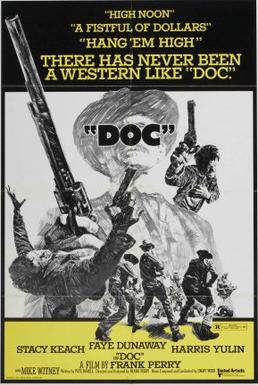
Doc

In a long line of truly interesting, fascinating individuals the wild west produced in the 19th Century, some stand out from the rest. For me, John 'Doc' Holliday has always been one of my favorites, a dentist turned gunfighter who gained fame for his friendship with famed lawman Wyatt Earp. Countless movies have been made about Earp and the gunfight at the O.K. Corral, but Holliday is typically a supporting player to Earp. That's not the case in 1971's Doc, a western devoted to Holliday himself.

Riding west to Tombstone, Arizona, Doc Holliday (Stacy Keach) stops at a wayward, isolated stop along the trail. In a game of cards with a cowboy, Ike Clanton (Michael Witney), Holliday "wins" a woman, Kate Elder (Faye Dunaway), a prostitute similarly making her way west. Holliday agrees to have Kate travel with him as far as Tombstone, but upon arriving in the violent booming mining town, the gunfighter finds something he wasn't expecting. His friend Wyatt Earp (Harris Yulin) is the territorial Marshal, but not the town sheriff in Tombstone. Just the same, Wyatt sees the potential for riches with a town in his fingertips waiting to be controlled. He needs Doc's help though, Wyatt controlling the town from his position as a law officer, Doc from the saloons controlling the business end. Earp's grab for power though is a tricky one with the Clantons standing in the way, leaving Doc to decide how he wants to proceed.

If you needed an example of what a revisionist western really is, this 1971 western from director Frank Perry is right at the top of the list. It isn't interested in painting a romantic, heroic vision of the west. It's going for real, violent, cynical and dirty. Within minutes of meeting, Doc and Katie are in bed together. Riding through the mountains, they have a conversation about farting and later oral sex. In other words, this isn't John Ford's My Darling Clementine. Wyatt Earp is played as an unhinged psychopath, and the Clantons are unknowing -- if a little slow -- dupes in Earp's master plan. I like anything that tries to take a fresh, new look at assumed 'knowns' in history, but there's a line too. The best revisionist westerns find that middle ground in between the romantic vision and the ultra-cynical picture.

So while I didn't love the version of the story that Perry and scriptwriter Pete Hamill presents, it did appeal to me. The story of Wyatt Earp, Doc Holliday, Tombstone and the gunfight at the O.K. Corral has had countless film adaptations, and it's fair to say this is unlike any of the other versions. From what's been revealed and discovered in the last 100-plus years, this vision of Earp has some truth to it. He wasn't the clean-cut marshal some history books have made him out to be. Was he this psychotically unhinged though? I'm thinking probably not. As well, we see Dunaway's Katie Elder (known now as Big Nose Kate) as a whore traveling through the west. The topper though is definitely the finale, the iconic showdown between Wyatt and his two brothers and Doc vs. the Clanton/McLaury clan at the O.K. Corral. It is by the far the most gunplay you'll see in the entire movie, but it's over in a flash. Without giving any spoilers away, this gunfight is unlike any other depiction of the iconic event we've seen in any film version.

Through all the revisionist history though, what stands out from this 1971 western is the focus on Doc Holliday. Still a relative unknown, Keach does a fine job playing the tuberculosis-ridden dentist turned gunfighter John 'Doc' Holliday. He has a reputation as a gambler and a killer, that reputation preceding him wherever he goes. Doc is struggling through a disease that is tearing him apart, sending him into horrific fits of coughing. Traveling west in hopes of holding off the disease as much as possible, Holliday is looking for something else out of life, not just what he's known with gambling, drinking and women. In Kate Elder, he may have found that outlet to a better life. We also get a window into Doc with his relationship with the Kid (Denver John Collins), a young cowboy working with the Clantons who seeks out Doc's help learning how to be a gunfighter. In a story dead set on tearing history down and apart, it's cool to see Keach do such a fine job creating a human character.

Unfortunately, not much of the rest of the cast is especially memorable. Dunaway is trying, but I think she's simply miscast. She's too good-looking for the part, a rather unglamorous part. I liked Yulin as Earp mostly because it's such a departure from the known Wyatt Earp, but it's a one-note performance. Earp is nuts. That's all. John Scanlon is good as Bartlett, the friendly bartender, Dan Greenburg plays Clum, the newspaper editor hovering over the situation like a social conscience (subtle, huh?). I did like Whitney as Ike Clanton, another fresh look at a supposedly known individual, a surprisingly sympathetic character caught up in the Earp's whirlwind. Also, Earp's brothers are completely marginalized to dupes, latchkeys, and idiots. Lack of star power isn't a huge issue, but the performances here other than Keach and Whitney are disappointing.

I liked a lot about this movie. The almost silent opening at the isolated tavern is tense and unnerving with Perry using some interesting camera angles in a slow, anxiety-ridden sequence. There's no soundtrack at all, just a few instances of mariachi music being played live in a cantina or saloon. 'Doc' was filmed on location in Almeria where countless spaghetti westerns were filmed, giving the story an oddly effective other-worldly feel. I loved how the film looks, how scenes are composed with lighting and shadows. On the other hand, the history is garbage. Revisionist is one thing, but like lesser efforts, it simply tries too hard to tear down the history. A mixed bag with some really good positives and some really bad negatives.

Doc (1971): ** 1/2 /****