With 1960's The Alamo -- one of my two favorite movies -- producer-director-star John Wayne built an entire set in Bracketville, Texas, that included the famous Alamo mission and nearby San Antonio. It was a set that was used in many, many films in the years following, even becoming quite the tourist attraction, before closing in the last few years. One of the best and one of my favorites? A 1968 western called Bandolero!
It's 1867 in Val Verde, Texas -- a small border town not far from the Rio Grande -- where noted outlaw Dee Bishop (Dean Martin) and his gang is caught trying to rob a bank, killing two people in the process. Sentenced to hang, the entire gang is rescued on the gallows by Mace Bishop (James Stewart), who is posing as the hangman. Dee and his men escape, riding out of town hell bent for leather trying to reach Mexico ahead of a posse led by the stubborn Val Verde sheriff, July Johnson (George Kennedy). On the trail, the Bishop gang takes a hostage, Maria Stoner (Raquel Welch), a widow of one of the men killed in the robbery, and continue on to Mexico with the posse close behind. Embarrassed in his town, July Johnson has another reason to pursue the gang as far as they go. He's long been in love with Maria. All sides cross into Mexico into what Maria calls 'territorio bandolero.' Translation? Bandit country, bandits who will kill any and all gringos they come across.
This isn't a classic western, but for me, it's always been one that is a lot of fun. It's from director Andrew McLaglen, a director who specialized in pretty straightforward, almost always pretty entertaining guy's guys movies like this, The Wild Geese, McClintock, The Devil's Brigade and many others. He's one of my favorites just because of that, he made movies that were fun, that were entertaining. This is one of his better efforts, a western with a great cast, an interesting premise, and some tweaks and twists and turns in a story that tries to blaze its own trail. Again, not a classic, but damn entertaining and one of my little-known movies I consider a personal favorite.
It starts with two of my favorite actors, Jimmy Stewart and Dean Martin, in lead roles. The character premise is familiar but handled nicely. These are two brothers torn apart by the Civil War, Stewart's Mace fighting for the Union while Martin's Dee fought with the South, specifically Quantrill's Raiders. Now, years later they're brought back together by dumb luck, some coincidence and one brother desperately trying to help the others. These are two good actors, and they carry the dramatic moments. It's especially cool to see Martin in a villain role, albeit a likable villain. The middle portion of the movie is carried by their scenes as they reunite, talk things out, plan for the future, all the while trying to mend their differences. So yeah, they're on the wrong side of the law, but...meh, it's Jimmy Stewart and Dean Martin so you kinda go with it.
As for the Bishop gang, look for Will Geer as the crotchety old man, Pop Chaney, his ill-mannered, probably a little off son, Joe (Tom Heaton), Babe Jenkins (Clint Richie), a deadshot with a rifle and a bit of a ladies man, and Robbie O'Hare (Sean McClory), the hard-living, loving-life Scotsman. An interesting, nasty group to round out the gang.
The rest of the cast ranges from interesting to good to good-looking. Kennedy is underused but very solid as Sheriff Johnson, the peace officer trying to do his job but he's got some ulterior motives for his actions. I also have always liked Andrew Prine as Roscoe Bookbinder, Johnson's loyal deputy. Lonesome Dove author Larry McMurtry was apparently a big fan of this movie and used both character names and general descriptions in that novel. As for Raquel Welch, she's trying, really doing up a Mexican accent. It isn't nearly as bad as some reviews make it out to be -- the script doesn't do her any favors -- but it isn't especially good either. Shallow dude time though, she looks as beautiful as ever. Plenty more familiar faces though including Denver Pyle, Rudy Diaz (the bandit leader), Harry Carey Jr., Perry Lopez, and Dub Taylor.
Now for that Alamo Village portion of our programming. McLaglen uses the Alamo set to good use with two extended set pieces, the opening being Val Verde, the robbery and then the eventual escape. The finale is actually on the Alamo mission set, an abandoned town set among the ruins of the bombed out fort. They try to disguise the recognizable chapel face, but you can't miss it if you're paying attention. It's a great use of the locations, Utah and Arizona also serving as some locations. Also, one more thing. I love composer Jerry Goldsmith, but this is one of his favorites, a score I absolutely love. The use of a mouth harp over the opening credits is an odd choice, but does it ever work. The rest of the score is more action-packed western themes, but it's catchy, memorable and a great support to all the action. Give it a listen HERE.
If there's an issue in this McLaglen western, it's that the script has a great opening set piece and a memorable, blood and guts finale. In the middle....yeah, things drag at times. There's a couple campfire scenes, Maria getting to know Dee, Dee reacquainting himself with Mace, and all the while Johnson's posse tangles with a large gang of bandits. Never boring, but never as exciting as the beginning and end. Now that ending/finale? Yikes, it packs a wallop, packs quite a punch and does so while delivering some genuine surprises. Quite an ending to one of my favorites. A perfectly entertaining little western. Nothing more, nothing less.
Bandolero! (1968): ***/****
Rewrite of February 2010 review
The Sons of Katie Elder
"First, we reunite, then find Ma and Pa's killer...then read some reviews."
Showing posts with label Raquel Welch. Show all posts
Wednesday, May 13, 2015
Wednesday, July 23, 2014
100 Rifles
Almost but not quite. At the peak of their popularity in the late 1960s, the spaghetti westerns found their footing in theaters all over the world. Studios from a long list of different countries did their best to release their own imitations. They were filmed in spaghetti western locations, used spaghetti-sounding scores, and often featured familiar faces from the genre. One of the better examples of those imitations? That's 1969's 100 Rifles.
It's 1912 somewhere south of the Rio Grande in Mexico, and an Arizona lawman, Lyedecker (Jim Brown), has no idea what he's ridden into. Looking to keep his sheriff position on a permanent basis, Lyedecker has been tasked with arresting and bringing back an outlaw who stole some $6,000 from an Arizona bank. He actually finds the outlaw, a Mexican-half breed, Yaqui Joe (Burt Reynolds), in a small town but quickly finds out that Joe is wanted by the Mexican army as well. Now, Lyedecker finds himself working with the man he's supposed to arrest, but desperate times call for desperate measures. With an ethnic-cleansing minded general, Verdugo (Fernando Lamas), on their trail, Lyedecker and Joe race across the frontier. The key to them getting away? It may be a fiery Mexican girl, Sarita (Raquel Welch), fighting with the revolutionaries against Verdugo's forces.
Okay, let's get this out of the way. This is an entertaining, always interesting quasi-spaghetti western, but that doesn't necessarily mean it's good. The story drifts along with a series of episodic showdowns and some cool characters over a 110-minute running time. Any criticisms aside though, this is an excellent, action-packed shoot 'em up that western and action fans will certainly enjoy. Filming on location in Almeria, spaghetti western fans will no doubt recognize some of the on-location shooting. Maybe the best thing you can take away from '100' is the score from composer Jerry Goldsmith. Listen to an extended sample HERE, the best part of the theme kicking in about 40 seconds in and then again at 1:55. It's an underrated score, one of my favorites, a great whistle-worthy theme. The score was recycled seven years later in the 1976 western The Last Hard Men.
Nothing flashy but always enjoyable, '100' is a good example of a Zapata western, westerns with similar themes and stories involving the Mexican Revolution. We get all the familiar faces, genre archetypes you get used to seeing with enough viewing. The Mexican bandit/fighter is Yaqui Joe, the outsider, usually an American thrust into the fighting, Lyedecker, the fiery revolutionary, Sarita, the evil general, Verdugo, the German military adviser, Lt. Franz Von Klemme (Eric Braeden), and the American businessman working with the developing railroad, Grimes (Dan O'Herlihy). Like the better Zapata westerns, '100' covers a lot of ground with plenty of interesting characters. They're drawn in broad strokes, the good if flawed (Lyedecker, Joe, Sarita), the bad (Verdugo) and the messy gray middle ground (Von Klemme, Grimes). It is all familiar, but it is fun.
What ends up being the best part of '100' is the buddy dynamic between Jim Brown's stubborn sheriff and Burt Reynolds' fun-loving, live on the edge bandito. They don't like each other in the least, but their constant arguing, the never-ending bitching and moaning is pitch perfect, especially when they're thrown right in the mix of all the fighting. Yaqui Joe (half-American, half-Indian) actually used his stolen $6,000 to buy 100 rifles for the revolution, but Lydecker still intends to bring him back for trial. The only way to do it? Help Joe escape from the Mexican army. The rest of the cast is okay to bad. The worst? Welch, sporting a stereotypically heavy Mexican accent as Sarita. She's given any number of chances to undress or wear little -- including one shower scene while wearing clothes -- but this wasn't her best work. Lamas evils it up in impeccable fashion, thick mustache, constant sneer and pearl-handled pistols completing the look.
Who else to look for? Braeden is underused as Lt. Von Klemme, a military adviser who sees the mistakes Verdugo is making with each passing day. O'Herlihy is solid too as the greedy American businessman, interested in making the railroad money and keeping his locomotive intact. Also look for Michael Forest as Humara, Sarita's muscle-bound enforcer who doesn't speak a word, and spaghetti western regular Aldo Sambrell as Sgt. Paletes, Verdugo's trustworthy non-commissioned officer.
Onto the action! And let me tell you, there's plenty of it. The story drifts along at times, a series of quick dialogue scenes broken up by said action scenes. Lots of gunplay, some good chases, all of it handled well with only an occasional slow-motion death here and there. We get the small-scale like Brown and Reynolds having a good knock-down fight about halfway through. On the far bigger scale, we see an ambush of a heavily guarded train in a seemingly empty desert, all of it leading to the epic final showdown in another well-guarded town. Is this a great movie? Far from it, but I'm always entertained, and Reynolds especially makes it worthwhile. He commits himself to the fun, and it always looks like he's actually having fun. A good, solid almost spaghetti western.
100 Rifles (1969): ***/****
It's 1912 somewhere south of the Rio Grande in Mexico, and an Arizona lawman, Lyedecker (Jim Brown), has no idea what he's ridden into. Looking to keep his sheriff position on a permanent basis, Lyedecker has been tasked with arresting and bringing back an outlaw who stole some $6,000 from an Arizona bank. He actually finds the outlaw, a Mexican-half breed, Yaqui Joe (Burt Reynolds), in a small town but quickly finds out that Joe is wanted by the Mexican army as well. Now, Lyedecker finds himself working with the man he's supposed to arrest, but desperate times call for desperate measures. With an ethnic-cleansing minded general, Verdugo (Fernando Lamas), on their trail, Lyedecker and Joe race across the frontier. The key to them getting away? It may be a fiery Mexican girl, Sarita (Raquel Welch), fighting with the revolutionaries against Verdugo's forces.
Okay, let's get this out of the way. This is an entertaining, always interesting quasi-spaghetti western, but that doesn't necessarily mean it's good. The story drifts along with a series of episodic showdowns and some cool characters over a 110-minute running time. Any criticisms aside though, this is an excellent, action-packed shoot 'em up that western and action fans will certainly enjoy. Filming on location in Almeria, spaghetti western fans will no doubt recognize some of the on-location shooting. Maybe the best thing you can take away from '100' is the score from composer Jerry Goldsmith. Listen to an extended sample HERE, the best part of the theme kicking in about 40 seconds in and then again at 1:55. It's an underrated score, one of my favorites, a great whistle-worthy theme. The score was recycled seven years later in the 1976 western The Last Hard Men.
Nothing flashy but always enjoyable, '100' is a good example of a Zapata western, westerns with similar themes and stories involving the Mexican Revolution. We get all the familiar faces, genre archetypes you get used to seeing with enough viewing. The Mexican bandit/fighter is Yaqui Joe, the outsider, usually an American thrust into the fighting, Lyedecker, the fiery revolutionary, Sarita, the evil general, Verdugo, the German military adviser, Lt. Franz Von Klemme (Eric Braeden), and the American businessman working with the developing railroad, Grimes (Dan O'Herlihy). Like the better Zapata westerns, '100' covers a lot of ground with plenty of interesting characters. They're drawn in broad strokes, the good if flawed (Lyedecker, Joe, Sarita), the bad (Verdugo) and the messy gray middle ground (Von Klemme, Grimes). It is all familiar, but it is fun.
What ends up being the best part of '100' is the buddy dynamic between Jim Brown's stubborn sheriff and Burt Reynolds' fun-loving, live on the edge bandito. They don't like each other in the least, but their constant arguing, the never-ending bitching and moaning is pitch perfect, especially when they're thrown right in the mix of all the fighting. Yaqui Joe (half-American, half-Indian) actually used his stolen $6,000 to buy 100 rifles for the revolution, but Lydecker still intends to bring him back for trial. The only way to do it? Help Joe escape from the Mexican army. The rest of the cast is okay to bad. The worst? Welch, sporting a stereotypically heavy Mexican accent as Sarita. She's given any number of chances to undress or wear little -- including one shower scene while wearing clothes -- but this wasn't her best work. Lamas evils it up in impeccable fashion, thick mustache, constant sneer and pearl-handled pistols completing the look.
Who else to look for? Braeden is underused as Lt. Von Klemme, a military adviser who sees the mistakes Verdugo is making with each passing day. O'Herlihy is solid too as the greedy American businessman, interested in making the railroad money and keeping his locomotive intact. Also look for Michael Forest as Humara, Sarita's muscle-bound enforcer who doesn't speak a word, and spaghetti western regular Aldo Sambrell as Sgt. Paletes, Verdugo's trustworthy non-commissioned officer.
Onto the action! And let me tell you, there's plenty of it. The story drifts along at times, a series of quick dialogue scenes broken up by said action scenes. Lots of gunplay, some good chases, all of it handled well with only an occasional slow-motion death here and there. We get the small-scale like Brown and Reynolds having a good knock-down fight about halfway through. On the far bigger scale, we see an ambush of a heavily guarded train in a seemingly empty desert, all of it leading to the epic final showdown in another well-guarded town. Is this a great movie? Far from it, but I'm always entertained, and Reynolds especially makes it worthwhile. He commits himself to the fun, and it always looks like he's actually having fun. A good, solid almost spaghetti western.
100 Rifles (1969): ***/****
Labels:
1960s,
Aldo Sambrell,
Burt Reynolds,
Dan O'Herlihy,
Eric Braeden,
Jim Brown,
Raquel Welch,
westerns
Saturday, March 15, 2014
The Three Musketeers (1973)
Some stories and literature just translate well to the big screen. Plain and simple. What do you think is the piece of literature that has inspired the most film adaptations? Okay, as I write this I'm assuming the Bible, but I'm talking about author Alexandre Dumas' The Three Musketeers. There have been one adaptation after another over the years, an estimated 200 for Dumas' career work. Well, that's add another review from that list, 1973's The Three Musketeers.
It's the 1620s in France, and a young, poor and idealistic Frenchman, D'Artagnan (Michael York) is on his way to Paris to become a Musketeer. Without the experience necessary, D'Artagnan is quickly turned down and turned away. In the span of a few hours, he manages to insult three different Musketeers, agreeing to duel with each of them at three different times back-to-back. When he meets them later, D'Artagnan ends up fighting at their sides, including Athos (Oliver Reed), Aramis (Richard Chamberlain) and Porthos (Frank Finlay), against the Cardinal's guards. While he's not officially a Musketeer, young D'Artagnan is welcomed by the friendly trio, especially when they are thrust into some intrigue between the French queen and an English lord while Cardinal Richelieu (Charlton Heston) seeks to gain more and more power over the inept French king.
Ready to get your mind blown? This movie was originally intended for.....The Beatles!!! Director Richard Lester had worked with the famous British rockers in Help! and A Hard Day's Night, but the Musketeers a la The Beatles never came to fruition. Instead, we get this entry, a solid action-packed story with a great cast and some funny physical humor that works surprisingly well. With a ton of attention to period detail, 'Musketeers' shot on location in Spain (a nice stand-in for France, kudos to cinematographer David Watkin) and features a fun, big, fast-paced score from composer Michel Legrand. It isn't the cleaned-up, glossy vision like the 1948 version or even the 1993 reboot. I can't speak for the the newest take on Dumas' iconic characters from 2011. Lester's version though? It seems to be the favorite of all the versions, so good that most of four hours of footage was shot, Lester deciding to make one film into two. Yeah, the cast was less than pleased. Paid for one film, turned into two. That's good business.
Go figure, the high point of this 1973 take is the Three Musketeers. I haven't seen much with Michael York in it other than the Austin Powers trilogy so it was cool to see him in a part like this. Playing D'Artagnan, he just goes for it, committing to bringing the almost hyper-active, goofy, idealistic young man to life. He also falls for the lovely Constance Bonacieux, played by Raquel Welch, and that's never a bad thing. York fits in well with Reed, Chamberlain and Finlay as the three established Musketeers who all come to respect young D'Artagnan, originally thinking of him as one of their own. If anything, the group is underused through much of the 105-minute movie. I wanted to see more of them. Of the three, I was most impressed with Oliver Reed as the fiery Athos, the unofficial leader of the trio. Reed defined on-screen intensity in the 1970s, and his Athos is just a cool character, waiting for an enemy to make his mistake and unleash an attack. Also look for Roy Kinnear as Panchet, D'Artagnan's hired servant who becomes an unofficial fifth member of the group.
If there's a weakness, it's that Dumas' novel just has so much going on. A ton of characters, a fast-moving story, it's a lot to handle in a movie that's 15 minutes short of 2-hours, and that's including a credit sequence. There's a ton of talent here, but it gets lost in the shuffle at times. Heston is underused as Cardinal Richelieu, the treacherous papal official looking to take over France, Faye Dunaway playing his gorgeous spy, Milady de Winter, and Christopher Lee as Rochefort as the head of the Cardinal's guards. As for the French royalty, look for Geraldine Chaplin and Jean Pierre Cassel. Rounding out the cast is Simon Ward as the Duke of Buckingham and Spike Milligan as Bonacieux, Constance's dimwitted husband.
But what are the Musketeers all about? Sword fighting. Lots of sword fighting. Master swordsman William Hobbs choreographed some great fight scenes that are big and all over the place with four and five swordsman on either side. The highlight is a great extended fight at a quiet countryside convent, a group of laundry women working away when the Musketeers arrive to fight a group of the Cardinal's guards. The action features some great physical gags, rope swings that don't quite reach where they're needed, trips and falls at will. Kinnear provides some good laughs too, always ready to hit some baddies over the head with a blunt instrument while the Musketeers duel away with their swords. Fun throughout.
Because it was decided post-production to turn one movie into two, the ending is just sorta there. A tad disjointed to say the least with not much resolved. I hope to check in with the follow-up soon. In the meantime, this one was pretty good. How can you pass up a movie where Roy Kinnear walks around dressed up as a polar bear who can juggle and then causes massive amounts of havoc? Or a catfight between Raquel Welch and Faye Dunaway. I submit that you CANNOT.
The Three Musketeers (1973): ***/****
It's the 1620s in France, and a young, poor and idealistic Frenchman, D'Artagnan (Michael York) is on his way to Paris to become a Musketeer. Without the experience necessary, D'Artagnan is quickly turned down and turned away. In the span of a few hours, he manages to insult three different Musketeers, agreeing to duel with each of them at three different times back-to-back. When he meets them later, D'Artagnan ends up fighting at their sides, including Athos (Oliver Reed), Aramis (Richard Chamberlain) and Porthos (Frank Finlay), against the Cardinal's guards. While he's not officially a Musketeer, young D'Artagnan is welcomed by the friendly trio, especially when they are thrust into some intrigue between the French queen and an English lord while Cardinal Richelieu (Charlton Heston) seeks to gain more and more power over the inept French king.
Ready to get your mind blown? This movie was originally intended for.....The Beatles!!! Director Richard Lester had worked with the famous British rockers in Help! and A Hard Day's Night, but the Musketeers a la The Beatles never came to fruition. Instead, we get this entry, a solid action-packed story with a great cast and some funny physical humor that works surprisingly well. With a ton of attention to period detail, 'Musketeers' shot on location in Spain (a nice stand-in for France, kudos to cinematographer David Watkin) and features a fun, big, fast-paced score from composer Michel Legrand. It isn't the cleaned-up, glossy vision like the 1948 version or even the 1993 reboot. I can't speak for the the newest take on Dumas' iconic characters from 2011. Lester's version though? It seems to be the favorite of all the versions, so good that most of four hours of footage was shot, Lester deciding to make one film into two. Yeah, the cast was less than pleased. Paid for one film, turned into two. That's good business.
Go figure, the high point of this 1973 take is the Three Musketeers. I haven't seen much with Michael York in it other than the Austin Powers trilogy so it was cool to see him in a part like this. Playing D'Artagnan, he just goes for it, committing to bringing the almost hyper-active, goofy, idealistic young man to life. He also falls for the lovely Constance Bonacieux, played by Raquel Welch, and that's never a bad thing. York fits in well with Reed, Chamberlain and Finlay as the three established Musketeers who all come to respect young D'Artagnan, originally thinking of him as one of their own. If anything, the group is underused through much of the 105-minute movie. I wanted to see more of them. Of the three, I was most impressed with Oliver Reed as the fiery Athos, the unofficial leader of the trio. Reed defined on-screen intensity in the 1970s, and his Athos is just a cool character, waiting for an enemy to make his mistake and unleash an attack. Also look for Roy Kinnear as Panchet, D'Artagnan's hired servant who becomes an unofficial fifth member of the group.
If there's a weakness, it's that Dumas' novel just has so much going on. A ton of characters, a fast-moving story, it's a lot to handle in a movie that's 15 minutes short of 2-hours, and that's including a credit sequence. There's a ton of talent here, but it gets lost in the shuffle at times. Heston is underused as Cardinal Richelieu, the treacherous papal official looking to take over France, Faye Dunaway playing his gorgeous spy, Milady de Winter, and Christopher Lee as Rochefort as the head of the Cardinal's guards. As for the French royalty, look for Geraldine Chaplin and Jean Pierre Cassel. Rounding out the cast is Simon Ward as the Duke of Buckingham and Spike Milligan as Bonacieux, Constance's dimwitted husband.
But what are the Musketeers all about? Sword fighting. Lots of sword fighting. Master swordsman William Hobbs choreographed some great fight scenes that are big and all over the place with four and five swordsman on either side. The highlight is a great extended fight at a quiet countryside convent, a group of laundry women working away when the Musketeers arrive to fight a group of the Cardinal's guards. The action features some great physical gags, rope swings that don't quite reach where they're needed, trips and falls at will. Kinnear provides some good laughs too, always ready to hit some baddies over the head with a blunt instrument while the Musketeers duel away with their swords. Fun throughout.
Because it was decided post-production to turn one movie into two, the ending is just sorta there. A tad disjointed to say the least with not much resolved. I hope to check in with the follow-up soon. In the meantime, this one was pretty good. How can you pass up a movie where Roy Kinnear walks around dressed up as a polar bear who can juggle and then causes massive amounts of havoc? Or a catfight between Raquel Welch and Faye Dunaway. I submit that you CANNOT.
The Three Musketeers (1973): ***/****
Monday, March 10, 2014
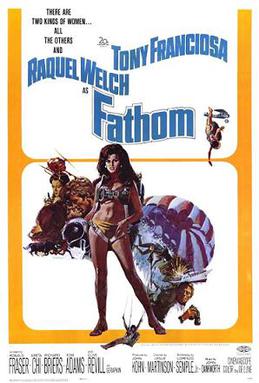
Fathom
James Bond, Derek Flint, Matt Helms, even the more straight-laced British spy Harry Palmer played by Michael Caine. The 1960s had countless spy and espionage movies for audiences that ate them up. A whole lot of testosterone, huh? How about a female secret agent navigating some international intrigue? I've long been aware of this one and was finally able to catch up with it, 1967's Fathom.
An American skydiver touring Europe with a U.S. parachuting team, Fathom Harvill (Raquel Welch) has become quite the attraction for audiences. Well, now she's getting some attention for another reason. After one successful jump, Fathom is approached by a mysterious security officer, Colonel Douglas Campbell (Ronald Fraser), who enlists her help in a matter of worldwide peace. A trigger/detonator -- dubbed the Fire Dragon -- that can set off a nuclear device has gone missing. The trail has led Campbell to a countryside Spanish villa where an agent working for the Chinese, Peter Merriwether (Tony Franciosa), is staying. With no other alternative to getting into the villa, Fathom will have to parachute in, pretending to have gone off course and accidentally landing at the villa. Find the Fire Dragon, get out and return it. Simple, right? Not everyone is telling her all she needs to know.
This is a fun movie. That's all, and that's not a bad thing so deal with it. From director Leslie H. Martinson, 'Fathom' has that 1960s style that can be so fun to watch now, look back and appreciate. The 1960s are my favorite decade for movies, and while this isn't an all-time classic (far from it), it's what can be so fun about the decade as a whole. It's goal is to be fun, to entertain, to put pretty people in pretty places with some witty repartee (and some subtle sexual innuendos. Scandalous!). 'Fathom' was filmed on location in the Spanish coast and countryside in and around Cartama, Mijas, Malaga, Torremolinos, and Nerja in Andalucia. It is a gorgeous-looking movie, Spain providing quite the visual backdrop....in addition to other things to come. There's also a dreamy theme song, listen and more importantly watch it HERE, with a good score from John Dankworth. The message is simple. This isn't a hard-hitting spy movie. It's not quite a spoof, just somewhere fun in between.
Blah blah blah, let's talk about Raquel Welch! One of the biggest sex symbols of the 1960s (and in Hollywood history in general), Welch was coming off the immensely successful One Million Years, B.C. that really put her and her fur bikini on the map. This is Miss Welch at her best. With the right part in a more dramatic movie, she did have some acting chops she could show off. This is more suited to her comedic ability, a lighter, more fun role that doesn't strain any acting muscles. Welch was a better comedic actress than she's given credit for, and this is a good follow-up rule to her speech-limited part in 'Million.' This movie was one of three female spy movies from Warner Bros. in 1967, and it's not a mystery why this one was remembered better than Caprice (starring Doris Day) and Come Spy With Me (starring Andrea Dromm). It's Raquel Welch.
Let's not misconstrue this, and yes, it's time to be a shallow dude. Raquel Welch is sexy, beautiful and taking her status as a 1960s sex symbol quite, quite seriously. Yes, there's a twisting story with a whuddunnit mystery, but let's get down to basics. This movie exists to get Welch into as many skimpy outfits as humanly possible. We're talking bikinis, short skirts, tight jumpsuits, plunging necklines, any and all. I've long had a crush on Raquel Welch, but I don't know if she ever looked as downright good-looking as she did here. And so ends a rant from this shallow guy. If you're a Welch fan, you'll like this movie.
But onto actual movie analysis! The cast supporting Welch is having some fun, none of the characters telling the complete truth and all of them having a secret or two. Actually the top-billed star here, Franciosa does what he does best, a roguish charming renegade, here as Merriwether, an agent working for the Chinese. He has a great chemistry with Welch, calling her 'Poppet' for some reason. He also gets some help from Greta Chi's Major Jo-May Soon, a real-life Chinese agent. Having some fun as the security officer who sends Fathom on her mission, Fraser does a good job as the equally mysterious Col. Douglas, Richard Briers playing his assistant, Lt. Timothy Webb, who has an interest in Welch's Fathom. Also hamming it up in Bond villain-esque mode is Clive Revill as Serapkin, the monocle-wearing Russian black market dealer with a low body temperature, forcing him to...."seek warmth" with Fathom at basically all times. Also look for Tom Adams (a supporting player in The Great Escape) as Mike, a hotel owner with an interest in everything going on.
In a 99-minute movie, 'Fathom' packs one surprise/twist on top of each other in waves. We're never sure who's working with who, which side is trying to scam Fathom out of the Fire Dragon (it ain't what it seems), and who will end up with it in the end. Getting there? Basically nonstop action, lots of fun, some cool stunts that force Welch to run, jump and fly across Spain. A very entertaining movie throughout.
Fathom (1967): ***/****
An American skydiver touring Europe with a U.S. parachuting team, Fathom Harvill (Raquel Welch) has become quite the attraction for audiences. Well, now she's getting some attention for another reason. After one successful jump, Fathom is approached by a mysterious security officer, Colonel Douglas Campbell (Ronald Fraser), who enlists her help in a matter of worldwide peace. A trigger/detonator -- dubbed the Fire Dragon -- that can set off a nuclear device has gone missing. The trail has led Campbell to a countryside Spanish villa where an agent working for the Chinese, Peter Merriwether (Tony Franciosa), is staying. With no other alternative to getting into the villa, Fathom will have to parachute in, pretending to have gone off course and accidentally landing at the villa. Find the Fire Dragon, get out and return it. Simple, right? Not everyone is telling her all she needs to know.
This is a fun movie. That's all, and that's not a bad thing so deal with it. From director Leslie H. Martinson, 'Fathom' has that 1960s style that can be so fun to watch now, look back and appreciate. The 1960s are my favorite decade for movies, and while this isn't an all-time classic (far from it), it's what can be so fun about the decade as a whole. It's goal is to be fun, to entertain, to put pretty people in pretty places with some witty repartee (and some subtle sexual innuendos. Scandalous!). 'Fathom' was filmed on location in the Spanish coast and countryside in and around Cartama, Mijas, Malaga, Torremolinos, and Nerja in Andalucia. It is a gorgeous-looking movie, Spain providing quite the visual backdrop....in addition to other things to come. There's also a dreamy theme song, listen and more importantly watch it HERE, with a good score from John Dankworth. The message is simple. This isn't a hard-hitting spy movie. It's not quite a spoof, just somewhere fun in between.
Blah blah blah, let's talk about Raquel Welch! One of the biggest sex symbols of the 1960s (and in Hollywood history in general), Welch was coming off the immensely successful One Million Years, B.C. that really put her and her fur bikini on the map. This is Miss Welch at her best. With the right part in a more dramatic movie, she did have some acting chops she could show off. This is more suited to her comedic ability, a lighter, more fun role that doesn't strain any acting muscles. Welch was a better comedic actress than she's given credit for, and this is a good follow-up rule to her speech-limited part in 'Million.' This movie was one of three female spy movies from Warner Bros. in 1967, and it's not a mystery why this one was remembered better than Caprice (starring Doris Day) and Come Spy With Me (starring Andrea Dromm). It's Raquel Welch.
Let's not misconstrue this, and yes, it's time to be a shallow dude. Raquel Welch is sexy, beautiful and taking her status as a 1960s sex symbol quite, quite seriously. Yes, there's a twisting story with a whuddunnit mystery, but let's get down to basics. This movie exists to get Welch into as many skimpy outfits as humanly possible. We're talking bikinis, short skirts, tight jumpsuits, plunging necklines, any and all. I've long had a crush on Raquel Welch, but I don't know if she ever looked as downright good-looking as she did here. And so ends a rant from this shallow guy. If you're a Welch fan, you'll like this movie.
But onto actual movie analysis! The cast supporting Welch is having some fun, none of the characters telling the complete truth and all of them having a secret or two. Actually the top-billed star here, Franciosa does what he does best, a roguish charming renegade, here as Merriwether, an agent working for the Chinese. He has a great chemistry with Welch, calling her 'Poppet' for some reason. He also gets some help from Greta Chi's Major Jo-May Soon, a real-life Chinese agent. Having some fun as the security officer who sends Fathom on her mission, Fraser does a good job as the equally mysterious Col. Douglas, Richard Briers playing his assistant, Lt. Timothy Webb, who has an interest in Welch's Fathom. Also hamming it up in Bond villain-esque mode is Clive Revill as Serapkin, the monocle-wearing Russian black market dealer with a low body temperature, forcing him to...."seek warmth" with Fathom at basically all times. Also look for Tom Adams (a supporting player in The Great Escape) as Mike, a hotel owner with an interest in everything going on.
In a 99-minute movie, 'Fathom' packs one surprise/twist on top of each other in waves. We're never sure who's working with who, which side is trying to scam Fathom out of the Fire Dragon (it ain't what it seems), and who will end up with it in the end. Getting there? Basically nonstop action, lots of fun, some cool stunts that force Welch to run, jump and fly across Spain. A very entertaining movie throughout.
Fathom (1967): ***/****
Labels:
1960s,
Clive Revill,
Espionage,
Raquel Welch,
Ronald Fraser,
Tony Franciosa
Wednesday, February 13, 2013
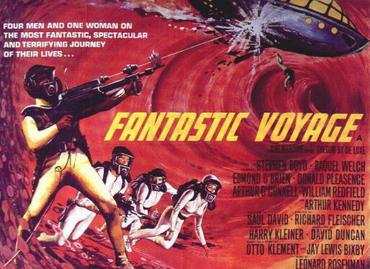
Fantastic Voyage
Groundbreaking doesn't mean groundbreaking for all-time. It qualifies only in the moment, maybe a few months, or even a year in the luckiest of situations. If a movie is considered groundbreaking, it kicks the door open and hundreds of rip-offs and wanna be follow-ups storm through the opening. That kept cycling through my head as I watched 1966's Fantastic Voyage.
A scientist (Jean Del Val) working for the Soviets has defected with American intelligence agencies desperate to help him and bring him to the United States. In the transport though, enemy agents attack, severely wounding him. He's in a coma with an unreachable blood clot on his brain, but he has info that the American government desperately wants. To relieve the pressure of the clot, a new technology will be utilized. A team of surgeons (including Arthur Kennedy and Donald Pleasence), a security officer (Stephen Boyd), and two others will travel via a submarine, be shrunk down to a microscopic size and injected into the scientist's body, traveling through his body and ultimately break up the clot and save his life. There's problems though. The body will most likely do everything it can to slow down the intruders, and they only have 60 minutes to get the job done before they begin to grow back to their normal size, whether they're in the body or not.
From director Richard Fleischer, this science fiction story won two Oscars, one for Best Art Direction and one for Best Special Effects. So while I didn't really care for the movie, I can appreciate the crazy visual on display. A tiny submarine the size of a period with five people inside traveling through a human body? How couldn't that be a great visual experience as a movie? Much of it comes from a green screen visual -- sets of the human body would be rather immense I'm supposing -- and just in terms of color alone, it's a beautiful movie. The little prototype submarine travels through the veins, arteries, lungs, heart, ears and ultimately, the brain.
So what do you think? A trip through the body and all its inner workings is unique, no doubt about that. Why then is this story so dull? I was bored to tears almost the second the submarine went to work. There's plenty of detours that provide some excitement. A miscalculation forces the crew to travel through the heart, but the problem is that the heart beating should tear the submarine apart. The medical staff monitoring the body basically shuts down the heart, giving the crew 60 seconds to travel through it. The premise presents all kinds of impressive, should-be cool situations like that. The crew is told that the body is going to do its best to protect itself, assuming that the submarine is a disease or virus of sorts. Those provide some cool visuals as well, antibodies swarming to the sub and the crew, but it's the weirdest thing. If that wasn't enough, someone involved with the mission is an enemy agent, but even that reveal is disappointing. It's a dull story of a very cool idea.
In a variation on one of my favorite sub-genres, 'Voyage' is a men-on-a-mission movie. Check that; a men-on-a-mission movie with Raquel Welch in a tight white bodysuit. So there it is, a group of specialists working to accomplish a mission. Along with Boyd's security and government agent, Kennedy's extremely talented lead surgeon, and Pleasence's reliable medical officer, there is Welch as Cora, Kennedy's assistant, and William Redfield as Capt. Owens, the Navy officer piloting the prototype submarine. Back at normal size, Edmond O'Brien and Arthur O'Connell play the bickering officers forced to make the difficult command decisions. Also look for a young James Brolin as one of the technicians working in the lab. None are given much in the way of background so instead of characters working to accomplish a dangerous mission, we're watching Stephen Boyd, Arthur Kennedy and Raquel Welch accomplish the mission. In other words, there's little personal investment in accomplishing the mission.
I thought I would enjoy this movie a lot in the early goings. The virtually silent, unexplained opening is a great scene-setter, eerie and unsettling because we don't know what's going on. It reminded me a lot of 1965's The Satan Bug in its simple style. I can't explain it though, but the second the miniaturized mission was presented I lost almost all interest in the story. There are some cool moments, but they didn't add up to a finished product that I enjoyed that much. Sorry to say it because I've long wanted to see it, but I came away disappointed with this 1960s sci-fi classic.
Fantastic Voyage (1966): **/****
A scientist (Jean Del Val) working for the Soviets has defected with American intelligence agencies desperate to help him and bring him to the United States. In the transport though, enemy agents attack, severely wounding him. He's in a coma with an unreachable blood clot on his brain, but he has info that the American government desperately wants. To relieve the pressure of the clot, a new technology will be utilized. A team of surgeons (including Arthur Kennedy and Donald Pleasence), a security officer (Stephen Boyd), and two others will travel via a submarine, be shrunk down to a microscopic size and injected into the scientist's body, traveling through his body and ultimately break up the clot and save his life. There's problems though. The body will most likely do everything it can to slow down the intruders, and they only have 60 minutes to get the job done before they begin to grow back to their normal size, whether they're in the body or not.
From director Richard Fleischer, this science fiction story won two Oscars, one for Best Art Direction and one for Best Special Effects. So while I didn't really care for the movie, I can appreciate the crazy visual on display. A tiny submarine the size of a period with five people inside traveling through a human body? How couldn't that be a great visual experience as a movie? Much of it comes from a green screen visual -- sets of the human body would be rather immense I'm supposing -- and just in terms of color alone, it's a beautiful movie. The little prototype submarine travels through the veins, arteries, lungs, heart, ears and ultimately, the brain.
So what do you think? A trip through the body and all its inner workings is unique, no doubt about that. Why then is this story so dull? I was bored to tears almost the second the submarine went to work. There's plenty of detours that provide some excitement. A miscalculation forces the crew to travel through the heart, but the problem is that the heart beating should tear the submarine apart. The medical staff monitoring the body basically shuts down the heart, giving the crew 60 seconds to travel through it. The premise presents all kinds of impressive, should-be cool situations like that. The crew is told that the body is going to do its best to protect itself, assuming that the submarine is a disease or virus of sorts. Those provide some cool visuals as well, antibodies swarming to the sub and the crew, but it's the weirdest thing. If that wasn't enough, someone involved with the mission is an enemy agent, but even that reveal is disappointing. It's a dull story of a very cool idea.
In a variation on one of my favorite sub-genres, 'Voyage' is a men-on-a-mission movie. Check that; a men-on-a-mission movie with Raquel Welch in a tight white bodysuit. So there it is, a group of specialists working to accomplish a mission. Along with Boyd's security and government agent, Kennedy's extremely talented lead surgeon, and Pleasence's reliable medical officer, there is Welch as Cora, Kennedy's assistant, and William Redfield as Capt. Owens, the Navy officer piloting the prototype submarine. Back at normal size, Edmond O'Brien and Arthur O'Connell play the bickering officers forced to make the difficult command decisions. Also look for a young James Brolin as one of the technicians working in the lab. None are given much in the way of background so instead of characters working to accomplish a dangerous mission, we're watching Stephen Boyd, Arthur Kennedy and Raquel Welch accomplish the mission. In other words, there's little personal investment in accomplishing the mission.
I thought I would enjoy this movie a lot in the early goings. The virtually silent, unexplained opening is a great scene-setter, eerie and unsettling because we don't know what's going on. It reminded me a lot of 1965's The Satan Bug in its simple style. I can't explain it though, but the second the miniaturized mission was presented I lost almost all interest in the story. There are some cool moments, but they didn't add up to a finished product that I enjoyed that much. Sorry to say it because I've long wanted to see it, but I came away disappointed with this 1960s sci-fi classic.
Fantastic Voyage (1966): **/****
Thursday, October 4, 2012
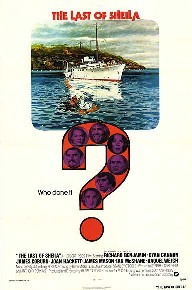
The Last of Sheila
Whodunit?!? Was it the suspicious relative who stands to earn millions of dollars on someone's death? Was it a hired gun? Oh, the murder mystery, where you can throw a long list of characters/suspects into one story, and let the chaos ensue. There are comedies like Clue, dramas like Murder on the Orient Express, and somewhere in between the two genres, 1973's The Last of Sheila.
It has been a full year since the death by hit-and-run of the wife of powerful Hollywood producer Clinton Green (James Coburn), and he's got a plan. Green has invited six friends of both his and his dead wife to a week-long vacation in the Mediterranean on his expansive yacht. All of them with different motivations and reasonings, they all agree. Green has a complicated scavenger hunt for them that will take them to six different ports, all to see who can figure out the end game first. But as the clues come together, the guests begin to realize there may be something more sinister going on.
For the last couple of years, I've been aware of this 1973 murder mystery with a touch of comedy amidst a much darker undertone. I'll get into it more in a bit, but the star power is impressive so it would be hard to completely miss it. From writers Stephen Sondheim and Anthony Perkins (yes, the actor) comes a script that is very smart, very clever and very entertaining. The game turns into a genuine mystery as a second murder comes into question. It's fast paced though, and the first hour is basically perfect as clues start to come together about what exactly Green is up to.
And what is his plan? The Hollywood producer has issued each of his guests a notecard with a single message; "I am a....." They seem like personality traits taken from the ether, but the guests begin to figure out that Green has identified very specific traits from each of his guests, one more embarrassing than the others. One clue is the worst though. "I am a hit and run killer." Does Clinton Green hope to reveal the identify of his wife's murderer? The scavenger hunt provides two great mood-setting scenes, equal parts dark humor and then just plain old darkness. It's clever without being too clever, and in tone alone, it's different from basically any other murder mystery I've ever seen. Win-win.
Now onto that cast, and no James Coburn is not the only star. This is a part that's pitch perfect for him. He's likable, he's charming, and he's an a-hole. His Clinton Green knows how to get under someone's skin like he's being paid to do it. By the 1970s, Coburn seemed to specialize in these amoral characters with questionable....well, everything. Green lures his guests in with the promise of possibly producing a movie about his wife, and he wants them all involved. There's Tom (Richard Benjamin), a screenwriter fallen on tough times, and his wife, Lee (Joan Hackett), Christine (Dyan Cannon), a talent agent who's had a relationship with Clinton in the past, Philip (James Mason), a director now forced to direct TV commercials, and Anthony (Ian McShane), an assistant/agent for his movie star wife, Alice (Raquel Welch). Not a weak performance in the bunch.
From here on in, I continue admitting that I liked this movie a lot and will give it a positive rating. But following my enjoyment from the first hour, I didn't go along as much for the second hour. The story takes a very surprising twist around the 60-70 minute mark that I didn't see coming in the least. The remainder of the story twists, turns, veers, U-turns and brakes all over the place. It all comes together in a long, detailed and fast-moving scene late as everything comes together, but all I could think was that I was missing something. Definitely an ending (and its build-up) that would probably improve on multiple viewings. I'll add it to the list, but for now, I very much enjoyed my first viewing. Above average murder mystery.
The Last of Sheila <---trailer (1973): ***/****
It has been a full year since the death by hit-and-run of the wife of powerful Hollywood producer Clinton Green (James Coburn), and he's got a plan. Green has invited six friends of both his and his dead wife to a week-long vacation in the Mediterranean on his expansive yacht. All of them with different motivations and reasonings, they all agree. Green has a complicated scavenger hunt for them that will take them to six different ports, all to see who can figure out the end game first. But as the clues come together, the guests begin to realize there may be something more sinister going on.
For the last couple of years, I've been aware of this 1973 murder mystery with a touch of comedy amidst a much darker undertone. I'll get into it more in a bit, but the star power is impressive so it would be hard to completely miss it. From writers Stephen Sondheim and Anthony Perkins (yes, the actor) comes a script that is very smart, very clever and very entertaining. The game turns into a genuine mystery as a second murder comes into question. It's fast paced though, and the first hour is basically perfect as clues start to come together about what exactly Green is up to.
And what is his plan? The Hollywood producer has issued each of his guests a notecard with a single message; "I am a....." They seem like personality traits taken from the ether, but the guests begin to figure out that Green has identified very specific traits from each of his guests, one more embarrassing than the others. One clue is the worst though. "I am a hit and run killer." Does Clinton Green hope to reveal the identify of his wife's murderer? The scavenger hunt provides two great mood-setting scenes, equal parts dark humor and then just plain old darkness. It's clever without being too clever, and in tone alone, it's different from basically any other murder mystery I've ever seen. Win-win.
Now onto that cast, and no James Coburn is not the only star. This is a part that's pitch perfect for him. He's likable, he's charming, and he's an a-hole. His Clinton Green knows how to get under someone's skin like he's being paid to do it. By the 1970s, Coburn seemed to specialize in these amoral characters with questionable....well, everything. Green lures his guests in with the promise of possibly producing a movie about his wife, and he wants them all involved. There's Tom (Richard Benjamin), a screenwriter fallen on tough times, and his wife, Lee (Joan Hackett), Christine (Dyan Cannon), a talent agent who's had a relationship with Clinton in the past, Philip (James Mason), a director now forced to direct TV commercials, and Anthony (Ian McShane), an assistant/agent for his movie star wife, Alice (Raquel Welch). Not a weak performance in the bunch.
From here on in, I continue admitting that I liked this movie a lot and will give it a positive rating. But following my enjoyment from the first hour, I didn't go along as much for the second hour. The story takes a very surprising twist around the 60-70 minute mark that I didn't see coming in the least. The remainder of the story twists, turns, veers, U-turns and brakes all over the place. It all comes together in a long, detailed and fast-moving scene late as everything comes together, but all I could think was that I was missing something. Definitely an ending (and its build-up) that would probably improve on multiple viewings. I'll add it to the list, but for now, I very much enjoyed my first viewing. Above average murder mystery.
The Last of Sheila <---trailer (1973): ***/****
Labels:
1970s,
Ian McShane,
James Coburn,
James Mason,
Raquel Welch,
Richard Benjamin
Sunday, May 15, 2011
One Million Years B.C.
Earlier in 1966, Raquel Welch starred in Fantastic Voyage, a cool little science fiction movie with an impressive ensemble cast. But if we're talking movies Welch starred in during 1966, that conversation is going to begin and end with one movie, One Million Years B.C.. Before this cult caveman classic was even released, 20th Century Fox Studios released photos of Miss Welch outfitted in a skimpy fur bikini that not surprisingly, went over quite well with audiences (I'm assuming a male-dominated audience). The pictures are easy to find -- just do a simple Google search -- and if anything, it is the outfit that is remembered more than the actual movie, which is pretty bad all things considered. It's up there with Ursula Andress in Dr. No coming out of the water in her white bikini as moments burned into the brains of thousands of viewers. As for the movie, you can take it or leave it.
Rewatching it this week for the first time in years, I realized how bad a movie it is. It was made by Hammer Films -- master of cheesy schlock in science fiction, horror, thriller and B-movies -- and came at a time when audiences ate up these low-budget flicks. In one of those weird examples where it is hard to explain reasoning, movie-going audiences went through a caveman/creature faze in the late 1960s and early 1970s. Of the ones I've seen, none of them are very good, but I don't know exactly what to say. These were movies about cavemen. Were they supposed to be good? Maybe not, but if nothing else they offered a chance to see some cool creature creations (more on that later) and female castmembers in various stages of undress or in scantily clad outfits. Take Raquel Welch out of this movie, and we're talking about a flick left to the ages.
In some sort of ridiculous past time where dinosaurs and people lived together, a caveman from the Rock tribe, Tumak (John Richardson), is banished from the group after a fight with the tribe's chieftain, Akhoba (Robert Brown). He heads out in the vast wasteland that is the desert wilderness on his own, battling creatures and conditions, desperately clinging to life. Tumak walks and walks and finally at the brink of death collapses near a large body of water where another tribe, the blonde Shell people, rescue him and bring him to their caves. One member of the tribe, the beautiful Loana (Welch), takes a keen interest in this strange, dark-looking man who walked out of the wild. But almost immediately, Tumak's ways burn that bridge too, and together he and Loana head back out into the wilderness. As they try to start a new life, a conflict is brewing between the two tribes, one that will bring them all together.
I've seen this movie a handful of times (it was a favorite of mine as a kid), but it wasn't until just now I realized how stupid it really is. To say there is an actual plot is a gigantic understatement. This is Cavemen Walking in the Desert. That's it. Occasionally, they grunt at each other, battle some prehistoric creatures, and then keep walking. The script -- yes, there is a script -- is an oddity because no actual conversation goes on at any point. There is some sort of pig latin caveman speak, but any interactions among anyone on-screen is a grunt, a blank stare, or a pissed off "I'm going to kill you!" look. If you're looking for a positive, and trust me, I'm trying, it's that director Don Chaffey shot this movie in the Canary Islands off of Spain. What did the landscape look like in prehistoric times? Who knows for sure, but this movie looks like some sort of post-apocalyptic hellhole where anything would struggle to survive. Stupid story, you bet. Great-looking movie, that too.
To talk about performances here feels beyond ridiculous to me so I'm not going to even make an attempt. Typically, I try and avoid minimizing criticisms/judgment of female characters based on looks or sex appeal alone, but that's basically impossible to do here because the whole movie is an excuse to watch Raquel Welch in her skimpy fur and leather bikini. That's it. End of movie. She's gorgeous, beautiful, out of this world sexy. Reviews have some fun pointing out that she's the most well-maintained cave-woman ever. A blonde, tan Raquel Welch in a bikini running around from all sorts of cavemen and creatures trying to kill her? It sounds like a decent basis for a movie. Who actually needs words spoken or a story when you've got that? Because there are at least a few other people in the movie, I'll mention them too. Richardson is phenomenal at looking bug-eyed and screaming, Brown is one gnarly-looking, angry dude, Percy Herbert is equally pissed off and willing to kill anyone who as much as looks at him funny, and Martine Beswick is Welch's Rock people adversary, a gorgeous, brunette cave-woman. See what they did there? Pretty sneaky.
One of the reasons movies like this are remembered so fondly are the creature creations of model-master Ray Harryhausen, he of Jason and the Argonauts fame among many other 1950s and 1960s flicks. Some 40-plus years later, the special effects do look dated, but they all add to the camp appeal of the movie. His stop-motion filming technique was a staple of a pre-CGI era in Hollywood. We see an allosaurus attack the Shell people's village, a pterodactyal swoop down and scoop up Welch's Loana, a giant turtle attack a hunting party, and several other examples peppered throughout the film. There is also the technique of super-imposing smaller animals (lizards, snakes, tarantulas) onto the screen to make them look gigantic, dwarfing the cast members. The movie never goes long without throwing some odd creature into the story, building up to the apocalyptic ending when all hell breaks loose when the volcanoes start to go. Yeah, no explanation needed there, just go with it. Throw in composer Mario Nascimbene and his epic, booming score, and you've certainly got a visually interesting movie.
Read through the DVD reviews at Amazon or anyplace really, and you'll come across complaints that the film as is on the DVD is an edited version of the film that was released in theaters in 1966. Almost 10 full minutes were cut out, and fans understandably were pissed they weren't seeing the whole movie. Good news for those fans, the print Turner Classic Movies aired recently is the full 100-minute long version. All the scenes mentioned that were cut (read IMDB's Alternate Versions HERE) were in the movie, back for everyone to enjoy. This is a guilty pleasure movie if there ever was one. A really bad, even awful movie, but one you can't help but enjoy through all the camp and cheesiness.
One Million Years B.C. <---trailer (1966): ** 1/2 /****
Rewatching it this week for the first time in years, I realized how bad a movie it is. It was made by Hammer Films -- master of cheesy schlock in science fiction, horror, thriller and B-movies -- and came at a time when audiences ate up these low-budget flicks. In one of those weird examples where it is hard to explain reasoning, movie-going audiences went through a caveman/creature faze in the late 1960s and early 1970s. Of the ones I've seen, none of them are very good, but I don't know exactly what to say. These were movies about cavemen. Were they supposed to be good? Maybe not, but if nothing else they offered a chance to see some cool creature creations (more on that later) and female castmembers in various stages of undress or in scantily clad outfits. Take Raquel Welch out of this movie, and we're talking about a flick left to the ages.
In some sort of ridiculous past time where dinosaurs and people lived together, a caveman from the Rock tribe, Tumak (John Richardson), is banished from the group after a fight with the tribe's chieftain, Akhoba (Robert Brown). He heads out in the vast wasteland that is the desert wilderness on his own, battling creatures and conditions, desperately clinging to life. Tumak walks and walks and finally at the brink of death collapses near a large body of water where another tribe, the blonde Shell people, rescue him and bring him to their caves. One member of the tribe, the beautiful Loana (Welch), takes a keen interest in this strange, dark-looking man who walked out of the wild. But almost immediately, Tumak's ways burn that bridge too, and together he and Loana head back out into the wilderness. As they try to start a new life, a conflict is brewing between the two tribes, one that will bring them all together.
I've seen this movie a handful of times (it was a favorite of mine as a kid), but it wasn't until just now I realized how stupid it really is. To say there is an actual plot is a gigantic understatement. This is Cavemen Walking in the Desert. That's it. Occasionally, they grunt at each other, battle some prehistoric creatures, and then keep walking. The script -- yes, there is a script -- is an oddity because no actual conversation goes on at any point. There is some sort of pig latin caveman speak, but any interactions among anyone on-screen is a grunt, a blank stare, or a pissed off "I'm going to kill you!" look. If you're looking for a positive, and trust me, I'm trying, it's that director Don Chaffey shot this movie in the Canary Islands off of Spain. What did the landscape look like in prehistoric times? Who knows for sure, but this movie looks like some sort of post-apocalyptic hellhole where anything would struggle to survive. Stupid story, you bet. Great-looking movie, that too.
To talk about performances here feels beyond ridiculous to me so I'm not going to even make an attempt. Typically, I try and avoid minimizing criticisms/judgment of female characters based on looks or sex appeal alone, but that's basically impossible to do here because the whole movie is an excuse to watch Raquel Welch in her skimpy fur and leather bikini. That's it. End of movie. She's gorgeous, beautiful, out of this world sexy. Reviews have some fun pointing out that she's the most well-maintained cave-woman ever. A blonde, tan Raquel Welch in a bikini running around from all sorts of cavemen and creatures trying to kill her? It sounds like a decent basis for a movie. Who actually needs words spoken or a story when you've got that? Because there are at least a few other people in the movie, I'll mention them too. Richardson is phenomenal at looking bug-eyed and screaming, Brown is one gnarly-looking, angry dude, Percy Herbert is equally pissed off and willing to kill anyone who as much as looks at him funny, and Martine Beswick is Welch's Rock people adversary, a gorgeous, brunette cave-woman. See what they did there? Pretty sneaky.
One of the reasons movies like this are remembered so fondly are the creature creations of model-master Ray Harryhausen, he of Jason and the Argonauts fame among many other 1950s and 1960s flicks. Some 40-plus years later, the special effects do look dated, but they all add to the camp appeal of the movie. His stop-motion filming technique was a staple of a pre-CGI era in Hollywood. We see an allosaurus attack the Shell people's village, a pterodactyal swoop down and scoop up Welch's Loana, a giant turtle attack a hunting party, and several other examples peppered throughout the film. There is also the technique of super-imposing smaller animals (lizards, snakes, tarantulas) onto the screen to make them look gigantic, dwarfing the cast members. The movie never goes long without throwing some odd creature into the story, building up to the apocalyptic ending when all hell breaks loose when the volcanoes start to go. Yeah, no explanation needed there, just go with it. Throw in composer Mario Nascimbene and his epic, booming score, and you've certainly got a visually interesting movie.
Read through the DVD reviews at Amazon or anyplace really, and you'll come across complaints that the film as is on the DVD is an edited version of the film that was released in theaters in 1966. Almost 10 full minutes were cut out, and fans understandably were pissed they weren't seeing the whole movie. Good news for those fans, the print Turner Classic Movies aired recently is the full 100-minute long version. All the scenes mentioned that were cut (read IMDB's Alternate Versions HERE) were in the movie, back for everyone to enjoy. This is a guilty pleasure movie if there ever was one. A really bad, even awful movie, but one you can't help but enjoy through all the camp and cheesiness.
One Million Years B.C. <---trailer (1966): ** 1/2 /****
Labels:
1960s,
Hammer Productions,
Percy Herbert,
Raquel Welch,
Ray Harryhausen
Thursday, April 29, 2010
Mother, Jugs and Speed
Pick a profession, any profession at all, and I'd bet you can find some sort of humor in it. Typically, the darker profession the funnier. Take 1976's Mother, Jugs and Speed which is about a privately owned ambulance company competing with another ambulance company for a contract with the city. People driving around saving patients who are in pain doesn't seem like an ideal setting for a comedy, but this one works somehow.
It is typical of many 70s comedies because it has a strong ensemble cast, some really quirky humor -- really quirky -- and a few attempts at some fairly raunchy jokes, most of which that don't work. The movie's first 30 minutes are the best and the funniest with the story getting weirder and weirder (not necessarily for the better) with each passing minute as so many elements are thrown together. What does work about the second half of the movie is more of a focus on three key characters, Mother, Jugs and Speed.
A cop on suspension (Harvey Keitel) -- he's under investigation for selling drugs -- takes a job with F & B Ambulances, a privately owned company in Los Angeles. Dubbed 'Speed' by his new co-workers, he finds quite a business going on. The owner, Harry Fishbine (Allen Garfield), tells Speed a city council meeting is coming up in a week where the company's fate will be decided and for him to not do anything stupid. He's teamed with Mother (Bill Cosby) in an ambulance and off they go. Speed finds quite the eccentric group of individuals at F&B including Jugs (Raquel Welch), the secretary, and Murdoch (Larry Hagman), a would-be ladies' man, among many others. Can this crew of weirdos keep it together long enough to keep the company going?
There isn't a plot here as much as a series of vignettes showing the craziness and quirkiness of the job of the ambulance drivers. The first 20-25 minutes is just gag after gag as Mother and Co. go through a typical night of doing their job. Because they're privately owned, the drivers have to ask for payment on pickup -- $42.50 and 50 cents a mile -- which does provide some funny moments. Their rival, United Ambulance, is always competing with them for patients, and neither company is beneath pulling off some shenanigans. A local police officer (L.Q. Jones) is always willing to help them out as long as his palm is greased. It probably would have been difficult to maintain that tone throughout the movie when Captain Buzzkill arrives.
It's after that first 30 minutes that the story takes an odd turn. The script has a lot of different elements, some of which seem incredibly out of place, almost like director Peter Yates couldn't decide which direction to take his movie in. It's slapstick comedy, then dark comedy, then romance, some perverted actions for good measure, and a shootout at the end. Hagman's Murdoch tries to rape a knocked out patient but still has a job. Mother beats the crap out of him but for something completely different. Murdoch disappears and reappears when his craziness is needed for the finale.
Even with all the ridiculousness going on, the cast has a way of righting the ship. Cosby is great as Mother, the sarcastic driver who always helps run the place and is protective of the company and his co-workers, even if he never shows it to their faces. A lot of his laughs sound like he improvised them, but the serious side of the character is dead-on, especially one monologue late about the pressures and demands of the job. He also has one of the weirdest scenes ever in a "massage parlor" where he gets to do some Cosby-isms. Welch must have groaned when she saw her character's name, but she's good as Jennifer ("Jugs"), the secretary trying to make it as an EMT. Keitel is good as always -- when wasn't he good? -- as the straight man to all the craziness. Along with Hagman, some of the other drivers include Bruce Davison as pot-smoking Leroy, NFL legend Dick Butkus as Rodeo, and Allan Warnick as Bliss, the highly intelligent and highly gay driver.
A weird, off the wall 70s comedy if there ever was one. I wish the story could have been streamlined some more with a decision to go one way or another, but this is still an enjoyable movie. It's got some good laughs -- one bit early with a runaway gurney is priceless -- but the main reason to see this is the cast, especially the leads. Cosby, Welch, and Keitel have a great chemistry together and through all the craziness, that's what is worth watching.
Mother, Jugs and Speed <----trailer (1976): ***/****
It is typical of many 70s comedies because it has a strong ensemble cast, some really quirky humor -- really quirky -- and a few attempts at some fairly raunchy jokes, most of which that don't work. The movie's first 30 minutes are the best and the funniest with the story getting weirder and weirder (not necessarily for the better) with each passing minute as so many elements are thrown together. What does work about the second half of the movie is more of a focus on three key characters, Mother, Jugs and Speed.
A cop on suspension (Harvey Keitel) -- he's under investigation for selling drugs -- takes a job with F & B Ambulances, a privately owned company in Los Angeles. Dubbed 'Speed' by his new co-workers, he finds quite a business going on. The owner, Harry Fishbine (Allen Garfield), tells Speed a city council meeting is coming up in a week where the company's fate will be decided and for him to not do anything stupid. He's teamed with Mother (Bill Cosby) in an ambulance and off they go. Speed finds quite the eccentric group of individuals at F&B including Jugs (Raquel Welch), the secretary, and Murdoch (Larry Hagman), a would-be ladies' man, among many others. Can this crew of weirdos keep it together long enough to keep the company going?
There isn't a plot here as much as a series of vignettes showing the craziness and quirkiness of the job of the ambulance drivers. The first 20-25 minutes is just gag after gag as Mother and Co. go through a typical night of doing their job. Because they're privately owned, the drivers have to ask for payment on pickup -- $42.50 and 50 cents a mile -- which does provide some funny moments. Their rival, United Ambulance, is always competing with them for patients, and neither company is beneath pulling off some shenanigans. A local police officer (L.Q. Jones) is always willing to help them out as long as his palm is greased. It probably would have been difficult to maintain that tone throughout the movie when Captain Buzzkill arrives.
It's after that first 30 minutes that the story takes an odd turn. The script has a lot of different elements, some of which seem incredibly out of place, almost like director Peter Yates couldn't decide which direction to take his movie in. It's slapstick comedy, then dark comedy, then romance, some perverted actions for good measure, and a shootout at the end. Hagman's Murdoch tries to rape a knocked out patient but still has a job. Mother beats the crap out of him but for something completely different. Murdoch disappears and reappears when his craziness is needed for the finale.
Even with all the ridiculousness going on, the cast has a way of righting the ship. Cosby is great as Mother, the sarcastic driver who always helps run the place and is protective of the company and his co-workers, even if he never shows it to their faces. A lot of his laughs sound like he improvised them, but the serious side of the character is dead-on, especially one monologue late about the pressures and demands of the job. He also has one of the weirdest scenes ever in a "massage parlor" where he gets to do some Cosby-isms. Welch must have groaned when she saw her character's name, but she's good as Jennifer ("Jugs"), the secretary trying to make it as an EMT. Keitel is good as always -- when wasn't he good? -- as the straight man to all the craziness. Along with Hagman, some of the other drivers include Bruce Davison as pot-smoking Leroy, NFL legend Dick Butkus as Rodeo, and Allan Warnick as Bliss, the highly intelligent and highly gay driver.
A weird, off the wall 70s comedy if there ever was one. I wish the story could have been streamlined some more with a decision to go one way or another, but this is still an enjoyable movie. It's got some good laughs -- one bit early with a runaway gurney is priceless -- but the main reason to see this is the cast, especially the leads. Cosby, Welch, and Keitel have a great chemistry together and through all the craziness, that's what is worth watching.
Mother, Jugs and Speed <----trailer (1976): ***/****
Labels:
1970s,
Harvey Keitel,
L.Q. Jones,
Peter Yates,
Raquel Welch
Subscribe to:
Posts (Atom)
.jpg)
.jpg)