One of the seminal moments in American history, especially in the 19th Century, the gunfight at the O.K. Corral is synonymous with the wild, wild west. It was a gunfight that only lasted 15 or 20 seconds, but the men involved would became famous because of their actions. What about after the gunfight though? What happened next? That is a story that is far less well-known, but it gets a fascinating examination in a mostly forgotten 1967 western, Hour of the Gun.
It's October 26, 1881 in the Arizona silver boom-town of Tombstone. Deputy Marshal Wyatt Earp (James Garner), his two brothers, and their friend Doc Holliday (Jason Robards), are heading for a fight after a long-running, long-simmering feud with Ike Clanton (Robert Ryan) and his gang of gunmen, bandits and rustlers. A gunfight ensues with three men -- all outlaws -- killed while Wyatt's brothers are wounded. The fight does nothing to end the feud, only adding fuel to the fire. The immediate response begins in a courtroom as Wyatt, Doc and the Earp brothers are brought up on charges for their actions that led to the gunfight and then for outright murder. This won't be resolved with words though. Too much has passed between the two sides with too many deaths for it to be fixed so easily. Wyatt and Doc live by the gun as does Ike Clanton. Let the bullets fly and those who get caught in the way...so be it.
From the first time I saw 1993's Tombstone, I was fascinated not just by the gunfight at the OK Corral but what happened after it. Unless I'm missing a flick, this is the first western to dive in headfirst to the aftermath. An unofficial sequel from his film 10 years earlier, Gunfight at the OK Corral, director John Sturges turns in a dark, moody, character-driven angle of the story. There's gunplay but not a ton. The story condenses months and months of history into a tightly-packed 105-minutes but one that doesn't feel too rushed. It's a daunting extended stretch to handle but Sturges and writer Edward Anhalt do a pretty solid job condensing and tweaking and twisting here to make it more manageable.
Two years later, Sam Peckinpah's The Wild Bunch would kick open the door for the western, effectively starting the genre on a path that proved to be its doom. The spaghetti westerns started it, Peckinpah continued and the revisionist westerns of the 1970's finished it off. Where's 'Hour' fit? Somewhere in between. It isn't a revisionist western. It's just a straightforward, mostly honest, not heroic interpretation of the real-life events. There aren't heroes, just less unlikable individuals. Case in point is Garner's Wyatt, not the crisp, clean, honest lawman he's often portrayed as. Here, he's a hypocrite, blinded with rage and almost completely driven by it. Towns are run by the rich, everything depends on power and money, and that power depends on backstabbing, back-shooting and all sorts of underhanded dealings. This ain't no good guys in white hats vs. bad guys in black hats. A precursor of the things to come in the western genre.
In film or on television, James Garner has a reputation as a likable presence, a sympathetic hero so....it's awesome to see him take these darker roles, like 1970's A Man Called Sledge. As we've learned, Wyatt Earp wasn't necessarily the heroic, noble lawman he's often portrayed as. 'Hour' delves right into that concept. Here, he's a revenge-seeking murderer hiding behind a marshal's badge and a warrant for arrest. It's a fascinating character and not necessarily sympathetic. Garner doesn't disappoint with this darker role. Just wish he had done more roles like this!
The key relationship in all the Earp/Tombstone movies though is between Wyatt Earp, the law officer, and Doc Holliday, the gambling dentist slowly dying of tuberculosis. All Holliday performances pale in comparison to Val Kilmer in 1993's Tombstone, but Robards is pretty damn good and belongs in close second with Dennis Quaid in the otherwise painful Wyatt Earp. Robards does what he always does. He quietly steals all his scenes to the point you don't even realize he's doing it. His chemistry with Garner is impeccable, a friendship with more of an edge than we're used to seeing. Their arguments become heated to the point of lashing out violently. Through it all though, there's an unspoken bond between them, two loners, two outsiders who have found the unlikeliest of friends. Two excellent leading performances.
Beyond Ryan, 'Hour' is light on star power, but that's not a bad thing. Ryan's Ike Clanton is probably the most exaggerated part here with the movie Clanton not resembling the actual historical Clanton. Still, it's Robert Ryan in sneering, condescending villain mode, and that ain't a bad thing. Wyatt's misfit posse includes Monte Markham, William Windom and Lonny Chapman. Their targets include Michael Tolan, Robert Philips, Steve Inhat and a very young Jon Voight. Too many familiar faces from film and television to mention, but also look for Albert Salmi, Karl Swenson and Bill Fletcher among many others.
I can't quite put my finger on it, but I liked 'Hour' much more on this second viewing than the first (it had been at six or seven years). It isn't an easy western to watch, and doesn't do much to pull you in in any sort of obvious fashion. That said, there's just something about it. Filmed in Mexico with cinematographer Lucien Ballard (one of the all-time greats), the movie looks stunning. Throw in one of Jerry Goldsmith's more underrated scores and it all adds up. Listen to the score HERE. It's a familiar story by now, that of Wyatt Earp and the OK Corral, but this adult western holds together quite well. Highly recommended.
Hour of the Gun (1967): ***/****
The Sons of Katie Elder
"First, we reunite, then find Ma and Pa's killer...then read some reviews."
Showing posts with label John Sturges. Show all posts
Thursday, April 7, 2016
Monday, August 3, 2015
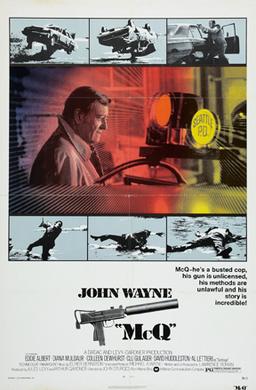
McQ
By the mid 1960's John Wayne wasn't just John Wayne anymore. He was the Duke, an icon and a star. He came to represent something bigger, something Wayne thought people needed to look up to. Because of that sentiment, he turned down some roles that he thought were too much against type. The two big ones? The Major Reisman part from The Dirty Dozen and the role of a famous rogue cop named....Dirty Harry. Wayne regretted not taking the part made famous by Clint Eastwood and went about fixing the issue. The result? Two cop movies, starting with 1974's McQ and following a year later with Brannigan (soon to be reviewed).
A longtime detective on the Seattle police force, Lieutenant Lon 'McQ' McHugh (Wayne) has seen everything there is to be seen. After years on the force, he's sick of the politicians and the glad-handing and all the garbage. He's interested in putting the crooks away, but now one attempted murder hits too close to home when his partner, Lt. Stan Boyle (William Bryant), is shot in the back with a shotgun with no witnesses. Boyle's chances aren't too good, but McQ intends to do something about it. Who shot his partner? The clues are there, and McQ begins to suspect there's a whole lot more going on than meets the eye. He begins to find evidence that could point to any number of trails worth following, from a high-level drug supplier to corruption within the police force. Can he piece it all together before those people he's chasing get him instead?
I've been a huge John Wayne fan for as long as I can remember. If he's starring in a movie, I'll give it a shot. Mostly, they're winners but occasionally there's a dud here and there. I'm looking at you The Conqueror. In this last portion of his career -- mostly the late 1960's and into the 1970's -- Wayne was making movies he wanted to make, movies he figured his fans and audiences wanted to see. Are they classics? With the exception of True Grit and The Shootist, no. On the other hand, they're F-U-N, movies like Big Jake, The Train Robbers, Chisum, The Cowboys and several others. So regretting not taking the Harry Callahan role (a big thank you from Eastwood), Wayne dove headfirst into the renegade cop genre. The winners? Us. McQ and Brannigan aren't classics, but man, are they ever fun.
The rogue/renegade cop movies of the 60's and 70's were everywhere, ranging from Bullitt to Dirty Harry to Magnum Force to The French Connection with plenty more in between. The crime thriller as a whole was at its absolute best. But a John Wayne take on the genre? Yes. Yes. The script gives him some nice touches to show he's a cool cop, like his houseboat, his Pontiac trans am, his efforts to stay involved in his daughter's life, even though ex-wife Julie Adams just couldn't take their marriage anymore. By 1974, Wayne was 66 years old, a little thicker around the midsection and sporting a toupee but you know what? He makes it look effortless. That no-nonsense, all-business attitude plays well as the frustrated cop role. Rules? Meh. Hippies? Don't bug him about them. Getting the crooks behind bars? NOW you're talking.
It doesn't matter the genre. It doesn't matter the script really. It's John Wayne, and he's going to make the most of it. The cast across the board is pretty cool. Eddie Albert gets to glare and snare as Kosterman, McQ's commanding officer who's sick of his take no prisoners attitude, and has some great scenes, two pros going toe to toe. Diana Muldaur plays Boyle's wife, always close with McQ, while Colleen Dewhurst plays Myra, an informant, waitress and drug addict who McQ milks for dirt. Among the cops on the case, also look for Clu Gulager, David Huddleston, and Julian Christopher while Roger E. Mosley plays a pimp/snitch, quite the one-two punch. And last but not least, Al Lettieri does what he does best...in be a slimy 1970's villain, this one a drug supplier with a checkered history with McQ so you know that's going to end well. Some fun parts to back up the Duke throughout.
If you're a fan of Bullitt, the Dirty Harry movies, or assorted other 1960's/1970's cop movies, you'll like this one. Director John Sturges does a good job using his on-location shoots in Seattle to give the story that sense of authenticity, and composer Elmer Bernstein turns in a cool, funky, jazzy score...that's still very clearly an Elmer Bernstein score (and that's a good thing). There's a really cool car chase through and around Seattle's highways about halfway through (just like Bullitt), and the shootout finale on oceanfront beach is very well-done as three 1970's boats, um, I mean "cars," tear after each other. Oh, and John Wayne gets to unleash a heavy-duty automatic machine gun.
Is it a classic? No way, but it is a heck of a lot of fun with a story that never really slows down and has some fun with twists you think you'll see. More than enough to recommend, and John Wayne is having some fun from beginning to end. What would it have been like if Wayne took the Dirty Harry role? We'll never know, but it seemed to turn out generally okay for everyone involved. I guess. Right, Mr. Eastwood?
McQ (1974): ***/****
A longtime detective on the Seattle police force, Lieutenant Lon 'McQ' McHugh (Wayne) has seen everything there is to be seen. After years on the force, he's sick of the politicians and the glad-handing and all the garbage. He's interested in putting the crooks away, but now one attempted murder hits too close to home when his partner, Lt. Stan Boyle (William Bryant), is shot in the back with a shotgun with no witnesses. Boyle's chances aren't too good, but McQ intends to do something about it. Who shot his partner? The clues are there, and McQ begins to suspect there's a whole lot more going on than meets the eye. He begins to find evidence that could point to any number of trails worth following, from a high-level drug supplier to corruption within the police force. Can he piece it all together before those people he's chasing get him instead?
I've been a huge John Wayne fan for as long as I can remember. If he's starring in a movie, I'll give it a shot. Mostly, they're winners but occasionally there's a dud here and there. I'm looking at you The Conqueror. In this last portion of his career -- mostly the late 1960's and into the 1970's -- Wayne was making movies he wanted to make, movies he figured his fans and audiences wanted to see. Are they classics? With the exception of True Grit and The Shootist, no. On the other hand, they're F-U-N, movies like Big Jake, The Train Robbers, Chisum, The Cowboys and several others. So regretting not taking the Harry Callahan role (a big thank you from Eastwood), Wayne dove headfirst into the renegade cop genre. The winners? Us. McQ and Brannigan aren't classics, but man, are they ever fun.
The rogue/renegade cop movies of the 60's and 70's were everywhere, ranging from Bullitt to Dirty Harry to Magnum Force to The French Connection with plenty more in between. The crime thriller as a whole was at its absolute best. But a John Wayne take on the genre? Yes. Yes. The script gives him some nice touches to show he's a cool cop, like his houseboat, his Pontiac trans am, his efforts to stay involved in his daughter's life, even though ex-wife Julie Adams just couldn't take their marriage anymore. By 1974, Wayne was 66 years old, a little thicker around the midsection and sporting a toupee but you know what? He makes it look effortless. That no-nonsense, all-business attitude plays well as the frustrated cop role. Rules? Meh. Hippies? Don't bug him about them. Getting the crooks behind bars? NOW you're talking.
It doesn't matter the genre. It doesn't matter the script really. It's John Wayne, and he's going to make the most of it. The cast across the board is pretty cool. Eddie Albert gets to glare and snare as Kosterman, McQ's commanding officer who's sick of his take no prisoners attitude, and has some great scenes, two pros going toe to toe. Diana Muldaur plays Boyle's wife, always close with McQ, while Colleen Dewhurst plays Myra, an informant, waitress and drug addict who McQ milks for dirt. Among the cops on the case, also look for Clu Gulager, David Huddleston, and Julian Christopher while Roger E. Mosley plays a pimp/snitch, quite the one-two punch. And last but not least, Al Lettieri does what he does best...in be a slimy 1970's villain, this one a drug supplier with a checkered history with McQ so you know that's going to end well. Some fun parts to back up the Duke throughout.
If you're a fan of Bullitt, the Dirty Harry movies, or assorted other 1960's/1970's cop movies, you'll like this one. Director John Sturges does a good job using his on-location shoots in Seattle to give the story that sense of authenticity, and composer Elmer Bernstein turns in a cool, funky, jazzy score...that's still very clearly an Elmer Bernstein score (and that's a good thing). There's a really cool car chase through and around Seattle's highways about halfway through (just like Bullitt), and the shootout finale on oceanfront beach is very well-done as three 1970's boats, um, I mean "cars," tear after each other. Oh, and John Wayne gets to unleash a heavy-duty automatic machine gun.
Is it a classic? No way, but it is a heck of a lot of fun with a story that never really slows down and has some fun with twists you think you'll see. More than enough to recommend, and John Wayne is having some fun from beginning to end. What would it have been like if Wayne took the Dirty Harry role? We'll never know, but it seemed to turn out generally okay for everyone involved. I guess. Right, Mr. Eastwood?
McQ (1974): ***/****
Labels:
1970s,
Al Lettieri,
Cops,
Eddie Albert,
John Sturges,
John Wayne,
Julie Adams
Tuesday, May 6, 2014
The Magnificent Seven
Why
do some movies stick with you more than others? I grew up watching
westerns and war movies from the 1950s and 1960s, movies that still
dominate my all-time Top 10, movies like The Alamo, The Great Escape,
The Dirty Dozen, The Good, the Bad and the Ugly, The Professionals and
several others. They still resonate now more than a few years later. Oh,
and of course, 1960's The Magnificent Seven.
Several years back I reviewed all four movies (the original and the 3
sequels), and it's been too long. Time for an updated review. The
original and still best, one of the best westerns ever and a personal
favorite.
South of the border in a small farming village, a bandit named Calvera (Eli Wallach) rides in and steals almost everything he and his gang of 40 bandits can carry, leaving just enough for the village to survive and start all over again. The villagers decide they've had about enough, riding north into Texas to buy guns so they can fight back against Calvera's gang. Instead, they meet Chris (Yul Brynner), a mysterious gunfighter clad in black who recommends they hire men rather than buy guns. Chris agrees to help, recruiting six other gunfighters from varying backgrounds, including an amiable drifter and gunfighter, Vin (Steve McQueen), to help out. The money is poor, the mission is more than difficult and the odds are stacked against them. Chris and the six gunslingers ride south, ready to help the village and fight off Calvera, odds be damned.
What a good movie. From director John Sturges (a master of 'Movies for Men'), 'Seven' came along at an interesting time for the western genre. Things, they were a'changing. Westerns were becoming more cynical, darker, more introspective, eventually transforming into the spaghetti western and the folksy, revisionist westerns of the 1970s. As fondly remembered as 'Seven' is now, it struggled in theaters in the U.S. upon its initial release, finding huge success in Europe and Asia before being re-issued in the U.S. several years later. It is an Americanized version of Akira Kurosawa's classic film, Seven Samurai, transplanting samurais for wild west gunfighters. It's interesting for any number of reasons, from the music to the budding star power on display, the dark tone to the exciting action scenes. A favorite of mine, a four-star review, and I won't really debate it. So there!
How about that casting?!? Much of the cast would go on to become huge stars, but here in 1960, they were relative unknowns. Brynner was the established star, The King and I, The Ten Commandments already to his name, and he's the pulse of the movie. His Chris is the unflappable leader of the group, a capable gunfighter who's also got all the qualities a leader should have. Loyal, strong, and tough. McQueen steps up to the plate in his first starring role. His Vin is easy-going, a drifter looking for work, quite good with his gun but maybe looking for something else in his life. Brynner and McQueen had a tumultuous relationship on the set -- McQueen trying to upstage the established star -- but the result is more than solid. Their chemistry crackles, their scenes together that perfect dynamic between the commander and his right-hand man. As the bandit Calvera, Wallach is an effortless scene-stealer, disappearing for huge stretches only to return with a vengeance.
And then there's the rest of the seven, because Brynner and McQueen weren't enough, right? Right?!? First, there's Charles Bronson as Bernardo O'Reilly, a half-Mexican, half-Irish gunman who has quite the reputation for cleaning up nasty jobs and his price is high...usually. He bonds with three boys from the village who "got him," promising to watch over him and care for his grave should he die in battle. Then, there's James Coburn as Britt, the laconic, knife-throwing specialist who has few equals with knife or gun. Coburn says about 30 words the entire movie and steals every scene he's in. Next, Robert Vaughn as Lee, a hired gun who's lost his edge, convinced he is facing his death. Next up, Brad Dexter as Harry Luck, a friendly gunslinger convinced there's more to the job than Chris is saying. Finally, there's Horst Buchholz as Chico, the young, unproven kid looking to make a name for himself with his more established cohorts.
As if that star power wasn't enough to carry a movie, I liked the characterization of these gunslingers more than anything. That's something I've picked up on repeated viewings as I got older. The portrayal of these hired guns is honest, not looking to glamorize these men. They're tied down by nothing, drift along from job to job, all the while risking their lives knowing that any job could be their last. What do they have? Their guns, their horse and maybe most importantly, their word. 'Seven' boasts one of my all-time favorite scenes, in westerns and films in general. Given a chance to run from a battle against seemingly insurmountable odds, they opt to stay. Coburn's Britt famously says "No one throws me my own guns and says run....Nobody." When offered the chance to run, Vaughn's Lee is told "Go ahead, Lee, you don't owe anything to anybody." His answer? "Except to myself." That's the essence and spirit of the movie. Men in a nasty situation doing what's right because it's what they should do, what is right. Profoundly simple, it always sticks with me, these men living by their code and what they believe in.
As for the villagers, look for Vladimir Sokoloff as the Old Man, the village patriarch who has little use for the whiny farmers, Jorge Martinez de Hoyos as Hilario, the fiery farmer ready to side with the gunmen, Pepe Hern and John Alonzo his close friends, Rico Alaniz as Sotero, the quasi-mayor of the village trying to weigh all his options and lastly, Rosenda Monteros as Petra, the young woman in the village who takes a liking to Buchholz's Chico. Also look for familiar western faces Robert J. Wilke and Whit Bissell in quick scenes.
More than anything else though, I think what's lasted the longest in the social conscience is composer Elmer Bernstein's musical score. The soundtrack is one of the all-time greats, the main theme a whistle-worthy track that will be running through your head for days. This is what big movie soundtracks can be. They add something to the movie itself, like a new but essential character. If you're not familiar with it (and even if you are), listen HERE. Just a great score, moving, adrenaline-pumping and emotional as needed. An all-time great score from an all-time great composer.
The story covers a lot of ground over its 128-minute running time. The story is fairly episodic, starting with the essential and entertaining recruiting of the team, Brynner's Chris seeking the gunmen out for the job. Each snippet gives each actor his chance to stand out on their own before becoming part of the group. Coburn's classic introduction especially stands out. From there, it's one great scene after another, both as entertainment value but also for delving into all the characters from the Seven to the villagers to Calvera. There isn't a ton of action, but the gunplay stands out, two featured sequences as the Seven tangle with Calvera's gang. It's the final battle that packs the emotional punch, the odds finally taking their toll on this group of gunfighters we've come to like and root for. It's a downbeat ending when you really consider it, but it's the right ending for this story and the characters.
Just a great movie. It was a favorite growing up and always will be. One of the best westerns ever, and an easy one to recommend for fans of the western genre or for someone just being introduced to the genre as a whole. A classic, plain and simple.
The Magnificent Seven (1960): ****/****
Rewrite of September 2009 review
South of the border in a small farming village, a bandit named Calvera (Eli Wallach) rides in and steals almost everything he and his gang of 40 bandits can carry, leaving just enough for the village to survive and start all over again. The villagers decide they've had about enough, riding north into Texas to buy guns so they can fight back against Calvera's gang. Instead, they meet Chris (Yul Brynner), a mysterious gunfighter clad in black who recommends they hire men rather than buy guns. Chris agrees to help, recruiting six other gunfighters from varying backgrounds, including an amiable drifter and gunfighter, Vin (Steve McQueen), to help out. The money is poor, the mission is more than difficult and the odds are stacked against them. Chris and the six gunslingers ride south, ready to help the village and fight off Calvera, odds be damned.
What a good movie. From director John Sturges (a master of 'Movies for Men'), 'Seven' came along at an interesting time for the western genre. Things, they were a'changing. Westerns were becoming more cynical, darker, more introspective, eventually transforming into the spaghetti western and the folksy, revisionist westerns of the 1970s. As fondly remembered as 'Seven' is now, it struggled in theaters in the U.S. upon its initial release, finding huge success in Europe and Asia before being re-issued in the U.S. several years later. It is an Americanized version of Akira Kurosawa's classic film, Seven Samurai, transplanting samurais for wild west gunfighters. It's interesting for any number of reasons, from the music to the budding star power on display, the dark tone to the exciting action scenes. A favorite of mine, a four-star review, and I won't really debate it. So there!
How about that casting?!? Much of the cast would go on to become huge stars, but here in 1960, they were relative unknowns. Brynner was the established star, The King and I, The Ten Commandments already to his name, and he's the pulse of the movie. His Chris is the unflappable leader of the group, a capable gunfighter who's also got all the qualities a leader should have. Loyal, strong, and tough. McQueen steps up to the plate in his first starring role. His Vin is easy-going, a drifter looking for work, quite good with his gun but maybe looking for something else in his life. Brynner and McQueen had a tumultuous relationship on the set -- McQueen trying to upstage the established star -- but the result is more than solid. Their chemistry crackles, their scenes together that perfect dynamic between the commander and his right-hand man. As the bandit Calvera, Wallach is an effortless scene-stealer, disappearing for huge stretches only to return with a vengeance.
And then there's the rest of the seven, because Brynner and McQueen weren't enough, right? Right?!? First, there's Charles Bronson as Bernardo O'Reilly, a half-Mexican, half-Irish gunman who has quite the reputation for cleaning up nasty jobs and his price is high...usually. He bonds with three boys from the village who "got him," promising to watch over him and care for his grave should he die in battle. Then, there's James Coburn as Britt, the laconic, knife-throwing specialist who has few equals with knife or gun. Coburn says about 30 words the entire movie and steals every scene he's in. Next, Robert Vaughn as Lee, a hired gun who's lost his edge, convinced he is facing his death. Next up, Brad Dexter as Harry Luck, a friendly gunslinger convinced there's more to the job than Chris is saying. Finally, there's Horst Buchholz as Chico, the young, unproven kid looking to make a name for himself with his more established cohorts.
As if that star power wasn't enough to carry a movie, I liked the characterization of these gunslingers more than anything. That's something I've picked up on repeated viewings as I got older. The portrayal of these hired guns is honest, not looking to glamorize these men. They're tied down by nothing, drift along from job to job, all the while risking their lives knowing that any job could be their last. What do they have? Their guns, their horse and maybe most importantly, their word. 'Seven' boasts one of my all-time favorite scenes, in westerns and films in general. Given a chance to run from a battle against seemingly insurmountable odds, they opt to stay. Coburn's Britt famously says "No one throws me my own guns and says run....Nobody." When offered the chance to run, Vaughn's Lee is told "Go ahead, Lee, you don't owe anything to anybody." His answer? "Except to myself." That's the essence and spirit of the movie. Men in a nasty situation doing what's right because it's what they should do, what is right. Profoundly simple, it always sticks with me, these men living by their code and what they believe in.
As for the villagers, look for Vladimir Sokoloff as the Old Man, the village patriarch who has little use for the whiny farmers, Jorge Martinez de Hoyos as Hilario, the fiery farmer ready to side with the gunmen, Pepe Hern and John Alonzo his close friends, Rico Alaniz as Sotero, the quasi-mayor of the village trying to weigh all his options and lastly, Rosenda Monteros as Petra, the young woman in the village who takes a liking to Buchholz's Chico. Also look for familiar western faces Robert J. Wilke and Whit Bissell in quick scenes.
More than anything else though, I think what's lasted the longest in the social conscience is composer Elmer Bernstein's musical score. The soundtrack is one of the all-time greats, the main theme a whistle-worthy track that will be running through your head for days. This is what big movie soundtracks can be. They add something to the movie itself, like a new but essential character. If you're not familiar with it (and even if you are), listen HERE. Just a great score, moving, adrenaline-pumping and emotional as needed. An all-time great score from an all-time great composer.
The story covers a lot of ground over its 128-minute running time. The story is fairly episodic, starting with the essential and entertaining recruiting of the team, Brynner's Chris seeking the gunmen out for the job. Each snippet gives each actor his chance to stand out on their own before becoming part of the group. Coburn's classic introduction especially stands out. From there, it's one great scene after another, both as entertainment value but also for delving into all the characters from the Seven to the villagers to Calvera. There isn't a ton of action, but the gunplay stands out, two featured sequences as the Seven tangle with Calvera's gang. It's the final battle that packs the emotional punch, the odds finally taking their toll on this group of gunfighters we've come to like and root for. It's a downbeat ending when you really consider it, but it's the right ending for this story and the characters.
Just a great movie. It was a favorite growing up and always will be. One of the best westerns ever, and an easy one to recommend for fans of the western genre or for someone just being introduced to the genre as a whole. A classic, plain and simple.
The Magnificent Seven (1960): ****/****
Rewrite of September 2009 review
Thursday, January 5, 2012
Ice Station Zebra
Part Cold War thriller, part submarine movie, 1968's Ice Station Zebra has a lot going for it. Good story, better cast and solid directing. For years, it gained more of a cult status because it wasn't even available on DVD. It's even known as one of Howard Hughes' favorite movies. How's that pointless trivia for you? So what happens to it? Somewhere along the line, 'Zebra' goes off the tracks.
Patrolling in the North Atlantic, Capt. James Ferraday (Rock Hudson) and the U.S.S. Tigerfish, a US nuclear submarine, receives a new set of orders. The Tigerfish is to pick up a new passenger, a British agent named Jones (Patrick McGoohan), and head north to find Ice Station Zebra, a civilian weather station floating on a polar ice cap. Jones can say nothing else about the importance of the mission, only that it must be accomplished. Picking up two other passengers, Boris (Ernest Borgnine), a Russian defector, and Capt. Anders (Jim Brown), a Marine officer, the Tigerfish heads north. Ferraday quickly figures out that there is a traitor among the group and maybe even his crew. Can they find out who it is as they desperately attempt to complete their mission?
'Zebra' is based on a novel by adventure/espionage master Alistair MacLean, author of The Guns of Navarone and Where Eagles Dare. This past summer I read 'Zebra' for the first time only to discover it was a mess. I struggled to go along with it unlike any other MacLean novel I'd read. Directed by John Sturges, the film suffers from some of the same problems. In 1968, a nuclear submarine was big news, especially a portrayal on said sub. Much like Tom Clancy would years later, 'Zebra' gets bogged down in the minutiae of day-to-day life on the submarine; traveling under an ice pack, using radar and advanced technology to locate icebergs and drifts, finding a suitable spot to break through the ice. None of this makes for an exciting visual story.
That's a start though, but not a finish. Leisurely doesn't begin to describe the story here, clocking in at 148 minutes with Overture, Intermission, Entre'Acte, and Exit Music. An epic is one thing -- the 1960s were full of them -- but there is no urgency, NONE, through the first half of the movie. Before the intermission, almost nothing happens. Top that off with an explanation of the mission being held off until 105 minutes into the movie, and yeah, we've got a problem. An espionage guessing game is one thing, but almost two hours of guessing? A little much. The MacLean novel wasn't much better, throwing consistently new twists at the reader out of the blue and as needed.
Part of the charm though and cult classic status earned by 'Zebra' over the years is the casting. Big names, yes, especially some solid action stars. Some are utilized better than others. Hudson makes the best impression as Ferraday, the quiet, confident sub commander not really interested in cloak and dagger and espionage. McGoohan too is subtle in his mysterious nature, intensity brimming under his cool, even cold exterior. Borgnine gets to ham it up as Boris Vaslov, a Russian defector turned British agent, managing a quasi-Russian accent of sorts. Unfortunately, Jim Brown is wasted, his Capt. Anders almost serving as a red herring to the twists and turns. Not Brown's fault though because he's trying. Also look for Lloyd Nolan as Admiral Garvey and Tony Bill as Lt. Walker, one of Anders' Marines.
Through all the sometimes tedious underwater shots of the sub and the slow-moving story, there is that charm that I mentioned before. Not quite camp value, but something along those lines. Once some twists are actually laid out, the story picks up speed at a lightning pace. The last 45 minutes are both highly enjoyable and incredibly frustrating, keeping the action flowing and the answers revealing themselves, making me wonder why the rest of the story couldn't have had this urgency. All that said, I like this movie...sometimes in spite of its flaws.
Ice Station Zebra <---TCM trailer/clips (1968): ** 1/2 /****
Patrolling in the North Atlantic, Capt. James Ferraday (Rock Hudson) and the U.S.S. Tigerfish, a US nuclear submarine, receives a new set of orders. The Tigerfish is to pick up a new passenger, a British agent named Jones (Patrick McGoohan), and head north to find Ice Station Zebra, a civilian weather station floating on a polar ice cap. Jones can say nothing else about the importance of the mission, only that it must be accomplished. Picking up two other passengers, Boris (Ernest Borgnine), a Russian defector, and Capt. Anders (Jim Brown), a Marine officer, the Tigerfish heads north. Ferraday quickly figures out that there is a traitor among the group and maybe even his crew. Can they find out who it is as they desperately attempt to complete their mission?
'Zebra' is based on a novel by adventure/espionage master Alistair MacLean, author of The Guns of Navarone and Where Eagles Dare. This past summer I read 'Zebra' for the first time only to discover it was a mess. I struggled to go along with it unlike any other MacLean novel I'd read. Directed by John Sturges, the film suffers from some of the same problems. In 1968, a nuclear submarine was big news, especially a portrayal on said sub. Much like Tom Clancy would years later, 'Zebra' gets bogged down in the minutiae of day-to-day life on the submarine; traveling under an ice pack, using radar and advanced technology to locate icebergs and drifts, finding a suitable spot to break through the ice. None of this makes for an exciting visual story.
That's a start though, but not a finish. Leisurely doesn't begin to describe the story here, clocking in at 148 minutes with Overture, Intermission, Entre'Acte, and Exit Music. An epic is one thing -- the 1960s were full of them -- but there is no urgency, NONE, through the first half of the movie. Before the intermission, almost nothing happens. Top that off with an explanation of the mission being held off until 105 minutes into the movie, and yeah, we've got a problem. An espionage guessing game is one thing, but almost two hours of guessing? A little much. The MacLean novel wasn't much better, throwing consistently new twists at the reader out of the blue and as needed.
Part of the charm though and cult classic status earned by 'Zebra' over the years is the casting. Big names, yes, especially some solid action stars. Some are utilized better than others. Hudson makes the best impression as Ferraday, the quiet, confident sub commander not really interested in cloak and dagger and espionage. McGoohan too is subtle in his mysterious nature, intensity brimming under his cool, even cold exterior. Borgnine gets to ham it up as Boris Vaslov, a Russian defector turned British agent, managing a quasi-Russian accent of sorts. Unfortunately, Jim Brown is wasted, his Capt. Anders almost serving as a red herring to the twists and turns. Not Brown's fault though because he's trying. Also look for Lloyd Nolan as Admiral Garvey and Tony Bill as Lt. Walker, one of Anders' Marines.
Through all the sometimes tedious underwater shots of the sub and the slow-moving story, there is that charm that I mentioned before. Not quite camp value, but something along those lines. Once some twists are actually laid out, the story picks up speed at a lightning pace. The last 45 minutes are both highly enjoyable and incredibly frustrating, keeping the action flowing and the answers revealing themselves, making me wonder why the rest of the story couldn't have had this urgency. All that said, I like this movie...sometimes in spite of its flaws.
Ice Station Zebra <---TCM trailer/clips (1968): ** 1/2 /****
Labels:
1960s,
Alistair MacLean,
Ernest Borgnine,
Jim Brown,
John Sturges,
Rock Hudson
Wednesday, June 1, 2011
The Great Escape
In World War II, both the Allies and Axis forces had to deal with how to handle prisoners of wars. In Germany, the Luftwaffe, the German Air Force, was placed in charge of these Allied prisoners, placing them in P.O.W. camps all over their occupied territory. These prisoners -- as was their sworn duty -- tried countless escapes over the length of the war in typically small groups, sometimes getting as many as a dozen out. But one true story set the bar for heroism and courage among the prisoners, the true story of 76 prisoners escaping Stalag Luft III in March 1944. Literally hundreds of prisoners were involved in the effort as the escape even had an impact on D-Day some three months later.
It's 1943, and a new prison camp has been built. The German Luftwaffe has taken the worst prisoners from all their camps and thrown them in this new camp that features all the security aspects they've learned from previous camps. In this "perfect" camp, the Germans (Hannes Messemer is the commandant) intend to watch these men very carefully. Leading the prisoners is Roger Bartlett (Richard Attenborough), dubbed 'Big X' for his leadership at the top of the 'X Organization,' a team of prisoners working together to bust out as many captured soldiers as they can. Bartlett has bigger plans though this time around. Instead of just getting two or three prisoners out, he intends to get 250 out of the camp with a large-scale plan that includes three extremely long tunnels under the barbed-wire fence. The plan seems impossible, but the prisoners go to work, slowly working their way toward escape.
Do you know the line 'They don't make them like they used to?' This movie applies. Director John Sturges (one of my favorites and an underrated filmmaker overall) turns in his all-time best film, one that stands at or near the top in the lexicon of World War II movies. It is based in fact, sticking to the details and truths in the story, without getting bogged down. There is action, humor (never overplayed, just natural humor arising from the situation), and characters you love and are generally rooting for. Composer Elmer Bernstein turns in a score that is one of the greats, especially the main theme, listen HERE. Bernstein's score both drives the story as needed and keeps it grounded in the quieter, emotional scenes (including one where a tunnel is discovered and its tragic consequences). Sturges filmed in Germany -- as his assistant said, 'Germany looks like Germany.' An entire camp was built, an exact duplicate of the actual camp, bringing this 1963 epic up another notch in terms of realism and authenticity.
Sturges' movies were famous for their male-dominated ensemble casts, but this may be his most impressive. Start with Steve McQueen as Hilts, the motorcycle-riding 'Cooler King,' the role that shot him to international stardom. Then there's James Garner as Hendley, the scrounger, and Attenborough as Bartlett, the prisoner's top man, a brilliant mind who comes up with this improbable plan. Not bad, huh? Oh yeah, there's also James Donald as Ramsey, the senior British officer, Charles Bronson and John Leyton as Danny and Willie, the tunnel kings, James Coburn as Sedgwick, the manufacturer, Donald Pleasence as Blythe, the forger, David McCallum as Ashley-Pitt, "dispersal," and Gordon Jackson as MacDonald, the intelligence officer. Other prisoners include Nigel Stock, Jud Taylor and Angus Lennie in a small but essential part as Ives, Hilt's progressively wire-happy partner. A more impressive cast could be impossible to assemble.
What is amazing is that even with all those stars -- some on the rise, some already established -- is that they all register, they all make a lasting impression in a positive way. More on McQueen later, but Attenborough delivers a career-best as Big X, the driven even obsessed leader who wants to take the war back to the Germans, not sitting out the war comfortably as his captors intend. Garner's Hendley bonds with Pleasence's Blythe in some of the movie's most touching scenes, two very different people forming a friendship. Bronson and Leyton as the tunnel kings certainly make an impression, carving three tunnels out of the Earth 30 feet below the surface. Bronson is at his best, a Polish flyer with claustrophobia who hides his fear of small, enclosed spaces and digs. Coburn doesn't get a ton to do compared to the others, but is his usual, laconic self. There is not a weakness in the cast from top to bottom.
When movie fans think of The Great Escape, they usually go right to Steve McQueen, a rising star who got his crack at the big time here and didn't disappoint. His Capt. Virgil Hilts is one of his most iconic roles, the loner, trouble-making American prisoner who attempts escape attempt after attempt. What's funny is that his character basically disappears for vast stretches of the movie, only to reappear after a stint in the cooler and steal every scene he is in. This is McQueen at his laid back, scene-stealing best. With all the notable actor's actors around him, he is the unquestioned star thanks in great part to the finale, a motorcycle chase across Germany with his captors in hot pursuit. It is one of the greatest chases sequences ever, caped with one of the most impressive stunts ever, a 7-foot jump by stunt man Bud Ekins over a high-strung barbed-wire fence. McQueen is my favorite, but this is always his best to me.
With a final run-time of 2 hours and 53 minutes, Sturges' true story doesn't have to rush along at a lightning pace...but does anyway. The first 105 minutes or so focus exclusively on the escape attempt, putting all the little details together that need to happen. The first and biggest of course is the digging of the tunnels, 30 feet down and over 300 feet straight out. A track is built to transport prisoners/diggers, and wooden boards are needed to shore up the entire length of the tunnel. Up above, forgers create documents, tailors make clothes, Intelligence gathers information, all part of an elaborate system of security and watchmen to make sure nothing is discovered by their ever-vigilant German guards. It would have been easy for this movie to get bogged down in these details, but The Great Escape revels in them, making the mundane and possibly boring, exciting at a breakneck pace.
It is a movie called 'The Great Escape' though, and it is at its most exciting once the prisoners do escape, 76 of them in the dead of night spread out all over the German countryside. The escape attempt covers the last hour of the movie, an incredible extended sequence that is hard to top. It is almost entirely dialogue free, Bernstein's score playing over the action the whole way. Finally free of their camp, the prisoners make their efforts to hopefully reach freedom, some by train, some by bikes, others by planes, and in Hilts' case, a stolen German motorcycle. Sturges was an action master, and this may be his tour de force sequence.
I could go on and on with this movie, and I've already sort of done so. My head is full of little tidbits of information that I've picked up over the course of repeated viewings. Above all else through the drama, the facts, and the action is that Sturges gets the tone right from Paul Brickhill's source novel, and most importantly, the true story it is based on. These men did the impossible in an impossible situation. Knowing their chances of escape back to freedom were slim, they plodded on when they could have just as easily quit. If you didn't know and just read the details -- check out the Wikipedia entry HERE for more details -- you would say there's no way this happened, but somehow, some way, it did. The ending hits you square in the stomach as it should, but the movie ends on a positive note; McQueen's Hilts once again in the cooler, bouncing his baseball off the wall. You may capture him again, but you'll never stop him from trying.
A perfect movie, one of the best around, and one of my two favorite movies.
The Great Escape <---trailer (1963): ****/****
Monday, May 16, 2011
The Satan Bug
Because guns, grenades and bombs weren't good enough at killing people, a new type of weapon started to be developed in the 20th century. It started as early as WWI with mustard and poison gas being used during trench warfare. It escalated and became more sophisticated, more efficient over the years. As part of the Cold War mutual destruction strategy, world powers turned to scientists to give them an edge in fighting...a different sort of fighting. Germ and chemical warfare became a topic of conversation, little strands of diseases that could destroy the world in minutes, days, and weeks without a weapon fired. That's the background for 1965's The Satan Bug.
This is one of those hidden gems that you're glad you stumbled upon, in this case, because of the director of the film, John Sturges. I knew his other movies like The Magnificent Seven and The Great Escape so reading through his list of films, I happened upon this one, a well-made and exciting if at times confusing espionage thriller centered around germ and chemical warfare. It is based on a novel by Alistair MacLean of Guns of Navarone and Where Eagles Dare fame, originally published under his pseudonym Ian Stuart. In a different setting from his usual WWII adventures, some changes were made to MacLean's book for the movie version, transplanting the story from dreary old England to the arid, dry American southwest. It is the rare novel that makes it to film completely the same as it was written, but as far as novel-to-film transformations go, this is a good one.
At remote, isolated and heavily guarded Station 3 somewhere in the Southwestern desert, two men are killed and several flasks of a recently developed germ/disease strand have been stolen. The robbery and murder seem too perfect considering the heavy security at the facility, but former security head and all-around rebel Lee Barrett (George Maharis) is called in to investigate. He's given some sobering news early on in his investigation. One strand of botulinus that's been stolen has the potential to wipe out hundreds and thousands of lives but has a short life once its oxidizes. The other strand is far more dangerous, a world killer that if unleashed will destroy every living thing on Earth. What mastermind orchestrated the job, and more importantly, what do they intend to do with the new formula, dubbed simply the Satan Bug. Up against the clock, Barrett has to figure out who did it, why, and where exactly the flasks are. Can he do it in time though?
If I had to pick a decade as my favorite in terms of movies, it would be the 1960s, and the decision isn't a tough one. I love the epic quality, the stars, the character actors, and especially the style. In one of the great descriptions I've ever read of an era, one reviewer pointed out that The Satan Bug is one of the last hurrahs of the suit and hat. This movie has style. All the characters wear a suit and tie and stylish hats as they race all over the Southwest looking for these disease-filled flasks. These aren't rogue agents who look like bums off the street. These are the good guys, and they're going to look good catching the bad guys. The sets scream 1960s leisurely style, and composer Jerry Goldsmith turns in an eerie, unsettling score that keeps things moving at a brisk pace. It will also ring in your head for a couple days so beware of that too. Sometimes all a movie needs to work is that style, and The Satan Bug is a very cool movie to watch.
As a director over four decades with more than 40 movies to his name, Sturges made a career out of tough guy movies with typically male-dominated casts (Great Escape, Mag7, Bad Day at Black Rock), and while the big star name recognition doesn't qualify here, the cast is still impressive. Maharis is a good lead, the super intelligent investigator who pieces things together quicker than any man should be able to do. He's also worried about ex-wife Mary (Anne Francis), but that's understandable. Dana Andrews is General Andrews, a former military man who still holds a mysterious position in the government who also happens to be Barrett's father-in-law. Richard Basehart is Dr. Hoffman, one of Station 3's top doctors who include John Larkin and Simon Oakland. John Anderson plays Reagan, the security officer in charge of Station 3, albeit briefly. Richard Bull is Cavanaugh, a police investigator working with Barrett to catch Ed Asner and Frank Sutton, two of the murdering thieves. Yes, Lou Grant and Sgt Carter as bad guys. It takes some getting used to. The star quality might not be there, but the cast makes up for it, working smoothly together from the start.
Now I like this movie, but I can admit I have no idea what's going on half the time. My first viewing? I must have watched it in a daze, only to review it a couple days later. I understood more if not everything. MacLean's novel The Satan Bug is a mystery thriller, throwing lots of characters and suspects at you. It's just hard to keep up. In the movie, characters are introduced, killed off, and then we find out they were important much later. Nothing is spelled out at all, forcing the viewer to jump to or make their own conclusions. Not always the best idea when it comes to movies. Maharis' Barrett makes some ridiculous jumps in logic too, piecing together pieces of evidence so effortlessly that it is almost laughable. By the end, I feel I've got some sort of grip on what was happening, but it is all relative. Explanations, reasoning, development, not really present at any point.
Just like MacLean's novel, the movie takes some liberties with these mankind-killing diseases, but I won't spoil them here. They're supposedly able to wipe out men everywhere...except...well, it doesn't matter. But if Barrett needs to survive, he comes up with some off-the-wall plan to postpone death, mostly because the story requires his presence. These characters are also surprisingly lax with an easily breakable flask carrying the disease that will literally wipe out the Earth. This isn't a great movie, and it might not even be a good movie, but the 1960s style and ensemble cast make up for the lack of logic in the rest of the movie. It is available to watch at Youtube, starting HERE with Part 1 of 11.
The Satan Bug <---trailer (1965): ***/****
This is one of those hidden gems that you're glad you stumbled upon, in this case, because of the director of the film, John Sturges. I knew his other movies like The Magnificent Seven and The Great Escape so reading through his list of films, I happened upon this one, a well-made and exciting if at times confusing espionage thriller centered around germ and chemical warfare. It is based on a novel by Alistair MacLean of Guns of Navarone and Where Eagles Dare fame, originally published under his pseudonym Ian Stuart. In a different setting from his usual WWII adventures, some changes were made to MacLean's book for the movie version, transplanting the story from dreary old England to the arid, dry American southwest. It is the rare novel that makes it to film completely the same as it was written, but as far as novel-to-film transformations go, this is a good one.
At remote, isolated and heavily guarded Station 3 somewhere in the Southwestern desert, two men are killed and several flasks of a recently developed germ/disease strand have been stolen. The robbery and murder seem too perfect considering the heavy security at the facility, but former security head and all-around rebel Lee Barrett (George Maharis) is called in to investigate. He's given some sobering news early on in his investigation. One strand of botulinus that's been stolen has the potential to wipe out hundreds and thousands of lives but has a short life once its oxidizes. The other strand is far more dangerous, a world killer that if unleashed will destroy every living thing on Earth. What mastermind orchestrated the job, and more importantly, what do they intend to do with the new formula, dubbed simply the Satan Bug. Up against the clock, Barrett has to figure out who did it, why, and where exactly the flasks are. Can he do it in time though?
If I had to pick a decade as my favorite in terms of movies, it would be the 1960s, and the decision isn't a tough one. I love the epic quality, the stars, the character actors, and especially the style. In one of the great descriptions I've ever read of an era, one reviewer pointed out that The Satan Bug is one of the last hurrahs of the suit and hat. This movie has style. All the characters wear a suit and tie and stylish hats as they race all over the Southwest looking for these disease-filled flasks. These aren't rogue agents who look like bums off the street. These are the good guys, and they're going to look good catching the bad guys. The sets scream 1960s leisurely style, and composer Jerry Goldsmith turns in an eerie, unsettling score that keeps things moving at a brisk pace. It will also ring in your head for a couple days so beware of that too. Sometimes all a movie needs to work is that style, and The Satan Bug is a very cool movie to watch.
As a director over four decades with more than 40 movies to his name, Sturges made a career out of tough guy movies with typically male-dominated casts (Great Escape, Mag7, Bad Day at Black Rock), and while the big star name recognition doesn't qualify here, the cast is still impressive. Maharis is a good lead, the super intelligent investigator who pieces things together quicker than any man should be able to do. He's also worried about ex-wife Mary (Anne Francis), but that's understandable. Dana Andrews is General Andrews, a former military man who still holds a mysterious position in the government who also happens to be Barrett's father-in-law. Richard Basehart is Dr. Hoffman, one of Station 3's top doctors who include John Larkin and Simon Oakland. John Anderson plays Reagan, the security officer in charge of Station 3, albeit briefly. Richard Bull is Cavanaugh, a police investigator working with Barrett to catch Ed Asner and Frank Sutton, two of the murdering thieves. Yes, Lou Grant and Sgt Carter as bad guys. It takes some getting used to. The star quality might not be there, but the cast makes up for it, working smoothly together from the start.
Now I like this movie, but I can admit I have no idea what's going on half the time. My first viewing? I must have watched it in a daze, only to review it a couple days later. I understood more if not everything. MacLean's novel The Satan Bug is a mystery thriller, throwing lots of characters and suspects at you. It's just hard to keep up. In the movie, characters are introduced, killed off, and then we find out they were important much later. Nothing is spelled out at all, forcing the viewer to jump to or make their own conclusions. Not always the best idea when it comes to movies. Maharis' Barrett makes some ridiculous jumps in logic too, piecing together pieces of evidence so effortlessly that it is almost laughable. By the end, I feel I've got some sort of grip on what was happening, but it is all relative. Explanations, reasoning, development, not really present at any point.
Just like MacLean's novel, the movie takes some liberties with these mankind-killing diseases, but I won't spoil them here. They're supposedly able to wipe out men everywhere...except...well, it doesn't matter. But if Barrett needs to survive, he comes up with some off-the-wall plan to postpone death, mostly because the story requires his presence. These characters are also surprisingly lax with an easily breakable flask carrying the disease that will literally wipe out the Earth. This isn't a great movie, and it might not even be a good movie, but the 1960s style and ensemble cast make up for the lack of logic in the rest of the movie. It is available to watch at Youtube, starting HERE with Part 1 of 11.
The Satan Bug <---trailer (1965): ***/****
Thursday, February 10, 2011
Mystery Street
Since 2000 when CSI: Las Vegas premiered, the CBS police procedural/forensics has given viewers a look into the behind the scenes lives of police officers and crime scene investigators. In this modern age of technology, the equipment available to investigators is truly amazing, able to analyze evidence seemingly in minutes. Well, it's easy to take it for granted, especially when CSI has spinoffs, and other shows like Law and Order and Bones deal with the same topic. It wasn't always that easy before computers made police work "easier."
Released in 1950 at the height of the film noir popularity, Mystery Street shows the life of a police investigator doing his job the only way he knows how, getting out on the streets and following up any piece of evidence or clue that could help solve the case. It reminded me a lot of All the President's Men where two reporters do the same thing trying to break a story that ends up being the Watergate scandal. The procedures seem archaic now watching them, but the story certainly gives a look at what old-fashioned police work entailed over 60 years ago.
Driving out of Boston to meet an acquaintance and deliver some important news, call girl/escort Vivian Heldon (Jan Sterling) picks up a drunk man, Henry Shanway (Marshall Thompson) drinking his worries away after his wife lost their baby in labor. Vivian leaves Henry stranded in the middle of nowhere to go meet her mystery man who then shoots her, buries her naked on the beach and dumps the stolen car in a deep pond. Six months pass, and the bones are found. A local detective working for the district attorney, Peter Moralas (Ricardo Montalban), leads the investigation with help from a Boston officer (Wally Maher) to follow what little evidence they have. A Harvard medical professor (Bruce Bennett) may be their only hope as he starts to analyze the found bones, hoping it leads to something, anything that could help solve the case.
Some reviewers at IMDB asked if this was the first ever police procedural movie? I know there were others before this (Jules Dassin's The Naked City was released in 1948), but it is clear this is one of the first of many that would follow. Think of an extended episode of Law and Order or CSI that runs about 90 minutes and this is the movie you'd get. The script isn't anything out of the ordinary, and the case itself is one you will have seen if you've watched even a few cop/lawyer TV shows. Still, there's a grittiness to the story that keeps it interesting. The acting is solid, director John Sturges doesn't waste time on any unnecessary subplots, and there are some very cool shots of Boston neighborhoods as the investigation moves along.
Once the investigation is laid out for Montalban's character, the story is nothing new, but the opening of the movie certainly gets points for originality. Sturges introduces a handful of characters without explaining much as to what's going on or who they are. Then, BAM! The cute blonde is dead, stripped and buried, and the story fast forwards 6 months to when a man walking on the beach sees bones poking out of the sand and reports them to the police. As a viewer, we're given just enough information to make us think we know what's going on, but let's face it, we're in the dark. We're a little bit ahead of Montalban and the police but not by much. We still don't know motive or who did it, making the somewhat worn story flow along at an easier clip.
Leading the cast, this is the Ricardo Montalban I am a fan of. We're not talking Fantasy Island here, we're talking a solid actor who was one of the first Mexican actors to hit it big in Hollywood. The early part of his career was defined by roles like this, a Hispanic character doing a job who also has to worry about prejudices and racial undertones from the people he's working with. There is just enough of a racial edge to the story and his character to make it interesting without being overbearing. The rest of the cast is solid if unspectacular, starting with Sally Forrest as Grace Shanway, Henry's wife who is sure her husband couldn't have done what he's being accused of. Bennett is good as the Harvard professor helping the investigation (even if his techniques are lost on everyone around him), Thompson is good at looking worried, Elsa Lanchester hams it up as Mrs. Smerling, the owner of Vivian's boarding house, Betsy Blair is a friend and neighbor of Vivian, and Edmon Ryan plays Harkley, a man Vivian ran across months before.
Watching the case and clues materialize, I couldn't help but think how police and law enforcement agencies caught anyone in a pre-computer era. All a killer would have had to do was start driving and don't look back. By the time the police figured out what was going on, he could be in Russia. Still, it's a cool look at an era that is most definitely a thing of the past. Now it is a movie so Montalban and Co. obviously get their guy. The finale is typical Sturges, solid action with some great camerawork, filming a chase scene in a train station and a rail yard as the murderer attempts to get away. An interesting noir overall with a mix of police procedural.
Mystery Street <---TCM trailer (1950): ***/****
Released in 1950 at the height of the film noir popularity, Mystery Street shows the life of a police investigator doing his job the only way he knows how, getting out on the streets and following up any piece of evidence or clue that could help solve the case. It reminded me a lot of All the President's Men where two reporters do the same thing trying to break a story that ends up being the Watergate scandal. The procedures seem archaic now watching them, but the story certainly gives a look at what old-fashioned police work entailed over 60 years ago.
Driving out of Boston to meet an acquaintance and deliver some important news, call girl/escort Vivian Heldon (Jan Sterling) picks up a drunk man, Henry Shanway (Marshall Thompson) drinking his worries away after his wife lost their baby in labor. Vivian leaves Henry stranded in the middle of nowhere to go meet her mystery man who then shoots her, buries her naked on the beach and dumps the stolen car in a deep pond. Six months pass, and the bones are found. A local detective working for the district attorney, Peter Moralas (Ricardo Montalban), leads the investigation with help from a Boston officer (Wally Maher) to follow what little evidence they have. A Harvard medical professor (Bruce Bennett) may be their only hope as he starts to analyze the found bones, hoping it leads to something, anything that could help solve the case.
Some reviewers at IMDB asked if this was the first ever police procedural movie? I know there were others before this (Jules Dassin's The Naked City was released in 1948), but it is clear this is one of the first of many that would follow. Think of an extended episode of Law and Order or CSI that runs about 90 minutes and this is the movie you'd get. The script isn't anything out of the ordinary, and the case itself is one you will have seen if you've watched even a few cop/lawyer TV shows. Still, there's a grittiness to the story that keeps it interesting. The acting is solid, director John Sturges doesn't waste time on any unnecessary subplots, and there are some very cool shots of Boston neighborhoods as the investigation moves along.
Once the investigation is laid out for Montalban's character, the story is nothing new, but the opening of the movie certainly gets points for originality. Sturges introduces a handful of characters without explaining much as to what's going on or who they are. Then, BAM! The cute blonde is dead, stripped and buried, and the story fast forwards 6 months to when a man walking on the beach sees bones poking out of the sand and reports them to the police. As a viewer, we're given just enough information to make us think we know what's going on, but let's face it, we're in the dark. We're a little bit ahead of Montalban and the police but not by much. We still don't know motive or who did it, making the somewhat worn story flow along at an easier clip.
Leading the cast, this is the Ricardo Montalban I am a fan of. We're not talking Fantasy Island here, we're talking a solid actor who was one of the first Mexican actors to hit it big in Hollywood. The early part of his career was defined by roles like this, a Hispanic character doing a job who also has to worry about prejudices and racial undertones from the people he's working with. There is just enough of a racial edge to the story and his character to make it interesting without being overbearing. The rest of the cast is solid if unspectacular, starting with Sally Forrest as Grace Shanway, Henry's wife who is sure her husband couldn't have done what he's being accused of. Bennett is good as the Harvard professor helping the investigation (even if his techniques are lost on everyone around him), Thompson is good at looking worried, Elsa Lanchester hams it up as Mrs. Smerling, the owner of Vivian's boarding house, Betsy Blair is a friend and neighbor of Vivian, and Edmon Ryan plays Harkley, a man Vivian ran across months before.
Watching the case and clues materialize, I couldn't help but think how police and law enforcement agencies caught anyone in a pre-computer era. All a killer would have had to do was start driving and don't look back. By the time the police figured out what was going on, he could be in Russia. Still, it's a cool look at an era that is most definitely a thing of the past. Now it is a movie so Montalban and Co. obviously get their guy. The finale is typical Sturges, solid action with some great camerawork, filming a chase scene in a train station and a rail yard as the murderer attempts to get away. An interesting noir overall with a mix of police procedural.
Mystery Street <---TCM trailer (1950): ***/****
Labels:
1950s,
Film Noir,
John Sturges,
Marshall Thompson,
Ricardo Montalban
Monday, May 17, 2010
The Law and Jake Wade
Rising to fame in the late 1940s and early 1950s, Richard Widmark made a name for himself for one big reason. Anybody can play the angelic good guy, but what about the devilish, laughing at death bad guy? From his screen debut in Kiss of Death as a psychotic killer, Widmark was typecast to a certain point early in his career as the villain. Why not really? He was the perfect bad guy. In the late 1950s though, he started to get more offers for leading roles, the good guys instead.
One of the last true villains Widmark played -- he took on some characters that lived in that gray area between good and bad -- was in 1958's The Law and Jake Wade. In this John Sturges western, Widmark isn't required to go crazy villain on the viewer, but just enough to be both charming and intimidating at the same time. Okay, maybe a little crazy, but not too much. Sturges is right in his comfort zone with this western and makes the most of a small-scale and most likely small budget in this above average western. With Widmark and a strong cast around him, 'Jake Wade' is better than it should have been.
After years of living on the outlaw trail, Jake Wade (Robert Taylor) has become a respectable marshal in a small New Mexico town -- apparently he formed a new identity. But before he can marry his sweetheart, Peggy (Patricia Owens), Wade feels he has one thing he has to do. He rides to a town several days ride away and busts out Clint Hollister (Widmark), his old partner, who's rotting away in a jail cell awaiting sentencing. Wade gets him out and sets him free, claiming they're even now. A few days pass though and Hollister shows up with his gang. He's not done with his old partner yet, wanting Wade to lead them to the $20,000 he hid years before after a robbery. Hollister kidnaps Peggy to force Wade to go along so they set off into the wilderness to get the money back.
As far as westerns go, this is pretty typical of many 1950s entries, but it handles everything so well it's elevated above so many others. Sturges keeps the story tight at under 90 minutes and the cast comes in at just eight key characters with little else to distract from the story at hand. As a director, he specialized in 'guy movies' where large casts of tough guy actors worked together and dealt with ideas of loyalty, honor, and betrayal. Some of those ideas were used to an even better point a year later in The Magnificent Seven. It's to the point, entertaining, and improves all the way to an exciting finale.
The only part that lags a bit is the midsection as Hollinger's gang -- with kidnappees -- head out into the desert to the spot where Wade buried $20,000 in cash years before. What makes this part tolerable is Widmark's part here in several campfire dialogue scenes as he explains the history he has with Wade. It's scenes like that brimming with tension and testosterone that make the middle portions anything but boring. Of course, there are too many long shots of riders on the horizon with the California locations in the background.
Widmark is the main reason I'd recommend this western, but the rest of the cast is nothing to sneeze at. Taylor is solid if not spectacular as Jake Wade, a outlaw turned peace officer trying to put his violent past behind him. Midway through the movie it looks like Taylor realizes he's being overshadowed by Widmark's villain and saves his energy for the finale. Wise choice, Rob, wise choice. Owens looks worried and screams when needed as her character requires little else. Hollister's gang includes Rennie (Henry Silva), Wexler (DeForest Kelley), Ortero (Robert Middleton) and Burke (Eddie Firestone), Silva as the nutty gunfighter and Middleton as the wavering bandit standing out from the rest in strong parts.
Sturges saves his best for last here as the gang reaches the sand-swept, windy ghost town where the money is buried. Arriving about the same time as the gang? A Comanche war party looking for scalps. Sturges and cinematographer Robert Surtees do an incredible job of filming this ghost town as if it was in the middle of a vast empty. This feeling of being trapped in a wide open space makes the shootout a great sequence as the Comanches close in. This ending would have been good on its own, but then we've got the inevitable Wade vs. Hollister showdown which doesn't disappoint either. An empty town and two men looking for revenge is always a good combination in a western. Solid ending to an overall above average western.
The Law and Jake Wade <----TCM trailer (1959): ***/****
Labels:
1950s,
Henry Silva,
John Sturges,
Richard Widmark,
Robert Middleton,
Robert Taylor,
westerns
Monday, August 10, 2009
Underwater!
In the 1950s, how did movie producers get audiences to come out to the theaters when families could just stay home and watch TV in the comforts of their living rooms? They went two ways, gimmicky, like 3-D, and for the spectacle. Show the audience something they couldn't or wouldn't see on the television, and they'd come out in droves.And who better to go for the spectacle than producer Howard Hughes, almost the definition of eccentric millionaire always trying to top himself and his movies. That's what the Hughes-produced 1955 adventure Underwater! tried to do. With a story heavily reliant on underwater shooting as stunt doubles/swimmers explore coral reefs and shipwrecks, Hughes certainly gets points for creativity and effort. But the story never rises above any other typical sunken treasure story as the movie stays firmly in the B-movie genre.
Working in the Caribbean, Johnny Gray (Richard Egan) meets his old friend Dominic (Gilbert Roland). Dom convinces Johnny to go diving with him and while searching, the duo discovers a sunken wreck with clues to its identity; a Spanish ship from the 1600s that was supposed to be carrying a gold shipment back to Spain. After a lot of convincing with Johnny's wife Theresa (Jane Russell), the trio sets out to raise the money and equipment it will take to salvage the old wreck. They recruit a rich woman, Gloria (Lori Nelson) who owns a boat and quickly falls for Dominic, and a priest with knowledge of the Caribbean's sunken treasures, Father Cannon (Robert Keith). The search doesn't go smoothly though as a shark hunter (Joseph Calleia) is suspicious of their activities.
From reading director John Sturges' biography, it seems the script was never quite finished during the shooting. All producer Hughes was sure of was that the underwater diving footage would be the key part of the movie. The diving sequences are pretty good as stunt doubles for Russell, Egan and Roland explore the Caribbean depths. But everything else suffers because of it. All of the budget must have been spent on the cast and diving scenes because the rest of the movie has Gloria's boat in a tank with a pretty obvious painted background a few feet behind the ship. The same goes for indoor scenes with low budget boat and restaurant sets. You get a long shot of a beautiful bay with a boat and people visible, but the cut goes to a clearly indoor tank set.
Since he discovered Russell in the mid 1940s with The Outlaw, Hughes clearly had a bit of a crush on the young actress. The movies where they worked together seemed to be an excuse for Hughes to dress Russell up in any number of skimpy and/or tight outfits, and Underwater! is no different. No complaints because she's gorgeous, but just felt the need to point it out. Her Theresa has a Spanish accent that goes in and out from scene to scene, but is anyone actually paying attention to the dialogue? As old friends Johnny and Dominic, Egan and Roland look to be having a good time without having to put too much effort into it. Nelson and Keith are wasted in background parts, and Calleia doesn't have much to do as the shark hunter who pops in and out of the story.
There isn't much conflict throughout the story although efforts are made. Johnny and Theresa are newlyweds with some issues, but that's resolved. Dominic gets the bends late in the movie, but it's pretty clear they're not going to kill off Gilbert Roland. The story is just sort of there. It never tries to be anything other than a thin story around all the impressive underwater sequences.
That said, I enjoyed it. Underwater! serves more as a vacation brochure than anything, and the cast does seem to be having a good time. Besides Jane Russell in a swimsuit is nothing to scoff at. A classic by no means, but definitely a movie you can shut your brain off and enjoy for 90 minutes.
Underwater! <------trailer (1955): ** 1/2 /****
Labels:
1950s,
Gilbert Roland,
Jane Russell,
John Sturges,
Richard Egan,
Robert Keith
Thursday, June 18, 2009
Netflix review #22: Marooned
Director John Sturges has built up a lot of credibility to me when looking at his list of movies. Two of those, The Great Escape and The Magnificent Seven, are even in my all-time top 5 movies. But after the huge success of The Great Escape in 1963, it seems like Sturges just hit a wall. He never made another great movie, instead finishing his career with nine movies that range from decent to plain bad. The biography I read, Escape Artist, explored this some, stating that late in his career Sturges started to phone in his efforts.
Courtesy of Netflix, I finished watching those nine movies with 1969's Marooned which reading the plot outline and cast sounded promising to me. But in its execution, something is missing with the result a heartless story with a wasted cast that could have been a much better movie.
The premise is a good one, and even a bit eerie considering the movie was released a year before the Apollo 13 disaster. Three astronauts, Commander Jim Pruett (Richard Crenna), young scientist Clayton Stone (James Franciscus) and Buzz Lloyd (Gene Hackman), are sent on a dangerous mission that is much of a scientific experiment as anything else. The trio is sent to live in orbit in a space station for seven months, being observed the whole time to see the toll it takes on them. The experiment goes surprisingly well, even if NASA headman Charles Keith (Gregory Peck) pulls the plug early, sending the order to bring the men back after five months in space.
But as they board Ironman One to reenter Earth's atmosphere, they discover something's wrong, and the engine won't ignite. They're trapped with no way to seemingly get back. With only 42 hours or so of oxygen left in the shuttle, Keith and fellow astronaut Ted Dougherty (David Janssen) and all of NASA must decide what to do to save them; figure out what's malfunctioning on the ship or put together a desperate rescue mission that typically would take weeks to organize. They opt for the rescue mission, but with time drifting by realize there's only enough oxygen for two of the three men. Can the rescue still make it in time?
Even reading the description now having already seen the movie, I can't help but think 'hey, that sounds interesting.' But from the start, this movie doesn't have a pulse. Filmed almost like a documentary dealing with the subject, the story never comes alive. We're expected to feel for these astronauts and the men trying to save them, but we're never given a reason. The story is developed and unfolded before we even learn anything about the men. The one truly effective scene that comes to mind has the astronauts talking to their wives as NASA begins to think time is running out. It's an emotional scene, especially between Crenna's Pruett and his wife Celia (Lee Grant), but it's too late.
The special effects have taken a beating since its release, but I thought that was one of the better aspects of the movie. At times it looked like models, but most of the movie appeared somewhat realistic. That's another problem. Sooooooo much of the dialogue is technical jargon that means nothing to the average moviegoer. There are far too many discussions between Houston and Ironman One that did nothing for me other than throw me for a loop. Maybe Sturges and Co. were going for an ultra-realistic look at a possible situation for NASA and its astronauts, but they might have gone too far.
As for the cast, I can't say it's their fault. Because there is little to no background until well over halfway into the movie, we know nothing about them. Sure, I was rooting for them to get back to Earth safely, I'm no sadist, but it wasn't like Ron Howard's much better Apollo 13 where I had a vested interest in the characters. The same goes for Peck and Janssen on the ground in Houston. Peck mumbles and grimaces through conversations with officials and reporters while Janssen disappears here and there to mount the rescue effort. It all builds to an ending that's just too perfect, too coincindental, all too ludicrous.
Not that I'd recommend running out and buying the DVD, but it's good packaging. The disc offers the movie in widescreen presentation with trailers for 4 other movies, but oddly enough, not Marooned. No other special features are included. A big disappointment here all around, and a movie I definitely won't be revisiting anytime soon.
Marooned (1969): */****
Courtesy of Netflix, I finished watching those nine movies with 1969's Marooned which reading the plot outline and cast sounded promising to me. But in its execution, something is missing with the result a heartless story with a wasted cast that could have been a much better movie.
The premise is a good one, and even a bit eerie considering the movie was released a year before the Apollo 13 disaster. Three astronauts, Commander Jim Pruett (Richard Crenna), young scientist Clayton Stone (James Franciscus) and Buzz Lloyd (Gene Hackman), are sent on a dangerous mission that is much of a scientific experiment as anything else. The trio is sent to live in orbit in a space station for seven months, being observed the whole time to see the toll it takes on them. The experiment goes surprisingly well, even if NASA headman Charles Keith (Gregory Peck) pulls the plug early, sending the order to bring the men back after five months in space.
But as they board Ironman One to reenter Earth's atmosphere, they discover something's wrong, and the engine won't ignite. They're trapped with no way to seemingly get back. With only 42 hours or so of oxygen left in the shuttle, Keith and fellow astronaut Ted Dougherty (David Janssen) and all of NASA must decide what to do to save them; figure out what's malfunctioning on the ship or put together a desperate rescue mission that typically would take weeks to organize. They opt for the rescue mission, but with time drifting by realize there's only enough oxygen for two of the three men. Can the rescue still make it in time?
Even reading the description now having already seen the movie, I can't help but think 'hey, that sounds interesting.' But from the start, this movie doesn't have a pulse. Filmed almost like a documentary dealing with the subject, the story never comes alive. We're expected to feel for these astronauts and the men trying to save them, but we're never given a reason. The story is developed and unfolded before we even learn anything about the men. The one truly effective scene that comes to mind has the astronauts talking to their wives as NASA begins to think time is running out. It's an emotional scene, especially between Crenna's Pruett and his wife Celia (Lee Grant), but it's too late.
The special effects have taken a beating since its release, but I thought that was one of the better aspects of the movie. At times it looked like models, but most of the movie appeared somewhat realistic. That's another problem. Sooooooo much of the dialogue is technical jargon that means nothing to the average moviegoer. There are far too many discussions between Houston and Ironman One that did nothing for me other than throw me for a loop. Maybe Sturges and Co. were going for an ultra-realistic look at a possible situation for NASA and its astronauts, but they might have gone too far.
As for the cast, I can't say it's their fault. Because there is little to no background until well over halfway into the movie, we know nothing about them. Sure, I was rooting for them to get back to Earth safely, I'm no sadist, but it wasn't like Ron Howard's much better Apollo 13 where I had a vested interest in the characters. The same goes for Peck and Janssen on the ground in Houston. Peck mumbles and grimaces through conversations with officials and reporters while Janssen disappears here and there to mount the rescue effort. It all builds to an ending that's just too perfect, too coincindental, all too ludicrous.
Not that I'd recommend running out and buying the DVD, but it's good packaging. The disc offers the movie in widescreen presentation with trailers for 4 other movies, but oddly enough, not Marooned. No other special features are included. A big disappointment here all around, and a movie I definitely won't be revisiting anytime soon.
Marooned (1969): */****
Thursday, February 12, 2009
Netflix Review #6: Joe Kidd

After the huge success of Dirty Harry the year before, Clint Eastwood returned to the genre that made him a star, the western, in 1972's Joe Kidd, the story of a range war in turn of the century New Mexico. It's another Eastwood western I've always avoided some because I enjoyed the Leone spaghettis so much, but I enjoyed it even with all its flaws of which there are many.
Eastwood is Joe Kidd, a small-time rancher who's just received a 10-day jail sentence for a number of offences. He's let out when a rich land owner, Frank Harlan, wants to hire Joe to lead a hunting expedition of sorts, a hunt for a Mexican stirring up trouble when it comes to land rights by the name of Luis Chama. Kidd turns down the offer but changes his mind when he returns home to find that Chama and his gang have stolen his horses and beaten one of his hired hands. Kidd joins up with Harlan and his posse, finding out how brutal their methods can be on the trail.
For one, it's a short movie at 88 minutes. I was disappointed to read the DVD has missing scenes from previous releases or TV showings. I can't verify having never seen it, but a DVD always gets lower points for something like that. With the short running time, you lose a ton of character and plot development. John Saxon plays Chama, appearing for the first five minutes and then disappearing until the last 20 minutes. Robert Duvall has always been a good villain, and lives up to reputation here, but his character is as one-dimensional as they come. Must kill Chama!
Some of these issues most likely were caused by the lack of a finished script. Director John Sturges improvised on the fly, especially in the finale. There's a cool stunt with a train going off the rails, but a few minutes later, the movie just sort of ends. It's not one of those open-ended conclusions where you're left to interpret what happened, the movie is over and credits roll.In spite of these flaws, it's a western I enjoyed. Eastwood is a more laid back gunslinger, and even if he is underwritten, Duvall provides a good counter to him. Composer Lalo Schifrin does his own version of a spaghetti western score that's memorable, and the California and Old Tucson locations are shot beautifully. Harlan's posse of hired guns, Lamarr Simms (Don Stroud), a hothead who would like nothing more than kill Kidd, Olin Mingo (James Wainwright), a sniper who can hit anything, and Roy Gannon (Paul Koslo), the calm, cool fast draw specialist, are also good villains, if underused. The showdown the movie builds to with Kidd and Simms has no pay-off, too bad, it would have been a goodie.
The DVD, missing scenes and all, is an average disc. Widescreen presentation is noticeably scratchy in certain scenes, but otherwise appears okay. Special features include the always boring production notes with cast and crew info, and a trailer that plays up the action in the movie. A western with flaws, sure, but still check it out.
Joe Kidd (1972): ***/****
Labels:
1970s,
Clint Eastwood,
John Saxon,
John Sturges,
Paul Koslo,
Robert Duvall,
westerns
Friday, January 30, 2009
Never So Few
After reading a bio on director John Sturges the last couple of weeks, I thought I'd go back and watch some of his movies, starting with 1959's Never So Few starring Frank Sinatra and Gina Lollobrigida. The basic story is a good one that hasn't been dealt with in many WWII movies. Sinatra is Capt. Tom Reynolds, an OSS volunteer leading a group of Kackins, Burmese guerillas, in Burma in 1942-43. I can only think of two other WWII movies that even deal with that part of the war, Objective, Burma, a great action movie with plenty of flag-waving, and Merrill's Marauders, the story of 3,000 US volunteers trekking across Burma to take out a Japanese airfield.
When I first saw the movie a few years back, I was glad I found because of the subject matter. But when I saw what a great all-around cast was in it, I started to wonder how it'd slipped through the cracks since its release. I figured it out quick enough, it's an average war movie that's pulled down by a completely unnecessary love story. The story of Reynolds and his Kachin guerillas is the high point of the movie with some impressive action sequences, an ambush on a bigger Japanese force, a surprise attack on the Kachins' Xmas party, and an assault on a heavily guarded Japanese airfield.
Too bad of course the love story was added. It doesn't work for any number of reasons. For one, Sinatra and Lollobrigida had little to no actual chemistry. Two, it takes far too long to develop. The movie opens with an ambush and the aftermath and then spends most of 45 minutes to an hour with Reynolds and his 2nd in command, British officer Danny DeMortimer, back in civilization as Reynolds and Lollobrigida's Carla meet.
Having said all this, I did buy the DVD so there must be something positive, right? Sinatra is pretty good as Reynolds, although he does sport a ridiculous goatee early in the movie. Richard Johnson as DeMortimer has some funny moments and is a great character, a good counter to Reynolds. The whole supporting cast is good, Charles Bronson, Peter Lawford, Dean Jones, Brian Donlevy, Phillip Ahn, and Robert Bray. But most of them aren't given much to do because so much of the story's focus is away from the OSS volunteers and the Kachins.
So overall, an average movie that could have been better, but it's a guilty pleasure for me. Worth checking out, but don't expect a classic.
Subscribe to:
Posts (Atom)