The Sons of Katie Elder

The Sons of Katie Elder
"First, we reunite, then find Ma and Pa's killer...then read some reviews."
Showing posts with label John Hodiak. Show all posts

Monday, December 24, 2012

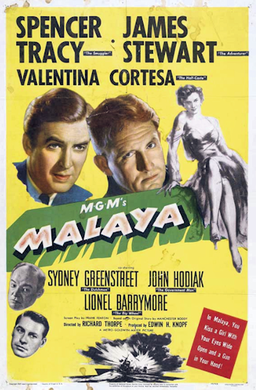
Malaya

Look down the right side of the page, and you'll see under 'Labels' quite a few war movies. For the most part though, most are about the actual fighting, the combat of war. What about the behind the scenes war angle though? How about the things that make a war possible, like production of planes, guns, materiel, and all that good stuff? A little change of pace today with 1949's Malaya, a shadowy film noir-ish story set in World War II.

Having just escaped the South Pacific with Japanese forces on his tail, newspaper reporter John Royer (James Stewart) is approached by a former boss (Lionel Barrymore) upon arrival. The conversation turns to Royer's exploits -- sometimes shady ones -- in Asia and the Pacific, Royer admitting he knows where quite a lot of raw rubber is being stored, harvested and hidden in Malaya. As the need for war materiel increases, so does the need for rubber, used to build countless key things needed to fight the war. With backing from the government (on a somewhat backdoor-ish deal), Royer agrees to go back to Malaya and see if he can buy as much as the rubber as possible and slip it out of the country. He needs help though and arranges for a friend, former partner and smuggler, Carnahan (Spencer Tracy), to aid the cause. Together, they head into Japanese-occupied territory on their nearly suicidal mission.

Considering the star power assembled here -- and there's more -- I was surprised I had never stumbled across this WWII flick before. I'm glad I did. From director Richard Thorpe, it's a mix between a behind the lines secret agent mission with many of the conventions viewers in 1949 had come to love about the film noir genre. Filmed in black and white with Malaya as the backdrop, it is a South Pacific film noir, and I can honestly say I've never seen a movie quite like that. Okay, maybe 1952's Macao. I loved the setting here, the crowded, smoky saloon and gambling house, the alleyways and dim streets, the expansive mansions and businesses in the countryside. The combination of the war movie and the crime noir just flows well together. It's always fun to see two such vastly different genres combine (usually not this well), but the end result is a lot of fun.

Not exactly a buddy movie, 'Malaya' nonetheless plays on some of those conventions that would become so familiar to audiences over the coming years. This film was the only on-screen pairing Tracy and Stewart ever made although they were together in 1962's How the West Was Won (Tracy narrating, Stewart acting). I'm never going to complain when a film pairs two Hollywood legends like this and lets them have at it. The two play well off each other. Stewart's Royer is a journalist with quite the checkered past, but with this mission, he wants to accomplish something, something meaningful. Tracy's Carnahan is a businessman and a convincing one. He looks out for himself more than anything, questioning Royer's patriotic actions. His bottom line? Usually dollar signs. Together though, they're great, always sarcastically calling each other 'Buddy!' as the mission develops. A WWII Odd Couple noir style of sorts, it's a winning combination.

Most movies would be quite content to pair two actors of that caliber together and let things be, but Thorpe doesn't settle for just two stars. This is one impressive cast, both in star power and performances delivered. Noir veteran and perpetual scene stealer Sydney Greenstreet plays the Dutchman, a saloon and gambling house owner with his hand in everything that could make him more money who joins in with Carnahan and Royer. Valentina Cortese is the checkered woman with a heart of gold, Luana, Carnahan's long-time love. John Hodiak is underused but reliable as always as Keller, a government agent working with Royer who puts the plan in motion for his Malayan plan. Barrymore too makes what amounts to a cameo as Manchester, a businessman working with several other very well to-do businessman to help the war effort. Also look for Gilbert Roland as Romano, one of the locals who teams up with Carnahan, utilizing his "unique" skill set to help in the thieving. Richard Loo gets to sneer and leer as Colonel Tomura, the Japanese officer suspicious of what's going on.

So a story that blends WWII and noir conventions? Not bad, not bad at all. How about elements of a western too? Why not?!? I very much enjoyed how the story plays out as Royer and Carnahan deal with various rubber plantation owners, working with some, intimidating others. We see their motives and intentions though, and that goes a long way. Royer is far from an idealist, but he wants to accomplish something. Carnahan is the opposite, thinking logically. Where it comes to a fork in the road is that both men come to a point where they want to do what's right. Is is the smart decision? No, if anything it's more dangerous, but there's a code of honor of sorts. As a man, what do you decide? The ending has a bit of a cop-out, but it's not a big deal. It's a movie that blends a whole lot of different things but manages to come out the better. Well worth checking out.

Malaya (1949): ***/****

Thursday, September 20, 2012

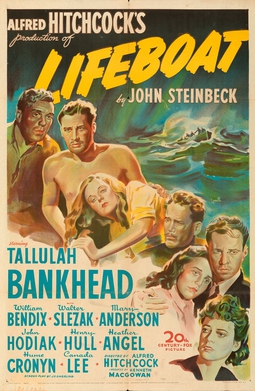
Lifeboat

The timing here was interesting, two completely different types of movies, and I couldn't help but be slightly amused by it. I just recently reviewed Around the World in 80 Days, a huge scale epic that had locations around the world. Then there's this review, an entire movie set on an adrift boat at sea. I love a good epic, but an entire movie contained on one set? That's impressive. The movie is 1944's Lifeboat.

On its way to England during WWII, an Allied supply ship crewed by merchant marines is attacked by a German U-boat and sinks. Aboard a sturdy lifeboat, respected writer Connie Porter (Tallulah Bankhead) rescues Kovac (John Hodiak), a member of the crew from the engine room. Connie tells him that the German U-boat sunk as well in all the chaos. Minutes pass and they begin to pick up other survivors until there is nine of them all told. Among them is a German sailor, Willi (Walter Slezak), who no one is sure what to make of. Should they throw him overboard or keep him as a prisoner? With food and water limited, their decision could directly affect their survival.

Do you need proof that director Alfred Hitchcock was a director far ahead of his time? First off, if you said 'yes,' shame on you. Second, this film should serve as proof....if it was some how needed. Some four years before his 1948 film Rope and 13 years before 12 Angry Men used the formula, Hitchcock films the entire movie on one set, in this case the lifeboat adrift at sea. The entire movie. There are no asides or flashbacks or anything that distracts from the very singular location. This well-made, sturdy boat ends up being a weirdly compelling additional character. By the end of the movie, you feel claustrophobic and alone. Not a lot of directors could pull this premise off successfully, but Hitchcock seems to do it with ease.

Working with an ensemble cast, Hitchcock brings together a group of actors/actresses from all walks of life with more than a few differences in background. Bankhead as Connie gets top billing and delivers a solid performance but is far from sympathetic. Hodiak brings a tough guy edge to his part as Kovac, the former slaughterhouse worker turned sailor and maybe the one thinking the clearest. Slezak ends up being Evil Incarnate as Willi, the German sailor who knows more than he is letting on. Also look for William Bendix as Gus, the lovable sailor wanting to get back to his dancing girlfriend, Mary Anderson as Alice, a young nurse nervous about reaching London, Henry Hull as Rittenhouse, a proud, self-made businessman, Hume Cronyn as Sparks, the radioman who bonds with Alice, Canada Lee as Joe, the black steward, and Heather Angel as Mrs. Higgins, a mother traveling with infant to visit her husband.

What is impressive about the film can also be a weakness depending on your point of view. Hitchcock chooses not to use any gimmicks or tricks in developing a story that clocks in at 97 minutes. There are no marauding sharks circling the boat or patrolling plane overhead. This is an ultra-personal story that is entirely contained within the confines of the boat. Because there is nothing to distract from the task at hand, this is a dialogue-heavy movie. At times, it gets to be a little much. You can only hear so many monologues about the past and how people got here, their beliefs and relationships before things get a little on the slow. When it does work though, it's great. The story gives a window into mob mentality, especially when survival is on the line. Not surprisingly, you react differently to a situation at hand when life and death hangs in the balance.

Setting the survivor story (yeah, alliteration!) during WWII was no doubt a timely one. I can't help but wonder though what the story would have been like in a more existential setting; just survivors on the open sea hoping to make it to land or rescue of some sorts. Yes, the Willi character and his sinister motives are necessary, but that could have been tweaked too. The WWII dynamic is one thing, but a solid, interesting story detours and degenerates some in the finale as a propaganda message is not to subtly blared at us as a viewing audience. Oh, Germans are bad! There was potential for a twisted, darker ending in the closing minute, but the propaganda shuts the door on that possibility. Still, it's an impressive movie, and one that's easily recommended.

Lifeboat (1944): ***/****

Sunday, August 19, 2012

Trial

The system at its purest should always work. Yes, a pretentious "message" lede that I apologize for, but I've got nothing else. Government, politics and and the right to a fair trial are all ideal in their execution. It's when the human element is added that things get tricky, like 1955's Trial, a solid if somewhat meandering look at not only a courtroom case, but the sinister, sniveling grab for power in the background far from the court.

A law professor at a California university, David Blake (Glenn Ford) is in a jam. He's never actually had a court case so his superiors demand that if he wants to keep his job he must get some actual courtroom experience. Every lawyer and firm in town slams a door in his face except one, that of Barney Castle (Arthur Kennedy) who takes him on for an upcoming controversial murder case. A Mexican teenager, Angel Chavez (Rafael Campos), has been accused of murdering a white teenage girl, and things don't look good. Looking for experience and genuinely believing in the boy's innocence, David takes the case only to discover there's much more to the judicial system than knowing a law book.

What impressed me most about this Mark Robson-directed courtroom drama is that for much of its 105-minute running time, 'Trial' is less than interested in whether or not Angel actually committed the crime. His guilt or innocence is almost secondary. This is a story about the inner-workings of the system, how things get done not by what's right, but by who is able to tweak the system to their advantage. While obviously dealing with different subjects, 'Trial' reminds me in tone of Billy Wilder's Ace in the Hole. Not quite as dark -- especially in the ending here -- it still has a cynical, dark and jaded look at the people involved, at the individual and how simple and easy it is to manipulate the system.

Maybe in 2012, none of this should come as a surprise, but Robson's film is at its most effective in those very moments. When we meet Kennedy's Barney, he seems like a genuinely good guy willing to fight for the underdog and give this inexperienced lawyer a shot. Yeah, not even close. Everything in this world is a selfish, me-first type attitude. Robert Middleton's A.A. 'Fat Stamps, the county sheriff, will say and do anything that helps him get re-elected. Supremacist groups make the possible murder into a race riot, not a simple encounter gone wrong. Barney stirs up the masses wherever he goes, almost making Angel into a martyr before his guilt is decided. He manipulates Angel's mother (Katy Jurado) to embrace her Mexican culture for a sympathetic plea. The actual guilt or innocence steps to the forefront late, but the movie is at its best leading up to that.

Unfortunately a little more than halfway through 'Trial,' a big old curveball is thrown at us as an audience. It's timely for 1955, but overbearing and heavy-handed now. Yes, you guessed it. COMMUNISM!!!!! I won't go into specifics here as to how communism is involved, but there are ulterior motives working all over the place, all of them hamstringing an otherwise very solid courtroom drama. The last 45 minutes are slowed down significantly as communism rears its ugly head. We get it, Red Scare, Stalin, evil Russkies, but it feels overly forced here. On top of that, the ending forces a nice, happy conclusion on us, one that seems far-fetched for the story and out of left field.

Thankfully through all that craziness, the cast is uniformly above average. Chalk up another positive part for Glenn Ford, his David Blake an idealist who believes and has faith in the judicial system. When he sees it for what it really is? He's not naive anymore, just pissed. Like most of his roles, it comes across naturally, a tortured individual weighing all his options. His relationship with Barney's assistant, Abbe (Dorothy McGuire), is a bright spot too. Kennedy does what he does best, sneers and snivels and is generally as slimy as humanly possible. John Hodiak is Armstrong, the district attorney primed for bigger and better things down the road, making the most of a smaller, one-note performance. Along with Jurado and Middleton in supporting parts, Juano Hernandez is a scene-stealer as Judge Motley, an African American judge presiding over the case who must deal with prejudices and assumptions of everyone around him, especially on a racially charged case like this.

I've got mixed emotions about this movie. The parts I did like, I really liked. Ford and a deep cast are very watchable are solid throughout, even the portions of the movie that are too timely for their own good. In the end, the negatives prevent it from reaching its potential. Still a very worthwhile movie to seek out, but it never quite reaches the heights it could and should have.

Trial <---TCM clips (1955): ** 1/2 /****

Monday, October 11, 2010

The Arnelo Affair

Certain movie gimmicks bother me more than others.  Typically I can deal with just about any of them as long as they're competently handled.  But one that has to hit it out of the park for me to abide by it is the voiceover narration, a technique that's been used to death over the last 10 or 20 years.  Positive uses that jump to mind include American Beauty and Kevin Spacey, The Shawshank Redemption with Morgan Freeman, examples that are near if not perfect in their execution.

When the voiceovers are handled poorly though, it can drag a whole movie down with it, like 1947's noirish The Arnelo Affair.  Film noirs more often than not nailed the main character narrating because it got you into the head of a typically tortured main character trying to deal with some inner demons.  Without any actions or dialogue, we get to know the character without a lot of background.  Those were usually cool characters though.  'Arnelo' is certainly a departure from the tough noir anti-hero with the perspective of a lonely housewife contemplating an affair just not being interesting enough.

After years of marriage to her lawyer husband (George Murphy), Anne Parkson (Frances Gifford) is in a bit of a mid-life rut.  She has everything she could ask for, but her husband takes her for granted, basically ignoring her even though he doesn't realize it. Looking for any sort of excitement, Anne meets a client of her husband's, a club owner, Tony Arnelo (John Hodiak), and gets that excitement. But as appealing and attractive as she finds Tony, she quickly finds out there's more than meets the eye.  Tony gets involved with an actress who is found dead soon after, but the sneaky club owner turns the tables on her, possibly pinning the murder on her.  Can she get herself out of the situation before she's in too deep?

Something was missing from this movie, but I'll start with the narration supplied by Gifford's Anne.  First, it's the most banal stuff I've heard in awhile.  "I like him, but why? What's going on in my head? I'm married so I shouldn't do it...but I'll see him anyway."  The first 45 minutes of an 86-minute movie is dominated by this never-ending stream of conscious narration that drove me up the wall.  If you're going to hit the audience with a lot of voiceover while the main character sits at a table looking worried, you've got to at least attempt to make it interesting.  But because it's dull as all get out, you're basically watching a book on tape.  Nothing interesting visually to look at, and nothing interesting to listen too in terms of dialogue.

Certain names come to mind when I think of femme fatales in film noir, and no offense intended, but Frances Gifford isn't one of them.  A wife stuck in a rut at home with a husband that isn't interested in her certainly has some potential, but there's no conflict here.  Maybe the censors went to town on the finished product from director Arch Oboler (<--- cool name, huh?) and took out any scandalous revelations, but there's a hole in the middle of this movie that needed filling.  Husband ignores wife, wife visits mysterious club owner, they TALK, other woman ends up dead, and we've got a case of blackmail.  Apparently somewhere in there Hodiak falls in love with Gifford while blackmailing her and her family.  It just doesn't come together, but it is 1947 so in the end everything is wrapped up nicely with a big red bow, including happiness for the precocious pre-Quantum Leap Dean Stockwell with a reunited family.

Once everything hits the fan for Gifford's Anne, she basically shuts down as a human being.  She wasn't much of an actress through the first part of the movie, and it only gets worse as things move along.  Her character isn't that well-written, but you've got to chalk some of it up to her.  It's just not an interesting lead character.  Murphy is pretty clueless as her lawyer husband (hate to have him defending me in court) who doesn't realize he's driving his wife away with his constant ignoring her.  Hodiak -- one of my favorite character actors -- is a bright spot with a smaller part as Arnelo, the club owner with some definitely shady connections.  He keeps you guessing as to Arnelo's intentions because he's charming in his evil way.  Other worthwhile parts include Warner Anderson as Detective Leonard, the investigating officer in the murder of the actress that links all these people together.

By the time the murder occurs near the midpoint, the movie's pacing does pick up.  The second half of the movie is noticeably better than the first half, but it's not like that was hard to do.  As mentioned, everything gets wrapped up too quickly, too nicely and with a little bit too much coincidence for my liking.  Not a lot to recommend about this dull noirish flick, maybe for diehards only.

The Arnelo Affair <---TCM trailer (1947): * 1/2 /****

Thursday, September 9, 2010

A Robert Stack double feature

As part of their annual Summer Under the Stars festival in August, Turner Classic Movies has again done a great job of going beyond the typically popular stars and devoting a day to them.  Sure, some of the bigger stars get their days, but for the most part lesser stars are getting their shots.  One included TV star Robert Stack who before he became Elliott Ness was in a fair number of movies in the 1950s. But I'm going to pull a bit of a cop-out here.  I taped two westerns Stack starred in, and really, neither was anything special.  So you all know what that means....a two-fer review!

The two westerns, 1956's Great Day in the Morning and 1953's Conquest of Cochise, are pretty typical of most 1950s westerns. They're hamstrung by a smallish budget and a small scale, and are basically filled out with enough good guy vs. bad guy action and romantic triangles to fill 90 minutes and give the audience what they paid for.  'Morning' has some unused potential to be a really good B-western while 'Conquest' is more content to just sit back with some odd casting and let the story do its own work.  Neither are available on DVD, probably for a reason, but I can think of worse westerns, and I've seen some doozies.

With war on the horizon in 1861, Owen Pentecost (Stack) rides west into Colorado.  A Southerner, he's used to putting up with some anti-South sentiments, even more so when he wins a saloon in a poker game from a northern businessman, Jumbo Means (Raymond Burr). With some help with a saloon girl (Ruth Roman), Owen goes about building a business as the Civil War looms and animosity grows between the North and South. A pretty new shopowner (Virginia Mayo) has arrived in town to stir up some more problems, and a rumor that a Southern-owned mine is transporting gold back to the east hovers over the town.

Watching movies, I struggle more and more with main characters who just aren't likable.  I don't need a lovey-dovey sweetheart, but give me some reason to like a character.  Stack's Pentecost (what kind of name is that?) is that condescending a-hole who comes across as too standoffish, and therefore, I don't like him.  Burr is an immense villain -- the guy looks huge -- and Roman delivers a good performance as the saloon girl with a heart of gold...sort of. The story deals with a topic most westerns steer clear of -- pre Civil War in the west -- but it's pretty run of the mill overall.  There was a chance to be something better, but I can't put my finger on exactly what's missing that director Jacques Tourneur didn't accomplish.  Look for Leo Gordon as a heavy with a grudge against Stack.

In 'Conquest,' Stack plays Major Tom Burke, a cavalry officer assigned with four companies to Tucson to help keep the hostile situation in control.  Apache chief Cochise (John Hodiak) could go either way, start a war with the ever-growing number of American settlers settling on Apache land, or arrange a peace treaty so the two sides may live in peace. That's just one problem though as a tribe of Comanches is nearby and threatening to attack everyone in sight, whites, Mexicans and Apaches alike. Major Burke and his cavalry and Cochise and his warriors may be forced to fight alongside each other if they have any chance of surviving the coming war.

What surprised me about this 70-minute western was the almost complete disregard for the cavalry perspective for a change, instead focusing on the Apache's perspective.  Once you get past the ridiculous casting of Hodiak as an Apache chief, it's a good ride.  When he's not talking in stunted, stilted "Indian talk," Hodiak is more than solid at introducing the Apache way of life.  For a B-western average in any other way, it's a refreshing look at the Indians' way of life in the 19th Century.  How authentic? I'm not sure, but effort gets points here.  Stack's portrayal of a woman-chasing cavalry officer is downright dull, and he ends up disappearing for about 20, maybe 25 minutes late in the movie only to reappear at a strategically necessary time.

Not being a huge Robert Stack fan to begin with -- he always come across as bland and wooden to me -- these two movies did nothing to change my mind either way.  The supporting casts were actually better than the star in both cases, and if nothing else the stories tried something new, a little different, where many westerns play it safe.  Average but not bad either.

Great Day in the Morning <---TCM trailer (1956): ** 1/2 /**** 
Conquest of Cochise <--- TCM trailer (1953): **/****

Tuesday, July 13, 2010

Mission Over Korea

Just 41 years old when he died of a coronary thrombosis while shaving, John Hodiak had already made 30-plus movies in a career that lasted just over a decade.  He was never a huge star and often played the second or third billed star, but in the handful of movies I've seen with him, Hodiak always left a positive impression.  He had a natural way of acting, and always came across as incredibly likable.  One of the last movies he starred in before dying so young was 1953's Mission over Korea, a war flick released while the U.S. was still involved in the Korean War. 

The movie is really nothing special overall and works as a prime example of what a lower budget war movie could be.  Not great, not bad.  Just kind of there.  It's instantly forgettable with its story of army pilots flying observation planes over the battlefield so that artillery can be called in on enemy positions.  There's always a positive, if just depends on how hard you want to look.  Besides Hodiak as the star, the positive is the aerial footage, blending shots of the slower, no armored observation planes and some of the first uses of jets in aerial combat.  Other than, the character and story is as cookie-cutter as they come.

Flying as an observer in a light-weight plane with no weapons and no armor to protect from enemy fire, Capt. George Slocum (Hodiak) receives word that a new pilot is inbound to join him as an observer.  The new, inexperienced pilot is Lt. Pete Barker (John Derek).  Slocum has worked with Pete's older brother at the same airfield and is looking forward to meeting the younger brother.  Barker is a hotshot though and is always looking to show off his ability, make a name for himself.  With so few observation planes doing such an important job, Slocum is forced to go along with the antics, especially when reports of a new mission start circling the base.

That description is about as stream-lined as I could make this one.  It used just about every war movie cliche, throws it in a blender, and the final result is a mismatched story that never really says anything or goes anywhere.  We briefly meet Slocum's wife (Maureen O'Sullivan), but it's very briefly.  Ladies man Barker tries to woo a nurse (Audrey Totter) but never really gets anywhere with her.  Add in the ever-present threat of a North Korean attack, and you've got two romance subplots which are dead in the water.  There's also a mission that's never really well defined as Slocum and Barker fly from airfield to airfield hoping to avoid those Korean attacks.  A nice voiceover late states 'More will fight after what these men have started.'  Translation, we didn't have more money to do anything else.

Searching for something to recommend, it starts with Hodiak and two supporting parts and ends with some cool aerial footage.  Hodiak plays a well-worn character you've no doubt seen in countless other war movies, but the character is likable from the start.  A father-son relationship with a Korean teenager (William Chun) is a little much at times, but that's minor.  As for Slocum's mechanical crew, Harvey Lembeck as Sgt. Maxie Steiner and Richard Erdman as Pvt. Swenson have some fun in supporting roles.  The trio have a good dynamic broken up by Derek's woodenness in a generally dislikable character. While somewhat limited, the aerial footage of the observation planes and fighter jets are impressive -- even if we have to see certain shots repeated over and over.

Not much more to say about this one.  It's pretty poor overall and leans toward being straight propaganda.  The North Korean guerrillas are outfitted with white sheets (I didn't get it either) and typically make appearances when a main character needs a reason to storm out of a scene and be angry.  It's entertaining enough in an 'oh, that's pretty bad' way, but it's inoffensive enough to watch if you've got 80 minutes to kill.  For Hodiak fans looking for a war movie, go check out the much better Battleground from 1949.

Mission over Korea (1953): **/****