The Sons of Katie Elder

The Sons of Katie Elder
"First, we reunite, then find Ma and Pa's killer...then read some reviews."
Showing posts with label Vietnam War. Show all posts

Thursday, March 3, 2016

The Quiet American

For the United States, the Vietnam War officially began in 1965 as American forces officially became involved in the fighting in Vietnam. Of course, American advisors had been on the ground in Vietnam for a decade-plus trying to help swing things toward the American way and away from the Communist way. A particularly nasty period leading to a far nastier period, it's shady and dark and very hush-hush, very Cold War. Not too many films address the pre-Vietnam War time. An exception? From 1958, The Quiet American.

It's 1952 in Saigon and the political situation in Vietnam is on the verge of exploding as Vietnamese insurgents have begun to fight back against their French colonist rulers. Everything is seemingly in the balance just waiting for someone to strike the match that sets it all off. Living in the city is Thomas Fowler (Michael Redgrave), a middle-aged British journalist working as a war correspondent on the almost-daily updates of the fighting. He lives with a young Vietnamese woman, Phuong (Giorgia Moll), and is quite comfortable in his living situation in spite of the fighting and death around him. His peaceful arrangement changes though when a young American (Audie Murphy) shows up in Saigon. Working with a friends of Asia organization, the American takes an immediate liking to Phuong, putting the young woman in quite a spot. Now, Fowler -- with a wife back home -- must decide what is most important to him.

This 1958 historical drama from director Joseph Mankiewicz is based on a novel by author Graham Greene. As for the finished product, Greene was less than pleased with some rather major changes made from his source novel. Mankiewicz too was displeased with what the studio had done to the version he had written and then directed. I haven't read the novel, but I have seen the 2002 version of the film (starring Michael Caine and Brendan Fraser) that's supposedly a lot more in line with Greene's original. Moral of the story? Issues those involved may have had, 'Quiet' is worth a watch for any number of reasons, flaws considered and flaws aside.

My feeble mind can only grasp so much Politic. That's right...the upper-cased Politic. That was my worry about this 1958 drama. Though it is a personal story among three people in Saigon, the political situation in the city (and the world on a bigger level) is the basis. I wasn't always sure what they're talking about, but it's fascinating to watch it develop. Basically, everyone has their motives, the French, Communists, Americans and those that would benefit from a third force taking an active role in Vietnam, in this case those dastardly Americans. Mankiewicz filmed in Vietnam in 1958 -- so not the most peaceful filming location -- which gives 'Quiet' an authentic air of actually being a part of what we're seeing on-screen. Filming was less than smooth sounds like as demonstrations and violence rocked the city. How about that for adding that layer of reality?

The basis of the story is one of my least favorite storytelling devices....well, ever. It's the love triangle among Redgrave's middle-aged journalist, Murphy's noble, naive, idealistic American, and Moll's innocent Phuong who simply wants to be happy. The historical backdrop certainly helps alleviate the pain, but mostly, it's the acting talent involved. Mankiewicz's script lets these potential cardboard cutouts be red-blooded individuals (mostly). Redgrave is excellent as Fowler, the journalist going through a mid-life crisis of sorts at the worst possible moment. It's a challenging character because he isn't sympathetic, is a bit too whiny but all under the umbrella of being a stodgy British gentleman. He's passive aggressive and with a touch of condescending for good measure. By far, that's the best performance.

Murphy wasn't the first choice to play the titular, unnamed character, just part of a checkered production that saw some huge names drop in and out of filming. Murphy takes a rap sometimes for his wooden acting, but I thought he was excellent here. The biggest change made from Greene's novel is in the character, Murphy's American presented as a heroic, naive, honest, genuinely good individual while his backstory and motive for being in Vietnam are never truly explained. The 2002 version did not have that problem. Redgrave and Murphy play well off each other, Moll keeping up throughout with a thankless part. Also look for Claude Dauphin as a scene-stealing police investigator, Bruce Cabot, Fred Sadoff, Kerima and Richard Loo in key supporting parts.

There are issues with the story's pacing and as I mentioned, I get lost at times in the politically-heavy scenes. But as a movie? It's very good. I liked the movie-watching experience a lot. Filmed in black and white, 'Quiet' looks great, humid and sweaty and sun-drenched, a perfect backdrop for that politically and love-charged Saigon. The storytelling techniques work well -- giving away the ending in the opening scene, the rest told in flashback -- and the acting is solid all-around. A lot to recommend for an oft-forgotten drama.

The Quiet American (1958): ***/****

Thursday, July 17, 2014

The Losers (1970)

Well, at the rate I'm going, I'll watch a new biker movie every year or so. It's not that I don't like them, far from it. It's that at times, it can be difficult to find good ones, even viewable ones. So following up 1968's The Savage Seven (a very pleasant surprise) and 1969's Hell's Angels '69 (liked it a lot, heist movie meets biker movie), here's 1970's The Losers.

At a a remote Army outpost deep in Vietnam, a heavily armed patrol cuts through several Viet Cong ambushes to deliver a special team being used for an almost suicidal mission. Who steps out of the Army truck? Five Hells Angels bikers led by Link Thomas (William Smith), a tough as nails biker recruited by his brother, an Army major (Dan Kemp), who's limited by international law as to what he can do. Just across the border a few miles into Cambodia, an American diplomat/CIA agent is a prisoner of the North Vietnamese and Viet Cong forces, but American forces aren't allowed to cross the border to rescue him. On the other hand, there's nothing stopping five rogue Hells Angels from hopping on their bikes and riding into Cambodia. With Army backing as long as they're in Vietnam, Link and his men armor their motorcycles with armor-plating, heavy machine guns and grenades, all the while preparing to go in and rescue the captured American.

There are certain low budget genres you just know aren't going to be truly quality moments, many of them from the late 1960s and into the 1970s. Think of the lousier spaghetti westerns, gory, schlocky horror flicks, and in this case, biker flicks. Put a bunch of tough-looking, grizzled bikers on some motorcycles and let the craziness ensue, low budget be damned! If you can embrace that cheap quality, you're in for a treat. Sometimes, it's just too much. I wanted to like this biker action movie from director Jack Starrett (also starring as the paranoid, ranting CIA agent). At its heart, it is a men-on-a-mission movie, a bunch of oddballs working together to pull off a suicide mission. Even the bad ones can be good with that formula, but this one just isn't good enough to recommend. It has a moment here and there, but in between can be rough-going.

For openers, the casting felt like a good jumping off point. A physical bear of a man, Smith is Link, a Vietnam vet turned biker who assembles a team of bikers to pull off a rescue at his brother's behest. He's the leader, but an anti-hero through and through, troubled at what the war has become. He has a soft spot for some of the people he runs into, all the while trying to hold his crew together. That group includes biker regular Adam Roarke as Duke, a fellow vet looking to find a past love in the Vietnamese boonies,  Paul Koslo as Limpy, similarly finding love in a rundown old house, Houston Savage as Dirty Denny, the pot-smoking, booze-swilling, three-way having biker, and Eugene Cornelius as Speed, the goofy, long-haired hippie with an odd sense of humor. There's also Bernie Hamilton as Capt. Jackson, the regular army officer tasked with keeping the Losers in line, and John Garwood playing his right-hand man, Sgt. Winston.

Some cool potential there, right? That's what I figured, but that's what it remains with little else, potential. I expected a hard-edged men on a mission movie with said men fighting impossible odds. Instead, it's a half-boiled love story. We get Roarke's Duke reuniting with his lost love, walking through the fields dreamily, wondering about the future. Koslo's Limpy falls for a Vietnamese girl with a baby and steps in as a surrogate father. What the hell happened?!? Sure, there's some biker shenanigans, Dirty Denny (of course) having a three-way and then getting in a fight with some locals. There's no story, no sense of urgency, and no rhythm in the least. The bikers party and bitch and fight and screw around, outfit their cycles, and then oh yeah, they head into Cambodia. By that point, I'd been fast-forwarding through huge stretches of so-called 'story.'

If there's a remotely positive saving grace, it is the biker attack on the Red Chinese camp in Cambodia. All sorts of crazy bike stunts, gunfire and explosions throughout make it an exciting, adrenaline-pumping shootout. That isn't the end though, some preachiness saved for the last 15 minutes as a movie about bikers on a suicide mission decides it needs to deliver a message to its viewers. Seems logical, right? The ending is not surprisingly pretty downbeat, but it was yet another case of too little, too late. A pretty bad movie, aided by two folk songs in the soundtrack that try to again, add depth to a story that simply doesn't require it.

Make a movie about Hells Angels rampaging through Vietnam and Cambodia and be content with it. Don't try and make it something more. A disappointment.

The Losers (1970): * 1/2 /****

Friday, June 13, 2014

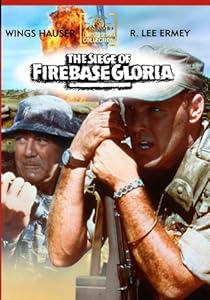
The Siege of Firebase Gloria

If you don't recognize the name, you will surely recognize the voice and that face. Known as the tough as nails drill sergeant in 1987's Full Metal Jacket, R. Lee Ermey has been one of those perfect character actors over the years, even starring in a History Channel show that answered all sorts of questions about the military. His performance in Full Metal Jacket is the one he will always be known for, but he delivers another excellent performance in a far lesser known but very high quality film about the Vietnam War, 1989's The Siege of Firebase Gloria.

It's early in 1968 and a long range Marine recon patrol led by Master Sergeant Hafner (Ermey) keeps coming across signs of increased North Vietnamese and Viet Cong activity. With his second-in-command, Corporal DiNardo (Wings Hauser), and a six-man patrol, Hafner leads the small group of Marines onto a small firebase named Gloria deep in the Vietnamese jungle. They find a poorly constructed, undermanned and under-supplied defensive position that's just waiting to be overrun should the Viet Cong attack. Hafner takes command, DiNardo helping at every turn, but their time is running out. As the Marines work to build up the firebase, the Viet Cong unleash the Tet offensive all over the country, American positions fighting back against waves of attacking guerrilla fighters. With no real hope of getting reinforcements, ammunition or supplies, can Gloria hold out or is it already too late?

Where do you go for a very solid movie about the front line fighting in the Vietnam War? Why, Australia of course with the Philippines providing the filming locations. From Australian director Brian Trenchard-Smith, 'Siege' is one of those hidden gems you're glad you stumble across. I caught it a couple times on TV during Memorial Day marathons and found it recently during just such a marathon on MGM-HD. Why are there so few movies about Vietnam? More specifically, about the fighting in Vietnam? My first thought is because America lost. My second is that this was a particularly nasty war with fighting unlike anything the world had seen. Trenchard-Smith's film doesn't shy away from that nastiness. At different points, it shows American soldiers "fragging" their own officers, American soldiers killing wounded Viet Cong soldiers, among other things. We also see the particularly brutal remnants of a Vietnamese massacre of a peaceful village, decapitations, rapes, a pile of murdered children's corpses. Not exactly uplifting stuff.

Limited somewhat by a smallish budget, 'Siege' makes up for it with that hard-edged, in-your-face authenticity. At no point does this feel forced. Though two screenwriters are listed in the credits, Trenchard-Smith has stated in interviews that Ermey wrote the screenplay. Whoever wrote it...it's good in a brutal, straightforward fashion. We get a bigger picture of what's going on with the Tet Offensive, but this is a story with its focus far more on the foot soldiers, the infantry, the grunts. We follow a single engagement (over 3 or 4 days) as a small garrison tries to defend a remote outpost against overwhelming odds. There are some stiff moments, and the characters are from the War Movies Handbook 101, but the movie is always interesting. The realism and authenticity does an excellent job in that department.

No big names here, Ermey and Hauser carrying the heavy lifting. Ermey was a Vietnam vet who served multiple tours before being sent home with his wounds. His narration is that no-frills type of voiceover that would come from a lifelong Marine, a soldier who's seen all that war has to offer. He's tired, worn down but loves the Marines and loves the fight. Hauser's DiNardo is his close friend who's struggling with some personal demons but remains an incredibly capable soldier in his own right, a soldier Hafner trusts with his life. Who else to look for? There's Murphy (Mark Neely), a young soldier figuring out the ins and outs of Vietnam, Coates (Clyde Jones) the radioman -- who's called Short Waves) who's also on short time on his tour, and Jones (Albert Popwell), an Army sergeant who bristles at the Marines' commands but knows ultimately it's their call.

There's other parts, some more worthwhile than others that include an on-base nurse, a war photographer thrust into action, a wounded officer who survived Viet Cong torture, and a very strong part for Gary Hershberger as Moran, a gung-ho chopper pilot who continuously risks his life to bring Gloria any supplies and ammunition he can. His brief interactions with Ermey's Hafner on an under-fire landing zone are perfect, the no-nonsense Marine lifer vs. the free-spirited helicopter pilot who doesn't have much use for rules or authority. Also look for Robert Arevalo as Cao Van, the commander of the attacking Viet Cong forces, presented as a human being, not a stereotypically evil villain. Not much in star power or name recognition, but some solid supporting parts across the board.

Wasting little time in its 95-minute running time, 'Siege' is action-heavy and never lets up. The violence is brutal and uncomfortable but while it is particularly graphic, the camera doesn't linger on the violence. War, killing and death is quick and hard-hitting, brutal and unceremonious. We see the lines all along the firebase up in the air, Viet Cong pushing forward as Americans fall back and then the other way when the outnumbered American infantry push back. There are brief respites but they're quick breaks, and it is never too long before the attack continues. Is this a groundbreaking war movie? No, but it is very effective on multiple levels. It succeeds as a war story and as an action movie. It has little in the way of a reputation or cult following, but it deserves far more. A difficult movie to watch, but one that is worthwhile in the end.

The Siege of Firebase Gloria (1989): ***/****

Monday, September 2, 2013

Missing in Action

Before he was the punchline to countless facts and one-liners about how cool, awesome and badass he was, Chuck Norris was quite the action star in the late 1970s and throughout the 1980s. We're not talking classic, big budget action flicks, just hard-edged, action-packed B-movies that fans and audiences usually ate up. Are they good? For the most part, not particularly, but Chuck Norris is so cool!!! Here's one of his best, an audience favorite and near cult classic (because it's really dumb), 1984's Missing in Action.

Having spent seven years in a North Vietnamese prisoner of war camp, Lt. Colonel James Braddock (Norris) still struggles with the traumatic experience. He escaped 10 years ago, but the experience still lingers with him, especially because he believes that even long after the war, Braddock believes there are still many more missing in action American soldiers. The only problem is, he can't convince anyone of his belief. Braddock is finally able to get back into Vietnam, convincing a government investigation team to look out for evidence of other M.I.A. American soldiers. The team is met with a stone wall of doubt and questioning, frustrating Braddock even further. The former Colonel takes things into his own hands, planning an excursion deep into Vietnam where he's found the location of a hidden camp for POWs. Can he somehow pull it off, rescuing the prisoners who have long since been abandoned?

If that plot description sounds familiar, it should. In 1983, a story treatment from director James Cameron made its way around Hollywood and was eventually turned into Rambo: First Blood Part II. The studio that made 'Action,' Cannon Group, claimed to be "inspired" by the treatment and made its own rescuing POW movie. It was actually two movies, this one and a prequel, Missing in Action 2: The Beginning, that were made back-to-back and raced into theaters before Rambo's bloody return in 1985. So is it familiar? Yes, it should be. More than that, there's a whole sub-genre about rescue efforts of Americans in Vietnam, including this one, Rambo, and the first and best of the bunch, 1983's Uncommon Valor. The Vietnam War was unlike any other war America had fought in, and numbers differ about how many soldiers were missing in action or their bodies were never recovered.

It's a natural jumping off point for a story/script, right? Operations and missions into Vietnam to rescue Americans, how can you lose? Uncommon Valor is an action-packed, men on a mission movie with a solid cast. Rambo is mindlessly stupid, Sylvester Stallone a ridiculous one-man killing machine. And then there's this movie. Yeahhhhhhhhhh, I thought Rambo was pretty bad until I saw this movie. The script is the biggest culprit. We get countless scenes of Braddock staring into the distant with a blank stare on his face. We get more scenes of him walking around Vietnam and Thailand. There is no real tension at any point in the story that basically drifts along from dull action scene to dull action scene through the first hour plus. It's very basic. Americans = angelically good. Vietnamese = Satanically evil in sinister ways. All of them. They're all bad. It's so simplistic in its execution that it ceases to be a good bad movie, one you can sit back and revel in. It becomes just bad.

Surely Chuck Norris himself can be a saving grace, can't it? Yeah, that's what I was counting on, but that never comes around. As an action star, Norris is quite capable. He handles much of his own stunts, including one impressive stunt late as he hangs from a ladder on a hovering helicopter, and all his hand-to-hand combat scenes are pretty decent. Maybe it's the character, maybe it's the script, but the character just isn't very interesting. Braddock's tortured past is shown and mentioned, but I never actually felt too interested in him. M. Emmet Walsh gets to ham it up as Tuck, Braddock's old friend who owes him one and uses his boat as a way to get back into Vietnam. David Tress is the U.S. Senator at the head of the investigating team with Lenore Kasdorf as Ann, the Senator's assistant who helps Braddock and gets nude too! The horrific Vietnamese villains are James Hong as General Trau with Ernie Ortega as Vinh, the sadistic prison guard who is now a government official apparently.

So if Chuck Norris can't save the movie, surely the action can, right? Right?!? Once again, it comes up short. 'Action' basically rewrites Action Movie Cliches 101. Braddock can hit anything and everything he aims at. He can be running, walking, crouching, falling, and he's going to drill that bad guy dead center. Meanwhile, the Vietnamese troops -- supposedly trained at some point in firearms -- can't hit one freaking guy! Not once, not even a scratch! The action scenes aren't actually that bad, providing a minor positive in an otherwise pretty lousy story, but the cliches get to be a little much. Even the best scene, Braddock and Tuck on a motorized raft gunboat attacking a Vietnamese column on shore, is undone by the appearance of a Vietnamese patrol boat/gunboat. Oh, and a helicopter! Braddock arranged days before for it to show up at the exact second it's needed! Tuck's assistant guns away at the boat (seemingly not hitting it at all), and then Tuck takes over. There are scenes of seven, eight seconds of these guys blasting away, unedited, just firing. It's riveting to watch, as riveting as it was to write.

Here's a good example. If this scene puts a smile on your face, check the movie out and start drinking (heavily). If it doesn't, this ain't for you. Thinking they've killed Braddock -- silly Vietnamese -- three soldiers stand and show off their most ridiculous, over the top evil laughter, celebrating killing the indestructible American. In slow motion (of course), Braddock pops up out of the water and shoots them to pieces. I thought this movie would have a put of that guilty pleasure charm, a really bad movie that embraces the badness. Mostly, it takes itself too seriously and is one big dull final product.

Missing in Action (1984): */**** 

Wednesday, August 28, 2013

Forrest Gump

For some movies, it takes years for it to reach classic status, an accumulation of word of mouth, DVD sales, positive reviews. For others, it takes very little time, audiences flocking to see it in theaters like their lives depended on it. Released in 1994, Forrest Gump became an instant classic. Some 19 years later -- aaaahhhh! It's 19 years old!!! -- thanks to an insanely quotable script, great acting, and linear-story bending flashbacks and an almost non-stop replay on TV, it still is and still deserves its status.

Sitting on a park bench, Forrest Gump (Tom Hanks) is waiting for his bus. A fellow waiting passenger sits down next to him, and Forrest strikes up a conversation. He starts to tell the story of his life dating back to all his childhood memories, all of them right up until the moment that brought him to this bus stop. Raised by a single mom, Mrs. Gump (Sally Field), in rural Alabama, Forrest has an IQ of just 75. He's not mentally challenged, just a little slow, but his lowish IQ isn't going to stop him. Growing up, he meets Jenny, a young girl from a broken home and instantly becomes friends. From kids to adults, Forrest wants nothing more than to be with Jenny (Robin Wright), but their lives seem to be on different paths. What does Forrest's hold? Living in one of the most turbulent times in American history, Forrest's life is destined to be a part of some of America's biggest historical events.

As I watched 'Forrest' last night, a terrifying thought raced through my head. How do I even begin to describe this movie's plot? It basically defies any one-paragraph description because it covers so much ground, introduces so many characters, and does so with a unique storytelling device. For the most part, the story is told via flashback, Forrest sitting on a park bench, talking to a variety of passengers over the course of a couple hours as he waits for his bus. The people come and go, but the story continues on. Then, in the last 30 minutes, Forrest's story takes a step forward as his reasoning for waiting for the bus comes to light. It is a unique device, but it works. The Oscar-winning script from Eric Roth is a gem, the flashbacks working flawlessly, not to mention some great asides -- Forrest's namesake, Lt. Dan's family's military "history" -- fitting in effortlessly. Throw in a soundtrack featuring music from The Doors to Jimi Hendrix and a whole lot of classic songs, and we've got quite the formula.

Where to start though? Well, I think Tom Hanks is a fair place to start. Coming off his Oscar win from 1993 for Philadelphia, Hanks followed it up with....another Oscar-winning performance. Hanks has a career of really good to great performances to his name, but for me, it's easy to peg this one as his best. It's remarkable what he does with the character, avoiding stereotypes and cliches in bringing Forrest to life. He gives him all these great little mannerisms from a walk to putting his hands high on his hips, his very pronounced speech patterns to his little, quick moves that you pick up on multiple viewings. Forrest's IQ is just 75, but he's not mentally challenged in the least. He is smart in many ways, but he's also fiercely loyal, honest to a fault and takes life in stride no matter what's thrown at him. Hanks is phenomenal. His line deliveries are perfect, his inflections bringing these lines to life with that perfect Southern drawl. It has to be one of the most beloved characters in film history, and Hanks deserves every single accolade he got for the part.

Without a doubt, this is Hanks' movie, but part of the fun and enjoyment is meeting all the people that Forrest meets in his life. Wright does a fine job as the love of Forrest's life, Jenny, a young woman who explores all the 1960s and 1970s can offer, sex, drugs and everything in between. With repeated viewings, I've come to like Jenny less and less -- Forrest deserves far better - but Wright makes the character a human being, commendable in itself. Field too is perfect, the ideal mother, a woman who does anything she can to provide for her son. Gary Sinise delivers a career-making performance as Lt. Dan Taylor, Forrest's commanding officer in Vietnam, a relationship that goes far beyond the battlefield. Mykelti Williamson does just the same as Benjamin Buford Blue, or simply, Bubba, Forrest's best friend he meets in basic training before heading to Vietnam together. Also look for a very young Haley Joel Osment (just six years old) in a key supporting role late in the movie.

What's remarkable about the story is how much ground in terms of character development and actual years it covers. Forrest is born in the late 1940s in Alabama so he grows up in the midst of the Civil Rights movement as the deep south goes through the definition of turbulent time. The story is obviously pretty episodic, following Forrest through all the different parts of his life. At different points, he goes to the University of Alabama as a football star, heads to Vietnam as a rifleman in the infantry, develops into one of the world's best ping pong players, becomes a shrimping boat captain, and runs across the United States multiple times among many other smaller things. He meets multiple presents including JFK and Nixon while also being involved in the Watergate scandal, the desegregation at the University of Alabama and meets everyone from a young Elvis Presley to John Lennon. Some cool CGI techniques actually insert Forrest into some footage from the 60s/70s, giving it all a sense of reality and authenticity as the years pass.

It has to be mentioned that this is a script that helped turn 'Forrest' into one of the most quotable movies of all time. Director Robert Zemeckis -- winner of the Oscar's best director that year -- has a gem, a movie with countless memorable scenes. Ask anyone who's seen this movie, and no doubt they can recite at least a handful of lines. Everything from 'Run, Forrest, rrrrrrun!' to 'Life is like a box of chocolates, you never know what you're gonna get,' 'My name is Forrest, Forrest Gump' to 'That's all I have to say about that' and everything in between. It works and flows from scene to scene, unifying an episodic story that runs an always entertaining 142-minutes. The story never drags and instead races by, the two-plus hours going by in a flash.

Above all else, I keep coming back to Hanks' performance as Forrest Gump. I rewatched this movie in one viewing recently for the first time in years, and I liked the performance more than ever. He holds all the story together, drama, human emotion good and bad, action, comedy, romance, unifying it all. Forrest has a scene late with Wright's Jenny, talking about all the beauty the world has to offer, a sunset at sea in the Gulf of Mexico, the rain letting up in the Vietnam night, the sun rising in the desert mountains. He talks about the purpose of life, drifting along without a purpose or working toward a destiny. Forrest reasons that maybe life is somewhere in between, finding your own path. It's a beautiful monologue, perfect in its simple honesty. That's the movie. A moving, very emotional, very funny story with great performances and too many great moments to mention.

Forrest Gump (1994): ****/****

Thursday, February 16, 2012

Apocalypse Now

As a fan of movies, there are just certain films you have to see. When you haven't seen those movies, you typically get a reaction something like 'HOW HAVE YOU NOT SEEN THAT? IT'S A CLASSIC!' The reaction can be angrier or happier depending on the individual. I've gotten that reaction concerning 1979's Apocalypse Now. Well, check that one off the list.

Having already served at least one tour in Vietnam, special forces Capt. Willard (Martin Sheen) is wasting away in Saigon as he battles through some personal demons. He waits and waits for a mission, and finally gets one, but it's nothing like he expected. Across the Cambodian border, an American officer and Special Forces vet, Col. Kurtz (Marlon Brando), has gone rogue, and Intelligence things he's gone insane with his adoring command still intact. Willard's mission sounds simple but is anything but. Boarding a small patrol boat with its close-knit crew, Willard travels all the way up a river into Cambodia with one objective; terminate Kurtz with extreme discretion.

While director Francis Ford Coppola's highly controversial and much debated movie is typically grouped as a war movie, it is really anything but. It is based off Joseph Conrad's Heart of Darkness, albeit based in a Vietnam setting. Not to sound pretentious -- the movie does enough of that -- but this movie isn't about war. It's more about the affects of war, how it hits people, how it impacts them. I watched Apocalypse Now Redux, the longer version Coppola released in 2001, and I feel safe saying it is unlike any movie I've ever seen before. Emotional, moving, existential, other-worldly, upsetting. It defies descriptions in so many ways.

The best I can do though is surreal. The Vietnam setting is a jumping off point for the weirdness. At 202 minutes (the Redux), it is a leisurely, slow moving story. It is one of the most incredibly visual movies I've ever seen, haunting in its beauty at times and upsetting at others. Working with his father, a composer himself, Coppola creates a musical score that is both classical and innovative. It uses an electronic synthesizer and lots of percussion, setting an eerie, unsettling mood to this trippy, even psychedelic trip up the river to Kurtz's compound. The feeling and aura of the movie is unreal and hard to put into words. Coppola creates a vision of a war -- Vietnam -- that I can only imagine was more terrifying than the actual war itself.

This is a movie about a journey though, both physically moving up the river and in one's mind, specifically Sheen's Capt. Willard. In a movie that runs three-plus hours, we get to see a lot of these bizarre, surreal moments in the journey. It starts with an opening set to The Doors' The End, and then we're off to the Intelligence community where the mission is explained, and then Willard is to to the Air Cav, a helicopter unit commanded by Col. Kilgore (Robert Duvall), more interested in surf conditions than objectives. That's just the start though. We see a disintegrating force of soldiers the further north the boat travels, officers in "command" long since gone. The patrol boat also runs into a USO show with Playboy playmates, the crew later running into them at an isolated Medevac station, and is also captured of sorts by French plantation owners (including Christian Marquand) still in Vietnam from the French occupation years before. The longer the journey, the stranger things get.

Through the good and the bad -- and there's a fair share of both -- are some moments of perfection. Kilgore's Air Cav command assaulting a Viet Cong coastline post is a brilliant sequence, one of the most realistic, intense, adrenaline-pumping action scenes ever. It's set to Wagner's Flight of the Valkyries, the music the attacking helicopters listen to as they fly into battle. Has to be seen to be believed and appreciated. Watch part of it HERE. Another highpoint is the patrol boat reaching the last American post on the river, a bridge under constant construction and under constant attack. Arriving in the dead of night during an attack with lights strung across the river, Willard and the crew find the semblance of what used to be a command in a dream-like, eerily beautiful sequence.

Onto the cast, and there's plenty to talk about there. Sheen nails his part as the tortured Capt. Willard. His narration fills in much of the movie's quieter gaps, treading the line between obnoxious and pretentious with genuinely heartfelt messages. His own descent into madness, his obsession to finish the mission is startling in its own right. Brando doesn't even appear until 150 minutes in, and his performance is almost a caricature of himself. It's all right, but a little much (more on that later). Duvall very much earns his Best Supporting Nod (but didn't win) as Col. Kilgore, infamously stating "I love the smell of napalm in the morning. The patrol boat's crew include Chief (Albert Hall), the no-nonsense commander, Clean (very young Laurence Fishburne), Chef (Frederic Forrest) and zen-like surfer Lance (Sam Bottoms). G.D. Spradlin and Harrison Ford have small parts as Intelligence officers giving Willard his mission. 

As good as parts of the movie can be, it also struggles to hold its momentum until the end. The story drifts along far too much, and by the time Brando's Kurtz actually reveals himself it's almost a disappointment. There is little energy in the build-up to the finale, an incredible ending that has stirred up controversy over the years in all its different variations. Dennis Hopper as a stoned-out photojournalist (Scott Glenn has a small part here as one of Willard's predecessors) and Brando spout off with lots of philosophical musings that mean nothing but sound good. Kurtz delivers one moving monologue about the horrors of war, but it's lost in a sea of drifting, pointless "messages." That's the problem with much of the movie. It wants to say something about war and man, but what exactly? 

Through everything though, this is an incredible movie. Even if you hate it, Apocalypse Now will almost certainly make an impact on you either negative or positive. I watched it two days ago and am still wrapping my head around it. It is unlike any other movie I can think of, and truly needs to be experienced.

Apocalypse Now <---trailer (1979): ***/****

Tuesday, October 4, 2011

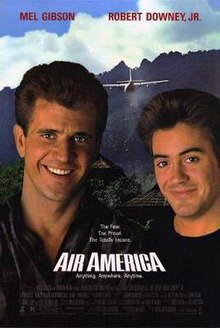
Air America

At some point over the last 15-20 years, both Robert Downey Jr. and Mel Gibson have had their fair share of "down" moments. The difference of course is that Downey has recovered from those moments, battling through drug addictions to become one of the most popular, bankable stars in Hollywood currently working today. One of the biggest stars of the 1980s and 1990s, Gibson has fallen on some hard times because of his off-screen antics, everything from an alcohol problem, brutal voice mails left for his kids' mother, and that whole not believing in the Holocaust thing.

When they teamed up for 1990's Air America though, they were both riding high. Downey Jr. was a rising star, and Gibson was the established star coming off the Lethal Weapon and Mad Max movies, among others. It is an oddity among Vietnam War films in that it has a comedic touch to it, something you wouldn't normally associate with such a dark time in American history. We're not talking obvious humor or even slapstick, just an odd attempt to be funny at times. It is based on a true story -- supposedly -- with some conspiracy theories and shady government dealings going on. I don't know. It could all be true, but mostly I'll recommend this movie for the cast.

It's 1968 in Laos, and the United States is officially not in that country at all....seriously, we weren't. Working for a company called Air America, American pilot Gene Ryack (Gibson) is several years into a job that has him dropping supplies, food, arms, materiel into Laos to help the locals fight the ever-present North Vietnamese. He is part of a small group of American pilots working for the company (CIA? Interesting...) who get a weird adrenaline rush from flying these highly dangerous missions.  A new pilot fresh from the U.S., Billy Covington (Downey Jr.), arrives in Laos to join the crew and immediately starts to question what's going on. Officially, none of these men are even in country because the government says they're not, but what's really going on? What are they actually shipping? A curious Billy wants to find out, and a weary Gene just wants to make some money.

A variation on the buddy picture, 'America' succeeds (or fails I guess, depending on your take) because of Gibson and Downey Jr. as the two leads. Besides both men dressing and having the look of someone from well...1990 and not 1968, they are an ideal ying and yang to work off each other. Gibson's Gene has thousands of hours flying under his belt with little to show for it. He has a little side business he hopes will prove lucrative while Billy is a bit of a thrill-junkie, an idealist at times and naive to what's really going on in Laos.  Not quite the Odd Couple, but close. Both actors are immensely talented which is on display here with characters and a story that isn't really anything new. You've seen characters like this before, and you'll see them again most likely. Gibson and Downey Jr. make it interesting in this light, comedic take on the Vietnam War.

Doesn't sound quite right, does it? A comedy about Vietnam? That description isn't completely fair, but director Roger Spottiswoode does keep 'America' at a certain light and happy level. While based in the Korean War, MASH satirizes Vietnam successfully, and that's the route to go. This isn't satirical, just a dig at a war and conflict that was and is hard to understand. The humor that does work is the out of left field, almost bizarre humor. Gene and co-pilot Tim Thomerson fight over crayons while they draw in a coloring book while Billy almost crashes in foggy weather. Gene, Billy and the American pilots go on a bender of sorts, playing mini-golf in the midst of  a war. Thomerson's Babo says when asked if they always go on benders like this "No, this is nighttime." There are some laughs here, but the story on the whole needed to go deeper and darker.

The potential for a story based in darker roots comes from the supporting cast and the very interesting parts they play. Burt Kwouk plays the Vietnamese warlord working with the Americans, ready to betray anyone for the right price. Nancy Travis is Corinne, an aid worker working at a refugee camp. Ken Jenkins and David Marshall Grant are perfectly cast as Major Lemond and his right hand man, CIA(?) officials running a drug operation with Kwouk and the American pilots. Lane Smith is very good as Davenport, a visiting U.S. senator looking for answers. Along with Thomerson, Art LaFleur, Ned Eisenberg, Marshall Bell and David Bowe round out the other American pilots. With so many characters, 'America' covers a lot of ground and from a ton of different perspectives. I felt like I got a good, detailed picture of a murky, shady situation. The picture just wasn't cynical enough. A hidden war with drug money supporting the effort is as dark as it gets, and 'America' doesn't truly capitalize on that darkness.

That is most evident in the ending, a finale that is too pleased with itself wrapping the story up nicely.  It goes for the generic happy ending that would have been better suited to so many other movies. But as I write this, I realize how negative this is all sounding. I did in fact, like this movie. It is a good story, no matter that it could have been better.  There is some crazy aerial footage from a variety of different planes, Thailand is an incredibly visual backdrop for the story, and a classic rock soundtrack from the late 1960s is never a bad thing. It's not a great movie overall, but I enjoyed it nonetheless.

Air America <---trailer (1990): ***/****   

Thursday, November 25, 2010

Tigerland

One of the more controversial movies to come out about the Vietnam War, Stanley Kubrick's Full Metal Jacket is a divisive movie among fans because of its makeup.  It is two radically different halves of a story, the first being boot camp for a company of Marines, the second following one main character as he's shipped overseas to fight in Vietnam.  I like both halves, but many fans/critics maintain that the boot camp first half is far and away the better half (I tend to agree).  So why not make a whole movie about the boot camp aspect of being a soldier preparing for Vietnam?  That's 2000's Tigerland.

Director Joel Schumacher is known more for his ability to make the big, booming, heartless blockbuster than a documentary-like portrayal of a true story (sort of).  But in a departure from his usual, Schumacher turns in a winner with a vastly different style.  Telling the story of an American platoon of soldiers training at Fort Polk in Louisiana, Tigerland feels like a documentary made in the 1970s.  He films with handi-cams that does produce some stomach-turning editing -- hold the camera steady for God's sake! -- but also uses a filter that gives the movie a retro, even fuzzy look at times.  The end result though is that you feel like you're there with the soldiers as they struggle with the reality that in a few short weeks they'll be fighting in Vietnam.

It's 1971 at Fort Polk in Louisiana, and a platoon of American soldiers is just eight quick weeks away from being shipped to Vietnam.  The officers and NCOs push them to their limits to prepare them for the hell they will fight with in Vietnam, but nothing can really prepare them for what awaits.  Among this platoon is Jim Paxton (Matthew Davis), a Northern college student who volunteered in the army where most were drafted, and Roland Bozz (Colin Farrell), a rebellious Texan doing everything he can to get kicked out of the army. The two very different soldiers have a completely opposite viewpoint on the war, but they share a common goal in just wanting to survive.  But as big a troublemaker as he is, Bozz is seen by his superiors as an ideal leader.  Looming ahead though is a week-long trek to Tigerland, a camp meant to simulate Vietnam and all its horrors.

First off, this is not a Vietnam movie like Platoon or Apocalypse Movie where combat and jungle fighting dominate the story.  Tigerland is about the training plain and simple.  Vietnam is only an idea, a place none of these young men have ever been yet.  It's a refreshing change of pace though because the Viet Cong and NVA aren't the enemies here.  It is the infighting that takes place among a melting pot of American soldiers from a laundry list of backgrounds and experiences.  These are 18 and 19 year old kids getting ready to fight in a very unpopular war and are very much aware of that.  By 1971, the backing of the war had taken a huge turn to the negative in public sentiment. Going to fight a lost war where chances of survival are slim? I'd be pissed too.

I was worried early on that the pretentious, cliche-filled story was going to be more than a little boring to watch...again.  I'd seen this movie before.  Thankfully, Schumacher establishes all these well-worn, known cliches and builds on them.  We see characters that we know from other movies, but he doesn't stop there, allowing us to get to know these individuals rather than resting on the audience being comfortable with what they've seen before.  Some of the supporting characters include Thomas Guiry as Pvt. Cantwell, a father of four with a schizophrenic wife, Clifton Collins Jr. as Miter, the appointed platoon guide who begins to crumble under the pressure, Shea Whigham as Pvt. Wilson, a soldier dripping with hate, and Russell Richardson as Pvt. Johnson.  The training officer and commanders include Nick Searcy, Afemo Omilami, and James MacDonald.  

Still a relative unknown in the United States when he made this movie, Colin Farrell is the hands down breakout star.  I've long been a fan of Farrell as an actor, but this might be his part overall role.  He creates a mess of a character in Roland Bozz, a soldier who you find yourself rooting for almost in spite of him at times.  A loner, a rebel, Bozz does anything he can to fight the system and push the limits.  He is an idealist who opposes the war but not for anything far-flung ideas or principles.  He just thinks it's wrong what one human being can do to another.  Doing his best to get kicked out of the army, Bozz ends up getting a leadership role.  All his objections aside, Bozz is a natural leader who gains the respect of his fellow trainees, but that doesn't mean he's still not looking for an out.  His character gets all twisted around into making decisions that obviously impact him, but all those around him.

The highlight of the movie was the last 25-30 minutes, the actual trip into Tigerland, a portion of the Louisiana swamp serving as a testing ground for what Vietnam will be like. The trainers are recent vets of Vietnam -- Cole Hauser impresses as a sergeant just days removed from a tour -- who know they're fighting a losing battle but nonetheless have a job to do in training these green soldiers. The movie's more startling moments come to the forefront here as the trainees are pushed to their limits and respond accordingly.  The ending does supply a bit of a surprise and is both appropriate and frustrating.  You'd like closure as to what happens, but it's just not in the cards.

Tigerland <---trailer (2000): *** 1/2 /****