The Sons of Katie Elder

The Sons of Katie Elder
"First, we reunite, then find Ma and Pa's killer...then read some reviews."
Showing posts with label Dennis Hopper. Show all posts

Wednesday, December 10, 2014

Giant

So there's the United States, but if you ask some people from Texas, there's a different way of looking at it. There's 49 states that make up the U.S., and then there's TEXAS!!! A giant state with some giant personality, it needs a movie just as big as the idea of the state to really get the message across. Here's an epic that certainly tries, 1956's Giant.

It's the early 1910s and young, powerful Texas rancher Jordan 'Bick' Benedict (Rock Hudson) travels to a farm in Maryland to buy a strong, beautiful young horse. There, he finds what he's looking for and much, much more. Instantly struck, Bick marries the seller's daughter, Leslie (Elizabeth Taylor), who's as equally moved by the big, strong Texan. Leslie travels back to Texas with Bick where she's stunned by the immensity of the Benedict ranch, hundreds of thousands of acres with cattle numbering in the thousands. The life is hard but worthwhile...for those accustomed to it. Leslie is used to a certain openness about living and prejudices and beliefs, none of which she finds in Texas. The marriage is just weeks old, but Bick and Leslie begin to butt heads almost immediately. The young couple with everything at their disposal, right at their fingertips, is heading into a turbulent time, both for themselves but also for Texas.

Some movies just scream EPIC, and in the age of the monster budget, historical epics, this 1956 Texas family drama from director George Stevens certainly qualifies. Based off a novel from author Edna Ferber, this is a big old movie. At the time, it was the most expensive film ever made. The scope and scale is gigantic. Stevens took advantage of the widescreen filming techniques, filling the screen with the wide expanses of the Texas plains in all its sunny and sandy glory. Visually, 'Giant' is a stunner. Dimitri Tiomkin's score is solid but more subdued than most of his more well-known scores and with an obvious reliance on some patriotic Texas songs. A must in an epic -- seemingly -- is to get a message across though, to say something. That's where 'Giant' seems to stumble in a big way. I don't know if it's trying to say much of anything. That's for a little later. For now, here's some positives to take away.

So big story, big setting....yeah, we need a big cast. Two rising stars who were definitely on the way to bigger and better things in Rock Hudson and Elizabeth Taylor. I was interested in these characters which is a credit to Hudson and Taylor because let's be honest. These aren't especially likable characters. They bicker, fight and argue about anything and everything. Love at first sight....until real life settles in. So they're not especially likable, but they do a fine job bringing these characters to life. It feels like real life, two madly in love individuals figuring out marriage and love isn't so easy. Neither is a truly great performance, but they're very solid performances just the same. 

Unfortunately, 'Giant' was remembered both then and now for the sudden, tragic death of one of its cast members. That actor? The iconic James Dean, star of just three movies before his sudden passing in 1955 before the film was completely finished, just 24 years old when he died. Here, he plays Jett Rink, a lower class cowboy working on the Benedict Ranch, a thorn in Bick's side but liked by everyone else. Jett was my favorite character, a remotely sympathetic anti-hero just trying to make his way, to carve out a niche for himself. A late monologue had to be re-recorded because the dubbing hadn't been completed before his surprising death during post-production. It's a quiet, understated part with some great moments (early on at least), especially when Jett's land proves to be far more valuable than originally thought. An obvious influence on many actors who would rise to stardom in the coming years, Dean is a gem.

Okay, enough with the relative positives. I love epics, especially those from the 1950s and early 1960s. This one pushed even me to the limits to the point I struggled to get through the last hour-plus in a movie that already runs 201 minutes. The first 90-120 minutes are pretty good if nothing classic in my mind. Then from there on in, the story jumps to when Bick and Leslie are far older, their empire grown, their family established and all grown up. At this point, all the issues introduced early are basically brushed aside. The story -- not exactly fast-moving up to this point -- grinds to a complete halt. Characters are introduced and dispatched with little fanfare. It drifts aimlessly until an ending that to put it lightly is disappointing. Was there an ending in mind that actually accomplished something? 'Giant' limps to the finish line after a painfully slow 3-hour road trip.

That's the biggest issue. What -- if anything -- is it trying to say? It's obviously a story focused on family and Texas and all their drama. Let's say this though. There is A LOT of drama. It's everything from marital strife to racism, sexism to political corruption, old school versus new school, parenting methods to manipulation of all sorts and on countless different levels, cattle ranching to becoming an oil baron. Pick one, or even two or three, and run with it. Instead, Giant just barrels ahead with all of the above and lets things fall where they may.

Now back to the casting. The characters may not always be very good, but the star power is impressive. Mercedes McCambridge does what she does best as Luz, Bick's sister who's a tomboy, a bit of a spinster, and if this movie was in 2014...a tough as nails lesbian. Chill Wills is solid in a more subdued part as Bick's very Texas uncle. As for the younger generation that pops up in the last third of the movie, look for Carroll Baker, Sal Mineo, Earl Holliman, and Dennis Hopper. Oh, and for good measure, Paul Fix and Rod Taylor have underused supporting parts so there's that. A big disappointment for me though, one I really, REALLY wanted to love. I came away barely tolerating it. A major disappointment.

Giant (1956): **/**** 

Thursday, February 16, 2012

Apocalypse Now

As a fan of movies, there are just certain films you have to see. When you haven't seen those movies, you typically get a reaction something like 'HOW HAVE YOU NOT SEEN THAT? IT'S A CLASSIC!' The reaction can be angrier or happier depending on the individual. I've gotten that reaction concerning 1979's Apocalypse Now. Well, check that one off the list.

Having already served at least one tour in Vietnam, special forces Capt. Willard (Martin Sheen) is wasting away in Saigon as he battles through some personal demons. He waits and waits for a mission, and finally gets one, but it's nothing like he expected. Across the Cambodian border, an American officer and Special Forces vet, Col. Kurtz (Marlon Brando), has gone rogue, and Intelligence things he's gone insane with his adoring command still intact. Willard's mission sounds simple but is anything but. Boarding a small patrol boat with its close-knit crew, Willard travels all the way up a river into Cambodia with one objective; terminate Kurtz with extreme discretion.

While director Francis Ford Coppola's highly controversial and much debated movie is typically grouped as a war movie, it is really anything but. It is based off Joseph Conrad's Heart of Darkness, albeit based in a Vietnam setting. Not to sound pretentious -- the movie does enough of that -- but this movie isn't about war. It's more about the affects of war, how it hits people, how it impacts them. I watched Apocalypse Now Redux, the longer version Coppola released in 2001, and I feel safe saying it is unlike any movie I've ever seen before. Emotional, moving, existential, other-worldly, upsetting. It defies descriptions in so many ways.

The best I can do though is surreal. The Vietnam setting is a jumping off point for the weirdness. At 202 minutes (the Redux), it is a leisurely, slow moving story. It is one of the most incredibly visual movies I've ever seen, haunting in its beauty at times and upsetting at others. Working with his father, a composer himself, Coppola creates a musical score that is both classical and innovative. It uses an electronic synthesizer and lots of percussion, setting an eerie, unsettling mood to this trippy, even psychedelic trip up the river to Kurtz's compound. The feeling and aura of the movie is unreal and hard to put into words. Coppola creates a vision of a war -- Vietnam -- that I can only imagine was more terrifying than the actual war itself.

This is a movie about a journey though, both physically moving up the river and in one's mind, specifically Sheen's Capt. Willard. In a movie that runs three-plus hours, we get to see a lot of these bizarre, surreal moments in the journey. It starts with an opening set to The Doors' The End, and then we're off to the Intelligence community where the mission is explained, and then Willard is to to the Air Cav, a helicopter unit commanded by Col. Kilgore (Robert Duvall), more interested in surf conditions than objectives. That's just the start though. We see a disintegrating force of soldiers the further north the boat travels, officers in "command" long since gone. The patrol boat also runs into a USO show with Playboy playmates, the crew later running into them at an isolated Medevac station, and is also captured of sorts by French plantation owners (including Christian Marquand) still in Vietnam from the French occupation years before. The longer the journey, the stranger things get.

Through the good and the bad -- and there's a fair share of both -- are some moments of perfection. Kilgore's Air Cav command assaulting a Viet Cong coastline post is a brilliant sequence, one of the most realistic, intense, adrenaline-pumping action scenes ever. It's set to Wagner's Flight of the Valkyries, the music the attacking helicopters listen to as they fly into battle. Has to be seen to be believed and appreciated. Watch part of it HERE. Another highpoint is the patrol boat reaching the last American post on the river, a bridge under constant construction and under constant attack. Arriving in the dead of night during an attack with lights strung across the river, Willard and the crew find the semblance of what used to be a command in a dream-like, eerily beautiful sequence.

Onto the cast, and there's plenty to talk about there. Sheen nails his part as the tortured Capt. Willard. His narration fills in much of the movie's quieter gaps, treading the line between obnoxious and pretentious with genuinely heartfelt messages. His own descent into madness, his obsession to finish the mission is startling in its own right. Brando doesn't even appear until 150 minutes in, and his performance is almost a caricature of himself. It's all right, but a little much (more on that later). Duvall very much earns his Best Supporting Nod (but didn't win) as Col. Kilgore, infamously stating "I love the smell of napalm in the morning. The patrol boat's crew include Chief (Albert Hall), the no-nonsense commander, Clean (very young Laurence Fishburne), Chef (Frederic Forrest) and zen-like surfer Lance (Sam Bottoms). G.D. Spradlin and Harrison Ford have small parts as Intelligence officers giving Willard his mission. 

As good as parts of the movie can be, it also struggles to hold its momentum until the end. The story drifts along far too much, and by the time Brando's Kurtz actually reveals himself it's almost a disappointment. There is little energy in the build-up to the finale, an incredible ending that has stirred up controversy over the years in all its different variations. Dennis Hopper as a stoned-out photojournalist (Scott Glenn has a small part here as one of Willard's predecessors) and Brando spout off with lots of philosophical musings that mean nothing but sound good. Kurtz delivers one moving monologue about the horrors of war, but it's lost in a sea of drifting, pointless "messages." That's the problem with much of the movie. It wants to say something about war and man, but what exactly? 

Through everything though, this is an incredible movie. Even if you hate it, Apocalypse Now will almost certainly make an impact on you either negative or positive. I watched it two days ago and am still wrapping my head around it. It is unlike any other movie I can think of, and truly needs to be experienced.

Apocalypse Now <---trailer (1979): ***/****

Wednesday, October 12, 2011

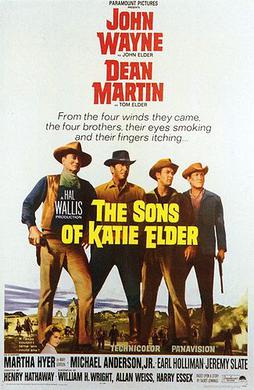
The Sons of Katie Elder

At the height of his long and very popular career in 1964, John Wayne was diagnosed with lung cancer. He underwent surgery to remove one of his lungs and two ribs, putting him out of commission for awhile. Production was even delayed on the movie he was working on, but he returned following the surgery and a cancer-free Wayne returned with a bang, bringing his usual imposing presence to the criminally underrated 1965 western, The Sons of Katie Elder.

It's been 10 years since gunfighter John Elder (Wayne) has returned home to Clearwater, Texas, but when news reaches him that his mother, Kate, has died, he returns home. There he finds his three younger brothers, Tom (Dean Martin), a gambler, Matt (Earl Holliman), a hardware store owner, and Bud (Michael Anderson Jr.), the youngest. Dealing with the guilt of not having seen his mother in years, John and his brothers find out their father was killed just six months earlier under suspicious circumstances. The Elder ranch is now owned by Morgan Hastings (James Gregory), but no one is quite sure how he came to be the owner. The Elders want some answers as to what exactly happened, but mostly they're trying to do something for their long-suffering mother. John intends to do a right, proving that Kate's faith in her sons was well founded.

Coming back from cancer (although it would eventually kill him), this 1965 film marked a big of a turning point for the Duke. From here on in through the end of his career, Wayne could be accused more of playing himself repeatedly in more viewer-friendly, cookie-cutter movies. He knew what his fans liked, and he intended to give it to them. Take none of that as a negative, I love many of the post-1965 movies Wayne made. They're fun to watch and easy to digest. There are good guys and bad guys with little middle ground. You know how it will end before it even starts. Once again, the movie equivalent of comfort food. 'Sons' has a ton going for it, ranging from Elmer Bernstein composing one of his most underrated and memorable scores ever (listen to the main theme HERE) to the location shooting in Durango, Mexico and along the Rio Grande. It's the little things that count.  

There are better, more iconic westerns, but I think 'Sons' would be a fitting introduction to someone who either isn't a fan or just doesn't care for westerns. Above all else, this is a movie -- not just a western -- about family, in this case a family coming back together after years apart. Wayne is the oldest brother, John, a gunfighter who's name precedes him wherever he goes. Martin is the wily gambler, Holliman the button-down businessman, and Anderson Jr. the college dropout. The movie's best moments come from the quartet of brothers reuniting, talking, fighting, working to make the Elder name something to be proud of in their Ma's name. There isn't a weak performance in the bunch. The chemistry is spot-on, the dialogue crackles like four brothers actually would talk -- in love and fighting -- and when the time comes they put aside their differences to work together.

Who ends up being one of the more memorable characters is the never seen Katie Elder. We hear a lot about her from anyone who ever met her, not one person having something negative to say about her. Martha Hyer's Mary Gordon, the boarding house owner, gives a great monologue about Katie lying about her boys, telling the town they always sent money, always wrote to check in. Some of the best parts of Bernstein's score come in these quieter moments as both the Elders and the population of Clearwater reflect on Katie's passing. All she leaves behind is two worn dresses, a rocking chair, and a "legacy" of her four boys. The movie's final shot is a touching one, surprising for a western oater.

Not enough yet? Still haven't sold you on this one? 'Sons' has one of the best supporting casts to come out of a 1960s western. Start with Gregory as Hastings, the businessman looking to put Clearwater on the map, no morals needed. A young Dennis Hopper plays Hastings' squirrelly son, Dave. Western vet and character actor Paul Fix is a scene-stealer as Sheriff Billy Wilson, an old friend of the Elders trying to keep peace in his town with fiery deputy, Ben Latta (Jeremy Slate in a solid supporting role), at his side. In a small but key role, George Kennedy is particularly intimidating as Curley, a hired gun working for Hastings. Also look for John Doucette, John Qualen, Sheldon Allman, and Strother Martin in supporting roles.

From director Henry Hathaway, 'Sons' is never listed as one of the all-time western greats or even among John Wayne's best. Why? I'm not sure. There isn't a ton of action, most of the gunplay saved for the last 30 minutes, including a high tension shootout in El Saltito, Mexico, a gorgeous and familiar location for western fans. The story is very much more interested in characters and their dynamic than making a shoot 'em up flick. It's a wise choice. The script is about as perfect as a western can get, and the cast beyond perfect. Underrated in any number of categories, and one all movie fans should be able to enjoy -- western or not.

P.S. Watch the movie and tell me otherwise. I'm convinced Dean Martin's Tom is supposed to die in the end. One throwaway line saves him, but it always felt tacked on to me. Any opinions?

The Sons of Katie Elder <---trailer (1965): ****/****

Tuesday, June 7, 2011

I Died a Thousand Times

As summer nears and all the big blockbusters hit theaters in the coming weeks and months, it is time to look ahead and see how many remakes and sequels are heading our way.  Long story short...there's a lot of them, some more necessary than others. As I've mentioned before, it's a huge pet peeve for me.  Why come up with something original or interesting or unique when you can just re-do something that was previously successful?  Remakes have always been made, but it seems like a more recent trend, or maybe there's just more out now.  Well, I can eat my words with 1955's I Died a Thousand Times.

Reading the movie's description at TCM's website, my first thought was 'That sounds familiar.' A simple Google search later, and it was easily figured out why.  It is a straight remake of 1941's High Sierra, a film noir classic from director Raoul Walsh and starring Humphrey Bogart and Ida Lupino. Both movies were released by Warner Bros. Pictures although 'Thousand Times' does take advantage of the recent widescreen-processing in production (it looks great, more on that later). It just seems an odd choice for a remake.  The 1941 version is a classic film noir, one held in high regard by reviewers and fans alike. So why remake it? Big pile of cash I'd assume.

Paroled early after serving part of a armed robbery sentence, well-known and feared gangster Roy Earle (Jack Palance) heads west, a new job already waiting for him. An old friend and partner, Big Mac (Lon Chaney Jr.), has set up a heist at a lavish resort where the end result could be almost a half million bucks.  He meets his inexperienced cohorts, Babe (Earl Holliman) and Red (Lee Marvin), as they wait for the signal from their inside man (Perry Lopez) to pull the job. Roy kills time with a poor family from Ohio, including their clubfooted daughter, Velma (Lori Nelson), and also with a dance hall girl, Marie (Shelley Winters) who tags along with Red. Going stir crazy just sitting and waiting around, the call finally comes to pull off the job, but even with an experienced crook like Roy along, nothing goes as planned.

Without a specific way of explaining it or putting it into words, there is a look to 1950s films that just appeals to me.  Movies were still in the early stages of taking advantage of that new widescreen process, especially here with CinemaScope. Even watching the film on TV, it looks gigantic, and I can only imagine what it looked like on a big screen in theaters. Director Stuart Heisler filmed his movie with cinematographer Ted D. McCord in Pine Hills, California, and it looks gorgeous. The Sierra mountains never looked better, and even some studio inserts for outdoor shots can't ruin it. The picture is BIG and the California desert and the tiny resort towns and stops along the highway provide a great, stark setting for this heist remake.

If there is anyone you don't want to follow in their footsteps as an actor, Humphrey Bogart has to be at the top of the list. His High Sierra performance is one of his best; a likable, sympathetic bad guy.  Stepping into the role, Jack Palance is a more than solid option to take over the Roy Earle character. Palance was an always intense actor who just by giving a look can intimidate.  Adding that sympathetic edge to his character, Palance's Roy is that tragic, doomed bad guy (whether you've seen the original or not, it's obvious from the start). This is supposed to be his last job, and through Winters' Marie and Nelson's Velma, he is looking for some sense of normalcy. Neither woman is the right choice for him, but he doesn't know that.  Roy wants to settle down, and even though he has a mean streak a mile wide, I genuinely liked this character. An underrated Palance performance.

As for the supporting cast, it is a case of the names being more impressive than the actual performances. That's not necessarily the fault of the cast, just a script that doesn't give the actors and actresses a lot to do. Instead, there's too many characters. Holliman and Marvin are generally wasted as Babe and Red, Roy's partners in the heist.  Winters is at her clingy, annoying best as Marie, a young woman who has to be around a man. She seems to play this part a lot. Pedro Gonzalez Gonzalez plays Chico, a helpful hotel attendant similar to the character he played in 1959's Rio Bravo four years later. Chaney Jr. isn't around much as Big Mac, but his quick scene with Palance is memorable.  Nelson is the surprisingly dark character, Velma, with Olive Carey and Ralph Moody playing her parents. Even look for very young Nick Adams and Dennis Hopper in small parts.  Dub Taylor has a quick appearance too as a gas station attendant.

Watching a remake when you're familiar with the original is tricky because you're basically watching the same movie. The 1955 version of High Sierra is virtually identical with nothing new or different really thrown in. The story lags some after the heist goes down, almost like some time needed to be killed before the finale.  The ending is the same and works just as well, mostly because it is an appropriate ending.  So watching the same movie, there has to be something to recommend for anyone who's seen High Sierra.  The cast -- especially Jack Palance in the lead -- makes this one worth watching. Check out High Sierra too, and compare.

I Died a Thousand Times <---TCM trailer (1955): ***/****

Wednesday, January 5, 2011

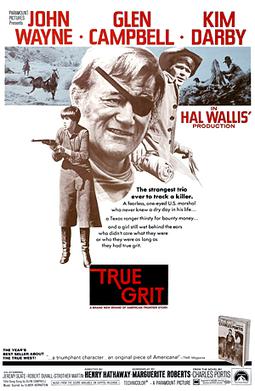
True Grit (1969)

Through a career that spanned four decades by the time 1969 had rolled around, John Wayne had somehow only been nominated for one Oscar in his entire career.  His part in 1949's Sands of Iwo Jima earned him a Best Actor nod which he would lose to Broderick Crawford in All the King's Men.  My complaint isn't that Wayne lost, but he had some excellent parts during his career that included The Searchers, The Quiet Man, Red River, and She Wore a Yellow Ribbon among others.  Well, in 1969 Wayne won his first and only Oscar for his performance in True Grit, an award that obviously came about because of that movie but was almost a symbolic Lifetime achievement award.

Recently this flick has been in the news because the Coen brothers remade it with their movie hitting theaters in the last few weeks.  My worry was that it was a movie that didn't need to be remade so why touch it?  Honestly, the 1969 version isn't a great western, but it is remembered so fondly because of what it meant for John Wayne, his career and his fans.  It's a pretty standard oater and a good example of the type of movies Wayne made at this later point in his career.  Familiar story, good vs. bad, lots of recognizable faces, and nothing really groundbreaking.  But in the end, it's entertaining and a pleasant enough way to pass a couple of hours.

For those not familiar with the story, here's a basic description. The 1969 and 2010 versions are pretty identical story-wise, but here goes. Teenager Mattie Ross (Kim Darby) travels to Fort Smith, Arkansas in 1880 looking for help in tracking down the man, Tom Chaney (Jeff Corey), who gunned down her father in cold blood. She finds no takers other than U.S. Marshal Rooster Cogburn (Wayne), a one-eyed, drunk who is a few years past his prime.  With a Texas Ranger, La Beouf (country singer Glen Campbell), Mattie and Rooster head into the Indian territory to hunt down Chaney and bring him back, hearing rumors he has joined up with outlaw Lucky Ned Pepper (Robert Duvall) and his gang.

Call it his best performance if you want (I don't think it's even close, he had much better) but this may be the one Wayne is most remembered for.  Criticisms aside, and I don't have many, but he had better parts that showed off his ability, Wayne does deliver a great performance and one that he fully deserved his Oscar for.  To a certain point, he is playing a caricature of himself.  He later joked that if he knew all it would take to win an Oscar was put on an eye patch he would have done it years before.  Wayne was an underrated comedic actor, and his Rueben 'Rooster' J. Cogburn shows that off.  He's rough and ready but has a softer side to when it comes to Mattie who can both drive him nuts and have him develop a fatherly bond with her at the same time.  Watch his Oscar acceptance speech HERE for a simple, effective and very moving look at Wayne and this part which finally earned him some Academy Award consideration.

So Wayne is obviously the biggest selling point here, but the problem is what else is there to sell?  As good as Wayne is as Rooster, his two main supporting parts are about as awful as they can be. The Mattie character is key, and as was the case with the remake, annoying but endearing in an odd way.  You're supposed to root for in spite of how ridiculously annoying, how brutally honest she is.  Darby just can't manage it in one of the most grating performances I've ever come across.  You just can't get behind this character.  A similar problem exists for Campbell as Texas Ranger La Beouf.  First, this country singer can't act a lick.  His character is supposed to be the polar opposite of Rooster, but just like Darby's Mattie it's hard to find a reason to like him.  If nothing else, his character redeems himself in the end...twice actually.  Still, it's not enough to save the part.  Check out the remake for how these characters should and could have been played.

Having watched both versions in little less than a week, I had to laugh at the idea that the Coen brothers did something vastly different with their version. Working off the Charles Portis novel, whole scenes, whole exchanges of dialogue are exactly the same between the two movies.  The tone is obviously different -- more light-hearted here -- and the only huge difference is the period authentic dress, dialogue, and accuracy in general.  Director Henry Hathaway films this story in Mexico, California and Colorado and ends up with a beautifully photographed film that looks absolutely nothing like the setting it takes place in, but that's just a minor detail, right? Elmer Bernstein's score sounds like a mix of a lot of his movies, but not necessarily in a bad way.  You'll notice a lot of familiar notes if you're familiar with his work at all, but the main theme is a good one.

You can't help but compare the two, and all I could come up with involving both was that the story itself is lacking something.  Portis was known for straightforward stories that didn't pull punches.  If anything, True Grit is too simplistic, too straightforward.  At times, it's even a little dull.  This is a movie about characters, and for the most part they're interesting even if we don't like them.  Story gets lost in the shuffle at times, but sit back and enjoy getting to know the main characters.  Of the rest of the cast, Duvall makes basically a small cameo, Jeremy Slate and Dennis Hopper are two of his gang, and Strother Martin is a haggling horse trader who incurs Mattie's wrath.

True Grit <---trailer (1969): ***/****

Monday, August 16, 2010

Knockaround Guys

Gangsters and mobsters have been in movies dating back to Edward G. Robinson, James Cagney and many others in the 1930s, and since then have never really left popular culture.  There have been lulls here and there, but other flicks like The Godfather trilogy have a way of bringing them back.  There's so many gangster/mobster stories you start seeing repeats, almost the same movie made over and over again.  Released in 2001, Knockaround Guys revels in some of those genre conventions, but adds a cool twist as a topper.

With the exception of The Godfather, most mobster movies deal with just that...the mobsters.  'Knockaround' goes deeper than that, exploring the effects and consequences of growing up in a mafia family.  Through no fault of your own, growing up just became that much more difficult because of your last name, not because of who you are as a person.  Al Pacino's Michael Corleone embraced the life his father tried to keep away from him, basically becoming his father.  The main character in 'Knockaround' wants to be that guy, but it doesn't come as easy to him, putting him in quite the situation.

As a low-level operator for his underboss dad (Dennis Hopper), Matty Demaret (Barry Pepper) is fed up.  He can't get a job because of his name, and his father won't entrust him with anything important. With some help from his also-connected uncle (John Malkovich), Matty finally gets approval from his father to do a job, a simple pick-up and deliver. Matty gets his friend and pilot, Johnny Marbles (Seth Green), to fly to Spokane and pick up a bag brimming with cash that needs to be delivered on time. The worst happens though when Marbles loses the bag while refueling the plane in an isolated Montana town.  Matty is forced to fly out to try and find the bag or pay the consequences, bringing along two friends, Taylor (Vin Diesel) and Scarpa (Andrew Davoli) along for help.  But the clock is ticking, and the money bag is nowhere to be found.

At a brisk 92 minutes, this is a streamlined story that doesn't waste time with any unnecessary subplots or characters that serve no purpose.  The premise of a youngster trying to prove himself is nothing new and can apply to just about any movie genre out there, it just translates well to crime, mobsters and murder generally.  There's nothing spectacular at all about this movie.  It just flows along without trying to deliver a message or blow you away with huge twists.  For all those reasons, I actually liked the movie a lot more than I would expect.  Things fall apart a bit in the last 20 minutes or so, but with the right mix of story, character and a dose of black humor, I liked this movie.  Loved it? No, but it's worth a watch.

The biggest appeal here will be the strong casting, both the stars and the supporting parts that amount to cameos.  Barry Pepper has been one of my favorite character actors ever since I saw him as the god-fearing sniper in Saving Private Ryan, and here as the lead he turns in a great performance.  He struggles in this in-between state of how much to commit to the family.  He's not a killer, he just doesn't have it in him, but his Matty also wants to help out his father, live up to the old man's expectations.  Glad to see Pepper step into the limelight instead of his typical supporting parts.  The other scene stealer is Vin Diesel who in a rare non-action movie delivers one of -- if not THE -- best performances of his shorter career.  Think of Robert Duvall's Tom Hagen, but in the sense he could beat you to death with a crowbar.  Diesel's Taylor is a tough guy, always has been, who realizes to a point that he's never going to climb up the ladder like Matty because of his Jewish/Italian background.

With such a short running time, there isn't a ton of background scenes among Matty and his three friends.  Instead there are three quick early scenes that introduce all three, and then we're right into the story.  I enjoyed watching the dynamic among the quartet because like real friends do, they fight and argue constantly but always come around in the end, especially when needed the most.  Directing combo Brian Koppelman and David Levien do a fine job with the script, crafting a story that allows these characters to breathe some while also reining them in when need be.  There are times late in the movie where it would have been easy to detour and go down a different road, but thankfully it always stays on line.

As for those two cameos, Hopper is only in three or four scenes that need him to be a smartass and glare at someone occasionally.  Malkovich gets to chew the scenery a little more as Uncle Teddy, a mafioso underboss like Hopper who helped raise Matty when his father was thrown in prison.  But like so many good actors in average movies, them just being in this movie aids the cause.  Also listen for a good if underused score by Clint Mansell, and an excellent rock soundtrack to boot. A solid if unspectacular vehicle that does try something new within the mobster movie sub-genre.  A decent enough way to spend 90 minutes.

Knockaround Guys <---trailer (2001): ** 1/2 /****

Monday, June 28, 2010

Hoosiers

Attending Indiana University for four years, it's safe to say I know how serious Indiana -- the state and the university -- takes its basketball.  Pro, college, and high school, it doesn't matter.  The state loves basketball.  Maybe the best way to see this love of the sport is in 1986's Hoosiers, the best basketball movie ever made and easily one of the top five sports movies ever made.  Where it might take a couple hours to explain how much Indiana love their basketball heroes, it's easier to say this.  Just check out the movie.

Based very loosely on the 1954 Milan state championship team, Hoosiers paints a picture of what life in small-town Indiana was like in the 1950s.  In the same way that Friday Night Lights showed what high school football means to Texas, so goes high school basketball to Indiana.  In a town where there's little to do and not much in the way of excitement, the basketball team was a top priority in entertainment.  On Friday nights, the town packed the gym to root on their boys.  When they traveled, the town did too.  Naturally there's a huge amount of pressure that goes with that on the coaches and players.  In telling this story, director David Anspaugh creates one of the more emotional, powerful, and enjoyable underdog stories, a perfect example of what can be right about sports.

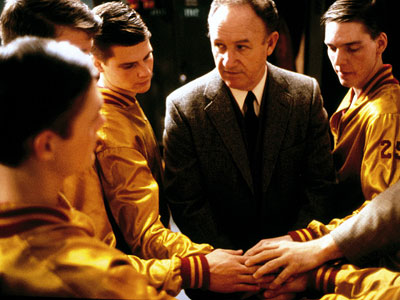
After 10 years away from coaching, Norman Dale (Gene Hackman) accepts a coaching position in Hickory, Indiana, a small high school with just under 70 students.  He quickly meets resistance on just about every front possible including the acting principal, Miss Fleener (Barbara Hershey), the townsfolk who expect their team to be perfect, and worst of all, the team's best player, Jimmy Chitwood (Maris Valainis) has decided not to play in honor of the last coach's passing.  Undeterred, Dale goes about his business of trying to coach his 7-man squad to be the best team they can be.  A weird thing starts to happen even as everyone objects to Dale's strategy, Hickory starts winning, and it looks like nothing is going to stop them.

There's so many positives going on with this movie I really don't know where to start.  A hugely under-appreciated actor, I don't know if Hackman was ever better than he was here.  His Norman Dale has been given a second chance to do something good after an incident from his past hung over his head all these years.  He clearly knows what he's doing coaching on the sidelines, but he has to convince everyone else he knows what he's doing.  As for the necessary 'coach' moment, listen to this speech and tell me that wouldn't get a team fired up.  I love so many of Hackman's parts -- good guys and bad guys alike -- but this may be my favorite.

As for the basketball, it's handled well in scenes that always allow you to keep up with the action.  Local high school and college athletes filled out the Hickory squad, and with the exception of Valainas as Chitwood, none of the players ever acted again.  You never get a sense of someone putting on a show or overacting.  These were kids in their late teens playing themselves.  And even down to a set-shot jumper or style of play, they look like they could have played in the 1950s.  The basketball scenes are instrumental in getting that 1950s feel to the story.  We're not talking massive gymnasiums for playing, we're talking tiny, claustrophobic places where the crowd is right on top of the action.

I'm going to say SPOILERS here, but if you don't know how Hoosiers ends where have you been these last 24 years?  Chitwood rejoins the team and saves Dale's job, sparking the team all the way to the state title game at Hinkle Fieldhouse in Indianapolis against a powerhouse team from South Bend. An absolutely inspired scene has Dale measuring the basket and the free throw line at Hinkle to show that the venue may be much bigger, but the court is just the same. The ending of course is obvious, Hickory has to win, but that doesn't take away from the power of the moment. Valainis says maybe 20 words the whole movie, but none speak larger than 'I'll make it.'  Done, and game over.  Gives me chills just thinking of it.

Beyond the underdog story, sports movies are so often about second chances and rising to the occasion.  In many ways, they're about people coming to together in a situation out of their comfort zone.  Dale butts heads with Hershey's Myra Fleener for his tactics but ends up wearing her down.  Dale takes on the town drunk and one of the player's fathers, Shooter (Dennis Hopper, Oscar-nominated for his role), because he knows basketball like few others do despite his drinking problems.  Chitwood wants nothing to do with basketball at first, only to realize how much it means to him and more importantly, his town.  The sports aspect is key, but the interpersonal relationships that develop are as big a part of the sports flick above all else.

Comparing sports movies though, a key element is that one moment, that special scene that does send chills down your back.  Hoosiers has too many to even count, most of them aided by Jerry Goldsmith's Oscar-nominated score.  Give it a listen HERE and HERE.  There's the entrance at the fieldhouse, Ollie hitting two underhanded free throws to win the regional title game, Hackman sending four players out and stating 'My team is on the floor,' or Hopper's Shooter forced to coach and lead his team to victory.  It is the moments like that which make sports movies special.

I don't intend this as a cop-out, but you watch Hoosiers and just know it's a good movie.  It lives on in Indiana -- people still talk about Milan, and are angry that with the class system there'll never be another Milan -- as if this story was the true one.  Every so often in movies, every little thing fits perfectly together in a way that is hard to express or explain.  It's just good, and that's what counts.

Hoosiers <----trailer (1986): ****/****