The Sons of Katie Elder

The Sons of Katie Elder
"First, we reunite, then find Ma and Pa's killer...then read some reviews."
Showing posts with label Carroll Baker. Show all posts

Wednesday, December 10, 2014

Giant

So there's the United States, but if you ask some people from Texas, there's a different way of looking at it. There's 49 states that make up the U.S., and then there's TEXAS!!! A giant state with some giant personality, it needs a movie just as big as the idea of the state to really get the message across. Here's an epic that certainly tries, 1956's Giant.

It's the early 1910s and young, powerful Texas rancher Jordan 'Bick' Benedict (Rock Hudson) travels to a farm in Maryland to buy a strong, beautiful young horse. There, he finds what he's looking for and much, much more. Instantly struck, Bick marries the seller's daughter, Leslie (Elizabeth Taylor), who's as equally moved by the big, strong Texan. Leslie travels back to Texas with Bick where she's stunned by the immensity of the Benedict ranch, hundreds of thousands of acres with cattle numbering in the thousands. The life is hard but worthwhile...for those accustomed to it. Leslie is used to a certain openness about living and prejudices and beliefs, none of which she finds in Texas. The marriage is just weeks old, but Bick and Leslie begin to butt heads almost immediately. The young couple with everything at their disposal, right at their fingertips, is heading into a turbulent time, both for themselves but also for Texas.

Some movies just scream EPIC, and in the age of the monster budget, historical epics, this 1956 Texas family drama from director George Stevens certainly qualifies. Based off a novel from author Edna Ferber, this is a big old movie. At the time, it was the most expensive film ever made. The scope and scale is gigantic. Stevens took advantage of the widescreen filming techniques, filling the screen with the wide expanses of the Texas plains in all its sunny and sandy glory. Visually, 'Giant' is a stunner. Dimitri Tiomkin's score is solid but more subdued than most of his more well-known scores and with an obvious reliance on some patriotic Texas songs. A must in an epic -- seemingly -- is to get a message across though, to say something. That's where 'Giant' seems to stumble in a big way. I don't know if it's trying to say much of anything. That's for a little later. For now, here's some positives to take away.

So big story, big setting....yeah, we need a big cast. Two rising stars who were definitely on the way to bigger and better things in Rock Hudson and Elizabeth Taylor. I was interested in these characters which is a credit to Hudson and Taylor because let's be honest. These aren't especially likable characters. They bicker, fight and argue about anything and everything. Love at first sight....until real life settles in. So they're not especially likable, but they do a fine job bringing these characters to life. It feels like real life, two madly in love individuals figuring out marriage and love isn't so easy. Neither is a truly great performance, but they're very solid performances just the same. 

Unfortunately, 'Giant' was remembered both then and now for the sudden, tragic death of one of its cast members. That actor? The iconic James Dean, star of just three movies before his sudden passing in 1955 before the film was completely finished, just 24 years old when he died. Here, he plays Jett Rink, a lower class cowboy working on the Benedict Ranch, a thorn in Bick's side but liked by everyone else. Jett was my favorite character, a remotely sympathetic anti-hero just trying to make his way, to carve out a niche for himself. A late monologue had to be re-recorded because the dubbing hadn't been completed before his surprising death during post-production. It's a quiet, understated part with some great moments (early on at least), especially when Jett's land proves to be far more valuable than originally thought. An obvious influence on many actors who would rise to stardom in the coming years, Dean is a gem.

Okay, enough with the relative positives. I love epics, especially those from the 1950s and early 1960s. This one pushed even me to the limits to the point I struggled to get through the last hour-plus in a movie that already runs 201 minutes. The first 90-120 minutes are pretty good if nothing classic in my mind. Then from there on in, the story jumps to when Bick and Leslie are far older, their empire grown, their family established and all grown up. At this point, all the issues introduced early are basically brushed aside. The story -- not exactly fast-moving up to this point -- grinds to a complete halt. Characters are introduced and dispatched with little fanfare. It drifts aimlessly until an ending that to put it lightly is disappointing. Was there an ending in mind that actually accomplished something? 'Giant' limps to the finish line after a painfully slow 3-hour road trip.

That's the biggest issue. What -- if anything -- is it trying to say? It's obviously a story focused on family and Texas and all their drama. Let's say this though. There is A LOT of drama. It's everything from marital strife to racism, sexism to political corruption, old school versus new school, parenting methods to manipulation of all sorts and on countless different levels, cattle ranching to becoming an oil baron. Pick one, or even two or three, and run with it. Instead, Giant just barrels ahead with all of the above and lets things fall where they may.

Now back to the casting. The characters may not always be very good, but the star power is impressive. Mercedes McCambridge does what she does best as Luz, Bick's sister who's a tomboy, a bit of a spinster, and if this movie was in 2014...a tough as nails lesbian. Chill Wills is solid in a more subdued part as Bick's very Texas uncle. As for the younger generation that pops up in the last third of the movie, look for Carroll Baker, Sal Mineo, Earl Holliman, and Dennis Hopper. Oh, and for good measure, Paul Fix and Rod Taylor have underused supporting parts so there's that. A big disappointment for me though, one I really, REALLY wanted to love. I came away barely tolerating it. A major disappointment.

Giant (1956): **/**** 

Tuesday, October 7, 2014

The Carpetbaggers

One of my favorite movies growing up -- and still is -- is the 1966 western Nevada Smith starring Steve McQueen. Wouldn't you know it? It's a prequel to a novel by Harold Robbins called The Carpetbaggers. How's that work? Well, it does and it doesn't. I'm still looking for the book, but I can check the film adaptation off the list. That's 1964's The Carpetbaggers.

It's the early 1920s and Jonas Cord Jr. (George Peppard) is a young man without a care in the world. Any problems he has, his rich father will solve or give him money or turn a blind eye to his antics. When Jonas' father suddenly dies from an aneurysm, a whole business empire is thrust upon Jonas. Will it crumble with the irresponsible Jonas at its helm? Far from it if he has anything to do with it. Young Cord wants to expand and grow and dominate the world. He starts the steady climb up, parlaying one factory into another and there's no market anywhere that Jonas doesn't want his hand in. He wants the power, the money, the prestige and nothing is going to stop him. But in the 1920s and 1930s, can anything actually slow Jonas down? Maybe only himself.

This was a movie I've long been aware of, one that I was vaguely familiar with because of 1966's Nevada Smith. For quite awhile it lingered on my Netflix Saved queue and lingered and lingered. Seriously....do people just hold onto the movies for months at a time?!? 'Carpetbaggers' finally popped up on the Retro Movie Channel, and I had to jump. I'm glad I did. From director Edward Dmytryk, it is a well-told story about business, ego, power, corruption and all that good, dark, sexy stuff that audiences can't turn away from. It clocks in at 150 minutes which might seem long, but the story moves at a lightning pace throughout. The timeline covers around 20 years but never feels rushed. We see the important moments from the good to the mostly bad to the really bad and often painful.

There's something simple and appealing about rise to power stories. How do they climb up? How do they stay there? What, if anything, will ultimately prove to be their downfall? This is a dark movie. There aren't good guys, just less bad guys. Everyone is out for themselves and willing to screw anyone over to get what they want with Peppard's Jonas leading the way. 'Carpetbaggers' takes place in posh hotel suites, busy movie sets, on new-model airplanes, in factories and follows Jonas with every decision he makes. It's nothing crazy original -- sure seems like a Howard Hughes-esque main character -- but there's something enjoyable, entertaining and appealing about this flick. I especially liked composer Elmer Bernstein's musical score with some familiar touches from other scores but forming its own identity. Listen HERE to the main theme.

Look at George Peppard's 1960s filmography, and you only see a couple classic movies, Breakfast at Tiffany's and How the West Was Won. But there's more there to appreciate, but he's got a handful or two of really solid movies worth seeking out. This film definitely counts. Peppard specialized in playing the anti-hero, that a-hole lead you just hate but can't look away from.This is a character who's icy, calculating, brutally efficient and with some deep-seeded personal issues. Obviously this isn't a character you're rooting for, but he's perfectly fascinating. We want to see what makes him tick. We want to see his next brutal takeover, whether it's on a personal basis or putting together a corporate buyout. An excellent performance from one of my favorites, Mr. Peppard. Nice work all around.

Peppard's Cord is the lightning rod for the story, but we meet a whole lot of other folks, most of them just as egotistical, greedy and downright lousy. Some good performances in a deep cast, starting with Alan Ladd in one of his all-time best parts as aging cowboy Nevada Smith. A checkered past to his name, Nevada tries to help Jonas knowing it can never really work. There's also Carroll Baker as Rina, Jonas' stepmother who's the same age as him and looking to make a name for herself. Slinking it up and quite sexy, Baker delivers an excellent part. There's also key supporting parts for Elizabeth Ashley (Jonas' wife), Robert Cummings (an agent turned producer), Martha Hyer (another femme fatale), Lew Ayres (Jonas' much-maligned yet capable accountant), Martin Balsam (a rival movie studio owner), Ralph Taeger (a pilot and business part of Jonas'), Archie Moore (the house servant who knows all) and Leif Erickson (Jonas' tough-love father).

If there's a weak point, it comes in the ending. I was looking for something better, something more appropriate and something DARKER. This is a tidy ending. An easy ending. The build-up makes up for it though to the point the last five minutes can't and won't ruin things. As for the connection to 1966's prequel, Nevada Smith, I think it is best to consider it two unrelated movies. Things don't jive just right, especially Brian Keith's Jonas turning into manipulative, evil Leif Erickson. One produced the other so that's cool, but that's about it. Both excellent movies, and let's leave it at that.

The Carpetbaggers (1964): ***/****

Monday, April 21, 2014

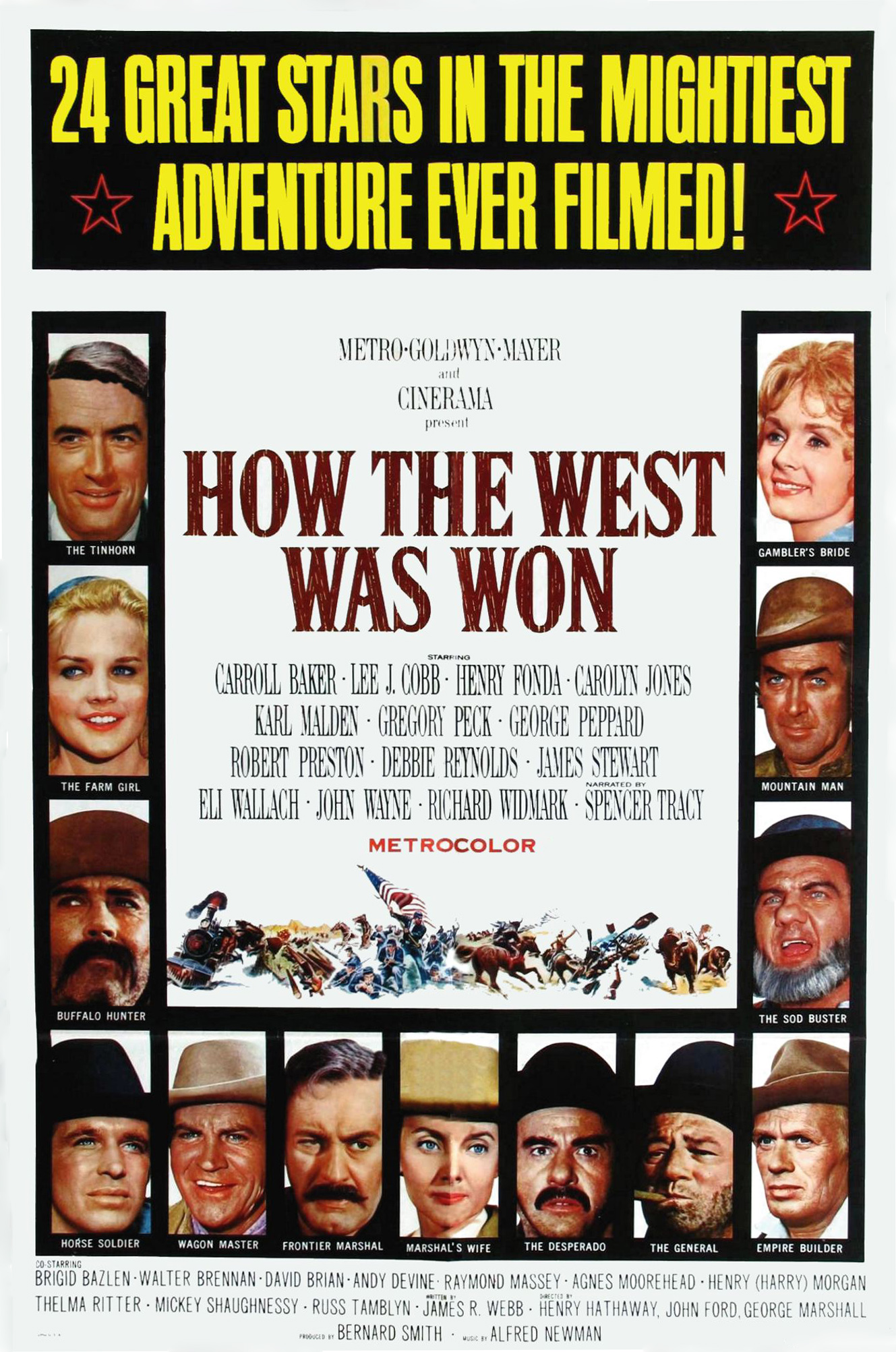
How the West Was Won

In the age of the epics -- the 1950s and 1960s -- some just stand above the rest. It's the stories, the cast, the scope. I don't love 1962's How the West Was Won but as far as epics go, there are very few in its neighborhood. There are obvious flaws, but when it works, it works in a big way. An impressive all-star cast, a story about the development of the American west and a shooting technique that is must-see. That's a winning formula.

A 162-minute film is broken up into five separate segments, the story following the Prescott-Rawlings family as it moves west and settles between the 1840s and the 1880s. It was directed by three different directors and covers a ton of ground. And away we go!

1. The Rivers (directed by Henry Hathaway): It's the 1840s, and the Prescott family, led by patriarch Zebulon (Karl Malden), is moving west and looking for a new life. In Zebulon's family is two daughters, Eve (Carroll Baker), looking for a new life in the west, and Lillith (Debbie Reynolds), wanting to stay in the far-more civilized East. In their dangerous travels on the rivers, they also meet Linus Rawlings (James Stewart), a mountain man with a canoe full of pelts.
Also starring: Lee Van Cleef, Walter Brennan, Agnes Moorehead, Brigid Bazlen.

2. The Plains (directed by Hathaway): Having worked for years on her own as a singer and dancer, Lillith Prescott (Reynolds) has just inherited a gold mine in the wake of the California gold rush. She heads west on a wagon train led by trail driver Richard Morgan (Robert Preston) with a gold-seeking gambler, Cleve Van Valen (Gregory Peck), also along too. 
Also starring: Thelma Ritter.

3. The Civil War (directed by John Ford): The war between the states in its early months, young Zeb Rawlings (George Peppard) leaves home with the blessing of his mother, Eve, to join the Ohio volunteers in the fighting. Like so many others, he thinks the war will be full of glory and be over quickly. Zeb finds out how very wrong he is at the bloody battle of Shiloh.
Also starring: John Wayne (as General Sherman), Russ Tamblyn (as a Confederate deserter), Harry Morgan (as General Grant), Andy Devine, Ken Curtis, Raymond Massey (as Abraham Lincoln).

4. The Railroad (directed by George Marshall): In the years following the Civil War, railroad companies race across the U.S. to link the two coasts. Now in the cavalry, Zeb Rawlings (Peppard) finds himself balancing out what his duty requires of him with what he knows is right, the railroad, including brutal supervisor Mike King (Richard Widmark), pushing the Arapahoes to their limit.
Also starring: Henry Fonda as Jethro Stuart, a former mountain man.

5. The Outlaws (directed by Hathaway): Having left the cavalry behind, Zeb Rawlings is now a family man with two kids, now trying to leave his profession as a lawman behind. He receives a letter from his aunt, Lillith (Reynolds), and readies the family to move. As they travel though, Zeb runs into Charlie Gant (Eli Wallach), a notorious outlaw gunning for Zeb.
Also starring: Lee J. Cobb, Carolyn Jones.

This is a movie that's simply put, BIG. It was filmed in Cinerama, three cameras filming each scene and then splicing the action together. The result? An immense look at the expansion of the west. Shots look like panoramic paintings, putting a whole new scope on the growth and development of the American west. It is a beautiful movie. Certain sequences especially stand out -- the camera on a raft trying to survive river rapids, an Indian attack on a wagon train, a stampeding buffalo herd trampling a railroad camp, a runaway train during an attempted robbery -- over the course of the movie, but visually there just isn't a weak spot. I love composer Alfred Newman's score -- listen to an extended sample HERE -- as it gives a moving background to the story. Countless gorgeous filming locations, providing a great backdrop while also transitioning from segment to segment.

It had been years since I watched this movie straight through in one sitting before my recent revisit of this 1962 epic. As you compare the five separate segments, I don't think it's really in question which one is the strongest. It's John Ford's Civil War segment, doing in 20 minutes what entire movies couldn't do in bringing the Civil War to life. Quick, dark, visually striking and unsettling, it is a gem of a sequence, especially Peppard meeting Tamblyn's Confederate deserter after the battle. The second strongest segment for me is the opening 'Rivers' with Stewart, Baker, Reynolds and Malden all leaving a positive impression. All five segments could be stretched out to a feature length film on their own, but these two especially stand out. They get their message across in a quick window and in both cases left me wanting more. Kudos to Ford and Hathaway for their work here.

What struck me more on the rewatch was the other three segments. They are by no means bad segments, but they're just not as good as the other two. I've always thought the weakest was the Plains segment, things feeling too rushed in general. The same qualifies for the Railroad and Outlaws portions. By the time you take away the Entr'Acte, intermission, and Finale music, we're looking at a movie with five segments covered in about 150 minutes (give or take). None of these three are given a chance to breathe to the point they feel downright rushed. As for some other positives? I loved the transitional scenes -- narrated by Spencer Tracy, directed in uncredited fashion by Richard Thorpe --  that set things up, explaining how America has changed, how its people change. These quick montages provide the heart of the movie, almost like a documentary in some ways. Like any movie that tries to accomplish so much, there's good and bad. The positives -- especially the Civil War middle -- is enough to outweigh the negatives thankfully.

One of my biggest worries in reviewing this 1962 epic was that the cast is too big. There's no way I was gonna be able to get all those names tagged with a 200-character limit. Who stands out? Stewart i excellent as Linus Rawlings, Fonda is good in a quick part as Jethro Stuart, and Baker is very strong too. The best parts though are Debbie Reynolds as Lillith and George Peppard as Zeb, the two hearts of the family. One or both is in every segment, the audience seeing them age, learn and adapt as America grows with them. Their scenes together in the Outlaws portion ring especially true. However you cut it though, just an impressive cast from top to bottom, one of the best ever assembled for a Hollywood film.

A doozy of a movie for what it's trying to accomplish. It falls short at times, but this is a movie worth watching for what it represents alone. This is a throwback film, a true epic that strives to be something great. If it doesn't live up those high hopes, so be it. The effort is admirable, a fascinating story of America growing up over an extremely turbulent portion of its history. Oh, and Debbie Reynolds singing A Home in the Meadow (listen HERE) is a truly beautiful song, a fitting one for the movie.

How the West Was Won (1962): ***/****

Friday, March 8, 2013

Jack of Diamonds

Turner Classic Movies devoted Tuesdays in January to one of my favorite sub-genres; the heist film. For the most part, I had seen most of the flicks that popped up on the schedule, and the ones I hadn't seen, I at least recognized them. Well, most of them. I'd never seen or heard of 1967's Jack of Diamonds, and away we go!

An infamous thief with police and law enforcement agencies around the world searching for him, Jeff Hill (George Hamilton), dubbed the Jack of Diamonds, has pulled off countless jobs, usually stealing rare jewels and diamonds. After one particularly successful job, Jeff heads on a skiing vacation with his friend and mentor, Ace (Joseph Cotten), but instead he stumbles into another job. They meet an old friend of Ace's, Nicolai (Maurice Evans), who presents a job that will net them the rarest of blood-red diamonds. There's a catch though. Always working on his own no matter the job, Jeff must conspire with Nicolai's daughter, Olga (Marie Laforet), to pull off the job. The heist itself -- robbing a well-guarded vault -- seems impossible, and that's if the quartet can actually work together to pull it off.

The 1960s were the decade of spy flicks, espionage thrillers, and heist capers. For all the serious entries in those three films though, there were probably just as many spoof and/or comedic takes on the genre. In a lot of ways, this 1967 caper reminded me most of the Matt Helm series starring Dean Martin. Goofy, tongue-in-cheek and very stylish, 'Diamonds' succeeds because it doesn't take itself too seriously....at all. At the same time, director (and former actor) Don Taylor knows not to make it outright stupid. As far as capers go, it sticks to the basics; likable, roguish thief pursued by cops. What shenanigans will he get into this time around? Pretty meat and potatoes, although there is a good twist in the final 10 minutes that breathes some new life into a familiar formula.

'Diamonds' has a very distinctive 1960s style from its cheesy-looking indoor sets to its odd musical score from composers Bob Harris and Peter Thomas. The music is good and bad, some reviews comparing it to a psuedo-Ennio Morricone score. When it works, that's a fair comparison. Much of the time though, it's just odd vocals that are annoying more than appropriate. Other reviews pointed out the style here in 'Diamond' is similar to the generally odd Danger: Diabolik which I think is fair too, if in a measured way. How best to describe it? A mix falling somewhere in between American, European and low-budget B-movie style that works because it is so random and eclectic. It's hard to describe this 1960s style in detail or pin-point fashion, but throw all that weirdness together, and it just works. And in the random department, stars Carroll Baker, Zsa Zsa Gabor and Lilli Palmer all make cameos as themselves, all victims of the Jack of Diamonds.

My first thought at hearing George Hamilton's name is not 'dramatic actor' so with that said, this is the perfect part for him! He gets to be charming, suave and cool, delivering basically all his lines with a kind of cheesy charm....and a whole lot of guy-liner. From the word 'go,' he's clearly having a lot of fun. I especially liked the dynamic between Hamilton's Jack and Cotten's Ace, the mentor-student relationship producing some pretty funny, cool scenes. Cotten does a solid job with a smaller part. Evans too is a scene-stealer as Nicolai, possibly suspicious partner in crime to Jack and Ace. Playing his daughter who's got a love-hate rivalry with Jack, Laforet is okay as Olga, but she doesn't have a ton of chemistry with Hamilton. In another solid supporting part, WWII movie vet Wolfgang Preiss plays Von Shenk, the Interpol agent on Jeff's trail.

For a movie with a pretty jokey, spoofish tone, I was surprised then when the actual heist comes along. I'm figuring it would be something ridiculous and completely out of left field that would make no sense. Well, I was wrong. It's the complete opposite in a sequence that runs about 15 minutes as Jack and Olga make their way into a heavily-guarded building via some Paris rooftops. The extended sequence is basically wordless, letting the silence mess with our heads as the tension gets ratcheted up. It's a great sequence with a surprising conclusion, but still an exciting one. The reviews are almost uniformly down to below average for this flick, but I liked it a lot. Watch Hamilton and Co. traipse across Paris, New York City, and Munich and have fun with them.

Jack of Diamonds (1967): ***/****

Tuesday, October 23, 2012

The Game

For better or worse, directors can get type-cast just as quickly as actors/actresses can. That's not always a bad thing. In the case of director David Fincher, he's typecast, but for a good thing. He's not been pigeon-holed into one genre or type of movie. For lack of better description, he makes good, smart, quality movies. Ready for the twist? I don't know if Fincher's 1997 movie The Game is one of those movies.

A highly successful investment banker living in San Francisco, Nicholas Van Orton (Michael Douglas) is "celebrating" his 48th birthday. While he's business successful, he is all alone other than his housekeeper and lives a quiet, lonely (it appears) life. Nicholas is visited by his younger brother, Conrad (Sean Penn), who gives him a mysterious birthday present; a card with a telephone number to a company that will get Nicholas involved in a similarly mysterious, cryptic game. Without really knowing why, Nicholas goes along with 'the game' and soon finds himself in an ever-evolving situation that he has absolutely NO control over. Can he figure out the game that threatens to take him over? Is this what Conrad intended?

When 'Game' works, it really works. Fincher shows a knack for building tension to the point it's almost unbearable. The unsettling quiet, the dark, shadowy streets, the feeling that something horrific is right around the corner. It's all there. It's so nerve-wracking that for most of the first 90 minutes, I was actually uncomfortable watching it. It's good uncomfortable, but you know what I mean. What the hell is this game Nicholas is involved in? What's the point? What's the end game? Weird things happen all around him, some that could be coincidental, others not at all, clearly examples of somethings and someone being manipulated.

The sense of not knowing is what makes much of this movie so easily recommendable. Fincher filmed in San Francisco, a city that's never looked bad on-screen. It is a great backdrop for the story. The city becomes a shadowy, sinister character, holding all sorts of terror and fear. There were times it even reminded me of a modern Hitchcock movie, and that's never a bad thing. A modern Hitchcock film noir full of shadows, secrets and all sorts of sinister mysteries, it's a great ride.

And then it isn't. Somewhere it just becomes too much. This is a movie/script/screenplay that has plot holes you could drive a semi-truck through. Even now as I write this review, I keep thinking of more instances where the story has dumb luck, coincidence or maybe Fate itself willing something to happen. It is convoluted beyond belief, and that's fine if it builds to something acceptable that makes it all worthwhile. At some point, it has to all click into place. Unfortunately, it doesn't. The twist is disappointing in so many ways including one scene that defies logic. I won't describe it here -- experience the badness for yourself -- but so many separate items need to come together for it to work that there is NO HUMAN WAY this could have worked. We're talking an inch difference, even a foot, and the movie ends completely different. Not making sense? Watch it, and see for yourself.

Keeping the movie based in some sort of enjoyment is Michael Douglas in the lead. An individual who's used to controlling every little thing about his life thrust into a situation that's the complete opposite? Oh, he isn't going to enjoy that at all, is he? I like Douglas as an actor, and he's a great choice here to play Nicholas. Even when he's pretentious and condescending and an a-hole, you can't help but like him a little. His complete unraveling is key because it's not overdone. It's believable. Penn's appearance is nothing more than a cameo, three or four quick scenes. They're effective, but short. Deborah Kerr Unger is solid as Christine, a waitress mixed up with the game who may or may not be helping Nicholas. Also look for James Rebhorn, Carroll Baker, Peter Donat, Armin Mueller-Stahl and Anna Katarina in key supporting parts.

A mixed bag in the end. Great build-up, great tension, and an imposing sense of doom hanging over the story. The execution is there for the most part, building to an almost unbearable point, but the ending falls short in a big way for me. Still worth watching though. The parts that work do just enough to overshadow the weaknesses of the finale.

The Game <---trailer (1997): ** 1/2 /****