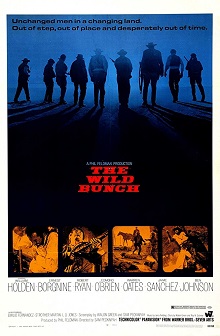
By 1969, director Sam Peckinpah had worked on several TV series and several film productions, including The Deadly Companions, Ride the High Country and Major Dundee. He was an incredibly talented director but one whose fiery personality and personal demons could potentially derail any film he worked on. But in 1969, it all came together, Peckinpah making his classic, his all-time great film, one of the best westerns ever and best films ever in general, 1969's The Wild Bunch.
It's 1913 in a small border town near the Rio Grande, and a gang of outlaws, led by the infamous Pike Bishop (William Holden), disguised as soldiers ride in to rob the bank of a rumored silver shipment. The robbery is an epic disaster as a posse of bounty hunters, led by Deke Thornton (Robert Ryan), a paroled outlaw who used to ride with Pike, is waiting in ambush. Many of Pike's gang is killed in the robbery that nets them NO money. The remaining members of the gang, including Dutch Engstrom (Ernest Borgnine), retreat into Mexico. They need a new job, a new robbery, a new chance to earn some money. Pike especially knows that time is running out, that times are changing, and their chances at surviving as outlaws is becoming ever more unlikely. It doesn't help that Deke and his bounty hunters have followed them into Mexico, looking to collect the bounties on these infamous outlaws. With time running out, what do they do?
What a movie. Every so often, each and EVERY thing involved in the making of a film comes together and forms that perfect symmetry. 'Bunch' is an all-timer, not just a movie I love but a great movie in terms of storytelling and in technical terms. Appropriate for the time it was released (the late 1960's), it is cynical, horrifically violent, brutally honest and generally downbeat. This is a western and film ahead of its time, helping set the tone where films would go in the coming years. This is Peckinpah at the top of his game. He would have other good to great to classic films, but this is his Great film. Just a gem.
There is little to nothing to criticize here. While the filming process sounds incredibly interesting (a film in itself), the choice to film in Mexico pays off huge dividends. Cinematographer Lucien Ballard shoots a beautiful movie with the Mexican countryside and desert as a backdrop. The locations are phenomenal. You feel like you're watching the actual settings of the Mexican Revolution to our story. Composer Jerry Fielding turns in quite the memorable score as well, appropriately epic at times and equally quiet and emotional as necessary in other scenes. Listen to a sample HERE. As for the story itself, Peckinpah and writer Walon Green turn in a screenplay that's just a gem. It isn't a movie in a rush, letting things breathe and allow the viewer to get to know the characters -- for good or bad -- over its 145-minute running time. Sit back and take it in. You shan't be disappointed!
Many westerns have dealt with the death of the old west, the end of an era, but none better than The Wild Bunch. It's 1913 and there's no place for these outlaws, killers and gunfighters anymore. The world is changing, and civilization (of sorts) is moving in to replace them. We follow a gang of those outlaws, robbers, killers/murderers as they try to pull off their one last job and step away, and it's a testament to the acting on display and screenplay that we feel any sympathy at all to these men. Like few movies I've ever seen, there is a doomed quality to these men who are working with limited time on their hands. They know the door is closing on them, more than likely a bloody death awaiting them if they don't figure out something soon.
Where Peckinpah's screenplay is so strong is in its characterization and its depth. There's a whole lot of acting talent on display in 'Bunch,' and for much of the cast, this is their all-time best performance or certainly one of their best. Holden's Pike Bishop is one of the most fascinating characters ever in my book, an aging outlaw who's outlived his time but doesn't know what else to do. Borgnine too is excellent as Dutch, his right-hand man who can also see the writing on the wall. Their scene together after the early botched robbery is essential, two men who potentially know what awaits them but go into things willingly because maybe that ending is what's supposed to happen. On the counter, Ryan's Deke Thornton is equally tragic. He's riding after his old partner, Bishop, and would much rather be riding with them than chasing them. But as the script relies on, your word is your word, and these men live by that coda.
One of the many things Peckinpah loved to touch on in his films was that bond of men under fire who come through while others don't. Holden's Pike is the mouthpiece for that concept, of giving your word and sticking by it even when it'd be far easier to tuck your tail and run. We see that again and again with the bunch, including Pike, Dutch, old, grizzled Sykes (Edmond O'Brien), the crass, unsavory Gorch brothers, Lyle (Warren Oates) and Tector (Ben Johnson), and Angel (Jaime Sanchez), the youngest of the group, a fiery Mexican. What's interesting is that though Pike and the bunch claim to live by this coda, they continue to fall short of actually living up to it. It's when they realize their faults in that department that the story takes a far more tragic turn toward the inevitable ending that you just knew was coming.
Because the already-mentioned star power wasn't enough, here's some more! Along with Ryan, look for scene-chewing Strother Martin and L.Q. Jones as two scummy bounty hunters with Albert Dekker as the railroad magnate "employing" them. Emilio Fernandez is perfectly slimy as Mapache, the Mexican general claiming to be some sort of freedom fighter but it seems it is all for show, for more power, with Jorge Russek and Alfonso Arau (El Guapo in Three Amigos) as his subordinate officers. Also look for Bo Hopkins, Dub Taylor and Chano Urueta in key (if small) supporting parts.
What 'Bunch' has become synonymous with over the years is its groundbreaking, sometimes horrifying portrayal of on-screen violence. It's not that Peckinpah lingers on the violence for the sake of shock value. Far from it, but instead he makes it into an art form. The idea of a 'dance of death' comes to mind in any portrayal of violence with three main set pieces (1. The opening robbery turned into a bloody shootout 2. A prolonged train robbery and 3. The final, bullet-riddled and blood-splattered gun battle). The editing is ridiculously fast and cut in with perfect uses of slow motion. Simply put, there is an art to Peckinpah's use of violence, both in the editing, in the overwhelming use of slow-motion blood squibs, and the impact of that violence we're seeing. If Bonnie and Clyde opened the door some for its own use of on-screen violence, Peckinpah's The Wild Bunch kicked that door wide open. Almost 50 years later, it still resonates, and it's clear the impact it had on hundreds and thousands of movies released since.
It all builds to maybe the most memorable action sequence of all-time. If it's not No. 1, it certainly belongs in the conversation. In a sequence that's been dubbed "The Battle of Bloody Porch," it all comes together in an extended sequence that has lost none of its edge since its release in 1969. This is a transfixing scene that is equal parts horrifying and startling but you just can't look away. There are too many great moments just in this scene alone to mention, including an improvised walk the Bunch takes on their way to a final showdown (maybe the movie's second-strongest sequence). It is followed by a quick, shocking death, and then an eerie moment of silence that hangs in the air. With one gunshot, it is on, bullets flying thick in the air. Obvious SPOILERS but you can watch it HERE. If you haven't seen the movie, I don't recommend watching the sequence out of context. Watch the movie and soak it all in as part of the whole product. Just a remarkable extended sequence with virtually no music. The focus is the characters, violence and death. Nothing more. Nothing less.
A classic in every sense of the word. I pick something new up with every viewing, and it never loses any of its impact. A film without a weakness.
The Wild Bunch (1969): ****/****
The Sons of Katie Elder
"First, we reunite, then find Ma and Pa's killer...then read some reviews."
Showing posts with label Warren Oates. Show all posts
Monday, December 28, 2015
Wednesday, October 14, 2015
China 9, Liberty 37
Monte Hellman isn't necessarily a household name among movie fans. He worked pretty regularly in the 1960's and 1970's and has worked on and off since. He doesn't have a huge, crazy classic to his name, a director who usually was at the helm of low-budget, straightforward flicks. His best film -- for me at least -- is Two-Lane Blacktop. His others? More hit or miss, like 1978's China 9, Liberty 37, a western I didn't like at all.
Wasting away in a prison cell, Clayton Drumm (Fabio Testi) is minutes away from walking to the hangman's noose when he's given a reprieve. Well, sort of. Local government and train officials have an offer for the infamous gunfighter. They'll let him go free and avoid the noose if he agrees to ride out and kill a farmer, Matthew Sebanek (Warren Oates), who owns a piece of land that the railroad needs to continue building across the country. Somewhat suspicious, Clayton takes the deal and rides to the Sebanek homestead where he meets the farmer and his younger wife, Catherine (Jenny Agutter). Drumm doesn't ride up and shoot the farmer but instead introduces himself as a drifter passing through looking for a roof over his head for the night and maybe a meal. Sebanek agrees, but he's no dummy. He knows what's Drumm is up to. What will come of the slow-burning showdown?
Hmm, interesting...interesting. I wanted to like this 1978 quasi-spaghetti western. I did, but it just isn't very good. As a director of westerns, he specialized in low-key, low-budget stories that were more about the reality of western life than the romance or the glory or the heroes. It was a dark, nasty life where death seemingly hovered in the air. There wasn't any romance or glory or glamour. In that sense, 'China' is spot-on. It is cynical, violent in quick strikes, and with a touch of irony sprinkled in for good measure. All these little positives though, they got lost in a sea of a wayward story, out of place soundtrack and a disappointing go-nowhere direction.
First, the biggest issue. The first 40 minutes are interesting. I kinda sorta maybe thought I was getting a story about a gunfighter who must make a difficult decision. Do what's right? (Not kill the farmer). Do what he's spent his life doing? (Kill the farmer). It isn't even close. It becomes a forced, uncomfortable love story about the gunfighter, the farmer and wouldn't you know it, the farmer's wife. Yeah, we're talking about some low-budget porn. All the potential goes out the window in an instant, and the rest of the movie is far different than what I thought I was watching. The switch itself isn't awful (but it ain't good either), but the pacing dies and any interest I had in the story was gone with the snap of a finger.
The casting definitely intrigued me, but that too came up a little short. Warren Oates is the man. I'll watch him in anything, even when he's just chewing the scenery. This is a good part for him, a for the most part quiet performance, a farmer who knows he's in a hell of a pinch and must decide how far he's willing to fight to keep what is his. So yeah, 40 minutes and then he's just an angry husband looking for vengeance. Testi was a big star in the 1970's, and I've typically liked him. The performance is -- again -- potentially interesting, the infamous gunslinger with a chance for redemption of sorts, but it goes literally nowhere. He isn't dubbed either so I had trouble understanding his very heavy Italian accent. There are some great scenes between Oates and Testi as they talk about how they got to this point, what to do from here that indicates this could have been an excellent, thoughtful western...but it isn't.
Instead, 'China' degenerates into soft-core porn. Agutter is nude for much of the movie and Testi goes shirtless a lot in awkward, truly uncomfortable love scenes as Testi and Agutter stare into each other's eyes before getting to the oh so sexy lovemaking. Except they don't have any chemistry, and they literally look like robots when they're kissing. It is truly awkward, almost like they were told to do it that way. It wouldn't be a huge issue except that this happens four and five times, long sex scenes set to equally uncomfortable and out-of-place folk songs that dot the soundtrack. When things should be quickening the pace, that pace goes nowhere as we get one more repetitive sex scene. So yeah, the good western goes bye-bye.
'China' was filmed on-location in Spain as so many classic to good to god-awful westerns were in the 60's and 70's. It is a mix of the American revisionist westerns and the hard-hitting, horrifically violent spaghetti westerns but never finds its own groove or rhythm. You get the sense Hellman was going for something lyrical and beautiful with a story about true love that can't be denied, but that never comes together. The running time is 102 minutes -- and I did get to watch a beautiful print on Turner Classic Movies -- but the last 100 minutes dragged in a big way. A major disappointment because it feels like there was so much wasted potential. So much potential that never goes anywhere.
China 9, Liberty 37 (1978): */****
Wasting away in a prison cell, Clayton Drumm (Fabio Testi) is minutes away from walking to the hangman's noose when he's given a reprieve. Well, sort of. Local government and train officials have an offer for the infamous gunfighter. They'll let him go free and avoid the noose if he agrees to ride out and kill a farmer, Matthew Sebanek (Warren Oates), who owns a piece of land that the railroad needs to continue building across the country. Somewhat suspicious, Clayton takes the deal and rides to the Sebanek homestead where he meets the farmer and his younger wife, Catherine (Jenny Agutter). Drumm doesn't ride up and shoot the farmer but instead introduces himself as a drifter passing through looking for a roof over his head for the night and maybe a meal. Sebanek agrees, but he's no dummy. He knows what's Drumm is up to. What will come of the slow-burning showdown?
Hmm, interesting...interesting. I wanted to like this 1978 quasi-spaghetti western. I did, but it just isn't very good. As a director of westerns, he specialized in low-key, low-budget stories that were more about the reality of western life than the romance or the glory or the heroes. It was a dark, nasty life where death seemingly hovered in the air. There wasn't any romance or glory or glamour. In that sense, 'China' is spot-on. It is cynical, violent in quick strikes, and with a touch of irony sprinkled in for good measure. All these little positives though, they got lost in a sea of a wayward story, out of place soundtrack and a disappointing go-nowhere direction.
First, the biggest issue. The first 40 minutes are interesting. I kinda sorta maybe thought I was getting a story about a gunfighter who must make a difficult decision. Do what's right? (Not kill the farmer). Do what he's spent his life doing? (Kill the farmer). It isn't even close. It becomes a forced, uncomfortable love story about the gunfighter, the farmer and wouldn't you know it, the farmer's wife. Yeah, we're talking about some low-budget porn. All the potential goes out the window in an instant, and the rest of the movie is far different than what I thought I was watching. The switch itself isn't awful (but it ain't good either), but the pacing dies and any interest I had in the story was gone with the snap of a finger.
The casting definitely intrigued me, but that too came up a little short. Warren Oates is the man. I'll watch him in anything, even when he's just chewing the scenery. This is a good part for him, a for the most part quiet performance, a farmer who knows he's in a hell of a pinch and must decide how far he's willing to fight to keep what is his. So yeah, 40 minutes and then he's just an angry husband looking for vengeance. Testi was a big star in the 1970's, and I've typically liked him. The performance is -- again -- potentially interesting, the infamous gunslinger with a chance for redemption of sorts, but it goes literally nowhere. He isn't dubbed either so I had trouble understanding his very heavy Italian accent. There are some great scenes between Oates and Testi as they talk about how they got to this point, what to do from here that indicates this could have been an excellent, thoughtful western...but it isn't.
Instead, 'China' degenerates into soft-core porn. Agutter is nude for much of the movie and Testi goes shirtless a lot in awkward, truly uncomfortable love scenes as Testi and Agutter stare into each other's eyes before getting to the oh so sexy lovemaking. Except they don't have any chemistry, and they literally look like robots when they're kissing. It is truly awkward, almost like they were told to do it that way. It wouldn't be a huge issue except that this happens four and five times, long sex scenes set to equally uncomfortable and out-of-place folk songs that dot the soundtrack. When things should be quickening the pace, that pace goes nowhere as we get one more repetitive sex scene. So yeah, the good western goes bye-bye.
'China' was filmed on-location in Spain as so many classic to good to god-awful westerns were in the 60's and 70's. It is a mix of the American revisionist westerns and the hard-hitting, horrifically violent spaghetti westerns but never finds its own groove or rhythm. You get the sense Hellman was going for something lyrical and beautiful with a story about true love that can't be denied, but that never comes together. The running time is 102 minutes -- and I did get to watch a beautiful print on Turner Classic Movies -- but the last 100 minutes dragged in a big way. A major disappointment because it feels like there was so much wasted potential. So much potential that never goes anywhere.
China 9, Liberty 37 (1978): */****
Labels:
1970s,
Fabio Testi,
Monte Hellman,
Warren Oates,
westerns
Tuesday, March 4, 2014
Major Dundee
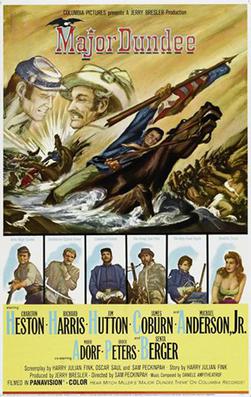
It's late in 1864, the Civil War raging back east, but in the New Mexico territory, an Apache war party led by Sierra Charriba (Michael Pate), massacres a troop of U.S. cavalry, kidnapping three boys from a local ranch at the same time. The commander of a nearby Confederate prison camp, Major Amos Dundee (Charlton Heston) decides to go after the Apaches, rescuing the kids and bringing Charriba to justice. Without abandoning the camp though, he must assemble a ragtag group of Confederate prisoners, black infantry, inexperienced officers, cowboys, drunks, bandits and thieves to capture the Apaches. At his right hand is a Confederate officer and friend from the past but now a sworn enemy, Capt. Benjamin Tyreen (Richard Harris). Dundee's company of irregular cavalry hits the trail, following the Apache war party into Mexico, tangling with occupying French forces as well. The Apaches and the French are just two enemies though, the Union and Confederate loyalties among the company threatening to tear Dundee's command apart from the inside.
The production history of this Peckinpah western has quite the checkered past. The production in Mexico went way over budget and way over schedule. Depending on what you read, Peckinpah's original cut for 'Dundee' was anywhere between three and four hours long. When the studio took it away from him, it was cut down to just over two hours. A DVD released in 2005 had a new, never before seen version with almost 15 additional minutes added to the running time. Some additional footage was found that was unable to be reinserted back into the film, but as is, we'll probably never know/see Peckinpah's intended version. So what's the end result with the 136-minute version? A far better western than the 123-minute version that features some good performances, a ridiculously deep cast, some ahead of its time vicious action, and a story that drifts needlessly at times.
What was Peckinpah's goal? He wanted to make an epic western, a new western in the vein of the John Ford cavalry movies. It was supposed to be big and violent full of scope and vision. 'Dundee' doesn't quite live up to that, but in terms of pure entertainment, it's hard to beat. It starts with Charlton Heston in the titular role. Like Peckinpah's best movies, Dundee is the flawed anti-hero like nobody's business. The story almost becomes Moby Dick in the Civil War west. Dundee has been posted to this isolated prison camp because of a command decision he made at Gettysburg (hinted at, never spelled out), and he intends to right that wrong. His plan? Get the kids back, take out Sierra Charriba, become a hero again. The problem? Dundee may not be cut out for command. He's equal parts brilliant strategist with overreaching egoist. His pride and ego get in the way of things, the mission into Mexico becoming an obsession. Quite the performance, one that doesn't always get the notoriety it deserves in Heston's already impressive filmography.
One of Peckinpah's favorite storytelling devices was the anti-hero and his right hand man, sometimes a former friend turned unwilling ally, a device used to its best ability four years later in The Wild Bunch. Here, that relationship is between Heston's Dundee and Richard Harris' Capt. Ben Tyreen. Again, their checkered history (friendship turned bitter rivalry, even hatred) all leads up to this, two men forced to work together. Harris is one of my favorite actors, and this is my favorite performance of many, one of my all-time favorite characters in any film. Harris' Tyreen is everything Dundee wants to be; intelligent, charming, a good leader, and well liked and respected by his men. Tyreen has one great line after another, Harris bringing this character to life, a Irish immigrant turned cashiered American officer to Confederate renegade. The dynamic between Dundee and Tyreen provides some of the movie's best dialogue scenes, the confrontations crackling with energy. Kudos to both actors for developing that chemistry to its fullest.
Brace yourself though. This movie has one sick cast of tough guy actors, many from the Peckinpah stock character Hall of Fame. Jim Hutton provides some laughs as Lt. Graham, a bumbling artillery officer assigned to the cavalry. James Coburn is a scene-stealer as Samuel Potts, Dundee's one-armed, bearded, quick-witted scout, as is Mario Adorf as the feisty, loyal Sgt. Gomez, Dundee's most capable Union soldier. Michael Anderson Jr. does a fine job too as Trooper Ryan, Dundee's young bugler, providing the narration from his in-mission journal. There's also Brock Peters as Aesop, the leader of the small contingent of black infantry, Slim Pickens as Wiley, the drunken mule-packer, R.G. Armstrong as Reverend Dahlstrom, the shotgun-wielding preacher, and Dub Taylor as Priam, the disheveled horse thief. As for Tyreen's Confederates, there's Ben Johnson as the tough Sgt. Chillum, L.Q. Jones and Warren Oates as Arthur and O.W. Hadley, and John Davis Chandler as Jimmy Lee, the troublemaker. Also look for Karl Swenson as Dundee's second-in-command at the prison camp. Just a ridiculously deep cast full of great characters.
Where the movie struggles some -- but is also damn entertaining in those struggles -- is the final 40 minutes. The story does drift too much from the Apaches to the French to Dundee's lost weekend in Durango and a brief love affair with Senta Berger's Teresa. Trooper Ryan's narration gets choppy, weeks slipping by in a flash. The saving grace is back-to-back action sequences, one a showdown with the Apaches in a box canyon, the other a bloody, violent battle with French lancers in the Rio Grande. This is Peckinpah at his action best, clearly an indicator of where his movies would go, especially with The Wild Bunch. Watch the scene with the French and see how brutal it is, how graphic it could have been if censors allowed it. Characters are unceremoniously killed off (blink and you'll miss it), including one surprising death, but it's just a great action scene leading to a quick ending.
Most Peckinpah fans don't list this as their favorite, maybe not even one of their favorites. I just really like this movie, always have, and the longer version with the additional 15 minutes or so really does help make it better. The musical score from composer Daniele Amfitheatrof takes some heat, especially the Major Dundee theme (listen HERE), but I like it, almost as a guilty pleasure. Filming on location in Mexico, including stops in Durango, a gorgeous waterfall location at El Saltito, and many more, all add to that authentic flavor. You really feel like you're on an odyssey across Mexico, seeing a variety of spots, locations and cities. One of my favorite westerns, a heavily flawed but just a damn entertaining movie in the end. Hard to beat, even if we'll never see that epic 4-hour version Peckinpah intended.
Major Dundee (1965): ****/****
Rewrite of August 2009 review
Tuesday, November 5, 2013
Yellowstone Kelly
One of the turning points in the history of the taming of the west in the U.S., the massacre at the Little Big Horn has certainly received its due in film adaptations. Maybe more so is the fallout from the battle that wiped out George Custer and his famed 7th Cavalry. There's been a-plenty of westerns about what happened after the battle, like 1959's Yellowstone Kelly.
It's been several months since the Battle of the Little Bighorn, and well-known trapper and frontiersman Yellowstone Kelly (Clint Walker) has ridden down out of the hills with his trappings from a busy season. He catches a ride on a steamboat where he meets Anse Harper (Edd Byrnes), a young, inexperienced man traveling west, Kelly agreeing to take him along -- somewhat unwillingly -- when he heads back up into the mountains. Kelly is also approached by the cavalry to scout for them in helps of leading an expedition against the Sioux and Cheyenne. The veteran scout knows the land as well as anyone, but he also has an agreement with the warring Sioux so he declines the offer, instead heading out with Anse into the mountains. His decision has been made, but his involvement between the Indians and the cavalry is far from over.
From director Gordon Douglas, this 1959 western is a good but not great entry. It popped up recently on Encore Westerns and with no regular DVD out there for viewing, I wanted to give it a shot. If it doesn't do anything particularly new in the western genre, so be it. It's mostly entertaining. 'Kelly' benefits from some great location shooting in the Coconino National Forest and Sedona, Arizona. This is a Technicolor movie that needs to be viewed in widescreen. Just watching Walker's Kelly ride around through the mountains is a visual treat. Mountains, deserts, it's got it all to produce a great-looking movie. As well, the score from an uncredited Howard Jackson is good, borrowing from themes from They Died With Their Boots On, as well as a familiar tune here and there from The Charge at Feather River. It must be the Warner Brothers file archive.
Right in the midst of his successful TV run on Cheyenne, Walker takes a break to star here, and it's a good part. He's a good if not great actor, as much of a domineering physical presence as anything. The 6-foot-6 actor was certainly a presence on-screen, appearing to tower over his co-stars. He has a good chemistry with another TV star in Edd Byrnes. The experienced trailhand and scout working with the oppositely inexperienced younger man is a familiar genre convention, but it works well here. Neither Walker or Byrnes ever became huge stars, but the TV turned movie stars do very capably here. If there's a weak point, it's when Kelly and Harper rescue Wahleeah (Andra Martin), an Arapaho captive of the nearby Sioux tribe. Byrnes' Harper falls quickly for her, Kelly recommending he stays clear of her. It's just not as interesting as the other story. It's not awful, but it does slow things down in a 92-minute movie.
This must have been a TV stars convention here for the cast. Star of TV's Lawman, John Russell wears some skin darkener and wears a pair of braids as Gall, a Sioux chieftain who had his life saved by Walker's Kelly years before. Now, he has an uneasy deal with the scout about where he can/can't go. Ray Danton plays Sayapi, Gall's pissed off nephew who wants his Arapaho captive back, and he doesn't care who's trying to stop him. Leading the cavalry contingent is Rhodes Reason as Major Townes, an officer who seemingly learns nothing from the past (i.e. Custer) with Gary Vinson as his Lieutenant, Claude Akins and Warren Oates playing Sergeant and Corporal, no names provided.
The action is kept on the small scale for the most part. An early fistfight has Kelly and Harper teaming to tangle with Akins' Sergeant and his soldiers. The biggest fighting is saved for the finale between the cavalry and the attacking Indians on a desert hillside covered in trees. It's pretty quick and doesn't have a ton of scale, but it's a good action scene. That's the western itself. Nothing flashy, but I enjoyed it. A pleasant time-waster with good locations and cast.
Yellowstone Kelly (1959): ** 1/2 /****
It's been several months since the Battle of the Little Bighorn, and well-known trapper and frontiersman Yellowstone Kelly (Clint Walker) has ridden down out of the hills with his trappings from a busy season. He catches a ride on a steamboat where he meets Anse Harper (Edd Byrnes), a young, inexperienced man traveling west, Kelly agreeing to take him along -- somewhat unwillingly -- when he heads back up into the mountains. Kelly is also approached by the cavalry to scout for them in helps of leading an expedition against the Sioux and Cheyenne. The veteran scout knows the land as well as anyone, but he also has an agreement with the warring Sioux so he declines the offer, instead heading out with Anse into the mountains. His decision has been made, but his involvement between the Indians and the cavalry is far from over.
From director Gordon Douglas, this 1959 western is a good but not great entry. It popped up recently on Encore Westerns and with no regular DVD out there for viewing, I wanted to give it a shot. If it doesn't do anything particularly new in the western genre, so be it. It's mostly entertaining. 'Kelly' benefits from some great location shooting in the Coconino National Forest and Sedona, Arizona. This is a Technicolor movie that needs to be viewed in widescreen. Just watching Walker's Kelly ride around through the mountains is a visual treat. Mountains, deserts, it's got it all to produce a great-looking movie. As well, the score from an uncredited Howard Jackson is good, borrowing from themes from They Died With Their Boots On, as well as a familiar tune here and there from The Charge at Feather River. It must be the Warner Brothers file archive.
Right in the midst of his successful TV run on Cheyenne, Walker takes a break to star here, and it's a good part. He's a good if not great actor, as much of a domineering physical presence as anything. The 6-foot-6 actor was certainly a presence on-screen, appearing to tower over his co-stars. He has a good chemistry with another TV star in Edd Byrnes. The experienced trailhand and scout working with the oppositely inexperienced younger man is a familiar genre convention, but it works well here. Neither Walker or Byrnes ever became huge stars, but the TV turned movie stars do very capably here. If there's a weak point, it's when Kelly and Harper rescue Wahleeah (Andra Martin), an Arapaho captive of the nearby Sioux tribe. Byrnes' Harper falls quickly for her, Kelly recommending he stays clear of her. It's just not as interesting as the other story. It's not awful, but it does slow things down in a 92-minute movie.
This must have been a TV stars convention here for the cast. Star of TV's Lawman, John Russell wears some skin darkener and wears a pair of braids as Gall, a Sioux chieftain who had his life saved by Walker's Kelly years before. Now, he has an uneasy deal with the scout about where he can/can't go. Ray Danton plays Sayapi, Gall's pissed off nephew who wants his Arapaho captive back, and he doesn't care who's trying to stop him. Leading the cavalry contingent is Rhodes Reason as Major Townes, an officer who seemingly learns nothing from the past (i.e. Custer) with Gary Vinson as his Lieutenant, Claude Akins and Warren Oates playing Sergeant and Corporal, no names provided.
The action is kept on the small scale for the most part. An early fistfight has Kelly and Harper teaming to tangle with Akins' Sergeant and his soldiers. The biggest fighting is saved for the finale between the cavalry and the attacking Indians on a desert hillside covered in trees. It's pretty quick and doesn't have a ton of scale, but it's a good action scene. That's the western itself. Nothing flashy, but I enjoyed it. A pleasant time-waster with good locations and cast.
Yellowstone Kelly (1959): ** 1/2 /****
Labels:
1950s,
Claude Akins,
Clint Walker,
Edd Byrnes,
Gordon Douglas,
John Russell,
Warren Oates,
westerns
Wednesday, September 11, 2013
The Split
A stylish, dark heist flick from the 1960s with one of the all-time
great tough guy casts. It's a winning formula for sure, especially for a
sucker like me for heist movies. It took me years to track down 1968's The Split
-- which I first reviewed in August 2009 -- and I was less than
impressed with the film on my first viewing. When it popped up on Turner
Classic Movie's schedule recently, I was going to give it another try. I
mean....come on.....look at this cast!
A master thief who's gone off the grid seemingly for several years, a man named McClain (Jim Brown) is reunited with a former partner and an expert planner, Gladys (Julie Harris), when it comes to pulling off impossible jobs. They team up again, Gladys putting forth the plan; rob the L.A. Coliseum during an NFL playoff game that will net $500,000. McClain assembles a team of crooks who haven't worked together in the past, but he convinces them to put their differences aside with the thought of a very lucrative payday. The five-man team goes about planning the job with very little time to do so. The dangerous job is one thing though, but the fallout from the job may be even more dangerous, especially when an investigating detective, Lt. Brill (Gene Hackman), catches wind of them and is right behind them.
For years, this 1968 heist film from director Gordon Flemyng wasn't available in any form; DVD, VHS, nothing. Now, it's available on a burn-for-order DVD so if you've never seen it and are dying to catch up, there it is for you. First or second viewing though, I had the same issues. 'Split' has a lot of potential, much of it tied to the casting, but it never quite goes anywhere. It's got the style from its frame-in-frame credits sequence to its Quincy Jones soundtrack, the on-location shooting at the L.A. Coliseum to the dark nature of the team of crooks working together. All these disparate elements never manage to jell, ending up with a heist film that takes a really bizarre turn in the last third of the movie. A very disappointing end result because it did have so much potential.
How about that casting though? In assembling his team for the robbery, Brown's McClain brings together Bert Clinger (Ernest Borgnine), a gym owner and strong man, Harry Kifka (Jack Klugman), a down on his luck limo driver who will serve as the team's getaway driver, Marty Gough (Warren Oates), a temperamental safe cracker, and Dave Negli (Donald Sutherland), a smooth as ice hit man and hired killer. And NFL great turned action star Jim Brown for good measure?!? How can you lose??? Well, as dark and dirty as things get, something is missing from the group. The movie runs only 91 minutes and after McClain's recruiting, things move right along to the actual heist. The group is full of so many bad guys I never found myself rooting for them to pull the job off successfully. Still, it is an impressive grouping of star power, misutilized though they may be.
I think that's the problem for 'Split' in general. With so much going on, the right tone is never picked out. It bounces back and forth and among all these different things. Brown's McClain meets up with his jilted ex-wife, Ellie (Diahann Carroll), still holding a grudge, but darn it, she still likes him a lot as we see in a montage set to a Jones song as they walk along a beach. The actual recruiting of the team just feels a tad bit off, like certain things aren't fitting together well, but it's entertaining enough. The robbery at the Coliseum lacks a certain energy with no real catch of anything unique helping them pull the job off. But the biggest problem? That would be the final half hour.
One of the keys to a good heist film is oddly enough, not the heist. It's the fallout after the job when the cops close in, the team has to wait for things to cool down to get their money, and seemingly inevitably....turn on each other. That's fine and dandy, just about any good heist movie follows that formula. Ready for the derail? It comes in a really odd one-scene cameo from James Whitmore as Ellie's creepy landlord. Then, Gene Hackman doesn't even make his first appearance until 70 minutes into a 90-minute movie. From there on in, the story and twists and turns feel rushed. It's a pretty dark ending, but even that feels mishandled. The movie just sort of ends, leaving all sorts of questions unanswered. A truly disappointing movie, one that handled differently could have been a near-classic among the heist genre. Oh, and the above poster is bad, giving the impression the team is just a bunch of friends out to pull a job. Um.....no.
The Split (1968): **/****
Rewrite of August 2009 review
A master thief who's gone off the grid seemingly for several years, a man named McClain (Jim Brown) is reunited with a former partner and an expert planner, Gladys (Julie Harris), when it comes to pulling off impossible jobs. They team up again, Gladys putting forth the plan; rob the L.A. Coliseum during an NFL playoff game that will net $500,000. McClain assembles a team of crooks who haven't worked together in the past, but he convinces them to put their differences aside with the thought of a very lucrative payday. The five-man team goes about planning the job with very little time to do so. The dangerous job is one thing though, but the fallout from the job may be even more dangerous, especially when an investigating detective, Lt. Brill (Gene Hackman), catches wind of them and is right behind them.
For years, this 1968 heist film from director Gordon Flemyng wasn't available in any form; DVD, VHS, nothing. Now, it's available on a burn-for-order DVD so if you've never seen it and are dying to catch up, there it is for you. First or second viewing though, I had the same issues. 'Split' has a lot of potential, much of it tied to the casting, but it never quite goes anywhere. It's got the style from its frame-in-frame credits sequence to its Quincy Jones soundtrack, the on-location shooting at the L.A. Coliseum to the dark nature of the team of crooks working together. All these disparate elements never manage to jell, ending up with a heist film that takes a really bizarre turn in the last third of the movie. A very disappointing end result because it did have so much potential.
How about that casting though? In assembling his team for the robbery, Brown's McClain brings together Bert Clinger (Ernest Borgnine), a gym owner and strong man, Harry Kifka (Jack Klugman), a down on his luck limo driver who will serve as the team's getaway driver, Marty Gough (Warren Oates), a temperamental safe cracker, and Dave Negli (Donald Sutherland), a smooth as ice hit man and hired killer. And NFL great turned action star Jim Brown for good measure?!? How can you lose??? Well, as dark and dirty as things get, something is missing from the group. The movie runs only 91 minutes and after McClain's recruiting, things move right along to the actual heist. The group is full of so many bad guys I never found myself rooting for them to pull the job off successfully. Still, it is an impressive grouping of star power, misutilized though they may be.
I think that's the problem for 'Split' in general. With so much going on, the right tone is never picked out. It bounces back and forth and among all these different things. Brown's McClain meets up with his jilted ex-wife, Ellie (Diahann Carroll), still holding a grudge, but darn it, she still likes him a lot as we see in a montage set to a Jones song as they walk along a beach. The actual recruiting of the team just feels a tad bit off, like certain things aren't fitting together well, but it's entertaining enough. The robbery at the Coliseum lacks a certain energy with no real catch of anything unique helping them pull the job off. But the biggest problem? That would be the final half hour.
One of the keys to a good heist film is oddly enough, not the heist. It's the fallout after the job when the cops close in, the team has to wait for things to cool down to get their money, and seemingly inevitably....turn on each other. That's fine and dandy, just about any good heist movie follows that formula. Ready for the derail? It comes in a really odd one-scene cameo from James Whitmore as Ellie's creepy landlord. Then, Gene Hackman doesn't even make his first appearance until 70 minutes into a 90-minute movie. From there on in, the story and twists and turns feel rushed. It's a pretty dark ending, but even that feels mishandled. The movie just sort of ends, leaving all sorts of questions unanswered. A truly disappointing movie, one that handled differently could have been a near-classic among the heist genre. Oh, and the above poster is bad, giving the impression the team is just a bunch of friends out to pull a job. Um.....no.
The Split (1968): **/****
Rewrite of August 2009 review
Sunday, December 30, 2012
Barquero
With the distinct feel of a spaghetti western, 1970s Barquero relies on a simple formula; pair two very successful western stars and let them do their thing. Not particularly flashy by any means, it's a meat and potatoes kind of western, just barely worth getting an above average rating.
At an isolated river crossing along the border, Travis (Lee Van Cleef) is thriving as the owner of a river barge. The crossing is the only spot for miles in either direction, and a little town has popped up around Travis' barge. Miles away, infamous outlaw Jake Remy (Warren Oates) and his gang have led a bloody raid on a cavalry convoy transporting silver and repeating rifles, wiping out a town in the process. Remy's gang heads for the river crossing, knowing time will become a factor with the Army in hot pursuit to get back their silver and rifles. Travis and the river town catch wind though, getting to the far side of the river. Now Travis and Co. are on one side while Remy's gang is on the other, plotting their next move as the Army closes in behind them. Who will cave first?
From director Gordon Douglas, this is a western from a sub-genre that popped up in the late 1960s in the U.S. In Europe, the spaghetti westerns had emerged as a factor to be reckoned with, and western fans responded. They wanted darker, more cynical and more violent westerns. Good guys weren't just good guys. They became anti-heroes. So studios gave them what they want, and the result is a sticky middle ground that isn't pigeon-holed clearly. I have always thought of them as quasi-spaghetti westerns, movies like 100 Rifles, Villa Rides, Charro!, Shalako and so many more. 'Barquero' wasn't filmed in Europe -- Colorado is the backdrop, and a good one at that -- but it still feels like a spaghetti western. Composer Dominic Frontiere's score is okay, but it's not memorable like some of his better scores.
The best thing going for this American-ish spaghetti western is the casting of Lee Van Cleef and Warren Oates as rivals. Both actors were at the height of their popularity. Van Cleef became an international star because of the spaghetti westerns, and Oates had risen from a career of supporting parts to become a leading man/star in his own right. They look to be having a lot of fun in the process, two tough guys sneering and yelling at each other from across a river. As Travis -- dubbed 'the Barquero' (Spanish for boatman) -- Van Cleef is not playing his typical gunfighter, but instead a tough as nails working man who won't turn his back on something he has created. Playing Remy, Oates hams it up (as usual, but it's always interesting) as the unhinged outlaw. We learn some about his past, and how he got here -- most definitely crazy -- but he plays one nasty dude like few others can.
Beyond that tough guy duo, 'Barquero' lacks the star power, but the supporting cast doesn't disappoint. I thought the best part was for Kerwin Matthews as Marquette, Remy's right hand man in leading a brutal gang. He is a former French officer who survived when French emperor Maximilian was killed by Mexican revolutionaries, now working as Remy's reasonable thinking ally. Also providing a scene-stealing supporting part is Forrest Tucker as Mountain Phil, a mountain man drifter who teams with Travis to protect the crossing. Both fighting over Van Cleef's Travis, Marie Gomez and Mariette Hartley play the love interests. Rounding out Remy's gang of cutthroats are Armando Silvestre, John Davis Chandler, Ed Bakey, Richard Lapp and Brad Weston. Craig Littler plays Pitney, the town store owner doubling as a con man preacher.
While I did like this western, I can't say I loved it. The premise is cool; two rivals across a river from each other. Time is running out for one of them, and they need to get across the river. Sounds like a pretty decent cat and mouse game, doesn't it? It should be, but it isn't. Remy's plan is....well, he doesn't have one. He brews and stews on his side of the river for much of the middle portion of the movie without actually doing anything. It's Matthews' Marquette who finally comes up with a plan. Clocking in at 109 minutes, it's a tad long with not enough going on. Still, it's a worthwhile popcorn western. Enjoy it for what it is, and watch Van Cleef and Oates be cool together. You can watch the entire movie HERE at Youtube.
Barquero (1970): ** 1/2 /****
At an isolated river crossing along the border, Travis (Lee Van Cleef) is thriving as the owner of a river barge. The crossing is the only spot for miles in either direction, and a little town has popped up around Travis' barge. Miles away, infamous outlaw Jake Remy (Warren Oates) and his gang have led a bloody raid on a cavalry convoy transporting silver and repeating rifles, wiping out a town in the process. Remy's gang heads for the river crossing, knowing time will become a factor with the Army in hot pursuit to get back their silver and rifles. Travis and the river town catch wind though, getting to the far side of the river. Now Travis and Co. are on one side while Remy's gang is on the other, plotting their next move as the Army closes in behind them. Who will cave first?
From director Gordon Douglas, this is a western from a sub-genre that popped up in the late 1960s in the U.S. In Europe, the spaghetti westerns had emerged as a factor to be reckoned with, and western fans responded. They wanted darker, more cynical and more violent westerns. Good guys weren't just good guys. They became anti-heroes. So studios gave them what they want, and the result is a sticky middle ground that isn't pigeon-holed clearly. I have always thought of them as quasi-spaghetti westerns, movies like 100 Rifles, Villa Rides, Charro!, Shalako and so many more. 'Barquero' wasn't filmed in Europe -- Colorado is the backdrop, and a good one at that -- but it still feels like a spaghetti western. Composer Dominic Frontiere's score is okay, but it's not memorable like some of his better scores.
The best thing going for this American-ish spaghetti western is the casting of Lee Van Cleef and Warren Oates as rivals. Both actors were at the height of their popularity. Van Cleef became an international star because of the spaghetti westerns, and Oates had risen from a career of supporting parts to become a leading man/star in his own right. They look to be having a lot of fun in the process, two tough guys sneering and yelling at each other from across a river. As Travis -- dubbed 'the Barquero' (Spanish for boatman) -- Van Cleef is not playing his typical gunfighter, but instead a tough as nails working man who won't turn his back on something he has created. Playing Remy, Oates hams it up (as usual, but it's always interesting) as the unhinged outlaw. We learn some about his past, and how he got here -- most definitely crazy -- but he plays one nasty dude like few others can.
Beyond that tough guy duo, 'Barquero' lacks the star power, but the supporting cast doesn't disappoint. I thought the best part was for Kerwin Matthews as Marquette, Remy's right hand man in leading a brutal gang. He is a former French officer who survived when French emperor Maximilian was killed by Mexican revolutionaries, now working as Remy's reasonable thinking ally. Also providing a scene-stealing supporting part is Forrest Tucker as Mountain Phil, a mountain man drifter who teams with Travis to protect the crossing. Both fighting over Van Cleef's Travis, Marie Gomez and Mariette Hartley play the love interests. Rounding out Remy's gang of cutthroats are Armando Silvestre, John Davis Chandler, Ed Bakey, Richard Lapp and Brad Weston. Craig Littler plays Pitney, the town store owner doubling as a con man preacher.
While I did like this western, I can't say I loved it. The premise is cool; two rivals across a river from each other. Time is running out for one of them, and they need to get across the river. Sounds like a pretty decent cat and mouse game, doesn't it? It should be, but it isn't. Remy's plan is....well, he doesn't have one. He brews and stews on his side of the river for much of the middle portion of the movie without actually doing anything. It's Matthews' Marquette who finally comes up with a plan. Clocking in at 109 minutes, it's a tad long with not enough going on. Still, it's a worthwhile popcorn western. Enjoy it for what it is, and watch Van Cleef and Oates be cool together. You can watch the entire movie HERE at Youtube.
Barquero (1970): ** 1/2 /****
Labels:
1970s,
Gordon Douglas,
Kerwin Matthews,
Lee Van Cleef,
Warren Oates,
westerns
Wednesday, April 14, 2010
Mail Order Bride
Buddy Ebsen had his fair share of success on television, starring in two huge hits -- The Beverly Hillbillies and Barnaby Jones -- and playing a key role in the mega-successful Davy Crockett episodes on Disneyland, but lost in the shuffle are some interesting movies. Like his George Russel character in the Crockett episodes, Ebsen often played the sidekick, the right hand man to the gent in charge, and he was great at it. In 1964's Mail Order Bride, the longtime TV star gets a crack at a leading role and succeeds in a big way.
In this semi-comic, semi-serious western, Ebsen plays a cowboy who drifts along the trail minding his own business. It's the type of character you wouldn't be surprised to see John Wayne or Robert Mitchum play as they did in any number of westerns. But why this part fits so well within the movie is because it isn't Wayne or Mitchum. Huge stars like that would have overshadowed the story and the rest of the characters. With Ebsen though, he does what he does in a solid leading role but knows when to step back and let the supporting players take center stage.
A young hell-raiser named Lee Clark (Keir Dullea) rides home one day to find an older cowboy by the name of Will Lane (Ebsen) working around the ranch, shoeing horses, fixing fences. Lee isn't much for work and would rather be drinking, gambling or visiting the girls in the backroom of the saloon. Lane though has a document from Lee's dead father giving him ownership of the ranch until Lee is old enough to handle the place himself. Nothing seems to calm Clark so Lane thinks of a way to tame him, get a mail order bride who will help him grow up. He finds Annie Boley (Lois Nettleton), a young widower, who with her son moves onto Lee's spread. Young Lee has a plan to push Lane out the door, but a friend of his, another drifting cowboy (Warren Oates) has other plans.
Director Burt Kennedy turns in one of his better efforts here in this light-hearted and good-natured western that for the most part hits all the right notes. Almost exclusively a director of westerns, Kennedy had a knack for these smaller stories and goes against the grain with almost no gunplay whatsoever here. The story is as straightforward as a story can get, and the ending is easily predicted about 30 seconds into the movie. Okay, maybe a little longer than that. For the filming locations, California stands in for Montana and looks beautiful. Clark's little spread is picture perfect, set up in a little mountain valley with plenty of water and trees all around.
As drifter Will Lane, Ebsen has a peaceful way about him that makes the character easily likable from the start. He's been a cowboy all his life, but we never do find out much about him. The task in front of him is not an easy one, but Lane wants to keep his word to his old partner no matter how difficult his job may be. And for once, it's nice to see Ebsen get a starring role instead of being pushed back with the rest of the supporting characters. His Lane does disappear some in the second half, but the story turns its attention more to Dullea's Lee and Nettleton's Annie. Ebsen is adept as action or comedy, especially the scene where he's looking for the prospective brides that include an older woman, a prude, and a dance hall girl. His face sells the comedy nicely.
My only other experience with Dullea is in 2001: A Space Odyssey, but this is clearly a strong part for him. Lee is far from likable and through 40 minutes or so I found myself wishing Ebsen would just pop him one in the face and ride out. But Dullea brings the character around as he starts to grow up and realize there is more to life than drinking and gambling. Working with Nettleton's Annie, the duo has some strong chemistry together as they try to figure the other one out. Still early in his career in movies and playing bit parts on TV, Oates gets to play the friend turned bad guy who looks out for No. 1 above all else. The confrontation between him and Dullea at the end is a little disappointing but works in terms of storytelling.
This is a Burt Kennedy western, and he rounds out the cast with several recognizable and always reliable western character actors, including Paul Fix as Sheriff Jess Linley, the beautiful Barbara Luna as Marietta, one of the backroom girls who has a history with Lee, Denver Pyle in a funny scene as the angry preacher marrying Lee and Annie, and William Smith as one of Oates' gunhands. Nothing really sets this western apart from the pack, but I enjoyed it. Good-natured story with good characters, just don't expect much in the way of action.
Mail Order Bride (1964): ***/****
In this semi-comic, semi-serious western, Ebsen plays a cowboy who drifts along the trail minding his own business. It's the type of character you wouldn't be surprised to see John Wayne or Robert Mitchum play as they did in any number of westerns. But why this part fits so well within the movie is because it isn't Wayne or Mitchum. Huge stars like that would have overshadowed the story and the rest of the characters. With Ebsen though, he does what he does in a solid leading role but knows when to step back and let the supporting players take center stage.
A young hell-raiser named Lee Clark (Keir Dullea) rides home one day to find an older cowboy by the name of Will Lane (Ebsen) working around the ranch, shoeing horses, fixing fences. Lee isn't much for work and would rather be drinking, gambling or visiting the girls in the backroom of the saloon. Lane though has a document from Lee's dead father giving him ownership of the ranch until Lee is old enough to handle the place himself. Nothing seems to calm Clark so Lane thinks of a way to tame him, get a mail order bride who will help him grow up. He finds Annie Boley (Lois Nettleton), a young widower, who with her son moves onto Lee's spread. Young Lee has a plan to push Lane out the door, but a friend of his, another drifting cowboy (Warren Oates) has other plans.
Director Burt Kennedy turns in one of his better efforts here in this light-hearted and good-natured western that for the most part hits all the right notes. Almost exclusively a director of westerns, Kennedy had a knack for these smaller stories and goes against the grain with almost no gunplay whatsoever here. The story is as straightforward as a story can get, and the ending is easily predicted about 30 seconds into the movie. Okay, maybe a little longer than that. For the filming locations, California stands in for Montana and looks beautiful. Clark's little spread is picture perfect, set up in a little mountain valley with plenty of water and trees all around.
As drifter Will Lane, Ebsen has a peaceful way about him that makes the character easily likable from the start. He's been a cowboy all his life, but we never do find out much about him. The task in front of him is not an easy one, but Lane wants to keep his word to his old partner no matter how difficult his job may be. And for once, it's nice to see Ebsen get a starring role instead of being pushed back with the rest of the supporting characters. His Lane does disappear some in the second half, but the story turns its attention more to Dullea's Lee and Nettleton's Annie. Ebsen is adept as action or comedy, especially the scene where he's looking for the prospective brides that include an older woman, a prude, and a dance hall girl. His face sells the comedy nicely.
My only other experience with Dullea is in 2001: A Space Odyssey, but this is clearly a strong part for him. Lee is far from likable and through 40 minutes or so I found myself wishing Ebsen would just pop him one in the face and ride out. But Dullea brings the character around as he starts to grow up and realize there is more to life than drinking and gambling. Working with Nettleton's Annie, the duo has some strong chemistry together as they try to figure the other one out. Still early in his career in movies and playing bit parts on TV, Oates gets to play the friend turned bad guy who looks out for No. 1 above all else. The confrontation between him and Dullea at the end is a little disappointing but works in terms of storytelling.
This is a Burt Kennedy western, and he rounds out the cast with several recognizable and always reliable western character actors, including Paul Fix as Sheriff Jess Linley, the beautiful Barbara Luna as Marietta, one of the backroom girls who has a history with Lee, Denver Pyle in a funny scene as the angry preacher marrying Lee and Annie, and William Smith as one of Oates' gunhands. Nothing really sets this western apart from the pack, but I enjoyed it. Good-natured story with good characters, just don't expect much in the way of action.
Mail Order Bride (1964): ***/****
Labels:
1960s,
Buddy Ebsen,
Burt Kennedy,
Denver Pyle,
Paul Fix,
Warren Oates,
westerns
Friday, April 9, 2010
Race With the Devil
Ah, the open road where anything can happen. Of course, if everyday life was anything like the open road in movies, no one would ever leave their home. Has anything ever gone well on an epic road trip? There's always murdering hitchhikers, roving motorcycle gangs, or suicidal semi-truck drivers just waiting to kill you. In 1975's Race with the Devil, it's none of those. Instead, it's a satanic cult terrorizing our all-American couples on the open road.
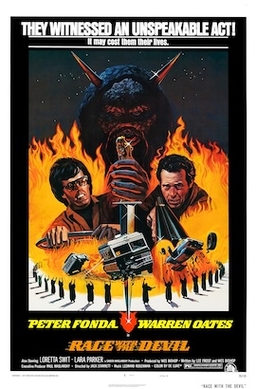
After saving for years for vacation, two couples, Roger and Kelly (Peter Fonda and Lara Parker) and Frank and Alice (Warren Oates and Loretta Swit) head west in their new RV for Aspen, Colorado for some skiing. The first night out, they camp a mile or so off the road to enjoy the beauty of the country. Staying up late drinking, Roger and Frank see something weird on a nearby hilltop; a group of people chanting and dancing around a roaring fire. At first, they think nothing of it until one of the dancers is stripped and stabbed. They're spotted, and by the skin of their teeth escape. The sheriff (R.G. Armstrong) in the closest town investigates and sends them on their way when he decides there's nothing more they can do. But these cultists aren't done with these two couples yet.
When it comes to horror and thriller movies, I typically stay pretty clear of them. But with this one, the cast and the very B-movieish plot caught my eye. 'Devil' was released four years after Steven Spielberg's Duel premiered on TV, and it would be hard not to compare the two. Where Duel had one man vs. one rogue semi driver, 'Devil' has four people running for their lives from a lot of people -- a number is never really established. SPOILERS It seems everyone they run into following the murder is in the cult. You could call it a twist, but it was pretty obvious to me what was going on the second Armstrong enters as the all too helpful country sheriff. END OF SPOILERS
I enjoyed the movie as a whole, but two scenes will stick with me most of all. One, the getaway after they've been spotted. It's the dead of night, and these cultists are hauling ass after them. I'll go into this more later, but a gigantic, new model RV also isn't the best getaway vehicle. Of course, the RV gets stuck in a shallow riverbed as the cultists close in. Check out the murder and getaway HERE at Youtube. Another is midway through the movie as paranoia starts to set in that they're being tracked. The cult has hidden rattlesnakes throughout the RV, and coming from someone who isn't a huge fan of snakes in general, this is an incredibly uncomfortable scene to watch. Add to it that the scene goes on and on as Roger and Frank try to throw these snakes outside, and you've got quite a shocker sequence.
The last 45 minutes are more like Duel because the story is almost completely contained in this RV as the cultists try to knock them off the road. These chase sequences are something else, especially considering the type of vehicles. The RV seems to swallow up the road with its size, and chasing them are tow trucks, school buses, and midsize trucks. The chases feature some impressive stunt driving and keep that lightning fast pace going right up until the end. The two couples just want to get to Amarillo and a bigger police force to report what's happened, but nothing is going to come easy for them on the open road and all its dangers.
Fonda and Oates had worked together four years earlier in 1971's The Hired Hand, and the chemistry they had there rolls over to this B-movie. These aren't roles that require a whole lot of acting -- look worried/pissed/terrified and repeat -- but both stars look to be having fun. Oates always is worth watching even in the worst movies, and Fonda holds his own alongside the wily character actor. This was also the first time I'd seen Swit -- MASH's Margaret 'Hot Lips' Houlihan -- in a movie and not TV. The same as the gents, she's required to look worried and be scared. Parker doesn't make much of an impression as the wife who's losing her mind a whole lot quicker than the rest of the RV passengers. They do meet a handful of people on the road -- all of them connected with the cult -- but they're nothing more than creepy faces.
And then there was the ending. I won't spoil it here for you, but it is the type of ending that could only be in a movie from the 1970s, and more than that, a 70s horror/thriller flick. It's quick with little build-up and certainly caught me off guard. Don't blink or you might miss it before the credits start to roll. Apparently, it's a pretty unpopular ending, but I really liked it in terms of story and shock value. The whole story's been building up to this so why throw in a happy ending? Check this out at Youtube, starting with Part 1. A cheesy movie for sure, but it packs some good scares and a good cast. Worth a watch.
Race With the Devil <-----trailer (1975): ***/****
After saving for years for vacation, two couples, Roger and Kelly (Peter Fonda and Lara Parker) and Frank and Alice (Warren Oates and Loretta Swit) head west in their new RV for Aspen, Colorado for some skiing. The first night out, they camp a mile or so off the road to enjoy the beauty of the country. Staying up late drinking, Roger and Frank see something weird on a nearby hilltop; a group of people chanting and dancing around a roaring fire. At first, they think nothing of it until one of the dancers is stripped and stabbed. They're spotted, and by the skin of their teeth escape. The sheriff (R.G. Armstrong) in the closest town investigates and sends them on their way when he decides there's nothing more they can do. But these cultists aren't done with these two couples yet.
When it comes to horror and thriller movies, I typically stay pretty clear of them. But with this one, the cast and the very B-movieish plot caught my eye. 'Devil' was released four years after Steven Spielberg's Duel premiered on TV, and it would be hard not to compare the two. Where Duel had one man vs. one rogue semi driver, 'Devil' has four people running for their lives from a lot of people -- a number is never really established. SPOILERS It seems everyone they run into following the murder is in the cult. You could call it a twist, but it was pretty obvious to me what was going on the second Armstrong enters as the all too helpful country sheriff. END OF SPOILERS
I enjoyed the movie as a whole, but two scenes will stick with me most of all. One, the getaway after they've been spotted. It's the dead of night, and these cultists are hauling ass after them. I'll go into this more later, but a gigantic, new model RV also isn't the best getaway vehicle. Of course, the RV gets stuck in a shallow riverbed as the cultists close in. Check out the murder and getaway HERE at Youtube. Another is midway through the movie as paranoia starts to set in that they're being tracked. The cult has hidden rattlesnakes throughout the RV, and coming from someone who isn't a huge fan of snakes in general, this is an incredibly uncomfortable scene to watch. Add to it that the scene goes on and on as Roger and Frank try to throw these snakes outside, and you've got quite a shocker sequence.
The last 45 minutes are more like Duel because the story is almost completely contained in this RV as the cultists try to knock them off the road. These chase sequences are something else, especially considering the type of vehicles. The RV seems to swallow up the road with its size, and chasing them are tow trucks, school buses, and midsize trucks. The chases feature some impressive stunt driving and keep that lightning fast pace going right up until the end. The two couples just want to get to Amarillo and a bigger police force to report what's happened, but nothing is going to come easy for them on the open road and all its dangers.
Fonda and Oates had worked together four years earlier in 1971's The Hired Hand, and the chemistry they had there rolls over to this B-movie. These aren't roles that require a whole lot of acting -- look worried/pissed/terrified and repeat -- but both stars look to be having fun. Oates always is worth watching even in the worst movies, and Fonda holds his own alongside the wily character actor. This was also the first time I'd seen Swit -- MASH's Margaret 'Hot Lips' Houlihan -- in a movie and not TV. The same as the gents, she's required to look worried and be scared. Parker doesn't make much of an impression as the wife who's losing her mind a whole lot quicker than the rest of the RV passengers. They do meet a handful of people on the road -- all of them connected with the cult -- but they're nothing more than creepy faces.
And then there was the ending. I won't spoil it here for you, but it is the type of ending that could only be in a movie from the 1970s, and more than that, a 70s horror/thriller flick. It's quick with little build-up and certainly caught me off guard. Don't blink or you might miss it before the credits start to roll. Apparently, it's a pretty unpopular ending, but I really liked it in terms of story and shock value. The whole story's been building up to this so why throw in a happy ending? Check this out at Youtube, starting with Part 1. A cheesy movie for sure, but it packs some good scares and a good cast. Worth a watch.
Race With the Devil <-----trailer (1975): ***/****
Labels:
1970s,
Horror,
Peter Fonda,
R.G. Armstrong,
Warren Oates
Wednesday, September 16, 2009
Return of the Magnificent Seven
The sequel picks up 10 years after the conclusion of the first movie. Chico (Julian Mateos instead of Horst Buchholz) is still living in the village he helped save with his wife Petra (Elisa Montes) and son. But one day, a gang of bandits ride into the village and basically kidnap every male and march them out into the desert. Petra goes for help, finding Chris (Brynner) in a nearby border town. Assembling a new group of seven, with Vin (Robert Fuller instead of Steve McQueen), Chris rides south to rescue Chico and the other men from the village.
What they find is a small city being built in the middle of the desert, the workings of an eccentric rancher, Francisco Lorca (Emilio Fernandez). Lorca needs all these men to build the town and most importantly, a church, in honor of his two sons who were killed on the location during a recent uprising. Chris and the six bully Lorca out of the way, but the Mexican rancher won't go quietly, forcing the Mag7 to hole up and try to defeat Lorca and all his gunhands.
The new Magnificent Seven: With two more sequels to go, I'll get this out of the way now. You can't cast a movie with the caliber of actors that were in the first one. Brynner is back, and we do get some background information on him which is cool to find out about. McQueen was reportedly offered the part of Vin but chose not to reprise the role unfortunately. It's an average western as is, but with him, it might move up a notch. Fuller is capable enough but doesn't bring a ton of personality to the part. And in the upgrade department, Mateos makes a good Chico. For one, he's actually Hispanic, not German.
On to the new members of the seven, led by Warren Oates and Claude Akins, two great character actors ideally suited for key supporting roles here. Oates plays Colbee, a gunslinger with a wandering eye for the women, signing up with Chris when he hears about a village occupied by only women. It's a funny part, but one with some darkness to it as Colbee explains some of his background with Chris. Akins is Frank, a gunman looking to get himself shot up for the guilt he holds from something in his past. Also joining the group are Virgilio Teixeira as Luis, a Mexican bandit Chris frees from jail, and Jordan Christopher as Manuel, a young Mexican boy inexperienced with guns looking for somewhere to belong.
The Villain: Eli Wallach set the bar about as high as it could go with his part as Calvera so it would be difficult to live up to the original. Emilio Fernandez (Mapache in The Wild Bunch) just isn't as strong an opponent as Wallach's Calvera, and that's with about five times the amount of gunmen with him. His back story is interesting, but it makes him seem like a weak old man, not an intimidating, half-crazy madman. Fernando Rey has a small part as the wise village priest.
Overall, that's the problem with this first sequel. At 95 minutes, 'Return' is 33 minutes shorter than the first movie. The script seems thrown together in a rush job once the seven are assembled. Then, once the situation is laid out, it's basically 35 minutes of siege fighting as Lorca and his men attack the seven in a half-built church. The action scenes are well put together, if a little ridiculous (especially the finale), but with little build-up they're just there. The same issues are there with Chris and Vin questioning what they've done all these years, surprisingly enough producing some emotional moments.
Part of me wants to say that if this movie was just released on its own with no predecessor, it'd be a more highly regarded movie. But following in the rather large footsteps of the original, it would be almost impossible to match the enjoyment and excitement. 'Return' is worthwhile and an entertaining western in spite of some flaws, but don't expect a classic going in and you should be okay.
Return of the Magnificent Seven <-----trailer (1966): ** 1/2 /****
Labels:
1960s,
Burt Kennedy,
Claude Akins,
Fernando Rey,
Julian Mateos,
Sequels,
Warren Oates,
westerns,
Yul Brynner
Sunday, August 2, 2009
Netflix review: Dillinger
So for those keeping track at home, 'very long wait' on the Netflix queue is about a month so not too bad. After seeing Public Enemies its opening week, I guess I wasn't the only one who wanted to see other movies about infamous bank robber John Dillinger so it took a little while for 1973's Dillinger to become available. And let me say this, it was well worth the wait.The story focuses exclusively on Dillinger and his year-plus rampage through the Midwest with his gang. Nothing new here if you know the history, and for those who don't there's some helpful subtitles to guide you along with locations and dates. As Dillinger becomes Public Enemy No. 1 for the FBI, top agent Melvin Purvis leads the hunt to bring him in and if need be, kill him off. While director John Milius plays fast and easy with the historical facts at times, it's never enough to take away from the story.
'Dillinger' can't help but be compared with this summer's Public Enemies, but there are enough differences to set them apart. I'll start off with the obvious, the casting. Typically playing a supporting character, and usually knocking those roles out of the park, character actor Warren Oates gets a rare shot at the lead role. He plays Dillinger as a man who is fully aware of his reputation and tries to live up to it. Oates' Dillinger revels in the fame and popularity he's gained, refusing to escape to Mexico with $70,000 because 'what would his fans think?' But even with a bigger than life persona, Oates brings a humanity to the role much like Johnny Depp does. It's a great performance from Oates, and it is always nice to see a character actor get a shot at the spotlight. He handles both the dramatic scenes, like John's relationship with Billie Frechette (Michelle Phillips in her first starring role), and then the action/bank robbing scenes.
As his opposite, Ben Johnson plays FBI agent Melvin Purvis. Other than the obvious age differences, Johnson is 55 here and Purvis was 30-31 during the time frame, the casting works. This isn't the historically accurate Purvis with Johnson putting his own spin on the character. In real life, the FBI agent in charge of the Midwest struggled early on in the hunt for any number of high-profile crooks. Here it's the polar opposite, Johnson's Purvis is an experienced, veteran agent who knows how to get the job done, promising to smoke a cigar over the dead body of each of the crooks he's hunting down. And just for some odd movie connections, five years prior Oates and Johnson played brothers in Sam Peckinpah's The Wild Bunch but find themselves here trying to kill each other.
One significant improvement in the 1973 movie is the attention given to the rest of the Dillinger gang. We learn about them, see their interactions among the group, and get to know them. And while Oates plays the lead well, his Dillinger doesn't have a huge amount of screentime with the supporting cast, including the gang, getting their fair share too. The list includes an impressive grouping of 70s character actors that should make any movie fan smile. Harry Dean Stanton and Geoffrey Lewis play Homer Van Meter and Harry Pierpont, two key members of the gang, with Steve Kanaly and Richard Dreyfuss giving support as Pretty Boy Floyd and Baby Face Nelson. All four actors bring a humanity to their parts, something easier said than done when considering these weren't exactly God-fearing folks. Even Cloris Leachman has a brief part as Anna Sage, the lady in red, who helped betray Dillinger.
With the caliber of actors that 'Dillinger' boasts, it makes everything else fall into place. When the gang does start to ultimately meet their ends, I was surprised by how moving the scenes were. You're hit with these crazy amounts of action with BARs and Thompson submachine guns going off and then these shocking scenes of death, often shot so quickly it can be hard to catch. It's Kanaly as Pretty Boy Floyd that stands out in his final scene, talking with an old couple on their farm about his sins.
It is those scenes where the movie shines. From the shootout at Little Bohemia until Dillinger's death, about the last 35-40 minutes of the movie are about as perfect as they could be. The Little Bohemia shootout (<----check it out there, SPOILERS obviously) is loud, chaotic and bloody and stands out as the best scenes in the movie. It's in the aftermath as the gang gets away that the members start to get picked off, leading up to Dillinger's death outside the Biograph Theater in Chicago. In directing a movie that most people know the story of at least somewhat, Milius really brings the year-long spree to life. The feel of the Depression-era in the mid 1930s is brought to life with period cars, clothing, music and weapons. There's an artsy quality to certain shots as Milius lets the camera linger on the aftermaths of certain shootings that could have been out of place but fit seamlessly into the story. I was surprised by how much I enjoyed 'Dillinger' especially Oates in the lead, the chaotic gunbattles, and the supporting cast. Just beware of the 'very long wait.'
Dillinger <----trailer (1973): *** 1/2 /****
Thursday, April 23, 2009
Netflix review #17: The Hired Hand
Peter Fonda will never be considered a mainstream, Hollywood kind of guy. His first big hit, 1969's Easy Rider, proved that pretty clearly about two bikers enjoying their travels across the country before they start to see what the country and people are really like. Fonda's first film as a director, 1971's The Hired Hand, has the same edge and darkness in tone to it as Easy Rider, except that instead of modern times, it takes place in the Old West.
Riding west toward the Pacific Ocean, cowboy drifters Harry Collings (Fonda) and Arch Harris (Warren Oates) hope to hit it big in California. Along for the adventure is a youngster, Danny Griffen (Robert Pratt) who's always looking for the next big thing on the horizon. But as they ride into a no-account, run down town of Del Norte, Harry decides he's had enough of the drifting life and wants to go back home. It's been years, but he had a wife and daughter at some point and wants to find them. Longtime friends, Arch tags along.
It's at home on a quaint, little farm they discover Harry's wife, Hannah (Verna Bloom), isn't going to welcome him back with open arms and understandably so. She'll tolerate him, but that's as far as things will go until Harry proves he's there to stay. Arch sees the writing on the wall and leaves his friend, knowing that Harry's found what he's looking for. Everything seems to have worked out perfectly until a rider comes along saying Arch is in trouble, and the only one that can help him is his old friend. Does Harry go and help him, or stay with the life he's rediscovered?
I'm not sure if it makes sense, but this is an artsy western that at times reminded me of Terrence Malick movies. Much of the movie was shot with an eye for the visual, riders moving across a sandy plain or through a densely wooded forest. There's a very lyrical, other worldly feel to the proceedings. One technique I thought worked really well was shots overlapping each other. One in particular has Harry and Arch talking to each other with their faces in close-up while in long shot their bodies are blurred by the setting sun. On top of each other, the two shots form a beautiful shot.
Casting is dead on, plain and simple. Fonda's Harry is similar to Captain America in many ways. He's laid back and easygoing, just looking for a good life and happiness wherever it may be. It's only when you push him too far his other side comes out. As his partner, Oates hits all the right notes as Arch. The veteran character actor was so good at turning it on and hamming it up, just one of the reasons he's the best, but here he underplays everything. Harry and Arch have ridden across the west for 7 years and there's a genuine friendship there. It's that relationship that carries the movie and sets it apart from most westerns with a similar storyline.
Verna Bloom could have easily gotten lost in the movie behind Fonda and Oates, but her performance is on equal ground with them. As Hannah, Harry's wife, she is a woman that's been burned in the past and she has trouble putting it behind her. Hannah is lonely and wants companionship, but she's worried she'll get hurt again, as much for her daughter Janey as herself. Two other supporting roles are worth mentioning, Pratt's youngster Danny and Severn Darden as McVey, the power-hungry little dictator of Del Norte who doesn't have much use for rules or laws and because of that forces a confrontation.
Besides all the casting and cinematography, The Hired Hand is what's right about westerns. Shown through the Harry and Arch relationship, the bigger idea here is loyalty and doing what's right even if the cost may be a hard one to pay. A man does something not because he's forced to do it, but because he knows it's the right thing to do. It's a great little western that I'm glad I watched.
Released through Sundance Film Festival, the DVD has the movie in a well-done widescreen presentation and trailers for a wide variety of Sundance releases. Fonda also provides a commentary track. And if you don't want to invest in the DVD, Youtube has the movie posted and broken up into segments. Here's a trailer if interested.
The Hired Hand (1971): *** 1/2/****
Riding west toward the Pacific Ocean, cowboy drifters Harry Collings (Fonda) and Arch Harris (Warren Oates) hope to hit it big in California. Along for the adventure is a youngster, Danny Griffen (Robert Pratt) who's always looking for the next big thing on the horizon. But as they ride into a no-account, run down town of Del Norte, Harry decides he's had enough of the drifting life and wants to go back home. It's been years, but he had a wife and daughter at some point and wants to find them. Longtime friends, Arch tags along.
It's at home on a quaint, little farm they discover Harry's wife, Hannah (Verna Bloom), isn't going to welcome him back with open arms and understandably so. She'll tolerate him, but that's as far as things will go until Harry proves he's there to stay. Arch sees the writing on the wall and leaves his friend, knowing that Harry's found what he's looking for. Everything seems to have worked out perfectly until a rider comes along saying Arch is in trouble, and the only one that can help him is his old friend. Does Harry go and help him, or stay with the life he's rediscovered?
I'm not sure if it makes sense, but this is an artsy western that at times reminded me of Terrence Malick movies. Much of the movie was shot with an eye for the visual, riders moving across a sandy plain or through a densely wooded forest. There's a very lyrical, other worldly feel to the proceedings. One technique I thought worked really well was shots overlapping each other. One in particular has Harry and Arch talking to each other with their faces in close-up while in long shot their bodies are blurred by the setting sun. On top of each other, the two shots form a beautiful shot.
Casting is dead on, plain and simple. Fonda's Harry is similar to Captain America in many ways. He's laid back and easygoing, just looking for a good life and happiness wherever it may be. It's only when you push him too far his other side comes out. As his partner, Oates hits all the right notes as Arch. The veteran character actor was so good at turning it on and hamming it up, just one of the reasons he's the best, but here he underplays everything. Harry and Arch have ridden across the west for 7 years and there's a genuine friendship there. It's that relationship that carries the movie and sets it apart from most westerns with a similar storyline.
Verna Bloom could have easily gotten lost in the movie behind Fonda and Oates, but her performance is on equal ground with them. As Hannah, Harry's wife, she is a woman that's been burned in the past and she has trouble putting it behind her. Hannah is lonely and wants companionship, but she's worried she'll get hurt again, as much for her daughter Janey as herself. Two other supporting roles are worth mentioning, Pratt's youngster Danny and Severn Darden as McVey, the power-hungry little dictator of Del Norte who doesn't have much use for rules or laws and because of that forces a confrontation.
Besides all the casting and cinematography, The Hired Hand is what's right about westerns. Shown through the Harry and Arch relationship, the bigger idea here is loyalty and doing what's right even if the cost may be a hard one to pay. A man does something not because he's forced to do it, but because he knows it's the right thing to do. It's a great little western that I'm glad I watched.
Released through Sundance Film Festival, the DVD has the movie in a well-done widescreen presentation and trailers for a wide variety of Sundance releases. Fonda also provides a commentary track. And if you don't want to invest in the DVD, Youtube has the movie posted and broken up into segments. Here's a trailer if interested.
The Hired Hand (1971): *** 1/2/****
Saturday, April 4, 2009
Two-Lane Blacktop
When I saw a Criterion Collection DVD called Two-Lane Blacktop with a cast that included singer James Taylor, Beach Boy Dennis Wilson and character actor extraordinaire Warren Oates leading the way, I knew I had to give it a try. It's the definition of a 70s road movie with an existential feel to it where characters are called by what they are, 'the Driver' and 'the Mechanic' are just two, and while at times the movie tries too hard to be cool or different, it is a good example of how good a road movie can be.The storyline at its most basic, VERY BASIC, is a cross-country road race for pink slips between the Driver (Taylor) and his Mechanic (Wilson) in their stripped-down and souped up 1955 Chevy against a man called G.T.O (Oates) in his yellow Pontiac GTO. The race is almost an excuse for the movie because it's the most laid back contest you'll ever see. Both drivers don't take the easy way out. If one has car troubles, the other waits because they don't want an unfair advantage, no asterisk next to a possible win.
Taylor and Wilson are clearly not actors as the two car nuts completely obsessed with their ride. During one exchange with GTO, Taylor famously says "You can never go fast enough." The singer mumbles his way through most of his lines and glares the rest of the movie. Looking back over the movie, I'm not sure Wilson has a line that doesn't involve the state of the car of what he wants on his hamburger. Even then, as clear as it is that they're not actors, there is something appealing about two musicians taking on these roles and definitely it is one of the reasons this movie has gained cult status over the years.
Other than the great racing and car footage, the reason to see this movie is Oates as G.T.O. He's a middle-aged man driving his car across the country as his pace until he keeps seeing these car nuts through two states. One of my all-time favorite actors, Oates brings a personality and humanity to the part that Taylor and Oates aren't able to with their own. GTO constantly picks up hitchhikers, soldiers, gay cowboys, a grandma with her granddaughter, and tells a different story each time as to how he acquired the car. It's a perfect part for the veteran character actor, one I think could and should have gotten him a Supporting Actor nomination.
It's hard to pick out why I enjoyed the movie as much as I did. The first 15-minutes are ridiculously slow and almost made me quit watching. The story drifts along without a ton of purpose even after the race for pink slips has been declared. But like Easy Rider, there's a tone and style to the movie that works for some unexplained reasons. It's an enjoyable movie with a very 70s feel to it that deserves the cult status it has acquired over the years.
Of course, the Criterion Collection DVD is a pricey one at $35 or so depending on where you find it. Youtube has a fair share of videos up with movie clips. Because it is an expensive movie, I'd recommend looking into the movie before buying it blind. If you do like road movies though, this is one of the better ones you'll come across.
Here's the trailer and a great scene with Oates telling a hitchhiker all about his car.
Subscribe to:
Posts (Atom)


.jpg)