The Sons of Katie Elder

The Sons of Katie Elder
"First, we reunite, then find Ma and Pa's killer...then read some reviews."
Showing posts with label Brad Dexter. Show all posts

Wednesday, April 15, 2015

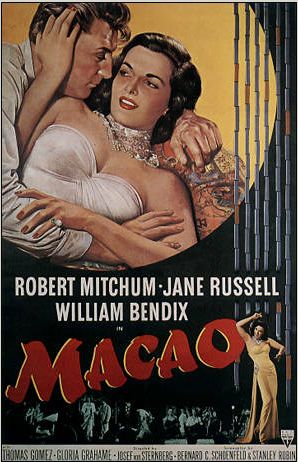
Macao

They don't have the all-time classics to their names that other film couples did. They weren't Tracy and Hepburn or Bogart and Hepburn or Wayne and O'Hara. But you know what stars Robert Mitchum and Jane Russell had in their two films together? An easy-going, sizzling charm that oozed off the screen. I'm hoping to write reviews for both soon, starting here with 1952's Macao, their second pairing.

Just 40 or so miles from Hong Kong, the city of Macao in the years following World War II has become a den of gambling, corruption, violence and any number of any other vices. One particularly crooked casino owner with his hands in everything, Vince Halloran (Brad Dexter), is especially worried though after he and his men killed an investigating officer from New York. They're playing the waiting game for the officer's replacement...and maybe some more heavy duty reinforcements. Coming ashore from a ship traveling from Hong Kong, all but three passengers are recognized, leading Halloran to believe one of them is the cop. The suspects? A Navy veteran on the run, Nick Cochran (Mitchum), a talkative salesman, Lawrence Trumble (William Bendix), and a nightclub singer looking for a job, Julie Benson (Russell). Who is the right one to target? Just which one is the cop looking to take Halloran in?

If that doesn't sound like the most pointed plot description, well, it ain't. Director Josef von Sternberg (along with some uncredited work from Nicholas Ray) was a silent film director who drifted along a touch when the sound era moved into the film industry. The Wikipedia page for 'Macao' specifically says "When von Sternberg's scenes made no sense dramatically..." so you know he wasn't always interested in a Point A to Point B (or C-through-Z) story to begin with. Production actually wrapped on filming in 1950, and then the finished product sat on the shelf for most of two years. How come? Producer Howard Hughes' track record basically. Decisions didn't have to make a whole lot of sense when your boss is one of the world's richest people. What's the end result then for this shelved, quasi-film noir?

It's good to great early on because of its randomness and general kookiness. It derails some in the last 20 minutes of its 80-minute running time. Let's focus on the positive though. 'Macao' is genuinely fun as everything is laid out and established. It mixes classic film noir with international intrigue with the huge chemistry between Mitchum and Russell with some laughs along the way. Long story short...it is a pleasant, enjoyable movie. It is dark, but not as dark as most film noirs. Some reviews point to that lack of a unified tone as a negative but the helter-skelter tone really worked for me. Should it have? Probably not but something clicks for me. Filmed in black and white with some stock footage of Macao and Hong Kong mixed in with the seedy Hollywood sets for the two cities, Sternberg's film has style and a great visual look.

Blah blah blah with all that film analysis. Let's talk about movie star chemistry!!! Robert Mitchum and Jane Russell are two of my favorites. Mitchum was that perfect tough guy anti-hero who just didn't give a crap. Russell was a solid actress, singer and performer who fit in well with the tough guys when her film roles allowed it. The end result? Two actors who don't look like they're acting. They're just hanging out, having a ton of fun bringing these two characters together. Their chemistry is evident from Scene No. 1 and never lets up. Not remembered as a great role -- and rightfully so -- Mitchum is pretty perfect, laconic and laid back with a checkered past hanging over his head. The same for Russell's Julie, bouncing from city to city looking for work. Oh, and Russell is drop dead gorgeous here. Hughes made her a star by utilizing her....natural talent I'll say. She's beautiful, and she's even given a chance to sing two songs.

The rest of the cast is solid throughout. I especially liked Bendix as Lawrence C. Trumble, fast-talking, looking to blow off some steam traveling salesman. His almost manic delivery pairs well with Mitchum's slower-paced line reads. Dexter is perfectly slimy as Halloran, the black market casino dealer always with an eye on shady deals and easy money. Also look for Thomas Gomez as the corrupt police officer working with Halloran, poorly and under-used Gloria Grahame as Halloran's much-maligned girlfriend, Philip Ahn as Halloran's steely-eyed enforcer, and Vladimir Sokoloff as a mysterious blind man who seems to pop up at the right moment whenever needed. A fun cast with some cool parts.

Now that line before about von Sternberg's lack of dramatic timing, yeah, that comes into play in the last 20 minutes. The cool, couldn't care less style loses all momentum. The finale turns into a big chase scene that doesn't keep the adrenaline flowing unfortunately. The ending itself feels a tad rushed, a disappointing end to an otherwise very enjoyable movie.

Macao (1952): ** 1/2 /****

Monday, August 11, 2014

Von Ryan's Express

Introduced as a kid to 1963's The Great Escape, I fell hook, line and sinker for the entire prisoner of war genre. Some like 'Escape' and Bridge on the River Kwai are instantly recognizable among movie fans while many others have taken some digging on my part to track them down. How about one of the best? One of my all-time favorites? Oh, yes, one I always enjoy revisiting, 1965's Von Ryan's Express.

As the Germans try to hold off advancing Allied forces in Italy in August 1943, an American Army Air Corp pilot, Colonel Joseph Ryan (Frank Sinatra) is shot down and sent to a prisoner of war camp where he becomes the ranking officer. There he clashes quickly with his second-in-command, a fiery, stubborn British officer, Major Eric Fincham (Trevor Howard). When the camp's Italian guards abandon the camp, Ryan makes a difficult decision, one that ends up backfiring as almost 400 prisoners are rounded up and boarded on a German train heading north. Heading the wrong way away from the advancing Allied forces, it seems hope has run out for Ryan, Fincham and their fellow prisoners. When all seems lost though, Colonel Ryan has one more trick up his sleeve, a daring plan that has the prisoners attempting to take over the train. The closely packed train is headed to Germany, but not if Ryan has his say. Instead? They look to Switzerland, but can their plan hold together?

If there is one major difference between 'Von Ryan's' and other prisoner of war movies, it is this. While all entertaining, movies like The Great Escape, River Kwai, Stalag 17 and others are high drama, often delivering a message. That's not to say Von Ryan's Express isn't high drama, director Mark Robson doing a fine job in this WWII actioner. It's more than that. It's more than just describing it as a prisoner of war movie. I've long thought this is one of the most perfect popcorn flicks ever made, the most entertaining, the most adrenaline-pumping action/dramas I can think of. It clocks in at 116 minutes but with each viewing, it goes by quicker and quicker. There isn't a weak moment. There are no slow portions, no parts where the momentum lets up. It's the rare movie that can accomplish that. From beginning to surprising finale, I love it all, one of my all-time favorites, one film I can watch over and over again.

What's the best thing going here for this 1965 war movie? There's a ton to mention! Just a few weeks ago in my review for 100 Rifles I mentioned how much I loved composer Jerry Goldsmith's score. Well, as good as that score was, I think his score here is one of his bests (and that's saying something considering the breadth of his career). Listen to the main theme HERE. This is the perfect score to back up the action, the heart-pumping moments, the quieter, more inward scenes and everything in between. An underrated score that deserves more of a reputation. Right up there with the musical score as an additional character is the choice to film on location in Italy. The filming locations give an air of authenticity that Hollywood backlots just wouldn't have accomplished. From the hills and streams to the ancient ruins to the weathered towns and train stations, wouldn't you know it? The film actually looks like it takes place in Italy. Go figure, right?!?  These are things that if mishandled wouldn't be a deal-breaker, but when handled correctly.....well, they can lift the movie up a notch or two or 10.     

You know who's cool? Totally caught me off guard, but it's that guy -- maybe you've heard of him -- named Frank Sinatra. By the mid 1960s, Sinatra played variations on tough guy parts that allowed him to more or less, be himself. In other movies, it might seem too familiar, but there's an energy here as Sinatra brings this intriguing character to life. Dubbed 'Von Ryan' by his fellow prisoners for helping the Germans, he's forced to make difficult decisions left and right, often putting lives at risk with each passing decision. There's an easy-going confidence to Sinatra's Ryan, a 90-day wonder as he calls it, a capable leader making some impossible decisions. The best supporting part not surprisingly comes from Trevor Howard as the stubborn, action-driven Fincham. Their Odd Couple-like relationship works, the quiet, cool American and the fiery Brit officer providing some good energy, some good sparks throughout. Their chemistry is evident any time and every time they're on screen together. Two excellent leads.

Lost in the shuffle can be a damn good supporting cast beyond Sinatra and Howard. In the eye candy department, Raffaella Carra plays Gabriella, a beautiful Italian girl who becomes a part of the escape. As for the villains, there's Adolfo Celi as a Fascist Italian officer and commandant of the camp and the very German Wolfgang Preiss as a very German officer in command of the prison train. My favorite supporting parts are Ryan's fellow prisoners, a cool group, an almost oddball crew that includes Bostick (Brad Dexter), one of the few American prisoners, Capt. Oriana (Sergio Fantoni), a well-meaning Italian officer thrust in with the P.O.W.s, Orde (John Leyton, also in Great Escape), Fincham's right-hand man, Father Costanzo (Edward Mulhare), the naive at times but very brave priest, and Stein (Michael Goodliffe), the camp medic. Also look for James Brolin, Michael St. Clair, Richard Bakalyan and James Sikking as other prisoners with smaller parts.  

Based off a novel by David Westheimer, 'Von Ryan' certainly has plenty to offer, including a handful of memorable set pieces. The opening 40 minutes are spent in the camp, the next 15 or so on the road and the last hour is when the prisoners are boarded on the prison train. I loved Ryan's scene with an inquisitive Gestapo agent (supposedly William Berger, I'm not positive) asking about Ryan's American watch. I loved Mulhare's masquerade as a German officer hoping to dupe an inspection. There are all these great moments that embrace this ludicrous possibility of this happening and run with it. We go along because it's so damn fun. This is a thrill a minute flick that's meant to entertain scene in and scene out. Nowhere is that more evident than....

The finale. As strong as the movie is, 'Von Ryan' is at its absolute best over the last 25 minutes, the prison train making a desperate run to the Alps and Switzerland, a German troop train (commanded by John Van Dreelen) hot on their trail. Throw in a trio of Messerschmitt fighters, a bombed out bridge (Spain standing in for Italy), and a stunning backdrop on a mountainside railway trestle....well, you've got a winner. It is in the ending that the film deviates most from Westheimer's novel, but it is a doozy of a finale. In terms of pure excitement, of really getting your blood pumping, I can think of few movies that can the ending here. A race against time, Germans edging ever closer, it has it all. Just a great movie, one I can rewatch over and over and always pick up something new.

Highly recommended. One of my all-time favorites.

Von Ryan's Express (1965): ****/****
Rewrite of October 2009 review

Tuesday, May 6, 2014

The Magnificent Seven

Why do some movies stick with you more than others? I grew up watching westerns and war movies from the 1950s and 1960s, movies that still dominate my all-time Top 10, movies like The Alamo, The Great Escape, The Dirty Dozen, The Good, the Bad and the Ugly, The Professionals and several others. They still resonate now more than a few years later. Oh, and of course, 1960's The Magnificent Seven. Several years back I reviewed all four movies (the original and the 3 sequels), and it's been too long. Time for an updated review. The original and still best, one of the best westerns ever and a personal favorite.

South of the border in a small farming village, a bandit named Calvera (Eli Wallach) rides in and steals almost everything he and his gang of 40 bandits can carry, leaving just enough for the village to survive and start all over again. The villagers decide they've had about enough, riding north into Texas to buy guns so they can fight back against Calvera's gang. Instead, they meet Chris (Yul Brynner), a mysterious gunfighter clad in black who recommends they hire men rather than buy guns. Chris agrees to help, recruiting six other gunfighters from varying backgrounds, including an amiable drifter and gunfighter, Vin (Steve McQueen), to help out. The money is poor, the mission is more than difficult and the odds are stacked against them. Chris and the six gunslingers ride south, ready to help the village and fight off Calvera, odds be damned.

What a good movie. From director John Sturges (a master of 'Movies for Men'), 'Seven' came along at an interesting time for the western genre. Things, they were a'changing. Westerns were becoming more cynical, darker, more introspective, eventually transforming into the spaghetti western and the folksy, revisionist westerns of the 1970s. As fondly remembered as 'Seven' is now, it struggled in theaters in the U.S. upon its initial release, finding huge success in Europe and Asia before being re-issued in the U.S. several years later. It is an Americanized version of Akira Kurosawa's classic film, Seven Samurai, transplanting samurais for wild west gunfighters. It's interesting for any number of reasons, from the music to the budding star power on display, the dark tone to the exciting action scenes. A favorite of mine, a four-star review, and I won't really debate it. So there!

How about that casting?!? Much of the cast would go on to become huge stars, but here in 1960, they were relative unknowns. Brynner was the established star, The King and I, The Ten Commandments already to his name, and he's the pulse of the movie. His Chris is the unflappable leader of the group, a capable gunfighter who's also got all the qualities a leader should have. Loyal, strong, and tough. McQueen steps up to the plate in his first starring role. His Vin is easy-going, a drifter looking for work, quite good with his gun but maybe looking for something else in his life. Brynner and McQueen had a tumultuous relationship on the set -- McQueen trying to upstage the established star -- but the result is more than solid. Their chemistry crackles, their scenes together that perfect dynamic between the commander and his right-hand man. As the bandit Calvera, Wallach is an effortless scene-stealer, disappearing for huge stretches only to return with a vengeance.

And then there's the rest of the seven, because Brynner and McQueen weren't enough, right? Right?!? First, there's Charles Bronson as Bernardo O'Reilly, a half-Mexican, half-Irish gunman who has quite the reputation for cleaning up nasty jobs and his price is high...usually. He bonds with three boys from the village who "got him," promising to watch over him and care for his grave should he die in battle. Then, there's James Coburn as Britt, the laconic, knife-throwing specialist who has few equals with knife or gun. Coburn says about 30 words the entire movie and steals every scene he's in. Next, Robert Vaughn as Lee, a hired gun who's lost his edge, convinced he is facing his death. Next up, Brad Dexter as Harry Luck, a friendly gunslinger convinced there's more to the job than Chris is saying. Finally, there's Horst Buchholz as Chico, the young, unproven kid looking to make a name for himself with his more established cohorts.

As if that star power wasn't enough to carry a movie, I liked the characterization of these gunslingers more than anything. That's something I've picked up on repeated viewings as I got older. The portrayal of these hired guns is honest, not looking to glamorize these men. They're tied down by nothing, drift along from job to job, all the while risking their lives knowing that any job could be their last. What do they have? Their guns, their horse and maybe most importantly, their word. 'Seven' boasts one of my all-time favorite scenes, in westerns and films in general. Given a chance to run from a battle against seemingly insurmountable odds, they opt to stay. Coburn's Britt famously says "No one throws me my own guns and says run....Nobody." When offered the chance to run, Vaughn's Lee is told "Go ahead, Lee, you don't owe anything to anybody." His answer? "Except to myself." That's the essence and spirit of the movie. Men in a nasty situation doing what's right because it's what they should do, what is right. Profoundly simple, it always sticks with me, these men living by their code and what they believe in.

As for the villagers, look for Vladimir Sokoloff as the Old Man, the village patriarch who has little use for the whiny farmers, Jorge Martinez de Hoyos as Hilario, the fiery farmer ready to side with the gunmen, Pepe Hern and John Alonzo his close friends, Rico Alaniz as Sotero, the quasi-mayor of the village trying to weigh all his options and lastly, Rosenda Monteros as Petra, the young woman in the village who takes a liking to Buchholz's Chico. Also look for familiar western faces Robert J. Wilke and Whit Bissell in quick scenes.

More than anything else though, I think what's lasted the longest in the social conscience is composer Elmer Bernstein's musical score. The soundtrack is one of the all-time greats, the main theme a whistle-worthy track that will be running through your head for days. This is what big movie soundtracks can be. They add something to the movie itself, like a new but essential character. If you're not familiar with it (and even if you are), listen HERE. Just a great score, moving, adrenaline-pumping and emotional as needed. An all-time great score from an all-time great composer.

The story covers a lot of ground over its 128-minute running time. The story is fairly episodic, starting with the essential and entertaining recruiting of the team, Brynner's Chris seeking the gunmen out for the job. Each snippet gives each actor his chance to stand out on their own before becoming part of the group. Coburn's classic introduction especially stands out. From there, it's one great scene after another, both as entertainment value but also for delving into all the characters from the Seven to the villagers to Calvera. There isn't a ton of action, but the gunplay stands out, two featured sequences as the Seven tangle with Calvera's gang. It's the final battle that packs the emotional punch, the odds finally taking their toll on this group of gunfighters we've come to like and root for. It's a downbeat ending when you really consider it, but it's the right ending for this story and the characters.

Just a great movie. It was a favorite growing up and always will be. One of the best westerns ever, and an easy one to recommend for fans of the western genre or for someone just being introduced to the genre as a whole. A classic, plain and simple.

The Magnificent Seven (1960): ****/****
Rewrite of September 2009 review

Monday, April 28, 2014

Johnny Cool

Some faces just stick with you as you watch more and more movies. A glare, a stare, a smile, a laugh, a maniacal laugh at that, just something easily remembered. Henry Silva qualifies on basically all of those things, a character actor who made a career out of playing supporting parts, usually crazy, psychopathic villains. He was GOOD at it, beyond good, a great bad guy. Then there's 1963's Johnny Cool where Silva got a starring role as the definition of an anti-hero bordering on out-and-out bad guy.

As a young teenager in 1940s Sicily with World War II raging, young Salvatore Giordano sees his mother killed by a German soldier. He joins the Italian partisans, becoming a hero across the countryside both during the war and after. Years pass and now Salvatore (Silva) is infamously known around the country and even internationally. Some know him simply as a bandit chieftain, others as a modern day Robin Hood. An exiled American gangster, Johnny Colini (Marc Lawrence), arranges a faked death for Salvatore as he has far bigger plans for him. Colini teaches Salvatore how to act and look like a gentleman, but more importantly he turns him into an unstoppable killer. His intended targets? The men who helped orchestrate Colini's exile. If Salvatore -- taking the gangster's name -- can pull it off, Colini's empire will be his.

Yikes. What a vicious, brutal movie. From director William Asher, it's even darker when you consider it was released in 1963. Playing like a hard-boiled, brutal, in your face film noir, 'Cool' is the definition of a B-movie. It's gritty and doesn't feel faked from beginning to end. While there are indoor/studio shots, there is also plenty of on-location scenes from New York City to Los Angeles to Las Vegas. The gloomy, impending doom, jazz-heavy score from Billy May and Johnny Worth permeates Asher's gangster/underworld story. This is a story based in smoky nightclubs, in backroom gambling halls, in gangsters' offices in high rises. Filmed in black and white, there's a great, throwback style throughout. I didn't love the movie -- little slow-moving at times -- but it does have a lot going for it.

From possibly unhinged supporting player to...partially unhinged leading player....Yeah, okay, maybe this part isn't a huge departure for Silva, but it's a chance he doesn't disappoint with. While there's a strong ensemble working with him, this is Silva's movie, plain and simple. It's cool to see the transformation his character goes through, from revenge-seeking teenager to infamous bandit to killing machine. It would have been cool to see some more background, more motivation -- is he solely interested in riches and fame? Is it something else, something more? -- but we see a man who becomes obsessed with achieving his goal. It's pretty apparent from the second we meet Salvatore/Johnny that this is one doomed dude, but the route he takes is certainly fascinating. Silva brings that intensity we've come to expect from the veteran character actor. A very interesting part.

The rest of the cast has its positives and negatives. Ever seen 1960s TV sitcom Bewitched? Yeah, Samantha herself, Elizabeth Montgomery plays Darien, a divorced woman looking for some excitement and getting more than she figured when she joins up with Silva's Johnny. How about some of Johnny's hopeful victims? There's Telly Savalas (sporting some hair), Jim Backus, John McGiver Brad Dexter and Mort Sahl. If that wasn't enough, also look for Joey Bishop, Sammy Davis Jr., Richard Anderson, Elisha Cook Jr. Beyond Montgomery and Savalas, no one on this list is around for more than a couple minutes, the story almost becoming a revolving door of quick cameos. Still, cool to see some big names like this all in one cast.

Mostly though, this is a dark movie to sit back and watch without much in the way of a sympathetic character. Silva's Salvatore/Johnny becomes a killing machine who's beyond saving. Fascinating to watch, far from an even remotely sympathetic anti-hero. Much of the violence is off-screen, but it's pretty hardcore just the same. You don't have to see it to know that a man getting bashed in the head with a shotgun is gonna be rather graphic. People are dispatched with no build-up, no tension. Just BOOM! You're dead. And that ending....wow, just wow. We don't see what's going on, but the foreshadowing is rough. An interesting movie, but beware of what you're getting into.

Johnny Cool (1963): **/****

Sunday, January 1, 2012

Vigilante Force

My history with 1976's Vigilante Force is a little checkered, going back a couple years. "History" is a little strong for a bomb of a movie that still manages to be entertaining I suppose. I saw the end of the movie on a Spanish TV station one time, forgot to record the rest a second time, and recently managed to sit through the entire thing. What a mess of a movie...if entertaining.

The peaceful California town of Elk Hills is in trouble. The oil workers called in to drill the oil fields have basically taken over the town, killing, robbing and stealing on a daily basis to the point where no one in town is safe. Single father and business owner, Ben Arnold (Jan-Michael Vincent), is asked by the town's committee if his brother, Aaron (Kris Kristofferson), would agree to come in and clean up the town. A Vietnam vet who survived three tours, Aaron agrees, bringing in a four-man mercenary crew to help him get the job done. The problems get cleared up, but Elk Hills has bigger problems now. Aaron and Co. are on a power trip.

Stumbling across this 1970s cheapie on late night Spanish television probably says a lot about the quality of the movie....for those who were wondering about it at least. Granted, there is a certain nostalgic memory from the movie as I spent a couple years tracking it down. There was more of a 'so bad it's good quality' that stuck with me since watching the last 15 minutes of 'Vigilante.' The picture of Kristofferson and his "gang" decked out in band uniforms shooting it out with an overall-clad Vincent and his crew of fed-up townspeople was too much to even consider forgetting. So what's the verdict now that I've seen the whole movie?

It's a dud, and overall a pretty lousy movie, but it is entertaining. Directed and written by George Armitage, 'Vigilante' has that cheap, low budget feel that I often think of as synonymous with the 1970s. Clearly not made with much of a budget, it has the look of a studio backlot with characters, story and gunfights thrown into a blender. Whatever sticks, that's what makes it into the final version. Top it off with an oddly-toned soundtrack heavy on a light banjo theme, and you've got a winner.

So many years later, the ending is by far the best thing going for 'Vigilante.' And I don't mean that as some sort of backhanded compliment like 'The movie's over...that was the best part.' The build-up to that final confrontation can be a tad on the slow side, but Armitage must have decided he'd had enough. A power-hungry Aaron has gone too far so brother Ben must stop him no matter the cost. Automatic weapons, bazookas, grenades, and did I mention Kristofferson dressed up as a band leader, complete with red and gold braided outfit. On the oddity scale, it's close to a 10, especially with Vincent chasing him wearing overalls. I guess they were comfy and meant for a good chase/gunfight.

If you're looking for great acting, first off a movie titled 'Vigilante Force' should have been a clue you were watching the wrong movie. Second, it's fun to see Kristofferson and Vincent play off each other. Kristofferson's Aaron is the cool Vietnam vet who with the snap of a finger basically goes insane. No explanation provided, he just wants money. He spends most of the movie shirtless standing around being shirtless. Not an actor with the most range to begin with, Vincent is a bit stiff with his delivery, but let's face it. I can't rip him too much. The script doesn't exactly give him much to do or work with. Also look for Bernadette Peters and a pre-Dallas Victoria Principal as the love interests, Brad Dexter as the Elk Hills mayor, and Judson Pratt as the can't win sheriff.

Mindlessly dumb movie, but one I still enjoyed for what it is...a mindless dumb movie. Nothing more, nothing less so don't expect much, and you'll moderately enjoy it.

Vigilante Force <---trailer (1976): ** 1/2 /****

Sunday, June 27, 2010

The Asphalt Jungle

Whether he was behind the camera directing or in front of the camera acting, there were few directors or actors as tough/cool/badass as John Huston.  As an actor, he always played characters with an edge and with his gravelly voice and not so classic looks, he always sold the part.  As a director, he excelled with movies that were as tough as the stories they told.  They were 'guy's guys movies' that rarely disappointed and one of his best was 1950's The Asphalt Jungle.

This 1950 heist movie is worth talking about for two reasons.  One, released at the height of film noir popularity, 'Jungle' finds a way to put its own spin on the story and it ends up being a classic in the genre.  Two, you can judge it by the impact it had on later underworld heist movies.  Watch a heist movie released since 1950, and it's almost impossible not to make some connection or influence Huston's flick had.  At just under two hours, there is not a wasted minute in the build-up, heist, and fall out of a jewelry robbery.

Just out of jail after seven years inside, Doc Reidenschneider (Sam Jaffe) wastes no time setting up a job that could net him and his partners almost a million dollars.  With some help and financial backing from a crooked lawyer, Alonzo Emmerich (Louis Calhern), Doc reveals his plan to knock off a diamond exchange.  He'll need some help though and recruits three men, Dix Handley (Sterling Hayden), the muscle, Gus Minnisi (James Whitmore), the getaway driver, and Louis Ciavelli (Anthony Caruso), the safe-cracker to help him pull off the job.  The Doc has everything figured out down to the second, but all the planning in the world can't account for the unexpected.  And then there's Emmerich, who may have ulterior motives for the heist.

The 'jungle' of the title is the underworld, the crime figures who threaten to take over cities and ruin the lives of good people all across the country, or at least that's how Police Commissioner Hardy (John McIntire) explains it.  Like most noir movies, Huston shoots in black and white in this unnamed midwest city.  The characters live and die in smokey rooms and dark, shadowy alleys as they go about their heist.  Like few other movies, Huston creates a real feeling of the underworld, the seedier parts of town that you don't want to be caught in after a certain hour.  With composer Miklos Rozsa's score, you've got the right start to a winner.

Working with an ensemble cast, Huston gets the best out of this talented crew.  Often stiff and a little wooden in starring roles, Hayden delivers a career-best performance as Dix Handley (other than the pornstar-sounding name).  Handley is a two-bit thug -- dubbed a 'hooligan' -- who dreams (watch HERE) of raising enough money to buy his childhood farm and leaving this dirty city life.  I don't think he was ever better than he was here.  Jaffe too is beyond perfect casting as the small in stature but brilliant planner of crimes and heists, earning an Oscar nomination for his part.  His Doc is incredibly intelligent and a gentleman to boot, seemingly involved in crime because he's good at it.  These two characters end up forming an unlikely friendship based on truth and hard knocks, a surprising friendship to come out of a heist movie.

The rest of the cast isn't anything to sneeze at as well.  Calhern as Emmerich is the prototypical slimy villain.  From the moment the heist is brought up, you know he's looking to double-cross Doc and his crew (with some help from equally slimy Brad Dexter). Where Handley might beat you with his fists, Emmerich would do the same with words and intellect, never ruffling a hair on his head or putting a crease in his suit.  Jean Hagen is solid as Doll, a wandering young woman attracted to Handley in who she sees something good where no one else does.  Whitmore too is great in his quick appearance as Gus, the hunchback getaway driver who will be loyal to the end.  Also look for an actress you might have heard of, Marilyn Monroe in just her 3rd credited role, as Emmerich's mistress.  You look at her and understand what Emmerich was thinking.

The beauty of 'Jungle' is in the execution because it never slows down.  The actual heist -- an exciting if not groundbreaking sequence -- is over less than an hour into the movie.  The fallout from the heist is where the movie revels because even Doc can't plan for everything, in this case unforeseen accidents popping up when least expected.  It's an idea and a premise used in so many types of movies, but it is has never been used so well as it is in the heist movie.  Without giving too much a way, it's safe to say 'Jungle' doesn't exactly have a happy ending -- it is 1950 -- but overall it works better because there wasn't a happy ending.

Because so many heist movies have been made since, The Asphalt Jungle may play like a movie that you've seen many times before...been there, done that.  But watch it thinking that when it was released in 1950, there hadn't been a movie quite like this before.  Director Huston puts together a doozy of a cast with Hayden delivering a career-best part leading the way, and there isn't an aspect of the movie that fails.  A winner in every sense of the word.

The Asphalt Jungle <----trailer (1950): ****/****

Monday, March 29, 2010

The Las Vegas Story

Cities like New York, L.A., and Chicago may have inspired more stories and probably more movies, but running a close fourth is Las Vegas, the City of Lights.  Movies like the original Ocean's 11, the remake, Vegas Vacation, The Hangover, and many others are set in Sin City.  Gambling, women, entertainment and debauchery left and right just translates well I guess.  Made right in the boom as the city became the city we know today, 1952's The Las Vegas Story presents a desert town full of love triangles, robberies, fraud, embezzlement, and of course, murder.

What caught my eye with this film noirish story was the cast, but I ended up liking it as a whole and not just because of the talent involved.  Certain outdoor scenes were obviously filmed in Las Vegas for any shots of the Strip or the hotels, but other than those, it's pretty clear most scenes were shot indoors at the Hollywood studios.  It's not a big deal really, but don't expect lots of live shots of the city.  The story starts off as one thing and ends up going down a very different route.  Lots of different elements must have been thrown into the blender, and when it came out, there was The Las Vegas Story.


Taking a cross country trip, husband and wife Lloyd Rollins (Vincent Price) and Linda Rollins (Jane Russell) make a stop in Las Vegas.  Lloyd is acting suspiciously, but that is overshadowed by Linda, who worked for years in the city as a lounge singer and left under less than ideal conditions.  She left behind her fiance who is now a detective on the LVPD, Dave Andrews (Victor Mature).  They awkwardly meet up with some baggage from their past, but that's just the beginning. Lloyd has a money issue (or lack of) and is quickly in the hole.  He pawns off one of Linda's necklaces, but the casino/club owner (Robert J. Wilke) he sold it to ends up dead and the necklace goes missing.  An insurance investigator (Brad Dexter) is on the case as well, where it seems anyone could be the murderer.

The plot detour works, making this love triangle more of a driving force to the story than the focus point.  Of course because of that, the story is all over the place, and not always in a good way.  It's still well-made and entertaining as these twists and detours lead to a great ending.  SPOILERS  The actual killer is Dexter's insurance investigator.  Dexter almost always played a heavy so it's no real surprise when it is revealed he is the killer.  Mature's Det. Andrews figures it out though and goes after Linda -- the kidnapped love of his life -- who Dexter took prisoner.  Watch the showdown HERE.   The finale features some great stuntwork involving a helicopter chasing a car in and around an abandoned airfield.  Even after the chase, there's a great cat and mouse game between Dexter and Mature in the wide open, dusty and windy expanses of this airfield.  END OF SPOILERS

Looking at the casting, RKO Studios didn't always have the biggest names in their movies, but that makes these type of movies appeal to me more.  Jane Russell is drop dead gorgeous, but too often that's all her roles required of her -- and to be fair, her character is neglected in the last 20 minutes.  When given the chance, she showed a knack for playing tough femme fatale who can pull off some humor and be sexy at the same time.  As for the looks department, 'Vegas Story' does display her proudly, including one silhouette shower scene that seems tame now.  A beauty on screen, she's often stereotyped as a body with no acting ability, but she is a strong actress with the right part.

Mature and Price provide some fireworks as the love interests.  As an actor, Mature is underrated in my book the same way Russell is.  He's got quite the presence when the camera focuses on him, and maybe he doesn't have the greatest range.  But if you do what you're good at and find those appropriate roles, who cares?  As a police detective scorned by his fiance, Mature gets to do the romantic scenes and the action too so it's the best of both worlds.  Price was a versatile actor and shows it here as a character who's motivations are left in the shadows until the end.  Horror, comedy, or thriller, Price could do them all.  Dexter is Dexter, and Jay C. Flippen has a funny part as a veteran cop who thinks he knows everything.

My only other complaint about this movie is Hoagy Carmichael being cast in a supporting role.  A bandleader, singer and composer, Carmichael plays Happy, a piano player who used to work with Russell's Linda.  Russell was a singer as well as an actress, and she had a decent voice but this also means she sings in her movies.  In some situations -- like Gentlemen Prefer Blondes -- a quick song is fine because it fits with the tone of the movie.  But a murder mystery noir full of deceit and infidelity?  Not so much.  Still, we get songs with Russell and Carmichael singing, like HERE, instead of focusing on the more interesting, more entertaining storyline.  Still, with all that said, the movie is worth a watch.  It's a mess of a movie, but an entertaining one at that.

The Las Vegas Story <---trailer (1952): ** 1/2 /****

Friday, August 28, 2009

Taras Bulba

Known for an ability to play both comedic roles, like Some Like it Hot, and dramatic roles, think The Defiant Ones, Tony Curtis can handle a wide variety of roles. In the late 1950s and early 1960s, Curtis had key parts in three movies from a different genre, the studio epic, in The Vikings, Spartacus, and Taras Bulba. If you're a movie fan like me, you recognize the first two movies and ask 'huh?' at the third one. An epic story set in 16th Century Poland and Ukraine, Taras Bulba is an underappreciated spectacle movie.

After helping their Polish neighbors defeat a common enemy, a large force of Cossacks is betrayed by their Polish allies. What is left of the force spreads to the four corners of their territory with plans of biding their time until they are once again a power to be dealt with. Flash forward 20 years later when Cossack warrior Taras Bulba (Yul Brynner) somewhat unwillingly sends his sons, Andrei (Curtis) and Ostap (Perry Lopez), to Kiev to learn the Polish culture and way of life. Met with resistance right away by the natives, Andre and Ostap settle in, Andrei especially who falls in love with a Polish princess Natalia (Christine Kaufmann). But their love sends ripples through Kiev and Natalia's brother is killed by the brothers.

Forced to run, Andre and Ostap return home with all they've learned of their treacherous enemies, the Poles. It's not long before the Polish aristocracy calls for a Cossack army to help in an invasion of the Baltic Sea, but Andrei convinces Taras that the Poles are the enemy to be dealt with. So starts a conflict between warring nations as Andrei just hopes to be reunited with his lost love.

Based on a novel by Nikolai Gogol, Taras Bulba deals with a time in history that is rarely dealt with in movies, but with the huge successes of epic movies it was only a matter of time before a movie came along. What I know about Polish/Ukrainian history in the 1500s would take as long for me to explain as a good, long blink so I'm not sure of the accuracy of the movie in relation to that history. But with a movie like this, accuracy shouldn't be your main concern, especially with Taras Bulba, because it's so damn entertaining right from the get-go.

As the father-son relationship, Brynner and Curtis (only 5 years younger than Brynner in real life) carry the movie. Brynner's Taras is fiercely patriotic and proud of his Cossack heritage. He wants what is best for his people and his family, sometimes in that order. Brynner's sheer physical presence makes this role stand out. It's easy to see why thousands of warriors would want to follow him. Curtis is not pushed to the background though, staying at the forefront of the story. His Romeo and Juliet-like love story with Natalia comes across as real and not nearly so forced as so many other epic movie love stories. The script also doesn't go for the easy ending, but it works more because it feels more real, more authentic to the characters and their makeup.

The fun of Taras Bulba though is the spectacle of it all, the sheer monstrosity of certain scenes. Director J. Lee Thompson clearly did not skimp on money here when it came to sets, costuming, and extras. Scenes of Cossack riders joining up on the road are a sight to see with literally hundreds, and maybe thousands in certain shots, of stuntmen/riders onscreen at the same time. I've made no bones hiding my distaste for overusing CGI because of scenes like that. Nothing fake about it, just hundreds of riders moving in formation.

The same goes for the battle scenes that are mostly saved for the last hour or so of the movie. Here's the first assault as the Cossack army attacks a walled Polish city. With the cannons going off in the background, extras on foot hauling ass for the safety of the castle and the large masses of riders wearing out horses behind them, it's just a fun, adrenaline-pumping scene to watch. Aided by Franz Waxman's score, these are the scenes epic movies were made for, like the chariot race in Ben-Hur or the climactic battle in Spartacus.

Just a fun movie overall that blends strong casting, especially Tony Curtis and Yul Brynner, with all that's positive about a big screen epic story including a worthwhile love story. Buy it cheap at Amazon, or look for it again on TCM in the coming months. Fans of historical period pieces won't be disappointed.

Taras Bulba (1962): ***/****

Tuesday, July 14, 2009

Kings of the Sun

When movies in the 50s and 60s were trying to figure out how to deal with the growing popularity of TV, studios tried to tell stories that TV just couldn't duplicate. Translation, big, sprawling historical epics in widescreen with big casts and big stars. Like any grouping of movies, some were better than others with classics like Ben-Hur, The Ten Commandments, and Spartacus. But there's something appealing about all of them, good or bad, because they're at least trying to shoot for the stars.

Directed by J. Lee Thompson, 1963's Kings of the Sun is a prime example of an average epic that has enough going for it overall to recommend. Historical setting? Mayans running from fellow tribesmen who've joined with the Spaniards. Check. Big names in the cast? Yul Brynner and George Chakiris, double check. Unnecessary love triangle because the story on its own isn't enough? Of course, what would an epic be without it?

As his father dies and he's appointed king, Mayan king Balam (Chakiris) must deal with a new threat. A large group of fellow tribesmen led by tyrannical Hunac Cel (Leo Gordon) have teamed with European invaders and are rampaging across the land, destroying everyone who doesn't join them. With a small group of survivors, Balam heads to the coast with Hunac Cel close behind. It's there they find a village of fishermen and farmers, and before they too are wiped out, they join Balam in sailing across the Gulf of Mexico to safety and hopefully freedom.

After days of sailing with no end apparently anywhere in sight, the new tribe finally sees land. They reach the beach and start to build a new life, sacrificial temple and all with a stockade to prevent any natives from attacking. It's not long before those natives show up, including Black Eagle (Yul Brynner), a chief of a tribe of hunters and wanderers. Black Eagle is taken prisoner with plans to sacrifice him to the gods in hopes of having a good harvest. Will Balam go against his beliefs to let him go or is the inevitable showdown coming?

This is another time in history that's too often ignored when it comes to movies. I'm no expert when it comes to Mayan culture and history, but KotS seems to get the basics right. One of the main issues with new king Balam is how he keeps up their religion, their beliefs. The high priest, Ah Min (Richard Baseheart), looks out for Balam and tries to guide him, but the main dispute is over sacrificing their own tribesmen. Does it work or are they just too superstitious and believe it has some effect?

Thompson went to Chicen Itza and Mazatlan to film extensively for KotS which gives the story an authenticity, a realism that would be missing if it had just been filmed in the hills around Hollywood. Shot with a Panavision camera, the cinematography is one of the best things about the movie. The main set once the tribe has set up camp is in a beautiful, sunny Mexican bay that fits perfectly.

The main set then provides a cool location for a final battle with Balam's Mayans, Black Eagle's tribe and Hunac Kel's barbarian tribesmen in the village and up the scaffolding of the temple slowly being built. It's the set piece the whole movie builds up to, and it doesn't disappoint. Hundreds of extras, Elmer Bernstein's booming and appropriately epic score, good action with fighters going toe to toe.

The casting is somewhat hit or miss, but Brynner is at his best. At the ripe "old" age of 43 when the movie was released, Brynner looks like he could handle someone half his age, the dude's ripped. Instantly recognizable with his shaved head, he presents an imposing figure as his tribe's most respected warrior. But more than that, his character has a depth missing from other parts in the movie. About to be sacrificed, Black Eagle bonds with Ixchel (Shirley Anne Fields), a young woman promised to Balam as a wife. While the action is good in other scenes, these quiet scenes work just as well and keep the movie somewhat grounded. As his rival, Chakiris doesn't leave much of an impression. Fresh off the success of West Side Story, he just doesn't have the presence needed to keep up with Brynner. Here's their first meeting.

Also worth mentioning, Kings of the Sun has more than a few connections with 1960's The Magnificent Seven. Both films were made by the Mirisch Company so that'll have something to do with it, both star Brynner and Brad Dexter, as Balam's right hand man, Bernstein did the score for both films, and even laconic gunfighter Britt, um, I mean James Coburn provides the opening narration. Just some cool trivia, or at least cool to me.

All things considered, Kings of the Sun is a worthwhile epic. It doesn't have the scope or size of some of the true classics, but it gives a good effort and if nothing else is a fun watch.