The Wild West in the post-Civil War years was synonymous with a lot of things, but maybe none more than the infamous gunslingers, gunfighters and pistoleros that roamed the country. Some are instantly recognizable like Billy the Kid, Jesse James, Wild Bill Hickok, while others don't have that notoriety. Take John Wesley Hardin for instance, reputed to have killed more than 40 people depending on what you read. Stick with Wikipedia though for any facts because 1953's The Lawless Breed...well, it's a steaming pile of you know what.
It's the years following the Civil War in Texas and young John Wesley Hardin (Rock Hudson) has grown up under a strict, God-fearing father who's tried to instill his own strict beliefs in his son. Wes as he's called, he's not interested. He's worked long and hard to be fast with a six-shooter and wants nothing more than to marry his longtime crush, Jane (Mary Castle), and start working at building up a farm where he can care for and sell horses. That's his plan at least. His father's actions push him away to the point young Wes finds himself in a saloon in a card game that goes poorly quickly. A man across the table draws first, but Wes outdraws him, killing him. Witnesses say otherwise though, forcing Hardin on the run as he tries to prove his innocence. The rewards and bounties grow larger and so does the body count as Wes tries to put the killing behind him (sort of). Can he though or will his name and reputation be too much?
My timing here is interesting. I'm currently reading Larry McMurtry's Streets of Laredo, his sequel to one of my favorite books, Lonesome Dove. John Wesley Hardin is a supporting character in the western novel, portrayed as an unhinged killer with no qualms about shooting anyone for any reason. Then, I saw this pop up on a movie channel and thought I'd give it a try. I shouldn't have...
From director Raoul Walsh, 'Breed' is based off the autobiography Hardin wrote about his life while serving a prison sentence in the 1880s/1890s. To say it stretches the truth a little is a massive understatement. It portrays Hardin as a kid who ends up in the wrong place time and time again and has to kill people over and over again because there's just no alternative. Yuck. Gag me. It's like an anti-revisionist western, hell-bent on portraying one of the west's more dastardly killers as...well, a decent guy! The script is a mess, drifting along far too much even at just 83 minutes, and though the casting is interesting (at times), most of it falls short because that source material is just so weak. Both in character portrayal and visual look, 'Breed' is too clean, too polished and too manicured as it tries to make a killer into the unlikeliest of heroes.
A rising star by 1953, Hudson gives it a go, but this isn't great casting for John Wesley Hardin. It tries to portray him as misunderstood but the next second it shows him as a bit of a scamp, a liar and a gambler who doesn't intend to keep his promises. If we're supposed to feel sympathy for this fella, there's an epic misfire. No matter what happens, the character just keeps digging deeper and deeper, never realizing it's all his fault and that he's to blame. If you're not on our "hero's" side, then things are going to get rough before they get better.
The rest of the cast has some name recognition, but again, the script does them no favors. Julie Adams is Rosie, the saloon girl turned potentially more with Wes, representing herself fairly well with a script that has her wearing very little and leaning forward a lot seductively. I'm sure her back was bothering her, nothing sinister about being able to see down her shirt/dress/blouse. In the oddity department, John McIntire plays dual roles, one as Wes' Bible-thumping Dad and the other as his more fun-loving but hard-working uncle. The Uncle is better than the Dad, but still, it's odd to just go along with. Also look for Dennis Weaver, Lee Van Cleef, Michael Ansara, Forrest Lewis, and Hugh O'Brian in supporting parts.
I kept waiting for something enjoyable, entertaining or interesting to come along but to no avail. By the time the framing device of Wes and his autobiography wraps up...well, it's not good. The newspaper editor looks longingly off-camera and when asked how the story ends says "I'm not sure. It's a story that hasn't ended yet." The ending itself is laughable compared to Hardin's real-life death, read about that HERE with SPOILERS obviously, to the point I actually groaned when "The End" popped up on the screen. It's a B-western, but it's a bad one with very little other than the lovely Julie Adams to recommend giving it a watch. Give it a big, old wide berth!
The Lawless Breed (1953): */****
The Sons of Katie Elder
"First, we reunite, then find Ma and Pa's killer...then read some reviews."
Showing posts with label John McIntire. Show all posts
Sunday, December 6, 2015
Monday, August 24, 2015
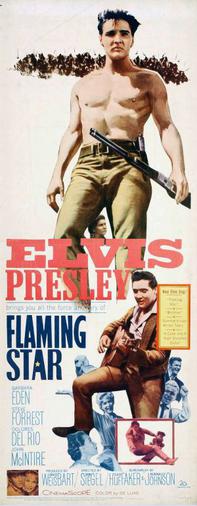
Flaming Star
Elvis Presley was a singer, a performer, an entertainer. And yes, he was a movie star, starring in 31 movies over 13 years. Most were movies meant to capitalize on his singing (and scandalous dancing), the King singing plenty of his songs to keep audiences dancing in their seats. I like Elvis' music a lot, but musicals are not really my thing so I've actually never seen any of those movies. What have I seen? Presley's ventures into the western genre, 1969's Charro! and today's review, 1960's Flaming Star.
In the late 1870's in west Texas, aging, small-time rancher Sam Burton (John McIntire) has worked hard to create a life for himself with his family. On their small but solid ranch, they run cattle and horses, working every day to keep things up. Sam's family includes his wife (his second wife), a full-blooded Kiowa woman, Neddy (Dolores Del Rio), and two sons, Pacer (Presley), and Clint (Steve Forrest), with his first wife. Pacer is a half-breed but has lived his whole life with the whites, not the Kiowas. It's never been much of an issue as the Burton's friends think of them as just that; friends and even family. But when a new, young chief riles up his Kiowa warriors, no one in the territory is safe...except the Burtons who seem to go untouched while everyone around them is attacked. The townspeople and local families begin to suspect something. Now who's the bigger enemies? The supposedly friendly white families and settlers or the rampaging Kiowas?
I caught parts of this 1960 western years (YEARS) ago on AMC at some point but never sat down and watched the entire thing. Well, this channel called Encore Westerns shows westerns...all...day...long, and I was able to track it down. Westerns I haven't seen are getting harder and harder to find! Why this one doesn't have more of a reputation for the positive, I just don't know. It's not a classic, but with an excellent performance from young Mr. Presley and a hard-hitting story, 'Star' deserves much more standing within the western genre.
A big ingredient for success? Director Don Siegel behind the camera. One of the all-time great tough guy directors, Siegel is known for his pairings with Clint Eastwood in the 1960's and 1970's, but he had actually been directing feature films since the late 1940's. He was a no-nonsense kind of director, and 'Star' fits the mold. Even by 1960, westerns often painted the white Americans as the good guys and the Indians (whatever tribe, pick one) as the blood-thirsty savages obsessed with killing. That trend would begin to change in the coming years, but this is one of the first westerns I can think that tries to not only humanize Native Americans but shows that white settlers were far from perfect. It is a rare socially conscious western that simply paints things as they were. Prejudices and biases are ugly in any form, whether it's 2015 or 1878. This is a western story ahead of its time, and it's the better for it.
By the time this film was released, Presley was a S-T-A-R. He'd already made five movies, but this was the first to allow him to show off his dramatic acting chops. Much like he would years later in Charro, Presley gives an above average turn as the stoic, quiet, loyal and very capable anti-hero (of sorts). If there's any red flags, it's that Presley is playing a half-white, half-Indian character, but the part, script or Presley never makes it cliched, forced or overdone. Other than some really tan skin (really tan), the casting of a white actor as a Native American character isn't an issue, never presenting itself. Presley is known for being a singer, a dancer, an entertainer, but when given the chance, he showed that he was a more than respectable dramatic presence too. This is a good one.
The dynamic among the Burton family as a whole is key and the main (and best) focus of the story. For these four people, their "situation" isn't a situation at all. They are family. White blood or Indian blood doesn't matter in the least. McIntire and Del Rio are excellent as a couple that's been married for half a lifetime by now. The same goes for Presley and Forrest, half-brothers who never question the 'half' part. They complain and insult each other but are always there for the other because that's what brothers do. Hatred and violence can be quite the divider though, testing even the strongest of brotherly relationships. Four very strong performances from Presley, McIntire, Del Rio and Forrest as the heart of the movie.
Filling out the rest of the cast, look for a pre-I Dream of Jeannie Barbara Eden, Rodolfo Acosta, Richard Jaeckel, Karl Swenson, L.Q. Jones, Ford Rainey, and Perry Lopez.
There are some slightly overdone dramatic moments in the second half as everything comes front and center. AH, DRAMA! The ending too feels a little rushed, almost like a key scene was shot but eventually cut for timing or something. Overall though, this is an easy movie to recommend for any number of reasons from Elvis fans to western fans. And yes, Presley sings one song early almost to appease his fans before the story takes a turn for the dark. A hard-hitting story western that's definitely worth checking out.
Flaming Star (1960): ***/****
Friday, April 18, 2014
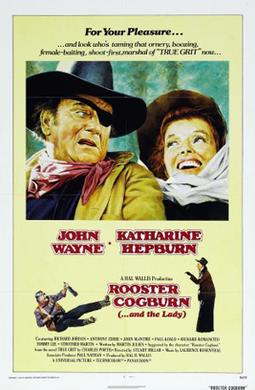
Rooster Cogburn
By the 1970s, there weren't too many bigger and better Hollywood legends than John Wayne and Katharine Hepburn. Both stars had been just that, stars, non-stop since the 1930s and by the mid 1970s were in the later parts of their careers. But even with all those classics films, classic roles and interesting pairings of stars, the duo had never worked together...until 1975's Rooster Cogburn, also known as Rooster Cogburn...and the Lady.
Still working as a U.S. Marshal, Rooster Cogburn (Wayne) is up to his old tricks again. Not too interested in how the law says he should bring suspects in, Cogburn has been suspended for his overzealous ways...for now. He's given his badge and title back if he promises to bring in a dangerous gang of killers led by a maniacal outlaw, Hawk (Richard Jordan). The outlaw's gang murdered an army convoy carrying nitroglycerin, shipments of rifles and a Gatling gun. Their goal? Knock off a federal depository up in the mountains. Cogburn is on their trail quickly, but he's got a problem. In Hawk's wake, the marshal finds an older woman, a missionary of sorts, Eula Goodnight (Hepburn), who saw her father and his mission almost wiped out by the gang. Cogburn hopes to bring her back to safety, but Eula has other plans. She intends to go with, helping bring her father's killers to justice.
I'm usually completely against sequels, especially when the first movie wraps up everything so nicely. That's the case with 1969's True Grit, a western that brought Wayne his only Oscar win for a long, distinguished career. It isn't a great western, but it has stood the test of time because of Wayne's scene-stealing part as Marshal Rooster Cogburn. This 1975 follow-up from director Stuart Millar takes the formula and takes it a step forward, pairing Wayne with Hepburn in a similarly scene-stealing part. Much the same way 'Grit' resonates, so does 'Rooster.' It's typical of many other late Wayne entries, straightforward and entertaining, likable, fun good guys versus dastardly bad guys, and just a lot of fun throughout. Laurence Rosenthal's score is solid, tweaking Elmer Bernstein's score from the original. Listen HERE for the theme. The Oregon locations go a long way too, the backgrounds for the shots providing a stunningly good-looking backdrop to the story.
Who are we kidding though? This is a movie that exists solely to put John Wayne and Katharine Hepburn together. The wait was worth it, the two Hollywood legends stepping to the plate in a big way. They make it look effortless. We learn some more about Rooster (including his first name), but he's still the same fat, one-eyed marshal who likes a good drink and is a tough as nails peace officer. Hepburn is not quite a spinster, but an older woman who looks to religion for answers, nagging Rooster about his drinking, his language, his boasting, a little bit of everything. The chemistry is on display from their first scene until the final scene. They argue, they bond, they talk about their pasts, finding there's plenty of differences between them, but there's also more similarities than they would have originally thought. Along for the trip is Wolf (Richard Romancito), an Indian boy in his teenage years, a capable rider who looks up to Rooster.
If you're going to have a great hero to lead the way, you need an equally bad villain to put in his way. In steps Richard Jordan, an underrated actor who never became a huge star. His Hawk is beyond intense, his upcoming robbery of a gold depository becoming almost an obsession. In some nice touches with Hawk and his gang, we learn about some past meetings with Cogburn. In his gang, look for Anthony Zerbe as Breed, a tracker/scout who used to ride with Rooster, now on the outlaw trail, and Hawk's maligned right-hand man, Luke, played by 1970s tough guy Paul Koslo. John McIntire makes a quick but memorable appearance as Judge Parker, the court representative who always has to deal with Rooster. Strother Martin hams it up in a one-scene appearance as McCoy, a cantankerous veteran of the sea now renting his raft for river crossings.
Heading into this movie, if you're looking for any sort of groundbreaking western, you're going to be disappointed. The focus is clearly on Wayne and Hepburn, the highpoints their scenes sitting around a campfire, talking while riding on a wagon, moving along the trail. The potential was there for a darker western with more shoot 'em up and gunplay, but for the most part Jordan as Hawk is underused. This is a good, old-fashioned western that plays like comfort food. Just sit back and enjoy this one.
Rooster Cogburn (1975): ***/****
Wednesday, January 23, 2013
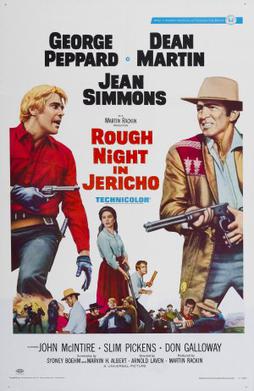
Rough Night in Jericho
Dean Martin is one of my favorite movie stars and/or entertainers. As far as his movies go, I typically think of the Rat Packer as a heroic good guy, ranging from drama in movies like Some Came Running or The Sons of Katie Elder to goofy comedies like the Matt Helm spoofs. But in a few departures from that heroic good guy, Martin switched it up, playing some bad guys, like 1967's Rough Night in Jericho.
Working with his longtime friend and former peace officer, Ben Hickman (John McIntire), former deputy and gunslinger Dolan (George Peppard) ride into the town of Jericho looking to set up a business. They've been hired by a widow, Molly (Jean Simmons), to help revive a stagecoach company that's recently gone under. What they find is something far different from what they expected. The town is run by sheriff turned town boss Alex Flood (Martin) who has his hand in every business and establishment in and around Jericho. Not surprisingly, Flood wants the new stagecoach company gone, even wounding Hickman as they arrive. Molly begs Dolan to help get rid of Flood, but ever the gambler, he doesn't like his odds. But in trying to push them out of Jericho, Flood pushes too far, and Dolan is going to push right back.
This is just another in a long list of reasons why I like westerns. Released in 1967 when westerns were very much trying to change with the times (cough more violence cough), I had never even remotely heard of 'Jericho.' From director Arnold Laven, it stars two of my favorite stars in Martin and Peppard, but it had never even crossed my radar. Always keep looking for those hidden gems because you never know when you will find one. It's somewhat limited by a smallish budget -- lots of indoor sets standing in for "outdoor" scenes -- and the score from Don Costa isn't anything out of this world. But in the end, things fall into place for an enjoyable, sometimes surprisingly violent western.
Your enjoyment will no doubt come from how big a fan you are of 1. westerns and 2. Dean Martin and George Peppard. I'm guilty on both counts so read on with a grain of salt. For starters, it's always fun to see an actor play against type like Martin is doing here. His Alex Flood is a charming, capable, intimidating bad guy; a former sheriff who cleaned up the town and basically took over in the process. Peppard does what he does best; cocky disinterest, looking like he's bored at times but being eternally cool in the process. Their scenes together are the high point of this western. Two tough guys talking over a bottle of whiskey, over a card game, both trying to intimidate the other one into leaving town. I loved the dynamic, both men knowing what the other is capable, but neither willing to blink or give up.
Playing the love interest of the not so painful love triangle, Jean Simmons wouldn't seem to be an obvious choice for a western. Go figure, but she's a worthy opponent and target for Martin and Peppard. Slight and soft with her voice, she's nonetheless one tough lady, even when Martin's Flood starts whaling on her. McIntire is in bed (wounded) much of the movie, but once he heals up, his crotchety veteran of the west fits right in with the toughness of the story. Filling out the ranks as Flood's evil henchmen who will no doubt meet nasty fates are Slim Pickens, Steve Sandor and and Brad Weston. Don Galloway has a good supporting part as Jase, the former sheriff of Jericho run out of town because he stands up to Flood over a hanging.
Two years before the groundbreaking The Wild Bunch was released, here comes 'Jericho.' Obviously not on par with that classic, this movie is nonetheless surprisingly violent. It's not as graphic, but it's certainly getting there. It is effective though because it is a surprise. At one point, we see a man get blasted in the face by a shotgun, blood flowing down his hands and arms. Realistic? No, but the point is made. Plenty of blood squibs (cheesy maybe, better than people clutching at wounds? Yes) as countless good and bad guys bite the dust. A highlight in the nastiness department comes in a fight between Slim Pickens and Peppard, Pickens' evil Yarbrough favoring a horse whip. Brutal, knockdown fight that feels real, not forced at all. Lots of positives, only a few minor negatives. Generally forgotten, well worth tracking down.
Rough Night in Jericho (1967): ***/****
Labels:
1960s,
Dean Martin,
George Peppard,
Jean Simmons,
John McIntire,
Slim Pickens,
westerns
Friday, July 23, 2010
Who Was That Lady?
In the age of the 24 hours new cycle, TMZ and tabloids everywhere, a lot is made when movie star couples work together in a movie. Think of the debacle of Jennifer Lopez and Ben Affleck in Gigli as a worst possible scenario. As long as there's been movies there have been movie couples, it's just that they are in the news more than ever before. Supply and demand I guess. One such couple, Tony Curtis and Janet Leigh, worked together twice in two very different movies.
The first I can find is 1958's The Vikings, a historical epic where a Viking tribe attacks England with Kirk Douglas and Ernest Borgnine starring along with Curtis and Leigh. Fast forward two years and we've got 1960's Who Was That Lady?, a screwball comedy if there ever was one. With a plotline that most sitcoms would be jealous of, this is a comedy that in all honesty is a truly bad movie. But thanks to the three stars, the quick pace and the surprisingly funny moments the story produces, it's a truly bad movie that's at least worth checking out.
One day visiting her husband, Dave (Curtis), at work, Ann (Leigh) walks in on a foreign exchange student kissing her husband in his laboratory. She storms out, demanding he move out of the apartment and getting ready to sign divorce papers. Claiming the student kissed him -- not the other way around -- Dave tries to come up with a plan, any plan, that will convince his wife he's telling the truth. He turns to his best friend Mike (Dean Martin), a TV mystery writer, to come up with something. Their solution? Tell Ann that Dave is an FBI agent, and that it was all part of a mission. Somehow, some way, she buys it, and it looks like Dave is sitting pretty. That is, until an FBI agent (James Whitmore) and his supervisor (John McIntire) get involved with reports of a rogue agent floating around.
More than the average comedy, the beauty of the screwball comedy is that nothing, not one thing, has to be based in reality at all. That is the only reason they're even somewhat enjoyable to watch. A wife actually buying that explanation that her husband is a FBI agent? Sure, it's a movie. Actual FBI agents going along with the ploy once they figure out what's going on? You bet. It's the type of story (a thin one at that) that keeps getting worse and worse as a simple lie turns into something much, much worse. Think of a 30-minute episode of I Love Lucy with a crazy story, add about 75 minutes, a bigger budget, a ridiculous story, and a good cast and you've got this movie.
Now as stupid as the proceedings really are, I laughed. I enjoyed the movie. Go figure. The cast is what sells it for me mostly because of the quick, witty dialogue, the fast pacing, and the chemistry among the group. Curtis and Martin together are a comedic dream, at times over the top and other times improvising golden lines left and right. At a certain point, you feel bad for Leigh's character because really, could anyone be that gullible? But she sells it so well as she gets wrapped up in it all that Ann is as funny as anyone. Whitmore and McIntire steal every scene they are in as an agent and his supervisor trying to figure out what's going on while also preventing the breakup of a young married couple. Also look for Simon Oakland and Larry Storch as two Russian agents, bumbling agents of course.
Because the cast plays so well off each other, the lines that would otherwise fall flat end up producing some honestly funny laughs. From Curtis to McIntire and everyone in between, the cast commits to these ridiculous, darn right stupid parts. And as dumb as it is? I laughed more than I would have expected. On the stupidity charts, it just gets dumber and dumber as the story escalates. My favorite bit was the finale as Curtis and Martin, believing they're in a Russian sub, try to sink the sub not realizing they're in the basement of the Empire State Building. Singing God Bless America as they await their "deaths" while delivering a crippling blow to Russia, it's all too much and in a good way. There's an extended bit in a Chinese restaurant that keeps going and going, building to one climax after another. That's the movie. It keeps building and building until the end.
That's the whole movie in a nutshell. Absolutely nuts, over the top, not an ounce of reality, and a movie that's the better for it. Curtis and Leigh, Martin and Curtis, Whitmore and anyone, they work together like a finely tuned machine to make a really stupid storyline entertaining to watch and interesting from start to finish. Couldn't find a trailer, but TCM does have a clip available through their website.
Who Was That Lady?<-----TCM clip (1960): ***/****
Labels:
1960s,
Comedy,
Dean Martin,
James Whitmore,
Janet Leigh,
John McIntire,
Simon Oakland,
Tony Curtis
Sunday, June 27, 2010
The Asphalt Jungle
Whether he was behind the camera directing or in front of the camera acting, there were few directors or actors as tough/cool/badass as John Huston. As an actor, he always played characters with an edge and with his gravelly voice and not so classic looks, he always sold the part. As a director, he excelled with movies that were as tough as the stories they told. They were 'guy's guys movies' that rarely disappointed and one of his best was 1950's The Asphalt Jungle.
This 1950 heist movie is worth talking about for two reasons. One, released at the height of film noir popularity, 'Jungle' finds a way to put its own spin on the story and it ends up being a classic in the genre. Two, you can judge it by the impact it had on later underworld heist movies. Watch a heist movie released since 1950, and it's almost impossible not to make some connection or influence Huston's flick had. At just under two hours, there is not a wasted minute in the build-up, heist, and fall out of a jewelry robbery.
Just out of jail after seven years inside, Doc Reidenschneider (Sam Jaffe) wastes no time setting up a job that could net him and his partners almost a million dollars. With some help and financial backing from a crooked lawyer, Alonzo Emmerich (Louis Calhern), Doc reveals his plan to knock off a diamond exchange. He'll need some help though and recruits three men, Dix Handley (Sterling Hayden), the muscle, Gus Minnisi (James Whitmore), the getaway driver, and Louis Ciavelli (Anthony Caruso), the safe-cracker to help him pull off the job. The Doc has everything figured out down to the second, but all the planning in the world can't account for the unexpected. And then there's Emmerich, who may have ulterior motives for the heist.
The 'jungle' of the title is the underworld, the crime figures who threaten to take over cities and ruin the lives of good people all across the country, or at least that's how Police Commissioner Hardy (John McIntire) explains it. Like most noir movies, Huston shoots in black and white in this unnamed midwest city. The characters live and die in smokey rooms and dark, shadowy alleys as they go about their heist. Like few other movies, Huston creates a real feeling of the underworld, the seedier parts of town that you don't want to be caught in after a certain hour. With composer Miklos Rozsa's score, you've got the right start to a winner.
Working with an ensemble cast, Huston gets the best out of this talented crew. Often stiff and a little wooden in starring roles, Hayden delivers a career-best performance as Dix Handley (other than the pornstar-sounding name). Handley is a two-bit thug -- dubbed a 'hooligan' -- who dreams (watch HERE) of raising enough money to buy his childhood farm and leaving this dirty city life. I don't think he was ever better than he was here. Jaffe too is beyond perfect casting as the small in stature but brilliant planner of crimes and heists, earning an Oscar nomination for his part. His Doc is incredibly intelligent and a gentleman to boot, seemingly involved in crime because he's good at it. These two characters end up forming an unlikely friendship based on truth and hard knocks, a surprising friendship to come out of a heist movie.
The rest of the cast isn't anything to sneeze at as well. Calhern as Emmerich is the prototypical slimy villain. From the moment the heist is brought up, you know he's looking to double-cross Doc and his crew (with some help from equally slimy Brad Dexter). Where Handley might beat you with his fists, Emmerich would do the same with words and intellect, never ruffling a hair on his head or putting a crease in his suit. Jean Hagen is solid as Doll, a wandering young woman attracted to Handley in who she sees something good where no one else does. Whitmore too is great in his quick appearance as Gus, the hunchback getaway driver who will be loyal to the end. Also look for an actress you might have heard of, Marilyn Monroe in just her 3rd credited role, as Emmerich's mistress. You look at her and understand what Emmerich was thinking.
The beauty of 'Jungle' is in the execution because it never slows down. The actual heist -- an exciting if not groundbreaking sequence -- is over less than an hour into the movie. The fallout from the heist is where the movie revels because even Doc can't plan for everything, in this case unforeseen accidents popping up when least expected. It's an idea and a premise used in so many types of movies, but it is has never been used so well as it is in the heist movie. Without giving too much a way, it's safe to say 'Jungle' doesn't exactly have a happy ending -- it is 1950 -- but overall it works better because there wasn't a happy ending.
Because so many heist movies have been made since, The Asphalt Jungle may play like a movie that you've seen many times before...been there, done that. But watch it thinking that when it was released in 1950, there hadn't been a movie quite like this before. Director Huston puts together a doozy of a cast with Hayden delivering a career-best part leading the way, and there isn't an aspect of the movie that fails. A winner in every sense of the word.
The Asphalt Jungle <----trailer (1950): ****/****
Wednesday, June 16, 2010
Westward the Women
I'll be the first to admit it, I don't really like female characters in westerns. Talk about a blanket statement to start a review, ouch. There are exceptions of course, but too often they seem added on to appease a part of the audience or give the hero someone to talk to and fall in love with when he's not shooting it out with banditos or Indians. Maybe I should qualify my statement. It's not that I don't like female characters in westerns, I don't like poorly written, damsel in distress characters who are basically helpless/useless and they're to be saved.
Not the case with 1951's Westward the Women, a movie that plays on that idea. The story is one that's been used by several movies since including Savage Pampas and Blindman with the basic background being that there weren't many women in the west -- single, eligible women at least -- as Americans moved west to start new lives. 'Westward' differs from most westerns though because of its honesty in dealing with women in the west. The American west was an incredibly unpleasant place, and the weak just didn't survive. The women that went looking for husbands, new lives, a second chance were tough because they had to be.
Working to make a California valley a suitable place to live, owner Roy Whitman (John McIntire) wants the men working the valley to be able to start families, but the complete lack of women prevent that from happening. With a trail driver, Buck Wyatt (Robert Taylor), Whitman heads to Chicago where he recruits 138 women to travel west for husbands and a new life. The women are from all cultures and walks of life, but the belief in Manifest Destiny is strong, and they decide to brave the incredibly dangerous trail to get to California. Wyatt warns them of what is to come; Indians, horrific weather, low supplies of food and water, and even trailhands who might do anything to get with one of them.
What works best about this western from director William Wellman is its honesty in dealing with the subject matter. Wyatt states that if they're lucky 1/3 of the women will actually make it all the way to California while the other 2/3 will turn around and go back or even die along the way. And that's basically what happens. Wyatt's trailhands end up leaving the wagon train because Wyatt kills one who raped one of the women. Wyatt shoots him point blank three times in the chest without much warning. And his estimation is pretty dead-on, many of the women don't make it. So for honesty alone, this western gets points.
Taylor plays against his pretty-boy image as Buck Wyatt, a renowned trail driver who is going to do anything and everything to get this wagon train from Independence, Missouri to California. This is a tough character who has to revel in being hated because that hatred from the women motivates them. McIntire is all right in a smaller wasted part. The treat here is the portrayal of the women. We do meet a handful including Fifi Danon (Denise Darcel), a saloon girl with an eye on Buck, Patience Hawley (Hope Emerson), a rather large woman and widow who ends up becoming a second trail driver and mother to all the other women, and Rose Meyer (Beverly Dennis), a pregnant teenager shunned from her hometown looking for a second chance, among several others who get their chance to shine in a few scenes.
Out of necessity, these 138 women are forced to learn how to survive. Only a handful know how to handle a wagon or shoot a gun so the others must improvise and learn how to on the fly. They have to do this on the trail though so it's a bit of trial and error as they figure out what works and what doesn't work. Throw in that Wyatt's cowboys basically try to rape them whenever they get a chance, and we've got a not so pleasant trip. The cowboys eventually bail, forcing Wyatt, Whitman, one cowboy (Pat Conway) and Ito, the Japanese cook (Henry Nakamura) to protect the train, but when needed the women step up and shed their 'damsel in distress, please protect me' actions. Refreshing to see in a western, women being treated as equals.
Of course, even with a movie trying to show the best of these women, there are still some odd moments. Wellman often shows them bathing in creeks/rivers/waterholes with their dresses pulled up to their waists. It seems like he's saying 'Okay, men, sorry you had to see this movie, but check out the scenery!' There's also a fight late in the movie between two women -- that's right, a catfight! -- that doesn't fit the tone of the movie and seems tacked on. The trials and tribulations do become a little repetitive in the second hour because really, what else can we throw at these women?
The build-up to the ending is handled well because in a nice twist, the women may be more excited to see their husbands to be than the other way around. After four months on the trail, they insist Buck go into town and get them some nice things to wear so the men don't see them in their harried states (most still look pretty good to me all things considered). It's an ending that surprised me in its sweetness, and in a way that doesn't come across as sappy or over-sentimentalized. A western that has its flaws, but all things considered, it is different and for the better.
Westward the Women <----TCM trailer (1952): ***/****
Labels:
1950s,
John McIntire,
Robert Taylor,
westerns,
William Wellman
Subscribe to:
Posts (Atom)