I've been in Spartacus mode for about six months now. This spring I watched the entire run of Starz's Spartacus, I caught up with Howard Fast's novel Spartacus, found a couple non-fiction books about the famous slave turned gladiator at the library and then bought the TV miniseries that aired about 10 years ago. So what is there left? Naturally I tried to save the best for last, catching up recently with one of Hollywood's great historical epics, 1960's Spartacus.
It's the 70s B.C. in Rome when a Thracian slave named Spartacus (Kirk Douglas) is bought from a Libyan mine and sold to a gladiator school in Capua, Italy, several days ride from the city of Rome. The popularity of gladiators is growing ever stronger, Spartacus thrust into training to become hopefully one of the best. He shows promise but also resents the life, the hatred beginning to grow at Rome's brutal, cruel insistence on slaves and slavery itself. Months into his training, Spartacus incites a brutal takeover, his fellow gladiators joining him in a bloody attack that gives them power and allows them to escape. At first content to be a roving band of marauding bandits, Spartacus organizes his fellow escaped gladiators into an army. They can be more than bandits. They can be an army. An army that with growth and training could challenge Rome itself. His name grows, his army increases with each passing day. In Rome, a powerful Senator and businessman, Marcus Crassus (Laurence Olivier), watches the effect the gladiator slave general has and braces for a reply...if it's not too late.
Wowza, what a good movie, the definition of a historical epic that dominated Hollywood through the 1950s and into the early 1960s. A somewhat checkered production had some issues, a 30-year old Stanley Kubrick replacing Anthony Mann just a week or so into filming. Oddly enough, it is a movie that Kubrick doesn't consider one of his own, not including it in the canon of his films. It is an epic, a smart, well-written, beautifully shot movie with an impressive cast. Composer Alex North turns in a perfect score, large in scale but also very emotional in the quieter moments. I was always a fan of the score, but it really resonated with me on the most recent viewing. There isn't a weakness here, author Howard Fast's novel come to life in truly epic form.
One of the biggest stars working in Hollywood at the time, Kirk Douglas was firmly behind this movie, helping ramrod it right into production and is listed as executive producer. I've always thought this is one of his strongest, if underappreciated, performances. As slave turned gladiator turned general, Douglas is Spartacus. He has several effective so-called "bigger scenes" but the more effective moments are the quiet ones. When he touches the hand of the woman he loves, the rage in his eyes as he's addressed by his superiors, the pride when his army stands up for him, this is an actor doing his absolute best. He brings a real-life character to life, and it's easy to see why so many followed him against Rome. Douglas is charismatic and welcoming from beginning to end. He's furious and full of hate at the Roman system that enlists hundreds of thousands of slaves. Ultimately, he's pushed too far, and his response is something that shakes the world. Just a great performance from a Hollywood legend.
What this flick is able to do so well is to blend so many different moving pieces together. It is an epic with a true ensemble cast, all of the assembled talent given a chance to shine. In one of the best love stories I can think of, Douglas has a great chemistry with Jean Simmons, playing Varinia, a slave from Brittania who becomes Spartacus' wife, friend and confidant. They just work. They're perfect together. There's one of the great actors of all-time, Laurence Olivier, relishing the part of Crassus, a criminally smooth, brilliant manipulator who yearns for power in all forms. There's Tony Curtis in one of his best roles, here as Antoninus, an educated slave who escapes from Olivier's Crassus and joins Spartacus' army. Opposites in most ways, the uneducated leader and the younger, educated fighter become very close, a father-son, brotherly relationship. There's Charles Laughton as Gracchus, the Roman senator with a long, distinguished career behind him, now opposing Crassus, and John Gavin as Caesar, the young and upcoming senator, both giving Rome's perspective as Spartacus' revolt grows and grows. Oh, and there's a scene-stealing Peter Ustinov as Batiatus, the owner of the gladiatoral school that Spartacus escapes from, an Oscar-winning part for Ustinov.
Oh, but there's more. Herbert Lom plays Tigranes, an oily pirate negotiating with Spartacus to get his army out of Italy. As for the gladiators turned army command, look for an underused John Ireland as Crixus with Harold J. Stone and Nick Dennis also standing out from the crowd with smaller supporting parts. One of three performances in 1960 that helped make him more than a physical presence, Woody Strode plays Draba, an experienced gladiator worn down by the constant killing in the arena. A small part but a key one to propel the story forward. And last but not least, gravelly-voiced Charles McGraw as Marcellus, the brutal gladiator instructor, a man tasked with turning slaves into killing machines intended for the gladiator ring. Strength from top to bottom, not a weak link in one of the great casts ever put together.
This is a thinking man's epic, not a true sword and sandal epic. The script from blacklisted author/writer Dalton Trumbo is a gem, giving a window into the politics of the time. The story moves amongst the ensemble from the gladiator school in Capua, to the streets and halls of the Roman Senate, to Spartacus' base at Mount Vesuvius to his camps moving across Italy. Trumbo's script is an idea-script, one about freedom and corruption, living life to its fullest even if the means seem impossible. We see the inner-workings of the Roman senate, of Spartacus' inner circle. You get a feeling of what the times were like in ancient Rome. Just a beautifully written script, Douglas saying "Screw it" to the blacklist that prevented Trumbo from writing for years.
'Spartacus' has moments both big and small here, both working seamlessly. The arena fight between Spartacus and Draba is a gem. Not drawn out but incredibly intense, including a great twist near its conclusion. The revolt in the school is quick and hard-hitting, the tension finally boiling to an unbearable point. As the rebellion grows -- the real-life history was called the Third Servile War -- Spartacus realizes the fight can be as big as his army wants it to be. The entire movie is a treat to watch, but I've always found the second half the film's strongest, especially when the tide turns against the slave army. Maybe the most iconic scene, "I'm Spartacus!," has become a punchline in pop culture, but in context, it is one of the most beautifully constructed, emotionally perfect scenes ever, the camera lingering on Douglas as an ideal conclusion. Watch it HERE with obvious spoilers. The same for a late scene between Spartacus and Antoninus discussing the impact of what they've done, Spartacus willing to Crassus "He'll come back and he'll be millions." Too many great moments to mention.
This isn't an action-heavy movie so beware going in if you're expecting 3 hours of battle scenes. Supposedly more battle scenes were filmed but never used, all in hopes of making the one major battle late in the film far more effective. It is, but this is not a movie interested in the scope and scale of battle. This is a story about the people. We see scenes with literally thousands of extras, but the camera zooms in on the faces, people we see popping up throughout the second half of the movie. Old and young, mothers and fathers, teenagers, kids, thin and fat. The moment where Spartacus walks through his camp on the eve of battle is perfect, the former slave truly realizing the scope of what his army has accomplished. The post-battle scene is that much more gut-wrenching as is the finale itself.
Just a classic. Enjoy it.
Spartacus (1960): ****/****
The Sons of Katie Elder
"First, we reunite, then find Ma and Pa's killer...then read some reviews."
Showing posts with label Jean Simmons. Show all posts
Wednesday, July 30, 2014
Wednesday, January 23, 2013
Rough Night in Jericho
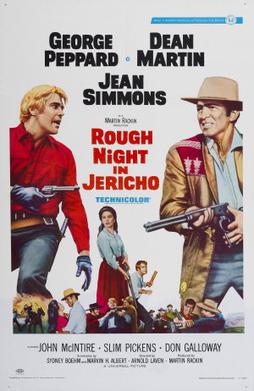
Dean Martin is one of my favorite movie stars and/or entertainers. As far as his movies go, I typically think of the Rat Packer as a heroic good guy, ranging from drama in movies like Some Came Running or The Sons of Katie Elder to goofy comedies like the Matt Helm spoofs. But in a few departures from that heroic good guy, Martin switched it up, playing some bad guys, like 1967's Rough Night in Jericho.
Working with his longtime friend and former peace officer, Ben Hickman (John McIntire), former deputy and gunslinger Dolan (George Peppard) ride into the town of Jericho looking to set up a business. They've been hired by a widow, Molly (Jean Simmons), to help revive a stagecoach company that's recently gone under. What they find is something far different from what they expected. The town is run by sheriff turned town boss Alex Flood (Martin) who has his hand in every business and establishment in and around Jericho. Not surprisingly, Flood wants the new stagecoach company gone, even wounding Hickman as they arrive. Molly begs Dolan to help get rid of Flood, but ever the gambler, he doesn't like his odds. But in trying to push them out of Jericho, Flood pushes too far, and Dolan is going to push right back.
This is just another in a long list of reasons why I like westerns. Released in 1967 when westerns were very much trying to change with the times (cough more violence cough), I had never even remotely heard of 'Jericho.' From director Arnold Laven, it stars two of my favorite stars in Martin and Peppard, but it had never even crossed my radar. Always keep looking for those hidden gems because you never know when you will find one. It's somewhat limited by a smallish budget -- lots of indoor sets standing in for "outdoor" scenes -- and the score from Don Costa isn't anything out of this world. But in the end, things fall into place for an enjoyable, sometimes surprisingly violent western.
Your enjoyment will no doubt come from how big a fan you are of 1. westerns and 2. Dean Martin and George Peppard. I'm guilty on both counts so read on with a grain of salt. For starters, it's always fun to see an actor play against type like Martin is doing here. His Alex Flood is a charming, capable, intimidating bad guy; a former sheriff who cleaned up the town and basically took over in the process. Peppard does what he does best; cocky disinterest, looking like he's bored at times but being eternally cool in the process. Their scenes together are the high point of this western. Two tough guys talking over a bottle of whiskey, over a card game, both trying to intimidate the other one into leaving town. I loved the dynamic, both men knowing what the other is capable, but neither willing to blink or give up.
Playing the love interest of the not so painful love triangle, Jean Simmons wouldn't seem to be an obvious choice for a western. Go figure, but she's a worthy opponent and target for Martin and Peppard. Slight and soft with her voice, she's nonetheless one tough lady, even when Martin's Flood starts whaling on her. McIntire is in bed (wounded) much of the movie, but once he heals up, his crotchety veteran of the west fits right in with the toughness of the story. Filling out the ranks as Flood's evil henchmen who will no doubt meet nasty fates are Slim Pickens, Steve Sandor and and Brad Weston. Don Galloway has a good supporting part as Jase, the former sheriff of Jericho run out of town because he stands up to Flood over a hanging.
Two years before the groundbreaking The Wild Bunch was released, here comes 'Jericho.' Obviously not on par with that classic, this movie is nonetheless surprisingly violent. It's not as graphic, but it's certainly getting there. It is effective though because it is a surprise. At one point, we see a man get blasted in the face by a shotgun, blood flowing down his hands and arms. Realistic? No, but the point is made. Plenty of blood squibs (cheesy maybe, better than people clutching at wounds? Yes) as countless good and bad guys bite the dust. A highlight in the nastiness department comes in a fight between Slim Pickens and Peppard, Pickens' evil Yarbrough favoring a horse whip. Brutal, knockdown fight that feels real, not forced at all. Lots of positives, only a few minor negatives. Generally forgotten, well worth tracking down.
Rough Night in Jericho (1967): ***/****
Working with his longtime friend and former peace officer, Ben Hickman (John McIntire), former deputy and gunslinger Dolan (George Peppard) ride into the town of Jericho looking to set up a business. They've been hired by a widow, Molly (Jean Simmons), to help revive a stagecoach company that's recently gone under. What they find is something far different from what they expected. The town is run by sheriff turned town boss Alex Flood (Martin) who has his hand in every business and establishment in and around Jericho. Not surprisingly, Flood wants the new stagecoach company gone, even wounding Hickman as they arrive. Molly begs Dolan to help get rid of Flood, but ever the gambler, he doesn't like his odds. But in trying to push them out of Jericho, Flood pushes too far, and Dolan is going to push right back.
This is just another in a long list of reasons why I like westerns. Released in 1967 when westerns were very much trying to change with the times (cough more violence cough), I had never even remotely heard of 'Jericho.' From director Arnold Laven, it stars two of my favorite stars in Martin and Peppard, but it had never even crossed my radar. Always keep looking for those hidden gems because you never know when you will find one. It's somewhat limited by a smallish budget -- lots of indoor sets standing in for "outdoor" scenes -- and the score from Don Costa isn't anything out of this world. But in the end, things fall into place for an enjoyable, sometimes surprisingly violent western.
Your enjoyment will no doubt come from how big a fan you are of 1. westerns and 2. Dean Martin and George Peppard. I'm guilty on both counts so read on with a grain of salt. For starters, it's always fun to see an actor play against type like Martin is doing here. His Alex Flood is a charming, capable, intimidating bad guy; a former sheriff who cleaned up the town and basically took over in the process. Peppard does what he does best; cocky disinterest, looking like he's bored at times but being eternally cool in the process. Their scenes together are the high point of this western. Two tough guys talking over a bottle of whiskey, over a card game, both trying to intimidate the other one into leaving town. I loved the dynamic, both men knowing what the other is capable, but neither willing to blink or give up.
Playing the love interest of the not so painful love triangle, Jean Simmons wouldn't seem to be an obvious choice for a western. Go figure, but she's a worthy opponent and target for Martin and Peppard. Slight and soft with her voice, she's nonetheless one tough lady, even when Martin's Flood starts whaling on her. McIntire is in bed (wounded) much of the movie, but once he heals up, his crotchety veteran of the west fits right in with the toughness of the story. Filling out the ranks as Flood's evil henchmen who will no doubt meet nasty fates are Slim Pickens, Steve Sandor and and Brad Weston. Don Galloway has a good supporting part as Jase, the former sheriff of Jericho run out of town because he stands up to Flood over a hanging.
Two years before the groundbreaking The Wild Bunch was released, here comes 'Jericho.' Obviously not on par with that classic, this movie is nonetheless surprisingly violent. It's not as graphic, but it's certainly getting there. It is effective though because it is a surprise. At one point, we see a man get blasted in the face by a shotgun, blood flowing down his hands and arms. Realistic? No, but the point is made. Plenty of blood squibs (cheesy maybe, better than people clutching at wounds? Yes) as countless good and bad guys bite the dust. A highlight in the nastiness department comes in a fight between Slim Pickens and Peppard, Pickens' evil Yarbrough favoring a horse whip. Brutal, knockdown fight that feels real, not forced at all. Lots of positives, only a few minor negatives. Generally forgotten, well worth tracking down.
Rough Night in Jericho (1967): ***/****
Labels:
1960s,
Dean Martin,
George Peppard,
Jean Simmons,
John McIntire,
Slim Pickens,
westerns
Monday, April 9, 2012
Black Narcissus
For hundreds and thousands of years, missionaries have tried to spread their beliefs and principles to the unexposed, those who are unaware and might or might not be willing to change. Film has explored the life and goals of missionaries countless times -- some better and less pretentious than others, but I've watched one that defies description and any predecessor or anything since, 1947's Black Narcissus.
An order of sisters has received an invitation from an Indian general (Esmond Knight) to come to his region and work at a convent and work with the people. Sister Clodagh (Deborah Kerr), a young nun, has been chosen to lead the new convent and is sent to the isolated mission/convent in the Himalayas with four nuns traveling with her, all of them with special skills designed to make the transition easier. The five nuns arrive to find a world unlike anything they've experienced with Mr. Dean (David Farrar), the only white man around for miles, a sort of unofficial guide for them. Clodagh and the sisters settle in, but nothing seems to work for them. Their intentions are pure, but it seems they are doomed to failure from the start.
This is maybe the most beautifully shot movie in the history of movies. Let's get that out there early and let that sink in. Visually stunning, breathtakingly beautiful and frightening at the same time with the credit going to cinematographer and future director Jack Cardiff. Full of color -- from the whites and blues of the nuns' clothes to the vibrant colors of the Indian villagers -- almost every single shot could be freeze-framed and placed on your wall as a work of art. The mission built into the side of a cliff is almost other-worldly (even if the sets were in a studio with liberal and spot-on uses of matte paintings). The wind never stops blowing and the air is always clear at this mission that seems to float above the world. Call it over-analyzing, but it almost serves like a purgatory of sorts for these nuns where a decision must be made on which direction to take. More on the visuals to come.
What originally caught my eye when I read the description at TCM's website was actually a picture....this ONE. Besides the chill that went up my back when I saw it, I knew this wasn't going to be a typical "clean," white-washed missionary story of the 1940s. A character study of nuns and the Indian villagers, yes, but this movie is not that simply described. This movie has all the tension and scares of a Gothic horror movie. We're talking an incredibly uncomfortable movie to watch. With some major spoilers, check out the pictures at THIS review. I thought the movie was going one way, and then it goes another, turning on a dime. I started to question exactly where it was going, what it was building to and was genuinely surprised where it ended up. The last 20 minutes are a straight horror film from the choir singing (with composer Brian Easdale's score) to Cardiff's unsettling visuals.
The visuals, the uniquely dark storytelling, all of that has helped make Black Narcissus a classic over the 60-plus years. However the acting is just as worthy in bringing up even if it's somewhat overshadowed by the visuals and that sense of impending, building doom. Just 26 years old at the time, Deborah Kerr does an amazing job as Sister Clodagh, a young nun who's joined the order because of an incident from her past. Wearing her immaculate white uniform, her face wrapped up tightly, Kerr looks angelic in the part. She doesn't resent her posting, fully committing herself to making it work, but she immediately sees that basically everything in front of her is working against her. Farrar's Dean is an interesting counter, a somewhat mysterious Englishman who's drifted east to India. Why exactly? We never find out. A tortured soul just the same, he serves as a sounding board for Kerr's Clodagh.
Sister Clodagh's nuns include Sister Philippa (Flora Robson), the oldest of the nuns and one struggling with her reasoning for her faith, Sister Honey (Jenny Laird), the youngest and most naive of the group, Sister Briony (Judith Furse), the strongest physically and the healer, and Sister Ruth (Kathleen Byron), the most fragile one who starts to become unhinged mentally. As a group, they're uniformly solid, but it is Byron (with the creepiest, most unsettling eyes EVER) who steals the show. Star of The Jungle Book, Sabu plays the Young General, the son of the older General, a young man trying to learn as much as he can through the sisters. Eddie Whalely Jr. plays Joseph, the Indian boy working with the sisters as a translator, and May Hallatt as Ayah, the somewhat off live-in caretaker of the cliff-side mission. Also making an appearance without saying a word in a key part is the very white Jean Simmons (with heavy makeup) as Kanchi, the Indian girl with a reputation.
I very much enjoyed this movie, or at least as much as you're supposed to enjoy a creepy, moving and unsettling story of five nuns working a mission in the Himalayas. Maybe 'enjoy' isn't the right word. I think we're supposed to appreciate a movie like this more than anything. I don't know if I got the dark message 'Narcissus' worked toward or if I missed something, but it is a movie unlike any I've seen.
Black Narcissus <---TCM trailer/clips (1947): ****/****
An order of sisters has received an invitation from an Indian general (Esmond Knight) to come to his region and work at a convent and work with the people. Sister Clodagh (Deborah Kerr), a young nun, has been chosen to lead the new convent and is sent to the isolated mission/convent in the Himalayas with four nuns traveling with her, all of them with special skills designed to make the transition easier. The five nuns arrive to find a world unlike anything they've experienced with Mr. Dean (David Farrar), the only white man around for miles, a sort of unofficial guide for them. Clodagh and the sisters settle in, but nothing seems to work for them. Their intentions are pure, but it seems they are doomed to failure from the start.
This is maybe the most beautifully shot movie in the history of movies. Let's get that out there early and let that sink in. Visually stunning, breathtakingly beautiful and frightening at the same time with the credit going to cinematographer and future director Jack Cardiff. Full of color -- from the whites and blues of the nuns' clothes to the vibrant colors of the Indian villagers -- almost every single shot could be freeze-framed and placed on your wall as a work of art. The mission built into the side of a cliff is almost other-worldly (even if the sets were in a studio with liberal and spot-on uses of matte paintings). The wind never stops blowing and the air is always clear at this mission that seems to float above the world. Call it over-analyzing, but it almost serves like a purgatory of sorts for these nuns where a decision must be made on which direction to take. More on the visuals to come.
What originally caught my eye when I read the description at TCM's website was actually a picture....this ONE. Besides the chill that went up my back when I saw it, I knew this wasn't going to be a typical "clean," white-washed missionary story of the 1940s. A character study of nuns and the Indian villagers, yes, but this movie is not that simply described. This movie has all the tension and scares of a Gothic horror movie. We're talking an incredibly uncomfortable movie to watch. With some major spoilers, check out the pictures at THIS review. I thought the movie was going one way, and then it goes another, turning on a dime. I started to question exactly where it was going, what it was building to and was genuinely surprised where it ended up. The last 20 minutes are a straight horror film from the choir singing (with composer Brian Easdale's score) to Cardiff's unsettling visuals.
The visuals, the uniquely dark storytelling, all of that has helped make Black Narcissus a classic over the 60-plus years. However the acting is just as worthy in bringing up even if it's somewhat overshadowed by the visuals and that sense of impending, building doom. Just 26 years old at the time, Deborah Kerr does an amazing job as Sister Clodagh, a young nun who's joined the order because of an incident from her past. Wearing her immaculate white uniform, her face wrapped up tightly, Kerr looks angelic in the part. She doesn't resent her posting, fully committing herself to making it work, but she immediately sees that basically everything in front of her is working against her. Farrar's Dean is an interesting counter, a somewhat mysterious Englishman who's drifted east to India. Why exactly? We never find out. A tortured soul just the same, he serves as a sounding board for Kerr's Clodagh.
Sister Clodagh's nuns include Sister Philippa (Flora Robson), the oldest of the nuns and one struggling with her reasoning for her faith, Sister Honey (Jenny Laird), the youngest and most naive of the group, Sister Briony (Judith Furse), the strongest physically and the healer, and Sister Ruth (Kathleen Byron), the most fragile one who starts to become unhinged mentally. As a group, they're uniformly solid, but it is Byron (with the creepiest, most unsettling eyes EVER) who steals the show. Star of The Jungle Book, Sabu plays the Young General, the son of the older General, a young man trying to learn as much as he can through the sisters. Eddie Whalely Jr. plays Joseph, the Indian boy working with the sisters as a translator, and May Hallatt as Ayah, the somewhat off live-in caretaker of the cliff-side mission. Also making an appearance without saying a word in a key part is the very white Jean Simmons (with heavy makeup) as Kanchi, the Indian girl with a reputation.
I very much enjoyed this movie, or at least as much as you're supposed to enjoy a creepy, moving and unsettling story of five nuns working a mission in the Himalayas. Maybe 'enjoy' isn't the right word. I think we're supposed to appreciate a movie like this more than anything. I don't know if I got the dark message 'Narcissus' worked toward or if I missed something, but it is a movie unlike any I've seen.
Black Narcissus <---TCM trailer/clips (1947): ****/****
Labels:
1940s,
Deborah Kerr,
Flora Robson,
Jack Cardiff,
Jean Simmons
Friday, July 22, 2011
A Bullet is Waiting
The plot description at Turner Classic Movie's website sounded promising enough for 1954's A Bullet is Waiting, aired as part of star of the month Jean Simmons' movie marathon. It read 'A plane crash strands a policeman and his prisoner in the wilderness' so I went in anticipating a film noir set in the west somewhere with a tense battle of nerves as policeman goes mano-a-mano with his prisoner. I was sorely disappointed then when I actually watched it, finding that while the description was accurate, it wasn't completely accurate.
Transporting his prisoner wanted for murder, Ed Stone (Rory Calhoun), back to Los Angeles, Sheriff Munson (Stephen McNally) is instead dealt a new problem when the plane they're flying in crashes somewhere in the mountains and hills of Utah. The pilot is killed, but both sheriff and prisoner survive and are met soon after by a young woman, Cally (Simmons), armed with a rifle who lives on an isolated sheep farm deep in the hills. With Munson's ankle possibly broken, the trio hole up at the small farm, waiting for Cally's father, David (Brian Aherne), to return from a lengthy trip to town while the ankle heals. Seeing the beautiful young Cally, Ed goes to work, wooing her in hopes of somehow escaping. Munson though is not telling the whole story, and it is only a matter of time before his secret comes out in the wash.
My first thought was that this story sounded similar to an Anthony Mann western, The Naked Spur, released a year before in 1953. The basic premise is similar; prisoner being transported to jail/trial, starts to play mind games. Even the small cast seemed alike. Instead of getting that in the form of a film noir though, this movie delves quickly into some philosophical metaphor for something bigger. Cally's father is a former Oxford professor writing a book about philosophy which at one point she reads to the two men. The characters go in depth of their own personal philosophy, beliefs and principles, at one point Calhoun's Ed alluding to the story of the Garden of Eden.
Now bear with me because I can overthink a movie like nobody's business. The Garden of Eden, you say, hhmm? We've got Adam -- that'd be Calhoun -- and Eve (Simmons, that one's easy), the devil/snake (McNally's suspicious Sheriff), and God (the father), all out in this isolated world where no outside contact is easily or readily made. Director John Farrow uses long, slow shots of nature to set scenes up; the sun poking up over the horizon, sheep running around the farm, storm clouds unleashing torrents of rain, drops of water dripping off the roof of the house. It all seems to point -- to my mind at least -- to be some metaphor to the story of the Garden of Eden. Thrown in with far too much philosophizing and delivering of a message, and the seemingly simple story gets over complicated quickly.
None of this is aided by some casting that just doesn't work. Jean Simmons was Turner Classic Movies June star of the month with this movie aired as part of the festival. One of the most classically beautiful actresses to ever hit the silver screen, she was also one of the best actresses around in the 1940s, 1950s and 1960s. She will be eternally watchable with an easy-going way about her, and while it isn't her performance that cripples the movie, she is miscast. Simmons has the look of a delicate flower out in the wilderness that just doesn't belong. Hair cut short but styled nonetheless, make-up always immaculate, she looks out of place. It doesn't help that her character has the potential to be a strong-willed, intelligent woman, only to be a defenseless, crying little girl by the end worried about the man she's fallen in love with.
As for the three male members of the cast, I'm thinking a batting average of .333 overall. Calhoun works to a point, but McNally and Aherne are a swing and a miss. Playing a prisoner supposedly wanted for murder, Calhoun is his typical smooth rogue who will prove validated in the end. He doesn't have the greatest chemistry with Simmons though, towering over the diminutive actress in their scenes. McNally is just a bizarre character, especially as we find out more about his Sheriff Munson and his motivations. Aherne does not make an appearance until very late in the movie just in time to iron everything out and put all the pieces where they belong.
It is the little things that throw me off as is so often the case. Simmons hides the rifle, and McNally somehow can't find it even though it's not that well-hidden. Calhoun carries a knife in his belt at all times, but nothing comes of it, the Sheriff never even demanding he give it back. If anything, McNally's Munson just sits around moping much of the movie. The best is saved for last though in one of those really bizarre moments that I really don't want to spoil here. I sat the movie out thinking there might be some redeeming quality in the end, but I was wrong again. The movie ends on a laugh -- okay, an attempted laugh -- as the characters literally ride off into the sunset. Pass on this one.
A Bullet is Waiting <---TCM trailer (1954): * 1/2 /****
Transporting his prisoner wanted for murder, Ed Stone (Rory Calhoun), back to Los Angeles, Sheriff Munson (Stephen McNally) is instead dealt a new problem when the plane they're flying in crashes somewhere in the mountains and hills of Utah. The pilot is killed, but both sheriff and prisoner survive and are met soon after by a young woman, Cally (Simmons), armed with a rifle who lives on an isolated sheep farm deep in the hills. With Munson's ankle possibly broken, the trio hole up at the small farm, waiting for Cally's father, David (Brian Aherne), to return from a lengthy trip to town while the ankle heals. Seeing the beautiful young Cally, Ed goes to work, wooing her in hopes of somehow escaping. Munson though is not telling the whole story, and it is only a matter of time before his secret comes out in the wash.
My first thought was that this story sounded similar to an Anthony Mann western, The Naked Spur, released a year before in 1953. The basic premise is similar; prisoner being transported to jail/trial, starts to play mind games. Even the small cast seemed alike. Instead of getting that in the form of a film noir though, this movie delves quickly into some philosophical metaphor for something bigger. Cally's father is a former Oxford professor writing a book about philosophy which at one point she reads to the two men. The characters go in depth of their own personal philosophy, beliefs and principles, at one point Calhoun's Ed alluding to the story of the Garden of Eden.
Now bear with me because I can overthink a movie like nobody's business. The Garden of Eden, you say, hhmm? We've got Adam -- that'd be Calhoun -- and Eve (Simmons, that one's easy), the devil/snake (McNally's suspicious Sheriff), and God (the father), all out in this isolated world where no outside contact is easily or readily made. Director John Farrow uses long, slow shots of nature to set scenes up; the sun poking up over the horizon, sheep running around the farm, storm clouds unleashing torrents of rain, drops of water dripping off the roof of the house. It all seems to point -- to my mind at least -- to be some metaphor to the story of the Garden of Eden. Thrown in with far too much philosophizing and delivering of a message, and the seemingly simple story gets over complicated quickly.
None of this is aided by some casting that just doesn't work. Jean Simmons was Turner Classic Movies June star of the month with this movie aired as part of the festival. One of the most classically beautiful actresses to ever hit the silver screen, she was also one of the best actresses around in the 1940s, 1950s and 1960s. She will be eternally watchable with an easy-going way about her, and while it isn't her performance that cripples the movie, she is miscast. Simmons has the look of a delicate flower out in the wilderness that just doesn't belong. Hair cut short but styled nonetheless, make-up always immaculate, she looks out of place. It doesn't help that her character has the potential to be a strong-willed, intelligent woman, only to be a defenseless, crying little girl by the end worried about the man she's fallen in love with.
As for the three male members of the cast, I'm thinking a batting average of .333 overall. Calhoun works to a point, but McNally and Aherne are a swing and a miss. Playing a prisoner supposedly wanted for murder, Calhoun is his typical smooth rogue who will prove validated in the end. He doesn't have the greatest chemistry with Simmons though, towering over the diminutive actress in their scenes. McNally is just a bizarre character, especially as we find out more about his Sheriff Munson and his motivations. Aherne does not make an appearance until very late in the movie just in time to iron everything out and put all the pieces where they belong.
It is the little things that throw me off as is so often the case. Simmons hides the rifle, and McNally somehow can't find it even though it's not that well-hidden. Calhoun carries a knife in his belt at all times, but nothing comes of it, the Sheriff never even demanding he give it back. If anything, McNally's Munson just sits around moping much of the movie. The best is saved for last though in one of those really bizarre moments that I really don't want to spoil here. I sat the movie out thinking there might be some redeeming quality in the end, but I was wrong again. The movie ends on a laugh -- okay, an attempted laugh -- as the characters literally ride off into the sunset. Pass on this one.
A Bullet is Waiting <---TCM trailer (1954): * 1/2 /****
Thursday, June 3, 2010
Angel Face
Through no fault of their own sometimes, actors/actresses get typecast as playing one character. Play enough bad guys and audiences want to see you as bad guys, like Anthony Perkins in Psycho. Others always play the cute girl next door and are never given a shot to do anything else. My example here is Jean Simmons who passed away this past January. To be fair, I've only seen her in a couple movies, but she looks like the most innocent, angelic person ever in those roles. Well, I've seen her play a femme fatale now, and to say the least, she's good at it.
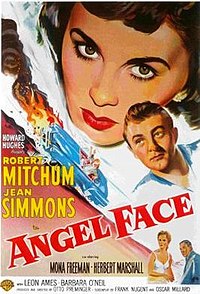
A later entry into the film noir chapter, 1952's Angel Face rides on Simmons' shoulders to keep the viewer guessing as to what's going on and what's going through her head. And I guess really that she's not the prototypical femme fatale, not in the typical sense of the definition when it comes to film noir. But whatever you want to call her part, it is impressive. Simmons' innocent, doe-eyed look brings you in thinking she's not capable of harming a fly, and then WHAM! There goes the fly. I'll add spoiler warnings for any twists -- and there are a few -- but be aware they're coming.
Working as an ambulance driver to save money for an exotic car garage, Frank Jessup (Robert Mitchum) is dispatched to a house in the hills outside Los Angelese. It's there he meets Diane Tremayne (Simmons), the daughter of the patient. Her stepmother almost asphyxiated when gas was pumped into her room. The police investigate but come to no conclusions. Frank puts it behind him, but Diane keeps popping up and the chemistry and romance begin (Frank seems awful clueless at times). She wants to help him start up his garage and offers him a better paying job as the family's chauffeur. He somewhat suspiciously accepts the job but finds out this family isn't all it is cracked up to be. Diane's father (Herbert Marshall) has remarried to a rich woman (Barbara O'Neil) who is jealous of the relationship he has with his daughter. Can Frank get out of this mess?
I was surprised throughout this movie at the way Simmons is able to pull off cute and innocent one scene and then throw you for a loop with a scene that clearly shows she's not all there in the head. One extended scene has Simmons walking through the house with a glaze over her face like she doesn't believe what's happened. SPOILER STOP READING SPOILER She wants to kill her stepmother, but in trying to set up an accident gets her father killed too. END OF SPOILER Director Otto Preminger doesn't go all the way in making Diane crazy though. A sub-plot with Frank's girlfriend Mary (Mona Freeman) dating co-worker Kenneth Tobey is generally let by the wayside, but made me think at some point we'd find out Diane killed her or set her up in some way.
Watching Simmons do her thing, I was reminded of Fatal Attraction with Michael Douglas and Glenn Close. Like I mentioned, Simmons doesn't go full-on crazy, but I'd wager Close had seen this movie at some point because the influences are all over the place. As for Mitchum, he's one of my favorite all-time actors, but this has to be his dumbest character ever. He never seems to catch on to what's actually happening around him. Even at a trial late in the movie, he seems disinterested in finding out the truth. There's a part of me wanting to scream at him 'Run for the hills, brother! She's nuts!' but of course stupid characters don't suddenly become aware of how stupid they are.
I did enjoy much of the movie, but some pacing problems exist. A long 15-20 minute scene is a courtroom scene late in the movie as Diane's lawyer (Leon Ames) does his best to acquit her and Frank with the district attorney (Jim Backus) doing his damnedest to throw the book at them. It's interesting enough as the two go back and forth, but Simmons and Mitchum are left in the background to grimace or look nervous every once in awhile. I'd bet neither says a word for 10-minutes plus during this segment. It doesn't help that Ames' defense lawyer is one of those slimy types you just want to pop in the face. After over an hour with Diane and Frank, the courtroom segment seems out of place and unnecessarily slows things down.
Following the trial and all its fallout, the ending comes as more of a shock in its violence than in a genuine surprise. About five minutes out, I called what was going to happen, and how Mitchum's Frank didn't see it coming I'll never know. But when it does come, it is a doozy, and a good one. Even with the slower parts, that's the movie as a whole; a good one. Strong directing from Preminger and Simmons and Mitchum have good chemistry together.
Angel Face <----(1952): ***/****
A later entry into the film noir chapter, 1952's Angel Face rides on Simmons' shoulders to keep the viewer guessing as to what's going on and what's going through her head. And I guess really that she's not the prototypical femme fatale, not in the typical sense of the definition when it comes to film noir. But whatever you want to call her part, it is impressive. Simmons' innocent, doe-eyed look brings you in thinking she's not capable of harming a fly, and then WHAM! There goes the fly. I'll add spoiler warnings for any twists -- and there are a few -- but be aware they're coming.
Working as an ambulance driver to save money for an exotic car garage, Frank Jessup (Robert Mitchum) is dispatched to a house in the hills outside Los Angelese. It's there he meets Diane Tremayne (Simmons), the daughter of the patient. Her stepmother almost asphyxiated when gas was pumped into her room. The police investigate but come to no conclusions. Frank puts it behind him, but Diane keeps popping up and the chemistry and romance begin (Frank seems awful clueless at times). She wants to help him start up his garage and offers him a better paying job as the family's chauffeur. He somewhat suspiciously accepts the job but finds out this family isn't all it is cracked up to be. Diane's father (Herbert Marshall) has remarried to a rich woman (Barbara O'Neil) who is jealous of the relationship he has with his daughter. Can Frank get out of this mess?
I was surprised throughout this movie at the way Simmons is able to pull off cute and innocent one scene and then throw you for a loop with a scene that clearly shows she's not all there in the head. One extended scene has Simmons walking through the house with a glaze over her face like she doesn't believe what's happened. SPOILER STOP READING SPOILER She wants to kill her stepmother, but in trying to set up an accident gets her father killed too. END OF SPOILER Director Otto Preminger doesn't go all the way in making Diane crazy though. A sub-plot with Frank's girlfriend Mary (Mona Freeman) dating co-worker Kenneth Tobey is generally let by the wayside, but made me think at some point we'd find out Diane killed her or set her up in some way.
Watching Simmons do her thing, I was reminded of Fatal Attraction with Michael Douglas and Glenn Close. Like I mentioned, Simmons doesn't go full-on crazy, but I'd wager Close had seen this movie at some point because the influences are all over the place. As for Mitchum, he's one of my favorite all-time actors, but this has to be his dumbest character ever. He never seems to catch on to what's actually happening around him. Even at a trial late in the movie, he seems disinterested in finding out the truth. There's a part of me wanting to scream at him 'Run for the hills, brother! She's nuts!' but of course stupid characters don't suddenly become aware of how stupid they are.
I did enjoy much of the movie, but some pacing problems exist. A long 15-20 minute scene is a courtroom scene late in the movie as Diane's lawyer (Leon Ames) does his best to acquit her and Frank with the district attorney (Jim Backus) doing his damnedest to throw the book at them. It's interesting enough as the two go back and forth, but Simmons and Mitchum are left in the background to grimace or look nervous every once in awhile. I'd bet neither says a word for 10-minutes plus during this segment. It doesn't help that Ames' defense lawyer is one of those slimy types you just want to pop in the face. After over an hour with Diane and Frank, the courtroom segment seems out of place and unnecessarily slows things down.
Following the trial and all its fallout, the ending comes as more of a shock in its violence than in a genuine surprise. About five minutes out, I called what was going to happen, and how Mitchum's Frank didn't see it coming I'll never know. But when it does come, it is a doozy, and a good one. Even with the slower parts, that's the movie as a whole; a good one. Strong directing from Preminger and Simmons and Mitchum have good chemistry together.
Angel Face <----(1952): ***/****
Labels:
1950s,
Film Noir,
Jean Simmons,
Kenneth Tobey,
Otto Preminger,
Robert Mitchum
Subscribe to:
Posts (Atom)