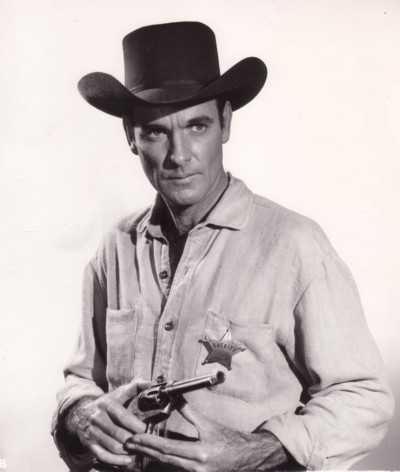
For the United States, the Vietnam War officially began in 1965 as American forces officially became involved in the fighting in Vietnam. Of course, American advisors had been on the ground in Vietnam for a decade-plus trying to help swing things toward the American way and away from the Communist way. A particularly nasty period leading to a far nastier period, it's shady and dark and very hush-hush, very Cold War. Not too many films address the pre-Vietnam War time. An exception? From 1958, The Quiet American.
It's 1952 in Saigon and the political situation in Vietnam is on the verge of exploding as Vietnamese insurgents have begun to fight back against their French colonist rulers. Everything is seemingly in the balance just waiting for someone to strike the match that sets it all off. Living in the city is Thomas Fowler (Michael Redgrave), a middle-aged British journalist working as a war correspondent on the almost-daily updates of the fighting. He lives with a young Vietnamese woman, Phuong (Giorgia Moll), and is quite comfortable in his living situation in spite of the fighting and death around him. His peaceful arrangement changes though when a young American (Audie Murphy) shows up in Saigon. Working with a friends of Asia organization, the American takes an immediate liking to Phuong, putting the young woman in quite a spot. Now, Fowler -- with a wife back home -- must decide what is most important to him.
This 1958 historical drama from director Joseph Mankiewicz is based on a novel by author Graham Greene. As for the finished product, Greene was less than pleased with some rather major changes made from his source novel. Mankiewicz too was displeased with what the studio had done to the version he had written and then directed. I haven't read the novel, but I have seen the 2002 version of the film (starring Michael Caine and Brendan Fraser) that's supposedly a lot more in line with Greene's original. Moral of the story? Issues those involved may have had, 'Quiet' is worth a watch for any number of reasons, flaws considered and flaws aside.
My feeble mind can only grasp so much Politic. That's right...the upper-cased Politic. That was my worry about this 1958 drama. Though it is a personal story among three people in Saigon, the political situation in the city (and the world on a bigger level) is the basis. I wasn't always sure what they're talking about, but it's fascinating to watch it develop. Basically, everyone has their motives, the French, Communists, Americans and those that would benefit from a third force taking an active role in Vietnam, in this case those dastardly Americans. Mankiewicz filmed in Vietnam in 1958 -- so not the most peaceful filming location -- which gives 'Quiet' an authentic air of actually being a part of what we're seeing on-screen. Filming was less than smooth sounds like as demonstrations and violence rocked the city. How about that for adding that layer of reality?
The basis of the story is one of my least favorite storytelling devices....well, ever. It's the love triangle among Redgrave's middle-aged journalist, Murphy's noble, naive, idealistic American, and Moll's innocent Phuong who simply wants to be happy. The historical backdrop certainly helps alleviate the pain, but mostly, it's the acting talent involved. Mankiewicz's script lets these potential cardboard cutouts be red-blooded individuals (mostly). Redgrave is excellent as Fowler, the journalist going through a mid-life crisis of sorts at the worst possible moment. It's a challenging character because he isn't sympathetic, is a bit too whiny but all under the umbrella of being a stodgy British gentleman. He's passive aggressive and with a touch of condescending for good measure. By far, that's the best performance.
Murphy wasn't the first choice to play the titular, unnamed character, just part of a checkered production that saw some huge names drop in and out of filming. Murphy takes a rap sometimes for his wooden acting, but I thought he was excellent here. The biggest change made from Greene's novel is in the character, Murphy's American presented as a heroic, naive, honest, genuinely good individual while his backstory and motive for being in Vietnam are never truly explained. The 2002 version did not have that problem. Redgrave and Murphy play well off each other, Moll keeping up throughout with a thankless part. Also look for Claude Dauphin as a scene-stealing police investigator, Bruce Cabot, Fred Sadoff, Kerima and Richard Loo in key supporting parts.
There are issues with the story's pacing and as I mentioned, I get lost at times in the politically-heavy scenes. But as a movie? It's very good. I liked the movie-watching experience a lot. Filmed in black and white, 'Quiet' looks great, humid and sweaty and sun-drenched, a perfect backdrop for that politically and love-charged Saigon. The storytelling techniques work well -- giving away the ending in the opening scene, the rest told in flashback -- and the acting is solid all-around. A lot to recommend for an oft-forgotten drama.
The Quiet American (1958): ***/****
The Sons of Katie Elder
"First, we reunite, then find Ma and Pa's killer...then read some reviews."
Showing posts with label Audie Murphy. Show all posts
Thursday, March 3, 2016
Wednesday, June 12, 2013
Ride Clear of Diablo
World War II hero turned movie star Audie Murphy knew what his fans wanted. Action movies and westerns, rinse, lather and repeat. Why fix something that isn't broken? So for the most part, Murphy's career doesn't offer more than a classic or two, but there is something familiar, comfortable and most importantly, enjoyable, about his films. Take 1954's Ride Clear of Diablo, a solid western that is content to be just that and little else.
A railroad surveyor, Clay O'Mara (Murphy) has received word that his father and son have been brutally gunned down by cattle rustlers stealing the family's herd. He heads home in hopes of tracking down the rustlers/killers but wants to do so legally. Clay approaches the Santiago sheriff, Kenyon (Paul Birch), about taking a job as a deputy so his efforts will be on the up and up, very legal. The sheriff approves, telling Clay that a good place to start in hunting down the rustlers is to go after infamous gunfighter and wanted killer Whitey Kincade (Dan Duryea). Bringing in the bandit is one thing, but Clay may have bit off more than he could chew. In his efforts, the new deputy finds out that Sheriff Kenyon and a lawyer in town, Meredith (William Pullen), may know far more than they're letting on.
This 1954 western was recently on Encore Westerns -- they seem to have a lot of B-westerns available on their programming -- and as a fan of Audie Murphy, I wanted to give it a try. It's received a solid rating at IMDB (6.8 as I write this review), but I didn't come away hugely impressed. I enjoyed it, liked it but at the same time didn't love it. 'Diablo' doesn't do much to distinguish itself from the rest of the pack in terms of B-westerns, but director Jesse Hibbs does a good, workmanlike job behind the camera. Pretty forgettable, but decent enough in the moment.
The biggest thing to take away from 'Diablo' is the early quasi-buddy pairing of Murphy and Duryea. It's an interesting Odd Couple pairing with Murphy's resolute, revenge-seeking lawman and Duryea's ruthless but intelligent hired gun teaming up. It isn't a friendship -- far from it -- but there's at least a mutual respect between the two men who are very different but hold more similarities than they might care to admit. Duryea's Kincade has a sick, morbid curiosity, always putting Clay into compromising situations to see how he'll handle it. Somewhere along the way, maybe they do become odd friends. I liked the dynamic between the duo a lot, their dialogue scenes together in cantinas and saloons, even just on the trail are Westerns 101, but they work.
In a movie that runs about 80 minutes, too much time is spent on a possible love interest for Clay in Susan Cabot's Laurie, the sheriff's well-meaning niece. She's engaged to the sinister, conniving Meredith (meh in the villain department), but wouldn't you know it? Laurie might just like Clay too. A far more interesting female part goes to Abbe Lane as Kate, a dance hall girl looking out for herself above all else. As for the villains beyond Kenyon and Meredith, Russell Johnson (Yes, Professor from Gilligan's Island, and yes, it's unsettling) is a greedy hired gun while Jack Elam plays Tim Lowerie, a rustler who takes an instant dislike to Clay upon arrival. Denver Pyle is solid in a smaller supporting part as Reverend Moorehead, his conversations with Clay about the right and wrong of the brutality of the west a highlight.
Mostly though, whenever Murphy and Duryea aren't together, the story in 'Diablo' runs a little slow. It picks up the pacing some in the finale as the duo team up to bring the rustling killers to justice including a surprisingly vicious final shootout. The script getting there is full of holes. How can Clay not see that Sheriff Kenyon is basically sending him on suicide missions every other day? Is he that stupid? A decent western, but nothing more.
Ride Clear of Diablo (1954): ** 1/2 /****
A railroad surveyor, Clay O'Mara (Murphy) has received word that his father and son have been brutally gunned down by cattle rustlers stealing the family's herd. He heads home in hopes of tracking down the rustlers/killers but wants to do so legally. Clay approaches the Santiago sheriff, Kenyon (Paul Birch), about taking a job as a deputy so his efforts will be on the up and up, very legal. The sheriff approves, telling Clay that a good place to start in hunting down the rustlers is to go after infamous gunfighter and wanted killer Whitey Kincade (Dan Duryea). Bringing in the bandit is one thing, but Clay may have bit off more than he could chew. In his efforts, the new deputy finds out that Sheriff Kenyon and a lawyer in town, Meredith (William Pullen), may know far more than they're letting on.
This 1954 western was recently on Encore Westerns -- they seem to have a lot of B-westerns available on their programming -- and as a fan of Audie Murphy, I wanted to give it a try. It's received a solid rating at IMDB (6.8 as I write this review), but I didn't come away hugely impressed. I enjoyed it, liked it but at the same time didn't love it. 'Diablo' doesn't do much to distinguish itself from the rest of the pack in terms of B-westerns, but director Jesse Hibbs does a good, workmanlike job behind the camera. Pretty forgettable, but decent enough in the moment.
The biggest thing to take away from 'Diablo' is the early quasi-buddy pairing of Murphy and Duryea. It's an interesting Odd Couple pairing with Murphy's resolute, revenge-seeking lawman and Duryea's ruthless but intelligent hired gun teaming up. It isn't a friendship -- far from it -- but there's at least a mutual respect between the two men who are very different but hold more similarities than they might care to admit. Duryea's Kincade has a sick, morbid curiosity, always putting Clay into compromising situations to see how he'll handle it. Somewhere along the way, maybe they do become odd friends. I liked the dynamic between the duo a lot, their dialogue scenes together in cantinas and saloons, even just on the trail are Westerns 101, but they work.
In a movie that runs about 80 minutes, too much time is spent on a possible love interest for Clay in Susan Cabot's Laurie, the sheriff's well-meaning niece. She's engaged to the sinister, conniving Meredith (meh in the villain department), but wouldn't you know it? Laurie might just like Clay too. A far more interesting female part goes to Abbe Lane as Kate, a dance hall girl looking out for herself above all else. As for the villains beyond Kenyon and Meredith, Russell Johnson (Yes, Professor from Gilligan's Island, and yes, it's unsettling) is a greedy hired gun while Jack Elam plays Tim Lowerie, a rustler who takes an instant dislike to Clay upon arrival. Denver Pyle is solid in a smaller supporting part as Reverend Moorehead, his conversations with Clay about the right and wrong of the brutality of the west a highlight.
Mostly though, whenever Murphy and Duryea aren't together, the story in 'Diablo' runs a little slow. It picks up the pacing some in the finale as the duo team up to bring the rustling killers to justice including a surprisingly vicious final shootout. The script getting there is full of holes. How can Clay not see that Sheriff Kenyon is basically sending him on suicide missions every other day? Is he that stupid? A decent western, but nothing more.
Ride Clear of Diablo (1954): ** 1/2 /****
Labels:
1950s,
Audie Murphy,
Dan Duryea,
Denver Pyle,
Jack Elam,
westerns
Monday, March 25, 2013
Posse from Hell
Ah, the posse, where men can be men and.....do manly stuff? Ride horses, shoot guns, track bad guys, eat jerky and drink bad coffee around a fire out in the desert under the stars. Pretty cool, huh? Eh, probably not, but for a western nut like myself, I could get on board with that. Obviously it wasn't a pleasant experience -- tracking down the bad guys to bring them to justice -- but there's been countless westerns following the posse, but few have been better than 1961's Posse from Hell.
Four very dangerous, murdering convicts led by an outlaw named Crip (Vic Morrow) descend on a small, peaceful western town, wreaking havoc and leaving a handful of dead in their wake, including the town marshal. The gang steals $11,000 from the bank and also kidnaps young Helen Caldwell (Zohra Lampert) and takes her with them. As a posse forms the following day, a new deputy arrives in town. His name is Banner Cole (Audie Murphy), and he immediately assumes the marshal's duties, starting with forming the posse. His honesty about the coming hunt scares many people away, leaving Banner with just six men riding with him to take down a four-man gang. The trail awaits with ambushes, double crosses, personal grudges and cowards waiting around every corner. Can Banner hold the group together long enough to get the gang?
From director Herbert Coleman, here is an example of a solid western that's flown under the radar in the 50-plus years since its release. It doesn't hit the 90-minute mark -- wrapping up in 89 instead -- and is most definitely a B-western. 'Hell' was filmed on the backlots with a few excursions to the California desert. The music is pretty standard stuff to the point the full cast and crew listing don't even list a composer. So why does it work then? Western novelist Clair Huffaker (wrote the novel and the screenplay) knows what he's doing. He knows the western and more importantly the characters. His good guy is resolute, his bad guys extremely nasty, and the rest are cannon fodder. Familiar? Maybe, but it's fun and entertaining throughout.
Maybe because it was a B-western and not a huge studio release, 'Hell' can get away with some stuff. That stuff ranks pretty high on the nasty, dark meter. There are things you would expect out of a spaghetti western or revisionist American western from the late 1960s or early 1970s, not a 1961 western. Morrow's Crip is a cold-blooded killer (channeling a similar character he played on an episode of The Rifleman) who favors a double-barreled shotgun and kills with no discretion. His gang kills because they can, not because it actually accomplishes anything. After leaving the town behind, Crip's gang even rapes Helen and leaves her for dead. Banner's posse is equally treacherous with insane, cowardly, big-talking individuals who can't back themselves up. It's a refreshing change of pace from some straightforward white hat good guys and black hat bad guys.
The king of the American B-western, Audie Murphy is an ideal lead. At times, his acting could be a tad wooden, but his stone-faced, almost monotone delivery plays well here. He's less than interested in the feelings or reactions of his posse. He's out there to do a job, not worry about the personalities of these people he's just met. The best dynamic is between Murphy's Banner and John Saxon's Seymour Kern, an Easterner working with the bank in town who's told to go with the posse to watch over the recovered money. The veteran cowboy and the inexperienced Easterner is a familiar convention, but it works. The rest of the posse includes Robert Keith as a power-happy former Union officer, Rodolfo Acosta as a Mexican cowboy known for his tracking ability, Royal Dano as Helen's drunken uncle, Frank Overton as the revenge-seeking townsperson trying to avenge his brother, and Paul Carr as the fast-draw with a pistol who's got little real life experience with his pistols. Also look for Lee Van Cleef as one of Crip's gang. It's a cool group with a variety of personalities, some around to be targets for Crip's gang.
The story is fairly episodic once the posse gets out on the trail. With seven members of the posse, it's clear some aren't going to make it so it becomes a guessing game as to who will survive. There are some surprising twists there so stay tuned through the end. Overall, the story doesn't really know how to end so it does drag a little in the final 15-20 minutes, but the build-up is so worthwhile I barely noticed. It's not enough to detract from a western I very much enjoyed. Highly recommended. Give it a shot at Youtube, link included below.
Posse from Hell (1961): *** 1/2 /****
Four very dangerous, murdering convicts led by an outlaw named Crip (Vic Morrow) descend on a small, peaceful western town, wreaking havoc and leaving a handful of dead in their wake, including the town marshal. The gang steals $11,000 from the bank and also kidnaps young Helen Caldwell (Zohra Lampert) and takes her with them. As a posse forms the following day, a new deputy arrives in town. His name is Banner Cole (Audie Murphy), and he immediately assumes the marshal's duties, starting with forming the posse. His honesty about the coming hunt scares many people away, leaving Banner with just six men riding with him to take down a four-man gang. The trail awaits with ambushes, double crosses, personal grudges and cowards waiting around every corner. Can Banner hold the group together long enough to get the gang?
From director Herbert Coleman, here is an example of a solid western that's flown under the radar in the 50-plus years since its release. It doesn't hit the 90-minute mark -- wrapping up in 89 instead -- and is most definitely a B-western. 'Hell' was filmed on the backlots with a few excursions to the California desert. The music is pretty standard stuff to the point the full cast and crew listing don't even list a composer. So why does it work then? Western novelist Clair Huffaker (wrote the novel and the screenplay) knows what he's doing. He knows the western and more importantly the characters. His good guy is resolute, his bad guys extremely nasty, and the rest are cannon fodder. Familiar? Maybe, but it's fun and entertaining throughout.
Maybe because it was a B-western and not a huge studio release, 'Hell' can get away with some stuff. That stuff ranks pretty high on the nasty, dark meter. There are things you would expect out of a spaghetti western or revisionist American western from the late 1960s or early 1970s, not a 1961 western. Morrow's Crip is a cold-blooded killer (channeling a similar character he played on an episode of The Rifleman) who favors a double-barreled shotgun and kills with no discretion. His gang kills because they can, not because it actually accomplishes anything. After leaving the town behind, Crip's gang even rapes Helen and leaves her for dead. Banner's posse is equally treacherous with insane, cowardly, big-talking individuals who can't back themselves up. It's a refreshing change of pace from some straightforward white hat good guys and black hat bad guys.
The king of the American B-western, Audie Murphy is an ideal lead. At times, his acting could be a tad wooden, but his stone-faced, almost monotone delivery plays well here. He's less than interested in the feelings or reactions of his posse. He's out there to do a job, not worry about the personalities of these people he's just met. The best dynamic is between Murphy's Banner and John Saxon's Seymour Kern, an Easterner working with the bank in town who's told to go with the posse to watch over the recovered money. The veteran cowboy and the inexperienced Easterner is a familiar convention, but it works. The rest of the posse includes Robert Keith as a power-happy former Union officer, Rodolfo Acosta as a Mexican cowboy known for his tracking ability, Royal Dano as Helen's drunken uncle, Frank Overton as the revenge-seeking townsperson trying to avenge his brother, and Paul Carr as the fast-draw with a pistol who's got little real life experience with his pistols. Also look for Lee Van Cleef as one of Crip's gang. It's a cool group with a variety of personalities, some around to be targets for Crip's gang.
The story is fairly episodic once the posse gets out on the trail. With seven members of the posse, it's clear some aren't going to make it so it becomes a guessing game as to who will survive. There are some surprising twists there so stay tuned through the end. Overall, the story doesn't really know how to end so it does drag a little in the final 15-20 minutes, but the build-up is so worthwhile I barely noticed. It's not enough to detract from a western I very much enjoyed. Highly recommended. Give it a shot at Youtube, link included below.
Posse from Hell (1961): *** 1/2 /****
Labels:
1960s,
Audie Murphy,
John Saxon,
Lee Van Cleef,
Robert Keith,
Rodolfo Acosta,
Royal Dano,
Vic Morrow,
westerns
Friday, August 12, 2011
Trunk to Cairo
The movie is a mess on so many levels. It is an Israeli-West German co-production if you're looking for any sign of the quality of the movie on the whole. 'Trunk' aired somewhat recently on Turner Classic Movies, and as a fan of Murphy, I recorded it, especially because I had never heard of the movie in any way. The reason was pretty clear. Like so many movies from the 1960s that featured transplanted American stars, it is awful. We're not talking guilty pleasure either, just a bad movie with few if any redeeming qualities. Seeing stars at their absolute worst is never a quality calling card, and that's about all this one has going for it.
Traveling to Cairo, German scientist Ludwig Bauer (Murphy) meets Helga (Marianne Koch), a young German woman going to meet her father, Professor Schlieben (George Sanders). Several of Schlieben's co-workers -- all highly intelligent scientists -- have all been brutally murdered in bombing attacks, Bauer sent as a replacement for the good professor's most recent job. Bauer is stunned at what he finds out. Schlieben is working on and close to completing his latest contract, building an atomic weapon that could knock out a major city, handing the weapon over to the Egyptian government for use at their discretion. Bauer has a secret though, he's a CIA agent working with the Israelis hoping to knock out this program run by Schlieben and his neo-Nazi cohorts.
This review has the potential to go poorly very quickly. About 20 minutes into this bomb, I realized I was watching just that...a bomb. Bad but not bad enough to be a guilty pleasure, I ended up fast-forwarding through long stretches of the movie, the 103-minute running time still managing to go by at a seemingly endless pacing. The powerhouse directing duo of Menahem Golan and Raphael Nussbaum -- yes, somehow these two giants of film were able to work together -- look to try and capitalize off the huge worldwide successes of the James Bond movies, but well....yeah, they fail. Good effort, I guess. Nah, who am I kidding? I could give some credit if the movie shot for the stars and crashed and burned. This one never gets off the launch pad.
In a recent wave of Audie Murphy reviews, I probably said the same thing over and over again. Good/Average actor at times who could be an above average actor with the right part, getting by on his on-screen persona and likability, audiences going along for the ride with his characters. 'Trunk' would not be a good movie to introduce someone to the real-life WWII hero who knew nothing about him. Sleepwalking would be a kind way to describe his performance here as undercover secret agent, Mike Merrick. His Texas drawl is there, but he mumbles his way through his lines, and at times it looks like he's reading off cue-cards held just off camera. He looks bored with the proceedings, clearly not his best effort.
This is not an effort to pile on Murphy, an underrated star/actor who I've always been a fan of. The blame should get placed evenly and all over the place. No one is safe here! Everyone comes under fire. What did George Sanders do to deserve this fate later in his career? I suppose you could call his Dr. Schlieben the villain, but he's so clueless and harmless I can't quite call him a bad guy. Koch -- who I only knew from A Fistful of Dollars -- is the love interest of sorts who falls for Murphy's Merrick, getting caught up in the middle of this mess. Hans von Borsody gets to play the ideal German, a blonde-haired, blue-eyed Neo-Nazi who tangles with Merrick before meeting a nasty demise while Yossi Yadin plays Capt. Gabar, Schlieben's Egyptian liaison. Gila Almagor is a bright spot as Yasmine, an undercover contact working with Merrick.
Let's get a bright spot out of the way before I trash the movie on the whole. The locations in Cairo and later Rome look great so the movie's got that going for it...and that's about it. By the end of the movie, the previously serious spy thriller has degenerated to a slapstick chase the Keystone Cops would have been jealous of. Composer Dov Seltzer turns in a laughably bad soundtrack that blares over the embarrassment, Murphy outrunning/outriding (on horseback) two Egyptian police on motorcycles chasing him because he rides up a gentle slope. The ending itself is a topper, but I only want to spoil so much of the badness. I've got to leave some mystery for this steaming pile, don't I? It's forgotten for a reason. Steer clear.
Trunk to Cairo <---trailer (1966): */****
Thursday, July 14, 2011
The Quick Gun
A user review at the IMDB points out a simple but key problem working against the success of the 1964 B-western The Quick Gun. Succinctly wrapping it all up, the user states 'It's not exciting.' As I struggled to come up with something to write about, that's what hit me. The story is a rehash of other westerns as is the case with the characters. But rehashes isn't always a bad thing so I kept watching. It never got better though as the movie coasts along.
After reviewing two Audie Murphy westerns these last couple of days, I was looking forward to this third western that aired as part of Turner Classic Movie's Audie Murphy night. I enjoyed both Drums Across the River and The Guns of Fort Petticoat, but 'Quick' never rises to that level. By the 1960s, Murphy's star had started to fade some which is reflected in his movie roles. The 60s were marked by low budget B-westerns that never rose above their smallish budgets. IMDB ratings aren't a hard and fast rule because voters can strategically increase or decrease a ratings, but of Murphy's 40 roles, The Quick Gun is his lowest rated movie, and that says something. It just isn't very good.
Two years after he was provoked into a gunfight where he killed the two sons of a local rancher (Walter Sande), gunfighter Clint Cooper (Murphy) returns home to the town he grew up in. He's not sure what reaction he will get from the townspeople who were happy to see him go, but his return is halted on the road into town. He meets Jud Spangler (Ted de Corsia), the leader of a gang Clint briefly rode with in the past. Spangler offers for Clint to ride with them as they rob the bank in town, but he refuses and manages to escape, riding into town. No one is happy to see him other than his old friend turned sheriff, Scotty Wade (James Best). The rancher is still looking for revenge, and suspicions abound when Clint informs the town of the news of Spangler's impending robbery. They believe Clint's working as an inside man so can he convince them otherwise in time?
You would think with a movie that doesn't even break the 90-minute barrier, a story would not have trouble moving things along. That's not the case here with director Sidney Salkow's western which struggles with a pacing problem throughout. I can deal with familiar stories and cliched characters, but something has to actually happen for a movie to be even a little enjoyable. Murphy's Clint rides into town, gets stared at a lot, he helps prepare a defense and he ends up in jail when he's forced to kill in self defense. By the time Spangler's gang actually shows up I was bored to tears. These townspeople don't deserve the help he's offering. More than any lack of excitement -- of which there's little to none -- is that there is no energy to the movie at all. No one seems that worried about the coming robbery.
In those previous Murphy western reviews, I mentioned the actor's somewhat limited range that usually worked well within westerns. The idea of the Clint Cooper character is a good one, a take on the prodigal son as this infamous gunfighter wants to return home after years away. His intentions are pure, just wanting to get a second chance, and he gets it when he stumbles into the news of the coming robbery. But like the rest of the movie, Murphy looks to be sleepwalking through the part. Some of that can be attributed to his character, a beaten down gunfighter sick of what he's done in the past. There's no real sense of urgency for this character who actually ends up spending about 30 minutes of the 87-minute movie in a jail cell. Now that just ain't right.
A bright spot from the slow-moving story is James Best as Sheriff Scotty Wade. Too often Best is remembered for his part in the 1980s TV show The Dukes of Hazard as Sheriff Rosco Coltrane, but he made a name for himself in the 1950s and 1960s, usually in supporting parts in westerns and war movies. It's great to see him in a leading role, keeping up with Murphy and eventually making more of a positive impression. Wade is now engaged to Helen (Merry Anders), the town schoolteacher who used to go with Clint, and he quickly sees the writing on the wall. Calling him a tragic character in this B-western is a little much, but the character is certainly on that path. It's clear it will not work out for him as he's torn between his duty to the town and the people, to his fiance Helen, and to his old friend who he genuinely believes is telling the truth. In an otherwise pedestrian western, Best's performance stands out from the rest.
The rest of the story and cast is more hit or miss. Anders as Helen is pretty awful, somewhat redeeming herself in the end when all seems lost. Ted de Corsia gets to ham it up as Spangler, the not quite maniacal bad guy who looks to be enjoying himself in the spotlight. Sande and Rex Holman are the secondary villains, the Morrisons, the ranchers looking for revenge, but they're not around enough to leave an impression. Frank Ferguson is solid as Dan Evans, the hotel owner who used to be close friends with Clint, while Mort Mills and Gregg Palmer play two of Spangler's gunmen.
Cynical watcher of westerns that I am, I was hoping for the darkest of endings here, especially about midway through the movie when I was losing interest. The most appropriate ending (in my head) has Murphy getting gunned down as he ultimately saves the town with Best's Wade ending up with the girl. That of course is not the ending we get, but I can wish. The shootout in the main street at the end has a chance to be good because it is far from a happy ending, but right before going into really dark territory, The Quick Gun takes its foot off the pedal and slams on the brakes. Too bad, a different ending could have saved it a little.
The Quick Gun <---TCM clips (1964): **/****
After reviewing two Audie Murphy westerns these last couple of days, I was looking forward to this third western that aired as part of Turner Classic Movie's Audie Murphy night. I enjoyed both Drums Across the River and The Guns of Fort Petticoat, but 'Quick' never rises to that level. By the 1960s, Murphy's star had started to fade some which is reflected in his movie roles. The 60s were marked by low budget B-westerns that never rose above their smallish budgets. IMDB ratings aren't a hard and fast rule because voters can strategically increase or decrease a ratings, but of Murphy's 40 roles, The Quick Gun is his lowest rated movie, and that says something. It just isn't very good.
Two years after he was provoked into a gunfight where he killed the two sons of a local rancher (Walter Sande), gunfighter Clint Cooper (Murphy) returns home to the town he grew up in. He's not sure what reaction he will get from the townspeople who were happy to see him go, but his return is halted on the road into town. He meets Jud Spangler (Ted de Corsia), the leader of a gang Clint briefly rode with in the past. Spangler offers for Clint to ride with them as they rob the bank in town, but he refuses and manages to escape, riding into town. No one is happy to see him other than his old friend turned sheriff, Scotty Wade (James Best). The rancher is still looking for revenge, and suspicions abound when Clint informs the town of the news of Spangler's impending robbery. They believe Clint's working as an inside man so can he convince them otherwise in time?
You would think with a movie that doesn't even break the 90-minute barrier, a story would not have trouble moving things along. That's not the case here with director Sidney Salkow's western which struggles with a pacing problem throughout. I can deal with familiar stories and cliched characters, but something has to actually happen for a movie to be even a little enjoyable. Murphy's Clint rides into town, gets stared at a lot, he helps prepare a defense and he ends up in jail when he's forced to kill in self defense. By the time Spangler's gang actually shows up I was bored to tears. These townspeople don't deserve the help he's offering. More than any lack of excitement -- of which there's little to none -- is that there is no energy to the movie at all. No one seems that worried about the coming robbery.
In those previous Murphy western reviews, I mentioned the actor's somewhat limited range that usually worked well within westerns. The idea of the Clint Cooper character is a good one, a take on the prodigal son as this infamous gunfighter wants to return home after years away. His intentions are pure, just wanting to get a second chance, and he gets it when he stumbles into the news of the coming robbery. But like the rest of the movie, Murphy looks to be sleepwalking through the part. Some of that can be attributed to his character, a beaten down gunfighter sick of what he's done in the past. There's no real sense of urgency for this character who actually ends up spending about 30 minutes of the 87-minute movie in a jail cell. Now that just ain't right.
A bright spot from the slow-moving story is James Best as Sheriff Scotty Wade. Too often Best is remembered for his part in the 1980s TV show The Dukes of Hazard as Sheriff Rosco Coltrane, but he made a name for himself in the 1950s and 1960s, usually in supporting parts in westerns and war movies. It's great to see him in a leading role, keeping up with Murphy and eventually making more of a positive impression. Wade is now engaged to Helen (Merry Anders), the town schoolteacher who used to go with Clint, and he quickly sees the writing on the wall. Calling him a tragic character in this B-western is a little much, but the character is certainly on that path. It's clear it will not work out for him as he's torn between his duty to the town and the people, to his fiance Helen, and to his old friend who he genuinely believes is telling the truth. In an otherwise pedestrian western, Best's performance stands out from the rest.
The rest of the story and cast is more hit or miss. Anders as Helen is pretty awful, somewhat redeeming herself in the end when all seems lost. Ted de Corsia gets to ham it up as Spangler, the not quite maniacal bad guy who looks to be enjoying himself in the spotlight. Sande and Rex Holman are the secondary villains, the Morrisons, the ranchers looking for revenge, but they're not around enough to leave an impression. Frank Ferguson is solid as Dan Evans, the hotel owner who used to be close friends with Clint, while Mort Mills and Gregg Palmer play two of Spangler's gunmen.
Cynical watcher of westerns that I am, I was hoping for the darkest of endings here, especially about midway through the movie when I was losing interest. The most appropriate ending (in my head) has Murphy getting gunned down as he ultimately saves the town with Best's Wade ending up with the girl. That of course is not the ending we get, but I can wish. The shootout in the main street at the end has a chance to be good because it is far from a happy ending, but right before going into really dark territory, The Quick Gun takes its foot off the pedal and slams on the brakes. Too bad, a different ending could have saved it a little.
The Quick Gun <---TCM clips (1964): **/****
Monday, July 11, 2011
The Guns of Fort Petticoat
It can be easy at times to forget that in the taming of the wild west, it wasn’t just the men leading the charge. Now granted, the movies, TV shows and western novels tend to focus on the male characters, but the women played a major role in the settling of the west. I’ve made no bones about my issue with female characters in so many westerns, but my issue has nothing to do with what the women did, just how they’re portrayed; the whiny, helpless damsels in distress who couldn’t find their way out of a paper bag. To live in the west in the second half of the 1800s, you had to be tough whether you were man or woman.
Too few westerns take advantage of that situation. There are countless stories of what women accomplished in the west. One of the best examples – which I reviewed a couple years back – was Westward the Women, a story of a wagon train full of women heading west to meet their husbands. They struggle on and keep going, taking everything thrown at them and continuing to fight. As part of the Audie Murphy night recently on Turner Classic Movies, 1957’s The Guns of Fort Petticoat reminded me a lot of ‘Westward’ for all the right reasons, taking the formula and tweaking it a bit as a valley-full of women must fend for themselves during an Indian uprising.
With the Union and Confederate forces back east in the Civil War, cavalry officer Lt. Frank Hewitt (Murphy) sees a superior officer order an unnecessary and brutal attack on a peaceful Indian village and knows there will be repercussions at their western post. He deserts his post and rides south, knowing there will be attacks and raids for thousands of miles in every direction. Hewitt is heading home to his home in Texas, a little valley that lies unprotected with all the men off fighting the war. Organizing all the women left behind, he prepares a defense at an abandoned Spanish mission, knowing an attack will come. He trains the women, readying them for the coming fight, but can he get them ready enough in time?
This is a movie that had a lot of potential to be a campy western full of obvious humor that would have been remembered for all the wrong reasons. Instead, director George Marshall turns in an above average western that is entertaining, well-made and different from your typical run of the mill cowboys/cavalry and Indians movies. 'Guns' was filmed in Old Tucson, one of the most instantly recognizable locations for western shooting to anyone even remotely familiar with westerns. For starters, it looks great. Not given a credit in the credit sequence, composer Mischa Bakaleinoff turns in an appropriate, exciting western score that keeps the action flowing. At just 82 minutes, this is fast paced and exciting, and a quality example of a modest B-movie rising above its genre conventions.
Before his tragic death in 1971 in a plane crash, Murphy made 44 movies of which 33 were westerns. He just seems at home as the lead -- cowboy, rancher, officer, scout, gunman -- in all these westerns. I don't intend this as a criticism, but Murphy wasn't the greatest actor around as he worked within a comfort zone that played to his range. Nothing wrong with that. That resolute, staunch hero is especially needed here because he's the only good guy (quite literally GUY) around. There are attacking Indians, conniving cowards, and a gang of opportunistic bandits around with Murphy leading the way for his little company of female fighters. Murphy -- range limitations aside -- is always very believable, very natural in his acting, and his performance is a key to this movie's success.
Instead of working with one tough, strong female co-star, Murphy gets plenty of them here. His company includes Kathryn Grant as Anne, a pretty tomboy who catches Lt. Hewitt's eyes, Hope Emerson as Hannah Lacey, an older, tough as nails woman who claims to be as tough as any three men and becomes Hewitt's "sergeant," (a similar role to the one she played in a similar movie, Westward the Women), Peggy Maley as Lucy, a saloon girl with a heart of gold (of course), Isobel Elsom as a prim and proper Southern woman with her slave/assistant, Hetty (Ernestine Wade) along, Jeanette Nolan as Cora, the bible-thumping religious freak and Patricia Tiernan as Stella, a past love interest of Hewitt's who hasn't quite moved on. As an ensemble filling in the pieces around Murphy, the almost all female supporting cast does not disappoint in their performances.
So often 1950s westerns can be extremely tame looks at a particularly brutal time in American history. That's not an issue here with this western. When a small group of people fort up and basically prepare for a siege, there are going to be some casualties. My worry was that somehow all these characters would make it through the movie unscathed, throwing away any semblance of reality. The siege and continuing attacks on the mission where Hewitt and Co. hole up are a bright spot for the movie. They're realistic, violent, and shot in a way where the battle is always coherent and easy to follow (harder than you'd think comparing it to other movies). And there are casualties which is probably a little more shocking because you just don't see many female characters killed in westerns. The action though on top of a solid story make this western better than most.
Now there are moments where this movie leans toward the camp humor (intentionally or not). Jeff Donnell plays Mary Wheeler, a single woman who is pregnant with the baby of a no-good gunslinger, Emmett Kettle (Sean McClory). It's the type of performance that grates like so many other helpless female characters and feels out of place compared to the rest of the women. There's also the obnoxious but somehow necessary little kid (Kim Charney), full of piss and vinegar and "tough talk" who ends up causing an attack when the Indians are about to pass the group by. Nolan's Cora is also a little much as the religious zealot, especially her rant in the end. Other small parts go to Ray Teal, Nestor Paiva and James Griffith as three low-down bandits. Underused parts, but effective for what's needed. Named Salt Pork, Tortilla and Kipper respectively, they also have three of the coolest names ever.
Reviews are somewhat mixed on Guns, and most of the criticisms I read were very fair. But in the end, I liked this western a lot. It isn't a classic western, but it does just about everything it can to be an above average oater.
The Guns of Fort Petticoat <---TCM clips (1957): *** 1/2 /****
Labels:
1950s,
Audie Murphy,
George Marshall,
Sean McClory,
westerns
Sunday, July 10, 2011
Drums Across the River
Thanks to a release of a recent DVD collection of four Audie Murphy movies, Turner Classic Movies did a service to western fans with a night devoted to the World War II hero turned movie star. Only one of the films shown is actually in the collection, but three Murphy westerns dotted the schedule, and not necessarily his more well-known flicks. In other words, expect a couple reviews over the next couple days of Murphy films, starting with 1953’s Drums Across the River.
I go back and forth on 1950s westerns, but when done right and not handled in a glossy whitewash, they can be a lot of fun. Just look to the Anthony Mann and Budd Boetticher westerns. With wave after wave of westerns made on a small scale hitting theaters, these movies needed bad guys, and the 1950s produced a lot of them. They aren’t instantly recognizable names now over 60 years later, but for a decade they parlayed their bad guy look into a long list of movies. One of the best at playing bad was Lyle Bettger, chief baddie in ‘Drums’ and Murphy’s main rival.
Working with his father (Walter Brennan) running a freight company in Crown City, a western mining town, Frank Brannon (Murphy) agrees to take on a job transporting goods to a mine that needs supplies. Along for the ride is a handful of cowboys looking to help out, including a man named Walker (Bettger), who has some other plans. Walker intends to start a war with the peaceful Ute Indians in the territory, all with hopes of getting a chance at mining gold out of the hills and mountains promised to the Indians. Brannin manages to negotiate a peace with the Utes after Walker’s failed attempt, but this fight is far from over.
I’ve been a fan of Audie Murphy since I first saw him in the autobiographical film To Hell and Back, the story of his exploits in World War II that earned him worldwide fame. Not always remembered with the John Waynes, Randolph Scotts and Clint Eastwoods, Murphy is nonetheless one of the all-time best western stars. As an actor, he didn’t have the greatest range, but as a western hero, he was strong, loyal, honest, trustworthy and tough as nails. You just know with a Murphy character that he’s not going to take any crap from the bad guys, and in the end, he’s going to win out and get the girl. As the western hero, he’s able to stay in that comfort zone as an actor, and as was the case here, he rarely disappoints.
What is cool about Murphy – and a few other action heroes – is that he does a majority of his stunts whether it be riding his horse at full speed chasing the bad guys or taking part in a knock down, drag ‘em out fistfight. That’s what works here with Drums. Starting with Murphy in the lead, this movie has a nasty streak right up its back, impressive stuff considering it was released in the early 1950s. Two fistfights are absolutely brutal affairs that don’t feel choreographed or overly staged, just two guys beating the hell out of each other. Murphy’s Brannin later dispatches a gunslinger by whipping him across the face and then shooting him twice in the stomach. You don’t see that too often in many pre-1960 westerns.
More than just the honest look at the brutality of the western life, this is a fun western, and one I enjoyed a lot surprisingly enough. Director Nathan Juran films his story on location for the most part in the hills and mountains of Red Rock Canyon State Park in California. It is a beautiful movie that features some familiar locations and some new ones. The story also treats Indians as human beings too, not just mindless savage killing machines. Later gaining fame as Tonto in The Lone Ranger, Jay Silverheels plays Taos, a Ute chief who strikes a deal with Murphy’s Brannin. With some twists and turns as to what everyone is up to, the story keeps you guessing enough to make it always entertaining, not easily settling for the typical route.
In one of his many 1950s western bad guy roles, Bettger is a gem as he so often was. These westerns weren’t interested in villains and shades of gray. There was black and white with nothing in between. So because of that, these bad guys are bad news with absolutely no redeeming qualities. Bettger revels in these roles, slimy, smooth villains who will no doubt meet a nasty fate in the end. As for the rest of the cast, screen veteran Brennan has a good chemistry with Murphy even if his part doesn’t require much after about half the movie. Lisa Gaye plays Jennie, the love interest with Mara Corday playing Sue, the saloon girl in cahoots with Bettger’s Walker. Hugh O'Brian plays Morgan, a hired gun who would like nothing more than a shot at Murphy in another part that has some fun with the over the top bad guy. It’s a fun western though, one that rises above so many average westerns from the 1950s. Well worth looking into.
Drums Across the River (1953): ***/****
Labels:
1950s,
Audie Murphy,
Hugh O'Brian,
Lyle Bettger,
Walter Brennan,
westerns
Sunday, May 2, 2010
The Gun Runners
One of my biggest complaints about movies over the last 10 or so years is the overwhelming use of remakes. Older movies are being updated, TV shows are being turned into movies, basically anything that's been proven successful in the past is being used repeatedly. And really why not? Why think of new creative, unique ideas when you can just reuse something from the past? It seems more prevalent now, but remakes are as old as movies themselves.
Take 1958's The Gun Runners which is based on an Ernest Hemingway novel from 1937, To Have and Have Not. Using Hemingway is nothing new to say the least, and this B-movie came just 14 years removed from the Humphrey Bogart/Lauren Bacall vehicle and only eight years removed from another remake made in 1950 starring John Garfield. They all deal with the same story, but it's fair to say this is a remake of a remake...and not a particularly good one at that.
With his midsize fishing boat off the coast of Florida, captain Sam Martin (Audie Murphy) who with his drunken first mate Harvey (Everett Sloane) takes tourists out for fishing trips, but he isn't too successful at it. He's months behind on payments for his boat with no real sign of money starting to flow in. One day, an American tourist enlists Sam's services to take him and a lady friend out onto the Gulf where he brings up a proposition. He'd like to go to Cuba -- in the midst of a revolution -- for a night where no one would bother him, and he'll pay well to get what he wants. The man's name is Hannigan (Eddie Albert), and he's not telling Sam everything. He's an arms dealer and has an arrangement for a large inbound shipment for the rebel fighters. Sam catches wind of the plan though and isn't going to go along willingly, but Hannigan has an ace up his sleeve.
Setting the story in southern Florida with detours over to Cuba is almost always a good idea in hopes of bringing up some controversy, even now 40 years later where the wet-foot, dry foot policy still remains with Cubans trying to escape to the U.S. But even with veteran tough guy director Don Siegel at the helm, this B-movie lacks a certain energy. There are long scenes of dialogue that don't really go anywhere, and the dynamics between characters is downright dull at times.
In the lead, Murphy takes off the gunbelt and cowboy hat and replaces it with a silly-looking captain's hat which he keeps on for almost the whole movie. I'm trying to think of an actor Murphy could be compared to, but I'm drawing a blank. I'll say this; he's a poor man's somebody. The real-life WWII hero made a movie career that saw him typically in B-westerns so it is refreshing to see a change of pace here. But like so much of the movie, his character is boring. He loves his wife (Patricia Owens) but their relationship lacks any fireworks. He looks out for drunken Harvey but why is he so protective? It's a nice enough character who you know in the end will make the right decision, but that's part of the problem. Sam Martin is about as interesting to watch as a drunken Harvey sleeping one off.
It's odd looking back on some actors' careers for how they're remembered. Albert is generally remembered as the star of the very stupid but very popular TV sitcom Green Acres, but I always think of him as playing a bad guy, and a good one at that. He was perfectly evil in The Longest Yard and Attack!, and he's one of few bright spots here. As Hannigan, Albert is charming and slimy at the same time, the kind of villain you love to root against. He'll deal with whoever has the most money, principals or morals be damned. The rest of the cast features Richard Jaeckel and Jack Elam in small parts where they're required to look menacing and do little else.
Throughout the movie where there should be a physical confrontation or at least a good shouting match, it feels like Siegel and his crew figured a way to keep the process cheap. I'm betting not a scene -- two at most -- go by before somebody's drinking, and I'm not talking apple juice. Got a problem? Go to the bar. Need to meet someone to talk things out? Go to a bar. Maybe this movie would be better if I had watched it drunk or at least buzzed. It's a snoozer with little to recommend other than Eddie Albert's turn as a villain.
The Gun Runners <---clips (1958): * 1/2 /****
Labels:
1950s,
Audie Murphy,
Don Siegel,
Eddie Albert,
Jack Elam,
Remakes,
Richard Jaeckel
Sunday, August 16, 2009
The Unforgiven
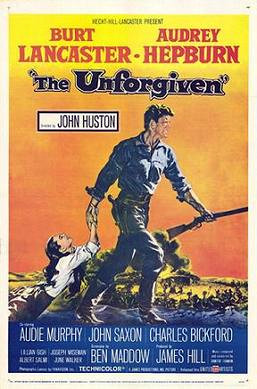
Some westerns are content to go for the lowest common denominator, an entertaining story with ridiculous amounts of action. I don't mean that as negatively as it sounds, I own a lot of movies like that. But some westerns strive for something else whether it be getting a message across or trying to make a statement about the times. These can be hit or miss because sometimes they strive to do too much, but every so often they find that balance, like John Huston's 1960 adult western The Unforgiven.
Based on a novel by author Alan Le May, who also wrote The Searchers, you have to figure you're not getting a typical shoot 'em up western. And in general, westerns were getting away from the old stereotypes, especially in the 1950s with some adult, psychological westerns like Anthony Mann's movies teaming up with Jimmy Stewart (all highly recommended). The Unforgiven doesn't settle for anything easy in it's story about a western family dealing with the revelation that their adopted daughter may be a Kiowa.
The Zacharys are a frontier family working their spread in the Texas panhandle and looking to put together a cattle herd to drive north to Wichita. The patriarch of the family since his father died years before, Ben (Burt Lancaster) is the leader, the oldest brother who keeps everyone else in check. His mother, Mattilde (Lillian Gish), runs the house and makes sure the family stays together. Helping Ben around the spread are his two younger brothers, Cash (Audie Murphy), a fiery, hot-tempered cowboy, and Andy (Doug McClure), the youngest brother who's still growing up. Then, there's Rachel (Audrey Hepburn), their adopted sister who their father supposedly found after her parents were massacred by Kiowas.
One day, a mysterious rider (Joseph Wiseman) rides into town with some revealing news. He says that Rachel has Indian blood in her, and that the story her father told was a lie. Everyone around turns on the Zacharys, and the news even tears the family itself apart with Cash refusing to live in the same house as a 'red-skinned' Indian. Even Ben's longtime partner and neighbor Zed Rawlings (Charles Bickford) refuses to deal with the family. All the while, Ben must hold the family together, even when the Kiowas come to take Rachel back.
Any movie, including a western, that deals with racism as straight forward and honest as this one is going to be polarizing. The Unforgiven can be brutally honest in that sense. We're introduced to all these characters, get to know them, and across the board they seem like good people. But the moment the possibility arises that one among them could be an Indian, they turn on each other. That could have been what the times were like, but it's a story that could be set in any decade or time in American history. It works because it doesn't try to whitewash the story.
Credit for that goes to Huston and his cast, an impressive listing of actors. It's not Lancaster's best part, but he's solid in the lead role. Hepburn is a bit of an odd choice as Rachel, but she pulls it off even if she looks little to nothing like a young Kiowa woman. This movie is known as much for the behind the scenes issues with Hepburn, but her role as Rachel works because she makes the character easy to identify with and very sympathetic.
Surprisingly enough with Lancaster and Hepburn in the leads, it's Audie Murphy that has the best part. His Cash Zachary is a deeply flawed character, a racist at the most basic who wants nothing to do with Indians of any sort, even his own adopted sister. Always known for playing the good guy in a white hat, the WWII hero plays completely against part here as the racist cowboy and comes across the best because he puts it all into the part. Of the rest of the cast, Gish and McClure round out the family, a believable representation of a frontier family, and John Saxon has a cool if small part as Johnny Portugal, an Indian horse wrangler/breaker, including this well choreographed chase scene.
Judging the movie apart from its story is a lot easier because Huston presents such a well-package western. Visually, he gets the spectacle down, the epic feel of what living in the west was like. The movie was shot in Durango, Mexico where many westerns were filmed, and it looks beautiful. The west was full of big, wide open spaces and Huston utilizes that feeling with some memorable long shots, some seemingly from miles away on a rock butte or hill. Composer Dimitri Tiomkin's score isn't as consistently strong as some of his others, but his music in those scenes fits perfectly.
A western that's dark and gloomy and doesn't pull any punches with its story dealing with racism and prejudices in the wild west. The movie benefits from some great performances, including a career-best part from Audie Murphy, and location shooting in Durango. This isn't as well known as Alan Le May's other highly respected western The Searchers, but it deserves more recognition than it's gotten in the years since.
The Unforgiven (1960): *** 1/2 /****
Based on a novel by author Alan Le May, who also wrote The Searchers, you have to figure you're not getting a typical shoot 'em up western. And in general, westerns were getting away from the old stereotypes, especially in the 1950s with some adult, psychological westerns like Anthony Mann's movies teaming up with Jimmy Stewart (all highly recommended). The Unforgiven doesn't settle for anything easy in it's story about a western family dealing with the revelation that their adopted daughter may be a Kiowa.
The Zacharys are a frontier family working their spread in the Texas panhandle and looking to put together a cattle herd to drive north to Wichita. The patriarch of the family since his father died years before, Ben (Burt Lancaster) is the leader, the oldest brother who keeps everyone else in check. His mother, Mattilde (Lillian Gish), runs the house and makes sure the family stays together. Helping Ben around the spread are his two younger brothers, Cash (Audie Murphy), a fiery, hot-tempered cowboy, and Andy (Doug McClure), the youngest brother who's still growing up. Then, there's Rachel (Audrey Hepburn), their adopted sister who their father supposedly found after her parents were massacred by Kiowas.
One day, a mysterious rider (Joseph Wiseman) rides into town with some revealing news. He says that Rachel has Indian blood in her, and that the story her father told was a lie. Everyone around turns on the Zacharys, and the news even tears the family itself apart with Cash refusing to live in the same house as a 'red-skinned' Indian. Even Ben's longtime partner and neighbor Zed Rawlings (Charles Bickford) refuses to deal with the family. All the while, Ben must hold the family together, even when the Kiowas come to take Rachel back.
Any movie, including a western, that deals with racism as straight forward and honest as this one is going to be polarizing. The Unforgiven can be brutally honest in that sense. We're introduced to all these characters, get to know them, and across the board they seem like good people. But the moment the possibility arises that one among them could be an Indian, they turn on each other. That could have been what the times were like, but it's a story that could be set in any decade or time in American history. It works because it doesn't try to whitewash the story.
Credit for that goes to Huston and his cast, an impressive listing of actors. It's not Lancaster's best part, but he's solid in the lead role. Hepburn is a bit of an odd choice as Rachel, but she pulls it off even if she looks little to nothing like a young Kiowa woman. This movie is known as much for the behind the scenes issues with Hepburn, but her role as Rachel works because she makes the character easy to identify with and very sympathetic.
Surprisingly enough with Lancaster and Hepburn in the leads, it's Audie Murphy that has the best part. His Cash Zachary is a deeply flawed character, a racist at the most basic who wants nothing to do with Indians of any sort, even his own adopted sister. Always known for playing the good guy in a white hat, the WWII hero plays completely against part here as the racist cowboy and comes across the best because he puts it all into the part. Of the rest of the cast, Gish and McClure round out the family, a believable representation of a frontier family, and John Saxon has a cool if small part as Johnny Portugal, an Indian horse wrangler/breaker, including this well choreographed chase scene.
Judging the movie apart from its story is a lot easier because Huston presents such a well-package western. Visually, he gets the spectacle down, the epic feel of what living in the west was like. The movie was shot in Durango, Mexico where many westerns were filmed, and it looks beautiful. The west was full of big, wide open spaces and Huston utilizes that feeling with some memorable long shots, some seemingly from miles away on a rock butte or hill. Composer Dimitri Tiomkin's score isn't as consistently strong as some of his others, but his music in those scenes fits perfectly.
A western that's dark and gloomy and doesn't pull any punches with its story dealing with racism and prejudices in the wild west. The movie benefits from some great performances, including a career-best part from Audie Murphy, and location shooting in Durango. This isn't as well known as Alan Le May's other highly respected western The Searchers, but it deserves more recognition than it's gotten in the years since.
The Unforgiven (1960): *** 1/2 /****
Labels:
1960s,
Audie Murphy,
Audrey Hepburn,
Burt Lancaster,
John Huston,
John Saxon,
Joseph Wiseman,
westerns
Saturday, May 16, 2009
The Texican
In the 1960s when your star wasn't as bright as you'd like in Hollywood, where did you go? To Europe to make spaghetti westerns where aging stars and up-and-coming newbies starred in low-budget westerns that audiences ate up. A star in countless B-westerns, WWII hero Audie Murphy only made one spaghetti western, 1966's The Texican, one of those in between movies. Not quite a full-on spaghetti, but darker/dirtier than your typical American western.Living for over a year south of the border in Mexico after hanging up his gun, gunslinger Jess Carlin (Murphy) finds out his brother, a newspaper editor, has been shot and killed. Jess sees through the explanation because brother Roy never carried a gun, but he was found with another dead man. Taking up the gun again and risking going up bounty hunters looking to cash in on the price on his head, Jess heads north and across the border to the town of Rimrock where he meets the man, Luke Starr (Broderick Crawford), who forced him to run into Mexico.
Murphy was never considered a great actor, but like so many action/adventure stars from the 50s and 60s, he was a physical presence even if he wasn't a big man. As Jess Carlin, Murphy handles all of his own stunts including a variety of fistfights, gunfights and chases on horseback. One fistfight especially stands out with one of Starr's gunmen. It doesn't look forced or fake, but instead feels very realistic, almost like the punches are always landing.
Leading the cast, Murphy and Crawford are good as counterparts. Murphy's character could have been lifted right out of some of the American westerns he starred in. Jess is on the straight and narrow and has some of a hard edge, but nothing like Clint Eastwood in the Dollars trilogy or any number of Franco Nero westerns. Big, brooding, hulking Crawford is an imposing villain, and his deep, raspy voice adds a lot to the character. Spaghetti westerns almost always throw in a female character that serves no real purpose but is easy on the eyes. The Texican amps that up a bit with 4 different ladies, but the two important parts go to the beautiful Diana Lorys as Kit O'Neal, Luke's girlfriend who takes a liking to Jess, and Luz Marquez as Sandy Adams, Roy's ex-fiance who helps Jess out in his hunt.
As for the typical spaghetti touches, The Texican doesn't disappoint. The music is one of the better Ennio Morricone clones from the genre, here's the trailer with a sample of the main theme. The locations around Barcelona, Cataluna, Spain don't look too familiar, but it's clearly Spain and they look as good as some of the more mainstream westerns from the area. And of course, you've got to mention the supporting cast. Easily recognizable Aldo Sambrell has one of his bigger supporting parts as Gil Rio, Luke's right-hand man who tangles with Jess whenever they meet. Joining Sambrell as the evil henchmen are Antonio Molino Rojo and Juan Antonio Peral.
So really, nothing too special here, just an enjoyable spaghetti western with a good cast, good music and enough shooting to keep you involved. Definitely worth a watch for spaghetti western fans, and especially for fans of Audie Murphy even if it's just to see him in an atypical part.
Labels:
1960s,
Audie Murphy,
Broderick Crawford,
spaghetti westerns
Subscribe to:
Posts (Atom)