Having died in 2004 from a heart attack at age 50, author Stieg Larsson never saw his trilogy of novels and the success they've had unfortunately. Originally published in Swedish, the 'Girl' trilogy has become a worldwide hit, and has even been turned into a Swedish movie trilogy, and hopefully an American one. For now though, we start with the series opener, 2011's The Girl With the Dragon Tattoo.
Having been found guilty of libel, Swedish business journalist Mikael Blomkvist (Daniel Craig) is at a bit of a career crossroad. An opportunity presents itself when aging businessman Henrik Vanger (Christopher Plummer) approaches him with a proposition. Henrik would like Mikael to write his biography, but that's really just a cover. He wants Mikael to investigate the 40-plus year mystery of the disappearance and possible death of his great-niece that's gone unsolved all these years. There's a twist to Henrik's offer, but the damaged journalist agrees to help. At the same time, an anti-social and uniquely odd investigator, Lisbeth Salander (Rooney Mara), is investigating her own case, one that will eventually hit a crossroad with that of Mikael's.
I'll get this out of the way early for fans of the book, the first of Larsson's trilogy. I read the book, loved it, and went into the American film with high expectations. They were very much met. Fans of the book will no doubt enjoy the movie. The transition from novel to film must have been a daunting one, but for the most part, all the changes that were made work out. Unnecessary supporting characters have been dropped. Some subplots among characters has been cut too. The only significant change comes in the finale, but for the sake of the movie it works in a more stream-lined fashion. Moral of the story is simple. In a time when so many adaptations struggle to channel a source novel's power and enjoyment, this one very much lives up to expectations. Now, onto the movie.
From accomplished director David Fincher, 'Dragon' is a true movie. With movies like Fight Club, Se7en, Zodiac, and The Social Network to his name, Fincher doesn't attach himself to just any movie. He doesn't just tell stories, he tries to make his films viewing experiences. In a story focusing on sexual/physical violence against women, corruption in business, cowardice in journalism, and a general disgust with human beings, that's quite a task. Filmed in Sweden, Switzerland and Norway, the visual look is dark and muted, especially gloomy in reflecting the darkness of the story. Fincher's ability with a camera is impressive; quick cuts without being frenetic in its movement. The soundtrack from Nine Inch Nails frontman Trent Reznor and Atticus Ross is a gem, even getting an Oscar nomination. It's acoustic and loopy, almost an updated sound of a Vangelis or Tangerine Dream in an electronic way. Lots of style points, and all for the better.
Heading into my reading of the book, I knew who would play certain characters which isn't always a good thing, but it works here. Showing again that he's not just James Bond, Craig is an ideal choice to play beaten down but crusading journalist Mikael. He really makes the character come alive. It's the little touches. He's confident but not cocky, just aware of his abilities. When interviewing or investigating, his glasses hang from one ear, rocking below his chin. Questioning at first, Mikael too becomes obsessed with the case. Casting Mara as Lisbeth took some heat (and some changes from the book have been made), but the then-25 year old actress does a phenomenal job. I didn't always like Lisbeth in the novel, but I was always interested in her. A survivor of physical, sexual and mental abuse, she is a ward of the state in Sweden, but she in reality is a brilliant individual in her way. The two characters together -- vastly different but eerily similar in others -- is an Odd Couple match made in heaven.
The most important characters -- obviously -- make the jump from print to film, starting with Plummer as Henrik. It's just a quick appearance (Henrik is kept in the background more here), but a professional like Plummer makes it worthwhile. Steven Berkoff is a scene-stealer as Frode, Henrik's lawyer who sets up the job and investigation with Mikael. Stellan Skarsgard and Joely Richardson play members of the Vanger family, both actors memorable in smaller parts. Robin Wright plays Erika, Mikael's long-time lover and fellow publisher/editor at the magazine they own. Also look for Yorick van Wageningen, Goran Visnjic and Donald Sumpter to round out the cast.
At its heart, 'Dragon' is a murder mystery, and a really good one at that. The premise and background of Harriet's disappearance is laid out early, and Fincher allows the story to develop as at first Mikael but then Lisbeth too becomes more involved in the case. In an investigation long since trapped in a dead end, the clues and pieces start to come together. It's a mystery at its best, and enjoyable to watch from beginning to heartbreaking end. Craig and Mara are perfect, Fincher a talent behind the camera, and I'm looking forward to seeing where the trilogy hopefully goes...and the novels too.
The Girl With the Dragon Tattoo <---trailer (2011): ***/****
The Sons of Katie Elder
"First, we reunite, then find Ma and Pa's killer...then read some reviews."
Showing posts with label Christopher Plummer. Show all posts
Monday, September 10, 2012
Wednesday, August 24, 2011
Up
What has worked so well for animated features over the last 10-15 years -- besides the crazy advances in technology -- has to be the choice to play to both an adult and child audience. The visuals, the cute characters, the vivid colors, all things that while appealing to both an adult and a kid are more directed toward a younger demographic. Then for the adults in the crowds, there is the stories that reflect your own past and upbringing, the in-jokes that a little kid wouldn't appreciate, and an ability to pull at your heart strings like nobody's business.
No studio has embraced this concept -- playing to both audiences -- better than Pixar Studios with the Toy Story series, Finding Nemo, Ratatouille, WALL-E and many more. Of all the studio's films though, maybe no other movie has hit all the right notes like 2009's Up did. Crazy, ridiculous, awesome animation aside, this has to be one of the most unique movies to hit theaters in recent years. The story is unlike any other animated movie I can think of, and the story goes for the emotional jugular on several different instances. All the Pixar movies are memorable in their own way, but this is right up there with Toy Story and Monsters Inc. as one of the best.
After a long happy life with his wife Ellie, crotchety old guy Carl Fredericksen (voice of Ed Asner) doesn't know what to do with himself as the world changes around him when his wife dies. He decides to complete one of Ellie's dreams, building their house on Paradise Falls in South America, attaching thousands of balloons to the house they lived in for so many years and flying it to South America. Carl isn't alone though as Russell (voice of Jordan Nagai), a young boy and Wilderness explorer looking for his final merit badge -- assisting the elderly -- was accidentally swept up with the house too. Together, they fly south toward Paradise Falls, picking up passengers along the way including a mythical, colorful bird Russell dubs 'Kevin,' and a dog named Dug (voice of Bob Peterson), who can communicate with words thanks to a gadget in his collar. Waiting in South America though is a longtime idol of Carl's, Charles Muntz (voice of Christopher Plummer), a supposedly heroic and good person who may have some ulterior motives.
I think the best and most positive thing I can say about this Academy Award winning animated feature from directors Pete Docter and Peterson is that it is unlike anything I've seen. All the Pixar movies have some unique feature, something different that sucks an audience in. Toy Story had toys coming to life, The Incredibles a superhero family, WALL-E a friendly alien. But what about Up? A story of a senior citizen who resents the way the world is changing after his wife's passing, a chubby, precocious and well-meaning kid looking for a friend, a dim-witted, ultra-friendly dog who can talk, and a bad guy straight out of a 1930s serial? Whoever thought that list of ingredients was a good one for an animated feature, well good for you. Nothing about that screams 'HUGE SUCCESS!' Somehow and some way, it just works.
Up does not have the huge name recognition among its voice talents, but that's not an issue by any means. Ed Asner providing his gravelly, scratchy voice to play Carl Fredericksen is an inspired choice. The visual of what Carl looks like just completes it all, making one of the most unlikely main characters ever to lead an animated movie. Young 10-year old Nagai clearly has a future doing voice work, bringing Russell to life as one of many characters in Up that leaves an impossibly positive impression. Peterson gets a ton of laughs as Dug, the talking dog (Squirrel!) while Plummer's always menacing voice is a nice touch as hero turned villain Charles Muntz. The voices are really solid without being distracting, letting the story and its emotion and visual aspects do their thing.
What struck me most about this movie was the darkness of the thing, the gut-wrenching emotional impact this supposedly kids oriented animation movie had. We're not talking a sniffle here and there, but instead that feeling where you want to throw up you feel so bad, the tears welling up in an instant in your eyes. The plot description I attempted doesn't exactly seem like a story designed for a young audience, does it? I'd be careful who I actually showed this movie to depending on the age of the kid. Up might be too dark and too much to handle for a very young audience. All the Pixar movies have that dark edge at some point, but nothing like this.
I knew I was in trouble about 10 minutes in with a montage showing Carl and Ellie's life together, a sequence done with music and visuals but no dialogue. I said it before, and I'll say it again. Gut-wrenching, it's the best and only way to describe the very moving montage, and nothing you'd expect from a Pixar movie (not on that emotional level at least). Think you're in the free and clear? Not so fast. The movie is full of these moments as Carl and Russell become surprisingly fast friends, two lonely people looking for just that...a friend. Carl misses his wife while Russell is looking for a father figure, a big brother if nothing else. In each other, they find what they're looking for; genuine friendship. The movie's ending is an especially touching one, working mostly because of its simplicity. It doesn't go for a BIG moment, just an effective one. The last shot especially is the perfect capper for a great animated movie.
Great voice talent, an incredibly unique storyline, beautiful visuals (what else do you expect from a Pixar/Disney movie?), and an emotional impact that most movies only dream of. Up slipped by me these last couple of years, but am I ever glad I watched this one. A gem of an animated movie, and overall just a great movie.
Up <---trailer (2009): ****/****
No studio has embraced this concept -- playing to both audiences -- better than Pixar Studios with the Toy Story series, Finding Nemo, Ratatouille, WALL-E and many more. Of all the studio's films though, maybe no other movie has hit all the right notes like 2009's Up did. Crazy, ridiculous, awesome animation aside, this has to be one of the most unique movies to hit theaters in recent years. The story is unlike any other animated movie I can think of, and the story goes for the emotional jugular on several different instances. All the Pixar movies are memorable in their own way, but this is right up there with Toy Story and Monsters Inc. as one of the best.
After a long happy life with his wife Ellie, crotchety old guy Carl Fredericksen (voice of Ed Asner) doesn't know what to do with himself as the world changes around him when his wife dies. He decides to complete one of Ellie's dreams, building their house on Paradise Falls in South America, attaching thousands of balloons to the house they lived in for so many years and flying it to South America. Carl isn't alone though as Russell (voice of Jordan Nagai), a young boy and Wilderness explorer looking for his final merit badge -- assisting the elderly -- was accidentally swept up with the house too. Together, they fly south toward Paradise Falls, picking up passengers along the way including a mythical, colorful bird Russell dubs 'Kevin,' and a dog named Dug (voice of Bob Peterson), who can communicate with words thanks to a gadget in his collar. Waiting in South America though is a longtime idol of Carl's, Charles Muntz (voice of Christopher Plummer), a supposedly heroic and good person who may have some ulterior motives.
I think the best and most positive thing I can say about this Academy Award winning animated feature from directors Pete Docter and Peterson is that it is unlike anything I've seen. All the Pixar movies have some unique feature, something different that sucks an audience in. Toy Story had toys coming to life, The Incredibles a superhero family, WALL-E a friendly alien. But what about Up? A story of a senior citizen who resents the way the world is changing after his wife's passing, a chubby, precocious and well-meaning kid looking for a friend, a dim-witted, ultra-friendly dog who can talk, and a bad guy straight out of a 1930s serial? Whoever thought that list of ingredients was a good one for an animated feature, well good for you. Nothing about that screams 'HUGE SUCCESS!' Somehow and some way, it just works.
Up does not have the huge name recognition among its voice talents, but that's not an issue by any means. Ed Asner providing his gravelly, scratchy voice to play Carl Fredericksen is an inspired choice. The visual of what Carl looks like just completes it all, making one of the most unlikely main characters ever to lead an animated movie. Young 10-year old Nagai clearly has a future doing voice work, bringing Russell to life as one of many characters in Up that leaves an impossibly positive impression. Peterson gets a ton of laughs as Dug, the talking dog (Squirrel!) while Plummer's always menacing voice is a nice touch as hero turned villain Charles Muntz. The voices are really solid without being distracting, letting the story and its emotion and visual aspects do their thing.
What struck me most about this movie was the darkness of the thing, the gut-wrenching emotional impact this supposedly kids oriented animation movie had. We're not talking a sniffle here and there, but instead that feeling where you want to throw up you feel so bad, the tears welling up in an instant in your eyes. The plot description I attempted doesn't exactly seem like a story designed for a young audience, does it? I'd be careful who I actually showed this movie to depending on the age of the kid. Up might be too dark and too much to handle for a very young audience. All the Pixar movies have that dark edge at some point, but nothing like this.
I knew I was in trouble about 10 minutes in with a montage showing Carl and Ellie's life together, a sequence done with music and visuals but no dialogue. I said it before, and I'll say it again. Gut-wrenching, it's the best and only way to describe the very moving montage, and nothing you'd expect from a Pixar movie (not on that emotional level at least). Think you're in the free and clear? Not so fast. The movie is full of these moments as Carl and Russell become surprisingly fast friends, two lonely people looking for just that...a friend. Carl misses his wife while Russell is looking for a father figure, a big brother if nothing else. In each other, they find what they're looking for; genuine friendship. The movie's ending is an especially touching one, working mostly because of its simplicity. It doesn't go for a BIG moment, just an effective one. The last shot especially is the perfect capper for a great animated movie.
Great voice talent, an incredibly unique storyline, beautiful visuals (what else do you expect from a Pixar/Disney movie?), and an emotional impact that most movies only dream of. Up slipped by me these last couple of years, but am I ever glad I watched this one. A gem of an animated movie, and overall just a great movie.
Up <---trailer (2009): ****/****
Tuesday, August 9, 2011
Syriana
When Syriana was released in 2005, reviews were almost uniformly positive, speaking of a dramatic story that was intelligent, well-written, and smart. I'm usually a tad-bit skeptical when I hear descriptions like that so I was wary going into the movie when we rented it after its DVD release. Call it whatever you want, but less than 30 minutes into the movie, and I was bored to tears. I stopped the movie, not willing to wait it out until it got better. Well, since then I'd see the DVD at video stores or at Netflix, and I felt like in a weird way it was judging me.
So here I sit in late July 2011 having revisited the movie, a political, current issue thriller with a non-linear story focused on oil and all its effects on the world (mostly bad if you don't watch the news). My second viewing -- first all the way through to the end -- was basically the same as the first viewing with a more stubborn point of view on my part. I was going to stick it out through hell or high water, fighting off the need to take a quick nap as the story developed s..l..o..w..l..y. That's 'slowly' for those who didn't get it. I watched it all the way to the end, re-read reviews, read some plot descriptions and came away feeling the same way. Not impressed even though I felt like I should have liked it.
Before writing and directing this 2005 thriller, Stephen Gaghan was most well-known for his work with the screenplay for 2000's Traffic. It is easy to draw parallels between the two movies with a handful of stories -- seemingly different but all heading in the same direction -- with the oil business taking over for the drug trafficking business. Syriana demands you pay attention to every scene (novel concept, huh?), but I say that having paid attention and still coming away confused. Call me naive or stupid in my movie-going and viewing ways, but just because everything is needlessly complicated and even unexplained does not mean a movie is "smart." It just means that someone, in this case writer/director Gaghan, wrote a weaving story that takes some odd routes to get there. He's clearly talented, but I felt lost with this story from the word 'go.'
The plot can be divided into four main storylines, sometimes connected and others times not so much. First, there's aging, veteran CIA agent Bob Barnes (George Clooney) who has caused some trouble for talking aloud about a problem he sees in the Middle East. His superiors are noticing him for the wrong reasons, sending him on a dangerous mission into the Middle East. Second, there is Bennett Holiday (Jeffrey Wright), an oil company representative involved with a multi-billion dollar oil company merger, but problems arise almost instantly, and his beliefs and morals may come under fire. Third is Bryan Woodman (Matt Damon), an energy analyst working closely with the possible future emir of an immense oil field, Prince Nasir (Alexander Siddig) who isn't going along with U.S. interests. Last, there is young Wasim (Mazhar Munir), a Muslim teenager searching for who he really is in turbulent, chaotic times.
As much talent is involved though with all these characters, the only one that left a truly positive impression was Clooney as Agent Barnes, a long-time field agent for the CIA who is at a bit of a crossroads in his personal life and his career. Clooney gets a bad rap at times for being a movie star, not an actor, but I think his acting ability is criminally underrated. At this point in his career, his Barnes is confused, frustrated and fed up, forcing him to make decisions he normally would not. The problem with the rest of this talented cast is that no one really comes to life. You don't see Bryan Woodman, you see Matt Damon. Not a dig at Damon because it's a problem across the whole movie. In addition to all those names above, there are also supporting parts for Christopher Plummer as a high-powered oil executive, Chris Cooper as a high-strung oil rep, Amanda Peet as Woodman's wife, Tim Blake Nelson as an oil rep clearly in the crosshairs for his actions, William Hurt as Stan, an old source from Barnes' past, and Mark Strong as Mussawi, an overseas contact Barnes will use on his mission.
A day since watching the movie, I'm struggling to put into words why I struggled to get through this movie. At just over two hours, it feels much longer than that. The non-linear story (read: confusing) is too disjointed and never gets into any sort of rhythm. As one portion of the story actually gets interesting, it jumps to another story. Mostly though, my issue comes down to boredom and lack of any emotion at all. Call it smart, call it well-written, call it educated. I was BORED, downright bored. I fell asleep again watching this movie...twice...forcing me to rewind and watch over what I'd missed. As for the emotion, there isn't any. The movie and all its intertwining stories keep you at an arm length. There are quick instances where you feel connected to the story or the characters, but they're fleeting moments. So I was bored and didn't really care about any characters, good combination, don't you think?
What next? I don't intend this as a 'I'm not smart so I'm going to lash out at the movie that threw me for a loop' rant regardless of how it sounds. Gaghan's script looks at all these different ways that oil affects the world, mostly in a negative way as greed, terrorism, corruption, betrayal and murder take over. Is this supposed to be surprising, or am I just missing something? Am I that cynical? Is this supposed to be innovative, groundbreaking or in any way a new look at the world? I don't feel like it takes a stance that hasn't or hadn't crossed my mind at some point.
The one saving grace is the ending, brutally efficient in its effectiveness. Honest and violent, it just works as we finally see the personal, human side of all these things. Lives are lost in an instant because there are bigger concerns and worries at play, more than one individual's life. It isn't enough to save the movie as a whole, but it does help Syriana end on a positive note, even if it is a little too late.
Syriana <---trailer (2005): **/****
So here I sit in late July 2011 having revisited the movie, a political, current issue thriller with a non-linear story focused on oil and all its effects on the world (mostly bad if you don't watch the news). My second viewing -- first all the way through to the end -- was basically the same as the first viewing with a more stubborn point of view on my part. I was going to stick it out through hell or high water, fighting off the need to take a quick nap as the story developed s..l..o..w..l..y. That's 'slowly' for those who didn't get it. I watched it all the way to the end, re-read reviews, read some plot descriptions and came away feeling the same way. Not impressed even though I felt like I should have liked it.
Before writing and directing this 2005 thriller, Stephen Gaghan was most well-known for his work with the screenplay for 2000's Traffic. It is easy to draw parallels between the two movies with a handful of stories -- seemingly different but all heading in the same direction -- with the oil business taking over for the drug trafficking business. Syriana demands you pay attention to every scene (novel concept, huh?), but I say that having paid attention and still coming away confused. Call me naive or stupid in my movie-going and viewing ways, but just because everything is needlessly complicated and even unexplained does not mean a movie is "smart." It just means that someone, in this case writer/director Gaghan, wrote a weaving story that takes some odd routes to get there. He's clearly talented, but I felt lost with this story from the word 'go.'
The plot can be divided into four main storylines, sometimes connected and others times not so much. First, there's aging, veteran CIA agent Bob Barnes (George Clooney) who has caused some trouble for talking aloud about a problem he sees in the Middle East. His superiors are noticing him for the wrong reasons, sending him on a dangerous mission into the Middle East. Second, there is Bennett Holiday (Jeffrey Wright), an oil company representative involved with a multi-billion dollar oil company merger, but problems arise almost instantly, and his beliefs and morals may come under fire. Third is Bryan Woodman (Matt Damon), an energy analyst working closely with the possible future emir of an immense oil field, Prince Nasir (Alexander Siddig) who isn't going along with U.S. interests. Last, there is young Wasim (Mazhar Munir), a Muslim teenager searching for who he really is in turbulent, chaotic times.
As much talent is involved though with all these characters, the only one that left a truly positive impression was Clooney as Agent Barnes, a long-time field agent for the CIA who is at a bit of a crossroads in his personal life and his career. Clooney gets a bad rap at times for being a movie star, not an actor, but I think his acting ability is criminally underrated. At this point in his career, his Barnes is confused, frustrated and fed up, forcing him to make decisions he normally would not. The problem with the rest of this talented cast is that no one really comes to life. You don't see Bryan Woodman, you see Matt Damon. Not a dig at Damon because it's a problem across the whole movie. In addition to all those names above, there are also supporting parts for Christopher Plummer as a high-powered oil executive, Chris Cooper as a high-strung oil rep, Amanda Peet as Woodman's wife, Tim Blake Nelson as an oil rep clearly in the crosshairs for his actions, William Hurt as Stan, an old source from Barnes' past, and Mark Strong as Mussawi, an overseas contact Barnes will use on his mission.
A day since watching the movie, I'm struggling to put into words why I struggled to get through this movie. At just over two hours, it feels much longer than that. The non-linear story (read: confusing) is too disjointed and never gets into any sort of rhythm. As one portion of the story actually gets interesting, it jumps to another story. Mostly though, my issue comes down to boredom and lack of any emotion at all. Call it smart, call it well-written, call it educated. I was BORED, downright bored. I fell asleep again watching this movie...twice...forcing me to rewind and watch over what I'd missed. As for the emotion, there isn't any. The movie and all its intertwining stories keep you at an arm length. There are quick instances where you feel connected to the story or the characters, but they're fleeting moments. So I was bored and didn't really care about any characters, good combination, don't you think?
What next? I don't intend this as a 'I'm not smart so I'm going to lash out at the movie that threw me for a loop' rant regardless of how it sounds. Gaghan's script looks at all these different ways that oil affects the world, mostly in a negative way as greed, terrorism, corruption, betrayal and murder take over. Is this supposed to be surprising, or am I just missing something? Am I that cynical? Is this supposed to be innovative, groundbreaking or in any way a new look at the world? I don't feel like it takes a stance that hasn't or hadn't crossed my mind at some point.
The one saving grace is the ending, brutally efficient in its effectiveness. Honest and violent, it just works as we finally see the personal, human side of all these things. Lives are lost in an instant because there are bigger concerns and worries at play, more than one individual's life. It isn't enough to save the movie as a whole, but it does help Syriana end on a positive note, even if it is a little too late.
Syriana <---trailer (2005): **/****
Wednesday, September 15, 2010
The High Commissioner
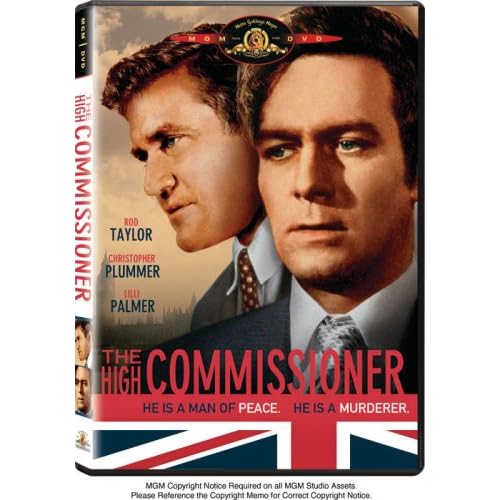
A fish out of water, one of the most reliable story ideas to use when making a movie. It's easy to take it in any direction whether it be drama, comedy or both. It seems movies lean more toward the comedy part, but dramatic ventures can be just as good, including 1968's The High Commissioner. A mostly forgotten smaller budget film with a good cast, 'Commissioner' has an Australian cop from the bush out of his element in London bringing in a murder suspect who happens to be a highly ranking government official.
I stumbled across this one on Netflix a few weeks ago and was curious why I'd never heard a thing about it. The stars are pretty good considering it is a late 1960s movie -- Rod Taylor and Christopher Plummer among others -- and the story sounded like it had a fair share of political intrigue and excitement. So what's the reasoning for its almost complete lack of popularity or even recognition? The stars are good, the intrigue is interesting, but that's it. 'Commissioner' is a straightforward thriller/action movie with a twist and turn here and there, but it doesn't possess anything major that sets it apart from the pack.
An Australian bush cop most comfortable and familiar with the Australian Outback, Scobie Malone (Taylor) receives a mission to travel to London and bring back a murder suspect from a case almost 15 years old. There's finally enough evidence to prosecute him, Sir James Quentin (Plummer), the High Commissioner of Australia currently living and working in London. Malone meets Quentin who agrees to go back to Australia with him, seemingly having waited all these years to be caught. But Quentin has one request; he's leading a commission with global trade ramifications that could unite 1st and 3rd world countries. All he needs is a few days to put it all together. Malone somewhat suspiciously agrees, not knowing that he's getting into a sticky situation with the powers that be not pleased with Quentin's intentions.
First off, I wasn't expecting the story to focus more on the global summit than Malone's mission to bring Quentin back. It was a pleasant surprise as the two plots balance each other out. A good cop no matter where he's working, Malone then devotes himself to protecting Quentin and helping him in any way he can. There's a leak in the meetings though so the Aussie cop has to narrow down the suspects, including Quentin's secretary Lisa (Camilla Sparv), his wife (Lilli Palmer), a gorgeous woman with suspicious motives (Daliah Lavi), and an American (Calvin Lockhart) who offers to help Malone in his investigation. The solution is not so surprising, but the momentum builds to the more surprising finale after that reveal.
Rod Taylor is one of my favorites, and he doesn't disappoint here as Aussie cop Scobie Malone. Cool name aside, the character is that fish out of water trying to figure everything out. He travels to London and is immediately out of place in this high-class setting. But on the other hand, he's a good cop above all else and no matter the situation he commits himself. Taylor also handles a lot of his really physical stunts, delivers some comedic one-liners and is pretty smooth in the process. Plummer drifts in and out of the story, but ever the professional he makes the most of it. The wisest choice made here is leaving his guilt up in the air until the end. Did he really kill his first wife so many years ago? If he didn't kill her, why'd he run? It all comes together nicely in the end, all the story lines converging and wrapping up with a nice tidy bow.
For a movie that's limited by a smaller budget, director Ralph Thomas balances out the limitations with some very cool location shooting. For every matte painting or indoor set standing in for a dark London street, there's an equally impressive on-location scene. One highlight has Taylor's Malone chasing down a possible hitman through the London streets and ending up at...Wimbledon, currently hosting the summer tennis major. It's a cool, fast-paced sequence as Malone realizes someone's making another attempt on Quentin's life. So for all the pretty obvious indoor set shooting, there's the good to balance it all out.
So for all the positive aspects of the movie, what's missing? I'm not quite sure. The story lacks a certain energy at times, relying too much on the talents of the actors to carry on through the slow patches. The biggest issue is that the story doesn't always know where it's going. It just drifts too much as all these characters go in and out of the story. Thankfully, the cast is up to the task so any slow parts are still entertaining enough to watch.
The High Commissioner (1968): ***/****
I stumbled across this one on Netflix a few weeks ago and was curious why I'd never heard a thing about it. The stars are pretty good considering it is a late 1960s movie -- Rod Taylor and Christopher Plummer among others -- and the story sounded like it had a fair share of political intrigue and excitement. So what's the reasoning for its almost complete lack of popularity or even recognition? The stars are good, the intrigue is interesting, but that's it. 'Commissioner' is a straightforward thriller/action movie with a twist and turn here and there, but it doesn't possess anything major that sets it apart from the pack.
An Australian bush cop most comfortable and familiar with the Australian Outback, Scobie Malone (Taylor) receives a mission to travel to London and bring back a murder suspect from a case almost 15 years old. There's finally enough evidence to prosecute him, Sir James Quentin (Plummer), the High Commissioner of Australia currently living and working in London. Malone meets Quentin who agrees to go back to Australia with him, seemingly having waited all these years to be caught. But Quentin has one request; he's leading a commission with global trade ramifications that could unite 1st and 3rd world countries. All he needs is a few days to put it all together. Malone somewhat suspiciously agrees, not knowing that he's getting into a sticky situation with the powers that be not pleased with Quentin's intentions.
First off, I wasn't expecting the story to focus more on the global summit than Malone's mission to bring Quentin back. It was a pleasant surprise as the two plots balance each other out. A good cop no matter where he's working, Malone then devotes himself to protecting Quentin and helping him in any way he can. There's a leak in the meetings though so the Aussie cop has to narrow down the suspects, including Quentin's secretary Lisa (Camilla Sparv), his wife (Lilli Palmer), a gorgeous woman with suspicious motives (Daliah Lavi), and an American (Calvin Lockhart) who offers to help Malone in his investigation. The solution is not so surprising, but the momentum builds to the more surprising finale after that reveal.
Rod Taylor is one of my favorites, and he doesn't disappoint here as Aussie cop Scobie Malone. Cool name aside, the character is that fish out of water trying to figure everything out. He travels to London and is immediately out of place in this high-class setting. But on the other hand, he's a good cop above all else and no matter the situation he commits himself. Taylor also handles a lot of his really physical stunts, delivers some comedic one-liners and is pretty smooth in the process. Plummer drifts in and out of the story, but ever the professional he makes the most of it. The wisest choice made here is leaving his guilt up in the air until the end. Did he really kill his first wife so many years ago? If he didn't kill her, why'd he run? It all comes together nicely in the end, all the story lines converging and wrapping up with a nice tidy bow.
For a movie that's limited by a smaller budget, director Ralph Thomas balances out the limitations with some very cool location shooting. For every matte painting or indoor set standing in for a dark London street, there's an equally impressive on-location scene. One highlight has Taylor's Malone chasing down a possible hitman through the London streets and ending up at...Wimbledon, currently hosting the summer tennis major. It's a cool, fast-paced sequence as Malone realizes someone's making another attempt on Quentin's life. So for all the pretty obvious indoor set shooting, there's the good to balance it all out.
So for all the positive aspects of the movie, what's missing? I'm not quite sure. The story lacks a certain energy at times, relying too much on the talents of the actors to carry on through the slow patches. The biggest issue is that the story doesn't always know where it's going. It just drifts too much as all these characters go in and out of the story. Thankfully, the cast is up to the task so any slow parts are still entertaining enough to watch.
The High Commissioner (1968): ***/****
Labels:
1960s,
Camilla Sparv,
Christopher Plummer,
Espionage,
Lilli Palmer,
Rod Taylor
Sunday, December 20, 2009
The Silent Partner
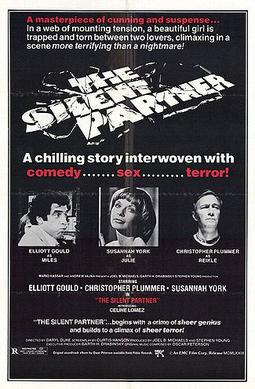
This was a Netflix recommendation based off my previous ratings, and with a few exceptions they've been pretty good about movies they'd think I'll like. 'Silent Partner' is set in Toronto and was filmed there too -- making a movie out of the U.S. always seems to be cheaper. Released in the late 70s, it has a low budget look that works well in giving the story a seedy feel to it both in terms of character and background. There are flaws, including one major plothole in the beginning, but Netflix came through with a good pick again.
Working as the head teller at a Toronto bank based in a busy mall, Miles Cullen (Elliott Gould) begins to notice clues that someone is planning a robbery of his bank. It's the holidays and more money than usual is available in the bank so Miles takes his chance. Seeing the robber preparing for his robbery -- he's working as a mall Santa Clause -- Miles pockets almost $50,000 from his drawer. So the armed robber gets away with a few thousand dollars, but thanks to Miles, he gets blamed for taking all of it. Miles thinks he's gotten away with it, but soon after he starts getting mysterious calls from the robber, Harry Reikle (Christopher Plummer), warning him that he wants all his money. So starts a cat-and-mouse game as Miles and Reikle try to outsmart each other.
The high point of the movie by far is the interaction between Gould's Cullen and Plummer's Reikle. From the start, it is very clear that Reikle is more than a little crazy and capable of just about anything if it gets him his money. Two scenes in particular jump out, Reikle cornering Miles in his apartment, and Reikle later using Miles' fish tank for a rather uncomfortable torture scene. If anything, Plummer is underused as his possibly bisexual or just very 70s villain drifts in and out of the story. As the 'good guy,' Gould is the opportunistic criminal who still remains sympathetic mostly because Plummer is so downright scary.
This back and forth retaliation continues to escalate including a friend of Reikle's, Elaine (Celine Lomez), joining the conflict in a plot twist that if you don't see coming, you should be ashamed of yourself. Parts in the middle do drag a bit (usually when Plummer isn't around), and Gould even seems surprised that the bank robber is coming after him for the cash. What did he think would happen? My only other major complaint is how Cullen catches on to the plan by finding a carbon copy of a note Reikle supposedly slipped to another teller. Has he been robbing other tellers, but if not that, did he just happen to lose that note when he was practicing for the real deal? Who knows for sure, but it did bug me.
Some reviews mentioned this 70s thriller as having a Hitchcockian feel, and I wouldn't disagree. The story could be streamlined some more, especially Cullen's on again off again relationship with another bank employee, Julie, played by the very lovely Susannah York. After the initial robbery, it's almost 30 minutes before the conflict arises. Maybe director Daryl Duke was going for a slow burn to try and lull the viewer into a feeling of security only to unleash Plummer's villain, but if you ask me it takes too long. These are just minor complaints because otherwise I really enjoyed this movie.
Slow-paced at times, but this offbeat, little known Canadian crime thriller (how often do you hear that?) has a lot going for it including an ending that confused me at first but worked when I went back and reviewed it. That ending also adds another odd chapter into Plummer's character, but I don't want to spoil it here. It's got a little bit of everything from random, unnecessary 70s nudity (it seems every female member of the cast signed on for a topless scene), and Candy making an appearance as a clueless bank teller, but what makes it worth watching is Elliott Gould and Christopher Plummer as the leads. Definitely worth checking out if you haven't heard of it. Sorry no trailer on this one, there wasn't even one on the DVD.
The Silent Partner (1978): ***/****
Labels:
1970s,
Christopher Plummer,
Elliott Gould,
John Candy,
Susannah York
Friday, August 28, 2009
Triple Cross
Behind the lines spy stories from WWII can be hard to mess up when translating stories to the big screen. There's typically going to be a strong villain, Germans or Japanese depending on the perspective, and a natural tension that livens up any story. Based on the true story of British criminal/spy Eddie Chapman, Triple Cross drags at times but ultimately comes through with a quality WWII spy story.
In the months leading up to WWII, British safecracker extraordinaire Eddie Chapman (Christopher Plummer) is stealing his way across the country, taking anything and everything he can from personal safes in houses and apartments. But vacationing on the Channel Islands, Chapman is captured and thrown into jail where months later he still resides when the Germans invade and take over. Fed up with his lot, Chapman offers his services to the German army as a spy. His English background and speaking abilities would clearly serve the Third Reich.
After some initial debates and tests, Chapman is sent to work a specialized German intelligence unit led by Baron Von Grunen (Yul Brynner), a career soldier and German colonel who doesn't necessarily agree with the Fuhrer and the Nazi party but nonetheless does his job. With the Baron's team are the Countess (Romy Schneider) who starts a relationship with Chapman, partially for herself but also for the job, and Colonel Steinhager (Gert Frobe), a former police officer suspicious of Chapman's intentions. The British turncoat goes through training and ends up as a trusted agent to Von Grunen, but what are his motivations?
Credit goes to Plummer for doing so well with this part because up until the 1:00-1:15 mark, you're not sure of his intentions. Is he a loyal Brit taking advantage of the situation to get back to England or does he intend to help the German war effort? Or is Chapman just looking out for himself and a chance at a big payday courtesy of the British and German intelligence outfits? Plummer plays the part so smoothly it's hard to figure out the character. He typically played a character like that, extremely smug, often overconfident that makes it hard to like him, and even when the intentions are revealed, you're not quite sure if you can believe them.
Directed by Terence Young and with Frobe as a supporting cast, the James Bond trio is completed with the casting of Claudine Auger (Domino in Thunderball). Kinda pointless trivia, but I thought worth pointing out. Trevor Howard also makes an appearance as the 'Distinguished Civilian,' no joke, a British higher-up working with Chapman on his possible collaboration with the British and Germans. It's the typical staunch, sophisticated British upper class role that Howard played so often and so well. Brynner too stands out in the cast as the intelligence colonel who sees the direction the war is going.
What I liked about Triple Cross was that the story doesn't settle for the spy adventure status-quo. One scene really jumped out for me when the Germans supposedly send Chapman out on his first mission, parachuting him into England. Thinking everything is legit, Chapman abandons his orders upon landing only to discover he's been dropped in Nazi-occupied France as a test. Scrambling to send the radio signal he was supposed to transmit an hour earlier, Eddie finds himself in a race for his life. And that's what is so nerve-wracking about spy movies. One slip up, even just a throwaway comment, can bring on your doom and when that dooms comes from the Nazis, you know you're in for it.
At times a little slow-moving and hard to follow, Triple Cross isn't the perfect spy thriller or even a very good one, but it is entertaining. Christopher Plummer and Yul Brynner provide memorable leads, and the based on a true story (loosely from what I've read) provide a nice backdrop for this WWII thriller. It seems the US version has been cut some so that might explain some flaws, but it's still worth checking out in its current form.
Triple Cross (1966): ***/****
Sunday, May 24, 2009
Battle of Britain
Heading into May, I had this plan to watch and review a bunch of WWII movies in honor of Memorial Day. Well, Memorial Day is tomorrow so that's not going to happen, but I can still get a couple reviews in at least.Battle of Britain (1969), directed by Guy Hamilton of James Bond fame, is everything that was good and bad about the epic war movies to come out of the 60s, and really epic movies in general. Growing up in the good old USA, the early parts of WWII were never taught as much as the post-Pearl Harbor years once America got involved in the war so this movie serves as a good introduction to the earlier years of the war. Immediately following the Dunkirk disaster, it appears that Hitler and the Third Reich are one good push away from winning the war. All that's needed for that final push is the invasion of England.
But before a cross-channel invasion can take place, Herman Goring and his illustrious Luftwaffe must knock out the Royal Air Force so an invasion force can go across the channel relatively unmolested. For the RAF though, they're heading into a battle with the odds heavily stacked against them with just 600 pilots to Germany's 2,500. As Laurence Olivier's Air Chief Marshal Dowding so eloquently but effectively states, "Our boys are going to have shoot down their boys at a rate of 4 to 1." So begins the battle of Britain, here's the film's opening, a good sum-up of what's happened and what's to come.
With a movie that focuses exclusively on a key moment in Britain's history, the benefits are obvious. Director Hamilton collects a who's who of British actors to fill out his cast. Olivier and Trevor Howard star as Dowding and Air Vice Marshal Park, the higher-ups in the RAF who oversee the desperate fight in the air. As the pilots, Micheal Caine, Robert Shaw and Christopher Plummer lead the fight with Ian McShane and Edward Fox as two pilots in Shaw's squadron. And then making short appearances are Curd Jurgens, Harry Andrews, Patrick Wymark, Michael Redgrave, Kenneth More, and Ralph Richardson. If that cast doesn't impress you at least a little bit, this might not be your movie.
As I've covered before though, the flaw with such a huge cast is the characterization which suffers. These characters are more outlines of historical figures than flesh and blood people. Plummer stands out mostly because he's given a love interest, the beautiful Susannah York, so we find out something about his squadron leader. You're not hoping Caine's Squadron Leader Canfield makes it, you're hoping Michael Caine makes it. The same with Shaw and Plummer. But that's a minor flaw for me, not something that should stop you from seeing the movie.
And surprise, surprise, what's the actual reason for seeing a movie built around WWII in the air? If you answered 'dogfights' and lots of aerial footage, pat yourself on the back. It's a pre-CGI movie that relies on actual footage being shot of these pilots in action, the British Spitfires tangling with the German Stukas, here's one great scene with Goring asking his officers what they need to win. The film will sink or swim for most viewers on the dogfights, which do eat up most of the movie's 132-minute running time. The best is saved for last appropriately enough as the British throw all their reserves into the battle in one last, desperate ploy to stop the Luftwaffe. It's a 4-minute scene with no dialogue, no sound at all other than Ron Goodwin's score, sampled here, a very British score indeed.
Hamilton's movie then is not so much about the characters as the battle itself. Obviously, without the pilots, WAFs and coast watchers, the battle for Britain could not have happened. But Hamilton goes for the spirit of these people. Maybe we don't know much about them, their personal backgrounds, but they're fighting for what they believe in to stop a power-hungry Adolf Hitler as he swept across Europe. If these pilots hadn't held off the Luftwaffe and ultimately won the battle, who knows how different the world would be right now? It's a frightening thought. And that's why Battle for Britain works, even with its flaws.
Still wavering? Here's a trailer, a long one at that, and a longer preview of the movie as a whole. A WWII movie not as well known as many war movies of the time, but one definitely worth checking out if you've missed it up to now.
Subscribe to:
Posts (Atom)