The Sons of Katie Elder

The Sons of Katie Elder
"First, we reunite, then find Ma and Pa's killer...then read some reviews."
Showing posts with label Curd Jurgens. Show all posts

Monday, June 10, 2013

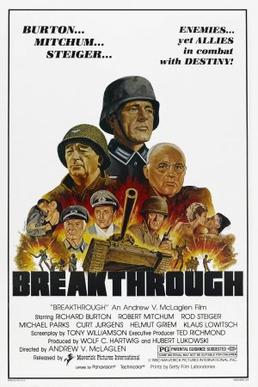
Breakthrough (1979)

Released in 1977, Sam Peckinpah's Cross of Iron is a forgotten masterpiece, a war movie that doesn't get the credit it deserves. Not necessarily remembered as a classic, it ends on a particularly downbeat if effective ending, making the news that there's a sequel kinda hard to believe. I'm a big fan of Peckinpah's original so here goes with the unlikely follow-up, 1979's Breakthrough.

Under a withering Russian attack, German forces are retreating all along the Western Front. Among them is Sgt. Rolf Steiner (Richard Burton), a hardened veteran who's seen all the fighting can offer throughout the war. Amidst the fighting, he's granted a 14-day leave in Paris, but just as he settles in, the Allies attack at Normandy with his division transferred to the fighting. Upon catching up with his men, Steiner is given a dangerous mission that could ultimately bring the war to an end, but at minimum could save thousands of lives. In between Allied and German lines, Steiner meets an American officer, a tanker, Col. Rogers (Robert Mitchum), who isn't sure whether he can believe what Steiner is telling him. A decision must be made though quickly with an Allied offensive imminent.

In terms of original to sequel, this 1979 WWII flick from director Andrew V. McLaglen bears little resemblance to its predecessor. The ending in 'Iron' is open for interpretation as to whether certain characters survive, but this sequel answers that question (They make it by the way). And other than character names and that this too is a World War II movie, there are no real unifying links. It seems an odd movie and storyline to continue, but whatever, it happened so here we sit. It's not a particularly good movie -- most reviews rip it pretty mercilessly -- but I managed to get some enjoyment out of it. Then again, I'm a sucker for basically any western and war movie. You've been warned!!!

So now that I've established that I liked this movie, let's move ahead with ripping the movie some! While I like many of McLaglen's films (The Wild Geese, The Devil's Brigade), I can admit he was far more a workmanlike director than a master filmmaker. To say the story drifts a little bit would be a vast understatement. It starts in Russia, moves to Paris, jumps to Normandy and involves German and Allied knowledge of assassination attempts on Hitler. Oh, and Steiner's commanding officer, Major Stansky (Helmut Griem), is power hungry and doesn't care who gets caught up in the killing, civilians and innocents alike. The budget is obviously pretty limited with a fair amount of stock footage used from other war movies of the era. The score is atrocious, an oddly horrific mix of spaghetti western tones, country music, odd rock and roll notes, and hippie-psychedelic noises. It's not just bad, it's distracting, and that's significantly worse.

Here's the issue that I'm noticing in a lot of reviews. The cast here has some pretty impressive name recognition -- more than Peckinpah's original -- but it's not necessarily good performances. It's a fair criticism that most of the big names gathered are clearly phoning it in. On the other hand....oh, Richard Burton and Robert Mitchum! Replacing James Coburn, Burton does a decent job as war-weary Steiner. Mitchum is clearly not too interested in the part, but I like Mitchum so there. Also look for Rod Steiger, pissed off as usual and screaming orders as an American general, Webster. Michael Parks has a good supporting part as Sgt. Anderson, Mitchum's assistant and jeep driver. Klaus Lowitsch returns from 'Iron' as Cpl. Kruger, Steiner's fellow NCO and close friend. Curd Jurgens also plays a familiar role, an aristocratic German general frustrated with Hitler's leadership.

Schizophrenic story with far too much going on, aging stars with less than spectacular acting jobs, and a budget that's limited in basically all aspects. The action is okay, including the finale as Maj. Stansky attempts to set up an ambush for an attacking American tank battalion, but that's really the only memorable set piece. Why did I even remotely like this movie? I have no freaking idea. I was entertained throughout -- maybe because of the badness -- and that's all I'm looking for. Also worth mentioning, do a shot every time Mitchum asks about the anti-tank emplacements. You'll be drunk in minutes.

Breakthrough (1979): ** 1/2 /****  

Friday, April 6, 2012

The Assassination Bureau

I can't think of a movie that surprised me more recently than 1969's The Assassination Bureau. The Netflix description of an international company that performs murders/assassinations for hire sounded like a drama, maybe an action movie. Or as I figured out, maybe that's just my head jumping to conclusions. I assumed it was a drama or action flick. So imagine my surprise when I found out it instead was a period piece mixed in with a screwball comedy. Oddly enough? It works.

In the early 1910s in London, an aspiring journalist, Sonya Winter (Diana Rigg), approaches a newspaper headed by Lord Bostwick (Telly Savalas) with a story idea. She has evidence of a murder-for-hire company that could date back centuries and has managed to arrange a meeting with its leader, Ivan Dragomiloff (Oliver Reed). Her catch? She intends to put a contract on Ivan himself. Seeing a chance to do some housecleaning among his own company, Ivan oddly enough agrees, challenging the other members of Assassination Bureau, Limited to a proposal. Can he kill all of them before they kill him? Secrets and twists await, more than Sonya originally counted on.

Can you see now why I was more than a little confused? From director Basil Dearden, the story certainly doesn't scream out screwball comedy. But using the jumping off point of a murder-for-hire company and its inherent very dark comedy, 'Assassination' somehow and some way works. I was expecting a late 1960s thriller set in modern times and got the complete opposite, a period piece set in 1910s Europe. The story bounces from London, Paris, Vienna, Venice and Zurich with a colorful lavish look. The sets are impressive, the costuming period accurate, and the screwball aspect not overdone thankfully. 'Dark' and 'screwball' don't always work in terms of comedy, but Dearden's film manages to put the two together.

It is a unique plot device of having a "company" like the Assassination Bureau at work, keeping tabs on the world. Reed's Ivan leads a committee of international representatives from around Europe and Asia including Germany, England, France, Austria, Russia, Switzerland and several more. Their only policy is simple...there must be a moral reason for killing. Ivan lives up to that standard, but his committee doesn't live and die by its principles. Semi-twist coming....Savalas is his vice commissioner. Come on, did you think Telly Savalas was around to play a newspaper editor? His Lord Bostwick is interested in cash, control and power, not Ivan's ideological beliefs. Some of the Bureau's members include General von Pinck (Curd Jurdgens), the militaristic German, Lucoville (Philippe Noiret), the woman-chasing Frenchman, Weiss (Warren Mitchell), the efficient Swiss, Spado (Clive Revill), the life-loving Italian, and Muntzof (Vernon Dobtcheff), the moping Russian among a few others. Comedy, drama or action, 'Assassination' gets points for originality.

The murder-for-hire story was one thing. I can buy that as a dark comedy. But as that surprise washed over me, I think the biggest reason for my thinking was the casting of Oliver Reed. A notorious partier/drinker/carouser, Reed does not strike me as someone to star in a dark comedy with romantic comedy undertones. He was typically the definition of intense so it was a welcome surprise to see him play a lighter role, and he doesn't disappoint. He's genuinely funny, can woo Rigg's Sonya, and is a master of disguise as he unleashes his attacks on his committee members turned opponents. Rigg as Sonya is the aspiring journalist who doesn't seem to figure out that both sides are playing her...to a point. She makes a good pair with Reed too as they jump from country to country in Europe. Also look for Italian beauty Annabella Incontrera as Senora Spado, the wife of one of the Bureau members who's got her own plans.

With obviously a much darker edge, 'Assassination' reminded me in many ways of 1965's The Great Race. The highlights are the impressively scaled set pieces. The intro to the Bureau has shades of a comedic James Bond movie while a madcap chase through Lucoville's high class house of ill repute gets the screwball aspect of the chase going at full speed. The comedy is often off-screen, allowing Reed, Rigg and Savalas to sell the humor with their reactions. Resorting to some action genre conventions, the finale is full of action as Reed stumbles onto Savalas' plan to take over Europe, a nice tie-in for history fans with the start of WWI and a zeppelin playing a key role. So what can I say? Sometimes the movies that surprise you are the best ones. An underrated, funny flick with a great cast.

The Assassination Bureau <---Youtube clip (1969): ***/****

Wednesday, November 10, 2010

The Enemy Below

While a majority of WWII movies cover the campaigns on land and air in both the European and Pacific theaters, there's a cool little genre within the WWII genre, the submarine movie.  The 1950s were ripe with these flicks of submarine commanders in the Atlantic or Pacific aiding the war effort on either side.  These submarines were such a new technology that audiences ate the movies up, and there was a lot of them.  I'd seen many of them and finally watched 1957's The Enemy Below this week.

What took me so long in watching this movie was that most of the 1950s WWII movies from major studios were pretty flat, interested more in the spectacle of what was on the screen than making it interesting story-wise.  There were these great premises, loaded casts, and then that was it.  As a viewer, we were supposed to be content with just watching what was on-screen without having anything invested in it.  Director Dick Powell expands on just the visual, delivering a great cat and mouse submarine story that also wisely tells the story from both the German and American perspectives. 

It's midway through WWII, and the U.S.S. Haynes is on patrol in the south Atlantic.  A new commander, Capt. Murrell (Robert Mitchum), has taken over in recent weeks, but the crew is worried about the new officer possibly being a jinx having seen no action since he came on board. Seemingly miles away from the action, the radar picks something up, leading Murrell to think the destroyer has found a German U-boat on patrol.  Playing it coy, Murrell holds his ship back, waiting to see what the U-boat does.  A few miles ahead, German commander Von Stolberg (Curd Jurgens) is aware of what's following him but with an important mission tasked to him knows he can't play his hand too early. With help days away for either crew, the two captains prepare for a battle that could end with both ships at the bottom of the ocean.

Right off the bat, I liked this movie because of its intelligence.  This is a story interested in battle tactics and strategies where other movies would just show a destroyer chasing down a U-boat with no explanation offered.  'Enemy' tries to keep the viewer at a point where they always know what's going on, and in that way is a sign of things to come with other sub movies like Das Boot or The Hunt for Red October.  Throw out the overdone score from composer Leigh Harline because the natural sounds are more appropriate. It is the sounds of radar and sonar pinging, the ca-chung of a depth charge being fired, the silence of a crew waiting for an explosion that makes the movie almost unbearably tense to watch. You feel like you're there with Mitchum's crew waiting for an inbound torpedo to be sighted, or Jurgen's crew waiting for a depth charge to rip the submarine apart.

A title card at the end of the movie thanks the U.S. Navy and the Department of Defense for all their cooperation in making this movie, and do they ever deserve it.  Besides some obvious uses of miniatures late in the movie's finale, most of the movie looks to have been filmed on an actual U.S. destroyer at sea.  Just like the natural sounds working their magic, a movie gets a ton of credibility when you actually see star Robert Mitchum at the conning tower of a destroyer on open water.  Even better, Mitchum in frame why a few hundred yards back a whole screen of depth charges go off, jetting water several hundred feet straight up into the air, almost like you can feel the blast of the water on your face.  Other similar movies might have cut away to some stock footage, but 'Enemy' shows the process as realistically as possible with the cast involved.  Good choice, Mr. Powell.

Now if it was just 97 minutes of this footage, it would get tiresome, but the cat and mouse game that ensues works so well because Mitchum and Jurgens in the lead roles.  I will always give a war movie a try that attempts to show the war from both sides, not just one or the other.  We get to see that there were good and bad soldiers/sailors on either side.  Depending on the story, there is no need to demonize the enemy.  Here, Mitchum and Jurgens are human beings, not killing machines with a bloodlust.  Mitchum's Murrell lost his wife when a German U-boat sunk the ship they were on, and Jurgens saw both of his sons killed for the Third Reich.  Seeing these characters do their job is half the fun of the movie.  They do it because it is their job, and they want to protect their crews.  The only way to do that is to take out the enemy right in front of them.

The cat and mouse game between the two captains highlights the movie and helps it through the parts that lean toward the tedious at times.  Each man can predict what the other is doing, not because the actions are predictable or easy to figure out; they just know exactly what they would do in that situation.  The chase continues over hundreds of miles and several days as either man tries to get a hand up on the other.  The ending goes for a message of hope that is fitting considering the story that led up to the finale.  There were two ways it could go. One, both ships go down, or two, one side wins.  'Enemy' finds a nice middle ground, but I can't spoil it here.  It's a moving ending to an above average story. I'm also pretty sure the DVD cover is not Jurgens on the right, but who knows?

The Enemy Below <---trailer (1957): ***/****

Sunday, May 24, 2009

Battle of Britain

Heading into May, I had this plan to watch and review a bunch of WWII movies in honor of Memorial Day. Well, Memorial Day is tomorrow so that's not going to happen, but I can still get a couple reviews in at least.

Battle of Britain (1969), directed by Guy Hamilton of James Bond fame, is everything that was good and bad about the epic war movies to come out of the 60s, and really epic movies in general. Growing up in the good old USA, the early parts of WWII were never taught as much as the post-Pearl Harbor years once America got involved in the war so this movie serves as a good introduction to the earlier years of the war. Immediately following the Dunkirk disaster, it appears that Hitler and the Third Reich are one good push away from winning the war. All that's needed for that final push is the invasion of England.

But before a cross-channel invasion can take place, Herman Goring and his illustrious Luftwaffe must knock out the Royal Air Force so an invasion force can go across the channel relatively unmolested. For the RAF though, they're heading into a battle with the odds heavily stacked against them with just 600 pilots to Germany's 2,500. As Laurence Olivier's Air Chief Marshal Dowding so eloquently but effectively states, "Our boys are going to have shoot down their boys at a rate of 4 to 1." So begins the battle of Britain, here's the film's opening, a good sum-up of what's happened and what's to come.

With a movie that focuses exclusively on a key moment in Britain's history, the benefits are obvious. Director Hamilton collects a who's who of British actors to fill out his cast. Olivier and Trevor Howard star as Dowding and Air Vice Marshal Park, the higher-ups in the RAF who oversee the desperate fight in the air. As the pilots, Micheal Caine, Robert Shaw and Christopher Plummer lead the fight with Ian McShane and Edward Fox as two pilots in Shaw's squadron. And then making short appearances are Curd Jurgens, Harry Andrews, Patrick Wymark, Michael Redgrave, Kenneth More, and Ralph Richardson. If that cast doesn't impress you at least a little bit, this might not be your movie.

As I've covered before though, the flaw with such a huge cast is the characterization which suffers. These characters are more outlines of historical figures than flesh and blood people. Plummer stands out mostly because he's given a love interest, the beautiful Susannah York, so we find out something about his squadron leader. You're not hoping Caine's Squadron Leader Canfield makes it, you're hoping Michael Caine makes it. The same with Shaw and Plummer. But that's a minor flaw for me, not something that should stop you from seeing the movie.

And surprise, surprise, what's the actual reason for seeing a movie built around WWII in the air? If you answered 'dogfights' and lots of aerial footage, pat yourself on the back. It's a pre-CGI movie that relies on actual footage being shot of these pilots in action, the British Spitfires tangling with the German Stukas, here's one great scene with Goring asking his officers what they need to win. The film will sink or swim for most viewers on the dogfights, which do eat up most of the movie's 132-minute running time. The best is saved for last appropriately enough as the British throw all their reserves into the battle in one last, desperate ploy to stop the Luftwaffe. It's a 4-minute scene with no dialogue, no sound at all other than Ron Goodwin's score, sampled here, a very British score indeed.

Hamilton's movie then is not so much about the characters as the battle itself. Obviously, without the pilots, WAFs and coast watchers, the battle for Britain could not have happened. But Hamilton goes for the spirit of these people. Maybe we don't know much about them, their personal backgrounds, but they're fighting for what they believe in to stop a power-hungry Adolf Hitler as he swept across Europe. If these pilots hadn't held off the Luftwaffe and ultimately won the battle, who knows how different the world would be right now? It's a frightening thought. And that's why Battle for Britain works, even with its flaws.

Still wavering? Here's a trailer, a long one at that, and a longer preview of the movie as a whole. A WWII movie not as well known as many war movies of the time, but one definitely worth checking out if you've missed it up to now.