The Sons of Katie Elder

The Sons of Katie Elder
"First, we reunite, then find Ma and Pa's killer...then read some reviews."
Showing posts with label Susannah York. Show all posts

Friday, May 30, 2014

Sands of the Kalahari

Ah, the survival film, the type of movie that makes you think how you would react in a life and death, do or die situation. Me? I'd probably wet myself and die of fright in most situations. Adrift at sea, stranded anywhere from a snow-covered mountain to a barren, savage desert wasteland, it all sounds pretty hellish to me. A straightforward story of survival with a hugely dark message, enter 1965's Sands of the Kalahari.

Traveling across Africa, Grace Munkton (Susannah York) is at the airport waiting for her flight when over the loudspeaker she hears her flight has been indefinitely postponed. She heads to a nearby hotel and is woken up hours later by a knock at the door. Several passengers have agreed to pay a pilot, Sturdevan (Nigel Davenport) with his own plane to fly them to their destination. With five passengers, Sturdevan takes off but hours out from the airfield they fly directly into an immense swarm of locusts. The engines give out, the plane crash-landing in the middle of the African desert. Now with limited supplies, Grace, Sturdevan and four other individuals must survive. They're trapped in the middle of the desert with no indication of where they are, where they should head. Making it worse? Sturdevan was unable to report his position before crashing. Can the group survive? Can they survive each other?

'Kalahari' comes from director Cy Endfield (who also wrote the screenplay) and star Stanley Baker who had worked together a year earlier on the very successful Zulu. It keeps the African location, but from there the similarities end. This flick was filmed on-location in South-West Africa and Spain, an expansive, sun-drenched look to the desert survival story. The music is kept to a minimum, the focus almost entirely on the survival aspect. It is based off a novel by author William Mulvihill and gets points for some wise choices. It's unglamorous, gritty, cynical and dark. It explores the possibilities when a situation is quite literally life and death. How would you respond? Would you freak out? Would you do your best to remain calm, hold out for hope and rescue? It's hard not to at least think of this story on a personal level in that sense.

The survivors certainly cover the gamut in terms of variety. We get a female character, an old man, strapping young man, the educated, the physical, the bullying. A little society pops up among the survivors who find a relative life when they stumble across a cave carved into an immense black rock mountain, a water hole nearby with a limited food supply. Baker plays Bain, an alcoholic engineer who's injured in the crash. Davenport has a character that's odd across the board in terms of personal choices, the pilot Sturdevan an interesting, flawed character. York adds the interesting element as the woman, drawn to Stuart Whitman's O'Brien, a big-game hunter who's traveling with two high-powered rifles in tow. Whitman is the star here, his O'Brien realizing how tenuous their grasp on survival is, and he's willing to make some harsh decisions. There's also Harry Andrews as Grimmelman, an aging German man with desert experience, and Theodore Bikel as Dr. Bondrachai, a professor with tons of knowledge but not necessarily life experience.

I liked this movie enough to seek out the novel from Mulvihill. I read it over a couple days, an entertaining, interesting read that I enjoyed. Endfield's adaptation is odd in a sense, trying to add some more profound outlooks on life. He doesn't just show the desperation for survival. He has to tell us about it. Everything is spelled out for us. Campfire scenes try to explain what's happening, about their situation, about how they're changing. I think they're trying to be profound in their analysis of humans, survival and that desperation that sets in with death on the line. Just show it though. These long, expository scenes of dialogue become tedious and worse than that, condescending.

If there's a weakness, it's that the story isn't as interested in spelling things out. 'Kalahari' leaves a couple loose ends in the finale about what happens to certain characters. The ending itself is perfect in its execution. There's some good twists along the way, some good performances, but it's also a tad slow-moving and drifts along at parts. I wanted to really like this one, but I came away with mixed feelings. I'll recommend it, but this is a decent movie that could have been significantly better.

Sands of the Kalahari (1965): ** 1/2 /****

Wednesday, March 13, 2013

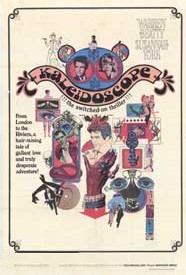
Kaleidoscope

I love heist and caper films. I tolerate romantic-ish comedies. So while I was intrigued by 1966's Kaleidoscope when it popped up on Turner Classic Movie's schedule in January, I was also a tad bit worried. Would the two different genres combine to be good? Okay, that's not fair. I was looking for a movie I don't hate. I'm a cheap date when it comes to most movies.

Making his way across Europe and countless cities, Barney Lincoln (Warren Beatty) is taking down one casino after another, and his riches are growing quickly. While he's in London, Barney meets Angel (Susannah York) on the streets and quickly falls for her. Angel, on the other hand, isn't interested at all in the smooth American....at first. After a chance encounter at a casino, Angel starts to tag along as Barney visits one casino after another. Only then does she start to question how he keeps winning and never loses. The young couple are falling for each other, but Angel has other plans, calling her father, McGinnis (Clive Revill), a Scotland Yard investigator, to look into things. What exactly has Barney gotten himself into?

So go figure, but heist-caper meets romantic comedy works surprisingly well. No, this is absolutely nothing new or innovative. An upper class, suave, well-to-do man has the hots for a woman who is perfect, but she wants nothing to do with him? I, for one, did not see that coming. (That was sarcasm by the way). It works because of Susannah York and a pre-Bonnie and Clyde Warren Beatty, their chemistry evident from the first scene. It's fun to see them go back and forth, always trying to one up the other as they start to realize they have genuine feelings toward each other. It's good, but not great, the first 30-40 minutes a little slow going. Never bad, just could have been better and more entertaining in the first half of the flick.

Overall, it's got a lot of little things going for it. Like several recent reviews -- Jack of Diamonds, Danger: Diabolik -- I've posted, Kaleidoscope has that always fun, always interesting 1960s style. With its lightly toned story (the "danger" is never really in question), Kaleidoscope globe trots around Europe. England is used as the backdrop for a majority of the story with some green-screen shots inserted here and there to show Barney's other stops. The score from composer Stanley Myers is solid and light without being too light-hearted. Give it a listen HERE. Even the scene to scene transitions are cool, the visual of a spinning kaleidoscope helping make the jumps.

While this is obviously Beatty and York's movie, I was more drawn to a handful of supporting players. Revill as Inspector MacGinnis is especially good. He's recruiting Barney for a dangerous mission that any James Bond fan will surely appreciate. Have you read Casino Royale? Seen the movie? Then you've seen this thinly veiled duplicate of the original Ian Fleming story for 007.  McGinnis needs Barney to break the bank of a narcotics supplier, Dominion (Eric Porter), who's fallen on difficult times financially. His trick? Barney snuck into Kaleidoscope, a playing card company and marked the card plates so he can read the cards where no one else can. Those cards happen to be at casinos and clubs across Europe, including Dominion's club. Revill brings some much-needed drama, Porter has some fun as the smooth, underplayed villain, and Murray Melvin plays Aimes, McGinnis' goofy assistant and dead-shot with a rifle.

It's in the last half of the movie that Kaleidoscope finds its rhythm in its James Bond-knock-off. There is something inherently simple and tense about a card game with hundreds of thousands and millions of dollars resting on one hand of cards. Director Jack Smight has some cool techniques with his camera, following the action around in long, unedited cuts, then zooming in for extreme close-ups. Watch some of the poker scenes HERE (SPOILERS). Generally underplayed and understated, the energy gets ratcheted up in the final act as Barney has it out with Dominion and his henchmen at a huge English countryside manor. I didn't love this movie early on, but I really liked the second half. Surprisingly good stuff. Worth checking out.

Kaleidoscope (1966): ***/****

Saturday, February 6, 2010

Tunes of Glory

Sometimes I can't help but think that British movies -- compared to Hollywood movies -- just get it. No over the top action, no fancy CGI or special effects, just that old reliable...acting. All it can take to pull a viewer in is a tour-de-force performance from an actor or actress, and you're hooked. Production values can be slim to none, but as long as the acting is on target chances are the movie will be a winner.

There I go again with vague, sweeping generalities, but British movies seem to rely more on acting above all else, with actors like Peter O'Toole, Richard Burton, Richard Attenborough, and of course, Alec Guinness. The English actor was a chameleon when it came to his roles, and I can't help but wonder if he'd be more well-known for his overall ability if he hadn't been in Star Wars. So many people associate him with Obi-Wan Kenobi that the rest of his movies have been somewhat forgotten. But in 1960's Tunes of Glory, Guinness once again shows how strong an actor he really was.

In command of a Highlands battalion in the years following WWII, Major Jock Sinclair (Guinness) is loved by his men. He led them through WWII in Europe and is really just one of the men...albeit with a higher rank. Sinclair is not the strictest of commanders and lets smaller things go in lieu of the bigger picture, and for that reason he's loved by his men. The battalion receives a new commander, Colonel Barrow (John Mills), an officer who spent much of the war in a German POW camp with years of desk duty prior to that. Barrow is a stickler for details, doing everything by the book. His command style clashes with Sinclair and what the battalion is used to. A division forms and the conflict comes to a rise when Sinclair strikes a corporal (John Fraser) who has been seeing his daughter (Susannah York).

Should Barrow bring his second-in-command up on charges? He's had prior issues with Sinclair so a court martial might seem like personal revenge. As well, a trial would bring disgrace to the battalion. But if he doesn't, Barrow is going up against everything he believes in. Whatever the Colonel decides to do could very well tear apart the unit from the inside out. This is a story definitely characteristic of a slow-burn, a plot that keeps on building and piling on. As a viewer, you know there will be some sort of confrontation but in what sense? I for one was completely caught off guard by the ending, a downer in every sense of the idea, but one that works and the most appropriate one too. A happy ending would seem out of place here.

This is a movie dominated by two men, Guinness and Mills, and dominated in a good way. Guinness' Sinclair is built up as the man to side with; he's loved by every one from family to fellow officers to his soldiers. There's a vibe off the character though, a little full of himself and quick-tempered. Mills is the toy soldier, the desk jockey who's never seen combat but is tortured still by his time spent in a German POW camp. He doesn't interact well with the men and gives off a sense of superiority to soldier and officer alike. What's interesting in the execution is how the story develops and how our perceptions change -- or at least mine did -- as we learn more about these two men.

With basically the whole story set in this extravagant barracks the battalion lives in and only a few venture outside the wall, the conflict drives things along thanks to the supporting cast. Some of the other battalion's officers include Dennis Price, Allan Cuthbertson, Duncan Macrae, and Paul Whitsun-Jones, some siding with Sinclair and others Barrow. Gordon Jackson especially rises above the rest as Capt. Jimmy Cairns, the battalion adjutant and a man loyal to his commander to a fault. It's one of those supporting roles that doesn't have much in the way of lines but ends up being memorable nonetheless.

No frills moviemaking at its finest. There is nothing flashy about the proceedings, but the story makes this movie special and really worth checking out. Two very different men, but both are strong-willed and even pigheaded when it comes to getting what they want. A Youtube user was kind enough to post the movie into segments, starting here with Part 1 of 10. Well worth your time if you don't mind sitting down at the computer for 105 minutes. Guinness, Mills, and a fine supporting cast don't disappoint.

Tunes of Glory <----trailer (1960): ***/****

Sunday, December 20, 2009

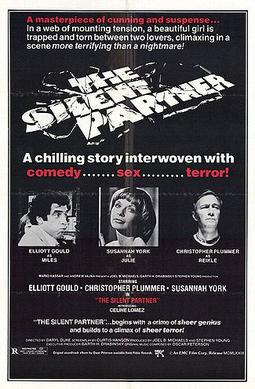
The Silent Partner

How about this for an odd list of elements in a crime thriller? A possibly bisexual bank robber, an incredibly odd use of a fish tank in a murder, random scenes of nudity, a pre-star John Candy making a cameo, and Elliott Gould as a clever bank teller with an agenda. Combine all that, and what do you get? A crime thriller from Canada that has completely flown under the radar since its release in 1978, The Silent Partner.

This was a Netflix recommendation based off my previous ratings, and with a few exceptions they've been pretty good about movies they'd think I'll like. 'Silent Partner' is set in Toronto and was filmed there too -- making a movie out of the U.S. always seems to be cheaper. Released in the late 70s, it has a low budget look that works well in giving the story a seedy feel to it both in terms of character and background. There are flaws, including one major plothole in the beginning, but Netflix came through with a good pick again.

Working as the head teller at a Toronto bank based in a busy mall, Miles Cullen (Elliott Gould) begins to notice clues that someone is planning a robbery of his bank. It's the holidays and more money than usual is available in the bank so Miles takes his chance. Seeing the robber preparing for his robbery -- he's working as a mall Santa Clause -- Miles pockets almost $50,000 from his drawer. So the armed robber gets away with a few thousand dollars, but thanks to Miles, he gets blamed for taking all of it. Miles thinks he's gotten away with it, but soon after he starts getting mysterious calls from the robber, Harry Reikle (Christopher Plummer), warning him that he wants all his money. So starts a cat-and-mouse game as Miles and Reikle try to outsmart each other.

The high point of the movie by far is the interaction between Gould's Cullen and Plummer's Reikle. From the start, it is very clear that Reikle is more than a little crazy and capable of just about anything if it gets him his money. Two scenes in particular jump out, Reikle cornering Miles in his apartment, and Reikle later using Miles' fish tank for a rather uncomfortable torture scene. If anything, Plummer is underused as his possibly bisexual or just very 70s villain drifts in and out of the story. As the 'good guy,' Gould is the opportunistic criminal who still remains sympathetic mostly because Plummer is so downright scary.

This back and forth retaliation continues to escalate including a friend of Reikle's, Elaine (Celine Lomez), joining the conflict in a plot twist that if you don't see coming, you should be ashamed of yourself. Parts in the middle do drag a bit (usually when Plummer isn't around), and Gould even seems surprised that the bank robber is coming after him for the cash. What did he think would happen? My only other major complaint is how Cullen catches on to the plan by finding a carbon copy of a note Reikle supposedly slipped to another teller. Has he been robbing other tellers, but if not that, did he just happen to lose that note when he was practicing for the real deal? Who knows for sure, but it did bug me.

Some reviews mentioned this 70s thriller as having a Hitchcockian feel, and I wouldn't disagree. The story could be streamlined some more, especially Cullen's on again off again relationship with another bank employee, Julie, played by the very lovely Susannah York. After the initial robbery, it's almost 30 minutes before the conflict arises. Maybe director Daryl Duke was going for a slow burn to try and lull the viewer into a feeling of security only to unleash Plummer's villain, but if you ask me it takes too long. These are just minor complaints because otherwise I really enjoyed this movie.

Slow-paced at times, but this offbeat, little known Canadian crime thriller (how often do you hear that?) has a lot going for it including an ending that confused me at first but worked when I went back and reviewed it. That ending also adds another odd chapter into Plummer's character, but I don't want to spoil it here. It's got a little bit of everything from random, unnecessary 70s nudity (it seems every female member of the cast signed on for a topless scene), and Candy making an appearance as a clueless bank teller, but what makes it worth watching is Elliott Gould and Christopher Plummer as the leads. Definitely worth checking out if you haven't heard of it. Sorry no trailer on this one, there wasn't even one on the DVD.

The Silent Partner (1978): ***/****

Sunday, May 24, 2009

Battle of Britain

Heading into May, I had this plan to watch and review a bunch of WWII movies in honor of Memorial Day. Well, Memorial Day is tomorrow so that's not going to happen, but I can still get a couple reviews in at least.

Battle of Britain (1969), directed by Guy Hamilton of James Bond fame, is everything that was good and bad about the epic war movies to come out of the 60s, and really epic movies in general. Growing up in the good old USA, the early parts of WWII were never taught as much as the post-Pearl Harbor years once America got involved in the war so this movie serves as a good introduction to the earlier years of the war. Immediately following the Dunkirk disaster, it appears that Hitler and the Third Reich are one good push away from winning the war. All that's needed for that final push is the invasion of England.

But before a cross-channel invasion can take place, Herman Goring and his illustrious Luftwaffe must knock out the Royal Air Force so an invasion force can go across the channel relatively unmolested. For the RAF though, they're heading into a battle with the odds heavily stacked against them with just 600 pilots to Germany's 2,500. As Laurence Olivier's Air Chief Marshal Dowding so eloquently but effectively states, "Our boys are going to have shoot down their boys at a rate of 4 to 1." So begins the battle of Britain, here's the film's opening, a good sum-up of what's happened and what's to come.

With a movie that focuses exclusively on a key moment in Britain's history, the benefits are obvious. Director Hamilton collects a who's who of British actors to fill out his cast. Olivier and Trevor Howard star as Dowding and Air Vice Marshal Park, the higher-ups in the RAF who oversee the desperate fight in the air. As the pilots, Micheal Caine, Robert Shaw and Christopher Plummer lead the fight with Ian McShane and Edward Fox as two pilots in Shaw's squadron. And then making short appearances are Curd Jurgens, Harry Andrews, Patrick Wymark, Michael Redgrave, Kenneth More, and Ralph Richardson. If that cast doesn't impress you at least a little bit, this might not be your movie.

As I've covered before though, the flaw with such a huge cast is the characterization which suffers. These characters are more outlines of historical figures than flesh and blood people. Plummer stands out mostly because he's given a love interest, the beautiful Susannah York, so we find out something about his squadron leader. You're not hoping Caine's Squadron Leader Canfield makes it, you're hoping Michael Caine makes it. The same with Shaw and Plummer. But that's a minor flaw for me, not something that should stop you from seeing the movie.

And surprise, surprise, what's the actual reason for seeing a movie built around WWII in the air? If you answered 'dogfights' and lots of aerial footage, pat yourself on the back. It's a pre-CGI movie that relies on actual footage being shot of these pilots in action, the British Spitfires tangling with the German Stukas, here's one great scene with Goring asking his officers what they need to win. The film will sink or swim for most viewers on the dogfights, which do eat up most of the movie's 132-minute running time. The best is saved for last appropriately enough as the British throw all their reserves into the battle in one last, desperate ploy to stop the Luftwaffe. It's a 4-minute scene with no dialogue, no sound at all other than Ron Goodwin's score, sampled here, a very British score indeed.

Hamilton's movie then is not so much about the characters as the battle itself. Obviously, without the pilots, WAFs and coast watchers, the battle for Britain could not have happened. But Hamilton goes for the spirit of these people. Maybe we don't know much about them, their personal backgrounds, but they're fighting for what they believe in to stop a power-hungry Adolf Hitler as he swept across Europe. If these pilots hadn't held off the Luftwaffe and ultimately won the battle, who knows how different the world would be right now? It's a frightening thought. And that's why Battle for Britain works, even with its flaws.

Still wavering? Here's a trailer, a long one at that, and a longer preview of the movie as a whole. A WWII movie not as well known as many war movies of the time, but one definitely worth checking out if you've missed it up to now.