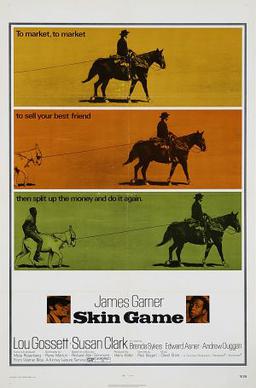
You know what isn't particularly funny? There's no way this introduction isn't in poor taste but...slavery! In recent years, even movies like Django Unchained that were fan favorites and critically loved caused a stir because of its slavery subject matter. So movies like Django, 12 Years a Slave, miniseries like Roots, the subject matter is played straight. That is NOT the case with 1971's Skin Game, a pre-Civil War story with comedy and drama rolled into one.
It's 1857 in Missouri when two men ride into a small town. Quincy (James Garner) is a plantation owner with some money problems, meaning he has to sell one of his slaves, Jason (Lou Gossett Jr.). He gets several hundred dollars for him and they part ways, Quincy onto the next town with Jason waiting to travel with his new owner. Well, that's what you'd think at least, what the supposed-plantation owner and his slave want you to think. In reality, they're con men, going from town-to-town, Quincy "selling" Jason to one plantation/land owner after another and getting out of town while Jason manages to escape in one way or another. The plan has worked well for quite a while now with a hefty bank account waiting for them back in Chicago when they decide they've had enough. Jason, he's had enough as he's the one taking more risk. Quincy, he'd like to travel to a couple more towns and pull off their successful con. What could possibly go wrong?
I've long been aware of this 1971 comedy-drama but never caught up with it. Thank you, Turner Classic Movies! It was worth the wait. From director Paul Bogart -- and an uncredited Gordon Douglas, I imagine there's a good story there -- it takes a touchy, potentially explosive subject matter in slavery and manages to tread the fine line between funny, at-times dramatic and just in poor taste. Come on...slavery. There's just nothing funny in that department. 'Game' doesn't minimize it or make light of it, instead attacking one of the most horrific periods in American history from the side. Considering it that way, it's actually pretty smart. Two con men looking to make some serious cash out of the sale of fellow human beings, now that is creative and certainly unique.
Playing on an oddball variety of a familiar storytelling device, Garner and Gossett have a ton of fun with their odd couple, buddy relationship. We don't learn too much about them, only that they've been con men for several years now piling up the cash with their risky play in each new town. We do learn that Jason was born a free man in New Jersey and chooses to do this, an important detail in my opinion. In a brief, quickly-cut flashback, we also see how the duo met, a fun aside and a necessary one that shows and tells a lot about these two. Sure, there are differences between the two men, but they're cut from the same cloth. The chemistry between Garner and Gossett is not in question with plenty of laughs and some great dialogue flying back and forth throughout the 102-minute running time. A great buddy combo to lead the way.
Also look for Susan Clark in a fun part as Ginger, a fellow con-man...um, con woman who crosses paths with Quincy and Jason at some inopportune moments. Brenda Sykes plays Naomi, a slave who Jason meets and wants to buy her freedom. Ed Asner is perfectly slimy as Plunkett, a slave trader with brutal tactics and no regard for his "merchandise." As for assorted slave and plantation owners, look for Andrew Duggan, Parley Baer, George Tyne, J. Pat O'Malley, and Henry Jones. Also watch for a quick appearance by Royal Dano as violent abolitionist John Brown.
There are some portions in the final act that run a tad sluggish with a story that has some pretty decent surprises. It tends to drift at times, but for the most part, this is an interesting story. I'm mostly recommending it though for the unique, inventive story and the spot-on, perfect chemistry between James Garner and Lou Gossett Jr. This isn't a movie that breaks any new ground, but it deserves more of a reputation than it currently does. Worth a watch for a creative story, unique setting in the pre-Civil War south and a very solid cast. Give it a watch!
Skin Game (1971): ***/****
The Sons of Katie Elder
"First, we reunite, then find Ma and Pa's killer...then read some reviews."
Showing posts with label Gordon Douglas. Show all posts
Tuesday, January 19, 2016
Tuesday, March 24, 2015
Chuka
I've been in a bit of a movie funk of late. I've given some newer flicks a try and couldn't/didn't get through them. The same for some older entries, movies that just didn't pull me in quick enough. Well, it is as good a time as any to revisit some reviews and give them an old-fashioned update. Today's review, 1967's Chuka, an underrated western I caught for the first time as I was just starting my reviews here at Just Hit Play.
Out of the snow-capped, frigid mountains of the north, a man named Chuka (Rod Taylor) rides south into the desert. A hired gun and a saddle bum, he has not set destination but is quickly realizing he's riding into the beginnings of an Indian uprising. As he rides across the desert, Chuka stumbles across a waylaid stagecoach carrying two women, one a woman from his past many years ago, the beautiful Senora Veronica Kleitz (Luciana Paluzzi). He agrees to escort them to the nearest outpost, Fort Clendennon but has no idea what he's heading into. The fort is commanded by a former English army officer now serving in the U.S. cavalry, Colonel Valois (John Mills), who is ignoring all the telltale signs of the coming uprising. Can Chuka convince the stubborn colonel to do something or is the entire outpost doomed to be wiped out by the warring Arapaho warriors?
This was a Netflix find for me way back in 2009. I'd never heard of it despite its impressive cast, much less seen a single minute of it. It left quite an impression on me then, and it did again on this recent revisit courtesy of Encore Westerns. The biggest reason? Made on the relative cheap, it is B-L-E-A-K. This is one dark, nasty western from director Gordon Douglas. It has the feel of a TV movie, but my goodness, it doesn't pull any punches. 'Chuka' is a tough guy movie for guys. Plain and simple. There aren't heroic good guys or even despicable villains, just flawed folks in a hellish situation looking for some way -- any way really -- to get out unscathed and keep on living. If there's no way out? Well, hell, let's have a bloody finish.
One of Hollywood's more underrated tough guys and one of my favorites, Rod Taylor passed away this past January at the age of 84 after a long, distinguished career. This is a dark role even for Taylor, ranking up there with Dark of the Sun as one of his more highly charged tough guy roles. I like his Chuka character, a reflection of where the western genre was in 1967. He's not particularly heroic, thinks of himself for the most part and has a reputation as a brutal gunslinger. It's a cool part because it is so brutally efficient. He is the anti-hero, a flawed figure, and as far as westerns go, you don't see a lot of main characters who are just what they seem. Chuka is a saddle tramp, a drifter, a killer and trying not to get shot in the back because of his bloody, body-riddled past. Taylor is always an above average screen presence, and he looks to be having some fun with this darker part.
How about the rest of the cast? It isn't a huge cast -- that whole B-movie feel -- but what's there, it's pretty preemo. John Mills is the flawed outpost commander, his checkered past floating over him at all times. Redemption? You bet, no matter the cost. Ernest Borgnine has some fun too in a role he specialized over the years, the tough as nails right hand man, playing Sgt. Otto Hahnsbach, Valois' loyal NCO who's served next to him for years. The always reliable James Whitmore plays Lou Trent, the fort's drunken scout who forms a fast friendship with Chuka upon his arrival. Paluzzi unfortunately isn't given much to do other than look worried/distressed, but dang, she's gorgeous. Also look for Victoria Vetri as her traveling companion, Louis Hayward as the cowardly Major Benton, and Joseph Sirola as Baldwin, the stagecoach guard who finds himself trapped in the fort with all the others.
So that whole bleak angle....yeah, this is one rough western. There are some slower portions -- Taylor and Paluzzi reuniting just ain't as interesting -- but the focus is this isolated, lonely outpost with a small army of Arapaho warriors waiting to attack. The odds are (to say the least) stacked against them. The fort's garrison? From Mills' Valois and his officers down to the enlisted men, these are the dregs of the army, all of them screw-ups, foul-ups, thieves, killers and deserters. A massacre seems impossible unless something is done and done quickly. A brutal knockdown fight between Taylor and Borgnine is an exhausting affair and a testament to the two actors who didn't appear to use ANY stunt doubles. When the action does come along, it is surprisingly graphic. It isn't bloody, but it is quick and hard-hitting and uncomfortable. It's quite an ending.
A hidden gem of a western. Sure, it has some flaws, but I'm glad I caught up with it (again). The claustrophobic fort set is a gem, really giving a sense of being closed in by the surrounding Indians. You get a sense of the coming doom, all of it building to quite an ending. Solid cast, surprisingly dark, a refreshingly brutal change of pace. Well worth catching up with.
Chuka (1967): ***/****
Rewrite of March 2009 review
Out of the snow-capped, frigid mountains of the north, a man named Chuka (Rod Taylor) rides south into the desert. A hired gun and a saddle bum, he has not set destination but is quickly realizing he's riding into the beginnings of an Indian uprising. As he rides across the desert, Chuka stumbles across a waylaid stagecoach carrying two women, one a woman from his past many years ago, the beautiful Senora Veronica Kleitz (Luciana Paluzzi). He agrees to escort them to the nearest outpost, Fort Clendennon but has no idea what he's heading into. The fort is commanded by a former English army officer now serving in the U.S. cavalry, Colonel Valois (John Mills), who is ignoring all the telltale signs of the coming uprising. Can Chuka convince the stubborn colonel to do something or is the entire outpost doomed to be wiped out by the warring Arapaho warriors?
This was a Netflix find for me way back in 2009. I'd never heard of it despite its impressive cast, much less seen a single minute of it. It left quite an impression on me then, and it did again on this recent revisit courtesy of Encore Westerns. The biggest reason? Made on the relative cheap, it is B-L-E-A-K. This is one dark, nasty western from director Gordon Douglas. It has the feel of a TV movie, but my goodness, it doesn't pull any punches. 'Chuka' is a tough guy movie for guys. Plain and simple. There aren't heroic good guys or even despicable villains, just flawed folks in a hellish situation looking for some way -- any way really -- to get out unscathed and keep on living. If there's no way out? Well, hell, let's have a bloody finish.
One of Hollywood's more underrated tough guys and one of my favorites, Rod Taylor passed away this past January at the age of 84 after a long, distinguished career. This is a dark role even for Taylor, ranking up there with Dark of the Sun as one of his more highly charged tough guy roles. I like his Chuka character, a reflection of where the western genre was in 1967. He's not particularly heroic, thinks of himself for the most part and has a reputation as a brutal gunslinger. It's a cool part because it is so brutally efficient. He is the anti-hero, a flawed figure, and as far as westerns go, you don't see a lot of main characters who are just what they seem. Chuka is a saddle tramp, a drifter, a killer and trying not to get shot in the back because of his bloody, body-riddled past. Taylor is always an above average screen presence, and he looks to be having some fun with this darker part.
How about the rest of the cast? It isn't a huge cast -- that whole B-movie feel -- but what's there, it's pretty preemo. John Mills is the flawed outpost commander, his checkered past floating over him at all times. Redemption? You bet, no matter the cost. Ernest Borgnine has some fun too in a role he specialized over the years, the tough as nails right hand man, playing Sgt. Otto Hahnsbach, Valois' loyal NCO who's served next to him for years. The always reliable James Whitmore plays Lou Trent, the fort's drunken scout who forms a fast friendship with Chuka upon his arrival. Paluzzi unfortunately isn't given much to do other than look worried/distressed, but dang, she's gorgeous. Also look for Victoria Vetri as her traveling companion, Louis Hayward as the cowardly Major Benton, and Joseph Sirola as Baldwin, the stagecoach guard who finds himself trapped in the fort with all the others.
So that whole bleak angle....yeah, this is one rough western. There are some slower portions -- Taylor and Paluzzi reuniting just ain't as interesting -- but the focus is this isolated, lonely outpost with a small army of Arapaho warriors waiting to attack. The odds are (to say the least) stacked against them. The fort's garrison? From Mills' Valois and his officers down to the enlisted men, these are the dregs of the army, all of them screw-ups, foul-ups, thieves, killers and deserters. A massacre seems impossible unless something is done and done quickly. A brutal knockdown fight between Taylor and Borgnine is an exhausting affair and a testament to the two actors who didn't appear to use ANY stunt doubles. When the action does come along, it is surprisingly graphic. It isn't bloody, but it is quick and hard-hitting and uncomfortable. It's quite an ending.
A hidden gem of a western. Sure, it has some flaws, but I'm glad I caught up with it (again). The claustrophobic fort set is a gem, really giving a sense of being closed in by the surrounding Indians. You get a sense of the coming doom, all of it building to quite an ending. Solid cast, surprisingly dark, a refreshingly brutal change of pace. Well worth catching up with.
Chuka (1967): ***/****
Rewrite of March 2009 review
Thursday, September 11, 2014
Santiago
I can think of exactly one movie made about the Spanish-American War. Okay, there I go again lying. It's actually a miniseries, 1997's Rough Riders, that's pretty good if not so well known. Well, I can kinda add a second movie to the list although it involves the years leading up to the war before the U.S. officially got involved. Here we go with 1956's Santiago.
Riding through the swamps of Florida, Cash Adams (Alan Ladd) arrives in Tampa with wagons loaded with guns, ammunition and dynamite ready to close a deal and make some money for himself and his men. Not so fast though, Mr. Adams. The deal he cut with Cuban revolutionaries fighting the Spanish is okay, but now he has to get all his materiel to Cuba himself. Adams finds an old steamboat captain and Civil War veteran, Sidewheel Jones (Chill Wills), to transport his supplies but it's not that simple. On board the boat is another gunrunner, Clay Pike (Lloyd Nolan), who has cut a similar deal with the Cubans. Adams has a rivalry with Pike dating back 10-plus years and the voyage across the Gulf of Mexico will be anything but easy. Spanish ships are waiting to stop them, if the ship can even get there before Adams and Pike tear each other apart.
Airing recently on Turner Classic Movies, 'Santiago' is from director Gordon Douglas. Not necessarily a well-known name, Douglas still has quite a few really solid movies to his name including Rio Conchos, Chuka, In Like Flint, Up Periscope and Golf of the Seven Saints among others. He specialized in tough movies, action and western and war flicks full of tough guy actors doing tough guy stuff. Douglas didn't have a huge visual style or anything that truly set him apart from the rest, but he was a solid, workmanlike director, and I have very much enjoyed a lot of his movies. This one? It's pretty decent, ahead of its time in certain moments with its use of on-screen violence and unfortunately too familiar in other scenes. It doesn't rewrite the genre, but I enjoyed it, 94 minutes of exciting action with a pretty cool cast and a different background, the Cuban War of Independence. Spanish-American War still to come!
The best comparison I can make is the similarities here with Robert Aldrich's 1954 classic western Vera Cruz, one of the most influential westerns of all-time. Here with 'Santiago,' Alan Ladd and Lloyd Nolan channel Gary Cooper and Burt Lancaster, two rivals who are forced to work together to battle a common enemy. All the while, they know a showdown is looming. Ladd is pretty decent as Cash Adams, his backstory providing most of the interest. A cavalry officer fighting the Apaches, he was dishonorably discharged when a captive Apache chief escaped because one of his men got drunk on guard duty. And who was providing those Apaches with repeating rifles? Why Nolan's Clay Pike of course! The rivalry is a little tame, little lacking in energy, but it seems Adams and Pike are never too far away from throwing down and having it out.
I wish there was more of that darker story material, and that becomes the issue. Yeah, it's a rivalry....but not really. Ladd's Adams is a good gunrunner (if there is such a thing), supplying materiel for the right side. Nolan's Pike doesn't care who gets the guns as long as he gets paid. And because that wasn't enough, we get a love interest with Rossana Podesta playing Dona Isabella, a beautiful Cuban revolutionary who works as the middleman for shipment of the guns. Who do you think she'll end up with?!? You won't need two guesses. There's also an adorable little Cuban boy who bonds with Adams, but you just know things aren't going to end well for the little stinker. At times, things are a tad too clean, a little slow-moving, but for the most part I was entertained throughout. Also, kudos to Ladd who in muggy Florida and Cuba manages to keep his tailored white shirts immaculate no matter what's going on. Now, THAT is talent.
Who else to look for? Wills is excellent, toning down his over the top act that could be a little hammy when overdone, Don Blackman playing Sam, his former slave and current right-hand man. Paul Fix is similarly very good as Trasker, Adams' loyal right-hand man with an interesting background that explain his loyalty. Some of the other tough guys on hand include Royal Dano, L.Q. Jones, and Frank DeKova. The movie is at its strongest when it leans on Ladd, Nolan and the familiar faces all around them. Romance? Motivations for independence? Meh, no thanks. The action and violence can be pretty startling -- even bloody -- and the finale especially is memorable. It even reminded me of the final battle in Major Dundee, a chaotic, quick-cut bloody mess where characters are dispatched without warning.
A decent movie that could have been better, but still worth a watch.
Santiago (1956): ** 1/2 /****
Riding through the swamps of Florida, Cash Adams (Alan Ladd) arrives in Tampa with wagons loaded with guns, ammunition and dynamite ready to close a deal and make some money for himself and his men. Not so fast though, Mr. Adams. The deal he cut with Cuban revolutionaries fighting the Spanish is okay, but now he has to get all his materiel to Cuba himself. Adams finds an old steamboat captain and Civil War veteran, Sidewheel Jones (Chill Wills), to transport his supplies but it's not that simple. On board the boat is another gunrunner, Clay Pike (Lloyd Nolan), who has cut a similar deal with the Cubans. Adams has a rivalry with Pike dating back 10-plus years and the voyage across the Gulf of Mexico will be anything but easy. Spanish ships are waiting to stop them, if the ship can even get there before Adams and Pike tear each other apart.
Airing recently on Turner Classic Movies, 'Santiago' is from director Gordon Douglas. Not necessarily a well-known name, Douglas still has quite a few really solid movies to his name including Rio Conchos, Chuka, In Like Flint, Up Periscope and Golf of the Seven Saints among others. He specialized in tough movies, action and western and war flicks full of tough guy actors doing tough guy stuff. Douglas didn't have a huge visual style or anything that truly set him apart from the rest, but he was a solid, workmanlike director, and I have very much enjoyed a lot of his movies. This one? It's pretty decent, ahead of its time in certain moments with its use of on-screen violence and unfortunately too familiar in other scenes. It doesn't rewrite the genre, but I enjoyed it, 94 minutes of exciting action with a pretty cool cast and a different background, the Cuban War of Independence. Spanish-American War still to come!
The best comparison I can make is the similarities here with Robert Aldrich's 1954 classic western Vera Cruz, one of the most influential westerns of all-time. Here with 'Santiago,' Alan Ladd and Lloyd Nolan channel Gary Cooper and Burt Lancaster, two rivals who are forced to work together to battle a common enemy. All the while, they know a showdown is looming. Ladd is pretty decent as Cash Adams, his backstory providing most of the interest. A cavalry officer fighting the Apaches, he was dishonorably discharged when a captive Apache chief escaped because one of his men got drunk on guard duty. And who was providing those Apaches with repeating rifles? Why Nolan's Clay Pike of course! The rivalry is a little tame, little lacking in energy, but it seems Adams and Pike are never too far away from throwing down and having it out.
I wish there was more of that darker story material, and that becomes the issue. Yeah, it's a rivalry....but not really. Ladd's Adams is a good gunrunner (if there is such a thing), supplying materiel for the right side. Nolan's Pike doesn't care who gets the guns as long as he gets paid. And because that wasn't enough, we get a love interest with Rossana Podesta playing Dona Isabella, a beautiful Cuban revolutionary who works as the middleman for shipment of the guns. Who do you think she'll end up with?!? You won't need two guesses. There's also an adorable little Cuban boy who bonds with Adams, but you just know things aren't going to end well for the little stinker. At times, things are a tad too clean, a little slow-moving, but for the most part I was entertained throughout. Also, kudos to Ladd who in muggy Florida and Cuba manages to keep his tailored white shirts immaculate no matter what's going on. Now, THAT is talent.
Who else to look for? Wills is excellent, toning down his over the top act that could be a little hammy when overdone, Don Blackman playing Sam, his former slave and current right-hand man. Paul Fix is similarly very good as Trasker, Adams' loyal right-hand man with an interesting background that explain his loyalty. Some of the other tough guys on hand include Royal Dano, L.Q. Jones, and Frank DeKova. The movie is at its strongest when it leans on Ladd, Nolan and the familiar faces all around them. Romance? Motivations for independence? Meh, no thanks. The action and violence can be pretty startling -- even bloody -- and the finale especially is memorable. It even reminded me of the final battle in Major Dundee, a chaotic, quick-cut bloody mess where characters are dispatched without warning.
A decent movie that could have been better, but still worth a watch.
Santiago (1956): ** 1/2 /****
Labels:
1950s,
Alan Ladd,
Chill Wills,
Gordon Douglas,
L.Q. Jones,
Lloyd Nolan,
Paul Fix,
Royal Dano
Wednesday, December 4, 2013
The Detective
Movie star, actor, singer and entertainer, Frank Sinatra was able to pick and choose his roles as he saw fit by 1968. He picked movies he wanted to do, not just for the sake of doing a movie. With 1968's The Detective, Sinatra was at the helm of a police drama that was ahead of its time and helped kick the door open for where the genre would go at the end of the 1960s and into the 1970s.
A veteran detective with years of experience in New York City, Joe Leland (Sinatra) has seen it all, and it's starting to wear on him more than a little bit. He's been called in to investigate a particularly gruesome murder, the son of a rich businessman killed and disfigured. Rumor has it the dead man was gay, Leland and his fellow detectives forced to explore the gay sub-culture (its the 1960s, just go with it) to see if they can track down the murderer. The case has gained notoriety in the headlines, putting Leland and the precinct in the spotlight to solve it and solve it quickly. It's the kind of case that can make or break a police officer. Solve it and quickly rise through the ranks? Don't? Well, a scapegoat will be needed. It's not the only case on the docket though, crimes -- murders and more -- rolling in on a daily basis. Hopefully, Leland can keep it together long enough to find his man.
The appeal in this police drama from director Gordon Douglas is obvious. Made during one of the most turbulent times in Hollywood history (and American history at that point), 'Detective' embraces the sharp-edged, rougher mindset perpetuating the minds of the audiences. It isn't interested in being politically correct...at all. A gay man being murdered (with his penis cut off) provides quite the jumping off point, constant mention of "fags" and "homos," as well as an almost laughable portrayal of a homosexual meeting point. Beyond that though, it's a brutally realistic story in terms of the storytelling. Sex, violence, one-night stands, drugs, city corruption, 'Detective' is ready, willing and able to dive in head first and get dirty.
For all the positives though, there's the obvious counter of the negatives. In a movie that runs 114 minutes, I thought too much time was spent getting to know Sinatra's Leland via a series of flashbacks. It serves to give some cool background, but there's a limit. We see Leland meet Karen (Lee Remick) who he eventually marries. If cop movies have taught us anything though, it's that a cop's marriage has never gone smoothly in the history of law enforcement. The subject matter may have seemed ahead of its time in 1968, but it makes the story lag. We hear Joe talk about all the women he's been with, we hear Karen discuss her troubled past, her series of one-night stands, her inability to hold a relationship. A little bawdy if you ask me (that's sarcasm by the way). Seeing Remick's Karen say 'Let me make love to you this time' is a little scandalous for the time, but when the murder cases are far more interesting, those wavy-screened flashbacks kill the momentum.
I've always thought Sinatra was an underrated actor. Was he a great actor? No, but he was far better than people remember him. He does a no-nonsense tough guy like nobody's business. As we see with his dating/marrying Karen, Joe is exceptionally smooth, looking like he's almost bored with the process. He's that cool. More than that though, I appreciated the human side of Sinatra's part as longtime detective Joe Leland. The job is beating him down as he sees the lowest of lows, what people can do to each other in day-to-day life. He comes from a family of police officers and does it because it's in his blood, not because he loves it. Joe is good at what he does, but as he sees the violence and corruption, he begins to question how much more he can take. Uninterested in being a PR police man, he wants to do his job. An underrated part, Sinatra is the best part of this one.
Give Sinatra credit when it's due. Other actors wanted to work with the guy. Including Remick, the cast is pretty impressive. The list of Leland's fellow detectives include Robert Duvall, Jack Klugman, Ralph Meeker and Al Freeman Jr, Horace McMahon playing the precinct commander. Jacqueline Bisset plays a widow who approaches Leland with a case involving her dead husband, supposedly by suicide but she believes otherwise. Also look for Tony Musante, Lloyd Bochner and William Windom as possible suspects in the cases Leland is pursuing.
I wanted to like this one more, mostly because there was so much potential for a really good to maybe even near-classic status. The flaws are pretty big though, especially the intense focus on Leland's personal life. I thought the twists in the movie's last act were pretty solid too, catching me by surprise, but even in that aspect, the execution is pretty weak as the film limps to the finish. Really good performance from Sinatra and a solid cast overall, but it never lives up to what it could have been.
The Detective (1968): **/****
A veteran detective with years of experience in New York City, Joe Leland (Sinatra) has seen it all, and it's starting to wear on him more than a little bit. He's been called in to investigate a particularly gruesome murder, the son of a rich businessman killed and disfigured. Rumor has it the dead man was gay, Leland and his fellow detectives forced to explore the gay sub-culture (its the 1960s, just go with it) to see if they can track down the murderer. The case has gained notoriety in the headlines, putting Leland and the precinct in the spotlight to solve it and solve it quickly. It's the kind of case that can make or break a police officer. Solve it and quickly rise through the ranks? Don't? Well, a scapegoat will be needed. It's not the only case on the docket though, crimes -- murders and more -- rolling in on a daily basis. Hopefully, Leland can keep it together long enough to find his man.
The appeal in this police drama from director Gordon Douglas is obvious. Made during one of the most turbulent times in Hollywood history (and American history at that point), 'Detective' embraces the sharp-edged, rougher mindset perpetuating the minds of the audiences. It isn't interested in being politically correct...at all. A gay man being murdered (with his penis cut off) provides quite the jumping off point, constant mention of "fags" and "homos," as well as an almost laughable portrayal of a homosexual meeting point. Beyond that though, it's a brutally realistic story in terms of the storytelling. Sex, violence, one-night stands, drugs, city corruption, 'Detective' is ready, willing and able to dive in head first and get dirty.
For all the positives though, there's the obvious counter of the negatives. In a movie that runs 114 minutes, I thought too much time was spent getting to know Sinatra's Leland via a series of flashbacks. It serves to give some cool background, but there's a limit. We see Leland meet Karen (Lee Remick) who he eventually marries. If cop movies have taught us anything though, it's that a cop's marriage has never gone smoothly in the history of law enforcement. The subject matter may have seemed ahead of its time in 1968, but it makes the story lag. We hear Joe talk about all the women he's been with, we hear Karen discuss her troubled past, her series of one-night stands, her inability to hold a relationship. A little bawdy if you ask me (that's sarcasm by the way). Seeing Remick's Karen say 'Let me make love to you this time' is a little scandalous for the time, but when the murder cases are far more interesting, those wavy-screened flashbacks kill the momentum.
I've always thought Sinatra was an underrated actor. Was he a great actor? No, but he was far better than people remember him. He does a no-nonsense tough guy like nobody's business. As we see with his dating/marrying Karen, Joe is exceptionally smooth, looking like he's almost bored with the process. He's that cool. More than that though, I appreciated the human side of Sinatra's part as longtime detective Joe Leland. The job is beating him down as he sees the lowest of lows, what people can do to each other in day-to-day life. He comes from a family of police officers and does it because it's in his blood, not because he loves it. Joe is good at what he does, but as he sees the violence and corruption, he begins to question how much more he can take. Uninterested in being a PR police man, he wants to do his job. An underrated part, Sinatra is the best part of this one.
Give Sinatra credit when it's due. Other actors wanted to work with the guy. Including Remick, the cast is pretty impressive. The list of Leland's fellow detectives include Robert Duvall, Jack Klugman, Ralph Meeker and Al Freeman Jr, Horace McMahon playing the precinct commander. Jacqueline Bisset plays a widow who approaches Leland with a case involving her dead husband, supposedly by suicide but she believes otherwise. Also look for Tony Musante, Lloyd Bochner and William Windom as possible suspects in the cases Leland is pursuing.
I wanted to like this one more, mostly because there was so much potential for a really good to maybe even near-classic status. The flaws are pretty big though, especially the intense focus on Leland's personal life. I thought the twists in the movie's last act were pretty solid too, catching me by surprise, but even in that aspect, the execution is pretty weak as the film limps to the finish. Really good performance from Sinatra and a solid cast overall, but it never lives up to what it could have been.
The Detective (1968): **/****
Tuesday, November 5, 2013
Yellowstone Kelly
One of the turning points in the history of the taming of the west in the U.S., the massacre at the Little Big Horn has certainly received its due in film adaptations. Maybe more so is the fallout from the battle that wiped out George Custer and his famed 7th Cavalry. There's been a-plenty of westerns about what happened after the battle, like 1959's Yellowstone Kelly.
It's been several months since the Battle of the Little Bighorn, and well-known trapper and frontiersman Yellowstone Kelly (Clint Walker) has ridden down out of the hills with his trappings from a busy season. He catches a ride on a steamboat where he meets Anse Harper (Edd Byrnes), a young, inexperienced man traveling west, Kelly agreeing to take him along -- somewhat unwillingly -- when he heads back up into the mountains. Kelly is also approached by the cavalry to scout for them in helps of leading an expedition against the Sioux and Cheyenne. The veteran scout knows the land as well as anyone, but he also has an agreement with the warring Sioux so he declines the offer, instead heading out with Anse into the mountains. His decision has been made, but his involvement between the Indians and the cavalry is far from over.
From director Gordon Douglas, this 1959 western is a good but not great entry. It popped up recently on Encore Westerns and with no regular DVD out there for viewing, I wanted to give it a shot. If it doesn't do anything particularly new in the western genre, so be it. It's mostly entertaining. 'Kelly' benefits from some great location shooting in the Coconino National Forest and Sedona, Arizona. This is a Technicolor movie that needs to be viewed in widescreen. Just watching Walker's Kelly ride around through the mountains is a visual treat. Mountains, deserts, it's got it all to produce a great-looking movie. As well, the score from an uncredited Howard Jackson is good, borrowing from themes from They Died With Their Boots On, as well as a familiar tune here and there from The Charge at Feather River. It must be the Warner Brothers file archive.
Right in the midst of his successful TV run on Cheyenne, Walker takes a break to star here, and it's a good part. He's a good if not great actor, as much of a domineering physical presence as anything. The 6-foot-6 actor was certainly a presence on-screen, appearing to tower over his co-stars. He has a good chemistry with another TV star in Edd Byrnes. The experienced trailhand and scout working with the oppositely inexperienced younger man is a familiar genre convention, but it works well here. Neither Walker or Byrnes ever became huge stars, but the TV turned movie stars do very capably here. If there's a weak point, it's when Kelly and Harper rescue Wahleeah (Andra Martin), an Arapaho captive of the nearby Sioux tribe. Byrnes' Harper falls quickly for her, Kelly recommending he stays clear of her. It's just not as interesting as the other story. It's not awful, but it does slow things down in a 92-minute movie.
This must have been a TV stars convention here for the cast. Star of TV's Lawman, John Russell wears some skin darkener and wears a pair of braids as Gall, a Sioux chieftain who had his life saved by Walker's Kelly years before. Now, he has an uneasy deal with the scout about where he can/can't go. Ray Danton plays Sayapi, Gall's pissed off nephew who wants his Arapaho captive back, and he doesn't care who's trying to stop him. Leading the cavalry contingent is Rhodes Reason as Major Townes, an officer who seemingly learns nothing from the past (i.e. Custer) with Gary Vinson as his Lieutenant, Claude Akins and Warren Oates playing Sergeant and Corporal, no names provided.
The action is kept on the small scale for the most part. An early fistfight has Kelly and Harper teaming to tangle with Akins' Sergeant and his soldiers. The biggest fighting is saved for the finale between the cavalry and the attacking Indians on a desert hillside covered in trees. It's pretty quick and doesn't have a ton of scale, but it's a good action scene. That's the western itself. Nothing flashy, but I enjoyed it. A pleasant time-waster with good locations and cast.
Yellowstone Kelly (1959): ** 1/2 /****
It's been several months since the Battle of the Little Bighorn, and well-known trapper and frontiersman Yellowstone Kelly (Clint Walker) has ridden down out of the hills with his trappings from a busy season. He catches a ride on a steamboat where he meets Anse Harper (Edd Byrnes), a young, inexperienced man traveling west, Kelly agreeing to take him along -- somewhat unwillingly -- when he heads back up into the mountains. Kelly is also approached by the cavalry to scout for them in helps of leading an expedition against the Sioux and Cheyenne. The veteran scout knows the land as well as anyone, but he also has an agreement with the warring Sioux so he declines the offer, instead heading out with Anse into the mountains. His decision has been made, but his involvement between the Indians and the cavalry is far from over.
From director Gordon Douglas, this 1959 western is a good but not great entry. It popped up recently on Encore Westerns and with no regular DVD out there for viewing, I wanted to give it a shot. If it doesn't do anything particularly new in the western genre, so be it. It's mostly entertaining. 'Kelly' benefits from some great location shooting in the Coconino National Forest and Sedona, Arizona. This is a Technicolor movie that needs to be viewed in widescreen. Just watching Walker's Kelly ride around through the mountains is a visual treat. Mountains, deserts, it's got it all to produce a great-looking movie. As well, the score from an uncredited Howard Jackson is good, borrowing from themes from They Died With Their Boots On, as well as a familiar tune here and there from The Charge at Feather River. It must be the Warner Brothers file archive.
Right in the midst of his successful TV run on Cheyenne, Walker takes a break to star here, and it's a good part. He's a good if not great actor, as much of a domineering physical presence as anything. The 6-foot-6 actor was certainly a presence on-screen, appearing to tower over his co-stars. He has a good chemistry with another TV star in Edd Byrnes. The experienced trailhand and scout working with the oppositely inexperienced younger man is a familiar genre convention, but it works well here. Neither Walker or Byrnes ever became huge stars, but the TV turned movie stars do very capably here. If there's a weak point, it's when Kelly and Harper rescue Wahleeah (Andra Martin), an Arapaho captive of the nearby Sioux tribe. Byrnes' Harper falls quickly for her, Kelly recommending he stays clear of her. It's just not as interesting as the other story. It's not awful, but it does slow things down in a 92-minute movie.
This must have been a TV stars convention here for the cast. Star of TV's Lawman, John Russell wears some skin darkener and wears a pair of braids as Gall, a Sioux chieftain who had his life saved by Walker's Kelly years before. Now, he has an uneasy deal with the scout about where he can/can't go. Ray Danton plays Sayapi, Gall's pissed off nephew who wants his Arapaho captive back, and he doesn't care who's trying to stop him. Leading the cavalry contingent is Rhodes Reason as Major Townes, an officer who seemingly learns nothing from the past (i.e. Custer) with Gary Vinson as his Lieutenant, Claude Akins and Warren Oates playing Sergeant and Corporal, no names provided.
The action is kept on the small scale for the most part. An early fistfight has Kelly and Harper teaming to tangle with Akins' Sergeant and his soldiers. The biggest fighting is saved for the finale between the cavalry and the attacking Indians on a desert hillside covered in trees. It's pretty quick and doesn't have a ton of scale, but it's a good action scene. That's the western itself. Nothing flashy, but I enjoyed it. A pleasant time-waster with good locations and cast.
Yellowstone Kelly (1959): ** 1/2 /****
Labels:
1950s,
Claude Akins,
Clint Walker,
Edd Byrnes,
Gordon Douglas,
John Russell,
Warren Oates,
westerns
Monday, August 26, 2013
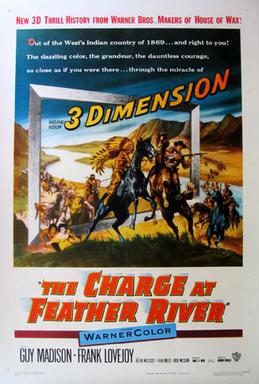
The Charge at Feather River
Why are some movies remembered and others aren't? It can be the tiniest thing, something that lingers with audiences long after viewing. A childhood favorite of mine, seemingly always airing on TNT, is 1953's The Charge at Feather River. What's it got going for it? Well, two things, an early use of 3-D technology that works surprisingly well and an iconic death scene that's influenced everything from Indiana Jones to Star Wars.
In the months following the end of the Civil War, former Union soldier Miles Archer (Guy Madison) returns to a ruined ranch with no cattle. He's approached by the commander at the nearby fort to undertake a dangerous mission. The railroad is moving into Cheyenne territory, leaving one last chance to get back two sisters who have long been held prisoners of the Cheyenne. Archer is less than enthused to take on this suicide mission, but he takes it on just the same, bringing a capable sergeant, Baker (Frank Lovejoy), to help him command a squad of prisoners from the guardhouse. Archer's squad heads into Cheyenne territory, but they find that only one of the women, Anne (Helen Westcott), even wants to be rescued while the other, Jennie (Vera Miles), is engaged to a chief, Thunder Hawk. More surprises await on this dangerous mission, Archer working to protect himself from threats inside and out.
According to a recent airing on Turner Classic Movies, 'Charge' was the highest grossing western released in 1953. Not bad when you consider Shane, Hondo, and The Naked Spur were all released that year. It's nothing special as a western, but it is enjoyable throughout. Director Gordon Douglas' movie is a solid cavalry vs. Indians western, featuring some cool locations and a memorable score from composer Max Steiner (borrowing some from his They Died With Their Boots On score). Listen to Steiner's main theme HERE. Using a familiar theme of saving captives from raiding Indians (The Searchers, Major Dundee), it's a pretty good example of what a pretty straightforward B-western can be. Some cool characters, good action and musical score. It doesn't have to be groundbreaking to be enjoyable.
What was the appeal then? No doubt some of the success had to do with the original release being in 3-D. I've never been a fan of 3-D filming, gone on record far too many times with that, but there is a cheesy charm when it's handled right. Maybe it has something to do with the 1953 release as opposed to 2013, but it's fun to watch. At different points, we get arrows, tomahawks, spears and lances chucked directly at the camera. Right in the midst of a battle, it can be a fun, diverting gimmick. At one point late, Lovejoy's Sgt. Baker even spits tobacco juice right at the camera!!! Twice!!! Take that rattlesnake about to bite him! Go figure, but the 3-D technique works here pretty well.
Taking a break from his starring role on TV's Adventures of Wild Bill Hickok, Madison is his typical workmanlike self, a tried and true hero to lead the way in an impossible mission. He's never flashy, but he was a good hero in countless westerns like this. Lovejoy too is well-cast as Baker, the necessary sidekick and right hand man, given a rivalry with Pvt. Ryan (Steve Brodie), who was trying to make a move on Baker's wife. Westcott is okay as the quasi-love interest while Miles gets to villain it up as Jennie, the captive turned future Indian princess. Madison's Guardhouse Brigade includes Cullen (Dick Wesson), a drunken thief providing some comic relief, Johnson (Onslow Stevens), a journalist/artist along for the mission, Johnny (Ron Hagerthy), the kidnapped sisters' younger brother, the treacherous Morgan (Neville Brand), Smiley (Henry Kulky), the boozing private, Zebulon (Lane Chandler), a former Confederate cavalry officer, and Connors (James Brown), the capable soldier.
It's a pretty straightforward formula once Archer and Co. get out on the mission road. We've got about 15-20 men on a dangerous mission in enemy territory. Who's going to make it, and who isn't? Various trials and tribulations are thrown at Archer's squad, providing some cool action scenes as they try and make it to safety with warring Indians seemingly all around them. The action is never on a large scale, but it's well put together, especially the finale with Thunder Hawk's war party closing in on all sides. What else to talk about? The scream of a certain Pvt. Wilhelm as he's hit with an arrow. Watch HERE. It is a scream that's been used in several movies since, including both the Star Wars and Indiana Jones series. Watch a compilation HERE. It's something little that helps make a good western particularly memorable. Solid western all-around.
The Charge at Feather River (1953): ***/****
In the months following the end of the Civil War, former Union soldier Miles Archer (Guy Madison) returns to a ruined ranch with no cattle. He's approached by the commander at the nearby fort to undertake a dangerous mission. The railroad is moving into Cheyenne territory, leaving one last chance to get back two sisters who have long been held prisoners of the Cheyenne. Archer is less than enthused to take on this suicide mission, but he takes it on just the same, bringing a capable sergeant, Baker (Frank Lovejoy), to help him command a squad of prisoners from the guardhouse. Archer's squad heads into Cheyenne territory, but they find that only one of the women, Anne (Helen Westcott), even wants to be rescued while the other, Jennie (Vera Miles), is engaged to a chief, Thunder Hawk. More surprises await on this dangerous mission, Archer working to protect himself from threats inside and out.
According to a recent airing on Turner Classic Movies, 'Charge' was the highest grossing western released in 1953. Not bad when you consider Shane, Hondo, and The Naked Spur were all released that year. It's nothing special as a western, but it is enjoyable throughout. Director Gordon Douglas' movie is a solid cavalry vs. Indians western, featuring some cool locations and a memorable score from composer Max Steiner (borrowing some from his They Died With Their Boots On score). Listen to Steiner's main theme HERE. Using a familiar theme of saving captives from raiding Indians (The Searchers, Major Dundee), it's a pretty good example of what a pretty straightforward B-western can be. Some cool characters, good action and musical score. It doesn't have to be groundbreaking to be enjoyable.
What was the appeal then? No doubt some of the success had to do with the original release being in 3-D. I've never been a fan of 3-D filming, gone on record far too many times with that, but there is a cheesy charm when it's handled right. Maybe it has something to do with the 1953 release as opposed to 2013, but it's fun to watch. At different points, we get arrows, tomahawks, spears and lances chucked directly at the camera. Right in the midst of a battle, it can be a fun, diverting gimmick. At one point late, Lovejoy's Sgt. Baker even spits tobacco juice right at the camera!!! Twice!!! Take that rattlesnake about to bite him! Go figure, but the 3-D technique works here pretty well.
Taking a break from his starring role on TV's Adventures of Wild Bill Hickok, Madison is his typical workmanlike self, a tried and true hero to lead the way in an impossible mission. He's never flashy, but he was a good hero in countless westerns like this. Lovejoy too is well-cast as Baker, the necessary sidekick and right hand man, given a rivalry with Pvt. Ryan (Steve Brodie), who was trying to make a move on Baker's wife. Westcott is okay as the quasi-love interest while Miles gets to villain it up as Jennie, the captive turned future Indian princess. Madison's Guardhouse Brigade includes Cullen (Dick Wesson), a drunken thief providing some comic relief, Johnson (Onslow Stevens), a journalist/artist along for the mission, Johnny (Ron Hagerthy), the kidnapped sisters' younger brother, the treacherous Morgan (Neville Brand), Smiley (Henry Kulky), the boozing private, Zebulon (Lane Chandler), a former Confederate cavalry officer, and Connors (James Brown), the capable soldier.
It's a pretty straightforward formula once Archer and Co. get out on the mission road. We've got about 15-20 men on a dangerous mission in enemy territory. Who's going to make it, and who isn't? Various trials and tribulations are thrown at Archer's squad, providing some cool action scenes as they try and make it to safety with warring Indians seemingly all around them. The action is never on a large scale, but it's well put together, especially the finale with Thunder Hawk's war party closing in on all sides. What else to talk about? The scream of a certain Pvt. Wilhelm as he's hit with an arrow. Watch HERE. It is a scream that's been used in several movies since, including both the Star Wars and Indiana Jones series. Watch a compilation HERE. It's something little that helps make a good western particularly memorable. Solid western all-around.
The Charge at Feather River (1953): ***/****
Labels:
1950s,
Frank Lovejoy,
Gordon Douglas,
Guy Madison,
Neville Brand,
Vera Miles,
westerns
Sunday, December 30, 2012
Barquero
With the distinct feel of a spaghetti western, 1970s Barquero relies on a simple formula; pair two very successful western stars and let them do their thing. Not particularly flashy by any means, it's a meat and potatoes kind of western, just barely worth getting an above average rating.
At an isolated river crossing along the border, Travis (Lee Van Cleef) is thriving as the owner of a river barge. The crossing is the only spot for miles in either direction, and a little town has popped up around Travis' barge. Miles away, infamous outlaw Jake Remy (Warren Oates) and his gang have led a bloody raid on a cavalry convoy transporting silver and repeating rifles, wiping out a town in the process. Remy's gang heads for the river crossing, knowing time will become a factor with the Army in hot pursuit to get back their silver and rifles. Travis and the river town catch wind though, getting to the far side of the river. Now Travis and Co. are on one side while Remy's gang is on the other, plotting their next move as the Army closes in behind them. Who will cave first?
From director Gordon Douglas, this is a western from a sub-genre that popped up in the late 1960s in the U.S. In Europe, the spaghetti westerns had emerged as a factor to be reckoned with, and western fans responded. They wanted darker, more cynical and more violent westerns. Good guys weren't just good guys. They became anti-heroes. So studios gave them what they want, and the result is a sticky middle ground that isn't pigeon-holed clearly. I have always thought of them as quasi-spaghetti westerns, movies like 100 Rifles, Villa Rides, Charro!, Shalako and so many more. 'Barquero' wasn't filmed in Europe -- Colorado is the backdrop, and a good one at that -- but it still feels like a spaghetti western. Composer Dominic Frontiere's score is okay, but it's not memorable like some of his better scores.
The best thing going for this American-ish spaghetti western is the casting of Lee Van Cleef and Warren Oates as rivals. Both actors were at the height of their popularity. Van Cleef became an international star because of the spaghetti westerns, and Oates had risen from a career of supporting parts to become a leading man/star in his own right. They look to be having a lot of fun in the process, two tough guys sneering and yelling at each other from across a river. As Travis -- dubbed 'the Barquero' (Spanish for boatman) -- Van Cleef is not playing his typical gunfighter, but instead a tough as nails working man who won't turn his back on something he has created. Playing Remy, Oates hams it up (as usual, but it's always interesting) as the unhinged outlaw. We learn some about his past, and how he got here -- most definitely crazy -- but he plays one nasty dude like few others can.
Beyond that tough guy duo, 'Barquero' lacks the star power, but the supporting cast doesn't disappoint. I thought the best part was for Kerwin Matthews as Marquette, Remy's right hand man in leading a brutal gang. He is a former French officer who survived when French emperor Maximilian was killed by Mexican revolutionaries, now working as Remy's reasonable thinking ally. Also providing a scene-stealing supporting part is Forrest Tucker as Mountain Phil, a mountain man drifter who teams with Travis to protect the crossing. Both fighting over Van Cleef's Travis, Marie Gomez and Mariette Hartley play the love interests. Rounding out Remy's gang of cutthroats are Armando Silvestre, John Davis Chandler, Ed Bakey, Richard Lapp and Brad Weston. Craig Littler plays Pitney, the town store owner doubling as a con man preacher.
While I did like this western, I can't say I loved it. The premise is cool; two rivals across a river from each other. Time is running out for one of them, and they need to get across the river. Sounds like a pretty decent cat and mouse game, doesn't it? It should be, but it isn't. Remy's plan is....well, he doesn't have one. He brews and stews on his side of the river for much of the middle portion of the movie without actually doing anything. It's Matthews' Marquette who finally comes up with a plan. Clocking in at 109 minutes, it's a tad long with not enough going on. Still, it's a worthwhile popcorn western. Enjoy it for what it is, and watch Van Cleef and Oates be cool together. You can watch the entire movie HERE at Youtube.
Barquero (1970): ** 1/2 /****
At an isolated river crossing along the border, Travis (Lee Van Cleef) is thriving as the owner of a river barge. The crossing is the only spot for miles in either direction, and a little town has popped up around Travis' barge. Miles away, infamous outlaw Jake Remy (Warren Oates) and his gang have led a bloody raid on a cavalry convoy transporting silver and repeating rifles, wiping out a town in the process. Remy's gang heads for the river crossing, knowing time will become a factor with the Army in hot pursuit to get back their silver and rifles. Travis and the river town catch wind though, getting to the far side of the river. Now Travis and Co. are on one side while Remy's gang is on the other, plotting their next move as the Army closes in behind them. Who will cave first?
From director Gordon Douglas, this is a western from a sub-genre that popped up in the late 1960s in the U.S. In Europe, the spaghetti westerns had emerged as a factor to be reckoned with, and western fans responded. They wanted darker, more cynical and more violent westerns. Good guys weren't just good guys. They became anti-heroes. So studios gave them what they want, and the result is a sticky middle ground that isn't pigeon-holed clearly. I have always thought of them as quasi-spaghetti westerns, movies like 100 Rifles, Villa Rides, Charro!, Shalako and so many more. 'Barquero' wasn't filmed in Europe -- Colorado is the backdrop, and a good one at that -- but it still feels like a spaghetti western. Composer Dominic Frontiere's score is okay, but it's not memorable like some of his better scores.
The best thing going for this American-ish spaghetti western is the casting of Lee Van Cleef and Warren Oates as rivals. Both actors were at the height of their popularity. Van Cleef became an international star because of the spaghetti westerns, and Oates had risen from a career of supporting parts to become a leading man/star in his own right. They look to be having a lot of fun in the process, two tough guys sneering and yelling at each other from across a river. As Travis -- dubbed 'the Barquero' (Spanish for boatman) -- Van Cleef is not playing his typical gunfighter, but instead a tough as nails working man who won't turn his back on something he has created. Playing Remy, Oates hams it up (as usual, but it's always interesting) as the unhinged outlaw. We learn some about his past, and how he got here -- most definitely crazy -- but he plays one nasty dude like few others can.
Beyond that tough guy duo, 'Barquero' lacks the star power, but the supporting cast doesn't disappoint. I thought the best part was for Kerwin Matthews as Marquette, Remy's right hand man in leading a brutal gang. He is a former French officer who survived when French emperor Maximilian was killed by Mexican revolutionaries, now working as Remy's reasonable thinking ally. Also providing a scene-stealing supporting part is Forrest Tucker as Mountain Phil, a mountain man drifter who teams with Travis to protect the crossing. Both fighting over Van Cleef's Travis, Marie Gomez and Mariette Hartley play the love interests. Rounding out Remy's gang of cutthroats are Armando Silvestre, John Davis Chandler, Ed Bakey, Richard Lapp and Brad Weston. Craig Littler plays Pitney, the town store owner doubling as a con man preacher.
While I did like this western, I can't say I loved it. The premise is cool; two rivals across a river from each other. Time is running out for one of them, and they need to get across the river. Sounds like a pretty decent cat and mouse game, doesn't it? It should be, but it isn't. Remy's plan is....well, he doesn't have one. He brews and stews on his side of the river for much of the middle portion of the movie without actually doing anything. It's Matthews' Marquette who finally comes up with a plan. Clocking in at 109 minutes, it's a tad long with not enough going on. Still, it's a worthwhile popcorn western. Enjoy it for what it is, and watch Van Cleef and Oates be cool together. You can watch the entire movie HERE at Youtube.
Barquero (1970): ** 1/2 /****
Labels:
1970s,
Gordon Douglas,
Kerwin Matthews,
Lee Van Cleef,
Warren Oates,
westerns
Thursday, November 22, 2012
Rio Conchos
No matter what movies will tell you, there was nothing
particularly pleasant about the wild, wild west. Let’s even limit that from the
years immediately following the Civil War right up into the 1890s. Depending on
the western, you’re going to get a different picture of that brutal, plain
nasty survival based time. One of the deepest and darkest? That’s 1964’s RioConchos, an ahead of its time western that still resonates today.
It’s 1867 along the Texas/Mexico border, and a shipment of
2,000 new repeating rifles meant for the undermanned U.S. cavalry has been
stolen without a trace. Jim Lassiter (RichardBoone), a former Confederate officer, is arrested with one of those rifles
soon after brutally shooting down a handful of Apache warriors. Lassiter is
approached to undertake a dangerous mission; find the rifles before they fall
into the wrong hands. He doesn’t want to but agrees to it, an incident from his
past haunting him. Under the command of Capt. Haven (Stuart Whitman) and a cavalry sergeant, Franklin (Jim Brown), and with a shifty bandit,
Rodriguez (Tony Franciosa), along to
“even things out,” Lassiter heads into Mexico. What awaits? A Confederate
officer, Pardee (Edmond O’Brien),
trying to start a second war with an army of Apache warriors.
From the first time I saw this Gordon Douglas-western on a beat-up old VHS, I loved this western.
It’s harder to find although it has received a DVD release the last few years.
It has all the little things going for it. Jerry Goldsmith’s score is a gem (listen HERE), setting the stage for a similar score four
years later with Bandolero! There’s also the location shooting in Arches National Park and Dead Horse State Park in Utah and
that adds that sense of realism that the best desert westerns have. Those
little things, they can make a bad movie mildly acceptable and a decent movie
into a good to great final product. The story as well doesn’t spell everything
out for you. It’s not always clear what some characters’ intentions are, adding
a sense of mystery to the mission.
What appealed to me most about ‘Conchos’ though was the casting.
It’s a men on a mission movie, and a goodie. These aren’t four specially
trained commandos working together. This is a group of four very different men
at that. With his gravelly voice, heavily lined face and generally nasty
demeanor, Boone looks extremely comfortable in the western setting. Lassister’s
background adds some much-needed sympathy to the Lassiter character. Franciosa
especially is a scene-stealer as the shiftless Rodriguez, always ready with a
smile but mostly waiting for a chance to double-cross you. Whitman delivers a
workmanlike performance, lost in the shuffle against Boone and Franciosa. In
his first movie, Brown is a nearly-silent presence, but an imposing one at
that.
The focus is on the back-stabbing quartet, but the supporting
cast also features Wende Wagner as an Apache woman the group picks up along the
way on the trail, Warner Anderson as Colonel Wagner, the Union commander setting up the mission, Rodolfo Acosta as Bloodshirt, a warring Apache
chief, Vito Scotti as a Mexican bandit, and an uncredited Timothy Carey as a
suspicious bartender with few answers. O’Brien as Pardee is nothing more than a
cameo. The character is more important as a name and idea, Pardee finally
showing up in the last 30 minutes. Hearing Boone say ‘Parrrrrr-deeeeeee’ is
worth the price of admission alone.
As for the whole nastiness factor, ‘Conchos’ has plenty of
it and more to spare. We’re introduced to Lassiter callously gunning down five
Apache warriors burying one of their own. Lassiter and Haven hate each other
almost as much as the Apaches. The former Confederate wants revenge for the
death of his wife and daughter at the hands of Apaches, and he sees Indians as
one being; man, woman, child. It doesn’t matter. In a rage, he tries to bash
Wagner’s Sally’s head in. The border setting helps too. It’s a country with
little law or rule. Whoever is fastest with a gun rules.
Now up to this point, you wouldn’t be wrong to think this is
an action-packed western. Ready to be surprised? It isn’t. The action is kept
to quick-hitting scenes that don’t linger. That ends up being a good thing. It
doesn’t overstay its welcome. An encounter with bandits is chaotic and bloody
as is a showdown later with an Apache war party. The nastiness in the action
department comes late when Lassiter and Co. encounter Pardee’s army of ex-Confederate
soldiers, Mexican bandits, and Apaches, enduring some brutal torture at their
hands. The ending still surprises me in its darkness, but it’s an ending that
won’t be easily forgotten. An underrated western, one definitely worth catching
up with.
Rio Conchos <---trailer (1964): *** 1/2 /****
Thursday, February 23, 2012
Fort Dobbs
Starring in TV's Cheyenne for seven seasons, Clint Walker shot to stardom as the burly hero of the long-running western. He never transitioned into a huge star in movies, but with a few exceptions (his supporting part in The Dirty Dozen among others) he was always quite at home in the western. Natural jump, right, TV to film? An underrated, exciting, well-made western, 1958's Fort Dobbs, was one he made during his Cheyenne run.
Having killed a man in the small town of Largo, Gar Davis (Walker) heads off into the desert ahead of a posse. Comanches are on the warpath and killing anyone in their path though, Gar stumbling across a dead man with an arrow in his back. He switches jackets with the corpse and manages to trick the posse into thinking the Comanches killed him. Gar is still on his own though amidst raiding Comanches until he walks onto a small ranch run by a wife, Celia Gray (Virginia Mayo), and her son, Chad (Richard Eyer), who are waiting for her husband to return. He agrees to help the Grays get to the relative safety of nearby Fort Dobbs, but Mrs. Gray begins to think that Gar has a secret, maybe even about her possibly missing husband.
This is an example of what a western can and should be. The story doesn't have to be on the level of The Searchers, Shane or High Noon where it delivers a message. It doesn't have to be mindlessly stupid either full of action and gunplay. From director Gordon Douglas, 'Dobbs' isn't a great, classic western. It is just a really good western, and that's fine with me. It is shot on a relatively small budget with Max Steiner's score sampling his score from They Died With Their Boots On and even borrows some action footage from 1953's The Charge at Feather River. But even on a small scale, it knows what it wants to do and how to get there. Unspectacular, solid entertainment that any western fan should be able to appreciate.
In the vein of the traditional, white-hat wearing hero from the 1940s westerns, Clint Walker is a great lead as Gar Davis. For starters, he looks like a western hero. Walker stood an imposing 6-foot-6 and weighed 235 pounds so he towers over basically everyone around him. When he starts talking, that deep, baritone voice sounds like it's going to bounce off of people and echo back. His backstory is explained late in the movie, giving Gar a slightly darker side albeit a righteous darker side. Don't go in thinking he's the flawless hero, but he is a good hero who will ultimately make the right choice. It's too bad Walker didn't become more of a star in films because as is the case here and yesterday's Gold of the Seven Saints, he's perfect for the western genre.
He is capably helped in three main supporting parts, all three of which could have gone obviously very wrong. We've got the damsel in distress, her possibly shrill, annoying son, and a smooth, conniving gunrunner. Credit to Mayo, Eyer and Brian Keith for making the most out of their parts. I've long been a fan of Virginia Mayo, an actress who was always able to hold her own against some of Hollywood's best tough guys. She's tough, smart and gorgeous, able to stand toe to toe with Walker. Eyer as her son, Chad, is also very good. So often in the 1950s (maybe more than any other decade), child actors could single-handedly ruin the movies they're in. In other films like Friendly Persuasion, The Desperate Hours, and The Seventh Voyage of Sinbad, Eyer shows he can act, genuinely act. He has a great scene with Walker too late in the movie, a natural, emotional scene for a 13-year old actor.
As for Mr. Keith, he's a scene stealer as Clett, a gunrunner who keeps crossing paths with Gar and Celia as they make a run for Fort Dobbs. He obviously has had some past run-ins with Gar, and that tension comes out in these scenes, especially when Keith's Clett goes after Mayo's Mrs. Gray. I'm used to seeing him as more of a straight-laced good guy (like in Nevada Smith) so it's great seeing him as a bad guy. It's more of a smooth, quick-talking bad guy, but you get the idea. The final confrontation between Gar and Clett is appropriately epic featuring some great dialogue that feels right at home in the western. It's not a huge part, but one that Keith knocks out of the park nonetheless.
The fairly straightforward story does just enough to keep you interested and/or guessing until the end. The Utah locations serve as a gorgeous backdrop to the trip to Fort Dobbs which upon arrival delivers quite a twist. The last 25-30 minutes are the more traditional cowboys and settlers vs. Indians story, but it's handled perfectly. The action is exciting, even surprisingly graphic, and in the end everything wraps up nicely. Russ Conway has a good part as the Largo Sheriff in this final portion. Good, underrated western. Definitely worth checking out.
Fort Dobbs <---Youtube montage (1958): ***/****
Having killed a man in the small town of Largo, Gar Davis (Walker) heads off into the desert ahead of a posse. Comanches are on the warpath and killing anyone in their path though, Gar stumbling across a dead man with an arrow in his back. He switches jackets with the corpse and manages to trick the posse into thinking the Comanches killed him. Gar is still on his own though amidst raiding Comanches until he walks onto a small ranch run by a wife, Celia Gray (Virginia Mayo), and her son, Chad (Richard Eyer), who are waiting for her husband to return. He agrees to help the Grays get to the relative safety of nearby Fort Dobbs, but Mrs. Gray begins to think that Gar has a secret, maybe even about her possibly missing husband.
This is an example of what a western can and should be. The story doesn't have to be on the level of The Searchers, Shane or High Noon where it delivers a message. It doesn't have to be mindlessly stupid either full of action and gunplay. From director Gordon Douglas, 'Dobbs' isn't a great, classic western. It is just a really good western, and that's fine with me. It is shot on a relatively small budget with Max Steiner's score sampling his score from They Died With Their Boots On and even borrows some action footage from 1953's The Charge at Feather River. But even on a small scale, it knows what it wants to do and how to get there. Unspectacular, solid entertainment that any western fan should be able to appreciate.
In the vein of the traditional, white-hat wearing hero from the 1940s westerns, Clint Walker is a great lead as Gar Davis. For starters, he looks like a western hero. Walker stood an imposing 6-foot-6 and weighed 235 pounds so he towers over basically everyone around him. When he starts talking, that deep, baritone voice sounds like it's going to bounce off of people and echo back. His backstory is explained late in the movie, giving Gar a slightly darker side albeit a righteous darker side. Don't go in thinking he's the flawless hero, but he is a good hero who will ultimately make the right choice. It's too bad Walker didn't become more of a star in films because as is the case here and yesterday's Gold of the Seven Saints, he's perfect for the western genre.
He is capably helped in three main supporting parts, all three of which could have gone obviously very wrong. We've got the damsel in distress, her possibly shrill, annoying son, and a smooth, conniving gunrunner. Credit to Mayo, Eyer and Brian Keith for making the most out of their parts. I've long been a fan of Virginia Mayo, an actress who was always able to hold her own against some of Hollywood's best tough guys. She's tough, smart and gorgeous, able to stand toe to toe with Walker. Eyer as her son, Chad, is also very good. So often in the 1950s (maybe more than any other decade), child actors could single-handedly ruin the movies they're in. In other films like Friendly Persuasion, The Desperate Hours, and The Seventh Voyage of Sinbad, Eyer shows he can act, genuinely act. He has a great scene with Walker too late in the movie, a natural, emotional scene for a 13-year old actor.
As for Mr. Keith, he's a scene stealer as Clett, a gunrunner who keeps crossing paths with Gar and Celia as they make a run for Fort Dobbs. He obviously has had some past run-ins with Gar, and that tension comes out in these scenes, especially when Keith's Clett goes after Mayo's Mrs. Gray. I'm used to seeing him as more of a straight-laced good guy (like in Nevada Smith) so it's great seeing him as a bad guy. It's more of a smooth, quick-talking bad guy, but you get the idea. The final confrontation between Gar and Clett is appropriately epic featuring some great dialogue that feels right at home in the western. It's not a huge part, but one that Keith knocks out of the park nonetheless.
The fairly straightforward story does just enough to keep you interested and/or guessing until the end. The Utah locations serve as a gorgeous backdrop to the trip to Fort Dobbs which upon arrival delivers quite a twist. The last 25-30 minutes are the more traditional cowboys and settlers vs. Indians story, but it's handled perfectly. The action is exciting, even surprisingly graphic, and in the end everything wraps up nicely. Russ Conway has a good part as the Largo Sheriff in this final portion. Good, underrated western. Definitely worth checking out.
Fort Dobbs <---Youtube montage (1958): ***/****
Labels:
1950s,
Brian Keith,
Clint Walker,
Gordon Douglas,
Virginia Mayo,
westerns
Wednesday, February 22, 2012
Gold of the Seven Saints
For better or worse, when I hear the name Roger Moore, I think of James Bond. To be fair, I do that with all the actors to play 007. Unfortunately typecast -- like Connery, Dalton and possibly Craig -- for one part, it's easy to forget that Moore was a solid actor before and after his Bond days. As a fan of Moore no matter the part, I was pleasantly surprised to stumble across a western he starred in, 1961's Gold of the Seven Saints.
Partners in trapping furs for three-plus years, Jim Rainbolt (Clint Walker) and Shawn Garrett (Moore) have hit it big, finding a gold vein in a creek that produced over 250 pounds of gold dust and nuggets. Trying to get the gold to a town, the partners are in trouble. Shawn gets caught stealing a horse to help carry the gold and is forced to buy that horse...with a gold nugget. Now people in this little western town know gold is in the area. Racing across the desert, Jim and Shawn must keep ahead of a murdering gang led by McCracken (Gene Evans). They pick up a third partner along the way, a drunken doctor, Gates (Chill Wills), and find themselves with little water and supplies, the gang drawing ever closer.
Thanks to Turner Classic Movies I found this western by accident recently, and am I glad I did. From underrated director Gordon Douglas, 'Gold' is a hidden gem lost in a sea of bad westerns from the 1950s and 1960s. It is shot on location in Dead Horse Point State Park (along the Colorado River), Arches National Park, and Red Rock Canyon State Park and offers some of the most stunning views I've ever seen in a western. Filmed in black and white, it looks amazing, but I can't help but wonder what it would have looked like in color. The story though is what sets it apart, and not for the reasons you'd think. For all the twisting and turning so many movies offer, 'Gold' is on the straight and narrow, good vs. bad to a point but more so survival and greed.
Throw large amounts of gold into any equation, and you can sit back and watch the fireworks go off. Treasure of the Sierra Madre showed that the best, greed can make men do a lot of bad things. 'Gold' early on though is as simplistic as they come (and for the better), an extended chase as Jim and Shawn desperately try to make a getaway with their hard-earned treasure. Evans' McCracken is a particularly nasty opponent, willing to dispatch anyone in his way, and even Jim's old friend, Gondora (Robert Middleton), a bandit turned "respectable" rancher, has his eyes set on the gold. There isn't anything flashy about the story and how it develops, we know eventually Jim and Shawn will have to defend their gold, but getting there can be a lot of fun. It isn't just good and bad as I mentioned before. 'Gold' has just enough of a darker, more cynical side to help it rise above the rest.
One of the key character elements to come out of the western maybe more than any other genre is the two partners, the sidekicks, the friends who back each other through thick and thin. Nearing the end of his run on TV's Cheyenne, Walker paired with a very young-looking Moore (he was 34 at the time) is a great pair in the vein of any number of western buddies. Yes, it's the buddy western relationship. At first glance, the pairing of Walker -- built like an NFL linebacker -- and the very-British Moore wouldn't seem to work, but it does. They're partners and friends first and foremost, arguing and talking like two people who have worked together for several years. They bitch and moan at each other, poking fun, but mostly they look out and back each other when the chips are down. And there's just a bit...a bit...of tension to keep things interesting, especially when a woman (curvy Leticia Roman) is involved.
I was a little worried when Middleton's Gondora arrived in the story, but it adds another dimension in the second half of this 88-minute flick. The last half hour is the darker part of the story, all the different individuals coming together to fight it out for many lifetime's worth of gold. The ending has a surprising twist of fate, but not a cruel one, the movie ending on a still positive note. The supporting performances are good, Wills hamming it up as the drunken doctor (he did this part a lot and excelled at it), Middleton the larger than life bandit who loves money, killing and women, and Evans is the sneering, murdering gunslinger. I really liked this movie and came away impressed. It deserves more recognition. Not a classic, but an above average, highly entertaining western.
Gold of the Seven Saints <---Youtube clips (1961): ***/****
Partners in trapping furs for three-plus years, Jim Rainbolt (Clint Walker) and Shawn Garrett (Moore) have hit it big, finding a gold vein in a creek that produced over 250 pounds of gold dust and nuggets. Trying to get the gold to a town, the partners are in trouble. Shawn gets caught stealing a horse to help carry the gold and is forced to buy that horse...with a gold nugget. Now people in this little western town know gold is in the area. Racing across the desert, Jim and Shawn must keep ahead of a murdering gang led by McCracken (Gene Evans). They pick up a third partner along the way, a drunken doctor, Gates (Chill Wills), and find themselves with little water and supplies, the gang drawing ever closer.
Thanks to Turner Classic Movies I found this western by accident recently, and am I glad I did. From underrated director Gordon Douglas, 'Gold' is a hidden gem lost in a sea of bad westerns from the 1950s and 1960s. It is shot on location in Dead Horse Point State Park (along the Colorado River), Arches National Park, and Red Rock Canyon State Park and offers some of the most stunning views I've ever seen in a western. Filmed in black and white, it looks amazing, but I can't help but wonder what it would have looked like in color. The story though is what sets it apart, and not for the reasons you'd think. For all the twisting and turning so many movies offer, 'Gold' is on the straight and narrow, good vs. bad to a point but more so survival and greed.
Throw large amounts of gold into any equation, and you can sit back and watch the fireworks go off. Treasure of the Sierra Madre showed that the best, greed can make men do a lot of bad things. 'Gold' early on though is as simplistic as they come (and for the better), an extended chase as Jim and Shawn desperately try to make a getaway with their hard-earned treasure. Evans' McCracken is a particularly nasty opponent, willing to dispatch anyone in his way, and even Jim's old friend, Gondora (Robert Middleton), a bandit turned "respectable" rancher, has his eyes set on the gold. There isn't anything flashy about the story and how it develops, we know eventually Jim and Shawn will have to defend their gold, but getting there can be a lot of fun. It isn't just good and bad as I mentioned before. 'Gold' has just enough of a darker, more cynical side to help it rise above the rest.
One of the key character elements to come out of the western maybe more than any other genre is the two partners, the sidekicks, the friends who back each other through thick and thin. Nearing the end of his run on TV's Cheyenne, Walker paired with a very young-looking Moore (he was 34 at the time) is a great pair in the vein of any number of western buddies. Yes, it's the buddy western relationship. At first glance, the pairing of Walker -- built like an NFL linebacker -- and the very-British Moore wouldn't seem to work, but it does. They're partners and friends first and foremost, arguing and talking like two people who have worked together for several years. They bitch and moan at each other, poking fun, but mostly they look out and back each other when the chips are down. And there's just a bit...a bit...of tension to keep things interesting, especially when a woman (curvy Leticia Roman) is involved.
I was a little worried when Middleton's Gondora arrived in the story, but it adds another dimension in the second half of this 88-minute flick. The last half hour is the darker part of the story, all the different individuals coming together to fight it out for many lifetime's worth of gold. The ending has a surprising twist of fate, but not a cruel one, the movie ending on a still positive note. The supporting performances are good, Wills hamming it up as the drunken doctor (he did this part a lot and excelled at it), Middleton the larger than life bandit who loves money, killing and women, and Evans is the sneering, murdering gunslinger. I really liked this movie and came away impressed. It deserves more recognition. Not a classic, but an above average, highly entertaining western.
Gold of the Seven Saints <---Youtube clips (1961): ***/****
Labels:
1960s,
Chill Wills,
Clint Walker,
Gene Evans,
Gordon Douglas,
Robert Middleton,
Roger Moore,
westerns
Thursday, July 21, 2011
Mara Maru
Working with partner, Andy (Richard Webb), and former war buddy, Greg Mason (Flynn) runs and operates a successful salvaging business based out of post-WWII Manila. Returning from a job, Mason finds Andy dead just a few hours after he was talking about a life-altering job, a treasure of over a million dollar's worth of diamonds at the bottom of the ocean. Mason is sure someone is trying to blackmail him for the murder, especially when shadowy businessman Brock Benedict (Raymond Burr) approaches him with a deal to recover the diamonds. Mason agrees to take on the job, hoping to move away with past love and Andy's recent widow, Stella (Ruth Roman), with his take from the job. With a nosy, greedy private detective, Ranier (Paul Picerni), along, the group heads out on the high seas to the location that only Mason knows for sure.
One of those unheralded directors that never quite reached stardom, Gordon Douglas has quite a string of movies to his name from a 20-plus year career. He didn't have a personal touch that instantly alerted you to a Gordon Douglas movie, but his best efforts always had a knack for bringing a hard-edged, tough professionalism to his stories. 'Mara Maru' is listed as an adventure, but it is actually a little bit of everything. It is an adventure thrown in with some film noir and a murder mystery with a 'Who done it?' feel. It is a little uneven because of that, the story not always sure what it wants to accomplish.
With a 98-minute run time, my biggest complaint would be an over-reliance on the script. This is a very talkative movie, but not the kind of dialogue that is that memorable. Long scenes of dialogue bring the first half of the movie to a snail's pace as all the characters and mysteries are presented. It's not all bad though. The murder mysteries can't really be called a mystery because if you can't figure out who's pulling the strings, you should probably head back to elementary school. Douglas does film in a shadowy black and white for that film noir feel, but it is so shadowy some scenes are difficult to follow. The same for the underwater salvage scenes which mainly consist of Flynn's stunt double walking slowly in a underwater diving suit.
Even in movies that weren't up to his standard, Flynn is always interesting to watch. I won't say he sleepwalks through this part, but the same energy just isn't there that you would have seen in his classics years before. I don't know where you attribute that. The script? The direction? The only exception is Burr and Picerni who brings their typical flair to their parts. Burr is most remembered for his TV role as lawyer Perry Mason, but he made a name for himself in the 1950s as a menacing, intimidating bad guy. Picerni has some fun as a keeps you guessing P.I., always looking to make a quick buck. Roman too doesn't look very interested in being there for the movie, playing all sides for the best hand.
This review is going to be a short one just because there isn't much to talk about. It's not a bad movie, but I didn't like it either. Errol Flynn is cool as always, but that only takes it so far.
Mara Maru (1952): **/****
Labels:
1950s,
Errol Flynn,
Gordon Douglas,
Paul Picerni,
Raymond Burr
Sunday, February 20, 2011
Robin and the 7 Hoods
In the early 1960s, the unquestioned kings of cool were the Rat Pack. NO ONE was cooler than this group of singers, actors, entertainers, performers, whatever you want to call them. Frank Sinatra, Dean Martin, Sammy Davis Jr., Peter Lawford, and Joey Bishop were to quote Bill Curtis in 'Anchorman'...."the balls." They oozed suaveness and style and pulled it off effortlessly because they just were cool. They didn't need to try to be cool. The Rat Pack toured, they put shows on in New York, Las Vegas and around the world, and expanding into all markets, guest starred on TV shows and thankfully (in my mind at least) ventured into movies too.
The movies range from good to bad, the high point being the original Ocean's 11 while others like 4 For Texas, Sergeants 3, and a few others that aren't really official Rat Pack movies but feature much or some of the group anyways, like 1959's Never So Few. These were not movies intended to sweep the awards season. These were just fun movies that were perfect flicks to watch with a big bowl of popcorn where you could sit back and shut your brain off for a couple hours and be entertained. It was Frank and his crew being themselves, shooting it out, wooing some ladies, and generally doing some boozing and partying. The one I'd never seen before was 1964's Robin and the 7 Hoods. A twist on the well-known Robin Hood story sounded appealing with Robin being transported to 1920s Prohibition gangster-filled Chicago. How could you go wrong? Make it a musical.
A well-known Chicago gangster, Big Jim (an uncredited Edward G. Robinson), is knocked off by all the Chicago mafiosos at a birthday party hosted in his honor. The power in the city is up for grabs with one gangster, Guy Gisborne (Peter Falk), swooping in and taking things over. He develops a plan with the crooked cops that not everyone agrees with, especially a gangster from the Northside of the city, Robbo (Sinatra). Robbo has no interest in pooling his interests and starts to prepare for facing the wrath of the organized gangsters. With his own crew, including transplanted Indiana gangster Little John (Martin), sharp-shooting Will (Davis Jr.) and Alan A. Dale (Bing Crosby), Robbo accidentally donates a large sum of money to charity, earning the trust and favor of Chicago. It's not so easy though because Guy is still working with Big Jim's power-hungry daughter (Barbara Rush) who has her eyes set on her recently passed father's death.
My one defense going into this Gordon Douglas directed flick was that I really didn't know going in that it was a musical. The other Rat Pack movies were more about the cool factor, the heists, the shootouts, the partying, the camaraderie, the inside jokes, and all those things are present here. A story about rival almost warring 1920s Chicago gangsters is almost impossible to mess up on entertainment value alone. But the story's flowing along, things are being put into motion and WHAM! Frankie, Deano, Bing, and Sammy start singing. It's not that the songs are bad, anything but with the immense talents involved, it's that there are songs at all. This is a story that would have worked just fine as a Rat Pack takes on 1920s Chicago story.
So what carries the movie in between the detours for some singing is what else? That cast. Call Sinatra a one-note actor, but he did that one-note perfectly. He's not the typical leading man, relying more on humor and even at times a dark cynicism to play his part. It's Sinatra though, and he's cooler than you. Get used to it. Dean Martin is my favorite member of the Rat Pack, and he's the ideal second banana to Sinatra. Davis Jr. shines in a supporting role as Will, and Crosby is a high point as Will A. Dale. Falk was never bad, especially in parts like this that let him ham it up in every scene. As the conniving daughter, Rush is generally wasted playing a character that could have been completely removed from the movie for the better. Victor Buono and Robert Foulk are also good as Chicago police officials with their hooks in the mob.
With all these different elements working together and against each other (depending on the scene), the movie struggles to find any sort of rhythm. With just the natural comedic chemistry this cast has together, you're going to get some laughs almost by accident or default. That's not fair though because there are some genuinely funny lines, and a few running gags that produce genuine laughs. But the laughs come few and far between for the most part, the scenes in between dragging along at a snail's pace. Even fast forwarding through some of the lengthier musical numbers, the 123-minute running time felt more like three or four hours. Stepping in as a film editor, I'd take out the music, add some more humor, a little more gunplay, and you've got a winner. If only, if only.
Boring at times, highly entertaining at others, there is just too much talent involved in this Rat Pack production not to give it a mild recommendation. Even at their worse, Frank, Dean and Co. were very likable with an on-screen presence that few other actors/performers have ever shown. They all have an easygoing way about them that gives the impression of watching a group of friends hanging around shooting the shit. If nothing else -- and this might not mean as much to a non-Chicagoan -- Sinatra sings 'My Kind of Town.' It's hard to mess that up.
Robin and the 7 Hoods <---trailer (1962): ** 1/2 /****
The movies range from good to bad, the high point being the original Ocean's 11 while others like 4 For Texas, Sergeants 3, and a few others that aren't really official Rat Pack movies but feature much or some of the group anyways, like 1959's Never So Few. These were not movies intended to sweep the awards season. These were just fun movies that were perfect flicks to watch with a big bowl of popcorn where you could sit back and shut your brain off for a couple hours and be entertained. It was Frank and his crew being themselves, shooting it out, wooing some ladies, and generally doing some boozing and partying. The one I'd never seen before was 1964's Robin and the 7 Hoods. A twist on the well-known Robin Hood story sounded appealing with Robin being transported to 1920s Prohibition gangster-filled Chicago. How could you go wrong? Make it a musical.
A well-known Chicago gangster, Big Jim (an uncredited Edward G. Robinson), is knocked off by all the Chicago mafiosos at a birthday party hosted in his honor. The power in the city is up for grabs with one gangster, Guy Gisborne (Peter Falk), swooping in and taking things over. He develops a plan with the crooked cops that not everyone agrees with, especially a gangster from the Northside of the city, Robbo (Sinatra). Robbo has no interest in pooling his interests and starts to prepare for facing the wrath of the organized gangsters. With his own crew, including transplanted Indiana gangster Little John (Martin), sharp-shooting Will (Davis Jr.) and Alan A. Dale (Bing Crosby), Robbo accidentally donates a large sum of money to charity, earning the trust and favor of Chicago. It's not so easy though because Guy is still working with Big Jim's power-hungry daughter (Barbara Rush) who has her eyes set on her recently passed father's death.
My one defense going into this Gordon Douglas directed flick was that I really didn't know going in that it was a musical. The other Rat Pack movies were more about the cool factor, the heists, the shootouts, the partying, the camaraderie, the inside jokes, and all those things are present here. A story about rival almost warring 1920s Chicago gangsters is almost impossible to mess up on entertainment value alone. But the story's flowing along, things are being put into motion and WHAM! Frankie, Deano, Bing, and Sammy start singing. It's not that the songs are bad, anything but with the immense talents involved, it's that there are songs at all. This is a story that would have worked just fine as a Rat Pack takes on 1920s Chicago story.
So what carries the movie in between the detours for some singing is what else? That cast. Call Sinatra a one-note actor, but he did that one-note perfectly. He's not the typical leading man, relying more on humor and even at times a dark cynicism to play his part. It's Sinatra though, and he's cooler than you. Get used to it. Dean Martin is my favorite member of the Rat Pack, and he's the ideal second banana to Sinatra. Davis Jr. shines in a supporting role as Will, and Crosby is a high point as Will A. Dale. Falk was never bad, especially in parts like this that let him ham it up in every scene. As the conniving daughter, Rush is generally wasted playing a character that could have been completely removed from the movie for the better. Victor Buono and Robert Foulk are also good as Chicago police officials with their hooks in the mob.
With all these different elements working together and against each other (depending on the scene), the movie struggles to find any sort of rhythm. With just the natural comedic chemistry this cast has together, you're going to get some laughs almost by accident or default. That's not fair though because there are some genuinely funny lines, and a few running gags that produce genuine laughs. But the laughs come few and far between for the most part, the scenes in between dragging along at a snail's pace. Even fast forwarding through some of the lengthier musical numbers, the 123-minute running time felt more like three or four hours. Stepping in as a film editor, I'd take out the music, add some more humor, a little more gunplay, and you've got a winner. If only, if only.
Boring at times, highly entertaining at others, there is just too much talent involved in this Rat Pack production not to give it a mild recommendation. Even at their worse, Frank, Dean and Co. were very likable with an on-screen presence that few other actors/performers have ever shown. They all have an easygoing way about them that gives the impression of watching a group of friends hanging around shooting the shit. If nothing else -- and this might not mean as much to a non-Chicagoan -- Sinatra sings 'My Kind of Town.' It's hard to mess that up.
Robin and the 7 Hoods <---trailer (1962): ** 1/2 /****
Monday, August 23, 2010
The Sins of Rachel Cade
In the Belgian Congo in 1939, American missionary and nurse Rachel Cade (Dickinson) arrives at a somewhat isolated mission only to have the doctor in charge drop dead from a heart attack. Forced to take over the not so friendly mission, Rachel does her best to offer medical treatment to the African villagers while also trying to teach them the ways of God, Jesus and the Bible from a Christian perspective. Nothing goes smoothly, but it gets more interesting when two different men, local commander Henri Derode (Peter Finch) and a suave doctor (Roger Moore) begin to show interest in the pretty young nurse, forcing her to decide if she can live by the lessons and teachings she gives to the local villagers.
After seeing Dickinson in mostly supporting roles or at least parts that usually relegated her to love interests, it was cool to see actually see her in a starring role. Her Rachel Cade is an interesting character, starting off as innocent, somewhat naive, and in some ways condescending to others' beliefs. I realize as a missionary that is her job, her mission, but she dismisses the beliefs of the villagers who have had those beliefs their whole lives. Still, even as she struggles with some inner demons and hypocritical feelings, it is a fascinating character to watch. Dickinson never gets too high or too low so Rachel is a little too laid back at times, but because we see her develop over several years, that's the character. Relatively calm even when everything around her seems to be falling apart.
Finch and Moore provide some interesting counters, and not just in who they play. Both Englishmen, Finch plays a French officer (thankfully not trying an accent) and a very young-looking Moore plays an American doctor from Boston (still sounding like a Brit). Rachel feels something for both men and ends up getting involved in a very serious way with one -- no SPOILERS today, folks -- that makes her question the morality of what's she doing. Of the two, Finch delivers the better performance, Moore playing his typically suave, ultra-charming character he perfected years later with the James Bond movies. Other good parts include Errol John as Kulu, Rachel's assistant open to embracing a Christian God, Frederick O'Neal as the local chief curious to Rachel's motivations and actions, and Rafer Johnson and Charles Wood as two of Rachel's helpers in the makeshift hospital.
Dealing with conversations about personal religious beliefs and what religion works and doesn't work, I struggled at times with how preachy the story could be. I haven't read the novel the movie was based on so I don't know what director Gordon Douglas was working with, but it is a very one-track story. Christianity good, African beliefs bad, no middle ground. Juano Hernandez plays a local medicine man/chief who may or may not believe in what he preaches, and Woody Strode plays an imposing medicine man who looks more like a witch doctor than anything else. The portrayal -- however true it is, I don't know -- seems very stereotypical to me and full of political incorrectness. Because of that portrayal, it seems obvious that of course Rachel is going to have success with converts to Christianity.
Simply in the moviemaking process, I struggled to get into this movie. It was filmed on an indoor set for this African village/mission Rachel comes to work at. Filming in Africa would have been no doubt rather expensive, but find somewhere outdoors that could have even slightly resembled the African jungle. You're very aware you're watching a movie that was filmed on a studio set and not anywhere on location. Composer Max Steiner's score is all right but doesn't leave much of a lasting impression. I had a hard time really getting into this story, and I don't know why.
The story lacks a certain amount of energy as it finds a rhythm among Rachel's mission, her personal feelings, and all the conflicts going around in the village. When issues do come up with Rachel finally caving in to some of her wants and desires, it is handled in such a PG fashion that it lacks any punch. Were we supposed to be shocked when Rachel reveals she is pregnant? Douglas probably couldn't get away with much by 1961 standards, but watching the movie some 50 years later, it is very noticeable. The whole movie is fairly dated, but some good acting brings it up a notch and at least makes the movie watchable.
The Sins of Rachel Cade <---TCM clip (1961): **/****
Monday, March 22, 2010
Them!
When American forces dropped atomic bombs on Hiroshima and Nagasaki, it was the beginning of a whole new era in terms of world history. For the next 50 years, the Cold War had the world in a chokehold thanks to the power that atomic and later nuclear weapons possessed. So who took advantage of this situation? Why the movie business of course. What did people really know about these new weapons and the effects they had? There's still a conspiracy theory that John Wayne died of cancer because he filmed several movies where atomic bombs were tested.
It's just that type of conspiracy that opens the door on 1954's Them!, a movie out of the big bug/animal subgenre that had its heyday in the 1950s and 1960s. Out in the deserts where these bombs were tested, what really happened? Directed by Gordon Douglas, this sci-fi classic plays on the emotions and worries of the time because right up there with the 3 C's (Chinese, Cubans, Commies), what was the biggest threat facing the United States? Big honking bugs and animals bent on destroying civilization as we know it.
Investigating some strange calls, police Sergeant Ben Peterson (James Whitmore) drives out into the New Mexico to find out exactly what's going on. Along with his partner, Peterson finds crime scenes with no rational explanations, and the only evidence points to an unidentifiable print in the sand. Zoology experts (Edmund Gwenn and Joan Weldon), along with some help from FBI agent Robert Graham (James Arness), pick up where Peterson left up. The motley quartet find that the damage is being done by gigantic ants as big as 15 feet long. Keeping the news under wraps, they manage to destroy one nest of ants only to find out that two queen ants escaped and have headed west. Can our motley group of heroes save the day before mankind is destroyed?
In a word...yes. Did you really think the gigantic bugs were going to beat America? Come on now. This is a movie that definitely needs to be viewed with an awareness of when it was made. The perception that Russia or Cuba could attack at any minute was all around in the 1950s, and more than that, no one was quite sure the effects of the a-bombs or how much damage they really did. So here with the story, the a-bomb testing had a profound impact on nature, making normal desert ants into enormous killing machines. It sounds ridiculous -- especially writing the plot synopsis -- but because it is handled seriously without even a tiny bit of a sense of humor, the movie works.
This has all the necessary makings of an enjoyable B-movie, starting with the giant ants. Without the benefit of computerized special effects, the filmmakers had to create these giant killer ants so they'd appear frightening on-screen. Credit for originality if not a whole lot of scares just by appearance. Instead, they decided to have these ants make a shrill, high-pitched noise that surprisingly works a lot better than actually seeing them. The noises provide a strong sense of foreboding, and that something mysterious and unknown is lurking out of sight (like Cubans or Russians) waiting to attack when the opportunity arises.
Because the story is handled so seriously, 'Them!' is more of a genuine enjoyment movie opposed to a campy, so bad it's good movie. Always reliable character actors Whitmore and Arness (pre-Gunsmoke) lead the cast and make the most of an average script. Full-fledged, 3-D characters these are not, but with pros like Whitmore and Arness you don't even notice. They commit to their parts, and in doing so, help us commit to what could have been a ludicrous movie. Gwenn (Santa in Miracle on 34th Street) doesn't look well but is only expected to spout off lines about the dangerous ants with his daughter Weldon not making much of an impression. Also starring are Sean McClory as Major Kibbee, a pilot working on the project, Onslow Stevens as General O'Brien, the Army representative, and Fess Parker as Alan Crotty, a farmer who stumbles across these eastbound traveling giant ants.
If this makes any sense, the last 40 minutes plays like a chase scene you will have seen in any number of movies; cop, western, adventure. Except instead of chasing a crook, we're chasing two queen ants capable of producing thousands of eggs. The chase leads to the storm drains off the Los Angeles River with Douglas filming on locations used years later by Grease -- among many other movies. It's a solid finale as Widmore, Arness, and a lot of soldiers search the storm drains for signs of two children trapped somewhere in the ants nest. Don't expect greatness out of this one, and you'll almost certainly enjoy it. You can watch it starting here with Part 1 of 10 at Youtube.
Them!...<-----trailer (1954): ***/****
It's just that type of conspiracy that opens the door on 1954's Them!, a movie out of the big bug/animal subgenre that had its heyday in the 1950s and 1960s. Out in the deserts where these bombs were tested, what really happened? Directed by Gordon Douglas, this sci-fi classic plays on the emotions and worries of the time because right up there with the 3 C's (Chinese, Cubans, Commies), what was the biggest threat facing the United States? Big honking bugs and animals bent on destroying civilization as we know it.
Investigating some strange calls, police Sergeant Ben Peterson (James Whitmore) drives out into the New Mexico to find out exactly what's going on. Along with his partner, Peterson finds crime scenes with no rational explanations, and the only evidence points to an unidentifiable print in the sand. Zoology experts (Edmund Gwenn and Joan Weldon), along with some help from FBI agent Robert Graham (James Arness), pick up where Peterson left up. The motley quartet find that the damage is being done by gigantic ants as big as 15 feet long. Keeping the news under wraps, they manage to destroy one nest of ants only to find out that two queen ants escaped and have headed west. Can our motley group of heroes save the day before mankind is destroyed?
In a word...yes. Did you really think the gigantic bugs were going to beat America? Come on now. This is a movie that definitely needs to be viewed with an awareness of when it was made. The perception that Russia or Cuba could attack at any minute was all around in the 1950s, and more than that, no one was quite sure the effects of the a-bombs or how much damage they really did. So here with the story, the a-bomb testing had a profound impact on nature, making normal desert ants into enormous killing machines. It sounds ridiculous -- especially writing the plot synopsis -- but because it is handled seriously without even a tiny bit of a sense of humor, the movie works.
This has all the necessary makings of an enjoyable B-movie, starting with the giant ants. Without the benefit of computerized special effects, the filmmakers had to create these giant killer ants so they'd appear frightening on-screen. Credit for originality if not a whole lot of scares just by appearance. Instead, they decided to have these ants make a shrill, high-pitched noise that surprisingly works a lot better than actually seeing them. The noises provide a strong sense of foreboding, and that something mysterious and unknown is lurking out of sight (like Cubans or Russians) waiting to attack when the opportunity arises.
Because the story is handled so seriously, 'Them!' is more of a genuine enjoyment movie opposed to a campy, so bad it's good movie. Always reliable character actors Whitmore and Arness (pre-Gunsmoke) lead the cast and make the most of an average script. Full-fledged, 3-D characters these are not, but with pros like Whitmore and Arness you don't even notice. They commit to their parts, and in doing so, help us commit to what could have been a ludicrous movie. Gwenn (Santa in Miracle on 34th Street) doesn't look well but is only expected to spout off lines about the dangerous ants with his daughter Weldon not making much of an impression. Also starring are Sean McClory as Major Kibbee, a pilot working on the project, Onslow Stevens as General O'Brien, the Army representative, and Fess Parker as Alan Crotty, a farmer who stumbles across these eastbound traveling giant ants.
If this makes any sense, the last 40 minutes plays like a chase scene you will have seen in any number of movies; cop, western, adventure. Except instead of chasing a crook, we're chasing two queen ants capable of producing thousands of eggs. The chase leads to the storm drains off the Los Angeles River with Douglas filming on locations used years later by Grease -- among many other movies. It's a solid finale as Widmore, Arness, and a lot of soldiers search the storm drains for signs of two children trapped somewhere in the ants nest. Don't expect greatness out of this one, and you'll almost certainly enjoy it. You can watch it starting here with Part 1 of 10 at Youtube.
Them!...<-----trailer (1954): ***/****
Labels:
1950s,
Fess Parker,
Gordon Douglas,
Horror,
James Arness,
James Whitmore,
Sci-Fi,
Sean McClory
Subscribe to:
Posts (Atom)


.jpg)

.jpg)