The Sons of Katie Elder

The Sons of Katie Elder
"First, we reunite, then find Ma and Pa's killer...then read some reviews."
Showing posts with label Sean Penn. Show all posts

Sunday, November 1, 2015

The Gunman

I'd like to thank Liam Neeson. I imagine a lot of actors in the late 40's and 50's might want to thank Mr. Neeson. Why is that? Courtesy of his Taken movies (and several others), it seems the middle-aged action star is back and getting a crack at carrying their own movies. The winners? Me. Moviegoers who love to see genuinely talented actors doing fun, more commercial movies. And of course, any and all of us who love a good action flick. Next up, Sean Penn in 2015's The Gunman.

A former special forces operative, Jim Terrier (Penn) has moved onto private security and in 2006 finds himself working with a kill team posing as construction workers in the violent, revolution-worn Congo. Millions (maybe billions) of dollars are up for grabs, leading the team to take out a mining commissioner with Jim taking the shot. He's forced to leave the country, leaving the woman, Annie (Jasmine Trinca), he loves behind. He tries to put it all past him, a lifetime of violence and killing, but he's ripped back into the world. Some eight years later, he's working in Africa as part of a humanitarian project when three men attempt to kill him. Jim dispatches them first, but he knows his past has caught up with him. Other members of the team in the Congo have recently turned up dead. Is Jim next? Who can he trust in the meantime while he finds out?

This movie got panned by critics upon its release last winter. I mean absolutely ripped, just torn up. I thought it looked pretty cool, but the overwhelming amount of negative reviews convinced me not to seek it out. The verdict? I liked it. A lot. It's dark, moody, violent and plays a little bit like a more adult Bourne movie (hold the Matt Damon). 'Gunman' isn't a classic, and at times it does feel a little too familiar to other action genre pieces. The Rotten Tomatoes page refers to this sub-genre as the rapidly aging Over-50 Action Hero Genre (get it? Because the stars are older...so they're aging?!?). I disagree. Sometimes, it's just fun to watch a good, old-fashioned bloody action movie. This ain't a classic, but my goodness, I liked it. So neener-neener, movie critics.

I think Sean Penn is a bit of a nut case, but that's why I like him. His political opinions, he doesn't care what you think of him. He takes film roles he likes, ones that seem to appeal to him. So just like Liam Neeson, it is very cool to see him take on a bullet-riddled action hero role with an ever-increasing body count. Penn's Jim Terrier has been at it for years, killing and killing wherever and for whoever will pay him. It's worn him down to the point his physical condition is rapidly deteriorating (an unnecessary subplot). Pile on the feeling he's lost anything good in his life -- cough the girl cough -- and we've got our moody anti-hero looking for redemption no matter what it takes. In the action genre, it is a well-worn, familiar character but for a good reason. It can be easy to root for that character. He realizes his faults and wants to do something about them dammit! Some reviews said Penn looked bored, but I thought he was pretty damn good.

Now, onto something bigger...Sean Penn himself! In his early 50's while filming 'Gunman,' Penn got absolutely shredded. SHREDDED. His arms are like tree trunks and when he starts dispatching killers on his trail....man, he looks like he'd actually rip their heads off. He's in ridiculously good shape, giving the character an edge of authenticity. Penn's face is tan and weathered, giving you the impression he could have been this gun for hire. He's more than capable of handling his own in the action scenes, especially those with hand-to-hand combat. These are quick, bone-crunching fights that are graphic but in a flash. Nothing feels forced, stylized or glamourized. Just highly trained killing machines looking to tear each other apart.

Moving along, the rest of the cast with some halfway decent names. Javier Bardem is a misfire here as Felix, a civilian contractor working with Jim who may have ulterior motives. He's an incredibly talented actor in just about everything I've seen, but this performance is cliched, broad, and way too big, like he's playing a spoof. Trinca is solid in a thankless part as the script generates into a....love triangle. "Yeah." I'm excited...Ray Winstone is a scene-stealer as Stanley, Jim's longtime friend with a hand in everything in the criminal/mercenary underworld. Fun part with some good laughs. Idris Elba makes what amounts to a cameo (maybe 3 scenes) as Barnes, a mysterious...well, something who may or may not be up to something. Last but not least, watch out for Mark Rylance (also excellent in the recent Bridge of Spies) as Cox, the Congo team leader, with Peter Franzen as his brutally efficient enforcer. Some solid supporting parts.

And last but not least, let's talk some blood-splattered action. 'Gunman' has it in droves. As Jim goes globe-trotting across Africa and Europe, a whole lot of people are trying to kill him, and he's more than willing to oblige them (well, the attempt at least). The best set piece has Jim and Annie tearing through an Italian villa as they're chased by a small army of gunmen. The hand-to-hand scenes (as previously mentioned) are quick and hard-hitting, uncomfortable and real. The finale too, set in a Spanish stadium hosting a bullfight, is a gem as well. A lot to offer for those seeking their action fill for the day.

Scenic locations from Africa to London to Spain, an appropriately dark, moody score from composer Marco Beltrami, a quick-moving story with some solid twists and turns, and a pretty good cast, especially Penn, Winstone and Rylance. The critics may disagree, but I definitely liked this action thriller from Pierre Morel. Hopefully you will too!

The Gunman (2015): ***/****

Monday, January 20, 2014

The Tree of Life

Terrence Malick has been downright busy the last couple years. His first feature film, Badlands, was first released in 1973, and over the next 32 years the director made just three more films. Over the last two years and looking ahead to 2014, Malick will have made five films total. Talk about picking up the pace, huh? Picking up an Oscar nomination for The Thin Red Line, Malick recently picked up his second nomination, this one for 2012's The Tree of Life.

A straightforward plot description really wouldn't do this one justice, plain and simple. Even the more linear Malick stories/films like Days of Heaven or Thin Red Line basically refuse to be tied down by a straightforward description. Here's a general gist of it all....very general. A middle-aged man, Jack (Sean Penn), works in modern times in a major city as an architect. He one day gets word that one of his brothers has died, opening up wounds from a odd, turbulent childhood that still haunts him. In flashbacks, we see that childhood, a younger Jack (Hunter McCracken), growing up with his two brothers and his parents, his father (Brad Pitt) and mother (Jessica Chastain). What did it all mean? What does it mean now in relation to his life?

Look, I get it. Terrence Malick doesn't make movies. He makes films. These aren't easily digested, popcorn movies you watch on a rainy Saturday afternoon. You've got to be primed, psyched for what you're about to watch. You've got to be in the right frame of mind. More than that? Don't even be slightly tired. If a nap is in your future, try the movie after your nap. A Malick movie is all about the style, the narration, the visual, the love and appreciation of nature and Earth and living and life. That sentence should do one of two things. One, encourage you and entice you into watching this film. Two, pack up your belongings and run for the hills. I have a love/hate relationship with Malick and often within his movies. One scene, one visual, one line of narration can be profound in its beauty (accompanied by Alexandre Desplat's worthy score), but that moment of brilliance can be lost in wave after wave of nauseous, overdone scenes that wallop you over the head in an attempt to be brilliant.

That ultimately is what prevented me from actually liking Malick's Tree of Life. I'd like to say that it is really trying here, really trying to say something profound, deep and all-meaning about life and growing up. Life can be equally beautiful and equal parts ugly in terms of personal relationships, emotions and interactions. It's finding that middle ground that makes it worthwhile. The word that came to mind over and over again while watching 'Life' was 'pretentious'. Then, reviews one after another I read used the description. Then, supporters of the movie said anyone who said it was pretentious was stupid, didn't get the meaning and should go back to watching Transformers. Very mature, huh? I debated even using the word itself because it is a pretty damning description in my mind. Maybe it is just trying too hard, but I keep coming back to it.

The biggest issue is that the message is....well, muddled? I don't know what it's trying to say. At 138 minutes, it is rather leisurely (to say the least) in its pacing. There is no linear story, but that in itself isn't a deal-breaker. The biggest focus is on Jack growing up as a child, specifically his teenage years, a turbulent time in any young man's life. What kind of person will he be? Kind and caring? More calculated and less emotional? Jack finds himself in a tug of war between his ultra-caring, sympathetic Mother (a solid part for Chastain) versus his ultra-tough, always teaching Father (a decent Pitt, nothing special). It really should be Mother and Father, the sense of an existential message doused in symbolism and a deeper meaning. Not just father and mother, but Father and Mother. Is that what Malick is going for? An all-meaning, all-told story of life and birth, ups and downs, living and learning, mistakes and victories? I really have no idea what he is going for in the least.

I don't know either if it is a movie that leaves so much up to the viewer/audience to make his own interpretation. I felt like it actually said very little, dragging on in a 138-minute film. It says a lot (or at least thinks so) while actually saying very little. As I write this review, it has now been a full week since my first viewing, and I still struggle to put into words what happened here. 'Life' is not a "Bad" movie. It strives to be something different, profound, maybe even something great. It is visually a stunner, something to sit back and appreciate like all of Malick's previous ventures and most likely his future films. But is that enough? If a movie strives to reach for the stars....and fails, how do you reward or penalize it? I can give credit where it's due, but on almost all levels I felt this one falls short. No story to speak of, narration that borders on the inane because it's trying to be profound, a 20-minute evolution sequence that shows the development of the universe, asides that may or may not be dreams/hallucinations/death/afterlife, all add up to a painful movie to watch at times.

As I've pointed out, I don't need a movie spelled out for me scene by scene, but a little help would have been appreciated. A little help, that's all. Even Penn in interviews said maybe Malick should have tweaked his film a little here and there, make it slightly more palatable to audiences. As is, I don't know what it's trying to say other than 1. Life can be tough. 2. Life is an ongoing, learning experience. 3. Life is full of constant tough decisions and 4. Appreciate it every minute because it's fleeting. An incredible disappointment to say the least.

The Tree of Life (2012): * 1/2 /****  

Thursday, January 9, 2014

The Secret Life of Walter Mitty

What do you think of when you hear the name Ben Stiller? Most people -- including myself -- think of comedies, Zoolander to Tropic Thunder, Dodgeball to There's Something About Mary and plenty others in between. I've always been a fan, but Stiller is better to me when he underplays parts. Yeah, his over the top roles, like Dodgeball, are funny, but he's at his best with underplayed genre. Take 2013's The Secret Life of Walter Mitty, a great part for Stiller and a great part in general.

A negatives analyst working at Life Magazine, Walter Mitty (Stiller) is the best at what he does, working with all the pictures Life uses over his 16 years with the magazine. With the changing times in the media, magazines and technology, Life is in for a change too, the iconic magazine going to an online-only format. A longtime photographer who's held in international regard, Sean O'Connell (Sean Penn) has sent Life and Walter a roll of film with one picture, Frame 25, that's perfect for the cover of the last print edition. There's a problem though. That one frame is missing, and Walter's bosses want and need that picture. Where could it be? The mysterious Sean isn't exactly easy to track down. A middle-aged man who doesn't feel like he's accomplished a whole lot with his wife -- daydreaming and zoning out all the time -- Walter decides this is his chance. This is his opportunity to get out in the world and find that possibly historic single picture. Can he find it in time?

Sometimes critics really throw me off. 'Mitty' has across the board mixed reviews, Rotten Tomatoes totaling 49%, Metacritic a 55% . Heading into movies, I really try not to read reviews, wanting to go into each new movie with a clean slate. Well, let's say this. I really don't want to read those reviews now, having seen the recent release. Why? Because they're wrong. That's all. I didn't like this movie, even really like it. I loved it. I loved the story and the message and everything really. Thankfully, it seems audiences are ignoring the critics (oh, wait, I'm a critic...ah, my head hurts!) and going out and seeing the movie. As I write this review, it has earned over $100 million in theaters and possesses a 7.7 rating at IMDB. I have some general issues, a couple criticisms, but what's important is a moving, straightforward, encouraging and emotional message that hopefully will resonate with you as much as it did me.

What hit me a couple hours after watching 'Mitty' was that the message is reminiscent of a Frank Capra movie. This is a movie that wants to believe in the genuine goodness of mankind/humanity, and that the world is a great place. Most of the time, I think it is. There's just so much negative at times that it is hard to go along with. But Stiller's film -- he starred and directed, working off a screenplay by Steve Conrad -- wants to believe in the positive. It is a story about dreams, striving for your dreams, having faith in yourself and others, appreciating the big moments and the little moments, appreciating your family and all the people you meet in your day-to-day life, the impact you can have on all those people and vice versa. If it seems a little dated, a bit of a throwback film, so be it. I fell for it hook, line and sinker.

So four paragraphs into the review, I haven't delved into an important aspect of this movie. Walter daydreams....a lot. The style in which that is shown is seamless. We see Walter in a normal, everyday interaction and then he isn't as he rescues a dog from a burning building, imagines a what-if encounter in the future, sees someone that isn't there, an epic fight scene that tears apart New York City, popping out of a magazine cover. Then, as quick as we saw them, they're gone, Walter's daydreaming broken up momentarily. As a director, Stiller shows off his skill in these scenes, blending the real and the imagined without missing a beat. In general, the style is everywhere from the credits that play like scenery, the scene-to-scene transitions, the soundtrack (Indie rock songs and a solid score from composer Theodore Shapiro), the beautiful visuals, it all rolls into one very enjoyable, pretty perfect package.

Directing and starring in the same movie can be tricky, but Stiller nails it. As a director, I think he does a fine job at the helm of an ambitious film that strives to do a whole lot. I was even more impressed with his acting job here. This isn't over the top Ben Stiller, but human, very dramatic Ben Stiller who perfectly underplays his part as Walter Mitty. We learn why Walter is the way he is, kinda quiet, a hard worker, shy but a nice guy in general, someone who has more impact on others than he could possibly imagine. His backstory is interesting and explanatory, adding another layer to Walter's personality. I love what he becomes. He decides he wants to accomplish something, something big and crazy because he's done nothing of the sort his whole life because he couldn't. What he doesn't realize is that just because your life hasn't been big and crazy doesn't mean you haven't accomplished something. Everything about the character though, I loved Walter.

This is Walter's movie, but like Capra's It's a Wonderful Life, it's also about the people with Walter. Kristen Wiig similarly pulls a Stiller, showing off a dramatic side on top of her comedy chops as Cheryl, a co-worker at Life who he has a crush on, Marcus Antturi playing her son. Penn is a scene-stealer as Sean, a photographer who has no qualms about going anywhere to get the picture he needs, as is Shirley MacLaine as Walter's Mom who's getting older and struggling with some medical issues, Kathryn Hahn as Walter's kinda goofy but well-meaning sister. Adrian Martinez is Walter's co-worker in the negatives room and a close friend, Hernando, while Adam Scott is Mr. Potter...um, uh, Ted Hendricks, the new boss in charge of the Life transition, in general an a-hole who revels in being that boss everyone hates. Also worth mentioning is Patton Oswalt in a great comedic part as Todd, a customer service representative at E-Harmony working with Walter over the phone.      

Trying to limit this movie to one specific genre is tough. It's a fantasy, a comedy, a drama, all of the above and more. Globetrotting from NYC to Iceland to Greenland to Afghanistan and the Himalayas, it is a movie full of beautiful moments that kept on impressing me with each passing minute. I loved it all, especially the ending that had me worried we were about to see some stupid, out of left field twist. No worries there. It is a great ending for a great movie. Shooting myself in the foot here a bit, but it's a prime example of not taking a critics' rating as a hard and fast rule. I can't recommend this one enough.

The Secret Life of Walter Mitty (2013): ****/****

Wednesday, August 21, 2013

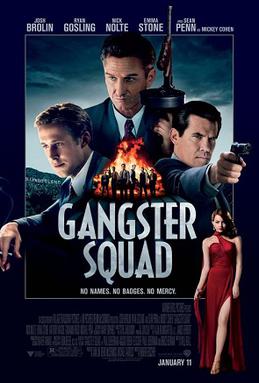
Gangster Squad

I'm a simple guy when it comes to movie. Entertain me, and I'll be pleased. Not every movie needs to be some groundbreaking, never before seen story that rewrites how films are made. Take 2013's Gangster Squad. It has taken a ridiculous amount of heat because.....I have NO IDEA. It is familiar in a way, but it's stylish, entertaining and action-packed with a ridiculous, loaded cast. Screw all the Debbie Downers. I loved this movie.

It's 1949 in Los Angeles and former boxer turned gangster Mickey Cohen (Sean Penn) is taking over the city bit by bit. Gambling, prostitution, drugs, Cohen is buying up cops, judges and politicians left and right as fast as he can. One of seemingly few clean cops, Sgt. John O'Mara (Josh Brolin) is fed up with what he's seeing in a city he wants his family to grow up in. He's approached by the similarly clean police chief, Parker (Nick Nolte), with an offer; assemble a small crew of officers and take the war to Cohen. O'Mara's squad will work as their own separate unit, completely removed from the laws and rules that would typically limit officers. He puts his crew together, including roguish Jerry Wooters (Ryan Gosling), and goes to work, attacking casinos, bars and clubs all over the L.A. area. They immediately find success, but it's only a matter of time before Cohen figures out who's gunning for him. Can O'Mara's Gangster Squad take Cohen's illegal businesses out before he gets to them?

There is little to nothing I didn't like about this movie. Playing like a modern film noir, it's a gem of a flick. It plays like a mix of L.A. Confidential, The Untouchables and The Magnificent Seven. If you put those three movies together and can't get a winner, then you're doing something wrong. Director Ruben Fleischer (Zombieland, 30 Minutes or Less) is at the helm of a damn entertaining movie. It feels like a throwback film to the Hollywood glory days with a huge cast -- much, much more on that later -- to go with a well-written script, exciting, well-choreographed action and a story that never really slows down. More than anything, it is just F-U-N. That's all. There are good guys and bad guys, cops and gangsters, a femme fatale and not a damsel in distress. Is it so wrong for a movie to just be entertaining? I read a surprising amount of reviews that were highly critical of this movie. Maybe I missed something, but I loved it from beginning to end.

Watching the trailer for the first time last year, I have no doubt my eyes were as big as dinner plates. A movie about cops and gangsters in post-WWII L.A. already drew me in, but with this cast?!? It's a ridiculously deep, very talented cast. Because there is so much talent assembled, we're not talking in-depth character studies, but there isn't a weak part in the bunch. For starters, Josh Brolin as the hard-headed, stubborn O'Mara is a hero cop gem. A WWII veteran, he's sick of Cohen and his antics so given a chance to take him down a whole lot of notches, he jumps at the chance. He has a pregnant wife (Mireille Enos) weighing on his mind, but he wants to get the job done, on principle alone. Brolin is aided by Ryan Gosling as Wooters, the cop who sees what L.A. has become and just doesn't care too much, but he's given a reason to care while also getting the love interest, Grace (Emma Stone), Cohen's girl. Uh-oh, more issues!

The names already mentioned would be enough for most movies, but not this one. Penn gets to ham it up as real-life boxer turned gangster Mickey Cohen, sneering and intimidating his way into the part. This is an out-and-out villain, a bad guy you just love to hate and can't wait to see get taken down. Nolte makes the most of his smallish but effective part as Chief Parker, the chief of police who sends O'Mara on his dangerous, illegal mission. Also look for Sullivan Stapleton as Jack Whalen, a bookie and friend of Wooter's working in Cohen's organization (a supporting but excellent part), Holt McCallany as Lockwood, Cohen's bodyguard and enforcer, and Troy Garity as Wrevock, a hired killer working for Cohen.

Not surprisingly, a certain part of the cast caught my eye....O'Mara's Gangster Squad! Uh-oh, it's another men-on-a-mission movie! Assemble a crew of misfits and specialists and let them go to work. How can you lose? Brolin and Gosling are the stars, showing off that hero-sidekick chemistry that every group of specialists needs. But wait, there's more! Rounding out the crew/squad are Harris (Anthony Mackie), a specialist with gun or knife looking to clean up the streets of drugs, Keeler (Giovanni Ribisi), a WWII intelligence officer and expert in radio technology, Kennard (Robert Patrick), the veteran cop and part-Wild West lawman who favors a six-shooter, and Ramirez (Michael Pena), a young Mexican officer who's looked down upon by much of the rest of the force. It's a good group of some really solid actors, all comfortable and willing to take a supporting part to flesh out an impressive cast.

Originally supposed to be released in summer/fall 2012, 'Gangster' was pushed back for re-shoots following the Aurora shooting at a movie theater. What remains is still an action-packed movie that will appease most moviegoer's needs for some shoot 'em up action. The script never goes long without a gunfight or shoot out of some sort. A couple different sequences stand out, including a failed ambush in a busy street in Chinatown and the finale at Park Plaza Hotel especially leaving their mark. It's pistols and machine guns to aid the throwback feel with some pretty cool uses of slow-motion without going overboard. Bloody but not overly graphic, the action sequences are just another selling point.

It's hard to describe this movie without describing the style. The late 1940s (and heading into the 1950s) were an inherently cool time looking back on them. Cops and police officers wore a suit, tie and a hat. The cars were ridiculously cool, the streets even more so, and Fleischer and Co. took that to heart. Part of the appeal here is the look of the movie, like we were transported to 1949 Los Angeles. Just like a scene where O'Mara and crew walk away from the L.A. City Hall, there's a cool factor that's hard to touch or classify. It's stylish and cool....because it is. How about a montage of the Squad doing their work to big band music? It works. There is style on display in every scene whether it be the clothes and sets or the quick, speedily delivered dialogue. I liked everything about this movie and look forward to future and repeat viewings.

Gangster Squad (2013): ****/****  

Tuesday, October 23, 2012

The Game

For better or worse, directors can get type-cast just as quickly as actors/actresses can. That's not always a bad thing. In the case of director David Fincher, he's typecast, but for a good thing. He's not been pigeon-holed into one genre or type of movie. For lack of better description, he makes good, smart, quality movies. Ready for the twist? I don't know if Fincher's 1997 movie The Game is one of those movies.

A highly successful investment banker living in San Francisco, Nicholas Van Orton (Michael Douglas) is "celebrating" his 48th birthday. While he's business successful, he is all alone other than his housekeeper and lives a quiet, lonely (it appears) life. Nicholas is visited by his younger brother, Conrad (Sean Penn), who gives him a mysterious birthday present; a card with a telephone number to a company that will get Nicholas involved in a similarly mysterious, cryptic game. Without really knowing why, Nicholas goes along with 'the game' and soon finds himself in an ever-evolving situation that he has absolutely NO control over. Can he figure out the game that threatens to take him over? Is this what Conrad intended?

When 'Game' works, it really works. Fincher shows a knack for building tension to the point it's almost unbearable. The unsettling quiet, the dark, shadowy streets, the feeling that something horrific is right around the corner. It's all there. It's so nerve-wracking that for most of the first 90 minutes, I was actually uncomfortable watching it. It's good uncomfortable, but you know what I mean. What the hell is this game Nicholas is involved in? What's the point? What's the end game? Weird things happen all around him, some that could be coincidental, others not at all, clearly examples of somethings and someone being manipulated.

The sense of not knowing is what makes much of this movie so easily recommendable. Fincher filmed in San Francisco, a city that's never looked bad on-screen. It is a great backdrop for the story. The city becomes a shadowy, sinister character, holding all sorts of terror and fear. There were times it even reminded me of a modern Hitchcock movie, and that's never a bad thing. A modern Hitchcock film noir full of shadows, secrets and all sorts of sinister mysteries, it's a great ride.

And then it isn't. Somewhere it just becomes too much. This is a movie/script/screenplay that has plot holes you could drive a semi-truck through. Even now as I write this review, I keep thinking of more instances where the story has dumb luck, coincidence or maybe Fate itself willing something to happen. It is convoluted beyond belief, and that's fine if it builds to something acceptable that makes it all worthwhile. At some point, it has to all click into place. Unfortunately, it doesn't. The twist is disappointing in so many ways including one scene that defies logic. I won't describe it here -- experience the badness for yourself -- but so many separate items need to come together for it to work that there is NO HUMAN WAY this could have worked. We're talking an inch difference, even a foot, and the movie ends completely different. Not making sense? Watch it, and see for yourself.

Keeping the movie based in some sort of enjoyment is Michael Douglas in the lead. An individual who's used to controlling every little thing about his life thrust into a situation that's the complete opposite? Oh, he isn't going to enjoy that at all, is he? I like Douglas as an actor, and he's a great choice here to play Nicholas. Even when he's pretentious and condescending and an a-hole, you can't help but like him a little. His complete unraveling is key because it's not overdone. It's believable. Penn's appearance is nothing more than a cameo, three or four quick scenes. They're effective, but short. Deborah Kerr Unger is solid as Christine, a waitress mixed up with the game who may or may not be helping Nicholas. Also look for James Rebhorn, Carroll Baker, Peter Donat, Armin Mueller-Stahl and Anna Katarina in key supporting parts.

A mixed bag in the end. Great build-up, great tension, and an imposing sense of doom hanging over the story. The execution is there for the most part, building to an almost unbearable point, but the ending falls short in a big way for me. Still worth watching though. The parts that work do just enough to overshadow the weaknesses of the finale.

The Game <---trailer (1997): ** 1/2 /****

Wednesday, February 29, 2012

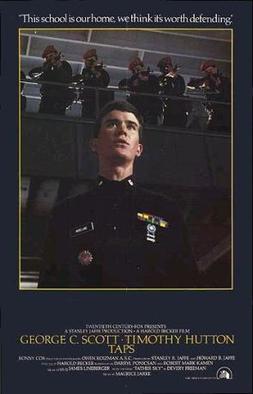
Taps

The military has been portrayed in a wide variety of ways over the relatively short history of Hollywood and films. For years, soldiers were typically portrayed as angelic heroes or your average man just trying to make it back home safely. As the years went on though and America became more cynical, so did the film portrayals of the military. Thanks to Korea and Vietnam, it became easy to jab at and criticize our military. In one of the best portrayals I've seen in awhile, 1981's Taps, the military is fairly shown, warts and all with the positives.

As commander of the Bunker Hill Military Academy, General Harlan Bache (George C. Scott) does his best to instill a feeling of pride, honor and duty among his cadets. One of the cadets, Brian Moreland (Timothy Hutton), has just been promoted to Major -- the highest ranking cadet -- for his senior year only to have some shocking news revealed. The Academy will be shut down in exactly one year, the grounds cleared for high-rise condos. An incident between some cadets and boys from the local town prompts an outcry though, and the date is moved up so the Academy will close immediately. Seeing his world and second home torn away from him, Moreland concocts a plan. With all the remaining cadets, Major Moreland takes over the Academy with armed force, but even he couldn't have predicted what his actions will produce.

From director Harold Becker, Taps has a feel of authenticity. Hutton and the rest of the young actors lined up with actual members of the Academy, doing the drills and living the life with them. The most important thing to come from this is that they're believable. To a man, they look comfortable in the part. The portrayal of the military is fair; an honor-bound society that lives by a specific code of morals and principles. You do what's right because it is right, not for any other reason. Filmed at Valley Forge Military Academy in Pennsylvania, Taps shows the life of the cadets from the various uniforms to the drilling to the dorms. An impressive scene has Hutton's Brian leading the commencement ceremony, the entire Academy parading around a field, and you believe it. All these little things, all these details add up because you see the life of these cadets -- good or bad on a personal level -- and what pushes them to do what they do.

Uniformly (pun intended) solid, three performances from the cadets stand out. This was Hutton's second feature film (he'd won an Oscar for his 1st part in Ordinary People) with co-stars Sean Penn making his screen debut and Tom Cruise making his first appearance in a non-background role. The talent on the screen even at a young age for all three is unquestioned. Hutton is the born leader, but he's quite sane and very intelligent. He loves the military life and resents the change. Him more than anyone else has fallen hook, line and sinker for General Bache's teachings about honor. Penn plays his best friend, Alex, a somewhat unwilling member of the revolt who sticks with it because he's going to stick it out next to his friend, not because he truly believes. On the other hand, there's Cruise's Shawn, a capable leader but a hot-head and possible fanatic. It's almost like good and evil, Alex on one shoulder as Brian's conscience, Shawn on the other as the Devil. Other keys part for the cadets include Giancarlo Esposito and Evan Handler as the two other cadet officers, Pierce and West, with Brendan Ward and John P. Navin Jr. as Charlie and Derek, two of the youngest cadets involved in the takeover.

In telling the story, Becker makes a wise choice. We see the story only from the cadets' perspectives and other than one quick detour, the whole story takes place within the walls of the Academy. We really only get to know two adult characters, Scott's General Bache and Ronny Cox as Colonel Kerby, commander of the National Guard called in to handle the situation which goes on for days. In a more subtle, understated part, Scott's performance is reminiscent of his most iconic role, George S. Patton, making it clear why these boys and young men believe so strongly in him. It's not a huge role, but it's a memorable one. Cox too brings humanity to a part that needs it. He wants to get the situation resolved as quickly as possible with as little bloodshed as possible. His one-on-one with Hutton's Moreland late at the Academy fence is an especially memorable confrontation. But other than these two parts, this movie belongs to the cadets. We see the quickly-escalating situation through their eyes and through what they see.

Making that choice works because we feel like we're right there with them. From the start, you know there will be no Hollywood happy ending. You can start to question their real motives, and that's where this movie rises above. Hutton and Cruise are the clear believers, truly believing in what they're doing. What about everyone else? Do they go along with it because the majority does or because they believe too? As the days wear on and an armed response from the National Guard looms, the courage begins to wither away for many. It's only late that Hutton's motives can be questioned. Has he been brainwashed? Has he gone too far because of a personal problem? Providing all the answers, the ending is especially emotional. Several scenes will no doubt leave a lasting impression, one in the predawn hours before the attack, the other coming in the movie's final minutes. It is an incredible ending, an appropriate, moving one if not a happy conclusion.

An underrated movie, I really enjoyed it. The message board at IMDB makes claims of dull, unrealistic, stupid, but I think they miss the point. The armed takeover and the ensuing situation isn't supposed to be an incredibly realistic development. It is a means to an end. It is intended to show these young men in a situation that becomes bigger than them and their intentions or beliefs. Their code of honor and pride is put to the test. Could something like this happen? Sure, of course it could, but it's the message that is important more than the situation.

Taps <---trailer (1981): *** 1/2 /****

Monday, July 4, 2011

The Thin Red Line

With just five movies to his names over a 39-year span, director Terrence Malick's movies have been few and far between to say the least. He doesn't take just any movie. He takes on projects that appeal to him. Malick is a director that was probably born a generation too late because he would have fit perfectly with the French auteurs of the 1950s and 1960s.  Not making a movie for 20 years after 1978's Days of Heaven, Malick returned in 1998 with a heavily anticipated WWII film based off a James Jones novel, The Thin Red Line.

The timing of the release no matter how anticipated this movie was could not have been much worse.  'Red Line' was released in early 1999 after a limited release in December '98, just five months removed from Steven Spielberg's Saving Private Ryan was shown in theaters.  It's not fair to compare the two movies, but the damage was done. Malick's film is the complete opposite of Private Ryan, and in the years since has been lost in the shadow of the Spielberg film.  I revisited The Thin Red Line, remembering enjoying it through several viewings. Instead this time around, I found a deeply flawed, even boring movie that I struggled to get through.

To write a plot synopsis of a Malick movie would be a waste of words so I'm not going to bother. He doesn't have stories in the linear sense. The Jones novel and this film are based on the fighting at Guadalcanal in 1942, but for Malick's purposes and his screenplay the setting is unnecessary. It could as easily have been Iwo Jima, Tarawa, Okinawa or any number of other Pacific islands that saw fighting in WWII. This isn't a story about the scope of war or the immensity of it all.  This is soldiers at their most basic, the thoughts racing through their heads as they take part in the unnatural act of killing another human being. Malick's screenplay does its best to delve into that aspect of war but ends up assembling an uneven, odd finished product that I can only qualify as an 'art house World War II movie.'

A trademark of Malick's in all his films is narration filling in for actual dialogue which is so often nuts and bolts conversation in his screenplays. When used correctly, narration can carry a movie, bringing emotion and power to a story that simple dialogue just couldn't do. Among the cast at different points just about everyone gets a crack at their own narration, but most prominently used are Jim Caviezel, Ben Chaplin, and John Dee Smith who appears only at the beginning and the end but narrates throughout. First, all three of these narrators are Southerners with a heavy drawl, making it nearly impossible to distinguish which one of them is which in their narration.

More than some tough accents to get used to though is the fact that these narrations are so poetic, so lyrical, so ethereal and from another world that very little of it registers.  I've seen the movie several times, but only an exchange or two sticks with me.  Chaplin's Pvt. Bell constantly thinks of his wife, the love and desire he feels for her.  It is so mind-numbingly tedious that I completely lost interest anytime he started talking, his thoughts drifting back to the time he spent with her (played in flashback by Miranda Otto). All of the soldiers -- who end up being dirt-covered, nameless individuals -- wonder about life, love, death, God, pain, suffering, righteousness, faith, and so much more. It is well written, but it is so unnatural that it sounds like a poetry jam. The eerily calm toning and pacing will no doubt put some viewers to sleep. Malick is in absolutely no rush to speed things up to get where he wants.

That's the problem I've had with this movie though since I first saw it. What is Malick trying to accomplish? What's he trying to say? Anti-war message for sure, but in what way?  We see the horrendous physical and psychological efforts war and combat can take on the individual. We see the inner turmoil tearing soldiers apart as they battle with their inner demons. But the tone of the movie is so odd I don't quite know what the intention was. 

The background of this film is interesting in itself, worthy of its own review. When Malick came out of the woodwork to make a movie, actors -- big, big name stars -- lined up to fill out the cast for this WWII story. Rumors persist of some epic five or six hour movie. Malick had to make cuts to his final movie, completely editing out parts for Bill Pullman, Gary Oldman, Viggo Mortensen, and Mickey Rourke among others. As is, the finished product is 170 minutes long and still features an interesting cast full of recognizable names. Along with those mentioned earlier, there's Nick Nolte, Sean Penn, John Cusack, Elias Koteas, Woody Harrelson, Adrien Brody and Thomas Jane. That's some of the cast. Check out the IMDB page for a complete listing. Even George Clooney and John Travolta make brief, pointless cameos.

With so many speaking parts, only a few get a chance to leave an impression -- positive or negative. Caviezel is the best as Pvt. Witt, a man who just doesn't belong in the army. His Heaven is the little Pacific village he deserts to, but he's torn away and brought back to the fighting as he's reunited with his company. He joins the fighting but doesn't quite know why. Sean Penn is great as Sgt. Welsh, the veteran sergeant who serves as the sounding board for all his men. His scenes with Caviezel's Pvt. Witt provide some of the movie's most memorable and more importantly, most moving movements as they question what they're accomplishing. Koteas too is a scene-stealer among the faceless soldiers as Capt. Staros, Charlie Company commander who refuses to waste his men in a frontal assault that has little hope of succeeding and feels the wrath from above.

That's probably the most frustrating part of this movie for me. There are moments of perfection that you just sit back and revel in, let them wash over you. Malick's directorial eye is never in question, his movies beyond gorgeous. Some directors work best with scripts and actors. Malick is a visual director, here Australia filling in for Guadalcanal. This is a story of nature and its beauty torn apart by the fighting. Malick is quite content to show a hillside with its long, green grass blowing in the wind.  Add in the musical score from Hans Zimmer, and you've got a winner. His main theme with the Melanesian choirs send chills down my back every time I hear it. Listen HERE. The rest of the score is more subdued than Zimmer's more well-known scores, but it soothes, it meditates, playing almost constantly in hushed tones over the action in some cases and the narration in others (Try HERE). There is something soothing about this movie in its execution and its message. It just can't keep up the momentum throughout.

Certain moments of this movie have stuck with me over the years. Almost an hour is spent in excruciating detail as C Company tries to take a Japanese bunker on a grassy hillside. Later, a running firefight takes the company through a ravaged Japanese camp, Zimmer's score combining with the action to make it one of the great realistic battle sequences ever, the aftermath as moving as the actual fighting. Witt's conversations with Welsh have always stuck with me, and Witt's final scenes as C Company goes on a patrol bring the movie full-circle in an inevitable way that you know is coming.

Is the movie pretentious and even tedious at times? Oh hell yes. There were times I wanted to fast forward through vast stretches of narration and shots of nature. The narration is done to death by the end of the movie, little lines of dialogue straight from a poet that I didn't even always comprehend what I'm hearing. But with all that said, I just can't give this movie a negative rating. The moments that work are so good they overpower and overshadow the weaker moments.  You have to know what you're getting into when you watch this movie, and even then, there's no guarantee you will like it. It is a movie experience though, and one every movie fan should at least try.

The Thin Red Line <---trailer (1998): ***/****