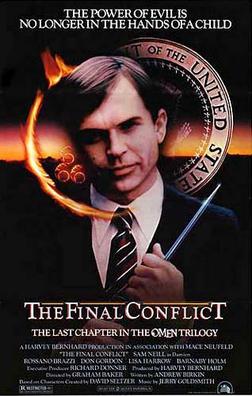
Well, evil has grown up. After reviewing the Omen remake from 2006 and the first sequel from the original, it's time to wrap things up with one last review. The original Omen movies were a trilogy and one failed TV movie. I watched part of this one years ago, especially remembering the finale, so here we go with 1981's Omen III: The Final Conflict.
The world has fallen into a costly recession, one that has some calling the current international crisis the 'end of days.' People are looking for answers, for a solution. Waiting to give them that answer and leadership is the C.E.O. of an aid company, a huge corporation with footholds all over the world, one Damien Thorn (Sam Neill), now 32 years old and fully embracing his Satanic makeup. When a grisly suicide leaves the position open, Damien is appointed the U.S. ambassador to England, the same position his father held years before. He has plans for his power position but he has fears, signs pointing to the Second Coming of Christ, that could cripple his plans. The timing is essential for those battling on both sides, both good and bad, as a small order of monks from Italy know Damien's true identity and are doing everything in their power to stop him. Who or what will prevail in the end? Good or evil?
Of the trilogy, only the first one is an above average horror flick to the point I'd say it is a classic. Where do the second and third ones fall? They're pretty good...just not as good. From director Graham Baker, 'Final' wraps things up in pretty cool fashion. It switches up the formula some and doesn't depend on gruesome deaths like Omen II did (even though I enjoyed that flick a lot). Again, these aren't the most plot-driven flicks, but I didn't get caught up in that stuff. It's all building, all developing a character, and this time we get a showdown in the finale between good and evil. 'Final' isn't as good as either of its predecessors, but I still enjoyed it a lot. It wraps things up nicely and even left an opening for the series to continue that never developed.
If you believe Wikipedia and its countless information -- and I tend to -- the casting for 32-year old Damien was pretty interesting. How about Jack Nicholson? Gene Hackman? Even Marlon Brando? All three were considered for the part before producers decided to go with a lesser known actor. Enter Sam Neill, 34 years old at the time. This is the natural progression for Damien. Having realized who he truly is in 'Damien II,' he's now actively working toward taking what is his. He's embraced his identity. He is the Antichrist, and he intends to rule the world. We get to see his political pull in a startlingly easy encounter with the President (Mason Adams), his pull on his political staff, and in most frightening fashion, his growing number of apostles and disciples. As I've mentioned before, evil...true, pure evil, can be scarier than any serial killer, murder mystery.
And that's an interesting angle of this sequel. Now, I'm not religious much, but this story fascinated me. Again, it's that BIG concept of good and evil. Add in the Antichrist, the believed Second Coming of Christ, and we've got some interesting stuff going on. Neill's Damien gets to chew the scenery several times as he addresses an immense crucifix (Jesus nailed to the cross backwards) about how he will ultimately defeat him. He calls him the Nazarene as if they were on a first-name basis, his cold, icy and calculating stare -- and what looks like some guy-liner -- adding that sinister edge to the story. This isn't a James Bond villain trying to conquer the world. This is the Prince of Darkness, the Devil, Satan himself. Not too many bigger stakes than that. Oh, and those dagger-wielding monks led by Father DeCarlo (Rossano Brazzi)? Nice touch, another enemy for Damien to deal with, even if they are sort of a bumbling bunch.
The cast is pretty small here for this horror sequel. Along with Neill, look for Don Gordon as Harvey Dean, Damien's personal assistant, fully aware of what his boss is and what he aspires to do in the old evil department. Lisa Harrow plays Kate Reynolds, a respected TV journalist trying to get down to the truth of Damien's background, Barnaby Holm playing her son, Peter, possibly a disciple for Damien.
There's some pretty cool moments along the way. I loved the credits sequence as we discover how the daggers that were supposedly lost in Damien II are discovered and end up where they need to be. The monks' attempts on Damien are tense, and Damien's ultimate plan to stop the second coming is particularly gruesome and more than a little unsettling. And then there's the ending, a great final scene that brings everything full circle. Yeah, there's some giant plot holes, but I liked the execution from beginning to end.
Omen III: The Final Conflict (1981): ***/****
The Sons of Katie Elder
"First, we reunite, then find Ma and Pa's killer...then read some reviews."
Showing posts with label Don Gordon. Show all posts
Thursday, October 30, 2014
Sunday, September 14, 2014
Force of Arms
Yuck, here we are again. War movies that aren't content to just be war movies. What else gets added to the formula? A love story, two tortured souls brought together because, God bless it, the universe just wants it to happen! Those crazy kids, they just belong together even if the war will do its best to keep them apart. Today's entry is 1951's Force of Arms.
It's 1943 and the fighting in Italy is intensifying all along the front. After weeks and months on the line, an infantry platoon commanded by Sgt. Joe Peterson (William Holden) is tasked with one more objective. Though it costs heavy casualties, the platoon retakes an important position from the Germans. The entire unit is awarded five days of leave far removed from the muddy, cold front lines, Peterson meets a WAC, Lt. Eleanor MacKay (Nancy Olson), who he starts off on a rocky path almost immediately. Still, as they argue and test each other back and forth, both Joe and Eleanor can't deny their attraction to each other. The clock is ticking though as the soldier and the WAC must decide where to go next before Joe returns to the front line fighting. Can they come to terms with how they feel about each other in time?
Gag me, I hate when I have to write plot descriptions like this. Don't get me wrong. If there's a good romance war story out there, I'll give it a fair shot. Also, I don't really count Casablanca. I'm talking war stories, men on the front lines when the story takes a detour for some loving away from the front. Director Michael Curtiz's flick has a ton of potential because the portions focusing on the fighting, on Peterson taking a leadership role, of the platoon both in action and resting, that is 'Force' at its strongest. Too much time is spent on the budding relationship between Holden and Olson in the process. 'Force' is filmed in black and white with some cool location shooting, California filling in surprisingly well for Italy. It has a gritty, worn look, but dang, enough with the love story.
Holden is one of my favorites, and Olson has more than held her own in Sunset Blvd., Battle Cry and several other flicks. They have some decent chemistry together, but this script does them absolutely no favors. They meet in a military cemetery in the dead of the night and at no point does Holden's Peterson ever think "Hmm, I wonder what she's doing here? Maybe someone she knew...died?" From there, we get to know two folks working through some stuff -- Peterson the war wearing him down day to day, Eleanor trying to overcome a lost love -- with death hanging in the air. They wonder aloud what love really is, question if they truly can love, take dreamy walks on the Italian countryside, and share tons of scandalous hugs where they rub faces. A love story is one thing. One that moves this sluggishly with not enough of a payoff? Yeah, not good.
At times, 'Force' reminded me of 1959's Never so Few, a WWII story that is at its strongest when it focuses on the war, on the soldiers, on the combat. That's 'Force' in a nutshell. The story starts at its strongest as Peterson's platoon is tasked with retaking a German-held position on a rocky hill. This isn't large scale warfare but a small unit of soldiers going toe to toe against another small unit of soldiers. The violence isn't graphic, but it's startling and quick just the same. That's most of the action/combat scenes, including the platoon moving into position under heavy German guns and later navigating an Italian town with winding streets and German shells and mortars raining down on them. As quick as these segments are over, the script jumps right back to the love story. Oh, joy.
Beyond Holden in the soldier department, look for Frank Lovejoy as Major Bradford, the unit's commanding officer and an old friend of Peterson's from back home. Commanding officer and one of his trusted officers but also friends with a past. In Peterson's platoon, look for Gene Evans as McFee, worried what his wife is up to back home, Dick Wesson as Kleiner, a capable soldier and a capable smartass, Paul Picerni as Sheridan, the smooth Italian (similar to the part he played in To Hell and Back), Ross Ford as Hooker, the southern farmer, Ron Hagerthy as Minto, Peterson's runner, and a young Don Gordon in one of his first speaking parts as Sgt. Webber. I like the group dynamic, their friendships, their arguments. It feels natural, and I just wish there was more of it.
A mixed bag unfortunately. When it's good, it's pretty good. When it's bad, love is pretty rough to watch.
Force of Arms (1951): **/****
It's 1943 and the fighting in Italy is intensifying all along the front. After weeks and months on the line, an infantry platoon commanded by Sgt. Joe Peterson (William Holden) is tasked with one more objective. Though it costs heavy casualties, the platoon retakes an important position from the Germans. The entire unit is awarded five days of leave far removed from the muddy, cold front lines, Peterson meets a WAC, Lt. Eleanor MacKay (Nancy Olson), who he starts off on a rocky path almost immediately. Still, as they argue and test each other back and forth, both Joe and Eleanor can't deny their attraction to each other. The clock is ticking though as the soldier and the WAC must decide where to go next before Joe returns to the front line fighting. Can they come to terms with how they feel about each other in time?
Gag me, I hate when I have to write plot descriptions like this. Don't get me wrong. If there's a good romance war story out there, I'll give it a fair shot. Also, I don't really count Casablanca. I'm talking war stories, men on the front lines when the story takes a detour for some loving away from the front. Director Michael Curtiz's flick has a ton of potential because the portions focusing on the fighting, on Peterson taking a leadership role, of the platoon both in action and resting, that is 'Force' at its strongest. Too much time is spent on the budding relationship between Holden and Olson in the process. 'Force' is filmed in black and white with some cool location shooting, California filling in surprisingly well for Italy. It has a gritty, worn look, but dang, enough with the love story.
Holden is one of my favorites, and Olson has more than held her own in Sunset Blvd., Battle Cry and several other flicks. They have some decent chemistry together, but this script does them absolutely no favors. They meet in a military cemetery in the dead of the night and at no point does Holden's Peterson ever think "Hmm, I wonder what she's doing here? Maybe someone she knew...died?" From there, we get to know two folks working through some stuff -- Peterson the war wearing him down day to day, Eleanor trying to overcome a lost love -- with death hanging in the air. They wonder aloud what love really is, question if they truly can love, take dreamy walks on the Italian countryside, and share tons of scandalous hugs where they rub faces. A love story is one thing. One that moves this sluggishly with not enough of a payoff? Yeah, not good.
At times, 'Force' reminded me of 1959's Never so Few, a WWII story that is at its strongest when it focuses on the war, on the soldiers, on the combat. That's 'Force' in a nutshell. The story starts at its strongest as Peterson's platoon is tasked with retaking a German-held position on a rocky hill. This isn't large scale warfare but a small unit of soldiers going toe to toe against another small unit of soldiers. The violence isn't graphic, but it's startling and quick just the same. That's most of the action/combat scenes, including the platoon moving into position under heavy German guns and later navigating an Italian town with winding streets and German shells and mortars raining down on them. As quick as these segments are over, the script jumps right back to the love story. Oh, joy.
Beyond Holden in the soldier department, look for Frank Lovejoy as Major Bradford, the unit's commanding officer and an old friend of Peterson's from back home. Commanding officer and one of his trusted officers but also friends with a past. In Peterson's platoon, look for Gene Evans as McFee, worried what his wife is up to back home, Dick Wesson as Kleiner, a capable soldier and a capable smartass, Paul Picerni as Sheridan, the smooth Italian (similar to the part he played in To Hell and Back), Ross Ford as Hooker, the southern farmer, Ron Hagerthy as Minto, Peterson's runner, and a young Don Gordon in one of his first speaking parts as Sgt. Webber. I like the group dynamic, their friendships, their arguments. It feels natural, and I just wish there was more of it.
A mixed bag unfortunately. When it's good, it's pretty good. When it's bad, love is pretty rough to watch.
Force of Arms (1951): **/****
Labels:
1950s,
Don Gordon,
Frank Lovejoy,
Gene Evans,
Michael Curtiz,
Paul Picerni,
William Holden,
WWII
Thursday, May 23, 2013
Revolt at Fort Laramie
As the Civil War started in 1861, the U.S. Army was faced with a difficult task. Units were composed of men from both the Northern and Southern states, leaving Southern soldiers to decide if they remain loyal to the oath they took to the U.S. Army or if they remain loyal to their home states. A pretty standard but enjoyable B-western, 1957's Revolt at Fort Laramie jumps right in with that premise, albeit in the west, not in the east.
At isolated Fort Laramie in the west, Major Seth Bradner (John Dehner) is facing an Indian uprising. Sioux chief Red Cloud (Eddie Little Sky) has signed a treaty with the army and government, but he hasn't received his gold payment in exchange yet for signing the treaty. Among his command is Capt. James Tenslip (Gregg Palmer), an experienced Indian fighter who is a more than worthy second in command. But as the commands readies to deal with the Indian uprising, a new issue arises. Back east, tensions are rising between the North and the South until finally Confederate forces fire on Fort Sumter in South Carolina. Bradner's command is now squarely divided between Confederates and Union men. Now, Bradner and Tenslip must try and hold their command together long enough to deal with the Sioux uprising, but the Civil War might not give them enough time.
Director Lesley Selander specialized in B-westerns in the 1950s, small scale flicks that were typically limited by smallish budgets and casts. If you're introducing someone to the western genre, a flick like this probably isn't the best jumping off point. Nothing jumps off the screen that screams 'CLASSIC!' They're solid, self-contained westerns that are familiar but always entertaining. This one has some obvious flaws, like the Moab Desert being a pretty if ill-suited stand-in for the prairies and plains of Wyoming, the Dakotas and Montana. The score is unspectacular, and the set is even familiar to a recent review here and another Telander-directed western, Tomahawk Trail. I'm probably not doing a solid job here selling this movie, but it's one that is definitely for die-hard western fans. At 73 minutes, it doesn't stay long enough to be a bad flick.
The casting is okay here, but it doesn't have much in the way of star power.....as in, any star power. Dehner gets top billing, but he's relegated to a background part that doesn't give him much to do. His Maj. Bradner is from a Southern state, and as commander of Fort Laramie finds himself in quite the sticky situation. Loyal to the army or to the South? Palmer is pretty vanilla as Capt. Tenslip, his 2nd in command, who's also engaged to Bradner's shrill niece, Melissa (Frances Helm). Any disgustingly sweet scene between Tenslip and Melissa can be pretty painful. In an odd bit of casting, Don Gordon plays Jean Salignac, a half-breed scout working for the cavalry with both French and Indian blood. His accent alone is something else. Robert Keys is underused as Sgt. Darrach, the ringleader of the Southern men at the fort.
The North vs. South dynamic provides some cool moments, but it never quite delivers like I hoped it would. A cool scene has the Southerners singing Dixie when the Northerners join in with John Brown's Body. The rivalry is more than just a rivalry, two sides full of hate because of something going on thousands of miles away. Throw in an Indian uprising, a small treasure in gold, and an outnumbered cavalry troop, and we've got ourselves an interesting predicament. More than just its B-movie status, there's something missing to make it particularly memorable. Also look for Harry Dean Stanton in an uncredited part as Rinty, one of the Confederates in the garrison.
With a movie wrapping up in 75 minutes, there isn't a lot of time or space for any fluff. Okay, not entirely true, all the romance is fluff, but there's also some solid action to balance it out. The opener has a patrol intervening on an Indian attack on a payroll wagon, and a later scene has cavalry traveling down the river on rafts as Indians attack from the riverbank. The highlight though is the finale as an immense Sioux war party surrounds retreating cavalry, the wagons circling up to defend themselves. Not a great western, maybe not even a good one, but I liked it just enough to give it a mild recommendation.
Revolt at Fort Laramie (1957): ** 1/2 /****
At isolated Fort Laramie in the west, Major Seth Bradner (John Dehner) is facing an Indian uprising. Sioux chief Red Cloud (Eddie Little Sky) has signed a treaty with the army and government, but he hasn't received his gold payment in exchange yet for signing the treaty. Among his command is Capt. James Tenslip (Gregg Palmer), an experienced Indian fighter who is a more than worthy second in command. But as the commands readies to deal with the Indian uprising, a new issue arises. Back east, tensions are rising between the North and the South until finally Confederate forces fire on Fort Sumter in South Carolina. Bradner's command is now squarely divided between Confederates and Union men. Now, Bradner and Tenslip must try and hold their command together long enough to deal with the Sioux uprising, but the Civil War might not give them enough time.
Director Lesley Selander specialized in B-westerns in the 1950s, small scale flicks that were typically limited by smallish budgets and casts. If you're introducing someone to the western genre, a flick like this probably isn't the best jumping off point. Nothing jumps off the screen that screams 'CLASSIC!' They're solid, self-contained westerns that are familiar but always entertaining. This one has some obvious flaws, like the Moab Desert being a pretty if ill-suited stand-in for the prairies and plains of Wyoming, the Dakotas and Montana. The score is unspectacular, and the set is even familiar to a recent review here and another Telander-directed western, Tomahawk Trail. I'm probably not doing a solid job here selling this movie, but it's one that is definitely for die-hard western fans. At 73 minutes, it doesn't stay long enough to be a bad flick.
The casting is okay here, but it doesn't have much in the way of star power.....as in, any star power. Dehner gets top billing, but he's relegated to a background part that doesn't give him much to do. His Maj. Bradner is from a Southern state, and as commander of Fort Laramie finds himself in quite the sticky situation. Loyal to the army or to the South? Palmer is pretty vanilla as Capt. Tenslip, his 2nd in command, who's also engaged to Bradner's shrill niece, Melissa (Frances Helm). Any disgustingly sweet scene between Tenslip and Melissa can be pretty painful. In an odd bit of casting, Don Gordon plays Jean Salignac, a half-breed scout working for the cavalry with both French and Indian blood. His accent alone is something else. Robert Keys is underused as Sgt. Darrach, the ringleader of the Southern men at the fort.
The North vs. South dynamic provides some cool moments, but it never quite delivers like I hoped it would. A cool scene has the Southerners singing Dixie when the Northerners join in with John Brown's Body. The rivalry is more than just a rivalry, two sides full of hate because of something going on thousands of miles away. Throw in an Indian uprising, a small treasure in gold, and an outnumbered cavalry troop, and we've got ourselves an interesting predicament. More than just its B-movie status, there's something missing to make it particularly memorable. Also look for Harry Dean Stanton in an uncredited part as Rinty, one of the Confederates in the garrison.
With a movie wrapping up in 75 minutes, there isn't a lot of time or space for any fluff. Okay, not entirely true, all the romance is fluff, but there's also some solid action to balance it out. The opener has a patrol intervening on an Indian attack on a payroll wagon, and a later scene has cavalry traveling down the river on rafts as Indians attack from the riverbank. The highlight though is the finale as an immense Sioux war party surrounds retreating cavalry, the wagons circling up to defend themselves. Not a great western, maybe not even a good one, but I liked it just enough to give it a mild recommendation.
Revolt at Fort Laramie (1957): ** 1/2 /****
Labels:
1950s,
Don Gordon,
Harry Dean Stanton,
John Dehner,
westerns
Wednesday, May 15, 2013
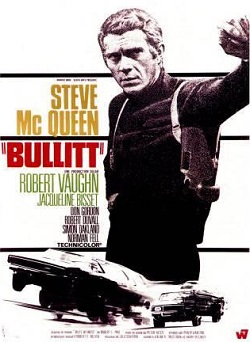
Bullitt
Let's cut away all the fluffiness and cut right to the bone. Steve McQueen is maybe the coolest actor to ever work in Hollywood. An underrated actor who had an incredible on-screen presence, he had his biggest success and popularity in the late 1960s. The Cincinnati Kid, Nevada Smith, Thomas Crown Affair, The Sand Pebbles, all excellent parts in good to great films. Nowhere was McQueen more at his coolest than 1968's Bullitt.
A respected and hard-edged San Francisco detective, Frank Bullitt (McQueen) has been tasked with a somewhat dull but essential task from ambitious politician Walter Chalmers (Robert Vaughn). Prepping for a Senate hearing about a Mafia takedown, Chalmers has enlisted a key witness (Felice Orlandi), and Bullitt and two other detectives must babysit him over a weekend until the hearing. Instead, the witness is killed by two assassins, forcing Bullitt to find out what's going on. Something doesn't fit together as he examines the clues and evidence, but the pressure is on. Chalmers needs a scapegoat, and Bullitt seems like the perfect target to take the fall. Knowing he's been backed into a corner, Bullitt has an extremely limited window to find out exactly what's going on.
The late 1960s were one of the most influential periods in Hollywood history, changing the way films were made and more importantly, the stories that were told. From director Peter Yates, 'Bullitt' is a police/cop movie like none before it. It is a smart, stylish cop drama/thriller that for me, gets better with each viewing. For starters, it was filmed in San Francisco, setting the stage for Dirty Harry, McQ and a whole cop genre to move into the city. It is an ideal backdrop for the story; a polished, good-looking city that is nonetheless hiding secrets. The score from Lalo Schifrin is a good mix of quiet, soothing jazz and faster-paced, more traditional yet still exciting musical cues (listen HERE). The style in an almost documentary-like fashion reflects some of the French crime thrillers that I've really come to appreciate, giving 'Bullitt' a different edge more than just the same old, same old cops and robbers story.
That starts with Steve McQueen as Detective Frank Bullitt, a veteran cop who always gets the job done but usually how he wants to do it, not how he should do it. That basic write-up is as cliched as the countless cop movie stereotypes that have been done to death in the years since, but McQueen gives the lead performance a different edge. Never one for huge dialogue scenes, McQueen's Bullitt is a huge presence whenever he's on-screen. He does more with a look here or there than many actors could do with an entire monologue with the camera trained on them. There's a self-assured confidence in the part, a quietness about it too. Bullitt is an expert at what he does, but he's not interested in fame or accolades. He does it because he's really good, so good that he's become almost desensitized to the violence he sees on a daily basis. McQueen is cool, acts cool and looks cool (I have a way with words, don't I?).
Okay, so we've talked about the plot, Steve McQueen's badass-ness (is that a word?), and hhhmmm, what else? Oh, right, the cars. Some 45 years since its release, 'Bullitt' is still remembered fondly for an infamous car chase that opened the door for countless knockoffs, remakes and retries. Driving his 1968 Ford Mustang, McQueen pursues two assassins (driver Bill Hickman, killer Paul Genge) in, around and through San Fran, two muscle cars going at it for everything they're worth. Schifrin's soundtrack is left by the wayside, just the sounds of the two engines doing battle providing all the soundtrack that's needed. Looking back on it now, it isn't a flashy sequence, but it is clear how much it has influenced just about every movie car chase since. It is an extended sequence that runs about 10 minutes total (near the film's halfway point), one that will definitely get the adrenaline pumping.
Now sometimes at the expense of the film's style is the film's story. It took me three or four viewings to really get everything down just right. Not to throw this out there as a cop-out, but an understanding of the story isn't a must here. You watch for the style. Some reviewers/critics have an issue with the pacing, some point-blank stating that it's a boring movie. It isn't an action-packed movie, that's for sure. 'Bullitt' takes its time but always knows where it wants to go. A chase through a hospital is subtle and underplayed but incredibly full of tension, as is the finale at the San Francisco airport as Bullitt chases a suspect across runways in use. We see little departures into San Fran with Bullitt's girlfriend, Cathy (Jacqueline Bisset), on dates and at work, to Bullitt's apartment, to follow up with witnesses. It's rarely flashy, but there's something charming just the same about that assured style.
Backing McQueen up, Vaughn does what he does best; gentlemanly slimy to perfection. His Chalmers is smooth and suave, but he's really a snake waiting in the grass to strike. Don Gordon (a longtime, close friend of McQueen) is nicely cast as Delgetti, Bullitt's longtime partner with Simon Oakland and Norman Fell as their superiors. Also look for Robert Duvall in a small but key (and effective) part as a cab driver whose help Bullitt enlists as he tries to figure everything out.
One of my favorites, an iconic flick from the 1960s, and one of Steve McQueen's all-time bests. Haven't seen it? What's wrong with you?!? Highly recommended.
Bullitt (1968): ****/****
Rewrite of November 2009 review
Saturday, December 4, 2010
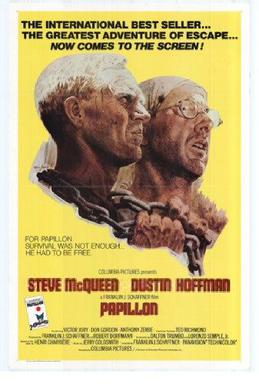
Papillon
I think it's a ridiculous claim for all three stars, especially McQueen. When I've talked to people who think he wasn't much of an actor -- more of a presence than anything -- the first movie I usually bring up is 1973's Papillon (with The Sand Pebbles close behind). Based on the real-life exploits of Henri Charriere, the deeply brooding, incredibly dark movie gives McQueen a chance to get deep into his own personal demons in a performance that you can't take your eyes off of. There are extended scenes and sequences that could serve as an example of how to dominate a movie doing very little at all. It is by no means an easy movie to sit through, one that makes you incredibly uncomfortable at times, but one worth watching.
Convicted in a French court for the murder of a pimp, Frenchman Henri Charriere (McQueen) is sentenced to life in prison in the French Guiana prison system in South America, a notorious system where diseases, horrific conditions, sadistic guards, and a short life expectancy await him. Aboard the ship bound for the prison, Henri -- known as Papillon because of the butterfly tattoo on his chest -- meets Louis Dega (Dustin Hoffman), a fellow Frenchman and an infamous forger responsible for thousands of families losing their life savings. For a price, Papillon offers to serve as Dega's bodyguard because the little forger is a target for his money. The two form an unlikely friendship as they near French Guiana, but no matter what awaits them, Papillon -- still claiming his innocence -- has no intention of staying long. Escape is on his mind, and no matter what the system does to him, he intends to make it out.
Charriere's autobiography is an extremely difficult book to read (I've tried twice and gotten no further than 100 pages) so formerly blacklisted screenwriter Dalton Trumbo has his work cut out for him. With a movie that clocks in at 151 minutes, his screenplay gets a chance to breathe. It is still at times a frustrating movie because not everything is spelled out for us as viewers. There are jumps in story, characters drift in and out, and over a decade has to be covered in the two and a half hours. But it's all part of the package here with a finished movie that leaves you wanting more. It is an eerily beautiful movie through all its depictions of what the human body and mind can survive when pushed to its absolute limit.
Up to this point in his career, McQueen had made a name for himself by playing the loner, the rebel, the anti-hero so it isn't a stretch for him to play a convicted murderer desperately trying to escape prison. But that's too simplistic a description because this performance is so much more. Charriere is a French safecracker who acquired a reputation in the Paris underworld as a man who could be trusted. As he prepares for this new phase in his life though, he not only looks ahead in preparation for awaits him but what he's leaving behind. Two quick dream sequences -- incredibly moody, unsettling scenes -- show a man who regrets how he got to this point, including one perfect line reading when a court says he's been found guilty of a wasted life. Watch it HERE. McQueen's face drops, knowing the statement is true, and says softly 'Guilty.'
While his whole performance is worth watching and recommending over and over again, one specific scene comes to mind. Captured after a failed escape attempt, Papillon is sentenced to two years in solitary confinement. Watch part of it HERE. From 5:25 on, watch a true actor do his job as good as humanly possible. In a cell about four feet across and eight feet long, there is nothing to distract from McQueen in the scene. This is a man at his absolute lowest who just won't give up, won't stop trying to survive when it would be so much easier to just lie down and stop. We're watching a man slowly losing his mind, slowly disintegrating right in front of us, and it is tragic to witness it. As good as McQueen was in The Sand Pebbles, I don't know if he was ever stronger than he was right there in that solitary cell in Papillon.
So McQueen's great, and that's it, right? Not so fast. In a role that could have been easy for him to get tossed aside, Dustin Hoffman delivers a subtle, very moving part as Louis Dega, the smallish in stature but incredibly intelligent forger who becomes friends with Papillon. Hoffman was on his way to being one of Hollywood's strongest, most gifted actors, and this part is definitely one that allows him to show off his many talents. As for the rest of the cast, Don Gordon, Anthony Zerbe, Woodrow Parfrey, and Robert Deman all impress too with smaller parts. I also have to mention Jerry Goldsmith's musical score, especially the main theme (listen HERE), one of the composer's all-time best scores.
Papillon <---trailer (1973): ****/****
Labels:
1970s,
Anthony Zerbe,
Don Gordon,
Dustin Hoffman,
Steve McQueen
Tuesday, November 9, 2010
Cannon for Cordoba
What I love more and more about movies as I look harder for those hard-to find gems is that there is always another gem around the corner. They are the movies that you read about but can't find or can't afford that pricey VHS through an Amazon vendor. They're the ones with these great casts that have somehow escaped your grasp for years. I love stumbling across one of these older gems more than I appreciate seeing a really good new movie at the theaters. For me, most of these gems are westerns or war movies, including 1970's Cannon For Cordoba.
I read about this American western shot in Spain a few years back and was immediately interested but just couldn't find a copy anywhere, and it never seemed to be on TV anywhere. Well, just like I was able to watch 1965's The Glory Guys last week, I found 'Cordoba' available through Netflix's Instant watch feature. I knew from the first time I read about the movie I'd like it because it comes from the always reliable 'men on a mission' sub-genre that stretches across countless types of movies. It is a mix somewhere between The Guns of Navarone, The Magnificent Seven, and The Professionals so it is fair to say you won't see anything you haven't seen before. It is a western that follows the formula closely and is the better for it, even if it isn't anything new.
It's 1916 and General Black Jack Pershing (John Russell) is on the Texas/Mexico border with the U.S. army doing his best to protect the border from bandit attacks, none of whom is worse than a rogue general named Cordoba (Raf Vallone). In a raid, Cordoba and his own army steals six artillery pieces and transport them back to his mountaintop fortress. Pershing has no option but to send some men undercover into Mexico to destroy the guns and possibly bring Cordoba out alive. He chooses an officer, Captain Rod Douglas (George Peppard) to the lead the raid that will have his team travel 200 dangerous miles into Mexico. On his team are three men from his unit (Don Gordon, Pete Duel, and Nico Minardos), a Mexican officer (Gabriele Tinti) and a beautiful, mysterious woman who will be used as bait looking for revenge (Giovanni Ralli). The odds are stacked against them though, and Douglas isn't sure any of them will come back.
Director Paul Wendkos sticks close the successful men on a mission formula from beginning to end here, and turns in a finished product that will never be thought of as classic, but it's like comfort food. Just cause you've seen it before doesn't mean it's a bad thing. He lays things out with an evil general as the villain, establishes a suicidal mission, assembles a team of specialists to pull off the job, throws in some curveballs, and lets the action take over. Throw in a solid if unspectacular score from composer Elmer Bernstein, beautiful location shooting in Spain, a touch of nudity here and there, and enough action to fill in all the gaps. It's typical of cheaper but well made westerns from the late 1960s and early 1970s that weren't trying to change the world. They were content to be damn entertaining, and whoever didn't like it didn't have to watch.
After some huge success in the early 1960s, Peppard was at a bit of a crossroads in his career, taking parts wherever he could get them. He's not slumming here, but the part and movie as a whole clearly isn't as large scale as he'd probably like. Playing Capt. Douglas, Peppard is a nice choice to lead a small team of specialists on a suicide mission. He was cool in just about everything he did, and his cigar chomping (hello Hannibal!), don't give a damn officer is a solid anti-hero to lead the proceedings. His team is made up of TV actors, and the four are given just enough background to make them interesting. Gordon is the soldier looking for revenge against Peppard, Duel is Andy, the fun-loving nut of the group ready to turn on anyone and everyone, Minardos is the Greek immigrant with a touch for explosives, and Tinti is the loyal Mexican officer also looking for some vengeance. I was surprised by which ones of the group actually makes it through the mission, but that's always part of the fun with these men on a mission movies.
This is an action western, and Wendkos does not disappoint. Three huge set pieces dominate the gunplay, all building up to the explosive finale that is just an orgy of gunfire, explosions and nameless henchmen getting blown away. Cordoba's raid on the cannons starts things off on a big scale, followed by Peppard's team tangling with some of Cordoba's men in a ruined, crumbling church. Smaller scale, but still exciting. Then in the finale, the actual suicidal mission. For one, Cordoba's mountaintop fortress is a very cool set so placing a battle in its midst with chaos and explosions everywhere is a great finish. It reminded me some of the ending to another Wendkos western, Guns of the Magnificent Seven, in terms of the large scope it takes. Exciting to the very end with some good twists.
For a story set in the Mexican Revolution, 'Cordoba' does follow a fair share of genre conventions, all the better to stick with that formula. You've got the generic evil general, the waves of nameless men in his armies more interested in women and drinking than fighting, and the requisite European general -- Swedish, not German this time -- played by Hans Meyer. Vallone is given little to do as the evil Cordoba, but he looks the part with that menacing glint in his eyes. He of course gets his comeuppance in the end as the bad guy always does. A classic this is not, but an exciting, always entertaining western that is worth tracking down. No luck finding a trailer either, my apologies.
Cannon for Cordoba (1970): ***/****
I read about this American western shot in Spain a few years back and was immediately interested but just couldn't find a copy anywhere, and it never seemed to be on TV anywhere. Well, just like I was able to watch 1965's The Glory Guys last week, I found 'Cordoba' available through Netflix's Instant watch feature. I knew from the first time I read about the movie I'd like it because it comes from the always reliable 'men on a mission' sub-genre that stretches across countless types of movies. It is a mix somewhere between The Guns of Navarone, The Magnificent Seven, and The Professionals so it is fair to say you won't see anything you haven't seen before. It is a western that follows the formula closely and is the better for it, even if it isn't anything new.
It's 1916 and General Black Jack Pershing (John Russell) is on the Texas/Mexico border with the U.S. army doing his best to protect the border from bandit attacks, none of whom is worse than a rogue general named Cordoba (Raf Vallone). In a raid, Cordoba and his own army steals six artillery pieces and transport them back to his mountaintop fortress. Pershing has no option but to send some men undercover into Mexico to destroy the guns and possibly bring Cordoba out alive. He chooses an officer, Captain Rod Douglas (George Peppard) to the lead the raid that will have his team travel 200 dangerous miles into Mexico. On his team are three men from his unit (Don Gordon, Pete Duel, and Nico Minardos), a Mexican officer (Gabriele Tinti) and a beautiful, mysterious woman who will be used as bait looking for revenge (Giovanni Ralli). The odds are stacked against them though, and Douglas isn't sure any of them will come back.
Director Paul Wendkos sticks close the successful men on a mission formula from beginning to end here, and turns in a finished product that will never be thought of as classic, but it's like comfort food. Just cause you've seen it before doesn't mean it's a bad thing. He lays things out with an evil general as the villain, establishes a suicidal mission, assembles a team of specialists to pull off the job, throws in some curveballs, and lets the action take over. Throw in a solid if unspectacular score from composer Elmer Bernstein, beautiful location shooting in Spain, a touch of nudity here and there, and enough action to fill in all the gaps. It's typical of cheaper but well made westerns from the late 1960s and early 1970s that weren't trying to change the world. They were content to be damn entertaining, and whoever didn't like it didn't have to watch.
After some huge success in the early 1960s, Peppard was at a bit of a crossroads in his career, taking parts wherever he could get them. He's not slumming here, but the part and movie as a whole clearly isn't as large scale as he'd probably like. Playing Capt. Douglas, Peppard is a nice choice to lead a small team of specialists on a suicide mission. He was cool in just about everything he did, and his cigar chomping (hello Hannibal!), don't give a damn officer is a solid anti-hero to lead the proceedings. His team is made up of TV actors, and the four are given just enough background to make them interesting. Gordon is the soldier looking for revenge against Peppard, Duel is Andy, the fun-loving nut of the group ready to turn on anyone and everyone, Minardos is the Greek immigrant with a touch for explosives, and Tinti is the loyal Mexican officer also looking for some vengeance. I was surprised by which ones of the group actually makes it through the mission, but that's always part of the fun with these men on a mission movies.
This is an action western, and Wendkos does not disappoint. Three huge set pieces dominate the gunplay, all building up to the explosive finale that is just an orgy of gunfire, explosions and nameless henchmen getting blown away. Cordoba's raid on the cannons starts things off on a big scale, followed by Peppard's team tangling with some of Cordoba's men in a ruined, crumbling church. Smaller scale, but still exciting. Then in the finale, the actual suicidal mission. For one, Cordoba's mountaintop fortress is a very cool set so placing a battle in its midst with chaos and explosions everywhere is a great finish. It reminded me some of the ending to another Wendkos western, Guns of the Magnificent Seven, in terms of the large scope it takes. Exciting to the very end with some good twists.
For a story set in the Mexican Revolution, 'Cordoba' does follow a fair share of genre conventions, all the better to stick with that formula. You've got the generic evil general, the waves of nameless men in his armies more interested in women and drinking than fighting, and the requisite European general -- Swedish, not German this time -- played by Hans Meyer. Vallone is given little to do as the evil Cordoba, but he looks the part with that menacing glint in his eyes. He of course gets his comeuppance in the end as the bad guy always does. A classic this is not, but an exciting, always entertaining western that is worth tracking down. No luck finding a trailer either, my apologies.
Cannon for Cordoba (1970): ***/****
Labels:
1970s,
Don Gordon,
George Peppard,
John Russell,
Paul Wendkos,
Raf Vallone,
westerns
Subscribe to:
Posts (Atom)