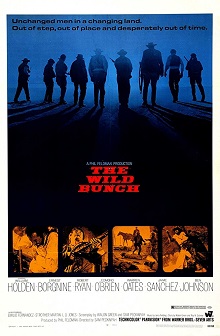
By 1969, director Sam Peckinpah had worked on several TV series and several film productions, including The Deadly Companions, Ride the High Country and Major Dundee. He was an incredibly talented director but one whose fiery personality and personal demons could potentially derail any film he worked on. But in 1969, it all came together, Peckinpah making his classic, his all-time great film, one of the best westerns ever and best films ever in general, 1969's The Wild Bunch.
It's 1913 in a small border town near the Rio Grande, and a gang of outlaws, led by the infamous Pike Bishop (William Holden), disguised as soldiers ride in to rob the bank of a rumored silver shipment. The robbery is an epic disaster as a posse of bounty hunters, led by Deke Thornton (Robert Ryan), a paroled outlaw who used to ride with Pike, is waiting in ambush. Many of Pike's gang is killed in the robbery that nets them NO money. The remaining members of the gang, including Dutch Engstrom (Ernest Borgnine), retreat into Mexico. They need a new job, a new robbery, a new chance to earn some money. Pike especially knows that time is running out, that times are changing, and their chances at surviving as outlaws is becoming ever more unlikely. It doesn't help that Deke and his bounty hunters have followed them into Mexico, looking to collect the bounties on these infamous outlaws. With time running out, what do they do?
What a movie. Every so often, each and EVERY thing involved in the making of a film comes together and forms that perfect symmetry. 'Bunch' is an all-timer, not just a movie I love but a great movie in terms of storytelling and in technical terms. Appropriate for the time it was released (the late 1960's), it is cynical, horrifically violent, brutally honest and generally downbeat. This is a western and film ahead of its time, helping set the tone where films would go in the coming years. This is Peckinpah at the top of his game. He would have other good to great to classic films, but this is his Great film. Just a gem.
There is little to nothing to criticize here. While the filming process sounds incredibly interesting (a film in itself), the choice to film in Mexico pays off huge dividends. Cinematographer Lucien Ballard shoots a beautiful movie with the Mexican countryside and desert as a backdrop. The locations are phenomenal. You feel like you're watching the actual settings of the Mexican Revolution to our story. Composer Jerry Fielding turns in quite the memorable score as well, appropriately epic at times and equally quiet and emotional as necessary in other scenes. Listen to a sample HERE. As for the story itself, Peckinpah and writer Walon Green turn in a screenplay that's just a gem. It isn't a movie in a rush, letting things breathe and allow the viewer to get to know the characters -- for good or bad -- over its 145-minute running time. Sit back and take it in. You shan't be disappointed!
Many westerns have dealt with the death of the old west, the end of an era, but none better than The Wild Bunch. It's 1913 and there's no place for these outlaws, killers and gunfighters anymore. The world is changing, and civilization (of sorts) is moving in to replace them. We follow a gang of those outlaws, robbers, killers/murderers as they try to pull off their one last job and step away, and it's a testament to the acting on display and screenplay that we feel any sympathy at all to these men. Like few movies I've ever seen, there is a doomed quality to these men who are working with limited time on their hands. They know the door is closing on them, more than likely a bloody death awaiting them if they don't figure out something soon.
Where Peckinpah's screenplay is so strong is in its characterization and its depth. There's a whole lot of acting talent on display in 'Bunch,' and for much of the cast, this is their all-time best performance or certainly one of their best. Holden's Pike Bishop is one of the most fascinating characters ever in my book, an aging outlaw who's outlived his time but doesn't know what else to do. Borgnine too is excellent as Dutch, his right-hand man who can also see the writing on the wall. Their scene together after the early botched robbery is essential, two men who potentially know what awaits them but go into things willingly because maybe that ending is what's supposed to happen. On the counter, Ryan's Deke Thornton is equally tragic. He's riding after his old partner, Bishop, and would much rather be riding with them than chasing them. But as the script relies on, your word is your word, and these men live by that coda.
One of the many things Peckinpah loved to touch on in his films was that bond of men under fire who come through while others don't. Holden's Pike is the mouthpiece for that concept, of giving your word and sticking by it even when it'd be far easier to tuck your tail and run. We see that again and again with the bunch, including Pike, Dutch, old, grizzled Sykes (Edmond O'Brien), the crass, unsavory Gorch brothers, Lyle (Warren Oates) and Tector (Ben Johnson), and Angel (Jaime Sanchez), the youngest of the group, a fiery Mexican. What's interesting is that though Pike and the bunch claim to live by this coda, they continue to fall short of actually living up to it. It's when they realize their faults in that department that the story takes a far more tragic turn toward the inevitable ending that you just knew was coming.
Because the already-mentioned star power wasn't enough, here's some more! Along with Ryan, look for scene-chewing Strother Martin and L.Q. Jones as two scummy bounty hunters with Albert Dekker as the railroad magnate "employing" them. Emilio Fernandez is perfectly slimy as Mapache, the Mexican general claiming to be some sort of freedom fighter but it seems it is all for show, for more power, with Jorge Russek and Alfonso Arau (El Guapo in Three Amigos) as his subordinate officers. Also look for Bo Hopkins, Dub Taylor and Chano Urueta in key (if small) supporting parts.
What 'Bunch' has become synonymous with over the years is its groundbreaking, sometimes horrifying portrayal of on-screen violence. It's not that Peckinpah lingers on the violence for the sake of shock value. Far from it, but instead he makes it into an art form. The idea of a 'dance of death' comes to mind in any portrayal of violence with three main set pieces (1. The opening robbery turned into a bloody shootout 2. A prolonged train robbery and 3. The final, bullet-riddled and blood-splattered gun battle). The editing is ridiculously fast and cut in with perfect uses of slow motion. Simply put, there is an art to Peckinpah's use of violence, both in the editing, in the overwhelming use of slow-motion blood squibs, and the impact of that violence we're seeing. If Bonnie and Clyde opened the door some for its own use of on-screen violence, Peckinpah's The Wild Bunch kicked that door wide open. Almost 50 years later, it still resonates, and it's clear the impact it had on hundreds and thousands of movies released since.
It all builds to maybe the most memorable action sequence of all-time. If it's not No. 1, it certainly belongs in the conversation. In a sequence that's been dubbed "The Battle of Bloody Porch," it all comes together in an extended sequence that has lost none of its edge since its release in 1969. This is a transfixing scene that is equal parts horrifying and startling but you just can't look away. There are too many great moments just in this scene alone to mention, including an improvised walk the Bunch takes on their way to a final showdown (maybe the movie's second-strongest sequence). It is followed by a quick, shocking death, and then an eerie moment of silence that hangs in the air. With one gunshot, it is on, bullets flying thick in the air. Obvious SPOILERS but you can watch it HERE. If you haven't seen the movie, I don't recommend watching the sequence out of context. Watch the movie and soak it all in as part of the whole product. Just a remarkable extended sequence with virtually no music. The focus is the characters, violence and death. Nothing more. Nothing less.
A classic in every sense of the word. I pick something new up with every viewing, and it never loses any of its impact. A film without a weakness.
The Wild Bunch (1969): ****/****
The Sons of Katie Elder
"First, we reunite, then find Ma and Pa's killer...then read some reviews."
Showing posts with label Bo Hopkins. Show all posts
Monday, December 28, 2015
Tuesday, July 29, 2014
The Man Who Loved Cat Dancing
If I know a movie is based off a book, I typically try to find that book before jumping into a viewing. Some are easier than others -- in terms of film and literature -- to track down so you take them when you can. I stumbled across The Man Who Loved Cat Dancing several years ago at a local library knowing it was also a feature length film. I didn't especially care for the book, but there was some potential. Now as for the movie....that proved difficult tracking it down. That is until TCM aired it recently. Here we are with the film adaptation, 1973's The Man Who Loved Cat Dancing.
Having pulled off a successful train robbery at an isolated part of the desert, outlaw Jay Grobart (Burt Reynolds) and his gang ready themselves to ride off with thousands of dollars in their saddlebags. The gang is in for a surprise though. A woman, Catherine Crocker (Sarah Miles), has accidentally ridden up and witnessed the entire robbery. With no alternative, the gang brings her along as a hostage of sorts, knowing a posse will be along soon enough. Jay and Co. put some miles between them, but they're right. A posse is following their trail, a Wells Fargo agent, Lapchance (Lee J. Cobb), and Catherine's worrying husband (George Hamilton), leading the way. With Catherine in tow, Jay continues on the getaway as planned. That route takes them right into Indian territory where Jay has a to this point unspoken plan he intends to bring about.
I can't say I went into this flick with high expectations with a pretty decent memory of the novel from author Marilyn Durham. Still, I'm having more and more trouble tracking down westerns from major studios I haven't seen before so I wanted to give it a fair shot. The cast was impressive enough. The story had potential, even if I felt like the novel wasted much of that potential. So clean slate going in, 'Man' still didn't do it for me. It isn't quite the ultra-dark vision of so many other revisionist westerns of the 1970s, but it does try for some sort of reality. The west as presented is violent, unpleasant, gritty and dirty where survival is as much about luck as anything else. What is this western from director Richard C. Sarafian missing then? While there are performances that are worth mentioning, the movie itself simply isn't interesting.
One of my pet peeves in westerns is unnecessarily jamming a love story into an otherwise good story that doesn't NEED a love story. Well, sticking to the Durham novel, 'Man' rides along with the love story that develops between Jay and Catherine. The odd thing isn't that the love story there. It's how it develops. Catherine is actually running away from her husband, and we find out she is a lady at basically all times. How's that? Yeah, she doesn't like sex to the point she's embarrassed by it. Does her husband abuse her? Could be although it's never spelled out. Naturally, Catherine gets some Stockholm Syndrome for Jay who is rough with her and doesn't baby her. She falls madly in love with him even when we find out about Jay's rather checkered past, especially with his dead wife, an Indian woman named Cat Dancing. It plays out in odd fashion and seems like an odd fantasy to have, like something you'd see in a schmaltzy romance novel.
So beyond that, the performances are pretty decent. It's cool to see Reynolds sink his teeth into a meatier performance, a heavy dramatic part. He's always good in lighter comedy roles, but give the guy credit. Reynolds was a solid dramatic actor when he wanted to be, and the anti-hero good guy turned bad guy in a western with a checkered past is a familiar western archetype. Miles does her best with what I found to be a poorly written character. Her chemistry is good with Reynolds, and she has a memorable moment here and there, but the character's intentions and motivations float all over the place. Lee J. Cobb is underused as the Wells Fargo agent while Hamilton is kept in the dark with another poorly defined character. He's shown as a bit of a dandy, a gentleman more interested in what people think of him than actually getting his wife back, but like so many characters we don't find out enough about him. As for Jay's gang look for Bo Hopkins and Jack Warden as despicably bad outlaws with Jay Varela playing Charlie, the one decent member of the crew. Also look for Robert Donner and Jay Silverheels in supporting parts.
A disappointing end result. At 123 minutes, it is far too long, possibly in an effort to be dreamlike and.....nah, just slow-moving. The soundtrack isn't memorable in the least, and while there is some beautiful on-location shooting, the movie just dreary-looking from beginning to end. The finale could have saved the movie some, but even there the brakes are tapped in a big way to make things a happy Hollywood ending. A meh movie in the end.
The Man Who Loved Cat Dancing (1973): **/****
Having pulled off a successful train robbery at an isolated part of the desert, outlaw Jay Grobart (Burt Reynolds) and his gang ready themselves to ride off with thousands of dollars in their saddlebags. The gang is in for a surprise though. A woman, Catherine Crocker (Sarah Miles), has accidentally ridden up and witnessed the entire robbery. With no alternative, the gang brings her along as a hostage of sorts, knowing a posse will be along soon enough. Jay and Co. put some miles between them, but they're right. A posse is following their trail, a Wells Fargo agent, Lapchance (Lee J. Cobb), and Catherine's worrying husband (George Hamilton), leading the way. With Catherine in tow, Jay continues on the getaway as planned. That route takes them right into Indian territory where Jay has a to this point unspoken plan he intends to bring about.
I can't say I went into this flick with high expectations with a pretty decent memory of the novel from author Marilyn Durham. Still, I'm having more and more trouble tracking down westerns from major studios I haven't seen before so I wanted to give it a fair shot. The cast was impressive enough. The story had potential, even if I felt like the novel wasted much of that potential. So clean slate going in, 'Man' still didn't do it for me. It isn't quite the ultra-dark vision of so many other revisionist westerns of the 1970s, but it does try for some sort of reality. The west as presented is violent, unpleasant, gritty and dirty where survival is as much about luck as anything else. What is this western from director Richard C. Sarafian missing then? While there are performances that are worth mentioning, the movie itself simply isn't interesting.
One of my pet peeves in westerns is unnecessarily jamming a love story into an otherwise good story that doesn't NEED a love story. Well, sticking to the Durham novel, 'Man' rides along with the love story that develops between Jay and Catherine. The odd thing isn't that the love story there. It's how it develops. Catherine is actually running away from her husband, and we find out she is a lady at basically all times. How's that? Yeah, she doesn't like sex to the point she's embarrassed by it. Does her husband abuse her? Could be although it's never spelled out. Naturally, Catherine gets some Stockholm Syndrome for Jay who is rough with her and doesn't baby her. She falls madly in love with him even when we find out about Jay's rather checkered past, especially with his dead wife, an Indian woman named Cat Dancing. It plays out in odd fashion and seems like an odd fantasy to have, like something you'd see in a schmaltzy romance novel.
So beyond that, the performances are pretty decent. It's cool to see Reynolds sink his teeth into a meatier performance, a heavy dramatic part. He's always good in lighter comedy roles, but give the guy credit. Reynolds was a solid dramatic actor when he wanted to be, and the anti-hero good guy turned bad guy in a western with a checkered past is a familiar western archetype. Miles does her best with what I found to be a poorly written character. Her chemistry is good with Reynolds, and she has a memorable moment here and there, but the character's intentions and motivations float all over the place. Lee J. Cobb is underused as the Wells Fargo agent while Hamilton is kept in the dark with another poorly defined character. He's shown as a bit of a dandy, a gentleman more interested in what people think of him than actually getting his wife back, but like so many characters we don't find out enough about him. As for Jay's gang look for Bo Hopkins and Jack Warden as despicably bad outlaws with Jay Varela playing Charlie, the one decent member of the crew. Also look for Robert Donner and Jay Silverheels in supporting parts.
A disappointing end result. At 123 minutes, it is far too long, possibly in an effort to be dreamlike and.....nah, just slow-moving. The soundtrack isn't memorable in the least, and while there is some beautiful on-location shooting, the movie just dreary-looking from beginning to end. The finale could have saved the movie some, but even there the brakes are tapped in a big way to make things a happy Hollywood ending. A meh movie in the end.
The Man Who Loved Cat Dancing (1973): **/****
Labels:
1970s,
Bo Hopkins,
Burt Reynolds,
George Hamilton,
Jack Warden,
Lee J. Cobb,
westerns
Monday, July 28, 2014
Tentacles
Some movies just defy description. They're just that bad. Now, you know what movie is pretty great? 1975's Jaws, the first true summer blockbuster. You know what isn't so good about it? The seemingly countless sequels, ripoffs and countless quasi-remakes. Some of them are pretty awful but pretty entertaining if you're looking for a laugh. Then there's 1977's Tentacles. It isn't entertaining. It. Is. Just. Bad.
At Ocean Beach, a quiet seaside resort, not much in terms of danger ever goes on....until now. Several people have gone missing in the water, including one diver who went looking for the missing persons. Their bodies have been discovered, their skeletons stripped almost entirely of skin and the marrow sucked out of their bones. What could possibly doing this? A veteran newspaper reporter, Ned Turner (John Huston), is on the prowl, suspecting a huge corporation drilling in the ocean may be at fault. Keeping on the trail, Turner continues to look for an explanation, even turning to a famed animal trainer and experienced diver, Will Gleason (Bo Hopkins), for help. Looking at those who've been attacked and the mounting piles of evidence, Gleason suspects the attacks could have come from a giant octopus, a creature not known for attacking humans. Could Turner be onto something, linking the attacks to the corporation? Lives depend on them finding the answer.
Wow, what a bad, just plain awful, lousy movie. I like some of the Jaws ripoffs from Orca to Grizzly, both lousy movies, but my goodness, are they entertaining in their lousiness. This U.S./Italian co-production from director Ovidio G. Assonitis doesn't even qualify in the lousiness department. You know what the best thing going for this movie is? The music, composer Stelvio Cipriani turning in a memorable, foreboding score. Listen HERE for an extended sample. In a disaster-themed, killer animal on the loose movie, when the music is the biggest positive, you know you're in trouble. It just isn't good to the point it is painfully boring. 'Tentacles' follows the Jaws formula to a T, duplicating entire scenes, characters and story development. At no point is it ever scary or foreboding so go watch Jaws or even Jaws 2, Orca, or Grizzly for a far better time.
I'll give disaster movies credit where it's due. You get to see a lot of movie stars in one place at the same time. Now.....the performances aren't going to be very good, but it's an abundance of movie stars!!! How can you lose?!? Well, we do so there's that. No one seems particularly interested, but there is name recognition. Huston is a good choice to play a crotchety, grizzled reporter with Shelley Winters starring as his sister, a single mom who's always looking to seduce a younger man. Give him credit, Bo Hopkins commits to the material, even if his part is a pretty odd one. He's at one with animals, especially when his wife (Delia Boccardo) comes into danger. Also starring is Claude Akins as the overworked, overstressed town sheriff trying to save his townspeople. Cesare Danova plays the maligned corporation representative who must answer all the questions, knowing his company could be held responsible for the attacks. The rest of the speaking parts are badly dubbed English from Italian-speaking actors.
A master of the 1970s disaster movie cameo, Henry Fonda also makes a quick appearance as Mr. Whitehead, the President of Trojan Construction who's looking to make a buck. If some people get killed in the process....meh, whatever happens.
I don't know what to say here. It's not that the movie is bad because it is more than that. A bad movie can be entertaining, but this disaster knockoff is pure and simple boring as watching paint dry on a wall, as watching grass grow. The octopus attacks are laughable, seemingly also making an octopus a killing creature that sprints across the top of the ocean. Oh, no! It's shooting ink at me!!! The reasoning seems far-fetched even for a poorly written script, construction vibrations deep on the ocean floor infuriating the creature to the point it feels the need to kill and to kill often. A seemingly unstoppable killing machine in nature is a cool premise and a great jumping off point, but this one never does anything with it.
Then there's the end. Hopkins' animal trainer who's coming off an extreme incident with the bends unleashes his two killer whales to take out the octopus. I can't say I've seen too many movies where animals become hired killers, but this one counts. When things should be raring to go in the finale, it just doesn't. The underwater scenes go on and on without a sense of urgency. That's the entire movie, long stretches of boredom broken up by slightly less boring animal attacks. Some cool names in the cast, but even that is wasted. Steer clear or the tentacles may get you!
Tentacles (1977): */****
At Ocean Beach, a quiet seaside resort, not much in terms of danger ever goes on....until now. Several people have gone missing in the water, including one diver who went looking for the missing persons. Their bodies have been discovered, their skeletons stripped almost entirely of skin and the marrow sucked out of their bones. What could possibly doing this? A veteran newspaper reporter, Ned Turner (John Huston), is on the prowl, suspecting a huge corporation drilling in the ocean may be at fault. Keeping on the trail, Turner continues to look for an explanation, even turning to a famed animal trainer and experienced diver, Will Gleason (Bo Hopkins), for help. Looking at those who've been attacked and the mounting piles of evidence, Gleason suspects the attacks could have come from a giant octopus, a creature not known for attacking humans. Could Turner be onto something, linking the attacks to the corporation? Lives depend on them finding the answer.
Wow, what a bad, just plain awful, lousy movie. I like some of the Jaws ripoffs from Orca to Grizzly, both lousy movies, but my goodness, are they entertaining in their lousiness. This U.S./Italian co-production from director Ovidio G. Assonitis doesn't even qualify in the lousiness department. You know what the best thing going for this movie is? The music, composer Stelvio Cipriani turning in a memorable, foreboding score. Listen HERE for an extended sample. In a disaster-themed, killer animal on the loose movie, when the music is the biggest positive, you know you're in trouble. It just isn't good to the point it is painfully boring. 'Tentacles' follows the Jaws formula to a T, duplicating entire scenes, characters and story development. At no point is it ever scary or foreboding so go watch Jaws or even Jaws 2, Orca, or Grizzly for a far better time.
I'll give disaster movies credit where it's due. You get to see a lot of movie stars in one place at the same time. Now.....the performances aren't going to be very good, but it's an abundance of movie stars!!! How can you lose?!? Well, we do so there's that. No one seems particularly interested, but there is name recognition. Huston is a good choice to play a crotchety, grizzled reporter with Shelley Winters starring as his sister, a single mom who's always looking to seduce a younger man. Give him credit, Bo Hopkins commits to the material, even if his part is a pretty odd one. He's at one with animals, especially when his wife (Delia Boccardo) comes into danger. Also starring is Claude Akins as the overworked, overstressed town sheriff trying to save his townspeople. Cesare Danova plays the maligned corporation representative who must answer all the questions, knowing his company could be held responsible for the attacks. The rest of the speaking parts are badly dubbed English from Italian-speaking actors.
A master of the 1970s disaster movie cameo, Henry Fonda also makes a quick appearance as Mr. Whitehead, the President of Trojan Construction who's looking to make a buck. If some people get killed in the process....meh, whatever happens.
I don't know what to say here. It's not that the movie is bad because it is more than that. A bad movie can be entertaining, but this disaster knockoff is pure and simple boring as watching paint dry on a wall, as watching grass grow. The octopus attacks are laughable, seemingly also making an octopus a killing creature that sprints across the top of the ocean. Oh, no! It's shooting ink at me!!! The reasoning seems far-fetched even for a poorly written script, construction vibrations deep on the ocean floor infuriating the creature to the point it feels the need to kill and to kill often. A seemingly unstoppable killing machine in nature is a cool premise and a great jumping off point, but this one never does anything with it.
Then there's the end. Hopkins' animal trainer who's coming off an extreme incident with the bends unleashes his two killer whales to take out the octopus. I can't say I've seen too many movies where animals become hired killers, but this one counts. When things should be raring to go in the finale, it just doesn't. The underwater scenes go on and on without a sense of urgency. That's the entire movie, long stretches of boredom broken up by slightly less boring animal attacks. Some cool names in the cast, but even that is wasted. Steer clear or the tentacles may get you!
Tentacles (1977): */****
Labels:
1970s,
Bo Hopkins,
Claude Akins,
Disaster Movies,
Henry Fonda,
John Huston,
Shelley Winters
Tuesday, February 4, 2014
Macho Callahan
I take pride in the fact I've seen a lot of westerns. It's my favorite genre, and I do my best to see as many as I can from lousy B-westerns to more polished, big budget ventures. The beauty of having that genre you like though is that if you keep on looking and exploring, you're going to find those little-known gems that don't have a big reputation. I can add 1970's Macho Callahan to that list.
It's late in the Civil War, a man named Macho Callahan (David Janssen) just released from solitary treatment at a brutal Confederate prison camp deep in Texas. He's been waiting to put into operation his plan for a mass escape, and in execution, it works. In a bloody breakout, Callahan escapes the hellish prison camp, managing to meet up with his former partner, Juan (Pedro Armendariz Jr.), with some revenge on his mind. How exactly did Callahan -- not a soldier -- end up in the prison camp? Well, now he's searching for the man, Duffy (Lee J. Cobb) that ended up putting him there. Callahan and Juan must first track Duffy down though, but it's not going to be easy. There is a reward on Callahan's head, a rather lucrative one, and every bounty hunter, gunman and two-bit killer in the state is looking for him.
Wow. This was one nasty, dark, brutal western. The spaghetti westerns had helped tweak the western genre in a big way already in the late 1960s (and continuing into the 1970s), giving it that cynicism, that darkness that just hadn't been there in most American westerns. Well, this entry from director Bernard L. Kowalski is one of the darkest, dirtiest, meanest westerns I've ever seen, and that's a good thing. Part of it is the look of the film, all the characters dirty, sweaty and sporting all sorts of unkempt hair and beards. It sounds simple, but that goes a long way. 'Callahan' looks and feels like we're there with the characters, a visceral, authentic peek into the not so glamorous wild, wild west. I liked composer Patrick Williams' score too, not used a ton but doing a good job of building that tension and doom.
It's more than just the look though. It's something else. This is a movie with a vicious mentality. This is brutality at its worst. This is a meanness that permeates the movie. That starts in the opening, quite-startling sequence set in the Confederate prison camp. The place looks filthy, disease and grime hanging in the air. We see a cook gutting a cow, its entrails falling from the body. The prisoners waste away, waiting for their chance to escape. This sequence was disturbing in its tension, in its reality, but it sets the tone immediately, especially with the bloody, gruesome escape. That incredibly dark mood sticks around throughout the movie. The violence is bloody and graphic and uncomfortable. No one...NO ONE, is safe. Characters are killed off with the snap of a finger. At one point, Janssen's Callahan even shoots a buffalo. There's just something hanging in the air here. No romance, no beauty, no charm of the old west. This is life, where survival reigns above all else.
A TV star from The Fugitive, Janssen doesn't scream western star, but his brooding, intense Callahan is a pretty interesting lead character. Early on, he's almost completely blinded by his desire for revenge. There's more to the character of course, and without giving away much in the way of spoilers, it comes courtesy of Jean Seberg's Alexandra, a widow who wants nothing to do with Callahan but is forced to travel with him and Juan on the trail. It's not quite a love story, but feelings do develop, two lonely people finding a friend of sorts in a nasty world. Janssen also has a solid chemistry with Armendariz Jr., a familiar western dynamic between two partners, two bandits who seem to be constantly on the run. I really liked the duo, neither stars but both very capable actors.
The rest of the cast is just as solid. Along with Lee J. Cobb, look for James Booth, Bo Hopkins, Diane Ladd, David Carradine, Richard Anderson and Matt Clark. Some of the parts are bigger than others, some just a scene or two. As I mentioned earlier though, 'Callahan' isn't interested in reputation or star power. Characters are killed without warning from beginning to end here, keeping you guessing from scene-to-scene what's going to happen. This isn't glorious, romantic death either, but an unceremonious, lightning-quick fate. One second you're there. The next second you're not.
I don't know if saying I liked this movie is an apt description. It's a tough movie to like, but to watch and experience it a little bit? Yeah, that's more appropriate. Things drag some in the second half of the 99-minute movie, but as the ending approaches, momentum picks up to the inevitable, appropriately unceremonious ending. No big shootout, no big gunfight, just an ending. There's touches of the surreal too, Callahan, Alexandra, Juan and a baby bear on the trail. Don't question. Just go with it. The whole movie is a trip.
Macho Callahan (1970): ***/****
It's late in the Civil War, a man named Macho Callahan (David Janssen) just released from solitary treatment at a brutal Confederate prison camp deep in Texas. He's been waiting to put into operation his plan for a mass escape, and in execution, it works. In a bloody breakout, Callahan escapes the hellish prison camp, managing to meet up with his former partner, Juan (Pedro Armendariz Jr.), with some revenge on his mind. How exactly did Callahan -- not a soldier -- end up in the prison camp? Well, now he's searching for the man, Duffy (Lee J. Cobb) that ended up putting him there. Callahan and Juan must first track Duffy down though, but it's not going to be easy. There is a reward on Callahan's head, a rather lucrative one, and every bounty hunter, gunman and two-bit killer in the state is looking for him.
Wow. This was one nasty, dark, brutal western. The spaghetti westerns had helped tweak the western genre in a big way already in the late 1960s (and continuing into the 1970s), giving it that cynicism, that darkness that just hadn't been there in most American westerns. Well, this entry from director Bernard L. Kowalski is one of the darkest, dirtiest, meanest westerns I've ever seen, and that's a good thing. Part of it is the look of the film, all the characters dirty, sweaty and sporting all sorts of unkempt hair and beards. It sounds simple, but that goes a long way. 'Callahan' looks and feels like we're there with the characters, a visceral, authentic peek into the not so glamorous wild, wild west. I liked composer Patrick Williams' score too, not used a ton but doing a good job of building that tension and doom.
It's more than just the look though. It's something else. This is a movie with a vicious mentality. This is brutality at its worst. This is a meanness that permeates the movie. That starts in the opening, quite-startling sequence set in the Confederate prison camp. The place looks filthy, disease and grime hanging in the air. We see a cook gutting a cow, its entrails falling from the body. The prisoners waste away, waiting for their chance to escape. This sequence was disturbing in its tension, in its reality, but it sets the tone immediately, especially with the bloody, gruesome escape. That incredibly dark mood sticks around throughout the movie. The violence is bloody and graphic and uncomfortable. No one...NO ONE, is safe. Characters are killed off with the snap of a finger. At one point, Janssen's Callahan even shoots a buffalo. There's just something hanging in the air here. No romance, no beauty, no charm of the old west. This is life, where survival reigns above all else.
A TV star from The Fugitive, Janssen doesn't scream western star, but his brooding, intense Callahan is a pretty interesting lead character. Early on, he's almost completely blinded by his desire for revenge. There's more to the character of course, and without giving away much in the way of spoilers, it comes courtesy of Jean Seberg's Alexandra, a widow who wants nothing to do with Callahan but is forced to travel with him and Juan on the trail. It's not quite a love story, but feelings do develop, two lonely people finding a friend of sorts in a nasty world. Janssen also has a solid chemistry with Armendariz Jr., a familiar western dynamic between two partners, two bandits who seem to be constantly on the run. I really liked the duo, neither stars but both very capable actors.
The rest of the cast is just as solid. Along with Lee J. Cobb, look for James Booth, Bo Hopkins, Diane Ladd, David Carradine, Richard Anderson and Matt Clark. Some of the parts are bigger than others, some just a scene or two. As I mentioned earlier though, 'Callahan' isn't interested in reputation or star power. Characters are killed without warning from beginning to end here, keeping you guessing from scene-to-scene what's going to happen. This isn't glorious, romantic death either, but an unceremonious, lightning-quick fate. One second you're there. The next second you're not.
I don't know if saying I liked this movie is an apt description. It's a tough movie to like, but to watch and experience it a little bit? Yeah, that's more appropriate. Things drag some in the second half of the 99-minute movie, but as the ending approaches, momentum picks up to the inevitable, appropriately unceremonious ending. No big shootout, no big gunfight, just an ending. There's touches of the surreal too, Callahan, Alexandra, Juan and a baby bear on the trail. Don't question. Just go with it. The whole movie is a trip.
Macho Callahan (1970): ***/****
Saturday, October 29, 2011
The Getaway
In a too short career, director Sam Peckinpah is both rightly and wrongly remembered for one thing; on-screen violence. It's true of course, The Wild Bunch opening the door for more graphic, brutal portrayals of violence. On the other hand, Peckinpah is so much more, an extremely talented director who used violence as a way of telling his stories. 'Wild' and Straw Dogs were shockers, Bring Me the Head of Alfredo Garcia a drug-induced trip, Ride the High Country a western classic. His most mainstream movie though, just a straight action thriller with no real message, is 1972's The Getaway.
Serving a 10-year sentence for armed robbery, Carter 'Doc McCoy (Steve McQueen) is paroled when his wife, Carol (Ali MacGraw), cuts a deal with a crooked/corrupt businessman, Jack Beynon (Ben Johnson). The parole comes at a price though, Doc having to take part in a bank robbery with two other crooks, Butler (Al Lettieri) and Jackson (Bo Hopkins). The robbery nets $500,000, but in the aftermath Jackson is killed, Butler tries to turn on Doc, and Beynon is looking to double cross them all. Now with Carol in tow, Doc is on the run, searching for a way out. With hired killers all around smelling the money, Doc and Carol -- dealing with some additional marriage issues -- must run the gauntlet to freedom, but where do they go?
Say what you want about Peckinpah as a director -- and he has his fair share of detractors -- but the man had style. By 1972, he was an established director and ended up with one of his career's biggest successes with 'Getaway.' His movies had style, but it was a gritty, realistic, no frills style. His trademark slow-motion violence is there (if somewhat subdued compared to other movies), and the characters are as tough as they come, everyone doing whatever it takes to survive on their own. It's a nasty little world Peckinpah presents as Doc makes his getaway across southern Texas along the Rio Grande. From his typically unique opening credit sequence through the final shootout, Peckinpah always keeps it interesting.
I love seeing teams of superstar directors and actors, especially when they're two of my favorites like here with Peckinpah and McQueen. The duo worked twice together in 1972, also making rodeo flick Junior Bonner. Their personal and individual styles just work together. McQueen's icy, business-like Doc McCoy is one of his darker characters. He's an incredible anti-hero, an ex-con who doesn't trust anybody, even his wife when he finds out what she's been up to. Where some actors made impressions with long stretches of dialogue, McQueen does a lot here -- as he often did -- with very little, using his face, a simple look, his physicality to get a message across. A man of few words to say the least. And because I mention it with every McQueen review....he's very cool. Black suit, shades and a 12-gauge shotgun blasting away at a police car? How isn't that cool?
Because of McQueen as the leading man and Peckinpah in the director's chair, I've always been able to look past some of the movie's more glaring problems. For one? There are surreal moments that just don't fit. Lettieri can and usually was an intimidating villain, but his Rudy Butler is bizarre, almost child-like. He ends up kidnapping a veterinarian, Harold (Jack Dodson), and his wife, Fran (Sally Struthers), to patch up his wounds. The scenes are so off-the-wall they're painful to watch, Rudy having sex with Fran in front of Harold. There's also a food fight, and Fran's utter dependence on Rudy with Struthers at her shrill best. I'm not for domestic abuse, but when McQueen punches a screaming, frantic, whining Struthers near the end it was like a release. Lettieri wasted, and Struthers at her annoying best.
Putting together a finished product, McQueen used his clout to get a new score for the movie, replacing Peckinpah collaborator Jerry Fielding with Quincy Jones. All in all, a bad choice. The score is awful and completely out of place. Not that kind of awful you can ignore either. Harmonica solos? Really, that's the best you've got? And God bless her, but MacGraw just was not a good actress. The future Mrs. Steve McQueen brings little personality to the part with McQueen salvaging what he can of their on-screen time together. Whatever chemistry they had in real-life rolled over to the movie at least a little bit, but that can't save 'Getaway' from her lack of acting ability.
Thankfully there's a ton of other small but well-done supporting parts. Johnson is underused, but his scene with McQueen on the Riverwalk in San Antonio is a great exchange. Hopkins too -- a Peckinpah favorite -- isn't around long, but it's always good seeing his brewing yet cool and laid back persona. Also look for Richard Bright as a conman, Dub Taylor as Laughlin, a hotel owner with connections everywhere, and Roy Jenson and John Bryson as two of Beynon's henchmen. The best part though is for Slim Pickens as an aging Cowboy who Doc and Carol meet in their getaway attempt. It's a small part -- maybe 5 minutes -- that I think should have earned Pickens a Best Supporting Actor nomination, it's that good. His dialogue is honest and refreshing, and his extended scene with McQueen and MacGraw is one of the most natural exchanges I've ever seen. Great part for one of the all-time great character actors.
For a Peckinpah movie, the action is pretty slim. If anything, 'Getaway' focuses more on the chase and the tension that gets built up. McQueen going to town on pursuing police with a shotgun is like a release for him as much as it is the viewer. The same goes for the showdown in Laughlin's hotel, an orgy of shotguns and machine guns. Peckinpah doesn't go overboard, tapping the brakes as necessary. He knows what works and what doesn't, what audiences want to see. It's a flawed movie in the end, but a good one. Since it has inspired a remake while also being sampled by countless other movies, especially impacting No Country for Old Men. Check this one out for Peckinpah behind the camera, and McQueen in front of it.
The Getaway <---trailer (1972): ***/****
Serving a 10-year sentence for armed robbery, Carter 'Doc McCoy (Steve McQueen) is paroled when his wife, Carol (Ali MacGraw), cuts a deal with a crooked/corrupt businessman, Jack Beynon (Ben Johnson). The parole comes at a price though, Doc having to take part in a bank robbery with two other crooks, Butler (Al Lettieri) and Jackson (Bo Hopkins). The robbery nets $500,000, but in the aftermath Jackson is killed, Butler tries to turn on Doc, and Beynon is looking to double cross them all. Now with Carol in tow, Doc is on the run, searching for a way out. With hired killers all around smelling the money, Doc and Carol -- dealing with some additional marriage issues -- must run the gauntlet to freedom, but where do they go?
Say what you want about Peckinpah as a director -- and he has his fair share of detractors -- but the man had style. By 1972, he was an established director and ended up with one of his career's biggest successes with 'Getaway.' His movies had style, but it was a gritty, realistic, no frills style. His trademark slow-motion violence is there (if somewhat subdued compared to other movies), and the characters are as tough as they come, everyone doing whatever it takes to survive on their own. It's a nasty little world Peckinpah presents as Doc makes his getaway across southern Texas along the Rio Grande. From his typically unique opening credit sequence through the final shootout, Peckinpah always keeps it interesting.
I love seeing teams of superstar directors and actors, especially when they're two of my favorites like here with Peckinpah and McQueen. The duo worked twice together in 1972, also making rodeo flick Junior Bonner. Their personal and individual styles just work together. McQueen's icy, business-like Doc McCoy is one of his darker characters. He's an incredible anti-hero, an ex-con who doesn't trust anybody, even his wife when he finds out what she's been up to. Where some actors made impressions with long stretches of dialogue, McQueen does a lot here -- as he often did -- with very little, using his face, a simple look, his physicality to get a message across. A man of few words to say the least. And because I mention it with every McQueen review....he's very cool. Black suit, shades and a 12-gauge shotgun blasting away at a police car? How isn't that cool?
Because of McQueen as the leading man and Peckinpah in the director's chair, I've always been able to look past some of the movie's more glaring problems. For one? There are surreal moments that just don't fit. Lettieri can and usually was an intimidating villain, but his Rudy Butler is bizarre, almost child-like. He ends up kidnapping a veterinarian, Harold (Jack Dodson), and his wife, Fran (Sally Struthers), to patch up his wounds. The scenes are so off-the-wall they're painful to watch, Rudy having sex with Fran in front of Harold. There's also a food fight, and Fran's utter dependence on Rudy with Struthers at her shrill best. I'm not for domestic abuse, but when McQueen punches a screaming, frantic, whining Struthers near the end it was like a release. Lettieri wasted, and Struthers at her annoying best.
Putting together a finished product, McQueen used his clout to get a new score for the movie, replacing Peckinpah collaborator Jerry Fielding with Quincy Jones. All in all, a bad choice. The score is awful and completely out of place. Not that kind of awful you can ignore either. Harmonica solos? Really, that's the best you've got? And God bless her, but MacGraw just was not a good actress. The future Mrs. Steve McQueen brings little personality to the part with McQueen salvaging what he can of their on-screen time together. Whatever chemistry they had in real-life rolled over to the movie at least a little bit, but that can't save 'Getaway' from her lack of acting ability.
Thankfully there's a ton of other small but well-done supporting parts. Johnson is underused, but his scene with McQueen on the Riverwalk in San Antonio is a great exchange. Hopkins too -- a Peckinpah favorite -- isn't around long, but it's always good seeing his brewing yet cool and laid back persona. Also look for Richard Bright as a conman, Dub Taylor as Laughlin, a hotel owner with connections everywhere, and Roy Jenson and John Bryson as two of Beynon's henchmen. The best part though is for Slim Pickens as an aging Cowboy who Doc and Carol meet in their getaway attempt. It's a small part -- maybe 5 minutes -- that I think should have earned Pickens a Best Supporting Actor nomination, it's that good. His dialogue is honest and refreshing, and his extended scene with McQueen and MacGraw is one of the most natural exchanges I've ever seen. Great part for one of the all-time great character actors.
For a Peckinpah movie, the action is pretty slim. If anything, 'Getaway' focuses more on the chase and the tension that gets built up. McQueen going to town on pursuing police with a shotgun is like a release for him as much as it is the viewer. The same goes for the showdown in Laughlin's hotel, an orgy of shotguns and machine guns. Peckinpah doesn't go overboard, tapping the brakes as necessary. He knows what works and what doesn't, what audiences want to see. It's a flawed movie in the end, but a good one. Since it has inspired a remake while also being sampled by countless other movies, especially impacting No Country for Old Men. Check this one out for Peckinpah behind the camera, and McQueen in front of it.
The Getaway <---trailer (1972): ***/****
Labels:
1970s,
Al Lettieri,
Ben Johnson,
Bo Hopkins,
Dub Taylor,
Sam Peckinpah,
Slim Pickens,
Steve McQueen
Thursday, August 18, 2011
Midnight Express
I honestly have no idea how to even start a review of 1978's Midnight Express, one of the more uncomfortable movies I've watched in recent memory. Now granted, it is supposed to be an uncomfortable viewing experience, but where do you even start? A movie about a young American jailed in Turkey for attempting to smuggle drugs out of the country isn't going to be much of a gut-buster now, is it? It is an odd movie, one that has gained a sort of cult status over the years since its first release.
Might as well start big picture here. The movie makes me appreciate a legal system in the United States that at least gives all involved in a case the benefit of doubt, the privilege of being innocent until proven guilty. Based on the true story of American Billy Hayes and his arrest in Turkey for drug smuggling, 'Midnight' is a brutal, downright dirty depiction of an appropriately brutal and dirty story. The screenplay takes some liberties with the actual facts of Hayes' stay in a Turkish prison, embellishing some of the incidents portrayed. I keep coming back to it above else, an unsettling story no matter what details are accurate and those exaggerated.
Traveling back to the United States with his girlfriend, Susan (Irene Miracle), a young American, Billy Hayes (Brad Davis) is attempting to transport two kilos of hashish out of Turkey. In a search at the airport just feet away from boarding his plane, Billy is caught and arrested, thrown into a brutal, corrupt Turkish prison and receiving a four-year sentence for possession as opposed to a harsher sentence for smuggling. Nothing could prepare this 20-something for what awaits. Conditions are barbaric, guards are sadistic and revel in inflicting pain, the same for other prisoners doing whatever they can to survive, and a corrupt system that relies on greed, bribes and power. Billy wants nothing more than to survive, contemplating escaping but ultimately deciding to ride out his relatively short four-year sentence. When a new ruling comes down though -- a much longer one at that -- will a struggling Billy change his mind?
In his most well known role in a career shortened by AIDS -- he died in 1991 -- Davis delivers an incredibly emotional, physical performance as Billy Hayes. A naive kid who sees a chance to make an easy buck lives to regret it, caught with two kilos of drugs on his person in a country looking to make an example out of him. You see the transformation he goes through as Billy survives over four years in this prison. The hell-like conditions wear on him, taking him down as a person, making him question everything he thought he knew. There are chances for Davis to lash out and really take over the role, but I came away more impressed with the quieter moments. In those scenes, Davis is able to do a lot with just a look, just a glance, his eyes expressing more than words ever could. A great talent and a great role for the young actor.
But with Davis playing Billy Hayes, a key plot point comes up. The script resorts to pandering at a certain point, and in my mind, the movie on the whole loses some credibility because of it. Yes, the conditions are horrific that Billy finds himself in. The guards are one notch short of the Devil, reveling and enjoying torturing prisoners with physical beatings, emotional torture, and sexual assaults. But you know what? The character BROKE the law, stupidly trying to smuggle drugs out of country. Are we supposed to feel bad for him because the Turkish prison is such a God-forsaken place? I certainly didn't, and I resent the story and script trying to convince me otherwise. At a court hearing, Billy delivers an impassioned speech ripping Turkey, its court and legal system, the Turkish people, and basically anything associated with the country. Watch it HERE. It's forced and unnecessary. Billy breaks the law, and he thinks he should just be forgiven? Give me a break. Man up. You did something mind-bogglingly stupid. Be ready to pay for the consequences.
Okay, I've stepped down off my holier than thou soap box, but I had to get it off my chest. From director Alan Parker, 'Midnight' is an incredible dose of mood-setting and atmosphere, a dark, dank look at prison life. Filmed in Malta, Greece and Turkey, it is one of the most visually depressing movies I've ever seen. You feel worn down just watching the movie, much less living it. There is little hope in this world, and the need and want to survive takes preference over everything else. Giorgio Moroder's musical score is a key ingredient -- listen to the main theme HERE -- sets the mood immediately with its electronica base. All the little elements working together here for the greater good.
If I can say anything though about the story, it would be that more is shown as opposed to just talking about it. We hear about the corruption, the brutal guards, the horrific conditions, but we don't see all those things enough. Hearing can be enough at times, and I'm not one who needs to be bashed over the head to understand a point, but the first hour as Billy slowly loses his mind and his bearings goes by too quickly. The movie as is now is particularly hard to watch so I'm not sure, maybe it's good as is. But that thought kept running through my head; SHOW the brutality more, don't just talk about it.
The casting is interesting behind Davis as Billy Hayes, highlighted by supporting parts from Randy Quaid, John Hurt, and Norbert Weisser as his fellow prisoners. Bo Hopkins makes a quick appearance as Tex, a shady American supposedly working with the Turkish police. Paul L. Smith plays Hamidou, a bear of a guard and the most brutal of all, one of the most genuinely scary villains a movie has ever introduced. Mike Kellin is heartbreaking in a small part as Mr. Hayes, Billy's Dad so desperately trying to save his son. These are performances that could have gotten lost in the shuffle of the power and emotion of the story, but instead all manage to find a way to shine through.
A flawed movie, but one that overall is able to rise above those flaws. Definitely know what you're getting into watching Midnight Express because otherwise you might turn it off about 12 minutes in. It's worth it though to stick things through.
Midnight Express <---trailer (1978): ***/****
Might as well start big picture here. The movie makes me appreciate a legal system in the United States that at least gives all involved in a case the benefit of doubt, the privilege of being innocent until proven guilty. Based on the true story of American Billy Hayes and his arrest in Turkey for drug smuggling, 'Midnight' is a brutal, downright dirty depiction of an appropriately brutal and dirty story. The screenplay takes some liberties with the actual facts of Hayes' stay in a Turkish prison, embellishing some of the incidents portrayed. I keep coming back to it above else, an unsettling story no matter what details are accurate and those exaggerated.
Traveling back to the United States with his girlfriend, Susan (Irene Miracle), a young American, Billy Hayes (Brad Davis) is attempting to transport two kilos of hashish out of Turkey. In a search at the airport just feet away from boarding his plane, Billy is caught and arrested, thrown into a brutal, corrupt Turkish prison and receiving a four-year sentence for possession as opposed to a harsher sentence for smuggling. Nothing could prepare this 20-something for what awaits. Conditions are barbaric, guards are sadistic and revel in inflicting pain, the same for other prisoners doing whatever they can to survive, and a corrupt system that relies on greed, bribes and power. Billy wants nothing more than to survive, contemplating escaping but ultimately deciding to ride out his relatively short four-year sentence. When a new ruling comes down though -- a much longer one at that -- will a struggling Billy change his mind?
In his most well known role in a career shortened by AIDS -- he died in 1991 -- Davis delivers an incredibly emotional, physical performance as Billy Hayes. A naive kid who sees a chance to make an easy buck lives to regret it, caught with two kilos of drugs on his person in a country looking to make an example out of him. You see the transformation he goes through as Billy survives over four years in this prison. The hell-like conditions wear on him, taking him down as a person, making him question everything he thought he knew. There are chances for Davis to lash out and really take over the role, but I came away more impressed with the quieter moments. In those scenes, Davis is able to do a lot with just a look, just a glance, his eyes expressing more than words ever could. A great talent and a great role for the young actor.
But with Davis playing Billy Hayes, a key plot point comes up. The script resorts to pandering at a certain point, and in my mind, the movie on the whole loses some credibility because of it. Yes, the conditions are horrific that Billy finds himself in. The guards are one notch short of the Devil, reveling and enjoying torturing prisoners with physical beatings, emotional torture, and sexual assaults. But you know what? The character BROKE the law, stupidly trying to smuggle drugs out of country. Are we supposed to feel bad for him because the Turkish prison is such a God-forsaken place? I certainly didn't, and I resent the story and script trying to convince me otherwise. At a court hearing, Billy delivers an impassioned speech ripping Turkey, its court and legal system, the Turkish people, and basically anything associated with the country. Watch it HERE. It's forced and unnecessary. Billy breaks the law, and he thinks he should just be forgiven? Give me a break. Man up. You did something mind-bogglingly stupid. Be ready to pay for the consequences.
Okay, I've stepped down off my holier than thou soap box, but I had to get it off my chest. From director Alan Parker, 'Midnight' is an incredible dose of mood-setting and atmosphere, a dark, dank look at prison life. Filmed in Malta, Greece and Turkey, it is one of the most visually depressing movies I've ever seen. You feel worn down just watching the movie, much less living it. There is little hope in this world, and the need and want to survive takes preference over everything else. Giorgio Moroder's musical score is a key ingredient -- listen to the main theme HERE -- sets the mood immediately with its electronica base. All the little elements working together here for the greater good.
If I can say anything though about the story, it would be that more is shown as opposed to just talking about it. We hear about the corruption, the brutal guards, the horrific conditions, but we don't see all those things enough. Hearing can be enough at times, and I'm not one who needs to be bashed over the head to understand a point, but the first hour as Billy slowly loses his mind and his bearings goes by too quickly. The movie as is now is particularly hard to watch so I'm not sure, maybe it's good as is. But that thought kept running through my head; SHOW the brutality more, don't just talk about it.
The casting is interesting behind Davis as Billy Hayes, highlighted by supporting parts from Randy Quaid, John Hurt, and Norbert Weisser as his fellow prisoners. Bo Hopkins makes a quick appearance as Tex, a shady American supposedly working with the Turkish police. Paul L. Smith plays Hamidou, a bear of a guard and the most brutal of all, one of the most genuinely scary villains a movie has ever introduced. Mike Kellin is heartbreaking in a small part as Mr. Hayes, Billy's Dad so desperately trying to save his son. These are performances that could have gotten lost in the shuffle of the power and emotion of the story, but instead all manage to find a way to shine through.
A flawed movie, but one that overall is able to rise above those flaws. Definitely know what you're getting into watching Midnight Express because otherwise you might turn it off about 12 minutes in. It's worth it though to stick things through.
Midnight Express <---trailer (1978): ***/****
Tuesday, August 17, 2010
The Bridge at Remagen
One Memorial Day I don't know how many years back, I stumbled across a WWII movie on Turner Classic Movies that I'd never seen before, much less heard of. 1969's The Bridge at Remagen is based on a WWII battle, but because of a general lack of big names -- whether it be the director or the cast -- is not mentioned in discussions of other 1960s MGM war movies. It is a product of the times as America was fully involved by 1969 in Vietnam, but it is a very effective look at the closing days of the war.
Too often war movies pick a side and go from there, disregarding the other side completely. Some of the better ones at least attempt to show both sides of the war. It is said of war that 'the victors write the history books' but in many ways, the soldiers on either side are very similar. They're fighting because that is what they're told to do, their superiors deciding what should or shouldn't be done. Director John Guillermin splits time evenly between the Americans and Germans, giving an excellent look at one of the key battles late in WWII with an underrated cast and some great action.
It's March 1945 and the German armies are in full retreat. The Allied forces are nipping at their heels, chasing them back into Germany. The German High Command has ordered all bridges over the Rhine River destroyed to help slow down the Allied charge, but one bridge at Remagen remains. General Von Brock (Peter van Eyck) sees that 75,000 German troops will be cut off if the bridge is destroyed and instead sends a close friend and fellow officer, Major Paul Krueger (Robert Vaughn), to hold the bridge as long as possible. Just miles away, the Allies charge forward hoping to catch the German defenses napping, at their front an armored infantry unit commanded by Lt. Hartman (George Segal), who after weeks at the point is leading an exhausted unit. But pressure from HQ and the battalion commander (Bradford Dillman) keeps the men going, hoping to end the war as quickly as possible.
Where this reflects the times is the portrayal of a war near its end, the soldiers deteriorating with pure exhaustion. The end of the war is near, and the Germans are turning on each other. Vaughn's Krueger is promised a defense that doesn't exist and reinforcements that can't be moved. The SS and Gestapo run rampant, ruling with an iron fist. The ranks are thinned by deserters, and refilled with old men and young boys. The Americans are always on the move, pushing themselves and the Germans to their absolute limits. They're bone tired but they have no option but to follow orders. The rules of war are gone to a certain point, and survival has taken priority over everything else. It is a cynical story at times, the effects of war wearing men down on both sides. Frightening at times to see the portrayal of the closing days of the war presented in a realistic fashion.
The portrayal of the opposing forces is seen through the eyes of two junior officers, both with different missions but driven to the same point. Segal is perfect as Lt. Hartman, a company commander at his wit's ends when it comes to commanding. He's trying to protect his men as best as possible, but HQ has their objectives. Guest star E.G. Marshall as an American general callously states "100 may die, but 10,000 will be saved." An honest statement in the big picture, but when you're part of the 100, does it matter? Across the river is Vaughn's Krueger, a career German officer -- not a Nazi -- disobeying orders but still trying to save as many men as possible. The two actors don't share any scenes together, but there is a bond between them nonetheless. They may be on opposite sides of the war, wearing different uniforms, but in many ways they're the same.
In the honest portrayal of a war in its closing days, both sides aren't shown as particularly heroic. Ben Gazzara is a scene-stealer as Sgt. Angelo, one of Hartman's men who is a good soldier under fire but rubs the Lt. the wrong way by picking clean the bodies of dead German soldiers. Gazzara is so good in the part that you forget at times how despicable his actions are. He balances the good with the bad, the power of his actions wearing on him. Forced to kill a Hitler Youth teenager, he almost snaps when confronted. All of the Americans aren't shown in a positive light, including Hartman's unit which includes Bo Hopkins, Matt Clark, Robert Logan, Steve Sandor, and Tom Heaton. Dillman's Barnes is a good officer but he has no idea how to interact or treat his men. The Germans too are at each other's throats. Look for Hans Christian Blech in a solid supporting part as one of Krueger's officers.
Bouncing back and forth between the American and German perspective could have caused a disjointed story, but that's never really a problem. Instead, it drives the pace at a lightning speed as the Germans fall back, the Americans pushing forward. The action scenes are well-handled and nicely choreographed starting with the filming locations in Czechoslovakia where a bridge similar in appearance to the actual Remagen bridge was used. There is an epic scale to the battles with the end result possibly being an earlier end to the war, but on a personal level we see Hartman's men ordered across a bridge fully expecting it to blow at any moment. Full of tension from the beginning, the battle sequences are aided by Guillermin's camerawork, right there on the ground with the foot soldiers.
A highly underrated WWII story. Elmer Bernstein's score (Main Theme listen HERE) borrows from some of his more notable musical scores, and at times sounds more like a western theme, but for the most part it's good. You can watch the whole movie in a widescreen version via Youtube, starting with Part 1 of 11. Don't let the lack of big names scare you away from this one. An all-around solid look at the closing days of WWII and one of its key engagements.
The Bridge at Remagen <---trailer (1969): **** /****
Too often war movies pick a side and go from there, disregarding the other side completely. Some of the better ones at least attempt to show both sides of the war. It is said of war that 'the victors write the history books' but in many ways, the soldiers on either side are very similar. They're fighting because that is what they're told to do, their superiors deciding what should or shouldn't be done. Director John Guillermin splits time evenly between the Americans and Germans, giving an excellent look at one of the key battles late in WWII with an underrated cast and some great action.
It's March 1945 and the German armies are in full retreat. The Allied forces are nipping at their heels, chasing them back into Germany. The German High Command has ordered all bridges over the Rhine River destroyed to help slow down the Allied charge, but one bridge at Remagen remains. General Von Brock (Peter van Eyck) sees that 75,000 German troops will be cut off if the bridge is destroyed and instead sends a close friend and fellow officer, Major Paul Krueger (Robert Vaughn), to hold the bridge as long as possible. Just miles away, the Allies charge forward hoping to catch the German defenses napping, at their front an armored infantry unit commanded by Lt. Hartman (George Segal), who after weeks at the point is leading an exhausted unit. But pressure from HQ and the battalion commander (Bradford Dillman) keeps the men going, hoping to end the war as quickly as possible.
Where this reflects the times is the portrayal of a war near its end, the soldiers deteriorating with pure exhaustion. The end of the war is near, and the Germans are turning on each other. Vaughn's Krueger is promised a defense that doesn't exist and reinforcements that can't be moved. The SS and Gestapo run rampant, ruling with an iron fist. The ranks are thinned by deserters, and refilled with old men and young boys. The Americans are always on the move, pushing themselves and the Germans to their absolute limits. They're bone tired but they have no option but to follow orders. The rules of war are gone to a certain point, and survival has taken priority over everything else. It is a cynical story at times, the effects of war wearing men down on both sides. Frightening at times to see the portrayal of the closing days of the war presented in a realistic fashion.
The portrayal of the opposing forces is seen through the eyes of two junior officers, both with different missions but driven to the same point. Segal is perfect as Lt. Hartman, a company commander at his wit's ends when it comes to commanding. He's trying to protect his men as best as possible, but HQ has their objectives. Guest star E.G. Marshall as an American general callously states "100 may die, but 10,000 will be saved." An honest statement in the big picture, but when you're part of the 100, does it matter? Across the river is Vaughn's Krueger, a career German officer -- not a Nazi -- disobeying orders but still trying to save as many men as possible. The two actors don't share any scenes together, but there is a bond between them nonetheless. They may be on opposite sides of the war, wearing different uniforms, but in many ways they're the same.
In the honest portrayal of a war in its closing days, both sides aren't shown as particularly heroic. Ben Gazzara is a scene-stealer as Sgt. Angelo, one of Hartman's men who is a good soldier under fire but rubs the Lt. the wrong way by picking clean the bodies of dead German soldiers. Gazzara is so good in the part that you forget at times how despicable his actions are. He balances the good with the bad, the power of his actions wearing on him. Forced to kill a Hitler Youth teenager, he almost snaps when confronted. All of the Americans aren't shown in a positive light, including Hartman's unit which includes Bo Hopkins, Matt Clark, Robert Logan, Steve Sandor, and Tom Heaton. Dillman's Barnes is a good officer but he has no idea how to interact or treat his men. The Germans too are at each other's throats. Look for Hans Christian Blech in a solid supporting part as one of Krueger's officers.
Bouncing back and forth between the American and German perspective could have caused a disjointed story, but that's never really a problem. Instead, it drives the pace at a lightning speed as the Germans fall back, the Americans pushing forward. The action scenes are well-handled and nicely choreographed starting with the filming locations in Czechoslovakia where a bridge similar in appearance to the actual Remagen bridge was used. There is an epic scale to the battles with the end result possibly being an earlier end to the war, but on a personal level we see Hartman's men ordered across a bridge fully expecting it to blow at any moment. Full of tension from the beginning, the battle sequences are aided by Guillermin's camerawork, right there on the ground with the foot soldiers.
A highly underrated WWII story. Elmer Bernstein's score (Main Theme listen HERE) borrows from some of his more notable musical scores, and at times sounds more like a western theme, but for the most part it's good. You can watch the whole movie in a widescreen version via Youtube, starting with Part 1 of 11. Don't let the lack of big names scare you away from this one. An all-around solid look at the closing days of WWII and one of its key engagements.
The Bridge at Remagen <---trailer (1969): **** /****
Sunday, June 6, 2010
American Graffiti
Before he was ever involved with the Star Wars franchise, director/producer/writer extraordinaire George Lucas made a movie that has impacted a completely different genre, one you probably wouldn't associate with his mega-successful sci-fi movies. The genre? The teen comedy. The movie is 1973's American Graffiti and it set out the groundwork for countless teen movies to come from John Hughes 1980s movies to the American Pie series more recently and everything in between.
It's a story Lucas based off of growing up as a teenager in California in the 1950s. Looking at the cast and even the main credits may throw you for a loop, making you think you're watching Happy Days: The Movie. Some of the storylines and characters will almost certainly seem cliched for younger audiences, but there's a funny thing about movie cliches. They've got to start somewhere, right? 'Graffiti' was one of the first as it tells the story of four teenagers and their adventures and misadventures in one late summer night. If a 1973 teen comedy doesn't sound appealing to you, I'd recommend 1998's Can't Hardly Wait which is basically a more modern remake of the same story.
The night before they're supposed to head east for their first semester of college, Steve (Ron Howard) and Curt (Richard Dreyfuss) meet up at the local burger joint early in the night. They've got big plans for their last night in town, but of course nothing goes smoothly. Steve wants to spend the night with his girlfriend Laurie (Cindy Williams) but gets things started off on the right foot by saying he'd like to date other girls at college. Curt is wavering about a decision if he should even go to college, all the while looking for a mysterious blonde. Two other friends, underclassmen Terry (Charles Martin Smith) goes cruising with Steve's car newly given to him, and John (Paul Le Mat), the town's designated cool kid is looking for challengers for a drag race while driving around a young girl (Mackenzie Phillips) who refuses to go home. No matter what happens, a lot of things could change before morning rolls around.
If you could bottle the late 1950s and early 1960s as a decade and sell it, American Graffiti could corner the market. Lucas -- writing and directing -- creates a feeling and look of the 50s/60s like few others have been able to. The soundtrack is full of classics from 'Rock Around the Clock' to 'Johnny B. Goode' and everything in between. Add in famous disc jockey Wolfman Jack, and you've got a winner. Everything from the souped-up cars to the lingo to the jeans and t-shirt look (cigarettes folded in the sleeve of course) feels authentic like you're there with the characters cruising through town on a warm late summer night.
The story is divided fairly equally among the four main characters, Steve, Curt, Terry and John, but thankfully Lucas decides to spend just a little more time with Terry and John -- by far the more interesting of the four characters. Terry is an underclassmen who meets Debbie (Candy Clark) and ends up feeding her every line in the book to try and convince her how cool he is. Naturally, nothing goes smoothly. John Milner is a couple years older than the others and though he's still the coolest guy around -- think of the Fonz -- he's beginning to wonder if his time has passed. The dynamic Le Mat and Phillips together is perfect and blends humor with drama flawlessly.
None of that is meant to say the other characters aren't interesting. The problem is it's clear from the start Steve and Laurie are going to end up together even with all the bickering they do. Howard and Williams -- a year before they'd work together on Happy Days -- do have some great chemistry, but their story is dull compared to the others. Dreyfuss' story is the weirdest as he starts off questioning what he should do with his life and ends up with the Pharaohs, a local gang of toughs (led by Bo Hopkins). This movie also starts a tradition where late 20-year olds play teenagers 10-15 years younger than they actually are. Also look for a scene-stealing Harrison Ford as Bob Falfa, an out of town drag racer, and Suzanne Somers as a mysterious blonde who puts a hex on Curt.
Now where it seems every teen comedy is a mindless sex romp, it can be refreshing to see a story as good as this one. A coming of age story can be just as interesting and entertaining -- although these characters are always looking for a little action even if it never ends well. Reading through the cast, I found a sequel to this one which seems weird. At the end, four weirdly out of place title cards explain what happened to the four main characters, two of them extremely depressing. Apparently the sequel wanted to explain those explanations. Stick with the original, it's about as good as a teen comedy can get.
American Graffiti <---trailer (1973): ***/****
It's a story Lucas based off of growing up as a teenager in California in the 1950s. Looking at the cast and even the main credits may throw you for a loop, making you think you're watching Happy Days: The Movie. Some of the storylines and characters will almost certainly seem cliched for younger audiences, but there's a funny thing about movie cliches. They've got to start somewhere, right? 'Graffiti' was one of the first as it tells the story of four teenagers and their adventures and misadventures in one late summer night. If a 1973 teen comedy doesn't sound appealing to you, I'd recommend 1998's Can't Hardly Wait which is basically a more modern remake of the same story.
The night before they're supposed to head east for their first semester of college, Steve (Ron Howard) and Curt (Richard Dreyfuss) meet up at the local burger joint early in the night. They've got big plans for their last night in town, but of course nothing goes smoothly. Steve wants to spend the night with his girlfriend Laurie (Cindy Williams) but gets things started off on the right foot by saying he'd like to date other girls at college. Curt is wavering about a decision if he should even go to college, all the while looking for a mysterious blonde. Two other friends, underclassmen Terry (Charles Martin Smith) goes cruising with Steve's car newly given to him, and John (Paul Le Mat), the town's designated cool kid is looking for challengers for a drag race while driving around a young girl (Mackenzie Phillips) who refuses to go home. No matter what happens, a lot of things could change before morning rolls around.
If you could bottle the late 1950s and early 1960s as a decade and sell it, American Graffiti could corner the market. Lucas -- writing and directing -- creates a feeling and look of the 50s/60s like few others have been able to. The soundtrack is full of classics from 'Rock Around the Clock' to 'Johnny B. Goode' and everything in between. Add in famous disc jockey Wolfman Jack, and you've got a winner. Everything from the souped-up cars to the lingo to the jeans and t-shirt look (cigarettes folded in the sleeve of course) feels authentic like you're there with the characters cruising through town on a warm late summer night.
The story is divided fairly equally among the four main characters, Steve, Curt, Terry and John, but thankfully Lucas decides to spend just a little more time with Terry and John -- by far the more interesting of the four characters. Terry is an underclassmen who meets Debbie (Candy Clark) and ends up feeding her every line in the book to try and convince her how cool he is. Naturally, nothing goes smoothly. John Milner is a couple years older than the others and though he's still the coolest guy around -- think of the Fonz -- he's beginning to wonder if his time has passed. The dynamic Le Mat and Phillips together is perfect and blends humor with drama flawlessly.
None of that is meant to say the other characters aren't interesting. The problem is it's clear from the start Steve and Laurie are going to end up together even with all the bickering they do. Howard and Williams -- a year before they'd work together on Happy Days -- do have some great chemistry, but their story is dull compared to the others. Dreyfuss' story is the weirdest as he starts off questioning what he should do with his life and ends up with the Pharaohs, a local gang of toughs (led by Bo Hopkins). This movie also starts a tradition where late 20-year olds play teenagers 10-15 years younger than they actually are. Also look for a scene-stealing Harrison Ford as Bob Falfa, an out of town drag racer, and Suzanne Somers as a mysterious blonde who puts a hex on Curt.
Now where it seems every teen comedy is a mindless sex romp, it can be refreshing to see a story as good as this one. A coming of age story can be just as interesting and entertaining -- although these characters are always looking for a little action even if it never ends well. Reading through the cast, I found a sequel to this one which seems weird. At the end, four weirdly out of place title cards explain what happened to the four main characters, two of them extremely depressing. Apparently the sequel wanted to explain those explanations. Stick with the original, it's about as good as a teen comedy can get.
American Graffiti <---trailer (1973): ***/****
Labels:
1970s,
Bo Hopkins,
George Lucas,
Harrison Ford,
Richard Dreyfuss,
Ron Howard
Friday, January 22, 2010
White Lightning
Reviewing Quentin Tarantino's Inglourious Basterds last fall, I did my fair share of slobbering over the movie but didn't go into much detail when it came to the soundtrack. An avid movie buff, Tarantino sampled a long list of scores from previous movies -- including a heavy dose of Ennio Morricone and spaghetti westerns -- that ranged from critically acclaimed French movies to lesser thought of average flicks. What was so surprising was that almost all these scores that were made for other movies worked so well in Tarantino's WWII story.Not intentionally seeking these movies out, I've caught up with many of them and more than a few times have thought 'why does this music sound familiar?' while watching. Give the man credit, he knows how to put a sountrack together. The latest track I can cross off the list is from 1973's White Lightning with a soundtrack from composer Charles Bernstein. Listen HERE to the main theme that Tarantino used in 'Inglorious Basterds.'
Bernstein's main theme sets the tone just seconds into White Lightning in a great scene that plays along with the credits. Two men are rowing a boat out in the swamp with a second boat tied behind them. In that second boat, two teenagers are gagged and cuffed to an anchor lying on the floor. One of the men in the lead boat pulls a shotgun up and blasts a hole in the second boat, sending the two boys to their painful deaths. At a work camp/prison upstate, one prisoner, Gator McCluskey (Burt Reynolds) receives news that his brother is dead and no one knows how it happened.
A longtime whiskey runner, Gator is no fool and can figure out what happened -- of course he doesn't know that his younger brother was one of the two in the boat. He cuts a deal with the government to work as an informant and try to bring the Bogan County sheriff, J.C. Connors (Ned Beatty), down for years of corruption and overstepping his bounds of the office. Gator signs on with another moonshine runner, Roy Boone (Bo Hopkins), and starts to work for the big supplier in the county, Big Bear (R.G. Armstrong). It's not long before Connors figures out Washington has a snoop in town, but can Gator get enough information on him to take him down before he gets whacked?
Moonshine in the deep South has been handled all sorts of ways in popular culture, as comedy in TV shows like The Andy Griffith Show and seriously like in Thunder Road with Robert Mitchum. White Lightning falls somewhere in between with comedic and dramatic moments. Gator takes the job as an informant only as a means to exact some revenge, but he doesn't seem to be in any rush to take that revenge. He does some moonshining, some driving, romances Boone's girl Lou (Jennifer Billingsley) and generally enjoys himself now that he's out of prison.
A few exciting car chases make the movie worthwhile including some crazy stunts, one that almost ended disastrously when a car tried to jump a pier onto a barge floating down the river. These chases are basically the Dukes of Hazard before that show was around, so imagine fast cars gunning it across country backroads with cops hot on their tail. Not a paved road in sight as sand, dirt and dust gets kicked up all over the South. Reynolds, Hopkins and Beatty all look to have done a fair share of their own stunt driving which is always nice to see instead of an obviously inserted stuntman.
This 'rednecks and cars' movie was released a year after the huge success of Deliverance so Reynolds was becoming a huge star at the time. I'd never say he was a great actor, but he's a great movie star. His parts always had a lot of presence, and Reynolds was a more than capable comedic action star. A part that required him to be a smart-ass who's always ready with a punch or a one-liner was ideal for him, and this fits in that category. The rest of the cast is one of those typically 70s casts that just makes me happy. Hopkins and Armstrong are joined by Matt Clark as Dude Watson, Gator's source and mechanic. All great supporting actors that were never huge stars but nonetheless make a movie better just by being there. And Beatty as the villain, who would have thought a little, balding, pudgy guy could be so intimidating, but he pulls it off.
A harmless enough movie that's a good way to spend a couple hours. Fast cars, sometimes faster women, boozing and corrupt cops. That sounds like an entertaining movie to me. I liked it enough to watch the sequel that came out three years later, named appropriately enough 'Gator.' If interested in checking this one out, Hulu has it available to watch, click HERE.
White Lightning <----trailer (1973) ** 1/2 /****
Labels:
1970s,
Bo Hopkins,
Burt Reynolds,
Ned Beatty,
R.G. Armstrong
Friday, March 13, 2009
Netflix review #10: The Culpepper Cattle Company
By the 1970s, the westerns, they were a' changing to quote Bob Dylan. Most directors weren't interested in showing how romantic and iconic the old west was. Movies tended to debunk the myths instead of glorifying them. The change had started in the 60s already with some American westerns but the switch really kicked in with the spaghetti westerns. One of the best American westerns to show how life really was is part of one of my favorite sub-genres, the cattle drive western. Dick Richards directs his first feature film, 1972's The Culpepper Cattle Co.Fresh off the success of Summer of '42, Gary Grimes plays Ben Mockridge, a teenager who wants to be a cowboy more than anything else. He's in luck as a man named Frank Culpepper is starting a cattle drive north to Fort Lewis, Colorado with 2,000 head of cattle. Culpepper hires him as the cook's assistant where he's named Little Mary, well, just because that's what you call the assistant. Ben figures out right away that the life of a cowboy isn't an easy one. The hours are brutal, the food lousy, the conditions even worse, and there's a good chance you'll end up with a bullet in your gut.
On the trail from south Texas to Colorado, Culpepper's crew tangles with cattle rustlers, horse thieves, infighting amongst the cowboys, and a landowner who doesn't appreciate the herd traveling across his land. It's the quiet moments that work the best in this 1972 western, scenes of cowboys at a campfire talking about all the women they've met in countless towns. The plot sort of meanders along much like the cattle drive. The movie's content to just tell its story, and that's why it works.
Grimes as the lead is a good actor that seemed to fall off the Hollywood radar. He starred in a John Wayne western, Cahill: US Marshal, in 1973 and a sequel to '42 but never starred in any other movies. It's a shame because as the wide-eyed kid here he has a really strong part. Seeing the cowboy life isn't everything it's made out to be, the viewer is right there with Ben. Billy Green Bush is Culpepper, the trail boss who will get his herd to market no matter what it takes. Joining Culpepper's crew is Geoffrey Lewis, Bo Hopkins, Luke Askew, Wayne Sutherlin, Matt Clark, Hal Needham, Raymond Guth, and Walter Scott. Lewis and Hopkins give memorable turns as somewhat crazy cowboys, but it's Askew who leaves the best impression as a cowboy who looks out for young Ben. John McLiam is Thorton Pierce, the vengeful landowner who won't allow Culpepper's herd to cross his land.
Some of these westerns try too hard to be different, but this one finds that good middle ground. There aren't good guys vs. bad guys, just men trying to get by in tough times following the Civil War. One scene near the shootout finale really illustrates how ridiculous things can be in the west. Ben and a handful of the crew ride back to help a wagon train of Mormons, not because they agree with the squatters, but because they've been pushed too far. As Pierce's hands charge toward them, they share a bit of maniacal laughing right before the shooting starts. The scene's maybe 20 seconds long, but it's a good one and tells more about the men than a long scene of dialogue could have.
The DVD is a steal at under $10. The disc offers widescreen and fullscreen presentations, a trailer, two photo galleries, and three trailers for other Fox Flic westerns. It doesn't receive the recognition other westerns from the 1970s get, but it's one of the best westerns to come out of the decade.
The Culpepper Cattle Co. (1972): *** 1/2 /****
Labels:
1970s,
Bo Hopkins,
Geoffrey Lewis,
Luke Askew,
westerns
Subscribe to:
Posts (Atom)

.jpg)


