The Sons of Katie Elder

The Sons of Katie Elder
"First, we reunite, then find Ma and Pa's killer...then read some reviews."
Showing posts with label Luke Askew. Show all posts

Saturday, December 12, 2015

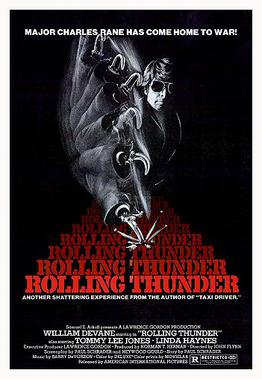
Rolling Thunder

The Vietnam War ended, and American soldiers came home to a country that felt strongly opposed to what had been done as part of the fighting. They were not greeted as heroes as our veterans had been welcomed in previous wars, especially World War II. For some -- and not to sound too flowery -- the fighting was just beginning as those vets tried to re-acclimate to living back home. That's what we've got in 1977's Rolling Thunder as a jumping-off point.

Major Charlie Rane (William Devane) is coming home to San Antonio, Texas. He's spent the last seven years as a prisoner of the North Vietnamese, subjected to horrific treatment and torture meant to beat him down into nothing. Somehow, some way, he survived though, and he is welcomed back as a hero. Rane on the other hand, he's not so sure. He steps back into a home situation where his wife wants a divorce so she can remarry. His son is almost 10 years old, and he barely knows him. Rane simply doesn't know how to readjust to life as he used to know it. What little balance he finds is quickly destroyed when personal tragedy strikes, the reasoning...simple, pure greed with too many lives as an expense. Rane himself barely survives the incident, telling the police he doesn't remember much about what happened. The Air Force veteran...he remembers though, and Rane intends to exact his own revenge.

I'd never heard of this Vietnam War-themed flick from director John Flynn until recently it popped up on the movie channel Retroplex. It certainly sounded interesting, and in the end, it was. It's not a great film, but 'Thunder' is darkly entertaining, a morbid cloud of cynicism hanging over the proceedings. Isn't that what we all want to see?!? No nonsense about the story either. Straightforward revenge with a more vigilante-themed story mixed in with the more message-oriented story of Vietnam vets struggling to readjust to life back in the states after the horror of what they saw during their tours of duty. It ain't flashy, but it's violent, gritty and uncomfortable to watch. Worth seeking out.

A good to great character actor who never quite became a full-on movie star, William Devane does not disappoint with one of his few starring roles. It's his movie, and he carries it. His time spent as a North Vietnamese prisoner has worn him down while making him tougher in the process. His Major Charlie Rane is almost mute, is claustrophobic, has some form of PTSD and struggles to get back to the things he used to know and love. It is an unsettling performance, full of intensity and menace as Rane struggles to piece it all together. What does it? A release of hatred, a hate-oriented goal of retribution and revenge. He seems to find himself when tasked with a mission, however dangerous. Devane is excellent in a quiet, emotional leading performance. Two thumbs up for a guy often relegated to bad guy roles. Part Travis Bickle, part Paul Kersey, part Wild West vigilante, this is a fascinating character.

I haven't seen much of Tommy Lee Jones' pre-Lonesome Dove work, but here the 31-year old actor shows off that quiet, intimidating charisma that has served him so well in the 35-plus years since. He's underused as Johnny Vohden, a fellow prisoner who experienced everything Rane went through. Through their common, horrifying experience, they've bonded to become friends that can't be broken up. Excellent supporting part. Linda Haynes plays Linda Forchet, a young woman in her 20's fascinated with Rane, drawn to him in ways she can't describe. It's a good part, but somewhat distracting, as her character's personality seems to be wearing tight, thin shirts without a bra. Just an observation. Also look for James Best and Luke Askew as two gutter-trash crooks who wrong Rane in a big old way (wait for those fireworks!). Also look for Dabney Coleman, Lisa Blake Richards and Lawrason Driscoll in supporting parts.

'Thunder' is a bit of a slow burn, even following the surprising, horrifically violent twist about 35 minutes into the 95-minute long flick. It's trying to build that intensity to almost unbearable levels as we wait for Devane's Rane to blow like a volcano. In that sense, it treads that fine line. Things can be a little slow in parts. Never boring, but at the same time, never as interesting as things could have been. I'll give credit where it is due though. Everyone involved seems to know where they want to end up, all the while building up to a blood and bullet-riddled finale. It could have gone for a horrifically dark ending but taps the brakes a bit.

So overall, good but not great. A crime thriller set along the Texas/Mexico border has a gritty, dark feeling, almost like a film noir with a lot of blood squibs! This is a revenge movie that certainly belongs along the likes of movies like Taxi Driver and Death Wish and the Dirty Harry movies. A tad on the slow side at times, but worth checking out.

Rolling Thunder (1977): ** 1/2 /****

Monday, May 27, 2013

The Devil's Brigade

In tribute to all our veterans, here's a Memorial Day review. As a movie fan, Memorial Day was a huge weekend for me growing up. I looked forward to watching old war movies on TNT in round-the-clock marathons, WWII flicks that are some of my favorites like The Dirty Dozen, Kelly's Heroes and an underrated classic and one of my all-time favorites, 1968's The Devil's Brigade.

It's 1942 and with World War II very much yet to be decided, Lt. Colonel Robert Frederick (William Holden) has been summoned to a staff meeting in England. Even though he has no combat experience, Frederick is being given command of a new unit, the First Special Service Force. Their ultimate mission is still to be decided but the Colonel prepares for the training that awaits his brigade that consists of a crack unit of well-trained Canadian troops commanded by Dunkirk veteran Maj. Alan Crown (Cliff Robertson) and an unruly, misfit group of American troops headed by the similarly unruly Maj. Cliff Bricker (Vince Edwards). The two sides bristle immediately, but training continues. If Frederick can manage to keep his men together, their services are very much needed, including a dangerous mission on the Italian front.

From veteran director Andrew McLaglen, 'Brigade' is based on a real-life military unit, the First Special Service Force. Released just a year after The Dirty Dozen, it bears some striking similarities, but it more than capably carves out its own niche in war movie department. It is one of the great men-on-a-mission movies, and that's saying something considering the late 1960s were rampant with them. McLaglen filmed on location in Italy for much of the second half of the movie, giving an authentic look and feel to the proceedings as the Brigade goes into battle. Composer Alex North turns in a gem of a soundtrack, his theme for the Brigade (listen HERE) one that you'll be whistling for days. The main theme is a highlight, but North specializes in the quieter, darker and more sinister moments leading up to the battle in the finale.

More of a workmanlike director than an auteur, McLaglen specialized in movies like this with impressive casts of male stars. This 1968 WWII flick is loaded with star power. As Colonel Frederick, Holden doesn't get a flashy part, but he leads the way just the same. His officer wants to prove himself while also proving how capable his men are too. The best part in the film goes to Robertson as Maj. Crown, an intelligent, well-spoken and brutally capable officer who survived the Dunkirk disaster. It is a smart, underplayed role, and he steals every scene he's in. As his American counterpart, Edwards too is very solid. His Maj. Bricker is blunt and without a filter, a scrounger and hustler with the best of them. Also look for Dana Andrews, Michael Rennie and Carroll O'Connor as American generals, all making cameo appearances.

Ah, yes, and then there's the rest of the cast. If the star power above wasn't enough, McLaglen assembles a deep, talented cast of tough guys to fill out the ranks of the brigade. Leading the American contingent, look for Claude Akins, Andrew Prine, Richard Jaeckel, Luke Askew, Tom Troupe, Bill Fletcher and Tom Stern. For the Canadian half of the Brigade, watch out for Jack Watson, Harry Carey Jr., Jeremy Slate, Richard Dawson and Jean-Paul Vignon. It's cool just seeing all these recognizable faces here together, some leaving more of an impression than others. Jaeckel as Omar Greco, an acrobat trying to escape but finding a home instead, especially stands out as does Akins as Rocky, the American bully, Prine as Ransom, a smart misfit, Watson as Peacock, the tough but gentlemanly Canadian and Slate as O'Neill, the hand-to-hand combat instructor.

I think it's the cast that separates the movie from so many other solid WWII movies. It's a familiar formula here; introduce everyone, train them, have them put their differences aside following some male bonding and then unleash them on the enemy. The male bonding comes courtesy of a barroom brawl (watch HERE) with some rowdy lumberjacks, a great scene. The script is ideal in its ability to let these tough guys be tough guys. It's fun, natural with chemistry and features some great one-liners. Other highlights include Slate's introduction in a showdown with Akins (watch HERE), a 30-mile hike where the rivalry develops further, and many others. Moral of the story is this, we need these parts to be effective for the second half of the movie to truly work. And you bet it does.

The last hour follows the Brigade as it enters combat. Required to prove themselves and their ability, Frederick leads a patrol behind the lines to a heavily guarded Italian town crawling with Germans. It's a lighter action scene, but memorable just the same. The best part though is in the finale, the Brigade ordered to attack the apparently impenetrable Mount la Difensa (where the Service Force really made a name for themselves), a mountain garrisoned by German infantry and heavy armor. First, they must scale a sheer cliff-face to mount a surprise attack on the garrison. It is a great action sequence, McLaglen filming in the trenches and dugouts as the Brigade begins their assault. We always know where the battle is, where it's going, and the sheer scale of it. When the casualties do come (and they do, quickly and with some surprises), it makes this extended battle sequence that much more effective emotionally.

This has always been one of my favorites, and I seem to pick something new up with each passing viewing (I'm guessing I'm somewhere between 20 and 30). This time? The darkness late, Frederick greeting his men as they prepare for battle. North's score goes dark, Dawson explaining "Haven't you ever heard a man say goodbye?" It's an eerie, uncomfortable moment. Spot-on too, considering the Brigade sustained 77% casualties in the coming battle. 'Brigade' doesn't have the reputation of so many other WWII movies of the time, but it deserves some attention. A hidden gem.

The Devil's Brigade (1968): ****/****
* Rewrite of June 2010 review

Thursday, June 21, 2012

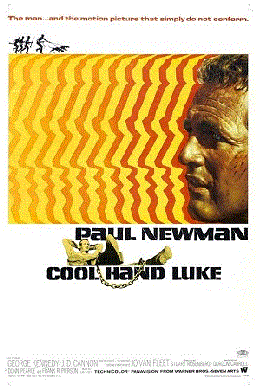
Cool Hand Luke

Heroes are supposed to be noble, loyal, honor-bound and always do what's right. But in the 1960s and its increased cynicism from the audience, was that concept of a hero really going to fly? The idea of an anti-hero started popping up in the 1950s thanks to James Dean and Marlon Brando among others, but for me, the one that kicked the door open in the 1960s was Paul Newman in 1967's Cool Hand Luke.

Having taken the heads off of a long row of parking meters, a drunken Lucas Jackson (Newman) is arrested and sentenced to a two-year sentence on a chain gang in Florida. He meets the Captain (Strother Martin) and his bevy of guards who keep their prison camp roster of 50 prisoners busy on the roads six days a week, but this camp has had nothing like Luke. Easy going enough early on in his sentence, he begins to bristle at being imprisoned, at being told what he's supposed to do. He becomes a hero to his other prisoners, forming a friendship with head honcho, Dragline (George Kennedy), but Luke can only take being held down for so long, and he wants out now.

Paul Newman is one of my all-time favorites, and this is HIS iconic part. Butch Cassidy, The Hustler, The Sting, and many others, all memorable roles, but nothing quite like this one. Want a face for a 1960s audience looking for something different? In steps Lucas Jackson, a man who has little regard for what society says he should do with his life, even less regard for any sort of authority hovering over him. Newman makes Luke -- dubbed 'Cool Hand' for a bluff in poker -- a charming, likable individual, his easy-going, natural smile disarming you in a second. We learn a lot about this character with little background (a veteran, countless jobs, a drifter), finding out that no one and no thing will slow him down. He will do things on his terms, and anyone else can be damned. Newman at his best.

With Newman's Oscar-nominated part at the head, 'Cool' has become one of the seminal movies of the late 1960s, ranking up there with The Wild Bunch, The Graduate, Bonnie and Clyde and several others I'm missing. This is a movie made for a late 1960s audience that isn't content with the status quo. No respect for authority or the so-called 'system'? Check. An anti-hero that wants to do things and live his life his way? Double check. The system are Martin's quiet but intense Captain, Boss Godfrey (Morgan Woodward), the silent guard who wears his ever-present aviator glasses, along with steely-eyed Luke Askew, Richard Donner and John McLiam.  The system is the villain here, imprisoning and breaking the individual down to conform. It's easy to see the appeal in 1967, and just as easy to see now 45 years later in 2012. The thinker, the free spirit, the intelligent rebel, it's an appealing character and premise to root for.

Because Newman's performance is so strong at the top, another part of the film gets lost in the shuffle, and that's the ensemble cast all around him from Martin and Kennedy to the guards to the prisoners. Martin is perfect in his few scenes, including muttering the iconic 'What we have here is failure to communicate.' Kennedy won an Oscar for his part as Dragline, an illiterate but intelligent and fast-talking prisoner who all the other prisoners look up to. Newman and Kennedy play off each other impeccably, the subtle, underplayed Luke with the showier, aggressive and funny Dragline. Other prisoners include J.D. Cannon, Lou Antonio, Robert Drivas, Harry Dean Stanton, Dennis Hopper, Wayne Rogers, Ralph Waite, Joe Don Baker, Dick Davalos and Buck Kartalian among others. Clifton James and Anthony Zerbe are good as prisoners turned associates who help the guards. 

Like any movie that lives on so many years after its release, there's got to be something to make it memorable, and director Stuart Rosenberg doesn't disappoint. The most obvious is Luke stating he can eat 50 eggs in an hour, a classic sequence in its humor, but there's so much more. Luke singing Plastic Jesus -- watch HERE -- after receiving some distressing news is an all-time great. There's Luke earning everyone's respect in a brutal, knock-down boxing match (watch HERE), refusing to go down even when he's beat. There's a teenager washing a car, driving the on-looking prisoners wild (HERE), and up there with Plastic Jesus for the most moving scene, Luke talking with his dying mother, Arletta (Jo Van Fleet). Almost scene-to-scene is aided by composer Lalo Schifrin's amazingly spot-on music, especially the main theme which you can listen to HERE.  

What struck me most in my latest viewing was the darkness of the story. The first hour is generally light-hearted, introducing characters, backgrounds and interactions, setting us up by liking Newman's Luke so much in spite of his bullheaded stubbornness. I'd forgotten then how intensely dark and at times uncomfortable the second half of the movie is. From the start, we know Luke is heading down a bad road, but that unbearable tension and impending sense of doom keeps building. The movie still has its lighter touches -- Luke's escapes provide some unlikely humor -- but there will not be a truly happy ending here. In the end though, one of the final shots shows that free spirits might not always win, but that also doesn't mean the system, authority and power positions will win either. The symbolism can be a little obvious, a little heavy-handed, but the message still strikes a chord.

A classic from beginning to end. End of story.

Cool Hand Luke <---trailer (1967): ****/****

Wednesday, September 23, 2009

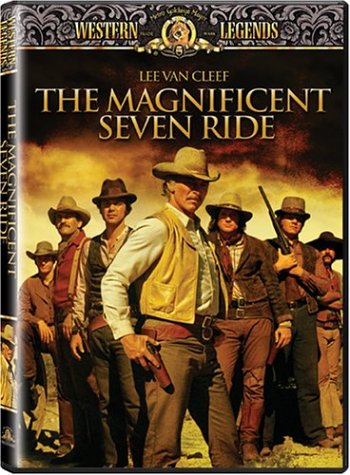
The Magnificent Seven Ride!

Probably the darkest and most cynical of the four movies, 1972's The Magnificent Seven Ride! is undone by any number of things starting from the apparently very cheap budget which affects the sets, the story, and surprisingly enough, the musical score from composer Elmer Bernstein. Ah, who knows? Maybe the studio thought adding an exclamation point in the title would fix all those problems. Close, but no cigar United Artists.

A good place to start is with the story/script. It's basically two movies which if done separately might have been good, or at least two hour-long TV shows. But of course, that might be too easy to do. My main issue though is simple, the new Magnificent Seven aren't even introduced as a group until an hour into the movie. Say what you want about the first three Mag7 movies, but Chris in anyone of his forms was putting together each group of 7 within the first 15 minutes or so. Not so here which starts a completely different storyline before even getting to a new group of specialists.

Now with a badge on his shirt, Chris Adams (Lee Van Cleef) is a marshal in a small western town with a new bride, Arilla (Mariette Hartley). Chris has built himself up quite a reputation as a tough law officer, but his wife convinces him to let go of a young prisoner she believes made one bad mistake. He does, but the boy joins a gang and during a bank robbery, they kidnap Arilla and ride out. Chris, joined by a writer, Noah Forbes (Michael Callan) trying to document his heroics, head out after the gang, only to find Arilla raped and murdered and the trio of youngsters split up.

Out on the trail looking for them, Chris meets an old friend, also now a sheriff, who is trying to stop a bandit and his gang from attacking their town. Chris declines the invitation to help, and it's not long before the friend and his posse are shot down. Feeling guilt for what he chose not to do, Chris finds the town, sans men, now occupied by just the widows, including Stefanie Powers (with some big 70s hair too) with the gang's return seemingly imminent. With no other option, Chris and Noah recruit five prisoners from the Tucson Territorial Prison (think crappy Dirty Dozen story) to help them defend the town.

The Seven: Van Cleef is an interesting choice to replace Yul Brynner and George Kennedy as Chris. A huge star because of his success in Europe, Van Cleef brings an edge to the character we haven't seen before. For him after losing his wife, he plans the town's defense like a suicide mission fulling expecting to die in the process. An interesting twist on the character for sure. In the quasi-McQueen sidekick part, Callan plays Noah as a whiny, cheap writer who questions Chris' actions, only to...gasp...come around in the end. It could have been a cool character to add to the mix, but Callan comes across as just plain annoying.

Now for the Mag7: Convict Style which seems like an easy way to keep the story moving by taking an idea from a different movie. Making it worse, none of the five convicts are developed much at all. There's Skinner (Luke Askew) and Pepe (Pedro Armendariz Jr), two gunfighters who'd like nothing more than kill Chris, Walt (William Lucking), the strong, silent type good with a shotgun, Hayes (James Sikking), a former Confederate officer adept at planning battle strategy, and Elliott (Ed Lauter in his first movie), the explosives expert. The only ones making much of an impression are Askew and Armendariz, more so because they act cool than any sort of development they have.

The "Villain": In the original, Eli Wallach's Calvera is introduced, disappears for an hour and then returns with a vengeance late. In 'Ride!' the lead bandit has one line the whole movie (a classic delivery of 'Vamanos!' if you ask me) and is played by acting powerhouse Ron Stein, a stuntman known for his parts in the Planet of the Apes TV series as 'First Gorilla.' The villain is totally wasted here and not a presence at all.

Another test of how good/bad movies can be is the groan test. How many times watching the movie do you groan at some cheesy line, horrible special effect, or set falling apart in the background? This one has its fair share including my personal favorite, 'I, Chris, degrade your woman!' in a message to Stein's De Toro character. Also, the widows left in town were gang-raped by De Toro's men and just found out their husbands are all dead. They sure cozy up to these new men awful quick, including Chris (wife raped and killed) snuggling up with Stefanie Powers (gang-raped, husband murdered, has to care for children...) days after all the bad news hits. Now that's a good script.

Besides the lack of a good story, the film has the look of a made-for-TV movie because it was filmed in the Hollywood backlots on a variety of generic looking sets straight out of Gunsmoke or Bonanza. The positive to take away is the final battle as De Toro and his men finally attack the town, but even then it's a measured positive. We know little to nothing about these men, but are supposed to feel something for them when they begin to drop like flies? Yeah, good luck with that. A disappointment all around and a sorry end to the four Magnificent Seven movies.

The Magnificent Seven Ride! <----trailer (1972): * 1/2 / ****

Friday, March 13, 2009

Netflix review #10: The Culpepper Cattle Company

By the 1970s, the westerns, they were a' changing to quote Bob Dylan. Most directors weren't interested in showing how romantic and iconic the old west was. Movies tended to debunk the myths instead of glorifying them. The change had started in the 60s already with some American westerns but the switch really kicked in with the spaghetti westerns. One of the best American westerns to show how life really was is part of one of my favorite sub-genres, the cattle drive western. Dick Richards directs his first feature film, 1972's The Culpepper Cattle Co.

Fresh off the success of Summer of '42, Gary Grimes plays Ben Mockridge, a teenager who wants to be a cowboy more than anything else. He's in luck as a man named Frank Culpepper is starting a cattle drive north to Fort Lewis, Colorado with 2,000 head of cattle. Culpepper hires him as the cook's assistant where he's named Little Mary, well, just because that's what you call the assistant. Ben figures out right away that the life of a cowboy isn't an easy one. The hours are brutal, the food lousy, the conditions even worse, and there's a good chance you'll end up with a bullet in your gut.

On the trail from south Texas to Colorado, Culpepper's crew tangles with cattle rustlers, horse thieves, infighting amongst the cowboys, and a landowner who doesn't appreciate the herd traveling across his land. It's the quiet moments that work the best in this 1972 western, scenes of cowboys at a campfire talking about all the women they've met in countless towns. The plot sort of meanders along much like the cattle drive. The movie's content to just tell its story, and that's why it works.

Grimes as the lead is a good actor that seemed to fall off the Hollywood radar. He starred in a John Wayne western, Cahill: US Marshal, in 1973 and a sequel to '42 but never starred in any other movies. It's a shame because as the wide-eyed kid here he has a really strong part. Seeing the cowboy life isn't everything it's made out to be, the viewer is right there with Ben. Billy Green Bush is Culpepper, the trail boss who will get his herd to market no matter what it takes. Joining Culpepper's crew is Geoffrey Lewis, Bo Hopkins, Luke Askew, Wayne Sutherlin, Matt Clark, Hal Needham, Raymond Guth, and Walter Scott. Lewis and Hopkins give memorable turns as somewhat crazy cowboys, but it's Askew who leaves the best impression as a cowboy who looks out for young Ben. John McLiam is Thorton Pierce, the vengeful landowner who won't allow Culpepper's herd to cross his land.

Some of these westerns try too hard to be different, but this one finds that good middle ground. There aren't good guys vs. bad guys, just men trying to get by in tough times following the Civil War. One scene near the shootout finale really illustrates how ridiculous things can be in the west. Ben and a handful of the crew ride back to help a wagon train of Mormons, not because they agree with the squatters, but because they've been pushed too far. As Pierce's hands charge toward them, they share a bit of maniacal laughing right before the shooting starts. The scene's maybe 20 seconds long, but it's a good one and tells more about the men than a long scene of dialogue could have.

The DVD is a steal at under $10. The disc offers widescreen and fullscreen presentations, a trailer, two photo galleries, and three trailers for other Fox Flic westerns. It doesn't receive the recognition other westerns from the 1970s get, but it's one of the best westerns to come out of the decade.

The Culpepper Cattle Co. (1972): *** 1/2 /****