The Sons of Katie Elder

The Sons of Katie Elder
"First, we reunite, then find Ma and Pa's killer...then read some reviews."
Showing posts with label William Devane. Show all posts

Saturday, December 12, 2015

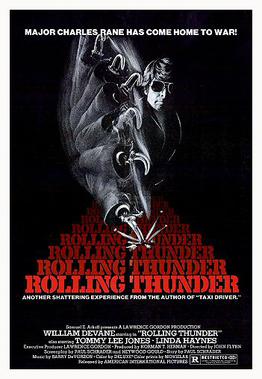
Rolling Thunder

The Vietnam War ended, and American soldiers came home to a country that felt strongly opposed to what had been done as part of the fighting. They were not greeted as heroes as our veterans had been welcomed in previous wars, especially World War II. For some -- and not to sound too flowery -- the fighting was just beginning as those vets tried to re-acclimate to living back home. That's what we've got in 1977's Rolling Thunder as a jumping-off point.

Major Charlie Rane (William Devane) is coming home to San Antonio, Texas. He's spent the last seven years as a prisoner of the North Vietnamese, subjected to horrific treatment and torture meant to beat him down into nothing. Somehow, some way, he survived though, and he is welcomed back as a hero. Rane on the other hand, he's not so sure. He steps back into a home situation where his wife wants a divorce so she can remarry. His son is almost 10 years old, and he barely knows him. Rane simply doesn't know how to readjust to life as he used to know it. What little balance he finds is quickly destroyed when personal tragedy strikes, the reasoning...simple, pure greed with too many lives as an expense. Rane himself barely survives the incident, telling the police he doesn't remember much about what happened. The Air Force veteran...he remembers though, and Rane intends to exact his own revenge.

I'd never heard of this Vietnam War-themed flick from director John Flynn until recently it popped up on the movie channel Retroplex. It certainly sounded interesting, and in the end, it was. It's not a great film, but 'Thunder' is darkly entertaining, a morbid cloud of cynicism hanging over the proceedings. Isn't that what we all want to see?!? No nonsense about the story either. Straightforward revenge with a more vigilante-themed story mixed in with the more message-oriented story of Vietnam vets struggling to readjust to life back in the states after the horror of what they saw during their tours of duty. It ain't flashy, but it's violent, gritty and uncomfortable to watch. Worth seeking out.

A good to great character actor who never quite became a full-on movie star, William Devane does not disappoint with one of his few starring roles. It's his movie, and he carries it. His time spent as a North Vietnamese prisoner has worn him down while making him tougher in the process. His Major Charlie Rane is almost mute, is claustrophobic, has some form of PTSD and struggles to get back to the things he used to know and love. It is an unsettling performance, full of intensity and menace as Rane struggles to piece it all together. What does it? A release of hatred, a hate-oriented goal of retribution and revenge. He seems to find himself when tasked with a mission, however dangerous. Devane is excellent in a quiet, emotional leading performance. Two thumbs up for a guy often relegated to bad guy roles. Part Travis Bickle, part Paul Kersey, part Wild West vigilante, this is a fascinating character.

I haven't seen much of Tommy Lee Jones' pre-Lonesome Dove work, but here the 31-year old actor shows off that quiet, intimidating charisma that has served him so well in the 35-plus years since. He's underused as Johnny Vohden, a fellow prisoner who experienced everything Rane went through. Through their common, horrifying experience, they've bonded to become friends that can't be broken up. Excellent supporting part. Linda Haynes plays Linda Forchet, a young woman in her 20's fascinated with Rane, drawn to him in ways she can't describe. It's a good part, but somewhat distracting, as her character's personality seems to be wearing tight, thin shirts without a bra. Just an observation. Also look for James Best and Luke Askew as two gutter-trash crooks who wrong Rane in a big old way (wait for those fireworks!). Also look for Dabney Coleman, Lisa Blake Richards and Lawrason Driscoll in supporting parts.

'Thunder' is a bit of a slow burn, even following the surprising, horrifically violent twist about 35 minutes into the 95-minute long flick. It's trying to build that intensity to almost unbearable levels as we wait for Devane's Rane to blow like a volcano. In that sense, it treads that fine line. Things can be a little slow in parts. Never boring, but at the same time, never as interesting as things could have been. I'll give credit where it is due though. Everyone involved seems to know where they want to end up, all the while building up to a blood and bullet-riddled finale. It could have gone for a horrifically dark ending but taps the brakes a bit.

So overall, good but not great. A crime thriller set along the Texas/Mexico border has a gritty, dark feeling, almost like a film noir with a lot of blood squibs! This is a revenge movie that certainly belongs along the likes of movies like Taxi Driver and Death Wish and the Dirty Harry movies. A tad on the slow side at times, but worth checking out.

Rolling Thunder (1977): ** 1/2 /****

Thursday, February 3, 2011

McCabe and Mrs. Miller

Revisionist westerns are completely hit or miss with me.  Made mostly in the 1960s and early 1970s as Americans and people around the world undoubtedly became a little more skeptical, a little more cynical, these westerns tried to show what the wild west was really like.  I go back and forth because I can appreciate the west was not the one so often portrayed in John Wayne movies.  It just wasn't a romantic place where everything ended with the good guys winning out.  Some revisionist westerns just go too far though.  There's a middle ground between the romantic and just ripping apart a myth or a legend for the sake of doing it.  One of the best I've come across though, proof that a revisionist look at the old west can be a classic, 1971's McCabe and Mrs. Miller.

Sometimes these westerns are prime examples of the period they were made in.  Director Robert Altman is certainly guilty of that here with his folk music soundtrack coming across as too lyrical and just trying too hard overall. But other than the poor choice in music, I feel safe saying Altman makes a nearly perfect western...if you can call this a western.  It is one of the most realistic looks a movie has ever given about what frontier life was really like.  It was a lawless place where one must fend for themselves.  Death lurked around any corner waiting to strike.  Maybe it's an anti-western, I really don't know.  But just on pure emotion with an ability to tell the simplest, darkest of stories, Altman delivers a winner.

Its the Pacific Northwest in the 1890s, and a man named John McCabe (Warren Beatty) rides into a small, muddy one-road mining town high up in the mountains.  He has his sights set on building a successful business for himself and letting the money roll in.  The plan goes perfectly as he brings three prostitutes in and goes about building a saloon for all the miners living nearby.  McCabe is quickly approached by a madam, Mrs. Constance Miller (Julie Christie), who wants to help him improve his business.  Not quite sure if he wants to go into business with a woman as a partner, McCabe wavers before ultimately deciding to do it.  It's the right choice, and his business thrives.  If anything, it thrives too much though.  The company that owns the nearby mines is very aware of his success and wants their fair share of the profits.

At the heart of this movie is Beatty and Christie as these two very similar flawed characters who find a common link between them through their arguments and disagreements.  This is the type of relationship that so many westerns attempt to show between a man and woman.  It's just natural, never forced.  The duo was actually dating in real life apart from the movie, and their chemistry certainly shows.  They have an easy-going back and forth in their conversations, whether it be an argument or a quiet discussion as they discuss what to do next.  It's also a plus that in two actors like Beatty and Christie, neither made a long list of movies during their careers.  They clearly chose quality projects to do, and this is a perfect example.

Altman has that rare knack that few directors have, an artsy reputation who still appeals to a mainstream audience.  I like his directing style because it's never in your face.  He places his camera there for a scene and lets things develop.  He filmed in West Vancouver in the mountains, giving a palatable feel of being separated from humanity in this mountaintop town.  It is a gorgeous movie, one that earned cinematographer Vilmos Zsigmond a British Oscar nomination for his camerawork. It is a movie that feels authentic down to its very roots and the muddy streets these characters walk through.  The dialogue, the period dress, the sets, the guns, all authentic as possible.

Now I've made no qualms about my preference for darker, cynical movies that shy away from generic happy endings, but this one bugged me to the point where I felt sick as the ending neared.  The whole tone of the movie led me to figure out how the story was going to end up, but even seeing it feels like a train just rolled over you.  This was 1971, and Altman pulls out all the stops.  No one is immune from his wrath, including big and small businesses, lawyers (William Devane in a great one-scene cameo), the church and organized religion, and just about anything else you care to think of in between. Altman comes out firing with both barrels and isn't afraid who gets caught in the crossfire.  That said, the ending (as much as I hated it) is the perfect, appropriate finale for this movie.  Anything else would have felt inauthentic.  The American dream, my ass, Altman is beyond pessimistic here.

Depending on the viewer, certain scenes in a given movie are going to have a different impact or leave an impression.  This had several -- the ending obviously -- but one just minutes before that shows how fragile life on the frontier really was.  Keith Carradine plays a young man known simply as the Cowboy who stops by McCabe and Miller's whorehouse, enjoys himself, and then prepares to ride out.  He's confronted by one of three killers sent to dispatch McCabe and callously gunned down by the man. It is an uncomfortable scene to watch because it's clear where it's building to, and when the gunshot roars to life, you wince at the noise. With the snap of a finger, one unlucky young man is dead as quick as that.  Without any pandering to the audience or a big speech explaining what just happened, Altman gets his message across.

More on the ending so SPOILERS from here on in.  Three hired guns are sent to this mountain town to force McCabe into a deal or kill him in the process.  All three actors are virtual unknowns, making their appearance more ominous. Who are they, and what are they capable of? McCabe has a reputation as a gunfighter, but he really isn't so when push comes to shove he loads his pistol and confronts them, not unlike the showdown at the end of High Noon.  He kills them all, but at a price. He's mortally wounded and dies in the snow as a storm rages all around him. Altman films this almost 30-minute sequence with no music and little dialogue to distract from what's happening on screen.  Heartbreaking, incredibly moving, however you want to describe it. It's an upsetting but perfect ending for the story.

McCabe and Mrs. Miller <---trailer (1971): ****/****

Wednesday, December 16, 2009

Family Plot

Pick a favorite director and look at his/her last movie. In some cases, they tried to go out with a bang, a big message movie, a huge epic, or sometimes just a middle of the road story that is neither great or awful, just somewhere in between. Making his last movie in an illustrious career, Alfred Hitchcock went down that last road with his 1976 comedy/thriller Family Plot. It is not highly regarded as many of his other movies still has that charm we've come to expect from the director.

It's odd because watching the movie I didn't chuckle once, didn't think I was watching a comedy at all. I'll have to chalk that up to previous Hitchcock movies which never even touched comedy. Sure, there were moments that you chuckled here and there, but that was usually a result of the script providing some odd, funny moment. So I finish Family Plot and read up on it some and the IMDB genre listing has it as 'comedy/crime/thriller.' I was okay on the last two, but comedy? Really? Maybe I missed something.

Working a scam as a spiritualist/psychic, Blanche Tyler (Barbara Harris) stumbles into a job that will pay her $10,000. One of her customers (Cathleen Nesbitt) wants Blanche to find out the whereabouts of the rightful heir to her family's fortunes. The man -- then a 17-year old kid -- was supposedly killed in a tragic house fire that claimed his mother and father, but his body was never found. Blanche takes the offer and with some help from her cab driver/private detective boyfriend, George Lumley (Bruce Dern) begins to investigate the suspicious circumstances surrounding the boy's death from 25 years earlier.

George quickly figures out the boy didn't die and starts to follow the clues. The boy is now a man, Arthur Adamson (William Devane), who is leading a double life, one as a diamond distributor, and two, as a kidnapper who ransoms people off with his girlfriend, Fran (Karen Black). Blanche and George somewhat innocently pursue him with no idea of what's really going on, thinking they will be helping Adamson out. Arthur on the other hand wants nothing to do with them and must figure out what to do with a rather high-up official locked in his basement as his next kidnapping victim with these junior detectives tailing him.

Looking back on the movie, there were parts that I can see now were going for laughs, but they ended up just pissing me off. At one point, the brakes on Blanche and George's car have been cut (check it out here) as they maneuver down a mountain road. Blanche's hysterics aren't funny, they're just annoying. What to do as the car veers out of control? Grab the driver and the wheel while screaming hysterically! As for other Hitchcock updates, much of the humor (I guess) comes from sex jokes and swearing which comes across as lazy. Dealing with all sorts of Hollywood censorship codes earlier in his career, Hitchcock dealt with sex subtly -- think Notorious or North by Northwest. But here, it's just awkward.

The story itself is a good one although Blanche and George never seem to figure out that if this person disappeared years ago there's a good chance he doesn't want to be found. The coincidence that Arthur and Fran are kidnapping masters is a little much, but because Devane is such a strong, reliable villain with his gigantic smile and shifty eyes, you hardly notice it. Black is given little to do as Fran but make the couple more sympathetic...if that's possible with kidnappers. Dern is at his best and does get a few laughs because his character is so off the wall, but then again, when wasn't a Bruce Dern character a little crazy? Juggling his cab driving duties while helping his girlfriend does provide some lighter moments. Harris gets to overact as she dupes customers, and the twist at the end isn't really a twist at all. Just listen closely in the last scene, and you'll know what I mean.

With all that said, I still enjoyed the movie. An average Alfred Hitchcock movie is still better than many of the movies out there. The comedic elements didn't work for me, but it is not enough to say this isn't a flick worth watching, especially because it was Hitchcock's last in a long, distinguished career. If you'd like to see this movie, it's available on Youtube broken up into parts, starting here with Part 1 of 13. A good but not great Hitchcock movie that tries too hard.

Family Plot <----trailer (1976): ** 1/2 /****