John Wayne was a cowboy, a cavalry officer, a marshal, a soldier, an officer, a tough guy, any and all. Name most of his Wayne's most famous, iconic roles, and odds are, you can peg it as one of those descriptions. I've seen most of Wayne's non-serial movies, and I can't think of too many comedies or dramas away from the wild west, a war situation or some sort of historical epic. Well, I found one, and I liked it a lot, 1953's Trouble Along the Way.
The longtime rector at St. Anthony's University in New York City, Father Burke (Charles Coburn) has been given some bad news. His small Catholic university is seriously in debt, and the order of brothers has decided to close the school and relocating the priests on the faculty while allowing its students to transfer to other universities. Not willing to accept the news, Father Burke goes about thinking of ways to raise money to keep St. Anthony's open. One of his best ideas? Reinvigorate the football program which has fallen on some tough times. A successful football team will no doubt bring in tons of money to the university, right? Burke finds his man to coach the team in an ex-coach with a checkered past, Steve Williams (Wayne), a single father who's fallen on some tough times as he tries to care for his young daughter, Carol (Sherry Jackson). Williams has his work cut out for him and not a lot of time to do it in. Can he pull it off?
I've watched John Wayne movies since I was a kid, but this was one of his few movies I haven't seen a second of this 1953 drama from director Michael Curtiz. It was available on Netflix, but that ominous 'Very Long Wait' kept staring back at me. Well, courtesy of Turner Classic Movies and a John Wayne marathon, here we sit. It's a good movie for all the right reasons, reminding me at times of a Frank Capra flick. 'Trouble' is an old-fashioned story that you can comfortably call 'cheesy, sappy, cliched and familiar,' but you know what? Those are good things here. Filmed in black and white at Pomona College and assorted Los Angeles high schools, 'Trouble' plays like a sweet throwback in the wayback machine to a simpler time, a Happy Days and Leave it to Beaver time. A cool change of pace.
John Wayne was all of those things above over a long, distinguished career so if for absolutely nothing else, it's pretty fun to see him in a far-more family role. His tough guy single dad is raising his daughter like a tomboy, father and daughter bonding through sports and football and billiards. Wayne has a great chemistry with Jackson's Carol, a talented young actress who doesn't force things. It's a natural performance, a rarity when you consider how bad some child actors were (especially in the 1950s). There's also a possible love interest in Donna Reed's character, Alice Singleton, a court officer sent to investigate if Carol should stay with her Dad or move in with her mother (oh no, family drama!). Thankfully, 'Trouble' allows most of the pratfalls here involving that budding relationship, keeping it in the background and developing it slowly. The Duke is excellent in the fatherly role, a change of pace but in a good way.
Beyond Wayne and Reed, Charles Coburn is the best supporting part as Father Burke, the idealistic, sweet old priest who wants nothing more than to have his St. Anthony's remain open, helping students struggling with money with an education. His fellow priests include Tom Tully and Dabbs Greer with Leif Erickson and Douglas Spencer as the two priests who bear the bad news to Burke. Marie Windsor plays the over the top evil, manipulative ex-wife of Steve's with Tom Helmore as her rich new beau. Also look for Chuck Connors and former NFL player Bill Radovich as Steve's assistants.
Now all that said -- and I did enjoy this movie -- there are some moments that will no doubt make some viewers cringe. Politically incorrect 'Trouble' is not, especially some scenes between Wayne and Reed, Wayne's Steve "analyzing" how Alice came to the job with a wrap-up compliment of 'And you've got nice legs.' As well, any sports fan will get a kick out of the 1950s-era college rules. The script has some fun with Steve's background, a coach who's been run out of a handful of college coaching jobs using some questionable players with eligibility issues. The school completely turns a blind eye to his coaching tactics. A dealbreaker it is not, but it certainly adds another fun, entertaining level to the story.
An interesting change of pace. Definitely worth a watch, especially for John Wayne fans.
Trouble Along the Way (1953): ***/****
The Sons of Katie Elder
"First, we reunite, then find Ma and Pa's killer...then read some reviews."
Showing posts with label Chuck Connors. Show all posts
Friday, May 23, 2014
Wednesday, March 27, 2013
Tomahawk Trail
In 1958, Chuck Connors became a star across America with the debut of The Rifleman on TV. It ran for five seasons before Connors moved on to other film and TV roles. For five years before his star-making turn on TV, he starred in countless movies -- usually in supporting roles -- and TV shows as a guest star or background player. They weren't all winners, but there were some good ones in there, like the 1957 B-western Tomahawk Trail.
On a routine patrol out of Fort Bowie in the southwestern desert, Lt. Davenport (George N. Neise) is putting his cavalry company in grave danger. A veteran of the Civil War and fighting for five years with the Sioux, Davenport has experience, but not fighting Mescalero Apaches. His patrol's horses have been driven off, leaving his 16-man patrol stranded and walking out out of the desert as well as losing their supply and ammo packs. With Apache war parties on the trail, the patrol is in serious trouble, forcing veteran Apache fighter Sergeant Wade McCoy (Connors) to take over, risking a court martial in hopes of getting his men to safety. The situation gets worse when the patrol accidentally stumbles upon an Apache chief's daughter (Lisa Montell). Now it's a race against time to see if the patrol can get to Fort Bowie before the Apaches close in.
The cavalry vs. the Indians, is there anything more familiar in a western? Okay, maybe cowboys and Indians instead. From director Lesley Selander, 'Trail' is about as meat and potatoes as a western can get, and I mean that in a positive way. There's no concept of a bigger picture of what's going on with the Apaches or why they're on the warpath, no worry about what the patrol was actually looking for. It's laid out and let free. Patrol....Apaches....run. Fairly simple, right? It can't be much else, clocking in at just 60 minutes (don't pay attention to the 96-minute running time listed at Wikipedia). It plays like a TV episode with anything even remotely superfluous stripped away. In other words, it's about as barebones as possible.
The story is told exclusively from the perspective of the cavalry. While the Apaches are mentioned, including their chief, Vittorio, we never really see more than 10 or 15 at a time. Even the chief is shown in a long, long shot on the horizon without even a close-up. Instead, we never leave the cavalry. We don't see much of the opening attack on the patrol and its supply wagons, Connors' hard-boiled narration playing over the action. There's some good build-up with some decent action scenes as the Apaches close in -- including a pretty cool showdown at an abandoned outpost -- but the ending is rather abrupt. Maybe the already rather small budget simply ran out.
What will draw most western fans is the casting of Connors in the lead. As the tough as nails Sgt. Wade McCoy, Connors is the prototypical western star. He's young, but he's got plenty of experience in fighting the Mescaleros over his time with the cavalry. Neise is a preening, obnoxious and generally clueless Lt. Davenport, an experienced officer who refuses to admit when he's wrong. When he puts his patrol at risk, McCoy finally steps in. Some other good supporting parts go to John Smith as Pvt. Tim Reynolds, a deadshot with a rifle and experienced trailsman who's close with McCoy, Robert Knapp as Pvt. Barrow, a troublemaker who ruffles feathers with McCoy, Eddie Little Sky as Johnny Dogwood, the Apache scout working with the cavalry, and Harry Dean Stanton as Pvt. Miller, Davenport's loyal adjutant. The rest of the patrol is kept in the background, nameless soldiers destined to take Apache arrows, spears, tomahawks and bullets as necessary.
Even in a movie that barely breaks the 60-minute mark, 'Trail' manages to insert a love interest into the already barebones story. That comes courtesy of Susan Cummings as Ellen Carter, a white woman taken captive by the Apaches who bonds with Montell's Tula during her captivity. As one IMDB reviewer says, Cummings is there so Connors can have someone to kiss -- other than an eager cavalry trooper -- as the story fades out. Nothing flashy or memorable here, and probably only worthwhile for diehard fans or any fans of Chuck Connors.
Tomahawk Trail (1957): ** 1/2 /****
Monday, April 23, 2012
Ride Beyond Vengeance
Though he starred in over 40 films and countless TV shows as a star and guest star, I'll always think of Chuck Connors
as The Rifleman, Lucas McCain, the single father who raised his son
Mark on their small New Mexico ranch. I'm a huge fan of the show and not
surprisingly, Connors. He parlayed his success into other shows and
movies, but he always seemed quite at home in the western, like 1966's
B-western Ride Beyond Vengeance.
After 11 years away from his wife trying to earn as much cash as possible, buffalo hunter Jonas Trapp (Connors) returns home to Coldiron, Texas with $17,000 in his saddlebags. As he nears the town, he's ambushed by three townspeople, Brooks Durham (Michael Rennie), the rich banker, Elwood Coates (Claude Akins), the drunken, deranged cowboy, and Johnsy Boy Hood (Bill Bixby), who scar him with a brand on his chest and steal his money, leaving him for dead. Jonas continues on, dead set on getting his money back and finding his wife, Jessie (Kathryn Hays), at the same time. Jonas finds Jessie is in love with Durham (thinking him long since dead), and the town doesn't appreciate his revenge-fueled return. Everything seems stacked against him.
An oddity among westerns, 'Vengeance' is hard to compare to any other western I've seen. I was pleasantly surprised by the opening, a modern day setting as a census taker (James MacArthur) prepares to leave Coldiron, stopping at a bar and talking to the bartender (Arthur O'Connell) about the town's history. He discovers the story of Jonas' return is the stuff of legend, living on for years to come. For a B-western shot on the cheap on a lightning-quick schedule, it seemed like a genuinely unique story opener. It sets the stage for some sort of surprise and epicness (yes, I make up words) to come. What could have happened almost 100 years before in a tiny, quiet Texas town that still resonates with its citizens? Oh, and what would a B-western be without a ballad theme? Give it a listen HERE.
And that's where the problem is. What follows is not epic, doesn't feature much in the way of surprises, and ends up being disappointingly flat in the end. I'll give credit where it's due. 'Vengeance' doesn't take the easy way out, focusing on character development instead of relying solely on shoot outs and gunfights. It is different in a way that I can't quite put my finger on, and that's not necessarily a good thing. The acting tends to be a little on the exaggerated side, the tone is incredibly dark, and there's a general feel of Gothic -- maybe Shakespearean -- undertones. On a more straightforward note, it's stupid at times. Not writing to his wife for 11 years, what did Jonas think was going to happen? She'd be waiting at the doorstep for him? It comes across as partially lazy in the storytelling department, a plot device necessary to move things along without making much sense. Aren't those the best?
Typecast to a certain point as Lucas McCain, Connors spent much of the rest of his career trying to play different roles, and this definitely qualifies. Probably a little too old for the part, this isn't his best acting job. He's rocking an unrecognizable accent, and generally is required to look pissed off at everyone around him. As for the rest of the cast, while there is some impressive name recognition, the performances don't amount to much. Rennie looks bored as Durham, Akins could have been legitimately drunk playing his part, and Bixby looks confused, but more on that later. Hays as the "love interest" just doesn't have much in the way of chemistry with Connors although to be fair, their parts consist of a handful of scenes of screaming at each other. Former Rifleman co-star Paul Fix has a small part too as Hanley, an old saddle tramp who helps Jonah in a cool connection to their successful run on TV.
Mostly with a whole lot of name recognition, the cast is wasted. Along with all those previously mentioned, there are parts for Joan Blondell as a drunken owner of a whorehouse, Gloria Grahame as a married woman cheating on her husband with Bixby, Frank Gorshin (Batman's The Riddler) as a lovelorn, drunken cowboy, and Gary Merrill as Dub Stokes, Jonah's tough-love stepfather. None of these parts are essential to the story, but even in their out of left field qualities, they disappear as quickly as they appear with no rhyme or reason. Cameos are one thing, pointlessly wasted cameos are another. As for the acting, it's laughable at times. A drunken Akins always talks to Whiskey Man, his imaginary friend he drinks with, and Bixby loses his mind when confronted by Jonas. Literally the guys goes nuts with no hints, foreshadowing or warning. He brands himself and runs into the woods laughing hysterically. It's Gothic on steroids, like nothing I've seen in a western.
It all comes to a head with that final resolution....sort of. It's a weak ending in general although a knock-down, brutal fight between Connors and Akins is surprisingly realistic with a minimum use of stunt doubles (watch it HERE). The resolution is built up as this event that made a lasting impression on this town, an event that's still talked about 75-plus years later. Really? That's what made such an impression? I was disappointed with the ending in this off-the-wall B-western that basically wastes a good cast and at least some potential.
Ride Beyond Vengeance (1966): * 1/2 /****
Friday, January 6, 2012
The Deserter
When a poster at a message board brought the movie up, I didn't believe him, thinking the movie he talked about was made up. As a western fan, how had this one slipped past me? Somehow it did, probably thanks to no U.S. DVD release and an old VHS (thank you Amazon vendors). The movie? A spaghetti western of sorts, think The Dirty Dozen in the West. It's 1970's The Deserter.
Returning from a patrol, Captain Viktor Caleb (Bekim Fehmiu) finds his wife on the brink of death, raped and tortured by an Apache war party. He mercifully ends her suffering, shooting her, and abandons his post but not before shooting the commander, Maj. Brown (Richard Crenna), who he blames. Two years pass and the cavalry Border Command has a new commander, General Miles (John Huston). Caleb has spent two years waging his own war on the Apaches, but Miles needs his help. An Apache chief, Mangus Durango, is organizing a huge war party that threatens to wipe out everyone in the territory. Their only hope? Caleb selects a small group of men and train them to fight like Apaches, striking the Apache camp in Mexico before the slaughter begins.
From American director Burt Kennedy, 'Deserter' isn't your prototypical spaghetti western. It was filmed in Almeria, Spain -- with some familiar locations for spaghetti fans -- and features a quirky but memorable score from Piero Piccioni. Listen to the main theme HERE. As opposed to bandits and gunslingers, the story obviously focuses on the cavalry and the Apaches so it's a cool change of pace. Mostly though, it is an above average men on a mission story, one of my favorite sub-genres in movies. A small group of men, all experts and specialists in their own way assigned an almost impossible, nearly suicidal mission. The movie follows the cookie-cutter formula, but in a good way. First, lay things out and assemble the team. Second, train them. And third, unleash them for their mission.
My rating far down below may be high in the eyes of some readers, but there's a reason. This isn't a great, classic movie that will live on in movie history. On the other hand, it is a great, fun and entertaining movie that quickly climbed into my list of favorites upon first viewing. Kennedy was a workmanlike director more than an auteur, but he knows how to manage this movie. The screenplay by western regular Clair Huffaker is a gem, nothing original but full of great one-liners, the perfect dialogue for a team of tough as nails "volunteers." This always sounds like a cop-out to me, but it's just a fun movie. Sit back and enjoy 100 minutes of running and gunning action in the desert.
Read some reviews about this generally forgotten western, and you'll find plenty of criticism of the casting of star Fehmiu in the lead. A Yugoslavian actor, this is one of his few English-speaking roles. I had absolutely no problem with him as Caleb and even think his steely-eyed, ice water running through his veins acting style is a high point of the film. Caleb doesn't care about living or dying, just avenging his wife's brutal death. That can be an appealing trait in a lead character. While I came to like Fehmiu as Caleb, what drew me into this movie was the supporting cast.
Big names? No, not especially, but reading the cast listing should put a smile on any western fan's face. Crenna is solid as needed as Caleb's opposition, and Huston is a scene-stealer as General Miles, chewing the scenery like only he can. Then there's Caleb's squad, a who's who of western characters. Start with Slim Pickens and Ricardo Montalban as Tattinger, a crotchety veteran scout, and Natchai, an Apache scout, both of them Caleb's closest friends. Not enough? There's also Chuck Connors as Reynolds, a dynamite-wielding chaplain, Ian Bannen as Crawford, an English soldier touring the Southwest, Brandon De Wilde as Ferguson, the young, unproven officer, Woody Strode as Jackson, the strong man and troublemaker, Albert Salmi as Schmidt, the soldier with a grudge against Caleb, Patrick Wayne as Robinson, the Gatling gun operator with his brother, Doc Greaves as Scott, the doctor, and recognizable spaghetti face Fausto Tozzi as Orozco, the knife fighter.
Good cast much? If you can't go along with that group, westerns probably aren't your thing. It is a men on a mission movie, and that means....wait for it...action! Most of it is saved for the last 40 minutes, but the training sequences leading up to it are equally as fun, a quick montage highlighting all the mayhem. The mission is the high point though, and even though some night scenes are limited by obviously indoor sets, it isn't a deal breaker. Men on a mission movie means casualties though, and the results here were surprising as to who makes it and who doesn't. Violent, bloody and chaotic, a worthwhile end to an underrated western.
Now this link won't be to a pristine, widescreen print, but it you're curious about seeing the movie you can see it at Youtube HERE. It's a Public Domain print and looks to be missing about 6 minutes from the VHS I have, but when a movie is as hard to find as this one, take what you can. Hope you enjoy it as much as I do!
The Deserter <---trailer (1971): ****/****
Thursday, December 1, 2011
Target Zero
Cliched, familiar, flawed, been there and seen that, all things that came to mind while watching 1955's Target Zero, a Korean War story of a lost patrol trying to make it back to their own lines. I've seen this movie before with a different title, and typically I always like them. With a fun couple tweaks here, I liked this one too even if it could have been a B-movie classic.
After a day of heavy fighting, U.N. staffer/nurse Ann Galloway (Peggie Castle) finds herself behind enemy lines with no way to get back to safety. A British tank crew (commanded by Richard Wyler) stumbles upon her and picks her up, the battle-scarred tank running across the remnants of an American patrol, commanded by Lt. Flagler (Richard Conte). Working together, the ragtag group hopes to make it back to American lines, Flagler insisting they head for a strategic hill position. Can they make it through a gauntlet of North Korean soldiers? Will anyone even be at the hill if they make it?
The Lost Patrol, The Steel Helmet, Anzio, this story has been done before and will most likely be done again. The story of a small group of survivors banding together to make it through enemy-infested territory is nothing new to any war movie, Korean or not. But as is the case here, it's just familiar enough to be a fun ride to go along with. Flagler's patrol unknowingly walks into a minefield, hides out as a North Korean patrol walks by, fights among themselves. You name it. You've seen the stereotypes elsewhere if you've even seen a couple war movies. If you can get past the cliches -- or at least go along with them -- you'll most likely enjoy this movie at least a little bit.
Filling out the unit, I had trouble going along with Conte as Lt. Flagler, the idealistic officer who lives for his company and nothing else. Conte's a better villain than a leading man, and I don't see the appeal or respect his men have for him in 'Target.' His patrol includes Charles Bronson as the loyal sergeant, Chuck Connors as Moose, the radioman, L.Q. Jones as O'Hara, the fast-talking Southerner, Strother Martin, Abel Fernandez as Geronimo, an Apache, Don Oreck as Della Nueva, a Latino boxer, and an uncredited and unlisted Richard Park as Pvt. Man Koo, a South Korean soldier. The British tankers include John Alderson and Terence Marney while John Dennis and Aaron Spelling play two American soldiers picked up carrying a mortar tube and little else. Cool little group, Bronson standing out along with Connors and Jones.
Early on, I was more than pleased to see Castle's Ann introduced into the story. A female nurse along for the trip was certainly a unique addition to the story. It takes about 30 minutes before she falls madly in love with Conte's Flagler. She loves him because he's good to his men, because he's driven, because he's a good leader. Yeah, that's awesome. Their scenes together try to explain war, figure it all out, talking about death and moving on, finding a way to cope. Someone picked up War Movie Dialogue Cliches 101 and turned it into a script. Castle's performance is fine -- nothing against her -- but these scenes are painful to watch.
At times playing like an episode of Combat (that's a compliment, I love that show), 'Target' is at its best dealing with the action. It was filmed at Fort Carson, an Army base in Colorado, and it has a great look of a stark land -- in black and white at that -- where anything could happen and anyone could be hiding. Thanks to the filming location, there's also some great aerial footage of fighter jets helping the patrol. The ending certainly influenced 1962's Hell is For Heroes, the patrol stranded on a lonely hilltop ready to face an attack from the North Koreans.
The set-up and intro to that action finale is impressive, but the execution -- or lack of -- is a little disappointing. With a unit picture, usually some men in said unit get picked off, dying in battle. Not here (that page of War Movie Cliches must have fallen out). Everyone makes it. A darker ending is hinted at, including killing Castle's Ann before the North Koreans can get her, but 'Target' doesn't go that far. It's still an entertaining if flawed movie, worth a watch.
Target Zero (1955): ** 1/2 /****
Wednesday, July 6, 2011
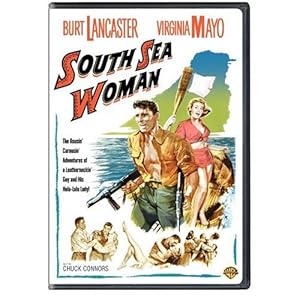
South Sea Woman
Working with stars like James Cagney, Gregory Peck and Burt Lancaster among others, it would have been easy for Virginia Mayo to get lost in the shuffle of the casts in her movies. She could have been a pretty background piece that didn't distract from the movie, letting her male co-stars do the heavy lifting. Mayo started her career as a dancer and singer but transitioned into film. Not in many classic movies, she never achieved huge stardom but through the 1940s and 1950s, Mayo was almost always a good choice to play a strong female character without getting overwhelmed by her co-stars.
Released in 1953, South Sea Woman is a good indication of Mayo's talent. Working alongside Lancaster for a second time after their pairing in The Flame and the Arrow with Chuck Connors playing the other lead role, she always remains at the forefront of this oddity of a movie. The TCM description read 'A Marine sergeant battles Nazi agents to help a showgirl escape war torn China.' Having watched the movie now, I can say that is one of the most inaccurate plot descriptions I've ever read. Did the person who write that even see the movie? Regardless of its inaccuracy, the premise -- however wrong -- seems fairly serious, but this is a WWII comedy. Confused much? I certainly was in the first 15 minutes or so.
Brought up on a variety of charges at a court martial trail, Marine Corps. Sergeant James O'Hearn (Lancaster) faces over 100 years in jail and even possible execution if he is found guilty. The veteran sergeant though remains completely quiet at his trial, prepared to face any and all charges which include everything from destruction of countless robberies, theft, and the most severe, desertion from his post. Nothing rattles O'Hearn even as the trial begins, the story revealing itself how he got into this spot. One of his Marines, Pfc. Davey White (Connors) was trying to marry a camera girl in a bar in Shanghai, Ginger (Mayo), who O'Hearn thinks is into the young Marine for all the wrong reasons. In hopes of helping White, O'Hearn ends up getting left behind when his unit sails, setting off a chain of events that no court is seemingly going to believe.
So for starters we've got a courtroom drama done in flashback mode with more comedic moments than you could ever count on concerning a story about two Marines and one beautiful woman all set around December 7th, 1941 when Japan attacked Pearl Harbor. It all seems like a natural fit for a story, doesn't it? I was skeptical when TCM host Robert Osborne explained that this seemingly WWII drama was in fact a comedy, but I went along for the ride. It is an uneven movie, and the humor isn't physical or slapstick thankfully. It's the natural humor that can arise out of perilous situations that ends up working the best. It never gets too heavy-handed, and when the time comes there's a sharp turn back to the dramatic. Fun while it lasted though.
Throw all these different elements together, and you're certainly going to get your money's worth. The movie is only 99 minutes, but director Arthur Lubin certainly packs a lot into that running time. The courtroom testimony -- including witnesses Mayo, Leon Askin, and Veola Vonn among others -- serve as a set-up for the flashbacks which tend to be episodic in nature. Lancaster, Mayo, and Connors certainly cover a lot of ground, running from gangsters, stowing away on a Chinese sailboat, getting shipwrecked on a remote island paradise, and then getting back into the war effort around Guadalacanal. As crazy as it sounds though, 'Woman' never feels disjointed. The story just keeps flowing along with that nice balance of drama and comedy.
If you're going to make a dramatic comedy or a funny drama, you can do a whole lot worse than Burt Lancaster, one of those few actors who can handle both genres within the same movie. He's a genuinely funny performer, whether it's a subtle line delivery (like wooing Vonn's Madame's three non-English speaking nieces) or physical movement like masquerading as a hula dancer while still wearing his Marine-issued boots and a grass skirt. Mayo is similarly able to handle being really sexy while still being funny. So often, it's one or the other. She has a great chemistry with both of her male co-stars. This was Connors' first major role, and he more than handles his own with Lancaster. They play off each other well, rivals always willing to fight who are also close friends.
The courtroom drama and its flashbacks (which dominate the movie, the trial is only a jumping off point) develop and head toward that drama in the finale which surprised me. The ending though -- and a key revelation about one character -- did provide a twist I didn't see coming as O'Hearn and White get back into the war effort in a big way. Other performances include Barry Kelley, Paul Burke, and Raymond Greenleaf as officers of the court, Bob Sweeney as the defense and Hayden Rorke as the prosecuting lawyer, and Arthur Shields, William O'Leary and John Alderson as members of O'Hearn's makeshift crew he assembles when stealing a yacht. Even a young Strother Martin has an uncredited part as a Marine at the trial.
Odd little movie, but one that works surprisingly well when considering all the different elements assembled here. Through drama or comedy though, the reason to see it is the cast, especially Burt Lancaster, Virginia Mayo and a very young Chuck Connors.
South Sea Woman <---TCM trailer (1953): ***/****
Labels:
1950s,
Burt Lancaster,
Chuck Connors,
Strother Martin,
Virginia Mayo,
WWII
Saturday, June 25, 2011
Captain Nemo and the Underwater City
First introduced to the world in Jules Verne's classic novel 20,000 Leagues Under the Sea, Captain Nemo is one of those great mysterious characters in literature. In films and television, he's been portrayed by James Mason, Herbert Lom, Omar Sharif, Michael Caine, Patrick Stewart and in 1969's Captain Nemo and the Underwater City, he is played by Robert Ryan. The character as Verne intended it is a mysterious one to begin with, but in basically all of the castings, the character is badly (sometimes very badly) miscast. As much as I love Robert Ryan, this is one epic case of miscasting.
One of Hollywood's more underrated actors, Ryan was a legend, starring in countless classics, able to play both good and bad alike. He specialized in torn tough guys, men with checkered pasts and fiery emotions. He's one of my favorites, but having him playing Nemo was just a bad idea. For starters, there's that whole physical resemblance thing. Nemo is the son of an Indian Raja, and Ryan is very, very American-looking. None of this is meant to rip on Ryan as an actor. Far from it, mostly because this is an awful movie, and Ryan's casting is just one of many huge holes this movie has.
A ship sailing off the coast of England late in 1864 sinks, the passengers desperately trying to cling to wreckage in the rough waters. A handful of survivors, including a United States senator, Robert Fraser (Chuck Connors), are rescued by several scuba divers under the water. They're brought on-board the Nautilus, the submarine of the mysterious and highly intelligent, Captain Nemo (Ryan). Glad to be alive but confused as to Nemo's intentions, Fraser and Co. go along with the captain as he returns to an immense underwater city he's constructed on the ocean floor. Nemo insists that no one ever leaves the city, no one returning to the cruel, hypocritical world that they've left behind. Is this life so bad though? Fraser struggles with the decision, going back and forth on what to do.
I was mostly drawn to this movie -- which I'd never even heard of before seeing it at TCM's schedule -- because of the cast, but it took about 10 minutes for me to figure out this wasn't going to be a very good movie. Some money was clearly spent on the production, but director James Hill just doesn't know what he's doing here. This lavish underwater city looks ridiculous, the costumes and sets are some weird mix of futuristic and bad late 1960s style, and the script is so all over the place that the movie never gets into any rhythm. That enough for you? It's not campy enough to be so bad it's good, and it is so dull at times that you can't just go along for the ride.
No saving grace here from the cast, but I don't think it is their fault. It's hard to believe Ryan starred in The Wild Bunch the same year he did 'Nemo.' As great as he was in that movie, he's equally bad here, phoning in his performance. Connors too is miscast as the U.S. Senator on some highly important, secret and dangerous mission for the U.S. government. His hair is about 12 feet high, and he just doesn't work as a Senator. There's also Nanette Newman as Helena, one of the survivors and a single mother, the beautiful Luciana Paluzzi as Mala, a school teacher in Nemo's city, John Turner as Joab, Nemo's right-hand man, Bill Fraser and Kenneth Connors as the gold-hungry Swallow brothers, and Allan Cuthbertson as Lomax, a claustrophobic survivor looking for any way out of this paradise city.
What works against the cast (because there is talent here) is a story and a script that just doesn't know what it wants to do or where to go. A long 10-minute sequence has Nemo giving the survivors a scuba-tour of his city, pointing out fish and fauna in his best Jacques Cousteau impression. Nemo and Helena have a budding relationship as the mysterious captain possibly looks for a wife. The Swallow brothers spent most of their time looking for gold mined from the ocean floor, planning how to escape with as much as they can. Fraser falls for Mala and debates staying with her, also watching out for Joab who sees the senator as competition. There's both too much going on and not enough. I suppose none of these storylines are enough to carry a movie on their own so instead we get tidbits of all of these less than interesting stories.
Mostly though with this movie I was just bored. A movie can be really bad, but as long as it is somewhat entertaining I'll go along for the ride. Not a long movie at just 105 minutes, I found myself fast-forwarding through basically every underwater sequence. The miniatures of Nemo's city and submarine are pretty poorly handled, and the submarine chase in the finale should have been so much cooler. Instead, the movie limps over the finish line. Bad, bad and bad. Steer clear.
Captain Nemo and the Underwater City <---trailer (1969): */****
Sunday, April 10, 2011
Synanon
The Synanon organization was devoted to drug rehabilitation, helping junkies and addicts kick the habit they'd developed. Founded in 1958 in Santa Monica, California by Charles Dederich, the organization existed until the late 1980s before finally going under. They were obviously doing something right to last over 30 years. Their success in the early 1960s was even parlayed into a feature film, 1965's appropriately titled Synanon. Made on location in Santa Monica at the Synanon Home where its patients went through treatment, the movie was made with the support of the organization, which made me wonder. Why didn't they insist on a more positive story, or if nothing else, at least a better written script?
Coming off a heroin high one night on the boardwalk, ex-con and thug Zankie Albo (Alex Cord) finds himself in front of the Synanon House on the beach and checks himself in. At the lowest of lows though, being sober sounds like a good thing. When you're off your high, not so much, and Zankie has to convince the Synanon administration (Edmond O'Brien as Dederich, along with Richard Conte and singer Eartha Kitt) that he's on the up and up. Zankie goes back and forth but decides to stick around, partially because he's got an eye for another patient, Joaney (Stella Stevens), while also dealing with a fellow patient and person from his past, Ben (Chuck Connors). Going along with the program though and genuinely trying to get better, it seems only a matter of time before his demons get the best of him.
The biggest reason I watched this flick was the cast, no huge stars but actors who I'm always glad to see. The performances though are more hit or miss. O'Brien is a one-note character, the tough-talking administrative leader of the house, always glowering down at its patients with his tough love mentality. Conte plays a variation of so many of his performances, a condescending guy who thinks he knows everything. Basically, that asshole everyone knows. Kitt is okay but isn't given a ton to do. Cord, Stevens, and Connors are the best thing going for the movie. All three characters are deeply flawed individuals with their pasts looming over them. What clicks together is that individually or as a group, there's nothing very redeeming about them, but they're still interesting to watch. In the end, one character does get a chance to redeem themselves and move on to something better.
Now if I'm supporting a Hollywood feature film about my organization, I'm making certain demands about how things are going to be portrayed. With an organization like Synanon, that can be trouble because you're dealing with drug rehab (albeit a seemingly white-washed version). If you show it as it is, this is going to be one of the darkest movies ever. If you censor it as it feels like in the film at times, you're not doing the story justice. Director Richard Quine is trapped somewhere in the middle with moments of incredible darkness followed by moments of adoring adulation of the organization. Going back and forth like the story does, that's not the biggest concern. It's a reliance on story conventions that soap operas would be jealous of. Maybe it seemed innovative or ahead of its time in 1965, but now in 2011, it's all been done and seen. Shocking then, but not so much now.
What aids the movie through its ups and downs has little to do with the actual story of this organization trying to aid patients in their drug rehab. It's a very stylish, well-made look at Santa Monica, California, providing a bit of a time capsule for a really cool time period. Filming was done at the original Synanon house on the Santa Monica beach although I'm guessing indoor scenes were filmed on a studio. Other than though, as a viewer we feel like we're there at the house with the patients. Quine shoots on the streets surrounding the house, in and around the seedy bars nearby, and uses some unique angles that take you out of a typical comfort zone. It's not an aggressive style, but it doesn't just settle to put the camera in front of the cast and let them go. With a soft jazz score by Neal Hefti, 'Synanon' gives a window into 1960s California that transports you into the story.
Trying to look past the cliches and stereotypes the script relies on far too much, I was genuinely impressed with the performances by Cord, Stevens and Connors. I've only seen Alex Cord in a handful of really average movies, but I've always liked him as an actor. Besides the ridiculously odd but still cool name -- Zankie Albo -- the character is interesting even if I would have liked a little more background. Stevens plays up her sex kitten image and then throws you for a twist the same way Connors does, shedding his Lucas McCain image from The Rifleman. So overall, while the movie wasn't that good, some of the performances were good enough to give this a slight recommendation.
Synanon <--- TCM clips (1965): ** 1/2 /****
Friday, June 4, 2010
Code Two
Did you ever watch an episode of CHiPs and think 'Man, I wish they made a movie about these guys?' Yeah, me neither. But if you did, 1953's Code Two might be just the movie for you except without Erik Estrada, way too tight biker pants, and police seducing women every chance they get. Almost serving as a public service announcement about how cool it is to be a motorcycle cop, Code Two has its moments in a quick 69-minute running time.
Made with a relatively unknown cast and with a smallish budget, 'Code' benefits from some cool on-location shooting in Los Angeles and the surrounding area which gives a nice window into 1950s California. Add on top of that some even cooler footage of vintage motorcycles whipping around the city, and you've basically got this movie with a ham-fisted storyline thrown in for good measure. Let's face it, what's a motorcycle cop movie without some ridiculous crime to solve?
Heading into the police academy, three officers-to-be dream of one day being motorcycle cops. First, there's Chuck O'Flair (Ralph Meeker), a cocky, fun-loving SOB who wants to prove he's the best. Second, there is Harry Whenlon (Jeff Richards), the boring All-American guy devoid of all personality. Last is Russ Hartley (Robert Horton), a husband looking to provide for his young family. But if these three crazy kids want to be motorcycle cops, first they've got to get through Jumbo Culdane (Keenan Wynn), the tough as nails veteran instructor who will throw everything in the book at them so they're ready for their jobs. Even if they do pass, they've got the extremely dangerous job of patrolling the streets ahead of them.
Nothing from that storyline isn't straight out of the movie script cookie cutter formula maker. Really, the plot is probably the last thing you'd look for in a movie like that. 'Code' at its best is with the trainees going through their equivalent of boot camp to get onto the LAPD and then their bike training to become motorcycle cops. There's some great footage of these training sequences with much of the cast -- especially Meeker and Wynn -- looking like they did much of their own riding whenever possible.
The cast is nothing special with the only characters of interest being Meeker's cocky Chuck and Wynn's tough as nails Jumbo. The All-American boy is about as cardboard as possible, and the family man cop tries to hide his job from his wife who worries about him. Thankfully, not too much time is devoted to either of them. Meeker does what he does best, play an a-hole, and while he's not particularly likable, he's at least interesting. Wynn looks to be enjoying himself the most as Jumbo -- think the police equivalent of a foul-mouthed (for the 50s at least) of a Marine drill sergeant.
The already mentioned ridiculous crime that has to be solved is a doozy. SPOILERS During a routine traffic stop, Harry gets knocked out and run over by a cattle truck (William Campbell is the killer), but little evidence other than a tire track is left behind to provide clues. Meeker's Chuck ends up breaking the case which even now having finished the movie makes me shake my head. In 1952 Los Angeles, some criminal organization is rustling cattle, transporting them in trucks, slaughtering them and butchering the meat, and apparently running some sort of illegal deli. Chuck tracks them down and gets in a shootout with a lot of nameless henchmen just waiting to get knocked off.
A completely forgettable movie but at least its entertaining. Also watch for a young uncredited Chuck Connors in just his fourth movie, making a quick appearance as a sheriff's deputy. Probably worthwhile for motorheads and for a nostalgic look at 1950s Los Angeles.
Code Two <----TCM trailer (1952): ** 1/2 /****
Labels:
1950s,
Chuck Connors,
Cops,
Keenan Wynn,
Ralph Meeker,
William Campbell
Friday, May 28, 2010
The Hired Gun
I've written at least two reviews of TV shows edited into feature length movies since I started the blog. Typically they're pretty easy to spot, but that doesn't mean they have to be bad. The pacing or editing might seem a little off, but what do you really expect from a TV show turned movie? Usually my radar is pretty decent trying to figure out if the movie I'm watching is from some short-lived 50s or 60s TV show. As for 1957's The Hired Gun, I never really thought it was from a TV show, but it sure felt like it.
For starters, 'Gun' clocks in at a whopping 63 minutes, many of which are just shots of the main characters riding across the desert. Visually stunning, agreed, but giving us any reason, any reason at all to be interested? Not really. Even at just over an hour, director Ray Nazarro (typically a TV director, appropriately enough) has two vastly different storylines, one covered over the first 30 minutes and then wham! Story change! New story up until the end. Too bad because with the talent involved, the movie had some potential but never amounts to much.
Waiting to be hanged in a few hours, Ellen Belden (Anne Francis) sits in her jail cell in a dusty Texas town. She claims innocence, but a judge sentenced her to death for the murder of her husband. When she steps up to the noose, she'll be the first woman ever hung in Texas. But the morning of the hanging, Judd Farrow (Chuck Connors), her uncle's ranch foreman, busts her out and helps her escape to the ranch in New Mexico. Ellen's dead husband's family, especially father Mace (John Litel) and brother Kell (Vince Edwards), want her back to answer for the murder. With no other options, they hire gunfighter Gil McCord (Rory Calhoun) to go get her back for $5,000.
One of the big problems here is that within 30 seconds of being introduced to Francis' character, she's spilling her guts claiming innocence in the opening narration. If it's me, I try and keep you guessing for at least a little while whether she killed her husband or not. Second on the problem list, Francis with her angelic blond hair and innocent face clearly isn't going to lie about her actions. From there on, it's just a matter of who did it, and looking at the supporting cast, it's a pretty easy guess.
As for the two stories, it just caught me off-guard. The first 30 minutes or so is the prison break and McCord's pursuit of Ellen as she flees into New Mexico. The last half is Gil and Ellen trying to prove who really killed her husband with a mysterious horse thief named Kirby (Guinn Williams) holding the key to proving her innocence. The problem isn't that the story takes a quick right turn midway through the movie, it's that the first half is pushed to the side in the blink of an eye. Connors' Judd helps Ellen escape and then assumes some reciprocity in the feelings department. He chases after Gil and Ellen, gets shot in the arm and disappears the rest of the story.
Of course, that's just one problem with the main characters. Calhoun is supposed to be a badass gunfighter but he only gets one chance to prove this in the movie. Other than people cowering when they hear his name, we're given no reason to think this guy is the ultimate bad hombre with a six-shooter. From the minute he's introduced to Ellen, it's only a matter of time before he figures out the truth and of course, falls in love with her. Oh, no, I certainly hope they can make it through this harrowing journey together! Calhoun and Francis are decent enough with their parts, but they're just not given enough to do.
SPOILERS STOP READING, HERE COMES THE KILLER REVELATION SPOILER From the start, it's pretty obvious the real killer is either Chuck Connors or Vince Edwards. And the winner for husband killer is....Vince Edwards, seeking his father's love, approval, and most importantly, his money! Both actors are capable of being strong bad guys, and here they both get a shot at being the brooding, intimidating villains. Like the main characters though, they're not given much to do until the story needs them to be shot so Gil and Ellen can end up together. END OF SPOILERS
That's my idea, make this into a half-hour episode of The Rifleman and you might have a halfway decent show. But as a 63-minute feature with about 30 minutes of storyline, this western falls woefully short of being halfway decent. The cast might make it seem more appealing, but this is just not a good movie from start to finish. Pass in a big way.
The Hired Gun (1957): */****
Labels:
1950s,
Chuck Connors,
Guinn Williams,
Rory Calhoun,
Vince Edwards,
westerns
Subscribe to:
Posts (Atom)