The Sons of Katie Elder

The Sons of Katie Elder
"First, we reunite, then find Ma and Pa's killer...then read some reviews."
Showing posts with label Alex Cord. Show all posts

Sunday, April 10, 2011

Synanon

Starting things off with a big generalization that I have no concrete facts to back up with, the 1960s have to be the most turbulent decade in American history, rivaled by the 1860s, the 1930s, and the 1940s among others I'm probably forgetting.  At the height of this turbulence was the drug culture that no doubt existed before, but really came to the forefront of people's minds during the time of Vietnam, hippies, and free love.  I have this perception of the average American home being oblivious to the drug culture. Were they? Who knows for sure, but some were aware.

The Synanon organization was devoted to drug rehabilitation, helping junkies and addicts kick the habit they'd developed.  Founded in 1958 in Santa Monica, California by Charles Dederich, the organization existed until the late 1980s before finally going under.  They were obviously doing something right to last over 30 years. Their success in the early 1960s was even parlayed into a feature film, 1965's appropriately titled Synanon. Made on location in Santa Monica at the Synanon Home where its patients went through treatment, the movie was made with the support of the organization, which made me wonder.  Why didn't they insist on a more positive story, or if nothing else, at least a better written script?

Coming off a heroin high one night on the boardwalk, ex-con and thug Zankie Albo (Alex Cord) finds himself in front of the Synanon House on the beach and checks himself in. At the lowest of lows though, being sober sounds like a good thing. When you're off your high, not so much, and Zankie has to convince the Synanon administration (Edmond O'Brien as Dederich, along with Richard Conte and singer Eartha Kitt) that he's on the up and up. Zankie goes back and forth but decides to stick around, partially because he's got an eye for another patient, Joaney (Stella Stevens), while also dealing with a fellow patient and person from his past, Ben (Chuck Connors). Going along with the program though and genuinely trying to get better, it seems only a matter of time before his demons get the best of him.

The biggest reason I watched this flick was the cast, no huge stars but actors who I'm always glad to see.  The performances though are more hit or miss.  O'Brien is a one-note character, the tough-talking administrative leader of the house, always glowering down at its patients with his tough love mentality. Conte plays a variation of so many of his performances, a condescending guy who thinks he knows everything.  Basically, that asshole everyone knows.  Kitt is okay but isn't given a ton to do.  Cord, Stevens, and Connors are the best thing going for the movie.  All three characters are deeply flawed individuals with their pasts looming over them.  What clicks together is that individually or as a group, there's nothing very redeeming about them, but they're still interesting to watch.  In the end, one character does get a chance to redeem themselves and move on to something better.

Now if I'm supporting a Hollywood feature film about my organization, I'm making certain demands about how things are going to be portrayed.  With an organization like Synanon, that can be trouble because you're dealing with drug rehab (albeit a seemingly white-washed version).  If you show it as it is, this is going to be one of the darkest movies ever.  If you censor it as it feels like in the film at times, you're not doing the story justice.  Director Richard Quine is trapped somewhere in the middle with moments of incredible darkness followed by moments of adoring adulation of the organization. Going back and forth like the story does, that's not the biggest concern. It's a reliance on story conventions that soap operas would be jealous of. Maybe it seemed innovative or ahead of its time in 1965, but now in 2011, it's all been done and seen.  Shocking then, but not so much now.

What aids the movie through its ups and downs has little to do with the actual story of this organization trying to aid patients in their drug rehab.  It's a very stylish, well-made look at Santa Monica, California, providing a bit of a time capsule for a really cool time period.  Filming was done at the original Synanon house on the Santa Monica beach although I'm guessing indoor scenes were filmed on a studio.  Other than though, as a viewer we feel like we're there at the house with the patients.  Quine shoots on the streets surrounding the house, in and around the seedy bars nearby, and uses some unique angles that take you out of a typical comfort zone. It's not an aggressive style, but it doesn't just settle to put the camera in front of the cast and let them go.  With a soft jazz score by Neal Hefti, 'Synanon' gives a window into 1960s California that transports you into the story.

Trying to look past the cliches and stereotypes the script relies on far too much, I was genuinely impressed with the performances by Cord, Stevens and Connors.  I've only seen Alex Cord in a handful of really average movies, but I've always liked him as an actor.  Besides the ridiculously odd but still cool name -- Zankie Albo -- the character is interesting even if I would have liked a little more background.  Stevens plays up her sex kitten image and then throws you for a twist the same way Connors does, shedding his Lucas McCain image from The Rifleman.  So overall, while the movie wasn't that good, some of the performances were good enough to give this a slight recommendation.

Synanon <--- TCM clips (1965): ** 1/2 /****

Thursday, August 12, 2010

The Brotherhood

A classic since it hit theaters in 1972, Francis Ford Coppola's The Godfather is and always will be remembered as one of the greatest movies ever made.  It set the groundwork for how to do a movie about gangsters, crooks, the Mafia, and somehow make these otherwise extremely nasty characters sympathetic in the eyes of the viewer.  It's been spoofed, honored, ripped off, and referenced in countless movies and TV shows since.  But it certainly wasn't the first Mafia movie, seemingly borrowing from 1968's long-forgotten The Brotherhood.

Mario Puzo's The Godfather first hit book shelves in 1969 a year after 'Brotherhood,' but I'm not going to go out on a limb and say he plagiarized this Martin Ritt-directed movie. With stories based on similar backgrounds (the Mafia) there are going to be similarities.  It just seems that a lot of similarities made the jump from one movie to another.  No worries though, 'Brotherhood' isn't about to overtake Godfather as a better movie, but it makes an interesting companion piece, maybe a good double feature.  Using some of the same character backgrounds, setting and story vehicles though, the 1968 flick is a more low-budget, studio oriented venture than the classic that would be released four years later.

Living in Sicily, Frank Ginetta (Kirk Douglas) lives in privacy with his wife (Irene Papas) away from the hustle and bustle of everyday life. He receives a message one day that his brother Vince (Alex Cord) is coming to visit, making him wonder if his brother has been sent to kill him. Flashback to years before at Vince's wedding when he approaches his mafioso brother, asking him if he can join in the family business.  Frank is happy to have him as the Ginetta empire grows.  But as the times change, Frank digs his heels in for the old ways, how things used to be done, instead of going along with a business proposition that could possibly net millions of dollars.  The elder Ginetta is making unnecessary waves, only to find out that a traitor from years past is still close to him, forcing him to make a difficult decision.

Starting the movie, I thought the opening and finale were great.  Frank drives to a prearranged meeting point to meet someone who's come to see him, not knowing it is his brother.  The beginning and ending were filmed in Sicily, and as the story plays out the Sicilian countryside sure isn't bad to look at.  But total, the story is probably only in Sicily for 20 minutes -- ten on either side of the flashback.  The rest takes place back in New York at Vince's wedding after he's returned from Vietnam (cough Michael Corleone cough Corleone wedding cough).  The problem is most of the rest of the movie is talking, a lot of talking that doesn't always go anywhere.  The talent involved won't let it get boring, but it's not exactly exciting either way.

Douglas was an extremely gifted actor, but playing an Italian Mafia Don seemed like a stretch for me and was one of the big reasons I picked this one at Netflix.  It's a solid if unspectacular performance as Douglas does what he can with a script that needs some work.  Too often he does go for the over the top, theatrical portrayal of an Italian man with lots of rapid fire Sicilian and 'Mama Mia!' when he's upset.  Okay, he doesn't say 'Mama Mia' but you know what I mean.  Frank is a cool character though, seeing that the old ways don't necessarily work but refusing to go along with the new ways.  An old school don, a creature of habit, nothing is going to change his mind, especially any threats.

The rest of the cast is all right, no one really calling too much attention to themselves.  Cord as Frank's younger brother looks the part, but the performance is a little flat, a little lifeless.  Vince is supposed to be this math/bookkeeping whiz, but that doesn't translate well in terms of a visual or a story effect.  He's the one man who could convince his big brother to go along with the times, but we're never given a reason to see why he's so convincing.  The "board" of Mafia higher ups and important local officials include Luther Adler, Murray Hamilton, Val Avery and Alan Hewitt, one of them playing a key role in Frank's possible rise and fall. As Frank's wife, Papas has little to do with a part that needs her to worry about her husband before fading into the background.  Too bad because when given the chance she almost always hit a home run.

On to some other points, both good and bad.  Ritt films in New York for some of his outdoor shots, giving a picture of late 1960s New York which is always cool with some location shooting.  Any interiors look like studio sets though, canceling out any credit earned through the on-location shooting.  Lalo Schifrin's score is good is not particularly memorable.  Also, the constant use of Sicilian without any subtitles.  I feel like I missed a lot just because characters are always talking in Sicilian.  An average movie on the whole, but interesting in terms of comparing it with The Godfather's release some four years later.

The Brotherhood (1968): **/**** 

Friday, August 6, 2010

The Dirty Dozen: The Fatal Mission

When watching a made for TV movie, there's a certain amount of 'cheese factor' to be expected.  With a lower budget, smaller cast, and in general smaller scale, it obviously lowers your standards some as a viewer.  That was the case when I bought The Dirty Dozen Double Feature, two sequels starring Telly Savalas building off the premise of the original 1967 movie starring Lee Marvin.  Take 12 prisoners sentenced to death or long prison sentences, train them and send them on a suicide mission.  Simple enough, right?

I reviewed the first Savalas sequel, The Deadly Mission, a few weeks ago and gave it 2.5 stars based mostly on its entertainment value.  A bad movie, sure, but an entertaining one if nothing else.  The same applies for the other sequel, 1988's The Dirty Dozen: The Fatal Mission, but basically take down everything a notch or two.  Once again filming in Croatia and Yugoslavia -- I'm guessing it was cheaper to film there -- 'Fatal' is that nice blend of too many explosions, too little story, and a cast of has beens, never will be "stars."

It's 1943 and Allied intelligence has received reports that Adolf Hitler has a plan to put the Fourth Reich into play so Germany and the Nazi Party can live on for years regardless of how WWII ends.  Major Warden (Ernest Borgnine) again orders Major Wright (Savalas) to assemble a commando squad of prisoners sentenced to death or long prison terms, train them, and then parachute them into enemy territory.  Hitler's plan requires 12 men to travel by train east to Yugoslavia, but Wright and his squad must intercept the train and kill everyone on board.  As if their mission wasn't suicidal enough, a Waffen SS general (Matthew Burton) knows Wright's objective and is planning to stop him thanks to a traitor in the newest Dirty Dozen.

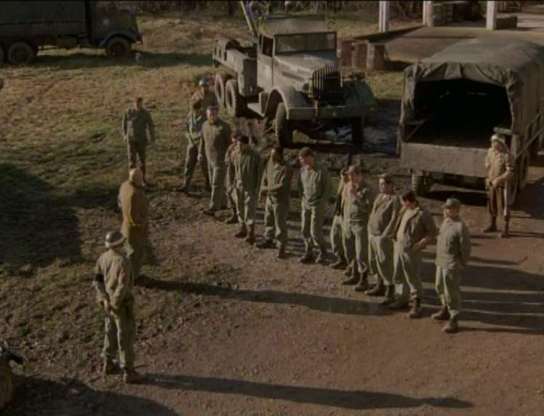
Where the other three DD sequels at least attempt to have some fun with the convict commandos, 'Fatal' doesn't give much of an effort.  This group includes soap opera star Hunt Block, Alex Cord, Erik Estrada, Ernie Hudson, John Matuszak (who played Sloth in The Goonies), boxer Ray Mancini, and Richard Yniguez. Instead of writing actual characters, 'Fatal' just borrows from the original.  Cord is Charles Bronson, Hudson is Jim Brown, Matuszak is Clint Walker, and Estrada is a mix between Savalas' Maggot and John Cassavetes.  Even worse than the other sequels, the rest of the dozen aren't even identified by name, not to mention never actually seeing their faces.  They are the definition of a 'Redshirt,' a character meant to be picked off but here it barely registers because we don't actually know who they are.  Of the actual name actors, Cord leaves the best impression as Dravko, an Eastern European immigrant turned soldier.  Also look for Taxi's Jeff Conaway as Sgt. Holt, replacing Vince Edwards in the loyal sergeant role.

Now all stupid allusions about having character development aside, the action isn't half bad here.  Granted it's that ridiculous TV movie action, but hey look! Gunfights and explosions!  The action scenes are basically Wright and the Dozen standing in the open gunning down German soldiers in every direction.  The dust settles, all the Germans are dead, the Dozen have a wound or two, and the story moves along.  There's a ridiculously high body count -- see all of them HERE, SPOILERS obviously -- and eventually the Dozen do begin to get picked off by some German soldiers who can actually shoot.  Making this all better though? Some of the nameless Dozen from 'Deadly Mission' return here and still don't get any lines!  Too perfect.

By now both late in their careers, Savalas and Borgnine are clearly slumming for work.  It's the type of movie though where if they weren't in it, there would be NO reason to see this.  They're both having some fun even if Savalas looks like he's wearing a helmet three sizes too small, and Borgnine spends most of his time looking at a map screaming about saving his men.  Still, they're Hollywood legends so they get a pass.  And if nothing else in the originality department, 'Fatal' has a female member of the Dozen, not a convict just a tag-along.  The Fall Guy star Heather Thomas plays a language expert needed for the success of the mission (I guess?) and shows she clearly didn't get the job because of her acting ability. She gives what could be the most wooden performance I've seen in awhile.

Because there's little else to say about this made for TV sequel, I'm including some links to three action scenes so anyone curious can see what they're getting into.  There's The Living Dead -- actually a cool scene even if it's completely ridiculous -- then Surprise Attack on a moving train, and Off the Rails, a self-explanatory scene if there ever was.  Average in every way and below average in a couple more ways, this is a pretty awful movie, but I can't completely rip it to pieces.  It's mindless enough to be entertaining so that counts for something.

The Dirty Dozen: The Fatal Mission (1988): **/****   

Monday, July 12, 2010

A Minute to Pray, A Second to Die

What flies in one market doesn't necessarily do the same in a separate market.  Take 1968's A Minute to Pray, A Second to Die, a popular spaghetti western released in Europe with an almost 2-hour running time. On a separate note, if that title isn't one of the coolest ever, I don't know what is.  Anyhow, MGM gets their hands on it for a U.S. release, cuts about 20 minutes, and hacks away the ending so American audiences can leave with a happy conclusion.  What's left? A good but not great spaghetti western that will always have the question of 'What if?' floating around it.

Released at the height of the spaghetti western craze, 'Minute' has been left in the dust by more popular spaghettis from directors like Sergio Leone and Sergio Corbucci among others and other movies with bigger stars.  This is a western with all sorts of genre regulars from the gothic sounding soundtrack -- not Ennio Morricone -- to the anti-hero to the supporting cast full of recognizable faces to the familiar locations.  A classic it is not, but it still remains an interesting watch for spaghetti western fans.

Infamous outlaw Clay McCord (Alex Cord) has ridden the outlaw trail for years, but the law seems to be closing in.  He hides out in the desert, bandit town of Escondido, run by a thuggish gunhand, Kraut (Leone regular Mario Brega), who would like nothing more than to put a bullet between McCord's eyes. While hiding, McCord hears of an offer made by the new territorial governor (Robert Ryan) giving amnesty to any outlaws who will sign a document and surrender their guns. The outlaw is skeptical, but a recurring problem that he believes is epilepsy continues to plague him, paralyzing his gunhand whenever it is put under stress.  Sooner or later, it will happen at the least opportune moment.  As he prepares to ride in to sign the amnesty though, McCord not only has to deal with Kraut, but the local sheriff (Arthur Kennedy) who is suspicious of McCord's motives.

This is not your typical spaghetti western in a lot of ways, and in others, it's a good example of how strong the genre could be.  Not a big star, Cord plays McCord as a sympathetic character forced into a life of working as a gunhand.  Some eerie flashbacks show some of Clay's motivation as he watched his father succumb to epilepsy.  It's an appropriate addition to a genre that has had heroes who are blind, deaf, tortured, mutilated and generally disabled.  Ryan gives the movie credibility just by showing up as governor Lem Carter, and Kennedy looks to be enjoying himself in the midst of his European movies.  Also look for Italian beauty Nicoletta Machiavelli as Laurinda, a woman who helps Clay.  For the rest of the cast, if you're a Leone fan you'll recognize countless faces in supporting roles.

Not as action packed as some reviews would make it out to be *cough Roger Ebert cough * this western gives a little more character development to its anti-hero in Clay McCord.  There are gunfights, including the exciting finale in one of the movie's more noteworthy filming locations.  Not just shooting in the sparse deserts, director Franco Giraldi moves his story all around from desert to river areas to forests and never stays in one place too long filming in Italy and Spain for the American west.  Composer Carlo Rustichelli turns in a score with two main themes, one quiet tune for the hero, the other that drives the action. All the little elements that help up and add to the quality of the movie.

Unfortunately, the DVD feels the need to taunt its buyers with a claim of a 118-minute running time, the original length upon being released in the late 60s.  In fact, the DVD runs about 98 minutes and does have a disjointed feel at times with some awkward cuts.  The worst cut comes at the end though.  SPOILERS As is, McCord signs the amnesty and rides off to a new life.  The original version has McCord sign the amnesty and then be shot down a few miles outside of town by bounty hunters unaware of what he's done.  Talk about a shocker ending, I've never found anyone who's actually even seen the ending.  The DVD ending does work, but the cut ending just seems like it would work better, especially for the McCord character arc.

Not as well known as many spaghetti westerns, this is a hidden gem in the genre.  It's floated around in anonymity thanks to its lack of big names, but all the better for catching up with it now.  It is available to watch through Youtube, but it is in Spanish and isn't of the best quality.  If you can find the MGM DVD, it does offer a cleaned-up widescreen presentation.  Hopefully somewhere out there is a 2-hour version with the original ending, but for now, this will have to do.

A Minute to Pray, A Second to Die (1968): ***/****