Not often remembered as one of Hollywood's great on-screen couples -- I'm totally stealing Turner Classic Movie's Ben Mankiewicz's introduction! -- Fred MacMurray and Barbara Stanwyck worked together four times during their illustrious characters. Double Indemnity is a classic, and I loved the Christmas-themed Remember the Night. Let's add a third to the list with today's review, 1953's The Moonlighter.
Wasting away in a jail in a small western town, an outlaw, Wes Anderson (MacMurray), has been captured for cattle rustling and is awaiting trial. Outside the jail though, some restless cowboys don't want to wait for that trial though, and through a case of mistaken identity, the wrong man is lynched, leaving Wes to escape with his life. He's torn up inside because a relatively innocent man (a hobo) died for absolutely no reason and struggles with how to handle the guilt. The only thing Wes knows is the outlaw life, whether it be rustling or bank robbing, and that's right where he reverts back to with no other options available to him. As Wes puts together a plan to rob a bank -- with some help from an old partner and his down-on-his-luck brother -- he finds out that a woman from his past, Rela (Stanwyck), is on his trail and looking for some answers.
I love westerns. I thought I'd like this generally forgotten, low-budget(ish) entry to the genre from director Roy Rowland. I was wrong. It's just not very good with too many negatives that cancel out some of its elements with some potential to offer. Good cast? Check. Story with rapid changes in tone? Double check. As soon as there's something to sit back and enjoy/appreciate, there's something equally frustrating that cancels it out.
That starts with the Wes character, MacMurray getting a rare chance at a villainous character. Sounds good, right? Can't go wrong with a star often associated with Father Knows Best and several Disney movies as a cattle-rustling outlaw...until you can. The script is rough. It starts off promising as we meet a grizzled Wes who hasn't shaved in days and is patiently sitting in a jail cell. When everything goes to hell with a lynching of mistaken identity (new band name?), so does the character. Wes' guilt is too much, and he takes it out on the lynching party. It's played like we should feel for him as he's wracked with guilt over what happened, but yeah, I'm not seeing it. His "revenge" is pretty weak too, roping some of the lynchers and then dragging them for awhile. He ropes Jack Elam (because Jack Elam was a villain in EVERY 1950 western) and we're not necessarily sure how much he does so there's that, but come on, if he's full of angst and vengeance, do it right. Make him pissed off and vengeful!
Further removing any edge off the character is the reliance on the love story. MacMurray and Stanwyck had unquestioned chemistry, but again, there's little reason to feel sympathetic for their stories. A tortured love from the past is typically a western-killer, especially when Stanwyck's Rela admits that "her love was too demanding, too strong" and that her demands drove...Wes...to...crime. Ugh, gag me. That's weak. And true love if you ask me! There's also a wasted subplot that doesn't live up to its potential with Wes' younger brother, Tom (William Ching), now engaged to Rela but struggling with where he's at in life. Never quite lives up to its dark potential, including the final act after a genuinely good -- if somewhat telegraphed -- 'twist.' Meh, why go with interesting when you can go with never-ending love full of passionate hugs and adults rubbing cheeks with their love?!?
Also look for Ward Bond as Cole Gardner, Wes' old partner, another rare opportunity for an actor who typically played good guys to get a bad guy role. Along with Elam, look for familiar faces John Dierkes and Morris Ankrum in small parts.
Just a western that tries too much. It's 75-minutes long and tries to tackle way too much. It even has an intermission! It starts off very strong but derails following the lynching scene, including a bizarre flashback as Wes starts to exact his revenge on the lynching party and the town. The scene develops with an intense tone of doom but ends up playing like a spoof. 'Moonlighter' is unfortunately never truly able to recover. It isn't awful -- there's simply too much talent on display -- but it sure ain't good either. Worth it as more of a western novelty than anything, especially with MacMurray, Stanwyck and Bond leading the way.
The Moonlighter (1953): **/****
The Sons of Katie Elder

"First, we reunite, then find Ma and Pa's killer...then read some reviews."
Showing posts with label Barbara Stanwyck. Show all posts
Showing posts with label Barbara Stanwyck. Show all posts
Sunday, February 21, 2016

Tuesday, January 26, 2016
The Strange Love of Martha Ivers

It's 1928 in the up-and-coming town of Iverstown in Pennsylvania when three teenagers from vastly different backgrounds and upbringings are witness to a horrific crime that results in murder. The truth never comes out though, putting the three teenagers on again, vastly different paths into the future. Fast forward to 1946 when the now grown-up Sam Masterson (Van Heflin) drives back into town looking to get his car fixed. He discovers that the other two teenagers have married, with Martha (Barbara Stanwyck) having become one of the most powerful businesswomen in the state with all sorts of public influence. Her husband, Walter (Douglas), is an equally powerful district attorney with political aspirations but really, it's Martha pulling his strings. Now after so many years have passed, the secret that bonds the trio threatens to tear everything down. Martha and Walter are convinced Sam is looking for a payoff. What is his intention exactly?
This is a flick that's hard to peg down. Not quite a romance or a mystery, not quite a thriller or film noir. Instead, director Lewis Milestone's film manages to blend all those elements into one very solid movie. At different points, it is all of those disparate pieces, providing a wave of different tones that might not work together but somehow...they just do. Filmed in black and white, there's a dark, shadowy and sinister look to it all. As well, there's that vein of small-town Americana where everyone has their secrets but no one ever gets called out on them. I will add it is an odd film when you take it all in, but there's something oddly appealing about it, the romance-thriller-mystery-film noir final product.
What holds it all together for me was the characters. We've got four main characters, all of them very human, very flawed and very vulnerable. I don't want to give spoilers away to the opening intro (it runs about 20-25 minutes) but it does involve a murder. If that doesn't provide some pyrotechnics some 17 years later, I don't know what will! Stanwyck, Heflin, Douglas and Lizabeth Scott as a troubled young woman brought into the years-old drama are all on-point in bringing their characters to life, the ensemble working quite well together. They all get their moments to shine and none disappoint. The chemistry between Stanwyck and Heflin is smoldering, as is between Heflin and Scott. In an age of movies that had a tendency to get a little overdone in the acting department, 'Strange' manages to harness all the melodrama and keep it relatively reserved (thankfully!). This is an acting movie, and the actors don't disappoint!
I came away especially impressed with Douglas in his first on-screen appearance and his first-ever film role. His Walter O'Neil is a product of his childhood and later, his marriage to Stanwyck's Martha. As Heflin's Sam points out, he's still a scared-looking little kid. Knowing where Douglas' career would go (and go quickly), it's startling to see him as an alcoholic, sniveling, weakling of a man. What's better? He nails the part. There's a perfect intensity to the proceedings, but he's perfectly believable as a grown man who can basically make a decision for himself. An underrated actor, Heflin delivers one of his best performances as Sam Masterson, a gambler, a WWII vet and with a checkered past to his name who still remains confident that something will come along because...well, because it always has before. Excellent parts for all four leads.
If there's an issue here, it's the pacing. At 116 minutes, 'Strange' can be a tad on the slow side. We spend a lot of time just introducing our characters and laying things out, most of an hour-plus actually. It's only then the wheels go into motion as we start to figure out what everyone's intentions are. What is Sam's plan? Is he interested in blackmail or is he just in the wrong place at the wrong time? What is Scott's Toni's background? Does Martha still have feelings for Sam? A lot to deal with for sure in the closing 45-50 minutes. So that said, I enjoyed the first hour more with its sense of mystery and foreboding doom hanging in the air over this budding industrial town. I was surprised by the ending itself because I just wasn't sure how dark this story would go...but it goes.
An excellent flick all-around, definitely worth checking out.
The Strange Love of Martha Ivers (1946): ***/****
Sunday, July 7, 2013
Double Indemnity

An experienced and successful insurance salesman with 11 years under his belt, Walter Neff (Fred MacMurray) is very good at what he does, able to sell policies to people who didn't even want insurance. On one house visit where he's looking to re-up on an auto policy, Walter meets Phyllis Dietrichson (Barbara Stanwyck), a young woman who's married but it's far from a happy marriage. He is magnetically drawn to her and can't stop thinking about her. Getting to know her better, Walter finds out about Phyllis and her background with her husband (Tom Powers). Moral of the story? Phyllis wants out, and Walter is going to help. He intends to get her husband to unknowingly sign a life insurance policy and then kill him. A longtime salesman, he's got a perfect plan to pull it off and have him and Phyllis split the $100,000 payout. Could it actually work?
One of the great films from Hollywood's Golden Era (and Hollywood history in general), 'Indemnity' is one of those movies I just never sought out even though I knew its reputation. It was worth the wait. Watching it on a first viewing, it seems familiar -- if in a good way. Why? Because hundreds of movies have tried to duplicate its success in the 60-plus years since its release. The duped male anti-hero, the brutal femme fatale, the characters in general who are interested in me-first, everyone else....well, never. The entire genre in general was ahead of its time, but this was one of the first examples, and it definitely deserves its classic status.
Based off a 'ripped from the headlines' story, the script from director Wilder and another halfway decent writer, Raymond Chandler, is like much of the movie, far ahead of its time. In its incredible darkness, honest depiction of just how nasty people can be with money on the line, it feels like a movie that would have been right at home in the equally dark/sinister late 1960s and 1970s. The script lays it all out there, setting it up and letting Walter's predicament get the best of...well, everyone. The dialogue seems a little stilted at times, but it's sharp and quick and well-written for the most part (obviously delivered pretty well too).
The cast doesn't call for too many key roles, but on a bigger level, it doesn't need more characters. MacMurray and Stanwyck are perfectly cast, playing off each other so well. In past reviews, I've mentioned my troubles with watching MacMurray in darker roles because I'm used to him as the star of My 3 Sons or any number of Disney movies, but there's a sinister charm that works nicely here. Stanwyck is the equally sinister femme fatale, like a snake waiting to strike. A match made in movie heaven (eh, maybe hell. We know this won't end well). In a scene-stealing part, Edward G. Robinson is Keyes, the inspector at the insurance company tasked with seeking out payouts that aren't on the level. Robinson expressed some concern at the time that he was taking a supporting part, but he needn't have been worried.
The development of Walter's plan is what sets this movie apart from the rest. Wilder and Chandler's script develops flawlessly, the tension building and building with each passing scene. The actual execution of the plan (oh, watch out, murder!) is tough to watch. We're clearly not rooting for them to succeed and murder someone, but at the same time, it's almost unbearable to watch because at the same time, you don't want them to get caught. It's the fallout afterward that is even tougher to watch. Wilder uses another ahead of its time technique, revealing in the opening scene courtesy of Neff that the plan will not succeed. That could be a dealbreaker for a lesser movie. We basically know the ending a minute into the movie, but it adds an interesting layer to the film. Okay, it's not going to work. How then is it going to crumble?
A classic movie from Hollywood's Golden Era for a reason. This would start Wilder on a ridiculously successful path that would help elevate him to one of Hollywood's all-time great directors. The style, the characters, the dark story and script, the score from composer Miklos Rozsa, it all works well, like puzzle pieces fitting together. Any movie that has influenced so many other films in the years following its release is/was clearly doing something right. Too bad I took so long catching up with it, but it is the rare film that was worth the wait.
Double Indemnity (1944): *** 1/2 /****
Friday, December 21, 2012
The Violent Men

Having been severely wounded during the Civil War, John Parrish (Glenn Ford) moves west and starts up a successful ranch as his wounds heal. It takes some three years, but he's healthy again and intends to sell the ranch and move back East with his fiance, Caroline (May Wynn). Against his better judgment, Parrish is going to sell the ranch to Lee Wilkison (Edward G. Robinson), the crippled owner of the Anchor ranch, the biggest cattle ranch in the territory. In an effort to buy up the whole valley, Wilkison and his wife, Martha (Barbara Stanwyck), try to low-ball Parrish. Making matters worse, they try to strong-arm him, killing one of his ranch hands. Quite content to take the low offer prior to the killing, Parrish has had enough. Outnumbered by Wilkison's small army of gunhands, Parrish -- a former cavalry officer -- goes on the offensive.
Though I've long been aware of this 1955 western from director Rudolph Mate, I never actively sought it out. For whatever reason, I looked it up on Netflix recently and seeing a very impressive cast, I gave it a shot. I'm glad I did. Partially because of its relatively short run-time at just 95 minutes, it isn't remembered as a classic, and I suppose it isn't. What it is is an above average, well-told, exciting adult western that doesn't settle for a status quo in a typical sense. It was filmed in the Alabama Hills in California (along with some location shooting in Old Tucson) and definitely has the look, if not the feel, of a much larger scaled, epic western. I also liked composer Max Steiner's score, sounding somewhat like a Dimitri Tiomkin score. Whatever it reminded me of, I liked it.
While there are very clearly good guys -- Ford's Parrish obviously -- and very clearly bad guys -- Robinson, Stanwyck and more -- this Mate-directed western is far from your typical good guys in white hats shooting it out with bad guys in black hats type of western. Comparing any western to Greek mythology or a Shakespearean play is opening the door for all sorts of criticism, but it's all deserved here. Ford's Parrish is the unquestioned hero while Robinson's Wilkison is the crippled, aging ranch owner. That would be a one-on-one showdown worth the price of admission, but that's the start. Robinson's brother, Cole (Brian Keith), is also having an affair with Martha, who wants nothing more than to own the valley, not really caring which man she's with to get there. Filling out the family tree is Judith (Dianne Foster), Lee and Martha's daughter, who knows exactly what's going on but doesn't know where to start or who to help. As a bonus, Wynn's fiance is also a cold-hearted you know what. Lots of betrayal, backroom deals and back-stabbings around every corner, and everyone is looking out for themselves.
With a cast this good, I probably would have gotten some enjoyment out of the story even if it was a dud. Watching this much talent on-screen can be fun in itself. On the positive though, the cast does a solid job from top to bottom here. The more I see Ford, the more I like him. His Parrish is a great hero, but one with a mean streak as needed. Robinson, Stanwyck and Keith are the three heads of one bad snake, all working against and with each other at the same time. It's only a matter of time before they start attacking each other. Foster is good too as the maligned Judith while Wynn is your pretty typical evil woman looking out for herself. Richard Jaeckel is all duded up as Wade Matlock, the Wilkison's top hired gun. His scenes with Ford are worth it to track the movie down on its own. Also look for Warner Anderson, Basil Ruysdael, Willis Bouchey, Jack Kelly and William Phipps in key supporting parts.
After a somewhat slow start as all the characters are introduced, the story picks up the Wilkisons try to strong-arm Parrish into selling his ranch. He puts his military background into effect, unleashing his own kind of strategic offensive on the better equipped, better outfitted Anchor ranch riders. The action picks up including a classic showdown between Ford and Jaeckel, a night ambush in a rocky canyon, and one form of guerrilla warfare after another. Not a lot of analysis needed for this one. It's a western that mixes elements of a good old-fashioned shoot 'em up with other more adult-themed elements. Well worth checking out.
The Violent Men (1955): ***/****
Thursday, December 6, 2012
The Furies

Running his cattle ranch, the Furies, with an iron fist, T.C. Jeffords (Walter Huston) has created an empire unto himself. He doesn't tolerate weakness in those around him and is always looking out for his own well-being no matter the cost/expense to others. At his side and helping him run the ranch is his fiery daughter, Vance (Barbara Stanwyck), who looks up to her father in every way and adopted his brutality as her own. As Vance decides she wants a husband who can keep up with her, the Furies falls on tough times with T.C. looking for any sort of income. Making matters worse is that T.C. proposes to Flo Burnett (Judith Anderson), a rich Easterner, a decision that does not sit well with Vance.
As I've written about before, the late 1940s and early 1950s were a key period in the transitioning of the wild west on film. Gone were the singing cowboys, straight-laced good guys and so obviously evil bad guys. The westerns became more adult-oriented. There weren't good guys and bad guys, just not-so-nice good guys and less evil bad guys. In other words? More realistic. These significantly darker stories have allusions from everything to Greek mythology to Shakespeare and everything in between. Hints of incest are there (incredibly subtle, but there) with countless more betrayals, back-stabbings and murders lurking in the corners.
Blending his film noir roots with the western makes for an easy transition for Mann in the director's chair. Picked up by the Criterion Collection, it's easy to see why. The film lives in both the film noir world and the western world, making for a great combination. All the film noir elements are there -- shadowy, smoky settings, the femme fatale, the conniving shady businessman and so many more -- and 'Furies' is certainly benefited from the black and white photography. Westerns can look beautiful in color, especially late 1940s ventures like She Wore a Yellow Ribbon, but there is an effective simplicity to the black and white. It was filmed on-location in the Arizona desert, the starkness and isolated feeling hanging over the ever-darkening developing story. Franz Waxman's score is worthwhile too.
One of my issues reading Greek mythology in high school and college was simple; too many characters. 'Furies' has a lot of characters, all of them looking out for themselves. A film noir star herself, Stanwyck seems at ease in the western. A tough female star is always a welcome addition to the genre, throwing away the notion of the damsel in distress. Huston gets to ham it up a bit as T.C., but he does a great job. Wendell Corey is the conniving Rip Darrow, a banker and saloon owner looking for revenge who also takes a shine to Stanwyck's Vance. Gilbert Roland makes the most of a supporting part as Juan Herrera who with his family is about to be kicked off the Jeffords' land, including his mother (Blanche Yurka), who's believed to be an old witch. Thomas Gomez as some fun as El Tigre, Jeffords' cattle boss, leading a supporting cast that includes Beulah Bondi, Albert Dekker, John Bromfield, and Wallace Ford.
With a 109-minute running time, I wasn't always sure where 'Furies' was heading. Well, check that. You know it won't be a happy ending, but it takes an interesting route getting there. All the back-stabbing and betrayals are present as anyone and everyone starts to turn on each other. Always pay attention though, it is the 1940s and karma, she is a....well, you know. Past transgressions must be paid for. The final scene is a little too hunky-dory, a little too sweet for my liking, but the build-up is solid enough to not be ruined by the cop-out finale at the Jeffords' ranch. Credit to Mann for combining film noir and an adult western so smoothly. It's missing that special something that keeps it from classic status, but it's an above average western.
The Furies (1950): ***/****
Friday, November 30, 2012
Meet John Doe
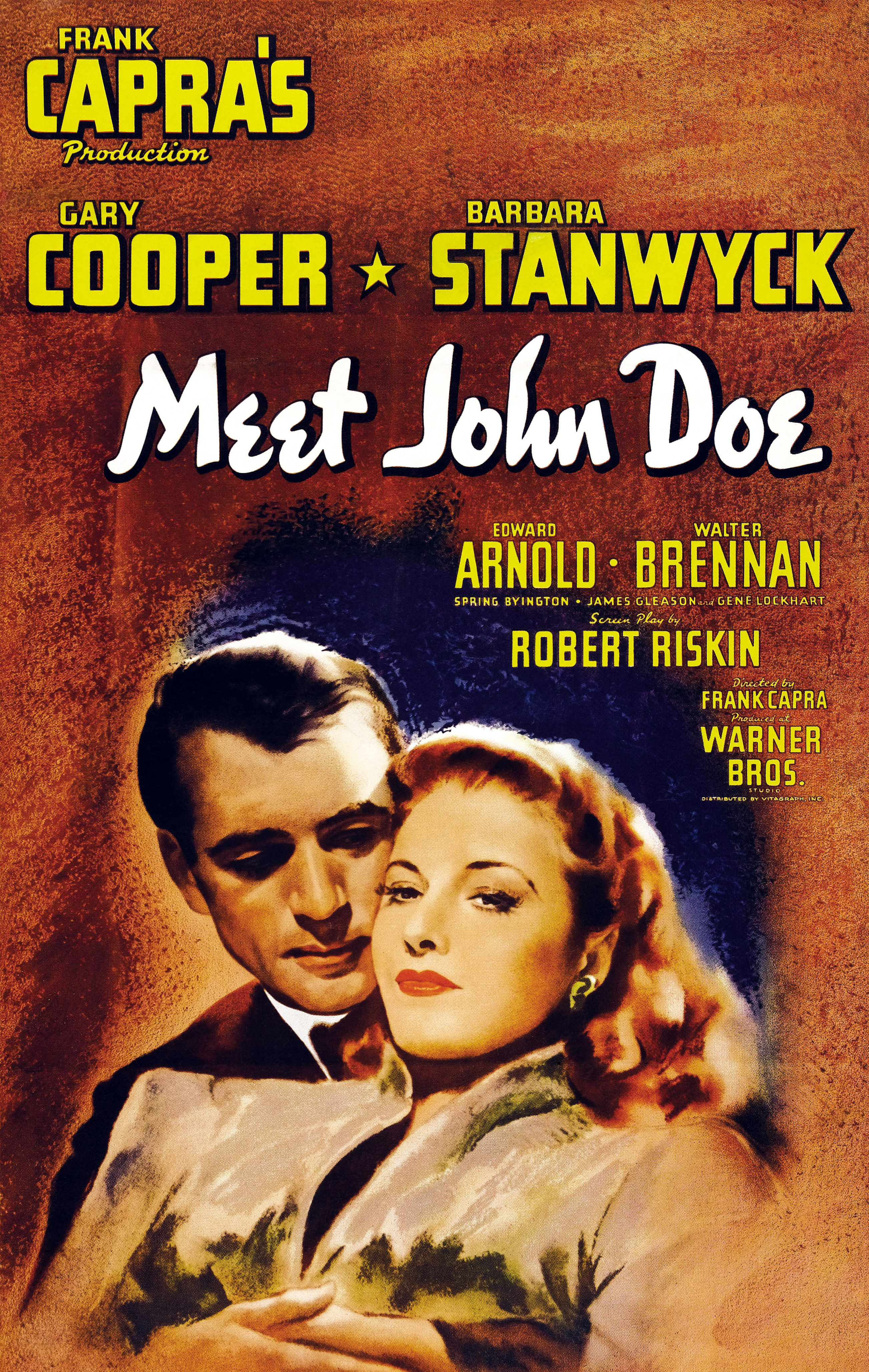
Squeezed out of a job when a new owner takes over at her newspaper, columnist Ann Mitchell (Barbara Stanwyck) goes out guns blazing. She writes a column from "John Doe," a reader who's become disillusioned and frustrated with humanity and civilization, vowing to kill himself by jumping off City Hall on Christmas Eve. Uh-oh, we've got a problem. Readers are curious, wanting to save John Doe. Where to find a reader who never existed? Ann and the paper hire John Willoughby (Gary Cooper), an ex-baseball player turned drifter, to pose as John Doe. The response is tremendous though across America, but even Ann could not have planned what John Doe becomes as certain parties become involved with the grassroots movement.
In his last film before making almost a dozen WWII documentaries, director Frank Capra does not disappoint here. His films have a certain style to them, and not just in the visual sense. Maybe not in a visual sense at all. At their base, these are good-hearted stories that want to believe there's genuine good in people. There are those that are inherently good and those that are inherently bad with little to no middle ground. You're either one or the other. Watch enough of his movies, and you see those traits pop up in countless stories and characters.
As a story, this 1941 Capra film is a forerunner of later classics A Face in the Crowd and Network. It shows the rise -- and the inevitable and eventual fall -- of an individual, a person who inspires charity, faith and belief in the masses. Here, Cooper's John Doe is just looking for a meal, a place to sleep at night with a roof over his head. He has no ulterior motives. It's Ann who sees the potential for good, and there's a plenty. The John Doe movement -- help thy neighbor, be friendly, be helpful to all -- takes the country by storm. The ulterior motive comes from Ann's boss, D.B. Norton (Edward Arnold, doing what he does best, being BAD), who sees the power that can be manipulated with the John Doe movement. For a country struggling to get back on the right track, the message was simple (and appealing); work together, work to help and good things will happen.
Capra's films in general had a great sense of the Everyman, the normal guy. Obviously here, the focus is entirely on that individual in all his different forms. Who better to play the face of the Everyman than all-American actor Gary Cooper? In a career of iconic roles, this is certainly up there as one of his best.He does a fine job representing the average American. The shady nature of his business deal with Ann quickly hits hard, but he sees there's certainly potential for good too on an immense scale. He has a great believable chemistry with Stanwyck, the brow-beaten journalist who similarly sees the chance to do something in the country if people would just try. In addition to Arnold's snaky D.B. Norton, the cast includes Walter Brennan as the Colonel, John's questioning drifting partner who hates the system, and for the most part, people, and James Gleason as Connell, Ann's boss who sees what Norton is up to.
A sucker for anything in the dark, realist mode in films, I didn't always love 'Doe.' The sugary sweet outlook on life gets to be a little much at times, and the pacing can be a tad slow. One scene introducing the John Doe clubs goes on forever, Regis Toomey's Bert character explaining in expansive detail how the club came to be in his little town. The story is at its strongest at its darkest points. Norton's plan is hinted at -- uh-oh, sense of doom! -- and when it's revealed, the rug is pulled out from under John, Ann, and millions of Americans. As sweet as Capra's outlook can be at times, it's equally dark in these instances and equally effective. There are scenes where the symbolism is far too heavy-handed (portraying John as a martyr...a la Jesus), but what makes it bearable is the message of goodness. Well worth checking out. You can watch the movie in its public domain format HERE at Youtube.
Meet John Doe <---trailer (1941): ***/****
Wednesday, August 15, 2012
Trooper Hook

Having led a successful attack on a warring Apache village, Sgt. Clovis Hook (Joel McCrea) is left in an interesting predicament. Among the prisoners is the leader of the rampaging Apaches, a chief called Nanchez (Rodolfo Acosta). That's just one problem though because a white woman, Cora Sutliff (Barbara Stanwyck), is among the prisoners, and she has a son with her. The father? Nanchez himself. Cora has been a prisoner of the Apaches for nine-plus years and has long since been feared dead. What can she do now? She can't return to the Apaches, but the white people in the fort and the surrounding towns are less than welcoming, questioning how a white woman could become an Apache warrior's squaw. Hook steps in, taking orders to take Cora to her husband, but nothing will come easy on this trip for either of them.
From director Charles Marquis Warren, 'Hook' is a no-frills, low-budget western from the 1950s. It was filmed on a small scale -- with ample use of poorly built "outdoor" sets standing in for nature's majesty -- and it shows. But because of its dark, adult subject matter, it rises above its smaller, modest background. Besides McCrea's Sgt. Hook, basically everyone forms an opinion (and quickly) about Stanwyck's Cora. They look at her with disdain, like she's less of a human because she tried to survive rather than kill herself and take the easy way out. This is a story about the people though, not interested in any bigger picture of how the west was conquered and the Indians were defeated.
An actor who made a career out of playing staunch, resolute heroes in B-movies and westerns, McCrea never rose to the heights of a John Wayne or even a Randolph Scott. He was excellent at playing a niche, a part in his comfort zone, and this movie is right in his wheelhouse. His Sgt. Hook (not Trooper as the title suggests) is a veteran horse soldier, experienced and trustworthy in every way, brutally effective in his soldiering. As for Stanwyck, she wasn't the in-demand starlet anymore, but she still delivers the movie's best performance. She doesn't say a word for some 30 minutes, but when she does speak (with a swinging shovel as accompaniment), you'd better watch out! The relationship that develops between Hook and Cora ends up being the key and the most important thing going for the movie. In his only career performance, Terry Lawrence plays Quito, Cora's half-breed six-year old son.
In a movie that's more interested in the people than the action, violence or gunplay, a handful of other supporting parts are worth mentioning. The best one going is Earl Holliman as Jeff Bennett, a down-on-his-luck cowboy who ends up traveling with Hook, Cora and the boy. A little inexperienced in the ways of the world, Holliman's Bennett is one of those archetypal western characters, a scene-stealing part for sure. John Dehner similarly has an interesting part not because it's a likable character but because of a question hanging over his head. He plays Cora's husband, a man who thought his wife was long since dead and now has to decide if he wants to care for someone else's son, much less an Apache chief's son. Edward Andrews, Celia Lovsky and Susan Kohner play other people the group meets on the stagecoach; Kohner a possible love interest for Holliman's Bennett. Royal Dano also has some fun as Mr. Trude, the fast-talking ex-Confederate soldier and current stagecoach driver.
While the story is anything but light and fluffy, I liked the low-key nature of 'Hook.' The action is kept to a minimum for the most part, and even when there is some gunfights, they're over almost as quick as they start. This is more a story about the people and how they choose to deal with a not so easy topic. How does a woman reintroduce herself to a life she knew so many years earlier? Will that life and society let her back? The story does a good job showing all the different possible answers here. That said, the ending loses some momentum once Dehner shows up. It's never in doubt where the story's going, but it takes awhile to get there. Still a worthwhile western, especially for parts from McCrea, Stanwyck and Holliman.
Trooper Hook <---fan-made video (1957): ** 1/2 /****
Friday, June 8, 2012
Forty Guns
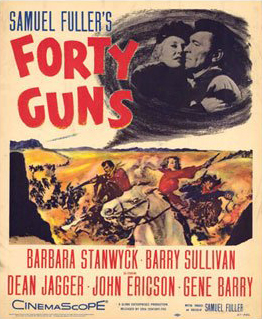
A federal peace officer with a well-known reputation, Griff Bonnell (Barry Sullivan) rides into Cochise County, Arizona with his two brothers, experienced gunhand, Wes (Gene Barry), and inexperienced but motivated Chico (Robert Dix). Griff is holding an arrest warrant on a cowboy accused of robbing a mail stagecoach, and then he finds out the man is working for Jessica Drummond (Barbara Stanwyck), a cattle queen in the area who has money, power and the guns -- some 40 gunslingers -- to back her up. The arrest warrant is just the start of problems as Jessica's younger brother, Brockie (John Ericson), doesn't like Griff's arrival and intends to do something about it.
Nothing too out of the ordinary for a western, is it? I didn't think so reading the plot description over at Netflix. From director Sam Fuller (who also wrote and produced), 'Forty' is just a mess of a movie. The positives are great, showing that at some point there was a chance this could have been a good to great western. The negatives though are epic, bordering on movie-killers. Some of the positives? It is a beautiful black and white movie, the camera work impressive, featuring long tracking shots, plenty of interesting angles, and basically a feeling of seeing something different. It is also surprisingly brutal and in its message. As far as westerns went in the 1950s, this is far ahead of its time, especially considering the cynicism that developed in 1960s westerns.
Besides Stanwyck in the lead, I didn't recognize much of the cast by name alone, but that ends up being a good thing. The Bonnells -- a thinly veiled take on the Earp brothers -- are great leads, especially Sullivan and Barry. Griff is the sure-handed lawman, so confident in his ability that he hasn't had to fire his gun in almost 10 years. Wes is his right-hand man, always backing him up like a guardian angel hovering over the situation. Chico wants to be like his brothers having seen the "glory" and "romance" of being a gunslinger. Stanwyck too is a bright spot, playing a strong female character, something that is lacking in so many westerns. She's no damsel in distress for sure, even doing her own stunt as she's dragged by her horse. Both the Bonnells and the Drummond characters are strong characters, able to carry a movie on their own. Instead of that, we get a jam-packed, even rushed 79 minute movie.
For all the positives, there's just too much going on for 'Forty' to be truly effective. Another 30 minutes would have been perfect to flesh things out. Barry's Wes is wasted in what was potentially a very cool character, "wooing" gunsmith's daughter, Louvenia (Eve Brent), and disappearing for long stretches of a short movie. Dean Jagger appears as necessary as corrupt and bought Sheriff Ned Logan, a possibly interesting backstory kept in the shadows. Oh, and did I mention that Stanwyck and Sullivan have a tortured love affair, two strong-willed individuals falling for each other for all the wrong reasons? Yeah, that's sort of a major plot, but like anything and everything else.....yeah, you guessed it. Rushed.
Rushed is one thing because it at least implies some sort of wasted potential. It was there, just never taken advantage of. On the other hand, there's just some badness. Ericson's terribly hammy performance as Brockie is so ridiculous it comes across as laughable. Some not so subtle sexual references -- a gun "going off in a woman's face" or "caring for one's gun with care and daily attention" -- are so heavy-handed they're hilarious in their badness.
A lot of these issues I had were almost thrown by the wayside in the finale, Sullivan's Griff delivering a truly surprising, brutal surprise, especially considering this was made in 1957. It's a mess of a movie overall -- both really good and epically bad -- but there's just enough....jjjjjjjjjjust....to recommend this one.
Forty Guns <---Youtube clip (1957): ** 1/2 /****
Tuesday, January 24, 2012
To Please a Lady
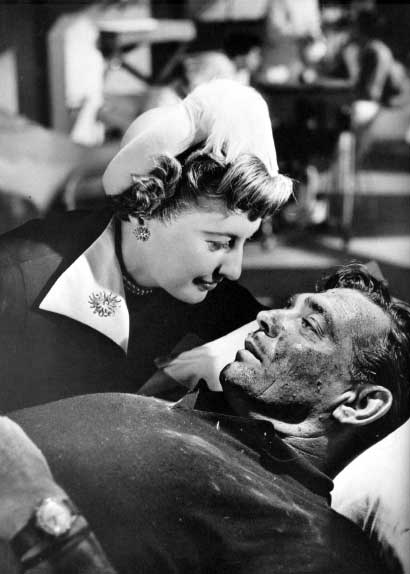
Writing a nationwide syndicated column and hosting a radio show, Regina Forbes (Barbara Stanwyck) is one powerful person, able to build someone up as quickly as she can take them down. Her latest target is Mike Brannan (Clark Gable), a midget car racer and former WWII hero in the Marines. Brannan has earned himself villain status on the racing circus, and Regina takes him down when he's involved in an on-course accident that kills a driver. Brannan is blacklisted and not allowed to race...at first. He climbs back up, joining the big racing circuits and hopefully getting back to the top. But if he thought he was rid of Regina and her efforts, he would be wrong. The high-powered writer isn't done with him yet.
The user reviews at the IMDB are decidedly mixed, but I liked this movie nonetheless. Some of that can be chalked up to a nostalgic factor ranging from the footage of late 1940s and early 1950 racing to the portrayal of the newspaper business (think of Stanwyck as a female Burt Lancaster from Sweet Smell of Success). Not surprisingly, a mutual interest arises between Gable and Stanwyck. I know, I didn't see it coming either. The story isn't the deepest of stories, and there are some odd moments (a quasi-phone sex scene between the two stars is kinda weird) but the end result is still entertaining.
Why is it entertaining? I don't care how simplistic the story is, when you put together actors the caliber of Gable and Stanwyck, it's going to be worthwhile to watch. There is chemistry, and then there's the chemistry these two have. It looks to be effortless. They're fighting after first meeting, and you believe it. They have little to nothing in common other than being dominant, Type-A personalities, but they're drawn to each other. Their scenes together are perfect, Gable as cool, smooth and suave as ever, Stanwyck as equally strong-willed and sexy in her confidence. Adolphe Menjou plays Gregg, Stanwyck's partner/adviser/secretary who's always needling her with Will Geer playing Jack Mackay, Brannan's team owner and pit crew leader.
Now chemistry is one thing, but I do have to mention one thing. It's never really in doubt that Stanwyck's Regina and Gable's Mike will end up together. It's just a matter of when more than if. How does it come about though? Regina basically blackballs Mike's career, and then goes and sees him about it as he tries to build his career. In arguing about the situation, Mike slaps Regina pretty forcefully (it looks like a real slap dealt by Gable). Only then does the relationship start to develop, like Regina needed a wake-up call. Call it over-analyzing, maybe I'm reading too much into it, but it didn't sit right with me.
I'm figuring if you've made it this far you're looking for some sort of race analysis. This 1950 movie is a gem for racing fans, motorheads, and anyone who appreciates a good car. The footage here is insanely good, including three sequences that don't montage a race to death but show much of it in its entirety. The finale at the Indianapolis 500 is a great ending too. From midget cars to stunt shows to the stronger, more powerful cars at the Indy 500, racing fans will be more than appeased. It's a time capsule, and a good one in a surprisingly good movie overall.
To Please a Lady <---TCM trailer (1950): ***/****
Friday, December 30, 2011
Christmas in Connecticut

A highly successful and very popular syndicated writer, Elizabeth Lane (Stanwyck) has created quite the elaborate lie. She publishes a monthly column about life on her farm with her husband, baby, and assorted adorable animals. The only problem? Elizabeth lives in a small New York City apartment. Her problem gets bigger when a sailor, Jefferson Jones (Dennis Morgan), rescued after 18 days on the open ocean has requested he meet Elizabeth and be treated to an All-American Christmas. Her publisher (Sydney Greenstreet) has complied, putting Elizabeth in quite the spot. With Jones and her boss on the way, can she continue to pull off a ruse with some help from friend and possible suitor, John (Reginald Gardiner)?
Let the 1940s crazy shenanigans begin! The premise is funny but ridiculous from the word 'go.' How do you pull off a ruse like this? Lies, lies and more lies. It reminded me of an extended episode of I Love Lucy, a crazy scheme that in no possible way would ever work....working. There are some very funny running gags including an appearance-changing baby, a judge (Dick Elliott) constantly trying to marry Elizabeth and John, and Greenstreet's publisher consistently muscling his way into problems. It's a 1940s romantic comedy, and that's a good thing. Stupid? Yes. Ridiculous? Oh, you know it. On the other hand.....
It's a sweet, innocent story that could only work in 1940s America. Romantic comedies released recently are mind-numbing, stories of "old maids" who can't get married, girls/guys talking about their conquests, and dreamy guys who always end up with the can't find a man "I'm so unlucky" woman. Some of that is on display here, but because it was made in the 1940s as opposed to the 2010s, it just works better (in my messed up head anyways). You can probably predict the ending now without seeing the movie. But the funny story, better script, black and white camerawork, a great cast, it all rolls up together into a winner. It just does. Would a story like this work now in 2011? Nope, and that's a good thing.
For all the movies I've seen (and are trying to see), I've only seen Stanwyck in one other movie I can think of even if I was aware of her screen presence as a seductive femme fatale. She does comedy here effortlessly. Her line deliveries are perfect as she navigates her way through "her life," not knowing how to care for a baby, to keep up a house, to cook, to do all the basics a wife might be able to expect. The humor is dry, her deliveries mostly subtle, and the looks she gives are priceless. It's always nice to see someone step out of their box as a performer, and Stanwyck nails this part. Her Elizabeth Lane is a great central character, her predicament seemingly getting worse by the moment.
Other than fellow noir alum Greenstreet, 'Connecticut's' supporting cast doesn't have a lot of star power or name recognition. Morgan as Jones is somewhat dull, the all-American soldier returning home to a hero's welcome, but he does have a good chemistry with Stanwyck, and that's all that really matters. Greenstreet too has a lighter part (with a somewhat darker side) as the money-minded publisher, Alexander Yardley. Gardiner as John Sloan is the dupe, keeping a seat warm until Elizabeth realizes she likes Jefferson. Heavily-accented Hungarian actor S.Z. Sakall is a scene-stealer as Felix, Elizabeth's friend and expert on cooking, with Una O'Connor playing Sloan's Irish live-in maid, Norah.
Not a Christmas classic up there in the vein of Wonderful Life, White Christmas, Miracle on 34th Street, but this is a winner. I'm disappointed I took so long actually sitting down and watching it. Definitely a movie that qualifies as one of those rare "They don't make them like they used to." Funny, charming, and sugary sweet, and a great movie overall.
Christmas in Connecticut <---TCM trailer/clips (1945): ***/****
Subscribe to:
Posts (Atom)