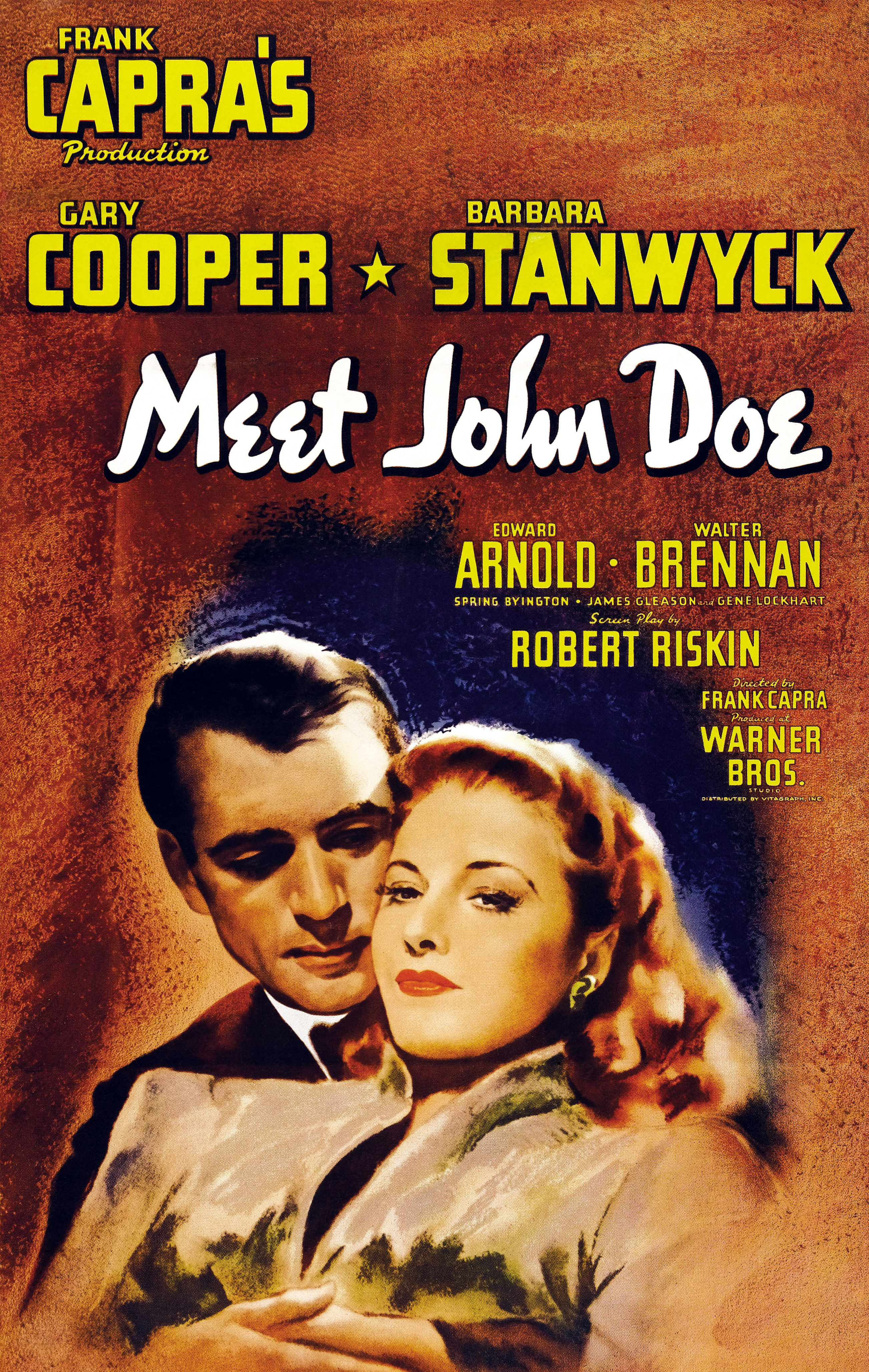
Released in the U.S. in spring of 1941, Meet John Doe is a successful movie that can chalk up at least part of its success to its release timing. At the tail end of the Great Depression and watching the world fall into WWII, the U.S. was at one of its historical low points. So how about a movie with a positive message that encourages the individual to work with others? Sounds simple, right?
Squeezed out of a job when a new owner takes over at her newspaper, columnist Ann Mitchell (Barbara Stanwyck) goes out guns blazing. She writes a column from "John Doe," a reader who's become disillusioned and frustrated with humanity and civilization, vowing to kill himself by jumping off City Hall on Christmas Eve. Uh-oh, we've got a problem. Readers are curious, wanting to save John Doe. Where to find a reader who never existed? Ann and the paper hire John Willoughby (Gary Cooper), an ex-baseball player turned drifter, to pose as John Doe. The response is tremendous though across America, but even Ann could not have planned what John Doe becomes as certain parties become involved with the grassroots movement.
In his last film before making almost a dozen WWII documentaries, director Frank Capra does not disappoint here. His films have a certain style to them, and not just in the visual sense. Maybe not in a visual sense at all. At their base, these are good-hearted stories that want to believe there's genuine good in people. There are those that are inherently good and those that are inherently bad with little to no middle ground. You're either one or the other. Watch enough of his movies, and you see those traits pop up in countless stories and characters.
As a story, this 1941 Capra film is a forerunner of later classics A Face in the Crowd and Network. It shows the rise -- and the inevitable and eventual fall -- of an individual, a person who inspires charity, faith and belief in the masses. Here, Cooper's John Doe is just looking for a meal, a place to sleep at night with a roof over his head. He has no ulterior motives. It's Ann who sees the potential for good, and there's a plenty. The John Doe movement -- help thy neighbor, be friendly, be helpful to all -- takes the country by storm. The ulterior motive comes from Ann's boss, D.B. Norton (Edward Arnold, doing what he does best, being BAD), who sees the power that can be manipulated with the John Doe movement. For a country struggling to get back on the right track, the message was simple (and appealing); work together, work to help and good things will happen.
Capra's films in general had a great sense of the Everyman, the normal guy. Obviously here, the focus is entirely on that individual in all his different forms. Who better to play the face of the Everyman than all-American actor Gary Cooper? In a career of iconic roles, this is certainly up there as one of his best.He does a fine job representing the average American. The shady nature of his business deal with Ann quickly hits hard, but he sees there's certainly potential for good too on an immense scale. He has a great believable chemistry with Stanwyck, the brow-beaten journalist who similarly sees the chance to do something in the country if people would just try. In addition to Arnold's snaky D.B. Norton, the cast includes Walter Brennan as the Colonel, John's questioning drifting partner who hates the system, and for the most part, people, and James Gleason as Connell, Ann's boss who sees what Norton is up to.
A sucker for anything in the dark, realist mode in films, I didn't always love 'Doe.' The sugary sweet outlook on life gets to be a little much at times, and the pacing can be a tad slow. One scene introducing the John Doe clubs goes on forever, Regis Toomey's Bert character explaining in expansive detail how the club came to be in his little town. The story is at its strongest at its darkest points. Norton's plan is hinted at -- uh-oh, sense of doom! -- and when it's revealed, the rug is pulled out from under John, Ann, and millions of Americans. As sweet as Capra's outlook can be at times, it's equally dark in these instances and equally effective. There are scenes where the symbolism is far too heavy-handed (portraying John as a martyr...a la Jesus), but what makes it bearable is the message of goodness. Well worth checking out. You can watch the movie in its public domain format HERE at Youtube.
Meet John Doe <---trailer (1941): ***/****
The Sons of Katie Elder
"First, we reunite, then find Ma and Pa's killer...then read some reviews."
Showing posts with label Frank Capra. Show all posts
Friday, November 30, 2012
Thursday, January 12, 2012
Mr. Smith Goes to Washington
It seems not a few days or weeks go by before another political corruption story hits the news circuits. Idealized maybe, but we vote elected officials into office to represent then us, and inevitably we find out that so much more was going on behind the scenes -- cough Blago cough -- that we never find out about. One of the best looks into political corruption, 1939's Mr. Smith Goes to Washington, is a true classic.
When a U.S. senator dies in an unnamed western state, naive and idealistic Jefferson Smith (James Stewart) is named to the vacant seat. The young Smith has no idea that he's been chosen to keep the seat warm for two months before reelection, an unknowing yes man to the more experienced senator from his state, Joseph Paine (Claude Rains). Jefferson is a newspaper publisher who helps run a camp for boys and has no experience in politics. He quickly finds out that he's been chosen only to serve as a dupe but decides to make the best of it, working with his assistant, Saunders (Jean Arthur), to put a bill through the Senate. He's unknowingly stepped into a high-level bill that will force him to deal with all sorts of political corruption, but can he maintain his idealist views?
As far as successful years go in Hollywood history, 1939 is basically 1, 1A and 1B. Any other years pales in comparison, and 'Mr. Smith' more than deserves it standing as one of the year's best. Teaming with Stewart (later reuniting for It's a Wonderful Life), director Frank Capra is at the helms of one of the all-time greats. It avoids some of the sappiness so prevalent in his other films and still manages to get its message across. To a 1930s audience still suffering through the Great Depression, it's message of the underdog sticking to his beliefs and cause must have hit home more. A political machine and system (Edward Arnold as the business kingpin in a frightening, real role) looking out for itself and willing to pressure and intimidate its way to riches? All too realistic. Not a heavy-handed attempt at delivering the message either, an obvious positive.
Okay, casting an idealistic, naive, well-meaning and intelligent young man stepping into a powerful government position, who better to choose than Mr. All American himself, Jimmy Stewart. I can't think of a better actor -- living or dead -- to play Jefferson Smith. His 'aw shucks' demeanor was made for this part. If this movie is going to work, you need to buy Stewart as Jefferson and everything about him. Mission accomplished then. Nominated but ultimately not winning for Best Actor, Stewart was a rising star here. You believe him and genuinely like him through all his innocence and naivete. His Jefferson Smith has become one of the more iconic movie characters ever, and it's easy to see why.
His most memorable scene is a whopper, and an entire 40-minute sequence carries this movie into another higher level. Made to look like he is one of the corrupt politicians and trying to save his good name -- among other things -- Jefferson is forced to filibuster, a political procedure that basically stalls for time. Talking and talking, the hours roll by as he tries to prove his point. This is where Capra's message comes across best, an effort by thousands of Americans -- on both sides, for good and bad -- work to help their side win. A remarkable sequence, and one that's remembered for a reason. Stewart earned his nomination with this scene alone.
The rest of the characters are painted with some broad strokes -- good or bad -- but the performances are almost uniformly strong. Jean Arthur actually received top billing (odd in a movie called Mr. Smith), playing well with Stewart as they show off an easy-going natural chemistry. Claude Rains as Paine, the veteran senator, is the darkest part, a man who wants more politically but knows it will come at a cost; his integrity. Thomas Mitchell plays Diz Moore, Saunders' friend and a political correspondent and reporter. Guy Kibbee, Eugene Pallette and Arnold play Jefferson's main opposition with Harry Carey stealing his scenes as the President of the Senate.
It's nice to go into a classic film and get just that...a classic. So often they're disappointing but not here. Filming on location in Washington D.C. gives a sense of realism and authenticity, and it's a beautiful city to begin with. The sets, especially the Senate chambers, become a character all to themselves. Mostly though, this is a classic about people and their beliefs, how far they're willing to take it when fighting for what they believe is right. A must-see film for movie fans.
Mr. Smith Goes to Washington <---TCM trailer/clips (1939): ****/****
When a U.S. senator dies in an unnamed western state, naive and idealistic Jefferson Smith (James Stewart) is named to the vacant seat. The young Smith has no idea that he's been chosen to keep the seat warm for two months before reelection, an unknowing yes man to the more experienced senator from his state, Joseph Paine (Claude Rains). Jefferson is a newspaper publisher who helps run a camp for boys and has no experience in politics. He quickly finds out that he's been chosen only to serve as a dupe but decides to make the best of it, working with his assistant, Saunders (Jean Arthur), to put a bill through the Senate. He's unknowingly stepped into a high-level bill that will force him to deal with all sorts of political corruption, but can he maintain his idealist views?
As far as successful years go in Hollywood history, 1939 is basically 1, 1A and 1B. Any other years pales in comparison, and 'Mr. Smith' more than deserves it standing as one of the year's best. Teaming with Stewart (later reuniting for It's a Wonderful Life), director Frank Capra is at the helms of one of the all-time greats. It avoids some of the sappiness so prevalent in his other films and still manages to get its message across. To a 1930s audience still suffering through the Great Depression, it's message of the underdog sticking to his beliefs and cause must have hit home more. A political machine and system (Edward Arnold as the business kingpin in a frightening, real role) looking out for itself and willing to pressure and intimidate its way to riches? All too realistic. Not a heavy-handed attempt at delivering the message either, an obvious positive.
Okay, casting an idealistic, naive, well-meaning and intelligent young man stepping into a powerful government position, who better to choose than Mr. All American himself, Jimmy Stewart. I can't think of a better actor -- living or dead -- to play Jefferson Smith. His 'aw shucks' demeanor was made for this part. If this movie is going to work, you need to buy Stewart as Jefferson and everything about him. Mission accomplished then. Nominated but ultimately not winning for Best Actor, Stewart was a rising star here. You believe him and genuinely like him through all his innocence and naivete. His Jefferson Smith has become one of the more iconic movie characters ever, and it's easy to see why.
His most memorable scene is a whopper, and an entire 40-minute sequence carries this movie into another higher level. Made to look like he is one of the corrupt politicians and trying to save his good name -- among other things -- Jefferson is forced to filibuster, a political procedure that basically stalls for time. Talking and talking, the hours roll by as he tries to prove his point. This is where Capra's message comes across best, an effort by thousands of Americans -- on both sides, for good and bad -- work to help their side win. A remarkable sequence, and one that's remembered for a reason. Stewart earned his nomination with this scene alone.
The rest of the characters are painted with some broad strokes -- good or bad -- but the performances are almost uniformly strong. Jean Arthur actually received top billing (odd in a movie called Mr. Smith), playing well with Stewart as they show off an easy-going natural chemistry. Claude Rains as Paine, the veteran senator, is the darkest part, a man who wants more politically but knows it will come at a cost; his integrity. Thomas Mitchell plays Diz Moore, Saunders' friend and a political correspondent and reporter. Guy Kibbee, Eugene Pallette and Arnold play Jefferson's main opposition with Harry Carey stealing his scenes as the President of the Senate.
It's nice to go into a classic film and get just that...a classic. So often they're disappointing but not here. Filming on location in Washington D.C. gives a sense of realism and authenticity, and it's a beautiful city to begin with. The sets, especially the Senate chambers, become a character all to themselves. Mostly though, this is a classic about people and their beliefs, how far they're willing to take it when fighting for what they believe is right. A must-see film for movie fans.
Mr. Smith Goes to Washington <---TCM trailer/clips (1939): ****/****
Friday, December 25, 2009
It's a Wonderful Life
As much as possible here with my reviews, I do my best to avoid huge, sweeping generalities about moviegoers and their likes and dislikes...this is not one of those times. Released in 1946 to mixed reviews and a horrific showing in theaters, It's a Wonderful Life was pretty much left by the wayside for many years only to be given new life as a new generation of moviegoers rediscovered it in the 1970s and 1980s. Let me say this about critics and audiences in 1946 who didn't think too highly of this movie; they are IDIOTS.If director Frank Capra can be accused of anything for his abilities as a moviemaker, it was that his films tended to be on the sentimental, downright sappy side. The description 'Capra-esque' is used all the time now to describe a movie that doesn't have a mean bone in its body. Is that really a bad thing? Coming from a movie fan who can be pretty cynical, doesn't really enjoy Hollywood happy endings, and is ready to roll his eyes at a moment's notice, that's saying something. 'Wonderful Life' is sappy, sentimental and meant to tug at your heart strings. What's wrong with a movie that is content being wholesome and entertaining?
For those people who haven't seen the movie -- I think they're called Communists -- here's the quick breakdown. George Bailey (James Stewart) is a family man in the town of Bedford Falls with his wife Mary (Donna Reed) and their four kids. George runs the Building and Loan, a small business that is basically all that remains in town not owning to rich old curmudgeon Mr. Potter (played to evil perfection by Lionel Barrymore). After years of struggling to stay above water financially, George has hit his breaking point. His partner and family relative Uncle Billy (Thomas Mitchell) lost $8,000 that the Building and Loan needs to survive. Looking at a lengthy jail sentence, George seeks a way out and comes to the conclusion he's worth more to his family dead than alive.
But standing on a bridge ready to jump into the freezing waters below, George instead has to jump in after another man that fell in. His name is Clarence (Henry Travers), an angel 2nd Class -- he doesn't have his wings yet -- and he's been sent to save George. But to convince him he's real, Clarence gives George a rare gift...to see what the world would be like if he was never born. Given this opportunity, George sees what a profound affect he's had on people all his life.
Much of the story is George's life seen in flashback as Clarence learns about the man he's supposed to save. This first 75 minutes is key, absolutely essential to show what George's makeup is. His life didn't turn out anywhere near what he had planned, but even with some detours and changes, he has a happy life through his marriage with Mary and his four children. He has family and friends and almost a whole town that needs him. These parts set the stage perfectly for the last hour of the movie as George is forced to take stock of his life and see what he's really accomplished with a life he thinks has been a waste to a certain point.
But the highlight of the movie is that final hour, one of the best extended sequences in the history of the movies. Watching George realize what's going on as he sees how different the world would be if he'd never been born is a series of perfect little vignettes. This leads him to realize his life was actually pretty great, building up to one of the all time great endings to a movie -- seen HERE if you've never seen it. Now I'm not usually a crier with movies, but I'll admit to crying like a little baby at this ending. It is the perfect ending to this story, well almost, but more on that later.
Jimmy Stewart had a lot of classics in his distinguished career, but this movie easily goes Top 5 with much of the praise coming from his performance. He brings George Bailey to life in creating one of Hollywood's greatest characters. As his wife, Donna Reed is the all-American girl everyone wants to marry, and the two do have great chemistry. On a side note, I find it hard to believe that Reed's Mary could not have found a husband if George wasn't around, but maybe that's just me. The supporting cast is just as good with Barrymore never more evil, Travers very funny as Clarence, the 293-year old angel, and Mitchell as bumbling Uncle Billy. There's also Ward Bond, Frank Faylen, Beulah Bondi, Gloria Grahame, and many more recognizable faces.
As absolutely perfect as the ending is in terms of producing an emotion in the audience, there is a question left unresolved. What about evil Mr. Potter? Saturday Night Live answered that question with one of their most inspired skits ever, check it out HERE at Hulu. The original though is the definition of a Christmas classic that's success just keeps on growing. If you haven't seen this movie yet, first what's wrong with you, and second go find it now.
It's a Wonderful Life <----trailer (1946): ****/****
Subscribe to:
Posts (Atom)
