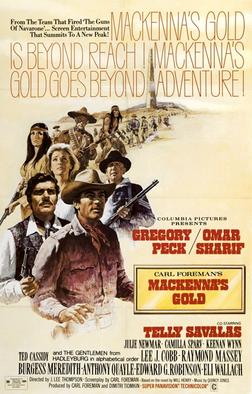
Oh, cable, how I love you. I basically have two channels on if I'm watching TV, either MLB Network or Encore Westerns. A whole channel devoted to western TV shows and movies?!? Aaahhh my head just exploded! It gives me a chance to revisit a whole bunch of movies I haven't seen in years, like 1969's Mackenna's Gold, a big-budget, all-star extravaganza that I remember liking (I think) on my first viewing. Does it hold up?
A marshal for the western town of Hadleyburg, Mackenna (Gregory Peck) is out on the trail when he's ambushed by an old Apache man who dies after a quick shootout. Before he dies, the Apache gives Mackenna a map to a famous, supposedly lost, canyon of gold ('Canon del Oro') that treasure hunters have long sought. Mackenna throws the map in the fire but not before noticing a couple landmarks on it. He's soon cornered by a Mexican bandit, Colorado (Omar Sharif), and his gang who similarly are looking for the canyon of gold. They're not alone. The desert seems full of treasure hunters and gold-hopefuls desperately searching for the gold. Discovering that Mackenna may hold the key to finding the canyon, he's taken along as Colorado's unwilling prisoner. The supposed location is days away across the vast desert with Mackenna, Colorado and his men forced to deal with a do-good posse out of Hadleyburg, an intervening cavalry troop and an Apache war party. How far will the prospect of gold drive all these folks?
I'm a sucker for westerns -- good and bad -- but this one is bad and just not that enjoyable. Talk about a movie where the ingredients don't come together (at all), and you've got this movie. The talent on-hand is unquestionable from director J. Lee Thompson, stars Gregory Peck and Omar Sharif leading a ridiculously deep cast, a cool, potential-filled story and a drop-dead look to it all...it should have been so much better. Or I guess I'd settle for just 'good' too. The formula seems to go after a western Guns of Navarone meets Treasure of the Sierra Madre combination, but it never jells into anything remotely coherent or especially enjoyable. That's tough to say because a cast this good should make a movie pretty decent on its own but alas, it wasn't meant to be this time! If you're looking for a Peck-Thompson-Carl Foreman pairing, stick with 'Navarone.'
Kudos to Encore Westerns. Watching the movie for the second time but first time since 2009, I watched it in widescreen, as it was meant to be. Thompson filmed in Super Panavision 70, a filming technique that fills the screen to epic proportions, almost like a panoramic picture. Shooting on-location in Monument Valley, Glen Canyon and Canyon de Chelly in Arizona adds a great visual appeal to the movie. Shots of riders galloping across these expanses are excellent to watch, a sight to behold, and unfortunately, one of the few genuine positives to take away from a western that's too long at 128 minutes. When a movie's looks are the best thing going...that's never a good thing.
Poor Gregory Peck, he looks like he's as bored as all get-out and doesn't quite know what to do. One of my all-time favorite actors, he's undone by all the shenanigans going on around him. Getting to play straight man to a murdering bandit, a gold-for-eyes posse, a bloodthirsty Apache war party, a murdering cavalry sergeant (an underused Telly Savalas), and all sorts of ancient legends coming to life is never a good thing. As reliable as anyone who's ever graced the screen, Peck is given little more to do than look out for Camilla Sparv's damsel in distress while navigating a love triangle with Julie Newmar's Apache warrior and Sparv. Yeah, you read that right. Catwoman plays an Apache warrior and looks great doing it! She even gets an odd nude swimming scene where she tries to kill both Peck and Sparv. So there's that!
So much of the rest of the cast is simply miscast. I like Sharif in just about any film he's ever done, but he's an odd choice to play our Mexican bandit, Colorado. His gang includes Keenan Wynn as a Mexican bandit named Sanchez, with Ted Cassidy (Lurch from The Addams Family), Rudy Diaz and Robert Phillips as Apache warriors. All spot-on casting! Brace for this list of appearances that amount to little more than cameos, members of a "posse" out of Hadleyburg that's looking for gold. The group includes Eli Wallach, Anthony Quayle, Lee J. Cobb, Burgess Meredith, Raymond Massey and Edward G. Robinson!!! Look at that Hollywood royalty! Unfortunately, they're introduced, given nothing to do and there basically because of their name recognition. So....yeah....there's that! Quite the cast, huh? I just wish they were given more to do. Maybe that character development was cut from the rumored 3-hour version of the film. Yeah, that's it I'm sure.
Just too many moving pieces that never get going in the same direction. There's virtually no story, just some character introductions and then they're off into the desert. The only detour are various ways to kill off characters in waves. Then, there's the beautiful location shooting, with a slight problem. Countless times, one after another, we see the location shots and then a quick cut to our actors in front of a rear projection shot. Nothing takes you out of the story's momentum like Peck, Sharif and Co. riding a "horse" as they tear across the desert. Throw in some odd, out of place narration (it's not Victor Jory's fault!), some painful theme ballads, and generally odd cutting and editing that is more and more jarring with each passing scene.
There's a meanness to the story that's hard to account for. Characters are introduced for the sake of dispatching them in unceremonious fashion, but the general tone of the movie itself isn't that dark. It feels like they're going for that "Greed will make you do horrible things" tone, but it's too light, fluffy and goofy to pull it off. There's some potential obviously with the all-star cast, some equally impressive camera angles and shots, and the location shooting, but there's just too much negative going on to ignore it. A stinker.
Mackenna's Gold (1969): **/****
The Sons of Katie Elder
"First, we reunite, then find Ma and Pa's killer...then read some reviews."
Showing posts with label Edward G. Robinson. Show all posts
Wednesday, December 30, 2015
Sunday, July 7, 2013
Double Indemnity
In 1944, director Billy Wilder was a young, up and coming filmmaker with just three films to his name. The film noir genre was in its infancy too, a film popping up here and there that introduce audiences to things that would later become commonplace within the genre. With one fell swoop, Wilder put his name on the map in a big way and helped blow up the film noir in a huge way (that's a positive). The film? A classic, 1944's Double Indemnity.
An experienced and successful insurance salesman with 11 years under his belt, Walter Neff (Fred MacMurray) is very good at what he does, able to sell policies to people who didn't even want insurance. On one house visit where he's looking to re-up on an auto policy, Walter meets Phyllis Dietrichson (Barbara Stanwyck), a young woman who's married but it's far from a happy marriage. He is magnetically drawn to her and can't stop thinking about her. Getting to know her better, Walter finds out about Phyllis and her background with her husband (Tom Powers). Moral of the story? Phyllis wants out, and Walter is going to help. He intends to get her husband to unknowingly sign a life insurance policy and then kill him. A longtime salesman, he's got a perfect plan to pull it off and have him and Phyllis split the $100,000 payout. Could it actually work?
One of the great films from Hollywood's Golden Era (and Hollywood history in general), 'Indemnity' is one of those movies I just never sought out even though I knew its reputation. It was worth the wait. Watching it on a first viewing, it seems familiar -- if in a good way. Why? Because hundreds of movies have tried to duplicate its success in the 60-plus years since its release. The duped male anti-hero, the brutal femme fatale, the characters in general who are interested in me-first, everyone else....well, never. The entire genre in general was ahead of its time, but this was one of the first examples, and it definitely deserves its classic status.
Based off a 'ripped from the headlines' story, the script from director Wilder and another halfway decent writer, Raymond Chandler, is like much of the movie, far ahead of its time. In its incredible darkness, honest depiction of just how nasty people can be with money on the line, it feels like a movie that would have been right at home in the equally dark/sinister late 1960s and 1970s. The script lays it all out there, setting it up and letting Walter's predicament get the best of...well, everyone. The dialogue seems a little stilted at times, but it's sharp and quick and well-written for the most part (obviously delivered pretty well too).
The cast doesn't call for too many key roles, but on a bigger level, it doesn't need more characters. MacMurray and Stanwyck are perfectly cast, playing off each other so well. In past reviews, I've mentioned my troubles with watching MacMurray in darker roles because I'm used to him as the star of My 3 Sons or any number of Disney movies, but there's a sinister charm that works nicely here. Stanwyck is the equally sinister femme fatale, like a snake waiting to strike. A match made in movie heaven (eh, maybe hell. We know this won't end well). In a scene-stealing part, Edward G. Robinson is Keyes, the inspector at the insurance company tasked with seeking out payouts that aren't on the level. Robinson expressed some concern at the time that he was taking a supporting part, but he needn't have been worried.
The development of Walter's plan is what sets this movie apart from the rest. Wilder and Chandler's script develops flawlessly, the tension building and building with each passing scene. The actual execution of the plan (oh, watch out, murder!) is tough to watch. We're clearly not rooting for them to succeed and murder someone, but at the same time, it's almost unbearable to watch because at the same time, you don't want them to get caught. It's the fallout afterward that is even tougher to watch. Wilder uses another ahead of its time technique, revealing in the opening scene courtesy of Neff that the plan will not succeed. That could be a dealbreaker for a lesser movie. We basically know the ending a minute into the movie, but it adds an interesting layer to the film. Okay, it's not going to work. How then is it going to crumble?
A classic movie from Hollywood's Golden Era for a reason. This would start Wilder on a ridiculously successful path that would help elevate him to one of Hollywood's all-time great directors. The style, the characters, the dark story and script, the score from composer Miklos Rozsa, it all works well, like puzzle pieces fitting together. Any movie that has influenced so many other films in the years following its release is/was clearly doing something right. Too bad I took so long catching up with it, but it is the rare film that was worth the wait.
Double Indemnity (1944): *** 1/2 /****
An experienced and successful insurance salesman with 11 years under his belt, Walter Neff (Fred MacMurray) is very good at what he does, able to sell policies to people who didn't even want insurance. On one house visit where he's looking to re-up on an auto policy, Walter meets Phyllis Dietrichson (Barbara Stanwyck), a young woman who's married but it's far from a happy marriage. He is magnetically drawn to her and can't stop thinking about her. Getting to know her better, Walter finds out about Phyllis and her background with her husband (Tom Powers). Moral of the story? Phyllis wants out, and Walter is going to help. He intends to get her husband to unknowingly sign a life insurance policy and then kill him. A longtime salesman, he's got a perfect plan to pull it off and have him and Phyllis split the $100,000 payout. Could it actually work?
One of the great films from Hollywood's Golden Era (and Hollywood history in general), 'Indemnity' is one of those movies I just never sought out even though I knew its reputation. It was worth the wait. Watching it on a first viewing, it seems familiar -- if in a good way. Why? Because hundreds of movies have tried to duplicate its success in the 60-plus years since its release. The duped male anti-hero, the brutal femme fatale, the characters in general who are interested in me-first, everyone else....well, never. The entire genre in general was ahead of its time, but this was one of the first examples, and it definitely deserves its classic status.
Based off a 'ripped from the headlines' story, the script from director Wilder and another halfway decent writer, Raymond Chandler, is like much of the movie, far ahead of its time. In its incredible darkness, honest depiction of just how nasty people can be with money on the line, it feels like a movie that would have been right at home in the equally dark/sinister late 1960s and 1970s. The script lays it all out there, setting it up and letting Walter's predicament get the best of...well, everyone. The dialogue seems a little stilted at times, but it's sharp and quick and well-written for the most part (obviously delivered pretty well too).
The cast doesn't call for too many key roles, but on a bigger level, it doesn't need more characters. MacMurray and Stanwyck are perfectly cast, playing off each other so well. In past reviews, I've mentioned my troubles with watching MacMurray in darker roles because I'm used to him as the star of My 3 Sons or any number of Disney movies, but there's a sinister charm that works nicely here. Stanwyck is the equally sinister femme fatale, like a snake waiting to strike. A match made in movie heaven (eh, maybe hell. We know this won't end well). In a scene-stealing part, Edward G. Robinson is Keyes, the inspector at the insurance company tasked with seeking out payouts that aren't on the level. Robinson expressed some concern at the time that he was taking a supporting part, but he needn't have been worried.
The development of Walter's plan is what sets this movie apart from the rest. Wilder and Chandler's script develops flawlessly, the tension building and building with each passing scene. The actual execution of the plan (oh, watch out, murder!) is tough to watch. We're clearly not rooting for them to succeed and murder someone, but at the same time, it's almost unbearable to watch because at the same time, you don't want them to get caught. It's the fallout afterward that is even tougher to watch. Wilder uses another ahead of its time technique, revealing in the opening scene courtesy of Neff that the plan will not succeed. That could be a dealbreaker for a lesser movie. We basically know the ending a minute into the movie, but it adds an interesting layer to the film. Okay, it's not going to work. How then is it going to crumble?
A classic movie from Hollywood's Golden Era for a reason. This would start Wilder on a ridiculously successful path that would help elevate him to one of Hollywood's all-time great directors. The style, the characters, the dark story and script, the score from composer Miklos Rozsa, it all works well, like puzzle pieces fitting together. Any movie that has influenced so many other films in the years following its release is/was clearly doing something right. Too bad I took so long catching up with it, but it is the rare film that was worth the wait.
Double Indemnity (1944): *** 1/2 /****
Friday, December 21, 2012
The Violent Men
A western doesn't have to be done on a huge scale to be a true epic. Sometimes the beauty of an epic western is that it's done on a more personal scale, like 1955's The Violent Men. Echoing characters, relationships, betrayals and backstabbings that Greek mythology and William Shakespeare would have been proud of, this is an underrated gem.
Having been severely wounded during the Civil War, John Parrish (Glenn Ford) moves west and starts up a successful ranch as his wounds heal. It takes some three years, but he's healthy again and intends to sell the ranch and move back East with his fiance, Caroline (May Wynn). Against his better judgment, Parrish is going to sell the ranch to Lee Wilkison (Edward G. Robinson), the crippled owner of the Anchor ranch, the biggest cattle ranch in the territory. In an effort to buy up the whole valley, Wilkison and his wife, Martha (Barbara Stanwyck), try to low-ball Parrish. Making matters worse, they try to strong-arm him, killing one of his ranch hands. Quite content to take the low offer prior to the killing, Parrish has had enough. Outnumbered by Wilkison's small army of gunhands, Parrish -- a former cavalry officer -- goes on the offensive.
Though I've long been aware of this 1955 western from director Rudolph Mate, I never actively sought it out. For whatever reason, I looked it up on Netflix recently and seeing a very impressive cast, I gave it a shot. I'm glad I did. Partially because of its relatively short run-time at just 95 minutes, it isn't remembered as a classic, and I suppose it isn't. What it is is an above average, well-told, exciting adult western that doesn't settle for a status quo in a typical sense. It was filmed in the Alabama Hills in California (along with some location shooting in Old Tucson) and definitely has the look, if not the feel, of a much larger scaled, epic western. I also liked composer Max Steiner's score, sounding somewhat like a Dimitri Tiomkin score. Whatever it reminded me of, I liked it.
While there are very clearly good guys -- Ford's Parrish obviously -- and very clearly bad guys -- Robinson, Stanwyck and more -- this Mate-directed western is far from your typical good guys in white hats shooting it out with bad guys in black hats type of western. Comparing any western to Greek mythology or a Shakespearean play is opening the door for all sorts of criticism, but it's all deserved here. Ford's Parrish is the unquestioned hero while Robinson's Wilkison is the crippled, aging ranch owner. That would be a one-on-one showdown worth the price of admission, but that's the start. Robinson's brother, Cole (Brian Keith), is also having an affair with Martha, who wants nothing more than to own the valley, not really caring which man she's with to get there. Filling out the family tree is Judith (Dianne Foster), Lee and Martha's daughter, who knows exactly what's going on but doesn't know where to start or who to help. As a bonus, Wynn's fiance is also a cold-hearted you know what. Lots of betrayal, backroom deals and back-stabbings around every corner, and everyone is looking out for themselves.
With a cast this good, I probably would have gotten some enjoyment out of the story even if it was a dud. Watching this much talent on-screen can be fun in itself. On the positive though, the cast does a solid job from top to bottom here. The more I see Ford, the more I like him. His Parrish is a great hero, but one with a mean streak as needed. Robinson, Stanwyck and Keith are the three heads of one bad snake, all working against and with each other at the same time. It's only a matter of time before they start attacking each other. Foster is good too as the maligned Judith while Wynn is your pretty typical evil woman looking out for herself. Richard Jaeckel is all duded up as Wade Matlock, the Wilkison's top hired gun. His scenes with Ford are worth it to track the movie down on its own. Also look for Warner Anderson, Basil Ruysdael, Willis Bouchey, Jack Kelly and William Phipps in key supporting parts.
After a somewhat slow start as all the characters are introduced, the story picks up the Wilkisons try to strong-arm Parrish into selling his ranch. He puts his military background into effect, unleashing his own kind of strategic offensive on the better equipped, better outfitted Anchor ranch riders. The action picks up including a classic showdown between Ford and Jaeckel, a night ambush in a rocky canyon, and one form of guerrilla warfare after another. Not a lot of analysis needed for this one. It's a western that mixes elements of a good old-fashioned shoot 'em up with other more adult-themed elements. Well worth checking out.
The Violent Men (1955): ***/****
Having been severely wounded during the Civil War, John Parrish (Glenn Ford) moves west and starts up a successful ranch as his wounds heal. It takes some three years, but he's healthy again and intends to sell the ranch and move back East with his fiance, Caroline (May Wynn). Against his better judgment, Parrish is going to sell the ranch to Lee Wilkison (Edward G. Robinson), the crippled owner of the Anchor ranch, the biggest cattle ranch in the territory. In an effort to buy up the whole valley, Wilkison and his wife, Martha (Barbara Stanwyck), try to low-ball Parrish. Making matters worse, they try to strong-arm him, killing one of his ranch hands. Quite content to take the low offer prior to the killing, Parrish has had enough. Outnumbered by Wilkison's small army of gunhands, Parrish -- a former cavalry officer -- goes on the offensive.
Though I've long been aware of this 1955 western from director Rudolph Mate, I never actively sought it out. For whatever reason, I looked it up on Netflix recently and seeing a very impressive cast, I gave it a shot. I'm glad I did. Partially because of its relatively short run-time at just 95 minutes, it isn't remembered as a classic, and I suppose it isn't. What it is is an above average, well-told, exciting adult western that doesn't settle for a status quo in a typical sense. It was filmed in the Alabama Hills in California (along with some location shooting in Old Tucson) and definitely has the look, if not the feel, of a much larger scaled, epic western. I also liked composer Max Steiner's score, sounding somewhat like a Dimitri Tiomkin score. Whatever it reminded me of, I liked it.
While there are very clearly good guys -- Ford's Parrish obviously -- and very clearly bad guys -- Robinson, Stanwyck and more -- this Mate-directed western is far from your typical good guys in white hats shooting it out with bad guys in black hats type of western. Comparing any western to Greek mythology or a Shakespearean play is opening the door for all sorts of criticism, but it's all deserved here. Ford's Parrish is the unquestioned hero while Robinson's Wilkison is the crippled, aging ranch owner. That would be a one-on-one showdown worth the price of admission, but that's the start. Robinson's brother, Cole (Brian Keith), is also having an affair with Martha, who wants nothing more than to own the valley, not really caring which man she's with to get there. Filling out the family tree is Judith (Dianne Foster), Lee and Martha's daughter, who knows exactly what's going on but doesn't know where to start or who to help. As a bonus, Wynn's fiance is also a cold-hearted you know what. Lots of betrayal, backroom deals and back-stabbings around every corner, and everyone is looking out for themselves.
With a cast this good, I probably would have gotten some enjoyment out of the story even if it was a dud. Watching this much talent on-screen can be fun in itself. On the positive though, the cast does a solid job from top to bottom here. The more I see Ford, the more I like him. His Parrish is a great hero, but one with a mean streak as needed. Robinson, Stanwyck and Keith are the three heads of one bad snake, all working against and with each other at the same time. It's only a matter of time before they start attacking each other. Foster is good too as the maligned Judith while Wynn is your pretty typical evil woman looking out for herself. Richard Jaeckel is all duded up as Wade Matlock, the Wilkison's top hired gun. His scenes with Ford are worth it to track the movie down on its own. Also look for Warner Anderson, Basil Ruysdael, Willis Bouchey, Jack Kelly and William Phipps in key supporting parts.
After a somewhat slow start as all the characters are introduced, the story picks up the Wilkisons try to strong-arm Parrish into selling his ranch. He puts his military background into effect, unleashing his own kind of strategic offensive on the better equipped, better outfitted Anchor ranch riders. The action picks up including a classic showdown between Ford and Jaeckel, a night ambush in a rocky canyon, and one form of guerrilla warfare after another. Not a lot of analysis needed for this one. It's a western that mixes elements of a good old-fashioned shoot 'em up with other more adult-themed elements. Well worth checking out.
The Violent Men (1955): ***/****
Thursday, March 10, 2011
Seven Thieves
The key of course is to bring something new to the table, anything at all. A twist you didn't see coming, a character that keeps everyone around them suspicious to their motives. We're not talking rewriting the formula here, just tweaking it to something a little different, a little more exciting. So now in 2011, the movies have had their chance to expand on the formula. But in 1960, it was still something new when bad guys and crooks were allowed to be the main characters far more often than during Hollywood's Golden Era. Unfortunately for 1960's Seven Thieves, every cliche, every stereotype, every genre convention is used in this often dull, disappointing heist flick.
Visiting the French Riviera, discredited American professor Theo Wilkins (Edward G. Robinson) sends for a friend from his past to come visit him. Paul Mason (Rod Steiger) obliges his old friend, visiting Theo in Monte Carlo and Cannes. The aged professor has a plan for the convict just recently released from a 3-year prison sentence, one that could likely land him back in prison. Theo has assembled a small team to pull of a dangerous heist in the Monte Carlo Casino, but he trusts none of them and needs help from Paul in leading and organizing the job, all the little details that so many others would forget about. Wary of actually being able to pull off the job, Paul agrees almost exclusively as a favor to his old friend, and starts working on how exactly how to put it all together, a huge lump sum of money waiting at the end.
Movies slip through the cracks over the years, and even with the impressive cast here, Seven Thieves couldn't avoid that fate. Generally forgotten, the cast is still worth mentioning and was the main reason I stumbled across it on Netflix. Steiger is always watchable in a weird, eccentric way, and Robinson is a consummate pro no matter the depth of the project he's working on. Joining his team are Joan Collins as Melanie, a dancer/stripper in a cheap Cannes club, Eli Wallach as Pancho, Melanie's protective guardian, Alexander Scourby as Raymond, the inside man at the casino, Michael Dante as Louis, all-around ladies man and safecracker, and Berry Kroeger as Hugo, the strong man and unpredictable muscle.
Robinson assembles this team, but something feels like it was missing in the process. For one, their parts in the actual heist seem sketchy at best. Other than wearing slinky outfits and generally being sexy (watch her "scandalous" dance scene HERE), Collins' main role in the job is to open a window. Wallach's Pancho has no real use other than pretending to be a Baron which he ends up failing at. Scourby looks nervous, Dante struggles with heights, and Kroeger is capable of who knows what. Something doesn't add up with director Henry Hathaway not hitting the right notes at all with this team of specialists.
I guess my biggest problem here is that the movie is just plain dull. There's no sense of urgency, no feeling of danger. The crew is never really dealing with the threat of being captured. The job itself is criminally simple compared relative to the security they're facing. Are there no guards in this casino at all? More than that, this is a visually dull movie. Hathaway films in black and white, giving it a romantic, throwback feel to the story. But that's it. The cast clearly never went to France (Monte Carlo or Cannes), instead relying on long establishing shots that zoom in to green-screen shots of the actual cast "enjoying" beautiful France. Hathaway's filming style isn't so much a style either with the veteran director simply placing his camera in front of the cast and letting them go to work. I'm all for a build-up of tension, but there's nothing here. Just long, uninterrupted shots of the cast talking.
A saving grace for even the crappiest of heist movies can be what everyone wants to see...the actual heist. Compared to the rest of the movie, 'Seven''s heist is nothing special, too simplistic, just too easy after all the build-up about how difficult the job will be. The Ocean's 11 remake channels it in a way, improving on it by leaps and bounds. A bad heist is one thing, but Hathaway drops the ball in the finale. Wallach's Pancho is supposed to take a pill that will knock him out, mimicking death. He falters, Robinson injects him, and then pockets the still-pristine pill. SPOILERS STOP READING SPOILERS Robinson actually dies of a heart attack, and I'm thinking "Oh, here we go, big twist." He took the pill, faked his death and will now steal away with the winnings. Yeah, I wish. There's no twist, and Seven Thieves features one of the stupidest endings I can think of in a story/movie of this nature. It limps to the finish, content to go back into the forgotten closet of movies that could have been so much better.
Seven Thieves <---trailer (1960): **/****
Sunday, February 20, 2011
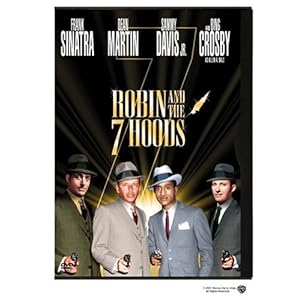
Robin and the 7 Hoods
In the early 1960s, the unquestioned kings of cool were the Rat Pack. NO ONE was cooler than this group of singers, actors, entertainers, performers, whatever you want to call them. Frank Sinatra, Dean Martin, Sammy Davis Jr., Peter Lawford, and Joey Bishop were to quote Bill Curtis in 'Anchorman'...."the balls." They oozed suaveness and style and pulled it off effortlessly because they just were cool. They didn't need to try to be cool. The Rat Pack toured, they put shows on in New York, Las Vegas and around the world, and expanding into all markets, guest starred on TV shows and thankfully (in my mind at least) ventured into movies too.
The movies range from good to bad, the high point being the original Ocean's 11 while others like 4 For Texas, Sergeants 3, and a few others that aren't really official Rat Pack movies but feature much or some of the group anyways, like 1959's Never So Few. These were not movies intended to sweep the awards season. These were just fun movies that were perfect flicks to watch with a big bowl of popcorn where you could sit back and shut your brain off for a couple hours and be entertained. It was Frank and his crew being themselves, shooting it out, wooing some ladies, and generally doing some boozing and partying. The one I'd never seen before was 1964's Robin and the 7 Hoods. A twist on the well-known Robin Hood story sounded appealing with Robin being transported to 1920s Prohibition gangster-filled Chicago. How could you go wrong? Make it a musical.
A well-known Chicago gangster, Big Jim (an uncredited Edward G. Robinson), is knocked off by all the Chicago mafiosos at a birthday party hosted in his honor. The power in the city is up for grabs with one gangster, Guy Gisborne (Peter Falk), swooping in and taking things over. He develops a plan with the crooked cops that not everyone agrees with, especially a gangster from the Northside of the city, Robbo (Sinatra). Robbo has no interest in pooling his interests and starts to prepare for facing the wrath of the organized gangsters. With his own crew, including transplanted Indiana gangster Little John (Martin), sharp-shooting Will (Davis Jr.) and Alan A. Dale (Bing Crosby), Robbo accidentally donates a large sum of money to charity, earning the trust and favor of Chicago. It's not so easy though because Guy is still working with Big Jim's power-hungry daughter (Barbara Rush) who has her eyes set on her recently passed father's death.
My one defense going into this Gordon Douglas directed flick was that I really didn't know going in that it was a musical. The other Rat Pack movies were more about the cool factor, the heists, the shootouts, the partying, the camaraderie, the inside jokes, and all those things are present here. A story about rival almost warring 1920s Chicago gangsters is almost impossible to mess up on entertainment value alone. But the story's flowing along, things are being put into motion and WHAM! Frankie, Deano, Bing, and Sammy start singing. It's not that the songs are bad, anything but with the immense talents involved, it's that there are songs at all. This is a story that would have worked just fine as a Rat Pack takes on 1920s Chicago story.
So what carries the movie in between the detours for some singing is what else? That cast. Call Sinatra a one-note actor, but he did that one-note perfectly. He's not the typical leading man, relying more on humor and even at times a dark cynicism to play his part. It's Sinatra though, and he's cooler than you. Get used to it. Dean Martin is my favorite member of the Rat Pack, and he's the ideal second banana to Sinatra. Davis Jr. shines in a supporting role as Will, and Crosby is a high point as Will A. Dale. Falk was never bad, especially in parts like this that let him ham it up in every scene. As the conniving daughter, Rush is generally wasted playing a character that could have been completely removed from the movie for the better. Victor Buono and Robert Foulk are also good as Chicago police officials with their hooks in the mob.
With all these different elements working together and against each other (depending on the scene), the movie struggles to find any sort of rhythm. With just the natural comedic chemistry this cast has together, you're going to get some laughs almost by accident or default. That's not fair though because there are some genuinely funny lines, and a few running gags that produce genuine laughs. But the laughs come few and far between for the most part, the scenes in between dragging along at a snail's pace. Even fast forwarding through some of the lengthier musical numbers, the 123-minute running time felt more like three or four hours. Stepping in as a film editor, I'd take out the music, add some more humor, a little more gunplay, and you've got a winner. If only, if only.
Boring at times, highly entertaining at others, there is just too much talent involved in this Rat Pack production not to give it a mild recommendation. Even at their worse, Frank, Dean and Co. were very likable with an on-screen presence that few other actors/performers have ever shown. They all have an easygoing way about them that gives the impression of watching a group of friends hanging around shooting the shit. If nothing else -- and this might not mean as much to a non-Chicagoan -- Sinatra sings 'My Kind of Town.' It's hard to mess that up.
Robin and the 7 Hoods <---trailer (1962): ** 1/2 /****
The movies range from good to bad, the high point being the original Ocean's 11 while others like 4 For Texas, Sergeants 3, and a few others that aren't really official Rat Pack movies but feature much or some of the group anyways, like 1959's Never So Few. These were not movies intended to sweep the awards season. These were just fun movies that were perfect flicks to watch with a big bowl of popcorn where you could sit back and shut your brain off for a couple hours and be entertained. It was Frank and his crew being themselves, shooting it out, wooing some ladies, and generally doing some boozing and partying. The one I'd never seen before was 1964's Robin and the 7 Hoods. A twist on the well-known Robin Hood story sounded appealing with Robin being transported to 1920s Prohibition gangster-filled Chicago. How could you go wrong? Make it a musical.
A well-known Chicago gangster, Big Jim (an uncredited Edward G. Robinson), is knocked off by all the Chicago mafiosos at a birthday party hosted in his honor. The power in the city is up for grabs with one gangster, Guy Gisborne (Peter Falk), swooping in and taking things over. He develops a plan with the crooked cops that not everyone agrees with, especially a gangster from the Northside of the city, Robbo (Sinatra). Robbo has no interest in pooling his interests and starts to prepare for facing the wrath of the organized gangsters. With his own crew, including transplanted Indiana gangster Little John (Martin), sharp-shooting Will (Davis Jr.) and Alan A. Dale (Bing Crosby), Robbo accidentally donates a large sum of money to charity, earning the trust and favor of Chicago. It's not so easy though because Guy is still working with Big Jim's power-hungry daughter (Barbara Rush) who has her eyes set on her recently passed father's death.
My one defense going into this Gordon Douglas directed flick was that I really didn't know going in that it was a musical. The other Rat Pack movies were more about the cool factor, the heists, the shootouts, the partying, the camaraderie, the inside jokes, and all those things are present here. A story about rival almost warring 1920s Chicago gangsters is almost impossible to mess up on entertainment value alone. But the story's flowing along, things are being put into motion and WHAM! Frankie, Deano, Bing, and Sammy start singing. It's not that the songs are bad, anything but with the immense talents involved, it's that there are songs at all. This is a story that would have worked just fine as a Rat Pack takes on 1920s Chicago story.
So what carries the movie in between the detours for some singing is what else? That cast. Call Sinatra a one-note actor, but he did that one-note perfectly. He's not the typical leading man, relying more on humor and even at times a dark cynicism to play his part. It's Sinatra though, and he's cooler than you. Get used to it. Dean Martin is my favorite member of the Rat Pack, and he's the ideal second banana to Sinatra. Davis Jr. shines in a supporting role as Will, and Crosby is a high point as Will A. Dale. Falk was never bad, especially in parts like this that let him ham it up in every scene. As the conniving daughter, Rush is generally wasted playing a character that could have been completely removed from the movie for the better. Victor Buono and Robert Foulk are also good as Chicago police officials with their hooks in the mob.
With all these different elements working together and against each other (depending on the scene), the movie struggles to find any sort of rhythm. With just the natural comedic chemistry this cast has together, you're going to get some laughs almost by accident or default. That's not fair though because there are some genuinely funny lines, and a few running gags that produce genuine laughs. But the laughs come few and far between for the most part, the scenes in between dragging along at a snail's pace. Even fast forwarding through some of the lengthier musical numbers, the 123-minute running time felt more like three or four hours. Stepping in as a film editor, I'd take out the music, add some more humor, a little more gunplay, and you've got a winner. If only, if only.
Boring at times, highly entertaining at others, there is just too much talent involved in this Rat Pack production not to give it a mild recommendation. Even at their worse, Frank, Dean and Co. were very likable with an on-screen presence that few other actors/performers have ever shown. They all have an easygoing way about them that gives the impression of watching a group of friends hanging around shooting the shit. If nothing else -- and this might not mean as much to a non-Chicagoan -- Sinatra sings 'My Kind of Town.' It's hard to mess that up.
Robin and the 7 Hoods <---trailer (1962): ** 1/2 /****
Saturday, January 22, 2011
The Sea Wolf
Based on the real life incident, the mutiny on the H.M.S. Bounty has been a ripe picking ground for movies over the years with a handful of flicks released over the years. It's a solid story of how horrifically bad living on the sea was as a sailor in the 1700s. At a certain point though, all other mutinies at sea feel like they're borrowing liberally from any of the Bounty stories. You start seeing repeats and do-overs, the evil, despicable captain and the crew pushed to its limits. That's why 1941's The Sea Wolf never amounts to anything better than a decent story, we've seen it before and will see it again.
Starting a movie based off a novel by famed novelist Jack London is usually about as solid a footing as a studio can pick. I grew up reading Call of the Wild and White Fang and loved them, but I'll admit I've never read London's The Sea Wolf, one of over 20-plus novels he wrote in his short career. Not having read the book, I can't fairly compare the novel to the movie, but with a little Wikipedia investigating it didn't take long to find out how much was changed from one medium to the next. Hollywood studios at work turning a solid, respected story into a dumbed down version that they believe audiences will love. Nice work all around.
In 1900 in the Pacific Ocean, there is one ship -- named The Ghost -- that no sailor willingly wants to work on. The ship's captain, Wolf Larsen (Edward G. Robinson), is a rabid tyrant, treating his men cruelly with little regard for anything but their job at hand, hunting seal. But on this trip, Larsen doesn't have a particular objective, he's running from something. On board are three new passengers including George Leach (John Garfield), a man similarly hiding from his past, and two passengers rescued at sea following a collision, Ruth Webster (Ida Lupino), an escaped convict from a women's prison, and Humphrey Van Weyden (Alexander Knox), a writer. All three want off the ship for one reason or another, but Larsen has no intention of changing his plans for everyone else regardless of the cost.
I will say before I rip into the movie that I liked the style of the film overall with director Michael Curtiz turning in a typically polished finished product. 'Wolf' plays like a film noir on the high seas where each character is flawed from their past and are thrown together to piece everything into place. There are no real good guys -- although Knox's Van Weyden is pretty close -- and everyone else is in shades of gray. For a movie from Warner Bros. in the early 1940s, it has a dark, shadowy look that ends up playing well because the Ghost is clearly a stage, a set built. No real-life adventures on the high seas here, too pricey. Money was spent on the film though, and it's enjoyable enough to watch.
Molding London's novel though from a book to a movie, some major changes were made, and even I didn't need to look this one up. As a writer, London doesn't seem the type to waste a lot of pages developing a hackneyed relationship between two characters who fall madly in love with each other almost at first glance. It's just not his style if you ask me. Well, the studios thought that would be a good route to take with the story. Lupino and Garfield were some of the best and most recognizable stars from the 1940s with talent to spare, but they're wasted here. Neither character was even in the book so the script adds them to apparently bring in a wider audience. Instead, this "relationship" falls flat and drags the movie downhill quickly.
Where the movie gets it right working off of London's novel was the odd bond that develops between Robinson's Wolf Larsen -- a smaller Capt. Bligh with more of a cruel streak -- and Knox's Van Weyden. As individual characters, you feel you actually get to know them through this high seas cruise. Robinson plays Larsen as a ball of contradictions, one second an intelligent, rational individual and the next, a raving lunatic pitting his men against each other. Knox makes Humphrey the most sympathetic character, a man forcefully enlisted to work with the crew even though he knows nothing of being a sailor. His writing talents come out, and when Larsen finds out about his honest analysis of this captain, he's not angry or disappointed. Maybe it's his pride, his ego, but he's intrigued and encourages Van Weyden to continue writing.
Too bad more of the movie couldn't have been devoted to that portion of the story. Robinson has that intensity in his parts that so few actors can pull off and not make it feel forced. His performance carries the movie as he drips with anger and even a little lunacy. Knox in the quieter part doesn't get lost along the way, managing to keep up with Robinson. Other strong supporting parts include Gene Lockhart as Dr. Louie, a drunk doctor who yearns for his glory days of the past, and Barry Fitzgerald playing against type in a particularly nasty part as Cookie, the ship's cook and an informant for Larsen about the goings on with the crew. The movie is all right overall, but it could have been better.
The Sea Wolf <---trailer (1941): ** 1/2 /****
Starting a movie based off a novel by famed novelist Jack London is usually about as solid a footing as a studio can pick. I grew up reading Call of the Wild and White Fang and loved them, but I'll admit I've never read London's The Sea Wolf, one of over 20-plus novels he wrote in his short career. Not having read the book, I can't fairly compare the novel to the movie, but with a little Wikipedia investigating it didn't take long to find out how much was changed from one medium to the next. Hollywood studios at work turning a solid, respected story into a dumbed down version that they believe audiences will love. Nice work all around.
In 1900 in the Pacific Ocean, there is one ship -- named The Ghost -- that no sailor willingly wants to work on. The ship's captain, Wolf Larsen (Edward G. Robinson), is a rabid tyrant, treating his men cruelly with little regard for anything but their job at hand, hunting seal. But on this trip, Larsen doesn't have a particular objective, he's running from something. On board are three new passengers including George Leach (John Garfield), a man similarly hiding from his past, and two passengers rescued at sea following a collision, Ruth Webster (Ida Lupino), an escaped convict from a women's prison, and Humphrey Van Weyden (Alexander Knox), a writer. All three want off the ship for one reason or another, but Larsen has no intention of changing his plans for everyone else regardless of the cost.
I will say before I rip into the movie that I liked the style of the film overall with director Michael Curtiz turning in a typically polished finished product. 'Wolf' plays like a film noir on the high seas where each character is flawed from their past and are thrown together to piece everything into place. There are no real good guys -- although Knox's Van Weyden is pretty close -- and everyone else is in shades of gray. For a movie from Warner Bros. in the early 1940s, it has a dark, shadowy look that ends up playing well because the Ghost is clearly a stage, a set built. No real-life adventures on the high seas here, too pricey. Money was spent on the film though, and it's enjoyable enough to watch.
Molding London's novel though from a book to a movie, some major changes were made, and even I didn't need to look this one up. As a writer, London doesn't seem the type to waste a lot of pages developing a hackneyed relationship between two characters who fall madly in love with each other almost at first glance. It's just not his style if you ask me. Well, the studios thought that would be a good route to take with the story. Lupino and Garfield were some of the best and most recognizable stars from the 1940s with talent to spare, but they're wasted here. Neither character was even in the book so the script adds them to apparently bring in a wider audience. Instead, this "relationship" falls flat and drags the movie downhill quickly.
Where the movie gets it right working off of London's novel was the odd bond that develops between Robinson's Wolf Larsen -- a smaller Capt. Bligh with more of a cruel streak -- and Knox's Van Weyden. As individual characters, you feel you actually get to know them through this high seas cruise. Robinson plays Larsen as a ball of contradictions, one second an intelligent, rational individual and the next, a raving lunatic pitting his men against each other. Knox makes Humphrey the most sympathetic character, a man forcefully enlisted to work with the crew even though he knows nothing of being a sailor. His writing talents come out, and when Larsen finds out about his honest analysis of this captain, he's not angry or disappointed. Maybe it's his pride, his ego, but he's intrigued and encourages Van Weyden to continue writing.
Too bad more of the movie couldn't have been devoted to that portion of the story. Robinson has that intensity in his parts that so few actors can pull off and not make it feel forced. His performance carries the movie as he drips with anger and even a little lunacy. Knox in the quieter part doesn't get lost along the way, managing to keep up with Robinson. Other strong supporting parts include Gene Lockhart as Dr. Louie, a drunk doctor who yearns for his glory days of the past, and Barry Fitzgerald playing against type in a particularly nasty part as Cookie, the ship's cook and an informant for Larsen about the goings on with the crew. The movie is all right overall, but it could have been better.
The Sea Wolf <---trailer (1941): ** 1/2 /****
Labels:
1940s,
Edward G. Robinson,
Ida Lupino,
John Garfield,
Michael Curtiz
Friday, May 21, 2010
Cheyenne Autumn
A solid director early in his career, John Ford shot to stardom behind the camera thanks to success in one particular genre, the western. Starting with Stagecoach in 1939 and continuing into the 1940s with his 'cavalry trilogy,' Ford became a go-to director westerns that he was able to put his own personal -- often romantic -- look at the American west in the latter half of the 19th century. And in almost every one of these westerns, Native Americans were portrayed in a negative light, whether as a fearful presence or as murdering on-screen savages.
With his last western, 1964's Cheyenne Autumn, Ford did an about face in terms of the depiction with something that has since been dubbed 'white man's guilt.' Based on a true story, the movie attempts to put Native Americans in a positive light instead of the stereotypical savage so often associated with westerns. It's a noble concept and feels like a bit of an apology on Ford's part, but too many things work against this movie from the start, ranging from the casting to the dull, slow-paced storyline.
It's 1878 and 300 members of a Cheyenne tribe on a reservation in the southwestern desert have had enough. They don't receive supplies promised to them -- food, clothes, medicine -- and are basically being ignored by the U.S. government. Led by two proud warriors (Ricardo Montalban and Gilbert Roland), the Cheyenne leave the reservation in the dead of night with hopes of marching almost 1,500 miles north to their ancestral hunting grounds in South Dakota and Montana. Pursuing them is a cavalry outfit led by the sympathetic Capt. Archer (Richard Widmark) who tries his best to bring the Cheyenne in peacefully. Nothing comes easy though and the terror sets in of 300 Cheyenne roaming the west in towns all along their trail.
To tell this story, Ford assembles a remarkable cast but as is so often the case with huge casts of big name stars, many are lost in the shuffle. Along with those mentioned already, there's also Karl Malden, Edward G. Robinson, Dolores Del Rio, Carroll Baker, Jimmy Stewart, Arthur Kennedy, Sal Mineo, George O'Brien, and Sean McClory, along with several others I'll mention later. Needless to say, that's a ton of talent involved, but the odd thing is almost NOTHING happens the entire movie. It's downright dull at many points and never really gets the viewer invested in what's going on.
First off, the story does represent the Cheyennes in a positive light as a tribe just trying to survive now that their heyday has passed. But then Ford spends a majority of the time with the white characters as the Cheyenne tribe disappears here and there for long stretches. There's also the issue of casting Hispanic actors as Indians which just doesn't make much sense to me. I figure there weren't many Native American actors working in Hollywood in the 1960s, but for a story trying to be authentic and fair, it would have been worthwhile to cast one or two. Montalban and Roland represent themselves well as the warriors leading the tribe while Mineo says two or three words and enthusiastically takes his shirt off at one point.
One criticism of Ford over his career is his bawdy, broad humor that populates his movies, and Cheyenne Autumn doesn't disappoint. About 90 minutes in, a 20-plus minute segment takes a complete detour from the story for some incredibly out of place humor in Dodge City with Stewart playing Wyatt Earp and Kennedy playing Doc Holliday. Besides being incredibly miscast as the famous gunfighters, the tone of this extended segment is comical and over the top. The tone to this point has been downbeat if not entirely interesting, and we get a segment here that is ripped right from any of the cavalry trilogy. This comedic segment is so out of place that it can be difficult to watch in its badness.
What I enjoyed most about this movie were the scenes on the trail with the Indians or with the cavalry pursuing them. Widmark makes the most of a part that just doesn't give him much to do, but Ford seems incredibly comfortable in the cavalry scenes. Patrick Wayne (the Duke's son) plays Lt. Scott, a young officer out for blood, Mike Mazurki plays the veteran sergeant, and in a nod to Rio Grande and She Wore a Yellow Ribbon, Ben Johnson and Harry Carey Jr play troopers Plumtree and Smith. A running bit between the two has Archer consistently forgetting Carey's name. Both parts were uncredited ones for the veteran character actors. Maybe because it feels like a throwback to better westerns, but the cavalry portions of the story are infinitely more watchable than much of the rest of the movie.
For all its flaws, 'Autumn' is still worth watching just to see that huge cast work together and as is typical with a Ford western, the Monument Valley scenery. Through all the movies ever shot there, I don't know if its ever looked better serving as a backdrop for the story. Overall though, this is an average movie from a great director like Ford. It's too inconsistent to call a good western, but one that fans should still see. A disappointing but intriguing last western from one of the genre's best.
Cheyenne Autumn <----trailer (1964) **/****
With his last western, 1964's Cheyenne Autumn, Ford did an about face in terms of the depiction with something that has since been dubbed 'white man's guilt.' Based on a true story, the movie attempts to put Native Americans in a positive light instead of the stereotypical savage so often associated with westerns. It's a noble concept and feels like a bit of an apology on Ford's part, but too many things work against this movie from the start, ranging from the casting to the dull, slow-paced storyline.
It's 1878 and 300 members of a Cheyenne tribe on a reservation in the southwestern desert have had enough. They don't receive supplies promised to them -- food, clothes, medicine -- and are basically being ignored by the U.S. government. Led by two proud warriors (Ricardo Montalban and Gilbert Roland), the Cheyenne leave the reservation in the dead of night with hopes of marching almost 1,500 miles north to their ancestral hunting grounds in South Dakota and Montana. Pursuing them is a cavalry outfit led by the sympathetic Capt. Archer (Richard Widmark) who tries his best to bring the Cheyenne in peacefully. Nothing comes easy though and the terror sets in of 300 Cheyenne roaming the west in towns all along their trail.
To tell this story, Ford assembles a remarkable cast but as is so often the case with huge casts of big name stars, many are lost in the shuffle. Along with those mentioned already, there's also Karl Malden, Edward G. Robinson, Dolores Del Rio, Carroll Baker, Jimmy Stewart, Arthur Kennedy, Sal Mineo, George O'Brien, and Sean McClory, along with several others I'll mention later. Needless to say, that's a ton of talent involved, but the odd thing is almost NOTHING happens the entire movie. It's downright dull at many points and never really gets the viewer invested in what's going on.
First off, the story does represent the Cheyennes in a positive light as a tribe just trying to survive now that their heyday has passed. But then Ford spends a majority of the time with the white characters as the Cheyenne tribe disappears here and there for long stretches. There's also the issue of casting Hispanic actors as Indians which just doesn't make much sense to me. I figure there weren't many Native American actors working in Hollywood in the 1960s, but for a story trying to be authentic and fair, it would have been worthwhile to cast one or two. Montalban and Roland represent themselves well as the warriors leading the tribe while Mineo says two or three words and enthusiastically takes his shirt off at one point.
One criticism of Ford over his career is his bawdy, broad humor that populates his movies, and Cheyenne Autumn doesn't disappoint. About 90 minutes in, a 20-plus minute segment takes a complete detour from the story for some incredibly out of place humor in Dodge City with Stewart playing Wyatt Earp and Kennedy playing Doc Holliday. Besides being incredibly miscast as the famous gunfighters, the tone of this extended segment is comical and over the top. The tone to this point has been downbeat if not entirely interesting, and we get a segment here that is ripped right from any of the cavalry trilogy. This comedic segment is so out of place that it can be difficult to watch in its badness.
What I enjoyed most about this movie were the scenes on the trail with the Indians or with the cavalry pursuing them. Widmark makes the most of a part that just doesn't give him much to do, but Ford seems incredibly comfortable in the cavalry scenes. Patrick Wayne (the Duke's son) plays Lt. Scott, a young officer out for blood, Mike Mazurki plays the veteran sergeant, and in a nod to Rio Grande and She Wore a Yellow Ribbon, Ben Johnson and Harry Carey Jr play troopers Plumtree and Smith. A running bit between the two has Archer consistently forgetting Carey's name. Both parts were uncredited ones for the veteran character actors. Maybe because it feels like a throwback to better westerns, but the cavalry portions of the story are infinitely more watchable than much of the rest of the movie.
For all its flaws, 'Autumn' is still worth watching just to see that huge cast work together and as is typical with a Ford western, the Monument Valley scenery. Through all the movies ever shot there, I don't know if its ever looked better serving as a backdrop for the story. Overall though, this is an average movie from a great director like Ford. It's too inconsistent to call a good western, but one that fans should still see. A disappointing but intriguing last western from one of the genre's best.
Cheyenne Autumn <----trailer (1964) **/****
Thursday, July 2, 2009
Grand Slam
Before I get into another review, I wanted to bring up an underrated DVD company that has done a great job over the years releasing a wide variety of cult classics and exploitation films from Europe, especially Italian movies. Thanks to Blue Underground, I've been able to see many movies that I otherwise would have only been able to read about or pay a nice bundle for a region free DVD player. BU does a great job with packaging the movies in widescreen presentations and doesn't skimp on the special features. Check out their website for some great if not so well known movie selections.
My latest Netflix movie was from Blue Underground, a 1967 Italian heist film called Grand Slam. It has drawn some comparisons to Rififi which are fair, but it stands on its own with a very 60s style to it. The movie was filmed in Rio de Janeiro which provides some interesting locations as the heist develops. Grand Slam begins with a bookend, a set-up for the rest of the movie. So if nothing else, GS gets points for originality.
After 30 years teaching in Rio, Professor James Anders (Edward G. Robinson) is retiring and heads home to New York. He visits an old friend, Mark Milford (Adolfo Celi), who's now heavily involved in the underworld with a proposition, a heist that's been brewing in Anders' head for many years. From his office in Rio, Anders had a view twice a year of a diamond shipment being delivered to the bank across the street. It comes like clockwork, and the professor has everything figured out on how to get the diamonds. And why do it this year? The delivery coincides with Carnival and will leave the bank closed for business for 4 days and wide open for the heist. With help from Milford recruiting a team, Anders puts his plan into action.
Heading the team is a German mercenary (Klaus Kinski), joined by an engineer (Riccardo Cucciolla), a safecracker (George Rigaud), and interestingly enough, a playboy (Robert Hoffmann) who typically has no problems with women. Part of the heist goes to the playboy, Jean-Paul, who must seduce a woman who works in the bank, Mary Ann (Janet Leigh), and get his hands on a set of keys to the vault. The planning goes smoothy until the foursome discover the bank has installed a new security system, the Grand Slam, which utilizes extremely sensitive microphones and sets off an alarm at the slightest sound over 16 decibels.
After the opening introduction and recruiting of the team, Robinson and Celi disappear until the last 15 minutes or so. Most of the movies belongs to the heist team with the planning, execution, and getaway of the diamonds. Just wanted to point that out so don't go in expecting a Robinson-dominated movie although he is good in what amounts to an extended cameo, Celi too. The always intense Kinski leads the team, and he doesn't disappoint here, seemingly always one good shove away from snapping. Hoffmann gets to smooze Leigh, that must have been tough, and Cucciolla falls for a local girl. As the stoic safecracker, Rigaud doesn't get any love interests, but as the veteran of the group provides some needed calmness and leadership with Kinski.
Following the huge success of Alfred Hitchcock's Psycho, Leigh was only in a handful of other movies while guest starring on a number of TV shows in the 60s and 70s. Made to look somewhat plain with a large pair of glasses and pulled back pale blond hair, Leigh is supposed to be the unattractive secretary that no man would be interested in. All I could think at that characterization was rrrrrrrrright. It would have been hard to 'ugly up' Leigh, with one character even saying "I'm glad it wasn't me" in reference to Jean-Paul having to woo her. Leigh has a great part here as a woman being played by the playboy.
Some of the comparisons to Rififi have to come from the similarities in the actual heist sequence. It's a quiet sequence although I'd have to go back and watch to see if there was actually any words spoken between the four men. The way the team gets around the Grand Slam security system is a creative one, one I hadn't thought of, and the setting of the opening of Carnival with a huge parade going on makes for an interesting entrance and getaway. The heist is long, lasting most of a half hour in running time as the plan develops, but it's well-choreographed, especially with two security guards patrolling the building on a 30-minute loop.
Other things worth mentioning include the ending with 2 different twists, both working very well without being forced. The second twist isn't as surprising as the first, but it works perfectly and should hopefully produce a chuckle or two because if we've learned anything from heist movies over the years, crime doesn't pay. It's the type of twist ending that can make a good movie into a very good movie. I won't say it's a classic heist movie, but Grand Slam does everything well. Ennio Morricone turns in another interesting, catchy score although it's really only used in the opening and closing credits. Check out the trailer if you're wavering on whether to see it.
Grand Slam (1967): ***/****
My latest Netflix movie was from Blue Underground, a 1967 Italian heist film called Grand Slam. It has drawn some comparisons to Rififi which are fair, but it stands on its own with a very 60s style to it. The movie was filmed in Rio de Janeiro which provides some interesting locations as the heist develops. Grand Slam begins with a bookend, a set-up for the rest of the movie. So if nothing else, GS gets points for originality.
After 30 years teaching in Rio, Professor James Anders (Edward G. Robinson) is retiring and heads home to New York. He visits an old friend, Mark Milford (Adolfo Celi), who's now heavily involved in the underworld with a proposition, a heist that's been brewing in Anders' head for many years. From his office in Rio, Anders had a view twice a year of a diamond shipment being delivered to the bank across the street. It comes like clockwork, and the professor has everything figured out on how to get the diamonds. And why do it this year? The delivery coincides with Carnival and will leave the bank closed for business for 4 days and wide open for the heist. With help from Milford recruiting a team, Anders puts his plan into action.
Heading the team is a German mercenary (Klaus Kinski), joined by an engineer (Riccardo Cucciolla), a safecracker (George Rigaud), and interestingly enough, a playboy (Robert Hoffmann) who typically has no problems with women. Part of the heist goes to the playboy, Jean-Paul, who must seduce a woman who works in the bank, Mary Ann (Janet Leigh), and get his hands on a set of keys to the vault. The planning goes smoothy until the foursome discover the bank has installed a new security system, the Grand Slam, which utilizes extremely sensitive microphones and sets off an alarm at the slightest sound over 16 decibels.
After the opening introduction and recruiting of the team, Robinson and Celi disappear until the last 15 minutes or so. Most of the movies belongs to the heist team with the planning, execution, and getaway of the diamonds. Just wanted to point that out so don't go in expecting a Robinson-dominated movie although he is good in what amounts to an extended cameo, Celi too. The always intense Kinski leads the team, and he doesn't disappoint here, seemingly always one good shove away from snapping. Hoffmann gets to smooze Leigh, that must have been tough, and Cucciolla falls for a local girl. As the stoic safecracker, Rigaud doesn't get any love interests, but as the veteran of the group provides some needed calmness and leadership with Kinski.
Following the huge success of Alfred Hitchcock's Psycho, Leigh was only in a handful of other movies while guest starring on a number of TV shows in the 60s and 70s. Made to look somewhat plain with a large pair of glasses and pulled back pale blond hair, Leigh is supposed to be the unattractive secretary that no man would be interested in. All I could think at that characterization was rrrrrrrrright. It would have been hard to 'ugly up' Leigh, with one character even saying "I'm glad it wasn't me" in reference to Jean-Paul having to woo her. Leigh has a great part here as a woman being played by the playboy.
Some of the comparisons to Rififi have to come from the similarities in the actual heist sequence. It's a quiet sequence although I'd have to go back and watch to see if there was actually any words spoken between the four men. The way the team gets around the Grand Slam security system is a creative one, one I hadn't thought of, and the setting of the opening of Carnival with a huge parade going on makes for an interesting entrance and getaway. The heist is long, lasting most of a half hour in running time as the plan develops, but it's well-choreographed, especially with two security guards patrolling the building on a 30-minute loop.
Other things worth mentioning include the ending with 2 different twists, both working very well without being forced. The second twist isn't as surprising as the first, but it works perfectly and should hopefully produce a chuckle or two because if we've learned anything from heist movies over the years, crime doesn't pay. It's the type of twist ending that can make a good movie into a very good movie. I won't say it's a classic heist movie, but Grand Slam does everything well. Ennio Morricone turns in another interesting, catchy score although it's really only used in the opening and closing credits. Check out the trailer if you're wavering on whether to see it.
Grand Slam (1967): ***/****
Labels:
1960s,
Adolfo Celi,
Edward G. Robinson,
Heist movies,
Janet Leigh,
Klaus Kinski
Subscribe to:
Posts (Atom)