Here's a fun game for you. Ready? Pick a movie star -- any movie star -- and go through their film career trying to pick their worst movie. That one that THEY would hate, not the one you hate. Let's start with Henry Fonda, a Hollywood legend who still had his fair share of duds in his career. I'm looking at you Tentacles, The Swarm, and Meteor. What's Fonda's choice? An odd one, but not because he's bad in it. It's 1943's Immortal Sergeant, and yeah, it has more to do with the making of the movie.
The North African campaign is still raging early in World War II as a British infantry unit arrives back at the front awaiting orders. Among these men are a squad led by Sergeant Kelly (Thomas Mitchell), a World War I veteran who talked his way back into the army. The squad looks to Kelly often to get them through thick and thin, the NCO an intelligent soldier with plenty of combat experience. Kelly's second-in-command is a young Canadian, Corporal Colin Spence (Fonda), a quiet, steady soldier who is nonetheless terrified of being placed in a position that will require him to command. He's scared to death of making a decision that will claim the lives of the men around him. That fear is about to be put to the test. Tasked with a long patrol in the desert to see what the Germans are up to, Kelly, Spence and the squad board an armored vehicle and two trucks and head out from the camp. What awaits in the expansive desert?
Airing on Turner Classic Movies recently, I was able to check off 'Immortal' from my to-watch list finally, the airing being the premiere broadcast on TCM. I remember it being advertised as a preview on my old Sands of Iwo Jima VHS (In COLOR too!) but was never able to find it. So why did Fonda hold this film in such poor regard? Well, apparently it wasn't because the story was a disappointment or the character wasn't interesting. It was because his arrangement with the studio required him to do it. He didn't want to, the contract said he had to so he did. What did Fonda think of the end result? I can't find too much and according to TCM host Robert Osborne, Fonda simply refused to talk about 'Immortal.' So what's the moral of the story? This is far from Fonda's worst movie. He just hated making it so no worries in that department.
Released in 1943, 'Immortal' is an interesting war film. It avoids all the pratfalls of pure propaganda flicks that shove patriotism down your throat so director John M. Stahl gets credit there. Mitchell and Fonda are very good, and the Lost Patrol-angle ends up being pretty decent if familiar. The biggest issue here? In a movie about the immortal Sergeant, it focuses far more on the worrying, sad sack Corporal. There's a handful of flashbacks as Spence worries about the woman he's been seeing, Valentine Lee (Maureen O'Hara), being seduced back home by a dashing war correspondent (Reginald Gardiner). Obviously soldiers in combat, wartime situations worry about what's happening back home, but these flashbacks are rough. A quiet -- some would say emotionless -- Spence doesn't give Valentine much reason to stick around if you ask me. So whenever the camera lingers on Spence as he looks off into space.....yeah, I lost a little focus in flashback mode.
What becomes most disappointing is that the rest of the story -- you know, that part focusing on the war -- is pretty decent. Playing the titular character, Thomas Mitchell is solid as always, what I kinda assume I'll get with Mitchell, one of my favorite character actors. He's natural and believable and likeable from beginning to end, really giving the sense of why his men look up to him and respect him so much, despite his older age. His scenes with Fonda's Spence are solid with two professionals just doing their think. Obviously, their conversations lean toward the dark and foreboding nature, but that comes as no surprise considering the movie's title is about a sergeant but the main character is a corporal. Underplayed, emotionally effective parts for Fonda and Mitchell, providing a good base for the story. Dona especially shines in a scene with O'Hara when he explains why he enlisted, a proud if confused look on his face as it all comes together for him.
As for the men in the squad, look for Allyn Joslyn, Melville Cooper, Bramwell Fletcher, and Morton Lowry. I was disappointed in that part of the story, a wasted opportunity to develop some cool characters around Spence and Kelly but nothing really comes of it. Also look quickly for 20-year old Peter Lawford in a small part as a member of the patrol before an Italian plane gets the best of the future Rat Pack-er.
This movie had some potential, especially when it focuses on the Lost Patrol angle. The story relies on small unit tactics, how a small group of men would still function as a fighting unit in an undesirable position trapped in the desert with little supplies and the enemy all around them. The battle scenes are quick and hard-hitting (especially for a movie released during WWII), including one scene that caught me by surprise in its brutality. It's not what you see, but that it happens at all in a surprisingly dark moment. A decent movie, one that could have been a lot better with some storytelling tweaks. But that's me. When I wanna watch a war movie, I wanna watch a WAR MOVIE, not a love story.
Immortal Sergeant (1943): ** 1/2 /****
The Sons of Katie Elder
"First, we reunite, then find Ma and Pa's killer...then read some reviews."
Showing posts with label Maureen O'Hara. Show all posts
Tuesday, August 5, 2014
Friday, December 20, 2013
Miracle on 34th Street (1947)
Well, it's Christmas time again, putting parents in awkward spots since....well, forever. How do you handle the Santa Clause issue to kids? Tell them or let them find out themselves? It's a great jumping off point for one of the all-time classic Christmas movies, 1947's Miracle on 34th Street.
In charge of organizing the Macy's Thanksgiving Day Parade, Doris Walker (Maureen O'Hara) is thrown for a loop when her Santa Clause turns up drunk on the float. She finds quite the stand-in, her new choice delighting the kids and parents in the crowd. He looks like Santa, talks like him, and is far better than previous Macy's Santas to the point he's offered the job as Santa Clause in Macy's, little kids lining up to see him and tell them what they want. There is an issue though. Named Kris Kringle (Edmund Gwenn), Kris says he is the Santa Clause. Doris finds herself in another spot, Kris has inspired an unlikely Christmas promotion nationwide in department stores across the country. What to do? Can she fire Santa? There's bigger issues though, a Macy's employee is taking the issue to court. Is Kris really Santa? Well, now it's for the court to settle.
The plot description for this 1947 Christmas movie from director George Seaton is tough. It's not that this is a complicated story, just an episodic one that covers a lot of ground for a Christmas movie. Clocking in at 96 minutes, it accomplishes a lot in its relatively short running time. Let's start with the look of the movie, a gorgeous, old-fashioned black and white that has aged quite well over the years. Steer clear of the colorized version! Seaton filmed on location in New York City as much as possible, giving us a good time capsule look at post-WWII NYC. There's some great footage early as Kris walks through Manhattan, as well as some even better behind the scenes(ish) footage of the Macy's parade. From the outdoor shots to the indoors at Macy's and Gimbel's, the look of the movie is pretty perfect.
That's all well and good though, but the best thing here is Gwenn as Kris Kingle, an old man with a round stomach and a big, white beard who claims he is the real Santa Clause. Could he be? Gwenn was nominated and won a Best Supporting Actor Oscar for his part, one of four nominations Seaton's film earned. It's easy to see why. First off, how do you play Santa Clause? Gwenn commits, and that's what is most key. The movie has its cynical moments -- about politics, Santa, belief/faith -- but the heart of the movie is Gwenn as Kris Kringle who convinces his employers at Macy's to help customers...wherever that may be, even if it's at another store! It's the spirit of Christmas, the time of the year for giving, for helping and for being thoughtful and generous. That's what Gwenn's Kris lives out and encourages.
In earning his Best Supporting Actor Oscar, Gwenn does just that; supports. He's in most scenes, but not all of them, his Kris Kringle character providing a jumping off point for the rest of the story and characters. Not quite episodic, but certainly approaching that territory. The focus is mostly on O'Hara's Doris, a single mom (I know, I was surprised as anyone to find out divorce existed in the 1940s!!!) who is trying to raise her daughter, Susan (9-year old Natalie Wood), basically as an adult, question everything and don't believe in all sorts of fairy tales and whatnot...namely Santa. What about when young Susan takes a liking to Kris, even if she's been taught not to believe in him? There's also the Walker's neighbor across the hallway, Fred Gailey (John Payne), a talented lawyer looking to make a name for himself who also strikes up a fast friendship with Kris, who stands for everything he shouldn't believe in. A good ensemble for sure, but there's more.
Also look for Gene Lockhart as the judge who presides over the Kris Kringle case, William Frawley (later of I Love Lucy fame) as his political adviser (how do you rule against Santa?), Porter Hall as Macy's amateur psychologist who gets on Kris' bad side and starts off the Santa circus, Jerome Cowan as the D.A. working against Kris, Philip Tonge as a nervous Macy's employee, and Alvin Greeman as Alfred, a 17-year old kid who volunteers as a Santa at a local youth club and meets Kris in his travels.
It's hard not to like this movie. 'Miracle' has its fair share of iconic moments from Wood's Susan suspiciously interviewing Kris at Macy's, famously pulling his beard, to Kris taking the stand at his own trial/hearing, answering enthusiastically and honesty about what he believes/knows to be the truth. The most famous scene though is obvious, Payne's Fred coming up with an ingenious way to prove Kris' identity. It's a great ending, followed up in the subsequent scenes which some good semi-twists. A Christmas movie that's aged incredibly well. Gwenn is excellent, young Natalie Wood a scene-stealer, their scenes together providing most of the movie's best moments. An easy one to recommend, one definitely worth checking out this holiday season.
Miracle on 34th Street (1947): *** 1/2 /****
In charge of organizing the Macy's Thanksgiving Day Parade, Doris Walker (Maureen O'Hara) is thrown for a loop when her Santa Clause turns up drunk on the float. She finds quite the stand-in, her new choice delighting the kids and parents in the crowd. He looks like Santa, talks like him, and is far better than previous Macy's Santas to the point he's offered the job as Santa Clause in Macy's, little kids lining up to see him and tell them what they want. There is an issue though. Named Kris Kringle (Edmund Gwenn), Kris says he is the Santa Clause. Doris finds herself in another spot, Kris has inspired an unlikely Christmas promotion nationwide in department stores across the country. What to do? Can she fire Santa? There's bigger issues though, a Macy's employee is taking the issue to court. Is Kris really Santa? Well, now it's for the court to settle.
The plot description for this 1947 Christmas movie from director George Seaton is tough. It's not that this is a complicated story, just an episodic one that covers a lot of ground for a Christmas movie. Clocking in at 96 minutes, it accomplishes a lot in its relatively short running time. Let's start with the look of the movie, a gorgeous, old-fashioned black and white that has aged quite well over the years. Steer clear of the colorized version! Seaton filmed on location in New York City as much as possible, giving us a good time capsule look at post-WWII NYC. There's some great footage early as Kris walks through Manhattan, as well as some even better behind the scenes(ish) footage of the Macy's parade. From the outdoor shots to the indoors at Macy's and Gimbel's, the look of the movie is pretty perfect.
That's all well and good though, but the best thing here is Gwenn as Kris Kingle, an old man with a round stomach and a big, white beard who claims he is the real Santa Clause. Could he be? Gwenn was nominated and won a Best Supporting Actor Oscar for his part, one of four nominations Seaton's film earned. It's easy to see why. First off, how do you play Santa Clause? Gwenn commits, and that's what is most key. The movie has its cynical moments -- about politics, Santa, belief/faith -- but the heart of the movie is Gwenn as Kris Kringle who convinces his employers at Macy's to help customers...wherever that may be, even if it's at another store! It's the spirit of Christmas, the time of the year for giving, for helping and for being thoughtful and generous. That's what Gwenn's Kris lives out and encourages.
In earning his Best Supporting Actor Oscar, Gwenn does just that; supports. He's in most scenes, but not all of them, his Kris Kringle character providing a jumping off point for the rest of the story and characters. Not quite episodic, but certainly approaching that territory. The focus is mostly on O'Hara's Doris, a single mom (I know, I was surprised as anyone to find out divorce existed in the 1940s!!!) who is trying to raise her daughter, Susan (9-year old Natalie Wood), basically as an adult, question everything and don't believe in all sorts of fairy tales and whatnot...namely Santa. What about when young Susan takes a liking to Kris, even if she's been taught not to believe in him? There's also the Walker's neighbor across the hallway, Fred Gailey (John Payne), a talented lawyer looking to make a name for himself who also strikes up a fast friendship with Kris, who stands for everything he shouldn't believe in. A good ensemble for sure, but there's more.
Also look for Gene Lockhart as the judge who presides over the Kris Kringle case, William Frawley (later of I Love Lucy fame) as his political adviser (how do you rule against Santa?), Porter Hall as Macy's amateur psychologist who gets on Kris' bad side and starts off the Santa circus, Jerome Cowan as the D.A. working against Kris, Philip Tonge as a nervous Macy's employee, and Alvin Greeman as Alfred, a 17-year old kid who volunteers as a Santa at a local youth club and meets Kris in his travels.
It's hard not to like this movie. 'Miracle' has its fair share of iconic moments from Wood's Susan suspiciously interviewing Kris at Macy's, famously pulling his beard, to Kris taking the stand at his own trial/hearing, answering enthusiastically and honesty about what he believes/knows to be the truth. The most famous scene though is obvious, Payne's Fred coming up with an ingenious way to prove Kris' identity. It's a great ending, followed up in the subsequent scenes which some good semi-twists. A Christmas movie that's aged incredibly well. Gwenn is excellent, young Natalie Wood a scene-stealer, their scenes together providing most of the movie's best moments. An easy one to recommend, one definitely worth checking out this holiday season.
Miracle on 34th Street (1947): *** 1/2 /****
Labels:
1940s,
Christmas,
John Payne,
Maureen O'Hara,
Natalie Wood
Thursday, February 7, 2013
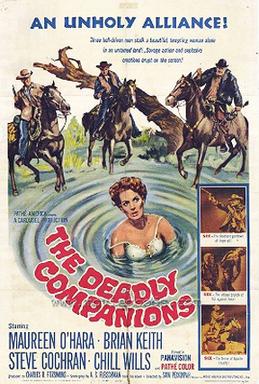
The Deadly Companions
By 1961, Sam Peckinpah had made a name for himself on the TV screen, writing, creating and even directing two different series, the classic The Rifleman and the lesser known The Westerner. The man that would go on to direct classics like The Wild Bunch, Straw Dogs, and Ride the High Country had to start somewhere though in films, and that's 1961's The Deadly Companions.
Drifting along from town to town, a man named Yellowleg (Brian Keith) teams up with two fellow drifters, Turk (Chill Wills) and Billy (Steve Cochran), agreeing to knock off a bank in a tiny, isolated desert town. As they ready to pull the job, the trio instead gets caught up in someone else's robbery, and a young boy is actually killed by Yellowleg in the process. The boy's mother, Kit (Maureen O'Hara), insists the boy be buried with her deceased husband, buried in the far-off and possibly abandoned town of Siringo. Feeling the extreme guilt over the accidental shooting, Yellowleg insists on guiding Kit through Apache territory to Siringo, but the dangerous journey holds secrets and trials that none of them were expecting.
Everyone has to start somewhere, and for Peckinpah in films, this was it. It is an interesting debut -- both good and bad -- that certainly is a forerunner of his later movies. While limited by a smallish budget, Peckinpah shows a knack that viewers would come to expect with movies like The Wild Bunch and Ride the High Country. According to O'Hara's biography, the filming was a less than pleasant process as first-time feature film director Peckinpah adjusted to shooting on a bigger scale than TV allowed. It's interesting though because with the exception of maybe Junior Bonner or Ballad of Cable Hogue, this is probably his least violent film. There are flaws, but I also think there's a hidden gem among all those flaws.
Let's start with Brian Keith as Yellowleg, a former Union officer traveling the west looking for vengeance on the man who tried to scalp him during the Civil War. That man? Chill Wills' Turk, a former Confederate soldier on the brink of lunacy trying to revive the Confederacy. Keith's Yellowleg (we never learn his real name) wears his hat low on his hat, never taking it off, because of the scar across his forehead from the failed scalping. He's also carrying a bullet in his shoulder and struggles to fire his gun accurately because of the wound. Peckinpah favored wounded, scarred anti-heroes dealing with extreme internal demons struggling to come to terms with those demons. I like Keith more and more with each passing part, and this is a very good one, if not one that's easily remembered as one of his best.
That's what I like about this first Peckinpah feature film. It isn't a classic by any means. But considering it was released in 1961, it's hard not to be impressed. This is far from a typical western released in that year, starting to reflecting the changing times, and that's what surprised me (although I guess it shouldn't have. Peckinpah wasn't exactly a touchy-feely kind of guy). This is one epically dark western. Each and every character is a tortured individual, all struggling to cope with something. Even the bad guys -- perfectly cast Cochran and Wills -- are trying to rape O'Hara's Kit, rob banks, shoot Yellowleg in the back and so on. Not nice guys. The background gives it all more depth; a former Union soldier obsessed with revenge on the Confederate who tried to scalp him? Oh, and a little boy gets gunned down in the first 20 minutes? It's hard to imagine a 1961 getting any more dark.
As I mentioned, this is far from an action-packed western. At the same time, it isn't exactly story-heavy either. It leans more toward episodic as Yellowleg, Kit, the two gunslingers and the dead boy make their way to Siringo. The focus is on Yellowleg's demons, Kit's mistrust and hatred of the man who killed her boy, and a vengeful Apache trying to kill them. I liked the dynamic between Keith and O'Hara especially. An IMDB reviewer compares it to an artsy Euro-western, and I'm hard pressed to disagree. The music from Marlin Skiles -- heavy on Spanish guitar, accordion and harmonica -- is oddly effective and appropriate. The look (including on-location shooting in Arizona, especially Old Tucson) is dreary and washed-out, reflecting the generally dark demeanor and tone of the story. Oh, and it is a Peckinpah film, watch for Strother Martin as a fire-breathing parson.
Things aren't perfect of course. At 93 minutes, 'Companions' can be a tad disjointed. Scenes transition from one to another without any real transition, scenes ending on odd notes as the screen fades to black. The ending especially is a little crazy as the studio took the finished film away from Peckinpah (a recurring trend later in his career) and reedited it into an indecipherable, completely out of place happy ending. It's still a good movie that doesn't deserve all the flak it takes, and one Peckinpah fans should definitely see. You can watch the entire movie HERE at Youtube, but it is a public domain print and therefore, not a good one. Hold out for another airing on TCM.
The Deadly Companions (1961): ***/****
Drifting along from town to town, a man named Yellowleg (Brian Keith) teams up with two fellow drifters, Turk (Chill Wills) and Billy (Steve Cochran), agreeing to knock off a bank in a tiny, isolated desert town. As they ready to pull the job, the trio instead gets caught up in someone else's robbery, and a young boy is actually killed by Yellowleg in the process. The boy's mother, Kit (Maureen O'Hara), insists the boy be buried with her deceased husband, buried in the far-off and possibly abandoned town of Siringo. Feeling the extreme guilt over the accidental shooting, Yellowleg insists on guiding Kit through Apache territory to Siringo, but the dangerous journey holds secrets and trials that none of them were expecting.
Everyone has to start somewhere, and for Peckinpah in films, this was it. It is an interesting debut -- both good and bad -- that certainly is a forerunner of his later movies. While limited by a smallish budget, Peckinpah shows a knack that viewers would come to expect with movies like The Wild Bunch and Ride the High Country. According to O'Hara's biography, the filming was a less than pleasant process as first-time feature film director Peckinpah adjusted to shooting on a bigger scale than TV allowed. It's interesting though because with the exception of maybe Junior Bonner or Ballad of Cable Hogue, this is probably his least violent film. There are flaws, but I also think there's a hidden gem among all those flaws.
Let's start with Brian Keith as Yellowleg, a former Union officer traveling the west looking for vengeance on the man who tried to scalp him during the Civil War. That man? Chill Wills' Turk, a former Confederate soldier on the brink of lunacy trying to revive the Confederacy. Keith's Yellowleg (we never learn his real name) wears his hat low on his hat, never taking it off, because of the scar across his forehead from the failed scalping. He's also carrying a bullet in his shoulder and struggles to fire his gun accurately because of the wound. Peckinpah favored wounded, scarred anti-heroes dealing with extreme internal demons struggling to come to terms with those demons. I like Keith more and more with each passing part, and this is a very good one, if not one that's easily remembered as one of his best.
That's what I like about this first Peckinpah feature film. It isn't a classic by any means. But considering it was released in 1961, it's hard not to be impressed. This is far from a typical western released in that year, starting to reflecting the changing times, and that's what surprised me (although I guess it shouldn't have. Peckinpah wasn't exactly a touchy-feely kind of guy). This is one epically dark western. Each and every character is a tortured individual, all struggling to cope with something. Even the bad guys -- perfectly cast Cochran and Wills -- are trying to rape O'Hara's Kit, rob banks, shoot Yellowleg in the back and so on. Not nice guys. The background gives it all more depth; a former Union soldier obsessed with revenge on the Confederate who tried to scalp him? Oh, and a little boy gets gunned down in the first 20 minutes? It's hard to imagine a 1961 getting any more dark.
As I mentioned, this is far from an action-packed western. At the same time, it isn't exactly story-heavy either. It leans more toward episodic as Yellowleg, Kit, the two gunslingers and the dead boy make their way to Siringo. The focus is on Yellowleg's demons, Kit's mistrust and hatred of the man who killed her boy, and a vengeful Apache trying to kill them. I liked the dynamic between Keith and O'Hara especially. An IMDB reviewer compares it to an artsy Euro-western, and I'm hard pressed to disagree. The music from Marlin Skiles -- heavy on Spanish guitar, accordion and harmonica -- is oddly effective and appropriate. The look (including on-location shooting in Arizona, especially Old Tucson) is dreary and washed-out, reflecting the generally dark demeanor and tone of the story. Oh, and it is a Peckinpah film, watch for Strother Martin as a fire-breathing parson.
Things aren't perfect of course. At 93 minutes, 'Companions' can be a tad disjointed. Scenes transition from one to another without any real transition, scenes ending on odd notes as the screen fades to black. The ending especially is a little crazy as the studio took the finished film away from Peckinpah (a recurring trend later in his career) and reedited it into an indecipherable, completely out of place happy ending. It's still a good movie that doesn't deserve all the flak it takes, and one Peckinpah fans should definitely see. You can watch the entire movie HERE at Youtube, but it is a public domain print and therefore, not a good one. Hold out for another airing on TCM.
The Deadly Companions (1961): ***/****
Labels:
1960s,
Brian Keith,
Chill Wills,
Maureen O'Hara,
Sam Peckinpah,
Strother Martin,
westerns
Sunday, December 16, 2012
Big Jake
From his starring screen debut in 1930's The Big Trail to his final film in 1976's The Shootist, John Wayne
became one of Hollywood's most beloved stars. For me, he will always be
one of my favorites. Some look to The Searchers, She Wore a Yellow
Ribbon and The Shootist as his best roles (and they are), but one of my
favorites from the Duke is a change of pace western from 1971, Big Jake.
It's 1909 along the Texas/Mexico border when an outlaw, John Fain (Richard Boone), leads his gang of murderers and cutthroats in a vicious attack on the expansive McCandles Ranch. Ten people are killed, and ranch owner Martha (Maureen O'Hara) sees her grandson kidnapped. Fain demands a ransom of $1 million, leaving a note that says simply "Follow the map." Knowing her grandson could be killed no matter what she decides, Martha seeks out her estranged husband, Jacob (Wayne), to take the ransom money into Mexico and get his grandson (who he didn't know) back. With help from his two sons, James (Patrick Wayne) and Michael (Christopher Mitchum), and an old friend, Apache Sam Sharpnose (Bruce Cabot), Jacob agrees, setting off to bring his grandson back alive or his captors dead.
Without a doubt, this is the most graphically violent movie of Wayne's career. Others like The Alamo are violent, but nothing quite like this. For western fans alone, that feature makes this George Sherman-directed western worth watching. Sidenote: With Sherman sick and unable to be on-location during shooting, Wayne directed much of the movie. In a career that spanned five decades, this is certainly a departure for the Duke. It is trying to be more modern, using some heavy-duty blood squibs. Even when the violence isn't on-screen, it is beyond startling and even disturbing in some scenes. Somewhat oddly, there is still an oddly comic tune at times that feels out of place alongside the sometimes extreme violence.
Wouldn't you know it though? I grew up watching this film -- still have an old VHS recording off TBS along with the bare-bones DVD -- and will always remember it fondly. Beyond the on-screen violence, there is something different about this western that's hard to put my finger on. I think I like it because of its general eccentric nature; the violence mixed with the odd humor. 'Jake' was shot on location in Mexico in Durango and Zacatecas, giving it a real sense of authenticity. Many Wayne westerns -- The War Wagon, Sons of Katie Elder, The Undefeated -- were shot in Mexico, and wouldn't you know it? Mexico looks like Mexico, giving a great backdrop to the story. The always reliable Elmer Bernstein turns in an eclectic score that covers a lot of ground, but in a good way. Listen to the main theme HERE, but that's just a taste of what Bernstein's score has to offer. Another case of the little things aiding the bigger cause.
What else though? I love the interaction between Wayne and his two sons he hasn't seen in years. Estranged from his family (for unknown reasons), he only comes back at his wife's request. Wayne's introduction is priceless, O'Hara's Martha saying she needs a man as unpleasant as the mission he'll undertake. Cut to Wayne squinting down the barrel of a rifle in an extreme close-up with Bernstein's score playing. Jake is believed to have been killed years before, forcing him to hear many people say "I thought you were dead." Nope, still kicking, traveling through Texas and Mexico with his fiercely loyal dog. Seeing his sons again provides some of the movie's genuinely funny moments and also some surprisingly effective dramatic moments. Neither Patrick Wayne or Mitchum are out of this world actors, but they hold their own, as does a scene-stealing Cabot as an aging Apache.
The cast is far from done there, especially an underused Richard Boone as the calculating, brutal John Fain. Most villains cower in Wayne's shadow, but not Boone. Their scenes together are beyond perfect, few though they may be. Watch THIS scene for proof (apologies for the low quality). Fain's gang includes O'Brien (Glenn Corbett), a half-breed gunslinger, Pop Dawson (an unrecognizable Harry Carey Jr.), Kid Duffy (stuntman Dean Smith), a deadshot with a rifle, John Goodfellow (Gregg Palmer), a machete-wielding psycho, Trooper (Jim Burk), an Army deserter, and Will Fain (Robert Warner), John's brother who favors a shotgun. Singer Bobby Vinton makes a brief appearance as Jake's third son. Also look for recognizable western faces John Doucette, John Agar, Jim Davis, Hank Worden, Chuck Roberson (Wayne's stunt double), and Roy Jenson. Wayne's real-life son, Ethan Wayne, plays the kidnapped Little Jake.
Following the startling opening attack at the McCandles Ranch, things more or less settle down until the finale in the action department. After dealing with some pistoleros who want to get their hands on the $1 million ransom, Jacob and Co. head to the ruins of an old Spanish mission for the exchange. On a stormy night, the sequence that follows is a gem. It's brutal and vicious -- with at least two surprises -- but it always stays on a small-scale level where you know what's going on. The mission and plaza was supposedly used in the 1910s by revolutionary Pancho Villa for executions, adding a dark edge to the scenes. The gunplay isn't remembered as one of the all-time bests, but the finale is one of my favorites, partially due to the action, some to the script with its great one-liners.
Whatever the reasoning, I love this movie. I know it's not a great movie, but I love it just the same. John Wayne fans should appreciate this one, and western fans on the whole as well.
Big Jake <----trailer (1971): ****/****
Rewrite of review from July 2009
It's 1909 along the Texas/Mexico border when an outlaw, John Fain (Richard Boone), leads his gang of murderers and cutthroats in a vicious attack on the expansive McCandles Ranch. Ten people are killed, and ranch owner Martha (Maureen O'Hara) sees her grandson kidnapped. Fain demands a ransom of $1 million, leaving a note that says simply "Follow the map." Knowing her grandson could be killed no matter what she decides, Martha seeks out her estranged husband, Jacob (Wayne), to take the ransom money into Mexico and get his grandson (who he didn't know) back. With help from his two sons, James (Patrick Wayne) and Michael (Christopher Mitchum), and an old friend, Apache Sam Sharpnose (Bruce Cabot), Jacob agrees, setting off to bring his grandson back alive or his captors dead.
Without a doubt, this is the most graphically violent movie of Wayne's career. Others like The Alamo are violent, but nothing quite like this. For western fans alone, that feature makes this George Sherman-directed western worth watching. Sidenote: With Sherman sick and unable to be on-location during shooting, Wayne directed much of the movie. In a career that spanned five decades, this is certainly a departure for the Duke. It is trying to be more modern, using some heavy-duty blood squibs. Even when the violence isn't on-screen, it is beyond startling and even disturbing in some scenes. Somewhat oddly, there is still an oddly comic tune at times that feels out of place alongside the sometimes extreme violence.
Wouldn't you know it though? I grew up watching this film -- still have an old VHS recording off TBS along with the bare-bones DVD -- and will always remember it fondly. Beyond the on-screen violence, there is something different about this western that's hard to put my finger on. I think I like it because of its general eccentric nature; the violence mixed with the odd humor. 'Jake' was shot on location in Mexico in Durango and Zacatecas, giving it a real sense of authenticity. Many Wayne westerns -- The War Wagon, Sons of Katie Elder, The Undefeated -- were shot in Mexico, and wouldn't you know it? Mexico looks like Mexico, giving a great backdrop to the story. The always reliable Elmer Bernstein turns in an eclectic score that covers a lot of ground, but in a good way. Listen to the main theme HERE, but that's just a taste of what Bernstein's score has to offer. Another case of the little things aiding the bigger cause.
What else though? I love the interaction between Wayne and his two sons he hasn't seen in years. Estranged from his family (for unknown reasons), he only comes back at his wife's request. Wayne's introduction is priceless, O'Hara's Martha saying she needs a man as unpleasant as the mission he'll undertake. Cut to Wayne squinting down the barrel of a rifle in an extreme close-up with Bernstein's score playing. Jake is believed to have been killed years before, forcing him to hear many people say "I thought you were dead." Nope, still kicking, traveling through Texas and Mexico with his fiercely loyal dog. Seeing his sons again provides some of the movie's genuinely funny moments and also some surprisingly effective dramatic moments. Neither Patrick Wayne or Mitchum are out of this world actors, but they hold their own, as does a scene-stealing Cabot as an aging Apache.
The cast is far from done there, especially an underused Richard Boone as the calculating, brutal John Fain. Most villains cower in Wayne's shadow, but not Boone. Their scenes together are beyond perfect, few though they may be. Watch THIS scene for proof (apologies for the low quality). Fain's gang includes O'Brien (Glenn Corbett), a half-breed gunslinger, Pop Dawson (an unrecognizable Harry Carey Jr.), Kid Duffy (stuntman Dean Smith), a deadshot with a rifle, John Goodfellow (Gregg Palmer), a machete-wielding psycho, Trooper (Jim Burk), an Army deserter, and Will Fain (Robert Warner), John's brother who favors a shotgun. Singer Bobby Vinton makes a brief appearance as Jake's third son. Also look for recognizable western faces John Doucette, John Agar, Jim Davis, Hank Worden, Chuck Roberson (Wayne's stunt double), and Roy Jenson. Wayne's real-life son, Ethan Wayne, plays the kidnapped Little Jake.
Following the startling opening attack at the McCandles Ranch, things more or less settle down until the finale in the action department. After dealing with some pistoleros who want to get their hands on the $1 million ransom, Jacob and Co. head to the ruins of an old Spanish mission for the exchange. On a stormy night, the sequence that follows is a gem. It's brutal and vicious -- with at least two surprises -- but it always stays on a small-scale level where you know what's going on. The mission and plaza was supposedly used in the 1910s by revolutionary Pancho Villa for executions, adding a dark edge to the scenes. The gunplay isn't remembered as one of the all-time bests, but the finale is one of my favorites, partially due to the action, some to the script with its great one-liners.
Whatever the reasoning, I love this movie. I know it's not a great movie, but I love it just the same. John Wayne fans should appreciate this one, and western fans on the whole as well.
Big Jake <----trailer (1971): ****/****
Rewrite of review from July 2009
Thursday, May 19, 2011
Spencer's Mountain
I have never seen an episode of The Waltons. Not one, not even one scene. The popular TV show ran between 1972 and 1981 with 221 episodes to the show's name and seven TV movies to boot. I'm aware of the show, know a little bit what it was about it, and at least somewhat know it's place in pop culture history. But still, I never saw a single episode. And to tell you the truth, I don't feel like I'm missing much.
Having little to no background with one of America's favorite TV families, I was then surprised when I started watching 1963's Spencer's Mountain from director Delmer Daves. Watching the movie in two different sittings, I did some investigating in between, quickly finding out that this movie is based off a novel by Earl Hamner. The novel turned into a feature length movie and some eight years later was turned into one of TV's most beloved shows, The Waltons. So having watched 'Mountain,' I can say I don't need to look into the TV show, not because it wasn't good, but because I doubt the 1970s show can live up to its predecessor.
For over 100 years in the shadow of the Grand Tetons, the Spencer family has lived, leading a simple, hard-working life. The oldest of nine boys, Clay Spencer (Henry Fonda), works at the local mill, putting in a solid day of work and returning home to his wife, Livy (Maureen O'Hara), and their passel of nine kids. Working hard to keep things up, Clay hopes to one day build his wife a dream house on the side of the family's mountain, giving her everything he knows she deserves. But as the kids grow up, Clay wants to give each of them everything he can, starting with his oldest, Clay Boy (James MacArthur), who just graduated from high school and wants to enroll at college. But nothing comes cheap, especially for the hard-working father who now must work even hard to support his family.
Just like The Waltons would come to be during their successful run on TV, Spencer's Mountain is a little slice of Americana. This isn't a rich family that lives life in piles of money. This isn't the dirt poor, scraping out a little niche for itself. This is a large family that isn't rich and isn't poor. Money is hard to come by, but they know that at a certain point, happiness is more important than possessions. It's hard not to get behind this family. They do what they need to do to survive, often making sacrifices so that survival is possible. The story and the setting though is pure American, hard-working, steadfast, honest people who aren't afraid of putting their back into something.
For this little piece of growing up and living as a family in America, director Daves turns in one of the most epically sweeping movies I've ever seen. It isn't about hundreds of extras in the background or flashy camera techniques. Plain and simple, this is a camera showing the pure beauty that is the American west in all its glory. Daves doesn't mess up a good thing, knowing all he has to do is set up the camera and start the film rolling. He films in Jackson Hole and Grant Teton National Park -- both in Wyoming -- and the landscape ends up being a key character. You understand Clay's motivation, his love of the land, just by seeing what he sees. This is one of those movies that needs to be seen in widescreen to appreciate what Daves filmed. I can only imagine what the movie would have looked like in 1963 on a big screen in movie theaters all over the country.
The timing is spooky, but the story from Sometimes a Great Notion is eerily similar to Spencer's Mountain. Maybe that's on account of its similar outlook on life in that hard-working, middle to lower class American family. In a long line of great performances and characters, Henry Fonda adds another exception part as Clay Spencer, the fun-loving family man who loves everything about life, the sinning and otherwise. He embraces the good and the bad, just going along for the ride at times. Maureen O'Hara is his polar opposite, a God-fearing woman trying to raise her children right, turning her back on carousing, drinking, fighting. So in their different outlooks, they find their perfect match. Fonda and O'Hara are two of my all-time favorites, and their chemistry in all their scenes together is spot-on. I wouldn't expect anything less from two professionals like them.
I've always been a fan of James MacArthur because of his role first in Swiss Family Robinson and then later in Hawaii Five-O. It's cool to see him in a starring role here, not a supporting part, and he plays well off of Fonda and O'Hara. He's the only one of the Spencer kids who gets more than a line or two of dialogue, his story dominating the second half of the movie in a positive way. This is Fonda, O'Hara and MacArthur's movie, but there's worthwhile supporting parts for Donald Crisp and Lillian Bronson as the Spencer grandparents, Wally Cox as Preacher Goodman, Mimsy Farmer as Claris, a teenager with her eyes set on Clay Boy, Virginia Gregg as Clay's high school teacher and biggest supporter, and Whit Bissell as Doc Campbell.
Waltons fan or not, this is just a good movie, well worth checking out.
Spencer's Mountain <---TCM trailer (1963): ***/****
Having little to no background with one of America's favorite TV families, I was then surprised when I started watching 1963's Spencer's Mountain from director Delmer Daves. Watching the movie in two different sittings, I did some investigating in between, quickly finding out that this movie is based off a novel by Earl Hamner. The novel turned into a feature length movie and some eight years later was turned into one of TV's most beloved shows, The Waltons. So having watched 'Mountain,' I can say I don't need to look into the TV show, not because it wasn't good, but because I doubt the 1970s show can live up to its predecessor.
For over 100 years in the shadow of the Grand Tetons, the Spencer family has lived, leading a simple, hard-working life. The oldest of nine boys, Clay Spencer (Henry Fonda), works at the local mill, putting in a solid day of work and returning home to his wife, Livy (Maureen O'Hara), and their passel of nine kids. Working hard to keep things up, Clay hopes to one day build his wife a dream house on the side of the family's mountain, giving her everything he knows she deserves. But as the kids grow up, Clay wants to give each of them everything he can, starting with his oldest, Clay Boy (James MacArthur), who just graduated from high school and wants to enroll at college. But nothing comes cheap, especially for the hard-working father who now must work even hard to support his family.
Just like The Waltons would come to be during their successful run on TV, Spencer's Mountain is a little slice of Americana. This isn't a rich family that lives life in piles of money. This isn't the dirt poor, scraping out a little niche for itself. This is a large family that isn't rich and isn't poor. Money is hard to come by, but they know that at a certain point, happiness is more important than possessions. It's hard not to get behind this family. They do what they need to do to survive, often making sacrifices so that survival is possible. The story and the setting though is pure American, hard-working, steadfast, honest people who aren't afraid of putting their back into something.
For this little piece of growing up and living as a family in America, director Daves turns in one of the most epically sweeping movies I've ever seen. It isn't about hundreds of extras in the background or flashy camera techniques. Plain and simple, this is a camera showing the pure beauty that is the American west in all its glory. Daves doesn't mess up a good thing, knowing all he has to do is set up the camera and start the film rolling. He films in Jackson Hole and Grant Teton National Park -- both in Wyoming -- and the landscape ends up being a key character. You understand Clay's motivation, his love of the land, just by seeing what he sees. This is one of those movies that needs to be seen in widescreen to appreciate what Daves filmed. I can only imagine what the movie would have looked like in 1963 on a big screen in movie theaters all over the country.
The timing is spooky, but the story from Sometimes a Great Notion is eerily similar to Spencer's Mountain. Maybe that's on account of its similar outlook on life in that hard-working, middle to lower class American family. In a long line of great performances and characters, Henry Fonda adds another exception part as Clay Spencer, the fun-loving family man who loves everything about life, the sinning and otherwise. He embraces the good and the bad, just going along for the ride at times. Maureen O'Hara is his polar opposite, a God-fearing woman trying to raise her children right, turning her back on carousing, drinking, fighting. So in their different outlooks, they find their perfect match. Fonda and O'Hara are two of my all-time favorites, and their chemistry in all their scenes together is spot-on. I wouldn't expect anything less from two professionals like them.
I've always been a fan of James MacArthur because of his role first in Swiss Family Robinson and then later in Hawaii Five-O. It's cool to see him in a starring role here, not a supporting part, and he plays well off of Fonda and O'Hara. He's the only one of the Spencer kids who gets more than a line or two of dialogue, his story dominating the second half of the movie in a positive way. This is Fonda, O'Hara and MacArthur's movie, but there's worthwhile supporting parts for Donald Crisp and Lillian Bronson as the Spencer grandparents, Wally Cox as Preacher Goodman, Mimsy Farmer as Claris, a teenager with her eyes set on Clay Boy, Virginia Gregg as Clay's high school teacher and biggest supporter, and Whit Bissell as Doc Campbell.
Waltons fan or not, this is just a good movie, well worth checking out.
Spencer's Mountain <---TCM trailer (1963): ***/****
Labels:
1960s,
Delmer Daves,
Donald Crisp,
Henry Fonda,
James MacArthur,
Maureen O'Hara
Saturday, September 11, 2010
Our Man in Havana
I think the best description I ever heard of British actor Alec Guinness was that he was a chameleon. There wasn't a role he couldn't get into and really flesh it out. Countless actors were asked to play the part that he may be most known for in The Bridge on the River Kwai, Charles Laughton even admitting "I didn't know how to play that part until I saw Guinness perform." That's him. Comedy, drama, sci-fi, action, he could do it all. His comedy is often a perfect blend of physical and subtle, like 1959's Our Man in Havana.
Based on a novel by the typically dark but never dull Graham Greene, 'Havana' gives Guinness a chance to show off his impressive acting chops. You look at him and think he just doesn't look like a comedic actor. He's too stiff upper-lip British, too gentlemanly, and then you see him do his thing. It is a story based in the months leading up to the Fidel Castro takeover in 1959, and more interesting than that, the movie was filmed in Havana after Castro took over...with some serious restrictions of course.
Running a small vacuum cleaner store in Havana, 40-something salesman Jim Wormold (Guinness) is one day approached in his shop by another British national, Hawthorne (Noel Coward). An agent for British intelligence, Hawthorne wants Wormold to set up his own ring in Cuba, keep tabs on all the goings on. The salesman laughs off the offer and moves on. That is until his daughter (Jo Morrow) is growing up and needs all sorts of things. Wormold agrees to become an agent, but when he attempts to recruit his own sources he draws blanks left and right. So instead, he starts to report he has countless agents who have stumbled upon a major Cuban military venture, possibly a missile? Apparently not thinking things through, trouble is about to hit the fan when British intelligence investigates, wanting to know more about all these things Wormold has fabricated. In trouble much?
This is the darkest of comedies mostly because of that trouble that arises. For the early parts of the story, Wormold's deception is played for laughs, including a great montage as he "reports" how he came to recruit his throng of agents compared with what actually happened upon meeting them. Then his codes are broken by other rival intelligence agents -- who we never find out -- so when a support team (including secretary/assistant Maureen O'Hara) comes to help coordinate everything, the jig is up. It's only a matter of time before everything and everyone gets figured out. As for that dark humor, some of Wormold's "agents" start showing up dead. Oops, didn't mean for that to happen.
Guinness might not be considered a great comedic actor, but you can chalk that up to how dry he was on screen. He's never over-performing. He's subtle and sells lines with a quick look or a blink and you'll miss it reflex. The best part of this performance is when Wormold is forced to improvise, convincing O'Hara's Beatrice that he's on the up and up. She believes him, but his actions are played so off the cuff like he's calm and suave, not bothered that his "agents" are ignoring him and in some cases upset he's anywhere near them. I love Guinness in his dramatic parts, but he's no slouch when it comes to comedy.
Basically playing straight men/women to Guinness's predicament is a great supporting cast. O'Hara plays a different part than usual, a career woman in an intelligence agency that has her moving around constantly. She has a good patter with Guinness who wants to tell her the truth but never seems to be able to get around to it. Burl Ives plays Dr. Hasselbacher, a German doctor and friend of Wormold's who thinks he's gotten too far into something he can't possibly control. Ernie Kovacs takes a stab at the slimy villain, Captain Segura, a Bautista enforcer curious as to what's going on while also showing interest in Milly, Wormold's daughter. Coward is perfectly British as agent Hawthorne, and Ralph Richardson as 'C,' the supervisor trying to piece it all together, get laughs just by playing it all straight.
Stories and impressive casting aside, the coolest part of this movie is a look into 1959 Havana, Cuba just months after Castro and his army overthrew the Bautista regime. Director Carol Reed received permission to shoot in Havana, choosing to film in black and white. Reed's camera is right there in the street with his actors, giving the proceedings a real sense of what's going on. The indoor scenes were filmed in studios in England, but they can't all be winners. An interesting, often very funny movie with Guinness at his comedic best.
Our Man in Havana <---trailer (1959): ***/****
Based on a novel by the typically dark but never dull Graham Greene, 'Havana' gives Guinness a chance to show off his impressive acting chops. You look at him and think he just doesn't look like a comedic actor. He's too stiff upper-lip British, too gentlemanly, and then you see him do his thing. It is a story based in the months leading up to the Fidel Castro takeover in 1959, and more interesting than that, the movie was filmed in Havana after Castro took over...with some serious restrictions of course.
Running a small vacuum cleaner store in Havana, 40-something salesman Jim Wormold (Guinness) is one day approached in his shop by another British national, Hawthorne (Noel Coward). An agent for British intelligence, Hawthorne wants Wormold to set up his own ring in Cuba, keep tabs on all the goings on. The salesman laughs off the offer and moves on. That is until his daughter (Jo Morrow) is growing up and needs all sorts of things. Wormold agrees to become an agent, but when he attempts to recruit his own sources he draws blanks left and right. So instead, he starts to report he has countless agents who have stumbled upon a major Cuban military venture, possibly a missile? Apparently not thinking things through, trouble is about to hit the fan when British intelligence investigates, wanting to know more about all these things Wormold has fabricated. In trouble much?
This is the darkest of comedies mostly because of that trouble that arises. For the early parts of the story, Wormold's deception is played for laughs, including a great montage as he "reports" how he came to recruit his throng of agents compared with what actually happened upon meeting them. Then his codes are broken by other rival intelligence agents -- who we never find out -- so when a support team (including secretary/assistant Maureen O'Hara) comes to help coordinate everything, the jig is up. It's only a matter of time before everything and everyone gets figured out. As for that dark humor, some of Wormold's "agents" start showing up dead. Oops, didn't mean for that to happen.
Guinness might not be considered a great comedic actor, but you can chalk that up to how dry he was on screen. He's never over-performing. He's subtle and sells lines with a quick look or a blink and you'll miss it reflex. The best part of this performance is when Wormold is forced to improvise, convincing O'Hara's Beatrice that he's on the up and up. She believes him, but his actions are played so off the cuff like he's calm and suave, not bothered that his "agents" are ignoring him and in some cases upset he's anywhere near them. I love Guinness in his dramatic parts, but he's no slouch when it comes to comedy.
Basically playing straight men/women to Guinness's predicament is a great supporting cast. O'Hara plays a different part than usual, a career woman in an intelligence agency that has her moving around constantly. She has a good patter with Guinness who wants to tell her the truth but never seems to be able to get around to it. Burl Ives plays Dr. Hasselbacher, a German doctor and friend of Wormold's who thinks he's gotten too far into something he can't possibly control. Ernie Kovacs takes a stab at the slimy villain, Captain Segura, a Bautista enforcer curious as to what's going on while also showing interest in Milly, Wormold's daughter. Coward is perfectly British as agent Hawthorne, and Ralph Richardson as 'C,' the supervisor trying to piece it all together, get laughs just by playing it all straight.
Stories and impressive casting aside, the coolest part of this movie is a look into 1959 Havana, Cuba just months after Castro and his army overthrew the Bautista regime. Director Carol Reed received permission to shoot in Havana, choosing to film in black and white. Reed's camera is right there in the street with his actors, giving the proceedings a real sense of what's going on. The indoor scenes were filmed in studios in England, but they can't all be winners. An interesting, often very funny movie with Guinness at his comedic best.
Our Man in Havana <---trailer (1959): ***/****
Labels:
1950s,
Alec Guinness,
Burl Ives,
Carol Reed,
Maureen O'Hara,
Ralph Richardson
Friday, September 10, 2010
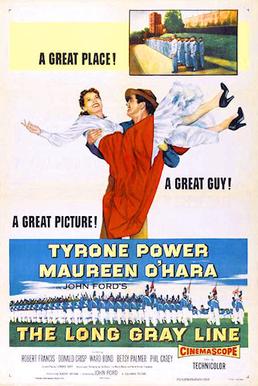
The Long Gray Line
When comparing his movies, it's easy to overlook his non-westerns. When in front of a Congressional hearing, Ford even introduced himself saying "I'm John Ford, I make westerns." But over a career that spanned decades and over 100 movies, it's unfair to just say he was a good director of westerns. He was a good director for all his faults and tendencies that can drive me nuts at times. Maybe the best example of a Ford movie -- non-western -- is 1955's The Long Gray Line, a departure from the expected Ford movie but still similar in many ways.
An Irish immigrant fresh off the boat in New York, young Martin Maher (Tyrone Power) travels to the United States Military Academy at West Point in upstate New York. He enlists in the army and right away begins helping the cadets, some just as a mentor, others as an instructor in classes. Marty can be a bit of a klutz, a bit of a doof at times, but when the chips are down, he's a good friend and a better man. The years go by, and Marty continues to reenlist while also marrying Mary O'Donnell (Maureen O'Hara), a pretty redhead from Ireland. They send for Marty's family from Ireland (father Donald Crisp, brother Sean McClory) and life continues, the whole family together again. And so the years go by, West Point unchanging as the world changes around it in the first half of the 20th Century.
When Ford gets it right, he typically hits a home run, and this qualifies in many ways. One review described it as a "very Irish" movie. And somehow that description is dead on more than just the main characters being Irish. It's about family and sticking together through thick and thin. More than that, it's the extended family you make in your life. All those things that drive me up the wall are here, but whether he realized it or not, Ford reins it all in. It never gets to be too much. The story is downright sappy at times, but I don't think Ford ever intended to do anything but that. For the most part, it hits all the right notes, happy, sad and everything in between.
This was never an intentional slight, but this was the first Tyrone Power movie I'd ever seen from beginning to end. I never had a negative idea of Power as an actor, but I guess it's fair to say it wasn't particularly positive either. Above all else, Power's performance here as Sgt. Martin Maher is the reason to check this one out. Marty is one of the most likable characters ever, willing to help whatever and whoever needs his help. We see this over the years the impression he makes on his cadets who end up looking at him as a father figure, or at least a big brother looking out for their best interests. Power gives Marty some funny bits, nails the emotional scenes, and handles an Irish accent that if handled poorly could have derailed the part. A great performance to lead the movie.
Mentioned earlier, Ford's stock company of actors was a long list of actors/actresses the director worked with on repeated times. If you've seen more than one Ford movie, you've no doubt seen these faces whether you knew it or not. 'Gray Line' is full of these folks, starting with O'Hara in a perfectly cast part as Marty's tough-minded wife Mary, an ideal match for the equally strong-willed and tough-minded Marty. Crisp isn't in the movie for long but certainly makes quite an impression as Marty's old school Pops. My favorite of the stock company has always been Ward Bond, and he doesn't disappoint as Major Keeler, Marty's commanding officer. Also look for Ford regulars Harry Carey Jr. and Patrick Wayne along with Robert Francis, Peter Graves, Philip Carey and William Leslie filling out some meatier supporting parts.
Only one complaint here, and I'll keep it brief. A story that covers 50-plus years in 140 minutes can't help but feel a little episodic, a little disjointed. Characters go in and out at will, no explanations offered, but the link through all the slower moving segments is Power as Martin Maher. Throw the performances in with some great on-location shooting at West Point that help sell the tradition and honor of the academy, and you've got a winner if not quite a classic.
The Long Gray Line <---trailer (1955): ***/****
Sunday, June 13, 2010
The Fallen Sparrow
Before he died at the young age of 39, actor John Garfield sure packed a lot into a brief career. In just over 10 years, he was in 32 movies, some parts bigger than others and not all of them starring parts. But he carved out a niche for himself playing tough guys who remained likable despite their on-screen actions especially in The Postman Always Rings Twice where he's a wandering, murdering lover. In 1943's The Fallen Sparrow, he gets to play a character that reminded me in a lot of ways that reminded me of Leonardo DiCaprio in Shutter Island.
Garfield plays John McKittrick, 'Kit' to his friends, a man wrestling with his past demons. In the 1930s, McKittrick traveled to Spain and fought in the Spanish Civil War. Toward the end of the war, his battalion was involved in a bloody battle that resulted in a majority of the men being killed or captured. Kit has an item the enemy would love to get their hands on but refuses to give it up and is sent to a prison where he rots for two years, his captors torturing him physically and mentally. Finally he escapes with the help of a childhood friend and returns to the U.S. where he lives on a ranch in Arizona (it's hinted this is some sort of asylum). But even free from the prison, he's tortured by his memories of what happened in the prison, the sounds, the smells, all the little things get to him as he tries to cope.
Here's where the story kicks in because all of that background is handled in a few scenes of dialogue as information is slowly filtered out. Kit travels to New York when he receives word that a friend of his -- the one who helped him escape -- died when he accidentally fell to his death from a window on a top floor of a skyscraper. Kit doesn't believe it for a second and starts his own investigation. He meets all sorts of people who were at the party when his friend fell, but no one seems to be telling him the truth. It's just the start of a story that goes left and right with twists around every corner as Kit tries to reveal the truth while also struggling to keep his sanity.
My plot description was a little shorter than usual and for good reason. Even after finishing the movie, I wasn't quite sure what I'd just watched or what exactly happened. Foreshadowing the huge popularity of film noir that was to come, 'Sparrow's' story isn't content just to keep you guessing as to what is to come. This is a story that feels the need to confuse you. Characters are introduced and then drift in and out as needed, disappearing for extended segments and then reappearing when some new twist or reveal appears. Granted, I watched this movie in a couple different windows, but I'm usually able to keep up with most movies. Not so much here.
SPOILERS As for the twists and turns that I did keep up with, it's all pretty ridiculous. Garfield's Kit stumbles into a web of political intrigue with international spy rings, government agencies, blackmail, murder and Nazis hiding out in 1943 in NYC as refugees. Then as for the big reveal of who the actual bad guy is, I thought I'd missed something. From the get-go, their very first appearance it is obvious to a blind man who the Nazi killers really are. Then the story spends the next hour and a half getting to that point of the reveal. One worthwhile point mentioning, Hugh Beaumont (Ward Cleaver, the Beav's Dad on Leave it To Beaver) is one of the Nazi agents working with his 'dad' Walter Slezak. The reveal is so obvious it threw me off to the point where when the camera zooms in and the music swells I thought I'd missed something else. Nope, that was it, and I called it five minutes in like most moviegoers had to do when seeing this one.
But because of the good performances in this mess of a movie, I can't completely rip it to pieces. Garfield is a strong lead as he tries to piece all this crazy evidence together with everyone around him thinking he's completely lost his mind. Maureen O'Hara plays Toni Donne, a pawn in a much bigger picture who is forced to do things against her will. She of course falls in love with Kit right away in one of those ultra-believable romances that I'm such a fan of. Also look for a much thinner, very young John Banner as Anton, a mysterious piano player who knows more than he's letting on. It took me quite a while to figure him as Sgt. Schultz from Hogan's Heroes. This isn't going to be a very long, very detailed review because even with the solid cast, this one was a stinker. Pass and pass again.
The Fallen Sparrow <----trailer (1943): * 1/2 /****
Labels:
1940s,
Film Noir,
John Garfield,
Maureen O'Hara,
Walter Slezak
Wednesday, April 21, 2010
Jack Sparrow's long-lost relatives
In 2003, Johnny Depp as Captain Jack Sparrow helped revitalize the pirate movie with the hugely popular and trilogy spawning Pirates of the Caribbean: Curse of the Black Pearl. Basically, he made pirates cool again mostly because Depp is one of the coolest actors around. For years though, the pirate movie had been a thing of the past -- other than the box-office bomb Cutthroat Island -- after being extremely popular in the Hollywood studio era. The star most often associated with these swashbuckling roles was Errol Flynn, but many actors took to the high seas as a pirate.
Where Flynn was an ideal choice to play a pirate -- roguish but not a killer, smooth but particularly vicious at times -- those other actors had their work cut out for them...usually because they were compared to Flynn. Some were better than others, but I watched two recently that certainly qualify in the odd casting department, Paul Henreid in 1945's The Spanish Main and Sterling Hayden in 1952's The Golden Hawk. I typically think of Henreid as a second banana, and I questioned whether Hayden has the on-screen presence to overact as pirates normally do in any number of extravagant ways. Safe to say, neither is Johnny Depp, but here goes.
Given away as a bride to the viceroy of Cartagena, Spanish contessa Francesca (Maureen O'Hara) is en route when her ship is attacked by the Barracuda, an infamous pirate ship in the Caribbean captained by Laurent Van Horn (Henreid). She is taken prisoner, and Van Horn demands that she marry him. Bargaining to save the life of the crew, Francesca agrees. But the viceroy (Walter Slezak) hears of this and is none too pleased because he's long hunted Van Horn. The pirate thinks he is in the free and clear with his new wife, but his crew and the pirate code say he has broken their rules. Nothing comes easy as a pirate.
First off, the casting. Henreid is not the right choice to play a swashbuckling pirate. He's too much of a dandy and to say the least, is not intimidating. He does little of his own stunts with an obvious double stepping in for him. You want to root for him as he takes on the evil viceroy, but it's hard to get behind him. O'Hara is quite the looker here with her strikingly red hair, but she's an Irish actress playing a Spanish contessa. Something doesn't add up, especially when she tries a Spanish accent. Slezak isn't much of a bad guy either as the somewhat vicious but mostly stupid viceroy. It's all wrapped up nicely with a bow in the end.
Read any of my previous reviews of a Sterling Hayden movie, and you'll get the same idea with each one. He's at his best when he's playing the steely-eyed hero. Ask him to show too much emotion or fire, and it gets awkward real quick. Transferring that thought, a pirate might not be the ideal choice for a part. Honestly, Hayden is the least of the problems in The Golden Hawk. It's a B-movie and not a good one. The script is awful having characters who hate each other fall madly in love with each other because the story requires it and little else. 'Hawk' has a cheap look to it, lots of studio work, and miniatures serving for any shots of cities or ships sailing the ocean blue.
If you're looking for a plot description, read the one from 'Spanish Main' but replace the actors names. Hayden is a French (really? French? That's a good one) pirate looking to avenge his mother's death years before. Hayden's Kit 'the Hawk' Gerardo sails the seas taking down any ship he can. On board one of theses ships he captures a beautiful woman (Rhonda Fleming) who ends up being a rival pirate. Throw in a kidnapped Spanish wife who's married to the evil captain, and you've got this stinker. Look for Michael Ansara in a good supporting part as Bernardo, one of Kit's men. Other than that, pass on this one in a big way.
The moral of the story after seeing these two pirate movies is this; stick with Errol Flynn and his swashbuckling pirate movies where money was spent on casting, costuming and getting a decent story to work with. Henreid and Hayden just aren't cut out for parts as pirates, but it's not like the rest of these movies helps out. O'Hara and Fleming both look great and its refreshing to see some take no crap badass chicks in older movies, but they're lost in a sea of bad movie.
The Spanish Main <---trailer (1945): **/****
The Golden Hawk (1952): */****
Where Flynn was an ideal choice to play a pirate -- roguish but not a killer, smooth but particularly vicious at times -- those other actors had their work cut out for them...usually because they were compared to Flynn. Some were better than others, but I watched two recently that certainly qualify in the odd casting department, Paul Henreid in 1945's The Spanish Main and Sterling Hayden in 1952's The Golden Hawk. I typically think of Henreid as a second banana, and I questioned whether Hayden has the on-screen presence to overact as pirates normally do in any number of extravagant ways. Safe to say, neither is Johnny Depp, but here goes.
Given away as a bride to the viceroy of Cartagena, Spanish contessa Francesca (Maureen O'Hara) is en route when her ship is attacked by the Barracuda, an infamous pirate ship in the Caribbean captained by Laurent Van Horn (Henreid). She is taken prisoner, and Van Horn demands that she marry him. Bargaining to save the life of the crew, Francesca agrees. But the viceroy (Walter Slezak) hears of this and is none too pleased because he's long hunted Van Horn. The pirate thinks he is in the free and clear with his new wife, but his crew and the pirate code say he has broken their rules. Nothing comes easy as a pirate.
First off, the casting. Henreid is not the right choice to play a swashbuckling pirate. He's too much of a dandy and to say the least, is not intimidating. He does little of his own stunts with an obvious double stepping in for him. You want to root for him as he takes on the evil viceroy, but it's hard to get behind him. O'Hara is quite the looker here with her strikingly red hair, but she's an Irish actress playing a Spanish contessa. Something doesn't add up, especially when she tries a Spanish accent. Slezak isn't much of a bad guy either as the somewhat vicious but mostly stupid viceroy. It's all wrapped up nicely with a bow in the end.
Read any of my previous reviews of a Sterling Hayden movie, and you'll get the same idea with each one. He's at his best when he's playing the steely-eyed hero. Ask him to show too much emotion or fire, and it gets awkward real quick. Transferring that thought, a pirate might not be the ideal choice for a part. Honestly, Hayden is the least of the problems in The Golden Hawk. It's a B-movie and not a good one. The script is awful having characters who hate each other fall madly in love with each other because the story requires it and little else. 'Hawk' has a cheap look to it, lots of studio work, and miniatures serving for any shots of cities or ships sailing the ocean blue.
If you're looking for a plot description, read the one from 'Spanish Main' but replace the actors names. Hayden is a French (really? French? That's a good one) pirate looking to avenge his mother's death years before. Hayden's Kit 'the Hawk' Gerardo sails the seas taking down any ship he can. On board one of theses ships he captures a beautiful woman (Rhonda Fleming) who ends up being a rival pirate. Throw in a kidnapped Spanish wife who's married to the evil captain, and you've got this stinker. Look for Michael Ansara in a good supporting part as Bernardo, one of Kit's men. Other than that, pass on this one in a big way.
The moral of the story after seeing these two pirate movies is this; stick with Errol Flynn and his swashbuckling pirate movies where money was spent on casting, costuming and getting a decent story to work with. Henreid and Hayden just aren't cut out for parts as pirates, but it's not like the rest of these movies helps out. O'Hara and Fleming both look great and its refreshing to see some take no crap badass chicks in older movies, but they're lost in a sea of bad movie.
The Spanish Main <---trailer (1945): **/****
The Golden Hawk (1952): */****
Labels:
1940s,
1950s,
Maureen O'Hara,
Michael Ansara,
Rhonda Fleming,
Sterling Hayden,
Walter Slezak
Thursday, February 4, 2010
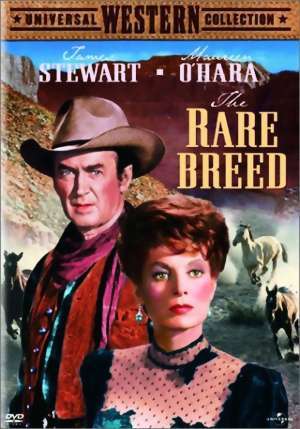
The Rare Breed
A few months back I reviewed a western from director Burt Kennedy named 'Young Billy Young' starring Robert Mitchum. Kennedy made a career of straight-laced, been there and done that movies that still managed to be entertaining. Another director from the 1960s, Andrew V. McLaglen, could have been separated at birth from Kennedy.Comparing the two directors' filmographies, McLaglen comes out on top with a deeper selection of worthwhile movies. Of course, that doesn't necessarily mean he was a great director. More and more, I think his success in directing was a result of a nice trio to have when making a movie. One, great casting, two, lots of action, and three, a well-written script (with some obviously better than others). But looking through McLaglen's movies, they can't all be winners, like 1966's The Rare Breed.
A long-time television director who directed almost 200 combined episodes of Gunsmoke and Have Gun Will Travel, McLaglen had finally hit the jackpot on the big screen with McClintock and Shenandoah. Both stories had their similarities, tough, family men trying to live their lives amidst a strong conflict. Most of McLaglen's movies followed a tried and true formula and were the better for it. But with his next movie, The Rare Breed, he is undone by an awful script that is about as unbalanced as they come that results in an incredibly dull finished product.
After traveling from England to the U.S. with a prize hereford bull, Martha Price (Maureen O'Hara) hopes to crossbreed her Hereford bull with the famous longhorns that roam across Texas and the west. With her daughter Hilary (Juliet Mills) along, Martha finds a buyer who pays handsomely for the animal, and then a cowboy, 'Bulldog' Sam Burnett (James Stewart) to help get the Hereford where it needs to be. Seeing a chance for some quick, easy cash, Burnett makes a deal with another rancher to "lose" the animal en route. There's another cowboy on their trail, a gun-wielding psycho, Simons (Jack Elam), who has plans of his own for the bull and the money.
Netflix only slightly recommended this late 60s western, but with the talent involved I thought it was a safe bet that I'd enjoy it. I wasn't looking for an instant classic, just a good movie. The story and the characters though are so uneven and all over the place that 'Rare Breed' never gets into any rhythm. Even at just 97 minutes, it felt incredibly long, and I found myself fast-forwarding for most of the last hour. If a movie doesn't grab you early, it probably won't later on either.
The idea of the Hereford cow moving into the west is nothing new but still presents a unique setting. The cattle drive was an integral part of the west in the 1800s and has been used many times before, handled best in Lonesome Dove and in a similar way in James Michener's Centennial. All three, including 'Rare Breed,' deal with the changing times as technology and innovations in all fields push the wild west into the history books. But this McLaglen entry never takes a stand and says anything, if anything help push the good old days out the door.
A bright spot in this dud is James Stewart who brings his character to life where it just as easily could have been a cardboard cutout of a character. Unfortunately, the rest of the cast isn't so good, and it's not necessarily their fault. O'Hara was an ideal woman to ride along with the fellas in the action/adventure genre; she was tough but endearing, hardhewn but likable, and her looks never hurt. But her Martha is dead on arrival here and not a good role at all. In the weird casting department, Brian Keith plays Bowen, a mad Scotsman living on his forted-up ranch in Texas. Typically I like Keith, especially as a character actor, but here he is every stereotype imaginable of a Scottish man. Other cast members include Ben Johnson as a crippled cowboy who is gone by the 15-minute mark, Harry Carey Jr as Elam's partner (gone by the 45 minute mark), and Perry Lopez, who you'd better look fast for in the background.
If you're going to assemble a pretty solid cast like this, give them something to do at least. Elam's villain is dispatched about 45 minutes in, and with him goes any conflict or sense of danger the story had. The second Keith's son is introduced is also the exact second you can predict the ending to the movie. It's not that this is a bad movie, it just has a lazy feel to it. The music is generic, the script plodding, and some truly awful looking greenscreen effects. Some California locations look nice, but when the filming location is the best thing about the movie you know you're in trouble.
The Rare Breed <---trailer (1966): * 1/2 /****
Subscribe to:
Posts (Atom)