The Sons of Katie Elder

The Sons of Katie Elder
"First, we reunite, then find Ma and Pa's killer...then read some reviews."
Showing posts with label Donald Crisp. Show all posts

Friday, August 7, 2015

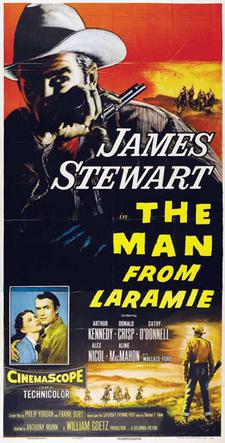
The Man From Laramie

By 1950, James Stewart had been working in Hollywood for 15-plus years, most of those years as a go-to star who audiences and critics alike liked and appreciated. In 1950 though, he starred in a western called Winchester '73, teaming with director Anthony Mann. It ended up playing a key -- if unappreciated -- role and movie as Stewart headed into the next portion of his career. From there on in, Stewart was a regular in the western genre, by my count starring in 17 westerns. Today's entry? That would be 1955's The Man from Laramie.

Having endured a long trip on the trail, Will Lockhart (Stewart) and his packed-to-the-gills freight wagons have finally arrived in the small, isolated desert town of Coronado. Lockhart sells his goods and is in no rush to get back to Laramie. Actually...he'd like to stick around. He's got some questions he would like answered about a cavalry patrol being massacred several months before by an Apache war party using repeating rifles. Where did those rifles come from? Who sold them to the Apaches? Now, Will isn't letting on to his real goal of being Coronado, but he quickly draws the ire of the local rancher, Alec Waggoman (Donald Crisp), who with his weak son, Dave (Alex Nicol), and loyal foreman, Vic (Arthur Kennedy), rule over the surrounding area. The clock is ticking on Lockhart if he wants to get his answers before he ends up six feet under with a bullet or knife in his back.

Early in his career, Stewart did star in one pretty excellent western, 1939's Destry Rides Again. Some more years under his belt, his service in World War II behind him, Stewart was a little more weathered, a little more grown up when he really dove into the western genre in the 1950's. He just looks like he belongs in the western, from the beat-up hat he wore in so many to the tall, lean look that screamed authentic cowboy. He's likable -- as always -- but as necessary, Stewart is able to call up this rage and fury as needed. That's especially important as we discover exactly what his Will Lockhart is up to in Coronado. It's an excellent performance from Jimmy Stewart all around, an actor and a man who appears quite comfortable in a genre that is and was happy to have him.

John Wayne had John Ford. Randolph Scott had Budd Boetticher. Jimmy Stewart....he had Anthony Mann. This is actually the fifth and final pairing of the actor/director combo, and it's a good one. They also paired in Winchester '73, Bend of the River, The Naked Spur, The Far Country, and this film. So many 1950's westerns were clean and polished, but there's a meanness, a darkness to these pairings. With touches of Shakespearean storylines, even some mythological storylines (greed, betrayal, lust, murder), Mann added a much-needed darkness and depth to the western. It wasn't always a cut and dry good and bad. It was tortured anti-heroes (a sign of things to come in the genre). It was realistic -- if not graphic -- violence. There are a fair share of pretty weak westerns from this decade, but when they were good? They were pretty good overall, like here, and so many Stewart/Mann, Scott/Boetticher pairings.

'Laramie' doesn't feature a huge cast or a ton of recognizable names, but the casting in general is solid because of the script with all that Shakespearean, mythology-based storylines. Crisp is excellent as the aging rancher who's desperately clinging to what he carved out of the wilderness. He's trying to keep it all together, balancing things between his whiny, weak-minded son, Dave (a sniveling Nicols), and the tougher, ruthless Vic Hansbro. Kennedy is excellent, as he usually was, without resorting too much to chewing the scenery. Cathy O'Donnell plays Barbara, Waggoman's niece and Vic's fiance, caught up in the middle of all the family drama, Aline MacMahon is a weathered, ranching rival to the Waggomans with a history with her rivals, Wallace Ford is Charley, Lockhart's quasi-partner and a tried and true wagon driver with experience to burn, and an underused Jack Elam doing what he did best as shifty, two-faced supporting villain.

This is a western with a ton to offer. It has elements of film noir storytelling, the mystery of the massacre playing out against a western backdrop. Lockhart's secret doesn't come as a huge surprise, but it works because the tension and mood is built up more with each passing scene. The final reveal in the closing scene is dealt with in almost matter of fact fashion, but getting there is a ton of fun. The score is nothing to write home about, but my goodness, the visuals from the on-location shooting in New Mexico are Stunning. What a beautiful picture, the rocky mountains and sand-swept plains and vistas filling the background with each passing scene. It is a sun-drenched western with seemingly no clouds anywhere near or around the location shooting. Story, twists and characters aside, you can just sit back and appreciate the natural beauty.

If there's a weakness, it's in the last 45 minutes or so of a 104-minute movie. As certain things are revealed, the story loses some momentum. The ending itself features some twists and betrayals and backstabbing along the way that do make it fun, but there isn't the same energy as was there in the first half. Still, it's a solid, well-made adult western from the 1950's and Jimmy Stewart is always fun to watch. Definitely worth seeking out.

The Man From Laramie (1955): ***/****

Monday, July 18, 2011

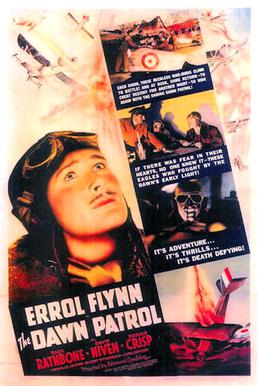
The Dawn Patrol

Just a few years after the turn of the century in 1903, the Wright Brothers were the first men to actually fly a plane -- sort of -- and over the last 100 years aviation has advanced by leaps and bounds. Think about just 10 years later though as the world was plunged into a world war. As thousands of soldiers blindly charged into enemy machine guns on the ground, planes were becoming part of war as well as pilots, fighters, and bombers all took to the skies in hopes of gaining a strategic edge on the enemy. World War I has always been vastly underrepresented in films, but there is potential for lots of good stories.

Maybe its the aviation aspect that studios assume viewers will be more interested in flying, but thankfully World War I pilots have been in several worthwhile movies. Most recently Flyboys struggled in theaters telling the story of American pilots flying with the French early in the war. George Peppard starred in The Blue Max, the story of a German infantry soldier turned national hero. One of the best though is 1938's The Dawn Patrol, an anti-war film that is both thrilling to watch and able to strike a nerve emotionally.  That's a good combination if there ever was one.

It's 1915 in France and as a leader of one of the flights in the British 59th Squadron and one of the few pilots with experience, Capt. Courtney (Errol Flynn) consistently finds himself leading rookie, inexperienced pilots on missions where they rarely return.  The war demands new pilots though and as quick as they're taught how to fly they are thrown into the fire. Courtney is constantly at odds with squadron commander Major Brand (Basil Rathbone) who realizes the idiocy of the orders he's receiving but can do nothing about it. Courtney's actions one day in destroying a rail depot actually gets Brand promoted, leaving the command post open to which Courtney is promoted. With close friend and fellow pilot, Lt. Scott (David Niven), taking over one of the flights, Courtney steps into the command position, immediately seeing that there will be no winners in this war.

I've long been aware of this movie, but just never got around to seeing it. I had a picture of gallant, heroic Errol Flynn single-handedly winning World War I from his fighter plane, dispatching hundreds of Germans at will.  Flynn does play the gallant, heroic pilot, but in terms of the rest of the movie I couldn't have been more wrong. Just a year before WWII started in a time when I think of blatant, painful propaganda movies, this is an anti-war movie screaming for someone to listen to the complete idiocy of war and armed combat. Director Edmund Goulding has a film here that doesn't pull any punches. An assembly line of pilots is sent to their deaths because the war requires it, not because it makes any sense. Someone has to fight, and these inexperienced pilots fit the bill.

The best utilization of this is when Niven's Lt. Scott sees his younger brother, Donnie (Morton Lowry), among the newest batch of replacements. Up to this point both Scott and Courtney have balked at what they're doing, but the new pilots are nameless, faceless and interchangeable individuals. Now they have a boy in front of them fresh out of flight school who with his barely 10 hours of time in a plane is expected to tangle with German aces. Niven's Scott begs, implores Courtney to ground his younger brother, giving him a few days to teach him how to survive. Courtney wants to do so, desperately wants to, but as commanding officer where can he draw the line? He can't because he would have to do this for every new pilot. It tears him up inside, sending these young men to almost certain death, but he's left no other option.

Robin Hood is Flynn's more well-known and even iconic role from 1938, but his part as Captain Courtney in The Dawn Patrol is without question the better part for him. I've always liked Flynn as an actor, but I've been critical at times because he does seem to play similar characters. It is roles like this that show he may play similar characters, but he was more than a movie star, he was an actor. Courtney is forced to go through a transformation because his duty calls for it, not because he wants to. Sending men to their death takes its toll on him, but he continues on. Flynn was just 29 years old at the time, and Niven just 28 as they filmed, both showing they were on their way to bigger and better. They have a friendship on-screen that reflects their friendship off-screen so their characters are unquestionably genuine.

With some impressive aerial footage of World War I era planes, it's impossible not to get sucked into the action.  We're watching these flimsy planes that look like a stiff wind would rip them apart as they maneuver and tear through the skies. In an age of planes that travel hundreds of miles in minutes, watching a movie like this can seem like ancient history. The best part of the movie though are the quieter moments, Scott and Courtney reminiscing before a mission that has little chance of success. It's the pilots wearily accepting their orders, hiding the disappointment and running out to their planes. It is Lt. Scott addressing his flight of the squadron, the movie beginning as it ends. There will be no victors, just survivors. These were gentleman fighting a brutish war, much of the time treating their German counterparts with respect. A great scene has Courtney drinking with a downed German pilot (Carl Esmond) just a few hours after shooting him down. There is a surreal nature to the proceedings that just couldn't be made up.

Rightfully so this is remembered as an Errol Flynn movie, and both Flynn and Niven are perfectly cast. Rathbone though is particularly memorable as Major Branch, the commander who wishes he could be up in the sky with his pilots instead of behind a desk. Donald Crisp is good in a supporting part as Phipps, the squadron adjutant while Barry Fitzgerald plays Bott, the squadron mechanic. This is a criminally underrated war movie, one that surprises in the effectiveness of its message. Well worth checking out.

The Dawn Patrol <---trailer (1938): *** 1/2 /****

Thursday, May 19, 2011

Spencer's Mountain

I have never seen an episode of The Waltons. Not one, not even one scene.  The popular TV show ran between 1972 and 1981 with 221 episodes to the show's name and seven TV movies to boot.  I'm aware of the show, know a little bit what it was about it, and at least somewhat know it's place in pop culture history. But still, I never saw a single episode.  And to tell you the truth, I don't feel like I'm missing much.

Having little to no background with one of America's favorite TV families, I was then surprised when I started watching 1963's Spencer's Mountain from director Delmer Daves. Watching the movie in two different sittings, I did some investigating in between, quickly finding out that this movie is based off a novel by Earl Hamner. The novel turned into a feature length movie and some eight years later was turned into one of TV's most beloved shows, The Waltons. So having watched 'Mountain,' I can say I don't need to look into the TV show, not because it wasn't good, but because I doubt the 1970s show can live up to its predecessor.

For over 100 years in the shadow of the Grand Tetons, the Spencer family has lived, leading a simple, hard-working life. The oldest of nine boys, Clay Spencer (Henry Fonda), works at the local mill, putting in a solid day of work and returning home to his wife, Livy (Maureen O'Hara), and their passel of nine kids. Working hard to keep things up, Clay hopes to one day build his wife a dream house on the side of the family's mountain, giving her everything he knows she deserves. But as the kids grow up, Clay wants to give each of them everything he can, starting with his oldest, Clay Boy (James MacArthur), who just graduated from high school and wants to enroll at college. But nothing comes cheap, especially for the hard-working father who now must work even hard to support his family.

Just like The Waltons would come to be during their successful run on TV, Spencer's Mountain is a little slice of Americana.  This isn't a rich family that lives life in piles of money. This isn't the dirt poor, scraping out a little niche for itself. This is a large family that isn't rich and isn't poor. Money is hard to come by, but they know that at a certain point, happiness is more important than possessions.  It's hard not to get behind this family. They do what they need to do to survive, often making sacrifices so that survival is possible. The story and the setting though is pure American, hard-working, steadfast, honest people who aren't afraid of putting their back into something.

For this little piece of growing up and living as a family in America, director Daves turns in one of the most epically sweeping movies I've ever seen.  It isn't about hundreds of extras in the background or flashy camera techniques.  Plain and simple, this is a camera showing the pure beauty that is the American west in all its glory.  Daves doesn't mess up a good thing, knowing all he has to do is set up the camera and start the film rolling. He films in Jackson Hole and Grant Teton National Park -- both in Wyoming -- and the landscape ends up being a key character. You understand Clay's motivation, his love of the land, just by seeing what he sees. This is one of those movies that needs to be seen in widescreen to appreciate what Daves filmed. I can only imagine what the movie would have looked like in 1963 on a big screen in movie theaters all over the country.

The timing is spooky, but the story from Sometimes a Great Notion is eerily similar to Spencer's Mountain. Maybe that's on account of its similar outlook on life in that hard-working, middle to lower class American family.  In a long line of great performances and characters, Henry Fonda adds another exception part as Clay Spencer, the fun-loving family man who loves everything about life, the sinning and otherwise. He embraces the good and the bad, just going along for the ride at times. Maureen O'Hara is his polar opposite, a God-fearing woman trying to raise her children right, turning her back on carousing, drinking, fighting. So in their different outlooks, they find their perfect match. Fonda and O'Hara are two of my all-time favorites, and their chemistry in all their scenes together is spot-on. I wouldn't expect anything less from two professionals like them.

I've always been a fan of James MacArthur because of his role first in Swiss Family Robinson and then later in Hawaii Five-O. It's cool to see him in a starring role here, not a supporting part, and he plays well off of Fonda and O'Hara.  He's the only one of the Spencer kids who gets more than a line or two of dialogue, his story dominating the second half of the movie in a positive way. This is Fonda, O'Hara and MacArthur's movie, but there's worthwhile supporting parts for Donald Crisp and Lillian Bronson as the Spencer grandparents, Wally Cox as Preacher Goodman, Mimsy Farmer as Claris, a teenager with her eyes set on Clay Boy, Virginia Gregg as Clay's high school teacher and biggest supporter, and Whit Bissell as Doc Campbell.

Waltons fan or not, this is just a good movie, well worth checking out.

Spencer's Mountain <---TCM trailer (1963): ***/****

Saturday, May 7, 2011

Drango

The Civil War was the bloodiest conflict in American history, but the Confederate surrender at Appomattox was far from the end of the war for much of the country. Not even accounting for the loss of life, huge portions of the South had been literally destroyed by the war. Business and industry literally had to be built from the ground up.  The Reconstruction Era followed the Civil War and lasted all the way into the late 1870s as America healed from the wounds of the war.

As few Civil War movies as there are (good ones at least), I can think of very few movies dealing with the Reconstruction, and that's part of what drew me to 1957's Drango. I will admit that at first I thought I had stumbled onto some weird American hybrid and a predecessor to the 1966 spaghetti western Django, but I was sorely mistaken.  During the war, North fought South in an attempt to regain control in the country, the North trying to free the slaves and the South fighting for states' rights (in a very simplified explanation of the war). But once the North had won, it was up to the U.S. government to rebuild because if the country hoped to move on, something had to be done to help the war-torn southern states.

Just months removed from the Confederate surrender and the end of the Civil War, two Union officers, Major Clint Drango (Jeff Chandler) and Capt. Marc Banning (John Lupton), ride into the town of Kennessaw Pass in Georgia. Drango has been tasked with starting the rebuilding process but immediately sees that the townspeople want nothing to do with him or his efforts, holding a deep hatred and resentment for what Union forces did just a year before in General Sherman's infamous march to the sea. Dealing with some inner demons, Drango goes to work, trying to go about the rebuilding the right way, by winning over the people instead of forcing them to do something.  His plan takes time, but it starts to show signs of working, only to see the groundwork torn apart by a Confederate officer, Clay Allen (Ronald Howard), who hopes to start the war all over again, resorting to terror tactics.

While few parts of the country went untouched during the war years between 1861 and 1865, few regions were as heavily impacted as the state of Georgia.  Trying to destroy Confederate infrastructure, General William Tecumseh Sherman basically unleashed his army through Georgia, burning, looting and destroying an entire state.  His March to the Sea is infamous in its brutal effectiveness and efficiency. In a historical context, it was necessary if brutal. Seeing the aftermath though, even in a movie made almost 100 years later, is startling, and we're just seeing one small Georgia town.  Crops burned, stores stolen, houses, churches and businesses burned to the ground.  It's easily understandable to see why these Southerners hold such a bubbling resentment of any help from Union officers.  Any complaints about the movie aside, that's Drango at its best.

Dying at the young age of 42 from blood poisoning following a back surgery, Jeff Chandler never became the star he could have.  In a 15-year span though, he was able to make over 40 movies, most of them B-movies and not major studio productions. But as was the case here with Drango, he delivers a moving performance that shows he was capable of the bigger, flashier roles.  His Clint Drango was part of Sherman's army, destroying as much of Georgia as possible, so he wants to right at least one wrong. He bonds with Joanne Dru's Kate, the daughter of a Union sympathizer who also deals with the glares, looks and judgments of the townspeople. He knows the job laid out for him is extremely difficult, but he intends to follow through, no matter how long it takes.

Portraying a post Civil War very bitter south is a trick subject here, especially with a movie that's only 92-minutes long.  For my liking, the townspeople's sentiment bounces around too much.  They're incredibly fickle, swaying and changing with every fresh wind coming down the road.  First, they hate Drango, then love him when they see his intentions are true, and then hate him again.  Maybe a longer, more developed movie could have covered these changes more effectively, but we're left with this shorter version.  It is frustrating also to see a people so full of hate they won't accept the helping hand being offered them.  Instead of moving on and putting their hate behind them, they're basically willing to wither away and die before admitting they need help. True to history? Maybe, but frustrating still.

In the opening credits, I was briefly under the impression that I was about to watch a 9-hour movie judging by the cast listing which was spread out over four or five pages of very small print.  After Chandler and Dru, the acting ranges from hammy and bad to moving and emotional.  Howard is a superb villain, charming and conniving all rolled up into one.  Donald Crisp is Judge Allen, the town patriarch blinded by his feelings who starts to see the error of his ways. The beautiful Julie London plays Shelby Ransom, Clay's girlfriend who questions what he's up to. Lupton isn't around enough to make much of an impression as Banning, but that's not his fault. Some of the townspeople include Parley Baer, Walter Sande, and Barney Phillips.

An interesting little picture covering a time in American history that is often overshadowed by the events that preceded it, and the events that would follow.  If you can find a copy, definitely a movie worth watching.

Drango (1957): ***/****

Friday, September 10, 2010

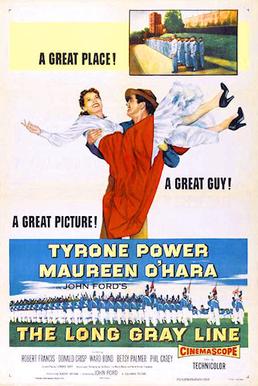
The Long Gray Line

Through all his films, a common, somewhat unexpected link bonds the movies of director John Ford.  It's not cowboys vs. Indians or John Wayne, Henry Fonda or Richard Widmark, but a sense of family and the importance of staying close to those you're related to. One of 11 children from an Irish family, Ford's beliefs filtered into his movies.  The stories, the settings, the characters, the famous John Ford stock company of supporting actors and actresses, Ford for all his aggression and belligerence was a family man.

When comparing his movies, it's easy to overlook his non-westerns.  When in front of a Congressional hearing, Ford even introduced himself saying "I'm John Ford, I make westerns."  But over a career that spanned decades and over 100 movies, it's unfair to just say he was a good director of westerns.  He was a good director for all his faults and tendencies that can drive me nuts at times.  Maybe the best example of a Ford movie -- non-western -- is 1955's The Long Gray Line, a departure from the expected Ford movie but still similar in many ways. 

An Irish immigrant fresh off the boat in New York, young Martin Maher (Tyrone Power) travels to the United States Military Academy at West Point in upstate New York. He enlists in the army and right away begins helping the cadets, some just as a mentor, others as an instructor in classes.  Marty can be a bit of a klutz, a bit of a doof at times, but when the chips are down, he's a good friend and a better man.  The years go by, and Marty continues to reenlist while also marrying Mary O'Donnell (Maureen O'Hara), a pretty redhead from Ireland. They send for Marty's family from Ireland (father Donald Crisp, brother Sean McClory) and life continues, the whole family together again.  And so the years go by, West Point unchanging as the world changes around it in the first half of the 20th Century.

When Ford gets it right, he typically hits a home run, and this qualifies in many ways.  One review described it as a "very Irish" movie.  And somehow that description is dead on more than just the main characters being Irish.  It's about family and sticking together through thick and thin.  More than that, it's the extended family you make in your life.  All those things that drive me up the wall are here, but whether he realized it or not, Ford reins it all in.  It never gets to be too much.  The story is downright sappy at  times, but I don't think Ford ever intended to do anything but that.  For the most part, it hits all the right notes, happy, sad and everything in between.

This was never an intentional slight, but this was the first Tyrone Power movie I'd ever seen from beginning to end.  I never had a negative idea of Power as an actor, but I guess it's fair to say it wasn't particularly positive either.  Above all else, Power's performance here as Sgt. Martin Maher is the reason to check this one out.  Marty is one of the most likable characters ever, willing to help whatever and whoever needs his help.  We see this over the years the impression he makes on his cadets who end up looking at him as a father figure, or at least a big brother looking out for their best interests.  Power gives Marty some funny bits, nails the emotional scenes, and handles an Irish accent that if handled poorly could have derailed the part.  A great performance to lead the movie.

Mentioned earlier, Ford's stock company of actors was a long list of actors/actresses the director worked with on repeated times.  If you've seen more than one Ford movie, you've no doubt seen these faces whether you knew it or not.  'Gray Line' is full of these folks, starting with O'Hara in a perfectly cast part as Marty's tough-minded wife Mary, an ideal match for the equally strong-willed and tough-minded Marty.  Crisp isn't in the movie for long but certainly makes quite an impression as Marty's old school Pops.  My favorite of the stock company has always been Ward Bond, and he doesn't disappoint as Major Keeler, Marty's commanding officer. Also look for Ford regulars Harry Carey Jr. and Patrick Wayne along with Robert Francis, Peter Graves, Philip Carey and William Leslie filling out some meatier supporting parts.

Only one complaint here, and I'll keep it brief.  A story that covers 50-plus years in 140 minutes can't help but feel a little episodic, a little disjointed.  Characters go in and out at will, no explanations offered, but the link through all the slower moving segments is Power as Martin Maher.  Throw the performances in with some great on-location shooting at West Point that help sell the tradition and honor of the academy, and you've got a winner if not quite a classic.

The Long Gray Line <---trailer (1955): ***/****

Wednesday, February 3, 2010

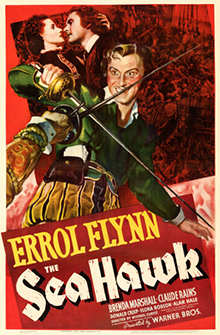
The Sea Hawk

A couple weeks ago I reviewed 1936's Charge of the Light Brigade and as I thought about it since realized I was probably more than a little harsh on star Errol Flynn. I wrote that "he probably didn't act a day in his life" because he seems to always play the ultra-suave, extremely cool hero that saves the day and gets the girl. It came off as more critical than I intended because one of my other favorites, John Wayne, made a career out of playing the same basic character repeatedly. Should we hold it against somebody because they found their niche and ran with it?

It's hard to be critical of Flynn as a movie star because for the most part his movies are so damn entertaining, straight popcorn flicks. But looking at the 1930s and 1940s, he is clearly one of Hollywood's biggest stars. Just look at the movies he made over a 10-year period. He made more classics or near-classics that many actors/actresses make in a career. And as I wrote, just about all those movies has him as a swash-buckling rogue of one sort or another (settings vary) who always ends up on top with a girl on his arm, like 1940's The Sea Hawk.

Flynn plays Geoffrey Thorpe, an English privateer in the late 1500s working for Queen Elizabeth as one of many 'sea hawks.' These English privateers -- or pirates to their enemies -- harass rival countries' ships and keep England flowing in money, gold and treasure. Thorpe's 'Albatross' one day attacks a Spanish galley brimming with treasure and two key passengers onboard, the new Spanish ambassador traveling to England, Don Jose Alvarez (Claude Rains) and his niece Dona Maria (Brenda Marshall). Thorpe delivers his prized catch to Queen Elizabeth (a great performance for Flora Robson) who promptly ignores Alvarez's demands he be put in chains.

Queen Elizabeth has bigger plans for Thorpe and the Albatross. Rumors are swirling that Spain's King Philip is assembling the powerful Spanish Armada with hopes of conquering England. Elizabeth does not have a navy to protect her country -- other than the Sea Hawks -- and no money with which to build a navy. She sends Thorpe on a dangerous mission to Central America; attack the gold convoy coming out of the Spanish mines at Vera Cruz and bring it back so she can assemble a navy in time. Off Thorpe goes, leaving Dona Maria behind. But the plan won't be so easy as Alvarez and the treacherous Wolfingham (Henry Daniell) are at work to make sure the plan fails.

Typecast as a swashbuckler early in his career, it's only fitting that Flynn was in fact very good at fencing having been trained in the art. The training obviously shows because in several of his movies, including The Sea Hawk, Flynn engages in several exciting, intricate-looking sword fights. At one point, Thorpe even takes on four English guards at once in the shadowy court of Queen Elizabeth. It is something so little that as an audience we take for granted sometimes with CGI and stunt doubles, but Flynn handling his own stunts helps make the movie more realistic and for me, much more enjoyable. It's cool to see one of Hollywood's biggest stars at the time going toe to toe like that.

The film opens with a bang as Thorpe's Albatross overwhelms Alvarez's Spanish galley, watch it HERE, with a pretty cool introduction for Flynn as we've heard about his character for most of 10 or 15 minutes. The action sequence does continue into Part 3 for those wanting to continue on. The attack is a great scene in itself, both epically grand as two huge ships duke it out and then on a smaller scale as the two crews engage in hand-to-hand combat to save their ships. The resolution to the fight is particularly unique as how to stop a conflict like that.

Playing Captain Geoffrey Thorpe, Flynn is at his coolest, a driven, patriotic man fighting for queen and country, and of course, the girl. Marshall made 20 movies in a short time and then left show business, and as she shows here as Dona Maria, she's not the greatest actress around but she has some potential. Rains is a worthy villain as always, and Donald Crisp makes the most of a smaller part as Sir John, one of Elizabeth's loyal court members. Often pairing with Flynn as a sidekick, the loyal right hand man, Alan Hale plays Mr. Pitt, the burly, brawling sailor. Robson is actually playing Queen Elizabeth for a second time and almost steals the movie away from Flynn and her co-stars as the outspoken ruler of England.

A movie that's a lot of fun with plenty of action, over-the-top dialogue and some cheesy romance. It's not my favorite Errol Flynn movie, but the swashbuckling actor was never one to disappoint with his action and adventure movies.

The Sea Hawk <----trailer (1940): ***/****

Saturday, September 19, 2009

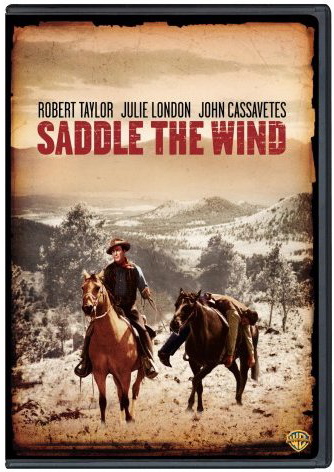
Saddle the Wind

With my review a couple weeks back of Duel in the Sun, I pointed out how much certain westerns seem related to many Greek tragedies. When you think about it, it's pretty easy to turn one into the other. As families spread across the U.S. in the 1800s, just about everybody had problems/conflicts that could only be resolved amongst the members of the family. Before westerns got too cynical in the 1960s, many American westerns used the Greek tragedy formula, including 1958's Saddle the Wind.

The key to pulling off that transformation from Greek tragedy to the wild west is in the relationships. 'Saddle' has this in a quasi-love triangle between two brothers who own a ranch in a mountain valley and the saloon girl one of the brothers brings home to be his wife. It's the type of story that if you can't predict how it ends, you definitely have not seen enough movies or read enough books. Director Robert Parrish and writer Rod Serling of The Twilight Zone do just enough with the story though to make it different, including a twist on the ending you can see coming a mile off.

In a lush, green mountain valley, two ranch owners live peacefully, Dennis Deneen (Donald Crisp), a grizzled old rancher who has come to despise violence and everything it brings, and Steve Sinclair (Robert Taylor), a reformed gunfighter trying to move on from his checkered, bloody past. Coming back from selling part of their herd, Steve's younger brother Tony (John Cassavetes) returns home with a fiance in tow, a saloon girl, Joan Blake (Julie London) who supposedly sees a better life than she's used to. Tony has also purchased a new pistol with a hair-trigger to boot.

Everything seems fine at the Sinclair's Double S ranch but in the span of a few days, two people arrive in town, both causing trouble in their own way. There's Larry Venables (Charles McGraw), a gunslinger as fast as Steve's ever seen gunning for the older Sinclair, and Clay Ellison (Royal Dano), a former Union soldier who says part of the valley rightfully belongs to him. Steve is forced to deal not only with these two problems, but also from Deneen and then his hot-tempered younger brother.

The family conflict comes across as authentic with a nice dynamic between Taylor and Cassavetes. Steve grew up caring for his younger brother, who in the process started to idolize his gunfighting older brother and now that he's full grown, he intends to be just as fast with a six-gun as Steve. Tony's intentions are good, he just wants to protect his brother (who doesn't wear a gun now), but caught up in the moment, a new side of him is revealed. Thrown into the mix is London's saloon girl who quickly sees maybe she didn't make a wise decision siding with fiery Tony.

Except for his lead role in Bataan, I've never been a huge fan of Taylor. He comes across as too wooden sometimes, but his role as Steve is the best I've seen yet. The reformed gunslinger is nothing new in a western, but Taylor brings humanity to the part as a man who genuinely regrets his past actions. As for Tony, who better to play hot-tempered, quick on the trigger brother than Cassavetes? Bordering on the obsessed with his drive, Cassavetes is the anger to Taylor's calm. London plays a strong woman, too often left behind in westerns, and even gets to serenade Cassavetes in an awkward, out of place scene.

There aren't any true villains here, but McGraw and Dano at least provide the lighter fluid for this fire. Gravelly voiced McGraw is intimidating and gruff as the new gunslinger in town and Dano as the beaten-down farmer looking to make something for his family provide strong support. Crisp makes the most of his part as the stodgy old ranch owner while recognizable character actors Richard Erdman, Ray Teal, and Douglas Spencer round out the supporting cast.

As is the case with the more story-oriented westerns, the action/gunplay is left by the wayside for most of the movie. Two gunfights are high on tension, but they're over in the blink of an eye, and the final shootout isn't much of a shootout at all. This isn't a complaint, I just felt the need to point it out so anyone watching the movie isn't expecting 100 minutes of western shootouts. It's a well-told story though with believable characters and good performances from Taylor, Cassavetes, and London. I couldn't find a trailer, but here's two scenes from later in the movie with semi-SPOILERS, one and two.

Saddle the Wind (1958): ***/****