The Sons of Katie Elder

The Sons of Katie Elder
"First, we reunite, then find Ma and Pa's killer...then read some reviews."
Showing posts with label John Cassavetes. Show all posts

Wednesday, December 3, 2014

The Fury

As I've brought up in several reviews before, I'm not a huge horror fan. Basically, I don't like being scared. Yeah, yeah, laugh at the scaredy cat! I usually need something to pull me into a horror movie, like an especially unique premise or as the case with 1978's The Fury, some cool casting you might not associate with the genre.

A former CIA agent, Peter Sandza (Kirk Douglas) is in the Middle East with his son, Robin (Andrew Stevens), getting ready to move back to the U.S. so Robin can go to college in the states. Well, that's the plan. Robin is kidnapped by a secret government agency with Pete's old friend and colleague, Ben Childress (John Cassavetes), leading the effort. What's behind the kidnapping? Robin seems to have some hidden powers and abilities; telekinetic powers that he doesn't have a full grasp of. Childress and the agency try to kill Peter, but he manages to escape. Now he's hiding out and trying to find out what happened to Robin and where he's been dragged off to. The key may be a high school student in Chicago, Gillian (Amy Irving), who has similar abilities to Robin and is slowly learning how to handle and manipulate them. If only all the pieces can fit together.

This isn't an out-and-out horror movie to be fair. From director Brian De Palma, 'Fury' is more of a supernatural horror flick. De Palma was coming off the mega-success of 1976's Carrie and takes the next natural step. It's not just about telekinetic creepy kids, but the government's involvement with said kids! Yeah! Reading about the story and the cast, I was psyched to give this one a shot, but in the end, I felt like the premise ends up being far better than the finished product. It's a long movie at 118 minutes and struggles with pacing and rhythm. At times, it's over the top to the point I thought it was kinda spoof-like. An uneven final product, lots of characters, some potential, but ultimately one quasi-horror flick that I won't be revisiting anytime soon.

The biggest pull 'Fury' had on me was the casting, a pairing of Kirk Douglas and John Cassavetes. Douglas was in a lull in his career, the late 1970s and 1980s providing some real stinkers for the Hollywood legend. It's a cool part, if an underwritten one, as Douglas' Pete has all sorts of espionage experience that he tries to utilize to get back his son. At 62 years old here, Douglas isn't the prototypical action hero, but he more than holds his own in the chase scenes early in the movie. I grew up watching Cassavetes in The Dirty Dozen and little else so it's always cool seeing him pop up in a cast listing. He's calm, cool and impeccably sinister as Childress, head agent on this mission to acquire all sorts of telekinetic kids. Like so much else, I wish there was more backstory with Childress and this secret agency. What's the end game? What will these kids be used for? How much backing do they actually have or is this a bit of a roguish renegade? 

I thought then I was getting one movie from the plot synopsis and ended up getting another. 'Fury' isn't just a movie about old friends turned deadly rivals. It's two stories, the Douglas/Cassavetes story moving along with a separate angle of young Gillian exploring her own powers (however scary and violent they may be). Irving does a really good job as a teenager struggling to come to terms with it all, Carrie Snodgress, Charles Durning, Fiona Lewis, and Carol Eve Rossen playing assorted doctors, physicians and assistants associated with the Paragon Institute, an organization "working" with talented kids. This felt like it could (and should) have been its own movie but no such luck. We get the two different stories that will eventually cross paths in the third act, but the pacing is rough getting there and there were several points I considered completely bailing. Things get a little goofy and a tad bit stupid in the finale with an especially graphic final scene. Some shock value from the director of Carrie? Who would have thought of that?

Now, yes, not a horror fan, but I am a sucker for certain things. High on that list? Any movie filmed in Chicago or even remotely close to the city. 'Fury' films a lot in and around Chicago, including some familiar locations for any fans of 1980's The Blues Brothers. We see everything from Lincoln Park to North Avenue Beach, Water Tower Place to Lower Wacker Drive, even the Old Chicago Shopping Mall and Amusement Park. If the story is a little dull at times, the filming locations in the background certainly help inject some life into things.

A mixed bag, but one I can't really recommend. And that's considering Spartacus, Franco and Chicago play key parts in it!

The Fury (1978): **/****

Monday, May 28, 2012

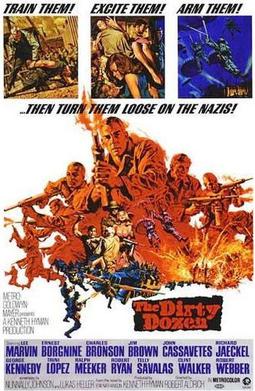
The Dirty Dozen

One of the all-time great tough guy casts -- if not the greatest -- in one of my favorite genres. A movie that stands the test of time that is action-packed, darkly funny and amazingly entertaining. It has taken abuse over the years by some because of its shocking ending, but it also has built up a diehard following by those who will defend it to the last (including me). One of my favorite movies ever, and a Memorial Day themed review, 1967's The Dirty Dozen.

An American army officer with a record a mile long, Major John Reisman (Lee Marvin) has been given a mission that even he doesn't believe is real. It's late spring 1944, and as the Allies prepare for the D-Day invasion, the Allied high command (including Ernest Borgnine) delivers his impossible, suicidal mission. Reisman is to take 12 prisoners either sentenced to death or years of imprisonment and hard labor, train them, and then in the days before the D-Day landing, drop them into German-occupied France. Their mission? Attack a German chateau, killing as many high ranking German officers as possible, hopefully wreaking havoc on the high command. Can Reisman get the prisoners to work together before they kill him?

This is a movie that is a perfect storm of timing, casting and story. A story of 12 convicted criminals -- rape, murder, robbery -- turned commandos who resent any sort of authority given a mission to kill enemy officers in cold blood? Could that story even remotely fly in any time other than late 1960s America? It was a time when America was changing, a darker, more cynical time in our history. Director Robert Aldrich taps into something special there. 'Dozen' has a unique look to it, interesting camera angles, a catchy theme for the Dozen -- listen HERE -- and a general feel of giving the middle finger to any sort of power or authority figure. Could there be a more perfect movie for a 1967 audience?

I could write a whole review discussing the characters and the long list of tough guy actors who play them, but I doubt many people would read 10,000 rambling words about how the cast of The Dirty Dozen is the coolest thing ever. Let's start with Lee Marvin, an all-around bad-ass who by the mid 1960s had become a major, bankable star. His Major Reisman, a sarcastic, quick-witted, smart-mouthed and brutally effective officer, is probably his most well known role, and he owns this movie. With the cast behind and around him, that's saying something. Marvin delivers brutally funny one-liners left and right, handles the action scenes flawlessly, and is believable as the cynical leader of this group of crook commandos. With those type of men behind him, you need someone like him to lead. Richard Jaeckel is a scene-stealer as Sgt. Bowren, the MP assigned to work with Reisman in training and execution of the mission. Along with Borgnine, the High Command and other Allied officers include Robert Webber, George Kennedy and Ralph Meeker. Oh, and Robert Ryan as a stiff-collared officer from the 101st. Enough for you? No?

And then there's the Dirty Dozen. The group includes Charles Bronson as Wladislaw, the former officer sentenced to hang for killing one of his own men, a medic carrying medical supplies away from battle. There's former NFL star Jim Brown as Jefferson, an African American soldier who killed in self defense but is sentenced to hang nonetheless. John Cassavetes was nominated for a Best Supporting Actor Oscar as Franko, a Chicago hood who killed a London man for $10 worth of cash. Telly Savalas is Maggot, a psychopathic Southerner convinced God works through him. Clint Walker is Posey, an Apache with rage issues, Donald Sutherland is Pinkley, a dimwitted soldier, and singer Trini Lopez plays Jiminez. Rounding out the Dozen are character actors Tom Busby, Ben Carruthers, Stuart Cooper, Colin Maitland, and Al Mancini as Bravos, the smallest of the bunch but with a mean/funny streak. The focus is Bronson, Brown, Cassavetes, Walker, Savalas and Sutherland, none of them disappointing, all of them living up to the hype, all given a chance to shine.  

What has helped 'Dozen' gain its cult-like following over the years is its humor in looking at and poking some fun at war in general. Sutherland's dimwitted Pinkley is forced to inspect a crack platoon of Ryan's Col. Breed in one of the most memorable, truly funny scenes. Watch it HERE. Reisman later arranges for eight London prostitutes to visit the Dozen as their training winds down. The facial expressions exchanged back and forth are priceless. The high point comically -- however dark it is -- comes in the War Games sequence, the Dozen forced to prove their worth by capturing Col. Breed's headquarters. They resort to cheating, con jobs, stealing, and all sorts of trickery. After the extended training sequence -- which has its fair share of funny moments -- the War Games development and the eventual payoff provides some great laughs.

The portion of the movie though that tends to drive people away is the attack on the chateau. SPOILERS AHEAD SPOILERS STOP READING Here's the plan, courtesy of Reisman, which you can watch HERE. It of course, doesn't go as planned, Reisman, Bowren and the Dozen forced to improvise. Their solution is simple; throw grenades and gasoline down air chutes and burn (think napalm) the German officers to death. Heroic? No, I would say not. It's a movie though. These guys aren't portrayed as heroes. These are prototypical 1960s anti-heroes! What does work? The entire finale sequence (around 45 minutes long) is dripping with tension, and once the adrenaline starts pumping, it doesn't stop. The Dozen start to get picked off -- including two legitimate shockers -- as the bullets start flying. I've seen this movie 50 times and still root for two characters especially to make it, knowing all the while they won't. The means are brutal, but as far as an entertaining action sequence goes, it is one of the best.

I'm not sure what this says about me, but I grew up watching this movie a lot. Introduced to it via Memorial Day war movie marathons, it will be always be one of my favorites. I love its cynical, dark look at war. I love the ridiculously strong cast from top to bottom. It is funny, entertaining, action-packed, and a true example of 'They don't make them like that anymore.' A classic.

The Dirty Dozen <---trailer (1967): ****/****

Thursday, August 11, 2011

Two-Minute Warning

When I think of movies from the 1970s, one genre rises above the rest...the disaster movie. Put an all-star cast together with a possibly world-ending catastrophe, and you've got a winner on your hands. Well, sort of. Most of these movies are pretty bad, the appeal coming from guessing which huge Hollywood star is going to die gruesomely in some horrific way.  Hint: It's almost always the aging star sacrificing themselves for the lives of a younger person. The disaster movie opened the door for all sorts of movies with all star casts, not necessarily just at the end of the world.

Take 1976's Two-Minute Warning as an example. The caliber of names is certainly impressive, but more on that later. The premise is disaster-like, but it's more of the man-made variety.  In fact, the movie and its premise -- a sniper setting up shop at a sporting event and opening fire -- was so controversial that it has been almost entirely buried over the last 30-plus years.  To air it on TV, an additional 30 minutes were added to make the lone sniper a diversionary tactic for a heist in Los Angeles, supposedly lessening the blow and the impact of what's going on.  The original theatrical version is a mixed bag overall though with a dull first hour, great middle half hour, and a finale and ending that rival the most uncomfortable scenes you'll ever watch.

Hosting a championship football game (supposedly between L.A. and Baltimore?), the L.A. Coliseum has opened its doors to some 90,000 fans who have turned out to see the contest. VIPs including politicians both locally and nationally have come out for the job, making Captain Peter Holly's (Charlton Heston) job that much more difficult maintaining security. Near halftime though, one of the countless cameras around the stadium spot a man with a rifle in the tower over the main entrance, a location that is impossible to get to without being detected. The high-powered automatic rifle will have free reign over the stadium, and no is seemingly safe. A SWAT team headed by Sgt. Button (John Cassavetes) is called in to handle the situation with Holly, but can they get the job done before the lone sniper opens fire on the thousands of targets in front of him?  

This is a difficult movie to review, and I try to only use that complaint every month or so.  It isn't so much a movie as a faux-documentary from director Larry Peerce, giving you the feeling of being a fly on the wall as this high-tension situation continues to escalate. Peerce's movie follows a handful of characters pre-game and as the game develops, giving us just enough info about them to get interested in them (hopefully that is, the attempt is hit or miss). Much of the movie was shot during the NFL season in 1975, also prominently featuring a Pac-10 game between USC and Stanford.  The problem is that much of the story shows a quick scene with the cast then cuts quickly to the football game and then the police and SWAT efforts to handle the sniper. With that filming technique, the first 45-60 minutes have a disjointed feel that makes it difficult to actually get into any rhythm with the movie and keep up with it.

Thankfully the movie finds the right gear at about the hour mark once Cassavetes' SWAT team arrives on the scene, the anxiety and tension building as the game nears its close.  SPOILERS STOP READING SPOILERS Despite the best efforts of the police and SWAT, the sniper does open fire, causing mass chaos as people start dropping dead all over the Coliseum, the deaths portrayed graphically and brutally.  Pieces start to click together as to why the all-star cast is there....as targets and little else.  Seeing movie stars shot aside, the finale as the sniper opens fire is one of the most troubling, uncomfortable extended scenes I've ever watched. Imagine 90,000 freaked out people all scrambling to stay alive, not quite sure what's going on.  People are trampled and thrown, pushed aside like rag dolls as survival takes over above all else. The second hour most definitely makes up for the struggles of the first hour, a truly memorable ending.

Let's talk celebrities here for a bit, typically a trademark of the disaster movie.  The description of the movie didn't do it justice, making it seem like Heston and Cassavetes worked closely together to stop the sniper.  Well, sort of, but not really.  Heston was in quite a few disaster movies so while it isn't a great part for him, he still brings his typical professionalism to the part. The same goes for Cassavetes, always intense and always very watchable.  Who else? Lots more. Martin Balsam plays McKeever, the Coliseum event coordinator, Beau Bridges as a father who brought his wife and two kids to the game, David Janssen and Gena Rowlands as a bickering couple going through a bitter fight, Jack Klugman as a gambler who needs his bet to stand or he'll be murdered by his bookie, Mitch Ryan as the priest sitting alongside him, Brock Peters as a Coliseum employee, and Walter Pidgeon as an aging pickpocket working the crowd.

More than the cast, the uncomfortable premise is the star here. All it takes is one lunatic to decide to do this, not some huge, elaborate plan that takes terrorists years to plan. It is a reasonably easy thing to do, and anyone who has been to a sporting event can appreciate the terror in the situation. The sniper doesn't care who he hits, just that he hits something. There's so much going on here that just wouldn't work now in 2011.  Can you imagine any stadium -- much less the well-known Coliseum -- opening its doors to a movie depicting mass murder?  I'd say N-O.  The movie works at its best in those moments, a feeling of realism, of pure terror and fear racking your body.

The story builds and builds, and thankfully the ending knows how far to push it.  The sniper is never actually shown in close-up (we see glimpses of him, get a vague sense of what he looks like), and maybe most appropriate...his motivations or reasons are never given. He's a nut, going on a suicide mission that will have only one ending; his death.  Cassavetes' SWAT leader delivers a cynical but ultimately honest brief of how the incident will be portrayed, appropriate for a late 1970s movie. The ending doesn't go for the jugular, just focusing on the emotion, Balsam's McKeever sitting in the empty stadium in the aftermath, wondering exactly what happened. The first hour is bad, but the second hour is that good to counter. Stick with this one.

Two-Minute Warning <---trailer (1976): ***/****

Saturday, September 19, 2009

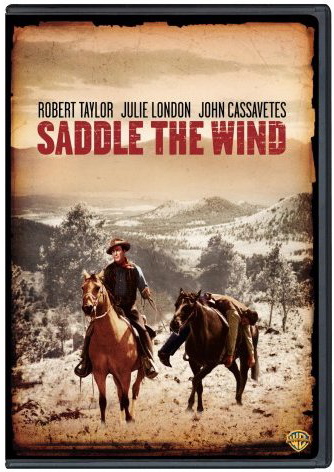
Saddle the Wind

With my review a couple weeks back of Duel in the Sun, I pointed out how much certain westerns seem related to many Greek tragedies. When you think about it, it's pretty easy to turn one into the other. As families spread across the U.S. in the 1800s, just about everybody had problems/conflicts that could only be resolved amongst the members of the family. Before westerns got too cynical in the 1960s, many American westerns used the Greek tragedy formula, including 1958's Saddle the Wind.

The key to pulling off that transformation from Greek tragedy to the wild west is in the relationships. 'Saddle' has this in a quasi-love triangle between two brothers who own a ranch in a mountain valley and the saloon girl one of the brothers brings home to be his wife. It's the type of story that if you can't predict how it ends, you definitely have not seen enough movies or read enough books. Director Robert Parrish and writer Rod Serling of The Twilight Zone do just enough with the story though to make it different, including a twist on the ending you can see coming a mile off.

In a lush, green mountain valley, two ranch owners live peacefully, Dennis Deneen (Donald Crisp), a grizzled old rancher who has come to despise violence and everything it brings, and Steve Sinclair (Robert Taylor), a reformed gunfighter trying to move on from his checkered, bloody past. Coming back from selling part of their herd, Steve's younger brother Tony (John Cassavetes) returns home with a fiance in tow, a saloon girl, Joan Blake (Julie London) who supposedly sees a better life than she's used to. Tony has also purchased a new pistol with a hair-trigger to boot.

Everything seems fine at the Sinclair's Double S ranch but in the span of a few days, two people arrive in town, both causing trouble in their own way. There's Larry Venables (Charles McGraw), a gunslinger as fast as Steve's ever seen gunning for the older Sinclair, and Clay Ellison (Royal Dano), a former Union soldier who says part of the valley rightfully belongs to him. Steve is forced to deal not only with these two problems, but also from Deneen and then his hot-tempered younger brother.

The family conflict comes across as authentic with a nice dynamic between Taylor and Cassavetes. Steve grew up caring for his younger brother, who in the process started to idolize his gunfighting older brother and now that he's full grown, he intends to be just as fast with a six-gun as Steve. Tony's intentions are good, he just wants to protect his brother (who doesn't wear a gun now), but caught up in the moment, a new side of him is revealed. Thrown into the mix is London's saloon girl who quickly sees maybe she didn't make a wise decision siding with fiery Tony.

Except for his lead role in Bataan, I've never been a huge fan of Taylor. He comes across as too wooden sometimes, but his role as Steve is the best I've seen yet. The reformed gunslinger is nothing new in a western, but Taylor brings humanity to the part as a man who genuinely regrets his past actions. As for Tony, who better to play hot-tempered, quick on the trigger brother than Cassavetes? Bordering on the obsessed with his drive, Cassavetes is the anger to Taylor's calm. London plays a strong woman, too often left behind in westerns, and even gets to serenade Cassavetes in an awkward, out of place scene.

There aren't any true villains here, but McGraw and Dano at least provide the lighter fluid for this fire. Gravelly voiced McGraw is intimidating and gruff as the new gunslinger in town and Dano as the beaten-down farmer looking to make something for his family provide strong support. Crisp makes the most of his part as the stodgy old ranch owner while recognizable character actors Richard Erdman, Ray Teal, and Douglas Spencer round out the supporting cast.

As is the case with the more story-oriented westerns, the action/gunplay is left by the wayside for most of the movie. Two gunfights are high on tension, but they're over in the blink of an eye, and the final shootout isn't much of a shootout at all. This isn't a complaint, I just felt the need to point it out so anyone watching the movie isn't expecting 100 minutes of western shootouts. It's a well-told story though with believable characters and good performances from Taylor, Cassavetes, and London. I couldn't find a trailer, but here's two scenes from later in the movie with semi-SPOILERS, one and two.

Saddle the Wind (1958): ***/****

Wednesday, August 19, 2009

Edge of the City

This has been bugging me since I finished 1957's Edge of the City yesterday, and I'm having trouble with it. I can't think of a buddy movie made before 1957, but I know there has to be examples out there. Now officially they didn't become known until the late 1960s or early 1970s with movies like Butch Cassidy and the Sundance Kid, but EotC is if nothing else a quasi-buddy movie with some racial undertones, and one I can highly recommend.

Made a year before the much more well-known The Defiant Ones, Edge of the City tells the story of two men, one white and one black, who become close friends in a short time, but one of their pasts comes back to haunt them. Axel North (John Cassavetes) walks into a shipping yard in New York looking for a job. He gets a job and is put to work with Charlie Malik (Jack Warden) and his work gang but quickly rubs Charlie the wrong way. Instead, Axel bonds with Tommy Tyler (Sidney Poitier) and joins his crew in the train yards.

But it's no time before Axel's somewhat checkered past comes back to haunt him. He becomes fast friends with Tommy and his wife Lucy (Ruby Dee) and even starts to date a teacher in the neighborhood, Ellen (Kathleen Maguire), but everything starts to unravel when news of his past gets out to certain people. The problems build to a twist I did not see coming, and an ending that is probably really authentic for the situation, and therefore that much more heartbreaking. It's a testament to these actors and their ability because the ending hits so hard.

Usually playing supporting parts in TV shows, Cassavetes gets a shot here in one of his first starring roles. An intense actor in every sense of the world, he creates a 3-D, believable, sympathetic character you can't help but root for. His Axel has made mistakes in the past and is trying to hide from them. He's a shy guy and doesn't want to face those problems, whether it be talking to his parents (Robert F. Simon and Ruth White, both great in their two scenes) or addressing any sort of confrontation with coworkers, especially Warden's Charlie, a great villainous, heavy role. It's the type of role that made me question why Cassavetes didn't become a bigger star, a more well-known name, because he clearly has the ability to act with the best.

Matching Cassavetes, Poitier's Tommy Tyler is a family man, a young husband with a wife and 2 kids trying to get by. Tommy becomes a bit of a big brother to Axel, looking out for him and helping him find his way. They talk together about their pasts but are also able to just go out and have a good time, having a beer at the bowling alley. Poitier gets to have some fun with the part, Tommy being an extremely outgoing guy both at work and home. For such a well-respected actor, I still think of him as completely underrated, and this is a great part for him. The two men present a believable friendship, Youtube clip here with quasi-spoilers, that carries the movie.

Released in 1957, I can't know what kind of reaction it got from critics and audiences, but it's the type of basic story, a black man befriending a white man, that could still push peoples' buttons today in 2009. And because of that, a movie released over 50 years ago, it's refreshing to see a story like this. Not once do Tommy and/or Axel mention that they have different skin color. It's not an issue for either of them, only some around them, but give director Martin Ritt credit. He tells the story by letting the actors do what they do and not calling attention to himself.

The strategy pays off because the characters and their relationships and interactions come across as authentic. A friendship starts with one man standing up for another and goes from there. A relationship begins with an awkard introduction between Axel and Ellen and turns into something more. The movie has an authentic, almost documentary-like feel to the story. The camera's never invasive and just follows the story. Filmed in New York and New Jersey in black and white, Ritt presents a realistic portrayal of lower middle class folks, some with pasts they'd rather forget.

I'd never heard of this one before stumbling across it on TCM, and it only caught my eye because of the two stars. I was glad I did watch it, and hopefully it continues to climb into the lexicon of movie fans because it's that good. It's been released on DVD as part of the Sidney Poitier Collection, but if you don't want to buy the set keep your eye out for it on the TCM upcoming schedule.

Edge of the City <----trailer (1957): *** 1/2 /****